Theology
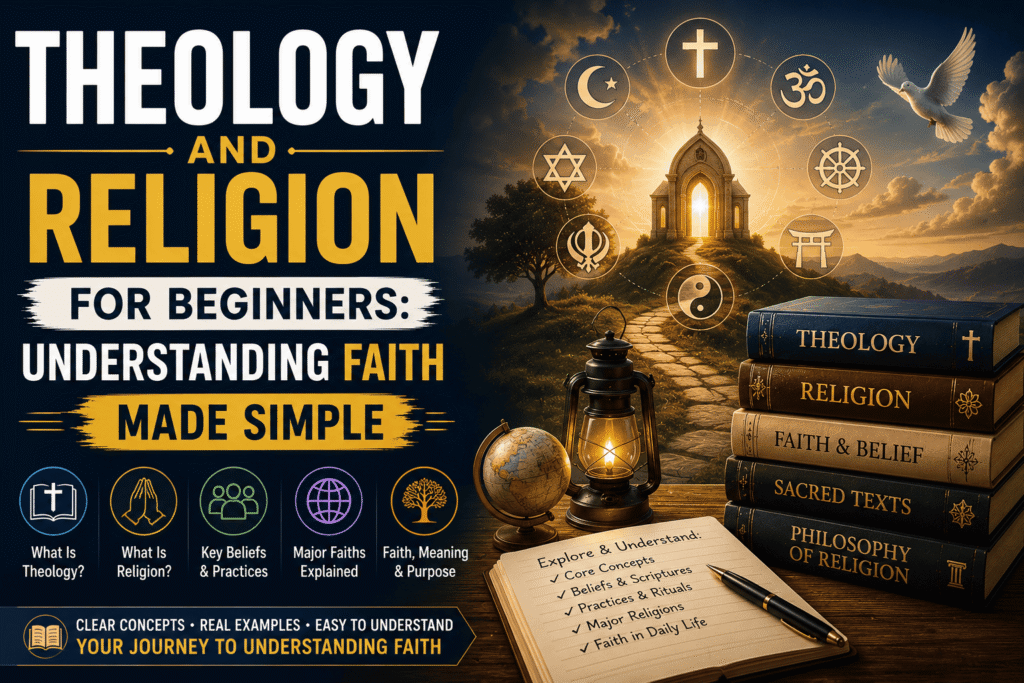
Explore Questions About the Divine, Faith, and Human Existence — Theology is the systematic study of religious beliefs, the nature of the divine, and the relationship between humanity and the sacred. It examines questions concerning God, creation, morality, suffering, revelation, and salvation by drawing on sources such as scripture, religious traditions, philosophical reasoning, and spiritual experience. Theology can be studied within many religious traditions, including Christianity, Islam, Judaism, Hinduism, and others, with each tradition offering its own perspectives on fundamental questions of faith and existence.
The field goes beyond describing religious beliefs by examining how those beliefs are understood, interpreted, and justified within particular traditions. It considers why people believe, how religious ideas influence concepts of morality and purpose, and how faith responds to questions about human existence and the nature of reality. At its core, theology explores what people believe about the divine, why those beliefs matter, and how they shape our understanding of meaning, purpose, and existence.
Content Overview
- Introduction to Theology
- Defining Theology: Study of the Divine and Sacred
- The Scope of Religious Studies: Belief, Practice, Community
- Theology and Philosophy: Areas of Overlap and Difference
- Religion as a Human Phenomenon: Cultural, Social, and Spiritual Dimensions
- Case Study: Religion as Worldview – Christianity, Islam, and Buddhism Compared
- Branches of Theology
- Core Doctrines and Attributes of God
- Omniscience and Omnipresence
- Theology and Metaphysics
- Contemporary Issues in Theology and Religion
- Science and Religion
- Historical and Spiritual Traditions
- Metaphysics and Spiritual Practice
- Future of Theology, Religion, and Spirituality
Introduction to Theology
Defining Theology: Study of the Divine and Sacred
Theology is the systematic study of the divine, the sacred, and religious beliefs. The word comes from the Greek theos (God) and logos (study, discourse). Theology examines questions such as: Who is God? What is the nature of God, and in what way does He relate to the world?
Theology is not only about abstract speculation; it seeks to understand how beliefs about God shape human life, morality, worship, and culture. It can be reflective (understanding what is believed), critical (evaluating those beliefs), or practical (applying those beliefs in everyday life). Example: In Christianity, theology explores the nature of the Trinity (Father, Son, Holy Spirit). In Islam, theology (Ilm al-Kalam) studies the oneness of God (Tawhid) and the attributes of Allah. Both traditions ask: How can we speak about God without limiting His greatness?
The Scope of Religious Studies: Belief, Practice, Community
Religious studies is the academic field that examines religions as human and cultural phenomena, including beliefs, practices, texts, rituals, and institutions.
Explanation: Whereas theology is often studied “within” a religion (by believers), religious studies takes a broader, often neutral or comparative approach. It asks questions like: Why do humans create religions? How do rituals shape identity?What function does religion serve within society? Example: A theologian might study how the Qur’an describes God’s mercy. A religious studies scholar might compare how mercy is expressed in Islam, Christianity, and Buddhism, focusing on cultural and social contexts rather than personal belief.
Theology and Philosophy: Areas of Overlap and Difference
Philosophy seeks wisdom through reason, while theology seeks understanding of divine truths often based on revelation.
Philosophy asks universal questions about existence, morality, and knowledge. Theology addresses similar questions but rooted in a specific tradition’s sacred texts and doctrines. Yet both overlap in the philosophy of religion, where reason and faith dialogue. Example: Philosophy asks: Does God exist? Theology answers from within faith: God exists, and here is how He is revealed in scripture. Philosophers like Thomas Aquinas combined both: he used reason to argue for God’s existence (philosophy) and scripture to describe God’s nature (theology).
Religion as a Human Phenomenon: Cultural, Social, and Spiritual Dimensions
Religion is a complex system of beliefs, practices, ethics, and community structures centered on what is considered sacred or ultimate reality.
Explanation: Religion is not only about doctrines but also about rituals, symbols, and communal life. It provides meaning, morality, and identity. From small tribal rituals to global faiths, religion has been central in shaping human history and societies. Example: In Hinduism, religion is expressed through rituals like puja (worship), festivals like Diwali, and philosophies like Vedanta.In many Native American traditions, religious expression often takes the form of respect for nature, oral storytelling, and shared community rituals. Both provide meaning and connect people to something greater.
Case Study: Religion as Worldview – Christianity, Islam, and Buddhism Compared
Christianity: Views reality through the lens of God’s creation, human sin, and salvation through Jesus Christ. Life is seen as a journey towards eternal communion with God.
Islam: Views reality as submission to the will of Allah, with life as a test of faith and obedience, leading to eternal reward or punishment.
Buddhism: Views reality through the Four Noble Truths, focusing on suffering (dukkha) and the path to liberation (nirvana).
Why this matters: This comparison shows how religion is both universal (answering big life questions) and diverse (different answers across traditions).
Branches of Theology
Biblical Theology
Biblical Theology is the study of God, faith, and religious truths as they are revealed within sacred scriptures (e.g., the Bible, Qur’an, Torah).
Unlike Systematic Theology (which organizes doctrines logically), Biblical Theology explores theology as it unfolds in scripture itself. It asks: How does God reveal Himself through texts? It focuses on narrative, themes, and contexts. Example: In Christianity, Biblical Theology looks at how the idea of the Messiah develops from the Old Testament (prophecies of Isaiah) to the New Testament (Jesus as fulfillment). In Islam, Qur’anic theology explores Allah’s attributes (e.g., mercy, justice) as revealed through different surahs.
Historical Theology
Historical Theology studies how religious beliefs and doctrines developed over time within the history of faith communities.
This branch traces the evolution of ideas, councils, creeds, schisms, and reformations. It examines how culture, philosophy, and politics influenced theology. Example: The Christian doctrine of the Trinity was debated for centuries. At the Council of Nicaea (325 CE), church leaders declared Jesus to be fully divine, countering Arianism (which argued He was created). This historical moment shaped theology permanently. In Islam, debates between the Mu‘tazilites (emphasizing reason) and Ash‘arites (emphasizing revelation) influenced Islamic theology for centuries.
Systematic Theology
Systematic Theology organizes religious doctrines into a coherent system. It addresses subjects such as God, the origin of the world, human nature, salvation, and the ultimate fate of existence.
Explanation: It doesn’t just follow scripture chronologically but arranges topics logically. For instance: first define who God is, then discuss creation, then human nature, then salvation. Example: In Christianity, systematic theology includes: Christology is the branch of theology that explores who Jesus Christ is and examines His nature, identity, and role in relation to humanity and God.
Pneumatology: The study of the Holy Spirit. Eschatology: Beliefs about the end times
In Islam, scholars like Al-Ghazali and Ibn Taymiyyah organized doctrines about God, prophecy, law, and the afterlife in structured theological works.
Practical Theology
Practical Theology applies religious beliefs to real-life contexts such as worship, ethics, counseling, social justice, and ministry.
Explanation: It asks: How do beliefs shape action? It bridges theory and practice, ensuring faith is lived and not just studied. Example: In Christianity: Liberation Theology in Latin America applied theology to fight poverty and injustice. In Islam: Practical theology is seen in Fiqh (Islamic Jurisprudence), applying divine law (Sharia) to daily life (e.g., prayer, charity, justice).
Summary of Branches
A Biblical theologian studies what Paul meant in Romans about justification.
A Historical theologian studies how Luther reinterpreted justification in the Reformation.
A Systematic theologian organizes the doctrine of justification logically within salvation.
A Practical theologian applies justification to pastoral counseling, teaching forgiveness and grace.
Core Doctrines and Attributes of God
Divine Simplicity: The Unity of God’s Being
Divine simplicity is the doctrine that God is not composed of parts, properties, or divisions. God’s essence and attributes are identical meaning God is His wisdom, His goodness, His power, and His existence.
For humans, we have different qualities (kindness, intelligence, strength), and they can change or grow. But in God, attributes are not separate “parts.” God’s love is His essence; His justice is His essence; they cannot be divided. This emphasizes God’s perfection and unity.
Example: St. Augustine and Thomas Aquinas taught that God is utterly simple unlike created things that are complex. In Islam, Tawhid (the oneness of God) implies a similar principle: Allah is one, without division or composition.
Eternity of God and Omnipotence: Timeless Power and Authority
God’s eternity means that God exists beyond time, with neither beginning nor end.
Everything in the world has a starting point and will eventually perish. But God, being eternal, is uncaused, timeless, and outside the flow of past, present, and future. For humans, time unfolds in sequence, but for God, all of history is equally present.
Example: In Christianity: Psalm 90:2 – “From everlasting to everlasting, You are God.” In Islam: Al-Awwal (The First) and Al-Akhir (The Last) God existed before creation and will remain after everything ends. In Hindu philosophy: Brahman is eternal, unchanging reality, while the world is temporary.
Omnipotence
Omnipotence means that God is all-powerful and has unlimited authority over all creation.
This does not mean God can do the logically impossible (like making a square circle), but that nothing outside of God limits His power. Omnipotence reassures believers that God’s will cannot be defeated.
Example: In Christianity: Jesus says, “With God all things are possible” (Matthew 19:26). In Islam: Al-Qadir (The All-Powerful) is one of Allah’s names. In Judaism: The Hebrew prayer Avinu Malkeinu (“Our Father, Our King”) acknowledges God’s power to change circumstances.
Omniscience and Omnipresence
Omniscience
Omniscience means God knows everything past, present, and future as well as the hidden thoughts and intentions of all beings.
Unlike human knowledge, which is partial and grows over time, God’s knowledge is total and perfect. This attribute raises questions about free will: If God knows everything in advance, are human choices truly free? Theologians debate how divine knowledge coexists with human freedom.
Example: In Christianity: Psalm 139 – “You are aware when I sit and when I stand; you understand my thoughts even from a distance.” In Islam: Al-‘Alim (The All-Knowing) emphasizes that Allah knows what is in the hearts. In Hinduism: Lord Krishna tells Arjuna in the Bhagavad Gita that He knows all beings’ past, present, and future lives.
Omnipresence
Omnipresence means that God exists everywhere at all times.
Explanation: This does not mean God is physically stretched across space, but that His being, power, and knowledge are present in all creation. Omnipresence emphasizes that no one is beyond God’s presence.
In different religious traditions, the idea of divine presence appears in various forms. In Christianity, Jeremiah 23:24 expresses that God is present everywhere, filling both heaven and earth. Similarly, in Islam, Qur’an 57:4 emphasizes that God is always with people, no matter where they are. In Buddhism, although it is not centered on a single deity, certain traditions such as Mahayana teach that Buddha-nature exists within all beings, suggesting a form of universal presence.
God’s Immanence vs. Transcendence
Immanence means God is close, involved, and present within creation.
Transcendence means God is beyond, greater than, and independent of creation.
Explanation: These two qualities balance each other.If God were only transcendent, He would remain distant and beyond human understanding. If only immanent, He would be reduced to nature itself. True theology holds God as both — beyond creation yet intimately near. Example: In Christianity: God transcends as Creator, yet becomes immanent in Jesus Christ. In Islam: Allah is transcendent (Al-Aliyy – The Most High) but also immanent (Qarib – Near). In Hinduism: Brahman is transcendent (absolute reality) but immanent as Atman (the divine within).
The Problem of Religious Language: Can We Speak of God?
The problem of religious language is the challenge of how finite human words can describe an infinite God.
Explanation: If God is beyond human understanding, can we truly say “God is love” or “God is powerful”? Theologians suggest three approaches:
Univocal language: Words mean the same for God and humans (but risks limiting God).
Equivocal language: Words mean entirely different things for God (but makes language useless).
Analogical language: Words mean something similar but greater when applied to God (the most accepted approach). Example: When we say “God is Father,” it does not mean God is male or biological, but that God relates to us with love, authority, and care in a higher way than human fathers.
Case Study: Maimonides on Negative Theology
The Jewish philosopher Maimonides (1135–1204) argued that we cannot positively describe God’s essence; instead, we should only say what God is not (negative theology). For example:
Instead of stating “God is wise,” we can express it as “God is not without knowledge.”Instead of saying “God is powerful,” we can say “God is not weak.”
This approach protects God’s transcendence and avoids making Him too similar to creatures.
Theology and Metaphysics
The Metaphysical Dimensions of Theology
Theology goes beyond religious rituals and scriptures; it asks deep questions about reality itself. Metaphysics studies what exists beyond the physical world such as existence, meaning, and ultimate causes while theology applies these questions to the divine. Simple example: Just like physics explains how rain falls, metaphysical theology asks why existence itself exists and whether there is a divine source behind everything.
Being, Existence, and the Divine
Philosophers and theologians have long debated the difference between being and existence. Being refers to the essence of something, while existence means that it actually is. In theology, God is often understood as pure being the source from which all existence flows. Simple example: A chair can exist or be broken, but the idea of a chair remains. Theology suggests God is like the ultimate “idea of existence” that never breaks or disappears.
Bridging Cosmology with Spiritual Frameworks
Cosmology explains how the universe began and functions, while spirituality seeks meaning within that vast universe. Theology attempts to connect scientific understanding of the cosmos with spiritual purpose. Simple example: Science explains how a clock works, but spirituality asks who made the clock and why. Theology tries to connect both questions into one meaningful understanding.
Contemporary Issues in Theology and Religion
Religion in the Modern World
Modern life is shaped by science, technology, and globalization. Religion now faces questions about relevance, identity, and coexistence with modern values. Simple example: Just as handwritten letters evolved into emails, religious traditions are adapting to modern lifestyles while trying to preserve their core message.
Theology and Technology
Technology raises serious ethical questions: artificial intelligence, genetic engineering, and digital identities challenge traditional ideas of humanity and morality. Simple example: If a machine can think, should it make moral decisions? Theology helps explore what truly makes a human “human.”
Intersections of Faith, Ethics, and Global Crises
Climate change, wars, and inequality are not just political problems—they are moral ones. Religious ethics offer guidance on responsibility, compassion, and justice. Simple example: Faith traditions often teach care for the poor and nature, reminding us that harming the planet is also a spiritual failure.
Science and Religion
Science and Religion: Conflict or Harmony?
Some see science and religion as enemies, while others see them as partners addressing different kinds of truth one empirical, the other existential. Simple example: Science explains how the brain works, but religion asks why love, hope, and purpose matter.
Secularism, Atheism, and Agnosticism
Secularism separates religion from public life, atheism denies the existence of God, and agnosticism remains uncertain. These perspectives shape modern debates about belief and meaning. Simple example: Some people rely on maps (religion), others trust only roads they see (atheism), while some remain unsure which path leads home (agnosticism).
Historical and Spiritual Traditions
Historical Origins of Spiritual Practices
Spiritual practices emerged from historical and cultural needs, helping humans cope with fear, suffering, and the mystery of life. Simple example: Early humans prayed for rain because survival depended on it—spirituality was closely tied to daily life.
Eastern and Western Meditation Techniques
Eastern traditions emphasize mindfulness and inner awareness, while Western practices often focus on contemplation and dialogue with God. Simple example: Eastern meditation is like watching clouds pass in the sky, while Western prayer is like speaking directly to someone you trust.
The Role of Mindfulness in Modern Spirituality
Mindfulness encourages awareness of the present moment and has become central to modern spirituality and mental health. Simple example: Eating slowly and fully tasting food is mindfulness—it brings attention back to the present moment.
Contemplative Practices and Silence
Silence allows deeper self-awareness and spiritual insight by reducing mental noise. Simple example: Just as turning off music helps you hear your thoughts, silence helps you hear your inner self.
Metaphysics and Spiritual Practice
Sacred Time and Sacred Space
Religions define certain times and places as sacred, helping individuals step outside ordinary life and connect with deeper meaning. Simple example: Just as birthdays feel special, sacred times like festivals create moments of spiritual focus.
Bridging Metaphysics and Spirituality
Metaphysics offers ideas about reality, while spirituality makes those ideas lived experiences. Simple example: Reading about swimming is metaphysics; entering the water is spirituality.
Asceticism as a Path to Metaphysical Awareness
Ascetic practices involve simplicity, discipline, and self-control to reduce distractions and deepen awareness. Simple example: Limiting phone use helps clear the mind, similar to how ascetic practices aim to free the soul.
Future of Theology, Religion, and Spirituality
Postmodern Perspectives
Postmodern thought questions absolute truths and encourages multiple interpretations, leading to more inclusive theological thinking. Simple example: Instead of one correct answer, postmodernism accepts that different paths may lead to similar wisdom.
Towards a Universal Spiritual Consciousness
This idea suggests humanity may move toward shared spiritual values beyond religious boundaries. Simple example: Different languages express the same emotions love, fear, hope just like different religions express similar spiritual truths.
The Ongoing Dialogue between Science, Philosophy, and Faith
The future of spirituality lies in dialogue, not conflict, between scientific discovery, philosophical reasoning, and religious wisdom. Simple example: Science builds the house, philosophy designs it, and faith makes it a home.