18th Century History: Enlightenment & Revolutions Explained
18th Century Explained: Enlightenment and Revolutions
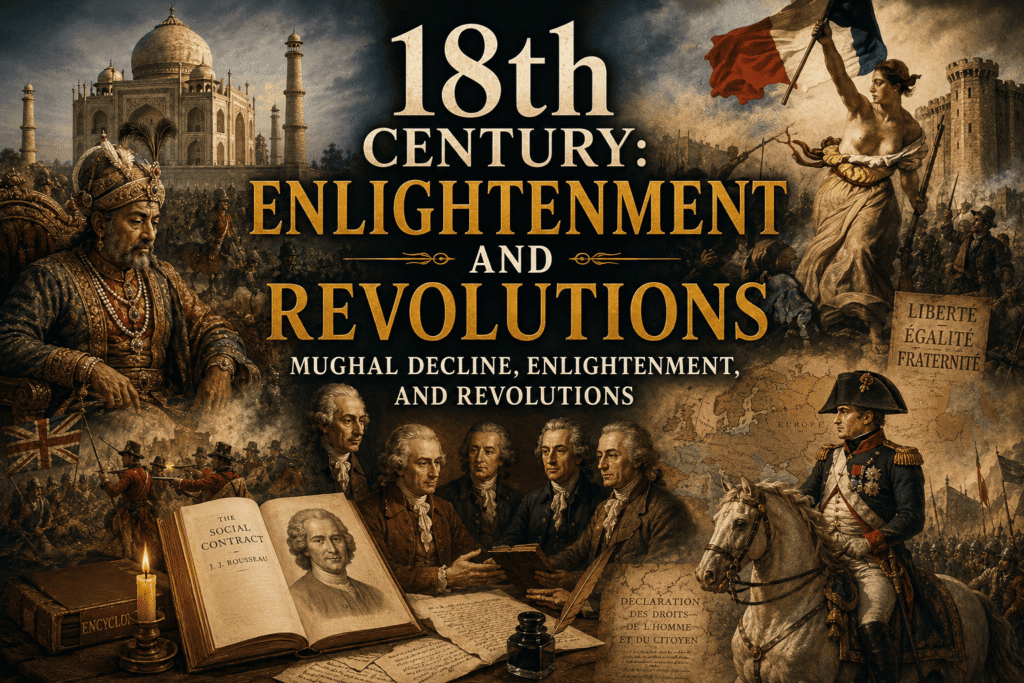
The 18th century was defined by the Enlightenment, as thinkers like Voltaire, Locke, and Rousseau championed reason, individual rights, and scientific inquiry, challenging traditional authority and reshaping political philosophy. This era culminated in revolutionary upheaval, most notably the American Revolution of 1776 and the French Revolution of 1789, both driven by Enlightenment ideals of liberty, equality, and self-governance. Alongside political transformation, the century saw the early stirrings of the Industrial Revolution, as new technologies began reshaping economies and societies across Europe. At its core, the 18th century reveals how the power of reason and revolutionary ideals fundamentally reshaped governance, society, and the relationship between citizens and the state.
Content Overview
- CHAPTER 1 — Understanding the 18th Century
- Chapter 2 — The Fall of the Mughal Empire
- CHAPTER 3 — European Expansion and the British Rise in India
- CHAPTER 4 — The Age of Enlightenment
- What Was the Enlightenment?
- Why the Enlightenment Happened in the 18th Century
- John Locke (1632–1704) — Natural Rights and Government by Consent
- Voltaire (1694–1778) — The Sword of Reason
- Jean-Jacques Rousseau (1712–1778) — The General Will and the Social Contract
- Montesquieu (1689–1755) — The Separation of Powers
- Adam Smith (1723–1790) — The Wealth of Nations
- Denis Diderot and the Encyclopédie — Knowledge for All
- The Enlightenment's Impact on Religion and Society
- CHAPTER 5 — The Industrial Revolution
- CHAPTER 6 — The American Revolution (1775–1783)
- CHAPTER 7 — The French Revolution (1789)
- France Before the Revolution — The Three Estates
- The Financial Crisis That Broke the Monarchy
- The Estates-General and the Tennis Court Oath (1789)
- “The Fall of the Bastille on July 14, 1789”
- “The 1789 Declaration of the Rights of Man and of the Citizen”
- The Execution of Louis XVI (January 21, 1793)
- The Reign of Terror (1793–1794)
- Napoleon Bonaparte — From General to Consul
- CHAPTER 8 — Scientific and Intellectual Progress
- CHAPTER 9 — The World Beyond Europe and India
- CHAPTER 11 — Complete Decade-by-Decade Timeline (1701–1800)
- 1701–1710: War of Spanish Succession Begins
- 1711–1720: The South Sea Bubble and Political Scandal
- 1721–1730: Peter the Great's Legacy and Walpole's Stability
- 1731–1740: Nadir Shah Strikes India
- 1741–1750: The Age of Frederick the Great
- 1751–1760: Plassey and the Beginning of British India
- 1761–1770: Industrial Revolution Takes Shape
- 1771–1780: American Revolution
- 1781–1790: Constitution and French Crisis
- 1791–1800: Revolution, Terror, and Napoleon
- CHAPTER 12 — Summary and Legacy of the 18th Century
CHAPTER 1 — Understanding the 18th Century
Definition and Context
The 18th century covers the years from January 1, 1701 CE to December 31, 1800 CE. In the Roman numeral system historically used for dating, it began in MDCCI and ended in MDCCC. It falls within what historians call the Early Modern Period in its first half, transitioning toward the beginning of the Modern Period by its end.
The 18th century is one of the most consequential in human history — arguably the century in which the modern world was most decisively created. By 1700, the foundations had been laid: Newton had described the laws of physics, Locke had articulated natural rights theory, the joint-stock company had been invented, the constitutional monarchy had been established in England. But all of these were seeds. The 18th century was when those seeds grew into the institutions, revolutions, ideologies, and economic systems that define our world today.
By 1800, the world had undergone transformations that would have been almost unimaginable to someone looking forward from 1700. The United States of America — the world’s first modern constitutional republic — existed and had survived its first decade under its new constitution. France had executed its king, abolished its monarchy, proclaimed the rights of man, gone through the most radical revolutionary transformation any major European state had ever undergone, and was about to make Napoleon Bonaparte its leader. The Industrial Revolution had transformed Britain from an agricultural country into the world’s first industrial economy. The Enlightenment had permanently established reason and empirical evidence as the primary authorities for understanding the natural and social world. And the Mughal Empire — which had been one of the richest and most powerful states in the world just a century earlier — had been reduced to a shadow emperor in Delhi with no real power, while the British East India Company had transformed from a trading corporation into the effective government of the most populous and wealthy region of Asia.
What Kind of World Existed in 1701 CE?
Standing at the beginning of 1701 and surveying the world, the picture is one of established empires in various stages of development and decline, combined with the early stirrings of forces that would transform everything.
In Europe, the dominant political event of the century’s beginning was the War of the Spanish Succession — a continent-wide conflict over who would inherit the Spanish throne and its enormous colonial empire. Louis XIV of France — still alive, still ruling, his absolute monarchy still the dominant model in Europe — was pressing the claim of his grandson Philip to the Spanish throne. England, the Dutch Republic, and Austria were forming a coalition to prevent France from dominating both France and Spain simultaneously. This war would last until 1714 and shape European politics for decades.
In South Asia, the Mughal Emperor Aurangzeb was still alive but 88 years old and exhausted — having spent 26 years personally campaigning in the Deccan against the Marathas without achieving victory. When he died in 1707, he left an empire that was territorially maximal but internally exhausted, politically fragmented, and facing challenges from multiple directions simultaneously. The British East India Company was present along the coasts — at Bombay, Madras, and Calcutta — as a commercial enterprise operating under Mughal permission, not yet the political power it would become.
In China, the Kangxi Emperor — one of the most capable rulers in Chinese history — was at the height of his long reign (1661–1722), presiding over a prosperous and expanding Qing Dynasty. Japan was deep in the Tokugawa Sakoku period — isolated, stable, and culturally productive but technologically diverging from the rapidly advancing West. The Ottoman Empire was recovering from its defeat at Vienna in 1683 but had signed the Treaty of Karlowitz (1699) surrendering Hungary — the beginning of its long territorial decline.
In the Americas, the European colonial empires were established — Spain controlling most of South America and Central America, Portugal controlling Brazil, France controlling large territories in North America (New France), and England controlling the eastern seaboard colonies that would eventually become the United States. The Atlantic slave trade was at or near its peak — bringing approximately 70,000 to 80,000 enslaved Africans to the Americas annually by the mid-18th century.
Why the 18th Century Is the Birth of the Modern Political World
The modern political world — with its nation-states, constitutional governments, recognized human rights, democratic principles, and separation of powers — was essentially created in the 18th century. Before the 18th century, these concepts existed as philosophical theories. After the 18th century, they existed as functioning (if imperfect) governments.
The American Revolution produced the first modern constitutional republic — a government based on a written constitution, separation of powers, and recognition of natural rights. The French Revolution produced the first declaration of universal human rights applied to an entire nation’s governance and permanently ended the idea that hereditary monarchy was the natural and inevitable form of government. The Enlightenment produced the philosophical framework within which both revolutions operated. And the Industrial Revolution produced the economic transformation that, over the following century, would make the political ideals of 1776 and 1789 practically achievable for a growing proportion of the world’s population.
Chapter 2 — The Fall of the Mughal Empire
The Mughal Empire in 1700 — Its Condition at Century’s Start
At the beginning of the 18th century, the Mughal Empire was simultaneously at its greatest territorial extent and in its deepest structural crisis. This paradox — maximum size, minimum strength — is the key to understanding why the empire that had been one of the world’s richest and most powerful in 1600 was effectively powerless by 1800.
The territorial extent: by the time Aurangzeb died in 1707, the Mughal Empire covered approximately 4 million square kilometers — stretching from Kabul in the northwest to Bengal in the east, from Kashmir in the north to the Kaveri River in the south. This was the largest the empire had ever been.
But beneath this territorial maximum, the empire was gravely ill. The treasury was exhausted by 26 years of expensive, inconclusive warfare in the Deccan. The imperial army — which had been the finest military force in South Asia — was weakened by years of attrition, poor pay, and demoralized by campaigns that seemed endless and pointless. The administrative system — Akbar’s brilliant mansabdari structure — had deteriorated as nobles became increasingly autonomous and local revenue was captured by regional powers rather than flowing to the imperial center. And the religious policies of Aurangzeb’s reign — the reimposition of the jizya, the destruction of temples, the persecution of Sikhs and other communities — had alienated precisely the communities that Akbar’s genius had made partners in the empire’s success.
The Death of Aurangzeb (1707) — The Beginning of the End
Aurangzeb died on March 3, 1707, in Ahmednagar in the Deccan, aged 88. His final letter — remarkable for its self-recrimination — reportedly expressed regret for his religious policies and his military failures: “I know not who I am, where I shall go, or what will happen to this sinner full of sins.” He was buried in an open-air grave, by his own instruction, in deliberate contrast to the magnificent tombs of his predecessors — a final act of Islamic piety that also symbolized, perhaps unconsciously, the diminished grandeur of the empire he left behind.
The succession crisis that followed was immediate and devastating. Aurangzeb had outlived most of his sons. The three surviving sons — Muazzam (Bahadur Shah I), Azam, and Kam Bakhsh — fought a succession war. Muazzam defeated and killed both his brothers and became Emperor Bahadur Shah I.
Bahadur Shah I (reigned 1707–1712) was already 63 when he became emperor. He attempted conciliation — releasing the Sikh Guru Gobind Singh from the hostilities of Aurangzeb’s reign and partially addressing Rajput grievances. But his reign was only five years, and the systemic problems he had inherited could not be addressed in that time.
After Bahadur Shah’s death in 1712, the empire entered what historians call the “Twelve Years of Anarchy” (1712–1724) — a period of five emperors in twelve years, most of whom were murdered by court factions. The Sayyid Brothers — two powerful nobles named Abdullah Khan and Husain Ali Khan Barha — became the effective rulers, making and unmaking emperors at will. They earned the title “King-makers” and exercised the real power of the empire for a decade, while the nominal emperors were essentially their puppets.
Nadir Shah’s Invasion and the Sack of Delhi (1739)
The most catastrophic single blow to the Mughal Empire in the 18th century was delivered not by a European power or an Indian regional challenger but by a Persian emperor. Nadir Shah — the brilliant, brutal ruler of Persia who had risen from shepherding poverty to imperial power — invaded India in late 1738 with an army of approximately 55,000 highly trained troops.
Background — Why Nadir Shah Invaded
Nadir Shah had several motivations. He was genuinely brilliant militarily but needed wealth to pay his armies and consolidate his power in Persia. He had received reports — from spies and merchants — of the enormous wealth that remained in Delhi despite the empire’s political weakness. He also had a legitimate pretext: the Mughal governor of Kabul had been harboring enemies of Nadir Shah and refusing to extradite them.
The Mughal Emperor Muhammad Shah (“Rangila” — the Colorful, so named for his love of art and entertainment) was politically weak and militarily incapable. His court was divided by factional intrigue. His army, when it eventually met Nadir Shah at the Battle of Karnal on February 13, 1739, was numerically larger but decisively inferior in every military quality. The battle lasted approximately three hours. The Mughal army was routed. Muhammad Shah was captured.
The Sack of Delhi — Step by Step
Step 1 — Entry into Delhi: Nadir Shah entered Delhi with Muhammad Shah in March 1739 — the captive emperor riding beside the conqueror in a deliberate display of the reversal of power.
Step 2 — The Massacre: On March 22, 1739, a rumor spread that Nadir Shah had been killed — probably started by Mughal loyalists hoping to trigger a revolt. Residents of Delhi attacked and killed several hundred Persian soldiers. Nadir Shah’s response was immediate and devastating. He ordered a general massacre — qatl-e-aam — instructing his soldiers to kill every person they encountered in the city.
The massacre lasted from sunrise until approximately noon — approximately six hours. Nadir Shah sat in the Sunehri Masjid (Golden Mosque) personally observing the carnage from the roof, refusing to rescind the order despite desperate pleading from imperial officials. Contemporary estimates of the death toll range from 20,000 to 30,000 people. The streets of Delhi ran with blood. Houses were burned. Women were assaulted. The great commercial districts of the city were looted and burned.
Step 3 — The Looting: After the massacre ended, the systematic looting began. For approximately 57 days, Nadir Shah’s forces stripped Delhi of everything movable. The imperial treasury — accumulated over two centuries of Mughal rule — was emptied. The Peacock Throne — the jeweled golden throne of the Mughals, encrusted with diamonds, rubies, emeralds, and pearls — was carried away to Persia. The Koh-i-Noor diamond — one of the largest in the world — was removed from Muhammad Shah’s turban (according to tradition, through a clever exchange of turbans at a ceremonial dinner). Wagon-loads of gold, silver, jewels, fine textiles, and precious objects were transported westward.
Step 4 — The Return: Nadir Shah returned to Persia in May 1739, having stripped Delhi of wealth estimated in various sources at the equivalent of hundreds of millions of modern dollars. He reportedly abolished taxation in Persia for three years with the proceeds.
The Consequences for the Mughal Empire: The sack of Delhi was the psychological and material blow from which the Mughal Empire never recovered. The treasury that remained was insufficient to pay the army or fund governance. Muhammad Shah — traumatized and humiliated — ruled for another 9 years but was essentially powerless. The empire he nominally ruled was already breaking into semi-independent regional states. Provincial governors — the Nawabs of Bengal, Hyderabad, and Awadh — stopped sending revenue to Delhi and kept it for themselves. The Mughals had become a ceremonial institution rather than a governing reality.
The Regional Powers That Replaced the Mughals
The Maratha Confederacy — India’s Last Great Hindu Empire
The Marathas — the Hindu warrior people of the western Deccan — were the most powerful force in India for much of the 18th century. Their founder, Shivaji (died 1680), had established the Maratha state in the 17th century through brilliant guerrilla resistance to Mughal authority. His successors expanded this into the Maratha Confederacy — a loose federation of five major Maratha dynasties (the Peshwas of Pune, the Bhonsles of Nagpur, the Holkars of Indore, the Scindias of Gwalior, and the Gaikwads of Baroda) that, at its height, controlled perhaps half of the Indian subcontinent.
The Peshwas — technically the chief ministers of the Maratha Chhatrapati (sovereign) but effectively the most powerful rulers — were the dominant political force in the confederacy from the 1720s onward. Peshwa Baji Rao I (reigned 1720–1740) was one of the most brilliant military commanders in Indian history — winning an extraordinary series of campaigns across northern India, humiliating the Mughals, defeating the Nizam of Hyderabad, and extending Maratha power from the Deccan to Delhi itself. He reportedly never lost a battle.
The Third Battle of Panipat (January 14, 1761) was the greatest catastrophe in Maratha history. An Afghan army under Ahmad Shah Durrani — invited by Indian Muslim powers alarmed by Maratha expansion — met the Maratha force near the historic battlefield of Panipat. The battle was a decisive Durrani victory. Approximately 40,000 Maratha soldiers and an unknown number of camp followers died — among them the Peshwa Vishwasrao and the commander-in-chief Viswasrao. The Maratha political leadership in Pune was devastated. The Maratha Confederacy survived, but its momentum and cohesion were permanently broken. The Marathas never recovered their mid-century dominance, and the British East India Company — steadily growing — would eventually dismantle the Confederacy through three Anglo-Maratha Wars.
The Sikh Confederacy — The Rise of Punjabi Power
The Sikhs — followers of the ten Gurus whose tradition had been founded by Guru Nanak in the 15th century — had been transformed into a militant community by Aurangzeb’s persecution and specifically by his execution of Guru Tegh Bahadur in 1675 and his wars against Guru Gobind Singh. Guru Gobind Singh established the Khalsa (the Pure) in 1699 — a community of baptized Sikhs bound by a code of conduct that included always carrying a sword, establishing a visible martial identity, and being prepared to defend the community against oppression.
After the death of Guru Gobind Singh (1708), the Sikh military leader Banda Singh Bahadur led a series of devastating raids against Mughal authority in the Punjab, temporarily capturing the city of Sirhind (where two of Guru Gobind Singh’s sons had been executed). The Mughals eventually captured and executed Banda Singh Bahadur in 1716 with great brutality — but could not destroy the Sikh movement.
During the 18th century, as Mughal power weakened and invasions by Nadir Shah and Ahmad Shah Durrani ravaged the Punjab, the Sikhs formed the Sikh Misls—twelve military confederacies that gradually established control over the region. By the century’s end, Ranjit Singh was consolidating these Misls into what would become the Sikh Empire — one of the most formidable military states in South Asia.
Mysore Kingdom — Hyder Ali and Tipu Sultan
The Kingdom of Mysore in southern India underwent a dramatic transformation in the 18th century from a Hindu dynasty into one of the most militarily modernized states in South Asia, under the rule of two Muslim generals: Hyder Ali and his son Tipu Sultan.
Hyder Ali (ruled 1761–1782) was born into a relatively modest family but rose through military ability to become the de facto ruler of Mysore. He modernized the Mysore army along European lines, incorporating trained infantry using muskets, artillery, and tactical formations derived from French military practice. He fought the British East India Company in the First and Second Anglo-Mysore Wars — achieving significant military successes that alarmed the Company.
Tipu Sultan (ruled 1782–1799) — called the “Tiger of Mysore” — continued his father’s modernization program and was one of the most formidable opponents the British faced in India. He developed rocket artillery — iron-cased war rockets that were more advanced than anything the British possessed — and used them effectively in battle. He sought alliances with France and with Zaman Shah of Afghanistan against the British. He died fighting at the siege of Seringapatam in 1799 — famously saying “Better to live one day as a tiger than a thousand years as a sheep” — when the British, allied with the Nizam of Hyderabad and the Marathas, captured and sacked his capital. His defeat removed the most serious military obstacle to British dominance in South India.
Why the Mughal Empire Really Fell — The Complete Analysis
The decline of the Mughal Empire had multiple, interconnected causes that historians continue to debate. The most complete analysis recognizes several simultaneous factors:
The Mansabdari System’s Deterioration: Akbar’s brilliant administrative system — assigning nobles ranked positions with specific duties and salaries — worked when the emperor was strong enough to enforce it. By the early 18th century, nobles had become increasingly autonomous — retaining local revenues rather than remitting them to the center, maintaining personal armies that owed primary loyalty to the noble rather than the emperor, and hereditary succession in positions that Akbar had specifically designed to be non-hereditary. The central state’s fiscal and military resources contracted as these resources were captured locally.
Aurangzeb’s Religious Policies and Their Long-Term Damage: The reimposition of the jizya, the destruction of temples, the persecution of non-Muslims — these policies reversed Akbar’s brilliant strategy of making the empire’s Hindu, Sikh, and Rajput populations stakeholders in the empire’s success. By the time of Aurangzeb’s death, the Marathas, the Rajputs, and the Sikhs — who under Akbar had been loyal partners in Mughal power — were all in various stages of rebellion. The empire that Akbar had built was a coalition of many peoples; Aurangzeb’s policies reduced it to an Islamic state trying to govern an unwilling non-Muslim majority.
Succession crises: The Mughal Empire lacked a fixed system for succession—any prince could claim the throne, and power was usually decided through conflict among rivals.This produced recurrent civil wars at every imperial transition, each of which weakened the state and allowed regional powers to consolidate independence during the chaos.
External Shocks: Nadir Shah’s sack of Delhi (1739) destroyed the financial resources that might have funded administrative reform. Ahmad Shah Durrani’s repeated invasions of the Punjab (1748–1769) permanently disrupted one of the empire’s richest provinces. The Third Battle of Panipat (1761) — which shattered the Marathas who might otherwise have revived the empire under their patronage — removed the last major indigenous force that might have restructured Indian politics before British dominance was established.
British Exploitation of the Vacuum: The British East India Company, with superior military technology and organization, financial resources backed by the emerging industrial economy of Britain, and a clear strategic vision of expanding commercial and then political control, was perfectly positioned to exploit the vacuum left by Mughal collapse. The Mughals’ decline and the British rise were not independent processes — they were intimately connected, each enabling the other.
CHAPTER 3 — European Expansion and the British Rise in India
The Battle of Plassey (1757) — The Conquest of Bengal
The Battle of Plassey on June 23, 1757 is one of the most consequential military engagements in world history — not because of its military complexity (it was decided primarily by treachery rather than battlefield skill) but because of what it began: the British domination of the Indian subcontinent that would last nearly two centuries.
Background — The Situation in Bengal
Bengal in 1757 was the richest province in India — perhaps the richest region in the world in per-capita terms, with enormous agricultural productivity, a thriving textile industry (producing the finest muslin and cotton cloth in the world), and control of the most important river system in the subcontinent. The Nawab of Bengal — Siraj ud-Daulah — was young (approximately 23 years old), politically inexperienced, and had inherited the position from his grandfather just the previous year.
The East India Company had been trading in Bengal for decades, operating from its settlement at Calcutta (Fort William). Tensions had been building between Siraj ud-Daulah and the Company over various issues — particularly the Company’s practice of extending its trade privileges (which exempted Company goods from customs duties) to Indian merchants who were not entitled to them, costing the Nawab significant revenue.
In 1756, Siraj ud-Daulah attacked and captured Calcutta. The infamous “Black Hole of Calcutta” incident allegedly occurred — 146 British prisoners were supposedly confined overnight in a small cell, with 123 dying of suffocation. The historical accuracy of these specific figures is disputed by modern historians, but the event became a powerful propaganda piece justifying British revenge.
Robert Clive — Architect of Empire
Robert Clive — a young East India Company officer who had distinguished himself in various military engagements in South India — was sent from Madras to recover Calcutta. He retook it in January 1757 and then began planning the campaign that would change South Asian history.
Clive’s genius was not primarily military but political. He understood that Siraj ud-Daulah had powerful enemies among his own court — particularly his commander-in-chief Mir Jafar, who resented his position and was deeply ambitious. Clive entered secret negotiations with Mir Jafar, offering him the position of Nawab of Bengal if he would betray Siraj ud-Daulah at the decisive moment.
The Battle — Step by Step
Step 1 — The Armies Assemble: On June 23, 1757, Siraj ud-Daulah’s army of approximately 50,000 infantry, 18,000 cavalry, 53 cannon served by French artillerymen, and 53 war elephants, faced Clive’s force of approximately 3,000 soldiers (about 800 British, the rest Indian sepoys) and 10 cannon at the village of Plassey near the Bhagirathi River.
Step 2 — The Opening Bombardment: The battle began with an artillery exchange. The Nawab’s French artillerymen initially performed well. Then a rainstorm began — and this is where the treachery became decisive. Siraj ud-Daulah’s gunpowder got wet and his artillery was silenced. Clive’s artillery had protected its powder with tarpaulins and continued firing.
Step 3 — Mir Jafar Stands Aside: Mir Jafar’s division — constituting a large portion of the Nawab’s army — stood motionless throughout the battle, neither advancing nor retreating, simply watching. His betrayal was complete and decisive.
Step 4 — The Collapse: The battle lasted approximately six hours but was decided by the artillery exchange and Mir Jafar’s treachery rather than by any genuine infantry combat. When the Nawab’s forces collapsed and fled, Siraj ud-Daulah himself fled by boat. He was captured two days later and killed — reportedly on Mir Jafar’s orders.
The Aftermath: Mir Jafar was installed as the new Nawab of Bengal — a British puppet. The East India Company received enormous financial compensation, trading privileges, and territory. Clive personally received approximately £234,000 (equivalent to tens of millions of modern pounds) — making him one of the richest men in Britain. The Company had acquired, in effect, the right to govern the most lucrative province in India.
The Battle of Buxar (1764) — Consolidating British Control
Mir Jafar proved difficult to manage — he began negotiating with other powers and was replaced by his son-in-law Mir Qasim, who proved even more problematic. Mir Qasim made the fatal mistake of actually attempting to govern Bengal effectively — reforming taxation, creating a professional army, and reducing the Company’s illegal extensions of trading privileges. This brought him into direct conflict with the Company.
The resulting war culminated in the Battle of Buxar on October 22, 1764 — where a British force defeated a combined army of Mir Qasim, the Nawab of Awadh (Shuja ud-Daulah), and the Mughal Emperor Shah Alam II. This was a genuinely significant military victory — the Company defeated not just one Nawab but three major regional powers simultaneously, demonstrating that no combination of Indian forces could defeat the Company’s disciplined sepoy army supported by European-commanded artillery.
The Diwani Rights (1765) — When a Company Became a Government
The most consequential outcome of Buxar was the Treaty of Allahabad (1765), negotiated by Clive, which granted the East India Company the Diwani — the right to collect revenue — for the provinces of Bengal, Bihar, and Orissa. This was a watershed moment. The Company was now not just a trading enterprise with military power but a fiscal authority — a government in everything but name. It collected taxes from tens of millions of people, administered civil justice, and maintained order through its sepoy army — all in the name of the Mughal Emperor, who received a pension but exercised no real authority.
Warren Hastings and the Systematization of British Rule
Warren Hastings — who served as Governor of Bengal from 1772 and then as the first Governor-General of India from 1773 to 1785 — was the administrator who transformed the Company’s chaotic and improvised territorial control into a systematic colonial government. He established courts, codified laws (including the first systematic attempt to apply Hindu and Muslim law through British courts), created a civil service, and organized the revenue collection system.
Hastings was both an able administrator and a controversial figure. He faced impeachment in Britain (ultimately acquitted) on charges of corruption and cruelty. The trial — which lasted from 1788 to 1795 — became a major public debate about the morality of British imperial rule, with Edmund Burke’s prosecution speeches articulating powerful critiques of colonial exploitation that remain relevant today.
The Anglo-Mysore Wars (1767–1799)
The four Anglo-Mysore Wars were the most serious military challenges the British faced in South Asia during the 18th century.
First Anglo-Mysore War (1767–1769): Hyder Ali outmaneuvered British forces, marched to within kilometers of Madras, and forced the British to sign a humiliating treaty of mutual assistance.
Second Anglo-Mysore War (1780–1784): During the American Revolutionary War, when Britain was distracted and France was supporting both the Americans and Mysore, Hyder Ali won major victories before his death in 1782. His son Tipu Sultan continued the war and fought to a negotiated peace.
Third Anglo-Mysore War (1790–1792): A British coalition with the Marathas and the Nizam defeated Tipu Sultan, forcing him to cede half his territory and give two of his sons as hostages.
Fourth Anglo-Mysore War (1799): The final war ended with the storming of Seringapatam (Tipu’s capital) and Tipu Sultan’s death. Mysore’s defeat removed the last serious military obstacle to British dominance in South India.
CHAPTER 4 — The Age of Enlightenment
What Was the Enlightenment?
The Enlightenment — called in German the Aufklärung, in French the Lumières, in Italian the Illuminismo — was an intellectual movement that dominated European thought from approximately the 1680s through the 1790s, reaching its fullest expression in the 18th century. Its central commitment was simple and radical: reason, not tradition, authority, or revelation, should be the primary guide to understanding the world and organizing human societies.
The Enlightenment was not a unified school of thought — Enlightenment thinkers disagreed vigorously with each other on many questions. But they shared certain commitments: to empirical investigation of the natural world; to skepticism about inherited beliefs, especially religious dogmas; to the belief that human beings could, through the use of reason, improve their condition; to the value of individual freedom and human dignity; and to criticism of institutions — the Church, absolute monarchy, aristocratic privilege — that maintained power through tradition and coercion rather than rational justification.
Why the Enlightenment Happened in the 18th Century
The Enlightenment built on the 17th century’s Scientific Revolution. Newton’s demonstration that the universe operated according to discoverable mathematical laws — that reason, applied to observation, could reveal the structure of reality — inspired the question: if reason can give us reliable knowledge about physics, why can’t reason give us reliable knowledge about society, government, and morality?
The printing press had made books and pamphlets cheap and widely available. Literacy was expanding. Urban commercial societies — particularly in France, Britain, and the Dutch Republic — had created educated middle classes who read, discussed, and debated ideas in coffeehouses, salons, and learned societies. The Republic of Letters — an informal network of intellectual correspondence connecting thinkers across Europe — allowed ideas to circulate rapidly across national boundaries.
Religious wars had exhausted Europe and made many people skeptical of claims that any single religious tradition possessed unique access to truth. The discovery of diverse, sophisticated civilizations in Asia and the Americas challenged the assumption that European Christian culture was obviously superior in all respects. All of these conditions combined to create an intellectual environment in which questioning established authority was not just possible but fashionable.
John Locke (1632–1704) — Natural Rights and Government by Consent
John Locke — whose major political works were published in 1689 — was the foundational thinker of Enlightenment political philosophy. Though he died in 1704 (technically early in the 18th century), his ideas defined the century’s political thought. We discussed Locke in detail in Chapter 10 of the 17th century; here we note how his ideas functioned in the 18th century context.
Locke’s theory of natural rights — that every human being possesses inalienable rights to life, liberty, and property that exist prior to and independently of government — became the intellectual foundation for both the American and French Revolutions. His argument that government’s legitimacy derives from the consent of the governed, and that a government that consistently violates natural rights may be legitimately overthrown, was cited explicitly by Thomas Jefferson in the Declaration of Independence and by French revolutionary leaders.
Voltaire (1694–1778) — The Sword of Reason
François-Marie Arouet — who wrote under the name Voltaire — was the most famous and widely read writer of the 18th-century French Enlightenment. His weapon was wit. More than any other Enlightenment thinker, Voltaire mastered the use of satire, irony, and savage humor to demolish what he saw as the pretensions of religious authority, superstition, and tyranny.
His most famous work — Candide (1759) — is a short satirical novel following an optimistic young man through a series of disasters, wars, earthquakes, inquisitions, and catastrophes, whose cumulative effect is to demolish the philosophical optimism of Leibniz (who argued that we live in the “best of all possible worlds”). Voltaire’s reply — through the narrative of Candide — was essentially: look around at the actual world. Is this the best that God could manage?
Voltaire’s most consistent target was the Catholic Church — which he referred to as “l’infâme” (the infamous thing) and whose motto for destroying was “Écrasez l’infâme!” (Crush the infamous thing!). He documented cases of judicial murder carried out with Church complicity — particularly the Calas Affair (1762), in which a Protestant merchant was tortured and put to death on false accusations of killing his son to stop him from converting to Catholicism. Voltaire’s public campaign for the posthumous rehabilitation of Calas — which ultimately succeeded — demonstrated that public intellectual pressure could challenge even established judicial and religious authority. It was an early example of what we now call human rights advocacy.
Voltaire spent significant time in England (1726–1728, in exile after offending a French nobleman) and was deeply impressed by English religious tolerance, constitutional government, and the intellectual freedom he found there. His Lettres philosophiques (Letters Concerning the English Nation, 1733) — which praised English institutions as superior to French ones — was immediately banned in France and publicly burned, but circulated widely in underground copies. It is sometimes called “the first bomb thrown against the Old Regime.”
Jean-Jacques Rousseau (1712–1778) — The General Will and the Social Contract
Jean-Jacques Rousseau was born in Geneva, Switzerland, and was in many ways the most complex, contradictory, and ultimately most revolutionary of the Enlightenment thinkers. He disagreed with many of his Enlightenment contemporaries — he was suspicious of the arts and sciences (arguing in his Discourse on the Sciences and Arts that they had corrupted rather than improved humanity), skeptical of urban commercial society, and hostile to the individualism that many Enlightenment thinkers celebrated.
Rousseau’s political philosophy — most fully expressed in The Social Contract (1762) — centered on the concept of the “general will” (volonté générale). He argued that legitimate political authority derived from the collective will of the community — not the will of a king, not even the will of a majority, but the genuine common interest of the entire community. People could be free only when they were governed by laws that expressed this general will — because following the general will was, in a deep sense, following their own best interests as members of a community.
This argument had revolutionary implications. If legitimate authority derived from the general will of the people, then any government that did not express this general will was illegitimate and could be overthrown. And the general will, properly understood, was not the sum of individual private interests (the “will of all”) but the common interest — which sometimes required individuals to subordinate their private desires to the community. Rousseau’s famous phrase “Man is born free, and everywhere he is in chains” opened The Social Contract and became one of the most quoted sentences of the revolutionary era.
Rousseau’s ideas were deeply influential on the French Revolution — particularly on the radical Jacobins like Robespierre, who invoked the general will to justify the Terror. This makes him a profoundly ambiguous figure: his ideas inspired both democratic idealism and totalitarian excess.
Montesquieu (1689–1755) — The Separation of Powers
Charles-Louis de Secondat, Baron de Montesquieu — French judge, social theorist, and political philosopher — published his masterwork The Spirit of the Laws (De l’Esprit des Lois) in 1748. It was an immediate sensation: within 18 months of publication it had been through 22 editions. It is the most intellectually comprehensive political work of the Enlightenment.
Montesquieu’s most enduring contribution was his systematic analysis and advocacy for the separation of powers in government. He argued, based on his study of what he believed to be the English constitution (which he idealized somewhat), that political liberty was best protected by dividing governmental authority into three separate branches — legislative (making laws), executive (implementing laws), and judicial (interpreting laws) — each with the ability to check and limit the others.
This principle — which he called the separation of powers — became the foundational structural principle of the American Constitution. James Madison, Alexander Hamilton, and the other Framers cited Montesquieu repeatedly in the Federalist Papers as their primary intellectual authority for the constitutional design. The US government’s division into Congress (legislative), the Presidency (executive), and the Supreme Court (judicial), each checking the others, is a direct implementation of Montesquieu’s theory. Similar structures now exist in virtually every constitutional government in the world.
Adam Smith (1723–1790) — The Wealth of Nations
Adam Smith — Scottish moral philosopher and economist — published An Inquiry into the Nature and Causes of the Wealth of Nations in 1776 (the same year as the American Declaration of Independence). It is one of the most influential books ever written and the founding text of modern economics.
Smith’s core argument was that national wealth was created not by accumulating gold (the mercantilist theory that dominated economic thinking before him) but by productive labor and efficient exchange. He argued that when individuals are free to pursue their own economic interests in a competitive market — buying where prices are lowest, selling where they are highest, producing what is most profitable — the result, through what he famously called the “invisible hand,” is the most efficient possible allocation of productive resources for the benefit of society as a whole.
This argument had enormous political implications: it was a powerful case against government interference in economic activity. Protective tariffs, monopolies (like the East India Company’s trading monopoly), and mercantilist regulations all impeded the efficient operation of markets and reduced overall wealth. Free trade — the removal of barriers to exchange between countries — would benefit everyone.
Smith was also clear-eyed about capitalism’s social costs. He was deeply critical of monopolists and merchants who used political influence to corrupt free markets. He worried about the deadening effects of repetitive factory work on workers’ intelligence and humanity. He supported public education for the poor, progressive taxation, and regulation to prevent the exploitation of workers. The popular image of Smith as a simple advocate for laissez-faire capitalism ignores the complexity and social concern of his actual thought.
The Wealth of Nations became the intellectual foundation for the free trade policies that Britain adopted in the 19th century, for classical liberal economics, and — in more recent interpretations — for various forms of free-market conservatism.
Denis Diderot and the Encyclopédie — Knowledge for All
The Encyclopédie, ou dictionnaire raisonné des sciences, des arts et des métiers (Encyclopedia, or a Systematic Dictionary of the Sciences, Arts, and Crafts) was the most ambitious publishing project of the 18th century — a 35-volume attempt to compile all human knowledge, edit by Denis Diderot and Jean le Rond d’Alembert, with contributions from Voltaire, Rousseau, Montesquieu, and dozens of other leading Enlightenment thinkers.
The Encyclopédie was published between 1751 and 1772 and was a political act as much as an intellectual one. By making knowledge available — not just to scholars and clergy, but to educated citizens — the Encyclopédie challenged the monopoly on knowledge that the Church and traditional authorities had maintained. Its articles on religion were skeptical of Church dogma. Its articles on government advocated for political reform. Its articles on commerce, manufacturing, and trades elevated practical knowledge — the knowledge of craftspeople and workers — to the same level as theoretical learning.
The project faced constant censorship attempts — the royal government twice suspended its publication, and the Church put it on the Index of Forbidden Books. But it continued, ultimately distributing approximately 25,000 copies — a massive circulation for an 18th-century publication. The Encyclopédie’s project — organizing all human knowledge according to rational principles and making it available to anyone who could read — was an embodiment of the Enlightenment spirit.
The Enlightenment’s Impact on Religion and Society
The Enlightenment did not eliminate religion in Europe—the vast majority of people in the 18th century continued to identify as Christian. But it fundamentally changed the relationship between religion and public life.
Several important shifts occurred. Deism — the belief in a God who created the universe and established its laws but does not intervene in its operation — became fashionable among educated elites. Many of the American Founding Fathers were Deists rather than orthodox Christians. This “watchmaker God” — who created the clockwork universe Newton had described and then stepped back — was perfectly compatible with Enlightenment rationalism.
Toleration became increasingly accepted as a political principle. The religious wars of the 16th and 17th centuries had killed millions without resolving theological disputes. The Enlightenment made the philosophical case for toleration — Locke’s Letter Concerning Toleration (1689), Voltaire’s Treatise on Tolerance (1763) — and the political case (religious uniformity was neither achievable nor necessary for political order). By the end of the 18th century, most European states had moved toward greater legal toleration of religious minorities, and the American Constitution explicitly prohibited any religious test for federal office and establishment of a state religion.
The status of women was debated — Mary Wollstonecraft’s A Vindication of the Rights of Woman (1792) applied Enlightenment principles of natural rights and rational equality consistently to women, arguing that if human dignity was based on reason, and women were rational beings, then they deserved the same rights and education as men. This argument — radical in 1792 — became the intellectual foundation of the feminist movement.
CHAPTER 5 — The Industrial Revolution
What Was the Industrial Revolution?
The Industrial Revolution was one of the most fundamental transformations in human history — comparable in its long-term consequences to the Neolithic Revolution (the shift from hunting-gathering to agriculture, approximately 10,000 years ago) and the development of writing (approximately 5,000 years ago). It was the shift from an economy based primarily on human and animal muscle power, working with hand tools, to an economy based on machine power — using mechanical devices powered first by water and then by steam to perform work at scales and speeds that human beings could never achieve manually.
This transformation began in Britain in the mid-18th century and spread outward from there — to continental Europe in the early 19th century, to the United States, Japan, and eventually the entire world over the following two centuries. Its consequences for every aspect of human life — how we work, where we live, what we eat, how we communicate, how we fight wars, how long we live — were and continue to be revolutionary.
Why Britain First — The Complete Analysis
The Industrial Revolution began in Britain rather than elsewhere for reasons that historians have debated extensively. The most convincing analysis recognizes multiple converging factors:
Agricultural Revolution First: In the century before the Industrial Revolution, British agriculture had undergone dramatic improvements — enclosure of common lands, crop rotation, selective breeding of livestock, drainage of wet lands. These improvements dramatically increased agricultural productivity, which had two consequences: it freed labor (fewer people needed to feed the population, releasing workers for other occupations) and it generated agricultural surpluses that provided capital for investment in industry.
Colonial Trade and Capital: Britain’s colonial empire — particularly the profitable Atlantic economy based on American plantation agriculture worked by enslaved Africans — had generated enormous capital in the hands of British merchants. This capital was available for investment in new technology and manufacturing.
Coal and Iron: Britain had enormous deposits of coal and iron ore in close proximity — the West Midlands, South Wales, the Northeast. Coal provided energy; iron provided materials. This geographic coincidence was crucial: the steam engine ran on coal; industrial machinery was built from iron.
Constitutional Government and Property Rights: Britain’s constitutional government — established by the Glorious Revolution of 1688 — provided secure property rights and reliable contract enforcement. Entrepreneurs could invest in long-term projects knowing their property would be protected and contracts honored. This security encouraged risk-taking and innovation.
Scientific Culture: The Royal Society, established in 1660, had created a culture of practical scientific investigation. The connection between scientific knowledge and practical technology was closer in Britain than elsewhere — artisans and scientists interacted, and technological innovation was valued and rewarded.
The Market: Britain had a large internal market connected by rivers and, increasingly, canals — making the transport of goods relatively cheap. It also had the world’s largest empire as an export market. The potential market for industrial products was enormous.
James Watt and the Steam Engine (1769)
The steam engine — the device that made the Industrial Revolution possible in its fully developed form — was not invented by James Watt. Thomas Newcomen had built a working atmospheric steam engine in 1712, primarily used for pumping water out of coal mines. But Newcomen’s engine was extremely inefficient: it consumed enormous quantities of coal relative to the work it performed.
James Watt — a Scottish instrument maker working at the University of Glasgow — was asked to repair a model of a Newcomen engine in 1763. He immediately recognized its fundamental inefficiency: the cylinder was alternately heated and cooled with every stroke, wasting most of the steam’s energy. Watt’s key innovation — patented in 1769 — was the separate condenser: a separate chamber where steam was condensed (cooled back to water), keeping the main cylinder hot and dramatically reducing heat loss. This simple but brilliant modification improved fuel efficiency approximately fourfold.
In subsequent years, Watt (in partnership with the entrepreneur Matthew Boulton) developed further improvements: the sun-and-planet gear (converting the up-and-down piston motion to rotary motion, making the steam engine usable for driving factory machinery), the double-acting engine (using steam on both sides of the piston for greater power), the centrifugal governor (automatically regulating engine speed), and the steam pressure gauge. By the 1780s, Watt’s engine was a general-purpose power source applicable to almost any industrial or transport purpose.
The unit of power — the watt — is named for him, and the concept of horsepower that Watt developed to help customers understand his engine’s output in familiar terms remains in use today.
The Textile Revolution — Spinning Jenny, Water Frame, Power Loom
The textile industry was the first to be industrialized, and the sequence of inventions that transformed it illustrates how industrial innovation works — each innovation creating a bottleneck elsewhere in the production process that stimulates the next innovation.
The Flying Shuttle (1733): John Kay invented a mechanism that allowed the weaving shuttle to be sent across the loom at much higher speed by a single weaver. This doubled the speed of weaving — but created a bottleneck at spinning, since weavers could now consume thread faster than hand spinners could produce it.
The Spinning Jenny (c. 1764–1770): James Hargreaves invented a machine that allowed one person to spin multiple threads simultaneously — initially 8, eventually 120. This solved the spinning bottleneck — but the thread produced was fine for weft (the crosswise threads in weaving) but too weak for warp (the lengthwise threads under tension).
The Water Frame (1769): Richard Arkwright invented a spinning machine powered by water (and later steam) that produced stronger thread suitable for warp. Arkwright’s crucial innovation was not just technical but organizational: he built the first modern factory — a large facility driven by water-powered machines, where hundreds of workers operated within an organized production system featuring shifts, strict discipline, and specialized roles.
The Power Loom (1785): Edmund Cartwright invented a power loom — a water or steam-powered weaving machine. Early versions were unreliable, but by the early 19th century, improved power looms were rapidly displacing hand weavers — causing enormous social distress among the handloom weaving communities (the Luddite movement — the deliberate destruction of textile machinery by displaced workers — occurred in 1811–1813).
The combined effect of these innovations was to transform textile production from a cottage industry (with skilled artisans working in their homes) to a factory industry — with machines performing most of the skilled work, supervised by less-skilled (and therefore cheaper) workers including women and children, in large centralized facilities.
The Social Costs — Child Labor, Poverty, and Inequality
The Industrial Revolution created enormous wealth — but its distribution was extraordinarily unequal, and its social costs in the early period were severe. Understanding the Industrial Revolution requires understanding both its productive achievements and its human costs.
Child Labor: Factories, coal mines, and textile mills employed large numbers of children — some as young as five or six. Children were used in textile mills to crawl under running machinery (too dangerous for adults) to retrieve waste thread. Children worked in coal mines, pulling carts of coal through tunnels too small for adults. Children worked as chimney sweeps, sent up hot narrow chimneys to clean them. These children worked 12 to 16 hour days, in dangerous conditions, for minimal wages, with no formal education. The mortality rates were high; injuries were common; lung diseases from coal dust and cotton fibers killed many.
Urban Poverty: Industrial cities — Manchester, Birmingham, Leeds, Glasgow — grew with extraordinary speed, but without the infrastructure (sanitation, housing, water supply) to support their populations. Industrial workers lived in overcrowded slums — back-to-back houses with no ventilation, no indoor plumbing, shared outdoor toilets serving dozens of families. Cholera, typhoid, and tuberculosis swept through these communities repeatedly. Life expectancy in industrial cities was dramatically lower than in rural areas.
The Destruction of Traditional Livelihoods: The displacement of skilled artisans — hand weavers, framework knitters, skilled craftspeople of all kinds — by machines was rapid and devastating. People who had spent years learning a skilled trade found their skills worthless overnight. The transition from artisan to factory worker — from independent skilled worker setting his own hours and pace to wage laborer subject to factory discipline, fixed hours, and supervisory authority — was psychologically as well as economically traumatic.
These social costs eventually produced reform movements — the trade union movement, Factory Acts limiting child labor and working hours, the Chartist movement demanding political reform — that gradually ameliorated the worst conditions. But the human cost of the early Industrial Revolution was very real and very severe.
CHAPTER 6 — The American Revolution (1775–1783)
Colonial America in the 18th Century
By 1700, Britain had established 13 colonies along the eastern seaboard of North America, extending from Massachusetts in the north to Georgia in the south. By the mid-18th century, these colonies had a combined population of approximately 1.5 to 2 million people — overwhelmingly of British descent but including significant German, Dutch, Scotch-Irish, and other communities, as well as approximately 500,000 enslaved Africans and African Americans.
The colonial societies were far more egalitarian and politically participatory than Britain itself. Land was more widely available; property ownership was more widespread; the middle class was more prominent. Each colony had its own elected assembly that managed local affairs and taxation — giving colonists a strong tradition of representative self-governance that went back generations.
Colonial Americans were deeply educated in Enlightenment political philosophy. John Locke, Montesquieu, and Algernon Sidney were widely read. The idea of natural rights — of inalienable freedoms that no government could legitimately violate — was not an abstract philosophical theory but a practical political conviction that the colonists had been acting on for generations through their elected assemblies.
The Road to Revolution — Causes and Tensions
The road to revolution was not sudden. It was the product of approximately a decade of escalating conflict (1763–1775) between the British government and its American colonies, rooted in a fundamental disagreement about the nature of colonial governance.
Britain, after the Seven Years’ War (1756–1763), was deeply in debt. The war had been partly fought in North America — where British regular forces had helped the colonists defeat France — and it seemed reasonable to British politicians that the colonists should contribute to paying the war debt and the ongoing cost of defending the colonies. The solution was taxation.
The problem was that Parliament had never previously taxed the American colonies directly — the colonies had always taxed themselves through their own elected assemblies. The colonists’ objection to Parliamentary taxation was constitutional and principled: they were not represented in Parliament, so Parliament had no right to tax them. “No taxation without representation” was not just a slogan — it was a carefully articulated constitutional argument grounded in Locke’s theory of government by consent.
The Stamp Act (1765)
The Stamp Act imposed a direct tax on paper used in the colonies — legal documents, newspapers, pamphlets, even playing cards had to carry a revenue stamp. This was the first direct internal tax Parliament had imposed on the colonies. The colonial response was immediate and furious.
Colonial assemblies passed resolutions denying Parliament’s right to tax them. Stamp Act collectors were intimidated, their offices attacked. A Stamp Act Congress — representatives from nine colonies — met in New York and sent a joint protest to London. Merchants organized boycotts of British goods. The combination of political protest and economic pressure was effective: the Stamp Act was repealed in 1766. But Parliament simultaneously passed the Declaratory Act — asserting its right to legislate for the colonies “in all cases whatsoever.” The constitutional conflict was unresolved.
The Townshend Acts (1767) and the Boston Massacre (1770)
The Townshend Acts imposed import duties on tea, glass, paper, and paint entering the colonies. Again, colonial boycotts were organized. British troops were sent to Boston to maintain order — their presence creating constant tension. On March 5, 1770, a confrontation between colonists and British soldiers resulted in the soldiers firing into a crowd, killing five colonists. Paul Revere’s famous engraving of the “Boston Massacre” — depicting it as a deliberate slaughter — spread through the colonies and inflamed anti-British sentiment.
The Townshend duties were repealed (except for tea) in 1770, and tensions temporarily eased. But the underlying constitutional conflict remained.
The 1773 Tea Act and the Boston Tea Protest
The Tea Act of 1773 actually lowered the price of tea in the colonies — but it did so by allowing the East India Company to sell tea directly, bypassing colonial merchants. The colonists objected not to the price but to the principle: acceptance of the cheap tea would implicitly accept Parliament’s right to tax. On the night of December 16, 1773, a group of colonists disguised as Mohawk Indians boarded East India Company ships in Boston Harbor and dumped 342 chests of tea into the water — the “Boston Tea Party.” The tea’s value was approximately £10,000 (equivalent to roughly $1.7 million today).
The British response — the Coercive Acts (1774), called the Intolerable Acts by the colonists — closed Boston Harbor, restricted Massachusetts’s self-governance, required colonists to house British troops, and allowed British officials accused of crimes to be tried in Britain. These punitive measures were intended to isolate Massachusetts and force compliance. Instead, they united the colonies in sympathy with Massachusetts and pushed them toward coordinated resistance.
The Shot Heard Round the World — Lexington and Concord (1775)
By April 1775, both sides were preparing for armed conflict. The British commander in Boston, General Gage, ordered his troops to march to Concord (a town 30 kilometers from Boston) to seize colonial military supplies. Paul Revere and William Dawes rode through the night to warn the countryside that the British were coming.
On April 19, 1775, British troops came face to face with a small force of colonial militia on the village green in Lexington. Someone — no one knows which side — fired the first shot. Eight colonists were killed; the British marched on. At Concord’s North Bridge, a larger contingent of militiamen fired on the British — forcing them to retreat. On the march back to Boston, colonial militia fired from behind trees, walls, and buildings along the entire route, killing 73 British soldiers and wounding 174 more. The American Revolutionary War had begun.
Ralph Waldo Emerson later called that first shot at Concord “the shot heard round the world” — recognizing that it began not just an American war but a world-historical revolution.
The Declaration of Independence (July 4, 1776)
The Second Continental Congress — meeting in Philadelphia — assigned a committee of five (including Thomas Jefferson, John Adams, and Benjamin Franklin) to draft a declaration of independence. Jefferson, who was the most elegant writer of the group, was primarily responsible for the text.
The Declaration of Independence is one of the most important political documents in history. Its preamble — which has been read and cited in freedom movements around the world — begins with one of the most powerful statements of Enlightenment political philosophy ever articulated:
“We hold these truths to be self-evident, that all men are created equal, that they are endowed by their Creator with certain unalienable Rights, that among these are Life, Liberty and the pursuit of Happiness. — That to secure these rights, Governments are instituted among Men, deriving their just powers from the consent of the governed, — That whenever any Form of Government becomes destructive of these ends, it is the Right of the People to alter or to abolish it, and to institute new Government…”
This passage is directly derived from Locke’s political philosophy — natural rights, government by consent, the right of revolution against tyranny — but expressed with a rhetorical power and universality that Locke’s prose never achieved. The phrase “all men are created equal” was, in its 1776 context, applied only to property-owning white men — enslaved people and women were excluded from its practical application. But the universality of the language — “all men,” not “all Englishmen” or “all free men” — contained within it the seed of its own expansion. Every subsequent movement for equality — the abolition of slavery, women’s suffrage, civil rights — has invoked the Declaration’s language and demanded that its promise be fulfilled consistently.
The War — Valley Forge, Saratoga, Yorktown
The Revolutionary War lasted eight years and was by no means a foregone conclusion. Britain had the most professional military force in the world; the Continental Army was often poorly equipped, poorly paid, and prone to desertion. George Washington’s achievement in keeping the Continental Army in existence through multiple disasters and maintaining the revolution’s momentum against vastly superior British forces is one of history’s great feats of military leadership.
Valley Forge (Winter 1777–1778): The Continental Army spent the winter of 1777–1778 at Valley Forge, Pennsylvania — approximately 20 kilometers from Philadelphia, which the British had captured. The conditions were appalling: approximately 2,000 soldiers died from cold, hunger, and disease. Washington struggled to keep the army from disintegrating. But Valley Forge also saw the training of the Continental Army by the Prussian officer Friedrich von Steuben — who drilled and organized the soldiers into a genuinely disciplined fighting force.
Saratoga (October 1777): The Battle of Saratoga — where the American General Horatio Gates’s forces surrounded and forced the surrender of an entire British army under General Burgoyne — was the strategic turning point. It demonstrated that the Americans could defeat British regulars in open battle and, crucially, it persuaded France to enter the war as America’s ally.
The French Alliance: France joined the war in 1778 for purely strategic reasons — to weaken Britain, its longtime rival. The alliance brought French naval power (which could contest British maritime superiority), French money, and eventually French regular troops. Without French participation, the American victory at Yorktown would not have been possible.
Yorktown (October 1781): The decisive battle of the war. Washington’s Continental Army and a French army under Rochambeau besieged the British army of General Cornwallis at Yorktown, Virginia. A French fleet under Admiral de Grasse defeated the British navy attempting to relieve Cornwallis at the Battle of the Chesapeake. Cut off by land and sea, Cornwallis surrendered his force of approximately 8,000 soldiers on October 19, 1781. Effective fighting was over.
The US Constitution (1787) — Building a New Government
The Constitution of the United States — ratified in 1788 and in effect from 1789 — was the product of the Constitutional Convention that met in Philadelphia in the summer of 1787 to address the failures of the Articles of Confederation (the first attempt at American federal governance, which had proved too weak to govern effectively).
The Constitution embodied Montesquieu’s principle of separated powers: Congress (bicameral — a Senate representing states equally, a House of Representatives representing population) made law; the President executed law; the Supreme Court interpreted law. Each branch had mechanisms to check the others. The President could veto congressional legislation; Congress could override the veto with a two-thirds majority; the Senate confirmed judicial appointments; the Supreme Court could strike down laws as unconstitutional.
The first ten amendments — the Bill of Rights (ratified 1791) — guaranteed specific individual rights against federal infringement: freedom of speech, press, religion, and assembly; the right to bear arms; protection against unreasonable searches; the right to trial by jury; prohibition of cruel and unusual punishment; protection against self-incrimination.
The Constitution was a practical application of Enlightenment political theory — Locke, Montesquieu, and the lessons of English constitutional history combined with the hard experience of 13 years of self-governance. It has, with 27 amendments, governed the United States for over 235 years — making it the oldest written national constitution still in operation.
CHAPTER 7 — The French Revolution (1789)
France Before the Revolution — The Three Estates
France in 1789 was the most powerful country in Europe — with a population of approximately 28 million (compared to Britain’s 8 million), a cultural prestige that made French the language of European diplomacy and high culture, and a military tradition of the highest quality. And yet France in 1789 was simultaneously in the grip of a systemic crisis — fiscal, social, and political — that would produce the most dramatic political revolution in European history.
French society was formally organized into three “Estates” — essentially three legal classes with different rights and obligations:
The First Estate — The Clergy: Approximately 100,000 people — less than 0.5% of the population — but owning approximately 10% of the land. The Church paid no taxes but made a voluntary “gift” to the Crown that was far less than a proportional tax would have been.
The Second Estate — The Nobility: Approximately 400,000 people — about 1.5% of the population — owning approximately 25% of the land. Nobles paid some taxes but were exempt from the most important ones, particularly the taille (the main direct tax) in most regions.
The Third Estate — Everyone Else: Approximately 27.5 million people — over 97% of the population. They paid the overwhelming share of taxes while owning a minority of the wealth. Within the Third Estate was an enormous range: from wealthy merchants and lawyers (the bourgeoisie) to urban artisans and laborers to peasant farmers who were technically free (serfdom had been largely abolished in France) but burdened by feudal dues, tithes to the Church, and royal taxes.
The Financial Crisis That Broke the Monarchy
The immediate trigger of the French Revolution was financial. France was effectively bankrupt. The Seven Years’ War, the cost of supporting the American Revolution (which France had funded to weaken Britain), and decades of court extravagance at Versailles had produced a debt so large that debt service (paying interest on existing loans) consumed approximately half the royal budget.
The obvious solution was to tax the nobility and clergy — the privileged classes who were largely exempt from direct taxation. But the French legal system required any new taxes to be approved by the regional law courts (parlements), which were dominated by the nobility and refused to register any tax that affected their privileges. The political system was gridlocked: the King needed money, the privileged classes refused to pay, and there was no constitutional mechanism to override them.
King Louis XVI — a well-meaning but indecisive man who was more interested in locksmithing (his hobby) than governance — eventually decided to convene the Estates-General — a representative assembly that had not met since 1614 — to address the crisis.
The Estates-General and the Tennis Court Oath (1789)
The Estates-General met at Versailles on May 5, 1789. The traditional procedure had each Estate meeting separately and voting as a bloc — giving the First and Second Estates (clergy and nobility, roughly 1% of the population) two votes against the Third Estate’s one. The Third Estate’s representatives — largely lawyers and other educated bourgeoisie — immediately demanded voting by head (each delegate one vote), which would have given them majority power given that they had as many delegates as the other two Estates combined.
When the King failed to resolve this procedural dispute in their favor, the Third Estate’s representatives took a dramatic step. On June 17, 1789, they declared themselves a National Assembly — representing not their Estate but the entire French nation. On June 20, finding themselves locked out of their meeting hall (the King had ordered it closed for supposed repairs), they gathered in a nearby indoor tennis court and swore the Tennis Court Oath — pledging not to disperse until they had given France a constitution.
This was revolutionary: they were claiming that sovereignty resided not in the king but in the nation’s representatives. Louis XVI backed down and ordered the clergy and nobility to join the National Assembly. The legal framework of the Old Regime had been challenged and defeated.
“The Fall of the Bastille on July 14, 1789”
On July 14, 1789, Paris erupted. Rumors were circulating that the King was massing troops to dissolve the National Assembly and arrest its leaders. The city’s working class and tradespeople — already enraged by bread prices that had reached record highs (the 1788 harvest had been catastrophic) — armed themselves. A crowd marched to the Bastille — a medieval fortress-prison that stood as a symbol of royal tyranny, even though it contained only seven prisoners at the time.
After a tense standoff, the Bastille’s garrison of 82 regular soldiers and 32 Swiss mercenaries surrendered. The governor, de Launay, was killed by the crowd — his head placed on a pike and paraded through the streets. The Bastille was torn down, brick by brick, over the following weeks.
The fall of the Bastille is still celebrated annually in France on July 14 (Bastille Day) as the national holiday — the symbolic birth of modern France. Its political importance in 1789 was immediate: it demonstrated that popular violence could overcome royal military force, it showed the King that he could not suppress the National Assembly by force, and it spread revolutionary fervor across France.
“The 1789 Declaration of the Rights of Man and of the Citizen”
On August 26, 1789, the National Assembly adopted the Declaration of the Rights of Man and the Citizen — one of the most important documents in political history. Influenced directly by the American Declaration of Independence, the Enlightenment philosophy of Locke and Rousseau, and the specific grievances of the French Third Estate, it articulated principles that became the foundation of modern human rights.
The Declaration proclaimed: Men are born and remain free and equal in rights. Natural and imprescriptible rights are liberty, property, security, and resistance to oppression. The principle of sovereignty resides essentially in the nation. “Liberty means having the freedom to act in any way that does not harm others.” The law is the expression of the general will. Every citizen has a right to participate personally in legislation. No person shall be accused, arrested, or imprisoned except in cases established by law, and according to the forms which the law has prescribed.
The Declaration’s universalism — “Men” rather than “Frenchmen” — gave it a significance beyond France. Its principles were invoked by revolutionary movements across Europe and the Americas. The Haitian Revolution of 1791 explicitly invoked the Declaration’s principles in demanding freedom for enslaved people in France’s Caribbean colonies.
The Execution of Louis XVI (January 21, 1793)
By 1792, the Revolution had radicalized. The Constitutional Monarchy phase had collapsed — partially because Louis XVI was found to be secretly corresponding with foreign powers hostile to the Revolution, partially because the Revolution’s escalating radicalism left no stable center ground. France declared war on Austria in April 1792; Prussia joined Austria. Foreign armies threatened to invade and crush the Revolution.
In these circumstances, the radical Jacobin faction — led by Maximilien Robespierre — gained dominance. The monarchy was abolished; the First French Republic was proclaimed in September 1792. Louis XVI was put on trial for treason — a trial with only one possible verdict. On January 21, 1793, Louis XVI was guillotined in the Place de la Révolution (modern Place de la Concorde) in Paris. His wife Marie Antoinette was guillotined in October 1793.
The execution of Louis XVI was an event that shocked Europe even more than the execution of Charles I of England in 1649. It was the definitive proof that the old world of divine-right monarchy was genuinely threatened — that revolution could sweep away not just policies but the entire framework of hereditary government. The rest of Europe’s monarchies united against France in increasing alarm.
The Reign of Terror (1793–1794)
The period from approximately September 1793 to July 1794 is known as the “Terror” — during which the Committee of Public Safety (dominated by Robespierre) exercised dictatorial power in the name of the Revolution, executing those deemed enemies of the Revolution with assembly-line efficiency.
The Revolutionary Tribunal convicted and guillotined approximately 2,600 people in Paris alone. Across France, summary executions and mass drownings (noyades) killed perhaps 40,000 people in total. The victims included not just royalists and counter-revolutionaries but fellow revolutionaries accused of insufficient commitment to the cause — including Georges Danton, one of the Revolution’s founding figures, who had begun to argue for moderation and was guillotined in April 1794.
The Terror was justified by Robespierre and his colleagues as necessary to defend the Revolution from its enemies — foreign and domestic. “Terror without virtue is murderous; virtue without terror is helpless,” Robespierre famously argued, combining Rousseau’s general will theory with a justification for extreme violence. The circular logic of revolutionary terror — anyone who questions the Terror is an enemy of the Revolution; enemies of the Revolution must be eliminated — was its most terrifying feature, and its most instructive lesson about the dangers of utopian politics.
The Terror ended with the Thermidorian Reaction — the arrest and execution of Robespierre and his closest associates on 9 Thermidor Year II (July 27, 1794) — engineered by other revolutionary leaders who feared they would be the next victims. The guillotine that had executed so many others now executed Robespierre.
Napoleon Bonaparte — From General to Consul
After the Thermidorian Reaction came the Directory (1795–1799) — a five-man executive committee that governed France with considerable corruption and instability. France was still at war with much of Europe; the economy was chaotic; the Revolution seemed to have eaten itself.
Into this vacuum stepped Napoleon Bonaparte — a Corsican-born French artillery officer of extraordinary military talent who had distinguished himself in campaigns in Italy (1796–1797) and Egypt (1798–1799). On 18 Brumaire (November 9, 1799), Napoleon launched a coup, abolishing the Directory and replacing it with a Consulate of three men — with Napoleon as First Consul and effective dictator. The French Revolution had ended and the Napoleonic era had begun.
Napoleon would dominate Europe for the next 15 years — conquering most of the continent, codifying French law in the Napoleonic Code (which spread the Revolution’s legal principles across Europe), and simultaneously preserving and betraying the Revolution’s ideals. His story belongs primarily to the 19th century, but his rise was the 18th century’s final, dramatic act.
CHAPTER 8 — Scientific and Intellectual Progress
Benjamin Franklin (1706–1790) — Electricity and Politics
Benjamin Franklin was one of the most remarkable figures of the 18th century — simultaneously a significant natural scientist, the founder of American journalism, a successful printer and businessman, a diplomat of extraordinary effectiveness, and a Founding Father of the United States.
His scientific work on electricity — conducted primarily in the 1740s and 1750s — established him as one of the foremost scientists in the Western world, earning him fellowship in the Royal Society of London. His famous kite experiment (c. 1752) — flying a kite with a metal key attached during a thunderstorm to demonstrate that lightning was electrical in nature — led directly to the invention of the lightning rod, which saved countless buildings and lives from fire.
Franklin’s demonstration that lightning was electricity was theoretically important: it showed that atmospheric phenomena were subject to the same physical laws as laboratory phenomena — another blow to the Aristotelian distinction between the celestial and terrestrial realms. And the lightning rod was practically important: it was one of the first examples of scientific knowledge being directly applied to solve a practical problem of public safety.
As a diplomat, Franklin was the American representative in France from 1778 to 1785, negotiating the French alliance that was crucial to American victory in the Revolutionary War. His fame as a scientist made him enormously respected in French intellectual society — he was a celebrity in Paris, mobbed by admirers, and his image was reproduced on snuffboxes, engravings, and medallions. His success as a diplomat was partly the product of his celebrity as a scientist — a remarkable illustration of the Enlightenment’s valorization of intellectual achievement.
Antoine Lavoisier (1743–1794) — The Father of Modern Chemistry
Antoine Lavoisier was the French chemist whose systematic experimental work transformed chemistry from a collection of practical knowledge and alchemical speculation into a rigorous, quantitative science.
His most important discovery was the nature of combustion. Before Lavoisier, the dominant theory of combustion — the phlogiston theory — held that combustible materials contained a mysterious substance called phlogiston that was released during burning. This theory had serious problems (materials sometimes gained weight when burned, which phlogiston theory could not explain satisfactorily), but it had dominated chemistry for decades.
Lavoisier solved the problem through precise quantitative experiments — carefully measuring the weights of everything involved in combustion reactions. He demonstrated that combustion involved a reaction between the combustible material and a specific component of air — which he named oxygen (from Greek words meaning “acid producer,” based on a slightly incorrect theory about acids, but the name stuck). Combustion uses up oxygen and produces carbon dioxide and water. The weight gained by burning materials was the weight of the oxygen absorbed from the air.
Lavoisier also established the conservation of mass in chemical reactions — the principle that matter is neither created nor destroyed in chemical reactions but merely rearranged. This principle is fundamental to all of modern chemistry and physics.
He also collaborated with others to establish the modern system of chemical nomenclature — systematic names for chemical substances based on their composition rather than their historical or alchemical names. The system he helped develop — oxygen, hydrogen, sulfate, carbonate, and so forth — is still used today.
Lavoisier was guillotined during the Reign of Terror in 1794 — accused of being an enemy of the Revolution because he had previously been a tax farmer (a private collector of royal taxes). The mathematician Joseph-Louis Lagrange reportedly said: “It took them only an instant to cut off his head, but France may not produce another such head in a century.”
Edward Jenner (1749–1823) — The Smallpox Vaccine
Edward Jenner — an English country doctor — developed the world’s first vaccine, preventing smallpox — one of the most deadly and feared diseases in human history. Smallpox killed approximately 30% of those it infected and left survivors permanently scarred or blind. Across the 18th century, smallpox killed approximately 400,000 Europeans annually.
Jenner had noticed — and pursued systematically — a common observation among dairy farmers: people who had contracted cowpox (a mild disease of cattle that occasionally infected humans) seemed to be immune to smallpox. In 1796, he tested this observation by deliberately infecting an eight-year-old boy, James Phipps, with cowpox (taken from the sore of a milkmaid named Sarah Nelmes), and then six weeks later exposing him to smallpox. The boy did not develop smallpox.
Jenner published his findings in 1798 and vaccination (the name derived from vacca, Latin for cow) rapidly spread across Europe and eventually the world. It was, despite initial resistance from some physicians and religious objectors, one of the most dramatic public health interventions in history. Smallpox was eventually eradicated globally in 1980 — the first human disease to be deliberately driven to extinction — through a worldwide vaccination campaign. Jenner’s observation made all of this possible.
The Seven Years’ War (1756–1763) — The First World War
The Seven Years’ War — fought between 1756 and 1763 on five continents — is sometimes called the first true world war. It was a conflict between Britain and its allies on one side, and France and its allies on the other, that was fought simultaneously in Europe, North America, the Caribbean, West Africa, India, and the Philippines.
In Europe, Prussia (under Frederick the Great) fought Austria, France, Russia, Sweden, and Saxony — in one of the most extraordinary feats of military survival in history. Frederick, outnumbered on multiple fronts, won a series of brilliant tactical victories at Rossbach (1757), Leuthen (1757), and Zorndorf (1758) that prevented Prussia from being crushed despite facing three of Europe’s largest armies simultaneously.
In North America, Britain defeated France — capturing Quebec (1759), Montreal (1760), and effectively all of New France (modern Canada). The British victory in North America set the stage for the American Revolution: having defeated France, Britain no longer needed to be conciliatory toward its American colonies, leading directly to the taxation disputes that produced the Revolution.
In India, British victories under Robert Clive — particularly the Battle of Plassey (1757) — established British dominance in Bengal, beginning the process of British colonial control over the subcontinent.
The Peace of Paris (1763) confirmed Britain as the dominant global colonial power: it received Canada, Florida, and various Caribbean and West African territories from France and Spain. France was effectively removed as a colonial competitor in North America. Britain’s global empire was established in its basic form.
CHAPTER 9 — The World Beyond Europe and India
China Under the Qing Dynasty — The Qianlong Emperor
The 18th century was in many ways the high point of the Qing Dynasty — particularly during the long reign of the Qianlong Emperor (1735–1796), one of the most capable and culturally ambitious rulers in Chinese history. The Qianlong Emperor presided over a dramatic territorial expansion: the Qing Empire incorporated Xinjiang (1759), consolidated control over Tibet, and established suzerainty over Burma, Nepal, and Vietnam through a series of military campaigns.
The 18th-century Qing Empire was also enormously prosperous. China’s population grew dramatically during this period — from approximately 150 million in 1700 to perhaps 300 million by 1800 — driven by agricultural improvements (particularly the adoption of New World crops like maize, sweet potatoes, and peanuts that could be grown on land unsuitable for rice or wheat) and a period of relative domestic peace.
However, the Qianlong Emperor’s reign also contained the seeds of 19th-century crises. The emperor was supremely confident in Chinese civilization’s superiority — his famous 1793 letter to King George III of Britain, refusing Britain’s request for expanded trade relations, asserted that China “possesses all things in prolific abundance and lacks no product within its own borders” and therefore had no need for foreign trade. This complacency, combined with the Qing’s failure to develop the military technology and administrative reforms that were transforming European states, left China vulnerable to the 19th-century crises that humbled it so severely.
Russia Under Catherine the Great (1762–1796)
Catherine II — “Catherine the Great” — was one of the most remarkable rulers of the 18th century and the most powerful woman in European history before the modern era. Born a German princess (Sophie of Anhalt-Zerbst), she came to Russia as the bride of the future Tsar Peter III, learned Russian fluently, converted to Russian Orthodox Christianity, and then — in a palace coup in 1762 — overthrew her husband (who died in custody shortly afterward under suspicious circumstances) and became Empress of Russia.
Catherine was a committed Enlightenment monarch — she corresponded extensively with Voltaire, Diderot, and d’Alembert, imported hundreds of artworks for the Hermitage (which she essentially founded), and wrote extensively on law, governance, and philosophy. She brought European Enlightenment culture to Russia with the same energy that Peter the Great had brought European technology and military organization.
Her political achievements were substantial: Russia expanded dramatically under her rule — acquiring large territories from Poland (in the three Partitions of Poland, 1772, 1793, 1795), from the Ottoman Empire (Crimea, 1783 — giving Russia access to the Black Sea for the first time), and in Central Asia. She created Russia’s administrative structure, promoted education and science, and transformed St. Petersburg into one of Europe’s great cities.
But her Enlightenment ideals were not applied to her own subjects. The Pugachev Rebellion (1773–1775) — a massive serf uprising led by Emelyan Pugachev, who claimed to be the murdered Peter III — was crushed with brutal efficiency, and its aftermath saw Catherine further restrict rather than expand serf rights. The gap between Enlightenment rhetoric and autocratic practice was one of the 18th century’s most visible contradictions.
The Haitian Revolution (1791–1804) — The Slave Revolution
The Haitian Revolution — which began in 1791 and ended with Haiti’s declaration of independence in 1804 — was one of the most extraordinary events of the 18th century and one of the most important in the history of human freedom. It was the only successful large-scale slave revolution in history, producing the first Black republic in the world and the first independent Caribbean nation.
Saint-Domingue (modern Haiti) was France’s most valuable colony — producing approximately 40% of Europe’s sugar and 60% of its coffee, worked by approximately 500,000 enslaved Africans in conditions of extraordinary brutality. The enslaved population outnumbered the white population approximately 10 to 1.
The Haitian Revolution started as a complex three-way struggle among white planters seeking independence to preserve slavery, free people of color demanding equal rights, and enslaved people fighting for their freedom. The enslaved uprising of August 1791 — when hundreds of thousands of enslaved people rose simultaneously across the colony, burning plantations and killing plantation owners — was the largest slave revolt in history. Its leader, Toussaint L’Ouverture — a formerly enslaved man of extraordinary military and political ability — eventually emerged as the dominant leader.
Toussaint negotiated with France, Spain, and Britain, eventually defeating all three and declaring himself Governor-General for Life of a nominally French but effectively autonomous Saint-Domingue. Napoleon Bonaparte — alarmed by this development — sent an army to re-conquer the island and reestablish slavery. The French army was defeated — partly by the Haitian army and partly by yellow fever, which killed approximately 40,000 French soldiers including the commanding general. Toussaint was betrayed, captured, and died in a French prison in 1803.
His successor Jean-Jacques Dessalines declared Haiti’s independence on January 1, 1804 — naming the new country Haiti (the indigenous Taíno name for the island), ordering the massacre of most of the remaining white population, and declaring that slavery would never be reestablished. Haiti was the second republic in the Western Hemisphere (after the United States) and the first state in history to be founded by formerly enslaved people who had successfully revolted. Its example terrified slaveholders throughout the Americas — and inspired enslaved people and abolitionists alike.
The Atlantic Slave Trade at Its Peak
The 18th century was the peak period of the Atlantic slave trade. Approximately 6 to 7 million enslaved Africans were transported to the Americas during the 18th century alone — more than in any previous century. The trade involved Portuguese, British, French, Dutch, Spanish, and Danish slave traders operating from ports along the West and Central African coast, purchasing or kidnapping people and transporting them across the Atlantic in conditions of horrifying brutality.
The Middle Passage — the ocean crossing from Africa to the Americas — killed approximately 15% of enslaved people on each voyage from disease, malnutrition, violence, and despair. Those who survived were sold at auction in American ports and forced to work on plantations producing sugar, tobacco, cotton, rice, and other cash crops.
The economic foundation of the Atlantic economy — British, French, and Portuguese colonial wealth — was built on enslaved labor. The profits from the slave trade funded the capital accumulation that financed the Industrial Revolution. The sugar plantations of the Caribbean and Brazil, worked by enslaved Africans, produced the wealth that flowed back to European cities. This connection between slavery and industrial capitalism is not incidental — it is structural, and understanding the 18th century requires acknowledging it.
The abolition movement also began in the 18th century. Quakers had been opposing slavery since the 17th century. The Enlightenment’s principles of natural rights and human equality — when applied consistently — implied the incompatibility of slavery with human dignity. By the 1780s and 1790s, organized abolition campaigns were active in Britain (led by William Wilberforce in Parliament and Thomas Clarkson in public advocacy) and in France. The British slave trade was abolished in 1807 — just after the century’s end — and slavery itself in the British Empire in 1833.
CHAPTER 11 — Complete Decade-by-Decade Timeline (1701–1800)
1701–1710: War of Spanish Succession Begins
1701 — War of Spanish Succession Begins: When the last Habsburg King of Spain, Charles II, died without an heir in 1700, he left his throne to Philip of Anjou — a Bourbon, grandson of Louis XIV. England, the Dutch Republic, and Austria formed the Grand Alliance to prevent the union of France and Spain under Bourbon rule. The resulting war would last until 1714 and reshape European politics.
1702 — Queen Anne Becomes Queen of England: Following the death of William III, his sister-in-law Anne became Queen. Her reign (1702–1714) saw the Act of Union (1707) that formally united England and Scotland into the Kingdom of Great Britain.
1704 — Battle of Blenheim: The Duke of Marlborough (John Churchill, ancestor of Winston Churchill) and Prince Eugene of Savoy defeated a French and Bavarian army at Blenheim in Bavaria — one of the most decisive battles of the war. The victory prevented France from achieving its war aims and established Marlborough as the greatest British general of his era.
1705 — Edmund Halley Predicts the Return of “His” Comet: The astronomer Edmund Halley published his prediction that the comet he had observed in 1682 would return in 1758 — the first prediction of a comet’s return. The comet (Halley’s Comet) duly returned in 1758, confirming Newtonian mechanics and Halley’s calculation. This was a dramatic public demonstration of the predictive power of Newton’s physics.
1707 — Act of Union Creates Great Britain: The Acts of Union merged the Kingdom of England and the Kingdom of Scotland into the Kingdom of Great Britain. Scotland retained its separate legal and church systems but joined the English Parliament. This union created the political entity that would build the British Empire.
1709 — Peter the Great Defeats Sweden at Poltava: Tsar Peter the Great of Russia decisively defeated the Swedish King Charles XII at the Battle of Poltava in Ukraine. This victory ended Swedish dominance in the Baltic and established Russia as the dominant power in Northern and Eastern Europe.
1711–1720: The South Sea Bubble and Political Scandal
1711 — South Sea Company Established: The South Sea Company was established in Britain with a monopoly on trade with Spanish South America (the South Sea). Its shares would fuel the first great stock market bubble in 1720.
1713 — Treaty of Utrecht: The War of Spanish Succession ended with the Treaty of Utrecht. Philip V of Spain was recognized as King but agreed to renounce any claim to the French throne. Britain received Gibraltar (still British today), Menorca, and the asiento — the right to supply enslaved Africans to Spanish American colonies.
1715 — Death of Louis XIV: The Sun King died after a reign of 72 years — the longest reign of any major European monarch. His death ended an era; the France he left was powerful but financially exhausted by his wars.
1718 — New Orleans Founded: The French founded New Orleans at the mouth of the Mississippi River — the capital of French Louisiana and one of the most important ports in North America.
1720 — South Sea Bubble Bursts: The South Sea Company’s share price had been driven to insane levels by speculation. When it collapsed, thousands of investors were ruined. The bubble demonstrated the destructive potential of financial speculation — a lesson that financial markets have had to relearn repeatedly since.
1721–1730: Peter the Great’s Legacy and Walpole’s Stability
1721 — Russia Officially Becomes an Empire: Peter the Great proclaimed Russia an empire and himself Emperor — formalizing Russia’s transformation from a medieval Tsardom into a modern European-style state.
1721 — Robert Walpole Becomes Britain’s First Prime Minister: Although the title did not formally exist, Robert Walpole’s dominance of the Cabinet and Parliament from 1721 established the office of Prime Minister as Britain’s effective executive. His long ministry (1721–1742) gave Britain domestic stability and kept it out of unnecessary wars.
1722 — Death of the Kangxi Emperor: China’s longest-reigning emperor died after 61 years on the throne — one of the most successful reigns in Chinese history. His son the Yongzheng Emperor succeeded him.
1725 — Death of Peter the Great: Peter died in February 1725 before completing all his reforms, succeeded by his wife Catherine I. The Russia he left was transformed — but his successors struggled to maintain his momentum.
1731–1740: Nadir Shah Strikes India
1733 — John Kay Invents the Flying Shuttle: The first of the great textile inventions that would trigger the Industrial Revolution — allowing one weaver to weave cloth much more quickly and creating the bottleneck in spinning that Hargreaves’s Spinning Jenny would eventually address.
1735 — Linnaeus Publishes Systema Naturae: The Swedish naturalist Carl Linnaeus published his system for classifying all living organisms — the foundation of modern biological taxonomy. The binomial nomenclature he established (genus and species names in Latin) is still used today for naming all living things.
1739 — Nadir Shah Sacks Delhi: One of the most devastating events in Mughal history — the Persian emperor’s army defeated the Mughal forces, sacked Delhi in a massacre that killed tens of thousands, and carried away enormous wealth including the Peacock Throne and the Koh-i-Noor diamond.
1739 — War of Jenkins’ Ear: Britain declared war on Spain, ostensibly because a Spanish coast guard captain had cut off the ear of the British captain Robert Jenkins during a boarding. The incident was a pretext for a commercial rivalry. The war eventually merged into the War of Austrian Succession.
1741–1750: The Age of Frederick the Great
1740 — Frederick the Great Becomes King of Prussia: Frederick II of Prussia — one of the most capable rulers of the century — became King. He immediately invaded the Austrian province of Silesia — starting the War of Austrian Succession — and through brilliant military campaigns established Prussia as a major European power.
1741 — War of Austrian Succession Begins: When the Habsburg Empress Maria Theresa inherited the Austrian throne, Frederick the Great invaded Silesia, and most of Europe was drawn into a conflict over the Habsburg succession. Britain supported Austria; France supported Prussia.
1745 — Jacobite Rising in Scotland: Charles Edward Stuart (“Bonnie Prince Charlie”) landed in Scotland and raised an army of Highland Scots to reclaim the British throne for the Stuart dynasty. His forces won initial victories but were decisively defeated at the Battle of Culloden (April 16, 1746) — the last pitched battle on British soil. The Highland clan system was systematically dismantled after Culloden.
1748 — Montesquieu Publishes The Spirit of the Laws: One of the most influential political works of the Enlightenment, arguing for the separation of powers and the importance of different governmental structures for different societies.
1751–1760: Plassey and the Beginning of British India
1751 — Encyclopédie First Published: Denis Diderot and Jean le Rond d’Alembert launched the Encyclopédie — the most ambitious publishing project of the century, compiling all human knowledge according to Enlightenment principles.
1754 — French and Indian War Begins: The North American theater of what would become the Seven Years’ War began with clashes between French and British colonial forces in the Ohio Valley — involving a young Virginia militia officer named George Washington.
1756 — The Seven Years’ War Begins Officially: The first truly global war — fought in Europe, North America, the Caribbean, West Africa, India, and the Philippines — formally began with Prussia’s invasion of Saxony.
1757 — Battle of Plassey: Robert Clive’s East India Company forces, aided by the treachery of Mir Jafar, defeated the Nawab of Bengal. The most consequential military event in South Asian history established the foundation of British colonial rule.
1759 — Year of Victories — Britain’s Annus Mirabilis: Britain achieved a remarkable series of victories in the Seven Years’ War: the defeat of the French fleet at Lagos and Quiberon Bay, the capture of Quebec (the death of General Wolfe on the Plains of Abraham becoming one of the iconic images of 18th-century warfare), and victories in India and the Caribbean. British global dominance was established.
1761–1770: Industrial Revolution Takes Shape
1761 — Third Battle of Panipat: The Maratha Confederacy suffered its catastrophic defeat against Ahmad Shah Durrani’s Afghan forces. Approximately 40,000 Maratha soldiers died. The Maratha Confederacy never recovered its momentum.
1762 — Catherine the Great Becomes Empress of Russia: The German-born Catherine overthrew her husband Peter III and began her extraordinary reign — expanding Russian territory, patronizing Enlightenment culture, and modernizing Russian governance.
1763 — Treaty of Paris Ends the Seven Years’ War: Britain emerged as the dominant global colonial power — receiving Canada, Florida, and territories across three continents. France was largely expelled from North America.
1764 — Battle of Buxar: The East India Company defeated the combined forces of the Nawab of Awadh, Mughal Emperor Shah Alam II, and Mir Qasim — consolidating British dominance in Bengal.
1765 — Stamp Act; Watt’s Steam Engine Improvements: The Stamp Act triggered the first organized colonial resistance in North America. Meanwhile, James Watt was developing the separate condenser that would transform the steam engine into the primary driver of the Industrial Revolution.
1769 — Watt Patents the Separate Condenser: James Watt’s key innovation in steam engine design was patented — the technological foundation of the Industrial Revolution.
1771–1780: American Revolution
1773 — Boston Tea Party: Colonists dumped East India Company tea into Boston Harbor in protest against the Tea Act — one of the immediate triggers of the American Revolution.
1774 — First Continental Congress: Representatives from twelve colonies met in Philadelphia to coordinate resistance to British taxation — beginning the process of colonial political unification.
1775 — American Revolutionary War Begins: The battles at Lexington and Concord on April 19, 1775, began the armed conflict between the Thirteen Colonies and Britain.
1776 — Declaration of Independence and The Wealth of Nations: On July 4, 1776, the Continental Congress adopted the Declaration of Independence. On the same year, Adam Smith published The Wealth of Nations — two of the most consequential documents of the century appearing in the same year.
1777 — Battle of Saratoga: The American victory at Saratoga — forcing the surrender of a British army — was the strategic turning point that persuaded France to enter the war as America’s ally.
1778 — France Enters the Revolutionary War: French entry dramatically changed the strategic balance — bringing a major European power’s navy, money, and eventually regular troops to the American side.
1781–1790: Constitution and French Crisis
1781 — Battle of Yorktown: The decisive battle of the American Revolutionary War. Lord Cornwallis surrendered his army — effectively ending British military resistance.
1783 — Treaty of Paris: 1783 — Treaty of Paris: Britain officially acknowledged the independence of the United States. The United States of America was formally established as a sovereign nation.
1784 — Pitt’s India Act: British Prime Minister William Pitt the Younger reformed the East India Company’s governance — establishing a Board of Control that gave the British government direct oversight of the Company’s political (as distinct from commercial) activities in India.
1787 — US Constitutional Convention: Delegates meeting in Philadelphia drafted the US Constitution — the world’s oldest written national constitution still in operation.
1788 — First Fleet Arrives in Australia: Britain established its first settlement in Australia at Sydney Cove — beginning European colonization of a continent whose indigenous people had lived there for approximately 65,000 years.
1789 — The French Revolution Begins: The storming of the Bastille on July 14, 1789, began the most dramatic political revolution in European history.
1789 — George Washington Becomes First President: The first President of the United States was inaugurated on April 30, 1789 — the world’s first modern constitutional republic was operational.
1791–1800: Revolution, Terror, and Napoleon
1791 — Haitian Revolution Begins: The enslaved people of Saint-Domingue rose in revolt — beginning the only successful large-scale slave revolution in history.
1791 — US Bill of Rights Ratified: The first ten amendments to the US Constitution — guaranteeing freedom of speech, religion, assembly, and press, among other rights — were ratified.
1792 — France Declares War on Austria; First French Republic Proclaimed: The revolutionary France declared war on Austria, beginning the French Revolutionary Wars that would convulse Europe for over two decades. The French Republic replaced the monarchy.
1793 — Louis XVI Executed; Reign of Terror Begins: The French King was guillotined; the Committee of Public Safety under Robespierre began the most radical and violent phase of the Revolution.
1794 — Robespierre Executed; Terror Ends: The Thermidorian Reaction ended the Terror and executed Robespierre — beginning a more moderate phase of the Revolution.
1796 — Napoleon’s Italian Campaign: Napoleon Bonaparte proved himself the most brilliant military commander in Europe through his dramatic campaign in northern Italy — defeating Austrian forces in a series of brilliant maneuvers.
1797 — Edward Jenner Publishes His Vaccine Findings: Jenner’s demonstration that cowpox vaccination prevented smallpox was published — beginning the era of vaccination that would eventually eradicate the disease.
1798 — Napoleon’s Egyptian Campaign: Napoleon invaded Egypt — bringing French soldiers, scholars, and scientists to the ancient land. The expedition made little permanent military achievement but produced the Description de l’Égypte — a monumental scientific study of Egypt — and discovered the Rosetta Stone, which eventually allowed the decipherment of Egyptian hieroglyphics.
1799 — Napoleon’s Coup of 18 Brumaire: Napoleon overthrew the Directory and became First Consul — effectively ending the French Revolution and beginning the Napoleonic era.
1800 — Alessandro Volta Invents the Battery: The Italian physicist Alessandro Volta constructed the first electrical battery — a voltaic pile of alternating zinc and copper discs — capable of producing a continuous electrical current. This invention opened the door to electrical technology and indirectly to the electrical age.
CHAPTER 12 — Summary and Legacy of the 18th Century
What Changed Between 1701 and 1800
The transformation from 1701 to 1800 was arguably the most comprehensive in human history to that point. Every major dimension of human organization — political, economic, scientific, social, religious — had been fundamentally altered.
Political Organization: In 1701, virtually every significant state in the world was governed by hereditary monarchy — kings and emperors whose authority was justified by tradition, divine right, or both. By 1800, the United States had demonstrated that a constitutional republic based on elected representatives and separation of powers could govern effectively; France had executed its king and proclaimed a republic; and Enlightenment ideas about natural rights and government by consent were live political forces across the world. The age of hereditary absolutism was not over — it would take another century and several more revolutions — but its ideological dominance had been permanently shattered.
Economics: In 1701, virtually all economic activity was organized around agriculture, trade, and artisan crafts — as it had been for millennia. By 1800, the Industrial Revolution was well underway in Britain — factories powered by steam were producing textiles, mining coal, and smelting iron at scales that no previous technology had approached. The economic world was beginning the transformation that would, over the following century, make the industrial economy the dominant form of production globally.
Science: In 1701, science — though Newton had provided its framework — was still largely the pursuit of individual gentlemen scholars and natural philosophers working in relative isolation. By 1800, scientific institutions (Royal Society, Académie des Sciences, various national academies) had systematized scientific inquiry, peer review was establishing shared standards of evidence, and systematic scientific knowledge was beginning to be applied to practical problems — Jenner’s vaccine being the most dramatic example.
The Mughal Empire: In 1701, the Mughal Empire — though weakening — was still the nominal sovereign of most of South Asia. By 1800, it had been reduced to a puppet state in Delhi with no real power, while the British East India Company governed Bengal, much of South India, and was expanding rapidly. The transition from Mughal to British dominance in South Asia was complete in its essentials, though the formal end of the Mughal dynasty would not come until 1858.
The Most Important People of the 18th Century
Isaac Newton (1643–1727): Though his major works were 17th century, Newton lived until 1727 and his Principia defined 18th-century science. The Newtonian worldview — a universe governed by discoverable mathematical laws — was the intellectual framework for the entire century.
Voltaire (1694–1778): The most widely read and influential writer of the French Enlightenment — whose wit, criticism, and advocacy for reason, tolerance, and human rights shaped 18th-century intellectual culture more than any other single writer.
Benjamin Franklin (1706–1790): Simultaneously the greatest American scientist of the century, its most effective diplomat, and one of its most important political thinkers. His life embodied the Enlightenment ideal of the citizen-scientist-statesman.
Jean-Jacques Rousseau (1712–1778): The philosopher whose Social Contract provided the theoretical foundations for both democratic republicanism and (dangerously) revolutionary totalitarianism — the most politically consequential and ambiguous Enlightenment thinker.
Adam Smith (1723–1790): The founder of modern economics — whose Wealth of Nations remains the foundational text of free-market economic thought and whose systematic analysis of how markets work is the basis of all subsequent economic thinking.
Immanuel Kant (1724–1804): The greatest philosopher of the century — whose Critique of Pure Reason, Critique of Practical Reason, and Critique of Judgement synthesized and transcended the empiricist and rationalist traditions, establishing the terms for modern philosophy.
George Washington (1732–1799): The general who won the American Revolutionary War and the first President who established constitutional precedents (particularly the voluntary transfer of power after two terms) that defined American democracy.
James Watt (1736–1819): The inventor whose improvements to the steam engine provided the technological foundation for the Industrial Revolution — arguably the most consequential technological development in human history.
Thomas Jefferson (1743–1826): The author of the Declaration of Independence — whose articulation of natural rights, human equality, and government by consent became the founding statement of American political identity and a global inspiration for freedom movements.
Antoine Lavoisier (1743–1794): The founder of modern chemistry whose systematic experimental work established the basic principles of chemical science.
Toussaint L’Ouverture (1743–1803): The leader of the Haitian Revolution — who demonstrated that enslaved people could organize, fight, and defeat the most powerful European military forces, producing the first Black republic in world history.
Napoleon Bonaparte (1769–1821): Though his major impact belongs to the 19th century, Napoleon’s rise to power in 1799 was the 18th century’s final act — the product of the Revolution he simultaneously carried forward and betrayed.
Edward Jenner (1749–1823): The physician whose development of the smallpox vaccine saved more human lives than almost any other individual in history.
How the 18th Century Shaped the 19th and Everything After
The 18th century’s legacies were immediate, enormous, and still active in our world today.
The American Model of Constitutional Government: The US Constitution — with its separation of powers, bill of rights, and elected government — became the model for constitutional democracy across the world. France, Latin American nations, and eventually most of the world’s governments are structured on principles first implemented in the 18th-century United States.
The French Revolutionary Legacy: The French Revolution established the principles that would drive the 19th century’s political history: nationalism (the idea that states should correspond to nations), democracy (the idea that governments derive legitimacy from popular consent), and social equality (the abolition of hereditary aristocratic privilege). Every major political event of the 19th century — the revolutions of 1830 and 1848, German and Italian unification, the spread of liberal constitutions across Europe — was directly shaped by the French revolutionary legacy.
The Industrial Revolution’s Global Spread: The Industrial Revolution that began in 18th-century Britain spread across the 19th century to continental Europe, the United States, and eventually Japan and the rest of the world. Its long-term consequences — urbanization, rising living standards, environmental degradation, the transformation of warfare by industrial production — are still unfolding.
British Imperial Dominance: The 18th century’s establishment of British dominance in India and the global trade networks it controlled laid the foundation for the 19th-century British Empire — the largest empire in history, spanning about one-quarter of the world’s land area. The relationship between Britain and India that the East India Company’s 18th-century conquests created would define South Asian politics until independence in 1947 and continues to shape South Asia today.
The Enlightenment’s Political Legacy: The Enlightenment’s core commitments — to reason, evidence, human rights, religious tolerance, and the improvement of human life through knowledge — became the foundational values of modern liberal democracy. Every human rights declaration, every constitutional guarantee of free speech and religious liberty, every international institution claiming to serve human dignity, is built on the Enlightenment foundations that the 18th century established.
The Abolition Movement: The 18th-century origins of organized abolitionism — applying Enlightenment principles of natural rights consistently to enslaved people — produced the 19th-century abolition of slavery across most of the world, from the British Empire (1833) to the United States (1865) to Brazil (1888).
The 18th century is not distant history. The constitutions under which most of the world’s democracies operate were written in the 18th century or directly modeled on 18th-century documents. The economic system of industrial capitalism that produces virtually everything in the modern world was born in the 18th century. The scientific institutions and methods that produced every modern technological achievement trace their lineage to the 18th-century Scientific Revolution’s maturation. The political vocabulary of rights, liberty, equality, and self-governance that defines modern political life was formulated in the 18th century.
To understand the world you live in, you must understand the 18th century. Not as past history but as the living foundation of the present.
“History is a mirror reflecting humanity’s strengths and flaws. By learning from the past, we can build a better future. The stories within these centuries are not just tales of triumph but lessons of caution and inspiration for generations to come.”