Physics
Physics is the fundamental science that studies matter, energy, motion, and the forces that govern their interactions, from the subatomic to the cosmic scale. It seeks to uncover the universal laws underlying phenomena like gravity, electromagnetism, thermodynamics, and quantum mechanics, often expressed through precise mathematical models. By combining theory with experimentation, physics builds a coherent framework for explaining how the universe behaves at every level of reality. At its core, it asks what fundamental rules govern all physical existence.
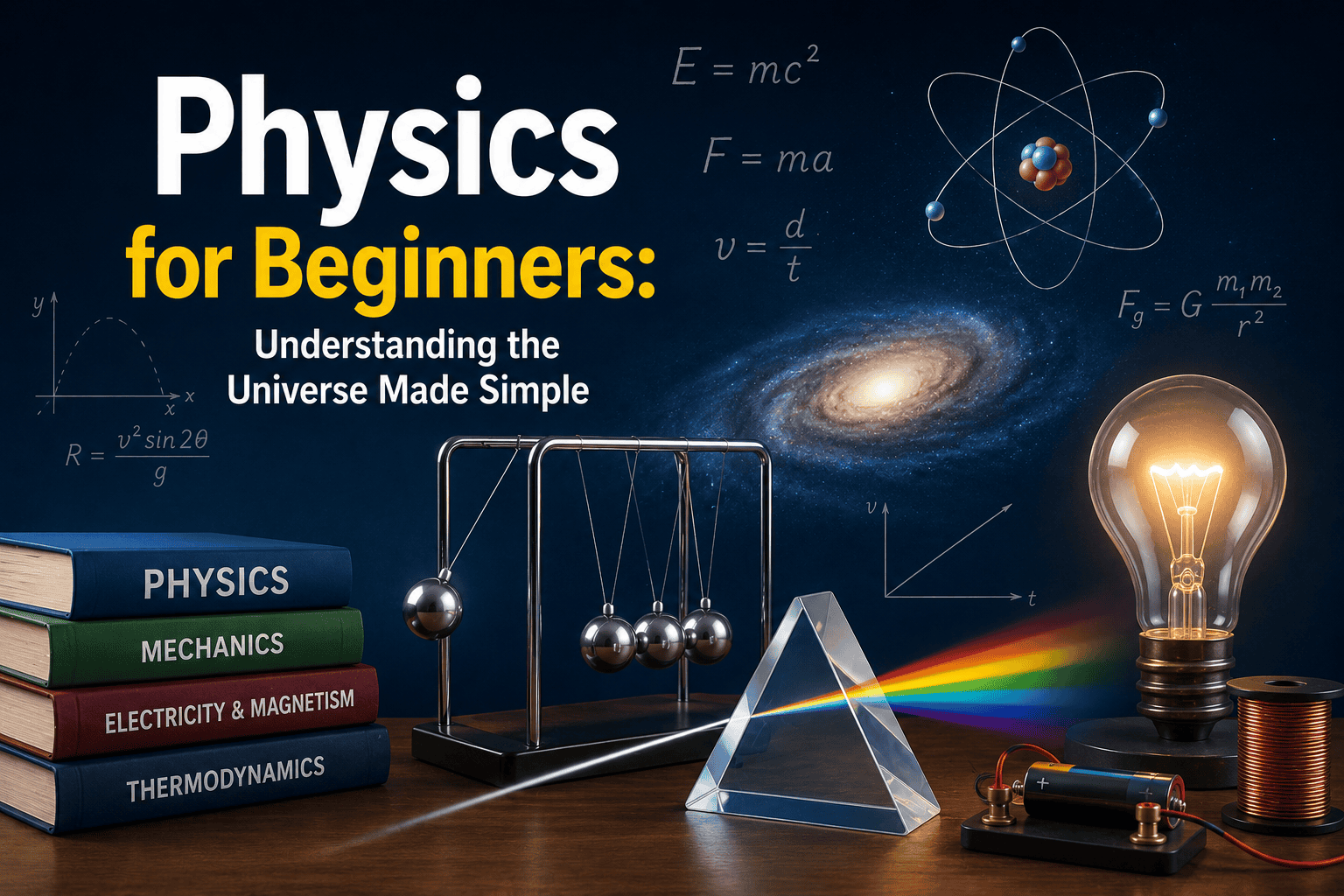
Content Overview
Introduction to Physics
Definition and Scope of Physics
Physics is the branch of natural science that studies matter, energy, space, time, and the forces that govern their interactions. It aims to explain how the universe operates at its most basic level, from the movement of everyday objects to the behavior of atoms and galaxies.
Physics explains why objects fall, how electricity flows, how light travels, and how stars are born and die. It forms the foundation of all other sciences, including chemistry, biology, astronomy, and engineering.
Real-world example: When you drop a ball and it falls to the ground, physics explains this using gravity and motion laws.
Physics is the field of science that studies the nature and behavior of matter and energy. It involves the study of fundamental concepts such as force, motion, energy, and the structure of atoms. Physics not only enhances our understanding of the universe but also lays the foundation for various technological advancements. This introductory chapter will cover the scientific method, emphasizing observation, experimentation, and hypothesis testing as critical tools in the study of Physics.
Importance of Physics in Daily Life
Physics is not confined to laboratories—it is present in everyday life at every moment.
Mobile phones work due to electromagnetism and semiconductor physics
Vehicles move due to mechanics and energy principles
Medical imaging (X-ray, MRI) relies on modern physics
Electricity, fans, refrigerators, and internet all depend on physical laws
Example: A microwave oven warms food by using electromagnetic waves that cause water molecules to vibrate and generate heat.
The Scientific Method in Physics
Physics uses a structured process called the scientific method to investigate and understand natural phenomena:
Observation
Hypothesis
Experimentation
Data analysis
Conclusion
Verification
Physics demands repeatable experiments and mathematical explanation, making it one of the most precise sciences.
Example: Galileo observed falling objects, tested them experimentally, and formulated laws of motion.
Chapter 1: Mechanics
1.1 Motion in One Dimension
Motion in one dimension occurs along a straight line, such as a car moving on a straight road. Motion in a single dimension is the change in an object’s position as time passes. Key terms include displacement (the shortest distance from initial to final position), velocity (the rate of change of displacement), and acceleration (the rate of change of velocity).
Example: When a car moves 100 meters north in 5 seconds, its velocity is found by dividing displacement by time:
Velocity = Displacement ÷ Time = 100 m ÷ 5 s = 20 m/s
Displacement, Velocity, and Acceleration
Displacement: Change in position
Velocity: Rate of change of displacement
Acceleration: Rate of change of velocity
Example: If a car moves 100 meters forward in 5 seconds, its average velocity is 20 m/s.
1.2 Motion in Two Dimensions
When motion occurs in a plane, it is two-dimensional. Motion in Two Dimensions: This includes analyzing motion in a plane, where both horizontal and vertical components are considered.
Example: A basketball player shoots a ball at an angle. The ball follows a parabolic trajectory, and its horizontal and vertical motions can be analyzed separately using projectile motion equations.
Projectile Motion
An object projected into the air follows a curved path due to gravity.
Example: A basketball thrown toward a hoop follows a parabolic trajectory.
1.3 Laws of Motion
Newton’s laws of motion explain how an object’s movement is affected by the forces acting on it.
Example: Newton’s first law states that an object at rest will stay at rest unless acted upon by a net external force. This is why seatbelts are crucial; they prevent passengers from continuing forward when a car stops suddenly.
Newton’s Laws of Motion
An object stays at rest or continues moving unless a force acts on it.
Force equals mass times acceleration
Each action produces a reaction that is equal in magnitude but opposite in direction.
Example: Seatbelts protect passengers by stopping sudden motion during braking.
1.4 Work, Energy, and Power
Work, energy, and power: Work occurs when a force leads to the movement of an object over a distance. Energy is the ability to do work, while power tells how quickly that work is done.
Example: Lifting a box requires work, calculated as: Work = Force × Distance = m · g · h. Here, m represents mass, g stands for gravitational acceleration, and h indicates height.
Work: Force applied over distance
Energy: Ability to do work
Power: Rate of doing work
Example: Lifting a bag upstairs requires work against gravity.
1.5 System of Particles and Rotational Motion
System of Particles and Rotational Motion: Explores the behavior of systems of particles and introduces rotational dynamics.
Example: A spinning wheel demonstrates angular velocity and the effect of torque when a force is applied at a distance from the axis of rotation.
Center of Mass and Torque
Torque causes rotation, while center of mass determines balance.
Example: A spinning wheel continues rotating due to angular momentum.
Chapter 2: Properties of Matter
2.1 Solids, Liquids, and Gases
States of Matter and Their Properties: Discusses the characteristics and differences between the three states of matter, including intermolecular forces.
Example: Ice floats on water because it is less dense, showcasing how temperature affects state and density.
Matter exists in different states depending on particle arrangement.
Example: Ice floats on water because solid water is less dense than liquid water.
2.2 Mechanical Properties of Solids
Mechanical Properties of Solids: Covers stress (force per unit area) and strain (deformation due to applied stress).
Example: Stretching a rubber band demonstrates elastic properties; the band returns to its original shape when the force is removed, illustrating Hooke’s Law.
Stress: Force per area
Strain: Deformation
Young’s Modulus: Elasticity
Example: When a rubber band is pulled, it elongates under the applied force and then returns to its original shape once the force is released.
2.3 Thermal Properties of Matter
Thermal Properties of Matter: Discusses heat transfer mechanisms: conduction, convection, and radiation.
Example: When heating a metal rod, heat is conducted from the hot end to the cold end, demonstrating conduction.
Heat transfers through: Conduction, Convection, Radiation
Example: Boiling water transfers heat through convection currents.
2.4 Kinetic Theory of Gases
Kinetic Theory of Gases: Explains the behavior of gases in terms of particle motion and interactions.
Example: Helium balloons rise because helium is less dense than the surrounding air, illustrating the principles of buoyancy.
Gas pressure arises from molecular collisions. Gas Laws and Their Applications
Example: Helium balloons expand when heated due to increased molecular motion.
Chapter 3: Thermodynamics
3.1 Temperature and Heat
Temperature and Heat: Differentiates between temperature and heat, explaining thermal equilibrium.
Example: When two objects at different temperatures come into contact, heat flows from the hotter object to the cooler one until they reach thermal equilibrium.
Temperature measures average kinetic energy. Concepts of Temperature and Thermal Equilibrium
Example: Metal expands when heated due to increased atomic vibration.
3.2 Laws of Thermodynamics
Laws of Thermodynamics: Introduces the laws governing energy transfers and transformations.
Example: The efficiency of a heat engine is calculated using the formula: Efficiency = Work Output / Heat Input
First, Second, and Third Laws of Thermodynamics – Example: The Efficiency of Heat Engines
Energy is conserved
Entropy increases
Absolute zero cannot be reached
Example: No engine can be 100% efficient.
3.3 Heat Engines and Refrigerators
Heat Engines and Refrigerators: Discusses how heat engines convert heat into work and how refrigerators transfer heat.
Example: A refrigerator removes heat from the interior and expels it outside, demonstrating the second law of thermodynamics.
They convert heat into work or vice versa. Working Principles and Applications
Example: A refrigerator works by taking heat from its interior and releasing it into the surrounding environment.
Chapter 4: Waves and Oscillations
4.1 Simple Harmonic Motion
Simple Harmonic Motion: Analyzes periodic motion in systems like pendulums and springs.
Example: The motion of a pendulum is an example of SHM, with a restoring force proportional to its displacement from equilibrium.
Periodic motion around equilibrium – Characteristics of SHM – Example: The Motion of a Pendulum
Example: A pendulum oscillating back and forth.
4.2 Waves
Waves: Differentiates between mechanical waves (requiring a medium) and electromagnetic waves (can travel in a vacuum).
Example: Sound waves are mechanical waves that require a medium like air or water to propagate.
Types of Waves: Mechanical and Electromagnetic – Example: The Sound Wave and Its Properties
Mechanical waves need a medium
Electromagnetic waves do not
Example: Sound waves travel through air, light through vacuum.
4.3 Wave Properties
Wave Properties: Discusses phenomena like reflection and refraction, crucial for understanding wave behavior.
Example: A straw appears bent in a glass of water due to the refraction of light as it passes from water to air.
Reflection, refraction, and diffraction explain wave behavior.
Example: A straw looks bent in water because light changes direction when it moves from one medium to another, a phenomenon known as refraction.
4.4 Superposition and Interference
Superposition and Interference: Introduces the principle of superposition and how waves interact.
Example: When two waves meet, they can interfere constructively or destructively, creating patterns such as those seen in water ripples.
Constructive and Destructive Interference. Waves combine to reinforce or cancel.
Example: Water ripples overlapping in a pond.
Chapter 5: Optics
5.1 Nature of Light
Nature of Light: Examines the dual wave-particle nature of light.
Example: The phenomenon of diffraction demonstrates the wave nature of light as it bends around obstacles.
Light behaves as both wave and particle. Wave and Particle Nature of Light
Example: Reflection allows us to see objects in mirrors.
5.2 Geometrical Optics
Geometrical Optics: Discusses the laws governing the behavior of light in terms of rays, including reflection and refraction.
Example: A plane mirror reflects light according to the law of reflection: the angle of incidence equals the angle of reflection.
Laws of Reflection and Refraction – Example: The Working of Lenses
Light follows laws of reflection and refraction.
Example: Eyeglasses correct vision using lenses.
5.3 Optical Instruments
Optical Instruments: Covers the function and principles of microscopes and telescopes.
Example: A compound microscope uses multiple lenses to magnify small objects, illustrating the principles of optics.
Microscopes magnify small objects; telescopes observe distant ones. Example: How a Camera Works. A camera focuses light on a sensor to capture images.
Chapter 6: Electricity and Magnetism
6.1 Electrostatics
Electrostatics: Explores electric charges, forces, and fields.
Example: A charged balloon sticks to a wall due to electrostatic attraction between charges.
Charge, Coulomb’s Law, and Electric Fields – Example: The Attraction Between Charged Objects
Electric charges exert forces.
Example: A charged balloon sticks to a wall.
6.2 Current Electricity
Current Electricity: Introduces electric current, voltage, and resistance.
Example: Ohm’s Law (V = IR) demonstrates the relationship between voltage, current, and resistance in a circuit.
Ohm’s Law and Circuits – Example: Calculating Resistance in a Circuit
Flow of charge through conductors.
Example: Bulbs glow due to electric current in filaments.
6.3 Magnetism
Magnetism: Discusses magnetic fields and forces.
Example: A compass needle aligns itself with the Earth’s magnetic field, providing direction.
Magnetic Fields and Forces – Example: The Behavior of Compass Needles
Magnetic fields exert forces on moving charges.
Example: Compass needles align with Earth’s magnetic field.
6.4 Electromagnetism
Electromagnetism: Explains the interrelationship between electricity and magnetism.
Example: A generator converts mechanical energy into electrical energy using electromagnetic induction.
Faraday’s Law and Induction – Example: How Generators Produce Electricity
Changing magnetic fields induce electricity.
Example: Generators produce electricity using rotating coils.
Chapter 7: Modern Physics
7.1 Quantum Physics
Quantum Physics: Introduces the concepts of quantization and the behavior of particles at the atomic level.
Example: The photoelectric effect demonstrates that light can dislodge electrons from a material, supporting the particle theory of light.
Energy exists in discrete packets.
Example: Photoelectric effect enables solar panels.
7.2 Atomic Physics
Atomic Physics: Covers the structure and behavior of atoms.
Example: Understanding isotopes, such as carbon-12 and carbon-14, helps explain radioactivity.
Structure of the Atom and Electron Configuration – Example: Understanding Isotopes
Atoms consist of nuclei and electrons.
Example: Isotopes differ in neutron number.
7.3 Nuclear Physics
Nuclear Physics: Discusses nuclear reactions, including fission and fusion.
Example: The process of nuclear fission in reactors provides energy through the splitting of heavy atomic nuclei.
Radioactivity and Nuclear Reactions – Example: The Process of Nuclear Fission
Studies nuclear reactions.
Example: Nuclear fission releases enormous energy.
7.4 Relativity
Relativity: Introduces Einstein’s theory of relativity and its implications for time and space.
Example: Time dilation, where time moves slower at high speeds, explains why astronauts age slightly less than people on Earth.
Introduction to Einstein’s Theory of Relativity – Example: Time Dilation Explained
Space and time are relative.
Example: Time slows for astronauts moving at high speeds.
Chapter 8: Astrophysics and Cosmology
8.1 Structure of the Universe
The Universe and Its Structure: Discusses celestial bodies and their interactions.
Example: The life cycle of a star, from nebula to supernova, illustrates the processes of stellar evolution.
Galaxies, Stars, and Planets – Example: The Life Cycle of a Star
Stars form galaxies; galaxies form clusters.
Example: The Sun is a medium-sized star.
8.2 Big Bang Theory
The Big Bang Theory: Describes the widely accepted explanation for how the universe began.
Example: The redshift of galaxies provides evidence for the expanding universe, supporting the Big Bang theory.
Understanding the Origin of the Universe – Example: Evidence Supporting the Big Bang Theory
Universe expanded from a hot dense state.
Example: Cosmic background radiation supports this theory.
8.3 Black Holes and Dark Matter
Black Holes and Dark Matter: Introduces concepts of black holes and their effect on surrounding space.
Example: The gravitational pull of a black hole is so strong that not even light can escape, making them invisible.
Concepts and Theories – Example: The Effect of Black Holes on Surrounding Matter
Invisible forces shape galaxies.
Example: Black holes bend light and trap matter.