Cosmology (Big Bang)
Explore the Origin, Structure, and Future of the Universe — Cosmology is the scientific study of the universe on its largest scales, focusing on how it began, how it has developed, how its major structures formed, and what may happen to it in the distant future. It investigates major topics such as the Big Bang, cosmic inflation, dark matter, dark energy, galaxies, and the large-scale structure of spacetime. By examining evidence from observations, mathematical models, and physical theories, cosmology seeks to build a comprehensive picture of the universe and its evolution.
The field brings together physics, mathematics, astronomy, and philosophical inquiry to investigate some of the most fundamental questions about existence. Beyond determining how cosmic processes occur, cosmology also encourages deeper reflection on why the universe has the properties we observe and what those properties reveal about reality. At its core, cosmology explores where the universe came from, how it became what it is today, and what its ultimate future might be.
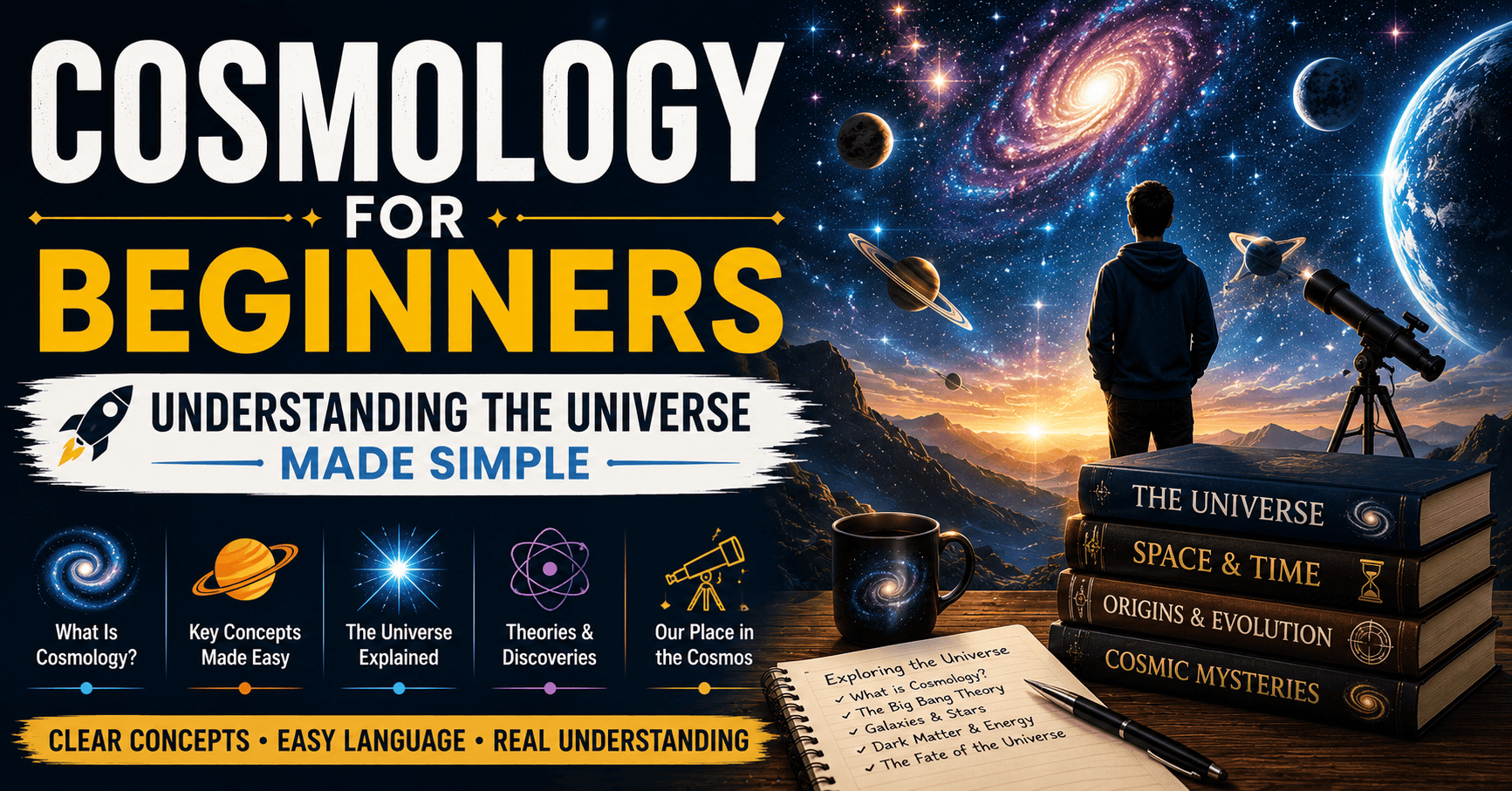
Content Overview
- Cosmology: Understanding the Universe, Space, and Time
- The Big Bang and Modern Cosmology
- The Anthropic Principle and Fine-Tuning
- Teleology and Purpose in Nature
- Matter in the Universe
- Black Holes and Singularities
- Cosmological Models and Theories
- The Cosmological Argument for a First Cause
- The Future of Cosmology
Cosmology: Understanding the Universe, Space, and Time
What Is Cosmology?
Cosmology is the scientific and philosophical study of the universe in its entirety, including its origin, structure, and evolution. It explores the origin, structure, evolution, and ultimate fate of the cosmos. From the earliest myths about the heavens to modern discoveries about dark matter and black holes, cosmology attempts to answer humanity’s deepest questions about reality. Scientists use physics, astronomy, and mathematics to investigate the universe, while philosophers examine its meaning, structure, and metaphysical foundations. Together, these perspectives create a comprehensive understanding of the cosmos.
Cosmology is the scientific study of the universe on its largest scales. It seeks to understand:
- how the universe began
- how it evolves over time
- what physical laws govern it
- how it may eventually end
Unlike ordinary astronomy, which studies individual celestial objects such as stars or planets, cosmology focuses on the universe as a complete system. Example: A cosmological question might be: If everything has a cause, then what caused the universe itself?
Importance of Cosmology in Philosophy
In philosophy, cosmology overlaps with metaphysics, the study of the nature of existence. Philosophers ask questions such as:
- Why does the universe exist?
- Is reality purely physical?
- Does the universe have a purpose?
- Are the laws of physics necessary or accidental?
These questions push cosmology beyond observation into deeper philosophical reflection.
Historical Development of Cosmology
Human ideas about the universe have changed dramatically over time.
Ancient Cosmology: Early civilizations explained the universe using myths and divine forces.
Greek Cosmology: The Ptolemaic model placed Earth at the center of the universe.
The Copernican Revolution: Nicolaus Copernicus suggested that the Sun lies at the center of the planetary system.
Modern Cosmology: Major developments include:
- Einstein’s General Relativity
- Hubble’s discovery of cosmic expansion
- The Big Bang theory
Expansion of the Universe
Balloon Model
Observations indicate that galaxies are drifting away from one another. This means the universe is expanding. Balloon Model: Imagine dots drawn on a balloon. As the balloon inflates:
- the dots move farther apart
- the surface expands
Similarly, in the universe, space itself expands.
Nature of the Universe: Infinite vs Finite Universe
One of the deepest questions in cosmology is whether the universe is finite or infinite.
Infinite Universe: An infinite universe has:
- no edge
- no boundary
- endless space
Finite Universe: A finite universe has:
- a beginning
- possibly an eventual end
However, it may still be unbounded, meaning there is no physical edge.
The Cosmological Principle
Modern cosmology assumes that the universe is uniform on large scales. This idea is called the Cosmological Principle. It has two components:
- Homogeneity: The universe is roughly the same everywhere.
- Isotropy: The universe looks the same in every direction.
Physics Behind Cosmology
Cosmology depends heavily on fundamental physics.
General Relativity: Einstein’s theory explains gravity as the bending of spacetime.
Quantum Mechanics: Quantum physics explains the behavior of matter at extremely small scales.
Thermodynamics: The second law of thermodynamics explains the increase of entropy and the direction of time.
Electromagnetism: Electromagnetic radiation allows scientists to observe distant galaxies.
Laws of Physics and Their Big Questions
Scientists rely on certain physical laws (like gravity and electromagnetism) to explain how the universe works. These laws seem to be the same everywhere in the universe. But people often ask: Why do these laws exist, and why are they the way they are? Some think that the exact nature of these laws hints at a deeper purpose or reason for the universe’s existence. If these laws were even slightly different, the universe would be a very different place.
The Big Bang and Modern Cosmology
The Big Bang Theory
The Origin of the Universe: Modern cosmology explores the origin, structure, development, and ultimate fate of the universe. The Big Bang Theory is the most widely accepted scientific explanation for how the universe began.Metaphysical Questions:
- Was there “something” before the Big Bang?
- Does “before” even make sense if time began at t = 0?
The Big Bang Theory: The Big Bang Theory states that the universe began about 13.8 billion years ago from an extremely hot, dense, and infinitely small point called a singularity. From this point, the universe expanded rapidly and has continued expanding ever since.
This expansion was not like a typical explosion in space. Instead, space itself expanded, causing galaxies to move farther apart over time.
Evidence Supporting the Big Bang Theory
1. Cosmic Microwave Background Radiation (CMB)
The Cosmic Microwave Background is a weak form of radiation that permeates all of space. It was discovered in 1965 by Arno Penzias and Robert Wilson.
- It is the leftover radiation from the Big Bang.
- It originated nearly 380,000 years after the Big Bang.
- It gives a glimpse of what the early universe looked like.
Small fluctuations in the CMB represent early density variations that later formed galaxies, stars, and planets.
2. Redshift of Galaxies
Astronomers observe that distant galaxies appear redshifted, meaning their light stretches to longer wavelengths. This shows:
- Galaxies are moving away from us.
- More distant galaxies move away from us at higher speeds.
This observation is explained by Hubble’s Law and confirms that the universe is expanding.
3. Abundance of Light Elements
The Big Bang theory predicts certain quantities of:
- Hydrogen
- Helium
- Lithium
Observations of these elements in the universe closely match theoretical predictions from Big Bang nucleosynthesis, further supporting the theory.
Timeline of the Early Universe
The early universe passed through several important stages.
| Time After Big Bang | Event |
|---|---|
| 0 seconds | Universe begins as a singularity |
| 10⁻⁴³ seconds | Planck Era – quantum gravity dominates |
| 10⁻³² seconds | Cosmic inflation (extremely rapid expansion) |
| 3 minutes | Formation of first nuclei (hydrogen and helium) |
| 380,000 years | First atoms form and CMB radiation appears |
| 200 million years | First stars and galaxies form |
| ~1 billion years | Large-scale cosmic structures develop |
Cosmic Inflation
Cosmic Inflation refers to a period of extremely rapid expansion that occurred within the first fraction of a second after the Big Bang. Inflation explains:
- Because of the cosmological principle, the universe is uniform and isotropic on large scales, so it appears the same in every direction.
- Why space appears flat
- How tiny fluctuations grew into galaxies and cosmic structures
The Singularity and Planck Epoch
At the very beginning, the universe existed as a singularity, a state of:
- Infinite density
- Infinite temperature
During the Planck Epoch (first 10⁻⁴³ seconds):
- Quantum gravitational forces dominated
- Current physical theories cannot fully describe conditions
Understanding this period requires a future theory combining quantum mechanics and general relativity.
The Anthropic Principle and Fine-Tuning
The Anthropic Principle
The Anthropic Principle suggests that the universe’s physical constants appear finely tuned to allow the existence of life. Two main versions exist:
- Weak Anthropic Principle: The universe must allow life because we exist to observe it.
- Strong Anthropic Principle: The universe may be structured in such a way that life is inevitable.
Fine-Tuning of the Universe
Certain physical constants seem precisely balanced for life to exist, including:
- Strength of gravity
- Electromagnetic force
- Mass of elementary particles
If these values were slightly different:
- Stars might not form
- Planets might not exist
- Life might be impossible
Example: If gravity were stronger, stars would use up their energy much faster. If weaker, stars might never form.
This fine-tuning raises important questions:
- Is the universe designed?
- Is it a coincidence?
- Are there many universes?
Teleology and Purpose in Nature
Teleology
Teleology is the philosophical idea that the universe may have purpose or direction. Some thinkers argue:
- The order and structure of the universe suggest purpose
- Natural systems seem organized toward specific outcomes
Example: A tree grows in ways that maximize survival. Similarly, some believe the universe may operate according to a larger purpose.
Matter in the Universe
Matter
Matter, the “stuff” that makes up everything we can see and feel, exists in the form of particles. The universe’s matter content can be categorized into:
Ordinary Matter
Matter made of atoms that forms:
- Stars
- Planets
- Humans
- Galaxies
This makes up only about 5% of the universe.
Dark Matter
Dark matter is an unseen form of matter that accounts for roughly 27% of the universe and cannot be directly detected because it does not emit, absorb, or reflect light.
- Does not emit light
- Does not absorb light
- Does not reflect light
Its presence is inferred through gravitational effects.
Evidence for Dark Matter:
- Galactic rotation curves
- Gravitational lensing
- CMB fluctuations
Dark Energy
Dark Energy is a mysterious force making up about 68% of the universe. It is thought to be responsible for the universe’s accelerated expansion.
Evidence for Dark Energy:
- Observations of distant supernovae
- Large-scale cosmic expansion patterns
Dark energy acts like a repulsive force, pushing galaxies farther apart over time.
Black Holes and Singularities
What is Black Holes
A black hole is an area in space where gravity is so intense that even light cannot escape its pull. They are created when massive stars collapse under their own gravity.
Key Features: The event horizon is the boundary beyond which nothing can escape.
Singularity: A central point with extremely high, seemingly infinite density.
Types of Black Holes
Stellar Black Holes: These are formed from the collapse of massive stars after they burn out. They typically have masses several times that of the Sun.
Supermassive Black Holes: Found at the centers of galaxies, these black holes have millions or billions of times the mass of the Sun.The Milky Way’s central supermassive black hole is called Sagittarius A*.
Intermediate Black Holes: These black holes are thought to be in the mass range between stellar and supermassive black holes. Their existence is still debated.
Primordial Black Holes: Hypothetical black holes that could have formed during the early universe due to high-density fluctuations in the vacuum.
An example is Sagittarius A*, the supermassive black hole at the center of our galaxy.
Black Hole Paradoxes
Black holes present numerous paradoxes and mysteries, especially related to information loss. The information paradox arises from the fact that, according to quantum mechanics, information cannot be lost, but when matter falls into a black hole, it seems to be destroyed. This creates a conflict between general relativity (which describes black holes) and quantum mechanics.
Example: Time Dilation Near a Black Hole As an object approaches a black hole, time appears to slow down relative to an observer far away.This phenomenon occurs because spacetime becomes extremely distorted near the event horizon. If an astronaut were to fall into a black hole, from their perspective, time would seem to pass normally, but to an outside observer, the astronaut’s descent would appear to slow down as they approach the event horizon, freezing at the edge.
Cosmological Models and Theories
Standard Model of Cosmology (ΛCDM)
The Lambda Cold Dark Matter Model is the current standard cosmological model. It includes:
- Lambda (Λ) – dark energy
- Cold Dark Matter (CDM) – invisible matter affecting galaxy formation
This model successfully explains:
- Cosmic microwave background
- Expansion of the universe
- Formation of large cosmic structures
Alternative Cosmological Models
Steady State Theory suggests that the universe is eternal and keeps a constant density even as it continues to expand. This theory has largely been replaced by the Big Bang model.
Cyclic Universe Theory: Suggests the universe undergoes repeated cycles: Big Bang → Expansion → Big Crunch → New Big Bang.
The Multiverse Hypothesis
The multiverse theory suggests that our universe may be just one among many. Each universe could have different:
- Physical laws
- Constants
- Dimensions
Types of Multiverses:
- Quantum Multiverse (Many Worlds Interpretation)
- Bubble Universes
- String Theory Multiverse
- Mathematical Multiverse
Example: Imagine a vast forest where every tree represents a different universe.
The Cosmological Argument for a First Cause
The Cosmological Argument is a philosophical argument stating that everything has a cause. Since the universe exists, there must be a First Cause that initiated it. Example: Imagine a row of dominoes. Each domino falls because another pushed it. But there must be a first domino that started the chain. Many philosophers identify this first cause as God.
Philosophical Contributions
Thomas Aquinas proposed five arguments to demonstrate the existence of God.
Leibniz: Introduced the Principle of Sufficient Reason: Everything exists for a reason.
Kant: Criticized the cosmological argument, arguing that human reason cannot prove the existence of a necessary being. Immanuel Kant critiqued the cosmological argument, claiming that it fails to prove the necessity of God. He argued that human reason cannot conceive of a necessary being because our knowledge is limited to experience and not pure reason.
Example: Is the Universe’s Existence Necessary? Consider the question of why anything exists at all rather than nothing. The cosmological argument proposes that the universe exists because of a necessary being that supports or sustains it. Without this first cause, there would be nothing at all.
The Future of Cosmology
Important areas of ongoing research include:
- Dark Matter
- Dark Energy
- Quantum Gravity
- Search for exoplanets
- Possibility of extraterrestrial life
The Fate of the Universe
Scientists propose several possible endings for the universe.
Big Freeze: The universe keeps expanding until stars eventually die out, leaving everything cold and dark.
Big Crunch: The Big Crunch is a scenario where the expansion of the universe eventually slows down and reverses. Gravitational attraction would cause galaxies, stars, and planets to collapse into a singularity. This idea is predicated on the assumption that the universe contains enough mass to eventually halt its expansion. However, current observations indicate that the universe is expanding faster over time, which makes the Big Crunch scenario less likely.
Big Rip: Dark energy becomes so strong that galaxies, stars, planets, and atoms are torn apart.