Accounting (Accountancy)
Understand How Financial Data Reveals the Real Condition of a Business — Accounting focuses on the systematic process of recording, organizing, analyzing, and reporting an organization’s financial activities. It provides a clear view of a business’s financial position and performance by tracking important elements such as income, expenses, assets, liabilities, and equity. The field includes essential areas such as bookkeeping, financial statements, auditing, taxation, and financial reporting, all of which help maintain accurate and transparent records.
Accounting combines detailed financial practices with established standards and regulations to ensure that reported information is reliable and understandable. Accurate accounting plays an important role in building confidence among investors, regulators, managers, and other stakeholders by providing trustworthy financial information for decision-making. At its core, accounting examines how financial activity is measured, documented, and communicated to represent an organization’s economic reality.
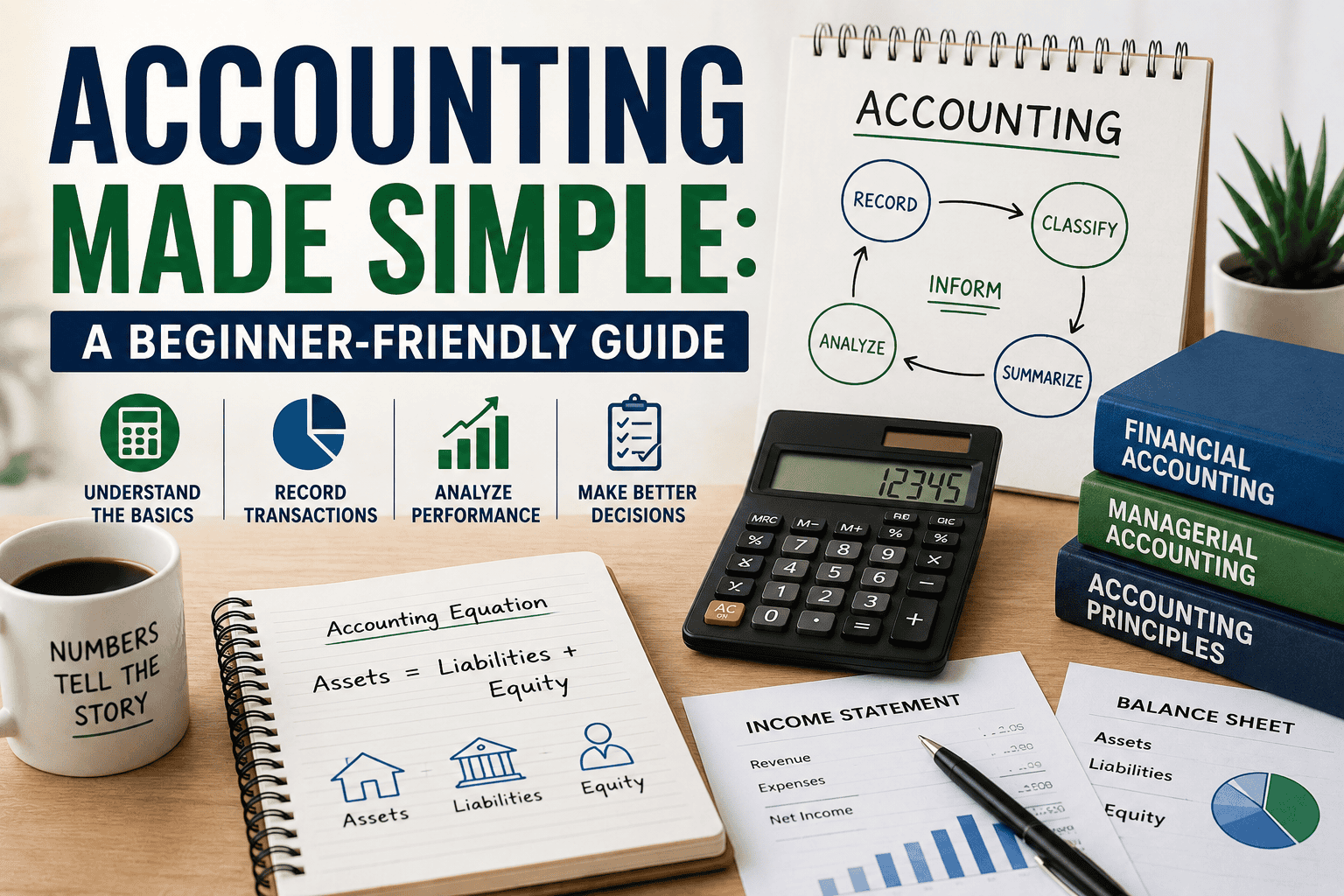
Content Overview
- 1. INTRODUCTION TO ACCOUNTING
- 1.1. What is Accounting?
- 1.2. Accounting vs Book‑Keeping vs Accountancy
- 1.3. Importance of Accounting
- 1.4. Objectives & Functions of Accounting
- 1.5. Evolution, Scope & Career of Accounting
- 1.6. Accounting Information and Users
- 1.7. Accounting Principles and Characteristics
- 1.8. Types of Accounting
- 1.9. Accounting Frameworks, Period, Boards & Standard
- 1.10. Accounting Ethics & Professionalism
- 2. ACCOUNTING ELEMENTS & TERMINOLOGY
- 2.1. Basic Accounting Elements
- 2.1.1. Business Entity
- 2.1.2. Assets and Assets Types
- 2.1.3. Liabilities and Liabilities Types
- 2.1.4. Equity and Capital
- 2.1.5. Capital
- 2.1.6. Drawings
- 2.1.7. Revenue & Income
- 2.1.8. Expenditure
- 2.1.9. Profit, Gain, Loss, Expenses & Depreciation
- 2.1.10 Goods, stock, or inventory refer to items owned by a business for resale, along with vouchers and discounts used in transactions.
- 2.1.11. Purchases, Purchase Returns, Sales & Sales Returns
- 2.1.12. Debtors & Creditors
- 2.1.13. Proprietor
- 2.1. Basic Accounting Elements
- 3. ACCOUNTING CYCLE (Process of Accounting)
- 3.1. Accounting Cycle
- 3.2. Business Transactions & Transaction Analysis
- 3.3. Journal Entries (Books of Original Entry): Double Entry System
- 3.4. Ledger Accounts (T‑Accounts)
- 3.5. Trial Balance (31-Dec-20X1)
- 3.6. Bank Reconciliation Statement (BRS), Adjusting Entries and Closing Stock
- 3.7. Final Accounts & Special Adjustments
1. INTRODUCTION TO ACCOUNTING
1.1. What is Accounting?
Accounting means recording financial transactions of a firm or business. In simple accounting, every money‑related activity of a business is properly recorded. Whenever a business handles money—receiving, paying, buying, or selling—an accounting transaction occurs and must be written down correctly. This process of writing and organizing money information is called accounting.
In simple terms: Accounting = Keeping money records properly.
Example:
Imagine a notebook where you write: how much money you receive, how much you spend, and how much is left at the end. That notebook represents basic accounting. So accounting involves: writing money records, calculating profit or loss, and understanding the financial position.Formal meaning: Accounting is the process of identifying, recording, classifying, summarizing, analyzing, and reporting financial transactions of a business. It captures financial transactions and then summarizes, analyzes, and reports financial information of an individual, business, or organization. It provides important financial data that helps stakeholders make decisions, evaluate financial health, and meet legal and regulatory requirements.
1.2. Accounting vs Book‑Keeping vs Accountancy
Many people confuse bookkeeping, accounting, accounts, and accountancy, but these terms are related yet distinct.
- Bookkeeping is the process of accurately recording financial transactions—it is essentially writing the story of the business.
- Accounting extends this process by analyzing, summarizing, and interpreting financial data, serving as the eyes of the business.
- Accountancy is the broader professional field that encompasses both bookkeeping and accounting, providing expertise, insights, and strategies to guide business decisions.
Accounting → Analyzing, reporting, and decision‑making using accounts. It follows CSAR: Classification (group similar transactions), Summarize (find totals), Analyze (understand results), Report (present financial information). Accounting helps management, investors, and other users make informed decisions.
Example (Bakery):
Capture: Record cake sales and expenses
Summarize: Total income and costs
Analyze: Profit or loss
Report: Income Statement & Balance Sheet
Bookkeeping → Writing down transactions. It is only concerned with recording and maintaining records, not analysis or decision‑making. Bookkeeping ensures nothing is forgotten.
Importance of Bookkeeping: It is the foundation of accounting. Without bookkeeping, accounting cannot be performed. It keeps track of all money transactions, prevents errors and fraud, helps prepare financial statements, and supports planning and decision‑making.
Example:
If you don’t write expenses, you won’t know why pocket money finishes early.Accounts → Summary of recorded transactions.
Accountancy → The complete field that includes bookkeeping, accounting, analysis, and professional judgment. It converts financial data into meaningful insights for business decisions, including bookkeeping, accounting, financial analysis, auditing, advisory, and decision‑making.
In simple terms: bookkeeping writes the story, accounting reads and understands the story, and accountancy explains its meaning and helps in decision‑making.
Comparison table:
| Feature | Bookkeeping | Accounting | Accountancy |
|---|---|---|---|
| Purpose | Record transactions | Analyze & report | Deliver expert insights and strategic guidance to support business growth. |
| Scope | Limited to recording | Recording + analysis | Encompasses bookkeeping and accounting professionally |
| Output | Journals and ledgers | Income statement and balance sheet | Provides financial guidance, strategic insights, and decision-making support |
| Nature | Clerical | Analytical | Professional & strategic |
1.3. Importance of Accounting
Why is accounting important? Because it shows business health, supports decision‑making, controls expenses, prevents fraud, helps planning, builds trust, supports growth, and ensures survival.
Advantages of Accounting:
- Shows financial health
- Helps decision‑making
- Controls expenses
- Supports planning
- Builds investor trust
- Helps in loans and taxes
- Prevents fraud
- Improves business growth
- Supports budgeting
- Builds business credibility
Limitations of Accounting:
- Personal Judgment – different accountants may treat items differently
- Historical Nature – shows past values, not current market values
- Estimation Errors – assumptions can cause inaccuracy
- Non‑Financial Factors Ignored – emotions, loyalty, satisfaction not recorded
- Complexity – requires skill and knowledge
- Costly – needs systems and professionals
Why Accounting is Needed:
It keeps track of money, supports decision‑making, is required by law, is needed by shareholders and investors, helps in business planning, prevents fraud and mistakes, and builds trust in business records.
It ensures all transactions are recorded systematically, produces accurate financial statements, maintains the accounting equation balance (Assets = Liabilities + Equity), and helps owners, managers, and auditors make decisions. It starts at the beginning of the accounting period and ends after preparing financial statements and closing books.
Role of Accounting in Business:
Accounting helps a business to measure performance, control costs, plan future activities, avoid losses, grow safely, and build trust with outsiders.
Example:
A doctor checks reports before treatment → A businessman checks accounts before decisions. Accounting provides a clear view of a business’s financial health and performance. A business without accounting is like a person walking in darkness. Accounting is not just writing numbers. It has clear objectives, functions, importance, advantages, and limitations. These explain why accounting is needed and what it helps a business achieve.Simple Example:
If you don’t write pocket‑money expenses, you won’t know where money went — and parents won’t trust you. Same with business.Important Accounting Concepts:
- Relevance: Only important information that affects decisions should be reported.
- Reliability: Information must be accurate, unbiased, and verifiable.
- Comparability: Using consistent methods so results can be compared across periods or organizations.
- Understandability: Financial information should be clear and easy to understand.
- Materiality: Focus on significant information that can influence decisions.
- Consistency: Accounting methods should be applied consistently each year.
Why Accounting Concepts Are Needed:
Accounting concepts are basic rules and principles that guide the recording and presentation of financial information. They help maintain consistency, reliability, and comparability in financial reports, provide an accurate and honest representation of financial information, ensure consistency across accounting periods, and help users trust and compare financial data.
1.4. Objectives & Functions of Accounting
Accounting is more than numbers; it tells the business’s financial story. Objectives guide the process from recording transactions to meaningful insights. Accounting has the following main objectives and functions.
Example Startup: Smart Pages Book Shop
Owner: Ali | Initial Cash Invested: 1,000
1. Systematic Record Keeping (Organize Money Properly)
Accounting means recording every business transaction properly and in order.
Why it is important: Easy to find past records, no forgetting of transactions, reduces mistakes, provides proof of payments and receipts.
Book shop example: Cash invested is 1,000, 300 is spent on books and stationery, and 200 is earned from book sales. Cash at end: 1,000 − 300 + 200 = 900. Because records are maintained, Ali knows how much cash is left and how it changed.
2. Profit & Loss Analysis (Understand Business Performance)
Accounting helps to know whether the business earned profit or suffered loss. Profit occurs when income > expenses; loss when expenses > income.
Book shop example: Total sales income = 15,000, Total expenses (books purchase, rent, bills) = 12,000. Profit: 15,000 − 12,000 = 3,000 profit. Accounting clearly shows the book shop is profitable.
3. Analysis (Understand Reasons of Profit or Loss)
Accounting also explains why profit or loss happened, not just the amount.
Questions answered by accounting: Which books sell more? Which expenses are high? Where is money wasted? How can profit be increased?
Book shop example: Analysis shows academic books sell faster, rent is high, old magazines do not sell. Ali decides to focus more on academic books, reduce slow‑moving items, control expenses. This improves future performance.
4. Financial position (net worth): understand assets, liabilities, and owner’s equity
Accounting shows what the business owns and what it owes at a specific time.
Formula: Net Worth (Equity) = Assets − Liabilities
Book shop example: Assets (cash + stock of books + furniture) = 12,000, Liabilities (supplier dues) = 4,000. Net Worth: 12,000 − 4,000 = 8,000. This shows the financial strength of the book shop.
Example Transactions:
1. Mr. X starts his business with Rs:100,000 (cash in and credit to capital as return to capital)
2. Purchase Furniture for Rs:4,000
3. Purchase goods for 25,000
4. Paid transportation on goods purchased Rs:1,000
5. Sold goods for Rs:15,000, costing Rs:11,000
6. Purchase Goods on credit basis for Rs:15,000
7. Sold Goods to Mr. Y on credit basis for Rs:8,000, costing Rs:6,500
8. Received cash from Mr. Z Rs:4,000
9. Cash paid to creditor Rs:9,000
10. Paid rent and salaries for the month of June Rs:4,000
Transaction Analysis Table:
| Transactions | Cash | Furniture | Goods | Receivables / Payables | Capital |
|---|---|---|---|---|---|
| Initial Capital | +100,000 | +100,000 | |||
| Purchase Furniture | -4,000 | +4,000 | |||
| Purchase Goods (Cash) | -25,000 | +25,000 | |||
| Transportation Expense | -1,000 | -1,000 | |||
| Sold Goods (15,000, cost 11,000) | +15,000 | -11,000 | +4,000 | ||
| Purchase Goods on Credit | +15,000 | Payables:+15,000 | |||
| Sold on Credit (8,000, cost 6,500) | -6,500 | Receivables:+8,000 | +1,500 | ||
| Cash Received from Mr. Z | +4,000 | Receivables:-4,000 | |||
| Cash Paid to Creditor | -9,000 | Payables:-9,000 | |||
| Rent & Salaries Expense | -4,000 | -4,000 | |||
| Ending Balance | 76,000 | 4,000 | 22,500 | Receivables:4000, Payables:6000 | 100,500 |
Verification: Assets (Cash + Furniture + Goods + Receivables) = Liabilities (Payables) + Owner’s Equity
106,500 (76,000 + 4,000 + 22,500 + 4,000) = 106,500 (6,000 + 100,500)
5. Trusteeship (Responsible Use of Owner’s Money)
The business acts as a trustee of the owner’s money and must use it only for business purposes.
Book shop example: Family gives Ali 1,000 to start book shop. Money used for buying books, shelves, shop supplies—not for personal clothes or mobile phone. This shows honest and responsible use of funds.
One‑Line Conclusion: Accounting helps a business record transactions, calculate profit or loss, analyze performance, know financial position, and use owner’s money responsibly, as seen in the book shop startup.
1.5. Evolution, Scope & Career of Accounting
1.5.1. Scope of Accounting
The scope of accounting includes: recording business activities, preparing financial statements, providing decision support, and ensuring legal and tax compliance.
With the growth of businesses, the scope has expanded to cover more functions: recording business activities, preparing financial statements, providing information for decision‑making, ensuring compliance with laws and taxes, and utilizing accounting software.
1.5.2. Accounting Career and Opportunities
Accounting offers a career with respect, stability, growth, and global opportunities. People who study accounting can work as: accountants, auditors, tax consultants, financial managers, business advisors.
Role of an Accountant: An accountant serves as a financial professional who ensures that a business’s financial information is accurate, reliable, and trustworthy.The role involves recording business transactions correctly, preparing journals and ledgers, calculating profit or loss, and preparing financial statements. An accountant also checks errors, follows accounting rules and laws, and helps management make informed business decisions. To perform these duties effectively, an accountant must be honest, careful, skilled, and responsible. Just like a doctor examines medical reports before prescribing medicine, an accountant carefully checks accounts before giving financial advice. Wrong accounting decisions can lead to business losses, tax problems, and legal issues. In summary, the role of an accountant is crucial for business success.
Evolution of Accounting (Historical vs. Modern):
- Past: Manual accounting, focused only on profit and loss.
- Present: Recording and reporting transactions, decision support for management, legal and tax compliance, use of accounting software.
Today, accounting includes recording transactions, preparing financial reports, helping management in decision‑making, following tax and legal rules, and using accounting software. This shows how accounting has developed from simple record‑keeping into a complete information system.
1.5.3. Professional Accounting Qualifications
1.5.3.1. ACCA
ACCA is a globally recognized accounting qualification that enables professionals to work across countries and multinational firms in accounting, auditing, and finance. Focus areas: financial accounting, management accounting, audit, taxation, business law.
Example:
An ACCA accountant can work in banks, companies, and audit firms worldwide.1.5.3.2. AFD
AFD (Accounting and Finance Diploma) is a basic to intermediate level qualification. It helps students understand accounting fundamentals, prepare basic accounts, and enter junior accounting jobs. Useful for beginners and students starting an accounting career.
Example:
AFD is like learning driving before becoming a professional driver.1.5.3.3. CA
CA (Chartered Accountant) is one of the most respected accounting professions. Chartered Accountants audit company accounts, handle taxation, give financial advice, and ensure legal compliance. Requirements: deep knowledge, strong discipline, hard work.
Example:
Big companies trust CAs to check their financial truth.1.5.3.4. ACAEW
ACAEW (Institute of Chartered Accountants in England and Wales) is a UK‑based professional accounting qualification. It prepares accountants for corporate finance, audit and assurance, and business leadership. Members work in multinational firms and global audit companies.
Example:
An ACAEW accountant may work in international finance companies.1.5.3.5. ICMA
ICMA (Institute of Cost and Management Accountants) focuses on cost and management accounting. ICMA accountants help businesses control costs, reduce waste, improve efficiency, and increase profit. Useful for manufacturing companies, industries, and management decision‑making.
Example:
An ICMA accountant helps decide how to reduce production costs and increase profit.Final Summary: Accounting is a professional career with many opportunities. It offers respect, job security, good income, and global reach. The accountant’s role is vital for business accuracy, decision‑making, and effective financial management.
1.6. Accounting Information and Users
1.6.1. Accounting as an Information System
Accounting works like a system that converts raw data into useful reports.
Types of information accounting provides:
- Money coming in → records income and revenue
- Money going out → records expenses
- Profit and loss → calculates profit or loss
- Assets and debts → shows what the business owns and owes
- Cash flow → shows movement of cash in and out
1.6.2. Types of Accounting Information
Accounting offers various types of information, including financial statements (income statement and balance sheet), budgets for future planning, and reports such as cost analysis and cash flow.
Example:
A report card shows marks, average, and areas to improve—similarly, accounting shows how a business is performing.Analogy:
Just like a report card tells parents about a child’s performance, accounting reports tell users about a business’s performance.Steps in the accounting system:
| Step | Action |
|---|---|
| Input | Transactions such as sales and purchases |
| Process | Journal → Ledger → Trial Balance |
| Output | Financial statements |
Analogy:
Raw food → Input, Cooking → Process, Meal → Output. Similarly, accounting “cooks” raw transactions into meaningful financial reports.Accounting works like a system: first transactions are collected, then they are processed, finally reports are prepared. These reports are called financial statements.
1.6.3. Key Aspects of Accounting Information
- Collection and Recording: Recording every transaction accurately
- Organization and Classification: Grouping data into income, expenses, assets, and liabilities
- Presentation and Reporting: Preparing reports like income statements and balance sheets
1.6.4. Accounting Information vs Financial Information
- Accounting Information: Detailed data about transactions, money received and paid, and decision‑related information.
- Financial Information: Summarized information shown in financial statements like Profit & Loss Account and Balance Sheet.
Example:
Accounting information → Every toy bought and sold.
Financial information → Total money earned and spent on toys.
1.6.5. Accounting as a Source of Information
Accounting provides useful information to many people. It helps users understand business performance and decide what to do next. Accounting as a source of information means collecting, recording, organizing, and presenting financial data in a structured way. It captures business transactions and converts them into reports that show financial performance, position, and cash flow. Accounting serves as a language that communicates a business’s financial performance and position.Just as words form sentences, transactions form accounting information. Raw data such as sales, expenses, and investments is turned into organized and understandable reports. In simple words, accounting is a way to collect, organize, and share financial information so people can understand where money comes from and where it goes.
How it works: Accounting works like a detective that gathers clues (numbers) from sales, expenses, and investments, organizes them, and prepares reports. These reports act like a report card for a business and show how well it is doing financially.
Why it is important: Accounting provides a factual base for decision‑making. It helps owners, managers, banks, and government understand business performance, money flow, and financial position. It guides planning, budgeting, and evaluating success. Just like a map helps plan a journey, accounting helps businesses plan growth, control costs, and improve performance.
Example to understand clearly:
A bakery records daily sales, tracks expenses like flour and wages, and monitors cash flow. At the end of the period, this data is converted into reports showing profit, expenses, and available cash. Similarly, a cake maker tracks ingredients used (expenses) and money earned from selling cakes (revenue). At the end of the day, profit or loss is calculated. This is basic accounting.1.6.6. Users of Accounting Information
Who uses accounting information? Different people use it for different purposes.
Internal Users (inside the business): owner (to know profit or loss), manager (to make decisions), employees.
Example:
A shop owner checks today’s earnings to decide whether to buy more items.External Users (outside the business): bank (to decide loans), government (to calculate tax), investors (to decide whether to invest).
Example:
A bank reviews a company’s financial statements before approving a loan.1.6.6.1. Needs of Users
| User | Need |
|---|---|
| Owner | Profit, loss, financial health |
| Manager | Cost control, future planning |
| Bank | Loan eligibility |
| Investor | Return on investment |
| Government | Tax calculation |
1.7. Accounting Principles and Characteristics
Accounting concepts and principles are rules that help record and present financial information clearly and fairly. Their purpose is to ensure the preparation of reliable, understandable, and comparable financial reports for effective decision‑making.
Example:
Comparing two cars before buying – both sellers use the same rules to show key details, making comparison easy.Key Accounting Principles:
- Materiality: Record only important information that affects decisions; ignore trivial details.
Example: Losing ₹1 → Not important; Losing ₹10,000 → Important. - Objectivity: Accounting records must be based on evidence, not opinions.
Example: Saying “I bought a book” isn’t enough; showing the receipt is required. - Consistency: Use the same methods every year to avoid confusion and allow meaningful comparisons.
Example: Following the same rules in a board game ensures fairness. - Conservatism: Don’t overstate profits or assets; recognize potential losses early.
Example: Record a possible loss now, but don’t record uncertain future gains. - Matching principle: Expenses should be recorded in the same period as the revenues they help generate.
Example: Cost of goods sold is recorded in the same period as sales revenue. - Going concern: Assume the business will keep operating for the foreseeable future.
Example: Financial statements assume the bakery will keep running next year.
1.7.1. Qualitative Characteristics of Accounting Information
Accounting information must have certain qualities to be useful and reliable: Relevance, Reliability, Understandability, Comparability.
- Relevance: Only include information useful for decision‑making.
Example: Last year’s profit helps in planning for the next year. - Reliability: Information must be accurate and verifiable, supported by evidence such as bills, invoices, and receipts.
Example: If a business claims income of 5,000 rupees, it must be supported by receipts or bank statements. - Comparability: Information should allow comparison between different years to identify trends.
Example: Comparing this year’s profit of 10,000 rupees with last year’s profit of 8,000 rupees shows growth. - Understandability: Information should be clear and easy to understand for users.
Example: Showing total income and expenses clearly instead of using complex terms.
1.8. Types of Accounting
Accounting is divided into different types based on the purpose of information and users. The main types are financial, managerial, cost, tax, forensic, governmental, nonprofit, and international accounting.
1.8.1. Financial Accounting
Financial accounting involves recording, summarizing, and reporting financial transactions for external users such as investors, creditors, regulators, and shareholders. Key financial statements include the income statement, balance sheet, and cash flow statement.
Example:
A company prepares annual financial statements and shares them with shareholders.Financial accounting helps in: recording financial transactions, classifying and summarizing data, interpreting and communicating financial information, ensuring legal compliance, evaluating financial performance, analyzing profitability, liquidity, and solvency, monitoring cash flow and inventory, supporting investment and financing decisions, and facilitating audits.
Subtypes of Financial Accounting:
| Type | Meaning | Example |
|---|---|---|
| Cash Basis Accounting | Transactions recorded when cash is received or paid | A small retail store records sales when customers pay cash |
| Accrual Basis Accounting | Transactions recorded when they happen, not when cash is received/paid | A consulting firm records revenue when services are completed, even if payment is pending |
1.8.2. Managerial Accounting
Managerial accounting provides financial information to internal management for planning, decision‑making, and controlling operations. It focuses on internal decision‑making, including planning, budgeting, cost control, and performance evaluation to improve efficiency and profitability.
Example:
A manufacturing company analyzes production costs to determine profitability and selling prices.Subtypes of Managerial Accounting:
| Type | Meaning | Example |
|---|---|---|
| Cost Accounting | Tracking and analyzing production costs | A car manufacturer calculates the cost of each component |
| Budgeting | Preparing budgets to plan and allocate resources | Setting a marketing budget for the next year |
| Performance Analysis | Comparing actual results with budgets | A restaurant compares actual monthly sales with projected sales |
1.8.3. Cost Accounting
Cost accounting focuses on analyzing and allocating costs to products or services to improve cost control and pricing decisions.
Example:
A manufacturing company determines cost per unit by considering materials, labor, and overhead.1.8.4. Tax Accounting
Tax accounting deals with compliance with tax laws and preparation of tax returns.
Example:
A tax accountant prepares business income tax returns while maximizing allowable deductions.Subtypes: Individual Taxation and Corporate Taxation.
1.8.5. Auditing
Auditing involves examining financial records to ensure accuracy, legality, and compliance with accounting standards.
Example:
An external auditor reviews a company’s financial statements and issues an independent opinion.Subtypes:
| Type | Meaning |
|---|---|
| External Auditing | Independent examination of financial statements |
| Internal Auditing | Evaluating internal controls and procedures to ensure they are effective |
1.8.6. Forensic Accounting
Forensic accounting combines accounting, investigative, and legal skills to detect fraud and financial irregularities.
Example:
Investigating suspected fraud by analyzing suspicious financial transactions.1.8.7. Governmental Accounting
Governmental accounting deals with financial reporting for government entities.
Example:
A city government reports annual budgets, revenues, and expenditures for transparency.1.8.8. Nonprofit Accounting
Nonprofit accounting focuses on financial reporting for nonprofit organizations to ensure accountability.
Example:
A charity prepares financial statements showing how donations are utilized.1.8.9. International Accounting
International accounting deals with accounting practices and standards across different countries.
Example:
A multinational company prepares consolidated financial statements under IFRS and local standards.1.9. Accounting Frameworks, Period, Boards & Standard
1.9.1. Frameworks of Accounting
Accounting operates within four main frameworks that guide financial reporting and ensure consistency, transparency, and reliability: Conceptual, Legal, Institutional, and Regulatory.
| Framework | Meaning | Example |
|---|---|---|
| Conceptual | Provides the objectives and principles of accounting | Relevance, faithful representation, comparability, understandability |
| Legal | Defines laws governing accounting and reporting for entities | Companies Act, tax laws, corporate regulations |
| Institutional | Comprises bodies that set accounting standards and guidance | IASB, FASB |
| Regulatory | Contains rules issued by regulatory authorities | SEC, SEBI |
Summary:
- Conceptual → sets accounting objectives and principles
- Legal → governs compliance through laws
- Institutional → provides standard‑setting guidance
- Regulatory → enforces rules and oversight
These frameworks together form the foundation of accounting, guide financial disclosures, ensure compliance, and support reliable reporting.
1.9.2. Accounting Period Concept
1.9.2.1. What is an Accounting Period?
An accounting period is a fixed time frame in which a business records and reports its financial transactions. It ensures that financial information is organized, comparable, and useful for decision‑making. Businesses prepare reports yearly, quarterly, or half‑yearly. Accounting cycles may vary by country.
Example: Austria – Jan 1 to Dec 31
1.9.2.2. Accounting Period and Reporting Cycles
| Type | Meaning |
|---|---|
| Annual Reporting | Reports covering 12 months (e.g., Jan–Dec) |
| Quarterly Reporting | Reports covering 3 months (e.g., Apr–Jun) |
| Half‑Yearly Reporting | Reports covering 6 months |
| Country‑Specific Cycles | Some countries define specific financial year cycles |
1.9.2.3. Purpose of Accounting Period
- Helps organize financial information systematically
- Allows comparison of performance over time
- Supports analysis, decision‑making, and planning
Example:
Yearly: Jan to Dec → full‑year report. Quarterly: Apr to Jun → 3‑month report.Analogy:
Just like your school reports are prepared each term, businesses prepare accounting reports for each accounting period to track performance and progress.1.9.3. Accounting Boards & Standard‑Setting Bodies
1.9.3.1. Major Accounting Boards
Accounting boards are organizations that set rules and standards for recording and reporting financial information. These standards ensure consistency, comparability, and reliability of financial statements across businesses and countries.
| Board | Region | Standard Issued | Notes |
|---|---|---|---|
| IASB | Europe / International | IFRS | Used globally by many countries outside the USA |
| FASB | USA | US GAAP | Used in the USA for standard financial reporting |
| ASB | India | Ind AS | Indian version aligned with IFRS |
| Local / National Bodies | Country‑specific | Country‑specific | Example: Austria, Pakistan, etc. |
1.9.3.2. Purpose of Accounting Standards
- Provide uniform rules for recording and reporting financial transactions
- Ensure comparability of financial information across time and organizations
- Maintain transparency and trust in financial reporting
Example:
Like everyone using the same ruler to measure length, accountants use standards to measure financial results in the same way. Standards, principles, and boards together guide accountants to record, report, and interpret financial information accurately.1.10. Accounting Ethics & Professionalism
Professional ethics in accounting ensures that financial statements are reliable and accurate, accountants act legally and morally, businesses are protected from fraud and misconduct, and public trust in financial reporting is maintained. Accounting professionals must follow a code of ethics and act responsibly to prevent fraud, misrepresentation, and errors. Ethics in accounting includes moral principles, professional responsibility, and legal compliance.
1.10.1. Professional Code of Conduct
A set of rules, standards, and principles that accountants follow to maintain honesty, transparency, and accountability.
| Key Element | Meaning | Example |
|---|---|---|
| Integrity | Act with honesty in all financial reporting | Never inflate revenue to attract investors |
| Objectivity | Avoid bias or conflicts of interest | Don’t approve a supplier invoice if you have a personal relationship |
| Professional Competence and Due Care | Maintain proper skills, knowledge, and careful attention | Update yourself on tax laws and accounting standards |
| Confidentiality | Protect sensitive information of clients or employers | Don’t disclose company financials to outsiders |
| Professional Behavior | Comply with laws and avoid actions that discredit the profession | Filing accurate accounts to government authorities |
1.10.2. Ethical Decision‑Making Frameworks
Structured approaches that accountants use to make morally and legally correct decisions when faced with ethical dilemmas.
Common Framework:
- Recognize the Ethical Issue – Identify if a transaction may involve dishonesty or conflict of interest.
Example: A manager asks you to understate expenses. - Analyze the Situation – Consider laws, regulations, and professional codes.
Example: Check GAAP/IFRS standards before adjusting revenue recognition. - Evaluate Alternatives – Compare possible actions against ethical principles (integrity, fairness).
- Make a Decision – Choose the option that upholds professionalism and legal compliance.
- Review and Reflect – Document the decision and learn for future cases.
1.10.3. Fraud Prevention and Detection Strategies
Fraud prevention is the implementation of systems, controls, and procedures to reduce the risk of misstatement or manipulation of financial records.
Strategies:
| Strategy | Purpose | Example (Nova Electronics Traders) |
|---|---|---|
| Segregation of Duties | No single employee can commit and conceal fraud | Cash handling by cashier, bank reconciliation by accountant |
| Internal Controls | Checks and balances on transactions | Require manager approval for purchases over 50,000 |
| Regular Audits | Independent verification of accounts | Annual internal audit of inventory & cash |
| Employee Training | Awareness of fraud risks & ethics | Educate staff about proper invoice handling |
| Whistleblowing Mechanisms | Anonymous reporting of unethical practices | Suggestion box or hotline for reporting irregularities |
| Monitoring & Reconciliation | Identify inconsistencies or errors within financial accounts. | Reconcile the sales ledger with actual bank deposits to identify any discrepancies. |
Example:
If an employee at Nova Electronics manipulates sales invoices to cover cash shortages, fraud prevention measures like regular bank reconciliations and audits would detect this irregularity early.Ethics is as important as the accounting cycle itself. Without it, even perfect books can be misleading or harmful.
2. ACCOUNTING ELEMENTS & TERMINOLOGY
2.1. Basic Accounting Elements
These form the fundamental components of accounting.
2.1.1. Business Entity
A business entity is the business itself considered as a separate unit, independent of its owners or any other entities. This means the business has its own financial life—its money, assets, and liabilities—distinct from the personal finances of the owner(s).
Key idea: The business is separate from the owner. Financial transactions of the business are recorded only for the business, not for personal matters.
Example:
Imagine you have a lemonade stall. Your stall sells lemonade and earns money. You also have toys and personal money at home. Your personal belongings and money are separate from the stall.
 The stall’s money and items are its own.
Owner’s personal money = 500. Stall cash = 1,000. Accounting rule: The stall’s accounts include only 1,000, not the owner’s 500.
Why the business entity concept is important:
- Accurate financial reporting: Keeps business finances separate from personal finances, avoids confusion in profit calculation.
- Legal clarity: If the business is sued or owes money, only business assets are affected (for certain entity types).
- Decision making: Helps the owner make business‑specific decisions using accurate financial information.
Summary: The business entity concept is the foundation of accounting. It ensures that business records reflect only business activities, maintaining clarity, accountability, and accuracy.
2.1.2. Assets and Assets Types
Assets are valuable resources that a business owns or controls, which are expected to generate benefits or contribute to operations in the future. Assets can be bought using capital invested by shareholders or earned through business operations. They are what a business owns and can use to generate revenue.Examples include cash, accounts receivable (amounts owed by customers), inventory or stock, property, plant and equipment, as well as intangible assets such as brand reputation and patents.
Example:
Cash in hand = 500 → current asset. Lemon stock = 200 → inventory. Juicer machine = 1,000 → tangible, non‑current.Types of Assets:
- Trade Receivable: Money owed by customers for goods/services sold (e.g., invoice payments)
- Inventory / Stock: Goods a business plans to sell (raw materials, semi‑finished, finished goods)
- Current Assets (Short‑Term): Expected to be turned into cash within one year (cash, accounts receivable, shares, prepaid expenses, stock)
- Non‑Current Assets (Long‑Term / Fixed): Held for more than one year and used in business operations (land, buildings, machinery, equipment)
- Tangible Assets: Physical form (cash, inventory, buildings, plant, machinery)
- Intangible Assets: Non‑physical (brand value, logo, patents, software)
Key Notes: Assets represent the resources a business controls to generate future economic benefits. Some assets depreciate over time (e.g., machinery, equipment). Classifying assets helps in better financial reporting and analysis.
2.1.3. Liabilities and Liabilities Types
Liabilities are debts or obligations of a business that arise from past transactions or events. They refer to amounts the business is required to pay to external parties. Examples: accounts payable (money owed to suppliers), loans payable (bank loans), accrued expenses (interest, salaries, taxes).
Example:
Borrowed 500 from a friend → liability. Owe 50 in taxes → liability.
Assets = 1,000 (cash + stock). Liabilities = 500 (loan). Net Worth = Assets − Liabilities = 1,000 − 500 = 500.
Types of Liabilities:
- Current Liabilities (Short‑Term): Obligations due within one year (accounts payable, accrued liabilities, accrued expenses, debt due in one year, taxes payable)
- Non‑Current Liabilities (Long‑Term): Obligations due after one year (bank loans, mortgages, bonds payable)
- Contingent Liabilities: Possible obligations depending on future events (lawsuits, product warranties)
- Provisions: Obligations expected but uncertain (e.g., lawsuit payments)
- Post‑Retirement Benefits / Recalls: Future obligations (employee pensions, product recalls like Samsung Note 7)
- Accounts Payable: Money owed to suppliers (supplier invoices)
- Interest: Payment on borrowed funds (bank loan interest)
- Taxes: Money payable to government (income tax, sales tax)
Key Points about Liabilities:
- Liabilities are not tangible or intangible (unlike assets)
- They are obligations to settle with cash, goods, or services
- Liabilities are recorded on the balance sheet under current and non‑current sections
Example for Liabilities:
Borrowed 500 rupees from friend → current liability.
Owe 50 rupees taxes → current liability.
Bank loan for 3 years → non‑current liability.
Potential lawsuit payment → contingent liability.
Assets: 1,000 (cash + stock). Liabilities: 500 loan + 50 taxes = 550. Net Worth: 1,000 − 550 = 450.
Liabilities are essential for understanding the financial obligations of a business and calculating net worth (Assets − Liabilities).
2.1.4. Equity and Capital
Equity refers to the owner’s remaining interest in a business after all liabilities are subtracted from its assets. It is essentially the owner’s or shareholder’s stake in the business.
Key point: Equity is viewed from the shareholder’s perspective as a book value, not as the company’s cash or assets. Cash received by the company becomes an asset, but the shareholder sees it as part of their equity stake.
Example:
If you invest 1,000 rupees in your lemonade stall, that amount represents your equity.
 The stall may have 1,000 cash as an asset, but for you, it represents your stake in the business.
Important Notes:
- Equity is residual interest after liabilities
- Equity can grow via retained earnings / net profit
- Liabilities have a repayment obligation; equity does not
- Shareholders take risk but also enjoy profits
- Equity is fundamental for measuring ownership and financial health
Components / Types of Equity:
- Paid‑in Capital: Money invested by the owner/shareholders at startup or IPO
- Retained Earnings: Profit kept in the business instead of distributing as dividends
- Net Profit / Net Income: Profit after deducting expenses from income
Example:
You start a lemonade stall by putting in 1,000 rupees (Paid‑in Capital = 1,000). Stall earns 200 profit, owner keeps it → retained earnings = 200.Relationship with Assets and Liabilities (Accounting Equation):
Assets = Liabilities + Equity
Stepwise Example:
At the beginning: Invested cash = 1,000. Equation: Assets (cash 1,000) = Equity (1,000)
After bank loan: Cash now = 1,000 (shareholder) + 500 (bank loan) = 1,500. Equation: Assets (1,500) = Liabilities (500) + Equity (1,000)
Key Concept: Cash from shareholder → Equity. Cash from bank → Liability. Liabilities are obligations that must be repaid. Equity is owner’s stake with no repayment obligation. Profit is distributed according to equity ownership as dividends.
Math Example:
Assets = 1,000 cash + 200 inventory = 1,200. Liabilities = 200 loan. Equity = Assets − Liabilities = 1,200 − 200 = 1,000.Example for Understanding Equity:
You invest 1,000 rupees → equity = 1,000
Stall earns 200 profit → retained earnings = 200
Total equity = 1,200
Bank loan = 500 → liability = 500
Assets = Cash (1,200) → Liabilities (500) + Equity (700)
Perspective:
| Perspective | Company View | Shareholder View |
|---|---|---|
| Cash invested | Asset | Equity |
| Bank Loan | Asset (cash) | Liability |
| Profit earned | Asset (cash) | Retained Earnings / Equity |
Key Insight: Equity represents shareholder’s risk. Liabilities must be cleared first if the company is sold, then equity is paid. No legal obligation to return equity like a loan.
2.1.5. Capital
Capital is the money or resources invested in a business by its owners or shareholders. This money becomes the assets of the business and is used to start or run operations.
Key idea: Capital = Owner’s or shareholder’s investment. Capital is different from profit; it is the initial money invested to operate the business.
Points of Investment (when capital can be invested):
- Startup: When a business begins, owners invest capital to start operations
- IPO (Initial Public Offering): The process through which a company sells its shares to the public for the first time. Shareholders buy shares → money goes into company as capital
- Open Market / Secondary Market: Shares traded among investors on stock exchanges like NYSE or NASDAQ. Capital for company may come indirectly via IPO or new share issuance
Capital and Equity: Capital is a part of Equity, which represents ownership in the business. Components include:
- Paid‑in Capital: Money directly invested by owners or shareholders
- Retained Earnings: Profits kept in the business
- Net Profit (Net Income): Earnings of the business during a period
Example of Equity & Capital Flow:
Company raises money via IPO → capital enters company → becomes assets.
Secondary markets (NYSE, NASDAQ) → shareholders buy/sell shares → company may raise more capital if issuing new shares.
Example:
You start a lemonade stall: You invest 1,000 rupees to buy lemons, sugar, cups, etc. That 1,000 rupees is your capital.
Capital = 1,000. Cash in hand = 1,000. After buying lemons for 300: Cash in hand = 700. Capital = 1,000 (investment stays the same).
Key Point: Capital is the owner’s investment, not affected by spending for business operations.
Summary: Capital is the financial foundation of a business. It allows the business to purchase assets, start operations, and grow. Capital remains the property of the business and is recorded separately from profits and expenses.
2.1.6. Drawings
Drawings are money or goods taken out by the owner from the business for personal use. Drawings reduce the business’s assets or cash since the owner takes out funds or resources for personal use. Drawings are not an expense; they are owner withdrawals.
Example:
You run a lemonade stall. You take 100 rupees from the stall to buy snacks for yourself. That 100 rupees is considered drawings.
Cash in hand before drawings = 700. Drawings = 100. Remaining business cash = 700 − 100 = 600.
Drawings reduce the cash/assets available for business, but it is not treated as a business expense. Drawings show the owner’s personal use of business resources and affect capital because money taken out reduces the owner’s equity.
2.1.7. Revenue & Income
Revenue (or Income) represents the money a business earns from its activities, primarily from the sale of goods or services. It is the top line in financial statements and a key indicator of business performance. Examples: selling products → sales revenue; providing services → consulting revenue; rent received → other income.
Example:
You sell lemonade for 500 rupees → Sales Revenue = 500. You rent out your stall for 50 rupees → Other Income = 50.Key Point: In most companies, Sales Revenue > Other Income, as core business activities generate the main revenue.
Types of Revenue / Income:
- Sales Revenue (Core Business Activity): Money earned from the main activity of the business
- Other Income: Earnings outside core business (rent received, interest earned, dividend income)
- Accrued Revenues (Current Asset): Amounts earned but not yet received in cash during the accounting period
- Prepaid Revenues (Current Liability): Amounts received in advance but not yet earned
Accounting entries:
- Accrued Revenues: Debit Accrued Revenue A/C, Credit Revenue A/C
- Prepaid Revenues: Debit Revenue A/C, Credit Prepaid Revenue A/C
Revenue vs Expenditure: Revenue is income generated. Expenditure is expenses incurred to generate that revenue. Revenue recognition affects net income, which impacts stakeholder’s equity if positive.
Calculation of Net Income:
Gross Profit = Sales Revenue − COGS (Cost of Goods Sold)
Example: Sales Revenue = 500, COGS = 200 → Gross Profit = 300

EBITDA = Gross Profit − Operating Costs + (Other Income − Other Expenses)
Example: Gross Profit = 300, Operating Cost = 50, Other Income = 50 → EBITDA = 300 − 50 + 50 = 300

EBIT = EBITDA − Depreciation − Amortization
Example: EBITDA = 300, Depreciation = 20 → EBIT = 280

Net Income / Profit = EBIT − Interest − Taxes
Example: EBIT = 280, Interest = 10, Taxes = 30 → Net Income = 240
Stakeholder Equity: If Net Income > 0, it increases retained earnings, thus increasing equity.
Summary Example:
Selling lemonade and earning 500 rupees is recorded as sales revenue.
Rent stall → earn 50 → Other Income.
Pay costs (lemons, sugar) → 200 → COGS. Gross Profit = 300.
Subtract operating costs 50 → EBITDA = 250.
Subtract depreciation 20 → EBIT = 230.
After subtracting interest 10 and taxes 30, net income = 190. Equity increases by 190.
Key Takeaways: Revenue is money earned. Sales Revenue comes from core operations. Other Income comes from secondary sources. Net Income is derived through Revenue → Costs → EBIT → Net Income process. Positive Net Income increases shareholder equity.
2.1.8. Expenditure
Expenditure is the money spent by a business to operate, grow, or maintain its activities. It can be classified based on nature and benefit period.
Relationship with Revenue/Income: Revenue (money coming in), Expenditure (money going out).
Example:
Buying lemons to make lemonade → Expenditure. Selling lemonade → Revenue.Types of Expenditure:
- Capital Expenditure (CapEx): Money spent on long‑term assets that provide benefits for many years.It is recognized as an asset on the company’s balance sheet. Examples: buying a juicer machine, purchasing furniture, vehicles, equipment, building a warehouse.
- Revenue Expenditure (RevEx): Money spent for day‑to‑day operations → short‑term benefits. Recorded on the income statement as an expense, reducing profit for the period. Examples: buying lemons, paying salaries, electricity, rent, advertising, minor repairs.
Math Example:
Capital Expenditure: Buy juicer = 1,000 → recorded as asset.
Revenue Expenditure: Buy lemons = 200 → recorded as expense.
If you sell lemonade for 500 → Revenue = 500. Net effect on Profit: Revenue − Revenue Expenditure = 500 − 200 = 300.
Child‑Friendly Summary: Money spent on machines, buildings, vehicles → Capital. Money spent on ingredients, wages, rent → Revenue.
2.1.9. Profit, Gain, Loss, Expenses & Depreciation
Profit, Gain & Loss:
- Profit occurs when Income > Expenses. Indicates the business earned more than it spent.
Example: Sell lemonade for 500, Expenses (lemons + rent) = 300 → Profit = 200 - Loss occurs when Expenses > Income. Indicates that the business’s expenses exceeded its revenue.
Example: Sales = 200, Expenses = 300 → Loss = 100 - Gain is extra money earned from selling assets or non‑core business activities.
Example: Buy old juicer for 500 → sell for 600 → Gain = 100
Example:
You sold 5 toys for 500 rupees, spent 300 rupees on making them → profit 200.
Bought 5 toys for 300 but could sell only 200 → loss 100.
You sell your old bicycle for more than you bought → gain.
Expenses & Depreciation:
- Expenses are costs incurred by a business in normal operations to generate revenue. They lower the company’s profit and are reported on the income statement.
Key idea: Revenue – Expenses = Profit. Expenses are short‑term costs consumed immediately.
Example: Rent for lemonade stall = 100 → expense. Buy lemons = 200 → expense. Sales = 500. Profit = 500 − (100+200) = 200.
Types of Expenses:
- COGS (Cost of Goods Sold): Cost directly tied to production or purchase of goods sold. Example: Buying lemons for 200.
- Operating expenses (SG&A) refer to the costs of running daily operations, such as rent, salaries, utilities, and advertising.
- Depreciation: Gradual reduction in value of tangible assets over time.
Example: Juicer cost = 1,000, useful life = 5 years → Straight Line Method = 1,000 ÷ 5 = 200 per year. - Amortization: Gradual write‑off of intangible assets (patents, software, copyrights).
- Interest Paid: Cost of borrowing money. Example: Loan interest = 50.
- Taxes: Money payable to government (income tax, sales tax, VAT).
Depreciation Methods:
- The straight-line method (SLM) allocates equal depreciation expense each year.
- Written Down Value Method (WDV): Depreciation reduces over time
Recording Depreciation: Debit Depreciation Expense A/C, Credit Accumulated Depreciation / Provision A/C
Other Accounting Treatments of Expenses:
- Accrued expenses are current liabilities representing costs incurred but not yet paid, recorded by debiting the expense account and crediting the accrued expense account.
- Prepaid Expenses (Current Asset): Amount paid in advance but not yet incurred. Entry: Debit the Prepaid Expense Account and credit the Expense Account.
2.1.10 Goods, stock, or inventory refer to items owned by a business for resale, along with vouchers and discounts used in transactions.
Items owned by a business that are kept for sale. Current asset. Goods are physical items bought or sold in the course of operations. They represent resources that will generate revenue when sold. Examples: lemons, sugar, cups (lemonade stall); clothes, shoes (retail shop); books, stationery (bookstore).
Example:
You buy 10 lemons for 200 rupees → goods purchased.
You sell 5 lemons in lemonade → goods sold.
Remaining 5 lemons → goods in stock.
Characteristics of Goods:
- Tangible: physical and measurable
- Bought to sell: purchased specifically for business resale
- Part of inventory: tracked as current assets
- Fluctuating value: changes with purchases and sales
Voucher is a document that serves as proof that a financial transaction has occurred.It ensures that every transaction is properly recorded.
Purpose: Evidence, authorization, record keeping, audit trail.
Examples: buying lemons for 200 → receipt is the voucher; paying rent of 100 → payment slip; receiving customer payment of 50 → receipt.
Key Points: Every financial transaction should have a voucher. Helps prevent fraud and errors. Forms the basis for journal entries.
Discount is a reduction in the price of goods or services either at the time of purchase or for prompt payment.
Types of Discounts:
- Trade Discount: Reduction in list price offered by supplier to encourage bulk purchase or regular business. Not recorded in accounting books; the transaction is recorded at the net amount after applying the discount.
Example: List price = 100, trade discount = 10, amount to pay = 90. - Cash Discount: Reduction given for prompt payment or early settlement. Recorded in accounting books as it affects cash flow.
Example: Amount after trade discount = 90, cash discount for immediate payment = 5, amount paid = 85.
Key Points: Trade discount encourages bulk purchase; cash discount encourages prompt payment. Both help manage supplier relationships and cash flow.
Accounting Entry Example (Cash Discount):
Payable to supplier after trade discount = 90. Cash discount received = 5.
Debit → Accounts Payable 90
Credit → Cash 85
Credit → Discount Received 5
2.1.11. Purchases, Purchase Returns, Sales & Sales Returns
Purchases means buying goods for business use. These are added to inventory.
Example: Buy lemons for 200 → purchase.
Purchase Return means returning purchased goods to supplier due to defects, spoilage, or excess quantity.
Example: Return 50 worth of lemons → reduces expenses.
Accounting Entries:
- Purchase: Debit Purchases A/C, Credit Cash/Bank or Accounts Payable
- Purchase Return: Debit Cash/Bank or Accounts Payable, Credit Purchase Return A/C
Net Purchase = Purchase − Purchase Return
Example:
You buy 10 lemons for 200 rupees → purchase. 2 lemons are spoiled → return them → purchase return. Net purchase = 8 lemons for 150 rupees.Key Points: Purchases increase inventory (current asset). Purchase returns reduce inventory and amount payable to supplier. Helps calculate COGS accurately.
Sales means selling goods to customers. Revenue earned by a business.
Example: Sell lemonade for 500 → sales.
Sales Return occurs when a customer returns goods previously purchased due to defects, wrong quantity, or dissatisfaction.
Example: Lemonade worth 50 returned → reduces revenue.
Accounting Entries:
- Sales: Debit Cash/Bank or Accounts Receivable, Credit Sales A/C
- Sales Return: Debit Sales Return A/C, Credit Cash/Bank or Accounts Receivable
Net Sales = Sales − Sales Returns
Example:
You sell 10 cups of lemonade for 500 rupees → sale. Customer returns 1 cup (50 rupees) → sales return. Net sales = 500 − 50 = 450.Key Points: Sales increase revenue → contributes to net income. Sales returns reduce revenue and affect accounts receivable if sold on credit. Helps accurately determine net income and overall profitability.
Summary:
- Sales refer to the money earned from selling goods or services.
- Sales returns reduce total sales when customers send items back
- Net sales are calculated as total sales minus sales returns.
- Net effect: Profit from operations = 200 − 50 (sales return) = 150. Gain from asset sale = 100 − 20 (purchase return) = 80.
2.1.12. Debtors & Creditors
A debtor is an individual or entity that owes money to the business, usually arising from credit sales. Debtor = money to be received → Asset.
Example:
Customer buys lemonade on credit 100 → debtor. Sold lemonade on credit for 50 rupees → customer owes 50 → this customer is a debtor.Accounting Entry for Debtor (Credit Sale): Debit Accounts Receivable / Debtor A/C, Credit Sales A/C
A creditor is a supplier or person to whom the business owes money for goods/services purchased on credit. Creditor = money to be paid → Liability.
Example:
Supplier you owe 50 for lemons → creditor. Bought sugar on credit for 100 rupees → business owes supplier 100 → supplier is a creditor.Accounting Entry for Creditor (Credit Purchase): Debit Purchase A/C / Inventory, Credit Accounts Payable / Creditor A/C
Net Effect on Cash: Cash remains same until payment is received or made.
Key Points:
- Debtors → Asset (money to receive)
- Creditors → Liability (money to pay)
- Helps track who owes money and to whom → important for cash flow management
2.1.13. Proprietor
A proprietor is the owner of a business who invests capital, takes decisions, and bears the risks and rewards of the business.
Example:
Your lemonade stall → you are the proprietor.Key Points:
- The proprietor owns the business and is responsible for its profits and losses
- In a proprietorship, there is no legal separation between the owner and the business
- All equity (capital) comes from the proprietor unless outside investments are made
- Proprietor has the right to withdraw money (drawings) for personal use
Math Example:
Capital invested by proprietor = 1,000. Profit earned = 200. Drawings for personal use = 50. Remaining equity of proprietor: 1,000 + 200 − 50 = 1,150.Relationship with Accounting:
- Proprietor’s capital is recorded as equity in the books
- Drawings reduce proprietor’s equity
- All business assets, liabilities, income, and expenses ultimately affect the proprietor’s stake
3. ACCOUNTING CYCLE (Process of Accounting)
3.1. Accounting Cycle
The accounting cycle is the step‑by‑step process of accounting, from recording transactions to preparing financial statements. It starts from noticing transactions and ends with financial statements. Each step ensures nothing is missed and the books are always balanced.
Sequence:
Transaction → Journal Entries → Ledger Account → Trial Balance → Adjustments → Financial StatementsHow accounting works:
- Identify transactions
- Record in journals
- Post to ledgers
- Prepare trial balance
- Make adjusting entries
- Prepare financial statements
- Close accounts
Characteristics of Accounting: Accounting is considered both an art and a science.
- Art: requires skill, judgment, and experience (e.g., deciding depreciation amount)
- Science: follows fixed rules, principles, and formulas (e.g., accounting equation Assets = Liabilities + Capital)
Specific characteristics:
- Recording of Financial Transactions Only: Only financial transactions are recorded. Non‑measurable events are not recorded.
Example: If a boss abuses an employee and the employee leaves, the loss cannot be measured in money, so it is not recorded. - Money Measurement: Transactions are recorded only in terms of money, not quantity.
Example: Bought 10 pencils → not recorded. Bought 10 pencils for 500 rupees → recorded. - Classification (Journal and Ledger): Transactions are classified by nature. Journal = book of original entry (daily diary). Ledger = grouping similar transactions.
- Summarization (Trial Balance): After classification, balances of all accounts are totaled in a trial balance to check accuracy.
Example: Cash account balance = 10,000, Sales = 8,000. Trial balance confirms totals match. - Interpretation of Results (Profit & Loss Account and Balance Sheet): Results are interpreted through financial statements. P&L shows income, expenses, profit/loss. Balance Sheet shows assets, liabilities, financial condition.
- Communication: Accounting communicates financial results to users (owners, managers, banks, government).
3.2. Business Transactions & Transaction Analysis
3.2.1. Business Environment
Every business operates in an environment that tells us what type of work it does, how it earns money, and its role in the economy. Understanding this helps in identifying the nature of business and applying correct accounting treatment.
Business Sectors & Categories:
- Primary Sector (Natural Resource Extraction): Taking raw materials from nature (farmers, miners, fishermen, lumberjacks)
- Secondary Sector (Manufacturing & Construction): Converts raw materials into finished products (factories, construction companies, car plants)
- Tertiary / Service Sector: Provides services (retail, wholesale, hospitality, transportation, healthcare, energy)
- Technology & E‑commerce: Online platforms, digital tools, software services
- Real Estate & Property: Involves land and buildings, including property purchases, sales, and rentals.
- Entertainment & Media: TV, movies, music, news
- Technology Companies: Software, apps, tech startups
- Social Media Agencies: Online promotion (Instagram, Facebook, TikTok)
- Traders and Importers/Exporters: Buying/selling goods domestically or internationally
Forms of Business Organization:
- Sole Proprietorship: Owned by one person (easy to start, all profit/loss to owner)
- Partnership: Owned by two or more people (shared profits/losses)
- Corporation: Separate legal entity owned by shareholders (limited liability, large capital)
- A Limited Liability Company (LLC) combines the flexibility of a partnership with the liability protection of a corporation.
- Cooperative: Owned and run by members (equal voting rights)
- Franchise: Using another company’s brand (McDonald’s, KFC)
- Joint Stock Company: Owned by shareholders, large scale
Financial Institutions: Banks, credit unions, insurance companies, investment banks, hedge funds, venture capital. They help store, protect, grow, and manage money.
3.2.2. Business Transactions and Accounts
A business transaction is any event or activity that affects the financial position of a business and can be measured in monetary terms. Transactions track the flow of money, goods, and obligations.
Source Documents: Proof of transaction (invoices, receipts, vouchers). Examples: cash received → receipt; credit purchase → invoice; rent paid → payment voucher.
Account: A detailed record of all transactions related to a particular item (asset, liability, revenue, or expense). Accounts are categorized into personal, real, and nominal types.
- Personal Accounts: Related to people or entities (accounts receivable, accounts payable, capital)
- Real Accounts: Related to assets (cash, furniture, stock, machinery, patents)
- Nominal Accounts: Related to expenses, losses, incomes, gains (rent expense, salary expense, sales revenue)
3.2.3. Impact of Transactions on Accounts (Debit & Credit)
Every transaction affects at least two accounts, ensuring the accounting equation (Assets = Liabilities + Equity) remains balanced.
Determination of Debit & Credit:
- Debit (Dr): Increases assets and expenses; decreases liabilities, equity, and revenue
- Credit (Cr): Increases liabilities, equity, and revenue; decreases assets and expenses
Types of Transactions:
- Cash Transactions: Payment/receipt immediate (e.g., cash sales)
- Credit Transactions: Payment deferred (e.g., credit sales)
- Non‑Monetary Transactions: No cash, only exchange (e.g., trade old computer)
- Accrual Transactions: Recognize revenue/expense when incurred (e.g., electricity accrued)
- Recurring Transactions: Regular expense/income (e.g., salaries)
- Investment Transactions: Owner/loan investment (e.g., capital)
- Adjusting Transactions: Period‑end adjustments (e.g., depreciation)
- Intercompany Transactions: Between related companies
Example Transaction Analysis (Electronics Trading Business – Owner Mr. X, Start Date 01‑Jan‑20X1):
| Transaction | Debit Account | Credit Account | Amount (₨) |
|---|---|---|---|
| Owner invested cash | Cash | Capital | 500,000 |
| Bank loan received | Bank | Bank Loan | 200,000 |
| Furniture purchased (cash) | Furniture | Cash | 80,000 |
| Stock purchased (cash) | Stock | Cash | 120,000 |
| Stock purchased (credit) | Stock | Accounts Payable | 150,000 |
| Cash sale of electronics | Cash | Sales | 250,000 |
| Credit sale of electronics | Accounts Receivable | Sales | 180,000 |
| Paid shop rent | Rent Expense | Cash | 24,000 |
| Paid salaries | Salary Expense | Cash | 36,000 |
| Electricity bill accrued | Electricity Expense | Accounts Payable | 6,000 |
| Bad debt | Bad Debt Expense | Accounts Receivable | 5,000 |
Accounting Equation Impact: Equation remains balanced (Assets = Liabilities + Equity) after every transaction.
3.3. Journal Entries (Books of Original Entry): Double Entry System
3.3.1. Double Entry System
The double entry system means every transaction affects two accounts: one debit and one credit. This ensures the accounting equation remains balanced: Assets = Liabilities + Equity.
Why it matters: Prevents errors by ensuring total debits always equal total credits, and provides a complete picture of financial effects.
Rule: Total Debits = Total Credits.
Examples:
Owner invests cash 500,000 → Debit Cash 500,000, Credit Capital 500,000
Purchase stock 120,000 cash → Debit Stock 120,000, Credit Cash 120,000
Rent paid 24,000 → Debit Rent Expense 24,000, Credit Cash 24,000
Golden Rules:
- Personal Account: Debit the person or entity receiving value and credit the person or entity providing it.Example: Paid supplier 50,000 → Debit Accounts Payable, Credit Cash
- Real Account: Debit what comes in, Credit what goes out
Example: Bought furniture 80,000 → Debit Furniture, Credit Cash - Nominal Account: Debit all expenses and losses, and credit all income and gains.Example: Rent 24,000 → Debit Rent Expense, Credit Cash
3.3.2. Journal Entries
A journal is a chronological record used to document a business’s financial transactions. Each transaction is recorded as a journal entry with accounts to be debited and credited, the amount, and a brief description.
Importance of Journal: Primary record of all business transactions; ensures chronological recording; helps ensure accuracy.
Journal Entries Table (Electronics Trading – Jan 20X1):
| Date | Particulars | Debit (₨) | Credit (₨) |
|---|---|---|---|
| 01-Jan | Cash A/C Dr | 500,000 | |
| To Capital A/C | 500,000 | ||
| 01-Jan | Bank A/C Dr | 200,000 | |
| To Bank Loan A/C | 200,000 | ||
| 02-Jan | Furniture A/C Dr | 80,000 | |
| To Cash A/C | 80,000 | ||
| 05-Jan | Stock A/C Dr | 120,000 | |
| To Cash A/C | 120,000 | ||
| 10-Jan | Stock A/C Dr | 150,000 | |
| To Accounts Payable A/C | 150,000 | ||
| 15-Jan | Cash A/C Dr | 250,000 | |
| To Sales A/C | 250,000 | ||
| 20-Jan | Accounts Receivable A/C Dr | 180,000 | |
| To Sales A/C | 180,000 | ||
| 25-Jan | Rent Expense A/C Dr | 24,000 | |
| To Cash A/C | 24,000 | ||
| 28-Jan | Salary Expense A/C Dr | 36,000 | |
| To Cash A/C | 36,000 | ||
| 31-Jan | Electricity Expense A/C Dr | 6,000 | |
| To Accounts Payable A/C | 6,000 | ||
| 31-Dec | Bad Debt Expense A/C Dr | 5,000 | |
| To Accounts Receivable A/C | 5,000 |
3.3.3. Journal Proper & Subsidiary Books
Journal Proper is used to record transactions that do not fit into specialized subsidiary books (adjustments, opening entries, closing entries, accruals, depreciation). Usually made at the end of an accounting period or for non‑routine transactions.
Example: Depreciation of furniture 8,000 → Debit Depreciation Expense 8,000, Credit Accumulated Depreciation 8,000.
Subsidiary Books are specialized journals for specific types of transactions, reducing errors and making accounting organized.
| Subsidiary Book | Purpose | Example Entry |
|---|---|---|
| Cash Book | Records all cash received and paid (functions as journal & ledger) | Cash received from sales 250,000 → Dr Cash, Cr Sales |
| Purchase Book | Records all credit purchases of goods | Bought stock on credit 150,000 → Dr Stock, Cr Accounts Payable |
| Sales Book | Records all credit sales of goods | Sold goods on credit 180,000 → Dr Accounts Receivable, Cr Sales |
| Purchase Return Book (PRB) | Records returns of goods previously purchased on credit | Returned damaged stock 20,000 → Dr Accounts Payable, Cr Stock |
| Sales Return Book (SRB) | Records goods returned by customers (credit sales) | Customer returned goods 15,000 → Dr Sales Return, Cr Accounts Receivable |
| Bills Receivable Book | Records promissory notes received from customers | Accepted bill from customer 50,000 → Dr Bills Receivable, Cr Sales |
| Bills Payable Book | Records promissory notes the business must pay to suppliers | Issued bill to supplier 40,000 → Dr Purchases, Cr Bills Payable |
| GST/Tax Books | Records all taxes collected and paid | GST collected on sales 20,000 → Dr Accounts Receivable, Cr GST Payable |
3.4. Ledger Accounts (T‑Accounts)
3.4.1. Ledger and its Types
A ledger is a book or record where all transactions of a specific account (cash, sales, stock, expenses) are collected after being recorded in the journal or subsidiary books. It records all debit and credit entries along with the corresponding running balances. Ledgers help summarize and analyze transactions, ensuring accurate financial reporting. It is known as the book of final entry.
Types of Ledgers:
- Cash Ledger: Records all cash receipts and payments
- Bank Ledger: Records all bank deposits and withdrawals
- Purchase Ledger: Tracks all credit purchases
- Sales Ledger: Tracks all credit sales
- General Ledger: Includes all asset, liability, equity, revenue, and expense accounts
- Special Ledgers: Accounts Receivable Ledger (customer balances), Accounts Payable Ledger (supplier balances)
Posting from Journal & Subsidiary Books: Each debit and credit entry in the journal is reflected in the ledger to show the cumulative effect.
T‑Account Format Examples (Electronics Trading after all entries):
Cash Ledger A/C (T‑Account):
| Cash A/C | Debit (₨) | Credit (₨) |
|---|---|---|
| 01-Jan Owner Investment | 500,000 | |
| 15-Jan Cash Sales | 250,000 | |
| 01-Jan Bank Loan Deposit | 200,000 | |
| 02-Jan Furniture Purchase | 80,000 | |
| 05-Jan Stock Purchase | 120,000 | |
| 25-Jan Rent Paid | 24,000 | |
| 28-Jan Salaries Paid | 36,000 | |
| Balance | 690,000 Dr |
Accounts Receivable Ledger:
| Accounts Receivable A/C | Debit (₨) | Credit (₨) |
|---|---|---|
| 20-Jan Credit Sales | 180,000 | |
| 31-Dec Bad Debt | 5,000 | |
| Balance | 175,000 Dr |
Stock Ledger:
| Stock A/C | Debit (₨) | Credit (₨) |
|---|---|---|
| 05-Jan Cash Purchase | 120,000 | |
| 10-Jan Credit Purchase | 150,000 | |
| Balance | 270,000 Dr |
Furniture Ledger:
| Furniture A/C | Debit (₨) | Credit (₨) |
|---|---|---|
| 02-Jan Purchase | 80,000 | |
| Balance | 80,000 Dr |
Capital A/C: Credit balance 500,000
Bank Loan A/C: Credit balance 200,000
Sales A/C: Credit balance 430,000 (250,000 + 180,000)
Accounts Payable A/C: Credit balance 156,000 (150,000 + 6,000)
Rent Expense A/C: Debit balance 24,000
Salary Expense A/C: Debit balance 36,000
Electricity Expense A/C: Debit balance 6,000
Bad Debt Expense A/C: Debit balance 5,000
3.4.2. Balancing of Ledger Accounts
Steps:
- Total the debit side and credit side
- Subtract the smaller total from the larger total.
- Record the balance on the larger side
Example – Cash Ledger:
Total Debit = 500,000 + 250,000 + 200,000 = 950,000
Total Credit = 80,000 + 120,000 + 24,000 + 36,000 = 260,000
Balance = 950,000 − 260,000 = 690,000 (Debit Balance)
Ledgers are the central hub of financial data. Using T‑accounts and proper balancing, accountants determine net balances, ensuring the accounting equation stays balanced.
3.5. Trial Balance (31-Dec-20X1)
3.5.1. Trial Balance
A trial balance is a list of all debit and credit balances of ledger accounts compiled at the end of an accounting period to verify that total debits = total credits.It serves as an intermediate stage before preparing the trading account, profit and loss account, and balance sheet.
Why: Without a trial balance, accountants cannot ensure mathematical correctness before creating financial statements.
When: At the end of an accounting period (monthly, quarterly, or annually).
How: List all ledger balances in debit and credit columns and check equality.
Objectives:
- Check arithmetic accuracy
- Detect certain errors (omission, wrong posting, miscalculation)
- Assist in preparing financial statements by supplying balances
- Summarize all accounts in one place
Preparation Steps:
- List all ledger accounts and their balances
- Separate balances into debit and credit columns
- Add up each column
- Verify that total debits = total credits
- Investigate differences if totals do not match
Methods of Trial Balance:
- Total Method: List all ledger accounts, separate debit and credit totals, then total both columns.
- Balance Method: List only the balances of each ledger account (debit or credit), then total columns.
- Extended Trial Balance: Includes adjustments and balances side by side for easier financial statement preparation.
Example – Electronics Trading (31-Jan-20X1):
| Account | Debit (₨) | Credit (₨) |
|---|---|---|
| Cash | 690,000 | |
| Accounts Receivable | 175,000 | |
| Stock | 270,000 | |
| Furniture | 80,000 | |
| Accounts Payable | 156,000 | |
| Bank Loan | 200,000 | |
| Capital | 500,000 | |
| Sales | 430,000 | |
| Rent Expense | 24,000 | |
| Salary Expense | 36,000 | |
| Electricity Expense | 6,000 | |
| Bad Debt Expense | 5,000 | |
| Total | 1,286,000 | 1,286,000 |
3.6. Bank Reconciliation Statement (BRS), Adjusting Entries and Closing Stock
3.6.1. Bank Reconciliation Statement (BRS)
A Bank Reconciliation Statement (BRS) is prepared to reconcile the difference between the cash book (company’s records) and the bank statement (bank’s records). It ensures that the company’s records match the bank’s and helps identify errors, omissions, or unrecorded transactions.
Need / Why Prepare BRS:
- Detect errors in cash book or bank statement
- Identify outstanding transactions (cheques issued but not cleared, deposits in transit, bank charges)
- Prevent fraud (regular reconciliation spots unauthorized withdrawals)
- Ensure accurate cash balance for financial statements
When: At regular intervals (monthly/quarterly) or at period‑end.
How: Compare bank statement and cash book; identify timing differences and errors; prepare BRS to reconcile balances.
Causes of Difference:
- Outstanding cheques: Issued but not yet presented to bank for payment
- Deposits in transit: Cash or cheques that have been deposited but have not yet appeared on the bank statement.
- Bank charges: Deducted directly by bank (service charges, cheque printing)
- Interest on bank account: Added by bank but not recorded in cash book
- Direct payments or collections: Bank collects payments directly for the company
- Errors: Mistakes in bank statement or cash book
Preparation of BRS – Example (Electronics Traders):
Cash Book Bank Balance: ₨200,000
Bank Statement Balance: ₨210,000

Differences:
- Outstanding cheques: ₨12,000
- Bank charges not recorded in cash book: ₨2,000
- Deposit in transit: ₨4,000

Steps:
Start with Bank Statement Balance: 210,000
Less: Outstanding Cheques: (12,000) → 198,000
Add: Deposits in Transit: +4,000 → 202,000
Less: Bank Charges not recorded: (2,000) → 200,000
Reconciled Balance = 200,000
Journal Entries for Adjustments in Cash Book:
- Bank Charges: Dr Bank Charges A/C 2,000, Cr Bank A/C 2,000
- Deposit in Transit (if not yet recorded): Dr Bank A/C 4,000, Cr Accounts Receivable/Cash 4,000
3.6.2. Adjusting Entries
Adjustments ensure accuracy of final accounts by matching revenue with expenses in the correct accounting period, updating ledger accounts before financial statements, and reflecting accurate asset and liability balances.
When: At the end of the accounting period.
How: Identify unrecorded items such as closing stock, accrued expenses, prepaid expenses, depreciation, bad debts; prepare journal entries.
Common Adjustments:
- Outstanding expenses: Add unpaid expenses to total expense
- Prepaid expenses: Deduct advance payments from expense
- Accrued income: Add earned but not received income
- Income received in advance: Remove unearned income
- Depreciation: Reduce asset value over time
- Provision for doubtful debts: Reduce receivables for possible losses
Examples of Adjusting Entries:
| Adjustment | Debit | Credit |
|---|---|---|
| Depreciation Furniture 10% | Depreciation Expense 8,000 | Accumulated Depreciation 8,000 |
| Bad debt | Bad Debt Expense 5,000 | Accounts Receivable 5,000 |
| Electricity accrued | Electricity Expense 6,000 | Accounts Payable 6,000 |
3.6.3. Depreciation, Provisions & Reserves
Depreciation is the systematic allocation of the cost of a fixed asset over its useful life (wear and tear, obsolescence, usage).
Methods:
- Straight Line Method (SLM): Equal amount each year.
Example: Furniture ₨80,000, 10% SLM → Depreciation = ₨8,000 - Written Down Value (WDV): Percentage on reducing balance
- Disposal Method: When asset is sold or discarded
- Change of Method: Switching from SLM to WDV or vice versa
Journal Entry – Depreciation:
Depreciation Expense A/C Dr 8,000
   To Accumulated Depreciation / Furniture A/C 8,000
Effect: Decreases asset value on balance sheet; records expense on P&L.
Amortization & Depletion:
- Amortization: Intangible assets (software, patents, copyrights). Spread cost over useful life.
Example: Patent cost = 100,000, life = 10 years → Amortization = 10,000/year - Depletion: Natural resources (mines, oil wells). Cost allocated based on extraction.
Example: Mine cost = 500,000, total extractable = 100,000 tons. If 5,000 tons extracted → Depletion = (5,000/100,000) × 500,000 = 25,000
Bad Debts & Provisions:
- Bad debts: Amounts that cannot be recovered from debtors.
Example: Customer defaulted ₨5,000.
Journal: Dr Bad Debt Expense 5,000, Cr Accounts Receivable 5,000 - Provision for Doubtful Debts: Estimate of future potential bad debts.
Example: 5% of receivables ₨175,000 → ₨8,750.
Journal: Dr Provision for Doubtful Debts 8,750, Cr Accounts Receivable 8,750
Provisions & Reserves:
- Provisions: For known liabilities or probable losses. Reduces profit directly.
Example: Provision for doubtful debts. - Revenue Reserve: Created from revenue profits (e.g., general reserve)
- Capital Reserve: From capital profits (e.g., gain on sale)
- General Reserve: For general business needs (e.g., contingencies)
- Specific Reserve: For specific purposes (e.g., bad debts)
- Secret Reserve: Not disclosed in financial statements (hidden)
3.6.4. Closing Stock
Closing stock refers to the value of unsold goods remaining at the end of an accounting period. It is treated as an asset in the balance sheet and deducted from purchases in the trading account.
Example – Electronics Traders: Closing stock on 31-Jan-20X1 = ₨50,000.
Journal Entry (to adjust for closing stock in Trading Account):
Stock A/C Dr 50,000
   To Closing Stock A/C 50,000
Effect: Stock appears as asset in balance sheet; reduces cost of goods sold in trading account.
3.6.5. Accruals & Prepayments
Accruals are costs that have been used but not paid yet, or income earned but not received yet.
Example: Electricity bill of ₨6,000 accrued in January but paid in February.
Journal Entry (Accrual – Expense):
Electricity Expense A/C Dr 6,000
To Accounts Payable A/C 6,000
Prepayments are expenses paid in advance that relate to a future accounting period.
Example: Rent of ₨24,000 paid in advance for February.
Journal Entry (Prepayment):
Prepaid Rent A/C Dr 24,000
   To Cash/Bank A/C 24,000
Effect: Adjusts expenses to reflect only the current period’s usage.
Summary of Adjustments for Electronics Traders (31-Jan-20X1):
| Adjustment | Debit (₨) | Credit (₨) |
|---|---|---|
| Closing Stock | 50,000 | Closing Stock 50,000 |
| Electricity Accrued | 6,000 | Accounts Payable 6,000 |
| Prepaid Rent | 24,000 | Cash 24,000 |
| Depreciation (Furniture) | 8,000 | Accumulated Depreciation 8,000 |
| Bad Debt | 5,000 | Accounts Receivable 5,000 |
| Provision for Doubtful Debts | 8,750 | Accounts Receivable 8,750 |
3.7. Final Accounts & Special Adjustments
3.7.1. Financial Statements
Financial statements are the final outputs of the accounting cycle, including the trading account, profit and loss account, and balance sheet.
3.7.2. Trading Account
The trading account determines the gross profit or loss from the buying and selling of goods.
| Particulars | Amount (₨) | Particulars | Amount (₨) |
|---|---|---|---|
| Opening Stock | 0 | Sales | 430,000 |
| Purchases | 270,000 | Closing Stock | 0 |
| Gross Profit | 160,000 |
3.7.3. Profit & Loss Account
The profit and loss account shows the net profit or loss after subtracting all operating expenses.
| Particulars | Amount (₨) | Particulars | Amount (₨) |
|---|---|---|---|
| Gross Profit b/d | 160,000 | ||
| Rent Expense | 24,000 | ||
| Salaries Expense | 36,000 | ||
| Electricity Expense | 6,000 | ||
| Bad Debt Expense | 5,000 | ||
| Depreciation Expense | 8,000 | ||
| Net Profit | 81,000 |
3.7.4. Balance Sheet
The Balance Sheet shows the financial position at a point in time (Assets = Liabilities + Equity).
| Assets | Amount (₨) | Liabilities & Equity | Amount (₨) |
|---|---|---|---|
| Cash | 690,000 | Capital | 500,000 |
| Accounts Receivable | 175,000 | Net Profit | 81,000 |
| Stock | 270,000 | Bank Loan | 200,000 |
| Furniture (80,000 – 8,000) | 72,000 | Accounts Payable | 156,000 |
| Total Assets | 1,207,000 | Total Liabilities & Equity | 1,207,000 |
3.7.5. Final Accounts
Final accounts present a summary of financial performance (Profit & Loss Account) and financial position (Balance Sheet).
3.7.6. Revenue vs Capital Receipts
- Revenue Receipts: Regular, recurring, affect profit (e.g., sale of goods, interest received)
- Capital Receipts: Non‑recurring, do not affect profit directly (e.g., loan received, sale of fixed asset)
3.7.7. Revenue vs Capital Expenditure
- Revenue Expenditure: Day‑to‑day business expenses, affect profit (e.g., salaries, repairs, rent)
- Capital Expenditure: For acquiring/creating fixed assets, benefit future periods, shown on balance sheet (e.g., buying machinery, building a factory)
3.7.8. Deferred Revenue Expenditure
Large expenses spread over multiple periods because the benefit is not immediate.
Example: Heavy advertising campaign costing 1,00,000 → benefit over 5 years → 20,000 per year treated as revenue expenditure.