19th Century Explained: Industrialization and Nationalism
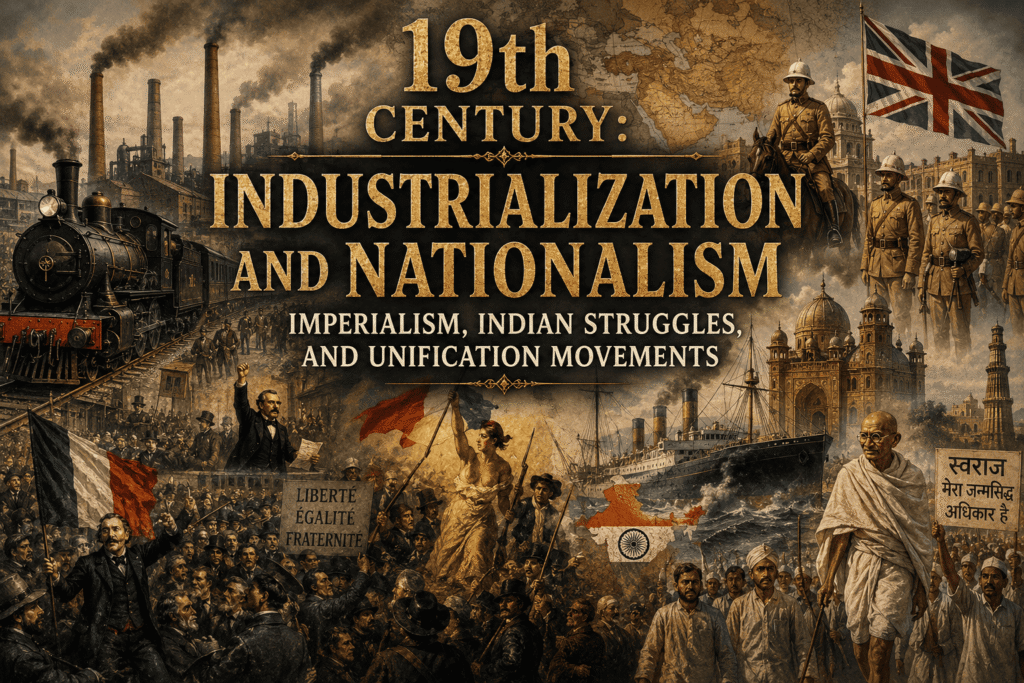
The 19th century was defined by the Industrial Revolution, as steam power, mechanized manufacturing, and railways transformed economies and societies, driving urbanization and reshaping the global balance of power. This era also witnessed the rise of nationalism, fueling movements for unification in Germany and Italy, independence struggles across Latin America, and intensifying colonial expansion as European powers scrambled to control territories across Africa and Asia. Alongside these shifts, the century saw major social reform movements, including abolition and early struggles for workers’ rights and suffrage, as industrial society grappled with its consequences. At its core, the 19th century reveals how technological transformation and the rise of national identity reshaped economies, empires, and the very structure of modern society.
Content Overview
- The 19th Century (1801–1900 CE)
- CHAPTER 1 — Understanding the 19th Century: Context and World Overview
- CHAPTER 2 — The British East India Company: From Merchants to Empire
- Foundation, Charter, and Early History — The Complete Story
- The Early Decades — Establishing Asian Presence
- The Mughal Permission — The Farman and Trading Rights
- How the Company Built Its Military Power — The Complete Account
- The Company's Administrative System — How It Governed
- The Diwani — When a Company Became a Government
- The Company's Treatment of India — Exploitation in Full Detail
- CHAPTER 3 — The Indian Rebellion of 1857: The Complete Account
- India Under Company Rule by 1857 — The Full Context
- The Enfield Rifle Cartridge — The Spark That Lit the Fire
- The Rebellion Begins — Step by Step
- The British Reconquest — Commander by Commander
- The End of the East India Company — The Government of India Act 1858
- The End of the Mughal Empire — Complete Final Account
- CHAPTER 4 — European Imperialism: The Complete Global Account
- CHAPTER 5 — National Unification Movements
- CHAPTER 6 — The Industrial Revolution: Complete Expansion
- CHAPTER 7 — Scientific and Intellectual Advances: Every Discovery Explained
- Charles Darwin (1809–1882) — On the Origin of Species: The Complete Account
- Gregor Mendel (1822–1884) — The Laws of Heredity
- Louis Pasteur (1822–1895) — Germ Theory: The Complete Account
- Joseph Lister (1827–1912) — Antiseptic Surgery
- Karl Marx (1818–1883) — The Communist Manifesto and Das Kapital: Complete Analysis
- CHAPTER 8 — The Abolition of Slavery: The Full Global Story
- Slavery in 1800 — The Complete System
- The British Abolition Movement — Complete Account
- The American Civil War — Complete Battle-by-Battle Account
- Background: The Road to War
- Fort Sumter (April 12–14, 1861)
- First Battle of Bull Run, fought on July 21, 1861
- The Peninsula Campaign and Battle of Antietam (1862)
- Battle of Gettysburg (July 1–3, 1863)
- Sherman’s March to the Sea, from November 15 to December 21, 1864
- Lee's Surrender at Appomattox (April 9, 1865)
- CHAPTER 9 — The Decline of Old Empires
- CHAPTER 10 — The Rise of New Powers
- CHAPTER 12 — Complete Decade-by-Decade Timeline (1801–1900)
- 1801–1810: Napoleon's Europe
- 1811–1820: Napoleon's Defeat and Latin American Independence
- 1821–1830: Greek Independence and Monroe Doctrine
- 1831–1840: British Reforms and Frontier Conflicts
- 1841–1850: Revolution, Famine, and the Great Wave
- 1851–1860: The Crystal Palace to Darwin
- 1861–1870: Civil War and European Unification
- 1871–1880: German Empire and New Technologies
- 1881–1890: The Scramble for Africa and Second Industrial Revolution
- 1891–1900: The Century Closes
- CHAPTER 13 — Summary and Legacy of the 19th Century
The 19th Century (1801–1900 CE)
CHAPTER 1 — Understanding the 19th Century: Context and World Overview
Definition and Context
The 19th century covers the years from January 1, 1801 CE to December 31, 1900 CE. It is, without question, the century in which the foundations of the contemporary world were most directly and comprehensively laid. Every major institution, ideology, technology, and geopolitical arrangement that defines our world today was either created or decisively shaped in the 19th century.
To understand the scale of change: a person born in 1801 lived in a world where the fastest method of communication was a messenger on horseback, the fastest transportation was a sailing ship or horse-drawn carriage, the largest industrial enterprises were still relatively small workshops, and most of the world’s political map was organized around hereditary monarchies and empires — the Mughal, Ottoman, Qing, and various European dynastic states — that had existed in some form for centuries. A person who died in 1900 lived in a world with the telegraph and the telephone, railways crossing continents, steam-powered ocean liners, electric lights, the automobile, the phonograph, the photograph, and the X-ray machine. Much of Africa and Asia was controlled by European colonial powers, while the United States had become the world’s leading industrial economy. Japan had transformed from a feudal samurai society into a modern industrial nation in a single generation. The germ theory of disease had revolutionized medicine. Evolution had transformed biology and challenged theology. Karl Marx had provided the intellectual framework for the political conflicts that would dominate the next century.
This transformation — the greatest in material terms in human history since the Neolithic Revolution — is the story of the 19th century.
CHAPTER 2 — The British East India Company: From Merchants to Empire
Foundation, Charter, and Early History — The Complete Story
The British East India Company — formally titled “The Governor and Company of Merchants of London Trading into the East Indies” — was established by a royal charter granted by Queen Elizabeth I of England on December 31, 1600. This was not a government institution. It was a private joint-stock company — a commercial enterprise organized by approximately 218 London merchants who pooled their capital to finance trading voyages to Asia.
The founding capital was approximately £68,373 — raised by selling shares to the 218 investor-merchants, each of whom owned a proportional stake in the company and would receive proportional profits from successful trading voyages. The company was granted a monopoly on all English trade east of the Cape of Good Hope — meaning no other English merchant or company could legally trade with Asia without the East India Company’s permission.
The company was governed by a Court of Directors — 24 men elected annually by the shareholders — who set company policy and appointed the senior officers. At its head was the Governor, assisted by a Deputy Governor. Day-to-day management of trading operations was handled by “factors” — the company employees posted at its overseas trading stations, called factories (meaning places where factors worked, not manufacturing facilities).
The company’s first voyage departed England in February 1601 under the command of Captain James Lancaster. Lancaster’s fleet of five ships reached Sumatra and the Malay Peninsula and returned in September 1603 with a cargo of pepper, cloves, and other spices that produced a profit of approximately 95% on the investment. The commercial model was validated.
The Early Decades — Establishing Asian Presence
In the early 17th century, the company competed intensely with the Dutch East India Company (VOC, established 1602) for dominance in the Asian spice trade. The competition was often violent — most notoriously at the Amboyna Massacre (1623), where Dutch authorities tortured and killed ten English East India Company merchants on the island of Ambon in the Spice Islands, effectively expelling the English from the most profitable spice markets.
This loss drove the English East India Company to focus more on India, where it had already begun to establish a presence. In 1608, a Company ship under Captain William Hawkins arrived at Surat (a major port on the Gujarat coast of northwest India) and Hawkins personally traveled to the court of the Mughal Emperor Jahangir at Agra. Hawkins — who could speak Turkish, a language Jahangir also spoke — spent three years at the Mughal court and obtained verbal assurances of trading rights, though no formal agreement was concluded.
The real breakthrough came in 1612, when the Company’s ship captain Thomas Best defeated a combined Portuguese fleet of four warships at the Battle of Swally near Surat. The Portuguese had been the dominant European naval power in the Indian Ocean since Vasco da Gama’s arrival in 1498, and they violently opposed any European competitors. Best’s defeat of the Portuguese demonstrated to the Mughal governor of Surat — and ultimately to the Mughal Emperor Jahangir himself — that the English were a naval force worth cultivating as allies against the Portuguese. This battle opened the door to formal trading rights in Mughal India.
The Mughal Permission — The Farman and Trading Rights
What Was a Farman?
A farman was an imperial decree issued directly by the Mughal Emperor — written on paper, sealed with the imperial seal, and carrying the full authority of Mughal sovereignty. The term comes from the Persian word “farman,” which means command or order. A farman granting trading rights was an extraordinarily valuable document — it meant the company had imperial authorization to conduct business within Mughal territory and that Mughal officials at every level were obligated to facilitate and protect the company’s commercial activities.
The First Farman — Emperor Jahangir (1612)
Following Thomas Best’s naval victory over the Portuguese at Swally in 1612, the Mughal Emperor Jahangir (full name Nuruddin Muhammad Salim, son of Akbar the Great, who reigned 1605–1627) issued the company’s first farman granting permission to establish a factory at Surat. This was the foundation document of the British East India Company’s presence in India.
Jahangir was a sophisticated ruler with genuine intellectual curiosity — his memoirs (the Tuzk-i-Jahangiri) reveal a man deeply interested in natural phenomena, art, and the personalities of those he encountered. He was willing to grant trading rights to the English because: English naval power offered a counterbalance to the Portuguese who threatened Mughal shipping; the English brought exotic goods (particularly fine broadcloth and manufactured items); and the English offered potential diplomatic and commercial connections to Europe.
The English merchant-diplomat Thomas Roe — who served as the official ambassador of King James I of England to the Mughal court from 1615 to 1619 — conducted extended diplomatic negotiations with Jahangir. Roe was a sophisticated diplomat who understood he was dealing with a powerful ruler, not a subordinate, and his approach was respectful. He secured more formal trading rights and established the commercial relationship on a more permanent footing.
The Farman of Emperor Farrukhsiyar (1717) — The Most Important Document
The most consequential farman in the company’s history was issued by the Mughal Emperor Farrukhsiyar (full name Farrukhsiyar, who reigned 1713–1719) in 1717. This document — which the company’s agent John Surman secured after three years of diplomatic effort in Delhi — is often called the Magna Carta of the East India Company.
The farman of 1717 granted the company:
In Bengal: The right to trade free of customs duties throughout Bengal in exchange for an annual payment of 3,000 rupees. The right to rent additional lands around Calcutta. The right for Company servants to use a specific seal on their goods.
In Madras: Confirmation of trading rights and grant of additional land.
In Bombay: The right to mint coins that would be accepted as legal tender throughout the Mughal Empire.
These were extraordinarily valuable commercial privileges — effectively exempting the company from the customs duties that other merchants had to pay, dramatically reducing the cost of its operations and making Company goods cheaper than those of Indian competitors. The farman of 1717 gave the Company an enormous structural commercial advantage that it exploited ruthlessly in the following decades.
Emperor Farrukhsiyar granted these privileges because he was politically weak — his reign was dominated by the Sayyid Brothers (Hussain Ali Khan Barha and Abdullah Khan Barha), two powerful nobles who effectively controlled the empire and who were willing to grant favorable terms to the Company in exchange for the medical services of Company surgeon William Hamilton, who had successfully treated the Emperor’s illness.
How the Company Built Its Military Power — The Complete Account
Why a Trading Company Had an Army
The East India Company was unique in human history: a private commercial enterprise that eventually maintained a larger army than most European states. Understanding how and why this happened requires understanding the specific conditions of 18th-century India.
The Company initially maintained only small guards at its trading posts — not an army. These guards were necessary to protect warehouses, goods, and company personnel from the routine dangers of life in a complex, turbulent political environment. The primary military force in India was the Mughal imperial army, supplemented by the armies of the regional governors (nawabs) who administered the empire’s provinces.
As the Mughal Empire began to disintegrate after Aurangzeb’s death in 1707 — as regional governors became effectively independent, as the Marathas expanded, as Nadir Shah’s invasion (1739) devastated Delhi — the security environment across India became significantly more dangerous. The Company’s trading posts were vulnerable to attack by competing powers, by regional conflicts, and by bandits.
The Company responded by systematically building a military force — not for conquest, initially, but for protection. This force evolved through several distinct phases:
Phase One — European Guards (1600s): Small detachments of European soldiers — hired by the Company — guarded the factories at Surat, Madras, Calcutta, and Bombay.
Phase Two — Native Infantry (Sepoys) (1680s–1740s): The Company began recruiting Indian soldiers — called sepoys (from the Persian/Hindustani “sipahi” meaning soldier) — to supplement the European guards. Sepoys were trained in European-style infantry drill, armed with European weapons (muskets, bayonets), and organized in European-style company and battalion formations. They were less expensive than European soldiers and could be recruited in large numbers.
Phase Three — Expansion During the Carnatic Wars (1744–1763): The decisive expansion of the Company’s military came during its competition with the French East India Company (the Compagnie des Indes) for influence over the Carnatic region of South India. French military adventurers — particularly the brilliant Joseph-François Dupleix — had demonstrated that small, well-trained European-led forces with artillery could defeat vastly larger Indian armies that lacked modern military organization and firepower. The young Robert Clive applied the same lesson on the British side. The Carnatic Wars established that Company military forces, properly led and equipped, could dominate the Indian military landscape.
Phase Four — Bengal Army and Post-Plassey Expansion (1757 onward): After the Battle of Plassey (1757) gave the Company effective control of Bengal, its military expanded dramatically. The Bengal Army — the Company’s primary military force in North India — grew from a few thousand to tens of thousands. By the early 19th century, the Company’s combined army in all three presidencies (Bengal, Madras, and Bombay) exceeded 200,000 soldiers.
The Structure of the Company’s Army
By the early 19th century, the Company’s military was organized into three separate presidential armies, each reporting to its respective presidency (Bengal, Madras, Bombay):
The Bengal Army: The largest and most prestigious of the three presidential armies. It was the primary military force of the Company in northern India and was used in most of the major campaigns — against the Marathas, against the Sikhs, against Nepal, and in Afghanistan. Strength: approximately 150,000 men by the 1850s.
The Madras Army: Based in southern India, responsible for operations in South India and Ceylon. It maintained a reputation for reliability that the Bengal Army would lose in 1857. Strength: approximately 50,000 men by the 1850s.
The Bombay Army: Based in western India, responsible for operations in western India, Sindh, and the Persian Gulf. Strength: approximately 30,000 men by the 1850s.
The Sepoy — the backbone of the army
The sepoy was the essential unit of the Company’s military power. Indian soldiers, trained in European military discipline, organized in European-style regiments and battalions, armed with European weapons, and led (at senior levels) by European officers, were the instrument through which the Company conquered an empire.
The sepoys of the Bengal Army were drawn primarily from the high-caste Hindu communities of Bengal, Bihar, and Awadh — particularly the Bhumihars, Rajputs, and Brahmins. These were men from warrior and landowning backgrounds who enlisted for regular pay, pension, and the prestige of military service. By the 1850s, the Company’s Bengal Army had approximately 140,000 Indian sepoys led by approximately 26,000 British officers and soldiers.
The relationship between British officers and Indian sepoys was complex. The best British officers learned Indian languages (particularly Hindustani/Urdu — the lingua franca of the Company’s army), respected their soldiers’ religious customs, and developed genuine bonds of mutual loyalty. Many sepoys served with distinction for decades. At the same time, the structural inequality — British officers were always superior in rank and pay, regardless of ability — created deep resentments that contributed to the 1857 Rebellion.
European Regiments in India
Alongside the sepoy battalions, the Company maintained regiments of European soldiers — British troops serving in the Company’s own European regiments. These were distinct from the Royal British Army regiments that were sometimes stationed in India by the British government. The Company’s European soldiers were professional soldiers, typically recruited in Britain for service specifically in India, paid by the Company, and serving under Company regulations.
European soldiers were considered more reliable for specific tasks — particularly defending artillery positions and serving as the “backbone” around which sepoy units were organized in battle. However, they were far more expensive than sepoys and required supplies (particularly meat and alcohol) that complicated logistics in tropical India.
Key Military Leaders of the East India Company
Robert Clive (1725–1774) — The Founder of Empire: Robert Clive was born in Market Drayton in Shropshire, England, the son of a modest lawyer. He was sent to India as a “writer” (clerical employee) of the East India Company in 1744 at the age of 18 — not as a soldier. His military career began almost accidentally when, as a bored and depressed clerk who had twice attempted suicide, he joined a volunteer military force during the First Carnatic War.
Clive’s military career was defined by reckless personal courage, brilliant tactical improvisation, and a complete lack of scruple in using bribery and treachery to achieve his objectives. His most famous early achievement was the defense of Arcot in 1751, when he led approximately 500 men against a force of 10,000 — holding the town for 53 days before being relieved. This improbable defense made him a celebrated hero and established his reputation.
His most consequential achievement was the Battle of Plassey (1757), discussed in detail below. Clive served as Governor of Bengal twice (1757–1760 and 1765–1767) and was responsible for establishing the basic administrative structure of British rule in Bengal. He returned to Britain enormously wealthy — with a fortune of approximately £300,000 — but was dogged by parliamentary investigations into his conduct in India. He died in 1774, widely believed to have committed suicide.
Warren Hastings (1732–1818) — The First Governor-General: Warren Hastings served as the first Governor-General of India from 1773 to 1785, under the Regulating Act that placed the Company’s political activities under parliamentary oversight. He was a more complex figure than Clive — genuinely learned in Indian languages and culture, capable of nuanced understanding of Indian governance, and a capable administrator.
Hastings systematized British revenue collection in Bengal, established the first system of regular courts in British India (organizing both civil and criminal justice), and created the Bengal Code (a set of regulations governing administration). He also fought the First Anglo-Maratha War (1775–1782) and the Second Anglo-Mysore War (1780–1784).
He was impeached by the British Parliament in 1786 on charges of corruption and cruelty — the trial, conducted by the great Edmund Burke and lasting from 1788 to 1795, became one of the most significant debates about the morality of imperial governance. Hastings was ultimately acquitted, but the trial established the principle that Company officials were accountable to Parliament and to public opinion.
Arthur Wellesley (1769–1852) — Future Duke of Wellington: The man who would later defeat Napoleon at Waterloo served in India as a military officer from 1797 to 1805, conducting the campaigns that established British dominance in southern India. He commanded the siege and storm of Seringapatam (1799) that killed Tipu Sultan and ended the last serious military threat to British dominance in South India. He also fought the Second Anglo-Maratha War (1803), defeating Maratha forces at Assaye and Argaon. His Indian experience gave him the military skills and discipline that he later applied at Waterloo.
General Charles Napier (1782–1853): The commander who conquered the province of Sindh (modern Pakistan) in 1843 for the East India Company. When he arrived in Sindh, he found the local Amirs (rulers) unwilling to accept British dominance. He provoked a conflict and then defeated the Baluchi armies at the battles of Miani (February 17, 1843) and Dubba (March 24, 1843). He is credited with sending the dispatch announcing his conquest in a one-word Latin pun: “Peccavi” (I have sinned — because “sinned” sounds like “Sindh”).
How the Company Applied Military Force — The Method of Expansion
The East India Company’s military expansion followed a consistent pattern that Robert Clive established and subsequent commanders refined:
Step 1 — Commercial Presence: The Company established trading posts and factories at key locations — Surat, Madras, Calcutta, Bombay. These posts were accepted by local rulers because the Company brought trade revenues, European manufactured goods, and — in the case of the Mughals — naval power that could counter Portuguese or Dutch maritime threats.
Step 2 — Military Buildup: Under the cover of protecting its commercial interests, the Company built military forces — sepoy battalions, European regiments, artillery. These forces were initially justified as defensive but were available for offensive operations when needed.
Step 3 — Political Manipulation: When a regional ruler was weak, the Company exploited succession disputes, political conflicts between rival factions, and financial crises. It offered loans, political support, and military assistance to one faction in exchange for trade privileges, land grants, and — eventually — political submission.
Step 4 — Military Confrontation: If political manipulation did not produce sufficient concessions, the Company used military force — typically after engineering a justification (a broken treaty, an “insult” to British honor, or a threat to allied rulers).
Step 5 — Post-Victory Settlement: After military victory, the defeated ruler was either deposed and replaced with a more compliant one, forced to cede territory, required to accept a British “Resident” at his court (a political officer who exercised real power over the ruler’s decisions), or obligated to pay a large indemnity that kept him financially dependent on the Company.
The Company’s Administrative System — How It Governed
The Company governed its Indian territories through a three-tiered system:
The Presidency System: The Company’s Indian empire was divided into three Presidencies: Bengal (headquartered at Calcutta, governing all of northeastern India), Madras (headquartered at Madras/Chennai, governing southeastern India), and Bombay (headquartered at Bombay/Mumbai, governing western India). Each presidency had its own government, courts, army, and revenue administration, all under a Governor (later the Bengal Governor became the Governor-General of India, with authority over all three presidencies under the Regulating Act of 1773).
The District System: Each presidency was divided into districts — the basic administrative units of British India. Each district was governed by a Collector — an Indian Civil Service officer who combined the functions of revenue collector, magistrate, and general administrator. The Collector was responsible for:
Assessing and collecting the land revenue (the primary source of government income). Maintaining law and order. Presiding over civil and criminal courts at the district level. Supervising public works — roads, irrigation, post offices. Reporting to the provincial government.
The Collector was typically a young British officer — often just arrived from Britain — who was expected to govern a district containing hundreds of thousands of people, often with minimal staff and no knowledge of local languages (at least initially). The Collector’s enormous power with minimal oversight created significant opportunities for both good governance and abuse.
The Revenue System: The Company inherited and intensified the Mughal revenue system — which assessed agricultural land and collected a percentage of the crop value as tax. The Company systematized this through the Permanent Settlement of Bengal (1793, introduced by Governor-General Lord Cornwallis) and later the Ryotwari System (in Madras and Bombay).
The Permanent Settlement of Bengal was a landmark — and deeply controversial — policy. It fixed the land revenue demand permanently at the level assessed in 1793, making the zamindars (large landowners) the permanent owners of their lands in exchange for paying fixed annual revenue to the Company. This created a class of landlords with permanent rights — but it also meant that if agricultural productivity increased, the Company received no additional revenue, while the zamindars (and later British-owned plantations) captured all the gains.
The Diwani — When a Company Became a Government
The most consequential single moment in the Company’s transformation from trading enterprise to colonial government was the grant of the Diwani — the right to collect land revenue — for the provinces of Bengal, Bihar, and Orissa, by the Mughal Emperor Shah Alam II in August 1765.
What Was the Diwani?
In the Mughal administrative system, the Diwan was the chief revenue officer of a province. The Diwani referred to his authority to assess and collect revenue across the province. It was one of the two great powers of provincial governance, the other being the Nizamat (military and judicial authority, held by the Nawab).
How It Was Granted:
After the Battle of Buxar (October 22, 1764) — where the Company’s army defeated the combined forces of the Nawab of Awadh (Shuja ud-Daulah), the Mughal Emperor Shah Alam II, and Mir Qasim (the Nawab of Bengal) — Robert Clive negotiated the Treaty of Allahabad (August 1765) directly with the Emperor.
Shah Alam II was in a position of complete military and political weakness. He had just been decisively defeated in battle. He was dependent on the Company’s good will for his safety. He had no realistic alternative to accepting Clive’s terms. The Emperor formally granted the East India Company the right to collect all land revenue in Bengal, Bihar, and Orissa — a region with a population of approximately 30 million people and revenues estimated at approximately £2 million annually — in exchange for a Company “pension” to the Emperor of 26 lakhs of rupees per year and the return of some territories to the Nawab of Awadh.
What It Meant:
The grant of the Diwani transformed the Company from a trading enterprise with military power into a government. It was now responsible for:
Assessing agricultural land and crop production across three large provinces. Collecting revenue from approximately 30 million people. Managing the revenue administration — paying revenue officers, maintaining records, handling disputes. Deploying the revenue for the Company’s military and administrative expenses.
The Company kept the nominal Nawab of Bengal in place to handle the Nizamat (criminal justice and military matters) — but it was now firmly in control of the money. As Clive explained to the Company’s Court of Directors in London: “We are in fact the sovereigns of Bengal; and neither the Nawab’s government nor that of the Mogul (Mughal) is anything more than a pure fiction.”
This was the moment — 1765 — when the British East India Company became, in practical terms, the government of Bengal. Everything that followed — the Anglo-Mysore Wars, the Anglo-Maratha Wars, the annexation of Sindh and Punjab, the Rebellion of 1857, and the formal establishment of the British Raj — was a consequence of this fundamental transformation.
The Company’s Treatment of India — Exploitation in Full Detail
The East India Company’s governance of India was — whatever its individual officers may have intended — systematically exploitative in its economic consequences. Several mechanisms of extraction operated simultaneously:
Revenue Extraction: The land revenue system extracted enormous sums from the agricultural population. In Bengal, where the Permanent Settlement had fixed revenue at high levels, many zamindars defaulted and lost their lands. The agricultural population — the actual farmers — paid rents to zamindars who passed a portion to the Company. In bad harvest years, revenue demands continued regardless of agricultural performance.
De-industrialization of Textiles: India had been, before British conquest, the world’s largest producer and exporter of cotton textiles. Indian weavers — particularly in Bengal, Madras, and Gujarat — produced fabrics of extraordinary quality that were exported across the world. The Company had been the primary buyer of these textiles in the early 18th century.
After the Industrial Revolution, British cotton mills could produce cheaper (though often lower-quality) cotton cloth using power looms. The Company — and then the Crown — imposed tariff policies that allowed British machine-made cloth to enter India duty-free while putting high tariffs on Indian textiles entering Britain. The result was the destruction of India’s handloom weaving industry over several decades. Millions of skilled artisans were pauperized. Bengal’s population declined significantly in the late 18th and early 19th centuries — partly due to famine (the Bengal Famine of 1770, which killed approximately one-third of Bengal’s population), partly due to economic devastation.
The Opium Trade: The Company monopolized the production and export of opium in Bengal. Opium poppies were grown by Indian farmers under coercive contracts that forced them to sell their crop to Company agents at artificially low prices. The Company then exported this opium to China, using the profits to purchase Chinese goods — particularly tea for the British market. This trade triangle — British manufactured goods to India, Indian opium to China, Chinese tea to Britain — enriched the Company and Britain while impoverishing Indian farmers and destroying millions of Chinese lives through addiction.
The Drain of Wealth: From approximately the 1750s onward, a “drain” of wealth from India to Britain became a structural feature of the colonial relationship. Revenue collected in India was used to pay for Company administration, the Company’s army, and the purchase of goods that were then exported to Britain — but the goods were purchased at artificially low prices and sold in Britain at market prices. The difference — the surplus — was remitted to Britain as Company profits and later as imperial government revenue. Indian economists in the late 19th century — particularly Dadabhai Naoroji in his book Poverty and Un-British Rule in India (1901) — calculated the “drain” at tens of millions of pounds annually.
CHAPTER 3 — The Indian Rebellion of 1857: The Complete Account
India Under Company Rule by 1857 — The Full Context
By 1857, the British East India Company controlled approximately three-fifths of the Indian subcontinent directly. The remaining two-fifths consisted of approximately 560 princely states — nominally independent kingdoms and chieftainships whose rulers maintained their thrones under British suzerainty, meaning they accepted British dominance over their external relations and kept British political officers (Residents) at their courts who effectively had veto power over major decisions.
The Company’s army — the primary instrument of this control — numbered approximately 350,000 soldiers, of whom approximately 300,000 were Indian sepoys (in the Bengal, Madras, and Bombay armies combined) and approximately 50,000 were British officers and European soldiers. The Bengal Army alone had approximately 150,000 Indian sepoys led by approximately 23,000 British officers.
The political climate in 1857 was charged with anxiety and resentment across multiple sections of Indian society:
The Dispossessed Rulers: Lord Dalhousie — the Governor-General from 1848 to 1856 — had implemented the Doctrine of Lapse with particular aggressiveness. This policy stated that any princely state whose ruler died without a natural male heir would be annexed by the Company, with no right of adoption (the traditional Indian succession method). Under Dalhousie’s implementation, the following states were annexed through the Doctrine of Lapse:
Satara (1848) — the ancestral domain of the Maratha Chatrapati, annexed when its ruler Raja Pratap Singh died without a natural heir. Jaitrapur (1849) — a small state in Konkan, Maharashtra. Sambhalpur (1849) — in Odisha, whose Raja had died in 1827, with the succession disputed; finally annexed in 1849. Baghat (1850) — a hill state. Chota Udaipur (1852) — in Gujarat. Jhansi (1853) — annexed when Maharaja Gangadhar Rao died without a natural heir, refusing to recognize his adopted son Damodar Rao. Rani Lakshmibai of Jhansi was granted a pension and instructed to leave the palace. Nagpur (1854) — the Bhonsle kingdom of the Marathas, one of the most important princely states in central India, was annexed when Raja Raghoji III died without a natural heir. Awadh (1856) — the wealthiest and most culturally sophisticated kingdom in north India, annexed on the dubious grounds that its Nawab, Wajid Ali Shah, was governing badly. The annexation was deeply resented because Awadh had been a loyal ally of the Company for decades.
These annexations dispossessed not just the rulers but the entire court establishments — nobles, soldiers, officials, servants, artists, and merchants — whose livelihoods had depended on the princely courts. Many of these people became bitterly hostile to the Company.
The Soldiers’ Grievances: The Bengal Army’s sepoys had a specific set of grievances that had been accumulating for decades:
Promotion by seniority rather than merit meant that Indian soldiers, however capable, could not rise above certain ranks (a Subahdar-Major — the highest rank available to an Indian in the Bengal Army — was equivalent to a junior British officer). Meanwhile, newly arrived young British officers were automatically placed in command of Indian soldiers who had served for 20 years.
Pay disparity: British officers in the Bengal Army received much higher pay than Indian officers of equivalent seniority. An Indian Subedar (the senior Indian officer in a company) earned approximately 20 rupees per month; a British Lieutenant earned approximately 200 rupees.
The General Service Enlistment Act of 1856 required newly recruited sepoys to agree to serve overseas if required. For high-caste Hindu soldiers, crossing the ocean (kalapani — “black water”) was religiously polluting and would result in loss of caste. The Act was resented as a violation of the terms under which many soldiers had enlisted.
The annexation of Awadh in 1856 was personally devastating for many Bengal Army sepoys — they were recruited predominantly from Awadh, their families were from there, and their land tenure arrangements depended on the Awadhi state. The annexation unsettled these arrangements and stripped away the traditional protectors of their property rights.
The Enfield Rifle Cartridge — The Spark That Lit the Fire
In early 1857, the Company began to introduce the Pattern 1853 Enfield Rifle — a significant upgrade from the older Brown Bess muskets that the Bengal Army had been using. The Enfield was a rifled musket — its barrel had spiral grooves that imparted spin to the bullet, dramatically improving accuracy and range.
The Enfield used a new type of ammunition: a paper cartridge that contained a measured charge of gunpowder and a conical Minié ball (bullet). To load the rifle, the soldier was required to:
Step 1: Take the cartridge from his ammunition pouch. Step 2: Tear or bite off the top of the paper cartridge with his teeth. Step 3: Pour the gunpowder down the barrel. Step 4: Push the bullet down the barrel using the ramrod. Step 5: Prime the firing mechanism.
The key step was Step 2 — biting the cartridge. For the cartridge paper to slide smoothly down the barrel, it needed to be greased. The grease used in British military cartridges at this time was — according to the standard practice of the time — a mixture of tallow (animal fat). Tallow was rendered from the fat of animals — in Britain, typically beef or mutton.
In India, where the Bengal Army’s sepoys were predominantly high-caste Hindus and Muslims, the use of animal fat in ammunition created a religious crisis. Hindus considered the cow sacred — contact with beef fat was a severe ritual pollution that would result in loss of caste. Muslims considered pork (pig) fat haram (forbidden) — contact with it was religiously defiling. Rumors spread through the Bengal Army cantonments — almost certainly with some basis in fact — that the Enfield cartridges were greased with a mixture of beef and pork fat.
The situation was made worse by the Company’s handling of the crisis. Senior British officers were dismissive of sepoy concerns — some literally scoffing at what they called “superstition.” Others made attempts to reassure sepoys but were not believed. A few units were ordered to drill with the new cartridges; when they refused, they were punished harshly.
At Meerut, in late February and March 1857, 85 troopers of the 3rd Bengal Light Cavalry refused to accept the new greased cartridges. They were court-martialed on April 25, 1857, found guilty of insubordination, sentenced to ten years of rigorous imprisonment, and — in a spectacularly ill-judged act of humiliation designed to serve as an example — stripped of their uniforms and shackled in irons in front of their entire regiment and the assembled garrison, in a full parade ceremony that took approximately an hour.
The effect was the opposite of what the British command intended. Instead of deterring resistance, the public humiliation of loyal soldiers who had served for years — shackling them like common criminals for a religious objection — enraged their comrades to a degree that overcame their trained military discipline.
The Rebellion Begins — Step by Step
Step 1 — Sunday Evening, May 10, 1857: Meerut
The Meerut cantonment on the evening of May 10, 1857 was at a state of alert — British officers were aware of tension in the Indian lines but did not take adequate precautions. The British officers were mostly at their evening church service; the Indian soldiers were in their lines.
At approximately 5 PM, the Indian soldiers in the 11th and 20th Bengal Native Infantry regiments and the 3rd Bengal Light Cavalry broke into open revolt. They went to the jail where their imprisoned comrades were held, overpowered the guards, and freed the 85 imprisoned troopers as well as approximately 800 other prisoners.
The violence was immediate and severe. British officers who came to investigate or restore order were shot. The families of British officers — women and children — were killed by some soldiers, though other Indian soldiers helped some British families escape. British cantonment buildings were burned. The officers’ mess halls were looted. The treasury was broken open.
By nightfall, the Meerut cantonment was in chaos. The British garrison — approximately 2,000 European troops who were present — responded slowly and ineffectively. The British cavalry commander, Brigadier Archdale Wilson, failed to mount an immediate pursuit that might have stopped the rebels. By morning, most of the rebel soldiers had marched through the night toward Delhi, approximately 60 kilometers to the southwest.
Step 2 — May 11, 1857: Delhi and Bahadur Shah Zafar
The rebel soldiers arrived at the Mughal capital of Delhi at dawn on May 11, 1857. They crossed the Yamuna River by boat, entered through the Calcutta Gate, and made their way through the city toward the Red Fort — the great palace of the Mughal Emperors.
The Delhi garrison — Indian soldiers of the Bengal Army stationed in Delhi — immediately joined the revolt. British officers in Delhi were killed. The Delhi Bank was looted. The telegraph office was destroyed (though not before the British telegraph operator sent the message “the sepoys have revolted” — one of the last messages to reach Company headquarters before Delhi was cut off).
The rebel soldiers entered the Red Fort and presented themselves before Bahadur Shah Zafar — Mirza Abu Zafar Sirajuddin Muhammad, the 82nd (approximately) Mughal Emperor of India, known by his poetic pen-name “Zafar” (Victory). Bahadur Shah was a distinguished Urdu poet and calligrapher — his poetry is still read and studied today — but was not a political or military leader. He had been living in the Red Fort under effective British supervision, with a small court that was a remnant of former glory, on a Company pension.
Bahadur Shah Zafar was initially horrified by the revolt. He argued with the soldiers, pleaded with them to leave, told them he could not protect them. His sons — particularly the eldest, Mirza Mughal — were more enthusiastic. Gradually, the emperor accepted the situation: he was the only figure with sufficient symbolic power to unite the revolt across religious lines.
The emperor issued proclamations in his name — calling on all Indians, Hindu and Muslim, to join the revolt against the Company. He appealed to regional rulers to send forces to Delhi. He attempted to organize a court of administration to govern the revolt.
The key figures at Delhi:
Mirza Mughal (1817–1857): Bahadur Shah’s eldest son, who became the military commander of Delhi’s rebel forces. He was enthusiastic but incompetent as a military commander — unable to organize effective coordination among the various rebel units that arrived from different parts of north India.
Bakht Khan (1797–1859): A subedar-major (senior Indian officer) of the Bengal Army’s artillery who arrived at Delhi from Bareilly in early July 1857 with approximately 40,000 troops and who was the most capable military leader among the rebel commanders in Delhi. He argued for offensive operations against the British but was frustrated by lack of coordination.
Hakim Ahsanullah Khan: Bahadur Shah’s personal physician and trusted advisor, who tried to maintain communication with the British — perhaps seeking a negotiated settlement. He was later used as a Company informer after Delhi’s recapture.
Step 3 — The Spread of Rebellion: June–July 1857
News of the events at Meerut and Delhi spread rapidly through the network of sepoy garrisons across north and central India. Over the following weeks and months, the rebellion spread to dozens of locations:
Kanpur (Cawnpore): The sepoys at Kanpur — the large garrison town on the Ganges — revolted on June 5, 1857. The British community at Kanpur, including military officers, civilians, women, and children, took refuge in an entrenchment that they defended for 21 days in the summer heat with minimal food, water, and ammunition. The senior British military officer was Major-General Hugh Wheeler (1789–1857) — who had served in India for over 50 years, had an Indian wife and mixed-heritage children, and believed his long-standing relationships with Indian soldiers would protect him. He was catastrophically wrong.
Nana Sahib (Dhondu Pant, c. 1824–c. 1859): The leader at Kanpur was Nana Sahib — the adopted son of the last Peshwa (the Maratha prime minister who was also the effective ruler) Baji Rao II, whose pension the Company had refused to continue after his father’s death in 1851. Nana Sahib had petitioned the Company and the British Parliament repeatedly for recognition of his claims and had been repeatedly refused. He had personal grievances against the Company but had maintained outwardly friendly relations with the British community at Kanpur.
When the rebellion began at Kanpur, Nana Sahib assumed leadership of the rebel forces. He negotiated with the besieged British — promising safe passage down the Ganges to Allahabad in exchange for their surrender. On June 27, 1857, the British garrison and civilians — approximately 450 people — accepted the terms and boarded boats on the Ganges. As they were boarding, firing broke out — whether by accident, by design, or in response to a perceived British attempt to seize the boats is still disputed. The boats caught fire. Many were killed; survivors were taken prisoner.
The approximately 200 survivors — mostly women and children — were imprisoned in a building called the Bibighar (women’s house). On July 15, 1857, as a British relief force under General Havelock approached Kanpur, the prisoners in the Bibighar were killed — reportedly by hired butchers after Indian soldiers refused orders to kill them. Their bodies were thrown into a nearby well. The Kanpur massacre became one of the most emotionally charged events in British imperial history — used to justify the brutal British reconquest and to mobilize British public opinion against any sympathy for the rebels.
Lucknow: Lucknow — the capital of the recently annexed Kingdom of Awadh — was one of the most culturally sophisticated cities in India. The sepoys of the Awadh garrison revolted in late May 1857. The British community — approximately 1,700 people including soldiers, civilians, women, and children — retreated to the British Residency complex (a cluster of large stone buildings that served as the British political office) under the command of Sir Henry Lawrence (1806–1857), the Chief Commissioner of Awadh.
Henry Lawrence was one of the more respected and humane British officials in India — he had opposed the annexation of Awadh and was genuinely respected by many Indians. He prepared the Residency’s defenses with considerable skill before being fatally wounded by an artillery shell on July 4, 1857. Command passed to Brigadier John Inglis.
Begum Hazrat Mahal (c. 1820–1879): The leader of the Awadh rebellion was Begum Hazrat Mahal — one of the wives of the deposed Nawab of Awadh, Wajid Ali Shah, who had been exiled to Calcutta after annexation. She assumed effective leadership of the Awadh rebel government in Lucknow, declared her young son Birjis Qadr as the new Nawab of Awadh, and organized both military resistance and political administration with considerable capability.
She maintained contact with Bahadur Shah Zafar in Delhi and with Nana Sahib at Kanpur, attempting to coordinate the rebellion across north India. She issued proclamations calling on Hindus and Muslims alike to join the revolt. When the British eventually reconquered Lucknow in March 1858, she escaped and continued guerrilla resistance in the forests of Awadh before eventually fleeing to Nepal, where she died in 1879.
Rani Lakshmibai of Jhansi — The Warrior Queen: Complete Account
Lakshmi Bai — born Manikarnika Tambe in Varanasi around 1828 — was the daughter of Moropant Tambe, a Brahmin official at the Maratha court of Bithoor. Her mother died when she was approximately four years old. Raised in the Peshwa’s court at Bithoor (near Kanpur), she received an unusually comprehensive education for a girl of the time — learning to ride horses, fight with weapons, and read and write in addition to the domestic arts conventionally taught to girls. Her childhood playmates included Nana Sahib (Dhondu Pant) and Tatya Tope (Ramchandra Pandurang) — both of whom would later become leaders of the 1857 Rebellion.
In 1842, at approximately age 14, she was married to Maharaja Gangadhar Rao Newalkar — the ruler of the princely state of Jhansi in what is now Uttar Pradesh. She became Rani (Queen) of Jhansi, taking the name Lakshmi Bai. She and Gangadhar Rao had one son who died in infancy. In 1853, with Gangadhar Rao seriously ill and dying, the couple adopted a child — Damodar Rao — as their heir in the traditional Indian manner, with the British Resident at Jhansi present at the adoption ceremony.
The British Resident — Captain Alexander Skene — wrote to his superiors that the adoption had taken place and that Damodar Rao was the Maharaja’s chosen heir. Governor-General Dalhousie refused to recognize the adoption. Under the Doctrine of Lapse, with no natural male heir, Jhansi was annexed by the Company in March 1854. Lakshmibai was given an annual pension of 60,000 rupees and ordered to vacate the fort.
Lakshmibai’s petition to the Company protesting the annexation and requesting recognition of Damodar Rao’s rights was rejected. Her appeal to the Board of Directors in London was rejected. Her petition to the British Parliament was rejected. She had exhausted all legal remedies when the rebellion of 1857 began.
Jhansi During the Rebellion:
When the rebellion spread to Jhansi in June 1857, Lakshmibai’s position was complicated. She was not initially part of the rebel network — she had been trying to work within the legal system. The British garrison at Jhansi was massacred by rebel sepoys; Lakshmibai may have had warning that could have prevented this but did not act, or may genuinely not have known. The British later accused her of ordering or permitting the massacre; this accusation is disputed by historians.
What is clear is that after the massacre, Lakshmibai governed Jhansi with considerable ability — maintaining order, distributing food to the poor, and organizing the defense of the city. She wrote to the British authorities protesting her innocence and asking for protection. The British did not respond helpfully.
When it became clear that British forces were advancing and that no accommodation was possible, Lakshmibai organized the military defense of Jhansi. She trained and drilled her troops — including a unit of women soldiers. She supervised the manufacture of weapons and ammunition. She organized intelligence networks and supply lines.
In March 1858, British General Hugh Rose arrived before Jhansi with a force of approximately 5,400 men. The siege of Jhansi lasted 17 days. Lakshmibai directed the defense personally — riding along the walls on horseback, encouraging her troops, directing artillery fire. Contemporary accounts from both Indian and British sides describe her personal courage as extraordinary.
On April 3, 1858, British forces breached the walls of Jhansi. Rather than surrender, Lakshmibai escaped on horseback — with her young son Damodar Rao tied to her back with cloth, leaving her hands free for weapons. She and a small escort rode through the British lines at night (the story that she jumped her horse over the fort wall, while dramatically told, is probably legend; she more likely escaped through a gate).
She rode approximately 100 kilometers to Kalpi, where she joined the rebel commanders Tatya Tope and Rao Sahib. At Kalpi, she participated in the defense against advancing British forces. When Kalpi fell, the rebel leaders made one final bold move — capturing the city of Gwalior from the Scindia (whose ruler was an ally of the British, and whose troops defected to join the rebels).
The Battle of Gwalior (June 17–18, 1858) was the Rani’s final engagement. She was killed in the fighting — accounts vary as to the precise circumstances. The British account says she was shot by a trooper of the 8th Hussars while leading a cavalry charge wearing the uniform of a male cavalryman, with her sword in one hand and reins in the other. Indian accounts give slightly different details but agree on the essential facts: she died fighting.
General Hugh Rose, the British commander who had besieged Jhansi and ultimately defeated the rebel forces at Gwalior, wrote in his official report that Rani Lakshmibai was “the best and bravest” of the rebel leaders.
She was approximately 29 or 30 years old when she died. She became — and remains — one of the most powerful symbols of Indian resistance to colonial rule. Poems about her begin in Hindi schoolbooks with the line “Khoob ladi mardani, woh to Jhansi wali Rani thi” — “She fought like a man, she was the Queen of Jhansi.”
Tatya Tope (Ramchandra Pandurang, c. 1814–1859)
Tatya Tope was one of the most militarily capable rebel commanders — a general of real talent who proved difficult to defeat for months after the main rebellion had been suppressed. He was a childhood companion of Nana Sahib and had served as a senior military officer at Nana Sahib’s court at Bithoor.
Tatya Tope commanded the rebel attempt to relieve Kanpur (which failed, allowing the British to recapture the city), the defense of Kalpi, the capture of Gwalior, and — after the fall of Gwalior — a guerrilla campaign across central India that lasted until April 1859. He was exceptionally mobile, difficult to pin down, and repeatedly escaped when British forces seemed to have him cornered. He was eventually captured by the British — betrayed by a Rajput chief whose friendship he trusted — tried by a military court, and hanged on April 18, 1859.
The British Reconquest — Commander by Commander
The British reconquest of northern India in 1857–1858 was the largest military operation the British had conducted in India to that point, requiring the dispatch of substantial reinforcements from Britain and a systematic campaign across hundreds of kilometers of contested territory.
General Henry Havelock (1795–1857): A deeply religious evangelical Christian soldier who was seen by the British public as a godly warrior fighting a holy war, Havelock commanded the initial relief force sent from Allahabad toward Kanpur and Lucknow. He won a series of engagements fighting northward — at Fatehpur (July 12), Aong (July 15), Pandoo Nadi (July 15), and Kanpur itself (July 17). He arrived at Kanpur to find the massacre of the Bibighar’s inhabitants had just occurred. He subsequently fought toward Lucknow — winning repeated engagements — and reached the Residency in September 1857 but with insufficient force to evacuate; he was effectively a second besieged force inside the Residency. He died of dysentery in November 1857, just days after a final relief force arrived.
General Colin Campbell, Lord Clyde (1792–1863): The Commander-in-Chief India and ultimately the overall British military commander for the suppression of the rebellion. Campbell was a veteran of the Peninsular War, the First Opium War, and the Crimea. He organized and executed the final relief of Lucknow in November 1857, evacuating the British garrison and civilian population, and then — methodically and comprehensively — reconquered Awadh over the following months. He was known for systematic, methodical operations rather than brilliant improvisation.
General Hugh Rose, Baron Strathnairn (1801–1885): The commander of the Central India Field Force, responsible for reconquering central India — including Jhansi and Gwalior. Rose was arguably the most militarily capable of the British commanders in the 1857–1858 campaign — he conducted rapid operations across enormous distances, defeating rebel forces at Saugor, Jhansi, Koonch, Kalpi, and Gwalior in a few months. He praised Lakshmibai’s military abilities explicitly in his dispatches.
The Reconquest’s Violence:
The British reconquest was accompanied by violence and reprisals on a large scale. The Kanpur massacre — the killing of the Bibighar prisoners — had enraged the British public and military to the point where many officers felt that revenge was not just permissible but obligatory.
British soldiers who entered rebel-held areas frequently killed civilians suspected of rebel sympathies. Villages were burned. Prisoners were executed without trial. The most notorious figure was Brigadier James Neill (1810–1857) — who was killed at Lucknow — but who before his death had established a policy in the Allahabad area of forcing rebel prisoners to clean up the blood of British victims at Kanpur before being hanged, an act designed to ritually defile them before death. The British press reported these actions with approval; humanitarian voices in Britain were few and largely ignored.
The End of the East India Company — The Government of India Act 1858
The Rebellion of 1857 — though ultimately suppressed — made the continuation of Company rule in India politically untenable in Britain. The Company had demonstrated:
That it could not maintain order without massive military reinforcement from Britain. That its administrative policies (the Doctrine of Lapse, the greased cartridge, the dismissive treatment of Indian soldiers’ religious concerns) had created conditions for rebellion. That governing a subcontinent of 250 million people as a commercial enterprise was fundamentally inappropriate.
The Government of India Act 1858, passed by the British Parliament on August 2, 1858, dissolved the East India Company as a governing authority. Its 258 years of existence — from the royal charter of 1600 to the act of 1858 — ended. All of its territories, armies, and administrative powers were transferred to the British Crown.
A Secretary of State for India, a British Cabinet minister accountable to Parliament, was appointed to oversee the governance of India. A Council of India (initially composed of former Company officials) advised him. In India, the Governor-General received the new title of Viceroy — emphasizing his position as the personal representative of the sovereign.
On November 1, 1858, Queen Victoria issued a proclamation to “the Princes, Chiefs and People of India” announcing the transfer of governance. The proclamation promised: the abandonment of all annexations and confiscations (the Doctrine of Lapse was implicitly abandoned); respect for the rights of Indian rulers; equal treatment for all subjects; religious tolerance; and advancement in public employment based on ability rather than race or religion.
In practice, many of these promises were honored imperfectly or not at all — racial discrimination in appointments continued; economic exploitation continued; Indian political rights were severely limited. But the proclamation established, at least in principle, a different framework for imperial governance than the Company’s purely commercial exploitation.
The End of the Mughal Empire — Complete Final Account
The Mughal Empire — founded by Zahir ud-Din Muhammad Babur at the First Battle of Panipat on April 21, 1526 — ended formally in 1858. Its last nominal emperor was Bahadur Shah II (Bahadur Shah Zafar), who was approximately 82 years old when the rebellion began.
After Delhi’s fall in September 1857, Bahadur Shah had taken refuge in Humayun’s Tomb — the magnificent 16th-century garden tomb of the second Mughal Emperor Humayun, located approximately 3 kilometers south of the Red Fort. William Hodson — a British cavalry officer of extraordinary ability and considerable ruthlessness — tracked the emperor there and negotiated his surrender on September 21, 1857.
Bahadur Shah surrendered on condition that his life would be spared. Hodson then returned the same day to the tomb, where two of the emperor’s sons — Mirza Mughal and Mirza Khizr Sultan — and a grandson — Mirza Abu Bakr — had also surrendered. Hodson had them brought out of the tomb, ordered the crowd around them to disperse, and shot all three himself. He cut off their heads, had them displayed at the Kotwali (police station) in Delhi, and allegedly sent them to the Red Fort as a gift for the captive emperor.
Bahadur Shah Zafar was tried by a military commission in January 1858. The charges: rebellion against the Company, murder of British subjects, and treason. He was defended — inadequately — by appointed counsel. The verdict was guilty. The sentence: exile for life.
On October 7, 1858, Bahadur Shah Zafar — the last Mughal Emperor of India, the descendant of Babur and Timur and Akbar and Jahangir and Shah Jahan and Aurangzeb — was placed in a bullock cart and taken from Delhi to Rangoon (modern Yangon, Myanmar) under armed escort. His wife Zeenat Mahal and other members of the household went with him.
In Rangoon, the last Mughal lived in a modest wooden house. He was 83 years old, far from the city he loved, in a foreign country, completely powerless. He continued to write Urdu poetry — some of his most celebrated ghazals (a poetic form) were written in exile, expressing his longing for Delhi and his acceptance of mortality:
“How tragic was Zafar—he could not secure even two yards of land for his burial in the country he loved.”
Bahadur Shah Zafar died on November 7, 1862, at approximately 87 years old. He was buried in a simple grave in Rangoon. His grave was lost and rediscovered only in 1991 during renovation work on a nearby building. A small mausoleum now marks the site.
With his death, the House of Timur — which had ruled Delhi for 332 years and had given India the Taj Mahal, the Red Fort, Fatehpur Sikri, the Mughal painting tradition, and one of the world’s most sophisticated cultures — was definitively ended. The Mughal Empire was over.
CHAPTER 4 — European Imperialism: The Complete Global Account
What Imperialism Was and Why It Happened
European imperialism in the 19th century was the most comprehensive reorganization of the world’s political geography since the Mongol conquests of the 13th century — and its consequences were, in many respects, more lasting. By 1900, European powers and their settler offshoots controlled approximately 84% of the world’s land surface.
The term “imperialism” describes the systematic extension of one state’s political, economic, and cultural power over other territories and peoples through colonial administration — not just influence or trade, but formal political control, typically backed by military force.
Why It Happened in the 19th Century:
Several converging factors made the 19th century the age of imperialism:
The Industrial Economy’s Resource Needs: Industrial economies required raw materials — cotton for textile mills, rubber for machinery, copper and tin for electrical equipment, palm oil for lubricants, ivory, gold, diamonds — that could be obtained most cheaply from tropical and subtropical regions with low labor costs. Colonial control allowed industrial countries to organize the extraction of these resources on their own terms, at prices they set.
Military Technology Gap: By the 1880s, European military technology was so far superior to that of most non-European peoples that conquest was relatively cheap. The Maxim gun — the first fully automatic machine gun, invented by Hiram Maxim in 1884 and quickly adopted by European armies — could fire 500 rounds per minute. A small force armed with Maxim guns could defeat vastly larger forces using traditional weapons. The Zulu warriors at the Battle of Rorke’s Drift (1879) demonstrated extraordinary courage but could not overcome the firepower of breech-loading rifles. The Mahdist forces at the Battle of Omdurman (1898) fought bravely but were destroyed by Kitchener’s Maxim guns — 10,000 Sudanese killed in a battle that cost the British 48 dead.
Steamships and Railways: Steam-powered gunboats could navigate rivers deep into the interior of continents that had previously been accessible only by canoe or on foot. Once a territory was conquered, railways could move military forces rapidly to suppress resistance. The combination of steam power and modern weapons made conquest and control of large territories far more practical than it had been in the era of sail and muscle power.
Quinine and Tropical Medicine: Africa had been known as the “white man’s grave” because malaria and other tropical diseases killed European visitors in large numbers. The systematic use of quinine — extracted from the bark of the cinchona tree — as a prophylactic against malaria was established in the 1840s. Europeans could now survive in tropical Africa for extended periods, making colonization practically possible.
European Nationalist Competition: As Germany unified in 1871 and challenged British and French dominance, the competition for colonial territories became a measure of national prestige. “Place in the sun” — the German demand for colonial territories — reflected a wider European competition in which acquiring colonies was equated with national greatness. France, humiliated by Prussia in 1871, found compensation in colonial expansion in Africa and Southeast Asia. Britain, alarmed by French and German expansion, intensified its own colonial acquisitions.
The Scramble for Africa — Country by Country
The partition of Africa was accomplished with extraordinary speed. In 1880, European territorial control in Africa was limited to:
British: The Cape Colony (modern South Africa), Natal (eastern South Africa), a few coastal posts in West Africa (Sierra Leone, Gold Coast/Ghana, Lagos). French: Algeria (since 1830), Senegal, small coastal posts. Portuguese: Angola (west) and Mozambique (east) coastal settlements. Other: A few Spanish and Dutch posts.
By 1900, only Ethiopia and Liberia remained genuinely independent.
British Territorial Acquisitions in Africa:
Egypt (occupied 1882): Britain occupied Egypt in 1882, ostensibly to suppress a nationalist military revolt (led by Colonel Ahmad Urabi) that threatened the Suez Canal. The “temporary” occupation lasted until 1952. Egypt was technically part of the Ottoman Empire — Britain simply took control, leaving the nominal Ottoman-appointed Khedive in place.
Sudan (conquered 1896–1899): After the Mahdist state established by Muhammad Ahmad (who had proclaimed himself the Mahdi — the Expected Guide — in 1881) destroyed a British-Egyptian force under General Charles Gordon at Khartoum in 1885, Britain launched a full reconquest. General Herbert Kitchener (1850–1916) led a methodical campaign up the Nile from 1896 to 1898, culminating in the Battle of Omdurman (September 2, 1898) where approximately 10,000 Sudanese were killed.
Nigeria (acquired 1861–1914): Britain progressively extended control over the territories of modern Nigeria — from the coastal Lagos (annexed 1861) through the Niger Delta protectorate (1885) to the conquest of the Sokoto Caliphate (1903) and the consolidation of Northern and Southern Nigeria into a single colony (1914). Nigeria was the most populous territory in Africa — the British managing its enormous diversity through a system of “indirect rule” using existing local political structures.
Gold Coast/Ghana (established as colony 1874): After several wars against the Ashanti Kingdom — whose rulers the British fought in the Anglo-Ashanti Wars (1823, 1863, 1873–1874, 1895–1896, and 1900) — Britain established the Gold Coast colony. The Ashanti War of 1900 (the “War of the Golden Stool”) was triggered when the British Governor Sir Frederick Hodgson demanded to sit on the Ashanti Golden Stool — the sacred symbol of Ashanti sovereignty.The Ashanti, led by Yaa Asantewaa, the Queen Mother of Ejisu, approximately 60 years old.
East Africa (Kenya, Uganda, Tanzania): Britain established protectorates over Uganda (1894) and East Africa (modern Kenya, 1895), and took control of German East Africa (Tanzania) after World War I. The construction of the Uganda Railway — built between 1895 and 1901, from Mombasa on the Indian Ocean coast to Kisumu on Lake Victoria, 930 kilometers — was one of the great engineering achievements of the era. It was built largely by approximately 32,000 Indian laborers imported from British India (many of whom were killed by man-eating lions at Tsavo, lions whose story was later told in the film The Ghost and the Darkness).
South Africa (Cape Colony, Natal, Transvaal, Orange Free State): Britain had controlled the Cape Colony since 1814 and Natal since 1843. The discovery of diamonds at Kimberley in 1867 and gold on the Witwatersrand in 1886 dramatically increased the economic importance of South Africa. The powerful Zulu Kingdom was defeated in the Anglo-Zulu War of 1879 — after the shocking initial British defeat at Isandlwana (January 22, 1879), where approximately 1,300 British soldiers were killed by Zulu warriors, the largest British defeat to indigenous forces in the 19th century. The Anglo-Boer Wars (1880–1881 and 1899–1902) against the Boer (Dutch-descended settler) republics of the Transvaal and Orange Free State were among the most controversial conflicts of the era.
French Territorial Acquisitions:
Algeria (since 1830): France had conquered Algeria beginning in 1830 under a pretext (the Dey of Algiers had allegedly struck the French consul with a fly whisk). The conquest was brutal — the French used systematic terror, crop destruction, and forced relocation to subjugate the Algerian population. Approximately 500,000 Algerians died in the first decades of French rule. Algeria was treated as an integral part of France — not a colony — and approximately one million European settlers (colons) moved there, dispossessing the Arab and Berber population of the best agricultural land.
West Africa (Senegal, Guinea, Côte d’Ivoire, Mali, Burkina Faso, Niger, Chad, Mauritania, Benin, and others): France built a vast West African empire connecting from the Atlantic coast to the Sudan. The most significant resistance was the Mandinka Empire of Samori Touré (c. 1830–1900), who organized sophisticated military resistance to French conquest for approximately 16 years (1882–1898) — repeatedly evading encirclement, manufacturing his own weapons, and relocating his state to avoid French military pressure. He was finally captured in 1898 and exiled to Gabon, where he died.
Madagascar (conquered 1895–1896): France invaded and conquered the Merina Kingdom of Madagascar despite fierce resistance, exiling Queen Ranavalona III (the last monarch) to Algeria.
Southeast Asia (Vietnam, Laos, Cambodia): France established the Indochina colonies — Cochinchina (1862), Cambodia (protectorate 1863), Annam and Tonkin (1883–1884), and Laos (1893). The conquest of Vietnam — the Nguyen dynasty’s territory — involved decades of warfare and fierce Vietnamese resistance.
Belgian Congo:
The Congo Free State (1885–1908) was the personal private property of King Leopold II of Belgium — not a Belgian colony but the king’s personal commercial estate. Leopold had successfully presented himself to the European powers as a philanthropic civilizer of Africa at the Berlin Conference of 1884–1885, obtaining recognition of his personal sovereignty over the Congo Basin.
The reality was a system of forced labor for rubber extraction that historians now recognize as genocidal. Rubber trees in the Congo had to be tapped by hand — a labor-intensive process. Leopold’s agents forced Congolese communities to produce rubber quotas under threat of atrocities: if a village failed to meet its quota, the Force Publique (Leopold’s private army) would cut off the hands of men, women, and children. Baskets of severed hands were used as proof that bullets had not been wasted. Photographs of amputated children — taken by the British consul Roger Casement and the American missionary E.D. Morel — caused international outrage when published in the early 1900s.
Conservative estimates suggest that the population of the Congo basin declined by approximately 10 million people between 1880 and 1920 — through murder, starvation, disease, and the destruction of communities forced to abandon farming for rubber collection. After the international scandal, Leopold was forced to transfer the Congo to the Belgian state in 1908.
German Colonies:
Germany entered the colonial competition late — only in the 1880s, after unification in 1871. Bismarck, who initially opposed colonies as economically pointless and diplomatically complicated, eventually acquiesced to domestic pressure and economic lobbying.
German East Africa (modern Tanzania, Rwanda, Burundi): Established through treaties with local rulers in 1884–1886. The Maji Maji Rebellion (1905–1907) — a massive uprising against German colonial rule that spread across southern Tanzania, led by a religious movement that told fighters that a specific water (maji in Swahili) would protect them against bullets — was suppressed with extraordinary brutality. German forces systematically destroyed crops and food stores, causing a famine that killed an estimated 200,000 to 300,000 people.
German Southwest Africa (modern Namibia): The Herero and Nama peoples of German Southwest Africa were subjected to what is now recognized as the first genocide of the 20th century. When the Herero rose in revolt in 1904 under Chief Samuel Maharero, the German General Lothar von Trotha issued an Vernichtungsbefehl (extermination order) — explicitly ordering the killing of every Herero man, woman, and child found in German territory. The Herero population declined from approximately 80,000 to approximately 15,000; the Nama population declined from approximately 20,000 to 10,000.
The Opium Wars — China’s Humiliation: Complete Account
Background — The Tea-Silver-Opium Triangle
By the late 18th century, British consumption of Chinese tea had become enormous — approximately 27 million pounds per year by the 1830s. To pay for this tea, Britain was sending silver to China — because China wanted almost nothing that Britain produced. The trade deficit was hemorrhaging silver from Britain.
The solution that British and Indian merchants devised was opium — grown in Bengal under East India Company monopoly, transported to China, and sold to Chinese consumers. Opium production in Bengal expanded dramatically: from approximately 4,000 chests in the 1790s to approximately 40,000 chests by the 1830s.
Each chest contained approximately 65 kilograms of opium — enough to supply perhaps 1,500 addicts. At 40,000 chests, this was approximately 2,600 tonnes of opium per year, potentially supplying millions of Chinese addicts. Contemporary estimates suggested that by the late 1830s, approximately 2 million Chinese were opium addicts.
The First Opium War (1839–1842)
The Commissioner — Lin Zexu (1785–1850):
The Qing Emperor Daoguang (reigned 1820–1850) recognized opium as an existential threat to Chinese society and appointed Lin Zexu as Imperial Commissioner with full authority to suppress the trade. Lin Zexu was a capable official who took his mandate seriously.
He wrote a remarkable letter to Queen Victoria in 1839 — not knowing whether such a letter would reach her — appealing to her sense of morality: “We find that your country is sixty or seventy thousand li [approximately 30,000 kilometers] from China. Yet there are barbarian ships that strive to come here for trade for the purpose of making a great profit. China’s wealth is being exploited for the benefit of foreigners. That is to say, the great profit made by barbarians is all taken from the rightful share of China. On what grounds do they then use this harmful substance to damage the Chinese people?”
In March 1839, Lin Zexu demanded that all foreign merchants surrender their opium stocks to the Chinese authorities. The British superintendent of trade, Captain Charles Elliot, complied under protest — turning over approximately 20,283 chests of opium (worth approximately £2 million). Lin Zexu had all of it publicly destroyed over 23 days — mixing it with salt, lime, and water in large trenches and washing it into the sea.
Britain declared war — not explicitly to defend the opium trade (which would have been politically embarrassing) but on the grounds that British merchants had been coerced, British subjects threatened, and Chinese officials had violated diplomatic protocols.
The Military Campaign:
The military disparity was absolute. British steam-powered warships — particularly HMS Nemesis, a flat-bottomed iron-hulled steam-powered gunboat — could navigate rivers and coastal waters where sailing ships could not go, and could outrun and outfight Chinese war junks with ease. Chinese coastal fortifications that had been formidable against earlier technology were largely useless against steam-powered gunboats with modern artillery.
British forces seized Hong Kong Island (January 1841), attacked and captured Guangzhou (Canton), moved up the Yangtze River, and threatened to capture Nanjing. The Qing government, unable to offer effective military resistance, sued for peace.
The Treaty of Nanjing (August 29, 1842):
The Treaty of Nanjing was the first of the “unequal treaties” that defined China’s century of humiliation. It required China to:
Cede Hong Kong Island to Britain in perpetuity. Open five ports (Canton, Amoy, Fuzhou, Ningbo, Shanghai) to British trade and residence. Pay an indemnity of $21 million (approximately the equivalent of the confiscated opium plus British war costs). Abolish the Cohong system (the Chinese monopoly merchants who had previously controlled foreign trade). Grant British subjects extraterritoriality — immunity from Chinese law, with British subjects tried in British consular courts even for crimes committed in China.
The treaty did not explicitly mention opium — opium was legalized only in the subsequent treaties — but the practical effect was to make the trade impossible for China to suppress.
The Second Opium War (1856–1860):
A dispute over a British-registered ship (the Arrow) whose crew were arrested by Chinese authorities on disputed legal grounds triggered a second conflict. Britain was joined this time by France.
The military campaign of the Second Opium War included the capture of Guangzhou (1857), the capture of the Taku Forts on the Peiho River (1860), and the advance on Beijing itself. When a British diplomatic mission to negotiate a peace treaty was detained and tortured — killing several British prisoners — the British and French forces marched on Beijing.
The Old Summer Palace (Yuanmingyuan) — a complex of palaces and gardens built over 150 years that contained perhaps the greatest concentration of Chinese imperial art objects in the world, including jade sculptures, porcelain, silk tapestries, clocks, and thousands of irreplaceable artifacts — was systematically looted by British and French soldiers. Lord Elgin (the British commander, son of the man who took the Elgin Marbles from Athens) then ordered it burned — a deliberate act of destruction intended to demonstrate to the Qing Emperor the consequences of resistance. The burning lasted three days. Contemporary witnesses described it as one of the most devastating acts of cultural destruction in history.
The resulting Convention of Beijing (1860) imposed even more humiliating terms: additional indemnities, the opening of more ports, legalization of the opium trade, cession of the Kowloon Peninsula (adjacent to Hong Kong Island) to Britain.
CHAPTER 5 — National Unification Movements
Italian Unification (The Risorgimento) — Complete Account
The Problem of 1815 — Italy as a “Geographic Expression”
The Austrian statesman Prince Metternich famously described Italy as “a geographic expression” — meaning that “Italy” was merely a name for a peninsula, not a political reality. In 1815, after Napoleon’s defeat, the Italian peninsula was divided into:
The Kingdom of Sardinia-Piedmont (northwest): Ruled by the House of Savoy; the only genuinely independent Italian state with a tradition of competent governance. Included Piedmont (mainland), Sardinia (island), Nice, and Savoy.
Lombardy and Venetia (northeast): Directly part of the Austrian Empire, administered as Austrian provinces. Economically prosperous, culturally sophisticated, but under Austrian military occupation.
The Duchies of Parma, Modena, and Tuscany (north-center): Ruled by members of the Habsburg family — Austrian relatives placed on these thrones by the Congress of Vienna. Effectively Austrian satellites.
The Papal States (center): A large territory stretching from Rome across central Italy, governed directly by the Pope as a temporal sovereign. Included Lazio, Umbria, the Marches, and Emilia-Romagna (in various configurations).
The Kingdom of the Two Sicilies (south and Sicily): Ruled by the reactionary Bourbon dynasty. Economically backward, politically repressive, and deeply hostile to modernization.
The task of Italian nationalists was to unite these diverse territories — different in dialect, economy, culture, legal system, and political tradition — into a single state, while removing Austrian military power from the north and dealing with the Pope’s temporal sovereignty in the center.
Giuseppe Mazzini (1805–1872) — The Prophet
Giuseppe Mazzini was born in Genoa in 1805 to a middle-class professional family. He received a university education and was drawn to liberal and nationalist ideas from his youth. In 1827, he joined the Carbonari — a secret revolutionary society that opposed Austrian domination of Italy — and was arrested and briefly imprisoned.
In 1831, from exile in Marseille, France, Mazzini founded Giovine Italia (Young Italy) — a new revolutionary organization that differed from the Carbonari in important ways. Young Italy was transparent about its goals (a united Italian republic) rather than secretive; it was aimed at educating and organizing the Italian people as a whole rather than just elite conspirators; and it was explicitly nationalist (Italian unity based on cultural and historical identity) rather than simply liberal (constitutional government within existing state structures).
Mazzini believed with quasi-religious intensity that nations were divinely ordained entities — that God had organized humanity into nations, each with a specific mission in the divine plan. Italy’s mission was to be the third Rome — after Rome of the Caesars and Rome of the Popes — providing the world with a new political model of democratic nationalism. This was not just politics but a kind of secular religion, and Mazzini expressed it with prophetic intensity that inspired young Italians across the peninsula.
Mazzini organized multiple revolutionary attempts — in Savoy (1834), Calabria (1837), Milan (1853), Genoa (1857) — that all failed. He lived most of his adult life in exile — first in Marseille, then London, where he was genuinely respected by the British intellectual establishment. He worked constantly, writing pamphlets, organizing correspondence networks, raising money, recruiting young men.
He never held political power — he was always the agitator, never the administrator. He disagreed with Cavour (who wanted a monarchy rather than a republic) and with Garibaldi (whose pragmatism he found insufficiently principled). When Italy was finally unified in 1861, Mazzini refused to accept it — the result was a monarchy, not his dream of a republic, and Rome (still under Papal sovereignty) was not yet included. He died in 1872 in Pisa, using an assumed name, technically an outlaw in his own country, which he had done more than almost anyone to create.
Giuseppe Garibaldi (1807–1882) — The Soldier
Giuseppe Garibaldi was born in Nice (then part of the Kingdom of Sardinia) in 1807, the son of a sea captain. He became a sailor and was drawn to Mazzini’s Young Italy movement as a young man. Condemned to death for his role in an 1834 uprising, he escaped to South America.
Garibaldi spent 14 years in South America — in Brazil and Uruguay — fighting in liberation movements. In Brazil, he fought for the separatist Republic of Rio Grande do Sul. In Uruguay, he commanded the Italian Legion in defense of Montevideo against Argentine aggression. These years gave him extraordinary military experience — particularly in irregular warfare, in managing volunteer forces with diverse backgrounds, and in the tactics of rapid movement and surprise that would define his later Italian campaigns.
He returned to Italy in 1848 — the revolutionary year — and fought in a series of campaigns, most notably in the defense of the short-lived Roman Republic (1849) against French forces sent to restore Papal authority. His defense of Rome against a much larger French army demonstrated his military ability and his personal courage. When the Republic fell, he led a remarkable fighting retreat northward with approximately 4,000 followers — through hostile Austrian and Papal territory — before eventually reaching safety. His wife Anita — who had followed him from South America and through every campaign — died during this retreat from exhaustion and illness.
Garibaldi returned to Sardinia and then emigrated again — to New York, where he worked for a time as a candlemaker. He returned to Italy in 1854 and settled on the island of Caprera off the Sardinian coast, farming.
When Cavour provoked war with Austria in 1859 and needed military forces, Garibaldi commanded the volunteer Cacciatori delle Alpi (Alpine Hunters) — proving an effective commander. His greatest achievement was the Expedition of the Thousand (Spedizione dei Mille) in 1860.
The Expedition of the Thousand — Step by Step:
Step 1 (April–May 1860): A revolt broke out in Sicily against the Bourbon Kingdom of the Two Sicilies. Garibaldi — who had been following events closely — decided to exploit it. He assembled approximately 1,089 volunteers (called the Mille, the Thousand) in Genoa, equipping them with red shirts (the Garibaldini’s distinctive uniform) and limited weapons.
Step 2 (May 5–6, 1860): The Thousand sailed from Quarto near Genoa on two chartered steamships — the Piemonte and the Lombardo — with Garibaldi in command. Cavour’s government officially neither approved nor stopped the expedition — maintaining plausible deniability while hoping Garibaldi would succeed.
Step 3 (May 11, 1860): The Thousand landed at Marsala on Sicily’s western tip — choosing a site where British naval vessels were present, calculating (correctly) that the Bourbon naval forces would not fire in the presence of British ships.
Step 4 (May 15, 1860): Battle of Calatafimi. Garibaldi’s volunteers attacked Bourbon regular forces positioned on terraced hillsides. The battle was fierce — the Bourbon forces had significant advantages in position and weapons. The Thousand’s military discipline and Garibaldi’s personal leadership (he fought at the front, exposing himself to fire) produced victory. The road to Palermo, Sicily’s capital, was open.
Step 5 (May 27–30, 1860): Palermo. Garibaldi’s forces attacked Palermo simultaneously with a popular uprising inside the city. Street fighting lasted several days before the Bourbon forces agreed to evacuate.
Step 6 (June–July, 1860): Garibaldi consolidated control over most of Sicily, defeating the main Bourbon army at the Battle of Milazzo (July 20, 1860).
Step 7 (August 19–September 7, 1860): The Thousand crossed the Strait of Messina to the Italian mainland and advanced northward through Calabria. Bourbon forces largely disintegrated or defected. Naples — the capital of the Kingdom of the Two Sicilies and one of the largest cities in Europe — was entered on September 7, 1860, without significant resistance.
Step 8 (October 26, 1860): Meeting at Teano. King Victor Emmanuel II of Sardinia advanced south with his army. Garibaldi rode out to meet him, hailed him as “King of Italy,” and handed over all his conquests — refusing any personal reward, returning to his farm on Caprera.
This act — surrendering a military conquest of millions of people to a constitutional monarch rather than using it for personal or republican political ambitions — was one of the most extraordinary acts of political self-abnegation in history. Garibaldi died in 1882, loved by Italians and celebrated across the world as the embodiment of romantic nationalist heroism.
Camillo Benso, Count of Cavour (1810–1861) — the statesman
Cavour was the most politically capable of the three architects of Italian unification — and the one who actually made it happen. Born in Turin in 1810 to a noble Piedmontese family, he was educated in military school, served briefly as an officer, and then turned to estate management, economics, and journalism before entering politics.
As Prime Minister of Piedmont-Sardinia from 1852, Cavour pursued a consistent strategy: modernize the Piedmontese state (railways, free trade, banking reform, reduction of Church influence in education and civil law) to strengthen and modernize Piedmont, establish its reputation in Europe as a stable constitutional state, and secure a strong ally—particularly France — to provide the military muscle to drive Austria out of Italy.
His most important diplomatic achievement was the secret meeting with Napoleon III at Plombières-les-Bains in July 1858, where Cavour secured French military support against Austria. The deal: France would support Piedmont militarily if Austria attacked first; in return, Piedmont would cede Nice and Savoy (where French was spoken) to France after victory. Cavour then engineered Austrian aggression by provoking a crisis that forced Austria to issue an ultimatum — which Austria was pressured into doing through Cavour’s calculated intransigence.
The resulting war (April–July 1859) produced French-Piedmontese victories at Magenta (June 4, 1859) and Solferino (June 24, 1859) — both battles of extraordinary carnage. The Battle of Solferino (approximately 40,000 casualties on both sides in a single day) was witnessed by the Swiss businessman Henri Dunant, whose horror at the suffering of the wounded with no organized medical care inspired him to found the Red Cross in 1863.
Cavour died in June 1861 — just months after the proclamation of the Kingdom of Italy — at age 50. He had achieved the unification of most of Italy but did not live to see Rome and Venice incorporated. He had been the most essential figure in the process — without his diplomacy, Garibaldi’s military achievements would have had no political framework to sustain them.
German Unification (1862–1871) — Bismarck’s Complete Story
The German States in 1848 and After
Germany in 1848 was the German Confederation — 39 states united by a loose diet (assembly) at Frankfurt, ranging in size from the Kingdom of Prussia (the largest and most powerful) and the Austrian Empire (which also had non-German territories and therefore had a complex relationship with German nationalism) to tiny principalities and free cities.
The revolutions of 1848 produced the Frankfurt Parliament — an elected assembly of German liberals that attempted to write a constitution for a unified Germany. After lengthy debates, they offered the imperial crown to King Friedrich Wilhelm IV of Prussia. He refused — saying he would not “pick up a crown from the gutter” (meaning he would not accept a crown granted by an elected assembly rather than by divine right and the agreement of other princes). The revolution collapsed; the old order was restored.
The failure of 1848 established that German unification could not be achieved by liberal parliamentary methods. It would require a different approach — which Bismarck would provide.
Otto von Bismarck (1815–1898) — Complete Profile
Otto Eduard Leopold von Bismarck-Schönhausen was born on April 1, 1815, in Schönhausen in the Brandenburg region of Prussia — to a Junker (Prussian landed nobility) family. He was educated at the University of Göttingen and the University of Berlin, studying law. He was a turbulent student — fighting approximately 25 dueling matches during his university years — and had a reputation for excess that alarmed his family and employers.
After university, Bismarck worked briefly in the Prussian bureaucracy but disliked subordination and returned to manage his family’s estates. He entered politics through the Prussian parliament (Landtag) in 1847 and rapidly established himself as the most forceful advocate of Prussian conservatism — opposing the liberal revolutions of 1848 and defending the authority of the king and the aristocracy.
He served as Prussian representative to the German Confederation in Frankfurt (1851–1859), where he developed his deep understanding of German and European politics and his conviction that Prussian leadership of Germany could only be achieved by diminishing Austrian influence. He served as Prussian ambassador to Russia (1859–1862) and briefly to France (1862) before being summoned back to Berlin by King Wilhelm I.
King Wilhelm I was in a severe constitutional crisis: he wanted to expand and modernize the Prussian army, which required additional military funding, but the liberal-dominated Prussian parliament refused to approve the budget. Bismarck was appointed Minister-President (effectively Prime Minister) in September 1862 and immediately cut the constitutional knot — he simply collected the taxes and spent the money without a parliamentary budget, arguing (in his “gap theory”) that the constitution did not specify who governed in case of conflict between king and parliament.
He governed Prussia unconstitutionally for four years — and was vindicated when the military victories of 1866 and 1870 made him a national hero, and the Liberal parliamentary majority in Prussia reversed its position and passed retroactive approval of the budgets it had previously rejected.
The Three Wars — Step by Step
The Danish War (1864):
The German duchies of Schleswig and Holstein were ruled by the King of Denmark but had complex constitutional relationships with both Denmark and the German Confederation. When the Danish government attempted to incorporate Schleswig into Denmark proper, Bismarck engineered a joint Austro-Prussian response — the two powers went to war against Denmark in early 1864.
The military result was swift and decisive — Danish forces were easily defeated. The subsequent peace (the Treaty of Vienna, October 1864) gave Schleswig to Prussia and Holstein to Austria — a deliberate arrangement that immediately created a pretext for the next conflict, since Austrian-administered Holstein was completely surrounded by Prussian territory.
The Austro-Prussian War (1866) — “The Seven Weeks’ War”:
Bismarck deliberately escalated the dispute over Holstein’s administration into a full-scale war with Austria. He diplomatically isolated Austria — securing French neutrality through deliberately vague promises of territorial compensation, Italian support (Italy would receive Venetia if it joined the war), and Russian benevolence (cultivated during his years as ambassador to St. Petersburg).
The Prussian army, reorganized and equipped under the military reformer General Albrecht von Roon and operationally planned by Chief of Staff General Helmuth von Moltke the Elder, was qualitatively superior to the Austrian forces in one crucial respect: the needle gun (Dreyse needle-fire rifle). This breech-loading rifle could fire five to seven rounds per minute — compared to two or three for the Austrian muzzle-loading Lorenz rifle. Prussian infantry could fire lying down; Austrian infantry had to stand to reload. In close combat, this rate-of-fire advantage was decisive.
The decisive battle was Königgrätz (Sadowa, July 3, 1866) — the largest European battle since Waterloo, with approximately 450,000 men engaged. The Austrian army was comprehensively defeated. Austrian losses: approximately 44,000 killed and wounded, 20,000 prisoners. Prussian losses: approximately 9,000.
Bismarck then demonstrated his political genius in victory. He overruled King Wilhelm I and the Prussian military — who wanted to march on Vienna and impose a humiliating peace — and instead negotiated the Peace of Prague (August 1866) with unusually generous terms. Austria paid a small indemnity, ceded Venetia to Italy, and agreed to withdraw from German affairs — but Austria itself was not occupied, humiliated beyond the minimum necessary, or forced to cede Habsburg territory. Bismarck wanted a defeated Austria that was not so humiliated it would seek revenge, and a future in which Austria might be a useful partner.
The results: The North German Confederation — a new political entity under Prussian leadership — was formed, incorporating all German states north of the Main River. The southern German states (Bavaria, Württemberg, Baden, Hesse-Darmstadt) maintained independence but were bound to the North German Confederation by secret military alliances. Austria was definitively excluded from German politics.
The Franco-Prussian War (1870–1871):
Bismarck needed to bring the southern German states into a unified Germany — and he recognized that a war against France, with France cast as the aggressor, would trigger the defensive military agreements and overwhelm southern German hesitation about Prussian dominance with nationalist feeling.
The trigger was the Spanish throne crisis. Spain needed a new king and offered the throne to Prince Leopold of Hohenzollern-Sigmaringen — a member of the Prussian royal family, though a distant cousin rather than a close relative. France objected violently — a Hohenzollern on both the German and Spanish thrones would mean France was encircled by Prussian power.
King Wilhelm I of Prussia, vacationing at Bad Ems, was approached by the French ambassador Vincent Benedetti, who pressed him to guarantee that no Hohenzollern would ever accept the Spanish throne — a humiliating demand for a binding personal guarantee from a foreign king. Wilhelm handled the meeting politely but declined to give such a guarantee, and sent a telegram to Bismarck describing the encounter (the Ems Dispatch).
Bismarck edited the telegram before releasing it to the press — shortening it in a way that made the French ambassador’s demand seem more insulting and Wilhelm’s refusal more curt. The result, as Bismarck calculated, was that the published version read as a mutual insult — Wilhelm appeared to have dismissed the French ambassador rudely, and France appeared to have been gratuitously confrontational. French public opinion, already inflamed, demanded war. France declared war on Prussia on July 19, 1870.
The French declaration of war was exactly what Bismarck wanted. It triggered the defensive military alliances with the southern German states — Bavaria, Württemberg, Baden, and Hesse-Darmstadt — who were now obligated to fight alongside Prussia against France. The war would be cast throughout Europe and German public opinion as defensive — France had declared war on Germany.
Moltke’s military machine performed with extraordinary efficiency. The Prussian mobilization — using the railway network to concentrate forces with a speed and coordination that France could not match — put approximately 380,000 well-equipped and well-organized soldiers on the French frontier within 18 days. France’s mobilization was chaotic by comparison.
The campaign was rapid and decisive. Two French armies were encircled and destroyed: the Army of the Rhine under Marshal Bazaine was trapped in Metz (it surrendered on October 27, 1870, with 173,000 men — the largest capitulation in French history to that point); and the Army of Châlons under Marshal MacMahon — which had been sent to relieve Metz — was forced to retreat to Sedan, where it was encircled. At the Battle of Sedan (September 1–2, 1870), the French Emperor Napoleon III was present — and surrendered personally along with approximately 83,000 soldiers. The French Empire collapsed; a republic was proclaimed.
Paris was besieged from September 1870 to January 1871. The city endured bombardment, starvation (the population ate the animals from the zoo before the siege ended), and eventually the humiliation of a Prussian victory parade through the Arc de Triomphe. Paris surrendered on January 28, 1871.
The proclamation of the German Empire on January 18, 1871:
Ten days before Paris surrendered, on January 18, 1871, the German Empire was proclaimed in the Hall of Mirrors at the Palace of Versailles. The location was deliberately chosen — the greatest palace of France’s greatest king, built as a monument to Louis XIV’s absolute power and the glory of France, was now the backdrop for Germany’s triumph and France’s humiliation.
King Wilhelm I of Prussia was proclaimed German Kaiser (Emperor). Bismarck, in the white uniform of the Prussian cavalry, read the proclamation. The princes of the German states cheered. The German Empire was born.
The peace terms imposed on France were harsh: an indemnity of 5 billion francs (to be paid within three years — France raised the money remarkably quickly through a massive bond issue); and the annexation of the province of Alsace and most of Lorraine — including the major cities of Strasbourg and Metz. The loss of Alsace-Lorraine created the grievance (revanche — revenge) that would define French foreign policy for the next 43 years and contribute directly to the causes of World War I.
CHAPTER 6 — The Industrial Revolution: Complete Expansion
Railways — The Full Story
The railway was the defining technology of the 19th century — the innovation that compressed geography, transformed economics, and made possible the integration of national economies and eventually the global economy.
Stephenson’s Rocket and the beginning of the railway age:
George Stephenson (1781–1848) — a self-educated engineer from Northumberland who learned to read as an adult — designed the first successful steam locomotive for the Stockton and Darlington Railway (1825). His son Robert Stephenson (1803–1859) developed the famous Rocket locomotive that won the Rainhill Trials in 1829 — a competition organized by the Liverpool and Manchester Railway to select their motive power. The Rocket, traveling at speeds of up to 47 kilometers per hour (29 mph), was decisively superior to all other competitors.
The Liverpool and Manchester Railway — opened in 1830 — was the world’s first inter-city railway using steam locomotives exclusively. Its opening was marked by tragedy when the Member of Parliament William Huskisson was struck and killed by the Rocket while the train was stopped at Parkside for a water stop — the world’s first railway passenger fatality. The railway carried approximately 460,000 passengers in its first year of operation — far more than anyone had predicted.
Railway Mania and the British Network:
The success of the Liverpool and Manchester triggered an explosion of railway construction in Britain. By 1850, Britain had approximately 10,000 kilometers of railway. By 1900, approximately 35,000 kilometers. The “Railway Mania” of the 1840s — when railway investment became a speculative frenzy comparable to the South Sea Bubble of 1720 — saw Parliament authorize 9,000 miles of new railway between 1845 and 1847. The collapse of the speculative bubble in 1847 ruined many investors but left the physical railway infrastructure intact.
Railway construction required enormous capital, massive labor, and sophisticated engineering. The builders of Britain’s railways — called “navvies” (from “navigators,” the term used for canal builders) — were typically Irish immigrants fleeing the Famine, supplemented by English laborers. They worked with pickaxes, shovels, wheelbarrows, and blasting powder — drilling tunnels through mountains and building viaducts across valleys with human muscle and engineering genius. The Kilsby Tunnel (1838) on the London to Birmingham line was the longest railway tunnel in the world at its completion — 2,190 meters through water-bearing quicksand, requiring the pumping of millions of liters of water per hour for over a year.
Indian Railways — The Railway for Empire:
The Indian railway network — built primarily between 1853 and 1900 — was one of the greatest infrastructure projects in British imperial history and one of the most consequential. The first Indian railway — the Great Indian Peninsula Railway, from Bombay to Thane, 34 kilometers — opened on April 16, 1853. By 1900, India had over 50,000 kilometers of railway — the largest network in Asia and the fourth largest in the world.
The Indian railways were built by British companies with capital guaranteed by the Indian government (effectively the Indian taxpayer) — a system that guaranteed profits to British investors while transferring risk to India. The railways served British commercial and military interests primarily: moving cotton from the interior to coastal ports for export to British mills; moving manufactured British goods from ports to interior markets; allowing rapid movement of British troops to suppress rebellions.
The Trans-Siberian Railway (1891–1916):
The Trans-Siberian Railway — from Moscow to Vladivostok on the Pacific coast, 9,289 kilometers — was the longest railway in the world when completed. Conceived by Tsar Alexander III and built under his son Nicholas II, it was a strategic project designed to strengthen Russian control over Siberia and the Far East. The railway was built under extraordinary conditions — through permafrost, across the Lake Baikal region (where the railway was initially run on ice across the lake in winter), and through remote wilderness. It was substantially complete in 1905, when it played a crucial role in the Russo-Japanese War (by allowing Russia to move troops to Manchuria).
Every Major Invention of the 19th Century — Explained
The Electric Telegraph (1837):
Samuel Morse (American, 1791–1872) and Charles Wheatstone (British, 1802–1875) independently developed practical electric telegraph systems in 1837. The telegraph used electrical pulses transmitted through wire to send coded messages — Morse developed the famous Morse code, in which combinations of dots and dashes represented letters and numbers.
The telegraph’s impact on communication was comparable to the internet’s impact in our own era. For the first time in human history, information could travel faster than physical transportation. A message that would have taken weeks by horse messenger from London to Edinburgh could be transmitted by telegraph in seconds. By 1866, a successful transatlantic telegraph cable connected Britain and the United States — allowing instantaneous communication across the ocean.
The telegraph transformed journalism (enabling the newswire services — Reuters, AP — that gathered news from around the world), military command (generals could communicate with subordinates and with government in near-real-time), business (commodity prices in different cities could be instantly compared and arbitraged), and diplomacy.
The Telephone (1876):
Alexander Graham Bell (1847–1922), a Scottish-born inventor working in Boston, patented the telephone on March 7, 1876 — describing it as “an instrument for transmitting vocal sounds telegraphically.” His first successful call — transmitted to his assistant Thomas Watson in the next room — conveyed the words “Mr. Watson, come here, I want to see you.”
Bell demonstrated his telephone at the Philadelphia Centennial Exhibition in June 1876, where the Brazilian Emperor Dom Pedro II exclaimed “My God, it talks!” — capturing the general astonishment. Within a few years, telephone exchanges were established in major cities, and the telephone was beginning the transformation of business and personal communication.
The Electric Light (1879):
Thomas Alva Edison (1847–1931) is often credited with “inventing” the light bulb, but the accurate description is that he developed the first practical incandescent light bulb — capable of burning for hundreds of hours — and, more importantly, designed the complete system for generating and distributing electricity to power it.
Edison’s Menlo Park laboratory in New Jersey (the first organized industrial research laboratory in history) developed, over several years, a carbon filament bulb that could burn for approximately 1,200 hours. On December 31, 1879, Edison demonstrated his system publicly at Menlo Park — lighting dozens of bulbs simultaneously, powered by a central generator. The demonstration attracted approximately 3,000 visitors.
More important than the bulb was Edison’s Pearl Street Station — the world’s first commercial electric power station, opened in New York City on September 4, 1882. It provided electrical current to 85 customers in a one-square-kilometer area of lower Manhattan, powering 400 lamps. This was the model for every subsequent electrical distribution system in the world.
The “War of Currents” between Edison (who advocated direct current/DC) and Nikola Tesla and George Westinghouse (who advocated alternating current/AC) was resolved in favor of AC, which could be more economically transmitted over long distances — a victory that established the technical foundation of the modern electrical grid.
The Internal Combustion Engine and the Automobile (1876–1886):
Nikolaus Otto (German, 1832–1891) developed the four-stroke internal combustion engine in 1876 — the basic engine design still used in most automobiles today. His four-stroke cycle: intake (fuel-air mixture enters the cylinder), compression (the mixture is compressed), power (a spark ignites the mixture, the explosion drives the piston), and exhaust (burned gases are expelled).
Karl Friedrich Benz (German, 1844–1929) used an improved version of the Otto engine to build the Benz Patent-Motorwagen — widely recognized as the world’s first automobile — in 1885–1886.It was a three-wheeled vehicle powered by a single-cylinder four-stroke engine producing about 0.75 horsepower and capable of reaching roughly 16 kilometers per hour.
Bertha Benz — Karl’s wife — made the first long-distance automobile journey in history in August 1888, driving the Motorwagen from Mannheim to Pforzheim (approximately 106 kilometers) with her two teenage sons. She solved numerous mechanical problems en route — cleaning a blocked fuel pipe with her hatpin, using her garter to insulate a wire. She is recognized as a pioneer of automotive history.
Gottlieb Daimler (German, 1834–1900) independently created a lighter, faster engine, as well as the first motorcycle in 1885 and a four-wheeled automobile in 1886. The merger of Daimler’s company with Benz’s eventually produced Daimler-Benz — the manufacturer of Mercedes-Benz cars.
The Photograph (1826–1839):
Joseph Nicéphore Niépce (French, 1765–1833) created the world’s first surviving photograph, “View from the Window at Le Gras,” around 1826 or 1827 using a camera obscura and a light-sensitive surface and a pewter plate coated with bitumen of Judea. The exposure time was approximately eight hours.
Louis Daguerre (French, 1787–1851) developed the daguerreotype process — which produced a sharper, more detailed image on a silver-plated copper sheet — and announced it publicly in 1839. The daguerreotype became the first commercially successful photographic process.
William Henry Fox Talbot (British, 1800–1877) independently developed the calotype process — which used paper negatives capable of producing multiple positive prints — establishing the negative-positive process that became the basis of photography for the next 150 years.
Photography immediately transformed portraiture, journalism, science, and the documentation of war. Roger Fenton’s photographs of the Crimean War (1855) and Mathew Brady’s photographs of the American Civil War (1861–1865) brought the reality of war to civilian audiences in ways that written descriptions could not.
X-Rays (1895):
Wilhelm Röntgen (German, 1845–1923) discovered X-rays on November 8, 1895, while experimenting with cathode ray tubes. He noticed that a fluorescent screen in his laboratory glowed when the tube was activated — even though it was not in the path of the cathode ray beam. He deduced that a new type of ray was being emitted, capable of passing through materials opaque to visible light. He called them “X-rays” because their nature was unknown (X being the mathematical symbol for an unknown).
Röntgen produced the first medical X-ray image — of his wife Bertha’s hand, showing her bones and her wedding ring — on December 22, 1895. He was awarded the first Nobel Prize in Physics in 1901. Within a year of his discovery, X-ray machines were being used in hospitals across Europe and America.
The Phonograph (1877):
Thomas Edison invented the phonograph in 1877 — a device that could record and play back sound by inscribing vibrations onto a rotating cylinder covered with tin foil. When Edison spoke “Mary Had a Little Lamb” into the device and played it back, he was astonished to hear his own voice reproduced — it was the first time in human history that sound had been recorded and played back.
CHAPTER 7 — Scientific and Intellectual Advances: Every Discovery Explained
Charles Darwin (1809–1882) — On the Origin of Species: The Complete Account
Darwin’s Background and the Beagle Voyage
Charles Robert Darwin was born on February 12, 1809, in Shrewsbury, Shropshire, England, the son of the physician Robert Darwin and grandson of the prominent naturalist Erasmus Darwin (who had himself speculated about evolution). He was educated at Edinburgh University (medicine, which he abandoned) and Christ’s College, Cambridge (theology, which he completed but found personally unconvincing).
At Cambridge, Darwin became close friends with the botanist John Stevens Henslow, who recognized Darwin’s exceptional observational abilities and recommended him for the position of naturalist on HMS Beagle — a Royal Navy survey ship being sent on a second voyage to chart South American coastlines. Darwin was not the official naturalist (that position was held by the ship’s surgeon) but sailed as a “gentleman companion” to Captain Robert FitzRoy — a socially acceptable position for a young man of his background.
HMS Beagle departed Plymouth on December 27, 1831. The voyage was intended to last two years but extended to nearly five — returning to Falmouth on October 2, 1836. Darwin suffered severe seasickness throughout the voyage but worked with extraordinary diligence — collecting thousands of specimens (geological, botanical, and zoological), keeping detailed notes, and writing extensive letters to Henslow that were read at the Cambridge Philosophical Society and established Darwin’s reputation before his return.
The most significant observations Darwin made during the voyage were:
In Patagonia (southern Argentina): Darwin found fossils of giant extinct mammals — giant ground sloths (Megatherium), giant armadillos (Glyptodon), and giant llama-like animals (Macrauchenia) — that were clearly related to the smaller, living animals of the same region but vastly larger. Why had these giant animals gone extinct? And why were their modern relatives confined to South America rather than distributed across the world?
In the Galápagos Islands (September–October 1835): The Galápagos archipelago — 19 volcanic islands approximately 1,000 kilometers west of Ecuador — was Darwin’s most significant destination. He observed that: tortoises from different islands had different shell shapes — those from dry islands had long necks and saddle-shaped shells (allowing them to reach up to feed on cacti); those from moist islands had dome-shaped shells and shorter necks. The vice-governor of the islands told Darwin that he could identify which island a tortoise came from by its shell shape. Mockingbirds on different islands were noticeably different from each other and from mockingbirds on the mainland. Darwin collected finches from different islands — noticing variation but initially not paying close attention to which island each came from. (He later regretted this.)
Key realization (back in England, 1837): When the ornithologist John Gould examined Darwin’s Galápagos bird specimens, he told Darwin that what Darwin had thought were separate types of birds (wrens, warblers, finches) were actually all finches — 13 distinct species, each with a beak shape adapted to a different food source. This realization — combined with the fossil evidence, the geographical distribution of species, and the island variation — convinced Darwin that species were not fixed, immutable creations but changed over time. He began his first notebook on the “transmutation of species” in July 1837.
The Development of Natural Selection
Darwin spent the next 20 years developing, testing, and gathering evidence for his theory. The key intellectual breakthrough came in October 1838, when he read Thomas Malthus’s Essay on the Principle of Population — which argued that populations always tend to grow faster than food supplies, leading to inevitable competition for scarce resources. Darwin immediately saw the relevance to nature: if more organisms are born than can survive, and if organisms vary from each other, then organisms with advantageous variations will tend to survive and reproduce more than those with disadvantageous variations. Over generations, the advantageous variations will become more common. This was natural selection.
Darwin worked quietly, accumulating evidence, conducting experiments (he kept and studied barnacles for eight years, becoming the world’s leading expert on them), and sharing his ideas with a very small circle of trusted friends — the botanist Joseph Dalton Hooker, the geologist Charles Lyell, and later the zoologist Thomas Henry Huxley.
He was finally moved to publish by a letter received in June 1858 from Alfred Russel Wallace (1823–1913) — a British naturalist working in the Malay archipelago (modern Indonesia and Malaysia) who had independently developed the theory of evolution by natural selection and was sending it to Darwin for forwarding to Lyell. Wallace’s manuscript contained the essential elements of Darwin’s own theory. Darwin was stunned — 20 years of priority potentially preempted.
The resolution — jointly arranged by Lyell and Hooker — was to present both Darwin’s and Wallace’s work simultaneously to the Linnean Society of London on July 1, 1858. Neither man was present; Darwin was dealing with the illness and death of his young son Charles Waring Darwin. The papers were read to a quiet audience and attracted little immediate attention.
Darwin then spent the following months writing On the Origin of Species by Means of Natural Selection, or the Preservation of Favoured Races in the Struggle for Life — published by John Murray on November 24, 1859, at a price of 15 shillings. All 1,250 copies of the first edition sold on publication day.
The Reaction — The Huxley-Wilberforce Debate
The most famous confrontation over Darwin’s theory occurred at the British Association for the Advancement of Science meeting in Oxford on June 30, 1860. Bishop Samuel Wilberforce (1805–1873), a skilled and influential speaker known as “Soapy Sam,” criticized Darwin’s theory as unscientific and degrading to human dignity. He reportedly asked Thomas Huxley whether Huxley claimed descent from an ape through his grandfather’s or his grandmother’s side.
Huxley’s reported response — delivered quietly but devastatingly — was that he would rather be descended from an ape than from a man who misused his intellectual gifts to obstruct science. The audience was shocked; ladies reportedly fainted. The precise words of both men are disputed, but the encounter established Huxley as Darwin’s most effective public defender and made the Darwinian controversy one of the defining cultural events of the Victorian era.
Gregor Mendel (1822–1884) — The Laws of Heredity
Gregor Johann Mendel was an Augustinian friar and scientist who conducted between 1856 and 1863 a series of experiments on pea plants in the monastery garden at Brno (in modern Czech Republic) that established the fundamental laws of genetic inheritance. His work — published in 1866 — was ignored by the scientific community for 35 years and was rediscovered only in 1900, after his death.
Mendel’s experiments were notable for their precise, quantitative approach—over seven years, he cultivated and studied about 29,000 pea plants, carefully recording traits such as seed color and shape, pod color, plant height, and several others) and counting the offspring of crosses between plants with different characteristics.
His key discoveries: traits were inherited as discrete particles (later called genes) rather than blending into a mixture; each organism carried two copies of each trait (from each parent); some traits were dominant (expressing even when one copy was present) and some recessive (expressing only when two copies were present); and different traits were inherited independently of each other (the law of independent assortment).
These “laws of Mendel” — the Law of Segregation and the Law of Independent Assortment — are the foundation of modern genetics. When Mendel’s work was rediscovered in 1900 by three researchers (Hugo de Vries in the Netherlands, Carl Correns in Germany, and Erich von Tschermak in Austria) working independently, it immediately transformed biological thinking and provided the mechanism for heredity that Darwin’s theory had needed but lacked.
Louis Pasteur (1822–1895) — Germ Theory: The Complete Account
Louis Pasteur was born on December 27, 1822, in Dole, France, and was the son of a tanner. He was educated at the École Normale Supérieure in Paris and initially worked in chemistry, making important discoveries about the molecular structure of tartaric acid crystals before turning to fermentation and microbiology.
The Refutation of Spontaneous Generation:
The theory of spontaneous generation — the idea that living organisms could arise spontaneously from non-living matter — had ancient roots and considerable scientific support in the 19th century. Pasteur refuted it definitively with his swan-neck flask experiments (1859–1861). He filled glass flasks with meat broth, drew the neck of each flask into a long, curved S-shape (like a swan’s neck), and boiled the broth to sterilize it. The curved neck allowed air to circulate but trapped dust particles (and the microorganisms they carried) in the curve. The broth remained sterile for months. When the neck was broken, the broth quickly became cloudy with microorganisms. The microorganisms came from the environment, not from the broth itself.
Germ Theory of Disease:
Pasteur’s demonstration that fermentation and putrefaction were caused by specific microorganisms — not by spontaneous generation or chemical processes — led naturally to the hypothesis that infectious diseases might also be caused by specific microorganisms invading the body. He articulated the germ theory of disease — initially in the context of silkworm diseases (pébrine and flacherie) that were devastating the French silk industry, where he identified specific microorganisms causing each disease.
Pasteur’s germ theory transformed medicine by providing the theoretical framework that explained why: diseases were contagious (because specific microorganisms spread from person to person); certain procedures (antiseptic surgery, sanitation) prevented infection; and vaccination worked (by exposing the immune system to weakened pathogens).
Pasteurization:
In the 1860s, French wine and beer producers were losing enormous quantities of product to spoilage caused by contaminating microorganisms. Pasteur demonstrated that heating wine or beer to approximately 55–60°C for several minutes killed the contaminating organisms without significantly affecting the flavor. This process — pasteurization — was applied first to wine and beer and later (most importantly) to milk, dramatically reducing the incidence of milk-borne diseases (tuberculosis, brucellosis, typhoid fever, scarlet fever) in populations that consumed pasteurized milk.
The Vaccines:
Pasteur’s most dramatic practical achievements were vaccines against three diseases:
Chicken Cholera Vaccine (1880): Pasteur found that bacteria kept in culture for long periods became weakened, losing their ability to cause disease while still triggering immunity. This was the general principle of attenuated live vaccines.
Anthrax Vaccine (1881): In one of the most famous public demonstrations in scientific history, Pasteur vaccinated 25 sheep with attenuated anthrax bacteria and left 25 control sheep unvaccinated. On May 31, 1881, all 50 sheep were injected with virulent anthrax. By June 2, all 25 vaccinated sheep were healthy; all 25 control sheep were dead or dying.
Rabies Vaccine (1885): The most personally dramatic of Pasteur’s vaccine achievements. He had developed a rabies vaccine using dried spinal cord tissue from infected rabbits. On July 6, 1885, a nine-year-old boy named Joseph Meister was taken to Pasteur’s laboratory in Paris. The boy had been severely bitten two days earlier by a rabid dog — 14 bites, some penetrating to the bone. Without treatment, death from rabies was virtually certain. Pasteur — who was not a physician and had never vaccinated a human — consulted medical colleagues and then gave the boy the first of 13 inoculations over 10 days. Joseph Meister survived. He later worked as a gatekeeper at the Pasteur Institute and, according to some accounts, committed suicide in 1940 rather than open Pasteur’s crypt for German occupation troops.
Joseph Lister (1827–1912) — Antiseptic Surgery
Joseph Lister was a British surgeon who, inspired by Pasteur’s germ theory, developed antiseptic surgical techniques that dramatically reduced post-operative mortality.
Before Lister’s innovation, surgery — even successful surgery — frequently killed patients through post-operative infection. Hospital wards were filled with sepsis, gangrene, and “hospital fever.” The mortality rate after amputations in major hospitals was approximately 40–50%. Surgeons wore street clothes, used unsterilized instruments, and operated with bare hands. Post-operative infection was so common that it was considered an inevitable part of surgical recovery — hospital surgeons called it “laudable pus,” as if some degree of wound infection was a healthy part of healing.
Lister read Pasteur’s work on fermentation and disease, understood the implication — that infection was caused by microorganisms from the environment — and set about preventing microorganisms from reaching surgical wounds. In 1865, he began using carbolic acid (phenol) to sterilize surgical instruments, wound dressings, and the surgeon’s hands. He also developed a carbolic acid spray to disinfect the air around the operating table.
The results were dramatic. Lister reported in The Lancet in 1867 that his antiseptic technique had reduced post-operative mortality in his Glasgow surgical ward from approximately 46% to approximately 15%. The technique was initially controversial — many surgeons refused to believe that invisible organisms caused infection — but its effectiveness was undeniable, and antiseptic surgery was gradually adopted across Europe and America.
Lister’s technique was later replaced by aseptic surgery — sterilizing all equipment and preventing microorganisms from entering the operating environment in the first place — but his fundamental insight (that post-operative infection was caused by microorganisms and could be prevented) was the breakthrough that made modern surgery possible.
Karl Marx (1818–1883) — The Communist Manifesto and Das Kapital: Complete Analysis
Karl Heinrich Marx was born on May 5, 1818, in Trier, in the Rhine Province of Prussia (modern Germany), to a Jewish family that had converted to Lutheranism shortly before his birth. His father, Heinrich Marx, was a successful lawyer — a cultured, liberal man who had read Voltaire and Rousseau. Karl grew up in a comfortable bourgeois household.
He studied law at the University of Bonn and then at the University of Berlin, where he became deeply influenced by the philosophy of Georg Wilhelm Friedrich Hegel — particularly Hegel’s concept of the dialectic (the idea that history progresses through the conflict of opposing forces) and his concept of alienation (the estrangement of human beings from the products of their activity). At Berlin, Marx joined the Young Hegelians — a group of radical intellectuals who applied Hegelian concepts to social and political criticism.
Marx earned his doctorate from the University of Jena in 1841 with a thesis on Greek philosophy. He turned to journalism — editing the Rheinische Zeitung (Rhine Gazette) in Cologne — but the paper was closed by Prussian censors in 1843. He moved to Paris, where he encountered and was deeply influenced by Friedrich Engels (1820–1895) — the son of a German textile manufacturer who was managing his father’s mills in Manchester, England, and who had witnessed first-hand the conditions of the English industrial working class.
Engels and Marx collaborated throughout their careers. Engels provided intellectual partnership, practical organizational assistance, and — crucially — financial support that allowed Marx to continue his writing despite chronic poverty. Their partnership was one of the most consequential intellectual collaborations in history.
The Communist Manifesto (1848):
The Communist Manifesto was written at the request of the Communist League — a small international workers’ organization — in 1847 and published in London in February 1848, just weeks before the European revolutions of 1848 began.
Its opening sentence — “A spectre is haunting Europe — the spectre of Communism” — announced the arrival of a new political force. Its analysis proceeded in several steps:
Step 1 — The History of Class Struggle: “The history of all hitherto existing society is the history of class struggles.” Every historical epoch has been defined by the struggle between ruling and subject classes — patricians and plebeians in Rome; lords and serfs in the Middle Ages; bourgeoisie and proletariat in the modern era.
Step 2 — The Rise of the Bourgeoisie: Capitalism had created the bourgeoisie — the capitalist class that owned the means of production. The bourgeoisie had transformed the world — industrializing economies, creating global trade, and sweeping away feudal structures. It had done enormous things, but it had also created its own gravedigger: the proletariat.
Step 3 — The Condition of the Proletariat: The industrial working class — who owned nothing but their labor power, which they sold to capitalists for wages — were exploited under capitalism. They were paid wages sufficient to reproduce their labor power (survive and produce the next generation of workers) but worked far longer than the time their wages represented, with the surplus going to the capitalist as profit.
Step 4 — The Inevitable Revolution: As capitalism developed, the proletariat would grow, become class-conscious, organize, and ultimately overthrow the bourgeoisie. The revolution would abolish private property in the means of production, establish collective ownership, and create a classless society.
Step 5 — The Program: The Manifesto concluded with a 10-point program including progressive taxation, abolition of inheritance, nationalization of credit and transport, free public education, and the abolition of child labor.
Its concluding lines state that the proletarians have nothing to lose but their chains. They have a world to win. Working men of all countries, unite!” — became one of the most cited passages in political history.
Das Kapital (Volume I, 1867):
Das Kapital (Capital: A Critique of Political Economy) was the product of 20 years of intensive research in the British Museum Reading Room in London — where Marx read everything available on economics, history, and technology while living in poverty (his family was several times evicted, he pawned his clothes to pay bills, and several of his children died in infancy partly from poverty-related illness).
Volume I analyzed the capitalist mode of production in extraordinary detail. Its central argument: the source of profit was the unpaid labor of workers. Marx argued:
Labor creates all value: A commodity’s value is determined by the socially necessary labor time required to produce it — the amount of time an average worker, working at average speed with average tools, would need to produce it.
Labor power is a special commodity: Workers sell not their labor (the work itself) but their labor power (the capacity to work). The capitalist buys labor power for a day and gets to use it for the entire working day.
Surplus value is the source of profit: If a worker produces enough value in 4 hours to cover his wage, but works for 8 hours, the additional 4 hours of production (surplus value) belongs to the capitalist. This is the source of profit — unpaid labor.
Capital accumulates and concentrates: As capitalists reinvest profit to expand production (accumulate capital), and as competition between capitalists drives weaker ones out of business, capital tends to concentrate in fewer and fewer hands — creating larger and larger enterprises but also deeper and deeper inequality.
Volumes II and III of Das Kapital were published posthumously by Engels from Marx’s manuscripts.
Marx’s Influence:
Marx died on March 14, 1883, in London — stateless, largely unknown to the general public, but with a small circle of devoted followers across Europe and America. He was buried in Highgate Cemetery in London; the graveside eulogy was delivered by Engels, who compared Marx to Darwin: “Just as Darwin uncovered the laws governing the development of organic life, so Marx revealed the principles shaping the course of human history.”
Within 30 years of his death, Marxist parties were significant political forces in Germany, France, Russia, Austria, and elsewhere. Within 70 years, governments claiming to implement his theories ruled approximately one-third of the world’s population. Whatever the assessment of his specific conclusions, Marx was arguably the most politically influential intellectual in human history.
CHAPTER 8 — The Abolition of Slavery: The Full Global Story
Slavery in 1800 — The Complete System
At the beginning of the 19th century, slavery was a global institution with deep economic roots. The main systems of slavery in practice included:
The American South: Approximately 900,000 enslaved people in 1800, growing to approximately 4 million by 1860 — driven primarily by the enormous expansion of cotton production after the invention of the cotton gin (1793). Cotton became the United States’ largest export crop and the primary raw material for the British and American textile industries. This economic foundation made slavery appear essential to the Southern economy.
Brazil and the Caribbean: The largest slave populations in the Americas were in Brazil (approximately 1 million enslaved people in 1800) and the Caribbean sugar islands (approximately 700,000 in British islands, plus large populations in French, Spanish, and Dutch territories). Sugar, coffee, and later rubber production depended entirely on enslaved labor.
The Ottoman Empire and North Africa: Various forms of slavery — including household slavery, concubinage, and administrative slavery (enslaved people could hold positions of authority) — operated throughout the Ottoman world. The Ottoman slave system was different in character from the plantation slavery of the Americas — not based on racial hierarchy and not organized for industrial-scale agricultural production.
Africa: Slavery had existed within Africa for centuries before the European slave trade — enslaved people were held in many African societies as laborers, soldiers, and servants. The Atlantic slave trade had dramatically intensified African slavery — as African rulers and merchants supplied the demand for enslaved people by raiding neighboring peoples or selling condemned criminals and prisoners of war.
The British Abolition Movement — Complete Account
The Slave Trade Act (1807):
The campaign to abolish the British slave trade — the buying and selling of enslaved people, as distinct from slavery itself — lasted approximately 20 years from its organized beginning in the 1780s.
William Wilberforce (1759–1833) was the parliamentary champion of abolition — presenting annual abolition motions in Parliament from 1789 onward. Born into a wealthy Yorkshire family, Wilberforce underwent an evangelical Christian conversion in 1785 that committed him to moral reform. He was a small, physically unimpressive man but an extraordinarily gifted parliamentary debater — his biographer called him “the nightingale of the House of Commons.”
Thomas Clarkson (1760–1846) was the movement’s researcher and organizer — spending years gathering evidence of the slave trade’s horrors. He traveled to slave ports (Bristol, Liverpool, London), interviewed sailors who had served on slave ships, collected examples of the equipment used (thumb screws, leg irons, the specific type of whip used to “pickle” (flog) enslaved people before sale), and compiled mortality statistics showing that the slave trade killed more British sailors than it transported enslaved Africans — because slave ships were so disease-ridden. His research transformed public understanding of the trade.
Granville Sharp (1735–1813), the Sharp sisters, Quaker networks, and abolitionist lecturers (including Olaudah Equiano — a formerly enslaved man whose autobiography became one of the most powerful arguments against slavery) all contributed to building the public pressure that made abolition politically possible.
The Slave Trade Act of 1807 — passed on March 25, 1807 — prohibited the buying, selling, and transporting of enslaved people in British ships. Ships found carrying enslaved people were confiscated; ship captains faced heavy fines and imprisonment. The Royal Navy’s West Africa Squadron was established to enforce the ban on the high seas — intercepting slave ships of all nations and liberating enslaved Africans (though the Squadron’s effectiveness was limited against the enormous volume of the trade).
The Slavery Abolition Act (1833):
The campaign to abolish slavery itself (not just the trade) took another generation. The key arguments that finally pushed Parliament to act were: the continuation of the slave trade under other nations’ flags made the 1807 act ineffective; the slave populations of the British Caribbean were declining (because the trade was banned, planters could no longer easily replace enslaved people who died), and the system was becoming economically unsustainable; and the abolitionist movement — reinvigorated by Elizabeth Heyrick’s 1824 pamphlet calling for immediate (not gradual) emancipation — was generating enormous popular pressure.
The Slavery Abolition Act received Royal Assent on August 28, 1833. Wilberforce had died three days earlier — on July 29, 1833 — having been told in his final days that the Act would pass.
The Act emancipated approximately 800,000 enslaved people across the British Empire — primarily in the Caribbean (Jamaica, Barbados, Trinidad, British Guiana), but also in South Africa, Mauritius, and other territories. The compensation: £20 million was paid to the slaveholders — equivalent to approximately 40% of the annual government budget. The enslaved people received no monetary compensation; they were required to work as “apprentices” for their former masters for four to six years (a transitional measure that was shortened to two years by parliamentary pressure in 1838).
The £20 million compensation loan to British slaveholders was so large that it was not fully repaid until 2015 — meaning British taxpayers (including the descendants of enslaved people who immigrated to Britain) were paying interest on it until recently.
The American Civil War — Complete Battle-by-Battle Account
Background: The Road to War
The United States Constitution of 1787 had carefully avoided using the words “slave” or “slavery” while creating legal structures that protected the institution. The “Three-Fifths Compromise” counted enslaved people as three-fifths of a person for purposes of congressional representation (giving Southern states more House members and Electoral College votes than they would have had if enslaved people were not counted, while those enslaved people had no vote). The Constitution prohibited Congress from banning the international slave trade until 1808. The Fugitive Slave Clause required states to return escaped enslaved people to their masters.
This constitutional compromise had contained the slavery question for approximately 70 years — but the Louisiana Purchase (1803), the Mexican-American War (1846–1848), and the subsequent question of whether new western territories would allow slavery constantly reopened the wound. The Missouri Compromise (1820), the Compromise of 1850, and the Kansas-Nebraska Act (1854) — each attempting to resolve the question of slavery in new territories — each temporarily settled it at the cost of creating deeper resentments.
Harriet Beecher Stowe’s Uncle Tom’s Cabin (1852) — a novel depicting the brutal realities of slavery — sold approximately 300,000 copies in its first year and transformed Northern public opinion. President Lincoln reportedly greeted Stowe with the words “So you’re the little woman who wrote the book that started this great war.”
The Dred Scott decision (1857) — in which the Supreme Court ruled that: enslaved people were not citizens and could not sue in federal court; Congress had no power to prohibit slavery in the territories; and the Missouri Compromise (which had excluded slavery from northern territories) was unconstitutional — inflamed Northern opinion and made compromise between free and slave states appear impossible.
John Brown’s raid on the federal arsenal at Harpers Ferry, Virginia (October 16–18, 1859) — in which Brown led 21 men (16 white, 5 Black) in an attempt to seize the arsenal and ignite a slave uprising — was crushed by US Marines under the command of Colonel Robert E. Lee. Brown was tried for treason and hanged on December 2, 1859. He was celebrated as a martyr in the North and as a terrorist in the South.
Abraham Lincoln (1809–1865) won the presidential election of November 6, 1860, with approximately 40% of the popular vote — winning entirely in the North, receiving almost no votes in the South. Lincoln was a moderate on slavery — opposed to its extension into new territories but not calling for its immediate abolition where it already existed. His election was sufficient to trigger Southern secession.
South Carolina seceded on December 20, 1860, followed by Mississippi (January 9, 1861), Florida (January 10), Alabama (January 11), Georgia (January 19), Louisiana (January 26), and Texas (February 1). The Confederate States of America was formed on February 4, 1861, with Jefferson Davis (a Mississippi senator and former Secretary of War) as President.
Fort Sumter (April 12–14, 1861)
Fort Sumter was a federal fort in Charleston Harbor, South Carolina — controlled by a Union garrison under Major Robert Anderson. The Confederacy demanded its surrender; Anderson refused. On April 12, 1861, at 4:30 AM, Confederate forces opened fire on the fort. The bombardment lasted 34 hours — the Union garrison, running out of food and ammunition, surrendered on April 14. No one was killed in the actual bombardment; two Union soldiers died in an accidental explosion during a salute while evacuating.
Lincoln called for 75,000 volunteer soldiers to suppress the rebellion. Four more Southern states — Virginia (April 17), Arkansas (May 6), North Carolina (May 20), and Tennessee (June 8) — seceded in response to Lincoln’s call for volunteers to be used against the Confederate states.
First Battle of Bull Run, fought on July 21, 1861
The first major land engagement of the war A Union army of approximately 35,000 men under General Irvin McDowell advanced from Washington toward Richmond, Virginia. A Confederate army of approximately 32,000 men under General P.G.T. Beauregard occupied a strong position along Bull Run creek near Manassas Junction.
Initial Union attacks pushed Confederate forces back, but the arrival of Confederate reinforcements — including the brigade of General Thomas Jackson, who earned the nickname “Stonewall Jackson” for holding his position with exceptional firmness — reversed the tide. The Union army collapsed and retreated in disorder toward Washington. Civilian spectators who had come from Washington in carriages to watch the battle were swept up in the chaotic retreat.
Bull Run ended the Northern expectation of a quick, easy suppression of the rebellion. Lincoln called for 500,000 three-year volunteers and appointed Major General George McClellan to command the Army of the Potomac.
The Peninsula Campaign and Battle of Antietam (1862)
General McClellan — an excellent organizer and trainer of troops but excessively cautious as a commander — conducted the Peninsula Campaign (April–July 1862), attempting to capture Richmond by advancing up the Virginia Peninsula, located between the York and James Rivers. The campaign failed after a series of battles (the Seven Days Battles, June 25 – July 1, 1862) in which Confederate General Robert E. Lee — who had assumed command after the Confederate commander Joseph Johnston was wounded — drove Union forces away from Richmond.
Lee then advanced northward, winning the Second Battle of Bull Run (August 28–30, 1862) against a Union army under General John Pope. He then invaded Maryland — hoping to bring the border state into the Confederacy and perhaps win European recognition.
Battle of Antietam (September 17, 1862):
The bloodiest single day in American military history. Lee’s Army of Northern Virginia — approximately 40,000 men — was attacked by McClellan’s Army of the Potomac — approximately 87,000 men — near the town of Sharpsburg, Maryland, beside Antietam Creek. McClellan attacked in poorly coordinated waves rather than simultaneously, giving Lee the ability to shift troops from quiet sections to threatened ones.
The fighting was extraordinarily intense in three areas: Miller’s Cornfield (where infantry attacked and counterattacked repeatedly, bodies covering the ground in rows); the Sunken Road (a worn country lane that Confederate defenders used as a rifle pit, later nicknamed “Bloody Lane” when it was swept by Union flanking fire, leaving approximately 5,500 Confederate dead and wounded); and Burnside Bridge (where Union forces spent hours trying to cross a narrow stone bridge against a small Confederate force that should have been flanked rather than frontally assaulted).
Casualties: approximately 12,401 Union and 10,316 Confederate — 22,717 total, in one day.
Lee was forced to retreat to Virginia — a strategic Union victory, or at least non-defeat. Lincoln had been waiting for a Union victory to issue the Emancipation Proclamation without it appearing to be an act of desperation. Five days after Antietam, on September 22, 1862, he issued the preliminary Emancipation Proclamation.
Battle of Gettysburg (July 1–3, 1863)
The most important battle of the war — the battle that destroyed the Confederacy’s capacity for offensive operations and, combined with the fall of Vicksburg on July 4, 1863, marked the war’s decisive turning point.
Lee had launched his second invasion of the North — partly to relieve pressure on Confederate forces in the Vicksburg siege, partly to threaten Northern cities and potentially force a negotiated peace. His Army of Northern Virginia — approximately 75,000 men — met the Army of the Potomac — approximately 93,000 men under General George Meade — at the small Pennsylvania town of Gettysburg.
Day 1 (July 1): Confederate forces attacked Union cavalry and infantry northwest and north of Gettysburg. Union forces were driven back through the town to Cemetery Hill and Cemetery Ridge — a strong defensive position that they would hold for the remainder of the battle.
Day 2 (July 2): Lee attacked both Union flanks. In the south, fierce fighting for the rocky outcroppings of Little Round Top and Big Round Top and the Wheatfield and Peach Orchard lasted most of the afternoon. The defense of Little Round Top by the 20th Maine Infantry under Colonel Joshua Lawrence Chamberlain — who led a desperate bayonet charge when his ammunition ran out — is one of the most celebrated episodes of American military history.
Day 3 (July 3) — Pickett’s Charge: Lee launched a massive frontal assault — approximately 12,500 Confederate soldiers advancing approximately 1,400 meters across open fields under artillery fire toward the center of the Union line on Cemetery Ridge. The assault — commanded nominally by General George Pickett, though three division commanders participated — was preceded by the largest artillery bombardment in American military history (approximately 150 Confederate guns firing for two hours). Much of the Confederate artillery fire went beyond the Union infantry, while Union guns effectively kept Confederate batteries in check.
When the Confederate infantry advanced — in formation, flags flying, with extraordinary discipline and courage — Union rifles and artillery destroyed them. At the “High Water Mark” — where Confederate forces briefly penetrated the Union line — they were repulsed. Approximately 6,000 Confederate soldiers were killed or wounded in the charge; approximately 400 reached the Union line. When Pickett reported to Lee that his division was destroyed, Lee reportedly said: “It was my fault.”
Total casualties at Gettysburg: approximately 51,000 (23,000 Union, 28,000 Confederate). Lee retreated to Virginia. He never launched another major offensive.
Lincoln’s Gettysburg Address (November 19, 1863):
At the dedication of the Gettysburg National Cemetery — where the 3,500 Union dead from the battle were being reinterred — Lincoln delivered a speech of 271 words that has become one of the most celebrated in American history. The main address of the day was a two-hour oration by Edward Everett (formerly President of Harvard University and Secretary of State) — which contemporary audiences found impressive. Lincoln’s brief remarks were considered anticlimactic by some present.
Its closing paragraph: “It is rather for us to be here dedicated to the great task remaining before us — that from these honored dead we take increased devotion to that cause for which they gave the last full measure of devotion — that we here highly resolve that these dead shall not have died in vain — that this nation, under God, shall have a new birth of freedom — and that government of the people, by the people, for the people, shall not perish from the earth.”
Sherman’s March to the Sea, from November 15 to December 21, 1864
General William Tecumseh Sherman (1820–1891) led his Army of approximately 62,000 men from Atlanta, Georgia (which he had captured on September 2, 1864, after a long siege) to Savannah on the Georgia coast — a march of approximately 480 kilometers through the heart of the Confederacy.
Sherman’s concept was “total war” — making war not just on Confederate armies but on the Confederate capacity to sustain the war, by destroying railways, factories, food stores, and anything else that could be used to supply Confederate forces. His forces burned Atlanta before departing, then moved in a 60-mile wide corridor through Georgia, living off the land (foraging from Georgia farms) and systematically destroying railways, warehouses, cotton gins, and infrastructure.
Sherman entered Savannah on December 21, 1864, and sent Lincoln a telegram: “I beg to present you as a Christmas gift the city of Savannah, with 150 heavy guns and plenty of ammunition, and also about 25,000 bales of cotton.”
Sherman then turned north through the Carolinas — in even harsher winter weather — meeting almost no organized resistance. His march through South Carolina (the state that had initiated secession) was particularly destructive. Columbia, the South Carolina capital, burned on February 17, 1865 — whether deliberately set by Sherman’s troops or by retreating Confederate forces is still disputed.
Lee’s Surrender at Appomattox (April 9, 1865)
By early April 1865, Lee’s Army of Northern Virginia — reduced to approximately 28,000 men, with no food, no ammunition reserves, and no realistic prospect of reinforcement — was surrounded by Union forces. Lee attempted a final breakout on April 8–9 but was blocked at every point.
On April 9, 1865, Lee sent a note to General Ulysses Grant: “I ask a suspension of hostilities pending the discussion of the conditions of surrender of this army.” The two generals met at the farmhouse of Wilmer McLean in the village of Appomattox Court House, Virginia.
Grant’s terms were generous — as Lincoln had instructed: Confederate officers could keep their sidearms; all officers and men could keep their horses (because they would need them for spring farming). Lee signed the surrender documents. Grant ordered that there would be no celebration — “The war is over; the rebels are our countrymen again.”
On April 12, 1865, the Army of Northern Virginia formally stacked its weapons and furled its flags in a surrender ceremony overseen by Union General Joshua Lawrence Chamberlain — the defender of Little Round Top at Gettysburg. Chamberlain ordered his men to attention and to carry arms — a full military salute to the defeated Confederate soldiers. Confederate General John Gordon, leading the column, was moved to return the salute.
Lincoln was assassinated at Ford’s Theatre in Washington by the actor John Wilkes Booth on April 14, 1865 — Good Friday — just five days after Lee’s surrender. He died on the morning of April 15. He was the first American president to be assassinated.
CHAPTER 9 — The Decline of Old Empires
The Ottoman Empire’s Long Decline — Complete Account
The Ottoman Empire — which at its peak in the 16th century had controlled southeastern Europe, Anatolia, the Middle East, North Africa, and parts of Arabia — entered the 19th century as the “Sick Man of Europe” (the phrase attributed to Tsar Nicholas I of Russia in 1853). Its core problems were structural: a military that could not match modernizing European armies, an administrative system that was corrupt and inefficient, an economy that could not generate the capital needed for modernization, and a multi-ethnic empire — Turks, Arabs, Armenians, Greeks, Bulgarians, Serbs, Romanians, Jews, Kurds, and dozens of other peoples — held together by religious and dynastic loyalty that was under increasing pressure from European nationalism.
The Tanzimat Reforms (1839–1876):
The Ottoman response to decline was a series of reform decrees — the Tanzimat (reorganization) — aimed at modernizing the empire’s legal, administrative, and military structures on European models.
The Gülhane Edict (Hatt-ı Şerif, November 3, 1839): Issued by Sultan Abdulmecid I, this decree proclaimed the security of life, honor, and property for all Ottoman subjects regardless of religion; regular methods of taxation; and regular methods of military conscription. It was the first Ottoman constitutional document and marked the beginning of legal equality for non-Muslim subjects.
The Reform Edict (Hatt-ı Hümayun, February 18, 1856): Issued under pressure from Britain, France, and Austria after the Crimean War, this decree elaborated on the Gülhane Edict, specifically promising equality between Muslim and non-Muslim subjects in access to civil and military positions, in the courts, and in education.
The Constitution of 1876: The most ambitious Tanzimat reform — a constitution creating a bicameral parliament (the Chamber of Deputies and the Senate) with the Sultan retaining significant executive power. The constitution was promulgated by Sultan Abdulhamid II in December 1876 — but he suspended it in February 1878, citing the Russian-Ottoman War, and did not restore it until 1908 (the Young Turk Revolution). The constitutional experiment was extremely brief.
Greek Independence (1821–1832): The Greek War of Independence established the pattern for subsequent Balkan nationalism — a subject Christian people rising against Ottoman rule, obtaining European great-power support, and achieving independent statehood. Discussed in detail in Chapter 11’s timeline.
The Crimean War (1853–1856): Russia and the Ottoman Empire had fought multiple wars throughout the 18th century — with Russia consistently gaining territory (particularly in the Black Sea region and the Caucasus). The Crimean War — in which Britain and France supported the Ottoman Empire against Russia — temporarily halted Russian expansion but demonstrated the Ottoman military’s inability to defeat Russia without European assistance.
The Russo-Turkish War (1877–1878): Russia declared war on the Ottoman Empire in April 1877, in response to Ottoman suppression of Bulgarian national movements (the “Bulgarian Horrors” — massacres of Bulgarian Christians by Ottoman irregular forces). Russian forces advanced rapidly through Bulgaria. The Treaty of San Stefano (March 3, 1878) created a large Bulgarian state — which alarmed Britain and Austria. The subsequent Congress of Berlin (June–July 1878) — organized by Bismarck as “honest broker” — revised the San Stefano terms, creating a smaller Bulgaria but also forcing the Ottoman Empire to cede Romania, Serbia, and Montenegro to independence, and to reform its administration of remaining Balkan territories.
The Qing Dynasty’s Crisis — The Opium Wars and Internal Rebellions
The Qing Dynasty’s 19th century was a cascade of disasters: two humiliating military defeats to Western powers (the Opium Wars); the most destructive civil war in human history (the Taiping Rebellion); further military pressures from France, Japan, and Russia; and a fundamental failure to modernize at the speed required.
The Taiping Heavenly Kingdom (1850–1864):
Hong Xiuquan (1814–1864) was a Hakka Chinese man who had repeatedly failed the imperial examinations, the gateway to official status in Qing China. After his fourth failure in 1837, he suffered a mental breakdown and had visions. He later read a Christian missionary pamphlet and reinterpreted his visions: he was the younger brother of Jesus Christ, sent by God to establish a Heavenly Kingdom on Earth.
Hong began preaching his religion — which combined Christian elements with traditional Chinese beliefs and a radical social program (communal property, equality between men and women, abolition of foot binding) — in Guangxi Province in the late 1840s. The movement grew explosively among impoverished peasants and miners. In January 1851, Hong declared the establishment of the Taiping Tianguo (Heavenly Kingdom of Great Peace) and himself as Heavenly King.
Taiping forces grew from thousands to millions. They captured Nanjing (March 1853) and made it their capital, renaming it Tianjing (Heavenly Capital). They controlled a vast territory in southeastern China with a population of perhaps 30 million for over a decade.
The Qing military — the Banner armies and the Green Standard Army — were largely ineffective against Taiping forces. The eventual suppression came through:
Zeng Guofan (1811–1872): A Confucian scholar-official who organized the Xiang Army — a provincial force loyal to him personally rather than to the corrupt official military system. Zeng recruited from his home province of Hunan, emphasized Confucian values and discipline, and fought a systematic campaign of re-conquest.
Li Hongzhang (1823–1901): Another provincial official who organized the Huai Army along similar lines. Li would become the most important Chinese statesman of the late 19th century, trying to modernize China through the “Self-Strengthening Movement.”
The Ever-Victorious Army: A small but effective force of Chinese soldiers led by Western officers — initially Frederick Townsend Ward (American, killed in 1862) and then Charles George Gordon (British, known as “Chinese Gordon”) — that used Western military equipment and tactics.
Nanjing fell to Qing forces on July 19, 1864. Hong Xiuquan had died of illness (or suicide) on June 1. The last resistance was suppressed with extreme brutality. The Taiping Rebellion killed an estimated 20 to 30 million people — the deadliest civil war in human history.
CHAPTER 10 — The Rise of New Powers
Japan’s Meiji Restoration — The Most Dramatic Modernization in History
Perry’s Black Ships (1853) — The Shock
Japan had been closed to most foreign contact since the Sakoku policy of the 1630s. The Tokugawa Shogunate — the military government that had ruled Japan since 1603 — maintained this isolation to protect its political control, believing that foreign contact threatened the existing order.
When Commodore Matthew Calbraith Perry (1794–1858) of the United States Navy arrived in Edo Bay (modern Tokyo Bay) on July 8, 1853, with four warships — including two steam-powered paddlewheel frigates (the USS Mississippi and the USS Susquehanna) that belched black smoke from their funnels — the Japanese were confronted with the most dramatic demonstration of technological disparity imaginable. Japanese observers recorded their astonishment — calling the ships “giant dragons puffing smoke” and the steam engines making “strange noises.”
Perry carried a letter from President Millard Fillmore demanding that Japan open its ports to American ships for coaling, provisioning, and trade, and that Japan ensure the humane treatment of shipwrecked American sailors. He indicated he would return the following year for an answer, and departed.
The Tokugawa Shogunate spent the following months in genuine crisis — knowing it could not resist the military technology on display, but knowing that capitulating to foreign demands would undermine its legitimacy. It took the extraordinary step of circulating the American demands to all the domains for their opinions — revealing its uncertainty.
Perry returned in February 1854 with nine ships — a larger and more intimidating force. The Convention of Kanagawa (March 31, 1854) opened two Japanese ports (Shimoda and Hakodate) to American ships, provided for the treatment of shipwrecked American sailors, and established an American consul at Shimoda.
The subsequent Harris Treaty (1858) — negotiated by Townsend Harris, the first American consul to Japan — opened additional ports to American trade, established fixed low tariffs on imports (taking away Japan’s ability to protect its industries), and granted extraterritoriality to American citizens. Similar treaties followed with other Western powers.
The Fall of the Shogunate (1868)
The Shogunate’s inability to resist foreign demands demonstrated its weakness to domestic critics who had long chafed under Tokugawa rule. The rallying cry “Sonno joi” — “Revere the Emperor, expel the barbarians” — combined loyalty to the Emperor (who had been a ceremonial figurehead in Kyoto while the Shogunate governed from Edo) with resentment of foreign intrusion.
A coalition of reformers from several powerful domains — particularly Satsuma (in southern Kyushu) and Chōshū (in western Honshu), both of which had directly experienced Western military superiority in their own confrontations with Western warships — overthrew the last Shogun, Tokugawa Yoshinobu, in a series of events (the Boshin War, 1868–1869) and “restored” power to the Emperor Meiji — a young man of 15 who had just inherited the throne as Emperor Mutsuhito.
The “Meiji Restoration” was not, in practice, the restoration of imperial rule in any meaningful sense. Emperor Meiji reigned but the actual governance was conducted by a group of remarkable young statesmen — mostly in their 20s and 30s — from the Satsuma and Chōshū domains. The most important were Itō Hirobumi (1841–1909), Yamagata Aritomo (1838–1922), Ōkubo Toshimichi (1830–1878), Kido Takayoshi (1833–1877), and Saigō Takamori (1828–1877).
The Meiji Reforms — Step by Step in Full Detail
Step 1 — The Abolition of Han and Samurai Class:
The 1868 reformers immediately recognized that Japan’s feudal structure — with the country divided into hundreds of domains (han) controlled by hereditary lords (daimyo), each with their own armies (samurai) — was incompatible with the centralized, modernized state they wanted to create.
In 1869, the daimyo were persuaded (or pressured) to return their domain registers to the Emperor — who immediately reappointed them as governors of their former domains, but now as imperial officials rather than hereditary lords. In 1871, the domains were abolished entirely and replaced by prefectures governed by centrally appointed officials — on the French administrative model.
The samurai class — approximately 1.9 million men (about 5% of Japan’s population) and their families, who had for centuries enjoyed hereditary stipends from the government and the exclusive right to bear swords — were progressively deprived of their privileges. In 1873, compulsory military service was introduced — a conscript army open to all classes replaced the samurai monopoly on military service. In 1876, the public wearing of swords was prohibited. Samurai stipends were converted to bonds (many of which were later redeemed at low value).
The Satsuma Rebellion (1877) — led by the charismatic former Meiji leader Saigō Takamori, who had become disillusioned with the direction of reform — was the last attempt by samurai to resist the new order. A force of approximately 42,000 samurai fought the new conscript army for approximately seven months before being crushed. Saigō committed ritual suicide (seppuku) rather than surrender. The conscript army had decisively defeated the samurai class.
Step 2 — Building the New Military:
The Meiji government determined to build modern military forces by studying and adopting the best models available. After investigation, they chose:
Army: The Prussian model — because the Prussian army had demonstrated in 1866 and 1870–1871 that it was the finest army in the world. German advisors, including the future general Klemens Wilhelm Jacob Meckel, were invited to Japan to train the army and establish military schools. The army adopted Prussian-style organization, tactics, drill, uniforms, and strategic concepts.
Navy: The British model — because the Royal Navy was the dominant naval force in the world. British naval officers and naval architects were invited to Japan; the Imperial Japanese Navy adopted British organization, training, and (initially) British-built ships.
The result of this systematic approach was extraordinary. By 1894, Japan’s modernized army and navy were able to defeat China — a vastly larger country — in the First Sino-Japanese War. By 1905, Japan defeated Russia — a European great power — in the Russo-Japanese War. These victories signaled Japan’s emergence as a major military power.
Step 3 — The Education System:
Meiji reformers recognized that military and industrial modernization required a literate, technically educated population. Japan in 1868 had a relatively high literacy rate by Asian standards — approximately 40% of men and 15% of women could read, largely due to the network of private schools (terakoya) attached to Buddhist temples — but this was insufficient for the needs of a modern industrial state.
The Education Ministry (Monbushō) was established in 1871. The Fundamental Code of Education (1872) established a national system of compulsory elementary education — 8 years of elementary school, open to all children regardless of gender or class. By 1907, school attendance was approximately 97% — one of the highest rates in the world.
The educational system was designed with two purposes: to create technically literate workers for industry and the military; and to create loyal Japanese subjects — the curriculum emphasized patriotism, reverence for the Emperor, and the Confucian virtues of loyalty and filial piety. The Imperial Rescript on Education (1890) — memorized by every Japanese schoolchild for the following five decades — articulated these values in a document that was treated with quasi-religious reverence.
Step 4 — Industrialization:
The Meiji government drove industrialization through direct state investment and then transfer to private hands. The government built model factories (silk reeling, cotton spinning, cement, glass, printing) to demonstrate modern techniques, then sold them to private entrepreneurs. It built railways — the first Japanese railway opened in 1872, from Shimbashi (Tokyo) to Yokohama, 29 kilometers; by 1900, Japan had approximately 6,000 kilometers of railway.
The zaibatsu — large family-controlled industrial conglomerates — developed with government support. The most important were Mitsubishi (shipping, then diverse industry), Mitsui (trading, banking, industry), Sumitomo (copper mining, then banking and industry), and Yasuda (banking). These conglomerates — with close ties to the government and access to government contracts — drove Japan’s industrial development in the late 19th and early 20th centuries.
Step 5 — The Meiji Constitution (1889):
The Meiji Constitution — promulgated on February 11, 1889 (the traditional date of Japan’s founding by the mythical Emperor Jimmu) — established Japan as a constitutional monarchy. It was modeled primarily on the Prussian constitution, with modifications to Japanese conditions.
Key features: The Emperor had supreme sovereignty — he commanded the armed forces, declared war and peace, signed treaties, called and dissolved parliament, and issued imperial ordinances. The Imperial Diet (parliament) consisted of a House of Peers (nobility and imperial appointees) and a House of Representatives (elected by taxpayers above a certain threshold — about 1% of the population initially). The military was responsible directly to the Emperor, not to the civilian government — a provision that would have enormous consequences in the 1930s.
The constitution was drafted primarily by Itō Hirobumi, who traveled to Europe in 1882–1883 specifically to study constitutional systems. He met with Bismarck in Germany, who advised him that the most important thing was to create a strong executive — advice that Itō took to heart.
The Results — Japan as a Great Power:
Japan’s transformation in the Meiji period (1868–1912) was the most dramatic national modernization in history. Within one generation:
The First Sino-Japanese War (1894–1895): Japan declared war on China over Korea — where both powers competed for influence. The Japanese army and navy performed brilliantly; the Chinese forces, despite being much larger, were disorganized and poorly equipped. Japan won rapidly, gaining Taiwan (which it ruled until 1945), the Pescadores Islands, and the Liaodong Peninsula (which it was forced to retrocede to China under pressure from Russia, France, and Germany — the “Triple Intervention” that left deep Japanese resentment toward Russia).
The Russo-Japanese War (1904–1905): Japan launched a surprise attack on the Russian Pacific Fleet at Port Arthur (February 8–9, 1904) and fought one of the most significant wars of the early 20th century. Japan defeated Russia on land (the Battle of Mukden, February–March 1905, the largest land battle in history to that point) and at sea (the Battle of Tsushima, May 27–28, 1905, where the Japanese fleet under Admiral Tōgō Heihachirō destroyed the Russian Baltic Fleet that had sailed halfway around the world — sinking 11 ships and capturing 6 others, losing only 3 torpedo boats). The Treaty of Portsmouth (brokered by President Theodore Roosevelt, who received the Nobel Peace Prize for it) gave Japan control of Manchuria and recognized its dominance in Korea (formally annexed 1910).
The Russo-Japanese War was the first time an Asian power had defeated a European power in a major war in the modern era. It sent shockwaves across Asia and Africa — demonstrating that Western military dominance was not inevitable — and contributed to nationalism in India, China, Egypt, Persia, and elsewhere.
CHAPTER 12 — Complete Decade-by-Decade Timeline (1801–1900)
1801–1810: Napoleon’s Europe
1801 — Act of Union: The United Kingdom of Great Britain and Ireland was formally established. The Irish parliament was abolished.
1803 — Louisiana Purchase: The United States purchased from Napoleon approximately 2.14 million square kilometers — the Louisiana Territory — for $15 million, doubling American territory.
1804 — Napoleon Becomes Emperor: Napoleon crowned himself Emperor of the French in Notre-Dame Cathedral, symbolically taking the crown from the Pope’s hands and placing it on his own head.
1805 — Battle of Trafalgar (October 21): Admiral Nelson’s British fleet destroyed the combined French and Spanish fleets off Cape Trafalgar. Nelson was killed by a French sharpshooter. British naval supremacy was established for the next century.
1805 — Battle of Austerlitz (December 2): Napoleon’s greatest military victory, defeating the combined Austrian and Russian armies. The French Empire reached its territorial maximum.
1807 — British Slave Trade Abolished: The Slave Trade Act outlawed the transportation of enslaved people in British ships.
1807 — Beethoven’s Fifth Symphony: Ludwig van Beethoven (1770–1827) composed his Fifth Symphony — one of the most recognized compositions in Western music. Its famous four-note opening motif (short-short-short-long) is one of the most immediately recognizable passages in all of music.
1808 — Napoleonic Invasion of Spain: Napoleon placed his brother Joseph on the Spanish throne, triggering the Peninsular War (1808–1814) — a brutal guerrilla conflict that would bleed the French Empire for six years and contribute to Napoleon’s eventual defeat.
1811–1820: Napoleon’s Defeat and Latin American Independence
1812 — Napoleon’s Russian Campaign: The Grande Armée of approximately 600,000 entered Russia. Moscow was reached and found abandoned and burning. The retreat through the Russian winter destroyed the army — approximately 400,000 died and 100,000 were captured.
1813 — Battle of Leipzig (October 16–19): The “Battle of Nations” — the largest battle in European history before World War I, with approximately 560,000 combatants.Napoleon was decisively defeated by a combined force of Russian, Prussian, Austrian, and Swedish armies.
1814 — Napoleon’s First Abdication and the Congress of Vienna: Napoleon abdicated and was exiled to the island of Elba. The Congress of Vienna (September 1814 – June 1815) reorganized Europe after the Napoleonic Wars.
1815 — The Hundred Days and Waterloo: Napoleon escaped from Elba, returned to France, and was finally defeated at Waterloo (June 18, 1815) by British forces under Wellington and Prussian forces under Blücher. Exiled to Saint Helena.
1816 — Argentine Independence: Argentina declared independence from Spain on July 9, 1816 — the first of a wave of Latin American independence declarations.
1817–1818 — Chilean Independence: Simón Bolívar and José de San Martín led liberation campaigns across South America. San Martín crossed the Andes in January 1817 with 5,000 men and defeated Spanish forces at the Battle of Chacabuco (February 12, 1817). Chilean independence was formally declared on February 12, 1818.
1819 — Gran Colombian Independence: Bolívar’s victory at the Battle of Boyacá (August 7, 1819) secured Colombian independence. Gran Colombia (modern Colombia, Venezuela, Ecuador, and Panama) was proclaimed.
1821–1830: Greek Independence and Monroe Doctrine
1821 — Greek War of Independence: The Greek revolt against Ottoman rule began on March 25, 1821 (still celebrated as Greek Independence Day). The war involved some of the most dramatic episodes in 19th-century history — including the massacres at Chios (1822, where Ottoman forces killed approximately 25,000 Greeks and enslaved approximately 45,000, inspiring Eugène Delacroix’s famous painting The Massacre at Chios), and the death of the English Romantic poet Lord Byron at Missolonghi (April 1824).
1821 — Mexican and Peruvian Independence: Mexico achieved independence on September 27, 1821, after an 11-year war. Peruvian independence was proclaimed by San Martín on July 28, 1821.
1823 — Monroe Doctrine: President James Monroe declared that the Americas were not open to future European colonization, and that any European interference in the newly independent Latin American states would be considered a threat to American security.
1825 — Decembrist Revolt in Russia: A group of liberal Russian military officers attempted a coup on December 14, 1825, when Nicholas I came to power. The revolt failed; five leaders were hanged and many others exiled to Siberia. The Decembrists became martyrs of the Russian liberal tradition.
1827 — Battle of Navarino: A combined British, French, and Russian fleet destroyed the Ottoman-Egyptian fleet at Navarino Bay — effectively guaranteeing Greek independence.
1828 — Shaka Zulu Assassinated: Shaka kaSenzangakhona (c. 1787–1828) — the founder and king of the Zulu Kingdom — was assassinated by his half-brothers. He had transformed a small chieftainship into the most powerful kingdom in southeastern Africa, developing the famous military system of the “bull horn formation” (impondo zankomo) and building an army that would later challenge British colonial forces.
1830 — Revolutions Across Europe: Liberal revolutions in France (overthrowing Charles X), Belgium (winning independence from the Netherlands), and Poland (unsuccessful revolt against Russian rule). The July Monarchy of Louis-Philippe began in France.
1830 — First Railway — Liverpool to Manchester: The world’s first inter-city steam railway opened on September 15, 1830. The opening ceremony was overshadowed by the accidental death of MP William Huskisson, who was struck by the Rocket locomotive.
1831–1840: British Reforms and Frontier Conflicts
1831 — Michael Faraday discovers electromagnetic induction: the English scientist Michael Faraday (1791–1867) found that moving a magnet through a coil of wire generates an electric current. This principle — electromagnetic induction — is the basis of the electric generator and electric motor, both of which power the modern world.
1832 — British Reform Act: The Reform Act restructured parliamentary representation, eliminating rotten boroughs and extending the franchise to more of the middle class. The first major democratic reform of British politics.
1833 — Slavery Abolition Act: Slavery abolished throughout most of the British Empire, freeing approximately 800,000 enslaved people. £20 million compensation paid to slaveholders.
1834 — The Poor Law Amendment Act: Britain reformed its system of poor relief, replacing outdoor relief (cash payments to the poor in their homes) with the workhouse system — requiring the poor to enter workhouses to receive assistance. The workhouses became symbols of Victorian harshness toward poverty and are memorably described in Dickens’s Oliver Twist.
1835 — The Great Trek: Approximately 12,000 Afrikaner (Boer) settlers in the British-controlled Cape Colony began migrating northward and eastward to establish independent republics beyond British authority. The Great Trek was a defining event in Afrikaner national identity and led to the establishment of the Transvaal Republic and the Orange Free State.
1838 — Chartist Movement Begins: The Chartist movement — Britain’s first mass working-class political movement — presented the People’s Charter to Parliament, demanding: universal male suffrage, the secret ballot, annual parliaments, equal electoral districts, payment for MPs, and abolition of the property qualification for MPs. Three mass petitions (1839, 1842, 1848) were rejected by Parliament. Most Charter demands were eventually implemented over the following decades.
1838–1839 — Trail of Tears: The forced removal of the Cherokee Nation and other southeastern Native American peoples to Oklahoma territories killed approximately 4,000 of the approximately 16,000 Cherokees who were forcibly relocated.
1839 — The First Opium War Begins: Lin Zexu’s destruction of 20,000 chests of British opium at Canton triggered the British declaration of war. Discussed in detail in Chapter 4.
1841–1850: Revolution, Famine, and the Great Wave
1842 — Treaty of Nanjing: The First Opium War ended with China forced to cede Hong Kong Island, open five ports, and pay $21 million indemnity. The first of the “unequal treaties.”
1845–1852 — The Great Irish Famine: The potato blight destroyed the primary food source of Ireland’s poor majority. Approximately 1 million died; approximately 1 million emigrated in 1845–1847 alone; over 1 million more emigrated in subsequent years. Ireland’s population declined from approximately 8.2 million (1841) to approximately 6.5 million (1851) to approximately 4.4 million (1900) — a continuing demographic collapse unique among European countries.
1848 — The Communist Manifesto Published (February): Marx and Engels published the founding document of modern communism — just weeks before the European revolutions began.
1848 — Year of Revolutions: Liberal nationalist revolutions erupted across Europe: France (overthrowing Louis-Philippe, establishing the Second Republic), Prussia, Austria, Hungary (declaring independence under Lajos Kossuth), Rome (declaring a republic), Venice, and dozens of smaller German and Italian states. Most revolutions ultimately failed — but they established the inevitability of political change.
1848 — Seneca Falls Convention (July 19–20): The first women’s rights convention in American history, organized by Elizabeth Cady Stanton and Lucretia Mott in Seneca Falls, New York. The Declaration of Sentiments, inspired by the Declaration of Independence, called for equal rights for women, including the right to vote.
1848 — California Gold Rush: Gold was discovered at Sutter’s Mill (January 24, 1848). The rush that followed brought approximately 300,000 people to California in 1849–1850, transforming it from a remote Mexican territory to one of the most populous and economically significant states in the union.
1849 — Dostoevsky Before the Firing Squad: The Russian novelist Fyodor Dostoevsky (1821–1881) was arrested for membership in a radical literary circle, sentenced to death, led out for execution, had the sentence commuted at the last moment (a deliberate psychological torture organized by Tsar Nicholas I), and spent four years in a Siberian prison camp. The experience profoundly shaped his literary vision of suffering, redemption, and the human capacity for both evil and transcendence.
1851–1860: The Crystal Palace to Darwin
1851 — Great Exhibition at the Crystal Palace (May 1 – October 15): The world’s first international exhibition of industry and technology, held in the Crystal Palace — a prefabricated iron-and-glass structure of 563,000 square meters built in Hyde Park, London, in just 17 weeks. Visited by approximately 6 million people, it showcased Britain’s industrial supremacy and the potential of international trade.
1853 — Commodore Perry Opens Japan: Perry’s Black Ships arrived in Edo Bay, forcing Japan to open its ports. Discussed in detail in Chapter 10.
1853–1856 — The Crimean War: Britain, France, and the Ottoman Empire against Russia. Florence Nightingale revolutionized military medicine at Scutari. The war ended with the Treaty of Paris (1856), temporarily halting Russian expansion.
1857 — Indian Rebellion: The most significant uprising against British colonial rule in the 19th century. Discussed in complete detail in Chapter 3.
1858 — Queen Victoria Proclaimed Ruler of India: The Government of India Act transferred sovereignty from the East India Company to the British Crown.
1859 — Darwin Publishes On the Origin of Species: The theory of evolution by natural selection transformed biology and challenged theology.
1859 — A Tale of Two Cities and the Dickens Era: Charles Dickens published A Tale of Two Cities (1859) and Great Expectations (1860–1861) — two of his greatest novels. His entire body of work was transforming British social consciousness about poverty, class, and the human costs of industrialization.
1859 — Suez Canal Construction Begins: Work began on the canal that would connect the Mediterranean to the Red Sea and transform global trade.
1861–1870: Civil War and European Unification
1861 — American Civil War Begins: Fort Sumter attacked on April 12. The most destructive war in American history began.
1861 — Kingdom of Italy Proclaimed: Victor Emmanuel II became King of Italy on March 17, 1861 — the culmination of the Risorgimento.
1861 — Emancipation of Russian Serfs: Tsar Alexander II (reigned 1855–1881) — recognizing that Russia’s defeat in the Crimean War revealed the limitations of its feudal economic system — emancipated approximately 23 million serfs on March 3, 1861. The emancipation gave serfs legal freedom but required them to purchase their land from their former lords through “redemption payments” — which created decades of financial burden.
1862 — Bismarck Appointed Prussian Minister-President: The most consequential political appointment in 19th-century Europe. Bismarck would dominate European politics for the next 28 years.
1863 — The Emancipation Proclamation (January 1): Lincoln declared enslaved people in Confederate states free — transforming the Civil War into an explicit war against slavery.
1863 — Red Cross Founded: Henri Dunant, horrified by the suffering of the wounded at the Battle of Solferino (1859), published A Memory of Solferino and organized the international conference that produced the First Geneva Convention (1864) and established the International Committee of the Red Cross.
1865 — End of the American Civil War and Lincoln’s Assassination: Lee surrendered at Appomattox (April 9). Lincoln was assassinated (April 14). The 13th Amendment abolished slavery (December 6).
1866 — Austro-Prussian War: Prussia defeated Austria in seven weeks, establishing Prussian dominance in German affairs.
1867 — Alaska Purchase: Secretary of State William Seward purchased Alaska from Russia for $7.2 million — mocked at the time as “Seward’s Folly” but ultimately acquiring territory rich in gold, oil, fish, and strategic value.
1867 — Karl Marx Publishes Das Kapital, Volume I: The most systematic analysis of capitalist economics ever written.
1869 — Suez Canal Opens and Transcontinental Railroad Completed: Two of the century’s great engineering achievements were completed in the same year.
1869 — Dmitri Mendeleev Presents the Periodic Table: The Russian chemist’s organizational framework for all known elements, with predictions for undiscovered ones.
1871–1880: German Empire and New Technologies
1871 — German Empire Proclaimed (January 18): The most consequential political event in 19th-century Europe after Napoleon’s defeat. Germany was now the dominant land power on the continent.
1871 — Paris Commune (March 18 – May 28): After the Franco-Prussian War, radical Parisians established a revolutionary municipal government that implemented social reforms for two months before being suppressed by the French army in the “Bloody Week” (la semaine sanglante) — approximately 10,000 to 30,000 Communards killed.
1871 — Darwin Publishes The Descent of Man: Darwin’s explicit application of evolution to human origins, confirming that humans and apes shared common ancestors.
1876 — Telephone Patented: Bell’s invention began transforming communication.
1876 — Battle of Little Bighorn (June 25–26): General George Armstrong Custer (1839–1876) led his 7th Cavalry regiment against a large encampment of Lakota Sioux, Northern Cheyenne, and Arapaho warriors in Montana Territory. Custer divided his forces and was killed with approximately 260 men in the battle — the most significant Native American military victory of the Indian Wars.
1877 — Queen Victoria Proclaimed Empress of India: The formal declaration of British imperial sovereignty over the Indian subcontinent.
1877 — The Satsuma Rebellion: The last major armed resistance by the samurai class against the Meiji reforms in Japan. The conscript army’s victory established the new order definitively.
1877 — Phonograph Invented: Edison’s first recording device captured the human voice for the first time.
1879 — Zulu War: The Anglo-Zulu War began with the catastrophic British defeat at Isandlwana (January 22, 1879) — approximately 1,300 British soldiers killed. The same day, approximately 139 British soldiers successfully defended the small supply depot at Rorke’s Drift against approximately 3,000–4,000 Zulu warriors — the Victoria Cross was awarded to 11 defenders, the most for any single action in British military history. The Zulu army was eventually defeated at Ulundi (July 4, 1879).
1879 — Electric Light Demonstrated: Edison’s practical incandescent light bulb and distribution system were demonstrated at Menlo Park.
1881–1890: The Scramble for Africa and Second Industrial Revolution
1881 — Pasteur Demonstrates Anthrax Vaccine: The dramatic public experiment at Pouilly-le-Fort transformed public understanding of vaccination.
1881 — Alexander II Assassinated: The Russian Tsar who had emancipated the serfs was killed by a People’s Will bomb in St. Petersburg. His son Alexander III rejected his father’s limited reforms and instead adopted a policy of repression.
1882 — British Occupation of Egypt: Britain occupied Egypt “temporarily” to protect the Suez Canal. The occupation lasted until 1952.
1883 — Brooklyn Bridge Completed: The longest suspension bridge in the world when completed — 1,825 meters — connecting Manhattan and Brooklyn. It took 14 years to build; its chief engineer, John Roebling, died from an infection contracted during construction; his son Washington Roebling supervised construction from his home through a telescope while bedridden with the bends (decompression sickness) contracted while working in the bridge’s underwater caissons.
1884–1885 — Berlin Conference: European powers divided Africa among themselves.
1885 — Pasteur’s Rabies Vaccine: The dramatic vaccination of young Joseph Meister, bitten by a rabid dog.
1885 — Karl Benz’s Automobile: The world’s first practical gasoline-powered automobile was built.
1886 — Statue of Liberty Unveiled: The gift from France to the United States, designed by sculptor Frédéric Auguste Bartholdi with an iron framework engineered by Gustave Eiffel, was unveiled on October 28, 1886. Its inscription (Emma Lazarus’s poem “The New Colossus,” added in 1903) — “Give me your tired, your poor, your huddled masses yearning to breathe free” — became one of the defining statements of American immigrant identity.
1888 — Brazil Abolishes Slavery: The last major country in the Western Hemisphere to abolish slavery — the Golden Law, signed by Princess Isabel (acting as regent for her father Emperor Pedro II) on May 13, 1888.
1889 — Eiffel Tower Completed: Built for the Paris World Exhibition marking the centenary of the French Revolution. Gustave Eiffel (1832–1923) designed the 324-meter iron tower — the tallest man-made structure in the world at its completion and one of the world’s most recognized structures.
1891–1900: The Century Closes
1893 — New Zealand Grants Women’s Suffrage: The first country in the world to grant women the right to vote in national elections. The Electoral Act was signed by Governor-General Lord Glasgow on September 19, 1893.
1894–1895 — First Sino-Japanese War: Japan defeated China, establishing itself as Asia’s dominant military power and winning Taiwan. China’s defeat accelerated demands for reform — leading ultimately to the 1898 Hundred Days’ Reform (suppressed by the Empress Dowager Cixi) and the 1911 Revolution that ended the Qing Dynasty.
1895 — Wilhelm Röntgen Discovers X-Rays: Medical imaging was born.
1895 — The Lumière Brothers’ First Film Screening: Auguste (1862–1954) and Louis (1864–1948) Lumière held the world’s first paid public film screening in Paris on December 28, 1895 — showing short films including La Sortie de l’usine Lumière à Lyon (Workers Leaving the Lumière Factory). Cinema was born.
1896 — Guglielmo Marconi Demonstrates Wireless Telegraphy: Marconi (1874–1937) transmitted a wireless signal approximately 1.5 kilometers in London — the first public demonstration of radio communication. By 1901, he had transmitted a signal across the Atlantic.
1896 — First Modern Olympic Games: The first modern Olympic Games were held in Athens, Greece, with athletes from 14 nations competing in 43 events. The games were organized by Baron Pierre de Coubertin (1863–1937), inspired by the ancient Greek games.
1898 — Spanish-American War: The United States declared war on Spain (April 25, 1898) following the mysterious explosion of USS Maine in Havana Harbor. The war lasted approximately four months; Spain was rapidly defeated on both the Caribbean and Pacific fronts. The Treaty of Paris (December 10, 1898) gave the United States control of Puerto Rico, Guam, and the Philippines — making America a colonial power in both the Atlantic and Pacific.
1899 — The Boer War Begins: Britain’s war against the Boer (Afrikaner) republics of the Transvaal and Orange Free State began on October 11, 1899. Britain’s use of concentration camps (in which approximately 26,000 Boer civilians and 14,000–20,000 Black Africans died), farm burning, and systematic devastation of the Boer countryside provoked international criticism and a major domestic political controversy.
1899 — Aspirin Synthesized and Marketed: Felix Hoffmann at Bayer AG synthesized a stable form of acetylsalicylic acid — marketed as Aspirin — on March 6, 1899. One of the most widely used medicines in history, aspirin reduces pain, fever, and inflammation.
1899–1901 — Boxer Rebellion in China: The Yihetuan Movement (“Righteous and Harmonious Fists”) — known to Westerners as the Boxers — was a Chinese nationalist movement that attacked Christian missionaries, Chinese Christians, and foreign diplomats. The Qing Empress Dowager Cixi declared war on the foreign powers (June 1900). An international coalition of eight nations (Britain, France, Germany, Russia, Japan, the United States, Italy, and Austria-Hungary) sent a combined expeditionary force that captured Beijing on August 14, 1900 — looting the Imperial Palace and imposing the Boxer Protocol (1901), which required China to pay an enormous indemnity and station foreign troops in Beijing.
1900 — Sigmund Freud Publishes The Interpretation of Dreams: Sigmund Freud (1856–1939) published Die Traumdeutung (The Interpretation of Dreams) on November 4, 1899 (though the official publication date was 1900) — the founding document of psychoanalysis. Freud argued that dreams were the “royal road to the unconscious” — that they revealed repressed desires and conflicts that shaped behavior. His concept of the unconscious, the id/ego/superego structure of the mind, and the therapeutic method of psychoanalysis transformed 20th-century psychology, psychiatry, literature, and cultural analysis.
CHAPTER 13 — Summary and Legacy of the 19th Century
What Changed Between 1801 and 1900
The transformation of the world between 1801 and 1900 was more complete in material terms than in any previous century — changing not just political structures and ideas (as the 18th century had done) but the physical conditions of daily life for hundreds of millions of people.
Technology: In 1801, the fastest communication was a messenger on horseback; the fastest land transport was a horse-drawn carriage; the primary sources of power were human muscle, animal muscle, water, and wind. By 1900, the telegraph connected the world instantaneously; railways crossed continents at speeds of 100 kilometers per hour; steam-powered ocean liners crossed the Atlantic in six days; electricity was lighting cities; the telephone was in widespread commercial use; the automobile was beginning to appear on roads; and the first wireless radio transmissions had been made.
Science: In 1801, the mechanism of heredity was unknown; the cause of infectious disease was unknown; the structure of the atom was unknown; the age of the Earth was unknown; the structure of the universe was barely guessed at. By 1900, evolution by natural selection explained the origin of species; germ theory explained infectious disease; the periodic table organized all known chemical elements; geological time scales of millions of years were established; and the laws of electromagnetism (Maxwell, 1865) were generating the electrical technology that would define the 20th century.
Political Organization: In 1801, hereditary monarchy was the dominant form of government across most of the world. By 1900, democracy was established in France, the United States, Australia, New Zealand, and Switzerland; constitutional government was universal in Western Europe; women had the vote in New Zealand and Australia; and democratic socialist parties were major political forces in Germany, Britain, France, and Sweden.
Empire: In 1801, most of Africa was independent and largely unknown to Europeans; most of Asia was under Asian governance; Latin America was under Spanish and Portuguese colonial rule. By 1900, approximately 84% of the world’s land surface was under European or Euro-American control. The colonial world had been created.
Slavery: In 1801, slavery was a global institution holding millions of people in bondage. By 1900, slavery had been legally abolished in every major country in the Western Hemisphere and was under severe pressure everywhere else.
The Most Important People of the 19th Century
Napoleon Bonaparte (1769–1821): The French general turned Emperor whose conquests spread revolutionary legal principles across Europe, whose defeat reorganized the continent, and whose legacy defined 19th-century European nationalism.
Charles Darwin (1809–1882): Author of the most consequential scientific theory since Newton — evolution by natural selection — which transformed biology, challenged theology, and (when misapplied) influenced political thought for decades.
Karl Marx (1818–1883): The political economist whose systematic critique of capitalism and advocacy for proletarian revolution inspired the major political movements of the 20th century and directly influenced the governance of approximately one-third of humanity.
Abraham Lincoln (1809–1865): The American president who preserved the Union, emancipated approximately 4 million enslaved people, and died by an assassin’s bullet — becoming a martyred symbol of democratic governance.
Otto von Bismarck (1815–1898): The Iron Chancellor who unified Germany through three carefully engineered wars and dominated European diplomacy for 28 years — the most capable pure statesman of the century.
Queen Victoria (1819–1901): The British monarch whose 63-year reign gave its name to an era that was simultaneously one of the greatest and most troubling in human history — combining extraordinary industrial achievement with systematic colonial exploitation.
Rani Lakshmibai of Jhansi (c. 1828–1858): The warrior queen who died fighting the British at age 29 and became the most powerful symbol of Indian resistance to colonial rule.
Louis Pasteur (1822–1895): The French chemist whose germ theory, pasteurization, and vaccines saved more human lives than perhaps any other individual in history.
Frederick Douglass (1818–1895): The escaped enslaved man who became America’s most powerful anti-slavery voice — his autobiographical Narrative (1845) and his speeches demolishing the moral justifications of slavery with devastating effectiveness.
Simón Bolívar (1783–1830), known as “El Liberador,” freed much of South America from Spanish rule and envisioned a united republic, but died as that dream fractured into separate nations.
Bahadur Shah Zafar (1775–1862): The last Mughal Emperor — a poet rather than a warrior — who became the reluctant figurehead of the 1857 Rebellion and died in exile in Rangoon, writing poetry about his longing for Delhi until the end.
Florence Nightingale (1820–1910), the founder of modern nursing and a pioneer in medical statistics, used mortality data to show that most deaths in the Crimean War could be prevented through better sanitation, and her systematic approach to hospital hygiene went on to save countless lives.
How the 19th Century Shaped the 20th and Our World Today
The 19th century is the most direct ancestor of the 21st century world:
The Nation-State System: The world map of national borders was largely created in the 19th century — through European unifications, colonial partitions of Africa and Asia, and Latin American independence. Many of today’s most intractable conflicts are consequences of 19th-century political arrangements: the Israel-Palestine conflict has roots in Ottoman decline and British colonial decisions; the India-Pakistan conflict was created by the colonial administrative structure; African civil wars reflect the arbitrary colonial borders drawn at Berlin.
Industrial Capitalism: The global economic system — industrial production, financial markets, free trade, multinational corporations, consumer goods — was created in the 19th century and remains the dominant economic organization of the world.
Scientific Foundations: Evolution, genetics, germ theory, electromagnetism, chemistry — the scientific disciplines that underpin all modern technology and medicine were established in the 19th century.
The Colonial Legacy: The poverty, inequality, and political instability that characterize much of the developing world today are direct consequences of 19th-century colonial exploitation. The extraction of resources, the destruction of indigenous institutions, the imposition of artificial borders, the systematic underdevelopment of colonized economies — these 19th-century policies created structural conditions that 20th-century decolonization could not fully reverse.
The Seeds of World War I: The tensions that produced World War I — German nationalism and imperial ambitions challenging British and French dominance; the arms race between European powers; the Balkan nationalism destabilizing the Ottoman and Austro-Hungarian empires; the alliance systems created by Bismarck and then mismanaged by his successors — were all products of 19th-century developments. The 20th century began, in the most direct sense, where the 19th left off.
Democratic Ideals: The 19th century’s political achievements — the American Constitution in practice, the abolition of slavery, the expansion of voting rights, the development of constitutional government across Europe, women’s suffrage in New Zealand and Australia — established the democratic ideal as the legitimate aspiration of all human political organization. However imperfectly realized, this ideal — that government should derive from the consent of all governed people, that every person’s rights should be protected by law — is the 19th century’s most enduring and valuable legacy.
The 19th century built the world we live in — for better and for worse, in its achievements and its crimes, in its science and its exploitation, in its democracy and its imperialism. To understand the 21st century, you must understand the 19th.
“History is a mirror reflecting humanity’s strengths and flaws. By learning from the past, we can build a better future. The stories within these centuries are not just tales of triumph but lessons of caution and inspiration for generations to come.”