Science
Science is the systematic pursuit of knowledge through observation, experimentation, and evidence-based reasoning about the natural world. It spans disciplines from physics and biology to chemistry and psychology, each seeking to explain how and why things work through testable theories and rigorous inquiry. Built on a foundation of skepticism, replication, and peer review, science continually refines its understanding as new evidence emerges. At its core, it reflects humanity’s enduring effort to separate what is true from what merely seems true.
Content Overview
- Introduction
- Part 1: What Is Science? – The Method and the Mindset
- Part 2: The Major Branches of Science – A Map of Knowledge
- Part 3: The Evolution of Science – A Historical Journey
- Part 4: The Importance of Science Today – Why It Matters
- Conclusion: Science as an Unfinished Journey
Introduction
Science is one of humanity’s most effective ways of understanding the universe.From the tiniest subatomic particle to the largest supercluster of galaxies, science asks questions and finds answers based on evidence, not opinion. But science is not a static collection of facts. It is a dynamic, evolving process – a journey that has taken thousands of years and involved countless individuals from every continent.
This guide will take you through the entire landscape of science: what it is, its major branches, how it developed historically, and why it matters today. Whether you are a student, a curious reader, or someone seeking a clear reference, this deep dive will provide a solid foundation.
Part 1: What Is Science? – The Method and the Mindset
1.1 Science as Systematic Knowledge
Science, derived from the Latin word scientia meaning “knowledge,” is a systematic process that develops and organizes understanding of the universe through observable explanations and testable predictions.
Explanation: Unlike casual observation or belief, science follows a disciplined approach. It does not accept “because I said so” or “because it has always been believed.” Instead, it demands evidence that can be checked, repeated, and verified by others. Science is both a body of knowledge (what we know) and a process (how we come to know it).
Simple Example: A child asks, “Why is the sky blue?” A non-scientific answer might be “Because God painted it that way” or “Just because.” A scientific answer investigates: sunlight scatters off molecules in the atmosphere; blue light scatters more because of its shorter wavelength. This explanation can be tested with instruments and is the same in Tokyo, Nairobi, and Lima.
1.2 Core Principles: Observation, Experimentation, Replication
Science rests on three pillars:
- Observation: Noticing phenomena in the natural world. This can be direct (seeing a volcano erupt) or indirect (measuring radiation with a detector).
- Experimentation: Actively manipulating variables to see what happens. Unlike passive observation, experiments test cause and effect. For example, giving one group a drug and another a placebo.
- Replication: Other scientists must be able to repeat the experiment or observation and get the same results. If a finding cannot be replicated, it is not considered reliable science.
Example: The discovery that handwashing reduces infection (Ignaz Semmelweis, 1840s) was initially rejected because it did not fit existing beliefs. Later, Louis Pasteur replicated and expanded the findings, and handwashing became standard.
1.3 The Scientific Method: From Hypothesis to Theory
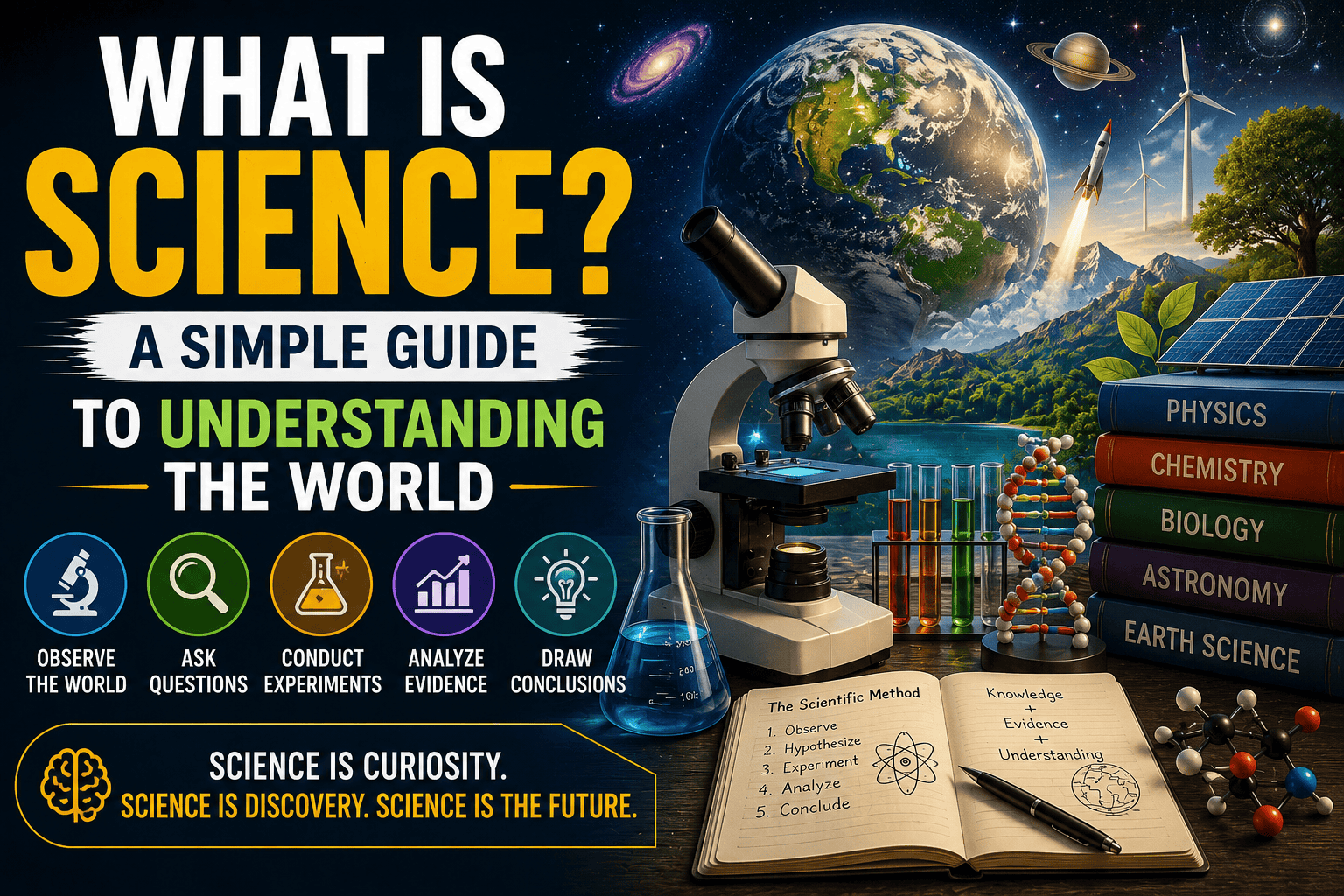
The scientific method is not a rigid recipe but a flexible cycle. A typical version has these steps:
- Pose a question, such as: “Does fertilizer X improve corn production?”
- Do background research – what is already known?
- Form a hypothesis – a testable, falsifiable prediction: “Corn plants given fertilizer X will produce 20% more grain than those without.”
- Design and conduct an experiment – control groups, variables, sample size.
- Analyze data – use statistics to see if results are significant.
- Reach a conclusion by either supporting or rejecting the hypothesis.
- Share the findings by publishing them in a peer-reviewed journal.
- Replicate – other scientists repeat the study.
Important terms:
- A hypothesis is a proposed explanation or educated guess that can be tested through observation or experimentation.
- Theory: A well-tested, widely accepted explanation that ties together many hypotheses and facts. Examples: germ theory of disease, theory of evolution, theory of relativity. In everyday language, “theory” means a guess; in science, it is the highest level of certainty.
- Law: A concise description of a natural phenomenon, often mathematical. Example: Newton’s law of universal gravitationLaws state what occurs, while theories seek to explain the reasons behind it.
Example: The hypothesis “smoking causes lung cancer” was tested over decades with epidemiological studies, animal experiments, and cell biology. It is now a theory – the most robust explanation for the observed correlation.
1.4 Science vs. Pseudoscience – A Crucial Distinction
Pseudoscience (false science) claims to be scientific but lacks the core principles of testability, falsifiability, and replication.
Key differences:
| Feature | Science | Pseudoscience |
|---|---|---|
| Falsifiability | Actively seeks tests that could prove it wrong | Explains away any contradictory evidence |
| Peer review | Requires publication in reputable journals | Avoids or attacks the peer review system |
| Progress | Changes when new evidence emerges | Stays fixed; claims “ancient wisdom” |
| Predictions | Makes specific, testable predictions | Vague or post-hoc explanations |
Examples of pseudoscience: Astrology (claims that star positions affect personality, but fails controlled tests), homeopathy (remedies so diluted that no molecules remain, yet claims efficacy), creationism (intelligent design as a scientific alternative to evolution – no testable mechanism).
Why it matters: Distinguishing real science from pseudoscience is essential for public health, safety, and policy. Vaccines save lives; anti-vaccine pseudoscience kills.
Part 2: The Major Branches of Science – A Map of Knowledge
2.1 Overview: Formal, Natural, and Applied Sciences
Science is traditionally divided into three broad domains:
- Formal sciences examine abstract systems through logic and mathematics.. They do not rely on empirical experiments. Examples: logic, mathematics, statistics, computer science theory.
- Natural Sciences – Study the physical and natural world through observation and experimentation. They are empirical. Examples: physics, chemistry, biology, earth science.
- Applied Sciences – Use knowledge from natural and formal sciences to solve practical problems. Examples: engineering, medicine, agriculture, environmental science.
Additionally, Social Sciences (psychology, sociology, economics, anthropology) use scientific methods to study human behavior and society. Some classify them separately, but they are empirical sciences.
2.2 Formal Sciences – The Abstract Foundations
Formal sciences do not need laboratories. They work with symbols, axioms, and proofs.
2.2.1 Logic – The Rules of Correct Reasoning
Logic is the study of valid inference and argumentation. It provides the structural rules that all other sciences follow.
Branches:
- Propositional logic: Deals with statements (true/false) and connectives (and, or, not, if-then).
- Predicate logic: Adds quantifiers (all, some) and relations.
- Mathematical logic: Formal systems used in mathematics and computer science.
Example: Modus ponens – If P implies Q, and P is true, then Q is true. “When it rains, the ground becomes wet.It is raining. Therefore, the ground is wet.”
2.2.2 Mathematics – The Language of Patterns
Mathematics studies quantity, structure, space, and change. It is the essential tool for all quantitative sciences.
Major subfields:
- Arithmetic: Basic operations on numbers (addition, multiplication, etc.).
- Algebra: Symbols and equations; solving for unknowns.
- Geometry: Shapes, sizes, positions; Euclidean and non-Euclidean.
- Calculus: Rates of change (derivatives) and accumulation (integrals). Essential for physics, engineering, economics.
- Linear algebra: Vectors, matrices, systems of equations. Used in computer graphics, machine learning.
- Statistics and probability: Collecting, analyzing, and interpreting data; measuring uncertainty.
- Discrete mathematics: Finite structures (graphs, sets, combinatorics). Used in computer science.
Example: Calculus allows us to calculate the trajectory of a rocket, the growth of a population, or the optimal price for a product.
2.2.3 Computer Science – Algorithms and Computation
Computer science studies computation, information processing, and the design of software and hardware.
Major subfields:
- Algorithms: Step-by-step procedures for solving problems (e.g., sorting, searching).
- Data structures: Organizing data efficiently (arrays, trees, hash tables).
- Artificial intelligence (AI): Systems that mimic human reasoning (machine learning, neural networks, natural language processing).
- Theory of computation: What problems can be solved by computers? (Turing machines, complexity classes like P vs. NP).
- Programming languages: Designing and implementing languages (Python, Java, C++).
- Computer architecture: Hardware design – processors, memory, input/output.
Example: Google’s search algorithm uses graph theory (PageRank), data structures (inverted indexes), and AI (RankBrain) to return relevant results in milliseconds.
2.3 Natural Sciences (Empirical Sciences)
Natural sciences study the material universe. They are divided into life sciences and physical sciences.
2.3.1 Life Sciences (Biology and Related Fields)
Biology: The study of living organisms. Subfields:
- Botany is the study of plants, including their structure, growth, reproduction, and interactions with the environment.
- Zoology: Animals – behavior, physiology, classification, and evolution.
- Microbiology: Microscopic life – bacteria, viruses, fungi, protozoa.
- Genetics: Heredity and variation – DNA, genes, genomes. Includes molecular genetics, population genetics.
- Ecology: Interactions between organisms and their environment – ecosystems, food webs, biodiversity.
- Evolutionary biology: How species change over time – natural selection, speciation, common descent.
- Cell biology: Structure and function of cells – organelles, cell division, signaling.
- Neuroscience: The nervous system – brain, neurons, behavior, cognition.
For example, ecology shows that deforestation in the Amazon can influence rainfall patterns as far away as the Midwestern United States because trees release water vapor that forms atmospheric rivers.
2.3.2 Physical Sciences – Matter, Energy, and the Cosmos
Physics: The most fundamental science. It examines matter, energy, space, time, and how they interact with one another.
- Classical physics: Mechanics (motion, forces), thermodynamics (heat, work), electromagnetism (electricity, magnetism, light).
- Modern physics: Quantum mechanics (behavior of subatomic particles), relativity (high speeds and strong gravity), nuclear physics (atomic nuclei, radioactivity).
- Condensed matter physics: Solids and liquids – semiconductors, superconductors, magnets.
- Astrophysics and cosmology study stars, galaxies, black holes, and the origin and future of the universe.
Example: Quantum mechanics explains why your smartphone’s transistor works – electrons tunneling through barriers.
Chemistry: The study of substances – their composition, structure, properties, and reactions.
- Organic chemistry: Carbon-based compounds (living things, plastics, drugs).
- Inorganic chemistry: Metals, minerals, and non-carbon compounds.
- Physical chemistry: The physics of chemical systems – thermodynamics, kinetics, quantum chemistry.
- Analytical chemistry: Identifying and measuring substances (chromatography, mass spectrometry).
- Biochemistry: Chemical processes inside living organisms – enzymes, metabolism, DNA replication.
Example: Biochemistry explains how the drug aspirin blocks an enzyme (COX) that produces pain-signaling molecules.
Earth and Space Sciences:
- Geology: Solid Earth – rocks, minerals, plate tectonics, volcanoes, earthquakes.
- Meteorology: Atmosphere – weather, climate, storms, climate change.
- Oceanography: Oceans – currents, marine life, seafloor geology.
- Astronomy: Celestial objects – planets, stars, galaxies, using telescopes and spacecraft.
- Planetary science: Comparative study of planets and moons in our solar system and beyond.
Example: Plate tectonics (geology) explains why earthquakes occur along the Pacific Ring of Fire and how mountain ranges like the Himalayas formed.
2.4 Applied Sciences – Turning Knowledge into Practice
Applied sciences use discoveries from natural and formal sciences to create technologies, treatments, and solutions.
2.4.1 Health and Medical Sciences
- Medicine: Diagnosis, treatment, and prevention of disease. Subspecialties: cardiology, oncology, neurology, etc.
- Pharmacology: How drugs interact with the body – development, dosing, side effects.
- Nursing: Patient care and health promotion.
- Dentistry: Oral health.
- Public health: Population-level health – epidemiology, sanitation, vaccination campaigns.
Example: Epidemiology (a medical science) identified that smoking causes lung cancer by comparing thousands of smokers and non-smokers over decades.
2.4.2 Agricultural Science (Agronomy, Animal Science)
- Agronomy: Crop production and soil management – plant breeding, irrigation, pest control.
- Animal science: Livestock – breeding, nutrition, health, and welfare.
- Food science: Processing, preservation, and safety of food.
Example: The Green Revolution (mid-20th century) used agronomy – high-yield wheat and rice varieties, synthetic fertilizers, and irrigation – to double global food production, saving millions from famine.
2.4.3 Applied Physics and Materials Science
- Electronics: Circuits, transistors, integrated circuits – the basis of all digital devices.
- Optics: Lenses, lasers, fiber optics – used in eye surgery, internet cables.
- Materials science: Designing new materials – polymers, composites, nanomaterials, superconductors.
- Energy technology: Solar cells, wind turbines, batteries, nuclear reactors.
Example: Semiconductors (materials like silicon with tunable conductivity) enable everything from smartphones to electric vehicles.
2.4.4 Environmental Science
An interdisciplinary applied science combining biology, chemistry, geology, and social science to address environmental problems.
- Pollution control: Air, water, soil remediation.
- Climate science: Modeling greenhouse gas emissions, predicting impacts.
- Conservation biology: Protecting endangered species and ecosystems.
- Waste management: Recycling, landfills, hazardous waste treatment.
Example: Environmental science developed catalytic converters for cars, which reduce nitrogen oxide emissions by 90%.
2.4.5 Engineering
Engineering involves applying scientific knowledge to create, develop, and maintain structures, machines, systems, and processes.
- Civil engineering: Bridges, dams, roads, buildings, water supply systems.
- Mechanical engineering: Machines, engines, HVAC, robotics.
- Electrical engineering: Power generation, motors, electronics, telecommunications.
- Chemical engineering: Industrial chemical processes – refineries, plastics, pharmaceuticals.
- Aerospace engineering: Aircraft, spacecraft, satellites.
- Computer engineering: Hardware-software integration (microprocessors, embedded systems).
- Biomedical engineering: Medical devices (pacemakers, prosthetics, imaging systems).
Example: Civil engineers use physics and materials science to build skyscrapers that can withstand earthquakes and high winds.
2.5 Social Sciences – The Scientific Study of Human Behavior
Although not always included in “natural science,” social sciences use scientific methods (observations, statistics, experiments) to study human societies and behavior.
- Psychology: Mind and behavior – cognition, emotion, personality, mental disorders.
- Sociology: Social structures, institutions, inequality, group dynamics.
- Economics: Production, distribution, and consumption of goods and services – microeconomics (individuals, firms) and macroeconomics (whole economies).
- Anthropology: Human cultures, evolution, archaeology, linguistics.
- Political science: Governments, power, public policy, international relations.
Example: Randomized controlled trials in economics (e.g., studying the effect of a cash transfer program on poverty) use the same methodology as medical trials.
Part 3: The Evolution of Science – A Historical Journey
3.1 Ancient Foundations (c. 3000 BCE – 500 BCE)
Long before the word “science” existed, humans practiced systematic observation and practical problem-solving.
Mesopotamia (modern Iraq): Sumerians developed a base-60 number system (we still use 60 minutes, 360 degrees). They recorded astronomical observations – lunar cycles, planets – to create calendars and predict eclipses.
Ancient Egypt: Geometry emerged from the need to re-survey land after Nile floods. Egyptian medicine included diagnosis, surgery, and herbal remedies (Ebers Papyrus, c. 1550 BCE). They built massive structures (pyramids) with remarkable precision.
Indus Valley (India): Advanced urban planning (grid streets, drainage systems). Developed standardized weights and measures.
Ancient China: Recorded supernovae (1400 BCE), developed acupuncture, and produced the earliest known star maps.
Example: The Antikythera mechanism (c. 100 BCE, Greece) was a mechanical analog computer that predicted astronomical positions – a stunning example of ancient applied science.
3.2 Greek Influence (c. 600 BCE – 200 CE)
The Greeks moved from myth to natural philosophy – seeking rational explanations.
- Thales of Miletus (c. 624–546 BCE): Predicted a solar eclipse; proposed water as the fundamental substance.
- Pythagoras (c. 570–495 BCE): Mathematics as key to understanding nature; Pythagorean theorem.
- Aristotle (384–322 BCE): Systematic observation and classification. He categorized animals, studied motion (though incorrectly), and influenced science for 2,000 years. His emphasis on empirical observation was crucial.
- Euclid (c. 300 BCE): Elements – the standard geometry textbook for over 2,000 years.
- Archimedes (c. 287–212 BCE): Discovered buoyancy (Eureka!), calculated pi, invented war machines.
- Ptolemy (c. 100–170 CE): Almagest – a geocentric model of the universe that predicted planetary positions with reasonable accuracy for 1,400 years.
Limitation: Greeks excelled at mathematics and logic, but they did not systematically perform experiments. They often relied on pure reason, leading to errors (e.g., Aristotle claimed heavier objects fall faster).
3.3 The Islamic Golden Age (c. 750 – 1250 CE)
While Europe fell into the Dark Ages, the Islamic world preserved, translated, and expanded Greek and Indian knowledge.
- House of Wisdom (Baghdad): A major center for translation and research.
- Al-Khwarizmi (c. 780–850): Father of algebra. His book Al-Jabr gave the name to the field. Introduced Indian numerals (our 0–9) to the West.
- Ibn Sina (Avicenna, 980–1037): The Canon of Medicine – a standard medical text in Europe until the 1600s. He described contagious diseases, clinical trials, and the importance of quarantine.
- Alhazen (Ibn al-Haytham, 965–1040): Often called the first true scientist. He used systematic experimentation (controlled conditions, repeatable methods) to study optics. He proved that light travels from objects to the eyes, not the reverse. His Book of Optics influenced Kepler, Descartes, and Newton.
Example: Alhazen built a dark room (camera obscura) and varied the size of the aperture to observe how the image changed – an early experiment in physics.
3.4 The Renaissance and Scientific Revolution (c. 1300 – 1700 CE)
This period transformed science from natural philosophy to the modern empirical enterprise.
- Nicolaus Copernicus (1473–1543): Proposed a heliocentric (Sun-centered) model, challenging Ptolemy’s geocentric system. His book On the Revolutions was published just before his death.
- Tycho Brahe (1546–1601): Meticulous naked-eye observations of planetary positions – the most accurate pre-telescope data.
- Johannes Kepler (1571–1630): Used Tycho’s data to derive three laws of planetary motion (elliptical orbits, equal areas, harmonic law). He showed that Copernicus was right but needed ellipses, not perfect circles.
- Galileo Galilei (1564–1642) is widely regarded as the pioneer of experimental physics. Used the telescope to observe Jupiter’s moons, Venus’s phases, and sunspots – evidence for heliocentrism. He formulated the law of falling bodies (all objects accelerate equally, ignoring air resistance). His conflict with the Catholic Church made him a symbol of scientific freedom.
- Francis Bacon (1561–1626): Developed the empirical method – inductive reasoning from observations to general laws. He argued against relying on ancient authority.
- René Descartes (1596–1650): Mathematician (Cartesian coordinates) and philosopher. He insisted on radical doubt and deduction. His mechanistic view of nature (animals as machines) influenced biology.
- Isaac Newton (1643–1727): The giant. Philosophiæ Naturalis Principia Mathematica (1687) presented the laws of motion and the theory of universal gravitation.He invented calculus (independently of Leibniz). He showed that the same force (gravity) makes apples fall and the Moon orbit. Newtonian physics dominated until Einstein.
Example: Newton’s experiment with prisms demonstrated that white light is composed of all colors – a crucial advance in optics.
3.5 Modern Science (19th Century – Present)
19th Century: Specialization and Professionalization
- Chemistry: John Dalton (atomic theory), Dmitri Mendeleev (periodic table), Louis Pasteur (germ theory, pasteurization).
- Biology: Charles Darwin (natural selection, On the Origin of Species, 1859). Gregor Mendel (genetics, though ignored until 1900).
- Physics: James Clerk Maxwell (electromagnetism – equations of light, electricity, magnetism). Michael Faraday (electromagnetic induction – the basis of generators).
- Geology: Charles Lyell (Principles of Geology) established uniformitarianism – the present is the key to the past.
20th Century: Relativity, Quantum Mechanics, and DNA
- Albert Einstein (1905, 1915): Special relativity (E=mc², time dilation), general relativity (gravity as curved spacetime). Revolutionized physics.
- Quantum mechanics: Max Planck (quantum of action), Niels Bohr (atomic model), Werner Heisenberg (uncertainty principle), Erwin Schrödinger (wave equation). It describes the subatomic world.
- James Watson and Francis Crick (1953): Double helix structure of DNA, based on Rosalind Franklin’s X-ray diffraction. This launched molecular biology and genetic engineering.
- Cosmology: Edwin Hubble (expansion of the universe). Discovery of cosmic microwave background (evidence for Big Bang).
21st Century: Digital Age and Beyond
- Computing: Transistor (1947), integrated circuit, microprocessor, personal computers, internet, AI.
- Genomics: Human Genome Project (2003) – sequenced all 3 billion base pairs.
- Physics: Detection of gravitational waves (2015), Higgs boson (2012).
- Space exploration: Rovers on Mars, probes to Pluto and beyond, the James Webb Space Telescope.
Example: CRISPR-Cas9 (2012) – a gene-editing tool derived from bacterial immune systems – allows precise modification of DNA, revolutionizing medicine and agriculture.
Part 4: The Importance of Science Today – Why It Matters
4.1 Science in Medicine and Healthcare
- Vaccines: Eradicated smallpox, nearly eradicated polio, controlled COVID-19. Save millions of lives annually.
- Antibiotics: Penicillin (Fleming, 1928) turned bacterial infections from death sentences to minor illnesses.
- Medical imaging: X-rays, CT, MRI, ultrasound – allow non-invasive diagnosis.
- Genomic medicine: Personalized treatments based on your DNA.
Example: The development of mRNA vaccines for COVID-19 (Pfizer, Moderna) took less than a year – a feat built on decades of basic research on messenger RNA.
4.2 Science in Technology and Communication
- Smartphones: Combine physics (transistors, radio), chemistry (batteries, displays), and computer science (OS, apps).
- Internet: From military research (ARPANET) to global network – enables instant communication, commerce, and information.
- Artificial intelligence: AlphaFold (DeepMind) solved the protein folding problem, predicting 3D structures from amino acid sequences – accelerating drug discovery.
Example: GPS (Global Positioning System) relies on Einstein’s theory of relativity – without correcting for time dilation, your phone’s location would drift kilometers per day.
4.3 Science in Environmental Protection and Sustainability
- Climate science: Models predict warming, sea-level rise, extreme weather. Evidence drives international agreements (Paris Accord).
- Renewable energy: Solar, wind, hydro, geothermal – developed through physics, materials science, and engineering.
- Conservation biology: Identifies endangered species, creates wildlife corridors, restores ecosystems.
Example: The Montreal Protocol (1987) – based on atmospheric chemistry showing that CFCs destroy the ozone layer – phased out those chemicals. The ozone hole is now healing.
4.4 Science in Space Exploration and Fundamental Discovery
- Understanding our origins: Cosmology and astrophysics reveal the age of the universe (13.8 billion years), the composition of stars, and the existence of exoplanets.
- Practical benefits: Satellite communication, weather forecasting, Earth observation (monitoring deforestation, ice melt).
- Inspiration: Space exploration drives STEM education and international cooperation (ISS).
Example: The Hubble Space Telescope and James Webb Space Telescope have allowed us to see galaxies forming just after the Big Bang – answering questions humans have asked for millennia.
4.5 Ethical Responsibilities of Science
Science is value-neutral in its methods, but its applications have ethical dimensions. Scientists and society must consider:
- Dual use: Research that could be used for harm (e.g., gain-of-function virus studies, autonomous weapons).
- Informed consent: Human subjects must understand risks.
- Animal welfare: Balancing scientific progress with humane treatment.
- Access and equity: Who benefits from new technologies? The rich or everyone?
- Misinformation: Scientists have a duty to communicate clearly and correct falsehoods.
Example: The Asilomar conference (1975) on recombinant DNA established guidelines for safe genetic engineering – a model of self-regulation by scientists.
Conclusion: Science as an Unfinished Journey
Science is not a monument of final truths. It is a living, growing, self-correcting process. Every answer leads to new questions. The branches of science – from formal logic to applied engineering – interconnect like a vast network. The journey of science, from ancient star-gazers to modern particle physicists, is the story of humanity using curiosity and discipline to understand our place in the cosmos.
As we face global challenges – climate change, emerging diseases, resource scarcity, and artificial intelligence – science alone cannot make moral choices. But without science, our choices are blind. Understanding the branches and history of science empowers us to be informed citizens, to support evidence-based policy, and to participate in the greatest adventure of all: the search for truth.
Final thought: The next great discovery may come from you – or from someone who reads this guide. Science belongs to everyone. Keep asking, keep testing, and never stop wondering.