Aesthetics
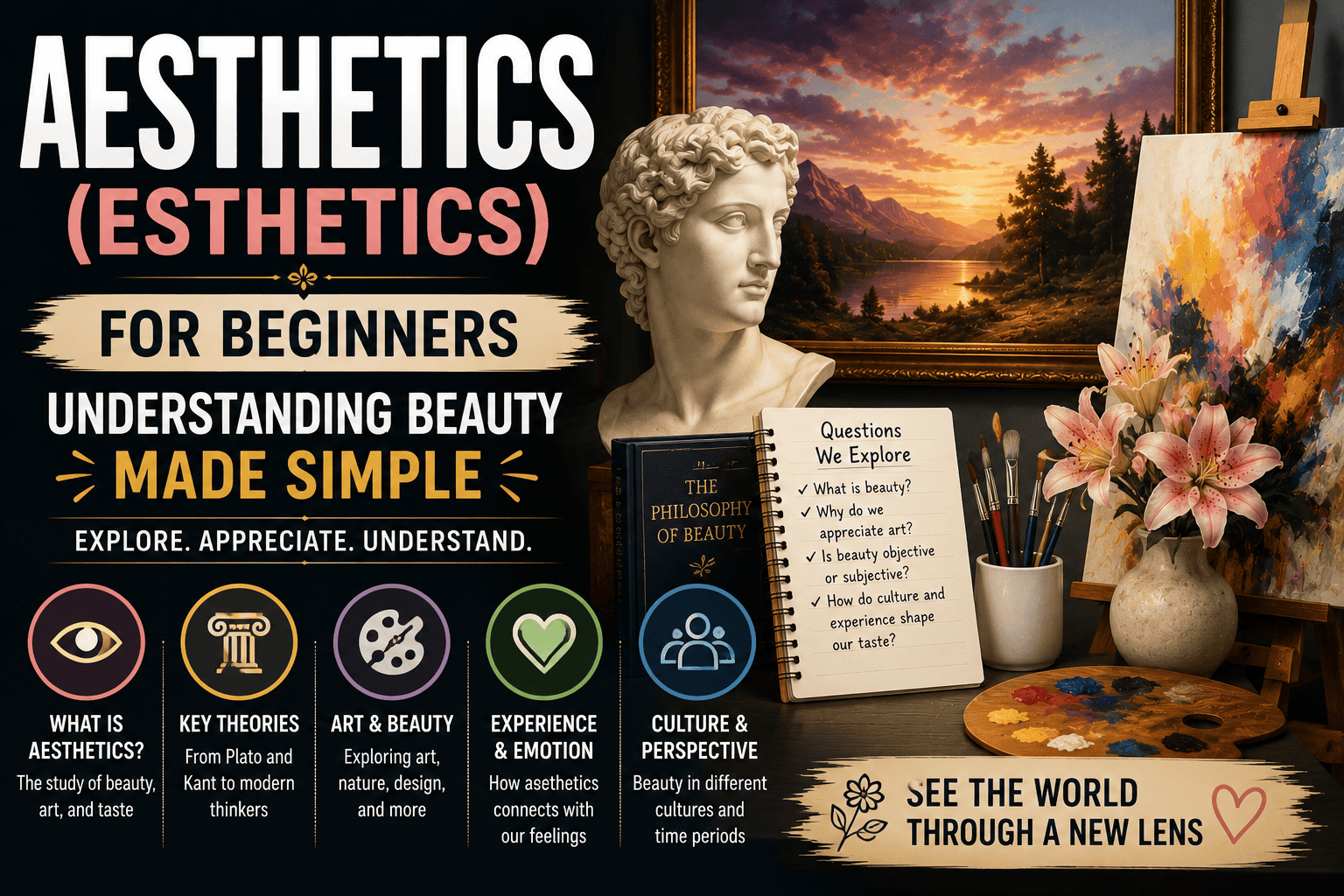
Aesthetics is the branch of philosophy concerned with beauty, art, and taste — asking what makes something beautiful, sublime, or artistically valuable. It explores whether beauty is objective or purely a matter of individual perception, and examines the nature of artistic creation, interpretation, and judgment. From classical ideals of harmony and proportion to modern debates over conceptual art, aesthetics probes how and why we respond emotionally to art and the world around us. Ultimately, it asks what role beauty and art play in a meaningful human life.
Content Overview
- Introduction: What Is Aesthetics?
- Part 1: Aesthetics – The Philosophy of Beauty and Art
- Part 2: Aesthetics in Art — theories and evaluation
- Part 3: Visual Arts and Graphic Design – Foundations and Practice
- 3.1 Foundations of Visual Art and Graphic Design
- 3.2 Design Principles – The Grammar of Visual Language
- 3.3 Typography in Detail – Kerning, Tracking, Leading, and Branding Examples
- 3.4 Logo and Brand Identity
- 3.5 Art and Illustration – Digital, Children’s, NFT, Cartoons
- 3.6 Web and App Design – UX/UI Design, Wireframes, Prototypes, and Landing Page Development
- 3.7 Print Design – Flyers, Brochures, Posters, Catalogs, Menus
- 3.8 Marketing Design – Social Media Graphics, Email Design, Web Banners, Signage
- 3.9 Packaging and Covers – Labels, Book Covers, Album Covers, Pattern Design
- 3.10 Architecture and Interior – Concept Sketching, 3D Modeling, Landscape Design, Lighting
- 3.11 3D Design – Architecture, Industrial Design, Game Art, Pipeline
- 3.12 Animation and Motion – 2D and 3D animation techniques, visual effects, animation for games, and development using Unity.
- 3.13 Adobe Mastery – Photoshop, Illustrator, Premiere Pro
- 3.14 Professional Portfolio – Showcasing Best Work, Case Studies, Behance, Dribbble
- 3.15 Freelancing and Career – Platforms, Pricing, Networking, Continuous Learning
- Part 4: Case Studies in Aesthetics and Design
- Conclusion: The Living Dialogue Between Philosophy and Practice
Introduction: What Is Aesthetics?
Aesthetics is the field of philosophy that explores beauty, art, taste, and sensory perception.. The word comes from the Greek aisthēsis – perception or sensation.Unlike ethics, which examines moral goodness, or epistemology, which investigates knowledge, aesthetics explores what we find pleasing, emotionally moving, and beautiful or sublime.
Aesthetics is not merely about personal opinion. It seeks to understand the nature of aesthetic experience – why a sunset moves us, why a symphony can bring tears, why a painting can change how we see the world. It also asks whether beauty is objective (in the object) or subjective (in the viewer’s mind), and whether art can be defined at all.
This guide covers both the philosophical foundations of aesthetics and their practical application in visual arts and graphic design. It is designed for students, professionals, and curious learners who want a deep, structured understanding of beauty, art, and design.
Part 1: Aesthetics – The Philosophy of Beauty and Art
1.1 Defining Aesthetics – Branch of Philosophy
Aesthetics is a field of philosophy concerned with beauty, art, and taste, as well as how beauty is created and experienced. It emerged as a distinct field in the 18th century, but its questions are ancient.
Aesthetics asks:
- What is beauty?
- Is beauty a feature of the object itself, or is it shaped by the perception of the observer?
- What makes something a work of art?
- What causes us to experience certain things as pleasing or emotionally affecting?
- Can there be a science of taste?
Example: A sunset is beautiful. But is its beauty a property of the sky, or a feeling in us? Aestheticians debate this.
1.2 Key Questions in Aesthetics
The central questions of aesthetics can be grouped into three areas:
- Ontology of art: What type of entity is a work of art? Is it a physical object, an idea, an experience?
- Aesthetic judgment: What does it mean to say something is beautiful? Are aesthetic judgments objective or merely expressions of feeling?
- Value of art: Why does art matter? Does it give knowledge, moral improvement, pleasure, or something else?
These questions lead to debates about whether a pile of bricks in a gallery can be art (Carl Andre’s Equivalent VIII), whether a child’s drawing has aesthetic value, and whether art can be judged independently of its moral content.
1.3 Key Areas of Aesthetics
1.3.1 Beauty (Nature and Art)
Beauty is the classic subject of aesthetics. Plato and Aristotle wrote about beauty as a property of harmony, proportion, and order.In the 18th century, thinkers drew a distinction between beauty—seen as pleasing, orderly, and modest—and the sublime, which was viewed as vast, overwhelming, and even terrifying. Kant argued that beauty is a feeling of disinterested pleasure – we take pleasure in an object without wanting to possess it or use it.
Example: A rose is beautiful. We enjoy looking at it without wanting to eat it or sell it. This is disinterested pleasure.
1.3.2 Art (Creative Human Expression)
Art is a subset of aesthetic objects – those created intentionally by humans for aesthetic appreciation. But not every beautiful thing is art (a sunset is not art), and not all art is beautiful (think of Picasso’s Guernica, which is powerful but not pretty). Philosophers have tried to define art by representation, expression, form, or institutional context.
1.3.3 Taste (Personal Preference)
Taste refers to the ability to judge beauty and artistic quality. The 18th-century philosopher David Hume asked whether there is a “standard of taste” – a way to decide whose judgment is better. Hume argued that true judges are those with delicacy of perception, practice, and freedom from prejudice. Kant argued that aesthetic judgments claim universality (“everyone ought to find this beautiful”) even though they are based on feeling, not concepts.
1.3.4 Cultural Aesthetics
Different cultures have different aesthetic traditions. Japanese aesthetics emphasizes wabi-sabi (beauty in imperfection and transience), mono no aware (the pathos of things), and yūgen (mysterious depth). Islamic aesthetics emphasizes geometric patterns, calligraphy, and the prohibition of figurative images in religious contexts. African aesthetics often values functionality, rhythm, and communal expression. Cultural aesthetics reminds us that beauty is not universal in content, even if the capacity for aesthetic experience is universal.
1.3.5 Everyday Aesthetics
Everyday aesthetics studies the aesthetic qualities of ordinary life – cooking, cleaning, gardening, driving, even using a smartphone. It argues that aesthetic experience is not limited to museums and concert halls. A well-designed kitchen tool, a tidy room, or a thoughtfully arranged desk can be sources of aesthetic pleasure.
1.3.6 Environmental Aesthetics
Environmental aesthetics studies the aesthetic appreciation of nature and the built environment. It asks: How do we appreciate a landscape, a mountain, a forest, or a city? Does nature have aesthetic value independent of human perception? Environmental aesthetics has become important in discussions of conservation and climate change – if we find nature beautiful, we are more likely to protect it.
1.4 Historical Overview of Aesthetics
1.4.1 Ancient Greece – Plato and Aristotle
Plato (c. 428–348 BCE) was suspicious of art. In his Republic, he argued that art is an imitation of an imitation. The physical world, for Plato, is already a copy of the eternal Forms (e.g., the Form of a bed). A painting of a bed is a copy of a physical bed, which is a copy of the Form.Therefore, art is considered two steps removed from reality. It appeals to the lower parts of the soul (emotion, desire) and can corrupt citizens. Plato would ban most poetry and painting from his ideal state.
Aristotle (384–322 BCE) took a more favorable perspective. In his Poetics, he argued that art (specifically tragedy) is also imitation (mimesis), but imitation is natural to humans and can be a source of learning and pleasure. Tragedy, by arousing pity and fear, produces catharsis – a purification or purging of these emotions. This is beneficial. Aristotle also introduced the concept of unity of action, time, and place, which became central to classical drama.
Example: A sculpture representing a human figure is an imitation. Plato says it is deceptive; Aristotle says it helps us understand the human form.
1.4.2 18th Century – Immanuel Kant’s Subjective Universal Judgment
Immanuel Kant (1724–1804) revolutionized aesthetics in his Critique of Judgment (1790). He argued that aesthetic judgments are:
- Subjective – they are based on feeling, not concepts. When you say “this rose is beautiful,” you are not stating a property of the rose but expressing your pleasure.
- Universal – you claim that everyone ought to find it beautiful. This is not a logical proof but a demand for agreement. Kant called this “subjective universality.”
Kant also differentiated between the beautiful—appreciated for its form without personal interest—and the sublime, which arises from overwhelming power that inspires both fear and respect. For Kant, art is a kind of “purposiveness without purpose” – it looks like it was designed for a purpose, but we cannot say what that purpose is.
Example: A beautiful flower gives us pleasure without us wanting to eat it or own it. That pleasure, Kant says, is disinterested.
1.4.3 19th Century – Hegel and the End of Art
Georg Wilhelm Friedrich Hegel (1770–1831) placed art in a historical and philosophical framework. In his Lectures on Aesthetics, he argued that art is a form of “absolute spirit” (along with religion and philosophy). Art reveals truth through sensory form.
Hegel famously declared that art, in its highest sense, is “a thing of the past.” He did not mean that no more art would be made. He meant that in the modern world, art is no longer the primary vehicle for expressing ultimate truth. Philosophy and science have taken over. This “end of art” thesis was influential for later thinkers like Arthur Danto.
Example: For Hegel, Greek sculpture perfectly embodied the ideal of human beauty and spirit. Modern art, by contrast, is more reflective and self-conscious.
1.4.4 20th Century – Institutional Theory (Danto, Dickie)
In the 20th century, thinkers increasingly asked what defines art. It became urgent as artists began producing works that challenged traditional definitions—such as Marcel Duchamp’s Fountain (a urinal signed “R. Mutt”) and Andy Warhol’s Brillo Boxes, which replicate ordinary supermarket packaging. Philosophers responded with new theories.
Arthur Danto (1924–2013) argued that what qualifies as art is determined by the theories and conceptual frameworks that surround it. Two objects that look identical can be art or not art depending on the context and interpretation. A Brillo box in a grocery store is not art; the same box in a gallery, with a theory about pop art, is art. Art requires an “artworld” – a historical context and a set of theories that confer art status.
George Dickie (1926–2020) formalized this into the institutional theory: a work of art is an artifact that has been conferred the status of candidate for appreciation by a person acting on behalf of the artworld (e.g., a curator, a critic, a gallery owner). This theory explains how Duchamp’s urinal became art – the artworld accepted it.
Critics argue that the institutional theory is circular (art is what the artworld says is art) and that it gives too much power to elites.
Example: Duchamp’s Fountain (1917) was rejected by the Society of Independent Artists. But after it was exhibited in avant-garde galleries, it became a landmark of 20th-century art. The institutional theory explains this shift.
1.5 Contemporary Debates in Aesthetics
Today, aesthetics is a vibrant field with debates about:
- Digital aesthetics: Can a video game be art? What about an NFT?
- Everyday aesthetics: Is there aesthetic value in a well-organized spreadsheet?
- Social aesthetics: How do race, gender, and class shape our aesthetic judgments?
- Neuroaesthetics: What brain processes underlie our experience of beauty?
- Environmental aesthetics: Does nature have aesthetic value independently of human perception?
Part 2: Aesthetics in Art — theories and evaluation
2.1 What Is Art? – A Contested Concept
Art is notoriously difficult to define. Some definitions are functional (art is what produces aesthetic experience), others are procedural (art is what is created according to certain rules), and others are historical (art is what stands in a certain relation to previous art). The failure to find a simple definition has led some philosophers (like Morris Weitz) to argue that art is an “open concept” – we can recognize it but not define it.
2.2 Theories of Art
2.2.1 Mimetic Theory (Art as Imitation) – Plato, Aristotle
The oldest theory: art imitates reality. For Plato, this made art dangerous (a copy of a copy). For Aristotle, imitation is natural and valuable. The mimetic theory works well for realistic painting and sculpture, but fails for abstract art, music, or conceptual art.
Example: Rembrandt’s The Night Watch imitates a group of militiamen. We can recognize the scene. But what does a Jackson Pollock painting imitate?
2.2.2 Expressive Theory (Art as Emotion) – Tolstoy, Croce
Leo Tolstoy (1828–1910) maintained that art functions as the communication of emotion. The artist experiences a feeling, conveys it through the artwork, and the viewer comes to share that emotion. Art succeeds if the emotion is sincere and infectious. For Benedetto Croce (1866–1952), art is essentially intuition-expression – the artist’s inner vision made external.
The expressive theory works well for Romantic painting, lyrical poetry, and much music. But it struggles with art that is cold, intellectual, or ironic.
Example: Edvard Munch’s The Scream expresses anxiety and despair. Even in silence, the intensity of the scream is still felt.
2.2.3 Formalist Theory (Art as Form) – Clive Bell, Roger Fry
Formalism focuses on the visual elements – line, color, shape, composition – rather than content or emotion. Clive Bell (1881–1964) coined the term “significant form” – certain combinations of lines and colors that produce aesthetic emotion. For formalists, what matters is how the work is made, not what it represents.
Formalism was influential in the early 20th century, especially for abstract art. But it ignores content and meaning, which many viewers care about.
Example: Piet Mondrian’s Composition with Red Blue and Yellow has no subject. Its aesthetic value lies in the balance, proportion, and color relationships.
2.2.4 Institutional Theory – George Dickie, Arthur Danto
As explained above, institutional theory defines art by its social context. Something counts as art if it is recognized as such by the art world.. This explains Duchamp’s Fountain and Warhol’s Brillo Boxes – they became art because curators, critics, and historians treated them as art.
The theory is descriptive (it describes how art is actually identified) rather than normative (it does not tell us what is good art). Critics say it is too permissive – it could make anything art if the right people say so.
Example: Andy Warhol’s Campbell’s Soup Cans (1962) are identical to grocery store cans. But in the gallery, with Warhol’s signature and the artworld’s acceptance, they are art.
2.3 Aesthetic Judgment and Taste
2.3.1 Subjective vs. Objective
Is beauty a property of the object, or does it exist in the perception of the viewer? Subjectivists say beauty is a feeling. Objectivists say beauty is a real property. Most philosophers now take a middle position: aesthetic judgments are subjective (based on feeling) but aim at universality (they claim to be correct). This is Kant’s position.
2.3.2 Kant’s Four Moments
Immanuel Kant’s Critique of Judgment examines aesthetic judgment through four distinct “moments”:
- Quality: The judgment of taste is disinterested – we take pleasure without desire.
- Quantity: The judgment is universal – it claims that everyone ought to agree.
- Relation: The object’s form is purposive without purpose – it looks designed, but we cannot say for what.
- Modality: The judgment is necessary – it does not depend on the existence of the object.
These are complex, but the core is that beauty is a matter of feeling that demands agreement.
2.3.3 Hume’s Standard of Taste
David Hume (1711–1776) argued that while taste is subjective, there is a “standard of taste” – the consensus of qualified critics. Qualified critics have strong sense, delicate taste, practice, comparison, and freedom from prejudice. Their collective judgment is as close to objectivity as we can get.
Example: We trust the judgment of experienced music critics over a casual listener because they have heard more music and can make finer distinctions.
2.4 Aesthetics in Different Art Forms
2.4.1 Visual Arts (Painting, Sculpture)
Visual arts appeal primarily to sight. Aesthetic issues include representation (realism vs. abstraction), composition (balance, rhythm, unity), color (harmony, contrast), and texture. In sculpture, the interplay of form, light, and space matters.
2.4.2 Performing Arts (Music, Dance, Theater)
Performing arts unfold in time. Music involves melody, harmony, rhythm, timbre, and dynamics.Dance integrates movement, music, and visual elements into a unified form. Theater adds language, character, and narrative. Aesthetic judgments here often involve the performer’s skill, the work’s emotional power, and the coherence of the performance.
2.4.3 Literature (Poetry, Fiction)
Literature uses language. Aesthetic qualities include imagery, metaphor, rhythm (prosody), narrative structure, character development, and voice. Literary aesthetics also engages with meaning – what the work says about the human condition.
2.4.4 Film and Digital Media
Film combines visual, auditory, and narrative elements. Aesthetic issues include cinematography (camera movement, lighting, framing), editing (pace, juxtaposition), sound design, and acting. Digital media adds interactivity – video games ask players to participate in creating the aesthetic experience.
Part 3: Visual Arts and Graphic Design – Foundations and Practice
3.1 Foundations of Visual Art and Graphic Design
3.1.1 What Is Visual Art?
Visual art is art that is primarily visual in nature. It includes:
- Painting: Applying pigment to a surface (canvas, paper, wall). Oil, acrylic, watercolor, fresco.
- Drawing: Using lines or marks on paper. Pencil, charcoal, ink, pastel.
- Sculpture: Three-dimensional art. Carving (wood, stone), modeling (clay), casting (bronze), assembling (found objects).
- Photography: Recording light onto a sensor or film, whether in digital or analog form.
- Digital art: Created using computer software. Includes digital painting, 3D modeling, pixel art, generative art.
3.1.2 What Is Graphic Design?
Graphic design is the discipline of creating and communicating ideas and experiences through a combination of visual and textual elements. It communicates messages through typography, imagery, color, and layout. Unlike fine art (which is often self-expressive), graphic design is usually commercial and problem-solving.
Applications: Branding, advertising, web design, print media, packaging, signage, user interfaces.
3.2 Design Principles – The Grammar of Visual Language
Design principles are guidelines for creating effective, pleasing compositions.
3.2.1 Composition – Rule of Thirds, Balance
Composition refers to how elements are arranged within a design; effective composition directs the viewer’s eye and creates a sense of balance and harmony.
- Rule of thirds: Divide the canvas into a 3×3 grid.Position key elements along the lines or at their intersections. This creates tension and interest.
- Balance: Distributing visual weight.
- Symmetrical balance: Mirror image on both sides (formal, stable).
- Asymmetrical balance: Different elements balanced by contrast (dynamic, interesting).
- Contrast: Difference between elements (light/dark, large/small, rough/smooth). Creates focus.
- Repetition and pattern: Repeating elements creates unity.
- White space (negative space): Empty areas that give breathing room and emphasize key elements.
Example: A poster with a large title in the upper-left and a small logo in the lower-right can be balanced asymmetrically.
3.2.2 Color Theory – Color Wheel, Complementary Colors, RGB vs. CMYK, Psychology
Color theory is the study of how colors mix and how they affect perception.
- Color wheel: Primary colors (red, yellow, blue), secondary colors (green, orange, purple), and tertiary colors created by mixing primary and secondary colors.
- Complementary colors are pairs positioned opposite each other on the color wheel, such as red and green, blue and orange, and yellow and purple. Create high contrast and vibrancy.
- Analogous colors: Adjacent on the wheel. Create harmony and calm.
- RGB (Red, Green, Blue): An additive color model used to display colors on digital screens.Light combines to make white.
- CMYK (Cyan, Magenta, Yellow, Key/Black): Subtractive color model for print. Ink absorbs light.
Color psychology: Colors evoke emotions. Red = excitement, danger, love. Blue = calm, trust, sadness. Yellow = energy, caution, happiness. Green = nature, growth, envy. Purple = luxury, creativity. Black = elegance, power, mourning. White = purity, simplicity, emptiness.
Example: A call-to-action button on a website is often red or orange (attention-grabbing) against a blue or neutral background.
3.2.3 Typography Basics – Serif vs. Sans-serif, Hierarchy, Font Pairing
Typography is the art of arranging type.
- Serif: Fonts with small lines (serifs) at the ends of strokes (e.g., Times New Roman, Garamond). Traditional, readable in long texts.
- Sans-serif: Fonts without serifs (e.g., Helvetica, Arial, Open Sans). Modern, clean, good for screens.
- Script: Cursive-like fonts (e.g., Brush Script, Pacifico). Decorative, use sparingly.
- Display: Decorative fonts for headlines, not body text.
Hierarchy: Using size, weight, color, and placement to show the order of importance (e.g., title > heading > subheading > body text).
Font pairing involves selecting and combining typefaces that work well together to create a balanced and visually appealing design. Common rule: one serif + one sans-serif, or two sans-serifs with distinct weights.
Example: A website might use a bold sans-serif for headings and a lighter sans-serif for body text, with a serif for quotes.
3.3 Typography in Detail – Kerning, Tracking, Leading, and Branding Examples
- Kerning: Adjusting space between two specific letters. Bad kerning creates awkward gaps (e.g., “AV” too wide). Good kerning looks even.
- Tracking (letter-spacing): Uniform space between all letters in a word. Tight tracking can create a modern look; loose tracking can feel elegant.
- Leading (line-height): Vertical space between lines of text. Too tight: lines touch; too loose: text feels disconnected. Typically 120–150% of font size.
Branding example: The Coca-Cola logo uses a custom script (Spencerian) with unique, widely spaced letters. The kerning is carefully adjusted so the “C” and “o” flow into each other.
3.4 Logo and Brand Identity
3.4.1 Types of Logos
- Wordmark: The brand name in a stylized font (Google, Coca-Cola, Disney).
- Lettermark: Initials or acronym (IBM, HBO, NASA).
- Pictorial (icon/symbol): A recognizable image (Apple’s apple, Twitter’s bird, Nike’s swoosh).
- Abstract: A geometric shape that represents the brand (Adidas’s three stripes, BP’s sunflower).
- Mascot: A character (KFC’s Colonel Sanders, Michelin’s Bibendum).
- Combination marks: Logos that integrate both text and a symbol, such as those used by Burger King, Lacoste, and Mastercard.
3.4.2 Design Process for a Logo
- Research: Client brief, industry analysis, competitor logos, target audience.
- Sketching: Rough pencil sketches – many ideas, quick iterations.
- Digitization: Vectorize the best sketches using Illustrator (pen tool, shapes).
- Refinement: Adjust proportions, colors, kerning. Test in different sizes and backgrounds.
- Presentation: Show logo in mockups (business card, website, sign).
3.4.3 Brand Style Guide
A brand style guide, also known as a brand book, helps maintain consistency. It includes:
- Guidelines for logo usage, including clear space, minimum size, and improper applications.
- Color palette (primary and secondary colors, hex/RGB/CMYK values).
- Typography: includes heading and body fonts, their sizes, and line spacing.
- Imagery style (photography, illustration, iconography).
- Voice and tone (writing style).
Example: The Google brand guide specifies that the logo should have four colors in a specific order, and the dot of the “g” is blue. It also shows how to use the logo on dark vs. light backgrounds.
3.5 Art and Illustration – Digital, Children’s, NFT, Cartoons
- Digital illustration: Created with a tablet and software (Procreate, Photoshop). Used across book cover design, concept illustration, and editorial projects.
- Children’s illustration: Bright, simple, narrative. Example: Eric Carle’s The Very Hungry Caterpillar – collage style with hand-painted papers.
- NFT art: Non-fungible tokens on blockchain. Digital art with proof of ownership. Example: Beeple’s Everydays: The First 5000 Days was purchased for approximately $69 million at auction.
- Cartoons and comics: Sequential art with humor or narrative. Includes webcomics, comic strips, graphic novels.
3.6 Web and App Design – UX/UI Design, Wireframes, Prototypes, and Landing Page Development
UX (User Experience): The overall feel and usability. Research, personas, user flows.
UI (User Interface): The visual elements – buttons, menus, forms.
Process:
- Wireframing: Low-fidelity sketches of layout (Figma, Sketch, Balsamiq).
- Prototyping: Clickable mockups to test user flow.
- Landing pages: Single-page designs focused on conversion (sign-ups, sales). Use concise headlines, prominent call-to-action buttons, and keep distractions to a minimum.
Example: A food delivery app’s UI uses large images of dishes, a bottom navigation bar, and a prominent “order now” button. UX ensures that adding items to the cart is intuitive.
3.7 Print Design – Flyers, Brochures, Posters, Catalogs, Menus
Print design requires attention to resolution (300 DPI), bleed (extra space for cutting), and color mode (CMYK).
- Flyers: Single sheet, often 8.5×11″ or A5. Eye-catching headline, key information, call to action.
- Brochures: Folded sheets (bi-fold, tri-fold). Informational, often used for businesses or events.
- Posters: Large format. Strong visual impact, minimal text.
- Catalogs: Multi-page, product-focused. Consistent grid, high-quality images.
- Menus: Restaurant. Should be easy to scan, grouped by categories, with strategic pricing placement.
3.8 Marketing Design – Social Media Graphics, Email Design, Web Banners, Signage
- Social media graphics: Size varies by platform (Instagram square, Facebook landscape, Twitter header). Use brand colors, short text, clear call-to-action.
- Email design: Responsive for mobile. Use a single column layout, buttons for clicks, alt text for images.
- Web banners: Animated or static.Incorporate motion to capture attention while maintaining a minimal file size.
- Signage: Physical signs (storefront, event, directional). Must be readable from a distance – high contrast, large type.
3.9 Packaging and Covers – Labels, Book Covers, Album Covers, Pattern Design
- Packaging and labeling should be designed to clearly attract attention and be easily noticeable on store shelves. Includes nutrition labels, instructions, branding. Use dielines (cut lines) for 3D shapes.
- Book covers: Genre expectations (romance uses script fonts and pastels; thriller uses dark colors and bold sans-serif). Title, author, imagery.
- Album covers: Art for music. Often square. Famous example: The Beatles’ Abbey Road – simple but iconic.
- Pattern design: Repeating motifs for textiles, wallpaper, wrapping paper. Seamless tiling.
3.10 Architecture and Interior – Concept Sketching, 3D Modeling, Landscape Design, Lighting
Architecture and interior design are applied visual arts that shape space.
- Concept sketching: Initial hand-drawn ideas of building forms, room layouts.
- 3D modeling: Using software (SketchUp, Revit, Blender) to create virtual buildings. Clients can “walk through” before construction.
- Landscape design: Planning gardens, parks, outdoor spaces. Includes plant selection, hardscaping (paths, walls), water features.
- Lighting design: Natural and artificial light. Affects mood, safety, and visibility.
Example: The Sydney Opera House’s iconic shells were conceived through concept sketches by Jørn Utzon. 3D modeling helped solve structural challenges.
3.11 3D Design – Architecture, Industrial Design, Game Art, Pipeline
3D design creates objects in three dimensions using software.
- Industrial design: Design of mass-produced products – chairs, smartphones, cars. Combines aesthetics with ergonomics and manufacturing.
- Game art: 3D models of characters, environments, props for video games.
- Pipeline: The production workflow:
- Concept art: 2D drawings of the idea.
- Modeling: Creating the 3D mesh (polygons) in Maya, Blender, or 3ds Max.
- Texturing: Applying colors, patterns, and surface details (using Substance Painter, Photoshop).
- Rigging involves building an internal skeleton—made of bones and joints—to enable animation.
- Animation: Moving the model over time.
- Rendering: Generating the final image or video.
Example: The character Groot from Guardians of the Galaxy began as concept art, was modeled in 3D, textured with bark-like surfaces, rigged for movement, and animated by artists.
3.12 Animation and Motion – 2D and 3D animation techniques, visual effects, animation for games, and development using Unity.
- 2D animation: Frame-by-frame (traditional) or rigged (puppet) animation. Used for cartoons, explainer videos. Software used includes Adobe Animate, Toon Boom, and Adobe After Effects.
- 3D animation: Moving 3D models. Uses keyframes or motion capture. Software: Maya, Blender, Cinema 4D.
- Visual effects (VFX): Integrating digital elements into live-action footage. Explosions, creatures, environments. Software: After Effects, Nuke, Houdini.
- Game animation: Animations triggered by player input (walk, jump, attack).It is implemented in game engines such as Unity and Unreal Engine.
- Unity development:Software designed to create and run both 2D and 3D games.Animators work with programmers to integrate assets.
Example: Disney’s Frozen used 2D character sketches, then 3D modeling and rigging, then animation with complex cloth and hair simulations.
3.13 Adobe Mastery – Photoshop, Illustrator, Premiere Pro
Adobe software is industry standard.
- Photoshop (raster – pixels):
- Layers: Stacked images that can be edited independently.
- Masks: Conceal portions of a layer without permanently removing them.
- Blending modes: How layers interact (multiply, screen, overlay).
- Uses: Photo retouching, digital painting, web design.
- Illustrator (vector – math-based lines):
- Pen tool: Create precise curves (Bezier).
- Vector shapes: Scale infinitely without loss.
- Pathfinder: Combine, subtract, intersect shapes.
- Uses: Logos, icons, typography, illustrations.
- Premiere Pro (video editing):
- Timeline: Arrange video, audio, and image clips.
- Keyframes: Animate properties over time (position, scale, opacity).
- Color grading: Adjust color and contrast (Lumetri Color).
- Uses: Video editing for social media, YouTube, films.
3.14 Professional Portfolio – Showcasing Best Work, Case Studies, Behance, Dribbble
A portfolio is essential for landing clients or jobs.
- Best work: Quality over quantity. 10–15 strong pieces.
- Case studies: Explain the problem, your process, the solution, and the results. Include sketches, wireframes, and final designs.
- Platforms:
- Behance: Adobe’s platform – good for creative portfolios, project-based.
- Dribbble: Design community – good for small shots (sneak peeks).
- Personal website: Domain name, portfolio gallery, about page, contact.
Example: A graphic designer’s case study for a rebrand: “Client X wanted a more modern look. I researched competitors, sketched 30 logo concepts, presented 3, refined the chosen one, created a brand guide, and applied it to business cards and social media. The client reported a 20% increase in engagement.”
3.15 Freelancing and Career – Platforms, Pricing, Networking, Continuous Learning
- Platforms:
- Fiverr: Gig-based, lower prices, good for beginners.
- Upwork: Hourly or fixed-price projects, more professional.
- Toptal: Top 3% of freelancers, high rates, rigorous screening.
- Pricing strategy:
- Hourly: Good for projects with uncertain scope.
- Fixed price: Good for well-defined projects (e.g., logo, brochure).
- Value-based: Charge based on the value to the client (e.g., a logo for a startup vs. a global brand).
- Retainer: Monthly fee for ongoing work (e.g., social media graphics).
- Networking: Attend design meetups, conferences (Adobe MAX), join online communities (Reddit r/design, Discord servers). Referrals are the best source of work.
- Continuous learning: Design trends change. Follow design blogs (Smashing Magazine, A List Apart), take courses (Skillshare, Coursera, LinkedIn Learning), experiment with new tools.
Part 4: Case Studies in Aesthetics and Design
4.1 Case Study: Marcel Duchamp’s Fountain – The Institutional Theory in Action
In 1917, Marcel Duchamp exhibited a urinal laid on its back and signed it “R.” Mutt.” Mutt,” and titled Fountain—to the Society of Independent Artists exhibition.. The board rejected it, but it was photographed and later exhibited in avant-garde galleries. Today, Fountain is considered a landmark of 20th-century art.
Aesthetic questions: Is a urinal art? Duchamp was testing the definition. He argued that art is not about craftsmanship but about the artist’s idea and the context. The institutional theory says Fountain became art because the artworld accepted it – art historians wrote about it, museums displayed it, and critics discussed it.
Impact: Fountain helped pave the way for conceptual art and readymades, promoting the idea that ordinary objects can be considered art when framed by an artist’s intent.
4.2 Case Study: Andy Warhol’s Campbell’s Soup Cans – Pop Art and the Nature of Art
In 1962, Andy Warhol exhibited 32 canvases, each depicting a different flavor of Campbell’s soup can. The works were hand-painted but looked mechanical. Viewers asked: Is this art? It’s just a grocery product.
Aesthetic questions: Warhol blurred the line between commercial art and fine art. He challenged the notion that art must be unique or express the artist’s inner feelings. Instead, he embraced mass production and consumer culture. Formalists disliked the lack of significant form; expressive theorists saw no emotion; but institutional theory easily accepts it as art because it was shown in a gallery.
Impact: Pop Art made everyday objects worthy of aesthetic attention. It also questioned the role of originality and the artist’s hand.
4.3 Case Study: The Coca-Cola Logo – Typography and Brand Identity
The Coca-Cola logo, designed in 1886 by Frank Mason Robinson, uses a flowing Spencerian script. It is among the most widely recognized logos globally.
Design elements: The script is unique – not a standard font but custom lettering. The red color is distinctive (Coca-Cola Red, Pantone 484). The logo has changed very little over 130 years, building brand equity.
Aesthetic principles: The curved letters create rhythm and motion. The “C” and “o” are kerned tightly for a continuous line.The logo functions effectively in a single color (red), as well as in white or black. It is legible at small sizes but also iconic as a silhouette.
Lessons: Simplicity, uniqueness, and consistency are powerful. A logo should work without explanation.
4.4 Case Study: The Bauhaus Movement – Form Follows Function
The Bauhaus was a German art school (1919–1933) that revolutionized design. Its motto: “Form follows function.” Bauhaus designers rejected ornamentation and embraced industrial materials (steel, glass, concrete). They believed design should serve human needs, not aristocratic decoration.
Key figures: Walter Gropius (founder), Ludwig Mies van der Rohe (“less is more”), Wassily Kandinsky (color theory), Paul Klee (art and pedagogy).
Impact: Bauhaus principles shaped modern architecture (glass skyscrapers, minimalist homes), furniture (Wassily chair, Barcelona chair), and graphic design (sans-serif typography, asymmetrical layouts).
Example: The Bauhaus Building features a clean design without ornamental decoration. Its form reveals its function – workshops, classrooms, dormitories. This aesthetic of honesty and efficiency influenced everything from Apple products to IKEA.
Conclusion: The Living Dialogue Between Philosophy and Practice
Aesthetics began as a branch of philosophy asking timeless questions about beauty, art, and taste.It has led to influential theories, ranging from Plato’s critique of imitation, to Kant’s idea of disinterested aesthetic pleasure, and Danto’s institutional approach to defining art. These theories help us understand why we are moved by a sunset, why we argue about whether a urinal is art, and why we trust the taste of a trained critic.
At the same time, aesthetics is not just abstract. It is applied every day by visual artists, graphic designers, architects, and illustrators. The principles of composition, color, typography, and branding are practical aesthetics. A well-designed logo is not just effective – it is beautiful. A well-made film is not just entertaining – it is sublime.
The fields covered in this guide – from the philosophy of beauty to Adobe mastery to freelance pricing – are all part of the same conversation. They ask: What moves us? How do we create that response? And how do we make a living doing so?
Whether you are a philosopher, a designer, an artist, or a curious learner, understanding aesthetics enriches your experience of the world. You will never look at a painting, a poster, or a product the same way.You will begin to recognize the decisions, ideas, and traditions that shape every visual work—and gain the skills to create your own.
Final thought: The next time you feel a shiver at a piece of music, pause before a painting, or admire a well-designed website, you are engaging in aesthetics. You are asking, in your own way, the same questions that Plato and Kant and Danto asked. Keep looking, keep feeling, and keep asking. That is the aesthetic life.