Spiritual Practices
Explore the Practices That Cultivate Inner Awareness, Connection, and Meaning — Spiritual practices are intentional activities through which people seek spiritual connection, inner calm, self-understanding, or a deeper sense of purpose. They appear in many religious and philosophical traditions and can include meditation, prayer, worship, ritual, fasting, contemplation, and the study of sacred or philosophical texts. Although these practices differ considerably in form and purpose, many encourage individuals to become more attentive to their thoughts, emotions, values, and relationship with something greater than themselves.
Spiritual practices can be performed privately or as part of a community, ranging from quiet personal reflection to collective ceremonies and worship. They often aim to develop qualities such as mindfulness, gratitude, discipline, compassion, and a greater awareness of everyday experience. At their core, spiritual practices explore how intentional habits and reflection can help people develop inner depth, strengthen their sense of connection, and find greater meaning and purpose in daily life.
Content Overview
- Introduction: What Are Spiritual Disciplines?
- Part 1: The Purpose and Context of Spiritual Practices
- Part 2: Meditation and Mindfulness – Universal Stillness
- 2.1 Origins of Meditation – Vedic, Buddhist, and Taoist Roots
- 2.2 Mindfulness in Buddhism – Sati and the Four Foundations of Mindfulness
- 2.3 Mindfulness in Modern Psychology – MBSR and Beyond
- 2.4 Christian Contemplative Prayer and Hesychasm
- 2.5 Case Study: Mindfulness-Based Stress Reduction (MBSR) – From Monastery to Clinic
- Part 3: Prayer and Contemplation – Speaking and Listening to the Divine
- Part 4: Ritual and Devotional Practices – Sacred Rhythms and Journeys
- Part 5: Metaphysical Spiritual Practices – Energy, Visualization, and Inner Alchemy
- 5.1 Visualization and Inner Transformation – Sacred Imagery
- 5.2 Energy Practices – Prana, Qi, and Life Force
- 5.3 Asceticism as Metaphysical Training – Discipline for the Soul
- 5.4 Yoga, Breathwork (Pranayama), and Esoteric Traditions
- 5.5 Case Study: Kundalini Awakening (Hinduism) and Sufi Dhikr (Islam) – Energy and Remembrance
- The Integrated Spiritual Life – Practices as Pathways
Introduction: What Are Spiritual Disciplines?
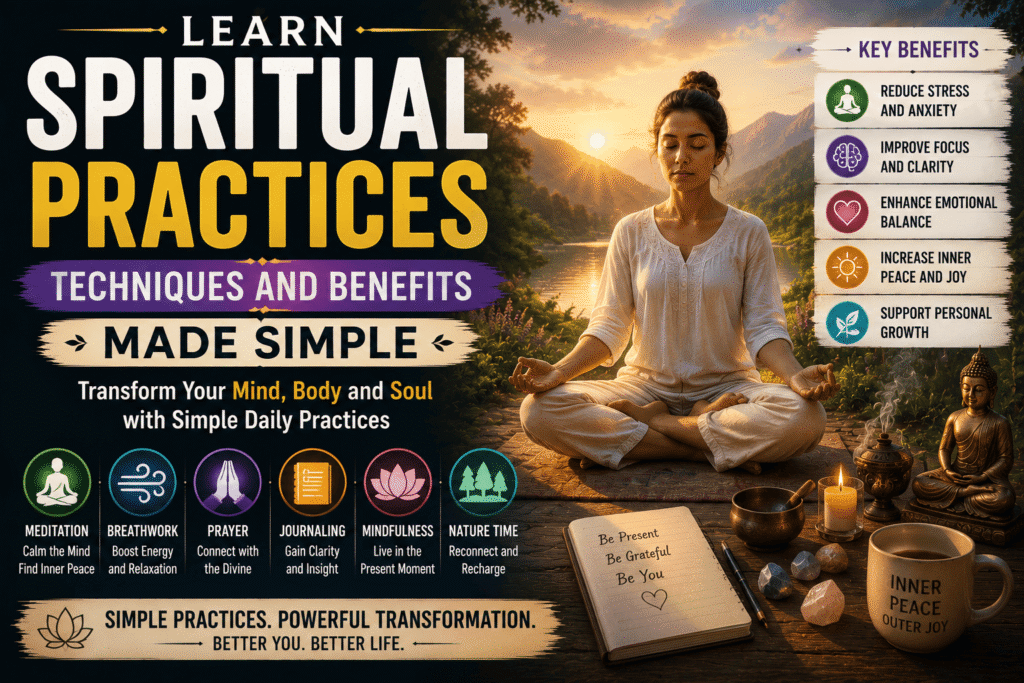
Spiritual disciplines are deliberate, structured practices that individuals or communities undertake to cultivate inner transformation, connect with the divine or ultimate reality, and embody ethical values. Unlike passive beliefs or intellectual assent, disciplines require active training – much like an athlete exercises the body, a spiritual practitioner exercises the mind, heart, and will. These practices appear in every major religious tradition and also in secular contexts (e.g., mindfulness without Buddhism). This guide covers the full spectrum: from meditation and prayer to pilgrimage, chanting, energy work, and asceticism.
Part 1: The Purpose and Context of Spiritual Practices
1.1 Spiritual Disciplines – Training the Inner Life
A spiritual discipline is any intentional, repeatable activity that aims to transform a person’s character, awareness, or relationship with the sacred. The word “discipline” comes from Latin disciplina – instruction, training, or self-control. It implies regularity, effort, and often a degree of difficulty.
Explanation: Just as physical exercise strengthens muscles, spiritual practices strengthen what might be called “soul-muscles” – attention, compassion, humility, patience, and inner peace. Without practice, spiritual insights remain abstract. With practice, they become embodied habits.
Example: A person who decides to meditate ten minutes every morning is engaging in a spiritual discipline. Over weeks, they notice they react less angrily to stress.
1.2 Purpose of Spiritual Practices – Transformation, Connection, Harmony
Spiritual practices serve multiple interconnected purposes across traditions:
- Self-Transformation: Overcoming ego, selfish desires, and destructive habits. This includes purifying the mind of greed, hatred, and delusion (Buddhism) or rooting out the seven deadly sins (Christianity).
- Connection to the Divine: Prayer, devotion, and surrender open a channel to God, the Tao, or the Absolute. The practitioner seeks not just information but relationship.
- Inner Harmony: Cultivating mindfulness, balance, and emotional regulation. Practices reduce anxiety, increase focus, and foster contentment.
- Moral Discipline: Regular practice shapes ethical character. For example, fasting builds empathy for the hungry; chanting loving-kindness phrases reduces ill will.
- Awakening or Liberation: In some traditions, the ultimate purpose is enlightenment (bodhi), salvation, or moksha – a permanent shift in consciousness.
Example: Fasting during Ramadan in Islam is not merely skipping meals. It trains self-control, reminds believers of the suffering of the poor, intensifies gratitude, and draws the community together at sunset meals.
Example: A Zen student sits in zazen (seated meditation) not to gain anything but to express the already-present Buddha nature. The purpose is purposeless – yet it transforms.
1.3 Spirituality vs. Religion – Overlap, Distinction, and Tension
These two terms are often confused. Understanding their difference clarifies the role of spiritual disciplines.
Religion, derived from the Latin religare meaning “to bind together,” can be understood as an organized system of beliefs, teachings, practices, sacred texts, and institutions. It provides a communal framework, moral codes, and often a hierarchy (priests, imams, gurus). Examples: Roman Catholicism, Sunni Islam, Orthodox Judaism.
Spirituality (from Latin spiritus – breath, life force) refers to an individual’s personal experience of transcendence, meaning, and connection to something greater than oneself. It may be expressed within a religious tradition or completely outside of any tradition.
Key distinctions:
- Religion is external, communal, and doctrinal. Spirituality is internal, personal, and experiential.
- A person can be religious but not spiritual – they perform rituals, attend services, and profess creeds without inner engagement or transformation.
- A person can be spiritual but not religious – they meditate, practice yoga, or feel awe in nature, but reject organized religion’s authority, dogma, or community.
- Religious spirituality is the integration: participating in a tradition’s practices while cultivating inner depth. This is the historic norm for most believers.
Example: A Catholic who goes through the motions of Mass but is distracted and indifferent is religious but not spiritual. A Catholic who receives the Eucharist with profound love, prays the rosary with focus, and volunteers at a shelter is both religious and spiritual.
Example: A person who practices mindfulness meditation using an app, reads Buddhist-inspired books, but has never visited a temple or taken refuge in the Three Jewels is spiritual but not religious (in the Buddhist institutional sense).
1.4 Individual vs. Communal Spiritual Life – Balance and Synergy
Spiritual disciplines can be practiced alone or in groups. Each has unique benefits and potential pitfalls.
Individual Spiritual Practices:
- Examples: Private meditation, journaling, personal prayer, reading sacred texts alone, solitary fasting, nature contemplation.
- Benefits: Deepens inner awareness, allows personalization, fosters self-reliance, and provides flexibility. It is the foundation of mystical and contemplative traditions.
- Risks: Can lead to isolation, eccentricity (unchecked by community), or spiritual pride (“I am more advanced than those who need church”).
Communal Spiritual Practices:
- Examples: Congregational prayer (Friday jumu’ah, Sunday Mass), group chanting (kirtan, gregorian chant), festivals (Diwali, Easter), pilgrimage caravans, monastic common life.
- Benefits: Builds solidarity, shared meaning, accountability, and emotional support. Collective worship can generate “collective effervescence” – a palpable energy that lifts individuals beyond their ordinary limits.
- Risks: Can become rote, performance-oriented, or coercive. Groupthink may suppress authentic questioning.
Balance: Most traditions recommend both. The Buddha told monks to meditate in solitude but also to gather for uposatha (confession and recitation of rules). The Desert Fathers lived alone in cells but gathered weekly for Eucharist. A healthy spiritual life alternates between the cave and the community.
Example: A Sufi dervish practices private dhikr (remembrance of God) alone in his room each night, repeating “Allah” silently. On Thursday evenings, he joins the sama ceremony at the tekke (lodge), whirling with other dervishes. The private practice deepens the communal, and the communal energizes the private.
Part 2: Meditation and Mindfulness – Universal Stillness
2.1 Origins of Meditation – Vedic, Buddhist, and Taoist Roots
Meditation is a family of techniques that train attention and awareness. Its roots are ancient and cross-cultural.
Vedic Tradition (Hinduism): The earliest references to meditation appear in the Upanishads (c. 800–200 BCE). The term dhyana (from Sanskrit dhi – to perceive, contemplate) refers to focused mental absorption. The Yoga Sutras of Patanjali (c. 400 CE) systematized eight limbs, of which dhyana is the seventh, leading to samadhi (union with the object of meditation). Vedic meditation often involves a mantra (sacred sound) such as “Om.”
Buddhist Tradition: The Buddha (5th century BCE) learned meditation from Hindu teachers but then developed his own framework. He taught two main types: samatha (calm abiding) – focusing on a single object (e.g., breath) to achieve deep concentration (jhana); and vipassana (insight) – observing the three marks of existence (impermanence, suffering, no-self) to attain enlightenment. Buddhist meditation is not about escaping the world but seeing it clearly.
Taoist Tradition: Taoist meditation (c. 4th century BCE onward) focuses on aligning with the Tao (the Way). Practices include zuowang (“sitting forgetting”) – emptying the mind of concepts, and neiguan (internal observation) – visualizing the flow of qi (life energy) through the body’s meridians. Unlike Buddhist emphasis on suffering, Taoist meditation emphasizes naturalness, spontaneity, and harmony with the cosmos.
Example: A Taoist practitioner sits in stillness, breathing softly, letting thoughts settle like mud in a pond. They do not fight thoughts; they simply return to the sensation of the breath at the lower abdomen (the dantian).
2.2 Mindfulness in Buddhism – Sati and the Four Foundations of Mindfulness
The Pali word sati (Sanskrit smriti) is usually translated as “mindfulness.” It means remembering to pay attention to the present moment non-judgmentally. The Buddha’s Satipatthana Sutta (Discourse on the Four Foundations of Mindfulness) is the classic text.
The Four Foundations:
- Mindfulness of the body: Breath, postures, bodily activities (walking, sitting, lying down), and the body’s elements (earth, water, fire, air). Also includes cemetery contemplations (the body’s decay) to reduce attachment.
- Mindfulness of feelings: Noticing pleasant, unpleasant, and neutral sensations as they arise, without craving or aversion.
- Mindfulness of mind: Observing the state of consciousness – greedy or not, angry or not, distracted or concentrated.
- Mindfulness of mental objects (dhammas): Observing the Five Hindrances (sensual desire, ill will, sloth, restlessness, doubt), the Five Aggregates, the sense spheres, etc.
Goal: To see things as they really are (yathabhuta). Continuous mindfulness leads to insight (vipassana) and eventually to liberation.
Example: A meditator feels an itch on her nose. Instead of scratching automatically, she notes “itching, itching” and observes the sensation’s location, intensity, and eventual fading. She sees that the itch is not “mine” – it is just a transient phenomenon. This weakens the habit of reacting.
2.3 Mindfulness in Modern Psychology – MBSR and Beyond
In the late 20th century, Jon Kabat-Zinn, a molecular biologist at the University of Massachusetts Medical School, stripped Buddhist mindfulness of its religious framework (rebirth, karma, nirvana) and created an 8-week program called Mindfulness-Based Stress Reduction (MBSR).
MBSR components:
- Body scan meditation involves gradually directing attention through different parts of the body.
- Sitting meditation (breath awareness)
- Gentle yoga (mindful movement)
- Informal practices (mindful eating, mindful walking)
- Daily home practice (45 minutes)
Empirical benefits (validated by hundreds of studies):
- Reduces chronic pain and improves pain acceptance
- Lowers anxiety, depression, and stress markers (cortisol)
- Improves immune function
- Enhances focus and working memory
- Reduces relapse in recurrent depression (when combined with cognitive therapy – MBCT)
Criticisms: Some Buddhists argue that secular mindfulness “waters down” the dharma by removing ethics (Right Speech, Right Action) and the goal of liberation. Others welcome the spread of a beneficial technique.
Example: A patient with chronic back pain learns to observe the pain as “a burning sensation” rather than “my terrible pain that ruins my life.” The suffering (mental anguish) decreases even if the pain remains.
2.4 Christian Contemplative Prayer and Hesychasm
Christianity has its own deep traditions of meditation, though the vocabulary differs.
Contemplative Prayer (Western Christianity): This is silent, wordless openness to God. Figures like Thomas Merton (1915–1968) revived it in the 20th century. Unlike petitionary prayer (asking for things), contemplative prayer rests in God’s presence. It often uses a sacred word (like “Abba,” “Jesus,” “Love”) to gently return the mind when it wanders.
Hesychasm (Eastern Orthodox Christianity): From Greek hesychia (stillness).In the Hesychasm tradition, practitioners use the Jesus Prayer—“Lord Jesus Christ, Son of God, have mercy on me, a sinner”—repeating it in a steady rhythm, often aligned with their breathing. Over time, the repetition becomes so deeply internalized that the prayer continues almost automatically, even during ordinary daily activities. Advanced hesychasts may achieve theoria (vision of the uncreated light of God).
Key distinction from Eastern meditation: Christian contemplative prayer is not about emptying the mind or achieving an impersonal state. It is about entering into a personal relationship with the triune God. The goal is theosis (deification) – becoming by grace what God is by nature, while remaining a distinct person.
Example: An Orthodox monk sits in a cave on Mount Athos, his gaze fixed on his navel (to control attention), repeating the Jesus Prayer with his breath. After decades, he reports that the prayer descends into his heart, and he experiences a warmth and light that is not created but divine.
2.5 Case Study: Mindfulness-Based Stress Reduction (MBSR) – From Monastery to Clinic
Origin: In 1979, Jon Kabat-Zinn, a student of Zen and Vipassana teachers (Philip Kapleau, Thich Nhat Hanh), established the Stress Reduction Clinic at the University of Massachusetts Medical Center. He designed an 8-week course for patients who had not responded to conventional treatments.
Structure of MBSR (8 weeks):
- Week 1: Introduction; body scan; raisin meditation (eating one raisin mindfully).
- Week 2: Perception and creative responding; sitting meditation (breath focus).
- Week 3: Mindfulness of breath, body, sounds, and thoughts; yoga.
- Week 4: Stress physiology; mindfulness of unpleasant events.
- Week 5: Responding vs. reacting; mindfulness of pleasant events.
- Week 6: Interpersonal mindfulness; mindful communication.
- All-day silent retreat (between weeks 6 and 7): 7 hours of silent practice.
- Week 7: Integrating mindfulness into daily life.
- Week 8: Review and continuation.
Evidence: A landmark 2014 meta-analysis in JAMA Internal Medicine found that MBSR produced moderate improvements in anxiety, depression, and pain. Brain imaging (fMRI) shows increased gray matter density in the hippocampus (learning, memory) and decreased activity in the amygdala (fear, stress).
Why It Matters: MBSR is the most successful example of a spiritual discipline (Buddhist mindfulness) being secularized, scientifically validated, and adopted in hospitals, schools, corporations, and the military. It shows that spiritual practices can be effective even when stripped of metaphysical beliefs.
Example: A Marine Corps veteran with PTSD, after completing MBSR, reports: “I used to be hijacked by flashbacks. Now I notice the flashback as a pattern in my body – tight chest, rapid breath. I breathe into it, and it loses its power over me.”
Part 3: Prayer and Contemplation – Speaking and Listening to the Divine
3.1 Forms of Prayer – Petition, Intercession, Thanksgiving, Praise
Prayer is the most widespread spiritual discipline across theistic traditions (Christianity, Islam, Judaism, Hinduism – though Hindu prayer is often called puja or bhajan). Prayer can be categorized into four classic types (from the Christian tradition, but applicable elsewhere):
- Petition: Asking God for personal needs – healing, guidance, strength, forgiveness. Example: “Lord, help me pass this exam.”
- Intercession: Praying on behalf of others. Example: “Please heal my friend’s cancer.”
- Thanksgiving: Expressing gratitude for blessings received. Example: “Thank you for the meal.”
- Praise: Worshipping God for who God is, not for what God gives. Example: “Holy, holy, holy, Lord God Almighty.”
Additional forms (in other traditions):
- Lament (Hebrew Bible/Psalms): Crying out to God in complaint or anguish. For example, “My God, my God, why have you abandoned me?”
- Contemplation (see below): Wordless, receptive prayer.
- Mantra repetition (Hinduism, Buddhism, Islam): Repeating a sacred name or phrase (e.g., “Om,” “Namo Amituofo,” “Allah”).
Example: The Lord’s Prayer (Christianity) contains petition (“Give us this day our daily bread”), intercession (“Forgive us our trespasses as we forgive…”), and praise (“For thine is the kingdom, the power, and the glory”).
3.2 Contemplative Silence – Centering Prayer and Zen Practice
Centering Prayer (Christianity): Developed by Trappist monks (Thomas Keating, Basil Pennington) in the 1970s as a modern adaptation of the ancient Lectio Divina (divine reading) tradition. Method:
- Choose a sacred word (e.g., “God,” “Jesus,” “Love,” “Peace”).
- Sit comfortably, eyes closed.
- Introduce the word gently as a symbol of your intention to consent to God’s presence.
- When you become aware of a thought, return to the sacred word – without frustration, without “trying” to eliminate thoughts.
- At the end (20–30 minutes), pray the Lord’s Prayer or rest in silence.
Zen Practice (Zazen – seated meditation): Unlike centering prayer, Zen has no deity and no “sacred word” (though some use a koan). Method:
- Sit on a cushion (zafu) with crossed legs (lotus or half-lotus), hands in the cosmic mudra (left hand over right, thumbs touching).
- Eyes half-open, gaze resting about three feet ahead.
- Count each breath from one to ten, or simply focus your attention on the natural rhythm of breathing.
- When thoughts arise, do not chase or suppress them – let them come and go like clouds in the sky.
- Do not “do” anything. Just sit.
Comparison: Both emphasize silence, stillness, and letting go of discursive thinking. Both aim for a state beyond words. However, centering prayer maintains a theistic framework (God as personal presence), while Zen’s “just sitting” (shikantaza) has no object and no goal – it is the expression of Buddha nature itself.
Example: A practitioner of centering prayer experiences a deep sense of being held in love, sometimes without images. A Zen student experiences kensho – a flash of seeing that the self is empty and all things are interdependent.
3.3 The Jesus Prayer in Eastern Orthodoxy – A Case Study in Continuous Prayer
What it is: The Jesus Prayer is a short formula: “Lord Jesus Christ, Son of God, have mercy on me, a sinner.” It is rooted in the biblical encounter of the blind man (Mark 10:47) and the publican’s prayer (Luke 18:13). It is the central practice of Hesychasm.
How it is practiced:
- Stage 1 (Oral prayer): The beginner recites the prayer aloud or in a whisper, often with a prayer rope (komboskini) to count repetitions (100, 300, 1000). This cultivates attention.
- Stage 2 (Mental prayer): The prayer internalizes. It is recited silently in the mind, synchronized with the breath: inhale “Lord Jesus Christ, Son of God,” exhale “have mercy on me, a sinner.”
- Stage 3 (Prayer of the heart): The prayer descends from the intellect into the heart (the spiritual center, not just the organ). It becomes automatic, repeating itself without conscious effort, even during sleep. The practitioner feels warmth and a sense of divine presence.
- Stage 4 (Unceasing prayer): As St.Paul the Apostle wrote, “Pray continually” (1 Thessalonians 5:17).. The prayer becomes a constant background hum, like a heartbeat. The hesychast is said to see the uncreated light of God.
Theological significance: The Jesus Prayer is not a mantra for emptying the mind. It is a personal invocation of Christ as Lord and Savior. The phrase “have mercy” (eleison) is not about begging for forgiveness in a transactional sense; it is a cry for healing, for God’s loving energy to transform the person. The goal is theosis becoming partakers of the divine nature (2 Peter 1:4).
Example from tradition: St. Seraphim of Sarov (1759–1833), a Russian Orthodox saint, was known to recite the Jesus Prayer continuously. Visitors reported seeing his face shining with light. He taught that the goal of the Christian life is the acquisition of the Holy Spirit, and the Jesus Prayer is the royal path.
Part 4: Ritual and Devotional Practices – Sacred Rhythms and Journeys
4.1 The Sacred Calendar – Festivals, Holy Days, and Liturgical Time
Religious calendars structure time itself as a spiritual discipline. By observing festivals and holy days, believers enter into sacred history – the cycle of creation, redemption, and renewal.
Examples across traditions:
- Christian liturgical year: Advent (preparation for Christmas), Christmas (birth of Jesus), Lent (40 days of fasting and repentance), Holy Week (Passion and death), Easter (resurrection), Pentecost (birth of the church). Each season has colors, readings, and prayers.
- Islamic calendar (Hijri): Ramadan (month of fasting), Eid al-Fitr (breaking the fast), Eid al-Adha (festival of sacrifice), Ashura (day of mourning for Shi’a), the month of Muharram.
- Jewish calendar: Rosh Hashanah (New Year), Yom Kippur (Day of Atonement – fasting and prayer), Sukkot (booths), Passover (exodus from Egypt), Shabbat (weekly Sabbath).
- Hindu calendar: Diwali (festival of lights – victory of light over darkness), Holi (spring festival of colors), Navaratri (nine nights of the goddess), Maha Shivaratri (night of Shiva).
- Buddhist calendar: Vesak (Buddha’s birth, enlightenment, and death), Uposatha (weekly observance day), Kathina (robe-offering ceremony).
Purpose: Sacred calendars break the monotony of profane time. They remind believers that history has meaning and that redemption is not just a future hope but a present reality reenacted annually.
Example: During Lent, a Christian may give up sweets, attend weekly Stations of the Cross, and increase almsgiving. This discipline reshapes 40 days into a spiritual journey that culminates in the joy of Easter.
4.2 Pilgrimages and Sacred Journeys – Walking the Path
A pilgrimage is a journey to a sacred place, often undertaken with hardship (walking, fasting, sleeping rough). It is a metaphor for the spiritual life itself – leaving the familiar, enduring trials, seeking transformation.
Major pilgrimages:
- Hajj (Islam): To Mecca, Saudi Arabia. Required once for those able. Rituals include circling the Kaaba, running between Safa and Marwa, standing at Arafat, and stoning the devil.The Hajj is believed to cleanse past sins and bring Muslims together in a shared global act of worship.
- Camino de Santiago (Christianity): A network of routes across Europe culminating at the cathedral of Santiago de Compostela, Spain, where St. James is buried. Pilgrims walk hundreds of miles, staying in hostels, carrying a scallop shell.
- Kumbh Mela (Hinduism): The largest pilgrimage gathering (see case study below). Not a single place but four rotating river banks (Allahabad, Haridwar, Nashik, Ujjain). Pilgrims bathe to wash away karma.
- Bodh Gaya (Buddhism): In Bihar, India, site of the Buddha’s enlightenment under the Bodhi tree. Pilgrims engage in meditation, walk around the Mahabodhi Temple in devotion, and present flowers as offerings.
- Varanasi (Hinduism): The holiest city on the Ganges. Pilgrims cremate their dead or scatter ashes to ensure liberation.
Spiritual benefits of pilgrimage: Physical hardship disciplines the body; leaving home strips away status and comfort; encountering other pilgrims builds community; the sacred site provides a focal point for prayer and gratitude.
Example: A modern Camino pilgrim might walk 800 km over 40 days. Blisters, rain, and fatigue become teachers of patience. Arriving at the cathedral, she feels a profound release – not just physical but spiritual.
4.3 Devotion – Bhakti, Dhikr, and Chanting
Devotional practices are those that cultivate love, surrender, and emotional connection to the divine.
Bhakti in Hinduism comes from the Sanskrit word bhaj, meaning “to share” or “to love.” Bhakti yoga is the path of loving devotion to a personal god (Vishnu, Krishna, Shiva, Devi). Practices include puja (offering flowers, food, incense), kirtan (call-and-response chanting of divine names), japa (repetition of a mantra on beads), and darshan (gazing at the deity’s image). The attitude is that of a servant, a child, a friend, or a lover.
Dhikr (Islam): Arabic for “remembrance.” Dhikr is the repeated recitation of God’s names or short phrases (e.g., “SubhanAllah” – Glory to God, “Alhamdulillah” – Praise be to God, “Allahu Akbar” – God is greatest). Sufis may perform dhikr in groups, with rhythmic breathing, swaying, or whirling. The goal is to purify the heart and attain fana (annihilation in God).
Chanting (Buddhism and Christianity):
- Buddhist chanting: In Pure Land Buddhism, repeating “Namo Amituofo” (Homage to Amitabha Buddha) is a practice of faith that leads to rebirth in the Pure Land. In Theravada, chanting suttas (e.g., Metta Sutta) cultivates loving-kindness.
- Christian chant: Gregorian chant, Taizé chants, and Byzantine chant use repetitive melodies and scripture texts to induce a meditative state. The community’s voices blend into a single prayer.
Example: A Hindu devotee of Krishna wakes at 4 AM, chants the Hare Krishna mantra (“Hare Krishna, Hare Krishna, Krishna Krishna, Hare Hare / Hare Rama, Hare Rama, Rama Rama, Hare Hare”) 108 times on beads, offers a tray of food, and then distributes prasada (blessed food). His whole day is saturated with devotion.
4.4 Case Study: The Hindu Kumbh Mela Pilgrimage – The Largest Gathering of Faith
What it is: The Kumbh Mela is a mass Hindu pilgrimage that occurs four times every 12 years, rotating among four sacred riverside sites: Prayagraj (confluence of Ganges, Yamuna, and mythical Sarasvati), Haridwar (Ganges), Ujjain (Shipra), and Nashik (Godavari). The Maha Kumbh Mela at Prayagraj occurs every 144 years (the most auspicious). The 2019 Kumbh Mela at Prayagraj attracted over 200 million people – the largest peaceful gathering in human history.
Mythological origin: The gods and demons churned the cosmic ocean to obtain the nectar of immortality (amrita). A celestial bird carried the pot (kumbh) of nectar, and drops fell at the four sites. The festival commemorates this event. Bathing in the river at the precise astrological moment is believed to wash away all karma, accelerating liberation (moksha).
Key rituals:
- Shahi Snan (Royal Bath): The most sacred bathing days, determined by planetary alignments. Naga sadhus (naked, ash-smeared ascetics) lead the procession, charging into the water at dawn.
- Processions: Akharas (monastic orders) parade with flags, spears, elephants, and music.
- Spiritual discourses (pravachan): Gurus and saints teach from stages.
- Charitable feeding: Massive langars (free kitchens) feed millions of pilgrims.
Spiritual discipline involved: Pilgrims often walk for weeks or months to reach the site. They may fast, sleep on the ground, and endure extreme weather. The act of bathing is a ritual immersion symbolizing inner purification. The sheer scale of the gathering creates a collective energy (shakti) that many describe as transcendent.
Example: A 70-year-old villager from rural Bihar walks 300 km to Prayagraj. She carries only a cloth bundle. At the sacred bathing hour, she wades into the cold January river, dips completely three times, and prays for her ancestors’ liberation. She then donates a small coin to a beggar. She returns home feeling “light” – as if a burden has been lifted.
Part 5: Metaphysical Spiritual Practices – Energy, Visualization, and Inner Alchemy
5.1 Visualization and Inner Transformation – Sacred Imagery
Visualization is the deliberate use of mental imagery to evoke spiritual states, transform the subconscious, or connect with divine beings.
Examples:
- Tibetan Buddhist deity yoga: The practitioner visualizes themselves as a buddha or bodhisattva (e.g., Chenrezig, the bodhisattva of compassion) – with specific color, posture, and attributes. This is not fantasy but a method to realize that one’s own mind is already enlightened. Advanced practitioners “dissolve” the visualization into emptiness.
- Christian Ignatian contemplation: St. Ignatius of Loyola (1491–1556) taught the composition of place – vividly imagining oneself in a Gospel scene (e.g., watching Jesus calm the storm). The practitioner engages all five senses, then speaks to the characters. This deepens affective union with Christ.
- Hindu yantra meditation: A yantra is a geometric diagram (e.g., Sri Yantra, composed of interlocking triangles). The meditator gazes at the external yantra, then closes their eyes and visualizes it internally, eventually dissolving into the central point (bindu) representing non-dual consciousness.
Purpose: Visualization uses the brain’s innate imagery capacity to rewire neural pathways. Over time, the qualities visualized (compassion, wisdom, purity) become spontaneous habits.
Example: A Buddhist practitioner visualizes light radiating from her heart, touching all suffering beings. After months of practice, she finds herself spontaneously feeling compassion in ordinary life.
5.2 Energy Practices – Prana, Qi, and Life Force
Many traditions believe in a subtle energy that flows through the body. Spiritual disciplines aim to cultivate, balance, or channel this energy.
Key terms:
- Prana (Hinduism, Yoga): Vital life force. It enters through breath, food, and sun. Pranayama (breath control) regulates prana, purifying the nadis (energy channels).
- Qi (or Chi – Taoism, Chinese medicine): The circulating life force. Practices like Qigong (energy cultivation) and Tai Chi (moving meditation) balance qi, removing blockages.
- Lung (Tibetan Buddhism): Wind energy associated with mind. Certain practices (e.g., tummo – inner heat) manipulate lung to generate heat and bliss.
Examples of energy practices:
- Reiki (Japanese): A healing method where the practitioner channels “universal life energy” through their hands to the recipient. Not traditionally religious but often spiritual.
- Pranayama (Yoga): Techniques like nadi shodhana (alternate nostril breathing) balance the left and right energy channels.
- Taoist inner alchemy (neidan): The practitioner circulates qi through the three dantian (energy centers in lower abdomen, heart, and head), ultimately refining it into “spirit” (shen).
Example: A Qigong master stands still (Zhan Zhuang), arms rounded as if holding a ball. He focuses on the sensation of qi rising from the feet to the lower dantian. After 30 minutes, he feels warm, grounded, and alert.
5.3 Asceticism as Metaphysical Training – Discipline for the Soul
Asceticism (covered in depth in a previous guide) can also be viewed metaphysically – as a method of freeing the soul from the constraints of the material body and its cravings.
Metaphysical rationale:
- In Hinduism and Jainism, karma is a subtle matter that binds the soul. Ascetic practices (fasting, celibacy, exposure to heat/cold) burn off karma, allowing the soul to rise to liberation.
- In Christianity, asceticism is not about earning salvation (grace alone saves) but about removing obstacles to grace. By disciplining the body, the soul becomes more receptive to the Holy Spirit.
- In Neoplatonism and Gnosticism, the material world is a prison. Asceticism reduces the soul’s identification with the body, enabling it to ascend to the spiritual realm.
Practical examples:
- Fasting – reduces energy spent on digestion, redirecting it to prayer or meditation.
- Celibacy – conserves sexual energy (ojas in Hinduism) for spiritual purposes.
- Silence (vow of silence) – conserves mental energy and breaks the habit of gossip and idle talk.
Example: A Jain monk fasts for 30 days, consuming only boiled water. He reports heightened clarity, vivid dreams of his past lives, and a sense of lightness. He is burning off karma.
5.4 Yoga, Breathwork (Pranayama), and Esoteric Traditions
Yoga (Hinduism): The term yoga means “union.” The Yoga Sutras define it as “the cessation of the modifications of the mind” (chitta vritti nirodha). The eight limbs of yoga are:
- Yama (ethical restraints): These include principles such as non-violence, truthfulness, honesty (avoiding theft), self-restraint, and freedom from excessive attachment.
- Niyama (observances – purity, contentment, austerity, study, surrender)
- Asana (posture – the physical poses, originally for sitting meditation)
- Pranayama (breath control)
- Pratyahara (withdrawal of the senses)
- Dharana (concentration)
- Dhyana (meditation)
- Samadhi (absorption or union)
Pranayama (Breathwork): More than just deep breathing. Examples:
- Ujjayi (victorious breath): slight throat constriction, creating a hissing sound. Used in Hatha yoga.
- Kapalabhati (skull-shining breath): rapid, forceful exhalations, passive inhalations. Cleanses the sinuses and energizes.
- Bhastrika (bellows breath): rapid, equal inhalation and exhalation. Increases metabolic fire.
Esoteric Traditions: These include Western esotericism (Hermeticism, Alchemy, Kabbalah) and Eastern tantra. They often involve:
- Mantra: Sacred sound syllables (e.g., “Om,” “Hum”) that vibrate specific energy centers.
- Yantra / Mandala: Geometric diagrams for meditation.
- Ritual magic: Using correspondences (planetary hours, colors, herbs) to effect change in consciousness.
Example: In Kundalini Yoga (as taught by Yogi Bhajan), practitioners perform rapid breathwork (pranayama), chanting (mantra), and physical postures (kriyas) to awaken the dormant energy at the base of the spine.
5.5 Case Study: Kundalini Awakening (Hinduism) and Sufi Dhikr (Islam) – Energy and Remembrance
Kundalini Awakening (Hinduism/Tantra):
- What it is: Kundalini (Sanskrit for “coiled one”) is a dormant spiritual energy depicted as a serpent sleeping at the base of the spine (muladhara chakra).
- Practice: Through a combination of asana, pranayama, mudra (gestures), and mantra, the practitioner awakens the kundalini. It rises through the central channel (sushumna), piercing each chakra (energy wheel) – from root to sacral to solar plexus to heart to throat to third eye to crown (sahasrara).
- Experience: Intense heat, involuntary movements (spontaneous yoga postures), visions, ecstasy, and eventually samadhi – union with divine consciousness.
- Risks: Kundalini awakening without proper preparation (a qualified guru, purification) can cause psychological instability, called “kundalini syndrome.”
Sufi Dhikr (Islam) – The Energy of Remembrance:
- What it is: Dhikr is the remembrance of Allah through repetition of divine names. In some Sufi orders (e.g., Naqshbandi, Shadhili), dhikr is performed with controlled breathing, focusing on the heart.
- Practice: The seeker closes their eyes, places their hand on their heart, and repeats “Allah” – inhaling the “Al-” and exhaling the “-lah.” The name is said to resonate in the heart, purifying it from heedlessness.
- Experience: The heart begins to vibrate, a warmth spreads, and the practitioner may enter a state of wajd (ecstasy) or fana (annihilation of the ego). Advanced Sufis speak of the “breath of the All-Merciful” (nafas al-rahman).
- Difference from Kundalini: Dhikr is not about chakras or serpent energy. It is about opening the heart (qalb) to divine presence. However, both describe a physiological-spiritual energy that transforms the practitioner.
Comparison:
- Kundalini emphasizes a measurable, map-like system (chakras, nadis) and is often practiced in a tantric framework.
- Dhikr emphasizes love, surrender, and the personal name of God. Energy is considered a secondary outcome rather than the primary aim.
Example: A kundalini yogi feels a searing heat rise from her tailbone, hears an inner roar, and then experiences a profound stillness – the world appears as luminous consciousness. A Sufi dervish repeats “Allah” thousands of times; suddenly the repetition stops, and he finds himself “in Allah” – no doer, no seeker, only the Real.
The Integrated Spiritual Life – Practices as Pathways
Spiritual disciplines are not ends in themselves. They are tools, pathways, or vehicles. A hammer is useless if it is never used to drive a nail; meditation is useless if it never transforms how one lives. The goal of all authentic spiritual practice – whether meditation in a Zen monastery, the Jesus Prayer in an Orthodox cell, the Kumbh Mela on the Ganges, or Kundalini in a yoga studio – is the same: to move beyond the small, fearful, grasping self and to awaken to a larger reality. That reality may be called God, Brahman, Tao, Dharmakaya, or simply “the way things are.”
The disciplines work because they engage the whole person – body (posture, breath, pilgrimage), mind (visualization, mantra, contemplation), heart (devotion, love, gratitude), and will (asceticism, vows, ethical precepts). They are ancient, tested, and available to anyone willing to begin. Whether you approach them as a devout believer or a curious secular seeker, the practices themselves – done with sincerity – have the power to open doors that no argument can unlock.