History by Century
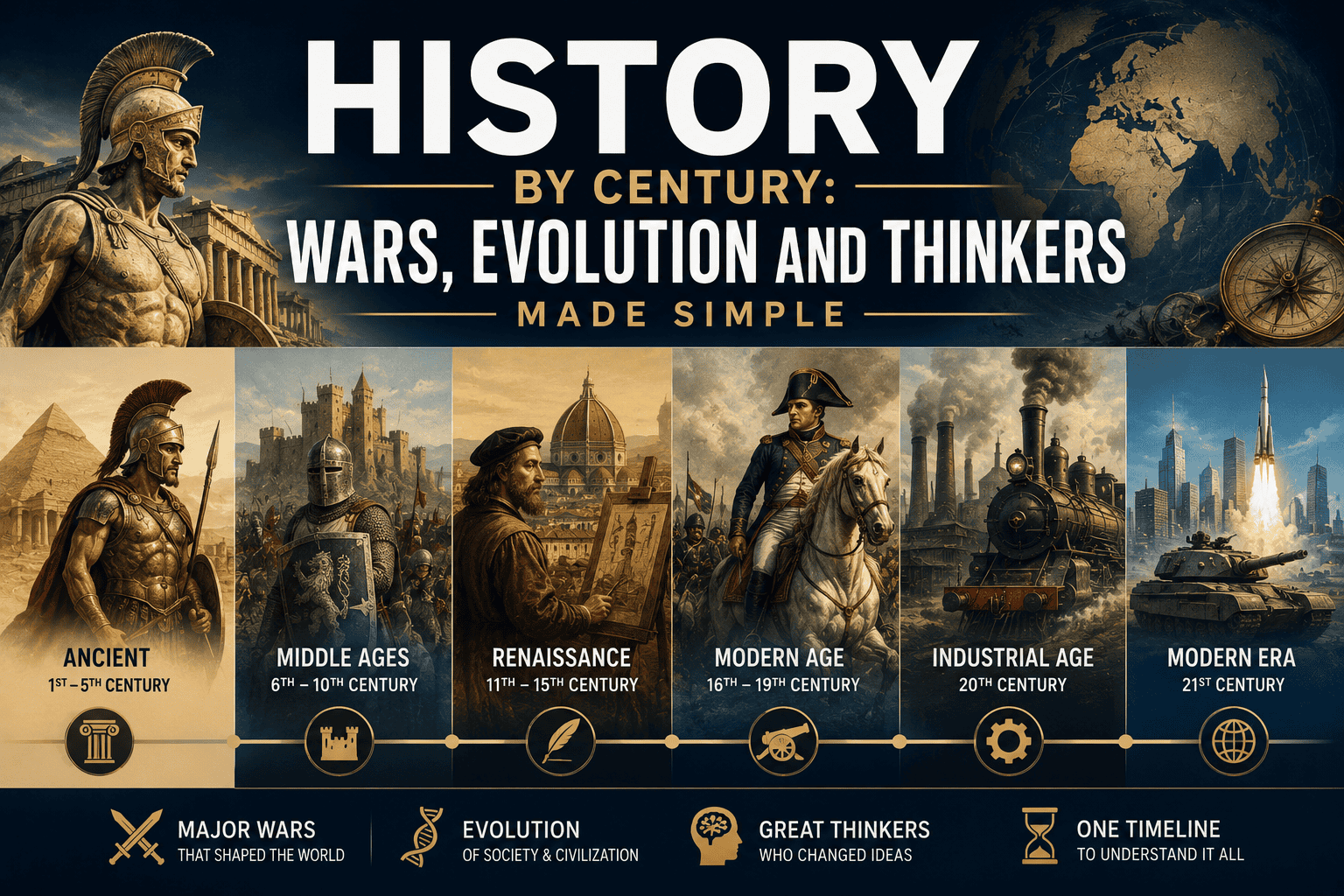
History by century – tracing wars, evolution, and thinkers – organizes the sweep of human history into defined chronological periods to reveal how conflict, ideas, and progress unfolded decade by decade. This approach highlights how major wars reshaped borders and power structures, how societies evolved technologically and culturally, and how influential thinkers challenged and redefined the ideas of their time. By examining each century as a distinct chapter, it becomes easier to trace cause-and-effect relationships between political upheaval, scientific advancement, and philosophical shifts. At its core, this lens asks how the collision of power, progress, and thought has driven the arc of human civilization forward.
- Philosophy of History by Century
- INTRODUCTION
- CHAPTER 0 — 1st to 10th Century: The Age of Empires and Religions
- CHAPTER 1 — 11th Century: Crusades and the Medieval World
- CHAPTER 2 — 12th Century: Power Struggles in Europe and Asia
- CHAPTER 3 — 13th Century: The Rise of the Mongols
- CHAPTER 4 — 14th Century: The Black Death and the Rise of Dynasties
- CHAPTER 5 — 15th Century: Discovery, Conquest, and Mughal Foundations
- CHAPTER 6 — 16th Century: Mughal Glory and Global Expansion
- CHAPTER 7 — 17th Century: Mughal Zenith and Early Colonialism
- CHAPTER 8 — 18th Century: Mughal Decline, Enlightenment, and Revolutions
- CHAPTER 9 — 19th Century: Imperialism, Indian Struggles, and Unification Movements
- CHAPTER 10 — 20th Century: World Wars, Decolonization, and the Birth of Nations
- CHAPTER 11 — Key Historical Mysteries and Unsolved Events
- CONCLUSION
Philosophy of History by Century
The Complete Human Story — From Ancient Empires to the Modern World
INTRODUCTION
Why History Matters — Understanding the Story Behind the Story
Imagine you are playing a video game, but you have no idea what happened in the previous levels. You do not know why the villain is angry, you do not know why the kingdom is broken, and you do not know why the hero is on this journey at all. You would be completely lost. That is exactly what life feels like when you do not know history.
History is not just a school subject full of boring dates and names. History is the greatest story ever told — a story written in blood, sweat, fire, discovery, love, war, and hope. Every single thing you see around you today — your country’s flag, your language, your religion, your money, your laws, the food you eat, the roads you drive on — all of it was shaped by events that happened hundreds or thousands of years ago.
Think about it this way. Why does Pakistan exist as a separate country? Why does India have the Taj Mahal? Why does Europe speak so many different languages? Why did America become the most powerful country in the world? Why did certain diseases kill millions of people? Why do we have democracies and parliaments and presidents? All of these questions have answers rooted deep in history — in decisions made by kings, in battles fought on dusty plains, in ideas born in the minds of philosophers, in plagues that wiped out entire cities.
This book is your complete roadmap through human history, organized century by century, so you can see clearly how one era led to the next. Each chapter builds on the one before it, just like floors of a building. You cannot understand the 20th century without understanding the 19th. You cannot understand why the Mughals fell without understanding how they rose. Everything is connected.
How to Use This Roadmap
This guide is written so that even a 10-year-old child can follow along. Here is how to get the most out of it:
Step 1: Read the introduction of each chapter first.Start by understanding the overall picture before focusing on the details. Think of it like looking at the cover of a book before reading it.
Step 2: Pay special attention to the examples. Every time you see the word “Example,” stop and really think about what it means. Examples are the bridge between abstract history and real life.
Step 3: After reading each chapter, ask yourself: “How did this century change the world? What would the world look like if this event had NOT happened?”
Step 4: Look for the connections. Notice how the Mongols of the 13th century connect to the Mughal Empire of the 16th century. Notice how the plague of the 14th century helped cause the Renaissance of the 15th. History is one long chain of cause and effect.
Step 5: Do not try to memorize everything. Focus on understanding the WHY. Why did empires fall? Why did people go to war? Why did new ideas spread? Understanding the why will help you remember the what automatically.
How Centuries Shape Human Evolution
Every hundred years — every century — humanity goes through dramatic change. Think of each century as a chapter in the human story. In some chapters, great empires are born. In others, terrible diseases nearly wipe out civilization. In some centuries, brilliant thinkers change how we understand the universe. In others, terrible wars kill millions.
But here is the beautiful truth: humanity always survives. Always rebuilds. Always moves forward. That pattern of resilience is the most important lesson history teaches us.
Now, let us begin our journey — starting nearly 2,000 years ago, in an age of mighty empires and powerful religions.
CHAPTER 0 — 1st to 10th Century: The Age of Empires and Religions
The Big Picture — What Was the World Like?
Close your eyes and imagine the year 1 CE. There are no smartphones, no cars, no airplanes, no electricity. Most people in the world have never traveled more than 50 miles from where they were born.The world is made up of many kingdoms and empires, each convinced that its own way of life is the most valid and superior. Communication across long distances takes weeks or months. Wars are fought with swords, spears, and arrows.
And yet, despite all this, human beings in this period created things so magnificent that we are still talking about them 2,000 years later. They built empires that stretched thousands of miles. They invented mathematical concepts we still use today. They created religions that now have billions of followers. They built roads, aqueducts, temples, and trade routes that connected the known world.
This period — from the 1st century to the 10th century CE — is the foundation of almost everything that came after it. If you want to understand the medieval world, the age of exploration, the Mughal Empire, or the modern world, you must first understand the Age of Empires and Religions.
The Roman Empire: Glory and Fall
What Was the Roman Empire?
The Roman Empire was, at its peak, the most powerful political entity the Western world had ever seen. It stretched from the British Isles in the northwest all the way to Egypt in the southeast, and from Spain in the west to Mesopotamia (modern Iraq) in the east. At its height, the Roman Empire controlled territory covering over 5 million square kilometers and governed a population of roughly 70 million people — about one-quarter of the entire world’s population at the time.
Rome was not just a military power. It was an idea. The Romans believed in law, order, engineering, and civilization. They created a system of governance so sophisticated that it influenced every major government that came after it — including the governments of Europe, America, and beyond.
How Rome Was Established — Step by Step
Step 1 — The Republic Phase (509 BCE to 27 BCE): Rome began as a small city-state ruled by a Senate — a council of elder men who made decisions together. This period is called the Roman Republic. The idea that rulers should answer to a council rather than rule alone was revolutionary and would eventually inspire the concept of democracy and parliaments.
Step 2 — The Empire Phase Begins (27 BCE): After years of civil war, a man named Augustus Caesar became the first Roman Emperor. This began the Roman Empire phase. The Emperor had enormous power, but Roman law and institutions still provided some structure and accountability.
Step 3 — The Pax Romana (27 BCE to 180 CE): This means “Roman Peace” in Latin. For about 200 years, the Roman Empire experienced remarkable stability and prosperity. Trade flourished, cities grew, and art and architecture reached extraordinary heights. This is the golden age of Rome.
Step 4 — The Crisis and Decline (3rd century CE): After the Pax Romana ended, Rome entered a period of crisis. Emperors came and went rapidly — sometimes one per year. The economy weakened, borders were attacked by Germanic tribes, and the empire became too large to govern effectively.
Step 5 — The Fall (476 CE): The Western Roman Empire officially fell in 476 CE when the Germanic chieftain Odoacer deposed the last Roman Emperor, Romulus Augustulus. This date is used by historians to mark the end of the ancient world and the beginning of the Middle Ages.
Example: Roman Aqueducts — Engineering That Changed the World
Imagine trying to supply fresh water to a city of over a million people without pumps, pipes, or electricity. The Romans solved this problem with aqueducts — massive stone channels built on arches that carried water from mountain springs miles away directly into cities.
The Aqua Claudia aqueduct, built in 38 CE, carried water over 69 kilometers (about 43 miles) into Rome. The engineering precision required to maintain a consistent downward slope over that entire distance — using only basic tools and human calculation — was nothing short of miraculous.
These aqueducts supplied public baths, fountains, and private homes. They gave Roman cities a level of sanitation and public health that would not be seen again in Europe for over a thousand years after Rome’s fall. When Rome collapsed, many aqueducts fell into disrepair, and European cities regressed to drawing water from polluted rivers and wells — contributing to disease and lower life expectancy throughout the Middle Ages.
The lesson here is powerful: when a great civilization falls, even its basic infrastructure can collapse, setting back progress by centuries.
Why Did Rome Fall? — Understanding Cause and Effect
This is one of history’s greatest questions, and historians still debate it. But the main causes include: military overextension (the empire was simply too large to defend), economic problems (heavy taxation, inflation, trade disruption), political instability (too many weak emperors in quick succession), and the pressure of migrating Germanic tribes who pushed into Roman territory. The fall of Rome was not a single event but a slow, painful process that unfolded over centuries.
Gupta Empire: A Golden Age in India
What Was the Gupta Empire?
While Rome was declining in the West, on the other side of the world, the Indian subcontinent was experiencing one of the greatest intellectual and cultural explosions in human history. The Gupta Empire, which flourished roughly from 320 CE to 550 CE, is often called the Golden Age of India — and for very good reason.
The Gupta rulers — beginning with Chandragupta I, followed by his son Samudragupta, and then Chandragupta II — created an era of unprecedented stability and prosperity in northern India. Unlike many empires that are remembered primarily for military conquest, the Guptas are remembered for what they built in the realms of the mind.
The Intellectual Achievements — Explained Simply
Mathematics: Here is something that will blow your mind. The concept of zero as a number — the idea that “nothing” can be a number — was invented in India during the Gupta period. The mathematician Aryabhata, who lived during the Gupta era, formalized the use of zero and positional notation (the idea that the position of a digit determines its value). Without zero, there is no modern mathematics. Without modern mathematics, there is no engineering, no computers, no physics, no chemistry. The Gupta invention of zero is arguably one of the most important intellectual contributions in all of human history.
Astronomy: Aryabhata also calculated that the Earth rotates on its own axis and revolves around the Sun — more than a thousand years before European scientists like Copernicus and Galileo were celebrated for “discovering” the same thing. He also calculated the length of a year with remarkable accuracy.
Medicine: Gupta-era physicians performed surgeries, understood the importance of hygiene in medical practice, and documented their knowledge in texts like the Sushruta Samhita, which described over 300 surgical procedures.
Literature and Art: This was the era of Kalidasa, considered the greatest poet and playwright in the Sanskrit language. His works — including Shakuntala and Meghaduta — are compared to the works of Shakespeare in their beauty and depth.
Example: The Concept of Zero Changes Everything
Let us make this concrete. Imagine you are trying to count sheep. You have 5 sheep. Then 3 more come. You now have 8. Simple. But what if all your sheep ran away? How many do you have? In many ancient number systems, there was no symbol for “none” — you simply would not write anything. However, this leads to major difficulties in complex calculations, since a placeholder is required.
The Indian mathematicians of the Gupta era formalized the idea of writing a special symbol — 0 — to represent “nothing.” This made positional arithmetic possible. The number 305 is very different from 35, and zero makes that distinction clear. This system — called the Hindu-Arabic numeral system — eventually spread through the Arab world to Europe, completely replacing the clunky Roman numeral system (where you had to write VIII instead of 8, or MCMXCIX instead of 1999). Every calculator, every computer, every piece of modern technology runs on mathematics that is ultimately built on the Gupta-era invention of zero.
Arab Expansion and the Birth of Islam
The Context — Arabia Before Islam
In the 6th century CE, the Arabian Peninsula was a land of warring tribes, harsh desert, and two dominant neighboring empires — the Byzantine (Eastern Roman) Empire to the northwest, and the Sassanid Persian Empire to the northeast. Arabian society was organized around tribal loyalty. There was no single political authority, no unified culture, and dozens of different local religions based on polytheism (worship of multiple gods).
The Birth of Islam — Step by Step
Step 1 — The Revelation (610 CE): In the year 610 CE, a merchant named Muhammad, living in the city of Mecca, reported receiving divine revelations through the angel Gabriel. These revelations, which continued until his death in 632 CE, were later compiled into the Quran — the holy book of Islam.
Step 2 — The Message: Muhammad preached a message of radical equality — that all human beings are equal before one God (Allah), regardless of tribe, wealth, or social status. In a deeply tribal society where nobility of birth determined everything, this was a revolutionary and deeply threatening idea.
Step 3 — The Hijra (622 CE): Facing persecution in Mecca, Muhammad and his followers migrated to the city of Medina. This migration — called the Hijra — marks the beginning of the Islamic calendar and the beginning of Islam as an organized political community, not just a spiritual movement.
Step 4 — The Conquest of Mecca (630 CE): Muhammad returned to Mecca with a large army, conquered it peacefully, and transformed it into the spiritual center of Islam. By the time of his death in 632 CE, most of the Arabian Peninsula had embraced Islam.
Step 5 — The Arab Expansion (632–750 CE): After Muhammad’s death, his successors — called Caliphs — launched an extraordinary military expansion. Within 100 years, Islam had spread from Arabia across the entire Middle East, Persia, Central Asia, North Africa, and into Spain. This was one of the fastest imperial expansions in human history.
Why Did Islam Spread So Fast? — A Child-Friendly Explanation
Think of it like a great new idea that solves real problems. Islam spread so rapidly for several interconnected reasons. First, the message of equality and brotherhood was deeply appealing to poor and marginalized people who had been oppressed by rigid class systems. Second, the two great empires on Arabia’s borders — the Byzantines and Sassanids — had exhausted themselves fighting each other for decades and were weak when the Arab armies arrived. Third, Islam offered a comprehensive system of law, governance, commerce, and personal ethics that made building stable societies much easier. Finally, Arab armies were highly motivated, believing they were carrying out a divine mission.
The Islamic Golden Age — What Came Next
Once the Arab expansion stabilized into the Abbasid Caliphate (750–1258 CE), centered in the great city of Baghdad, something remarkable happened. The Islamic world became the center of global knowledge. Scholars in Baghdad translated ancient Greek, Persian, and Indian texts into Arabic, preserving knowledge that would otherwise have been lost. They then built upon that knowledge, making major advances in mathematics (algebra was invented by the Arab mathematician Al-Khwarizmi), medicine, astronomy, chemistry, and philosophy. This Islamic Golden Age would eventually be one of the primary channels through which ancient knowledge reached the later European Renaissance.
Tang Dynasty: China’s Golden Age
What Was the Tang Dynasty?
While the Arab world was expanding and Europe was struggling through the early Middle Ages, China under the Tang Dynasty (618–907 CE) was arguably the most sophisticated civilization on Earth. The Tang capital, Chang’an (modern Xi’an), was the largest city in the world at the time, with a population estimated at over one million people.
The Tang Dynasty created a cosmopolitan, multicultural capital where merchants, scholars, monks, and diplomats from across Asia, the Middle East, and even Europe gathered to trade ideas along with goods. The Silk Road — the ancient network of trade routes connecting China to the Mediterranean — reached its height during the Tang era.
Tang Achievements — Made Simple
Literature: The Tang period is considered the golden age of Chinese poetry. Poets like Li Bai and Du Fu wrote works that are still memorized and celebrated in China today, over 1,200 years later. Think of them as the Shakespeare of China.
Technology: The Tang era saw significant advances in technology, including early experiments with gunpowder (originally discovered by Chinese alchemists looking for an immortality elixir, which is a wonderfully ironic fact given that gunpowder would go on to cause enormous amounts of death).
Governance: The Tang perfected the imperial examination system — a method of selecting government officials based on merit (demonstrated through exams) rather than birth or family connections. This was revolutionary. Instead of having to be born into an aristocratic family to hold government office, a talented person from a modest background could study hard, pass the exams, and earn a government position. This system would influence civil service selection processes around the world, including the modern concept of taking exams to become a government employee.
Trade and Culture: Chang’an was a truly international city. Buddhist monks from India, Zoroastrian priests from Persia, Islamic merchants from Arabia, and Christian missionaries from the Byzantine Empire all walked its streets. Music, fashion, art, and food from across Asia blended together in the Tang capital.
Comparative Analysis: The Four Great Powers of the Early Centuries
What is fascinating about this 1st-to-10th century period is that four great civilizations — Rome, the Gupta Empire, the Arab Caliphates, and Tang China — all flourished (at different times),and each made distinct and important contributions to human civilization:
Rome gave us law, governance structures, and engineering. The Gupta Empire gave us mathematics, astronomy, and philosophy. The Arab Caliphates preserved and synthesized ancient knowledge and gave us algebra and advances in science and medicine. The Tang Dynasty gave us art, meritocratic governance, and early technology. Together, these four civilizations form the intellectual and cultural foundation of the modern world.
CHAPTER 1 — 11th Century: Crusades and the Medieval World
Setting the Scene
By the year 1000 CE, Europe had survived the collapse of Rome and was slowly rebuilding. The continent was organized under the feudal system — a rigid hierarchy of kings, nobles, knights, and peasants. The Catholic Church had enormous power, controlling not just religion but education, law, and even the appointment of kings in many cases. It was a world defined by faith, hierarchy, and constant local warfare.
Meanwhile, the Islamic world — organized under the Abbasid and Fatimid Caliphates — was at the height of its intellectual golden age. Jerusalem, one of the holiest cities for Christians, Jews, and Muslims alike, was under Muslim control. And on the steppes of Central Asia, the Seljuk Turks — newly converted to Islam and known for military ferocity — were expanding westward, threatening both the Byzantine Empire and access to Christian holy sites.
This combination of religious tension, political rivalry, and military pressure would produce one of the most dramatic series of events in medieval history: the Crusades.
The First Crusade (1096–1099): Religion and War
What Triggered the First Crusade?
In 1095, Pope Urban II, the leader of the Catholic Church, stood up at the Council of Clermont in France and gave one of the most consequential speeches in history. He called upon the knights of Europe to stop fighting each other and instead unite under the banner of Christianity to reclaim Jerusalem from Muslim control. He promised that those who died on this holy mission would receive full forgiveness for all their sins and go directly to heaven.
The response was overwhelming. Tens of thousands of people — from powerful knights to poor peasants — took up the cross and began the long journey to Jerusalem. Their rallying cry was “Deus vult!” — Latin for “God wills it!”
The Journey — Step by Step
Step 1 — The People’s Crusade (1096): Even before the official army was organized, a charismatic preacher named Peter the Hermit led a poorly equipped mob of peasants and minor knights eastward. This force was disorganized, poorly armed, and largely destroyed by the Seljuk Turks before reaching Jerusalem. It was a disaster, but it shows the extraordinary religious fervor that gripped Europe.
Step 2 — The Official Crusade Army Assembles (1096): The real Crusade army — composed of professional knights from France, Normandy, southern Italy, and other regions — assembled at Constantinople (the capital of the Byzantine Empire, modern Istanbul). This was a massive, well-equipped military force.
Step 3 — The March Through Anatolia: The Crusader army marched through modern-day Turkey, fighting Seljuk Turkish forces along the way. The battle of Dorylaeum in 1097 was a major victory for the Crusaders, opening the road to the Holy Land.
Step 4 — The Siege of Antioch (1097–1098): The city of Antioch (in modern Syria) was a major strategic prize. The Crusaders besieged it for seven months — an incredibly difficult and exhausting effort — before finally taking it through a combination of military pressure and treachery (a Turkish convert to Christianity opened a gate for them).
Step 5 — The Conquest of Jerusalem (1099): On July 15, 1099, after a five-week siege, the Crusaders broke through the walls of Jerusalem. What followed was a brutal massacre — the Crusaders killed a large portion of the city’s Muslim and Jewish population. This act of violence would poison Muslim-Christian relations for centuries.
Example: The Knights Templar — Warrior Monks
One of the most fascinating and mysterious organizations to emerge from the Crusades was the Knights Templar. Founded around 1119 CE, they were a unique order of warrior monks — men who took vows of poverty, chastity, and obedience like regular monks, but who also trained as elite soldiers to protect Christian pilgrims traveling to Jerusalem.
The Templars became extremely influential, establishing one of the earliest international banking networks. A pilgrim could deposit funds at a Templar house in Paris and receive a coded document that could later be redeemed for money at a Templar house in Jerusalem, removing the need to carry gold and reducing the risk of theft during the journey. This was an early form of the modern bank check or letter of credit. In Friday October 13, 1307, King Philip IV of France — deeply in debt to the Templars — had hundreds of Templar knights arrested, tortured into confessions of heresy, and eventually executed. This is believed by some historians to be the origin of the superstition that Friday the 13th is unlucky.
The Feudal System: Europe’s Social Fabric
What Was the Feudal System?
The feudal system was the social and political structure that organized medieval European society. Think of it as a giant pyramid with very clear levels, and almost no way to move between them.
At the very top was the King. The king owned all the land in the kingdom in theory. He granted large portions of land to powerful nobles — called Lords or Barons — in exchange for their loyalty and their promise to provide soldiers when needed. These nobles then divided their land among lesser nobles called Knights, who received land called fiefs in exchange for military service. At the very bottom were the Serfs — peasants who were legally bound to the land. They could not leave without their lord’s permission. They farmed the land, gave a large portion of their crop to their lord, and received protection in return.
Why Did the Feudal System Exist?
After Rome’s collapse, there was no central authority in Europe capable of maintaining law and order. In this power vacuum, local strongmen with soldiers became the de facto rulers of small areas. People who had no means of self-defense — farmers, craftspeople, merchants — had a desperate need for protection. The feudal system was essentially a protection racket: you give me a portion of your crops and your labor, and I will make sure my soldiers protect you from bandits and rival lords. It was a rational response to an irrational, dangerous world.
Example: A Day in the Life of a Medieval Serf
Imagine waking up before sunrise every single day. You have a small mud-and-thatch hut. You do not own it — your lord does. You do not own the land you farm — your lord does. You do not even technically own your own body in the eyes of the law — you are legally bound to your lord’s land. You farm from sunrise to sunset, growing wheat, barley, and vegetables. Three days a week, you must work on your lord’s personal fields for free. You give roughly one-third of everything you grow to your lord and another tenth to the church. What is left — you hope — is enough to feed your family through the winter. You will never leave this village. Your children will be born here, grow up here, farm here, and die here. This was the reality of life for the vast majority of people in medieval Europe.
Ghaznavid Empire and Early Islamic Rule in India
Who Were the Ghaznavids?
The Ghaznavid Empire was centered in what is now Afghanistan, with its capital at Ghazni. Its most famous ruler was Sultan Mahmud of Ghazni (971–1030 CE), who launched seventeen military expeditions into the Indian subcontinent between 1000 and 1027 CE.
Why Did Mahmud Invade India?
Mahmud’s invasions were driven by a combination of religious zeal and practical economics. India was fabulously wealthy — its temples were repositories of enormous treasures accumulated over centuries of donations. Mahmud’s famous sacking of the Somnath temple in 1025 CE reportedly yielded so much gold that it transformed the economy of his empire. At the same time, Mahmud portrayed his invasions as jihad — holy war — giving them religious legitimacy in the Islamic world.
Long-term Significance
While Mahmud himself did not establish permanent rule over most of India, his invasions had enormous long-term consequences. They demonstrated that India could be invaded and conquered from the northwest, they spread Islam into parts of the subcontinent, and they weakened several Indian kingdoms, paving the way for the later, more permanent establishment of the Delhi Sultanate.
CHAPTER 2 — 12th Century: Power Struggles in Europe and Asia
The World in the 12th Century
The 12th century was a world in motion. In Europe, the Crusades continued, reshaping both the Middle East and European politics. In Asia, the groundwork was being laid for the most spectacular imperial expansion in history — the Mongol Empire. In India, Islamic rule was taking root. And in the arts and architecture, some of the most beautiful creations in human history were being built, from the Gothic cathedrals of France to the temples of Cambodia.
Delhi Sultanate: Foundations of Islamic Rule in India
The Battle of Tarain — The Turning Point
The Delhi Sultanate was formally established in 1206, but its roots go back to the decisive Battle of Tarain in 1192. Muhammad of Ghor, the Afghan sultan, faced Prithviraj Chauhan, the powerful Rajput king of northern India. The two armies met near the town of Tarain (in modern Haryana, India).
The first Battle of Tarain in 1191 was won by Prithviraj Chauhan, who famously showed mercy and released Muhammad of Ghor rather than killing him. This was a costly act of chivalry. Muhammad of Ghor returned the following year with a larger, better-prepared army. The second Battle of Tarain in 1192 was a catastrophic defeat for Prithviraj Chauhan, who was captured and killed. This battle opened the Gangetic plain — the fertile heartland of India — to Muslim rule.
Step by Step: How the Delhi Sultanate Was Built
Step 1 — Qutb-ud-din Aibak Founds the Sultanate (1206): When Muhammad of Ghor was assassinated in 1206, his slave-general Qutb-ud-din Aibak declared himself Sultan of Delhi. This is unusual — a slave becoming king — but it was actually a common pattern in medieval Islamic governance. Slave soldiers (called Mamluks) who proved themselves in battle could rise to positions of enormous power. The first dynasty of the Delhi Sultanate is actually called the Slave Dynasty.
Step 2 — Consolidation of Power: Aibak began building institutions, including the Qutb Minar — a stunning 73-meter minaret in Delhi that still stands today, a UNESCO World Heritage Site. This was a statement of permanence and power.
Step 3 — Expansion under Iltutmish (1211–1236): Aibak’s successor, Iltutmish, expanded and consolidated the sultanate, fending off the Mongol threat and establishing Delhi as a major center of Islamic culture in South Asia.
Mongol Tribes Unite: Prelude to an Empire
The Steppe World — Understanding Where the Mongols Came From
To understand the Mongols, you must first understand the environment that created them. The Mongolian steppe is one of the harshest environments on Earth — a vast, windswept grassland with brutal winters and hot summers. There are almost no natural resources to mine or crops to farm. The people who lived there were nomads — they moved constantly with their herds of horses, sheep, and cattle, following the grass.
This lifestyle produced extraordinary horsemen and warriors. Mongolian children learned to ride horses before they could walk properly. Every adult male was, by necessity, a skilled hunter, archer, and fighter. The Mongol diet was primarily meat and dairy, giving them high protein and high energy. They could travel enormous distances on horseback at speeds that armies of the time could not match.
Genghis Khan’s Rise — Step by Step
Step 1 — A Difficult Childhood: The man who would become Genghis Khan was born around 1162 CE with the name Temüjin. His father, a minor tribal chief, was poisoned by a rival tribe when Temüjin was about nine years old. The tribe abandoned his family, leaving them to starve on the steppe. As a child, Temüjin experienced kidnapping, slavery, and near-death. These experiences forged a personality of extraordinary resilience, cunning, and ruthlessness.
Step 2 — Building Alliances: As Temüjin grew into a young man, he began systematically building alliances with other tribal leaders — sometimes through negotiation, sometimes through marriage, sometimes through force. He made a powerful ally in Toghrul, the leader of the Keraite tribe, by helping him defeat enemies.
Step 3 — Military Innovation: Temüjin organized his armies in a revolutionary way. Instead of organizing by clan (which created loyalty problems), he organized his soldiers into units of 10, 100, 1,000, and 10,000. Promotion was based on merit rather than birth. This meritocratic military organization was centuries ahead of its time and gave the Mongol army enormous flexibility and efficiency.
Step 4 — Unification (1206): By 1206, Temüjin had defeated all rival Mongol and steppe tribes. At a great assembly called a kurultai, he was proclaimed Genghis Khan — which roughly translates as “Universal Ruler.” The Mongol nation was born.
The full story of the Mongol conquests continues in Chapter 3, but the 12th century is where the foundation was laid — in the harsh, beautiful steppe of Central Asia.
Key Events in Europe and Southeast Asia
The Norman Conquest of England (1066)
While technically at the tail end of the 11th century, the consequences of the Norman Conquest defined the 12th century in England. In 1066, William the Conqueror, the Duke of Normandy (northern France), defeated and killed the English King Harold II at the Battle of Hastings. William the Conqueror then declared himself King of England.
This had profound and lasting consequences. The English language was fundamentally transformed — Norman French (a form of Old French) mixed with Old English to create Middle English, from which modern English evolved. English law was restructured along Norman lines. The feudal system was imposed in a more systematic and complete way than anywhere else in Europe. And England became permanently connected to France in ways that would lead to centuries of rivalry and conflict.
The Khmer Empire: Southeast Asia’s Marvel
While Europe was dealing with crusades and feudalism, in Southeast Asia the Khmer Empire was building one of the most magnificent architectural complexes in human history: Angkor Wat. Built in the early 12th century under King Suryavarman II, Angkor Wat is the largest religious monument ever constructed — a vast temple complex covering over 400 acres, dedicated originally to the Hindu god Vishnu and later converted to Buddhism.
The hydraulic engineering of the Khmer Empire — their system of reservoirs, canals, and water management — was so sophisticated that it supported a population of perhaps one million people in the Angkor region, making it the largest pre-industrial city in the world. The Khmer achievement reminds us that remarkable civilizations flourished in every corner of the globe simultaneously.
CHAPTER 3 — 13th Century: The Rise of the Mongols
The Mongol Empire: The Largest Empire in History
Understanding the Scale
When we say the Mongol Empire was the largest contiguous empire in history, the word “contiguous” is important. It means all in one connected piece of land, without any water gaps. At its peak (around 1270 CE), the Mongol Empire covered approximately 24 million square kilometers — about 16% of the Earth’s entire land area. It stretched from the Pacific Ocean in the east to Eastern Europe in the west, from Siberia in the north to Southeast Asia and Persia in the south.
To give you a sense of scale: if you laid the Mongol Empire over a modern map, it would cover all of China, all of Russia, all of Central Asia, all of the Middle East, and large parts of Eastern Europe — simultaneously. Nothing like it has ever been achieved before or since.
How Did Genghis Khan Build This Empire?
Step 1 — Psychological Warfare First: Before attacking a city, Mongol envoys would arrive with a simple message: surrender immediately and you will be treated well; resist and every person in your city will be killed. This was not an empty threat. The Mongols made dramatic examples of cities that resisted. The combination of terror and the knowledge that the Mongols always kept their promises (in both directions — mercy for surrender, death for resistance) caused many cities to surrender without a fight.
Step 2 — Technological Adaptation: The Mongols were brilliant adopters of technology. When they encountered fortified cities (which their traditional steppe warfare was not designed to overcome), they recruited Chinese engineers to build siege weapons — catapults, trebuchets, siege towers. They hired Persian and Chinese administrators to govern conquered territory. They were never too proud to learn from those they conquered.
Step 3 — The Yam System: One of Genghis Khan’s most brilliant innovations was the yam — a system of postal relay stations spread across the empire. A rider carrying official messages could travel from one relay station to the next, switching to a fresh horse at each station. This allowed messages to travel thousands of kilometers in days rather than weeks or months, giving Genghis Khan the ability to coordinate military campaigns across a vast empire. It was the ancient world’s version of a telegraph system.
Step 4 — Religious Tolerance: Unusually for a medieval conqueror, Genghis Khan was remarkably tolerant of different religions. He himself followed a shamanic Mongolian religion, but he actively protected Christians, Muslims, Buddhists, and Taoists within his empire. He exempted religious leaders from taxation. This religious tolerance made the Mongol Empire more stable than it otherwise would have been and allowed trade and cultural exchange to flourish.
The Sack of Baghdad (1258): The End of an Era
In 1258, Genghis Khan’s grandson Hulagu Khan led a Mongol army to the gates of Baghdad — then the greatest city in the Islamic world, home to the Abbasid Caliphate, the spiritual and political center of Sunni Islam. After the Caliph refused to surrender, the Mongols attacked.
What followed was one of the most catastrophic events in Islamic history. The Mongols sacked Baghdad for days. The great libraries of the House of Wisdom — which contained centuries of accumulated knowledge including unique translations of ancient Greek texts, Persian scholarship, Indian mathematics, and original Islamic science — were allegedly thrown into the Tigris River. The water of the river reportedly ran black with ink and red with blood. The Caliph himself was executed. Hundreds of thousands of people died.
The sack of Baghdad effectively ended the Islamic Golden Age. The Abbasid Caliphate, which had been the organizing institution of the Islamic world for 500 years, ceased to exist. Baghdad never fully recovered its former position as the world’s center of learning.
Example: How the Mongols Changed Trade — The Pax Mongolica
Here is something counterintuitive: the most destructive empire in history also created one of the greatest periods of international trade and cultural exchange. After the conquests were complete, the Mongol Empire established what historians call the Pax Mongolica — the “Mongol Peace” — a period of relative stability across Eurasia from roughly 1260 to 1360 CE.
For the first time in history, a single political authority controlled the entire Silk Road from China to the Black Sea. A merchant could travel from China to Persia without crossing any national borders or paying multiple customs duties. The roads were patrolled, bandits were suppressed, and trade flourished. This is the period when Marco Polo made his famous journey from Venice to China — a journey that would have been impossible without the Mongol peace. The cultural and technological exchanges facilitated by this period — including the transfer of Chinese printing technology, gunpowder, and other innovations to the West — had enormous long-term consequences for the development of European civilization.
The Magna Carta (1215): Constitutional Beginnings in England
What Was the Magna Carta?
In 1215, a group of rebellious English barons — tired of the arbitrary and oppressive rule of King John — forced the king to sign a document called the Magna Carta (Latin for “Great Charter”). It was a list of promises and limitations on royal power. The most important principle it established was that even the king was not above the law.
Why Does This Matter?
Think about the world before the Magna Carta. Kings ruled by what was called “divine right” — the belief that God had chosen them to rule and that their authority was therefore absolute and unlimited. A king could throw any person in prison for any reason, or no reason at all. He could seize anyone’s property. He could impose any tax he wanted. There was no appeal, no due process, no rights.
The Magna Carta began to change this. While it was originally written to protect the rights of English nobles (not ordinary people), its core principle — that rulers must follow the law and respect certain fundamental rights — would eventually be expanded over centuries to protect everyone.
The Magna Carta directly inspired: the English Bill of Rights (1689), the United States Constitution and Bill of Rights (1789), the Universal Declaration of Human Rights (1948), and the constitutional systems of dozens of countries around the world. A document written by feudal lords in a muddy field in England in 1215 is one of the founding documents of modern human rights. That is the power of a big idea.
CHAPTER 4 — 14th Century: The Black Death and the Rise of Dynasties
The Black Death (1347–1351): History’s Deadliest Pandemic
What Was the Black Death?
The Black Death was an outbreak of bubonic plague — a disease caused by the bacterium Yersinia pestis — that swept through Europe, Asia, and North Africa in the mid-14th century. It was, by any measure, the deadliest pandemic in recorded human history.
How Did It Spread? — Step by Step
Step 1 — Origin in Central Asia: Modern genetic research suggests the plague originated in or near Central Asia, possibly in what is now Kyrgyzstan, around the 1330s or 1340s. Given that the Mongol Empire facilitated enormous amounts of trade and travel across Eurasia, the disease had an unprecedentedly efficient transportation network available to it.
Step 2 — The Silk Road: The plague traveled along the same trade routes that carried silk and spices from China to Europe. Infected fleas rode on infected rats, which hid in the bales of cloth, sacks of grain, and other cargo carried by merchants across thousands of miles.
Step 3 — Kaffa and the First Biological Weapon: In 1346, Mongol forces besieging the Black Sea port of Kaffa (modern Feodossia in Crimea) were suffering from the plague. In what may be history’s first recorded instance of biological warfare, the Mongol commanders used catapults to hurl plague-infected corpses over the walls of the city. The Genoese merchants inside the city fled by ship — carrying the plague with them.
Step 4 — Arrival in Europe (1347): Those Genoese ships arrived in Sicily in October 1347. Within days, people began dying. The disease spread from Sicily to the Italian mainland, then northward through France, the Iberian Peninsula, Germany, England, and Scandinavia. It swept through Europe with terrifying speed.
Step 5 — The Death Toll: Estimates vary, but the consensus among modern historians is that the Black Death killed between 30% and 60% of Europe’s entire population between 1347 and 1351. In some cities, mortality was even higher. The city of Florence lost perhaps two-thirds of its population. In total, the Black Death may have killed 75 to 200 million people across Eurasia.
The Social Effects — How the Plague Changed Society
Labor becomes valuable: When one-third to one-half of the workers are dead, the survivors become precious. Medieval peasants — who had previously been powerless serfs bound to their lord’s land — suddenly found that their labor was desperately needed. Lords competed for peasant workers by offering better conditions, lower rents, and eventually freedom. This economic power shift was a major factor in the eventual collapse of the feudal system.
The Church loses authority: The clergy died along with everyone else. Priests who were supposed to have divine protection died just as quickly as peasants and lords. This undermined the Church’s claim to spiritual authority. Questions that people were afraid to ask before — why would God allow this? — were now being asked openly. This spiritual crisis would eventually contribute to the Protestant Reformation of the 16th century.
Art and culture transformed: The plague’s shadow fell across European culture for generations. The motif of the “Dance of Death” — images of skeletons dancing with people of every social class, from king to peasant — became ubiquitous in art and literature. This macabre aesthetic was a genuine grappling with human mortality on a scale that had never been experienced before.
Timur (Tamerlane): The Scourge of the 14th Century
Who Was Timur?
Timur, known in the West as Tamerlane (a corruption of “Timur-i-leng,” meaning “Timur the Lame”), was born in 1336 near the city of Samarkand in what is now Uzbekistan. He was descended from Mongolian rulers but was Turkic in language and culture. He rose from a local chieftain to become the ruler of one of the most feared empires of the medieval world.
Why does he matter to our story? Because Timur is a direct ancestor in the lineage of power that would eventually produce the Mughal Empire of India — one of the greatest empires in South Asian history. His grandson would be the grandfather of Babur, the founder of the Mughal Empire. So Timur stands at the origin of a highly influential imperial lineage.
Timur’s Military Campaigns
Timur was a military genius who modeled himself consciously on Genghis Khan. He conquered a vast territory including Persia, Mesopotamia, parts of Russia, India (he sacked Delhi in 1398, causing a famine that reportedly killed hundreds of thousands), and even the Ottoman Empire (he defeated and captured the Ottoman Sultan Bayezid I in 1402). He was famous for constructing towers made of the skulls of those he defeated — a deliberate policy of terror designed to break the will of future opponents before a battle began.
Seeds of the Renaissance
How the Black Death Led to Rebirth
Here is one of history’s most remarkable ironies: the Black Death — the most catastrophic disaster in European history — was a direct catalyst for the Renaissance — one of the greatest cultural flowering periods in human history.
How? The plague killed so many scholars and clerics (people who could read and write) that it disrupted the rigid, church-dominated intellectual culture of the Middle Ages. The traumatic confrontation with mass death forced people to question established authorities and beliefs. The labor shortage created by the plague increased wages and created a prosperous merchant class, especially in Italian city-states like Florence and Venice. This new merchant class had money to spend and was interested in spending it on art, architecture, and learning. The Renaissance — literally “Rebirth” — emerged from the ashes of the Black Death.
CHAPTER 5 — 15th Century: Discovery, Conquest, and Mughal Foundations
Fall of Constantinople (1453): The End of an Era
What Was Constantinople?
Constantinople (modern Istanbul) was one of the greatest cities in the world. Founded as the eastern capital of the Roman Empire by the Emperor Constantine in 330 CE, it served as the capital of the Byzantine Empire (the Eastern Roman Empire) for over a thousand years. Protected by massive triple walls and a strategic location on a narrow water channel, it had been attacked dozens of times and never successfully conquered — until 1453.
The Ottoman Conquest — Step by Step
Step 1 — The Ottoman Rise: The Ottoman Empire was founded in northwestern Anatolia (modern Turkey) around 1299. Over the next 150 years, Ottoman sultans expanded steadily, conquering most of Anatolia and large parts of the Balkans, surrounding Constantinople on all sides.
Step 2 — The Young Sultan Mehmed II: In 1451, a 19-year-old sultan named Mehmed II came to power. He was brilliant, educated, and obsessed with one goal: taking Constantinople. His motto was reportedly “Either I take Constantinople or Constantinople takes me.”
Step 3 — The Bombards: Mehmed commissioned a Hungarian engineer named Urban to design cannon (bombards) specifically designed to breach Constantinople’s legendary walls. Urban created cannons so large that they required 200 men and 70 oxen to move. One of them could fire a 600-pound stone ball over a mile. The age of gunpowder warfare had arrived, and it fundamentally changed the strategic calculus of fortified cities.
Step 4 — The Siege and Fall (May 29, 1453): After a siege of 53 days, the Ottoman forces breached the walls. The last Byzantine Emperor, Constantine XI, reportedly tore off his imperial insignia and charged into battle, dying sword in hand. Constantinople fell. The Byzantine Empire — the last remnant of the Roman Empire — ceased to exist.
Why Does 1453 Matter?
The fall of Constantinople had consequences that rippled across the world. Greek scholars — carrying manuscripts of ancient Greek texts — fled westward to Italy, feeding the Renaissance with classical knowledge. The Ottoman control of Eastern Mediterranean trade routes made spice trade more expensive and complicated for Europeans, motivating them to find alternative sea routes to Asia — directly driving the Age of Exploration. The fall of Constantinople is one of those pivotal moments where a single event changes the direction of history in multiple ways simultaneously.
Age of Exploration: Christopher Columbus and Vasco da Gama
Why Did Europeans Start Exploring?
The most immediate practical reason was spices. Today, salt, pepper, cinnamon, nutmeg, and cloves are cheap and available everywhere. In medieval Europe, they were extraordinarily valuable — used to preserve food, cover the taste of partially spoiled meat, and as medicines. They came primarily from India, Southeast Asia, and the Spice Islands (modern Indonesia), traveling along trade routes through the Middle East and Eastern Mediterranean — routes now controlled by the Ottoman Empire.
European merchants and monarchs desperately wanted to find a direct sea route to Asia that bypassed the Ottoman middlemen. This economic motivation, combined with advances in navigation technology (the compass, the astrolabe, better ship designs like the caravel), made long ocean voyages possible for the first time.
Columbus (1492) — Step by Step
Step 1 — The Idea: Christopher Columbus, an Italian mariner working for the Spanish crown, had a simple but controversial theory: since the Earth is round, you could reach Asia by sailing west from Europe rather than going east around Africa.
Step 2 — The Problem: Columbus was right that the Earth is round. He was wrong about its size. He significantly underestimated the circumference of the Earth, thinking Asia was much closer to Europe by the western route than it actually is. The globe he imagined had almost no room for the Americas.
Step 3 — The Voyage: On August 3, 1492, Columbus set sail from Palos, Spain with three ships — the Nina, the Pinta, and the Santa Maria — and about 90 men. After 70 days at sea with no land in sight, the crew was close to mutiny. On October 12, 1492, land was spotted — one of the islands of the Bahamas.
Step 4 — The “Mistake” That Changed the World: Columbus believed he had reached the islands off the coast of Asia (which Europeans called the “Indies”), so he called the people he encountered “Indians.” He never realized he had found two entirely unknown continents. This “mistake” — the European encounter with the Americas — changed human history more profoundly than perhaps any single discovery in history.
Vasco da Gama (1498) — The Sea Route to India
While Columbus was sailing west, the Portuguese were working on sailing around Africa to reach India from the south. In 1497, the Portuguese navigator Vasco da Gama set out from Lisbon with four ships. He sailed south down the African coast, rounded the Cape of Good Hope at Africa’s southern tip, and then north along Africa’s east coast to the Swahili city of Malindi, where he hired an Indian pilot (reportedly named Ahmad ibn Mājid) who guided him across the Indian Ocean to the city of Calicut on India’s southwestern coast.
Vasco da Gama arrived in Calicut in May 1498. He returned to Portugal with a cargo of spices worth 60 times the cost of the expedition. The direct sea route to India was open. This would transform global trade, establishing Portuguese dominance in the Indian Ocean spice trade and eventually bringing European colonial power to the shores of South Asia.
Foundations of the Mughal Empire
Babur — The Man Who Would Found a Dynasty
Zahir-ud-din Muhammad Babur was born in 1483 in Fergana, a small kingdom located in present-day Uzbekistan. He was a direct descendant of Timur on his father’s side and Genghis Khan on his mother’s side — making him heir to two of the greatest military dynasties in history. He was also a remarkably cultured man — a poet who wrote a beautiful autobiography (the Baburnama), a lover of gardens, music, and philosophy.
Babur’s early life was one of almost constant defeat and exile. He lost his home kingdom of Fergana to the Uzbek Shaybanids. He captured Samarkand — the crown jewel of Central Asia, Timur’s old capital — twice, and lost it twice. By his early 30s, he had retreated to Kabul in Afghanistan, which he used as a base for raiding expeditions into northwestern India.
The 15th century closes with Babur established in Kabul, looking eastward toward the wealth and opportunity of India. The stage is set for one of history’s great empires.
Gutenberg’s Printing Press (1440s) — The Information Revolution
One more 15th-century development deserves attention because of its enormous long-term consequences. Johannes Gutenberg’s development of movable-type printing in Europe in the 1440s made it possible for the first time to produce books quickly and in large quantities. Before the printing press, every book had to be copied by hand — a process that took months and made books extremely rare and expensive.
With the printing press, ideas could spread across Europe in months rather than decades. The Protestant Reformation (Chapter 6) would have been impossible without the printing press. The scientific revolution, the Enlightenment, the political revolutions of the 18th century — all were enabled by the cheap and rapid dissemination of ideas made possible by printing. Gutenberg’s press is often cited as the single most important invention of the past millennium.
CHAPTER 6 — 16th Century: Mughal Glory and Global Expansion
The Establishment of the Mughal Empire (1526)
The First Battle of Panipat — A Decisive Moment
On April 21, 1526, two armies faced each other on the plain of Panipat (in modern Haryana, India, about 90 km north of Delhi). On one side stood Ibrahim Lodi, the Sultan of Delhi, with an army estimated at 100,000 men and 1,000 war elephants. On the other side stood Babur, with perhaps 12,000 men — but with an innovation that would change the outcome: gunpowder artillery.
Babur arranged his cannon along his front line, protected by carts chained together (a tactic borrowed from Ottoman warfare). When the much larger Lodi army advanced, Babur’s artillery opened fire. The war elephants, terrified by the noise of the cannon, turned and stampeded back into their own army, causing chaos. Babur’s cavalry then swept around both flanks in a classic Mongol pincer movement. Ibrahim Lodi was killed in the fighting. The Battle of Panipat lasted only a few hours. In those hours, the Delhi Sultanate was destroyed and the Mughal Empire was born.
Akbar the Great (1556–1605): History’s Most Remarkable Emperor
Who Was Akbar?
Akbar became emperor at the age of 13, after his father Humayun died unexpectedly. He ruled for nearly 50 years, and by the end of his reign, the Mughal Empire covered most of the Indian subcontinent. But Akbar is not remembered primarily for his military conquests. He is remembered for something far rarer: his extraordinary wisdom, tolerance, and vision.
Akbar’s Revolutionary Policies — Step by Step
Step 1 — Abolishing the Jizya Tax: In the Mughal Empire, non-Muslim subjects (primarily Hindus, who made up the vast majority of the population) were required to pay a special tax called the jizya in exchange for the right to practice their religion. Akbar abolished this discriminatory tax — a remarkable act of religious equality in 16th century India, or indeed anywhere in the world at that time.
Step 2 — Rajput Policy: Akbar pursued a deliberate policy of allying with the Rajput warrior kingdoms of Rajasthan rather than trying to conquer and subjugate them. He married Rajput princesses (without requiring them to convert to Islam), appointed Rajput nobles to high positions in his government, and allowed them to maintain their culture and religion. This policy of inclusion and partnership turned potential enemies into loyal allies and gave the Mughal Empire unprecedented stability.
Step 3 — Din-i-Ilahi: Akbar’s most ambitious and controversial religious experiment was his creation of a new syncretic spiritual path called Din-i-Ilahi (“Religion of God”) — an attempt to blend elements of Islam, Hinduism, Zoroastrianism, and Christianity into a universal religion. While Din-i-Ilahi did not survive Akbar’s reign, it represents an extraordinary attempt at religious synthesis and tolerance that was centuries ahead of its time.
Step 4 — Art and Architecture: Akbar’s court was a center of extraordinary cultural production. He patronized artists who developed a distinctive Mughal style of miniature painting that blended Persian and Indian aesthetics. He built magnificent monuments including the red sandstone city of Fatehpur Sikri and oversaw significant expansion of Agra Fort.
Step 5 — Administrative Innovation: Akbar created the mansabdari system — a standardized system of military and civil ranks that gave the Mughal Empire a consistent, professional administrative structure. Every noble and official in the empire was assigned a specific rank (mansab) that determined their salary, their military obligations, and their position in the imperial hierarchy.
Example: Akbar’s Approach to Governance — A Lesson for the Modern World
Akbar ruled an empire that was religiously, linguistically, ethnically, and culturally enormously diverse. India in the 16th century had Hindus, Muslims, Sikhs, Jains, Zoroastrians, Christians, Buddhists, and dozens of tribal religions. It had people speaking hundreds of different languages and following vastly different social customs.
Akbar’s response to this diversity was not to try to eliminate it or suppress it. Instead, he tried to build a system in which all of these groups had a stake in the empire’s success. He brought representatives of all communities into his government. He encouraged dialogue between religious scholars of different faiths. He built a court culture that celebrated diversity as a strength rather than treating it as a threat. The Mughal Empire under Akbar was a model of multi-cultural governance that many modern democracies still struggle to achieve.
European Colonialism: Early Dominance
The Portuguese and Spanish Empires
The 16th century saw the explosive expansion of European colonial empires, driven primarily by Portugal and Spain. Following Vasco da Gama’s opening of the sea route to India, Portugal rapidly established a chain of fortified trading posts — called feitorias — along the African coast, in India (Goa, captured 1510), in Southeast Asia (Malacca, captured 1511), and in the Spice Islands (modern Indonesia). By controlling key chokepoints along these trade routes, Portugal essentially monopolized the lucrative spice trade for decades.
Spain, following Columbus’s voyages, focused its colonial energies on the Americas. The conquistadors — Spanish soldiers of fortune — conquered the Aztec Empire (Hernán Cortés, 1519–1521) and the Inca Empire (Francisco Pizarro, 1532–1572) with shockingly small forces, leveraging gunpowder weapons, horses (which the Americas had never seen), and — most devastatingly — Old World diseases to which the indigenous population had no immunity. Smallpox alone killed an estimated 90% of the indigenous population of the Americas within a century of European contact. This was the greatest demographic catastrophe in human history.
The Protestant Reformation
In 1517, a German monk named Martin Luther nailed his “95 Theses” — a list of objections to Catholic Church practices — to the door of a church in Wittenberg, Germany. This act triggered the Protestant Reformation — a religious revolution that permanently fractured the Christian Church and had profound political, social, and cultural consequences.
Luther’s core objections were to practices like the sale of indulgences (essentially selling forgiveness for sins), and to the Church’s insistence that scripture could only be properly interpreted by trained clergy in Latin. Luther translated the Bible into German — accessible to ordinary people — and argued that every individual could read and interpret scripture for themselves. This was a radical democratization of religious authority that the Church correctly recognized as an existential threat.
The resulting conflict — religious, political, and eventually military — would convulse Europe for over a century, culminating in the Thirty Years’ War (Chapter 7).
CHAPTER 7 — 17th Century: Mughal Zenith and Early Colonialism
Shah Jahan (1628–1658): The Golden Age of the Mughals
The Emperor Who Built Forever
Shah Jahan was the fifth Mughal emperor, and his reign represents the aesthetic and architectural peak of Mughal civilization. He was a man of refined taste and enormous personal wealth, and he channeled both into building projects that remain among the most beautiful in human history.
The Taj Mahal — a timeless symbol of love preserved in marble
In 1631, Shah Jahan’s beloved wife Mumtaz Mahal died while giving birth to their 14th child. Shah Jahan was reportedly devastated. He commissioned the construction of a mausoleum for her that would be the most beautiful building in the world. The result was the Taj Mahal.
Construction began in 1632 and involved approximately 22,000 workers and artisans drawn from across the empire and beyond — including craftsmen from Persia, the Ottoman Empire, and Europe. The main structure is built of white marble quarried from Makrana in Rajasthan and transported over 300 kilometers by elephant. The marble is inlaid with 28 types of semi-precious stones — carnelian, jasper, lapis lazuli, turquoise — in intricate floral and geometric patterns. The calligraphy on the main gate was designed by a renowned calligrapher. The entire complex — including the mosque, guest house, gardens, and reflecting pool — was completed around 1653, after 22 years of construction.
Today, the Taj Mahal is arguably the most recognized building in the world, visited by over seven million people annually, and considered one of the Seven Wonders of the Modern World. It stands as a testament to the wealth, sophistication, and artistic achievement of the Mughal Empire at its peak.
Aurangzeb (1658–1707): Expansion and Decline
The Emperor Who Had Everything and Lost Everything
Aurangzeb was Shah Jahan’s third son. He came to power by imprisoning his own father and executing his brothers — a brutal political act that was not unusual in Mughal succession politics but set the tone for his reign. Militarily, Aurangzeb was the most successful of all Mughal emperors — by the end of his reign, the empire covered more territory than it ever had before, including much of the Deccan plateau in southern India.
And yet, Aurangzeb is largely remembered as the emperor who fatally weakened the Mughal Empire. Why? Because his policies reversed everything that Akbar had built. He reinstated the jizya tax on non-Muslim communities. He ordered the destruction of Hindu temples. He banned music and other art forms he considered un-Islamic from the court. He spent the last 26 years of his reign bogged down in an exhausting, expensive, and ultimately unsuccessful military campaign against the Maratha Confederacy in the Deccan.
By alienating his Hindu, Sikh, and Rajput subjects — who under Akbar’s policies had been among the empire’s most loyal supporters — Aurangzeb turned potential allies into active enemies. The Maratha Empire, led by the brilliant guerrilla strategist Shivaji and his successors, tied down enormous Mughal resources. When Aurangzeb died in 1707 at the age of 88, he left an empire that was territorially vast but politically fragile, financially exhausted, and facing rebellion from multiple directions.
Global Scientific Advancements: The Scientific Revolution
What Was the Scientific Revolution?
The 17th century saw a fundamental transformation in how human beings understood the natural world. For over a thousand years, European scientific thought had been dominated by the ancient Greek philosopher Aristotle, as interpreted through the lens of Catholic theology. Questions about nature were answered by consulting Aristotle’s texts or asking what the Bible implied. At the time, systematically testing theories through experiments to see if natural phenomena behaved as predicted was not yet a common practice.
The Scientific Revolution changed all of this by introducing the scientific method — the systematic use of observation, hypothesis, experimentation, and evidence-based conclusion as the way to understand nature.
Key Figures — Explained Simply
Galileo Galilei (1564–1642): Galileo pointed one of the first telescopes at the night sky and discovered that Jupiter had moons, that the Moon had mountains, and that Venus showed phases like our Moon — all of which supported the idea that the Earth revolved around the Sun (the heliocentric model) rather than the opposite. The Catholic Church condemned him as a heretic and placed him under house arrest for the last years of his life. He reportedly muttered, as he was forced to recant his scientific conclusions, “And yet it moves” — referring to the Earth.
Isaac Newton (1643–1727): Newton synthesized and expanded the work of all previous scientists into a unified theory of mechanics and gravity. His laws of motion and his law of universal gravitation described, with mathematical precision, the movement of everything from falling apples to planetary orbits. Newton’s work is arguably the greatest single intellectual achievement in the history of science, and it created the foundation for all of modern physics and engineering.
CHAPTER 8 — 18th Century: Mughal Decline, Enlightenment, and Revolutions
The Fall of the Mughal Empire
The Invasion of Nadir Shah (1739)
In 1739, a Persian emperor named Nadir Shah invaded India with a powerful army. The Mughal Emperor Muhammad Shah — nicknamed “Rangila” (the Colorful) for his love of pleasure and poetry — was militarily incompetent and politically isolated. The Mughal army was crushed at the Battle of Karnal.
Nadir Shah then entered Delhi and, after a riot in which some of his soldiers were killed by citizens, ordered a general massacre. Tens of thousands of Delhi’s inhabitants were killed in a single day. Nadir Shah then looted the city of everything movable — gold, silver, jewels, artworks, and most famously the Peacock Throne (the magnificent jeweled throne of the Mughal emperors) and the Koh-i-Noor diamond. He returned to Persia with wealth so vast that he reportedly abolished taxation in Persia for three years.
The Mughal Empire never recovered from this blow. Territory began peeling away — the Marathas, the Rajputs, the Sikhs, the Nawabs of Bengal, Hyderabad, and Awadh all became effectively independent, merely paying nominal allegiance to the Mughal emperor. The Mughal emperor became a shadow figure — still accorded great symbolic respect, but exercising no real power.
The Battle of Plassey (1757): The British Establish Their Presence
The East India Company had been operating trading posts in India since 1600. By the mid-18th century, as Mughal central authority collapsed, the Company — backed by a private army — began involving itself in Indian political affairs. In 1757, the Company’s forces under Robert Clive defeated the Nawab of Bengal, Siraj ud-Daulah, at the Battle of Plassey. The victory was achieved partly through military force and largely through bribery of the Nawab’s commander, Mir Jafar, who betrayed his own master.
The Battle of Plassey gave the East India Company effective control over Bengal — the richest province in India. This was the beginning of British colonial dominance over the subcontinent, a dominance that would last nearly 200 years.
Enlightenment Ideals and Their Spread
What Was the Enlightenment?
The Enlightenment was an intellectual movement that swept through Europe in the 17th and 18th centuries. Inspired by the Scientific Revolution’s success in using reason and evidence to understand the natural world, Enlightenment thinkers asked: could the same tools — reason, evidence, systematic analysis — be applied to human society, politics, and governance?
The answers they came up with were revolutionary. Key Enlightenment ideas included:
Natural Rights (John Locke): Every human being is born with certain inalienable rights — to life, liberty, and property — that no government can legitimately take away. Government exists only to protect these rights, and if it fails to do so, the people have the right to overthrow it.
The Social Contract (Jean-Jacques Rousseau): Legitimate political authority derives from the consent of the governed, not from divine right or inherited privilege.
Separation of Powers (Montesquieu): Government should be divided into separate legislative, executive, and judicial branches, each checking the power of the others, to prevent tyranny.
Freedom of Religion and Speech (Voltaire): Society functions better when people are free to believe what they want, say what they think, and practice religion as they choose, without government interference.
These ideas — radical in their time — directly inspired both the American and French Revolutions.
Revolutions in America and France
The American Revolution (1775–1783)
The American colonies were founded by Europeans seeking religious freedom, economic opportunity, and escape from political oppression. By the 1770s, there were approximately 2.5 million people in the thirteen British colonies along the eastern seaboard of North America — a prosperous, educated, and increasingly politically self-aware population.
The immediate trigger for the Revolution was taxation. Britain, deeply in debt from the Seven Years’ War, attempted to tax the American colonies — who had no representation in the British Parliament. The colonists responded with the slogan, “No taxation without representation!” — drew directly on Enlightenment ideas about government requiring the consent of the governed.
After years of escalating conflict, the American colonies declared independence on July 4, 1776. The Declaration of Independence, written primarily by Thomas Jefferson, is a masterpiece of Enlightenment political philosophy: “We hold these truths to be self-evident, that all men are created equal,They are described as being endowed by their Creator with certain inalienable rights, including life, liberty, and the pursuit of happiness. With assistance from France, the Americans ultimately achieved victory over the British in the war.The resulting United States Constitution (1787) created the world’s first modern constitutional republic.
The French Revolution (1789)
The French Revolution was more radical, more violent, and more transformative than its American counterpart. France in 1789 was in the grip of financial crisis, food shortages, and a deeply unjust social system in which the nobility and clergy paid almost no taxes while the peasants and middle class bore most of the burden. When King Louis XVI tried to tax the nobles, the result was a political crisis that spiraled into revolution.
The storming of the Bastille prison on July 14, 1789 — a largely symbolic act — became the defining moment of the Revolution. What followed was a decade of extraordinary events: the abolition of feudalism, the Declaration of the Rights of Man and Citizen, the execution of King Louis XVI and Queen Marie Antoinette by guillotine, the Reign of Terror (in which the revolutionary government executed tens of thousands of people as enemies of the Revolution), and finally the rise of Napoleon Bonaparte, who channeled the revolution’s energy into military conquest.
CHAPTER 9 — 19th Century: Imperialism, Indian Struggles, and Unification Movements
The Indian Rebellion of 1857: The First War of Independence
Context — How Did British Control Expand?
After the Battle of Plassey in 1757, the East India Company systematically expanded British control over India. By the mid-19th century, through a combination of military conquest, the “Doctrine of Lapse” (seizing control of states whose rulers died without a direct heir), and political manipulation, the Company controlled most of the subcontinent.
Indian soldiers (called sepoys) formed the backbone of the Company’s army. By 1857, there were roughly 350,000 Indian sepoys compared to about 45,000 British soldiers — the Company’s military control of India depended entirely on maintaining the loyalty of these Indian troops.
The Trigger — The Enfield Rifle
In 1857, the Company introduced a new rifle — the Enfield — that used paper cartridges greased with lubricant. To load the rifle, soldiers had to bite off the end of the cartridge with their teeth. Rumors spread among both Hindu and Muslim sepoys that the grease used on the cartridges was made from beef fat (sacred to Hindus) and pork fat (forbidden to Muslims). This was an outrage to religious sensibilities — biting the cartridge would ritually defile both Hindu and Muslim soldiers.
Whether the rumor was entirely accurate or not, it ignited grievances that had been building for decades — the Company’s disregard for Indian customs and religions, economic exploitation, and the systematic humiliation of Indian soldiers and officers who were paid less and promoted far less than their British counterparts.
The Rebellion — Step by Step
Step 1 — The Meerut Mutiny (May 10, 1857): 85 sepoys in Meerut who had refused to use the new cartridges were publicly humiliated — stripped of their uniforms and shackled in front of their fellow soldiers. The following day, Indian soldiers in Meerut rose up, killed their British officers, freed the imprisoned sepoys, and marched to Delhi.
Step 2 — The Capture of Delhi: The rebel forces captured Delhi and proclaimed the last Mughal Emperor, Bahadur Shah Zafar (an elderly, frail poet with no real power), as the emperor of a restored Mughal Empire — a powerful symbolic act that gave the rebellion a national focal point.
Step 3 — Spread Across North India: The rebellion spread rapidly across northern and central India — Lucknow, Kanpur (Cawnpore), Jhansi, and many other cities rose against British rule. Rani Lakshmi Bai of Jhansi became a legendary figure of the rebellion, personally leading troops in battle and dying fighting rather than surrendering.
Step 4 — British Reconquest: Britain sent reinforcements and mounted a brutal counter-campaign. Delhi was recaptured in September 1857 after a siege of three months. Lucknow was relieved. The rebellion was suppressed by mid-1858, but the fighting and reprisals on both sides were characterized by extraordinary violence and atrocity.
Step 5 — Aftermath: The British Parliament formally abolished the East India Company and transferred control of India directly to the British Crown. Queen Victoria was eventually proclaimed Empress of India. The Mughal Emperor Bahadur Shah Zafar was tried for treason and exiled to Rangoon (Burma), where he died in 1862. The Mughal Empire was formally and finally over.
Abolition of Slavery — A Global Moral Revolution
The 19th century saw the gradual abolition of slavery across much of the world — one of the most important moral advances in human history. Britain ended the slave trade in 1807 and later abolished slavery across its empire in 1833. The United States fought a devastating civil war (1861–1865) primarily over the issue of slavery, ending with the Emancipation Proclamation and the 13th Amendment abolishing slavery. Brazil, the last major country to abolish slavery, did so in 1888.
The abolition of slavery was driven by a combination of factors: Enlightenment ideas about natural rights and human equality, the work of dedicated abolitionists (many of whom were formerly enslaved people themselves, like Frederick Douglass and Olaudah Equiano), economic arguments that free labor was more productive than slave labor, and the practical reality that enslaved people themselves constantly resisted and rebelled against their bondage.
Unification of Germany and Italy
Why Were Germany and Italy Unified So Late?
For most of the medieval and early modern period, both Germany and Italy existed not as unified countries but as patchworks of dozens or hundreds of small states — duchies, principalities, city-states, and kingdoms — loosely organized under the Holy Roman Empire (in Germany’s case) or the Papal States and various foreign-controlled kingdoms (in Italy’s case).
The 19th century idea of nationalism — the belief that people sharing a common language, culture, and history should be organized into a unified nation-state — made these arrangements seem increasingly outdated and unjust.
Italian Unification (1815–1871): The movement for Italian unification — called the Risorgimento — was driven by three key figures: the philosopher-patriot Giuseppe Mazzini (who provided the ideology), the military genius Giuseppe Garibaldi (whose red-shirted volunteers famously conquered Sicily and southern Italy), and the cunning statesman Count Cavour (who manipulated great-power politics to create the political space for unification). Italy was formally unified as a kingdom in 1861, with Rome joining in 1871.
German Unification (1862–1871): German unification was driven primarily by Prussia — the most powerful German state — and its brilliant chancellor Otto von Bismarck. Bismarck was a master of realpolitik — practical, amoral politics focused entirely on achieving concrete power goals. He deliberately engineered wars against Denmark (1864), Austria (1866), and France (1870–71) to rally the German states around Prussia and build the political conditions for unification. The German Empire was proclaimed in the Hall of Mirrors at Versailles in 1871 — a deliberate humiliation of France that would fester for decades and contribute to the causes of World War I.
CHAPTER 10 — 20th Century: World Wars, Decolonization, and the Birth of Nations
World War I (1914–1918): The War That Changed Everything
The World Before the War
By 1914, Europe was an armed camp. The great powers had organized themselves into two rival alliance systems — the Triple Alliance (Germany, Austria-Hungary, Italy) and the Triple Entente (France, Russia, Britain). Military spending had been escalating for years. Nationalism was inflaming tensions across the continent, particularly in the Balkans, where the declining Ottoman and Austro-Hungarian empires were leaving a power vacuum that multiple competing national groups wanted to fill.
The assassination of Archduke Franz Ferdinand, heir to the Austro-Hungarian throne, by a Serbian nationalist in Sarajevo on June 28, 1914 was the spark that ignited this powder keg.
The War — Key Facts
World War I was unlike any war that had come before it. Industrial-age weapons — machine guns, artillery, poison gas, airplanes, tanks, submarines — made it possible to kill at a scale and speed that previous generations could not have imagined. The Western Front — a line of trenches stretching from the English Channel to Switzerland — became a scene of industrial-scale slaughter. Battles like the Somme (1916) and Verdun (1916) each produced hundreds of thousands of casualties in months of fighting for advances measured in yards.
By the time the war ended in November 1918, approximately 20 million people were dead — military and civilian — and another 20 million had been wounded. The Austro-Hungarian, Ottoman, Russian, and German empires had all collapsed. The map of Europe was redrawn. The League of Nations — the world’s first attempt at an international organization to prevent future wars — was created, though fatally undermined by the United States’ refusal to join.
World War II (1939–1945): Global Conflict and Aftermath
The Road to War
The Treaty of Versailles imposed strict conditions on Germany, including heavy reparations, territorial losses, major military restrictions, and a “war guilt” clause assigning full responsibility for the conflict. These terms caused enormous economic hardship and national humiliation in Germany, creating fertile ground for extremist politics.
Adolf Hitler and the Nazi Party rose to power in Germany in 1933, exploiting economic desperation and nationalist resentment. Hitler openly violated the Treaty of Versailles — rearming Germany, remilitarizing the Rhineland, absorbing Austria and Czechoslovakia — while the Western powers, traumatized by the memory of World War I and desperately hoping to avoid another war, followed a policy of appeasement — giving Hitler what he wanted, hoping he would stop.
When Germany invaded Poland on September 1, 1939, Britain and France finally declared war. World War II had begun.
The Scale of the War
World War II was truly global — fought in Europe, North Africa, the Middle East, East Asia, the Pacific Islands, and the Atlantic and Pacific Oceans. It involved the industrial and military power of every major nation on Earth. Its death toll was staggering: approximately 70–85 million people died — about 3% of the world’s entire population at the time.
The Holocaust — History’s Most Systematic Genocide
The Nazi regime implemented a systematic, industrialized program of genocide targeting Jewish people across Europe — along with Roma people, disabled people, homosexuals, political opponents, and others. By the end of the war, approximately 6 million Jewish people had been murdered — about two-thirds of all the Jewish people in Europe. The Holocaust stands as one of the most horrifying events in human history and a permanent reminder of where extreme nationalism and dehumanization of “the other” can lead.
The Aftermath — A New World Order
The United Nations was created in 1945 with the explicit goal of preventing future world wars through international cooperation and diplomacy. The United States and the Soviet Union emerged from the war as the two dominant superpowers, beginning the Cold War — a decades-long ideological and geopolitical competition that would define world politics until 1991.
The Partition of India (1947): Birth and Tragedy
Independence and Division
After decades of struggle led by Mahatma Gandhi, Jawaharlal Nehru, Muhammad Ali Jinnah, and countless other freedom fighters, the British finally agreed to grant India independence in 1947. But the process of independence was accompanied by Partition — the division of British India into two separate nations, India (predominantly Hindu) and Pakistan (predominantly Muslim).
The Partition was one of the largest and most violent mass migrations in human history. Approximately 10–20 million people were displaced as Hindus and Sikhs moved to India and Muslims moved to the newly created Pakistan. Between 200,000 and 2 million people were killed in sectarian violence. Families were torn apart. Communities that had coexisted for centuries were shattered in weeks.
The trauma of Partition continues to shape the relationship between India and Pakistan to this day — including the unresolved conflict over the region of Kashmir. Understanding Partition is essential for understanding South Asian politics in the modern world.
The Cold War (1947–1991): Ideological Conflict Without Direct Battle
The Cold War was a unique conflict — two superpowers, each capable of destroying the world with nuclear weapons, in a global competition that never escalated into direct military conflict between them. Instead, they fought through proxy wars (supporting opposing sides in conflicts in Korea, Vietnam, Angola, Afghanistan, and dozens of other countries), through intelligence operations (the CIA and KGB), through the space race, through economic competition, and through the contest of ideas between capitalism and communism.
The Cold War ended when the Soviet Union collapsed in 1991, largely from internal economic failure and the pressure of trying to compete militarily with the United States while its economy could not sustain the effort.
CHAPTER 11 — Key Historical Mysteries and Unsolved Events
The Decline of the Indus Valley Civilization
What Was the Indus Valley Civilization?
The Indus Valley Civilization (also called the Harappan Civilization) flourished from approximately 3300 to 1300 BCE in the region around the Indus River — covering parts of modern Pakistan, Afghanistan, and northwestern India. At its height, around 2600–1900 BCE, it was the most extensive of the three early urban civilizations—alongside Mesopotamia and Egypt—covering more than a million square kilometers.
What makes the Indus Valley Civilization remarkable — and mysterious — is its sophistication. Its cities, including Mohenjo-daro and Harappa, had carefully planned street grids, standardized brick sizes, sophisticated drainage and sanitation systems (the ancient world’s most advanced indoor plumbing), public baths, and granaries. And yet the civilization declined and largely disappeared around 1900 BCE. Why?
The Mystery — What Happened?
Historians and archaeologists still debate the cause of the Indus Valley Civilization’s decline. Theories include climate change and drought (there is evidence of a major climate shift in the region around 2200 BCE), shifting river courses (the Saraswati River, which fed many Indus cities, may have dried up), invasion or migration by Indo-Aryan peoples from Central Asia, epidemic disease, and internal social collapse.
The mystery is deepened by the fact that the Indus Valley script — the writing system used by this civilization — has never been deciphered. Unlike Egyptian hieroglyphics or Mesopotamian cuneiform, Indus Valley script remains completely unreadable. Until someone cracks the code, we literally cannot read what the Indus people themselves wrote about their world and their history.
The Voynich Manuscript: Decoding an Enigma
What Is the Voynich Manuscript?
The Voynich Manuscript is a handwritten book, approximately 240 pages long, dating to the early 15th century CE (carbon dating suggests it was created between 1404 and 1438). It is named after Wilfrid Voynich, a Polish book dealer who purchased it in 1912. It is presently kept at Beinecke Rare Book and Manuscript Library at Yale University.
The manuscript is written in an unknown script and an unknown language. It is lavishly illustrated with drawings of plants (most of which do not correspond to any known species), astronomical charts, strange diagrams of what appear to be bathing women connected by tubes, and zodiac symbols. Despite the efforts of some of the world’s greatest cryptographers, linguists, and code-breakers — including teams of professional code-breakers who cracked Nazi and Japanese codes in World War II — no one has successfully deciphered the Voynich Manuscript.
Theories about its origin and purpose range from the plausible (it is a medical or herbal text written in an artificial language, or a sophisticated cipher) to the exotic (it is an alien text, or it records the knowledge of a lost civilization). The truth remains unknown. It is one of history’s most tantalizing mysteries.
The Disappearance of the Roanoke Colony
England’s First American Colony
In 1587, 115 English settlers — men, women, and children — established a colony on Roanoke Island, off the coast of what is now North Carolina. It was England’s first serious attempt to establish a permanent presence in North America. The colony’s governor, John White, sailed back to England for supplies shortly after the colony was established.
Due to the war with Spain (the Spanish Armada attempted to invade England in 1588), White was unable to return to Roanoke for three years. When he finally arrived in 1590, the colony was completely gone. There were no bodies, no signs of violence, no burned buildings. The only clue was the word “CROATOAN” carved into a wooden post, and the letters “CRO” carved into a tree.
No definitive explanation has ever been confirmed. The colonists may have integrated with the nearby Croatoan (Hatteras) Native American tribe, may have tried to sail back to England and been lost at sea, may have been killed by hostile tribes or by Spanish forces, or may have attempted to reach a safer location and disappeared in the wilderness. The Lost Colony of Roanoke remains one of American history’s greatest unsolved mysteries.
CONCLUSION
History as a Mirror — What Has Humanity Learned?
We have traveled an extraordinary journey across two thousand years of human civilization. We have seen empires grow and collapse. We have seen terrible plagues that killed tens of millions and brilliant discoveries that improved hundreds of millions of lives. We have witnessed brutal conquests and remarkable moments of tolerance and wisdom. We have seen humanity at its worst — slavery, genocide, war — and at its best — the invention of mathematics, the creation of constitutional government, the abolition of slavery, the establishment of international institutions to prevent war.
What lessons can we draw from all of this?
Lesson 1 — Great civilizations are built on ideas, not just force. Rome conquered through military power but lasted centuries through law and governance. The Gupta Empire is remembered not for its conquests but for its mathematics and philosophy. Akbar’s empire was most stable not when it was most powerful militarily but when it was most tolerant and inclusive. The empires and civilizations that last are those that give their people something to believe in beyond mere obedience.
Lesson 2 — Catastrophe and progress are often connected. The Black Death was a horror, but it broke the rigid social structures of feudalism and helped create the Renaissance. The collapse of Constantinople drove Greek scholars westward, feeding the Renaissance. The trauma of two World Wars drove the creation of international institutions designed to prevent future wars. Out of every great catastrophe, humanity has found ways to rebuild and often to build something better.
Lesson 3 — The worst outcomes in history come from dehumanizing “the other.” Every genocide, every slavery system, every religious massacre was enabled by first convincing people that their victims were not fully human, or were fundamentally evil, or were a mortal threat to civilization. The Crusaders massacred Jews and Muslims. The Nazis killed six million Jewish people. The colonizers enslaved Africans. In every case, the first step was dehumanization. Understanding this pattern is the essential first step in preventing it from happening again.
Lesson 4 — Ideas are the most powerful weapons in history. The idea of zero transformed mathematics and technology. The idea of natural rights transformed governance. The idea that the Earth revolves around the Sun transformed science. The idea that all human beings are equal transformed society. A single idea, at the right moment, can change the world more profoundly than any army.
Lesson 5 — History is not destiny — but it is context. We are not trapped by our history. But we cannot escape it either. The conflicts of today — between India and Pakistan, between Israel and Palestine, between Russia and Ukraine, between democracy and authoritarianism — all have deep historical roots that cannot be understood without understanding the centuries of events that produced them. If you want to understand the world you live in, you must understand how it was built.
Final Thought — You Are Part of This Story
This book has covered twenty centuries of human history. But human history did not end. It continues — right now, today, as you read these words. The decisions being made by governments, scientists, businesses, and ordinary people around the world today will be the history that future generations read about in their books. The century you live in will have its own defining events — its own plagues, its own discoveries, its own wars, its own moments of extraordinary human courage and wisdom.
You are not just a reader of history. You are a maker of history. Every generation that understood the lessons of the past has been better equipped to build a better future. Every generation that ignored those lessons has been condemned, as the philosopher George Santayana warned, to repeat them.
History is indeed a mirror. Look into it clearly, honestly, and with the full weight of what it has to show you. Then turn around and face the future with the knowledge of everything humanity has endured, survived, created, and learned. That knowledge is the most powerful tool in the world.
“The stories within these centuries are not just tales of triumph but lessons of caution and inspiration for generations to come.”