Digital Marketing
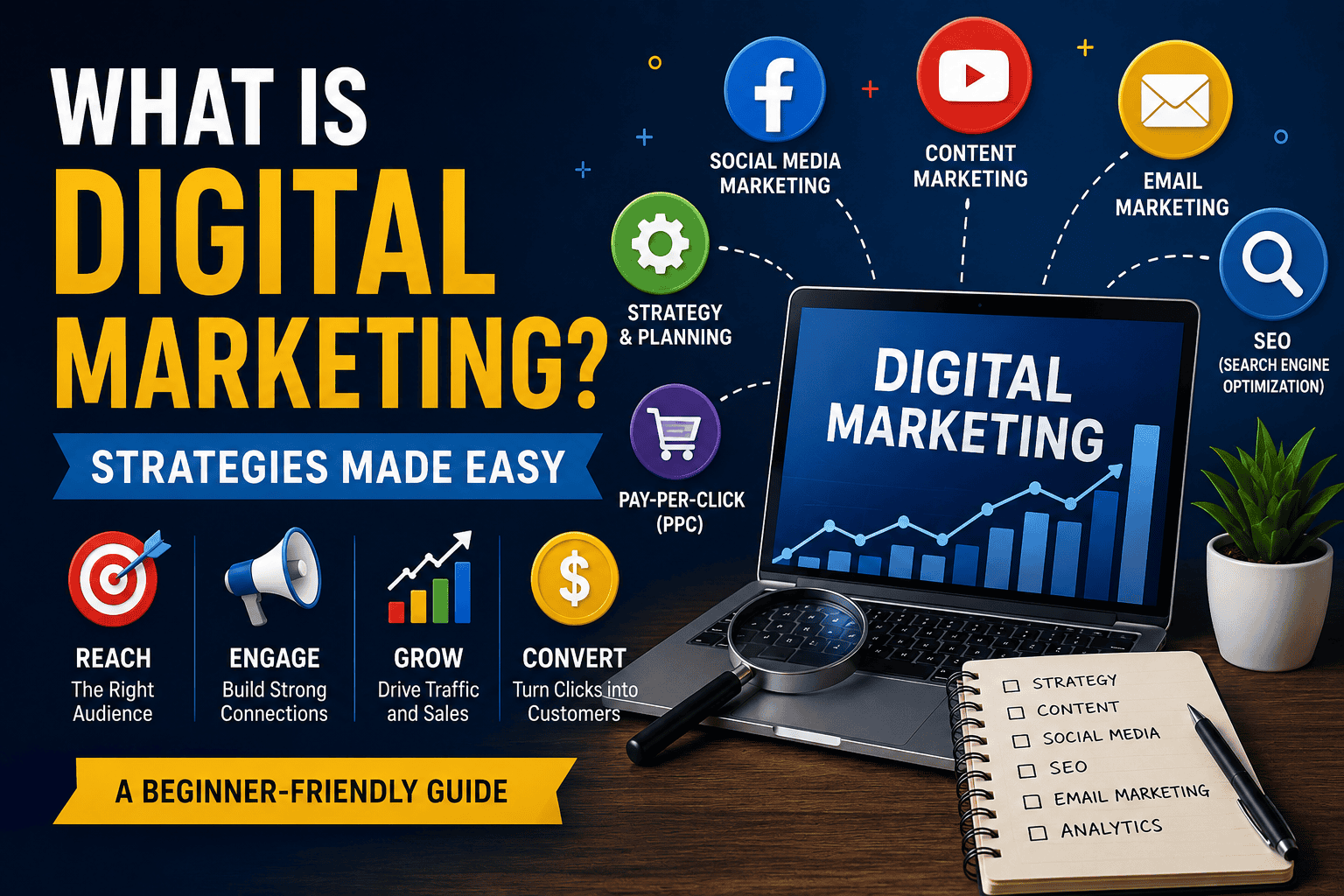
Learn How Businesses Connect with Customers in the Digital World — Digital Marketing focuses on the methods organizations use to promote products, services, and brands through online platforms and channels. It covers areas such as search engines, social media, email campaigns, websites, and content platforms, with strategies including SEO, paid advertising, social media promotion, and content marketing. These approaches help businesses increase online visibility, engage potential customers, generate leads, and convert interest into measurable results.
The field combines creative communication with data-driven decision-making, allowing marketers to understand audience behavior, target specific customer groups, and evaluate campaign performance. By using analytics and digital tools, businesses can refine their strategies and build stronger relationships with customers throughout the online customer journey. At its core, digital marketing explores how brands can reach relevant audiences, create meaningful engagement, and support sustainable business growth through digital channels.
Contant
- 1. MARKETING FOUNDATION
- 1.1. What Is Marketing Strategy?
- 1.2. Strategic Models in Business & Marketing
- 1.3. Consumer Psychology & Neuromarketing
- 1.3.1. AIDA Model
- 1.3.2. Cognitive Biases in Consumer Behavior
- 1.3.3. Behavioral Biases & Practical Application
- 1.3.4. Persuasive Copywriting & Psychological Triggers
- 1.3.5. FOMO, Social Proof & Scarcity Marketing
- 1.3.6. Color Psychology & Brand Perception
- 1.3.7. Behavioral Economics in Marketing
- 1.3.8. Emotional Triggers
- 1.3.9. Anchoring Effect
- 1.3.10. Summary Practical Takeaways
- 2. MARKETING ANALYTICS & STRATEGY
- 3. DIGITAL MARKETING ROADMAP
- 3.1. Traditional vs Digital vs Paid Marketing
- 3.2. Multi‑Channel Campaign Strategy & Planning
- 3.3. Digital Marketing Channels Overview
- 3.4. SEO – Search Engine Optimization
- 3.5. SEM / PPC – Search Engine Marketing
- 3.6. Paid Channels
- 3.7. Content Marketing & Blogging
- 3.7.1. Content Creation Strategy – 4 Phases
- 3.7.2. Blogging Strategy & Types
- 3.7.3. Copywriting & AIDA in Practice
- 3.7.4. Website Planning & WordPress Setup
- 3.7.5. SEO‑Driven Content & Keyword Integration
- 3.7.6. Content Funnel – TOFU, MOFU, BOFU
- 3.7.7. Content Promotion & Distribution
- 3.7.8. Monetisation – Affiliate, Ads, Digital Products
- 3.7.9. Authority Building & Personal Brand
- 3.8. Email Marketing & CRM
- 3.9. Affiliate Marketing & Partnership Growth
- 3.10. Growth Marketing & Experimentation
- 3.11. Digital Advertising
- 3.12. Analytics & Optimization
- 3.13. Social Media Marketing & Branding
- 3.14. Paid Advertising & Media Buying
- 3.15. Specialized Topics
- 4. AI AND AUTOMATION IN MARKETING
- 5. TOOLS, CERTIFICATIONS & CAREER PATHS
1. MARKETING FOUNDATION
1.1. What Is Marketing Strategy?
Marketing Foundation is the strategic brain of your business. If Business Foundation is structure, Marketing Foundation is direction – the growth engine. Without a proper marketing foundation, you guess; with strategy, you build a predictable, scalable revenue machine.
A simple illustration before we go deeper – imagine you want to sell homemade cakes. Without strategy: you bake cakes and hope someone buys. With strategy:
- Ask: who loves cakes? → Office workers who celebrate birthdays.
- What do they need? → Quick delivery and custom designs.
- Why you? → “We deliver in two hours – no other bakery does that.”
- How to reach them? → Instagram ads targeting offices in your city.
- How to profit? → Monthly corporate contracts ($500/month from 10 offices = $5,000 MRR).
Core Marketing Strategy answers five critical questions that every marketer must answer clearly, specifically, and provably before running a single ad or writing a single piece of content.
1.1.1. The Five Critical Questions Every Marketer Must Answer
| Question | What it means | A good, non‑generic answer |
|---|---|---|
| 1. Who is your customer? | A specific group, not “everyone who needs my product” | “E‑commerce store owners in Pakistan running Magento 2 stores earning $100k–$1M annually, who have invested in paid ads but have not yet touched SEO.” |
| 2. What do they actually need? | The outcome they want, not the service you sell | “They need more organic revenue without increasing ad spend – not ‘SEO services.’” |
| 3. Why should they choose you? | A specific, provable differentiator | “We specialize exclusively in Magento 2 technical SEO and guarantee a 40% improvement in page load time within 30 days, or we work free.” |
| 4. How will you reach them? | Two specific channels with clear logic | “LinkedIn posts targeting Magento store owners + ranking on Google for ‘Magento SEO agency Pakistan.’” |
| 5. How will you profit sustainably? | A recurring, predictable revenue model | “Free audit → $2,000 one‑time optimization → $500/month ongoing maintenance retainer.” |
Practical task – build your own marketing strategy foundation.
Open Google Sheets or a Notion page. Create five columns: Customer, Need, Why Us, Reach, Profit. Fill each column with specific, provable answers. No generic statements. Then test your answers with five real people in your target market. If they do not immediately say “yes, that sounds like me,” refine your answers.
1.1.2. Core Marketing Strategy Models Overview
Marketing models are proven strategic frameworks used by companies like Apple, Nike, and Amazon. They are practical decision‑making tools that prevent random marketing.
| Model | Purpose |
|---|---|
| STP | Segmentation, Targeting, Positioning – who to serve and how to be remembered |
| 4Ps | Product, Price, Place, Promotion – tactical execution decisions |
| 7Ps | Extended version for service businesses (adds People, Process, Physical Evidence) |
| Blue Ocean Strategy | Create an uncontested market space instead of competing for the same customers |
| Customer Journey Mapping | Map the full customer experience from awareness through advocacy |
Tools for these models: Miro for visual strategy mapping, HubSpot CRM for funnel tracking, and Canva for brand positioning visuals.
1.1.3. STP Model – Segmentation, Targeting, Positioning
STP is a three‑step model that transforms your marketing from generic broadcasting to targeted precision. It is the single most important strategic framework for any business that wants to stop wasting marketing budget.
Overall example – a Magento SEO agency:
- Segmentation: Divide the market into groups (by platform, revenue, spending behaviour, location).
- Targeting: Select mid‑sized Magento stores in Pakistan ($100k‑$1M revenue, spending on ads, ignoring SEO).
- Positioning: “The only agency in Pakistan specializing exclusively in Magento 2 technical SEO, with a 40% speed improvement guarantee or your money back.”
1.1.3.1. Segmentation – Dividing the Market into Groups
Segmentation is the process of dividing the broad market into distinct groups based on shared characteristics. Every marketer must use all four segmentation types together to build a complete, three‑dimensional picture of the ideal customer.
| Type | What it divides | Example (Magento SEO agency) |
|---|---|---|
| Demographic | Measurable personal characteristics – age, income, job title | “Males aged 25–40, business owners, annual revenue $100k‑$1M.” |
| Geographic | Physical location – country, city, region | “E‑commerce stores in Karachi, Lahore, and Islamabad.” |
| Psychographic | Psychographics: lifestyle, values, and attitudes. | Entrepreneurs who prioritize automation, rely on data-driven decisions, and focus on sustainable organic growth rather than depending on paid advertising. |
| Behavioral | Observable actions – purchasing patterns, usage frequency | “Magento store owners who currently spend $5,000+ monthly on Facebook ads, have not invested in SEO in the past 12 months, and have seen organic traffic decline by 15% or more.” |
Practical task – build your segmentation profile.
In Excel, create four columns (Demographic, Geographic, Psychographic, Behavioral). List 3‑5 specific criteria for each type based on your real customers. The combination of all four is your ideal customer profile.
1.1.3.2. Targeting – Choosing the Most Profitable Segment
Targeting is the process of selecting the single most profitable, reachable, and growing segment to serve. Not all segments are worth pursuing.
Score each potential segment against five criteria:
- Size – enough customers to sustain the business.
- Growth potential – the segment is expanding, not declining.
- Accessibility – you can actually reach them through available channels.
- Profitability – they can and will pay your prices.
- Competition intensity – the segment is not already saturated.
Real scoring example – Magento SEO agency:
| Criterion | Score | Justification |
|---|---|---|
| Size | ✅ | 200+ such stores in Pakistan |
| Growth | ✅ | Pakistan e‑commerce growing 40% annually |
| Accessibility | ✅ | Reachable via LinkedIn and SEO content |
| Profitability | ✅ | $2,000–$5,000 budget acceptable |
| Competition | ✅ | Most agencies are generalists, not Magento specialists |
Result: This segment is the primary target.
Practical task – score your potential segments.
List three possible customer segments. For each, rate the five criteria as ✅ (good), ⚠️ (medium), or ❌ (poor). Choose the segment with the most ✅ marks. That is your target.
1.1.3.3. Positioning – USP and Brand Differentiation
Positioning is not about what you claim about yourself. It is what customers remember about you after a single interaction. A Unique Selling Proposition (USP) is a specific, measurable promise that differentiates you from every competitor.
A weak USP sounds like “We provide SEO services” – identical to 500 other agencies. A strong USP sounds like: “We specialize exclusively in Magento 2 technical SEO and guarantee a 40% improvement in page load time within 30 days, or we work free.” (Notice the niche, the measurable outcome, the time limit, and the risk reversal.)
Positioning statement formula:
For a specific target audience with a defined problem, we provide a solution that delivers measurable results, unlike competitors who do not fully address that need.
Completed example:
For expanding Magento brands facing declining organic traffic, we deliver specialized technical SEO that drives revenue growth without increasing ad spend, unlike generalist agencies that rely on generic strategies and lack expertise in Magento-specific technical challenges.
Differentiation dimensions – choose one to dominate:
| Method | Example |
|---|---|
| Price | Premium pricing with premium guarantee |
| Niche Focus | Only Magento 2 stores – not all e‑commerce |
| Technology | AI‑powered audits and predictive reporting |
| Service Model | Weekly calls, dedicated Slack, 48‑hour response |
| Speed | “First measurable improvements within 14 days” |
| Guarantee | “Revenue improvement or work free” |
Practical task – map your positioning and write your USP.
Open Excel. Create a scatter chart: X‑axis = Price (Low to High), Y‑axis = Specialization (Generalist to Specialist). Plot your top five competitors. Identify the quadrant with the fewest competitors – position your brand to own that space. Then write your USP using the formula above. Test it on five prospects. If they do not immediately understand the difference, rewrite.
1.1.3.4. Buyer Personas – Giving Your Target a Name and Face
A buyer persona makes the targeting decision operational. It gives your target segment a name, a face, and a narrative – making every piece of content, every ad, and every email feel like a personal conversation rather than a broadcast.
Complete persona example – “Ahmed, the Magento store owner”:
| Field | Value |
|---|---|
| Name | Ahmed – E‑Commerce Business Owner |
| Age | 32 |
| Location | Lahore, Pakistan |
| Business | Magento 2 fashion store |
| Annual Revenue | $500,000/year |
| Team Size | 8 employees |
| Problem | Organic traffic declined 20% over 6 months despite increasing ad spend by $2,000/month |
| Goal | Increase organic revenue without increasing ad spend |
| Decision Criteria | Proven Magento‑specific case studies, transparent monthly reporting, measurable guarantees |
| Key Objections | “Can you show me results from stores similar to mine?” “How long before I see improvement?” “How do I know this isn’t the same as what others promised?” |
| Preferred Content | Detailed technical guides, video case studies with real metrics, data‑driven comparison reports |
| Where He Spends Time | LinkedIn (professional development), Google (research before decisions), industry WhatsApp groups |
Practical task – build your buyer persona in Excel.
Create columns: Name, Industry, Annual Revenue, Platform Used, Primary Pain Point, Top Goal, Decision Criteria, Key Objection, Preferred Content Type. Fill one row for each of your top three customer types. Before writing any content, any ad, or any email, reference the specific persona it is targeting. Write as if speaking directly to that one person – never to a demographic category.
Tool: HubSpot Persona Generator (hubspot.com/make-my-persona) – answer guided questions, and HubSpot generates a complete, formatted persona document you can download and share with your entire team.
1.1.4. 4Ps Marketing Mix – Tactical Execution
The 4Ps are the tactical execution decisions you make once your strategy is defined. Think of strategy as deciding what meal to cook, and the 4Ps as choosing every ingredient, the price per serving, where you will serve it, and how you will tell people it exists.
| P | What it includes | Example (Magento SEO agency) |
|---|---|---|
| Product | Features, quality, design, brand, service | Technical audit + speed improvements + 30‑day monitoring; delivered in a branded report with before/after visualizations; weekly progress calls, dedicated Slack channel, 3‑month post‑delivery support. |
| Price | Pricing psychology and tiers | Three tiers: Basic $1,500 (audit only), Professional $3,500 (audit + implementation) – most popular, Enterprise $7,500 (adds 3‑month support). The Enterprise tier makes $3,500 feel reasonable (decoy effect). |
| Place | Distribution channels | Primary: website (credibility + conversion). Secondary: LinkedIn, where target customers are active.Tertiary: referrals from hosting companies and Magento theme developers. |
| Promotion | Communication channels | 60% content (blog posts, case studies, technical guides), 30% LinkedIn (daily posts + direct outreach), 10% Google Ads (retargeting only). |
Practical task – map your 4Ps in Canva.
Go to canva.com, search “Marketing Mix Template”, and select a four‑quadrant layout. Customize each quadrant for your business: Product (features and unique qualities), Price (pricing tiers and rationale), Place (specific channels ranked by importance), Promotion (specific channels with percentage budget allocation). Export as PDF. Every campaign decision should reference this document to ensure tactical alignment with strategy.
1.1.5. 7Ps Extended Marketing Mix – For Service Businesses
The 7Ps extends the 4Ps with three elements critical to service businesses where customers cannot touch or test the product before buying. These three – People, Process, and Physical Evidence – create the tangible proof that a service is real, reliable, and worth the price.
People – who delivers the service
In service businesses, people are the product. Every person the customer interacts with shapes their perception of the entire company.
- Bad people strategy: Hire cheapest developers → no training → poor client communication → generic support responses → client feels like a number, not a partner.
- Good people strategy: Hire certified experts → weekly technical training → communication standard: respond within 2 hours, explain technical concepts in plain language → founder personally calls new clients on day one → every team member has an optimized LinkedIn profile showing their expertise.
Process – how the service is delivered
Process is the step‑by‑step system that ensures every client receives the same quality experience every time. Without process, quality is inconsistent and unscalable.
Example – Magento agency client process:
- Day 1: Auto‑response email with project overview + Calendly link to book discovery call.
- Day 2‑3: 30‑minute discovery call following a structured questionnaire.
- Day 4‑5: Automated proposal via Proposify with e‑signature built‑in.
- Day 6: Welcome email with project portal access + admin credentials request.
- Week 1: Technical audit.
- Week 2: Optimization implementation.
- Week 3: Testing and refinement.
- Week 4: Complete final testing, transfer the project, and confirm performance standards.
- Monthly: Monitoring reports, quarterly review calls, annual comprehensive audit.
Physical Evidence – tangible proof your service works
Since services are intangible, physical evidence makes them real and trustworthy. It is everything the client can see, hold, or show to their colleagues to prove they made a smart decision.
Examples:
- Professional website (fast, well‑designed, HTTPS).
- Case studies (PDF documents with before/after metrics and client logos).
- Performance certificate (branded document showing the speed improvement achieved).
- Weekly progress reports (PDF with screenshots, metrics, and next steps).
- Welcome kit (branded project roadmap, team introduction, communication plan).
- Certifications (Magento Certified Developer badge displayed on website).
Practical task – audit your 7Ps.
For each of the 7Ps, write down one thing you are doing well and one thing you could improve. Focus first on the weakest P – improving that single element often produces the biggest business impact.
1.2. Strategic Models in Business & Marketing
1.2.1. SWOT Analysis
SWOT evaluates internal factors (Strengths and Weaknesses – things within your control) and external factors (Opportunities and Threats – things in the market environment you cannot control but must respond to).
Real example – an e‑commerce startup:
| Strengths | Weaknesses |
|---|---|
| Unique handmade products, exclusive supplier relationships, strong visual brand identity, loyal founding customer base | Small marketing budget ($500/month), zero SEO history, social following under 1,000, no case studies yet |
| Opportunities | Threats |
|---|---|
| Growing online shopping trend in Pakistan, underserved artisan jewelry niche, increasing influencer marketing ROI | Amazon private label products at lower prices, larger agencies outbidding on keywords |
Strategic intersections that drive real action:
- Strength + Opportunity: Use exclusive supplier relationships to create a “limited edition” product series that competitors cannot replicate.
- Strength + Threat: Use brand loyalty to create a subscription model that insulates you from Amazon price competition.
- Weakness + Opportunity: Fix the SEO weakness immediately – the artisan jewelry niche has low keyword competition right now.
- Weakness + Threat: Build a case study with your first 5 clients before competing agencies dominate Google results.
Practical task – run a SWOT analysis for your business.
Open the free HubSpot SWOT Template (hubspot.com/business-templates). Fill each quadrant with at least five specific, observable facts – not aspirations. For each of the four intersections, write one specific action item with a deadline. A SWOT without actions is useless documentation.
1.2.2. Porter’s Five Forces
Porter’s Five Forces is a framework for assessing how competitive – and therefore how difficult – your industry environment is. It helps you build strategies that work with those forces rather than against them.
| Force | What it asks | Real example – a SaaS company |
|---|---|---|
| Competition among existing firms | How strong is the level of direct competition? | HIGH – many similar solutions, frequent feature wars |
| Risk of new competitors entering the market | How easy is it for new competitors to enter the market? | MEDIUM – low code requirements lower the entry barrier |
| Supplier bargaining power | The degree of influence suppliers have over pricing, quality, and availability. | LOW – cloud infrastructure (AWS/Google) is commoditized |
| Bargaining Power of Buyers | How much leverage do customers have over price? | MEDIUM – enterprise clients demand deep customization |
| Threat of Substitutes | Can customers solve their problem a completely different way? | LOW – unique AI features not replicated by manual alternatives |
Strategic implication: Focus on deep enterprise integrations that make switching costly – this reduces customer bargaining power and creates natural lock‑in.
Practical task – apply Porter’s Five Forces to your business.
Draw five boxes (on paper or in Miro). Label each with one force. For each force, write a rating (Low, Medium, High) and one or two sentences explaining why. Then write one specific strategic response to each force – what you will do to reduce the negative impact or take advantage of it. This exercise takes about 90 minutes and produces more strategic clarity than most business planning sessions.
1.2.3. PESTLE Analysis
PESTLE analyzes the macro‑environmental forces completely outside your control but deeply influential on your strategy and survival.It includes Political, Economic, Social, Technological, Legal, and Environmental factors.
Real example – a renewable energy company:
| Factor | How it affects the business |
|---|---|
| Political | Government solar energy installation subsidies increasing demand |
| Economic | Rising electricity prices make solar payback period shorter |
| Social | Consumer preference for sustainable energy growing year over year |
| Technological | Solar panel efficiency improving 8% annually, reducing installation cost |
| Legal | New environmental regulations mandate reduced carbon emissions |
| Environmental | Climate change awareness creating strong consumer and investor pressure |
Practical task – conduct a PESTLE analysis for your industry.
In Miro or Excel, create a six‑column table with one PESTLE factor per column. For each factor, write two to three specific items relevant to your industry. For each item, classify it as an Opportunity or a Risk, and write one specific strategic response.This exercise helps you anticipate broader environmental shifts ahead of time, reducing the chances of being caught off guard.
1.2.4. Market Gap Analysis
Market Gap Analysis identifies unmet customer needs or underserved market areas where demand exists but supply is insufficient. Market gaps are where new businesses should enter and where existing businesses should expand.
Practical task – conduct a market gap analysis.
In Excel or Google Sheets, list your top five competitors in rows. In columns, list every service category, price tier, and customer segment they serve. Compare this competitive map against customer needs gathered from forums, reviews, and direct customer conversations. Identify the cells where demand is clearly expressed but no competitor serves it well. Validate the gap with keyword research in SEMrush – if customers are searching for it but nobody ranks well for it, the gap is commercially real and immediately actionable.
1.2.5. Stakeholder Mapping
Stakeholder Mapping is a tool for identifying, prioritizing, and analyzing everyone who affects or is affected by your marketing and business decisions.
Power‑Interest Matrix:
| Quadrant | Power | Interest | Strategy |
|---|---|---|---|
| Manage Closely | High | High | Regular detailed communication, involve in major decisions, invest relationship time |
| Keep Informed | Low | High | Regular updates, appreciate their engagement, convert them to advocates |
| Keep Satisfied | High | Low | Meet their requirements without demanding unnecessary attention from them |
| Monitor | Low | Low | Minimal contact, inform on major changes only |
Practical task – build a stakeholder map in Miro.
Create a 2×2 grid. Label the vertical axis Power (Low at bottom, High at top). Label the horizontal axis Interest (Low at left, High at right). List every stakeholder connected to your business – aim for at least ten. Write each stakeholder’s name on a sticky note and place it in the correct quadrant. For every stakeholder in the top‑right quadrant (High Power, High Interest), write one sentence describing what they want from your business, and one sentence describing your current communication plan with them. If you cannot write both sentences clearly for any high‑power, high‑interest stakeholder, that relationship is being dangerously under‑managed and needs immediate attention.
1.2.6. Blue Ocean Strategy – Strategy Canvas
Blue Ocean Strategy is one of the most powerful positioning concepts in business. Instead of competing in a crowded, price‑driven market where everyone is fighting over the same customers – a Red Ocean – you create a new market space where you are the only player, at least initially.
- Red Ocean example: “We offer SEO services.” 500 other agencies say exactly the same thing. Customers compare on price alone. Margins shrink every year.
- Blue Ocean example: “AI‑Powered Magento Growth Lab.” No direct competitors exist for this category. Customers cannot compare you to others. Premium pricing is natural because there is no reference point.
The Four Actions Framework is a strategic tool used to uncover new market space by rethinking how value is created and delivered, helping organizations move toward a “Blue Ocean” where competition becomes less relevant.
| Action | Question | Example (Magento agency) |
|---|---|---|
| Eliminate | What does your industry compete on that customers don’t value? | Long‑term contracts (most agencies require 6‑12 months) |
| Reduce | What does your industry overdeliver that adds cost but not value? | Services to Magento only (instead of all digital marketing) |
| Raise | What does your industry underdeliver that customers desperately want? | Guarantee level (money back if not 40% faster) |
| Create | What has never been offered that customers would value? | A “Speed Performance Certificate” is an official document that verifies and highlights the improvement in a client’s Magento store loading speed. |
Practical task – build your Strategy Canvas in Miro.
Create a horizontal axis listing all competitive factors in your industry (price, service range, guarantee, specialization, reporting quality, speed of results). Create a vertical axis representing the level of offering from low to high. Plot your current position and your main competitors for each factor. The factors where every competitor scores low – that empty space is your Blue Ocean opportunity.
1.2.7. Customer Journey Mapping
Customer Journey Mapping visualizes every step a customer takes from the moment they first hear about you to the moment they become a loyal advocate who refers others. Most businesses obsess over acquisition and ignore retention and advocacy – the most profitable stages.
The five stages include awareness, consideration, decision-making, retention, and advocacy.
Complete real journey map – a Magento store owner:
| Stage | Touchpoint | Emotion | Action |
|---|---|---|---|
| Awareness | Sees LinkedIn post “Is your Magento store losing sales to slow checkout?” | Intrigued (“This directly reflects the challenge I’m facing.”) | Proceeds to open the blog post |
| Awareness | Reads blog “Magento Checkout Optimization Guide” | Impressed (“These people understand Magento specifically.”) | Downloads free speed test tool, submitting email address |
| Consideration | Receives email “Here are your speed test results – you scored 4.2 seconds” | Concerned (“That is much slower than I realized.”) | Clicks through to case studies |
| Consideration | Attends free webinar “Magento Performance Masterclass” | Impressed (“They know things that nobody else talks about.”) | Books free 30‑minute consultation call |
| Decision | Consultation call – specific analysis of their store | Confident (“They already know my exact problem and have fixed it before.”) | Receives proposal |
| Decision | Reviews proposal with money‑back guarantee | Reassured (“The guarantee removes all the risk.”) | Signs contract, pays deposit |
| Retention | Welcome kit received (project roadmap, team bios, communication plan) | Excited and confident (“This is organized and professional.”) | |
| Retention | Weekly update emails with progress screenshots | Informed (“I know exactly what is happening every step.”) | |
| Delight | Final delivery – load time from 7.2s to 2.1s | Thrilled (“This is exactly what they promised.”) | Provides testimonial |
| Advocacy | Case study request – “Can we feature your results?” | Pride (“I want to be recognized and featured.”) | Recommends your service to three other Magento store owners. |
Practical task – set up HubSpot CRM funnel tracking.
Go to hubspot.com, create a free account. Go to CRM → Contacts → add your existing leads and clients. Define the lifecycle stages as follows: Lead → Marketing Qualified Lead (MQL) → Sales Qualified Lead (SQL) → Opportunity → Customer → Advocate.For each contact, track their entry source, their current stage, time spent at each stage, and what converted them. Review the funnel monthly. The stage where most contacts are stuck is your highest‑leverage optimization opportunity.
1.3. Consumer Psychology & Neuromarketing
Marketing works because of psychology, not logic. This is not a philosophical observation – it is a scientific fact confirmed by decades of behavioural research. Humans make decisions emotionally and then construct logical justifications afterward. To shape behavior, address emotions before appealing to logic.
1.3.1. AIDA Model
AIDA describes the four mental stages a person passes through from first encountering your marketing to taking action. Every effective piece of marketing copy – an ad, an email, a landing page, a LinkedIn post – should move the reader through all four stages.
| Stage | Meaning | Example (Facebook ad for Magento SEO agency) |
|---|---|---|
| Attention | Stop the scroll, interrupt the pattern | “Is your Magento store traffic dropping right now?” (A direct question that addresses a genuine pain point and captures the attention of the intended audience.) |
| Interest | Show that this is specifically relevant to them | “Most Magento owners blame competition, but data from 127 audits shows the real cause is technical – indexing issues, bloated code, uncached queries. Things invisible to the owner.” (Specific number, specific causes, creates slight concern.) |
| Desire | Make them want the outcome you provide | “Ahmed’s store was losing $18,000 monthly to cart abandonment. Load time 7.2s → 2.1s in 28 days. Checkout completion 48% → 71%. He recovered full investment in week two.” (Real name, real numbers, specific timeline, ROI proof.) |
| Action | Tell them exactly what to do next, remove friction | “Book your free 30‑minute Magento speed audit this week. We show you your top 5 issues – before you pay anything. Guarantee: 40% faster or we work free. Only 3 slots available → Book Now.” (Free first step, specific guarantee, genuine scarcity.) |
AIDA applied across multiple channels:
- Email subject line (Attention): “Your Magento store is bleeding money right now”
- Email opening (Interest): “Hi [Name], I was analyzing Magento stores in Pakistan and found something alarming. 8 out of 10 stores I audited had the same critical speed issue causing 30% cart abandonment – owners had no idea.”
- Email middle (Desire): “Stores that fixed this saw immediate results: ABC Store – 45% more completed checkouts; XYZ Store – 60% faster load time; DEF Store – $18,000 recovered in monthly revenue.”
- Email CTA (Action): “Reply ‘AUDIT’ and I’ll send you a free speed analysis by tomorrow.”
Practical task – write an AIDA ad for your highest‑traffic offer.
Write one headline (Attention), two sentences of interest, two sentences of desire, and a clear CTA with urgency and risk reversal. Run it on your best performing channel for two weeks. Measure CTR and conversion. Then iterate.
1.3.2. Cognitive Biases in Consumer Behavior
Cognitive biases are systematic mental shortcuts the brain uses to make decisions quickly. They are not flaws – they are features that allow humans to process millions of data points without consciously analysing each one. For marketers, understanding these patterns means designing campaigns that work with the brain rather than against it.
| Bias | What it means | Marketing application |
|---|---|---|
| Anchoring | The first number or piece of information becomes the reference point for all subsequent judgments | Show $7,500 Enterprise package first → $3,500 Professional feels reasonable. Without the anchor, $3,500 feels expensive. |
| Scarcity | People want things more when they are limited or running out | “Only 5 audit slots available this month.” (Must be genuine – fake scarcity destroys trust permanently.) |
| Social Proof | People follow the behaviour of others, especially in uncertain situations | “Trusted by 500+ e‑commerce businesses.” (Ranked by persuasiveness: 1. friend referrals, 2. expert endorsements, 3. celebrity/influencer, 4. user reviews, 5. crowd statistics.) |
| Loss Aversion | The pain of losing is about twice as powerful as the pleasure of gaining | “Every day your Magento store loads in 7 seconds, you lose 30% of potential sales. At $100 AOV, that is $1,800 daily in lost revenue.” (vs “Get 40% faster load time.”) |
| Confirmation Bias | People seek information that confirms what they already believe | Customer believes: “Cheap SEO agencies produce bad results.” Wrong approach: “Actually, our affordable pricing doesn’t mean low quality.” Right approach: “You’re right – most cheap agencies don’t specialise in Magento, don’t understand technical SEO, and can’t measure what they claim. Here’s how we’re different.” |
| Recency Effect | People remember and are most influenced by the most recent information they saw | Place your single most powerful testimonial immediately before the CTA button – that is what they remember when their finger is hovering over “Book Now.” |
| Authority Bias | People trust and defer to recognised experts | Build authority through certifications (“Magento Certified Developer”), publications (“As featured in…”), numbers (“10 years + 127 stores optimised + average 45% improvement”), and deep technical guides. |
Practical task – run an A/B test using a cognitive bias.
Develop two different versions of the same landing page headline. Version A features a gain frame (“Get 40% faster load time”). Version B features a loss frame (“Every day you wait, you lose $1,800 in sales”). Run them against each other for two weeks. Measure which produces higher conversion. Let the data decide which bias works best for your audience.
1.3.3. Behavioral Biases & Practical Application
Practical task – install Hotjar and analyse bias response on key pages.
Step 1:Visit hotjar.com and sign up for a free account.
Step 2: Copy the tracking script and install it in your website’s header (or through Google Tag Manager).
Step 3: After 100+ sessions have accumulated, open Heatmaps and review your pricing page.
Step 4: Check where users stop scrolling. If they stop before reaching your CTA, your most important content is below where most eyes ever reach – move it up.
Step 5: Check where users click most. If they click non‑clickable elements, make those elements links.
Practical task – A/B test psychological triggers with VWO.
- Version A CTA: “Buy Now”
- Version B CTA: “Get Instant Access”
- Version A price: $3,500
- Version B pricing: previously $7,500, now reduced to $3,500.
- Measure which version produces higher click‑through rate. The winning version is not a matter of opinion – the data decides.
Practical task – conduct psychology‑driven customer research with Google Forms.
Create a survey with four questions:
- “What made you select us instead of other alternatives?”
- “What specific problem were you facing when you found us?”
- “What almost stopped you from buying?”
- “What would you tell a friend who has the same problem?”
The answers to question three are the most valuable in the entire survey. They reveal the exact objections your marketing must pre‑emptively address – before the customer even voices them.
1.3.4. Persuasive Copywriting & Psychological Triggers
Authority trigger – People trust recognised experts. Feature your credentials, client results, certifications, and media coverage – not as boasting, but as evidence that reduces perceived risk.
Example: “Recognized by Magento Solution Partners, we are among the select agencies in Pakistan with Magento 2 Developer Certification.”
Reciprocity trigger – When you give something valuable first, people feel a psychological obligation to give something back.
Example: “Get our free 47-point Magento 2 SEO checklist—no email required.” After downloading, users are much more likely to engage with follow-up communication.
Curiosity trigger – Incomplete information creates psychological discomfort that people resolve by seeking the missing information.
Email subject example: “Three Magento issues costing you $10k per month—and how to identify them,” where the number suggests completeness and the added phrase signals a solution. Together they create a curiosity gap that demands clicking.
Tools: ChatGPT or Jasper can generate 10 headline variations for any piece of content. Test the best three against each other. Canva can design visual CTAs that reinforce the emotional direction of the copy.
1.3.5. FOMO, Social Proof & Scarcity Marketing
FOMO (Fear of Missing Out) is most effective when it combines genuine scarcity with real social proof – showing that others are taking advantage of what this person might miss.
- Weak FOMO: “Limited time offer!”
- Strong FOMO: “Final chance – only 2 audit slots remaining for February. 7 other Magento stores booked their slots this week. Next opening: Not until April.”
(Combines real scarcity, social proof, and loss framing.)
Types of social proof (ranked by persuasiveness):
- Referral mention (“A colleague at XYZ recommended us”)
- Expert endorsements (“Recommended by Magento Solution Partners”)
- Celebrity / influencer (“Recommended by [known e‑commerce expert]”)
- User reviews (“Rated 4.9 stars by 127 Magento store owners”)
- Social proof (“Trusted by over 500 e-commerce businesses”)
Application: Place your strongest testimonial immediately before the CTA – it is the last thing they read before deciding, and recency makes it the most influential.
Scarcity principle – genuine vs manufactured:
- Genuine (use this): “We limit projects to 10 per month to maintain quality. January: 8 spots taken, 2 remaining.”
- Manufactured (never use): Countdown timer that resets when user refreshes, or “Only 3 left!” when you have unlimited availability.
Fake scarcity produces short‑term conversions and permanent trust destruction when discovered.
Tools: Deadline Funnel or OptinMonster for real countdown timers; Proof or Fomo app for live purchase notifications; Klaviyo or Mailchimp for urgency‑driven campaigns in the final 24 hours of any offer.
1.3.6. Color Psychology & Brand Perception
Colour communicates brand personality and directs behaviour before the customer reads a single word. The right colour palette can increase conversion rate, improve perceived value, and strengthen brand recall.
| Colour | Emotion evoked | Best used for |
|---|---|---|
| Red | Urgency, excitement, energy | CTA buttons, sale banners, time‑limited offers |
| Blue | Trust, security, stability | Banks, SaaS products, B2B professional services |
| Green | Growth, health, eco‑friendliness | Organic brands, financial services, wellness |
| Orange | Enthusiasm, creativity, warmth | E‑commerce CTAs, creative services |
| Black | Luxury, sophistication, premium | High‑end fashion, premium professional services |
| Yellow | Optimism, attention, warmth | Promotional highlights, attention elements |
Real conversion example: A Magento checkout CTA button changed from grey to red. Conversion rate increased 7%. Why? Grey communicates passivity and low importance. Red communicates urgency and priority. The button’s colour changed the perceived importance of the action.
Practical task – A/B test your CTA colour.
In VWO or Optimizely, create an A/B test on your highest‑traffic landing page. Change only the CTA button colour between the two versions – test your current colour against red or orange. Keep every other element identical. Run until each variation reaches 200 clicks. Implement the winning colour permanently.
1.3.7. Behavioral Economics in Marketing
Behavioural economics explains why people make financially irrational decisions in predictable, systematic ways. Applied to marketing, it allows you to design pricing, offers, and product positioning that work with human psychology rather than against it.
| Principle | What it means | Marketing application |
|---|---|---|
| Price framing | How a price is presented changes its perceived value | $19.99 feels meaningfully cheaper than $20.00; $1/day feels far more affordable than $365/year; “Invest $500 to recover $18,000” feels different from “costs $500.” |
| Decoy effect | When three options exist, the middle option is chosen most often – especially when the highest is priced close to the middle, making the middle look like obvious value | Plan A: Basic $20/month (10 features). Plan B: Premium $35/month (25 features) – most customers choose this. Plan C: Deluxe $40/month (27 features). Without Deluxe, 40% upgrade from Basic. With Deluxe as a decoy, 65% choose Premium. ARPU increases 21% from one pricing structure change. |
| Endowment effect | People place higher value on things they already possess – even temporarily | Free 14‑day trial with full feature access. After 14 days of using the product, cancelling feels like losing something they own – not simply declining to buy. Free trials convert at 20‑40% to paid plans. |
1.3.8. Emotional Triggers
Emotional triggers are cues that spark particular feelings, shaping how people make decisions and influencing their purchasing behavior.Different triggers are appropriate for different stages of the customer journey.
| Trigger | When to use | Example |
|---|---|---|
| Fear | Awareness stage – establish that a problem exists | “Don’t let competitors outrank you while you wait.” |
| Joy | After the purchase, focus on affirming and strengthening the customer’s decision. | “Bring joy to your loved ones with a thoughtfully chosen gift.” |
| Trust | Consideration stage – reduce perceived risk | “Over 1 million satisfied customers since 2018.” |
| Pride | Decision stage – make them feel smart for choosing you | “Join the top 1% of Magento stores that invest in technical SEO.” |
| FOMO | Action stage – motivate immediate decision | “Limited seats – 7 others booked this week.” |
1.3.9. Anchoring Effect
Anchoring deserves its own section because it is the most universally applicable and highest‑impact bias in pricing and sales psychology.
- No anchor: Customer sees $120 → evaluates “Is $120 reasonable?”
- With anchor: Customer sees “Was $200 → Now $120” → thinks “I’m saving $80!”
The product is identical. Only the anchor changed. The anchor makes the evaluation frame different, not the product.
E‑commerce applications:
- Product page: Display “Was $200 → Now $120” prominently.
- Pricing page: Show the most expensive package first, then progressively cheaper packages.
- Service proposal: “Agencies usually charge between $10,000 and $15,000 for this scope.” Our price: $3,500.” (Industry pricing is the anchor.)
Tools: Canva or Photoshop for visual strikethrough pricing design; Shopify or Magento admin for displaying original vs discounted pricing; VWO or Optimizely for A/B testing different anchor placements and amounts.
1.3.10. Summary Practical Takeaways
Combined trigger example – maximum conversion pressure:
“Only 3 spots left! Join 1,000+ Magento store owners who improved their organic revenue – register now before it’s gone!”
- “Only 3 spots left” → Scarcity
- “1,000+ Magento store owners” → Social Proof
- “improved their organic revenue” → Desire
- “register now before it’s gone” → FOMO + Loss Aversion
Tools summary for testing psychological triggers:
| Tool | Use |
|---|---|
| Hotjar / Crazy Egg | Track behaviour to see which triggers produce the most engagement |
| GA4 | Measure how urgency promotions affect conversion rates |
| VWO / Optimizely | A/B test psychological triggers, colours, and CTAs |
| Canva / Adobe | Design visuals that reinforce the emotional trigger direction |
| Shopify / Magento Admin | Display inventory counts, scarcity indicators, and anchored pricing |
2. MARKETING ANALYTICS & STRATEGY
2.1. Marketing Metrics & KPIs
KPIs are numbers that tell you whether your marketing is working or wasting money. Every campaign decision should be guided by at least one KPI, and every KPI must be tied to a specific business action. If you cannot describe what you would do when that KPI moves in either direction, it is a vanity metric and not worth tracking.
2.1.1. ROI – Return on Investment
ROI measures how much profit a marketing investment generated relative to its cost.
ROI = \left(\frac{\text{Net Profit}}{\text{Investment Cost}}\right) \times 100
Real example:
Ad spend = $5,000, revenue = $20,000, product cost = $8,000.
Net profit = $20,000 – $8,000 – $5,000 = $7,000.
ROI = ($7,000 ÷ $5,000) × 100 = 140% (every $1 invested generates $1.40 profit).
Practical task – track ROI per campaign in Google Sheets.
Open Google Sheets and create columns: Campaign Name, Ad Spend, Total Revenue, Product Cost, Net Profit, ROI %.
In the Net Profit column (E2), enter =C2-D2-B2.
In the ROI % column (F2), enter =(E2/B2)*100.
Apply conditional formatting: green when ROI >100%, yellow when 50‑100%, red when below 50%. Update this tracker every month for every campaign.
2.1.2. CAC – Customer Acquisition Cost
CAC is the total marketing and sales spend divided by the number of new customers acquired in the same period.
Example: Spent $3,000 across all channels in one month, acquired 60 new customers → CAC = $3,000 ÷ 60 = $50 per customer.
Strategic insight: LTV = $500, CAC = $50 → LTV/CAC = 10 → extremely healthy. LTV = $60 → LTV/CAC = 1.2 → dangerously thin margins. CAC > LTV means the business loses money on every customer acquired.
2.1.3. CTR – Click‑Through Rate
CTR measures how often people click on your ad or email after seeing it.
CTR = (Clicks ÷ Impressions) × 100
Example: Ad shown 10,000 times, clicked 300 times → CTR = (300 ÷ 10,000) × 100 = 3%.
Benchmarks:
- Google Search Ads: 3‑5% is good, above 5% excellent.
- Facebook/Instagram: 1‑2% typical, above 2% above average.
- Email campaigns: 2‑3% is healthy.
Low CTR means the ad creative is not compelling enough, the audience targeting is off, or the offer does not match what the audience needs.
2.1.4. ROAS – Return on Ad Spend
ROAS indicates how much revenue is earned for every dollar spent on advertising.
ROAS = Revenue ÷ Ad Spend
Example: With $2,000 spent on ads generating $10,000 in revenue, the return on ad spend (ROAS) is 5x.
Critical distinction: ROAS does NOT subtract product cost. ROI does. A 5x ROAS sounds impressive, but if the product cost is 80% of revenue, the business is actually losing money despite a high ROAS. Always calculate ROI alongside ROAS – ROAS alone is insufficient for profitability decisions.
2.2. Campaign Analysis
2.2.1. Multi‑Touch Attribution
Attribution assigns credit for a conversion to multiple marketing touchpoints across the customer journey, rather than giving all credit to a single channel.
Example journey:
Day 1: Customer sees Google Search Ad → reads blog post.
Day 3: Customer sees Facebook retargeting ad → views pricing page.
Day 5: Customer opens promotional email → books consultation.
Day 6: Customer purchases.
| Model | How credit is assigned | When to use |
|---|---|---|
| First Click | 100% to first touchpoint | When awareness is the growth priority |
| Last Click | 100% to final touchpoint | When closing channels matter most |
| Linear | Equal credit to all touchpoints | When all channels contribute equally |
| Time Decay | More credit to recent touches | When final‑stage interaction drives decisions |
| Data‑Driven | AI assigns based on statistical influence | When sufficient data volume exists |
Practical task – compare attribution models in GA4.
Open GA4 → click Advertising in the left menu → Attribution → Model Comparison. Select Last Click, Linear, and Data‑Driven. Set a 90‑day date range. Compare how revenue is credited to Google, Facebook, and Email under each model. If credit shifts significantly between models, your current default model is systematically misinforming your budget allocation decisions.
2.2.2. Cohort Analysis
Cohort analysis groups customers by a shared characteristic (typically signup or first purchase time period) and tracks their behaviour over time. It reveals retention patterns and identifies when and why customer quality changes.
Example:
January cohort: retention after 3 months = 70%.
February cohort: retention after 3 months = 50%.
Something changed between January and February that hurt retention. Was it a product change? A different acquisition channel? A pricing change? A customer service failure? Cohort analysis makes the problem visible and locatable in time.
Practical task – build a cohort analysis in Excel.
Create columns: Signup Month, Customer ID, Revenue Month 1, Revenue Month 2, Revenue Month 3. Enter data for each customer cohort by signup month. Insert a Pivot Table with Signup Month in Rows and the three Revenue Months in Values. Calculate retention rate for each cohort: Retention Rate Month 2 = (Customers who paid in Month 2 ÷ Total Cohort) × 100. Compare retention rates across cohorts. Declining retention in newer cohorts signals a problem to fix before scaling acquisition further.
Tools: Mixpanel (automated cohort tracking), Amplitude (advanced retention analysis), SQL (custom retention queries).
2.2.3. Lift Studies
Lift studies measure the true incremental impact of a campaign by comparing results from an exposed group against a statistically equivalent control group.
Example:
Group A (saw ads): revenue = $50,000.
Group B (no ads): revenue = $30,000.
Marketing lift = $50,000 – $30,000 = $20,000.
The $20,000 lift is provably caused by the advertising campaign. Without the control group, you cannot distinguish ad impact from natural market demand, seasonality, or other external factors. Lift studies prove causation rather than merely observing correlation – the difference between “our ads ran and sales increased” and “our ads provably caused the sales increase.”
2.3. CRM & Automation
2.3.1. HubSpot CRM
HubSpot is an all‑in‑one inbound marketing, sales, and CRM platform best for small to mid‑size businesses due to a generous free plan and seamless integration between marketing, sales, and service.
Practical task – set up HubSpot for complete lead nurturing.
Step 1: Create a free account at hubspot.com.
Step 2: Add a contact capture form to your website using HubSpot’s form builder.
Step 3: When a contact submits the form, they are automatically added to HubSpot contacts.
Step 4: Assign a lifecycle stage: Subscriber → Lead → MQL → SQL → Opportunity → Customer.
Step 5: Go to Workflows → Create New Workflow → Trigger: “Contact fills SEO Audit form.”
Step 6: Add automated actions:
- Day 1 → send welcome email with free resource.
- Day 3 → send a case study relevant to their industry.
- Day 5 → send an invitation to book a consultation call.
Step 7: Activate. All future form submissions enter this automated nurture sequence with zero manual work.
2.3.2. Salesforce
Salesforce is an enterprise‑grade CRM for large organisations managing complex sales pipelines, multi‑channel campaigns, and advanced customer lifecycle analytics.
Setup summary: Create an account at salesforce.com → configure standard objects (Leads, Contacts, Accounts, Opportunities) → track sales stages (Lead → Qualified → Proposal → Negotiation → Closed Won/Lost) → connect Salesforce Marketing Cloud for automated email campaigns.
Use case: An enterprise Magento agency managing 50+ active client relationships, each with different contract stages, renewal dates, and upsell opportunities across multiple account managers.
2.3.3. Marketo & Lead Scoring
Marketo is an enterprise marketing automation platform for large‑scale lead nurturing, advanced behavioural tracking, and sophisticated scoring across thousands of simultaneous leads.
Lead scoring example:
- Visited pricing page → +10 points
- Opened email campaign → +5 points
- Downloaded free resource → +15 points
- Attended live webinar → +20 points
- Requested a demo → +30 points
- Works at an enterprise company → +15 points
- Multiple visits in one week → +10 points
Thresholds:
- Score >50 → sales contacts immediately (hot lead)
- Score 25‑50 → continue automated nurture (warm lead)
- Score <25 → early‑stage nurture only (cold lead)
This scoring system ensures your highest‑quality leads receive immediate personal attention while lower‑intent leads continue through automated sequences – maximising both conversion rate and team efficiency.
2.4. Predictive Marketing
2.4.1. CLV – Customer Lifetime Value
CLV (Customer Lifetime Value) is the total revenue a business expects to earn from one customer over the entire relationship.
CLV = Average Order Value × Purchase Frequency Per Year × Customer Lifespan in Years
Example: AOV = $80, frequency = 4 purchases per year, lifespan = 3 years → CLV = $80 × 4 × 3 = $960.
Strategic rule: CLV must be at least 3× CAC for healthy, scalable growth. If CLV = $960, CAC cannot exceed $320 without destroying unit economics.
2.4.2. Sales Forecasting
Sales forecasting uses historical patterns to predict future revenue.
Example past six months:
Jan $10k, Feb $12k, Mar $15k, Apr $18k, May $22k, Jun $25k.
Trend: approximately $3,000 growth per month → July prediction ≈ $28,000.
Practical task – use Excel’s Forecast Tool.
Enter monthly revenue in two columns (Month, Revenue). Select both columns → Data → Forecast Sheet → set forecast 6 months forward. Excel generates a visual forecast with upper and lower confidence bounds. Use this to plan ad budget, content production, and hiring capacity for the coming quarter.
2.4.3. Churn Prevention
Churn rate measures the proportion of customers who stop using a product or service during a specific period.
\text{Churn Rate} = \left(\frac{\text{Lost Customers}}{\text{Total Customers at Start of Period}}\right) \times 100
Example: Total customers = 500, lost = 40 → churn rate = (40 ÷ 500) × 100 = 8%.
Predictive churn signals:
- The customer has been inactive for more than 30 days.
- Purchase frequency dropped by 50% or more.
- Opened last 3 emails but did not click any.
- Has filed a support complaint within the past 30 days.
- Downgraded plan or removed a payment method.
Practical task – build a churn prevention workflow in HubSpot.
Define churn signals as contact properties. Create a workflow triggered when a contact meets two or more signals. Automated actions:
- Day 1: Personal email – “Are you finding our service valuable?”
- Day 3: send a relevant case study or tip for their specific use case.
- Day 7: offer a free consultation or discount on the next purchase.
- Day 14: flag to the sales team for personal outreach if still inactive.
3. DIGITAL MARKETING ROADMAP
3.1. Traditional vs Digital vs Paid Marketing
| Type | Definition | Example | Key challenge |
|---|---|---|---|
| Traditional | Offline marketing channels | TV ads, newspapers, billboards, radio | Expensive, hard to measure ROI, no precise targeting |
| Digital Organic | Online marketing without paid distribution | SEO, content, social media, email | Slower to build but compounds over time |
| Paid Digital | Paying platforms to distribute content | Google Ads, Meta Ads, LinkedIn Ads | Fast results but stops the moment budget stops |
Real cost comparison: billboard advertising versus Facebook ads:
- Billboard ad: $5,000 one‑time cost – cannot measure who saw it, cannot retarget, cannot calculate conversion, zero data for optimisation.
- Facebook ad: $500 cost – target age 28‑40, e‑commerce owners, location Lahore; track every click, measure every conversion; retarget everyone who clicked but did not convert; calculate exact ROAS; scale what works, pause what doesn’t.
Strategic balance: Use Paid for immediate results and data collection while building Organic for long‑term compounding traffic. Paid channels deliver immediate results, while organic efforts build long-term growth. Organic eventually reduces dependence on paid. The combination produces the best economics at every stage of growth.
3.2. Multi‑Channel Campaign Strategy & Planning
Multi‑channel campaign means using multiple platforms in deliberate coordination where each channel reinforces the others rather than operating in isolated silos.
Complete multi‑channel strategy example:
- SEO Blog → attracts awareness‑stage traffic organically.
- Facebook → retargets blog visitors who did not convert.
- Email → nurtures retargeted leads through the decision stage.
- YouTube → builds brand authority supporting all other channels.
- LinkedIn → direct relationship building with B2B decision‑makers.
Result: Every channel contributes to a unified customer journey instead of competing for budget without coordination.
Practical task – set up HubSpot multi‑channel automation.
Create a HubSpot account → go to Workflows → create a new workflow → Trigger: “Contact submits blog form” → add Action: “Send welcome email with free resource” → add a 2‑day delay → “Send case study” → add a 3‑day delay → “Send consultation booking invitation.” Activate. All blog form submissions now enter a five‑day automated nurture sequence that converts cold organic traffic into warm sales conversations with zero manual work.
3.3. Digital Marketing Channels Overview
| Channel | Primary Purpose | Key Tools |
|---|---|---|
| SEO | Long‑term organic traffic from search | SEMrush, Ahrefs, Google Search Console |
| SEM / PPC | Immediate paid traffic from search | Google Ads, Keyword Planner |
| Social Media | Brand awareness, community building, and engagement | Meta Business Suite and Hootsuite |
| Content Marketing | Authority, lead generation, SEO support | WordPress, RankMath, Canva |
| Email Marketing | Nurturing, retention, conversion | Klaviyo, Mailchimp, HubSpot |
| Affiliate Marketing | Commission‑based partner acquisition | ShareASale, ClickBank, Impact |
3.4. SEO – Search Engine Optimization
SEO (Search Engine Optimization) is the practice of optimising your website’s content, structure, and authority so it ranks higher in organic (unpaid) search results. Google uses automated crawlers to scan websites, assess quality signals, and rank pages based on relevance, authority, and user experience.
SEO has four interconnected pillars: Keyword Research (what people search for), On‑Page Optimization (making pages relevant), Off‑Page SEO (building authority through backlinks), and Technical SEO (ensuring the site is crawlable and fast).
3.4.1. Keyword Research
Keyword research finds the exact phrases and questions your target customers type into search engines when looking for what you offer.
Practical task – complete keyword research in SEMrush.
Step 1: Go to semrush.com → create an account → open Keyword Overview.
Step 2: Enter your main topic (e.g., “Magento SEO services”).
Step 3: Analyse three key metrics:
- Search Volume – how many people search this monthly (higher = more opportunity).
- Keyword Difficulty – how hard to rank on page 1 (lower = faster results).
- CPC – how much advertisers pay per click (higher = stronger commercial intent).
Step 4: Target keywords with Volume above 500, Difficulty below 50, and clear commercial intent.
Step 5: Organise keywords by intent: - Informational (TOFU): “What is Magento SEO”
- Commercial (MOFU): “Best Magento SEO practices”
- Transactional (BOFU): “Hire Magento SEO agency”
Practical task – keyword research in Ahrefs.
Log in to Ahrefs → Keyword Explorer → enter your main keyword → check Volume, Difficulty, and Parent Topic → review the SERP Overview to understand the content depth required to rank → click “Also rank for” to find related keywords that competitors rank for, which you could target with the same page.
3.4.2. On‑Page SEO
On‑page SEO optimises elements directly on your pages so search engines clearly understand the topic and relevance of each page.
| Element | Bad example | Good example |
|---|---|---|
| Title Tag | Product 12345 | Apple iPhone 15 Pro (256GB) — Buy Online Pakistan |
| Meta Description | Buy this product | Order iPhone 15 Pro with free delivery and 1‑year warranty. Best price guaranteed. |
| URL | example.com/product?id=123 | example.com/iphone-15-pro-256gb |
| H1 Heading | iPhone | Buy iPhone 15 Pro 256GB Online in Pakistan |
| Image Alt Text | img001.jpg | Apple iPhone 15 Pro Space Black 256GB |
| Content | 50 words | 1,000+ words addressing buyer questions with keyword variations |
Practical task – optimise a product page in Magento 2.
Go to Magento Admin → Catalog → Products → select a product → SEO tab. Fill in:
- Meta title: “Buy [Product Name] Online in Pakistan | [Store Name]”
- Meta Description: “[Product] available with [key benefit]. [CTA] — [Store Name].”
- URL Key: “product‑name‑variant” (lowercase, hyphens only, no special characters).
Use descriptive, relevant alt text containing appropriate keywords for each product image. Write 300+ words of unique product description addressing real buyer questions and incorporating the target keyword naturally.
3.4.3. Off‑Page SEO & Link Building
Off‑page SEO includes activities outside your website that build authority through external signals – primarily backlinks from reputable, relevant websites.
Why backlinks matter:
- 50 authoritative websites link to your page → Google interprets “this content must be genuinely valuable – trusted sources validate it” → higher ranking.
- 0 external links → “this content may be good, but the industry has not yet validated it” → lower ranking until authority builds.
Primary link building methods:
- Guest posting: Write valuable articles for industry publications with a contextual link back to your relevant page.
- Resource pages: Find pages listing “best tools/resources” in your niche and request inclusion with a compelling value pitch.
- Broken link building: Find broken links on authoritative sites and offer your content as a replacement.
- Competitor replication: Use Ahrefs to find who links to competitors, then approach those same sites with better content.
Practical task – find and replicate competitor backlinks in Ahrefs.
Log in to Ahrefs → Site Explorer → enter a competitor domain → Backlinks report → filter DR above 40 (most valuable links). Find a contact email for each site using Hunter.io. Send a personalised outreach explaining why your content would benefit their audience. Track everything in a Google Sheet: Site Name, Contact, Date Reached, Response, Link Status.
3.4.4. Technical SEO
Technical SEO ensures your website is crawlable, indexable, fast, secure, and structured correctly so search engines can find and rank your content.
| Component | Purpose | Check with |
|---|---|---|
| Crawlability | Google can access all important pages | Screaming Frog, Google Search Console |
| Indexability | Pages can enter Google’s index | GSC Coverage Report |
| Site Speed | Fast loading improves rankings and UX | PageSpeed Insights, GTMetrix |
| Mobile‑Friendliness | Google prioritises mobile‑first indexing | Google Mobile‑Friendly Test |
| HTTPS / SSL | Secure sites get ranking preference | Browser padlock check |
| XML Sitemap | Helps crawlers find all pages | GSC Sitemap section |
| Schema Markup | Rich snippets in search results | Structured Data Testing Tool |
Practical task – run a complete technical SEO audit.
Step 1: Install Screaming Frog SEO Spider (free up to 500 URLs).
Step 2: Enter your site URL → Start → review all tabs:
- Response Codes → fix all 404 errors.
- Page Titles → find missing or duplicate title tags.
- Meta Descriptions → find missing or too‑long descriptions.
- H1s → ensure exactly one H1 per page.
- Images → find all missing alt text.
Step 3: Go to Google Search Console → verify your domain → submit your sitemap at yoursite.com/sitemap.xml → check the Coverage report for errors → check Core Web Vitals for “Poor” ratings that require speed optimisation.
3.4.5. Local SEO
Local SEO optimises your online presence to appear in local search results and Google Maps when customers search in your geographic area.
Keyword example: “Jewelry store in Karachi”
Action plan:
- Optimise your homepage title: “Handmade Jewelry Store in Karachi | [Store Name]”.
- Complete your Google Business Profile with address, phone, photos, and hours.
- Add location‑specific content to your About page.
- Collect 20+ Google reviews from verified Karachi customers.
- Build local citations – consistent NAP (Name, Address, Phone) across all directories.
Result: Appear in the Google Maps 3‑pack plus local organic results.
Tools: Google Business Profile (free), BrightLocal (citation management and local rank tracking).
3.4.6. Programmatic SEO
Programmatic SEO automatically generates large volumes of SEO‑optimised pages using data templates – targeting thousands of search queries without manually writing each page.
Example: 1,000 gemstone products in your Magento store.
- Manual approach: write unique SEO content for each = 1,000 hours of work.
- Programmatic approach: Python script + Google Sheets data feed → auto‑generate:
- Unique title tag for each product (template: “[Product Name] | [Store Name]”).
- Unique meta description (template: “Buy [Product Name] online. [Key Feature]. [CTA].”).
- SEO‑friendly URL (template: /product‑name‑material).
- Structured data markup (Product schema with price and availability).
Result: 1,000 fully optimised product pages in hours instead of months.
3.4.7. Search Intent Optimization
Search intent alignment means creating content that matches what users actually want when they type a query – not just matching keywords, but serving the underlying purpose behind the search.
| Intent Type | User Goal | Example Query | Best Content Format |
|---|---|---|---|
| Informational | Learn about something | “What are silver earrings?” | Educational blog post |
| Navigational | Find a specific site | “Tanishq website Pakistan” | Brand homepage |
| Commercial | Research before buying | “Best silver earring brands 2026” | Comparison article |
| Transactional | Ready to buy now | “Buy handmade silver earrings online” | Product / category page |
Practical task: For your top five pages by impressions in Google Search Console, identify the search intent of each target keyword. Verify that the page content format matches that intent. A transactional keyword landing on a blog post loses the conversion. An informational keyword landing on a product‑only page creates a high bounce rate. Intent mismatch is one of the most common and most fixable conversion killers.
3.4.8. Magento 2 SEO – Complete Guide
Step 1 – Product page optimisation in Magento Admin:
Go to Catalog → Products → select a product → SEO tab.
- Meta title: “Handcrafted silver earrings | artisan jewelry — [Store Name]”
- Meta Description: “Discover handcrafted silver earrings. Perfect gifts for any occasion. Shop now for unique pieces delivered fast across Pakistan.”
- URL Key: “handmade‑silver‑earrings”
- Image alt text: “Artisan-crafted silver earrings for women — handcrafted collection”
Step 2 – Category page optimisation:
Add 500+ words of SEO text at the bottom of each category page. Naturally incorporate the primary target keywords into the opening paragraph. Add internal links to 3‑5 related product pages. Include an FAQ section addressing the top questions buyers have.
Step 3 – Schema Markup (JSON‑LD):
{
  "@context": "https://schema.org/",
  "@type": "Product",
  "name": "Handmade Silver Earrings",
"description": "Handcrafted silver earrings suitable for every occasion.",
  "offers": {
    "@type": "Offer",
    "price": "29.00",
    "priceCurrency": "USD",
    "availability": "https://schema.org/InStock"
  },
  "aggregateRating": {
    "@type": "AggregateRating",
    "ratingValue": "4.8",
    "reviewCount": "127"
  }
}
This schema produces rich snippets in Google – star ratings, price, and availability visible in search results – significantly improving click‑through rate.
Step 4 – Site speed optimisation:
Aim for a mobile PageSpeed score above 70. Actions:
- Compress all product images to under 100KB (use tinypng.com).
- Enable Magento 2 full‑page cache.
- Minify CSS and JavaScript.
- Use a CDN for static assets.
- Upgrade to PHP 8.x and the latest Magento version.
Magento 2 SEO tool reference:
| Tool | Use | Example Action |
|---|---|---|
| Google Search Console | Track indexing, crawl errors, Core Web Vitals | Fix 404 errors with 301 redirects |
| Ahrefs | Keyword research, competitor backlinks | Find top 10 competitor product keywords |
| SEMrush | Keyword gap, site audit, position tracking | Run weekly position tracking for target keywords |
| Screaming Frog | Full technical crawl | Find all missing H1s across 5,000 product pages |
| Magento Admin SEO refers to the process of optimizing your store’s search engine settings directly within the Magento admin panel to improve visibility and rankings. | Key SEO elements include meta titles, meta descriptions, URLs, and image alt tags. | Optimize 50 product pages in bulk. |
| Google PageSpeed Insights | Speed scoring and fix list | Reduce load from 5s to 2.2s |
| Structured Data Testing Tool | Validate JSON‑LD schema | Confirm product schema shows in search |
3.5. SEM / PPC – Search Engine Marketing
SEM (Search Engine Marketing) refers to using paid advertising to promote websites on search engines. You pay to have your listing shown at the top of search results for targeted keywords. Unlike SEO, SEM delivers immediate visibility but stops completely the moment your budget is exhausted. The strategic use of SEM is: pay for visibility while organic SEO builds, then reduce SEM reliance as organic rankings develop.
3.5.1. Campaign Setup & Configuration
Practical task – set up your first Google Ads campaign.
Step 1: Go to ads.google.com → Create New Campaign.
Step 2: Choose campaign goal: Sales, Leads, or Website Traffic.
Step 3: Select type: Search Network.
Step 4: Set geographic targeting to your specific target markets.
Step 5: Set a daily budget—begin with $10–$20 per day to test performance.
Step 6: Bidding strategy: start with Maximize Clicks, switch to Target CPA after 30+ conversions.
Real example campaign setup:
- Campaign: Magento 2 SEO Agency
- Goal: Leads (consultation bookings)
- Type: Search Network
- Location: Pakistan, UAE, USA
- Budget: $15/day
- Keywords: “Magento SEO agency”, “Magento technical SEO”, “hire Magento SEO expert”
3.5.2. Keyword Research for SEM
Practical task – build keyword ad groups (one theme per group).
Ad Group 1: “Handmade Silver Earrings” – keywords: handmade silver earrings, artisan silver earrings, handcrafted earrings.
Ad Group 2: “Gift Earrings” – keywords: silver earrings gift, earrings for her, jewelry gift ideas.
Ad Group 3: “Buy Earrings Online” – keywords: buy silver earrings online, order silver earrings, silver earrings shop.
One theme per ad group = better relevance = higher Quality Score = lower cost per click. This is one of the most impactful structural improvements available to any Google Ads account.
3.5.3. Ad Creation & Copywriting
Ad structure:
- Headline 1 (30 chars): Primary keyword – grabs attention.
- Headline 2 (30 chars): Key differentiator or benefit.
- Headline 3 (30 chars): CTA or secondary benefit.
- Description 1 (90 chars): Expand on benefit + social proof element.
- Description 2 (90 chars): combine urgency with a clear and specific call to action.
Complete example:
H1: “Magento SEO Experts Pakistan”
H2: “Increase Organic Revenue 40%”
H3: “Free Audit — Limited Slots”
D1: “Trusted by 120+ Magento stores. Technical SEO that drives real revenue growth.”
D2: “Book your free 30‑min audit now. Only 3 slots available this week.”
3.5.4. Ad Extensions
| Extension | What It Shows | Benefit |
|---|---|---|
| Sitelink | Additional page links | More options, more chances to click |
| Callout | Short benefit phrases | More space in search results |
| Call Extension | Phone number | Direct phone calls from search |
| Location Extension | Business address | Local credibility |
| Structured Snippet | Feature list | Shows range of services |
Extensions cost nothing additional per impression and expand your ad’s visual footprint – pushing competitors lower on the page.
3.5.5. Bid Management
| Strategy | When to Use |
|---|---|
| Manual CPC | Full control during initial testing phase |
| Maximize Clicks | Early traffic data collection phase |
| Target CPA | After 30+ conversions – when you know your target cost per lead |
| Target ROAS | After 50+ conversions – when revenue tracking is reliable |
| Maximize Conversions | When budget is the binding constraint |
Practical task – monthly bid optimisation.
After 30 days of running, review keyword performance. Keywords with CPA below your target → increase bid 15% to capture more traffic. Keywords with CPA above target by 50% or more → reduce bid 20% or pause. Keywords with CTR below 1% → rewrite the ad for that ad group entirely.
3.5.6. Landing Page Optimization
Landing page must‑have checklist:
- The headline mirrors the ad’s core promise, reinforcing relevance and building trust.
- Page loads under 3 seconds on mobile.
- Single, clear CTA visible above the fold.
- Trust signals visible: reviews, certifications, client logos.
- Mobile‑responsive on 375px screen.
- No distracting navigation – one focused action only.
Real example:
Keyword: “buy silver earrings online”
Ad message: “Handcrafted silver earrings with free shipping.”
Landing page delivers:
- Shows only silver earrings collection (no other products).
- “Free Shipping” banner visible immediately.
- “Add to Cart” prominent above the fold.
- “4.9 stars from 342 buyers” trust signal.
- 2.1 second mobile load time.
Result: High Quality Score → lower CPC → more clicks for the same budget.
3.5.7. Conversion Tracking
Practical task – set up Google Ads conversion tracking.
Step 1: Google Ads → Tools → Conversions → Create New Conversion.
Step 2: Select type: Purchase or Lead.
Step 3: Assign a conversion value.
Step 4: Copy the tracking code.
Step 5: Install on the Thank You page via Google Tag Manager.
For Magento 2:
- Set up Google Tag Manager on your Magento store.
- Create a GA4 purchase event trigger in GTM.
- Fire the Google Ads conversion tag on the checkout success page.
Result: Every sale is now attributed to the exact keyword that drove it.
3.5.8. Remarketing & Retargeting
Remarketing shows ads to users who have already visited your site but did not convert.
Example: User visited /silver‑earrings → added to cart → left without purchasing.
3 days later they see: “Still thinking? Get 10% off your Silver Earrings – 24 hours only.”
This converts at 3‑5× the rate of cold traffic because:
- The user already knows the brand.
- The user already showed purchase intent.
- The message is personalised to what they viewed.
- The incentive addresses the specific hesitation (price).
Practical task – set up Google Display remarketing.
Step 1: Install Google Tag via Google Tag Manager.
Step 2: Google Ads → Audiences → Create Custom Audience.
Step 3: Define segments:
- “Viewed product page but didn’t purchase” → Last 14 days.
- “Added to cart, no checkout” → last 7 days
- “Visited pricing page” → last 30 days
Step 4: Create a Display campaign for each audience with tailored creative.
Step 5: Set a frequency cap of 3–5 impressions per user per day to prevent ad fatigue and avoid negative brand perception.
3.5.9. A/B Testing for SEM
Practical task – run an ad copy A/B test.
Step 1: In Google Ads, navigate to Drafts & Experiments and create a new experiment.
Step 2: Duplicate the campaign, change only the headline:
- Version A: “Handcrafted silver earrings with free shipping”
- Version B: “Unique silver earrings for her — shop now.”
- Step 3: 50/50 traffic split.
Step 4: Run for a minimum of 2 weeks or until 200+ clicks per version.
Step 5: Compare CTR and Conversion Rate – implement the winner permanently.
Step 6: Document the result. Immediately set up the next test. Continuous testing is the only path to sustained performance improvement.
3.6. Paid Channels
3.6.1. YouTube Ads
| Ad Type | Skippable | Best For |
|---|---|---|
| TrueView In‑Stream | Yes, after 5 seconds | Brand awareness, product demos |
| Non‑Skippable In‑Stream | No (15 seconds max) | High‑impact message delivery |
| Bumper Ads | No (6 seconds max) | Brand recall, mobile audiences |
Practical task – launch a YouTube ad campaign.
Upload your video to YouTube → Google Ads → Create Campaign → Video → choose TrueView In‑Stream → set targeting (demographics, interests, custom intent keywords) → set a $15/day budget → add a CTA overlay button linking to your landing page → track view‑through conversions in GA4.
3.6.2. Display Ads
Display ads are visual banner ads shown across websites in the Google Display Network – reaching users while they browse content related to your category.
Example banner: “Handmade Silver Earrings — Shop Now | 20% Off Today Only”Targeting: Jewelry, fashion, and gift‑giving websites.
Standard formats: 300×250 (most common), 728×90 (leaderboard), 160×600 (skyscraper).
Tools: Google Ads Manager (campaign setup), Triple Whale (ROAS tracking), Canva (professional creative design in all standard sizes).
3.6.3. Shopping Ads
Shopping ads are product‑specific ads appearing directly in Google Search showing image, price, and store name before users click through to any website.
Practical task – set up Google Shopping.
Go to Google Merchant Center → create an account → verify your website → create a product feed with required fields: id, title, description, link, image_link, availability, price, brand, gtin. Upload the feed → link to your Google Ads account → create a Shopping Campaign → set target ROAS → monitor which products generate the highest revenue and ROAS in GA4.
3.7. Content Marketing & Blogging
Content marketing creates valuable content that attracts, educates, and converts your target audience – building trust before asking for anything in return. The fundamental truth is: customers search before buying, compare before trusting, and read before purchasing. If you are not creating the content they search for, your competitors are.
3.7.1. Content Creation Strategy – 4 Phases
Phase 1 – Research
Tools: Google Search Autocomplete, AnswerThePublic, SEMrush, Google Trends.
Example research output for “Magento 2 SEO”:
- “Magento 2 SEO checklist”
- “Magento 2 SEO extension comparison”
- How to resolve duplicate content issues in Magento 2
- “Magento 2 product page SEO guide”
Each becomes a content piece targeting a validated, real search query.
Phase 2 – Planning – build a content calendar in Notion.
Open Notion → create a board with columns: Ideas, In Progress, Review, Published. For each content idea, create a card including: target keyword, content type, target persona, due date, and distribution channels. Plan four weeks ahead. Consistency beats volume – two deeply researched articles per month consistently outperform eight thin articles published sporadically.
Phase 3 – Creation – tools and structure.
- Tools: Google Docs (writing and collaboration), Canva (graphics), Grammarly (grammar), Adobe Premiere Pro / CapCut (video), ChatGPT (outline generation).
- Content structure for every piece:
- Hook – first sentence grabs attention (statistic, bold claim, or direct question).
- Problem – articulate exactly what problem this content solves.
- Solution – main content under clear H2 and H3 subheadings.
- Examples – real, specific, measurable examples for every major point.
- CTA – clear next step aligned with the reader’s journey stage.
Phase 4 – Distribution
- Primary: Website blog (indexed by Google, helping build domain authority).
- Secondary:
- LinkedIn → article excerpt + 3 key insights + link to full content.
- Email → weekly newsletter with a personal introduction.
- Medium → cross‑post with a canonical tag pointing to the original URL.
- YouTube → 5‑minute video version of the best‑performing articles.
- Quora → answer questions, referencing the article for depth.
- Instagram / Pinterest → infographic version linking back to the article.
The content multiplication formula:
One core article → LinkedIn post + Email campaign + YouTube video + Infographic + Quora answers + Twitter thread.
One content investment → 6 different formats → 6 different audiences reached – all pointing back to the same asset, building authority and backlinks.
3.7.2. Blogging Strategy & Types
| Blog Type | Purpose | Example |
|---|---|---|
| Informational | Build awareness, attract TOFU traffic | “What is Magento 2 and Why Use It?” |
| Tutorial / How‑To | Demonstrate expertise, build trust | “How to Install and Configure Magento 2” |
| Comparison | Capture commercial intent | “Magento vs Shopify: Which is Right for 2026?” |
| Case Study | Convert mid-funnel leads in the consideration stage | “How we boosted revenue by 40% in 90 days” |
| List Article | High shareability, natural backlinks | “10 Best Magento 2 SEO Extensions” |
| Personal / Niche | Individual branding and authority | Professional insights and lessons learned |
| Affiliate | Monetisation through commission | “Best Magento Hosting [With Affiliate Links]” |
Blogging standards – DO:
- Research the keyword before writing – every post has a specific target keyword.
- Write 1,000+ words of genuinely useful content.
- Add screenshots, images, and real examples throughout.
- Include a minimum of 3 internal links to related pages.
- Add a clear, specific CTA at the end of every article.
- Update old articles when information becomes outdated.
Blogging standards – DON’T:
- Copy or closely paraphrase competitor content.
- Stuff keywords where they read unnaturally.
- Avoid publishing low-value content that offers no original insight.
- Ignore the mobile reading experience.
- Write without a specific persona in mind.
3.7.3. Copywriting & AIDA in Practice
Copywriting motivates readers to take one specific action. Unlike content writing (which educates), copywriting converts.
AIDA on a landing page example:
- Attention (Headline): “We help Magento stores recover lost organic traffic and grow revenue without increasing ad spend.”
- Interest (Subheadline): “Many Magento stores miss out on valuable organic revenue because of hidden technical issues. We identify and resolve them within 30 days.”
- Desire (Social proof + transformation): “Ahmed’s store recovered $18,000 monthly in lost sales after our audit. Load time: 7.2s → 2.1s. Checkout completion: 48% → 71%. [Video testimonial] [Before/After screenshot]”
- Action (CTA with risk reversal): “Book your free 30‑minute Magento speed audit this week. We show you your top issues before you pay anything. Guarantee: 40% faster load time or we work free until we deliver. “Book now — only 2 slots remaining this week.”
Emotional copy triggers: Urgency (“3 slots left”), Scarcity (“offer ends Friday”), Social Proof (“1,000+ stores optimised”), Authority (“Magento Certified”), Fear of Loss (“every day you wait costs 30 more lost sales”).
3.7.4. Website Planning & WordPress Setup
Practical task – build a WordPress blog from scratch.
Step 1: Buy a domain at Namecheap – choose a name reflecting your niche and containing your primary keyword if possible.
Step 2: Buy hosting at Hostinger – includes one‑click WordPress installation.
Step 3: Log in at yoursite.com/wp-admin.
Step 4: Appearance → Themes → install Astra (free, fast, SEO‑friendly).
Step 5: Install essential plugins:
- RankMath SEO → on‑page SEO optimisation, schema markup, sitemap.
- Elementor → visual page builder.
- WP Rocket → site speed optimisation (cache, CDN, minification).
- MonsterInsights → Google Analytics dashboard inside WordPress.
Step 6: Settings → Permalinks → select “Post Name” structure (yoursite.com/post‑name, not ?p=123).
Step 7: Create three foundational pages: Home, About, Contact (with an embedded form).
UX principles:
- Fast loading → under 3 seconds on 4G mobile.
- Clean design → white space, readable fonts (minimum 16px), maximum 2 accent colours.
- Clear menu → maximum 5 top‑level items.
- Mobile‑first → test every change on a 375px screen immediately.
- CTA visible → newsletter signup or free resource offer visible without scrolling.
3.7.5. SEO‑Driven Content & Keyword Integration
Keyword placement rules:
- Include the target keyword in:
- Title tag
- First paragraph (within the first 100 words)
- At least one H2 subheading
- URL slug
- Meta description
- At least one image alt tag
- Naturally throughout the body (1‑2% density – never forced)
Never:
- Force the keyword where it reads unnaturally.
- Repeat the exact phrase when a natural variation reads better.
- Ignore latent semantic keywords (related terms Google associates with your topic).
Real keyword integration example – keyword “Magento 2 SEO Guide”:
- Magento 2 SEO in 2026: A Complete Guide to Improving Your Store’s Search Visibility
- URL: example.com/magento‑2‑seo‑guide
- Search engine optimization for Magento 2 is a key driver of sustainable growth, helping online stores attract consistent organic traffic and boost revenue without relying solely on paid ads.
- Step-by-step guide to Magento 2 product page SEO
- Image alt: “Screenshot of Magento 2 SEO settings in the admin panel”
- Meta description: “This comprehensive Magento 2 SEO guide covers keyword research, on-page optimization, technical SEO, and link building for e-commerce stores in 2026.”
Practical task – optimise with RankMath.
In WordPress, edit an article → open the RankMath sidebar → enter your focus keyword → follow the checklist to score 80+: keyword in title, in URL, in the first paragraph, in at least one H2, in the meta description; article 1,000+ words; minimum 3 internal links; at least one outbound link to an authoritative source; all images have keyword‑containing alt text. A green score means the page is properly optimised for ranking.
3.7.6. Content Funnel – TOFU, MOFU, BOFU
| Stage | Goal | Content Type | Example |
|---|---|---|---|
| TOFU (Top of Funnel – Awareness) | Attract maximum relevant traffic | Blog posts, YouTube tutorials, infographics | “Magento 2 Speed Optimization Checklist” → free downloadable PDF → captures email. |
| MOFU (Middle of Funnel – Consideration) | Educate and build preference | Case studies, webinars, email nurture sequences | Email series: “How We Improved Magento Store Speed 40% in 30 Days” – each email covers one technical fix with before/after data. CTA: Download the complete case study. |
| BOFU (Bottom of Funnel – Conversion) | Convert warm leads to paying customers | Free consultation, free audit, demo, testimonials | CTA: “Book Your Free Magento 2 SEO Audit — 2 Slots Left This Week” → GA4 event tracking on form submission. |
3.7.7. Content Promotion & Distribution
Full weekly distribution workflow:
- Monday: Publish “Magento 2 SEO Checklist” on WordPress → submit to Google Search Console.
- Tuesday: LinkedIn post with 5 checklist highlights + link to the full article.
- Wednesday: Email to your subscriber list – article summary + PDF download link.
- Thursday: Create a YouTube video walking through the checklist (link in description).
- Friday: Create an infographic version → post on Instagram + Pinterest with a link.
- Next week: Answer 3 Quora questions referencing the article for further depth.
Result: One content piece becomes 6 different assets across 6 different audiences – all driving traffic and backlinks back to the same page.
3.7.8. Monetisation – Affiliate, Ads, Digital Products
Affiliate revenue example (Amazon Associates):
With 5,000 monthly visitors, a 3% affiliate click-through rate generates 150 clicks; at a 5% conversion rate, that results in about 7–8 sales, earning roughly $225 per month at a $30 average commission.
AdSense setup (Google AdSense):
Go to adsense.google.com → create an account → verify your domain → paste the AdSense code in your WordPress header (via a header plugin or theme customiser) → enable Auto Ads → Google places ads optimally across your pages. Track RPM (Revenue per 1,000 views) in the AdSense dashboard. A more realistic estimate is an RPM between $2 and $10, depending on the niche. At 10,000 monthly visitors → $20‑$100/month passive income from AdSense alone.
Digital products (Gumroad, Shopify Digital Products):
Examples: Magento 2 SEO Checklist PDF – $29; Magento 2 Speed Optimization Workbook – $49; E‑Commerce Marketing Template Pack – $79.
Complete revenue from one well‑optimised article (50,000 monthly visitors):
AdSense: $150/month, Affiliate: $300/month, Digital products: $5,000/month (100 PDF sales × $50) → Total: $5,450/month passively from one article.
3.7.9. Authority Building & Personal Brand
Authority is being recognised by your target market as the definitive expert in your specific niche. It cannot be purchased or declared – it must be earned through consistent, high‑quality, evidence‑backed work published publicly over time.
30‑day authority building sprint:
- Week 1: Publish one detailed case study with before/after metrics and a client name.
- Week 2: Record a 30‑minute webinar on your core expertise area and publish it on YouTube.
- Week 3: Pitch and publish one guest post on a relevant industry publication.
- Week 4: Share one LinkedIn insight post every business day (lessons, data, observations).
End of month: More valuable public content than most competitors publish in an entire year – each piece demonstrating expertise through evidence rather than claiming it through assertions.
Tools: LinkedIn (daily professional posts), Zoom + YouTube (webinars and tutorials), Canva (professional social graphics), Medium (cross‑publishing with a canonical tag).
3.8. Email Marketing & CRM
3.8.1. Email Marketing Fundamentals
Email marketing uses email to build relationships, educate prospects, and convert them into buyers. It consistently delivers the highest ROI of any digital marketing channel – industry average: $36 return for every $1 spent.
Cold email template:
- Subject: “A quick question regarding your Magento store’s organic performance”
- Hi [First Name],
I noticed your Magento store ([Store Name]) ranks on page 2 for “[relevant keyword]” – I’ve helped 3 similar stores in your niche move that keyword to page 1 within 90 days.
Would a quick 20‑minute call this week to walk through your current rankings and share what I found be valuable to you?
[Your Name]
Nurture sequence structure:
- Day 0: Welcome email + deliver promised free resource.
- Day 2: Most valuable education email you can share.
- Day 4: Case study – proof of outcome.
- Day 6: Address the most common objection.
- Day 8: Testimonials and client results.
- Day 10: Soft CTA – consultation, demo, or trial.
- Day 14: Final CTA with urgency – “this offer closes Friday.”
Practical task – set up a nurture sequence in Mailchimp.
Go to mailchimp.com → create an audience → Campaigns → Create → Automated → Custom Workflow → Trigger: “Contact joins audience” (downloads a lead magnet) → add email 1 (send immediately) → add email 2 (2‑day delay) → continue for all emails → activate. Every new subscriber receives the full sequence automatically.
3.8.2. Drip Campaigns & Lead Nurturing
Complete drip campaign – Magento 2 SEO Course:
Trigger: user downloads “Magento 2 SEO Checklist” PDF.
- Day 0: “Here is your free checklist + what to do first”
- Day 2: “How we increased a Magento store’s traffic 40% in 60 days” [case study]
- Day 4: “The 3 Technical SEO Issues Most Magento Stores Never Fix”
- Day 7: “Curious how this could work for your specific store? Let’s walk through it together.”
- Day 10: “Get 20% Off Our Magento 2 SEO Masterclass — This Week Only” [Course Offer]
Result: A cold PDF download becomes a warm sales conversation in 10 days with zero manual follow‑up from the sales team.
3.8.3. CRM Platforms
| CRM | Best For | Key Differentiator |
|---|---|---|
| HubSpot | SMBs and agencies | Free plan, all‑in‑one, easy to start |
| Salesforce | Enterprise organisations | Deep analytics, complex pipeline management |
| Zoho CRM | Budget‑conscious SMBs | Affordable with comprehensive automation |
Practical task – lead‑to‑customer workflow in HubSpot.
Trigger: new contact created from a form submission.
- Day 1: Welcome email + free resource delivery.
- If the contact opens the email → tag as “Engaged”.
- If the contact clicks the CTA → move lifecycle stage to MQL.
- Day 5: If MQL → assign to a sales rep → create a follow‑up task.
- If MQL books a call → move to SQL → start the proposal workflow.
- If SQL signs → move to Customer → start the onboarding sequence.
3.8.4. Personalization & Behavioral Targeting
A mass email sent to 1,000 recipients: “Take a look at our SEO services and see how we can help your business grow.”
Open rate: 15%, CTR: 1.5%.
Personalised email to the same 1,000:
“[Name], I noticed your store saw a 20% drop in organic traffic in Q1—here are some common issues our audits usually uncover in similar cases…”
Open rate: 42%, CTR: 12% – 8× better CTR. Same audience, same offer – only the relevance of the message changed.
Behavioural trigger examples:
- User downloads a PDF → trigger a follow‑up email with a related case study.
- User visits a pricing page 3× in 7 days → trigger a sales rep notification + a pricing email.
- User has not opened 3 consecutive emails → trigger a re‑engagement sequence: “Are we still a good fit? Here’s our best offer.”
3.8.5. Email Deliverability Best Practices
Technical setup (required for professional email):
- SPF record: authorises your sending server.
- DKIM record: digitally signs each email for authenticity.
- DMARC record: tells receiving servers how to handle failures.
Without these, Gmail and Outlook route your campaigns directly to spam.
List hygiene:
- Remove subscribers who haven’t opened any emails in the past six months.
- Avoid buying email lists, as they can quickly harm your deliverability.
- Use a double opt-in process to confirm that new subscribers genuinely want to receive your emails.
Content standards:
- Avoid spam triggers: “Free!”, “Urgent!”, “100% guaranteed”, “Act now!”
- Maintain a minimum 60% text vs image ratio.
- Add a clearly visible one-click unsubscribe link to every email.
Target performance metrics:
- Open Rate: 25‑35% (below 15% = subject lines need significant work).
- CTR: 2‑5% (below 1% = content relevance needs attention).
- Bounce Rate: under 2% (above 5% = list quality emergency).
- Unsubscribe rate: under 0.5% (above 1% = frequency or relevance problem).
3.8.6. Analytics & ROI Tracking
| Metric | Formula | Example |
|---|---|---|
| Open Rate | Opens ÷ Delivered × 100 | 300 opens from 1,000 = 30% |
| CTR | Clicks ÷ Delivered × 100 | 50 clicks from 1,000 = 5% |
| Conversion Rate | Purchases ÷ Clicks × 100 | 10 purchases from 50 clicks = 20% |
| Revenue | Conversions × AOV | 10 × $50 = $500 |
Email ROI = (Revenue – Campaign Cost) ÷ Campaign Cost × 100
Example: Revenue = $500, Campaign Cost = $50 → ROI = ($500 – $50) ÷ $50 × 100 = 900%.
Email marketing’s 900%+ ROI makes it the highest‑returning channel in digital marketing when executed with proper segmentation, personalisation, and deliverability management.
3.9. Affiliate Marketing & Partnership Growth
3.9.1. Affiliate Business Model
Affiliate marketing is a performance‑based model where partners (affiliates) promote your product and earn a commission for every sale or qualified lead they generate through their unique tracking link.
Example: You run a handmade earrings store. Commission: 10% of each sale. A jewelry blogger promotes your products on Instagram. A follower clicks the affiliate link → purchases → blogger earns 10%. You track every sale through the unique link → commission paid monthly automatically.
ROI calculation: Affiliate payout $1,000, revenue generated $6,000 → ROI = ($6,000 – $1,000) ÷ $1,000 × 100 = 500%.
3.9.2. Setting Up an Affiliate Program
Practical task – launch your own affiliate program.
Step 1: Choose software – Post Affiliate Pro, Refersion, or ShareASale.
Step 2: Define a commission structure – either 10% of each sale (scales with order value) or a $25 flat fee per qualified lead (predictable cost).
Step 3: Create an affiliate signup page with: commission rate, payment terms, promotional materials, and terms of service.
Step 4: Prepare an affiliate resource kit:
- Product images in multiple sizes (300×250, 728×90, square).
- Pre‑written social media captions.
- Email templates for affiliates to send to their lists.
- Unique discount codes for each affiliate’s audience.
Step 5: Create a real-time dashboard to track affiliate performance and activity. - Step 6: Configure automated monthly commission payments.
3.9.3. High‑Converting Affiliate Funnels
Affiliate funnel structure:
- Awareness – Affiliate publishes “Top 10 Handmade Earrings for 2026 [My Honest Review]”.
- Interest – Reader subscribes for a bonus guide → Affiliate sends an email series about the products.
- Decision – Affiliate sends a product comparison + an exclusive discount code.
- Action – Reader clicks the affiliate link → purchases on your store → commission automatically tracked and attributed.
Tools: ClickFunnels for building sales funnels, and LeadPages or Unbounce for creating high-converting landing pages.
3.9.4. Influencer & Brand Partnerships
Influencer selection criteria – engagement rate:
- Micro‑influencer: 10,000 followers, 5% engagement = 500 engaged people per post.
- Macro‑influencer: 1,000,000 followers, 0.3% engagement = 3,000 engaged people per post.
The micro‑influencer reaches more engaged people for a fraction of the cost. Engagement rate matters more than follower count for conversion‑focused campaigns.
Practical task – launch an influencer partnership.
Step 1: Use BuzzSumo or Upfluence to find influencers with engagement above 3%.
Step 2: Contact them personally – reference specific content they have created (shows you actually know their work).
Step 3: Offer a commission‑based deal: a unique discount code + 15% commission per sale.
Step 4: Track via UTM parameters in Google Analytics or your affiliate platform.
Step 5: After 30 days, calculate ROI:
- Revenue: 100 sales × $50 = $5,000
- Cost: $500 fee + $500 commissions = $1,000
- ROI=10005000×100=500%
3.9.5. Performance Metrics in Affiliate Marketing
| Metric | Formula | Example |
|---|---|---|
| Clicks | Raw count from tracking link | 500 clicks from affiliate content |
| Conversion Rate | Sales ÷ Clicks × 100 | 50 sales ÷ 500 clicks = 10% |
| EPC (Earnings Per Click) | Total Revenue ÷ Total Clicks | $500 ÷ 500 = $1.00 per click |
| ROI | (Revenue – Cost) ÷ Cost × 100 | Pure commission = very high ROI |
3.10. Growth Marketing & Experimentation
3.10.1. The Growth Hacking Framework
Growth hacking is a data‑driven approach using rapid, low‑cost experiments to identify the specific levers that produce disproportionate growth – then scaling only what is proven.
The growth experiment cycle:
- Set a clear goal → “Increase email subscribers 20% this month.”
- Form a hypothesis → “An exit‑intent popup will increase sign‑ups.”
- Run the experiment → install OptinMonster → configure the popup → run it for 2 weeks.
- Measure the results → 1,000 visitors → 200 new sign‑ups → 20% conversion.
- Decide → works → keep and optimise; does not work → discard and test the next idea.
- Scale what works → add the popup to all high‑traffic pages → increase investment.
3.10.2. A/B Testing & Conversion Optimization
Complete A/B test example:
- Goal: improve CTA click rate on a landing page.
- Variant A: red “Buy Now” button.
- Variant B: green “Get Started Today” button.
- Setup: VWO → 50/50 split → 2‑week run.
- Results: A = 5% CTR, B = 8% CTR.
- Winner: B (60% improvement).
- Action: implement B permanently → document → run the next test immediately.
The continuous testing mindset: A/B testing is not a one‑time project. It is an ongoing discipline. The highest‑converting landing pages in existence today were not designed that way – they were tested to that result through hundreds of incremental experiments over months or years.
3.10.3. Funnel Optimization & User Retention
Funnel analysis example:
Visit → Product Page → Add to Cart → Checkout → Purchase
- Step 1: Visit → 10,000 users
- Step 2: Product Page → 4,000 users (60% drop – investigate with Hotjar)
- Step 3: Add to Cart → 1,200 users (70% drop – product page conversion problem)
- Step 4: Checkout → 800 users (33% drop-off, likely due to unexpected shipping costs or user experience issues)
- Step 5: Purchase → 600 users (25% drop – payment friction or trust gap)
The Add to Cart step has the largest drop (70%). Hotjar session recordings show that users view the product details.No reviews are visible on the page.
Fix: Add the reviews section above the fold → test for 30 days → add‑to‑cart rate improves from 30% to 42%.
Retention tactics:
- Post-purchase: “How to make the most of your purchase” (reinforcing value).
- 30‑day check‑in: “How are you finding [Product]? Here’s a tip…” (relationship).
- Loyalty reward: “You’ve earned 100 points – here’s your discount” (behavioural reward).
- Win‑back (90 days): “We miss you – here’s 15% off your next order” (reactivation).
3.10.4. Referral Marketing & Viral Loops
Viral loop mechanics:
User A signs up → shares a referral link → User B signs up → User B shares → User C signs up → growth compounds indefinitely.
K‑Factor: the average number of new users each existing user refers.
- K‑factor = 0.5 → growth compounds but slows: 100 → 150 → 175 → 187…
- K‑factor = 1.0 → growth is self‑sustaining: 100 → 200 → 400 → 800…
- K‑factor > 1.0 → true viral growth (rare but achievable in referral programs).
Real example:
100 customers receive a referral invitation.
25 share referral links.
15 result in new purchases.
Cost: 40 × $10 = $400 in discounts.
Revenue: 15 × $100 average = $1,500.
ROI = ($1,500 – $400) ÷ $400 × 100 = 275%.
And the 15 new customers become the next referrers.
3.10.5. Subscription & Recurring Revenue Strategies
- Free trial → premium conversion: Give 14 days of full access → users build habits and feel ownership → cancelling feels like loss (endowment effect) → conversion rate: 20‑40% from trial to paid.
- Annual pre‑pay incentive: Offer 20% discount for annual billing → eliminates monthly churn risk for 12 months → improves cash flow significantly → locks in the relationship long‑term.
- Upsell pathway: Basic ($20) → Premium ($35) → Enterprise ($60) → usage‑based triggers (reaching plan limits) prompt natural upgrades → each tier upgrade is 70% revenue with no additional acquisition cost.
3.11. Digital Advertising
3.11.1. Programmatic Advertising & DSPs
Programmatic advertising is automated, AI‑driven purchasing of digital ad space across multiple websites simultaneously using Real‑Time Bidding (RTB).
How RTB works:
User visits any webpage → publisher sends a bid request to an ad exchange in milliseconds → multiple DSPs bid simultaneously on this specific impression → the highest bid wins → the ad displays to that user → the entire process completes before the page finishes loading.
- DSP: Demand‑Side Platform – where advertisers purchase impressions automatically.
- SSP: Supply‑Side Platform – where publishers sell their ad space programmatically.
Tools: The Trade Desk, Google Display & Video 360. Used by large brands for highly targeted, scaled programmatic campaigns with sophisticated audience segmentation.
3.11.2. Native Ads & Sponsored Content
Native ads are advertisements that blend naturally into content – appearing as editorial articles, recommendations, or sponsored posts rather than obvious advertisements.
Example: On Medium – “5 Magento 2 SEO Strategies That Increased Revenue 40%” (sponsored article). Written in an editorial style with a naturally embedded link to a landing page.
Result: Higher trust than banner ads, lower cost than display, more qualified traffic because readers engaged with the full content.
Platform tools: Outbrain, Taboola (distribute sponsored content across news networks).
3.12. Analytics & Optimization
3.12.1. Web Analytics & GA4 Setup
Practical task – set up Google Analytics 4.
Step 1: Go to analytics.google.com → Create Account → Create Property → GA4.
Step 2: Get the Measurement ID (G‑XXXXXXXXXX).
Step 3: Install via Google Tag Manager: GTM → New Tag → GA4 Configuration → paste the Measurement ID → Trigger: All Pages → Submit and Publish.
Step 4: In GA4 → Admin → Events → Create Events for key conversions:
- “book_consultation” – consultation form submitted.
- “purchase” – completed transaction.
- “pdf_download” – lead magnet downloaded.
Step 5: Reports → Acquisition → Traffic Acquisition → identify which channels drive the most valuable traffic (highest conversion, lowest bounce, highest revenue per session).
Understanding consumer behaviour through analytics: In GA4, check Bounce Rate (users who leave without engagement – indicates traffic/content mismatch), Session Duration (time spent – indicates content relevance), and Conversion Rate (actions completed – indicates funnel effectiveness). Combine GA4 data with Hotjar heatmaps for a complete behavioural picture.
3.12.2. Conversion Rate Optimization (CRO)
CRO audit checklist:
- Headline: does it communicate the core benefit in under 5 seconds?
- CTA: is it specific, action‑oriented, visible without scrolling?
- Trust: are reviews, certifications, and client logos visible?
- Speed: check whether the page loads in under three seconds on mobile devices.
- Clarity: Can a visitor grasp the value of the offer within five seconds?
- Friction: how many checkout steps exist? (each step loses conversions)
- Mobile: does everything work on a 375px mobile screen?
The CRO formula:Conversion Rate = (Conversions ÷ Visitors) × 100
Example: 1,000 visitors → 30 purchases → 3% conversion rate.
Improving from 3% → 4.5% (50% improvement, same traffic):
→ 45 purchases → $1,500 additional monthly revenue at $100 AOV, with zero additional marketing spend.
3.12.3. Attribution Modeling
Covered extensively in Section 2.2.1. (Multi‑Touch Attribution).
3.12.4. Funnel Analysis
Practical task – build a purchase funnel in GA4.
Step 1: GA4 → Explore → Funnel Exploration.
Step 2: Add steps:
- Step 1: Session Start (all visitors)
- Step 2: View Product (product page visit)
- Step 3: Add to Cart (add_to_cart event)
- Step 4: Begin Checkout (checkout page visit)
- Step 5: Purchase (transaction completion)
Step 3: Set a 30‑day date range.
Step 4: Review the abandonment rate at each step.
Step 5: The step with the highest abandonment is your top‑priority optimisation target. Apply CRO techniques there before any other marketing investment.
3.12.5. KPIs in SEO & SEM
| KPI | Formula | Healthy Target |
|---|---|---|
| CTR | Clicks ÷ Impressions × 100 | Search: 3‑5%; Display: 0.35% |
| CPC | Total Cost ÷ Total Clicks | Track against category benchmarks |
| Conversion Rate | Conversions ÷ Clicks × 100 | 2‑5% typical; 5%+ excellent |
| CPA | Total Cost ÷ Total Conversions | Must be below CLV/3 |
| ROAS | A ratio above 3x is typically considered profitable. |
Real business scenario – Magento store monthly performance:
Traffic: 10,000 visitors, Conversion Rate: 2% → 200 orders, AOV: $100 → Revenue: $20,000, Ad Spend: $5,000 → ROAS: 4x (profitable).
Next optimisation target: improve conversion rate from 2% to 3% → same 10,000 visitors → 300 orders → $30,000 revenue → ROAS improves to 6x with identical ad spend → $10,000 monthly revenue increase at zero additional cost.
3.13. Social Media Marketing & Branding
3.13.1. Platform Overview & Strategy
| Platform | Primary Use | Best Content Format | Best For |
|---|---|---|---|
| Community, ads, groups | Posts, stories, videos | B2C awareness, event promotion | |
| Visual storytelling | Reels, carousels, stories | Product brands, lifestyle, e‑commerce | |
| B2B networking | Articles, posts, sponsored | Agency, SaaS, professional services | |
| TikTok | Short‑form viral | 15‑60 second videos | Youth brands, product demos |
| YouTube | Long‑form authority | Tutorials, case studies | Education, complex products, B2B |
SMM strategy framework:
- Set goals – Awareness, Leads, Sales, or Engagement.
- Audience analysis – who is your customer on each platform?
- Platform selection – choose 2‑3 maximum based on where the target audience is.
- Content planning – 40% educational + 30% entertaining + 20% promotional + 10% community.
- Paid amplification – boost posts with high organic engagement.
- Track KPIs – engagement rate, reach, CTR, conversions, follower growth.
Example weekly content calendar:
- Monday: Carousel – “Five common Magento SEO mistakes and how to fix them.”
- Wednesday: Reel – “30‑second speed optimisation tip for Magento 2.”
- Friday: Blog link post – “40% traffic increase in 60 days” case study.
- Sunday: Behind‑the‑scenes – team working on a client audit.
3.13.2. Content Creation & Storytelling
Social media storytelling formula:
- Hook (first 3 seconds): “Most Magento stores are invisible on Google – here’s why.”
- Problem: “Technical SEO issues owners never discover.”
- Solution: “Our audit revealed 23 issues on this store.”
- Proof: “After resolving these issues, traffic grew by 40% within 60 days.”
- CTA: “Want to know your store’s issues? Link in bio.”
Content types:
- Educational → build expertise and trust.
- Entertaining → build likability and shareability.
- Promotional → drive sales and conversions.
- Interactive → polls, quizzes, question stickers → build community.
Tools: Canva / Adobe Express (design), InVideo / CapCut (video editing), Lumen5 (convert blog posts to video), Hootsuite / Buffer / Sprout Social (scheduling and analytics).
3.13.3. Social Media Advertising
Instagram ad campaign example:
- Objective: Lead Generation (consultation bookings).
- Audience: E‑commerce owners, 25‑45, interests: Magento, Shopify, e‑commerce.
- Format: Carousel – 3 client case studies with before/after metrics.
- Budget: $20/day.
- CTA: “Book Free Audit” → Instagram Lead Form.
Results after 2 weeks:
Impressions: 15,000, Link Clicks: 450 (CTR: 3%), Lead Forms: 20 completed, Cost Per Lead: $14 ($280 total ÷ 20 leads).
3.13.4. Analytics & Performance
| KPI | Formula | Tool |
|---|---|---|
| Reach | Unique people who saw content | Meta Business Suite |
| Engagement Rate | (Likes + Comments + Shares) ÷ Followers × 100 | Native platform analytics |
| CTR | Clicks ÷ Impressions × 100 | Meta Ads Manager |
| Conversions | Completed sign‑ups or purchases | GA4 |
| ROAS | Revenue ÷ Ad Cost | GA4 + Meta Ads Manager |
3.14. Paid Advertising & Media Buying
3.14.1. Google Ads Setup
Covered in detail in Section 3.5. Key reference summary:
- Campaign Types: Search, Display, Shopping, Video, Performance Max.
- Bidding: Manual CPC → Maximize Clicks → Target CPA → Target ROAS.
- Tracking: Google Tag Manager → GA4 events → Google Ads conversion import.
- Optimisation: weekly keyword review, monthly audience analysis, continuous ad copy A/B testing.
3.14.2. Meta Ads (Facebook & Instagram)
Practical task – set up a Meta Ads campaign.
Step 1: Meta Business Suite → Ads Manager → Create Campaign.
Step 2: Objective: Conversions (sales) or Leads (consultations).
Step 3: Audience:
- Custom Audience: website visitors in the last 30 days (requires the Facebook Pixel).
- Lookalike: 1% lookalike of your best customers’ email list.
- Interest targeting: E‑commerce, Shopify, Magento, digital marketing.
Step 4: Placement: Automatic (Meta optimises across Facebook and Instagram).
Step 5: Creative: - Format: 30‑second video or carousel (3‑5 images with individual links).
- Headline: “Magento SEO Results in 90 Days or We Work Free.”
- Body: “120+ Magento stores trusted us. Book a free audit – 3 slots left.”
- CTA: “Book Now.”
Step 6: Budget: $20/day. Run for a minimum of 7 days before making optimisation decisions.
Step 7: Kill ad sets with CPA above your target after 7 days. Scale those below target.
3.14.3. TikTok & LinkedIn Ads
TikTok Ads:
- Best for: brand awareness, product demos, younger demographics.
- Format: 15–60 second videos designed to feel natural and organic.
- Rule: the first 3 seconds must hook – no slow intros, no brand cards first.
- Setup: In TikTok Ads Manager, create a campaign, set up an ad group, add your creative, and allocate a $20 per day budget.
LinkedIn Ads:
- Best for: B2B lead generation – targeting by job title, company, seniority.
- Formats include sponsored feed posts, direct message ads (InMail), and lead generation forms.
- Audience targeting:
- Job Title: E‑commerce Manager, Digital Marketing Manager, Founder.
- Company Size: 10‑500 employees.
- Industry: Retail, E‑Commerce, Consumer Goods.
- Best practice: Use Lead Gen Forms – LinkedIn pre‑fills contact details from the user’s profile, eliminating form friction entirely. Typically doubles conversion rate vs a website redirect.
3.14.4. Programmatic & DSPs
Covered in Section 3.11.1. The Trade Desk and Google DV360 are the primary tools.
3.14.5. Analytics & Campaign Optimization
| Metric | Formula | Healthy Benchmark |
|---|---|---|
| CTR | Clicks ÷ Impressions × 100 | Search: 3‑5%; Social: 1‑3% |
| CPC | Total Cost ÷ Clicks | Varies by industry |
| Conversion Rate | Purchases ÷ Clicks × 100 | 2‑10% depending on channel and offer |
| ROAS | Revenue ÷ Ad Spend | Above 3x sustainable |
Optimisation best practices:
- Test at least 3 different ad creatives simultaneously.
- Refresh creative every 2‑3 weeks before frequency causes fatigue.
- Optimise landing pages before scaling ad budget.
- Use frequency capping to avoid negative brand association from overexposure.
- Analyse audience insights monthly to identify emerging high‑value segments.
3.15. Specialized Topics
3.15.1. Online Reputation Management
Online Reputation Management monitors and manages how your brand appears across all digital platforms to ensure what people find builds confidence rather than doubt.
Action plan:
- Set up Google Alerts for your brand name → receive email notifications whenever your name is mentioned.
- Monitor weekly: Google Reviews, Trustpilot, social media comments.
- Respond to all negative reviews within 24 hours.
- Acknowledge the concern.
- Apologise for the experience.
- Offer a specific resolution.
- Move detailed discussion offline (email or phone).
- Proactively request reviews:
- After a successful project completion.
- After a positive support interaction.
- 30 days post‑delivery when satisfaction is highest.
- Create positive content (case studies, success stories, team updates) that ranks prominently when people search your brand name.
3.15.2. E‑Commerce Management & Conversion Optimization
Product page optimisation checklist:
- Keyword‑optimised product title (what they search + what they get).
- Benefit‑driven description (outcomes, not just features).
- High-quality product images from multiple angles, with at least four images per product.
- Customer reviews visible above the fold (minimum 10 reviews).
- Clear pricing with any discount prominently displayed.
- Prominent, contrasting “Add to Cart” button.
- Stock indicator (urgency when genuinely low).
- Trust badges (secure checkout, free returns, warranty).
- Schema markup for Google rich snippets.
Before/after conversion example:
Before: no reviews on page → conversion rate 2.0%.
After: 47 reviews above the fold → conversion rate 3.5%.
Result: 75% improvement – same traffic, same product, same price.
3.15.3. CRM, Cross‑Selling & Upselling
Inbound vs Outbound:
- Inbound: Customer comes to you through search, content, or referral. Blog → attracts leads → email nurture → consultation → client. Advantage: lower CAC, higher intent, more scalable over time.
- Outbound: You go to the customer through cold email or direct outreach. Direct outreach to 100 Magento store owners per week. Advantage: faster results initially. Limitation: more labour‑intensive, less scalable at volume.
- Best strategy: build inbound for long‑term scale while using outbound to fill the pipeline while inbound content builds authority.
CRM‑driven cross‑sell and upselling example:
- Cross‑sell via CRM: Client uses Magento Technical SEO → CRM flags at the 3‑month mark → sales task: “Propose content marketing add‑on” → email: “Your technical foundation is now strong – let’s fuel it with content.”
- Upsell via CRM: Client on Basic SEO Plan ($500/month) → CRM tracks growing results → at 6 months, propose the Premium Plan ($1,200/month) → framing: “Your store is growing – here is the plan that matches your scale now.”
4. AI AND AUTOMATION IN MARKETING
4.1. AI Copywriting & Content Generation
AI copywriting uses artificial intelligence to generate marketing text at scale and speed that human writers alone cannot match – for blogs, ads, emails, social media, and product descriptions.
Practical task – generate ad copy with ChatGPT.
Step 1: Go to chat.openai.com.
Step 2: Use this structured prompt:
“Work as a direct-response copywriter focused on B2B digital marketing. Write 5 Google Ads headlines (30 characters max each) and 3 descriptions (90 characters max each) for a Magento 2 SEO agency targeting e‑commerce store owners in Pakistan. Include results focus, urgency, and trust signals. Minimum one statistic and one clear CTA in the descriptions.”
Step 3: Select the best three headlines and two descriptions.
Step 4: Enter all combinations into Google Ads → run for 14 days → the highest CTR combination wins.
Jasper AI setup: Sign up at jasper.ai → select a template (Blog Post Intro, Ad Copy, Social Caption) → enter keywords (“Magento 2 SEO, e‑commerce, organic traffic”) → generate 5 variations → select and refine the strongest → use Jasper’s AIDA template for instant persuasion‑framework‑structured copy.
Real example output:
Prompt: “Write compelling ad copy for a 7‑day Magento 2 SEO course.”
Output: “Grow your Magento 2 store’s organic traffic in just 7 days!”Master technical SEO strategies proven across 127 real stores. Sign up today – only 12 spots remaining.”
4.2. AI‑Powered Ads – Google Performance Max
Performance Max is Google’s AI campaign type that automatically delivers ads across all Google channels (Search, Display, YouTube, Gmail, Discover, Maps) using machine learning to optimise placement and bidding.
Practical task – set up Performance Max.
Step 1: Google Ads → Create Campaign → Performance Max.
Step 2: Set conversion goal (Lead Forms or Purchases).
Step 3: Upload assets:
- Headlines (15 max): 30‑character benefit‑focused phrases.
- Descriptions (5 max): 90‑character outcome‑focused sentences.
- Images (5‑20): product photos, results screenshots, team photos.
- Videos (optional): 30‑60 second promotional video.
Step 4: Set audience signals: - Customer email list → Google finds similar users.
- Website visitors → retarget existing interest.
- Custom intent → “Magento SEO agency” keyword searchers.
Step 5: Budget minimum $30/day. Let the AI run for 2‑3 weeks before making changes – the algorithm needs sufficient data to optimise.
Real result:
Campaign: Magento 2 SEO course promotion. Assets: 3 headlines, 2 images, 1 video. Goal: 50 enrollments. Budget: $30/day × 30 days = $900.
Result: 60 enrollments (20% above target). Cost per enrollment: $15 (vs $22 with manual campaigns). AI optimisation gave a 32% cost per lead reduction compared to manual management.
4.3. Chatbots & Conversational AI
Practical task – build a lead chatbot with Drift.
Step 1: Sign up at drift.com → connect your website.
Step 2: Create a conversation flow:
- Output: “Increase your Magento 2 store’s organic traffic in just 7 days!”
- User: “I want to increase my store’s organic traffic.”
- Bot: “Great! What platform does your store run on?”
- User: “Magento 2.”
- Bot: “Great! We specialize in Magento 2. Could you share your store’s average monthly revenue?” This helps us check if we’re the right fit.”
- User: “$100k‑$500k.”
- Bot: “Excellent fit. Can I get your email? Our specialist will send you a personalised traffic audit report within 2 hours.”
- User: [enters email]
- Bot: “Done! Would you like to book a call now or wait for the report first?”
Step 3: Connect Drift to HubSpot → every captured lead appears in your CRM automatically.
Conversion impact:
- Without a chatbot: 100 visitors → 2 bookings (2% conversion).
- With a chatbot: 100 visitors → 12 leads captured (12% conversion).
The chatbot qualifies leads 24/7, captures contact details, and warms prospects before any human interaction – 6× better conversion.
ManyChat for Facebook Messenger and WhatsApp: build automated sequences for lead nurturing, FAQ answering, and promotional content delivery – all without human involvement until the lead is fully qualified.
4.4. Predictive Personalization
Predictive personalisation uses AI to predict what content, product, or offer each specific user is most likely to engage with – then delivers that personalised experience automatically in real time.
Example:
User visits a “Magento 2 SEO Basics” blog post → AI tags: “Beginner SEO interest.”
User visits a pricing page → AI tags: “Purchase intent, price‑sensitive.”
User does not convert.
Next email (automatically sent):
- Subject: “We saw you checking our pricing—here’s a helpful comparison.”
- Content: shows only the beginner course (matches interest level), includes a first‑time‑buyer discount (addresses price sensitivity), and features a case study from a similarly‑sized store (relevant social proof).
Result: 30% higher open rate, 20% higher conversion vs a generic email.
Practical task – set up basic personalisation in HubSpot.
Create contact properties: Platform (Magento/Shopify/WooCommerce), Company Size, Interest Level (Beginner/Advanced). Use Smart Content in email templates:
- IF contact.platform = “Magento” → show a Magento 2 case study.
- IF contact.platform = “Shopify” → show a Shopify case study.
- IF contact.interest = “Beginner” → show “Getting Started” content.
- IF contact.interest = “Advanced” → show “Advanced Techniques” content.
Activate the smart content. Track open rate and CTR improvement vs generic emails.
4.5. Marketing Automation Tools
Zapier – no‑code automation:
Practical task – set up lead capture automation.
- Go to zapier.com → Create a Zap.
- Trigger: “New submission in Google Forms.”
- Action 1: “Add contact to HubSpot CRM” → map all form fields.
- Action 2: Send a welcome email through your personal Gmail account.
- Action 3: “Create a task in Trello” → “New lead: [Name] — Follow up within 24 hours.”
- Turn the Zap on. Every form submission now creates a CRM contact, sends a welcome email, and creates a follow‑up task automatically – zero manual work.
Make (formerly Integromat) – advanced multi‑step automation:
Example complex workflow:
- New Facebook Lead Form submission → check if company size > 50 employees.
- If YES: add to “Enterprise” HubSpot segment → assign to a senior sales rep.
- If NO: add to “SMB” segment → enter the standard nurture sequence.
- Then send a personalised welcome email (content varies by segment).
- Finally, post in Slack: “New lead alert: [Name], [Company], [Segment].”
PhantomBuster – social media automation:
Use case: LinkedIn lead generation at scale.
Configure PhantomBuster’s LinkedIn profile scraper to target “E‑commerce Manager” at 50‑500 employee companies in Pakistan.
Action: Extract profiles → export to Google Sheet → import to HubSpot → trigger personalised email outreach.
Result: 50 targeted LinkedIn leads per day with zero manual extraction. All leads are automatically imported into your CRM and entered into a nurture sequence.
5. TOOLS, CERTIFICATIONS & CAREER PATHS
5.1. Marketing Tools
| Tool | Best For | Example Use |
|---|---|---|
| HubSpot | All‑in‑one inbound marketing, sales, CRM | Automate lead nurturing, track the funnel |
| Salesforce | Enterprise CRM with deep analytics | Complex multi‑stage pipeline management |
| Google Ads | Paid advertising across Google networks | PPC campaigns tracking ROAS |
| Meta Ads Manager | Facebook and Instagram campaigns | Retargeting website visitors |
Practical task – connect HubSpot to Google Ads.
HubSpot → Settings → Marketing → Ads → Connect Account → Google Ads → import conversion data. You can now see which specific ads drove leads that eventually became clients – attributing revenue to specific campaigns, not just clicks.
5.2. SEO & Content Tools
| Tool | Example Use |
|---|---|
| SEMrush | Competitor keyword gap analysis |
| Ahrefs | Find 20 link‑building opportunities |
| Moz | Monitor product page authority scores |
| SurferSEO | Achieve 80+ content score for a target keyword |
5.3. Analytics & BI Tools
| Tool | Best For | Example Use |
|---|---|---|
| GA4 | Website traffic, user behaviour, conversions | Track which blog post drives the most bookings |
| Power BI | Corporate dashboards, executive reporting | A unified Shopify + Google Ads ROAS dashboard |
| Tableau | Interactive data visualisations | Enrollment trends by traffic source |
| Looker Studio | Free shareable dashboards connected to GA4 | Monthly client marketing reports |
5.4. Email & CRM Tools
| Tool | Best For | Example Use |
|---|---|---|
| Mailchimp | Small business campaigns | An abandoned cart sequence that recovers 10% of lost sales |
| ActiveCampaign | Advanced behavioural automation | Trigger emails based on specific page visits |
| Klaviyo | E‑commerce email and SMS | Personalised product recommendations → 5% uplift |
5.5. Automation Tools
| Tool | Best For | Example Use |
|---|---|---|
| Zapier | No‑code app connections | Forms → HubSpot → Gmail → Trello |
| Make | Advanced multi‑step conditional flows | Facebook Lead → CRM → Slack → Email |
| PhantomBuster | Social media extraction | LinkedIn leads → CRM → outreach sequence |
5.6. Certifications
| Certification | Platform | Focus | Career Benefit |
|---|---|---|---|
| Google Analytics | Skillshop (free) | Web analytics, tracking, reporting | Track and optimise all campaigns |
| HubSpot Content Marketing | HubSpot Academy (free) | Inbound content, SEO, blogging | Plan and execute a full content strategy |
| Facebook Blueprint | Meta (free) | Paid social advertising | Run high‑converting Meta campaigns |
| Meta Ads Certification | Meta (free) | Social media paid campaigns | Optimise social campaign ROI |
| Google Ads Certification | Skillshop (free) | PPC, search, display, video | Manage all Google campaign types |
| Coursera Business Analytics | Coursera (paid) | Analytics, BI, data visualisation | Make data‑driven marketing decisions |
| Tableau Desktop Specialist | Tableau (paid) | Data visualisation | Build executive marketing KPI dashboards |
| Growth Hacking | CXL Institute | Advanced growth strategies | Drive rapid growth with a limited budget |
5.7 Career Opportunities in Marketing and Business Analytics
Digital Marketing Manager
- Responsibilities: Plan, execute, and optimise digital campaigns across SEO, SEM, social media, and email. Analyse performance data and maximise ROI. Collaborate closely with content, design, and analytics teams.
- Tools: Google Ads, Meta Ads Manager, SEMrush, Ahrefs, HubSpot, GA4.
- Example weekly workflow:
Monday: campaign planning – review last week’s GA4 performance data.
Tuesday: SEO keyword research – update the content calendar with opportunities.
Wednesday: Google Ads optimisation – pause losing keywords, raise bids on winners.
Thursday: HubSpot email campaign – set up and A/B test subject lines.
Friday: Performance report—analyze ROI by channel and present key insights to leadership.
Social Media Strategist
- Responsibilities: Create social media marketing strategies for engagement, growth, and brand building. Plan influencer collaborations and paid campaigns. Monitor analytics and adjust content and budget.
- Tools: Meta Ads Manager, LinkedIn Campaign Manager, Hootsuite, Canva, GA4.
- Real example: A TikTok campaign promoting a new blog post → 5% engagement rate → track link clicks in GA4 → retarget link clickers with an Instagram conversion ad → multi‑platform approach: TikTok for awareness, Instagram for conversion.
Data‑Driven Marketer / Marketing Analyst
- Responsibilities: Analyse campaign performance and customer behaviour. Build dashboards supporting strategic decisions. Forecast performance and identify growth trends.
- Tools: GA4, Tableau, Power BI, SQL, Python (Pandas, scikit-learn), and HubSpot for analytics, reporting, and marketing automation.
- CLV calculation in Python:
avg_purchase = df['order_value'].mean()avg_frequency = df.groupby('customer_id')['order_id'].count().mean()avg_lifespan = df.groupby('customer_id')['lifespan_years'].mean().mean()CLV = avg_purchase * avg_frequency * avg_lifespan
Example: $50 multiplied by 6 and then by 3 equals $900.
Growth Hacker / Conversion Specialist
- Responsibilities: Drive rapid growth through systematic experimentation. Run A/B tests on landing pages, CTAs, and emails. Track and optimise conversion funnels end‑to‑end.
- Tools: Hotjar, VWO, Zapier, HubSpot, GA4.
- Real example: Landing page converts at 8%. Hypothesis: an outcome‑focused headline outperforms a feature‑focused headline. Test: VWO A/B test → 14 days → 500 visitors per variant. Result: new headline converts at 12% (50% relative improvement). Impact: 1,000 monthly visitors → 40 additional conversions → at $2,000 average deal → $80,000 additional monthly pipeline.
E‑Commerce Marketing Specialist
- Responsibilities: Optimise product pages and checkout flows. Run paid advertising and retargeting. Track revenue, conversion rate, and ROAS.
- Tools: Magento 2, Shopify, Google Ads, Facebook Ads, Klaviyo, SEMrush.
- Real example: $500/month Google Shopping Ads → $1,500 product sales → ROAS = 3x. Action: double the budget to $1,000 → $3,000 expected → ROAS maintained. Continue scaling until ROAS starts declining (indicating market saturation).
Marketing Automation Specialist
- Responsibilities: Build automated workflows for email, CRM, and multi‑channel campaigns. Segment audiences by behaviour. Improve nurturing efficiency and retention rates.
- Tools: HubSpot, Salesforce, ActiveCampaign, Make, Zapier.
- Real example: A 3‑email automated sequence for new leads:
- Email 1: Welcome + free resource (Day 0).
- Email 2: Case study (Day 3).
- Email 3: Consultation invitation (Day 7).
Result: 40% of sequence entrants book a consultation. Without automation: 2 hours of manual follow‑up per lead. With automation: 0 minutes until the consultation is booked. Equivalent to 60+ hours/month of time reclaimed for higher‑value work.
Career summary table:
| Role | Key Tools | Focus Area |
|---|---|---|
| Digital Marketing Manager | HubSpot, GA4, Google Ads, SEMrush | Campaign management, ROI |
| Social Media Strategist | Meta Ads, Hootsuite, Canva | Engagement and branding |
| Data‑Driven Marketer | Tableau, Power BI, SQL, Python | Analytics and reporting |
| Growth Hacker | Hotjar, VWO, GA4, Zapier | Conversion and funnels |
| E‑Commerce Specialist | Magento, Shopify, Klaviyo, Ads | Product sales and retargeting |
| Marketing Automation Specialist | HubSpot, Salesforce, Zapier, Make | Automation and lead nurturing |
| Advanced (CMO, CDO, Director) | All of the above + strategic planning | Business‑level marketing leadership |
5.8. Emerging Trends in Marketing
AI in Marketing – AI is transforming every marketing discipline, from content creation to campaign optimisation to customer support.
- Key applications:
- Chatbots: 24/7 lead qualification without human involvement.
- Personalised recommendations: “You might also like…” (ML‑driven product matching).
- Sentiment analysis: monitor brand reputation across thousands of reviews at scale.
- Content generation: blog posts, ad copy, email subjects at scale (ChatGPT, Jasper).
- Predictive analytics: forecast churn, CLV, and purchase probability before they occur.
- Real combined example:
A Shopify store deploys a Drift chatbot → handles 300 customer queries per day automatically.
ChatGPT generates abandoned cart email sequences → 12% more recovered sales.
MonkeyLearn analyses 5,000 Instagram comments → identifies product improvements needed.
Together: 40% cost reduction in customer service + improved conversion + better product.
Voice Search Optimization – Optimising content for voice assistants (Google Assistant, Alexa, Siri). Voice queries are longer, more conversational, and often phrased as complete questions.
- Text search: “Magento SEO agency Pakistan”
- Voice search: “Which Magento SEO agency in Pakistan is best for mid-sized stores?”
- Optimisation actions:
- Add FAQ sections targeting question‑format queries.
- Use AnswerThePublic to find exact questions your audience voices.
- Implement FAQ schema markup for featured snippet eligibility.
- Write in natural, conversational language throughout.
- Example: Include an FAQ such as “How do I clean a coffee machine?”to a product page. Google Assistant can read this answer to voice searchers, driving voice search traffic to your product page.
Ethical Marketing – Core ethical rules:
- Obtain explicit consent before any email communication.
- Make unsubscribing as easy as subscribing – one click, no confirmation screens.
- Use zero‑party data (data users intentionally share) over third‑party data.
- Be fully transparent about how user data is used.
- Never manufacture scarcity – only use genuine limitations.
- Honour all guarantees and offers without fine‑print exceptions.
- Ensure compliance with GDPR, CCPA, and applicable local data privacy regulations.
Business case for ethics:
- Builds long‑term customer trust (the highest CAC reducer available).
- Reduces legal and regulatory risk.
- Improves email deliverability (engaged subscribers, not forced contacts).
- Creates authentic word‑of‑mouth that scales naturally.
Video & Podcast Marketing
- Video strategy:
- YouTube: tutorial content → “How to fix Magento 2 slow loading pages” – SEO optimise the title, description, tags, and transcript.
- TikTok: 15‑second tips → “One Magento SEO fix in 3 minutes.”
- Reels: behind‑the‑scenes → “A day on a Magento store audit.”
- LinkedIn: case study videos → “From page 5 to page 1 in 60 days.”
- Podcast strategy:
- Format: “The E-Commerce Growth Show,” featuring 30-minute episodes.
- Content: interview successful store owners + share technical tips.
- Distribution: Spotify, Apple Podcasts, Google Podcasts, Anchor.fm.
- Monetisation: sponsorships + your own service mentions.
- Authority benefit: being the host = being the industry expert by association – no credentials required, just consistent, valuable publishing.
Mobile‑First Marketing – Designing every marketing touchpoint primarily for mobile users. More than 60% of digital marketing traffic now comes from mobile devices.
Mobile optimisation checklist:
- Landing pages should load in under three seconds over a 4G connection.
- CTA buttons are at least 44px tall (thumb‑friendly).
- Text is readable without zooming (minimum 16px font).
- Forms have the minimum required fields (name + email only).
- AMP is implemented for blog content.
- Vertical video formats are used for Stories and TikTok (9:16 ratio).
Real example: A Magento store implements AMP pages for all category pages.
- Mobile loading: 4.2 seconds → 1.8 seconds.
- Mobile bounce rate: 68% → 43%.
- Mobile conversion: 1.2% → 2.1%.
- Result: 75% conversion improvement from speed optimisation alone.