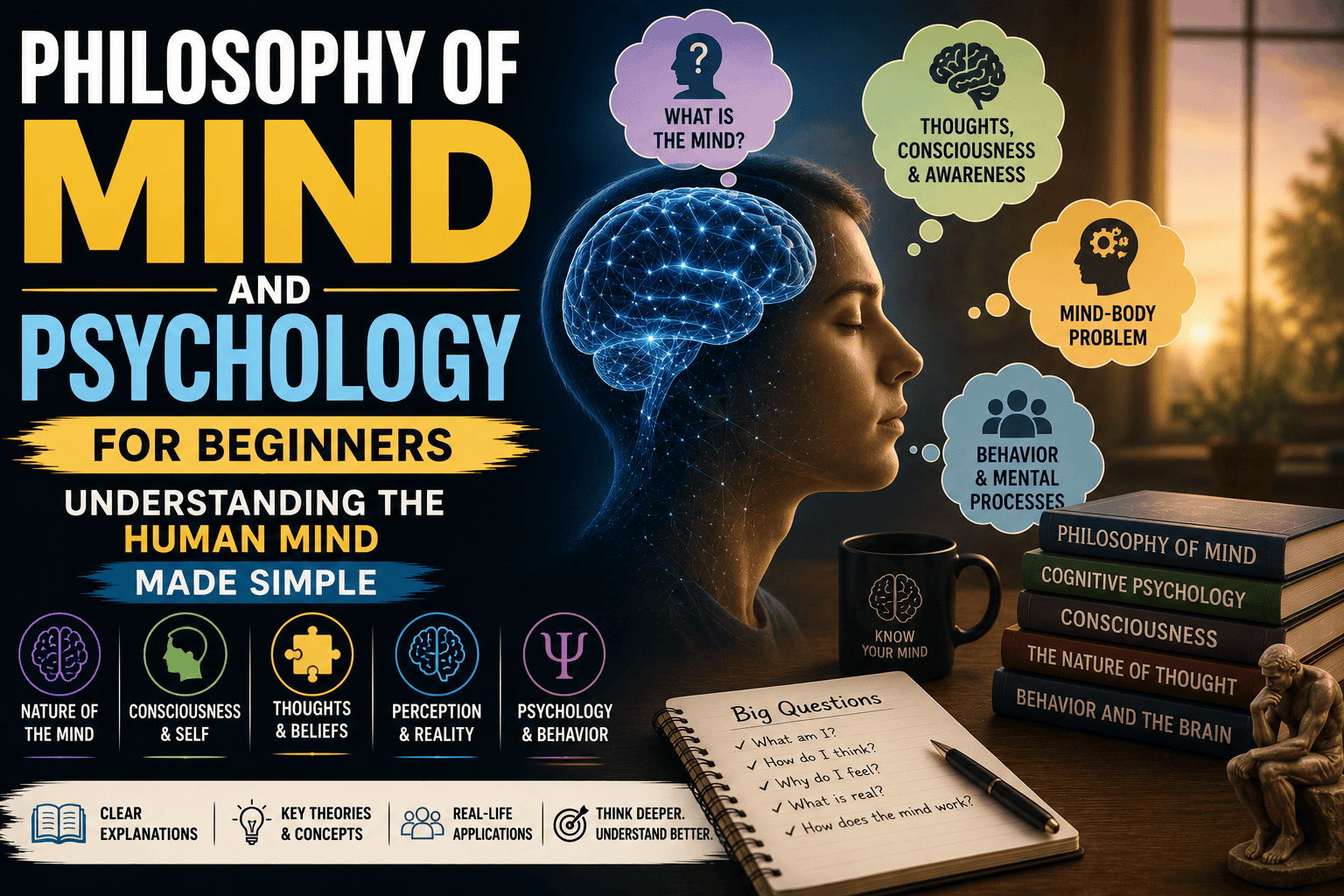
Philosophy of Mind and Psychology
Mind and psychology explore the nature of consciousness, thought, emotion, and behavior, seeking to understand how the mind works and why humans think, feel, and act the way they do. This field bridges philosophy and science, examining questions ranging from the biological basis of cognition to the subjective experience of the self and mental well-being. Through methods spanning experimental research, clinical practice, and theoretical inquiry, psychology investigates everything from perception and memory to mental health and social behavior. At its core, it asks what it truly means to have a mind and how that mind shapes human experience.
Content Overview
- Psychology Introduction
- Core Branches of Psychology
- History and Evolution of Psychology
- Modern approaches in psychology:
- Psychology as a Science
- 2. Fundamentals of Psychology
- 3. Cognitive Biases and Mental Distortions
- 4. Developmental Psychology
- 5. Social & Interpersonal Psychology
- 6. Persuasion and Influence Psychology
- 7. Emotional & Behavioral Psychology
- 8. Emotional Regulation & Behavior Change
- 9. Mental Health & Psychological Well-Being
- 10. Psychology roadmap for developing communication skills and emotional intelligence.
- Cognitive Psychology and Philosophy of Mind
- Behavioral Psychology
- Developmental Psychology
- Social Psychology
- Clinical Psychology & Mental Health
- Biological Psychology
Psychology Introduction
what is Psychology
1. Psychology: Foundations, Behavior, and Communication
Psychology is the scientific study of how people think, feel, and behave.. It explains why humans think, feel, and act the way they do—both individually and socially. In communication, psychology helps us understand perception, emotions, biases, persuasion, and decision-making.
Psychology is the scientific study of mental processes and human behavior.It explores how people think, feel, and act in various situations. This field bridges natural sciences (like biology) and social sciences (like sociology), making it a broad and interdisciplinary discipline.
1.1 Philosophical Roots of Psychology (Mind–Body Perspective)
Key Elements: Mind, Behavior, Scientific Approach
Mind: The thoughts, emotions, and consciousness of an individual.
Example: Experiencing happiness after hearing positive news.
Behavior: The actions or reactions of a person in a given situation.
Example: A child crying when hungry.
Scientific approach: studying mental processes and behavior through experiments, observation, and research.
Example: Conducting a study to test how sleep affects memory.
In the philosophy of mind, dualism refers to the idea that the mind and body are distinct but interconnected.
- Mind → thoughts, emotions, consciousness
- Body → brain, nervous system, physical actions
Example
Stress, a psychological condition, can lead to physical symptoms such as headaches.This shows the mind–body connection, a foundation of modern psychology.
Importance of Psychology
Understanding psychology is crucial for improving mental health, enhancing education, and refining marketing strategies. It allows us to explore how people think, feel, and behave, both individually and in groups. By studying psychological principles, we can develop effective interventions that benefit society.
Psychology is applied in a wide range of fields:
Mental Health: Helps diagnose and treat conditions like anxiety, depression, and stress.
Example: Cognitive-behavioral therapy (CBT) for managing anxiety.
Education: Improves teaching methods and student motivation.
Example: Using psychological strategies to enhance student focus.
Social Dynamics: Enhances understanding of relationships, communication, and group behavior.
Example: Understanding why people conform to social norms in marketing and business.
Core Branches of Psychology
Clinical Psychology & Mental Health
Treats mental illnesses. Example: Therapists help people with depression.
Focuses on diagnosing and treating mental disorders.Clinical psychology deals with the identification, treatment, and prevention of mental health disorders. It studies psychological distress, therapy approaches, and coping mechanisms for mental well-being.
Example: Using psychotherapy to help individuals cope with depression.
Counseling Psychology
Assists individuals in dealing with life challenges and emotional distress.
Example: Helping someone cope with grief or relationship issues.
Emotional and relationship therapy.
Example: Couples therapy for better communication.
Developmental Psychology
It examines how individuals develop and change over the course of their lives.
Example: Studying how children acquire and develop language abilities
Educational Psychology
(Stress-Health Connection, Behavioral Medicine)
It studies how people learn and how teaching methods can be made better.
Example: Developing strategies to help students with learning disabilities.
How students learn.
Example: Best ways to teach children with ADHD.
Social Psychology
Social Psychology Studies group behavior and relationships. Social psychology studies how people’s thoughts, feelings, and behaviors are influenced by others and society. It explores topics like social influence, relationships, and cultural impacts on behavior.
Explores how individuals are influenced by their social environments.
Example: Why do people follow fashion trends? ,Examining how peer influence shapes decision-making.
Cognitive Psychology
Concentrates on cognitive processes such as thinking, memory, and problem-solving.
Example: Investigating how individuals store and recall information.
Industrial/Organizational Psychology
(Leadership, Employee Motivation)
Applies psychological principles to workplace settings.
Example: Improving employee motivation and productivity.
Employee Motivation, Leadership Styles. Productivity and leadership within the workplace.
Example: What motivates employees?
Forensic Psychology
Applies psychological principles to workplace settings.
Example: Improving employee motivation and productivity.
Health Psychology
It looks at how mental and emotional factors affect a person’s health and illness.
Example: Studying the impact of stress on the immune system.
The relationship between a person’s mental health and physical health.
Example: Stress affects the immune system.
Neuropsychology
Explores how brain activity is connected to behavior.
Example: Studying how brain injuries affect memory.
Brain damage effects on behavior.
Example: Stroke patients losing memory.
Neuropsychology (Brain-Behavior Relationships e.g., Amygdala in fear)
History and Evolution of Psychology
History & Evolution: Psychology has evolved over time, moving from philosophy to a scientific discipline. Early psychologists focused on thoughts and consciousness, while modern psychology integrates biology, behavior, and social influences.
Example: Ancient philosophers like Aristotle and Plato debated the nature of the mind, but today, psychologists use brain scans to study mental processes.
– Freud’s psychoanalysis helped explain why childhood experiences affect adult behavior.
Psychology has developed from early philosophical thought into a contemporary scientific field.
Ancient Roots:Aristotle and Plato(Greek Philosophers):
Early philosophers who discussed and explored the nature of the mind.Aristotle(384–322 BCE) believed emotions affect reasoning and decision-making. Linked cognition to the heart. Suggested that thoughts come from the heart, not the brain. Plato (427–347 BCE):Advocated mind-body dualism.”He believed in dualism, where the mind and body are two separate entities.”
Wilhelm Wundt:
Founded the first psychology laboratory in 1879, emphasizing the study of introspection.. Set up the first psychology lab and focused on introspection (looking inward at one’s thoughts).
1890s | William James:
Introduced functionalism – studying the purpose of thoughts and behaviors.(purpose of behaviors).
Sigmund Freud ( 1900s):
Developed psychoanalysis, emphasizing the unconscious mind.Developed psychoanalysis – focusing on the unconscious mind.(unconscious mind).
John Watson and B.F. Skinner(1920s):
Pioneered behaviorism, focusing on observable behavior. Introduced behaviorism, studying observable actions instead of thoughts.(observable actions).
Carl Rogers and Abraham Maslow(1950s):
Founded humanistic psychology, emphasizing personal growth.
Cognitive Revolution(1960s):
Shifted focus back to mental processes like memory and perception.
Modern approaches in psychology:
Structuralism(Wundt):
Studying the structure of thoughts and feelings. Breaking down thoughts and feelings into basic components. Example: Breaking down emotions like happiness into sensations and experiences.
Functionalism (James):
Understanding how behavior helps survival. Understanding how behavior helps survival.Example: Fear helps us escape danger, improving survival chances.
Behaviorism(Watson, Skinner):
Focus on observable behavior rather than thoughts.It emphasizes observable behavior and learning through conditioning processes. Example: Training a dog with rewards (Pavlov’s classical conditioning).
Psychoanalysis(Freud):
Unconscious thoughts influence actions. Founded by Freud, this approach explores unconscious motivations and childhood experiences that shape behavior. Exploring unconscious motivations and childhood experiences. Example: Childhood trauma can affect adult relationships.
Humanistic Psychology (Maslow, Rogers):
Personal growth and self-fulfillment.Emphasizes individual potential and personal growth, focusing on self-actualization. Emphasizing personal growth and self-fulfillment. Example: The need for love and belonging motivates behavior.
Cognitive Psychology:
Studying mental processes like memory and problem-solving. Focus on memory, problem-solving, and learning. Example: Studying how people remember names.
Psychology as a Science
Psychology follows the scientific method: observing, hypothesizing, experimenting, and analyzing results to understand human behavior.
2. Fundamentals of Psychology
This section explains the core mental processes that shape human experience and communication.
2.1 Basic Psychological Concepts
2.1.1 Perception
Perception is how we interpret sensory information (what we see, hear, feel).
- Two people may experience the same event but interpret it in different ways.
- Perception is shaped by experience, culture, beliefs, and emotions.
Example:
A strict teacher is perceived as disciplined by one student and cruel by another.
2.1.2 Cognition
Cognition includes thinking, reasoning, remembering, and problem-solving.
- The brain processes information using mental shortcuts
- These shortcuts are efficient but can cause errors in judgment
Example:
Assuming someone is untrustworthy based on one mistake is a cognitive error.
2.1.3 Motivation
Motivation drives behavior and goal-directed action.
- Intrinsic motivation → internal desire (learning for curiosity)
- Extrinsic motivation → external reward (money, praise)
Example:
A student studying for knowledge vs studying only for grades.
2.2 The Human Mind & Cognitive Functions
Key cognitive functions include:
- Attention
- Memory
- Language
- Decision-making
These functions directly affect communication quality.
Example:
Poor attention leads to misunderstanding even clear messages.
2.3 Memory and Communication
Memory determines what we remember, forget, or distort.
- Short-term memory → limited capacity
- Long-term memory → beliefs, experiences, identity
Example:
Past criticism can make someone misinterpret neutral feedback as an attack.
3. Cognitive Biases and Mental Distortions
Cognitive biases are systematic thinking errors that influence judgment.
3.1 Common Cognitive Biases
3.1.1 Confirmation Bias
We favor information that confirms existing beliefs.
Example:
Consuming news that reinforces your existing political beliefs.
3.1.2 Anchoring Bias
The first piece of information strongly influences decisions.
Example:
A high initial price makes a discount seem better than it is.
3.2 How Biases Affect Communication & Relationships
- Misinterpret intentions
- Strengthen misunderstandings
- Reduce empathy
Example:
Believing that “this person always lies” can make honest communication difficult or impossible.
3.3 Reducing Bias in Thinking & Speaking
- Pause before reacting
- Seek opposing viewpoints
- Ask clarifying questions
4. Developmental Psychology
Developmental psychology studies the ways people grow and change over their lifespan.
4.1 Nature vs. Nurture
- Nature → genetics
- Nurture → environment, upbringing
Example:
Confidence may be inherited but strengthened by supportive parenting.
4.2 Lifespan Communication
- Children → emotional expression
- Adolescents → identity & peer influence
- Adults → logic & responsibility
- Elderly → experience & reflection
5. Social & Interpersonal Psychology
This field explains how people influence one another.
5.1 Social Influence & Group Behavior
Humans naturally conform to group norms.
- Peer pressure
- Cultural expectations
- Authority influence
Example:
People laugh at jokes they don’t find funny because others are laughing.
5.2 First Impressions
First impressions form within seconds and strongly affect perception.
Example:
Confident body language creates trust before words are spoken.
5.3 Non-Verbal Communication & Microexpressions
- Facial expressions
- Body posture
- Eye contact
Example:
Crossed arms signal defensiveness even without words.
6. Persuasion and Influence Psychology
Persuasion is the art of changing attitudes or behavior.
6.1 Principles of Persuasion
- Reciprocity – returning favors
- Scarcity – limited availability
- Authority – experts influence trust
- Social proof – people follow others
Example:
“Only 2 seats left” triggers urgency.
6.2 Ethical Use of Persuasion
Persuasion becomes manipulation when it:
- Removes free choice
- Exploits fear or misinformation
7. Emotional & Behavioral Psychology
Emotions guide decisions, communication, and behavior.
7.1 The Science of Emotions
Emotions are formed through:
- Physiological arousal
- Cognitive interpretation
7.2 Theories of Emotion
7.2.1 James–Lange Theory
Emotion follows physical reaction.
Example:
You experience fear as a result of your heart racing.
7.2.2 Cannon–Bard Theory
Emotion and physical response occur simultaneously.
7.2.3 Schachter–Singer Theory
Emotion = arousal + interpretation.
7.3 Emotions and Decision-Making
Strong emotions reduce rational thinking.
Example:
Anger leads to impulsive speech later regretted.
8. Emotional Regulation & Behavior Change
8.1 Emotional Regulation Techniques
- Cognitive Behavioral Therapy (CBT)
- Reframing thoughts
- Mindfulness practices
Example:
Replacing “I failed” with “I learned” reduces stress.
8.2 Habits & Behavior Change
Habits form through:
- Cue → Routine → Reward
Example:
Checking phone due to boredom becomes automatic behavior.
9. Mental Health & Psychological Well-Being
9.1 Stress, Anxiety & Depression
- Stress → pressure response
- Anxiety → future fear
- Depression → loss of motivation
9.2 The Mind–Body Connection
Mental health directly affects:
- Immunity
- Energy
- Communication style
9.3 Psychological Resilience
Resilience is the ability to recover and adapt after facing challenging circumstances.
- Emotional awareness
- Support systems
- Meaningful goals
9.4 Self-Therapy & Coping Strategies
- Journaling
- Mindfulness
- Cognitive restructuring
10. Psychology roadmap for developing communication skills and emotional intelligence.
10.1 Core Foundations
- Perception
- Cognition
- Memory
- Bias awareness
10.2 Emotional Intelligence Skills
- Emotional awareness
- Self-regulation
- Empathy
10.3 Social Mastery
- Persuasion ethics
- Group dynamics
- Non-verbal communication
Final Summary
Psychology explains how the mind works, why people behave, and how communication succeeds or fails. Mastering psychological principles improves decision-making, relationships, leadership, and emotional intelligence.
Cognitive Psychology and Philosophy of Mind
What is Cognitive Psychology?
What is Cognitive Psychology?
Cognitive psychology studies how people think, learn, remember, and solve problems. It explores mental processes and how the mind works helps us explore thoughts, consciousness, and mental processes like perception, attention, memory, and decision-making.
For example, studying how people think and process information while solving math problems.Studies how people process information, learn, and make decisions. When solving a math problem, you use memory, logic, and reasoning.
What is the Philosophy of Mind?
Philosophy of mind studies what the mind is, including thoughts, consciousness, mental experiences, and how they relate to the physical body.It raises profound questions such as:
What is the mind?
How is it connected to brain function?
– Do we have free will?
– Can machines have consciousness?
What is Mind ?
The mind is the set of thoughts, feelings, awareness, and memories that shape how we experience the world.
For example, when you see a red apple, your mind interprets its color, shape, and what it represents.Seeing a red apple involves multiple cognitive processes: recognizing color (perception), focusing on the apple (attention), recalling its taste (memory), and deciding to eat it (decision-making).
Theories of Mind:
Theories of the mind explore how we experience and understand thoughts. Various philosophers and scientists have suggested different ideas about what the mind is and how it functions.
Cartesian Dualism: A 17th-century theory by René Descartes on the separation of mind and body :
The mind and body are separate but interact.The mind is non-physical, involving thoughts and feelings, while the body is physical and part of the material world. They are distinct, but they function together.
Example: Deciding to raise your hand (mind’s decision) and the physical movement (body physical response). A common criticism is that if the mind and body are separate, it is unclear how they interact or communicate with each other.Can a machine ever truly be “conscious” or just simulate intelligence?
Materialism(Physicalism) :
The mind is a product of brain activityThoughts and emotions arise from neurons and chemical processes in the brain. The mind is not separate from the body; it is produced by physical activity in the brain, including neural processes that create thoughts, feelings, and consciousness.
Example: A person feels happy because their brain releases dopamine, a chemical responsible for pleasure. Modern neuroscience suggests that thoughts are generated by activity in the brain. For example, dualism holds that the soul exists separately from the body, while materialism views the mind as the result of neural activity.
Functionalism:
The mind can be compared to software running on the brain’s hardware. Mental states like thoughts and emotions depend on how the system functions rather than its physical structure, and they exist because they process information and influence behavior.
Example: A computer could mimic human thoughAI may be able to imitate human thinking by processing information in a similar way to the brain. Just as software can run on different hardware, the mind could, in theory, exist on other systems such as artificial intelligence.. Criticism: Can machines truly be “conscious” or just simulate intelligence?
Levels of Consciousness | Awareness of thoughts | Conscious, subconscious, unconscious
Panpsychism & Non-Physicalist Theories:
Panpsychism is the idea that consciousness is a basic feature of the universe, like space and time. Everything—atoms, rocks, plants—has some level of consciousness. Consciousness exists everywhere, even in non-living things. Consciousness exists in everything Atoms might have “micro-consciousness
For example, it suggests that even atoms may have a basic form of consciousness. Even simple organisms may have awarenessJust as small molecules come together to form a living organism, small units of consciousness could combine to form the human mind.Criticism: No scientific proof yet.Why do only complex systems, such as humans, experience higher levels of consciousness?
Core Cognitive Processes:
Perception, Attention, Memory, Language, Problem-Solving
- Perception
Interpreting sensory information. Example: Recognizing an apple as food.
Perception: The way we make sense of and interpret sensory input. Example: Seeing an apple and knowing it is food.
Bottom-Up vs. Top-Down Processing
Selective Attention, Inattentional Blindness
- Attention
Focusing on specific information. Example: Studying in a noisy environment.
Focusing on specific information. Example: Attempting to study in a noisy setting.
- Memory
Storing and recalling information. Example: Using mnemonics to remember facts.
Sensory, Short-Term, Long-Term Memory : Forgetting Curves, False Memories
- Language Processing and Communication
Understanding and using words. Example: Learning a new language improves cognition.
Broca’s vs. Wernicke’s Areas, Language Acquisition
- Problem-Solving & Decision Making
Finding solutions to challenges. Example: Breaking down complex tasks into smaller steps.
- Consciousness and Mental States
Introduction
Consciousness remains one of humanity’s deepest mysteries.It is our awareness of thoughts, feelings, and surroundings, but science still cannot fully explain how it emerges from the physical brain.. How do subjective experiences emerge? Can artificial intelligence achieve consciousness? And do we truly have free will? This blog post explores the major theories, debates, and fascinating aspects of consciousness, cognition, and intelligence.
- Theories of Consciousness
What is Consciousness?
Consciousness is our awareness of thoughts, emotions, and sensory experiences, and scientists and philosophers have offered different explanations for its origin and nature. A key question is: if the mind is separate from the body, how do they interact or communicate with each other?
Major Theories of Consciousness(Awareness comes from interconnected brain networks.)
- Global Workspace Theory explains consciousness as the result of different brain networks working together, where information is shared in a kind of “global workspace.”
- Integrated Information Theory (IIT) suggests that consciousness depends on how complex and interconnected the neural networks are, with more integrated systems leading to higher levels of awareness.
- Altered States of Consciousness(Dream interpretation in psychology.)
Not all conscious experiences are the same. Our awareness can change depending on different mental and physical states.
Examples of Altered States
- Meditation & Mindfulness – Enhances focus, reduces stress, and improves mental well-being.
- Dreams and interpretation: Sigmund Freud viewed dreams as expressions of unconscious desires, while modern research connects them to memory processing.
- Hypnosis & Drug-Induced States – Alterations in perception, memory, and behavior due to external influences.
🔹 Example: A student who frequently dreams of failing an exam may be experiencing hidden anxiety.
- The Hard Problem of Consciousness (David Chalmers)
The Hard Problem of Consciousness (proposed by David Chalmers) asks why we have subjective experiences. While science can explain how the brain works, it still struggles to explain why experiences like pain actually feel the way they do.Why does music “feel” emotional? Why do humans possess emotions and consciousness?How do we experience colors uniquely?
David Chalmers distinguished between two types of problems:
- Easy Problems refer to explaining how the brain processes information, responds to stimuli, and controls behavior.
- The Hard Problem – Understanding why we have subjective experiences (qualia).
Example: Why does red “feel” red? What is it about certain songs that makes us feel emotional?
Consciousness Debates
- Mind-Body Problem – How does the non-physical mind arise from the physical brain?
- Qualia – The subjective, individual experience of sensations.(e.g., why red “feels” red). Comprehending personal, subjective experiences.
Example: A robot can detect heat but does not “feel” pain like humans do. A robot can recognize colors and sounds, but it doesn’t experience emotions or pain like humans do.
- Neuroscience & Free Will
Do We Truly Make Choices? : The brain makes the decision before we do.
Scientific experiments suggest that decisions are made by the brain before we become consciously aware of them.
- Libet Experiments – Brain scans show activity before a person consciously “decides” to press a button.
- Determinism vs. Free Will – If our brain makes decisions before we are aware of them, do we really have control?
Example: If a brain scan predicts your decision before you realize it, are you truly in control of your choices? E.g. A person “decides” to press a button, but brain scans show activity before they become aware of the decision.
- Artificial Intelligence & Machine Consciousness
Can Machines Think?
With advancements in AI, the question arises: Can machines achieve consciousness?
- Turing Test – Can AI convince a human that it is intelligent?
- Chinese Room Argument – AI may mimic human intelligence, but does it truly “understand” anything?
Example: AI like chatbots can simulate conversations but lack true emotions and self-awareness and have don’t feelings.
- Cognitive Development & Intelligence
Jean Piaget’s theory of cognitive development explains how thinking evolves from infancy to adulthood.
Piaget’s Stages of Cognitive Development (Children develop thinking abilities in stages.)
Piaget studied how children’s thinking develops in stages:
- Sensorimotor stage (0–2 years): Learning occurs through sensory experiences and actions. Babies explore the world using senses. Example: A baby shakes a rattle to produce a sound.
- Preoperational Stage (2–7 years) – Symbolic thinking, but lacks logic. Developing symbols and imagination. Symbolic thinking and imagination develop.Children start using symbols (e.g., playing pretend).Example: A child believes the moon follows them.
- Concrete Operational Stage (7–11 years) – Logical thinking and problem-solving emerge.Logical thinking develops (e.g., understanding math).Logical thinking about concrete objects. Example: Understanding that the amount of water stays the same when poured into a different-shaped glass.
- Formal Operational Stage (12+ years) – Abstract reasoning and hypothetical thinking. Abstract and hypothetical thinking develop.Abstract and logical reasoning. Example: Thinking about hypothetical situations and future possibilities.
Example: A 5-year-old struggles with complex math problems but improves over time as their brain develops.
Memory & Learning
Sensory Memory – Immediate, fleeting(short-lived) information storage.
Short-Term Memory – Temporary retention of information.
Long-term memory: the lasting storage of knowledge and experiences.
Example: Using flashcards helps transfer knowledge to long-term memory.
- Levels of Consciousness
Freud categorized consciousness into different levels:
Conscious Mind – Thoughts we are actively aware of (e.g., solving a math problem).
Subconscious Mind – Just below awareness, influences decisions (e.g., recalling a forgotten name).
Unconscious Mind (Freud) – Hidden thoughts that shape behavior (e.g., repressed emotions, past trauma affecting current actions).
Example: Meeting someone and feeling uneasy without knowing why—your subconscious remembers a past negative experience.
States of Consciousness
- Normal Waking State – Fully aware and alert.
- Altered States – Meditation, hypnosis, or drug-induced experiences.
- Sleep and dreams: Brain activity varies across different stages of sleep. Different brain activities in various sleep cycles.
Example: A person under hypnosis recalling forgotten childhood memories.
- Meditation and Dreams
Meditation & Mindfulness
- Helps relax the mind, reduce stress, and improve concentration.
- Applied in psychology to support mental health and overall well-being.
Example: A person who meditates daily experiences lower anxiety levels and improve concentration.
Dreams and the Unconscious Mind
- Freud believed dreams reveal hidden desires and emotions.
- Modern research suggests dreams help process memories and emotions.
Example: A student dreaming of failing an exam may be reflecting hidden academic stress or anxiety.
Behavioral Psychology
Behavioral psychology focuses on how people learn behaviors through interactions with their environment. It examines conditioning, reinforcement, and the ways behavior can be shaped or changed. Behavioral Psychology (the study of how we behave)
Studies observable behaviors and how they are learned through experience.
Example: Why do people develop habits? , A child learns to say “please” because they get rewarded with candy.
Learning Theories:
Classical Conditioning:
Learning through association.
ExampleIvan Pavlov demonstrated this with dogs that began to salivate at the sound of a bell.A dog begins to salivate at the sound of a bell when it has been consistently associated with food.
Operant Conditioning (Skinner):
Learning through rewards and punishments.
Example: A child receiving candy for completing homework.A child receives candy for doing homework (positive reinforcement).
Observational Learning(Bandura):
Learning by watching others.
Example: A child imitating aggressive behavior seen on TV. A child learns aggression by observing violent behavior in the media.
Behavior Modification:
Behavior can be changed using reinforcement techniques.
- Reinforcement Schedules:
Patterns of rewarding behavior.Patterns that determine how behaviors are encouraged.
Example: A worker receiving a bonus for meeting targets. A worker gets paid weekly (fixed schedule) or after unpredictable tasks (variable schedule).
- Applications in Therapy:
Using behavioral techniques to treat phobias and addictions. Behavioral therapy helps with anxiety, phobias, and addiction.
Example: Exposure therapy for overcoming fear of heights. Exposure therapy assists individuals in gradually overcoming their fears.
Developmental Psychology
Developmental psychology studies how humans grow and change throughout life, including cognitive, emotional, and social development. Developmental Psychology: Examines changes from childhood to old age. Example: How do babies learn language?
Lifespan Development
Piaget’s Cognitive Stages:
Sensorimotor, Preoperational, Concrete Operational, Formal Operational.
Example: A child learning to solve math problems as they grow.
Erikson’s Psychosocial Stages:
Trust vs. Mistrust, Autonomy vs. Shame, etc.
Example: A teenager exploring their identity during adolescence.
Personality Psychology:
Studies personality traits.
Example: Why are some people extroverts?
Personality develops in 8 stages, each with a key conflict.
– Trust vs. Mistrust (Infancy): Learning to trust caregivers.
Example: A baby feels secure when parents respond to cries.
Autonomy vs. Shame (toddlerhood): building a sense of independence.
Example: A toddler insists on dressing themselves.
– Initiative vs. Guilt (Preschool Age): Taking initiative and making decisions.
Example: A child takes the lead while playing a game with friends.
– Industry vs. Inferiority (School Age): Building skills and confidence.
Example: A student feels proud of completing a difficult math problem.
– Identity vs. Role Confusion (Adolescence): Discovering personal identity.
Example: A teenager explores different hobbies to find their passion.
Intimacy vs. Isolation (young adulthood): developing close, meaningful relationships.
Example: A young adult seeks a deep and meaningful friendship or romantic relationship.
Generativity vs. Stagnation (middle adulthood): making meaningful contributions to society.
Example: A parent guides their children or mentors younger colleagues.
Integrity vs. Despair (old age): looking back on life with a sense of fulfillment or regret.
Example: An elderly person shares life lessons with grandchildren.
Social and Emotional Development
Attachment Styles(Bowlby):
Early relationships shape emotional bonds.
Secure Attachment: Comfortable with closeness and independence.
Example: A child explores a playground but returns to their parents when needed.
Anxious Attachment: Fear of abandonment and craving closeness.
Example: A person constantly seeks reassurance in relationships.
Avoidant Attachment: Emotionally distant and self-reliant.
Example: A person avoids emotional intimacy in relationships.
Example: A child feeling secure when their parent is nearby.
Moral Development (Kohlberg):
People’s sense of right and wrong can change and develop over time.
Example: A person protesting against an unfair law based on personal ethics.
Preconventional Level: Based on rewards and punishments.
Example: A child obeys rules to avoid getting scolded.
Conventional Level: Based on societal expectations.
Example: A teenager follows rules to gain social approval.
Postconventional level: guided by personal moral principles.
Example: A person protests against an unfair law.
Social Psychology
Social psychology studies how people think, feel, and behave in social situations.It examines how people perceive others, how they are influenced by social environments, and how relationships shape human interactions. Social psychology provides insights into attitudes, prejudice, conformity, obedience, cultural influences, and interpersonal relationships.
Social psychology helps us understand how individuals think, behave, and interact within a social context. By exploring social cognition, influence, relationships, and cultural factors, we gain insight into human behavior and its implications in society. Understanding these concepts enhances communication, reduces prejudice, and fosters positive relationships across diverse cultures.
Social Cognition
Social cognition involves how people perceive, remember, and use information about others and social situations. It plays a key role in shaping beliefs, attitudes, and behaviors. How beliefs shape behavior Example: A person forms an opinion about someone based on first impressions.
Social cognition is how people think about and understand others. It includes attitudes, prejudice, and stereotypes, shaping how individuals interact.
Attitudes, Prejudice, and Stereotypes
Attitudes: Personal beliefs that affect how individuals respond to different situations.
Example: A person who believes exercise is essential for health is more likely to engage in physical activity as work out regularly..
Prejudice: Preconceived judgments about others, often negative. Preconceived negative judgments about people based on their group membership.
Example: Assuming someone is untrustworthy based on their background or assuming someone is dishonest simply due to their cultural background.
Stereotypes are oversimplified and generalized assumptions about a group of people.
Example: Thinking that all teenagers are rebellious.
Social Influence
Social influence occurs when people change their behavior due to others. Social influence refers to how individuals modify their thoughts and behaviors in response to the presence or actions of others. It encompasses conformity, obedience, and group dynamics.
Conformity (Asch’s Experiment)
Conformity occurs when individuals change their behavior to align with group norms.Adjusting behavior to fit group norms. Example: Dressing similarly to colleagues at work.
Example: Dressing in a similar manner to colleagues at work to blend in.
Asch’s Experiment: Demonstrated how people tend to conform to group opinions even when they believe the group is wrong.
Obedience (Milgram’s Experiment)
Obedience involves following directives from an authority figure. Following authority figures. Example: A soldier following orders despite personal beliefs.
Example: A soldier obeying commands despite personal ethical conflicts.
Milgram’s Experiment: Showed how people are willing to obey authority figures even when it involves harming others.
Group Dynamics :Roles, Norms, Groupthink
Group roles, norms, and decision-making processes influence individual behavior within groups.How group roles, norms, and decision-making affect behavior.
Example: A jury reaching a verdict through group discussion.
Example: A jury deliberating and making a final decision based on group discussions.
Cultural Influences on Behavior
Culture shapes social behavior, values, and interactions. Culture plays a crucial role in shaping behaviors and social interactions.Example: A person follows a fashion trend to fit in with their social circle.Societal norms shape how individuals behave.
Example: In collectivist cultures, people prioritize family over personal goals.
Individualistic vs. Collectivist Cultures: Individualistic societies emphasize independence, while collectivist societies value community.
Example: Western cultures prioritize personal success, while Eastern cultures emphasize family honor. Individualistic societies emphasize personal success, while collectivist societies prioritize group harmony. How norms shape social interactions. Example: In some cultures, maintaining eye contact is seen as confidence, while in others, it may be considered disrespectful.
Example: In Western cultures, independence is encouraged, whereas Eastern cultures focus on family obligations.
Norms and Social Expectations: Unwritten rules that dictate behavior. Unspoken rules that dictate behavior. Example: Greeting with a handshake vs. bowing in different cultures.
Example: In some cultures, eye contact conveys confidence, while in others, it may be seen as disrespectful.
Interpersonal Relationships
Interpersonal relationships involve social connections such as friendships, romantic partnerships, and professional relationships. These interactions influence emotional well-being and social development.
Interpersonal relationships include friendships, romantic relationships, and professional interactions.
Attraction , Love and Friendship
Attraction and love are shaped by factors such as physical appearance, common interests, and emotional bonds.
Example: People tend to be drawn to those who share similar values and hobbies.
Factors influencing romantic and platonic connections.
Example: People tend to be attracted to those with shared interests.
Communication Styles and Conflict Resolution
Effective communication is essential for forming and sustaining relationships.
Example: Body language often conveys emotions more effectively than words. Example: A couple resolves a disagreement through active listening.
Verbal and nonverbal ways of expressing thoughts.
Example: Body language can reveal emotions even when words do not.
Conflict Resolution
Managing disagreements constructively helps sustain healthy relationships.
Example: A couple resolving a dispute by expressing their feelings calmly and listening actively.
Strategies for handling disagreements effectively.
Example: A couple resolving a dispute by expressing their feelings calmly.
Cultural Influences on Social Behavior
Cultural norms and values shape how people interact in different societies.
- Cultural Differences in Social Norms: What is acceptable in one culture may be inappropriate in another.
Example: Greeting customs vary, such as handshakes in Western cultures versus bowing in Asian cultures.
- Impact on Interpersonal Relationships: Social expectations influence relationship dynamics.
Example: Arranged marriages are common in some cultures but rare in others.
Clinical Psychology & Mental Health
Introduction
Clinical psychology focuses on identifying and treating mental health issues, emotional problems, and behavioral disorders. It combines scientific research with therapeutic approaches to improve mental health and overall well-being.
Understanding clinical psychology and mental health is essential for promoting well-being. Mental disorders, therapeutic approaches, and coping mechanisms play a crucial role in mental wellness. Seeking help and using effective strategies can improve one’s quality of life.
Mental Disorders
Mental disorders affect thinking, mood, and behavior. They vary in intensity from mild to severe and can greatly affect everyday functioning.
Anxiety Disorders
Anxiety disorders involve excessive worry and fear, which interfere with daily activities.Excessive worry and fear that interfere with daily life. Example: A student experiences extreme nervousness before an exam, making it hard to focus.
Example: A student experiences extreme nervousness before an exam, making it hard to concentrate.
Mood Disorders(Depression, Bipolar)
Mood disorders involve persistent emotional disturbances, including depression and bipolar disorder. Persistent emotional disturbances, including depression and bipolar disorder. Example: A person with depression loses interest in hobbies and feels fatigued all the time.
Schizophrenia
Schizophrenia is a mental disorder that impacts thinking, emotions, and perception, often leading to hallucinations and delusions.. Example: A person hears voices that others don’t hear.
Obsessive-Compulsive Disorder (OCD)
OCD is characterized by persistent intrusive thoughts and repetitive behaviors that are difficult to control.Repetitive thoughts and behaviors that feel uncontrollable. Example: Checking if the door is locked multiple times before leaving the house.
Example: Checking if the door is locked multiple times before leaving the house. Example: A person with anxiety avoids crowded places due to fear of panic attacks.
Therapeutic Approaches
Different therapeutic methods help individuals manage and recover from mental disorders.
Psychotherapy
Psychotherapy involves talking with a therapist to explore and address emotional challenges.Talking with a therapist to explore and address emotional challenges.
Example: A person with social anxiety learns to manage fears through therapy.
Psychopharmacology
Psychopharmacology focuses on using medications to treat psychological disorders.Using medications to treat psychological disorders.
Example: A doctor prescribes antidepressants for a patient with depression.
Example: A doctor prescribes antidepressants for a patient with depression.
Cognitive Behavioral Therapy (CBT)
CBT helps change negative thought patterns and develop healthier behaviors.A therapy that helps change negative thought patterns.
Example: A person with a fear of public speaking practices positive self-talk.
Humanistic Therapy
Humanistic therapy emphasizes personal growth and self-awareness. Example: A therapist helps a patient overcome negative thoughts through CBT techniques.Focuses on personal growth and self-awareness. Example: A therapist helps a client build self-confidence by focusing on strengths.
Resilience & Coping
Resilience is the ability to recover from stress and challenges. Coping strategies help manage difficult emotions.Resilience is the ability to recover from stress and challenges. Coping strategies help manage difficult emotions.
Stress Management
Effective stress management techniques reduce stress and enhance well-being. Methods to lessen stress and boost well-being.
Example: Meditation and exercise help relieve work-related stress.
Family Resilience
Family support plays a vital role in helping individuals cope with hardships.Example: A person practices deep breathing to stay calm during stressful situations. Support from family members to cope with hardships.
Example: A family comes together to support a loved one through a difficult time.
Biological Psychology
Introduction
Biological psychology explores how the brain, nervous system, and body influence thoughts, emotions, and behavior. Understanding these biological mechanisms helps in psychology, medicine, and neuroscience.
Links brain activity to behavior. Example: Stress affects heart rate.
Biological psychology examines how the brain and bodily systems influence behavior.Example: Dopamine affects happiness levels.
Biological psychology examines how brain activity, the nervous system, hormones, and genetics influence behavior. Understanding these connections enhances knowledge of human behavior, mental health, and well-being.
Example: Stress affects heart rate, and dopamine influences happiness.
Understanding the biological basis of behavior helps us learn how the brain, nervous system, and body influence thoughts, emotions, and actions. This knowledge is crucial in psychology, medicine, and neuroscience.
1. Neuroscience
Neuroscience studies the brain and nervous system to understand how they control behavior and mental processes.
- 1.1 Nervous System
Neuroscience (Nervous System, Brain Functioning, Neurotransmitters).
The nervous system is the body’s communication system, made up of:
Central Nervous System (CNS) – Brain and spinal cord, processing information.
Example: The brain helps in decision-making, and the spinal cord controls reflex actions.
Peripheral Nervous System (PNS) – Nerves outside the brain and spinal cord that connect the body to the CNS.
Example: Feeling pain when touching something hot.
- 1.2 Brain Functioning
The brain is divided into different lobes, each with a specific function:
Lobes: Frontal (decision-making), Temporal (memory), Occipital (vision)
Neurotransmitters: Dopamine (reward), Serotonin (mood), GABA (calm)
Brain Functioning : The brain is divided into different lobes , each with a specific function:
Frontal Lobe: Decision-making, problem-solving, emotions.
Example: Planning a trip requires frontal lobe activity.
Temporal Lobe: Memory and language.
Example: Remembering a friend’s phone number.
Occipital Lobe: Vision processing.
Example: Recognizing a familiar face.
Parietal Lobe: Touch, pain, temperature.
Example: Feeling the warmth of sunlight.
- 1.3 Neurotransmitters
Neurotransmitters are chemicals in the brain that carry signals and affect emotions and behavior:
Dopamine: Linked to pleasure and motivation.
Example: Feeling happy after reaching a goal.
Serotonin: Regulates mood and sleep.
Example: Low serotonin levels can cause depression.
GABA: Reduces anxiety and stress.
Example: Meditation increases GABA, promoting relaxation.
2. Endocrine System(Hormones: Cortisol, Oxytocin)
- 2.1 Hormones and Their Role
The endocrine system consists of glands that release hormones, which affect emotions and behavior:
Cortisol(stress): The stress hormone.
Example: High cortisol levels cause anxiety.
Oxytocin(bonding): The bonding hormone.
Example: Mothers bonding with newborns.
Genetics and Evolution, along with Human Body Systems
- 3.1 Role of Genetics in Behavior
Genetics: DNA influences behavior and personality.
Example: Some people are naturally more social due to genetic factors.
Evolutionary Psychology: Behavior is shaped by evolution for survival.
Example: Fear of heights helps prevent falls.How evolution shaped the mind.
Example: Why humans fear snakes.
- 3.2 Human Body Systems & Behavior
(Cardiovascular, Respiratory, Digestive, Musculoskeletal, Immune, Urinary, Reproductive)
Cardiovascular System(Circulating Life ): Heart and blood circulation.
Example: Stress increases heart rate.
Respiratory System (Breathing for Life ): Controls breathing.
Example: Deep breathing calms anxiety.
Digestive System(Fueling the Body): Breaks down food for energy.
Example: Hunger affects mood and focus.
Musculoskeletal System(Structure and Movement): Controls movement.
Example: Exercising improves mental health.
Immune System(Defense and Protection ): Protects against diseases.
Example: Stress weakens immunity.
Urinary system: Responsible for removing waste products from the body.
Example: Dehydration affects concentration.
Reproductive System(Life Continuation): Involved in sexual behavior and hormones.
Example: Hormonal changes influence mood.
Research Methods
Psychologists use different methods to study behavior: Experimental, Observational, Case Studies, Surveys, Correlational:
– Experimental Research: Testing theories through experiments.
Example: Studying how sleep affects memory.
– Observational Research: Watching behavior in natural settings.
Example: Observing children playing to study social development.
– Case Studies: Detailed studies of individuals.
Example: Studying a person with rare memory loss.
– Surveys: Asking people questions about behavior.
Example: Public opinion on social media addiction.
– Correlational Research: Finding relationships between factors.
Example: Does stress increase heart disease risk?