Mystery
Mystery, as a genre and mode of storytelling, centers on the unraveling of hidden truths – puzzles, crimes, or unexplained events that draw readers or viewers into a process of investigation and discovery. It relies on suspense, clues, and misdirection to engage the audience in piecing together what really happened, often through the perspective of a detective, investigator, or curious protagonist. Beyond entertainment, mystery taps into a deeper human fascination with the unknown and our innate drive to seek explanation and order from chaos. At its core, mystery explores how truth is uncovered – and what it reveals about human nature along the way.
Content Overview
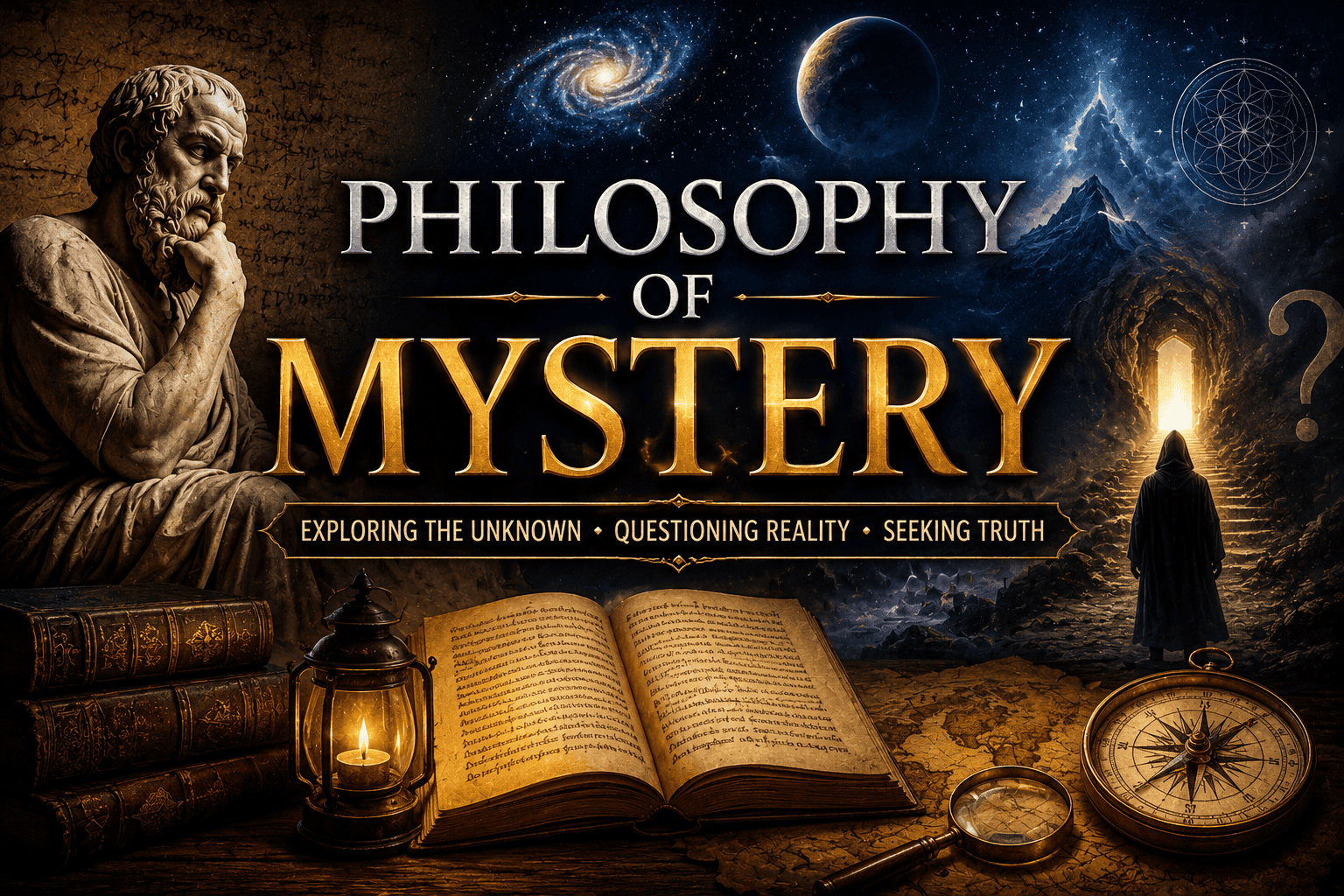
- Mystery Introduction
- 4.1 PHILOSOPHY OF MYSTERY
- 4.2 TYPES OF MYSTERY (ACADEMIC CLASSIFICATION)
- 4.3 HISTORICAL MYSTERIES (GLOBAL)
- 4.4 MYSTERY BY CONTINENTAL REGIONS
- 4.5 UNEXPLAINED PHENOMENA IN HISTORY
- 4.6 Mystery and Science: Why Some Questions Remain Unanswered
- 4.7 PHILOSOPHICAL REFLECTIONS ON MYSTERY
- 4.8 MYSTERY AS A DRIVER OF HUMAN PROGRESS
- Mystery: A Philosophical & Conceptual Exploration
- Table of Contents
- 1. Introduction: The Nature of Mystery
- 2. Taxonomy of Mysteries
- 3. Philosophical Approaches to Mystery
- 4. Psychology of Mystery
- 5. Mystery in Literature & Narrative
- 6. Scientific Investigation of Mysteries
- 7. Religious & Spiritual Dimensions
- 8. Social & Cultural Aspects
- 9. The Value & Function of Mystery
- 10. Contemporary Mysteries & Future Directions
- 1. Introduction: The Nature of Mystery
- 2. Taxonomy of Mysteries
- 3. Philosophical Approaches to Mystery
- 4. Psychology of Mystery
- 5. Mystery in Literature & Narrative
- 6. Scientific Investigation of Mysteries
- 7. Religious & Spiritual Dimensions
- 8. Social & Cultural Aspects
- 9. The Value & Function of Mystery
- 10. Contemporary & Future Mysteries
- Conclusion: Living with Mystery
- Table of Contents
Mystery Introduction
4.0 INTRODUCTION: WHAT IS “MYSTERY” IN HUMAN KNOWLEDGE?
A mystery is not merely something unknown; it is something partially known yet fundamentally unresolved despite evidence, logic, or investigation.
In academic terms, mystery exists where:
- Evidence is incomplete or contradictory
- Interpretation exceeds certainty
- Knowledge systems fail to explain phenomena
Mystery exists at the edge of history, science, philosophy, psychology, and metaphysics.
4.1 PHILOSOPHY OF MYSTERY
(Why Humans Are Drawn to the Unknown)
4.1.1 Mystery vs Knowledge
- Knowledge = verified understanding
- Mystery = persistent uncertainty
Philosophers argue:
- Socrates: Wisdom begins in knowing one does not know
- Immanuel Kant: Human reason has limits
- Karl Popper: Knowledge advances through unresolved problems
➡ Mystery is not ignorance; it is a driver of inquiry.
4.1.2 Mystery and Human Consciousness
Humans uniquely:
- Ask existential questions
- Create myths and symbols
- Seek meaning beyond survival
Mystery shapes:
- Religion
- Art
- Science
- Philosophy
4.2 TYPES OF MYSTERY (ACADEMIC CLASSIFICATION)
| Type | Description |
|---|---|
| Historical Mystery | Lost civilizations, unknown events |
| Archaeological Mystery | Undeciphered scripts, artifacts |
| Scientific Mystery | Unexplained natural phenomena |
| Psychological Mystery | Mass behavior, consciousness |
| Philosophical Mystery | Time, existence, free will |
| Cosmic Mystery | Origins of universe, dark matter |
4.3 HISTORICAL MYSTERIES (GLOBAL)
4.3.1 ASIA: MYSTERIES OF ANCIENT CIVILIZATIONS
🔹 Indus Valley Civilization (South Asia)
- Advanced cities (Mohenjo-Daro, Harappa)
- Perfect drainage, urban planning
- Script undeciphered
- Cause of decline unknown
Theories
- Climate change
- River shifts
- Epidemics
- Economic collapse
➡ Mystery: How did such an advanced civilization vanish without war evidence?
🔹 China
- Oracle bones partially decoded
- Lost dynasties
- Terracotta Army purpose debates
4.3.2 AFRICA: MYSTERIES OF LOST EMPIRES
🔹 Great Zimbabwe
- Massive stone structures
- No written records
- Unknown builders
🔹 Egyptian Mysteries
- Pyramid construction techniques
- Purpose of Great Pyramid
- Missing burial evidence
➡ Mystery persists despite advanced archaeology.
4.3.3 EUROPE: MYSTERIES OF MEDIEVAL & ANCIENT TIMES
🔹 Stonehenge
- Astronomical alignment
- Transport of massive stones
- Ritual vs scientific purpose
🔹 Voynich Manuscript
- Unknown language
- Botanical illustrations unreal
- Possibly cipher, hoax, or lost knowledge
4.3.4 AMERICAS: CIVILIZATIONS & DISAPPEARANCES
🔹 Maya Collapse
- Advanced astronomy
- Sudden urban abandonment
- No invasion evidence
🔹 Roanoke Colony
- Entire English colony vanished
- Only word “CROATOAN” left
4.4 MYSTERY BY CONTINENTAL REGIONS
4.4.1 ASIA
- Indus Script
- Lost Buddhist universities (Nalanda destruction gaps)
- Ancient Indian aviation myths (Pushpaka Vimana)
4.4.2 AFRICA
- Pre-colonial navigation knowledge
- Stone cities without records
4.4.3 EUROPE
- Roman concrete formula lost
- Greek fire composition unknown
4.4.4 NORTH AMERICA
- Mound builders
- Ancestral Puebloans disappearance
4.4.5 SOUTH AMERICA
- Nazca Lines purpose
- Inca stone-cutting technology
4.4.6 AUSTRALIA & OCEANIA
- Aboriginal Dreamtime origins
- Ancient navigation across Pacific without instruments
4.4.7 ANTARCTICA
- Subglacial lakes
- Prehistoric climate mysteries
- Possible ancient land connections
4.5 UNEXPLAINED PHENOMENA IN HISTORY
4.5.1 Natural Phenomena
🔹 Tunguska Event (1908)
- Explosion equal to nuclear bomb
- No crater
- Cause uncertain
🔹 Bermuda Triangle
- Ship and aircraft disappearances
- Natural vs supernatural debate
4.5.2 Psychological & Social Mysteries
🔹 Dancing Plague (1518)
- Mass hysteria?
- Poisoning?
- Religious psychosis?
🔹 Mass Visions & Religious Phenomena
- Fatima apparitions
- Collective hallucinations vs belief systems
4.6 Mystery and Science: Why Some Questions Remain Unanswered
Reasons mysteries persist:
- Evidence destroyed
- Cultural context lost
- Language extinct
- Technology insufficient
- Human bias in interpretation
➡ Mystery survives where method meets limitation.
4.7 PHILOSOPHICAL REFLECTIONS ON MYSTERY
4.7.1 Is Mystery Permanent?
- Einstein: Mystery is the source of science
- Heidegger: Mystery is part of being
Some mysteries may never be solved.
4.7.2 Mystery vs Myth
- Myths encode cultural truth
- Mystery arises where myth fades and investigation begins.
4.8 MYSTERY AS A DRIVER OF HUMAN PROGRESS
Without mystery:
- No exploration
- No science
- No philosophy
Mystery:
- Forces questioning
- Expands imagination
- Challenges certainty
✅ SECTION 4 SUMMARY
- Mystery exists at the edge of knowledge
- It connects history, science, philosophy, and psychology
- Mysteries are not failures of knowledge, but engines of discovery
- Some mysteries may remain eternal
Mystery: A Philosophical & Conceptual Exploration
Table of Contents
1. Introduction: The Nature of Mystery
1.1 What is Mystery?
1.2 Mystery vs. Problem vs. Puzzle
1.3 The Human Fascination with Mystery
2. Taxonomy of Mysteries
2.1 Cosmic Mysteries
2.2 Human Consciousness Mysteries
2.3 Historical & Archaeological Mysteries
2.4 Scientific & Mathematical Mysteries
2.5 Metaphysical & Religious Mysteries
2.6 Criminal & Investigative Mysteries
3. Philosophical Approaches to Mystery
3.1 Epistemological Perspectives: What Can We Know?
3.2 Ontological Perspectives: The Nature of the Unknown
3.3 Existentialist Views (Jaspers, Marcel)
3.4 Mystical & Transcendent Approaches
3.5 The Role of Wonder & Awe
4. Psychology of Mystery
4.1 Cognitive Processing of the Unknown
4.2 The Need for Closure vs. Tolerance for Ambiguity
4.3 Mystery and Emotional Response (Fear, Curiosity, Wonder)
4.4 The “Zeigarnik Effect”: Why Unresolved Mysteries Haunt Us
5. Mystery in Literature & Narrative
5.1 The Detective Story Formula
5.2 Gothic & Horror: Supernatural Mystery
5.3 Mystery as a Literary Device: Foreshadowing and Revelation5.4 The Unreliable Narrator & Narrative Gaps
6. Scientific Investigation of Mysteries
6.1 The Scientific Method and the Unknown
6.2 Unsolved Scientific Mysteries (Dark Matter, Consciousness, Origin of Life)
6.3 The Boundary of Scientific Explanation
6.4 When Mystery Becomes Research Program
7. Religious & Spiritual Dimensions
7.1 The Mysterium Tremendum et Fascinans
7.2 Negative Theology (Via Negativa)
7.3 Sacred Mysteries in Religious Traditions
7.4 Revelation vs. Concealment in Scripture
8. Social & Cultural Aspects
8.1 Mystery Cults and Secret Societies
8.2 Conspiracy Theories: Pathological Mystery
8.3 The Commodification of Mystery (Tourism, Entertainment)
8.4 Cultural Variations in Approaching the Unknown
9. The Value & Function of Mystery
9.1 Mystery as Engine of Inquiry
9.2 The Aesthetics of the Unsolved
9.3 Pedagogical Value: Mystery as Teaching Tool
9.4 When Mystery Should Be Preserved vs. Solved
10. Contemporary Mysteries & Future Directions
10.1 Technological Mysteries (AI Consciousness, Quantum Computing)
10.2 Unexplained Phenomena (UAPs/UFOs, Paranormal Claims)
10.3 Existential Mysteries in a Scientific Age
10.4 The Future of Mystery: Will We Run Out?
1. Introduction: The Nature of Mystery
1.1 What is Mystery?
Mystery (from Greek mysterion = secret rite or doctrine) refers to that which is unknown, unexplained, or beyond complete understanding.Unlike simple ignorance, a mystery suggests something deep, elusive, and meaningful that does not lend itself to easy explanation.
Example: The mystery of consciousness—why and how subjective experience arises from physical processes—differs from simply not knowing a factual detail.
1.2 Mystery vs. Problem vs. Puzzle
A crucial philosophical distinction:
- Problem: A difficulty or obstacle requiring a practical solution. It has a clear goal and methodology.
Example: “Reducing traffic congestion” can be considered a problem.
- Puzzle: Has a definite solution and follows established rules. Once solved, it ceases to be puzzling.
Example: A crossword puzzle or Sudoku.
- Mystery: May not have a definitive solution or may transcend our current frameworks of understanding. It often deepens upon investigation.
Example: The mystery of free will, the mystery of existence itself.
1.3 The Human Fascination with Mystery
Humans are uniquely drawn to mystery. This attraction manifests as:
- Cognitive: Our pattern-seeking brains try to resolve uncertainty.
- Emotional: A mystery can inspire feelings such as curiosity, wonder, fear, or awe.
- Existential: It connects to fundamental questions about meaning, purpose, and our place in the universe.
2. Taxonomy of Mysteries
2.1 Cosmic Mysteries
- Origin of the Universe: What, if anything, preceded the Big Bang?
- Nature of dark matter and dark energy: Together they make up about 95% of the universe, yet cannot be directly detected using conventional methods.
- Fermi Paradox: Given the vastness of the universe, why haven’t we found evidence of other civilizations?
- The Fine-Tuning Problem: Why do physical constants allow for life?
2.2 Human Consciousness Mysteries
- The Hard Problem of Consciousness: Why do we have qualitative, subjective experiences?
- The Nature of Self: What constitutes personal identity over time?
- Free Will vs. Determinism: Are our choices truly free?
- The Mind–Body Problem: How are mental states connected to physical states?
2.3 Historical & Archaeological Mysteries
- Purpose of Ancient Monuments: Stonehenge, the Pyramids of Giza.
- Lost Civilizations: Atlantis (mythical or historical?), the Indus Valley script.
- Disappearances: The Mary Celeste, the Roanoke Colony.
- Cryptic Texts: The Voynich Manuscript, the Phaistos Disc.
2.4 Scientific & Mathematical Mysteries
- Unified Field Theory: Merging quantum mechanics with general relativity.
- P vs. NP Problem (Millennium Prize Problem).
- Origin of life: How did non-living matter turn into living organisms?
- The nature of time: Why does it move in only one direction?
2.5 Metaphysical & Religious Mysteries
- The Problem of Evil: How can an omnipotent, benevolent God allow suffering?
- The Nature of God/Ultimate Reality: Ineffable and beyond human conception in many traditions.
- Afterlife and immortality: What, if anything, occurs after death?
- Miracles and the supernatural: Events that seem to go beyond natural laws.
2.6 Criminal & Investigative Mysteries
- Unsolved Crimes: Jack the Ripper, the Zodiac Killer.
- Mysterious Deaths: The Dyatlov Pass incident.
- Missing Persons: Cases with no clear resolution.
3. Philosophical Approaches to Mystery
3.1 Epistemological Perspectives
- Skepticism (Hume): Emphasizes the limits of human knowledge; some mysteries may be permanently beyond our grasp.
- Rationalism (Descartes): Believes reason can penetrate many mysteries, perhaps all.
- Pragmatism (James, Dewey): Focuses on mysteries that make a practical difference; others may be set aside.
3.2 Ontological Perspectives
- Realism: Mysteries exist objectively in the world, independent of our knowledge.
- Constructivism: Mysteries are partly constructed by our minds and cultural frameworks; what is mysterious in one era may not be in another.
3.3 Existentialist Views
- Karl Jaspers: Coined the term “the Encompassing” (das Umgreifende)—the ultimate, ungraspable horizon of all being and thought. For Jaspers, authentic existence involves confronting this mystery.
- Gabriel Marcel: Distinguished between a “problem” (something external I can solve) and a “mystery” (something in which I am intimately involved and cannot objectify). Being, love, and fidelity are mysteries.
3.4 Mystical & Transcendent Approaches
- Negative Theology (Pseudo-Dionysius, Meister Eckhart): God is so beyond human understanding that we can only say what God is not. The mystery is approached through negation and silence.
- Mysterium Tremendum et Fascinans (Rudolf Otto): The sacred is experienced as a tremendous, awe-inspiring mystery that both repels and fascinates.
3.5 The Role of Wonder & Awe
- Aristotle: “Philosophy begins in wonder.”
- Contemporary psychology (Keltner & Haidt): Awe is described as the feeling experienced when encountering vast mysteries that go beyond our understanding, often expanding perception and fostering a sense of humility.
4. Psychology of Mystery
4.1 Cognitive Processing
- Pattern Recognition: Our brains are wired to detect patterns, even in noise (apophenia). This leads to solving mysteries but also to seeing them where none exist (pareidolia).
- Cognitive Dissonance: The discomfort of unresolved mystery motivates us to seek resolution.
4.2 Need for Closure vs. Tolerance for Ambiguity
- High Need for Closure: Individuals prefer definite answers, even if incorrect, and may rush to judgment or embrace conspiracy theories to resolve mystery.
- High Tolerance for Ambiguity: Individuals can sustain curiosity and uncertainty, allowing for deeper, more complex investigation.
4.3 Emotional Responses
- Curiosity: The intrinsic desire to know, driving exploration.
- Fear: The “unknown” triggers threat response; horror genres exploit this.
- Wonder and awe: positive emotional responses that arise when encountering deep and meaningful mysteries
4.4 The Zeigarnik Effect
Named after psychologist Bluma Zeigarnik, this is the tendency to remember uncompleted or interrupted tasks (or mysteries) better than completed ones. This explains why unresolved plotlines or unanswered questions “haunt” us.
5. Mystery in Literature & Narrative
5.1 The Detective Story Formula
From Edgar Allan Poe’s Dupin to Arthur Conan Doyle’s Holmes and Agatha Christie’s Poirot, the classic structure:
- A crime or mysterious event.
- An investigation (gathering clues, red herrings).
- A revelation (the “big reveal” or denouement).
- Restoration of order.
5.2 Gothic & Supernatural Mystery
Explores mysteries beyond rational explanation: haunted houses, curses, the occult. Often leaves some element unresolved to preserve the sense of the unknown (e.g., Henry James’s The Turn of the Screw).
5.3 Narrative Gaps & Unreliable Narrators
- Gaps: What is left unsaid can be more powerful than what is said. The mystery invites reader participation.
- Unreliable Narrator: The mystery lies in discerning truth from distortion (e.g., The Murder of Roger Ackroyd, Gone Girl).
6. Scientific Investigation of Mysteries
6.1 The Scientific Method as Mystery-Solver
Science is humanity’s most powerful tool for transforming mysteries into problems and puzzles, and solving them. It proceeds by:
- Observation of a puzzling phenomenon.
- Hypothesis formation.
- Experimentation and testing.
- Theory building.
6.2 Unsolved Scientific Frontiers
- Dark Matter/Energy: The dominant components of the cosmos, yet unknown.
- Consciousness: No consensus theory for subjective experience.
- Origin of Life: How chemistry became biology.
- Quantum Gravity: Reconciling the very large (relativity) with the very small (quantum).
6.3 The Boundary of Science
Some philosophers (e.g., Stephen Jay Gould with “Non-Overlapping Magisteria”) argue science and religion/ mystery address different domains. Others believe science will eventually explain all. The debate over what is in principle unknowable continues.
7. Religious & Spiritual Dimensions
7.1 Mysterium Tremendum et Fascinans
Rudolf Otto’s description of the holy as the “wholly other” (ganz andere), evoking dread, awe, and fascination—the core of religious experience.
7.2 Via Negativa (The Apophatic Way)
A theological approach asserting that God can only be described by what God is not (not finite, not changing, not comprehensible). The deepest mystery is explored through silence, denial, and paradox.
7.3 Sacred Mysteries
- Christianity: The Trinity, the Incarnation, the Eucharist as holy mysteries to be revered, not fully comprehended.
- Ancient Mystery Religions (Eleusinian, Mithraic): Secret rites promising profound spiritual knowledge or salvation.
8. Social & Cultural Aspects
8.1 Conspiracy Theories as Pathological Mystery
Conspiracy theories provide simple, secretive explanations for complex and often tragic events. They provide:
- Cognitive: A sense of understanding and pattern.
- Emotional: A target for blame (the conspirators).
- Social: A sense of belonging to the “enlightened” few.
8.2 The Commodification of Mystery
- Tourism: Visits to “mysterious” sites (Stonehenge, Bermuda Triangle).
- Entertainment: Escape rooms, mystery novels, true-crime podcasts.
- Marketing: Creating an aura of mystery around a product or brand.
9. The Value & Function of Mystery
9.1 Engine of Inquiry
Mystery is the fundamental driver of philosophy, science, and art. Without the unknown, there is no reason to explore, question, or create.
9.2 The Aesthetics of the Unsolved
Some mysteries may be more valuable unsolved. Their power lies in their capacity to provoke thought, wonder, and humility. Solving them might diminish their significance (like knowing a magic trick’s secret).
9.3 Pedagogical Value
Presenting information as a “mystery” to be solved increases engagement, critical thinking, and retention (e.g., mystery-based learning in classrooms).
10. Contemporary & Future Mysteries
10.1 Technological Frontiers
- AI Consciousness: If/when an AI becomes conscious, how will we know?
- The Simulation Hypothesis: Could our reality be an advanced simulation?
- Brain-Computer Interfaces: The mystery of personal identity in a merged mind-machine system.
10.2 Unexplained Phenomena (UAPs/UFOs)
The recent shift from fringe topic to legitimate government investigation highlights how mysteries can move into the scientific mainstream.
10.3 The Future of Mystery
Will science eventually explain everything? Many thinkers argue no:
- Gödel’s Incompleteness Theorems suggest inherent limits in formal systems.
- The nature of consciousness may require new paradigms beyond physicalism.
- Each answered question uncovers deeper, more fundamental mysteries.
Conclusion: Living with Mystery
Mystery is not merely a gap in knowledge to be filled, but a fundamental category of human experience. It is the space where wonder lives, where science pushes its boundaries, where art finds its deepest themes, and where spirituality confronts the ultimate. A healthy relationship with mystery balances the drive to know with the wisdom to appreciate the unknown, recognizing that some mysteries define the very contours of what it means to be human.
The ultimate mystery may be this: Why is there something rather than nothing?This may be something we never fully answer—and perhaps that is how it is meant to be.