Philosophy of Urdu Language
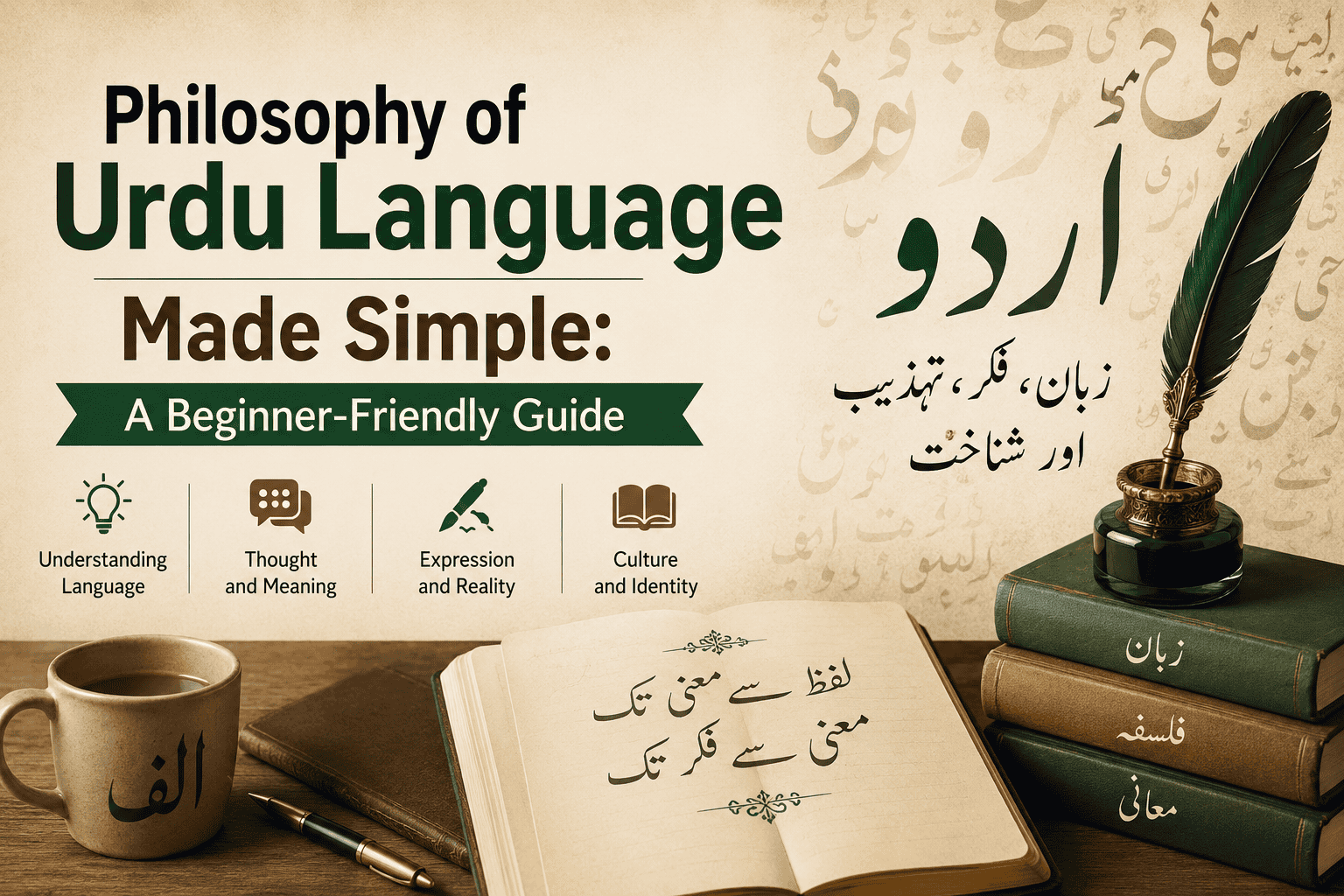
Philosophy of the Urdu Language examines the historical development of Urdu and its distinctive role as a linguistic and cultural link between diverse communities. Shaped by influences from Persian, Arabic, Turkic languages, and the languages of South Asia, Urdu developed a rich vocabulary and expressive style that became especially prominent through its literary traditions. This field explores how the language’s grammar, script, vocabulary, and patterns of expression have been influenced by centuries of cultural, religious, and literary interaction, with shayari and ghazal serving as important examples of its artistic depth.
Beyond the technical structure of the language, the study of Urdu also raises broader questions about identity, culture, belonging, and historical change. It considers how language can preserve the experiences and values of the societies that use it and how centuries of interaction across South Asia contributed to Urdu’s distinctive character. At its core, this subject explores how a language shaped by multiple cultural traditions came to express profound emotional, literary, and philosophical ideas. Discover the cultural depth of a language shaped by history, poetry, and human experience.
Content Overview
- The Philosophy of Urdu Language
- Part 1: The Origins and History of Urdu
- Part 2: The Urdu Alphabet and Script – How Many Characters?
- Part 3: Urdu Grammar – A Deep Dive (Line by Line)
- 3.1 Sentence Structure (Syntax)
- 3.2 Nouns and Gender
- 3.3 Pronouns – The Three Levels of Respect
- 3.4 Verb Conjugation – Present, Past, Future
- 3.5 Postpositions (Instead of Prepositions)
- 3.6 Adjectives – Agreement with Nouns
- 3.7 Case Markers – Direct, Oblique, and Vocative
- 3.8 Compound Verbs
- 3.9 Negation
- 3.10 Question Formation
- Part 4: Urdu Phonology – Sounds and Pronunciation
- Part 5: Urdu Poetry – The Soul of the Language
- Part 6: Common Urdu Phrases and Vocabulary Builder
- Part 7: How to Start Learning Urdu as an English Speaker
- Part 8: Urdu in the Digital Age – Challenges and Hopes
- Final Thought – Why Learn Urdu?
The Philosophy of Urdu Language
Urdu is not just a language. It is a living, breathing expression of culture, poetry, and identity. Spoken by over 170 million people worldwide, it serves as the national language of Pakistan and one of the 22 official languages of India. But what makes Urdu truly unique is not just its vocabulary or grammar – it is the philosophy behind how it shapes thought, emotion, and human connection.
If you have ever heard a ghazal by Faiz Ahmed Faiz or watched a Bollywood movie, you have already felt the magic of Urdu. This guide explores Urdu from its historical roots and development to its distinctive linguistic characteristics, writing system, and grammar, with each rule explained clearly and step by step. It also examines the cultural and emotional significance of Urdu—the reason many speakers affectionately describe it as “the language of the heart.”
Part 1: The Origins and History of Urdu
1.1 Where Did Urdu Come From?
Urdu is part of the Indo-Aryan branch within the Indo-European language family. Its story begins in the 12th century in the regions around Delhi, when local dialects (known as Apabhramsha) started mixing with Persian, Arabic, and Turkish brought by invading armies and later by the Delhi Sultanate and the Mughal Empire.
The very word “Urdu” comes from the Turkish word ordu meaning “army camp” or “cantonment.” In the Mughal military camps, soldiers, traders, and common people from different regions needed a common tongue to communicate. Over time, this “camp language” – called Zaban‑e‑Urdu – evolved into a refined literary language.
Example: Imagine a camp where a Persian‑speaking noble, a Turkish soldier, a Punjabi farmer, and a local merchant all need to trade goods. They naturally blend words from their own languages. “Water” becomes pani (from local), “thanks” becomes shukriya (from Persian/Arabic), “bread” becomes roti (from local). This mixing is the birth of Urdu.
1.2 The Role of the Mughals and the Deccan
During the Mughal Empire (16th to 19th centuries), Urdu spread across North India. Persian was the court language, but Urdu became the language of the army, the markets, and eventually, poetry. In the Deccan (South India), the Bahmani and Qutb Shahi kingdoms nurtured Urdu separately, giving rise to the Deccani dialect, which has its own literary tradition.
Example: The poet Wali Deccani (1667‑1707) is often called the father of Urdu poetry. He wrote ghazals in Urdu that were simple yet profound, inspiring later North Indian poets.
1.3 Urdu and Hindi – Two Sides of the Same Coin
One of the most fascinating facts about Urdu is that it shares the same grammatical base as Hindi. A simple sentence like “I will go to the market” sounds almost identical in everyday speech:
- Urdu: Main kal bazaar jaunga.
- Hindi: Main kal bazaar jaunga. (written differently, but spoken the same)
So why are they considered different languages? The main differences are:
| Feature | Urdu | Hindi |
|---|---|---|
| Script | Perso‑Arabic (Nastaliq), written right‑to‑left | Devanagari, written left‑to‑right |
| Vocabulary | More borrowings from Persian and Arabic | More borrowings from Sanskrit |
| Formal register | Uses words like mulk (country), insaan (human) | Uses desh, manushya |
Example – the same sentence in both scripts:
- Urdu (Nastaliq): اُردو ایک شیریں زبان ہے
- Hindi (Devanagari): उर्दू एक मीठी भाषा है
Both mean “Urdu is a sweet language.” Shireen (Urdu) and meethi (Hindi) both mean “sweet,” but they come from different roots. An ordinary speaker from Delhi or Lucknow understands both effortlessly.
Key insight: Linguists often say that Urdu and Hindi are the same language with two different cultural and literary identities. Urdu is the “Muslim‑influenced” version; Hindi is the “Hindu‑influenced” version. But in daily conversation, speakers switch between them without thinking.
Part 2: The Urdu Alphabet and Script – How Many Characters?
Urdu uses an extended Perso‑Arabic script called Nastaliq. Unlike printed Arabic or Naskh, Nastaliq is cursive, flowing, and highly artistic. Calligraphy is an honored art form in Urdu culture.
2.1 Total Characters in Urdu
The Urdu alphabet consists of 39 basic letters (plus several diacritical marks). However, if you count all modified forms and diacritics, the total number of graphical symbols is higher.
| Category | Count | Examples |
|---|---|---|
| Core consonants | 36 | ب, پ, ت, ٹ, ث, ج, چ, ح, خ, د, ڈ, ذ, ر, ڑ, ز, ژ, س, ش, ص, ض, ط, ظ, ع, غ, ف, ق, ک, گ, ل, م, ن, و, ہ, ھ, ی, ے |
| Vowels (represented by diacritics and letters) | 10 | ا, و, ی, آ (plus short vowels: zabar, zer, pesh) |
| Common diacritics | 3 | َ (zabar), ِ (zer), ُ (pesh) |
Important note: Unlike English, Urdu vowels are often not written as separate letters. Short vowels are indicated by diacritics placed above or below the consonant. In everyday writing, these diacritics are usually omitted, and readers infer the vowel from context. This is similar to Arabic and Hebrew.
2.2 How to Write Urdu – Right to Left
Urdu is written from right to left. For an English speaker, this takes practice, but the reward is access to centuries of poetry and prose.
Example – how to write your name in Urdu:
If your name is “John,” you would write it as جان (pronounced “Jaan” – but that also means “life”). English names are usually written phonetically. “David” becomes ڈیوڈ.
2.3 The Nastaliq Script – An Art Form
Nastaliq is not a “font” in the Western sense. Each letter changes shape depending on its position in a word: initial, medial, final, or isolated. This makes calligraphy a highly skilled art.
Example – the letter “alif” (ا):
- Isolated: ا
- Connected from the right side only (because it does not join to the left).
Example – the word “Pakistan” (پاکستان):
پ + ا + ک + س + ت + ا + ن combines to form the word “پاکستان.”
Notice how the letters flow together.
2.4 The 36 Consonants – Detailed Table
Below is the complete list of Urdu consonants with their names, pronunciation guide (using English approximations), and examples in Urdu script.
| # | Letter | Name | Pronunciation | Example (Urdu) | English meaning |
|---|---|---|---|---|---|
| 1 | ا | alif | a (as in “about”) | اپنا | own |
| 2 | ب | be | b (as in “boy”) | بچہ | child |
| 3 | پ | pe | p (as in “pen”) | پانی | water |
| 4 | ت | te | t (as in “tea” – dental) | تین | three |
| 5 | ٹ | ṭe | t (retroflex – tongue curled back) | ٹوپی | hat |
| 6 | ث | se | th (as in “think”) | ثواب | reward |
| 7 | ج | jīm | j (as in “joy”) | جان | life |
| 8 | چ | che | ch (as in “chair”) | چائے | tea |
| 9 | ح | baṛī he | h (pharyngeal, like a strong h) | حال | condition |
| 10 | خ | khe | kh (as in “loch” – guttural) | خوب | good |
| 11 | د | dāl | d (as in “day” – dental) | دو | two |
| 12 | ڈ | ḍāl | d (retroflex – tongue curled back) | ڈر | fear |
| 13 | ذ | zāl | dh (as in “that”) | ذہن | mind |
| 14 | ر | re | r (rolled lightly) | روٹی | bread |
| 15 | ڑ | ṛe | r (retroflex flap, like “tt” in “butter” American) | بڑا | big |
| 16 | ز | ze | z (as in “zebra”) | زبان | tongue/language |
| 17 | ژ | zhe | zh (like “s” in “pleasure”) | ژالہ | hail |
| 18 | س | sīn | s (as in “sun”) | سکول | school |
| 19 | ش | shīn | sh (as in “shoe”) | شیر | lion |
| 20 | ص | suād | s (emphatic, heavy sound) | صاحب | mister |
| 21 | ض | zuād | z (emphatic) | ضلع | district |
| 22 | ط | to’e | t (emphatic) | طب | medicine |
| 23 | ظ | zo’e | z (emphatic) | ظالم | cruel |
| 24 | ع | ain | a (guttural, like a vowel) | عمل | action |
| 25 | غ | ghain | gh (guttural, similar to French “r”) | غم | sadness |
| 26 | ف | fe | f (as in “fox”) | فلم | film |
| 27 | ق | qāf | q (k from deep throat) | قلم | pen |
| 28 | ک | kāf | k (as in “kite”) | کتاب | book |
| 29 | گ | gāf | g (as in “go”) | گل | flower |
| 30 | ل | lām | l (as in “love”) | لال | red |
| 31 | م | mīm | m (as in “mother”) | ماء | mother |
| 32 | ن | nūn | n (as in “no”) | نام | name |
| 33 | و | wāo | w/v/oo (as in “wood”, “van”, or “boot”) | وہ | he/she/it |
| 34 | ہ | choṭī he | h (as in “house”) | ہم | we |
| 35 | ھ | do chashmī he | h (aspiration mark) | بھی | also |
| 36 | ی | ye | y/ee (as in “yes” or “see”) | یا | or |
| 37 | ے | baṛī ye | ay (as in “day”) | میں | I |
2.5 Short Vowels (Diacritics)
Short vowel sounds are generally represented through diacritical marks rather than separate letters.They are added as marks above or below a consonant.
| Diacritic | Name | Sound | Example (with consonant ب) | Example word |
|---|---|---|---|---|
| َ | zabar | a (as in “about”) | بَ | بَچہ (bacha – child) |
| ِ | zer | i (as in “sit”) | بِ | بِلی (billi – cat) |
| ُ | pesh | u (as in “put”) | بُ | بُکھ (bukkh – hunger) |
| ْ | jazm | (no vowel) | بْ | cuts the vowel |
Part 3: Urdu Grammar – A Deep Dive (Line by Line)
3.1 Sentence Structure (Syntax)
Urdu follows the Subject – Object – Verb (SOV) word order.
English: Subject + Verb + Object
For example, “I” is the subject, “eat” is the verb, and “an apple” is the object.
Urdu: Subject + Object + Verb
Example: Main (S) ek seb (O) khata hoon (V).
Script: میں ایک سیب کھاتا ہوں۔
Rule: In standard Urdu sentence structure, the verb typically appears at the end of the sentence.
3.2 Nouns and Gender
All Urdu nouns have grammatical gender: either masculine (مذکر) or feminine (مؤنث). There is no neuter.
| Masculine example | Script | Feminine example | Script |
|---|---|---|---|
| لڑکا (ladka – boy) | لڑکا | لڑکی (ladki – girl) | لڑکی |
| باغ (bagh – garden) | باغ | باغیچہ (baghicha – small garden) | باغیچہ |
| گھوڑا (ghora – horse) | گھوڑا | گھوڑی (ghori – mare) | گھوڑی |
Rule of thumb for noun endings:
- Nouns ending in ا (alif) or ہ (h) are often masculine.
- Nouns ending in ی (ye) are often feminine.
Exceptions exist: پانی (pāni – water, masculine) ends with ی but is masculine. چیز (cheez – thing, feminine) ends with a consonant but is feminine. Learn gender with each noun.
3.3 Pronouns – The Three Levels of Respect
English has only one word for “you.” Urdu has three:
| Word | Transliteration | Level | When to use |
|---|---|---|---|
| تو | Tu | Intimate, very informal | With children, close friends, or in prayer to God |
| تم | Tum | Informal, friendly | Between equals, friends, family members |
| آپ | Aap | Formal, respectful | Elders, bosses, strangers, any polite context |
Example sentences:
- Tu kya kar raha hai? تو کیا کر رہا ہے؟ (to a young friend)
- Tum kya kar rahe ho? تم کیا کر رہے ہو؟ (to a colleague)
- Aap kya kar rahe hain? آپ کیا کر رہے ہیں؟ (to a teacher)
Other pronouns:
| English | Urdu (singular) | Script | Urdu (plural) | Script |
|---|---|---|---|---|
| I | main | میں | hum | ہم |
| You (intimate) | tu | تو | tum (you all) | تم |
| You (friendly) | tum | تم | aap (respectful plural) | آپ |
| You (respectful) | aap | آپ | aap (same) | آپ |
| He/She/It | woh | وہ | woh log | وہ لوگ |
| This | yeh | یہ | yeh (same) | یہ |
| That | woh | وہ | woh (same) | وہ |
3.4 Verb Conjugation – Present, Past, Future
Urdu verbs are built from a root plus tense markers and gender/number endings.
Example verb: karna (to do) – کرنا
Present tense (habitual) – “I do”
| Subject | Masculine | Script | Feminine | Script |
|---|---|---|---|---|
| Main | karta hoon | کرتا ہوں | karti hoon | کرتی ہوں |
| Tu | karta hai | کرتا ہے | karti hai | کرتی ہے |
| Tum | karte ho | کرتے ہو | karti ho | کرتی ہو |
| Aap | karte hain | کرتے ہیں | karti hain | کرتی ہیں |
| Woh (singular) | karta hai | کرتا ہے | karti hai | کرتی ہے |
| Woh (plural) | karte hain | کرتے ہیں | karti hain | کرتی ہیں |
Present continuous – “I am doing”
Replace karta with kar raha, and add hoon/hai/ho/hain.
Example: Main kar raha hoon (مَیں کر رہا ہوں).
Past tense (simple) – “I did”
| Subject | Masculine | Script | Feminine | Script |
|---|---|---|---|---|
| Main | kiya | کیا | ki | کی |
| Tu | kiya | کیا | ki | کی |
| Tum | kiye | کئے | ki | کی |
| Aap | kiye | کئے | ki | کی |
| Woh (masculine) | kiya | کیا | ki | کی |
| Woh (plural) | kiye | کئے | kin | کیں |
Future tense – “I will do”
Add ga/ge/gi after the root (kar).
- Main karunga (مَیں کروں گا) – masculine
- Main karungi (مَیں کروں گی) – feminine
- Tum karoge (تُم کرو گے) – masculine
- Aap karenge (آپ کریں گے)
3.5 Postpositions (Instead of Prepositions)
English uses prepositions before nouns (e.g., “to school”). Urdu uses postpositions after nouns.
Example: “to school” = school + ko (سکول کو)
- Main school ja raha hoon. میں سکول جا رہا ہوں۔ (literally “I school to going am.”)
Common postpositions:
| Urdu | Script | Meaning | Example (with “house” – گھر ghar) |
|---|---|---|---|
| میں | mein | in | گھر میں (ghar mein – in the house) |
| پر | par | on | گھر پر (ghar par – at home / on the house) |
| سے | se | from, with | گھر سے (ghar se – from home) |
| کو | ko | to (direction or object marker) | گھر کو (ghar ko – to the house) |
| کا / کی / کے | ka / ki / ke | of (possessive) | گھر کا (ghar ka – of the house, masc.) |
Note on possessive postpositions: ka is used for masculine singular nouns, ki for feminine singular, ke for masculine plural or before postpositions.
Example: Ali ka kitab – incorrect! Should be Ali ki kitab (because kitab is feminine).
3.6 Adjectives – Agreement with Nouns
Adjectives in Urdu agree with the noun in gender and number, but only when the adjective comes before the noun. If the adjective is used as a predicate (after the verb “to be”), it also agrees.
Rules:
- Masculine singular adjective: usually ends in a (بڑا – bara)
- Feminine singular adjective: ends in i (بڑی – bari)
- Masculine plural: ends in e (بڑے – bare)
- Feminine plural: same as feminine singular (بڑی – bari)
Examples before noun:
- بڑا گھر (bara ghar – big house, masculine)
- بڑی عورت (bari aurat – big woman, feminine)
- بڑے گھر (bare ghar – big houses, masculine plural)
- بڑی عورتیں (bari aurtein – big women, feminine plural)
Examples as predicate:
- لڑکا بڑا ہے۔ (Ladka bara hai. – The boy is big.)
- لڑکی بڑی ہے۔ (Ladki bari hai. – The girl is big.)
3.7 Case Markers – Direct, Oblique, and Vocative
Nouns in Urdu change form depending on their grammatical role. The direct case is used for subjects and objects without postpositions. The oblique case is used when a noun or pronoun appears before a postposition.
| Ending | Direct singular | Oblique singular | Direct plural | Oblique plural |
|---|---|---|---|---|
| Masculine ending in a (لڑکا) | لڑکا (ladka) | لڑکے (ladke) | لڑکے (ladke) | لڑکوں (ladkon) |
| Masculine ending in consonant (باغ) | باغ (bagh) | باغ (bagh) | باغ (bagh) | باغوں (baghon) |
| Feminine ending in i (لڑکی) | لڑکی (ladki) | لڑکی (ladki) | لڑکیاں (ladkiyan) | لڑکیوں (ladkiyon) |
| Feminine ending in consonant (کتاب) | کتاب (kitab) | کتاب (kitab) | کتابیں (kitabein) | کتابوں (kitabon) |
Example using oblique:
- Direct: لڑکا آ رہا ہے (Ladka aa raha hai – The boy is coming.)
- Oblique (with postposition ne for ergative subject in past): لڑکے نے کتاب پڑھی (Ladke ne kitab parhi – The boy read the book.)
Ergative case (with transitive verbs in past tense): The subject takes the postposition ne (نے) and the verb agrees with the object instead of the subject.
Example:
- لڑکے نے سیب کھایا۔ (Ladke ne seb khaya. – The boy ate an apple.)
Here ladke (oblique) + ne; verb khaya (masculine singular) agrees with seb (apple, masculine), not with the subject.
3.8 Compound Verbs
Urdu commonly uses compound verbs where a main verb is combined with a auxiliary verb (often jaana (to go), lagna (to attach), dena (to give), lena (to take)) to add aspect.
Examples:
- کر دینا (kar dena – to do and give, meaning to complete on someone’s behalf)
- کر لینا (kar lena – to do and take, meaning to complete for oneself)
- پڑھ لینا (parh lena – to read and take = to finish reading)
- آ جانا (aa jana – to come and go = to arrive unexpectedly)
Example sentence:
- میں نے کام کر لیا۔ (Main ne kaam kar liya. – I finished the work (for my own benefit).)
3.9 Negation
To negate a verb, add nahi (نہیں) before the verb or before the auxiliary.
Present tense:
- Main nahi jaata. (مَیں نہیں جاتا – I do not go.)
Past tense:
- Main nahi gaya. (مَیں نہیں گیا – I did not go.)
Future tense:
- Main nahi jaunga. (مَیں نہیں جاؤں گا – I will not go.)
For negative commands, use mat (مَت) instead of nahi.
- Mat jao! (مَت جاؤ – Don’t go!)
3.10 Question Formation
To form a yes/no question, simply add a rising intonation at the end of the sentence. No word order change is required.
Statement: Aap ja rahe hain. (آپ جا رہے ہیں – You are going.)
Question: Aap ja rahe hain? (آپ جا رہے ہیں؟ – Are you going?)
Question words (interrogatives):
| English | Urdu | Script |
|---|---|---|
| What? | kya? | کیا؟ |
| Who? | kaun? | کون؟ |
| Where? | kahan? | کہاں؟ |
| When? | kab? | کب؟ |
| Why? | kyun? | کیوں؟ |
| How? | kaise? | کیسے؟ |
Part 4: Urdu Phonology – Sounds and Pronunciation
4.1 Vowels (Harf-e-Ilat – حرف علت)
There are 10 vowel sounds in Urdu, divided into short and long vowels.
| Short vowels | Symbol (diacritic) | Example | English approximation |
|---|---|---|---|
| a (as in “about”) | َ (zabar) | کاغذ (kaghaz – paper) | a in “sofa” |
| i (as in “sit”) | ِ (zer) | کتاب (kitab – book) | i in “bit” |
| u (as in “put”) | ُ (pesh) | بند (bund – closed) | oo in “foot” |
| Long vowels | Represented by letters | Example |
|---|---|---|
| aa (as in “father”) | ا, آ | آب (aab – water) |
| ee (as in “see”) | ی | دین (deen – religion) |
| oo (as in “boot”) | و | نور (noor – light) |
| ay (as in “day”) | ے | مے (may – wine) |
| o (as in “go”) | و | چودہ (chaudah – fourteen) |
| ai (as in “air”) | ے | سینکڑے (sainkray – hundreds) |
4.2 Consonants (Harf-e-Sahih – حرف صحیح)
Already covered in the alphabet table. Focus on unique sounds:
| Sound | Urdu letter | Example | English equivalent |
|---|---|---|---|
| ق | qaaf | قلم (qalam – pen) | like a k from the back of the throat (not in English) |
| غ | ghain | غریب (ghareeb – poor) | similar to French “r” (guttural) |
| خ | khe | خوب (khoob – good) | like “ch” in Scottish “loch” |
| ڑ | rre | بڑا (bara – big) | rolled r with a flap, like “tt” in “butter” (American) |
| ٹ | tte | ٹوپی (topi – hat) | retroflex t, tongue curled back |
| ڈ | dd | ڈر (dar – fear) | retroflex d |
| ھ | do chashmi he | بھی (bhi – also) | aspiration mark (like “bh” in “abhor”) |
4.3 Stress and Intonation
In Urdu, stress typically falls on the first syllable of a word, though there are many exceptions. Urdu intonation is musical, with a gentle rise and fall – one reason poetry sounds so natural when recited.
Part 5: Urdu Poetry – The Soul of the Language
Urdu is perhaps most famous for its poetry. The two main poetic forms are:
- Ghazal (غزل) – a collection of couplets (sher) that express love, loss, and spirituality. Each couplet can stand alone.
- Nazm (نظم) refers to a longer, more structured poem that follows a unified theme.
Poets like Mirza Ghalib, Allama Iqbal, and Faiz Ahmed Faiz are household names. Their work is memorised, sung, and recited at gatherings called mushaira (مشاعرہ).
A Famous Ghazal Couplet by Ghalib
Urdu script:
نہ تھا کچھ تو خدا تھا، کچھ نہ ہوتا تو خدا ہوتا
مجھے میرے ہونے نے ہی ڈبو دیا؛ اگر میں نہ ہوتا تو کیا ہوتا۔
Transliteration:
When nothing existed, there was God; if nothing had existed, God would still remain.
It is my own existence that led to my downfall—had I not been, what would have been?
Translation:
“When nothing existed, God was; if nothing had existed, God would still be.”
My very being has drowned me; if I had not existed, what would it have mattered?”
This couplet plays with existence, ego, and the divine. It can be interpreted either as a love poem or as a philosophical reflection. Urdu poetry invites multiple interpretations – that is its genius.
Part 6: Common Urdu Phrases and Vocabulary Builder
Basic Greetings and Politeness
| Urdu Script | Transliteration | English meaning |
|---|---|---|
| السلام علیکم | Assalamu alaikum | Peace be upon you (hello) |
| وعلیکم السلام | Wa alaikum assalam | And peace be upon you (reply) |
| شکریہ | Shukriya | Thank you |
| بہت شکریہ | Bohat shukriya | Thank you very much |
| برائے مہربانی | Barae meharbani | Please |
| معاف کیجیے | Maaf kijiye | Excuse me / Sorry |
| خدا حافظ | Khuda hafiz | Goodbye (God protect you) |
Everyday Questions
| Urdu Script | Transliteration | English meaning |
|---|---|---|
| آپ کا نام کیا ہے؟ | Aap ka naam kya hai? | What is your name? |
| آپ کیسے ہیں؟ | Aap kaise hain? | How are you? (formal) |
| تم کیسے ہو؟ | Tum kaise ho? | How are you? (informal) |
| کیا ہو رہا ہے؟ | Kya ho raha hai? | What’s happening? |
| کتنا ہے؟ | Kitna hai? | How much is it? |
Numbers 1-10
| Number | Urdu Script | Transliteration |
|---|---|---|
| 1 | ایک | aik |
| 2 | دو | do |
| 3 | تین | teen |
| 4 | چار | chaar |
| 5 | پانچ | paanch |
| 6 | چھے | chay |
| 7 | سات | saat |
| 8 | آٹھ | aath |
| 9 | نو | nau |
| 10 | دس | das |
Days of the Week
| English | Urdu | Script |
|---|---|---|
| Monday | Peer | پیر |
| Tuesday | Mangal | منگل |
| Wednesday | Budh | بدھ |
| Thursday | Jumerat | جمعرات |
| Friday | Juma | جمعہ |
| Saturday | Hafta | ہفتہ |
| Sunday | Itwaar | اتوار |
Family Members
| English | Urdu | Script |
|---|---|---|
| Father | Waalid / Abbu | والد / ابو |
| Mother | Waalida / Ammi | والدہ / امی |
| Brother | Bhaai | بھائی |
| Sister | Behan | بہن |
| Son | Beta | بیٹا |
| Daughter | Beti | بیٹی |
| Husband | Shauhar | شوہر |
| Wife | Biwi | بیوی |
Part 7: How to Start Learning Urdu as an English Speaker
Step 1 – Learn the Alphabet (Nastaliq Script)
Use apps like “Learn Urdu” or “Urdu Alphabet” on your phone. Practice writing letters in a notebook. Focus on the 12 basic shapes that make up all letters.
Practical exercise: Write the alphabet from ا to ے three times daily. Then write your own name and the names of family members in Urdu.
Step 2 – Build a Core Vocabulary of 500 Words
Start with everyday words: family, food, directions, numbers, and polite phrases. Use flashcards (Anki app is excellent).
Example list:
- Common verbs: جانا (jana – to go), آنا (aana – to come), کھانا (khana – to eat), پینا (peena – to drink)
- Common nouns: پانی (pani – water), کھانا (khana – food), گھر (ghar – house), سکول (school – school)
- Adjectives: اچھا (acha – good), برا (bura – bad), بڑا (bara – big), چھوٹا (chhota – small)
Step 3 – Understand Basic Grammar
Learn the three “you” forms (tu, tum, aap). Learn how verbs change with gender. These rules are few and consistent. Do not skip this step – grammar is the skeleton of the language.
Practical exercise: Conjugate one verb (e.g., parhna – to read) in present, past, and future for all pronouns. Write them in a table.
Step 4 – Practice with Media
Watch Urdu news channels, such as Geo News, with subtitles enabled. Listen to ghazals by Ghulam Ali or Jagjit Singh (read the lyrics while listening). Read children’s stories in Urdu available online (e.g., “Bachon ki Kahaniyan”).
Recommended YouTube channels: “UrduPod101”, “Learn Urdu with Zia”, “BBC Urdu”.
Step 5 – Speak Without Fear
Find a language exchange partner on Tandem or HelloTalk. Urdu speakers are usually delighted when a foreigner tries to speak their language. They will help you gently.
Start with simple sentences:
- Example: میرا نام جان ہے (Mera naam John hai) — “My name is John.”
- میں اردو سیکھ رہا ہوں کا مطلب ہے “I am learning Urdu.”
Part 8: Urdu in the Digital Age – Challenges and Hopes
Like many traditional languages, Urdu faces pressure from English in education and business. Many young Pakistanis speak “Urdish” – a mix of Urdu and English. However, digital media is helping. There is Urdu Wikipedia, Urdu YouTube channels, and even AI translation tools. Poets and writers continue to produce new work.
Example – social media in Urdu: On Twitter, you will see hashtags like #اردو_شاعری (Urdu poetry). Young people share couplets and memes in the Nastaliq script. This keeps the language alive.
Typing Urdu on a Computer
You can type Urdu using a phonetic keyboard (like “Google Input Tools” or “Pak Urdu Installer”). Type “aap” to get آپ, “shukriya” to get شکریہ. Many websites and apps now support Urdu.
Useful Online Resources
| Resource | URL | Purpose |
|---|---|---|
| Rekhta | rekhta.org | Urdu poetry, dictionary, learning |
| Urdu Wikipedia | ur.wikipedia.org | Reading practice |
| Google Input Tools | google.com/inputtools | Typing Urdu |
| UrduPod101 | urdupod101.com | Audio lessons |
Final Thought – Why Learn Urdu?
Learning Urdu is not just about memorising vocabulary or mastering a script. It is about gaining access to a worldview where poetry is as important as politics, where politeness is encoded in grammar, and where a single word can carry the weight of centuries.
As the poet John Elia said:
Urdu script:
رنجش ہی سہی، دل ہی دکھانے کے لیے آ
آ پھر سے مجھے چھوڑ کے جانے کے لیے آ
Meaning:
Come, even if only to hurt my heart;
Come again, even if just to leave me once more.
Transliteration:
Ranjish hi sahi, dil hi dukhaane ke liye aa
Aa phir se mujhe chhod ke jaane ke liye aa
Translation:
“Even if you come with a complaint, come—if only to leave my heart shattered.”Come again, leave me again.”
In that couplet, you hear the philosophy of Urdu: embracing pain as part of beauty, and finding eloquence even in sorrow. “Even if you come carrying a grievance, come anyway—if only to break my heart once more.”
So take the first step. Learn to say “Assalamu alaikum” to a stranger. Write your name in Nastaliq. Listen to a ghazal and let the melody wash over you. You will soon understand why millions call Urdu their home.