metaphysics
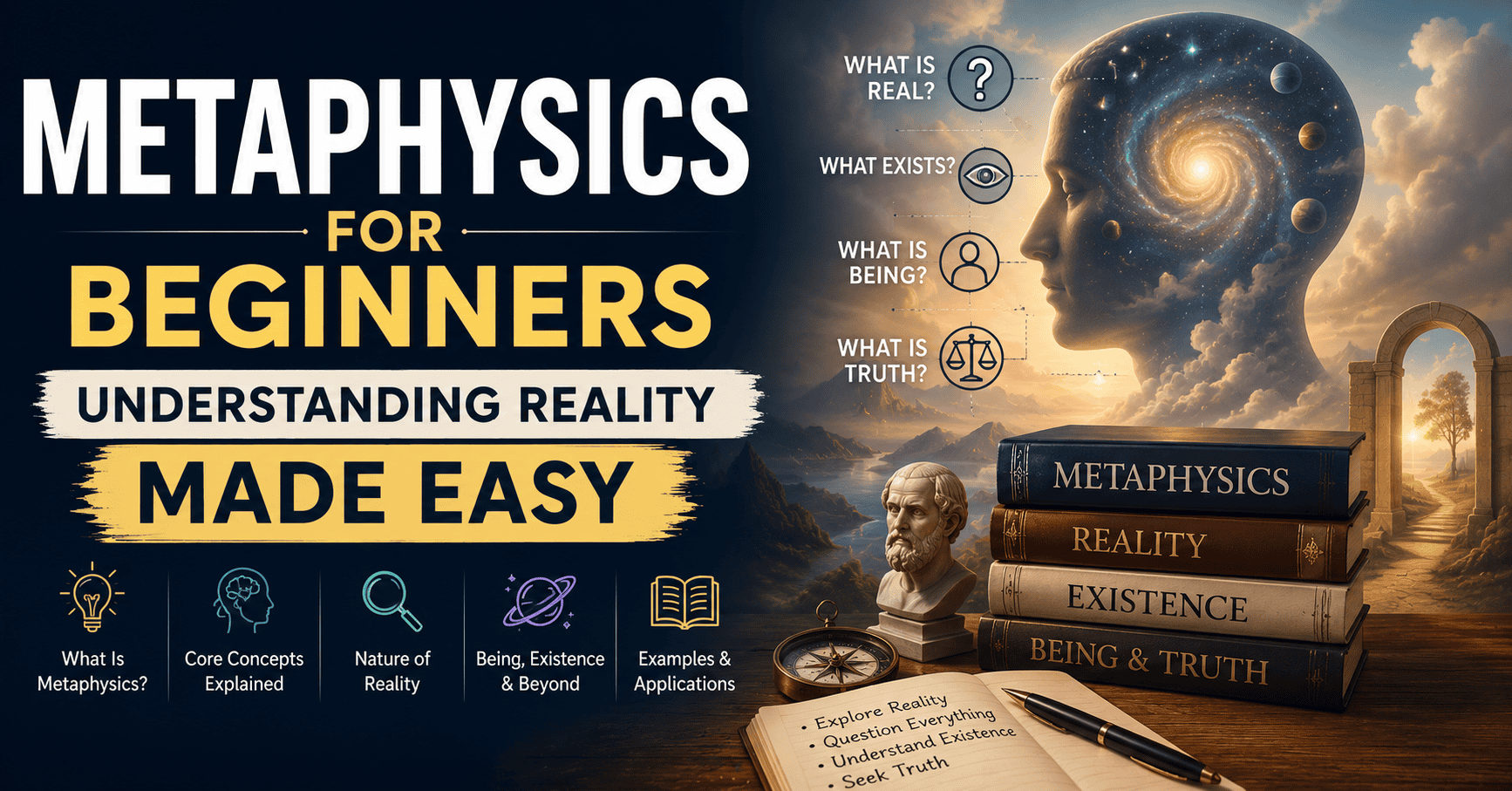
Explore the Fundamental Nature of Reality and Existence — Metaphysics is the branch of philosophy that investigates the most basic questions about reality, existence, and the nature of being. It examines what it means for something to exist and how different entities, events, and aspects of reality are related to one another. The field considers foundational concepts such as time, space, causation, identity, change, objects, and the distinction between different kinds of beings.
For example, when considering a tree, metaphysical inquiry goes beyond simply describing its physical properties. It may ask what makes the tree the particular thing it is, why it exists, what constitutes its identity, and how it differs fundamentally from objects such as rocks or living creatures. At its core, metaphysics seeks to understand what reality is ultimately made of, why things exist, and what principles determine the nature of existence itself.
Content Overview
- Introduction to Metaphysics
- What Is Metaphysics?
- The Role of First Principles
- Metaphysical Questions and Problems
- Metaphysics vs. Other Branches of Philosophy
- Metaphysics and Science
- Historical Context and Major Thinkers in Metaphysics
- Methods of Metaphysical Inquiry
- Contemporary and Critical Perspectives
- Critiques and Alternatives to Metaphysics
- Applied Metaphysics
- Final Summary
Introduction to Metaphysics
What Is Metaphysics?
Metaphysics is a field of philosophy that explores the basic nature of reality, including what exists, the nature of objects, and how they relate to one another.The word comes from the Greek meta (beyond or after) and physika (physical things or nature). Originally, it described Aristotle’s writings that came after his works on nature. Today, metaphysics refers to the study of what lies beyond the physical world – the deepest questions about reality itself.
Metaphysics asks the most general “big‑picture” questions:
- What kinds of things exist? (Physical objects, minds, numbers, God?)
- What does it mean to be? (The nature of existence or “being”)
- How are those things related? (Causation, dependence, identity)
It goes beyond what we can see or touch and explores the nature of everything, from numbers and minds to God and the universe itself.
Example: A chair exists physically. But does something like “justice” exist in the same way? If so, how? Can you point to “justice” the way you point to a chair? Metaphysics asks whether abstract concepts have real existence or are just useful ideas.
Another example – a tree: At first glance, a tree seems easy – you see it, so it exists. But metaphysics asks deeper: What makes this tree exist? Is it just the wood, leaves, and roots? Or is there something more, like the idea or essence of a tree – “tree‑ness” – that remains even if all trees disappeared? This line of thinking pushes us beyond physical observation into the nature of reality itself.
The Role of First Principles
In metaphysics, philosophers try to understand the most basic truths about reality. These are called first principles – the simplest, most fundamental truths that do not depend on anything else. Just as a house needs a strong foundation, all knowledge is built on these basic truths.
A first principle is something that is always true and cannot be proven by other ideas; it is already clear on its own.
Example – the Law of Non‑Contradiction:
Consider a simple statement: “This apple is red.” It cannot also be “not red” at the exact same time in the same way. This is the Law of Non‑Contradiction: something cannot be both true and false at the same time.
In everyday life, a light cannot be ON and OFF at the same moment. One of those statements must be false. This basic rule helps us think clearly and avoid confusion. First principles act as the foundation for all knowledge and reasoning. Without them, we could not decide what is true or false, and everything would become uncertain.
Practical task – identify a first principle in your own thinking.
Take a strong opinion you hold (e.g., “lying is wrong”). Ask yourself: what basic truth does this opinion rest on? Can you find a statement that seems self‑evident (e.g., “people should not be deceived”)? Write it down. Then check whether that statement could ever be false. If it cannot, you have found a candidate first principle.
Metaphysical Questions and Problems
Metaphysics explores deep, abstract questions about existence, reality, and the universe. Some of the key questions include:
- What is being? What kinds of things exist (material, immaterial, abstract, mental)?
- Is there a difference between how things appear and what they truly are?
- Are our choices truly free, or are all events determined in advance?
- What are time and space really like?
- What is the self? Is there a soul?
Example – do numbers exist?
You cannot touch or see the number “3,” yet it seems real in some sense. Metaphysics asks: are numbers real things (abstract entities), or are they just useful human inventions? A mathematician might treat numbers as real objects; a nominalist might say they are merely names for collections.
Example – the mind‑body problem: Is the mind separate from the body? Are thoughts and consciousness just the result of brain activity (physicalism), or is there something non‑physical like a soul (dualism)? This question has implications for artificial intelligence, medicine, and even law.
Example – identity over time (Ship of Theseus):
Imagine a ship. Over time, every single plank is replaced. Is it still the same ship? If not, at what stage did it become a different ship?This thought experiment explores what grounds identity over time – is it the material, the form, the continuity, or something else?
Why metaphysics matters today:
Though it sounds abstract, metaphysics impacts real life: it underlies science (What counts as real?), supports ethics (What is a person?), shapes religion (Is there a God?), and even touches technology (Can a machine have a mind?). When we ask whether AI can have consciousness, we are doing metaphysics.
Metaphysics vs. Other Branches of Philosophy
| Branch | Focus | Example Question | Metaphysical Overlap |
|---|---|---|---|
| Metaphysics | What exists? Nature of reality | Do numbers exist? | – |
| Epistemology | How do we know? What is knowledge? | How do we know numbers exist? | What kinds of things can be known? |
| Ethics | What is right and wrong? How should we act? | Is “goodness” a real property? | Ontology of values; free will and moral responsibility |
| Logic | Rules of correct reasoning | Is this argument valid? | Formal tools for metaphysical arguments |
| Philosophy of Science | The organization and framework underlying scientific theories. | Do particles that cannot be directly observed actually exist? | Reality of unobservables; laws of nature |
Example – “Stealing is wrong”:
- A metaphysician asks: Does moral truth exist independently of human thought?
- An epistemologist asks: How do we know stealing is wrong? Learned or innate?
- An ethicist asks: Why is stealing wrong? What principles make it unethical?
- A logician asks: Is the argument ‘Stealing is wrong, therefore we shouldn’t steal’ valid and sound?
Each branch deals with different aspects, but they often overlap and support one another.
Metaphysics and Science
Boundaries and Overlaps
Overlap: Both ask what exists and why (e.g., electrons, black holes).
Boundary: Science relies on empirical methods (observation, experiment); metaphysics also uses a priori reasoning (pure logic, thought experiments).
Example – quantum indeterminacy:
Scientific fact: radioactive decay is probabilistic (you cannot predict exactly when a single atom will decay).
Metaphysical question: Does this indeterminacy reflect a fundamental randomness in reality, or merely our ignorance of hidden variables? The science gives the data; metaphysics interprets what that data means about the nature of the universe.
Scientific Realism vs. Anti‑Realism
| Position | View |
|---|---|
| Scientific Realism | Our best scientific theories genuinely describe mind‑independent reality, including unobservable entities (electrons, quarks). |
| Scientific Anti‑Realism (e.g., Instrumentalism, Constructive Empiricism) | Theories are tools for prediction; we need not commit to the literal existence of unobservables. |
Example – electrons:
A realist says electrons really exist as physical particles with charge and mass. An anti‑realist treats “electron” as a convenient construct for explaining and predicting chemical reactions, without asserting its literal existence.
Key issues:
- Underdetermination: Different theories can equally predict the same phenomena – so which is “true”?
- Pessimistic Meta‑Induction: Many once‑successful theories (phlogiston, caloric fluid) were later abandoned – why trust current ones?
Laws of Nature: Humean vs. Non‑Humean
| View | Description |
|---|---|
| Humean (Regularity) Accounts | Laws are descriptive summaries of the actual mosaic of events – the “best system” that balances simplicity and fit. They have no governing power beyond our descriptions. |
| Non‑Humean (Governance) Accounts | Laws are fundamental, prescriptive relations that govern how things must behave, not merely summarize them. |
Example – Newton’s Law of Gravitation:
- Humean view: It is the simplest description that best fits data, but it does not “force” objects to attract.
- Non‑Humean view: It reflects a fundamental gravitational force that genuinely governs bodies.
Quantum Metaphysics – Interpretations and Implications
How does quantum theory shape our understanding of reality?
| Interpretation | Core Idea | Metaphysical Implication |
|---|---|---|
| Copenhagen | Wavefunction collapse is real but linked to observation | What is the role of the observer in reality? |
| Many‑Worlds | Every quantum event branches the universe into non‑interacting worlds | An immense multiverse of actualised possibilities |
| Pilot‑Wave (de Broglie–Bohm) | Particles have definite positions guided by a real “pilot wave” | Nonlocal hidden variables |
| Objective Collapse (GRW) | Wavefunction collapse is a genuine physical process, independent of observers | No special role for measurement |
Example – Schrödinger’s Cat:
A thought experiment where a cat in a sealed box is simultaneously alive and dead until observed. Metaphysical question: Does superposition reflect a literal dual state, or is “collapse” a real physical change upon observation?
Practical task – compare two interpretations of quantum mechanics.
Write a short paragraph explaining one difference between the Copenhagen interpretation and the Many‑Worlds interpretation. Then state which one seems more plausible to you and why. This is applied metaphysics.
Historical Context and Major Thinkers in Metaphysics
Ancient Roots – Presocratics, Plato, Aristotle
Presocratics sought the first principle (arche) of all things.
- Thales: “Everything from water.”
- Heraclitus: “Everything flows” – change is constant.You can’t enter the same river twice in exactly the same way.
- Parmenides: Change is an illusion; only “Being” is real and unchanging.
Plato – Theory of Forms:
Plato believed in a higher reality beyond the physical world – the world of Forms (perfect, unchanging ideas). Physical objects are mere shadows or copies of these Forms. A beautiful flower is beautiful because it “participates in” the perfect Form of Beauty.
Example – the Allegory of the Cave:
Prisoners are chained inside a cave, facing a wall. Behind them, a fire casts shadows. They believe the shadows are real. One prisoner escapes, sees the actual puppets, then leaves the cave and sees the real world – trees, sun, sky. He realises the shadows were mere copies. When he returns to tell the others, they do not believe him. This illustrates the difference between appearance and reality.
Aristotle – Hylomorphism and Four Causes:
Aristotle rejected Plato’s two‑world theory. He believed the form exists within the object itself. He proposed the concept of the Four Causes to account for why things exist and behave as they do:
| Cause | Question | Example (Statue) |
|---|---|---|
| Material | What is it made of? | Marble |
| Formal | What shape or form does it have? | The design of the statue |
| Efficient | What brought it into being? | The sculptor |
| Final | What is its purpose? | Decoration or honour |
Example – an acorn:
The material cause is the physical acorn. The formal cause is its potential to become an oak tree. The efficient cause is the process of growth (sun, soil, water). The final cause is the fully grown oak tree. Aristotle also introduced the concepts of potentiality (what something can become) and actuality (what it is now).
Medieval Developments – Scholasticism
During the medieval period, metaphysics developed through Scholasticism, where Christian, Islamic, and Jewish philosophers blended Greek philosophy with religious theology.
Christian thinkers:
- St. Augustine connected Platonic ideas to Christian theology.
- Thomas Aquinas combined Aristotle’s philosophy with Christian belief. He argued that God is the “necessary being” – the cause of all contingent things. Everything in the universe depends on something else for its existence except God, who exists necessarily and independently.
Islamic thinkers:
- Avicenna (Ibn Sina) and Averroes (Ibn Rushd) expanded on Aristotle’s metaphysics, adding theories about the soul, divine existence, and intellect.
Major debate – universals:
Do general ideas like “beauty,” “goodness,” or “humanity” actually exist in reality, or are they just names we give to things?
- Realism (e.g., Aquinas): Universals exist independently as real entities.
- Nominalism (e.g., William of Ockham): Universals are only names or mental concepts; only individual things exist.
Example – Anselm’s Ontological Argument:
Anselm described God as the greatest conceivable being, arguing that existing in reality is more significant than existing only as an idea in the mind. Therefore, if God is truly the greatest being imaginable, God must exist in reality, not just in thought.
Early Modern Debates – Rationalism and Empiricism
During the Enlightenment, metaphysics focused less on religion and more on the source of knowledge.
| School | View | Key Thinkers |
|---|---|---|
| Rationalism | Knowledge comes mainly from reason and logic | Descartes, Spinoza, Leibniz |
| Empiricism | Knowledge comes from sensory experience | Locke, Berkeley, Hume |
René Descartes – foundational doubt:
Descartes famously asked: “What can I know for certain?” He doubted everything that could possibly be doubted, until he reached a point he could not doubt: “I think, therefore I exist” (Cogito, ergo sum). Even if an evil demon is deceiving him, the fact that he is thinking proves he exists. From this, he explored the relationship between mind and body – mind‑body dualism.
John Locke – The Concept of the Mind as an Empty Slate
Locke argued that the mind starts as a tabula rasa (blank slate) and learns everything from experience. He also questioned “substance”: we never directly experience “substance” itself, only qualities like colour, shape, and texture. He called substance an “unknown support.”
David Hume – critique of causation:
Hume argued that we never observe necessary connection between cause and effect; we only observe constant conjunction (event A always followed by event B). Our idea of causation is a psychological habit, not a logical necessity.
Immanuel Kant – Transcendental Idealism
Kant tried to solve the debate between rationalists and empiricists. He argued that both are partly right but miss something important.
Key ideas:
- Phenomena vs. Noumena: We do not experience reality as it is in itself (the noumena). We only experience phenomena – the world as it appears through our senses and mental structures.
- The mind actively shapes experience: Our mind organises raw sensory data using built‑in structures like space, time, and causation. Time and space are not “out there”; they are ways our brain arranges experiences.
- A priori knowledge: Concepts like space, time, and cause‑and‑effect are not learned from the world; they are built into the human mind and are necessary for us to experience anything at all.
Example – a tree: You never see the “tree in itself.” You see colours, shapes, and organised sensations because your mind structures the information. The tree as you perceive it is a phenomenon; the tree as it exists independently is the noumenon – and that noumenon is forever unknowable.
Kant’s big idea changed philosophy by showing that reality is partly shaped by the human mind itself.
19th–21st Century – Analytic, Continental, and Metametaphysics
In modern times, metaphysics developed in three main directions.
Analytic Metaphysics (focus on logic, language, and precise reasoning)
- David Lewis – Modal Realism: Introduced the idea of possible worlds. Every possible way the world could have been actually exists in some form. There is not just one reality; there are many “worlds,” each corresponding to a different possibility.
- Bertrand Russell analysed language to understand reality, distinguishing between knowledge by acquaintance and knowledge by description.
- W. V. O. Quine questioned the analytic‑synthetic distinction, arguing that even our basic beliefs about reality can be revised.
Continental Philosophy (focus on human experience, existence, consciousness)
- Martin Heidegger – Being and Time: Asked “What does it mean to be?” He maintained that to explore the nature of existence, one must begin with human experience, which he referred to as Dasein, or “being-there.”
- Jean‑Paul Sartre – Existentialism: Explored freedom, choice, and “nothingness.” In a world without fixed purpose, humans create their own meaning.
Metametaphysics (the philosophy of philosophy itself)
Metametaphysics asks: What is metaphysics? Are its questions meaningful?
- Rudolf Carnap (logical positivist) argued that many traditional metaphysical claims are not scientifically meaningful – they fail the verification principle.
- Others defend metaphysics as an important way to understand reality beyond science.
Practical task – compare one analytic and one continental metaphysician.
Write a short paragraph contrasting David Lewis’s possible worlds with Martin Heidegger’s Dasein. Which approach feels more relevant to your own thinking? Why?
Methods of Metaphysical Inquiry
A Priori Reasoning and Conceptual Analysis
Metaphysicians often use a priori reasoning – deductive reasoning from self‑evident truths or definitions, without new empirical input. They analyse concepts we already use (e.g., “cause,” “self,” “existence”).
Example – based on the definition of identity:
If “x is identical to y” means “all properties of x belong to y,” then it follows that something cannot both exist and not exist simultaneously in the same respect. This is the Law of Non‑Contradiction, derived by conceptual analysis.
Logic, Argumentation, and Formal Tools
Metaphysical arguments often use formal logic to deduce truths about the universe.
- Modal logic formalises statements about possibility (◇P) and necessity (□P).
- Argument structures distinguish validity (conclusion follows from premises) from soundness (premises are true).
Example – cosmological argument:
- Everything that exists has a cause.
- The universe exists.
- Therefore, the universe has a cause.
Logic helps explore such cause‑and‑effect chains, even if the premises themselves are metaphysical.
Thought Experiments and Intuition Pumps
Philosophers use thought experiments – vivid scenarios that test intuitions about metaphysical concepts.
Example – Ship of Theseus:
If each part of a ship is replaced over time, does it remain the same vessel? This encourages reflection on identity, change, and continuity.
Example – Cartesian Demon (brain‑in‑a‑vat):
Imagine an evil genius deceiving you about reality. What can you know for certain? This leads to Descartes’ cogito.
Example – Schrödinger’s Cat:
A cat is described as both alive and dead at the same time until it is observed. This explores the interpretation of quantum superposition.
Intuition pumps are designed to “pump” certain intuitions, but they must be used critically. Not every intuition is reliable.
Introspection and Phenomenological Approaches
Some metaphysical questions require introspection – reflecting on one’s own conscious experience.
Phenomenology (Edmund Husserl):
“Return to the things themselves” by bracketing empirical assumptions and describing lived experience. Examine the structure of time‑awareness: how past, present, and future appear in a single temporal “flow.”
Example – consciousness:
What does it feel like to be aware? Science can measure brain activity, but it cannot directly capture the subjective “what‑it‑is‑like” of experience. Introspection is the only method that can access this.
Experimental Metaphysics
A newer approach that uses empirical methods (surveys, brain imaging, behavioural experiments) to test metaphysical intuitions.
Example – free will priming studies:
Researchers prime subjects to believe free will is an illusion. They then observe increased cheating. This suggests that metaphysical beliefs can affect moral behaviour – linking empirical psychology to questions of moral responsibility.
Contemporary and Critical Perspectives
Metaphysical Grounding and Fundamentality
Grounding analyses how some truths or entities depend on – are “metaphysically backed by” – more basic truths or entities.
Fundamentality asks which entities or facts lie at the base of reality.
Example – the statue and its molecules:
The fact “the statue exists” may be grounded in more basic facts about the arrangement of its molecules. At the bottom might lie fundamental particles and their laws – the fundamental layer of reality.
Social Ontology – Race, Gender, Collective Intentionality
Social ontology studies how social entities (race, gender, money, governments) exist. Are they merely sets of individuals, shared concepts, or something more?
Example – money:
A paper bill has physical properties, but its status as “five dollars” depends on collective acceptance – it exists because communities share the practice of using it as money.
Example – marriage:
Physically, two people plus a piece of paper. Socially, a binding institution with rights and duties – existing only because communities accept it.
Metaphysics of Information and Computation
Examines whether information and computation are fundamental features of reality, or merely describe patterns in physical systems.
Example – the “it‑from‑bit” hypothesis (John Wheeler):
Physical reality arises from binary informational distinctions – at bottom, reality is information processing.
Practical task – examine a social entity metaphysically.
Choose something like “a university” or “a law.” Write down what physical things it depends on, and then what beliefs or practices make it real. Is it just a collection of buildings and people, or is there something more?
Critiques and Alternatives to Metaphysics
Logical Positivism and the Verification Principle
Logical positivists (e.g., Carnap, A. J. Ayer) held that meaningful statements must be either empirically verifiable or analytic (true by definition). Metaphysical claims, they argued, fail both tests and are therefore “meaningless.”
Example – “The Absolute World‑Soul is the ground of all being”:
This statement is neither testable by experience nor true by logic alone. On verificationism, it lacks cognitive meaning.
Postmodern Skepticism and Deconstruction
Postmodern thinkers (Derrida, Foucault) critique the idea of fixed essences or universal structures. They emphasise the fluidity of meaning and the power dynamics in knowledge‑creation.
Example – Derrida’s deconstruction:
Every text undermines its own claims to stable meaning. This scepticism extends to metaphysical systems claiming universal Truth.
Pragmatist Approaches
Pragmatists (e.g., Richard Rorty, C. S. Peirce) suggest that philosophical problems – including metaphysical ones – are best understood as practical “language games” rather than descriptions of reality‑in‑itself.
Example – for Rorty:
Talking about “ultimate substances” is less about discovering reality than about advancing particular intellectual or social agendas.
Defenses of Metaphysics
- Descriptive Metaphysics (P. F. Strawson): Aims to map our most basic conceptual framework without constructing grand theories. It surveys concepts like “object,” “property,” “cause” as they actually operate in language and thought.
- Naturalised Metaphysics (Quine): Integrates metaphysical inquiry with scientific methods, asking: “What does our best science imply about what exists?”
Applied Metaphysics
Metaphysics in Ethics and Morality
Moral realism vs. anti‑realism:
- Realism: Values (good, bad) are mind‑independent facts. “Cruelty is wrong” is an objective fact, like “water boils at 100 °C.”
- Anti‑realism: Values are projections or social constructs – akin to “blue is prettier than red” (a matter of taste).
Moral responsibility and free will:
Does moral praise or blame presuppose genuine freedom?
- Hard determinist: If every action is caused, no one is truly responsible.
- Compatibilist: Even in a causally determined world, agents act “freely” when motives align with their actions. A person raised in harsh conditions who commits theft – a compatibilist maintains that, if the thief understood right from wrong and chose to act, moral responsibility remains intact.
Metaphysics in Art, Language, and Culture
Ontology of artworks:
Are artworks merely physical objects (the painted canvas), or do they involve abstract structures (the musical score, the play script)? A Beethoven symphony exists as the physical score (ink on paper), the abstract pattern of notes, and countless performances – which one is the “real” symphony?
Metaphor and meaning:
“Time is a river” is literally false but metaphorically conveys temporal flow. Metaphysicians ask: what makes that metaphor apt, and does it reflect anything real about time?
Interdisciplinary Methodologies
Metaphysics and cognitive science:
Findings on perception, concept‑formation, and brain processes can inform metaphysical theories of mind and reality. Experiments on how people categorise objects can reveal innate ontological “filters” (animate vs. inanimate).
Metaphysics and artificial intelligence:
AI’s development of “agents” and “goals” raises metaphysical questions about agency, intentionality, and personhood in machines. If a chatbot reliably expresses desires and plans, should we treat it as having a rudimentary “mind,” or is that an anthropomorphic illusion?
Metaphysics and physics – philosophy of quantum gravity:
Theories like loop quantum gravity or string theory propose radically different ontologies (discrete spacetime atoms, extra dimensions). If spacetime is quantised, then continuous models of motion break down – forcing metaphysicians to rethink persistence and change at the Planck scale.
Practical task – apply metaphysics to a contemporary issue.
Take one of these questions:
- Does a sufficiently advanced AI deserve rights?
- Is race a real biological category or a social construct?
- Does quantum randomness mean the universe is fundamentally unpredictable?
Write one page giving your reasoned opinion. Include at least one metaphysical concept (e.g., identity, grounding, realism/anti‑realism, free will). This is applied metaphysics in action.
Final Summary
Metaphysics is the branch of philosophy that studies the fundamental nature of reality – what exists, what it means to be, and how things are related. It asks questions that science alone cannot answer: Do numbers exist? Is the mind separate from the body? Do we have free will? What is time?
Metaphysics has a rich history, from the Presocratics (Thales, Heraclitus, Parmenides) through Plato (Theory of Forms) and Aristotle (Four Causes, potentiality/actuality), to medieval thinkers (Aquinas, Avicenna), early modern rationalists and empiricists (Descartes, Locke, Hume), Kant’s transcendental idealism, and contemporary analytic and continental philosophers (Lewis, Heidegger, Quine).
Metaphysical methods include a priori reasoning, conceptual analysis, thought experiments, introspection, and even experimental metaphysics. Contemporary metaphysics engages with science (quantum mechanics, cosmology), social ontology (race, gender, money), information theory, and artificial intelligence.
While metaphysics has been criticised by logical positivists, postmodernists, and pragmatists, it remains a vital discipline for understanding the deepest layers of reality – and for reflecting on the very nature of philosophy itself.
Final practical task – create your own metaphysical question.
Write down a question about reality that you think science cannot fully answer. Explain why it matters. Then try to answer it using one of the methods described above (logical analysis, thought experiment, conceptual analysis). Share your reasoning with someone else and invite their critique.
Stay curious, question deeply, and never stop exploring the foundations of reality.