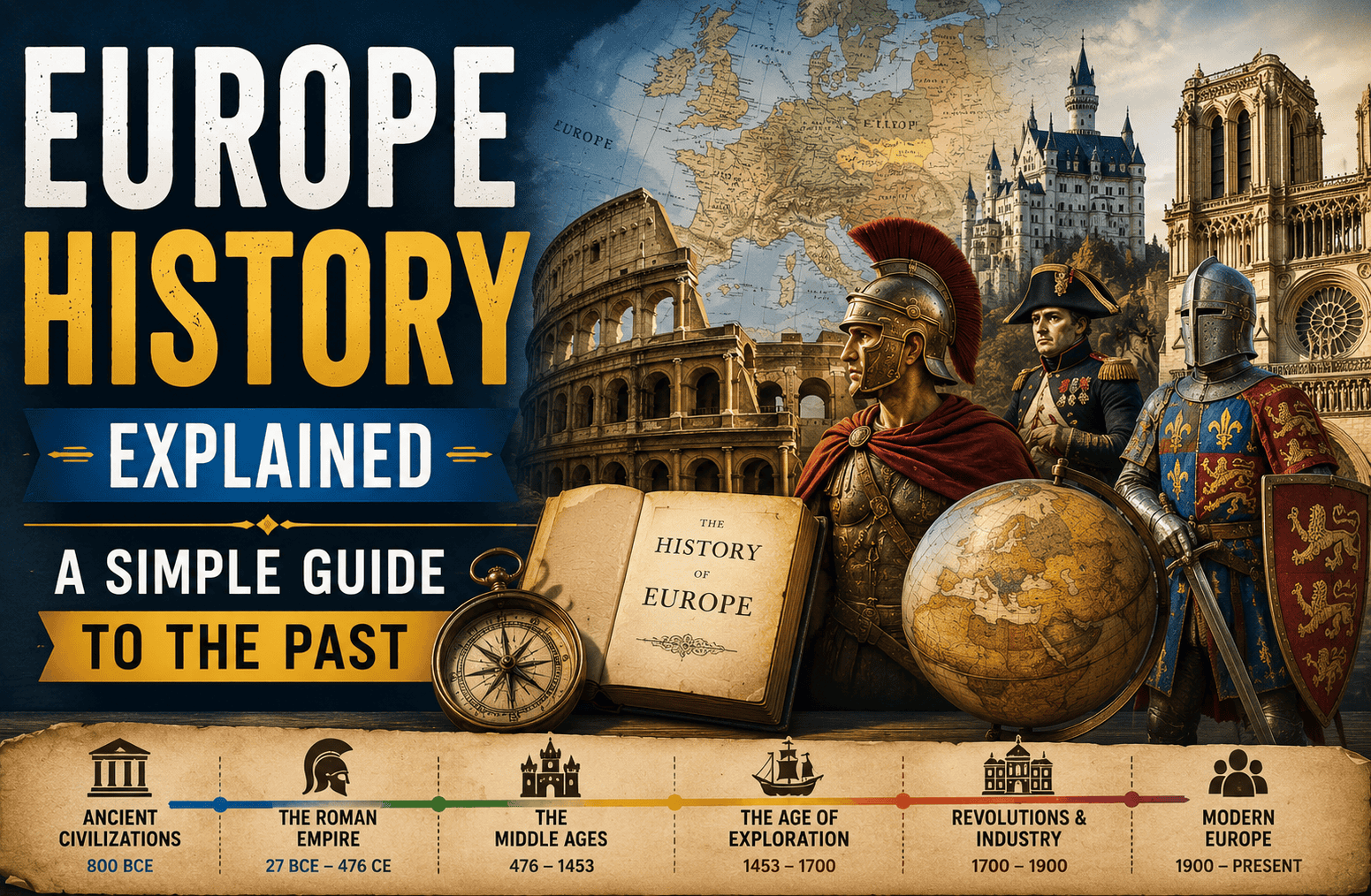
Europe History
European history traces the rise and transformation of civilizations across the continent, from ancient Greece and Rome through the Middle Ages, Renaissance, and Enlightenment, to the age of empire and the modern era. It examines pivotal shifts like the spread of Christianity, the birth of democratic ideals, the Industrial Revolution, and the devastating world wars that reshaped global power. Marked by centuries of innovation, conflict, and cultural achievement, European history reflects a continent whose ideas, conquests, and institutions profoundly influenced the rest of the world. At its core, it explores how competing empires, ideologies, and revolutions forged the political and cultural landscape of the modern West.
Content Overview
- Europe
- 2. Location and Borders
- 3. Countries of Europe
- 4. The Five Regions of Europe
- 1. Northern Europe
- 2. Western Europe
- 3. Central Europe
- 4. Eastern Europe
- 5. Southern Europe
- 5. European Civilization
- 6. Renaissance and Scientific Growth
- 7. Age of Exploration
- 8. Enlightenment and Revolutions
- 9. World Wars
- 10. Cold War and European Division
- 11. European Union
- Simple Summary
Europe
Geography, Regions, History & Civilization
1. Introduction to Europe
Europeis one of the world’s seven continents. It is the second-smallest continent after Australia, but it has played a very important role in global history, science, politics, and culture.
Key facts:
- Area: about 10.18 million km²
- About 6.8% of Earth’s land area
- Population: about 745 million people
- Around 10% of the world’s population
Europe shares the large landmass called Eurasia with Asia.
2. Location and Borders
Europe is located entirely in the Northern Hemisphere and mostly in the Eastern Hemisphere.
It is surrounded by major seas and oceans:
North → Arctic Ocean
West → Atlantic Ocean
South → Mediterranean Sea
Europe is separated from Asia by:
- Ural Mountains
- Ural River
- Caspian Sea
- Caucasus Mountains
- Black Sea
- Turkish Straits
3. Countries of Europe
Europe contains about 50 independent countries.
Largest country:
- Russia
Some well-known countries include:
- Germany
- France
- Italy
- Spain
- United Kingdom
4. The Five Regions of Europe
Europe is commonly divided into five main regions.
1. Northern Europe
Countries include:
- Norway
- Sweden
- Denmark
- Finland
- Iceland
Characteristics
- Cold climate
- Long winters
- Strong welfare systems
- High quality of life
This region is often called the Nordic countries.
2. Western Europe
Countries include:
- France
- Germany
- Belgium
- Netherlands
- United Kingdom
Importance
Western Europe became the center of:
- industrial development
- modern democracy
- scientific progress
The Industrial Revolution began in:
- United Kingdom.
3. Central Europe
Countries include:
- Poland
- Austria
- Hungary
- Czech Republic
- Switzerland
Characteristics
Central Europe is known for:
- historic cities
- strong cultural traditions
- political changes during the Cold War
4. Eastern Europe
Countries include:
- Ukraine
- Belarus
- Romania
- Bulgaria
During the Cold War, many Eastern European countries were influenced by the Soviet Union.
5. Southern Europe
Countries include:
- Italy
- Spain
- Portugal
- Greece
Ancient Civilizations
Two of the most important ancient civilizations began here:
- Ancient Greece
- Roman Empire
These civilizations shaped:
- democracy
- philosophy
- law
- architecture
5. European Civilization
European culture has deep roots in:
- Ancient Greece
- Roman Empire
Later, Christianity became an important cultural influence across Europe.
Following the fall of the Roman Empire in 476 CE, Europe transitioned into the period known as the Middle Ages.
6. Renaissance and Scientific Growth
A major cultural movement called the:
- Italian Renaissance
began in Italy.
This movement promoted:
- art
- science
- humanism
- education
Notable artists and intellectuals emerged during this period.
7. Age of Exploration
During the 15th–17th centuries, European countries began exploring the world.
Important explorers came from:
- Spain
- Portugal
These explorations led to the colonization of many regions, including:
- the Americas
- Africa
- Asia
- Oceania
8. Enlightenment and Revolutions
The Age of Enlightenment promoted ideas such as:
- freedom
- democracy
- scientific thinking
This period influenced major events like the:
- French Revolution
and the rise of modern political systems.
9. World Wars
Two of the largest wars in history began in Europe.
First World War
- World War I
(1914–1918)
Second World War
- World War II
(1939–1945)
These conflicts reshaped the balance of power on a global scale.
After World War II, global influence shifted to:
- United States
- Soviet Union
10. Cold War and European Division
Europe became divided during the Cold War.
Western Europe was allied with:
- NATO
Eastern Europe was allied with:
- Warsaw Pact
This division was symbolized by the:
- Berlin Wall
The wall fell in 1989, marking the end of the Cold War in Europe.
11. European Union
Many European countries now cooperate through the:
- European Union
The EU allows:
- free movement of people
- shared economic policies
- common market
Many EU countries also use the common currency:
- Euro
The EU economy is one of the largest in the world.
Simple Summary
Europe is:
- the second-smallest continent
- home to about 745 million people
- divided into five regions
- Northern Europe
- Western Europe
- Central Europe
- Eastern Europe
- Southern Europe
Europe has played a major role in world history, including:
- ancient Greek and Roman civilizations
- the Renaissance
- global exploration
- the Industrial Revolution
- the World Wars
- modern political integration through the European Union