Emotional Intelligence and Self-Awareness
Master the Skill That Shapes Every Relationship: Emotional Intelligence and Self-Awareness focuses on developing the ability to identify, understand, and regulate our emotions while also recognizing and responding thoughtfully to the feelings of others. Often considered a critical factor in personal and professional success, emotional intelligence can influence how effectively we communicate, make decisions, build relationships, and handle challenging situations. Self-awareness provides the foundation for understanding our thoughts, feelings, and behaviors, while emotional regulation helps us respond to conflict, pressure, and setbacks with greater control and clarity.
Drawing on insights from psychology and neuroscience, this field examines how greater awareness of our internal experiences can influence the way we interact, lead, adapt, and develop as individuals. At its heart, emotional intelligence encourages an important question: How deeply do you understand yourself, and how does that understanding affect the way you relate to the world around you?
Content Overview
- Emotional Intelligence (EQ)
- Pillars of Emotional Intelligence
- Self‑Discovery & Psychological Insight
- Branding Yourself Through Emotional Intelligence
- Self‑Improvement Strategies
- Final Steps for Mastery
- Recommended Resources
- Emotional Intelligence Is a Trainable Life Skill
Emotional Intelligence (EQ)
What is Emotional Intelligence
Emotional Intelligence (often called EI or EQ) is the ability to recognize, understand, manage, and influence emotions – both your own and those of other people. It is not about being “nice” all the time; it is about being intelligent about feelings.
Think of IQ (intelligence quotient) as how well your brain solves math problems, remembers facts, or finds logical patterns. EQ (Emotional Quotient) is how well you handle a heated argument, comfort a crying friend, or stay calm when things go wrong. You can be a genius with a 160 IQ but still shout at your co‑workers and feel miserable. You can also have average intelligence but excellent EQ and become a beloved leader.
Example – two job candidates
One has a perfect GPA and can solve any technical problem. The other has good but not outstanding grades. However, when asked about a tough situation, the second person says, “I felt frustrated when my teammate missed the deadline, so I took a deep breath, asked him what was wrong, and we solved it together.” That second person is demonstrating high EQ – and often gets the job.
Why Emotional Intelligence Matters
Emotional Intelligence affects almost every area of your life:
- Decision‑making: Emotions provide crucial information. Fear can warn you, excitement can motivate you. High EQ helps you use those signals without being controlled by them.
- Leadership: Great leaders don’t just give orders; they inspire, listen, and manage the emotional climate of a team. Studies show that EQ is a stronger predictor of leadership success than IQ.
- Relationships: Friendships, romantic partnerships, and family bonds all depend on empathy, self‑regulation, and clear communication.
- Mental health: Low EQ is linked to anxiety, depression, and anger issues. High EQ helps you recognize unhelpful thought patterns and choose healthier responses.
- Career success: Technical skills get you hired; emotional skills get you promoted.
Example – a hospital nurse with high EQ
She notices that a patient is unusually quiet. Instead of just taking vital signs, she gently asks, “You seem worried – is there something on your mind?”The patient subsequently reports experiencing anxiety regarding the scheduled surgical procedure.The nurse explains the procedure calmly, and the patient’s blood pressure drops. That’s EQ in action.
EQ vs IQ
| Feature | IQ (Intelligence Quotient) | EQ (Emotional Quotient) |
|---|---|---|
| What it measures | Logical reasoning, math, spatial skills, memory | Emotion recognition, empathy, self‑control, social skills |
| Can you improve it? | Mostly fixed after childhood | Highly trainable at any age |
| Predicts… | Academic success, technical job performance | Life success, leadership, relationship satisfaction |
| Example high score | Solves complex calculus quickly | Calms down an angry customer without escalating |
Scientific perspective: Research by Daniel Goleman and others shows that IQ accounts for only about 20% of success in life (depending on the field). EQ accounts for the rest. Think of IQ as the engine that gives you speed; EQ is the steering wheel and brakes.
Conclusion: IQ opens doors (college, first job). EQ keeps those doors open (promotions, lasting friendships, happiness).
How Emotions Work in the Brain
Your brain has two main parts when it comes to emotions:
- Limbic system (the emotional brain): This includes the amygdala, which acts like a fire alarm.It responds immediately when a threat is perceived, whether the danger is genuine or only anticipated.When the amygdala fires, you may feel anger, fear, or excitement before you even know why.
- Prefrontal cortex (the thinking brain): This sits right behind your forehead. It helps you plan, reason, and control impulses. It can calm down the amygdala by saying, “Wait, that’s not really a danger.”
Emotional intelligence is the skill of making these two parts work together. Instead of letting your amygdala hijack your behavior, you pause, let your prefrontal cortex catch up, and then choose a wise response.
Example –An example could be a critical email sent by your boss.
Your first emotional reaction (amygdala) is anger and defensiveness. High EQ means you notice that feeling, take a deep breath, wait an hour, then reply calmly and constructively.
EQ in Personal Life, Work, and Society
Personal Relationships: EQ helps you avoid blame games. Instead of accusing someone by saying, “You don’t listen to me!” you say, “I feel hurt when I’m interrupted. Could we take turns speaking?”This small adjustment can reduce defensiveness and create a greater sense of emotional security.
Professional Life: A leader with high EQ reads the room. If the team is stressed, they acknowledge it (“I know this deadline is tough – let’s talk about what we need”) instead of pushing harder. This builds loyalty and productivity.
Society and Culture: On a larger scale, emotional intelligence helps resolve conflicts without violence.It enables people from diverse backgrounds to find shared understanding.
Example – a heated family argument about politics
Someone with strong emotional intelligence might respond, “I understand that this matter means a great deal to you.” Can you help me understand why you feel so strongly?” This de‑escalates tension and opens dialogue.
Pillars of Emotional Intelligence
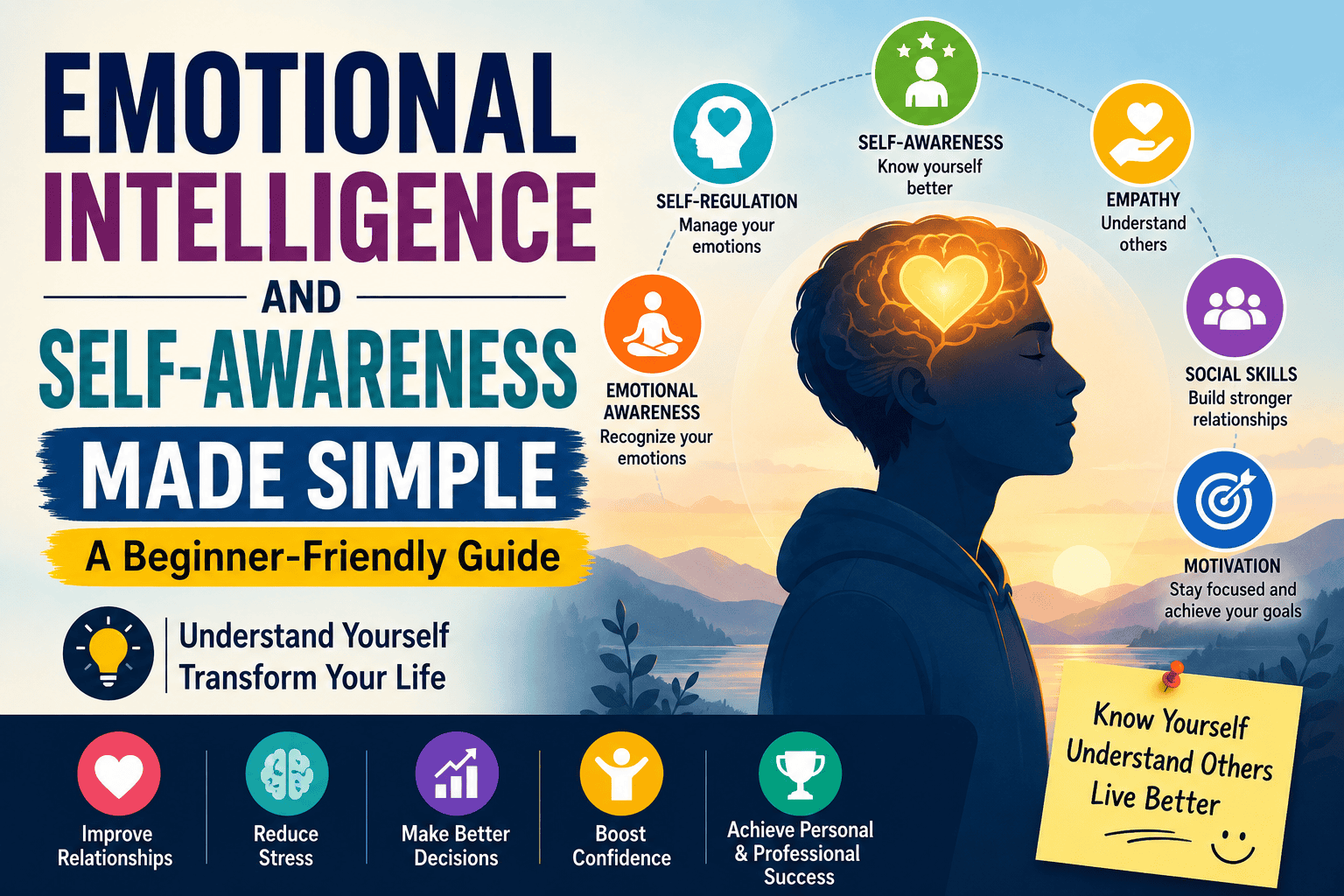
Psychologist Daniel Goleman popularized the concept of Emotional Intelligence with five main components.Mastering each of these creates a strong foundation.
Pillar 1: Self‑Awareness – Knowing Your Own Emotions
Self‑awareness is the ability to recognize your own emotions as they happen, and to understand your strengths, weaknesses, values, and impact on others. It is the foundation of all other EQ skills.
Why it matters: If you don’t know you are angry, you cannot control your anger. If you don’t realize that criticism triggers defensiveness, you will keep overreacting.
Examples:
- You notice that every time your partner asks about your day, you feel irritated. Upon reflection, you realize it’s because you’re tired after work. Solution: Ask for 20 minutes of quiet time before talking.
- You receive a poor performance review. Instead of blaming the boss, you recognize your own feeling of shame, and then you turn it into motivation: “I’ll ask for specific feedback and make a plan to improve.”
How to build self‑awareness: Keep an emotion journal. Several times a day, write down: what you felt, what triggered it, and how you reacted. Over time, patterns appear.
Practical task – emotion journal template
Date: _________
Time: _________
Emotion felt: _________
Trigger (what happened right before): _________
Physical sensation (tension, warmth, etc.): _________
Reaction (what I did): _________
Alternative response (what I could have done): _________
Do this for 14 days. Then review: you will see your most common triggers and reactions.
Self‑Awareness vs Self‑Consciousness
| Self‑Awareness | Self‑Consciousness |
|---|---|
| Focused on your inner world (feelings, values, patterns) | Focused on how others perceive you |
| Growth‑oriented; you want to understand yourself better | Fear‑oriented; you worry about being judged |
| Leads to confidence | Leads to anxiety |
| For example, someone might say they feel jealous when a friend succeeds, acknowledge it as normal, and decide to work on it. | Example: “Everyone is looking at me. They must think I’m stupid.” |
Key insight: Self‑awareness is looking inward with curiosity. Self‑consciousness is looking outward with fear. High EQ people have high self‑awareness but low unproductive self‑consciousness.
How to develop healthy self‑awareness
- Practice self‑observation without judgment. Rather than saying, “I’m so stupid for being angry,” you can say, “I notice that I’m feeling angry.” That’s a signal.”
- Ask for feedback from trusted people. They can see blind spots you miss.
- Separate facts from interpretations. Keep facts and interpretations separate; for example, “My boss sent a short email” is a fact, while “She’s mad at me” is an interpretation.
- Use the Observer technique: Imagine you are a compassionate scientist watching your own thoughts. This creates distance and reduces shame.
Developing Self‑Awareness – Practical Methods
Seeking Feedback
Seeking feedback means asking others how they perceive you. This is difficult but essential.
A more effective way to ask: Instead of asking, “Do you think I listen well?” (which invites a polite yes), ask “What is one thing I could do to be a better listener?” This invites constructive criticism.
Example – after a presentation: You ask a colleague: “What is one thing I could improve?” They say, “You talked very fast when you were nervous.” Now you have a concrete area to work on.
Practical task – schedule a feedback conversation: Choose one person you trust. Say: “I’m working on improving myself. Would you be willing to give me honest feedback on one behaviour? Please be specific.” Then listen without defending. Just say “thank you.”
Emotional Literacy – Naming Your Feelings
Emotional literacy is the ability to label emotions accurately. Many people only know “good”, “bad”, “angry”, “sad”. There are dozens of emotions: frustrated, disappointed, envious, anxious, overwhelmed, hopeful, energized, etc.
Why it helps: Identifying an emotion can lessen its intensity. It also helps you choose the correct solution. Saying, “I’m frustrated because the computer is running slowly,” may call for a different response than saying, “I’m angry because my colleague cut me off.”
Exercise: Use an “emotion wheel” (available online). Each day, pick three emotions you felt and write them down.
Practical task – expand your emotional vocabulary: For one week, every time you feel an emotion, consult an emotion wheel.Rather than saying “I’m bad,” you can say Phrases such as “I’m disappointed,” “I’m discouraged,” or “I’m lonely” reflect different emotional experiences, and each one may call for a different way of responding or coping.
Aligning with Your Values
Values are what matter most to you (e.g., honesty, family, achievement, security). When your actions align with your values, you feel authentic. When they don’t, you feel uneasy or guilty.
How to identify your values: Think of a time you felt truly proud. What value were you honoring? Also think of a time you felt ashamed. What value did you violate?
Example – you value “kindness”: You notice that you snapped at a waiter. That feeling of guilt is your value signaling misalignment. Next time, you consciously speak politely even when stressed.
Practical task – write your top five values: Take 10 minutes and write down five values that are non‑negotiable for you. Then, for each value, write one behaviour that demonstrates it and one behaviour that violates it. Use this as a daily reflection:Did I act according to my values today?
Personal SWOT Analysis for EQ
SWOT stands for Strengths, Weaknesses, Opportunities, Threats. Applied to emotional intelligence:
- Strengths: What emotions do you handle well? (e.g., “I stay calm in emergencies.”)
- Weaknesses: What triggers you easily? For example, someone might say, “I tend to become defensive when my work is questioned.”
- Opportunities: What situations could help you grow? For example, “Taking the initiative to lead a challenging project.”
- Threats: What environments make you lose control? For example, common triggers may include lack of sleep, excessive noise, or time pressure.
Example – a person realises her strength is empathy, her weakness is fear of public speaking. She joins a speaking club (opportunity) and ensures she sleeps well before presentations (mitigating threat).
Practical task – complete your EQ SWOT: Draw a 2×2 grid. Label the four quadrants. Fill each with specific items. Then for each weakness, write one action to improve it. For each threat, write one way to reduce its impact.
Pillar 2: Self‑Regulation – Controlling Your Reactions
Self‑regulation is the ability to manage sudden emotions and control your behavior, instead of being a slave to impulses.
Why it matters: Everyone gets angry, scared, or frustrated.What matters is how you respond afterward.High self‑regulation means you pause, think, and choose a response that aligns with your values.
Techniques:
- 10‑second pause: Before reacting, take a slow breath. This engages your prefrontal cortex and gives your amygdala time to calm down.
- Emotional delay: If you feel like sending an angry email, write it in a draft folder and wait 24 hours. Most of the time, you will edit or delete it.
- Cognitive reframing involves changing the narrative you tell yourself. Instead of “He did that on purpose to hurt me,” try “Maybe he had a bad day and didn’t think about how it would affect me.”
Example – child spills juice on your laptop: Your first impulse is to scream. Instead, you take a breath, say, “I’m frustrated right now, but accidents happen. “Let’s clean it up together” expresses your feelings without placing blame or attacking.
Stress Management Techniques
Stress is an emotional response, not a permanent state. High EQ people manage stress before it manages them.
- Breathing exercises: Inhale for 4 seconds, hold for 4, exhale for 6. This activates the parasympathetic nervous system (calming response).
- Time management: Part of stress is feeling overloaded. Dividing a large task into manageable steps can make it feel less overwhelming.
- Emotional distancing: Ask yourself, “Will this matter in 5 years?” If not, reduce its emotional weight.
Example: Before a difficult conversation, you take three deep breaths. Your heart rate slows, and you speak more calmly.
Impulse Control – The 10‑Second Pause
Impulse control refers to the ability to pause before acting on a sudden emotion.
The 10‑second pause: When you feel the urge to snap, buy something, or quit, stop. Count to ten slowly. During those seconds, ask: “What will I feel in an hour if I act now? What is a better choice?”
Example – an angry email arrives: You see an email that angers you. Your finger hovers over “Reply All”. Instead, you close the email, get a coffee, and return 20 minutes later. You then write a calm, professional response. You just saved your reputation.
Pillar 3: Motivation – Driving Yourself with Emotion
Motivation in the EQ model means using your emotions to pursue goals with energy and persistence. It is not about external rewards (money, praise) but about internal drive.
- Intrinsic motivation: You do something because it is personally rewarding – you enjoy learning, you want to master a skill, you care about the mission.Intrinsic motivation fosters greater satisfaction and long-term persistence.
- Extrinsic motivation: You act for external rewards – money, grades, approval. It works, but it often fades when the reward is removed.
Emotional drivers: Hope, enthusiasm, and even constructive anger (“I’m tired of being ignored”) can fuel perseverance. People with high EQ use their emotions as fuel, not as obstacles.
Example – a student who loves biology: She studies not just to pass the exam (extrinsic) but because she genuinely loves the subject and feels excited when she understands a new concept (intrinsic). When she fails a test, she feels disappointed but bounces back quickly because her internal drive remains strong.
Intrinsic vs Extrinsic Motivation
| Aspect | Intrinsic | Extrinsic |
|---|---|---|
| Source | Within yourself | External rewards or punishments |
| Longevity | Lasts longer | Fades when reward is removed |
| Creativity | Enhances creativity | Often reduces creativity |
| Example | Learning a language for fun | Studying to get a bonus |
EQ connection: People with high EQ cultivate intrinsic motivation by connecting tasks to their values and passions.
Practical task – find your intrinsic drivers: List five tasks you do regularly. For each, write down why you do it. If your motivation comes mainly from an outside incentive, such as earning money, consider asking yourself: “Which aspect of this task would I still find enjoyable if there were no reward?” That part is your intrinsic driver.
Emotional Drivers – What Fuels Your Persistence
Emotional drivers are the feelings that keep you going when things get hard. Hope, excitement, pride, and even constructive anger can be powerful fuels.
Example – an activist: She feels angry about injustice. Instead of becoming destructive, she channels that anger into persistent advocacy and organizing. Her anger becomes a driver.
To identify your emotional drivers: Recall a time you overcame a major obstacle. What emotion gave you strength? Was it hope? Love? Determination? Use that memory to fuel future challenges.
Resilience – Bouncing Back from Setbacks
Resilience is the ability to recover emotionally from failure, loss, or disappointment. It is not avoiding pain; it is processing it and moving forward.
Resilience factors:
- Social support: Having people who listen without judgment.
- Self-compassion means treating yourself with the same kindness you would offer a friend.
- Meaning-making involves discovering a lesson or sense of purpose within a struggle.
For example, when a salesperson loses a major deal, she acknowledges the disappointment by saying, “That hurts,” instead of falling into self-pity. I’ll allow myself to feel disappointed for an hour. Then I’ll analyze what I can learn and call my next prospect.” She bounces back quickly.
Practical task – build a resilience plan: Think of a recent setback. Write down: (1) What did I feel? (2) Who supported me? (3) What did I learn? (4) What could I do differently next time? Keep this in a journal. Over time, you will see that setbacks become lessons.
Sigma, Alpha, Beta Motivation Styles
These terms come from social dynamics, but they describe internal motivation styles:
- Alpha: Driven by dominance, status, and competition. An alpha personality wants to lead and be recognized.
- Beta: Cooperative, values harmony and belonging. Beta personalities are excellent team players.
- Sigma: Independent, self‑directed, not interested in traditional hierarchies. Sigmas march to their own drum.
EQ insight: No style is better or worse. The key is to understand your natural style and adapt when needed. An alpha might need to learn to listen more; a beta might need to assert themselves; a sigma might need to practice explaining their vision to others.
Example – a sigma employee: He works best alone but is forced to collaborate. He uses his self‑awareness to schedule solo deep‑work time before team meetings, so he is not drained.
Pillar 4: Empathy – Understanding Others’ Feelings
Empathy is the capacity to understand and share another person’s feelings.It is not the same as sympathy (feeling sorry for someone). Sympathy says, “I feel bad for you.” Empathy says, “I feel with you.”
Two types of empathy:
- Cognitive empathy: Understanding what someone feels and why, from an intellectual perspective. Example: “I see that you are angry because you were left out of the meeting.”
- Emotional empathy: Experiencing a similar emotional response to what another person is feeling. Example: When your friend cries, you also feel sadness.
Why both matter: Cognitive empathy helps you navigate relationships without being overwhelmed. Emotional empathy builds deep bonds. However, too much emotional empathy can lead to burnout (common in caregivers). Balance is key.
Example – a doctor giving bad news: He uses cognitive empathy to choose the right words, and emotional empathy to speak with genuine compassion, but he does not break down crying because he needs to remain functional.
Cognitive vs Emotional Empathy
| Aspect | Cognitive Empathy | Emotional Empathy |
|---|---|---|
| What it does | Understands perspective | Shares the feeling |
| What the experience feels like. | “I understand what may be causing you to feel upset.” | “I’m feeling upset about this as well.” |
| Risk | Can seem cold if used alone | Can lead to burnout |
| Best for | Negotiations, conflict resolution | Caregiving, close relationships |
Practical task – practice cognitive empathy: Next time someone disagrees with you, state their position back to them in your own words until they say “yes, that’s exactly what“This is what I mean,” which helps build cognitive empathy without taking on their emotions.
Active Listening – The Heart of Empathy
Active listening means fully concentrating on what the other person is saying, not just waiting for your turn to talk.
Techniques:
- Eye contact (but not staring aggressively).
- No interrupting. Let them finish their thought.
- Reflective responses: “It sounds like you felt…”
- Ask open‑ended questions: “What was that like for you?”
Example – your partner says, “I’m so tired of doing all the housework.”
- Low‑EQ reply: “You think I do nothing?”
- High‑EQ, active listening reply: “It sounds like you feel overwhelmed and unappreciated. Can we talk about how to divide tasks more fairly?”
The second response validates feelings and opens problem‑solving.
Reading Non‑Verbal Communication
Non‑verbal cues include facial expressions, posture, tone of voice, gestures, and eye contact. More than half of emotional communication is conveyed through nonverbal cues.
Common cues:
- Crossed arms might indicate defensiveness or cold temperature; ask, don’t assume.
- Avoiding eye contact could mean shame, distraction, or cultural norm.
- A forced smile (no eye wrinkles) often signals politeness, not genuine happiness.
How to improve: Watch TV with the sound off. Try to guess the emotions from faces and body language. Then check your accuracy.
Example – in a meeting: A colleague says “I agree with the plan” but has a tight jaw and avoids eye contact. You might privately ask later, “I sensed some hesitation – is there something you’d like to add?” This builds trust.
Pillar 5: Social Skills – Building Healthy Relationships
Social skills are the abilities you use to interact well with others: communication, conflict resolution, influence, and cooperation.
Why it matters: Even if you understand yourself and others, you still need to act effectively. Social skills turn emotional understanding into positive outcomes.
Key social skills:
- Active listening – paying full attention, not interrupting, reflecting back what you heard.
- Clear expression – saying what you need without blame or passive aggression.
- Conflict resolution – finding win‑win solutions, staying calm during disagreement.
- Influence – inspiring others without manipulation.
Example – a manager handling an argument: She notices two team members arguing. Instead of taking sides, she facilitates a conversation: “Let each person speak for two minutes without interruption. Then we’ll find common ground.” She uses her social skills to turn conflict into collaboration.
Building Trust Through Consistency
Trust is the expectation that someone will act predictably and with good intentions.
How EQ builds trust:
- Consistency: You say what you mean and do what you say.As time passes, people become familiar with what they can expect.
- Emotional honesty: You express feelings authentically (without blame). “I feel disappointed” vs. “You ruined everything.”
- Reliability: You follow through on promises.
Example – a leader who consistently thanks her team: Even for small efforts, she expresses gratitude. When a crisis hits, the team trusts that she will support them, not blame them.
Conflict Resolution with Empathy
Conflict resolution is the process of resolving a disagreement in a way that respects everyone’s needs.
EQ‑based steps:
- Calm yourself (use the 10‑second pause).
- Listen actively to the other person’s perspective.
- Validate their feelings (“I can see why you would be upset”).
- Express your own needs using “I” statements (“I need more clarity on deadlines”).
- Brainstorm solutions together.
Example – two teammates argue over credit for a project: A manager mediates: “Sarah, you feel your contribution was overlooked. Tom, you feel you did the heavy lifting. Let’s list each person’s specific tasks and agree on a joint acknowledgment.” The conflict ends with a fair solution.
Emotional Intelligence in Negotiations
Negotiation is not just about dividing a pie; it’s about understanding interests and emotions.
EQ tactics:
- Identify emotional hot buttons: Before negotiating, know what topics might trigger you or the other side.
- Use empathy to uncover hidden needs. Ask, “What’s the biggest concern from your side?”
- Stay calm when they make unreasonable demands. Pause, breathe, then respond factually.
- Create emotional safety: “I want to find a solution that works for both of us.”
Example – a seller offers a price you can’t afford: Instead of getting frustrated, you say, “I respect that price reflects quality. My budget is X. Could we look at a smaller package or extended payment terms?” You acknowledge their position before proposing alternatives.
Self‑Discovery & Psychological Insight
Personality Tests
Why personality tests help: They provide a vocabulary to describe your natural tendencies. They are not destiny, but they increase self‑awareness.
- MBTI (Myers‑Briggs Type Indicator): Measures four dimensions (extraversion vs. introversion, sensing vs. intuition, thinking vs. feeling, judging vs. perceiving). Example: An introvert (who recharges alone) can plan social events in shorter doses.
- Enneagram: Describes nine core motivations and fears (e.g., Type 1 – perfectionist; Type 2 – helper; Type 8 – challenger). It digs deeper into why you act the way you do.
- DISC: Focuses on behavioral style (Dominance, Influence, Steadiness, Conscientiousness). Useful for workplace communication.
Example – an introvert discovers her personality type: She learns that she is not “shy” or “broken” – she simply needs quiet time to recharge. She stops forcing herself to attend every party and feels less guilty.
As a practical task, take a free online personality test, such as 16Personalities for MBTI or a DISC assessment. Write down three insights about yourself that you did not realise before. Then ask a trusted friend if those insights match their experience of you.
Journaling & Self‑Reflection
Journaling is the practice of writing down your thoughts and feelings regularly. It forces you to slow down and examine your inner world.
How to journal for emotional growth:
- Emotional tracking: At the end of each day, list the strongest emotion you felt and what triggered it.
- Thought analysis: Write down a negative thought (“I’m going to mess up this presentation”) and then challenge it with evidence.
- Pattern recognition: After a month, review your journal. You may notice that you always feel anxious before team meetings. That understanding is the first step toward change.
Example – a person writes “Felt angry when my friend cancelled our plans.” Over several entries, she realises the anger is not really about the cancellation – it is about feeling unimportant. This insight helps her address the real issue with her friend.
Practical task – start a daily reflection journal using this template:
Date: _________
Three emotions I felt today: 1. _______ 2. _______ 3. _______
The strongest emotion: _______
Trigger (what happened right before): _______
How I reacted: _______
What I would do differently next time: _______
One thing I’m proud of today: _______
Do this for 30 days. You will see patterns, and self‑awareness will skyrocket.
Mindfulness & Meditation
Mindfulness involves focusing on the present moment with a nonjudgmental awareness. Meditation is a structured practice to build mindfulness.
How it improves EQ:
- Awareness: You notice emotions as they arise, instead of being swept away.
- Regulation: You learn to observe anger without acting on it.
- Stress reduction: Meditation lowers cortisol (stress hormone).
Simple mindfulness exercise:
Sit comfortably for 2 minutes. Focus on your breath. When a thought or emotion arises, just label it (“thinking”, “worry”, “anger”) and return to your breath. Do this daily.Example – a manager who meditates: He meditates for 10 minutes each morning. Later that day, he notices he feels irritated by a co‑worker’s tone. Instead of snapping, he takes a breath and says, “I’d like to understand your point better.” He uses the calmness he practiced.
Emotional Triggers & Behavioral Patterns
A trigger is a stimulus that causes an intense emotional reaction, often linked to past experiences. Triggers activate the amygdala before your thinking brain can engage.
How to identify your triggers: Journal after strong reactions. Ask: “What exactly happened? What did I feel? When have I felt this way before?”
Example – reaction to an authority figure raising their voice: Whenever an authority figure raises their voice, you feel paralyzed. Upon reflection, you remember that your father shouted at you as a child. Now you can tell yourself, “This is not my dad; this is my boss, who is actually fair. I am safe.”
Behavioral patterns: These are automatic habits of reacting. Once you notice a pattern (e.g., “Every time I feel criticized, I withdraw”), you can choose a new response (“I will ask clarifying questions instead”).
Practical task – track one trigger for one week: Identify one situation that consistently upsets you. Each time it happens, write down: (1) What was the trigger? (2) What did I feel? (3) What did I do? (4) What could I do instead? After a week, review. You will see a clear pattern. Choose one alternative response and practice it.
The Thought–Emotion–Behavior Connection
This is one of the most important concepts in psychology and EQ. It works like this:
Thought → Emotion → Action
Example:
- Thought: “I’m going to fail this interview.”
- Emotion: Anxiety, fear.
- Action: You avoid preparing, or you cancel the interview.
To change the outcome, change the thought. Cognitive restructuring involves recognizing unhelpful thoughts and replacing them with more balanced, realistic ones.
Example of restructuring:
The initial thought might be, “Everyone will laugh at my presentation.”
Challenge it: “Do I have evidence? Has anyone laughed before? Even if someone disagrees, that’s not laughing.”
New thought: “I have prepared well. I can handle questions respectfully.”
Once the thought changes, the emotion changes (anxiety → calm determination), and the action changes (you present confidently).
Practical task – thought record: For one week, carry a small notebook. Whenever you feel a strong negative emotion, write down: (1) The situation, (2) The automatic thought, (3) The emotion, (4) Evidence against the thought, (5) A balanced thought. This is the core of cognitive behavioural therapy (CBT) applied to EQ.
Branding Yourself Through Emotional Intelligence
Emotional Self‑Branding – How Others Experience You
Your emotional brand is the consistent feeling people get when they interact with you. Is it calm? Reliable? Empathetic? Volatile? Critical?
Why it matters: People tend to remember how you made them feel more than the exact words you used. Your emotional brand influences your career, friendships, and family life.
Ask trusted friends: “If you had to describe what it’s like to be around me in one word, what would it be?”” If they say “judgmental” or “dramatic”, that is your current brand. If they say “calm”, “supportive”, or “energizing”, that is also your brand.
Practical task – brand audit: Ask five people who know you well (in different contexts: work, family, friends) the same question: “What is one word you would use to describe being around me?” Write down their answers. Look for patterns. If the pattern is not what you want, you have identified your growth area.
Steps to Build Your Emotional Brand
- Identify your desired brand: How do you want people to feel? (e.g., safe, inspired, heard)
- Audit your current brand: Use feedback and self‑reflection.
- Choose one specific behavior to change: For example, if you want to be seen as “calm”, practice pausing three seconds before speaking in meetings.
- Reinforce consistently: Emotional branding is built over many small interactions.
Example – a manager wants to be seen as “approachable”: She used to answer emails with short, blunt replies. She responds by saying, “Thank you for your question.”Let me check and get back to you by tomorrow.” Within weeks, her team feels safer approaching her.
Self‑Improvement Strategies
Setting SMART Goals for Emotional Growth
SMART goals are defined as specific, measurable, achievable, relevant, and time-bound objectives.
Example of an EQ‑SMART goal: “For the next two weeks, in any meeting where I feel interrupted, I will pause for 5 seconds before responding. I will track each instance in my journal.”
- Specific: pause before responding.
- Measurable: count of instances.
- Achievable: 5 seconds is realistic.
- Relevant: improves impulse control.
- Time‑bound: two weeks.
After two weeks, review your progress and adjust.
Practical task – write three EQ‑SMART goals: For example: (1) “This week, I will ask for feedback from one colleague.” (2) “For 10 days, I will meditate for 5 minutes each morning.” (3) “In my next difficult conversation, I will use two active listening techniques.” Write them down and put them where you will see them daily.
Overcoming Fear & Self‑Doubt
Cognitive restructuring is powerful. Also:
- Gratitude practice: Each morning, write three things you appreciate about yourself. This builds self‑worth not dependent on external approval.
- Exposure therapy: Gradually face what you fear. To manage social anxiety, begin by speaking one sentence in a meeting, then gradually increase to two, and so on.
Example – fear of public speaking: You could start by recording a 1‑minute video for yourself. Then present to a friend. Then to a small group. Each step builds evidence that you can survive and improve.
Practical task – create a fear ladder: Write down a fear (e.g., “speaking in front of a group”). Then list 10 steps, from easiest (e.g., “imagine speaking”) to hardest (e.g., “speak to 20 people”). Do one step per day. After each step, rate your anxiety (1‑10).You will notice it gradually decrease over time.
Daily Emotional Journaling – The Complete Template
==================== DAILY EMOTIONAL JOURNAL ====================
Date: _________

SECTION 1 – EMOTIONAL CHECK‑IN (morning)
On a scale of 1‑10, how am I feeling right now? _____
What is the main emotion? _______
What do I expect from today? _______

**SECTION 2 – DAILY EVENTS & EMOTIONAL RESPONSES**
Time: _______ Event: _______ Emotion: _______ Intensity (1‑10): _______
What did I do? _______ What would I do differently? _______

SECTION 3 – EVENING REFLECTION
Three emotions I felt most today: 1. _______ 2. _______ 3. _______
The strongest trigger: _______
How I handled it (rate 1‑10): _______
One thing I learned about myself: _______
One thing I’m grateful for today: _______

SECTION 4 – TOMORROW’S INTENTION
Tomorrow, I will practice: _______
Do this for 30 days. You will see patterns, and self‑awareness will skyrocket.
Final Steps for Mastery
Real‑World Practice and Role‑Plays
Reading about EQ is not enough. You must practice.
- Role‑plays with a friend: Act out difficult conversations (asking for a raise, apologizing, giving criticism). Get feedback.
- Volunteer for challenging interactions: Lead a meeting, mediate a dispute, or comfort a distressed person (with consent). Real practice is the fastest teacher.
Practical task – one role‑play per week: Schedule 30 minutes every Friday with a trusted friend. Take turns playing a difficult scenario (e.g., a customer complaint, a performance review). After each, give each other specific feedback: “When you said X, I felt Y. Next time, try Z.”
Continuous Self‑Reflection
Set aside 10 minutes each evening to review your emotional performance. Ask:
- Did I notice my emotions before reacting?
- Did I manage any trigger well? Poorly?
- What will I do differently tomorrow?
Practical task – the 10‑minute evening review: At 9 PM every night, set a timer for 10 minutes. Answer the three questions above in a small notebook. Do not skip this for 30 days. After 30 days, you will have a record of your emotional patterns and clear evidence of improvement.
Finding a Mentor or Coach
A mentor with high EQ can point out blind spots and model effective behavior. Look for people who:
- Stay calm under pressure.
- Listen more than they talk.
- Resolve conflicts without making enemies.
Ask them: “Would it be possible for me to spend a day observing how you work?” or “Would you be willing to give me feedback on my communication?”
Practical task – identify one EQ mentor: Think of someone you know who handles emotions well. Send them a message saying, “I appreciate how you handle [a specific situation]. Would you be open to a 15‑minute coffee chat where I could ask you a few questions?” Most people will say yes.
Recommended Resources
Essential Books
| Book | Author | Focus |
|---|---|---|
| Emotional Intelligence | Daniel Goleman | Classic introduction. Explains the science and the five pillars. |
| Crucial Conversations | Patterson, Grenny, McMillan, Switzler | Tools for high‑stakes, emotional conversations. |
| Anger: Wisdom for Cooling the Flames | Thich Nhat Hanh | Mindful, compassionate communication. |
| The Psychology of Communication | Joseph A. DeVito | Broad overview of communication theory and practice. |
Personality and EQ Assessment Tools
| Tool | What it measures | How to access |
|---|---|---|
| MBTI | Cognitive preferences (Extraversion/Introversion, Sensing/Intuition, Thinking/Feeling, Judging/Perceiving) | Certified practitioner; many free online versions (unofficial). |
| Enneagram | Core fears, desires, motivations (9 types) | Books, online tests, workshops. |
| DISC | Behavioral style (Dominance, Influence, Steadiness, Conscientiousness) | Many free / paid online assessments. |
| EQ‑i 2.0 | Emotional intelligence composite score | Licensed assessment (often through coaches). |
Emotional Intelligence Is a Trainable Life Skill
Emotional intelligence is not a fixed trait of personality.. It is not something you “have or don’t have.” Like a muscle, it grows with exercise. The exercises are: paying attention to your feelings, pausing before reacting, listening with empathy, and practicing kindness toward yourself and others.
The journey has three phases:
- Self‑awareness – noticing your emotional patterns.
- Self‑regulation – choosing wiser responses.
- Relationship skills – using your emotional understanding to connect and influence positively.
You do not need to be perfect.You don’t have to make a huge leap—aim to be just a little better today than you were yesterday. Over months and years, small improvements compound into a completely different way of being – calmer, more resilient, more trusted, and more fulfilled.
Remember: IQ may open the door, but EQ keeps it open.When you learn to manage your emotions, you gain control over your life.