North America History
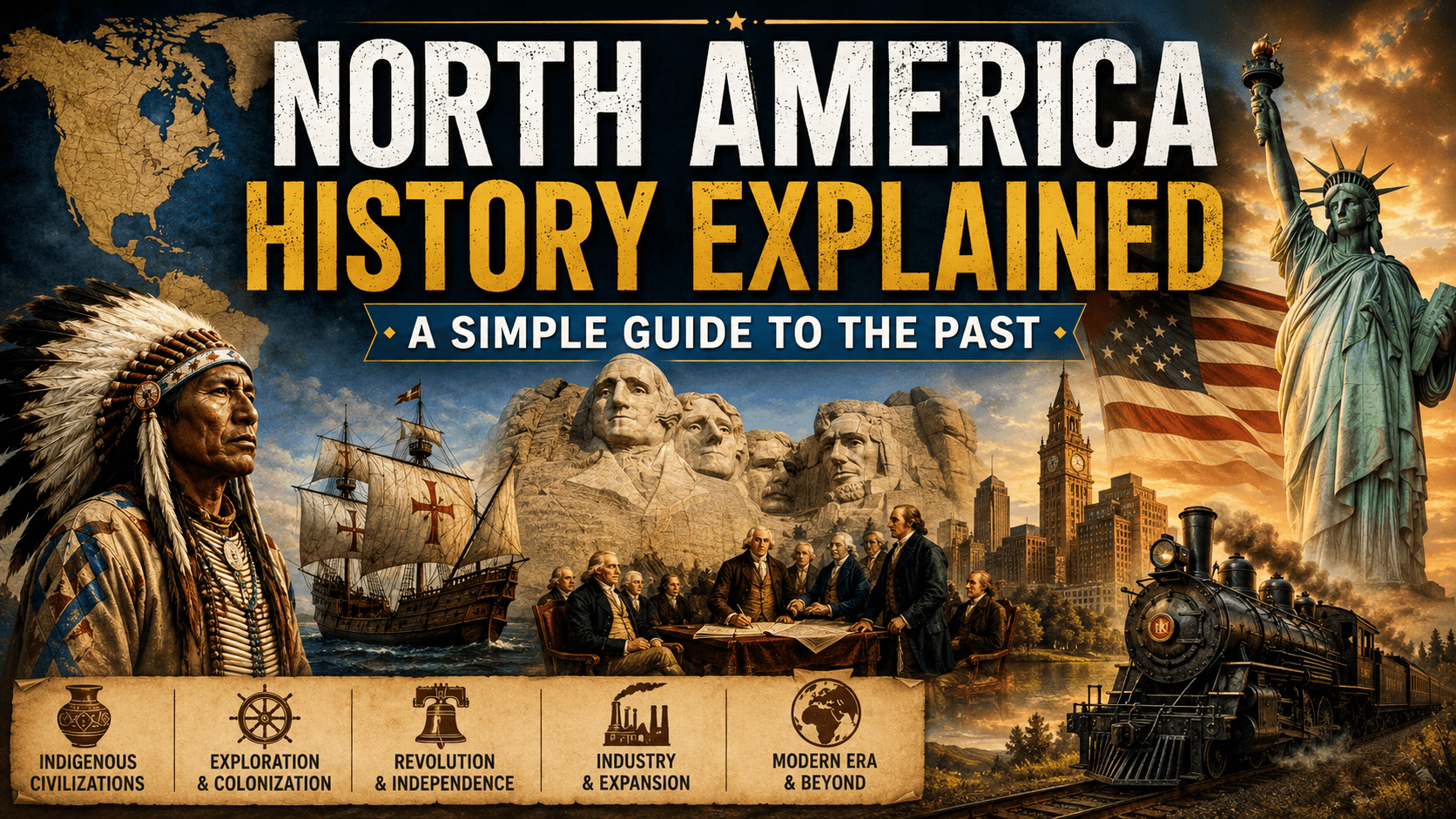
North American history spans the rich civilizations of Indigenous peoples long before European contact, through the era of colonization, revolution, and nation-building that shaped the United States, Canada, and Mexico. It traces pivotal events like the transatlantic slave trade, westward expansion, the fight for independence, and civil rights movements that redefined freedom and citizenship. This history reflects a continent shaped by cultural collision, immigration, and the ongoing struggle to reconcile diverse peoples within evolving national identities. At its core, North American history explores how conquest, resistance, and reinvention forged the modern nations of the continent.
Content Overview
North America
Geography, Regions, History & Civilization
1. Introduction to North America
North America is one of the world’s seven continents, located mainly in the Northern Hemisphere and partly in the Western Hemisphere.
Key facts:
- Area: about 24.7 million km²
- About 16.5% of Earth’s land area
- Population: about 592 million people
- Around 7.5% of the world’s population
- It is the third-largest continent by land area, following Asia and Africa.
The continent includes 23 independent countries and several territories.
2. Location and Borders
North America is surrounded by major oceans and seas.
North → Arctic Ocean
East → Atlantic Ocean
West → Pacific Ocean
South-east → Caribbean Sea
It is connected to South America through the region called Central America.
3. Major Countries
Important countries in North America include:
- United States
- Canada
- Mexico
Other territories and regions include:
- Greenland
- Saint Pierre and Miquelon
4. The Three Main Regions of North America
Geographers commonly divide North America into three main regions.
1. Northern America
This region includes:
- Canada
- United States
- Greenland
Characteristics
- Large land area
- Highly developed economies
- Advanced technology and industries
- Diverse climates (Arctic to temperate)
Major cities include:
- New York City
- Toronto
- Los Angeles
2. Central America
Central America links North America and South America.
Countries include:
- Guatemala
- Costa Rica
- Panama
- Honduras
- El Salvador
Characteristics
- Tropical climate
- Rainforests and volcanoes
- Important trade route through the Panama Canal
The Panama Canal links the Atlantic Ocean to the Pacific Ocean.
3. Caribbean
The Caribbean region consists of island nations in the Caribbean Sea.
Important countries include:
- Cuba
- Jamaica
- Haiti
- Dominican Republic
Characteristics
- Tropical islands
- Tourism-based economies
- Distinct cultures that blend African, European, and Indigenous influences
5. Early Human History
Humans first reached North America at least 20,000 years ago.
Many scholars believe they migrated from Asia through the Bering Land Bridge, which once connected Siberia and Alaska.
6. Indigenous Civilizations
Before European arrival, many advanced civilizations existed.
Important Indigenous cultures include:
- Maya civilization
- Aztec civilization
- Mississippian culture
These societies developed:
- cities
- agriculture
- trade networks
- advanced calendars and architecture
7. European Exploration
Around 1000 CE, the first Europeans to reach North America were the Norse (Vikings) from Norway.
They set up a brief settlement at L’Anse aux Meadows in Newfoundland.
8. Age of Discovery
In 1492, the voyages of Christopher Columbus began major contact between Europe and the Americas.
This period started large migrations of Europeans to North America.
Major colonial powers included:
- Spain
- France
- United Kingdom
9. Cultural Development
Modern North American culture developed through interaction between:
- Indigenous peoples
- European settlers
- Enslaved Africans
- Immigrants from Asia and Europe
As a result, the most widely spoken languages today are:
- English
- Spanish
- French
However, many Indigenous languages and traditions still exist, especially in parts of Canada, the United States, and Mexico.
10. Modern Importance
Today, North America contains some of the largest economies in the world, especially:
- United States
- Canada
The continent plays a major role in:
- global economics
- technology
- science
- international politics
Simple Summary
North America is:
- the third-largest continent by area
- the fourth-largest by population
- divided into three main regions
- Northern America
- Central America
- Caribbean
The continent has a long human history, beginning with early migrations from Asia and continuing through Indigenous civilizations, European exploration, and modern global development.