21st Century Explained: Technology, Globalization and Modern Life
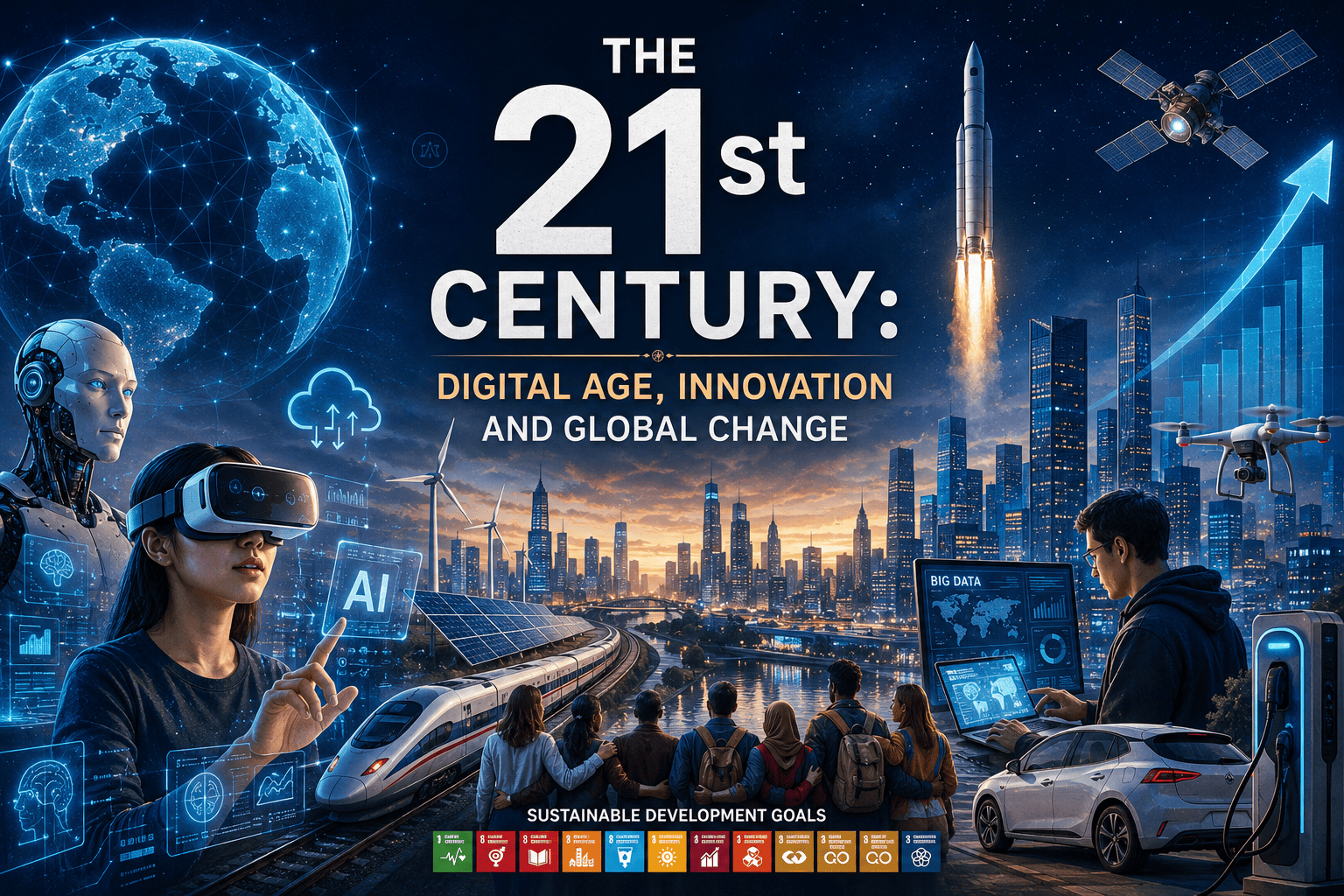
The 21st century has been defined by rapid technological transformation, as the rise of the internet, smartphones, and social media have reshaped how people communicate, work, and access information on a global scale. This era has also seen accelerating globalization, connecting economies and cultures more closely than ever, alongside growing challenges like climate change, geopolitical tension, and the rise of artificial intelligence reshaping industries and daily life. Major events, from the 2008 financial crisis to the COVID-19 pandemic, have tested global systems and reshaped economic and social norms worldwide. At its core, the 21st century reveals a world grappling with unprecedented connectivity, innovation, and the challenges of navigating a rapidly changing global landscape.
Content Overview
- The 21st Century (2001–2025 CE): the Digital Age
- CHAPTER 1 — Understanding the 21st Century
- CHAPTER 2 — September 11, 2001, and the War on Terror
- CHAPTER 3 — Technology Revolution: Mobile, Internet, and Social Media
- CHAPTER 4 — Wars and Major Conflicts (2001–2025)
- CHAPTER 5 — Global Economic Transformations
- CHAPTER 7 — NASA and Space Exploration (2001–2025)
- Every Major NASA Mission 2001–2025
- Mars Exploration Rover (MER) — Spirit and Opportunity (Launched 2003)
- Mars Reconnaissance Orbiter (MRO) — Launched 2005
- New Horizons — Pluto and the Kuiper Belt (Launched January 19, 2006)
- Cassini-Huygens — Saturn's Complete Story
- Mars Science Laboratory — Curiosity Rover (Launched November 26, 2011; Landed August 6, 2012)
- Perseverance Rover and Ingenuity Helicopter (Launched July 30, 2020; Landed February 18, 2021)
- James Webb Space Telescope (JWST) — Launched December 25, 2021
- SpaceX — Elon Musk's Revolutionary Company
- India's Chandrayaan Missions
- The Artemis Program — Return to the Moon
- Every Major NASA Mission 2001–2025
- CHAPTER 8 — The COVID-19 Pandemic (2019–2023)
- CHAPTER 9 — Artificial Intelligence Revolution
- CHAPTER 10 — Climate Change and the Environmental Crisis
- CHAPTER 12 — Social and Cultural Transformation
- CHAPTER 13 — Complete Year-by-Year Timeline (2001–2025)
- CHAPTER 14 — Summary and Legacy
The 21st Century (2001–2025 CE): the Digital Age
CHAPTER 1 — Understanding the 21st Century
Definition and Context
The 21st century began on January 1, 2001 CE and is currently ongoing as of 2025. Unlike the previous chapters in this book — which covered complete centuries of history — this chapter covers only the first 24 years of a century still being written. We are living inside this history. Every development described here is either ongoing or its consequences are still unfolding.
The 21st century is, above all else, the century of digital technology and its consequences. The internet — which existed as a specialist tool in 2001 — has become the fundamental infrastructure of human civilization, as essential to modern life as electricity or running water. The smartphone — which did not exist until 2007 — has put a supercomputer connected to all human knowledge into the pocket of approximately 6.8 billion people worldwide (as of 2024). Artificial intelligence — which existed only in science fiction and academic laboratories in 2001 — is now diagnosing diseases, writing code, generating art, and threatening to transform every profession.
At the same time, the 21st century has seen wars that lasted longer than both World Wars combined, a pandemic that killed approximately 7 million people officially and perhaps 15–20 million in excess deaths, the accelerating crisis of climate change, and a global political shift toward nationalism and populism that has challenged the post-Cold War liberal international order.
What Kind of World Existed in 2001?
The world of January 1, 2001 was in many ways unrecognizable from the world of 2025. Understanding what did not yet exist helps appreciate the scale of change:
There was no Facebook (founded 2004), no Twitter (founded 2006), no iPhone (launched 2007), no Android (launched 2008), no YouTube (founded 2005), no WhatsApp (founded 2009), no Instagram (founded 2010), no Uber (founded 2009), no Airbnb (founded 2008), no Netflix streaming (began 2007 — Netflix was still a DVD-by-mail service), no iPad (launched 2010), no Snapchat (founded 2011), no TikTok (founded 2016).
Google existed — it had been founded in 1998 — but had not yet become the dominant force in information. Amazon existed but was primarily a bookseller. Apple’s stock was trading at approximately $1 per share (adjusted for splits) — its market value was approximately $5 billion. In 2024, Apple became the first company to reach a $3 trillion market capitalization.
The dominant mobile phones in 2001 were Nokia and Motorola — devices primarily for voice calls and text messages, with tiny black-and-white screens. The internet was accessed primarily through dial-up connections (making a horrible noise as it connected) at speeds of approximately 56 kilobits per second — downloading a single song took approximately 15 minutes; streaming video was essentially impossible.
The world’s largest economy was the United States; the second was Japan; the third was Germany. China’s economy was approximately the same size as Italy’s. In 2024, China is the world’s second-largest economy and is projected to overtake the United States within a decade.
CHAPTER 2 — September 11, 2001, and the War on Terror
September 11, 2001 — What Happened, Minute by Minute
September 11, 2001 was the most consequential single day in 21st-century history — the event that launched two decades of war, transformed security and surveillance globally, and permanently altered international relations.
Background — Al-Qaeda and Osama bin Laden:
Al-Qaeda (Arabic: “The Base”) was a transnational Islamist terrorist organization founded by Osama bin Laden (1957–2011) in approximately 1988, during the Soviet-Afghan War. Bin Laden — the son of a wealthy Saudi construction magnate — had gone to Afghanistan to support the Mujahideen resistance against the Soviet occupation, partly funded by CIA-organized and Saudi-supported networks.
After the Soviet withdrawal (1989), bin Laden developed al-Qaeda into a global terrorist organization. His ideology — a form of Salafi jihadism that declared war on the United States, Israel, and “apostate” Muslim governments — was articulated in a 1996 “Declaration of War against the Americans Occupying the Land of the Two Holy Places” and a 1998 fatwa declaring it “an individual duty for every Muslim” to kill Americans wherever found.
The specific grievances driving this ideology were: the presence of American military forces in Saudi Arabia (the land of the two holy cities of Mecca and Medina, during and after the Gulf War); American support for Israel; and American support for authoritarian Arab governments.
The Attacks — Minute by Minute:
7:59 AM: American Airlines Flight 11 departs Boston Logan Airport for Los Angeles with 92 people aboard. Five al-Qaeda hijackers are on board.
8:14 AM: United Airlines Flight 175 departs Boston Logan Airport for Los Angeles with 65 people aboard. Five al-Qaeda hijackers.
8:20 AM: American Airlines Flight 77 departs Washington Dulles Airport for Los Angeles with 64 people aboard. Five al-Qaeda hijackers.
8:42 AM: United Airlines Flight 93 departs Newark Airport for San Francisco with 44 people aboard. Four al-Qaeda hijackers.
8:46 AM: American Airlines Flight 11 is deliberately flown into the North Tower of the World Trade Center in New York City, striking floors 93–99. The plane was traveling at approximately 490 mph. Approximately 1,344 people above the impact zone were immediately trapped; approximately 1,366 people below were able to evacuate. The impact and subsequent fire caused the building to be structurally compromised.
9:03 AM: United Airlines Flight 175 crashed into the South Tower of the World Trade Center between floors 77 and 85 at roughly 590 mph. The attack is live on television — every major news network is already covering the North Tower strike.
9:05 AM: President George W. Bush — who is at Emma E. Booker Elementary School in Sarasota, Florida, for a reading event — is whispered the news by his Chief of Staff Andrew Card. The image of Bush sitting quietly for approximately seven minutes while children read him “The Pet Goat” became one of the most discussed images of the day.
9:37 AM: American Airlines Flight 77 strikes the Pentagon — the United States Department of Defense headquarters in Arlington, Virginia — killing 125 Pentagon personnel and all 64 people aboard the aircraft.
9:59 AM: The South Tower of the World Trade Center collapses, after burning for approximately 56 minutes. The collapse takes approximately 9 seconds.
10:03 AM: United Airlines Flight 93 crashes into a field near Shanksville, Pennsylvania. The passengers — who had learned by telephone that other aircraft had been used as weapons — attempted to overrun the cockpit and take back the plane. The hijackers crashed the plane to prevent this, killing all 44 aboard. The intended target is believed to have been either the US Capitol or the White House.
10:28 AM: The North Tower collapses, after burning for approximately 102 minutes. The collapse kills all remaining occupants and many first responders who had been ascending the building.
The Death Toll:
2,977 people were killed in the attacks (not counting the 19 hijackers): 2,753 at the World Trade Center; 184 at the Pentagon; 40 in Pennsylvania. The victims were citizens of 93 different countries.
An additional approximately 400,000 people — rescue workers, survivors, and lower Manhattan residents — were exposed to toxic dust from the collapse of the towers and have experienced elevated rates of cancer and respiratory disease in subsequent years. The 9/11 Victim Compensation Fund has paid approximately $11 billion to approximately 40,000 claimants.
The War in Afghanistan (2001–2021) — Complete Account
President Bush demanded that Afghanistan’s Taliban government (which had provided sanctuary for al-Qaeda) surrender Osama bin Laden and dismantle al-Qaeda bases in Afghanistan. The Taliban refused. On October 7, 2001, the United States and United Kingdom launched Operation Enduring Freedom.
The initial campaign — combining American air power with the Northern Alliance (Afghan militias opposed to the Taliban) and small numbers of American and British Special Forces on the ground — rapidly overthrew the Taliban government. Kabul fell on November 13, 2001. The Taliban and al-Qaeda fled into the mountains and across the border into Pakistan’s tribal areas.
However, the quick military victory was not followed by sustainable peace. The new Afghan government — installed under the Bonn Agreement (December 2001) and led initially by Hamid Karzai — faced the fundamental challenge of rebuilding a country devastated by 22 years of continuous war (1979–2001), with inadequate resources, endemic corruption, and neighbors (particularly Pakistan) who continued to provide sanctuary and support to the Taliban.
Osama bin Laden was trapped at the Battle of Tora Bora (December 2001) — but American and Afghan forces failed to capture or kill him, and he escaped to Pakistan. He would remain at large for almost a decade, eventually killed in Abbottabad, Pakistan, in a US Navy SEAL raid (Operation Neptune Spear) on May 2, 2011.
The Taliban insurgency gradually rebuilt in Pakistani sanctuaries and returned to Afghan territory. By 2006, significant parts of southern and eastern Afghanistan were effectively under Taliban control despite the presence of approximately 140,000 NATO troops. The Obama administration’s surge (2009–2010) temporarily reduced violence but did not produce lasting security.
The US–Taliban Doha Agreement (February 2020) — negotiated by the Trump administration without the Afghan government’s participation — committed the United States to withdrawing all forces in exchange for Taliban guarantees not to allow Afghan territory to be used for attacks on the United States. The Taliban did not honor their counter-terrorism commitments; the agreement effectively legitimized the Taliban and demoralized the Afghan government.
President Biden completed the American withdrawal in August 2021. The Afghan government and security forces — which the United States had spent approximately $83 billion building and equipping over 20 years — collapsed in approximately 11 days. On August 15, 2021, the Taliban moved into Kabul. The last American troops departed on August 30, 2021.
The chaotic evacuation — American personnel and their Afghan allies scrambling onto aircraft, crowds at Kabul airport, a suicide bomb attack (August 26) that killed 13 American service members and approximately 170 Afghans — was one of the most humiliating images of American foreign policy failure in decades.
The War’s Cost:
American military deaths: 2,448. American civilians (contractors, etc.): approximately 3,800. NATO ally deaths: 1,144. Afghan security forces: approximately 66,000. Taliban and other insurgents: approximately 51,000. Afghan civilians: approximately 71,000. Estimated total Afghan war deaths (direct): approximately 176,000. Total American financial cost: approximately $2.313 trillion. The war lasted 19 years, 10 months, and 25 days — longer than the Civil War, World War I, World War II, and the Korean War combined.
The War in Iraq (2003–2011)
The Iraq War began on March 20, 2003, when a US-led coalition invaded Iraq based primarily on the stated justification that Iraqi President Saddam Hussein possessed weapons of mass destruction (WMDs) and had links to al-Qaeda. Both claims proved to be wrong.
The initial military campaign — Operation Iraqi Freedom — was rapid: Saddam Hussein’s government collapsed in approximately three weeks; Baghdad fell on April 9, 2003 (the scene of the Saddam statue being toppled in Firdos Square, with Marines helping Iraqi civilians, was broadcast worldwide). Saddam Hussein was captured hiding in a hole in the ground near Tikrit on December 13, 2003, tried by an Iraqi court, and executed on December 30, 2006.
However, the occupation that followed was severely mismanaged, as the Coalition Provisional Authority (CPA) under L struggled to establish stability L. Paul Bremer made two decisions of particularly devastating consequence: the de-Baathification order (dismissing all members of Saddam’s Baath Party from government positions — removing the experienced administrators who knew how to run the country) and the dissolution of the Iraqi Army (putting approximately 400,000 trained soldiers, many with weapons, out of work and immediately hostile to the occupation). These decisions fueled the insurgency that emerged within months.
By 2006, Iraq was in the grip of a sectarian civil war between Sunni and Shia populations, with al-Qaeda in Iraq (AQI — which had no significant presence in Iraq before the invasion) exploiting the chaos. The situation was described by American generals as “close to catastrophic.”
The “Surge” — President Bush’s decision to deploy an additional 30,000 American soldiers in 2007, under General David Petraeus’s new counter-insurgency strategy — combined with the “Sunni Awakening” (Sunni tribal leaders turning against AQI in exchange for American support) to dramatically reduce violence by 2008–2009.
American combat operations ended on August 31, 2010. The last American combat troops withdrew on December 18, 2011. AQI’s remnants reconstituted into the Islamic State of Iraq (later ISIS/ISIL/Daesh).
The Iraq War’s Legacy:
The war killed approximately 4,431 American military personnel, 179 British military personnel, and an estimated 100,000–460,000 Iraqi civilians (estimates vary widely). It cost approximately $1.922 trillion. It discredited the intelligence agencies that had provided flawed WMD assessments, damaged America’s international reputation (particularly its relationship with France, Germany, and the broader Muslim world), and — by removing the Sunni-dominated Baathist government that had kept Iran’s influence in check — dramatically strengthened Iran’s position in the Middle East.
The Rise and Fall of ISIS
The Islamic State of Iraq and Syria (ISIS, also known as ISIL — Islamic State of Iraq and the Levant — or Daesh, its Arabic acronym) emerged from al-Qaeda in Iraq. Abu Bakr al-Baghdadi (1971–2019) — who had been a relatively obscure Iraqi cleric before the war and who had spent time in American detention at Camp Bucca (where he reportedly met many of his future commanders) — led ISIS to a period of extraordinary territorial expansion in 2013–2015.
On June 29, 2014, ISIS declared the establishment of a “Caliphate” — a historical Islamic political entity — with al-Baghdadi as Caliph. At its peak (late 2014), ISIS controlled approximately 110,000 square kilometers of territory in Iraq and Syria — an area roughly the size of the United Kingdom — with a population of approximately 8 million people. It operated like a state: collecting taxes, running schools and courts, producing sophisticated propaganda videos (including videos of executions), and attracting approximately 40,000 foreign fighters from approximately 80 countries.
A US-led coalition launched air strikes against ISIS from August 2014. Iraqi and Kurdish forces, backed by American air power and advisors, gradually reconquered ISIS territory. Mosul — Iraq’s second-largest city, captured by ISIS in June 2014 — was recaptured after a nine-month battle (October 2016 – July 2017) in which approximately 1,000 ISIS fighters held off an Iraqi force of approximately 94,000, using approximately 16,000 improvised explosive devices and virtually every building as a fortified position.
Al-Baghdadi was killed on October 27, 2019, in a US Special Forces raid in northwestern Syria — cornered, he detonated a suicide vest, killing himself and two children he had taken with him. ISIS as a territorial state was effectively destroyed by 2019, though it continues as an insurgent and terrorist organization in Iraq, Syria, and through affiliated groups in West Africa, Southeast Asia, and Afghanistan.
CHAPTER 3 — Technology Revolution: Mobile, Internet, and Social Media
Google — Complete Foundation Story
Google was founded on September 4, 1998, by Larry Page (born March 26, 1973, in East Lansing, Michigan) and Sergey Brin (born August 21, 1973, in Moscow, Soviet Union — his family moved to the United States in 1979).Both were PhD students in computer science at Stanford University.
The company began as a research project called “BackRub” — Page and Brin developed a new algorithm for ranking web pages based on the number and quality of links pointing to each page (PageRank), reasoning that important pages would be linked to more often than unimportant ones. This was dramatically more effective than existing search engines, which ranked primarily by keyword frequency and could be easily manipulated.
They incorporated Google (a play on “googol” — the number 1 followed by 100 zeros) in a garage in Menlo Park, California — the garage belonging to Susan Wojcicki (who later became CEO of YouTube).Initial funding included a $100,000 check from Andy Bechtolsheim, co-founder of Sun Microsystems, written out to “Google Inc.” before the company was formally incorporated.
In August 1998, Google was handling approximately 10,000 search queries per day. By 2024, Google processes approximately 8.5 billion searches per day — approximately 99,000 per second.
Google’s business model — the AdWords system (later Google Ads) launched in 2000, allowing businesses to bid for placement in search results — proved extraordinarily lucrative. Google went public in August 2004 at $85 per share, raising approximately $1.9 billion. In August 2004, Google’s market capitalization was approximately $27 billion. By 2024, Alphabet (Google’s parent company, established in 2015) had a market capitalization exceeding $2 trillion.
Key Google products and their launch dates:
- Google Search: 1998
- Google AdWords: October 2000
- Google Images: July 2001
- Google News: September 2002
- Gmail: April 1, 2004 (users thought it was an April Fool’s joke — the offer of 1 GB of free email storage seemed impossibly generous when Yahoo and Hotmail were offering 4 MB)
- Google Maps: February 2005 (acquired from Where 2 Technologies)
- Google Earth: June 2005 (acquired from Keyhole Inc., which had been funded by the CIA’s venture arm In-Q-Tel)
- Google Analytics: November 2005
- YouTube: October 2006 (acquired for $1.65 billion in Google stock — at the time widely considered wildly overpaying; by 2023, YouTube’s revenue was approximately $31 billion annually)
- Google Chrome: September 2, 2008 (became the world’s most-used browser by 2012)
- Android: September 2008 (acquired from Android Inc., founded by Andy Rubin, in 2005 for approximately $50 million)
- Google Translate: April 2006
- Google Drive: April 2012
- Google Home (smart speaker): November 2016
- Google Gemini AI: December 2023
Apple and the iPhone Revolution — Complete Story
Apple’s Background:
Apple was founded on April 1, 1976, by Steve Jobs (1955–2011), Steve Wozniak (born 1950), and Ronald Wayne (who sold his 10% stake back for $800 twelve days later — a decision worth approximately $100 billion by 2023). The company’s early success (Apple II, Macintosh) was followed by a near-death experience in the 1990s when Jobs had been fired (1985) and Apple’s market share had collapsed to approximately 4%.
Steve Jobs returned to Apple in 1997 when Apple acquired NeXT (the company Jobs had founded after leaving Apple) for $429 million. Under Jobs’s leadership, Apple launched a series of revolutionary products:
iMac (August 1998): A translucent all-in-one computer that revived Apple’s fortunes. iPod (October 23, 2001): “1,000 songs in your pocket” — the digital music player that transformed the music industry and restored Apple’s cultural relevance. iTunes Store (April 2003): Digital music sold for $0.99 per song, disrupting the CD industry. iPhone (January 9, 2007): The device that changed everything.
The iPhone — Complete Story
Steve Jobs announced the original iPhone at the Macworld Conference on January 9, 2007, with the words: “Every once in a while, a revolutionary product comes along that changes everything.And Apple has been very fortunate—it has been able to bring a few of these into the world. Well, today we’re introducing three revolutionary products of this class. The first one: a widescreen iPod with touch controls. The second: a revolutionary mobile phone. And the third: a breakthrough internet communications device. So, three things: a widescreen iPod, a phone, and an internet communicator. Are you getting it? These are not three separate devices.This is a single device, and we are calling it the iPhone.
The audience erupted. The announcement is considered one of the greatest product launches in corporate history.
The original iPhone launched on June 29, 2007, at a price of $499 (4 GB) and $599 (8 GB) — requiring a two-year AT&T contract. It had: a 3.5-inch multi-touch screen (radical — no physical keyboard), 2-megapixel camera, no 3G internet (only EDGE), no App Store (apps could not be installed), Safari web browser, Google Maps, iPod music player. It did not support copy and paste. Steve Ballmer, Microsoft’s CEO, laughed at it: “Five hundred dollars? Fully subsidized? With a plan? I said that is the most expensive phone in the world. And it doesn’t appeal to business customers because it doesn’t have a keyboard.”
By the end of 2007, Apple had sold approximately 3.7 million iPhones. By Q1 2023, Apple had sold its 2 billionth iPhone. The iPhone is the most successful product in the history of consumer electronics.
iOS — Year by Year
iPhone OS 1 (June 2007): The original operating system, called iPhone OS (renamed iOS in 2010). Features: Phone, Mail, Safari, Maps, YouTube, Stocks, Weather, Clock, Calculator, Notes, Settings, SMS, Camera, Photos, iPod. No App Store. No third-party apps allowed initially.
iPhone OS 2 (July 11, 2008): Launched simultaneously with the iPhone 3G. The App Store launched — initially 500 apps. By 2024, the App Store has approximately 1.8 million apps. Apple takes a 30% commission on app sales — generating approximately $22 billion annually. Microsoft Office, enterprise email (Exchange support), GPS navigation, Push notifications.
iPhone OS 3 (June 17, 2009): Copy and paste (finally). MMS (multimedia messaging). Voice memos. Spotlight search. Tethering.
iOS 4 (June 21, 2010): Renamed to iOS (following the launch of iPad, which ran the same operating system). Multitasking. FaceTime video calling. Retina Display support. HomeScreen folders. iBooks.
iOS 5 (October 12, 2011): iMessage (free texting between Apple devices). Siri (voice assistant, initially only on iPhone 4S). Notification Center. iCloud. Twitter integration. This was the last iOS Steve Jobs worked on — he died on October 5, 2011.
iOS 6 (September 19, 2012): Apple Maps (replacing Google Maps — the launch was disastrous, with significant inaccuracies that caused embarrassment; Apple CEO Tim Cook apologized publicly). Passbook (predecessor to Apple Wallet). Facebook integration.
iOS 7 (September 18, 2013): The most visually radical redesign in iOS history — under Apple’s design chief Jony Ive, the skeuomorphic design (making digital interfaces look like physical objects — leather stitching in Calendar, green felt in Game Center) was replaced by a flat, minimalist aesthetic that defined smartphone design for the following decade. Control Center. AirDrop. iTunes Radio.
iOS 8 (September 17, 2014): HealthKit and Health app. Family Sharing. Continuity (phone calls and texts on Mac). Predictive text. iCloud Drive. Metal graphics framework. Extensions (apps could now interact with each other).
iOS 9 (September 16, 2015): Proactive Siri (suggesting relevant information before being asked). iPad split-screen multitasking. News app. CarPlay improvements. Performance improvements for older devices.
iOS 10 (September 13, 2016): Redesigned lock screen with 3D Touch quick actions. Redesigned Messages with rich preview links, handwriting, and invisible ink. Maps with third-party apps. Apple Music redesign.Home app for managing HomeKit smart home devices. Siri opened to third-party developers. iMessage apps.
iOS 11 (September 19, 2017): iPad redesign with Dock and Files app. Augmented Reality (ARKit). New Control Center. Drag and drop on iPad. Do Not Disturb while driving. QR code reader in camera. Machine learning built into the Core ML framework.
iOS 12 (September 17, 2018): Screen Time (monitoring and limiting usage). Grouped notifications. Siri Shortcuts. Memoji (personalized animoji). ARKit 2 with multiplayer AR. Performance improvements making older devices significantly faster.
iOS 13 (September 19, 2019): Dark Mode (system-wide black or dark grey interface). Sign in with Apple. Enhanced Maps with Look Around (like Google Street View). Swipe keyboard. Portrait Lighting and high-key mono in Camera. QuickPath keyboard swipe.
iOS 14 (September 16, 2020): App Library (automatic app organization). Widgets on Home Screen (finally customizable). App Clips. Picture in Picture video. Compact calls (incoming call no longer takes over the full screen). AirPods switching between devices. Privacy labels in App Store.
iOS 15 (September 20, 2021): FaceTime spatial audio, SharePlay (watching/listening together over FaceTime), and Android/Windows FaceTime links. Focus modes. Live Text (select and copy text from photos). Safari redesign. Wallet with IDs. On-device Siri processing (Siri could work offline for many tasks). Maps with immersive walking directions.
iOS 16 (September 12, 2022): Customizable Lock Screen (wallpapers with depth effects, widgets, custom fonts). Unsend and edit iMessages. Mail scheduling and undo send. iCloud Shared Photo Library. Emergency SOS via satellite, available on iPhone 14 and later models.
iOS 17 (September 18, 2023): StandBy mode (full-screen display when iPhone is charging horizontally — clock, widgets, photos). Contact Posters (personalized caller ID). Journal app. Interactive widgets. NameDrop (sharing contact info by touching phones). Live Voicemail. Check In (automatically notify someone when you arrive). Autocorrect finally learned swear words.
iOS 18 (September 16, 2024): Apple Intelligence (Apple’s on-device AI system, running AI processing on the iPhone itself rather than in the cloud). Writing tools (AI rewriting, proofreading, summarization) throughout the system. AI-powered Siri with more natural conversation and integration with ChatGPT. Image Playground (AI image generation). Photo cleanup tool (AI-powered object removal). Control Center fully customizable. RCS messaging (universal standard working between iPhone and Android). Messages text formatting. Lock screen app placement anywhere.
Current (iOS 18.x as of early 2025): Continuing to refine Apple Intelligence features with on-device large language models. Integration with ChatGPT for complex queries. AI notification summaries. AI-generated photo albums.
Android — Complete Foundation Story
Android was founded as a company by Andy Rubin (born June 22, 1963), Rich Miner, Nick Sears, and Chris White in October 2003. The name came from Andy Rubin’s nickname at Apple — where a former colleague had called him “Android” because of his love for robots.
Google acquired Android Inc. in August 2005 for around $50 million. Andy Rubin stayed to lead Android development within Google. The original vision — creating an intelligent operating system for digital cameras — evolved into a mobile phone operating system.
The first Android phone — the HTC Dream (also called T-Mobile G1) — launched on October 22, 2008, in the United States. It ran Android 1.0. The phone had a physical slide-out keyboard, a trackball, a 3.17-inch screen, a 3.2-megapixel camera, and ran on the T-Mobile network. It was not immediately considered a revolutionary product — but it was the beginning of the platform that would eventually run approximately 72% of the world’s smartphones.
Why Android Is Significant:
Android is open-source — any manufacturer can use it for free (with certain Google requirements if they want to include the Google Play Store and Google apps). This allowed an enormous range of manufacturers — Samsung, LG, Motorola, HTC, Huawei, Xiaomi, Oppo, OnePlus, and hundreds of others — to build Android phones at every price point, from $50 to $1,500.
By contrast, iOS is exclusive to Apple hardware. This meant that by 2011, Android had surpassed iOS in market share — and by 2024, Android runs approximately 72% of the world’s smartphones while iOS runs approximately 27%. In absolute numbers, there are approximately 3.3 billion Android users and approximately 1.2 billion iOS users.
Android Version History — Key Releases:
Android 1.0 (October 2008): HTC Dream/G1. Google Maps, Gmail, YouTube, browser. No virtual keyboard — only physical.
Android 1.5 Cupcake (April 2009): introduced a virtual keyboard. Video recording. Third-party keyboard support.
Android 1.6 Donut (September 2009): Universal search. Support for multiple screen sizes. Gesture framework.
Android 2.0 Éclair (October 2009): Multiple Google accounts. HTML5 browser. Live wallpapers. Turn-by-turn navigation in Google Maps — free. (This was significant because GPS navigation apps like Garmin and TomTom were selling dedicated devices for $200–$500; Google gave it away free, destroying the market for dedicated GPS devices.)
Android 2.2 Froyo (May 2010): Adobe Flash support. Mobile hotspot (using the phone as a Wi-Fi hub). App2SD (apps could be moved to SD card). 450% performance improvement over 2.1 through the JIT compiler.
Android 2.3 Gingerbread (December 2010): Near Field Communication (NFC) — the basis for contactless payments. Improved copy-paste. Download Manager.
Android 3.0 Honeycomb (February 2011): Tablet-only release. First Android designed specifically for larger screens.
Android 4.0 Ice Cream Sandwich (October 2011): Merged phone and tablet interfaces. Face Unlock. Data usage monitoring. Android Beam (NFC data sharing). Resizable widgets.
Android 4.1 Jelly Bean (July 2012): Google Now — a predictive assistant that showed relevant information before you asked for it (weather, traffic, sports scores, flight information) — considered the first true AI assistant on a smartphone. Project Butter (smooth 60fps animations).
Android 4.4 KitKat (October 2013): Named after the Nestlé chocolate bar — beginning the confectionery naming convention. Memory optimization for low-end devices.
Android 5.0 Lollipop (November 2014): Material Design — Google’s visual language that unified its products’ appearance. ART runtime replacing Dalvik (significant performance improvement). Lockscreen notifications.
Android 6.0 Marshmallow (October 2015): App permissions per-feature (apps had to ask permission for camera, microphone, location each time rather than at installation). Google Now on Tap (long-press Home button to analyze current screen). Doze mode (dramatically improved battery life).
Android 7.0 Nougat (August 2016): Multi-window split screen. Improved notifications. Vulkan graphics API. Direct Boot. Enhanced Do Not Disturb.
Android 8.0 Oreo (August 2017): Picture-in-Picture mode. Notification channels (fine-grained control over notifications). Project Treble (modular architecture making updates faster and cheaper for manufacturers). Auto-fill API.
Android 9.0 Pie (August 2018): Gesture navigation (replacing traditional three-button navigation). Digital Wellbeing (screen time management). Adaptive Battery (machine learning to optimize battery use). App Actions.
Android 10 (September 2019): Dropped the dessert naming convention for public releases. System-wide dark theme. Privacy improvements (location permission while using). Gesture navigation as default. Foldable device support. Live Caption (real-time captions for any video or audio on the device).
Android 11 (September 2020): Conversation notifications (messaging apps get a separate section). Bubbles (chat heads style floating conversations). One-time permissions (camera/microphone/location permission valid only for current session). Media controls in notification shade.
Android 12 (October 2021): Material You — a design overhaul that automatically generates a complete phone color scheme from the wallpaper. Privacy dashboard (see which apps accessed camera, microphone, location). Privacy indicators (green dot when camera or microphone is active). Quick Settings redesign.
Android 13 (August 2022): Per-app language settings. Photo/video picker (apps ask for specific photos rather than entire gallery access). Bluetooth device permissions. Themed app icons for more apps.
Android 14 (October 2023): Predictive back gesture (preview where back will take you). Large screen optimization. Health Connect centralized health data hub. Regional preferences (independent settings for temperature, date format, etc.). Credential Manager.
Android 15 (2024): Theft detection lock (accelerometer and AI detect if phone is snatched and lock it). Satellite connectivity support. Private space (hidden, separately locked section of the phone). Improved predictive back.
Facebook — Mark Zuckerberg’s Complete Story
Mark Elliot Zuckerberg was born on May 14, 1984, in White Plains, New York, to a Jewish family — his father Edward is a dentist and his mother Karen a psychiatrist. He showed early programming ability — his father taught him Atari BASIC as a child; at 12, he created a messaging program called “ZuckNet” for his father’s dental office that allowed communication between receptionists and dentist chairs. At Phillips Exeter Academy (elite New Hampshire boarding school), he developed a music player called “Synapse Media Player” that used machine learning to predict user preferences — both AOL and Microsoft offered to buy it; he turned them down.
At Harvard University (2002), Zuckerberg created “CourseMatch” (helping students choose courses based on what others were taking) and “FaceMash” (comparing photos of Harvard students to rate their attractiveness — which crashed Harvard’s network when 22,000 photo views occurred in the first four hours and got him nearly expelled). These were precursors to Facebook.
In January 2004, Zuckerberg started working on “TheFacebook” — a social network for Harvard students, inspired by the physical “face books” (photo directories) that Harvard dormitories distributed to new students. He was 19 years old.
Timeline of Facebook’s Creation:
January 11, 2004: TheFacebook.com domain registered. February 4, 2004: TheFacebook launched to Harvard students. March 2004: Expanded to Columbia, Stanford, and Yale. June 2004: Zuckerberg moved to Palo Alto, California for the summer and never returned to Harvard (he never completed his degree — Harvard awarded him an honorary degree in 2017, 13 years later). August 2004: “The” was dropped — the site became Facebook. October 2004: Dustin Moskovitz, Chris Hughes, Eduardo Saverin, and Andrew McCollum were co-founders; Sean Parker (Napster co-founder) became the first president. Peter Thiel invested $500,000 for approximately 10%. December 2004: 1 million users. October 2005: Facebook opens to high school students. Photos launched. September 2006: Facebook opened to anyone with an email address (not just university students). News Feed launched — immediately controversial because users felt their activity was being broadcast without permission. Zuckerberg was 22 and apologized via a blog post: “We really messed this one up.” November 2007: Facebook Ads and Pages launched. Beacon (tracking users across the web) launched and was immediately criticized as a serious privacy violation. Beacon was eventually shut down. July 2008: Facebook hit 100 million users. 2009: The “Like” button launched (February 9, 2009) — one of the most psychologically consequential decisions in social media history. The Like button created a dopamine loop — users would post content and then compulsively check for likes, training them to post more emotionally engaging content. 2010: Facebook hit 500 million users. The Social Network, the Aaron Sorkin-written, David Fincher-directed film dramatizing Facebook’s founding (portraying Zuckerberg as cold and ruthless) was released to critical acclaim and popular success. Zuckerberg called it “fictional” — but its characterization of Silicon Valley culture proved influential. February 2012: Facebook filed for its IPO (Initial Public Offering). May 18, 2012, Facebook went public at $38 per share, raising $16 billion — the third-largest IPO in American history. The IPO was technically botched (NASDAQ’s systems had problems processing orders), and the stock immediately fell — dropping to approximately $18 by September 2012. 2012: Facebook acquired Instagram (April 9, 2012) for approximately $1 billion — widely considered overpaying at the time. Instagram had 13 employees. 2014: Facebook acquired WhatsApp for approximately $19 billion (February 19, 2014) — the largest acquisition of a venture-backed company in history at that point. WhatsApp had 55 employees. Facebook acquired Oculus VR (virtual reality headset) for approximately $2 billion. 2016: Facebook Live launched. The algorithm prioritizing “meaningful social interactions” began deprioritizing news in the feed — a change that significantly reduced news publishers’ reach. 2016 Election: Russian Internet Research Agency (IRA) used Facebook to run a disinformation campaign targeting the 2016 American election — approximately 80,000 posts reaching approximately 126 million Americans. This triggered years of Congressional investigations and debates about social media companies’ responsibilities. 2018: Cambridge Analytica scandal — data of approximately 87 million Facebook users had been harvested without their consent and used to build targeted political advertising profiles. Zuckerberg testified before Congress for two days. 2021: Frances Haugen, a Facebook data scientist, became a whistleblower — leaking internal documents (the “Facebook Papers”) showing that Facebook’s own research demonstrated its platforms were causing harm to teenagers, particularly girls, and that the company had chosen engagement over user wellbeing. Facebook rebranded as Meta Platforms (October 28, 2021). 2021–2023: Facebook’s user growth stalled, particularly among younger users who preferred Instagram and TikTok. Meta invested approximately $40 billion in its “metaverse” vision — a virtual reality-based social internet — with limited consumer adoption. 2023–2024: Meta’s focus on AI and ad targeting improved profitability dramatically. Threads (a text-based social network, direct competitor to Twitter/X) launched July 5, 2023, gaining 100 million users in five days — the fastest app launch in history.
Facebook’s Current Scale (2024): Monthly active users (Facebook): approximately 3.07 billion. Instagram monthly active users: approximately 2 billion. WhatsApp monthly active users: approximately 2 billion. Total Meta family monthly active users: approximately 3.27 billion — meaning approximately 40% of all humans on Earth use at least one Meta product every month.
Twitter — Foundation and Transformation to X
Twitter was founded by Jack Dorsey (born November 19, 1976), Noah Glass, Biz Stone, and Evan Williams in March 2006, as a project within the podcasting company Odeo. The fundamental concept — a short message (initially 140 characters, later 280) broadcast to followers — came from Dorsey, who was inspired by dispatch services and the concept of people sharing their current status.
The first tweet was posted by Jack Dorsey on March 21, 2006: “just setting up my twttr”
Twitter launched publicly in July 2006 and gained significant mainstream attention during the 2007 South by Southwest Interactive (SXSW) festival in Austin, Texas, where usage tripled during the event. By 2009, Twitter had approximately 32 million users; by 2012, approximately 500 million registered users.
Twitter became the defining real-time information network — where breaking news (the death of Osama bin Laden was tweeted before official announcements), political discourse (Barack Obama used Twitter effectively in 2008; Donald Trump made it his primary communications channel), and cultural conversation happened simultaneously. During major world events (earthquakes, elections, sports events), Twitter’s real-time nature made it the first source for many people.
Elon Musk’s Acquisition:
Elon Musk (born June 28, 1971, in Pretoria, South Africa) began accumulating Twitter stock in January 2022. On April 14, 2022, he offered to acquire Twitter for $54.20 per share (approximately $44 billion). After initial resistance, Twitter’s board accepted the offer on April 25, 2022.
Musk then attempted to exit the deal — citing concerns about the number of bot accounts on the platform. Twitter sued to force completion of the acquisition; Musk completed it on October 27, 2022.
Musk’s takeover was immediately controversial. He fired approximately 80% of Twitter’s 7,500 employees within days. He restored the accounts of suspended users including Donald Trump. He implemented Twitter Blue (a paid subscription for the blue verification checkmark — previously given free to notable accounts after identity verification) — immediately causing confusion as paid “verified” accounts spread misinformation. Several major advertisers paused spending; Twitter’s advertising revenue fell approximately 50%.
He renamed the company X Corp and the platform Twitter/X, replacing the iconic bird logo with an X on July 23, 2023. The rebranding was widely mocked.
Current Status (2025): X (formerly Twitter) has approximately 368 million monthly active users — significantly below its 2022 peak of approximately 450 million. Musk continues to make it a focus of right-wing political discourse, having personally endorsed political candidates including Donald Trump. Competitors (Mastodon, Bluesky, Threads) have gained users from Twitter refugees but none has achieved Twitter’s centrality.
The iPhone vs. Android Revolution — Changing the World
The smartphone revolution — primarily driven by iOS and Android between 2007 and 2015 — is the most significant technology transformation of the 21st century. Consider what the smartphone replaced or disrupted:
Cameras: The dedicated digital camera market collapsed as smartphone cameras improved. Kodak — the dominant photography company for over 100 years — filed for bankruptcy in January 2012. Smartphone cameras now take approximately 93% of all photographs.
GPS Devices: TomTom and Garmin’s dedicated GPS navigation devices were replaced by Google Maps and Apple Maps. Both companies’ stock prices dropped by about 80% between 2008 and 2012.
Music Players: The iPod and then the iPhone replaced the Walkman, Discman, and standalone digital music players. Sony’s Walkman division eventually discontinued hardware production.
Alarm Clocks: Sales of standalone alarm clocks declined approximately 90%.
Flashlights: Standalone flashlight sales declined significantly.
Calculators: Scientific calculator sales declined for consumer use (still used for education).
Portable gaming devices: Nintendo DS/3DS and Sony PSP/Vita sales declined as smartphone gaming grew.
Newspapers and Magazines: Print newspaper circulation fell approximately 70% between 2005 and 2023 in most Western countries.
Maps: Physical map sales collapsed.
Encyclopedia sales: Encyclopaedia Britannica stopped printing its physical encyclopedia in 2012 after 244 years of continuous publication.
Shopping: E-commerce grew from approximately 1% of retail in 2000 to approximately 22% in 2023.
CHAPTER 4 — Wars and Major Conflicts (2001–2025)
The Syrian Civil War (2011–Present)
The Syrian Civil War began in March 2011 as part of the Arab Spring — the wave of popular uprisings across the Arab world triggered by the self-immolation of Tunisian street vendor Mohamed Bouazizi on December 17, 2010, as a protest against police harassment and corruption. The protests spread to Egypt (President Hosni Mubarak overthrown February 2011), Libya (Muammar Gaddafi killed October 2011), Bahrain (uprising suppressed), and Yemen (longtime President Ali Abdullah Saleh eventually removed from power).
In Syria, protests against President Bashar al-Assad’s government (which had ruled since his father Hafez al-Assad took power in 1970) began in the southern city of Deraa on March 15, 2011. The government’s brutal crackdown — arresting teenagers who had spray-painted anti-government graffiti, torturing them, and killing demonstrators — transformed protests into an armed insurgency.
The civil war involved multiple competing factions: Assad’s government (supported by Russia and Iran); the Free Syrian Army (Western-backed moderate rebels); Jabhat al-Nusra/HTS (al-Qaeda affiliated); ISIS (which captured large territories in 2013–2015 before being defeated); Kurdish forces (Syrian Democratic Forces — SDF, primarily YPG/YPJ, supported by the United States); and various other Islamist rebel groups.
Russia’s military intervention from September 30, 2015, dramatically changed the war’s course. Russian air power — which frequently attacked civilian infrastructure and rebel-held civilian areas — alongside Iranian-backed Hezbollah forces on the ground enabled Assad to reverse rebel gains. By 2018, Assad controlled most major population centers.
The Assad regime fell on December 8, 2024 — when rebel forces led by Hayat Tahrir al-Sham (HTS) and allied groups swept from Aleppo to Damascus in approximately 11 days, ending Bashar al-Assad’s 24-year rule and the Assad family’s 53-year control of Syria. Assad fled to Russia.
The War’s Human Cost:
Deaths: Approximately 500,000–600,000. Displaced persons: approximately 13 million (approximately 6.8 million refugees outside Syria, approximately 6.7 million internally displaced) — the largest refugee crisis since World War II. Syria’s pre-war population was approximately 22 million; roughly half were displaced by the conflict.
The Russia-Ukraine War (2022–Present)
Russia’s invasion of Ukraine on February 24, 2022 — the largest conventional land war in Europe since World War II — was the most consequential geopolitical event of the 21st century thus far.
Background:
UkUkraine declared its independence from the Soviet Union on August 24, 1991. Russia never fully accepted Ukrainian independence as legitimate — Russian nationalism, particularly in the Putin era, increasingly denied that Ukraine was a distinct nation (Putin wrote a 2021 essay titled “On the Historical Unity of Russians and Ukrainians” arguing that Russians and Ukrainians were “one people”).
In 2014, Russia had annexed Crimea following the Ukrainian “Maidan Revolution” (which overthrew pro-Russian President Yanukovych) and supported separatist forces in eastern Ukraine’s Donbas region — triggering a low-intensity conflict that killed approximately 14,000 people between 2014 and 2022.
The Invasion:
On February 24, 2022 at approximately 5 AM, Russian forces crossed into Ukraine from three directions: from Russia and Belarus in the north (toward Kyiv), from Russia in the east (Kharkiv and Donbas), and from the Russian-controlled Crimea in the south. Russian military planners apparently expected to capture Kyiv within days — based on 2014’s experience and an overestimate of Russian military capability and underestimate of Ukrainian resistance.
The rapid Russian advance on Kyiv failed — partly due to logistical failures (Russian forces famously ran out of fuel; their column north of Kyiv stretched 64 kilometers but was unable to advance), partly due to Ukrainian resistance (supported by American-supplied Javelin anti-tank missiles and other weapons), and partly due to President Volodymyr Zelensky’s decision to stay in Kyiv rather than evacuate. Zelensky’s video messages to the Ukrainian people and to Western leaders — filmed on his phone on the streets of Kyiv (“I need ammunition, not a ride”) — became defining symbols of Ukrainian resistance.
Russia withdrew from the Kyiv region in late March 2022, concentrating on the east and south. The war settled into a brutal attritional conflict. The Bucha massacre — discovered when Russian forces withdrew from the Kyiv suburb of Bucha in March–April 2022 and Ukrainian and international forces found bodies of civilians with bound hands showing signs of execution — triggered international outrage and demands for war crimes trials.
The War’s Key Events:
The Battle of Mariupol (February–May 2022): The Ukrainian port city — strategically vital for Russia’s goal of connecting Crimea to the Donbas — was besieged for nearly three months. The last defenders — Ukrainian marines, border guards, and Azov Regiment soldiers — made their final stand in the Azovstal steel plant, a vast industrial complex with extensive underground tunnels. Civilians also sheltered there. The defenders finally surrendered on May 20, 2022 — in exchange for a prisoner exchange agreement. Their resistance for 82 days had tied down significant Russian forces.
HIMARS (July 2022 onward): The United States provided Ukraine with HIMARS (High Mobility Artillery Rocket System) — a highly accurate rocket artillery system capable of striking targets 70–80 kilometers away. Ukraine used HIMARS to systematically destroy Russian ammunition depots, command posts, and logistics, disrupting Russian operations.
Ukrainian Counteroffensives (2022): Ukraine conducted highly successful counteroffensives — recapturing Kherson city (November 2022) and large areas of Kharkiv Oblast (September 2022) — demonstrating that Ukrainian forces could defeat Russian forces in mobile warfare.
Wagner Group Mutiny (June 23–24, 2023): Yevgeny Prigozhin — head of the Wagner Group, Russia’s most effective private military company in Ukraine — led an armed mutiny, marching his forces from southern Russia toward Moscow. The mutiny lasted approximately 24 hours before Prigozhin agreed to go into exile in Belarus. Prigozhin was killed in a plane crash on August 23, 2023 — widely attributed to Putin’s order.
Crocus City Hall Attack (March 22, 2024): ISIS-K terrorists attacked the Crocus City Hall concert venue near Moscow, killing 145 people — the deadliest terrorist attack in Russia in two decades.
The War’s Impact:
As of early 2025, the war continues. Estimates of military casualties vary widely — Ukraine’s Defense Ministry has claimed approximately 315,000 Russian soldiers killed or wounded; Russia does not release casualty data. Western intelligence estimates suggest approximately 150,000–200,000 Russian military casualties (killed and wounded). Ukrainian military casualties are similarly estimated at 100,000–200,000 killed and wounded. Ukrainian civilian deaths exceed 10,000 confirmed. Millions of Ukrainians have been displaced — approximately 6–8 million remain outside Ukraine as refugees; millions more are internally displaced.
Russia controls approximately 20% of Ukraine’s recognized pre-2022 territory — including Crimea, Luhansk, Donetsk, Zaporizhzhia, and Kherson oblasts (though not all of these oblasts completely).
The war has prompted the largest expansion of NATO since the Cold War: Finland (joined March 4, 2023) and Sweden (joined March 7, 2024) — both previously neutral — joined NATO as a direct result of Russia’s invasion. The war has also triggered a fundamental reassessment of European defense spending.
The Israel-Gaza War (2023–Present)
On October 7, 2023, Hamas — the Palestinian Islamist organization that governs the Gaza Strip — launched the largest terrorist attack in Israeli history. At approximately 6:30 AM on a Saturday morning (Shabbat and the Jewish holiday of Simchat Torah), Hamas launched a coordinated assault crossing from Gaza into Israel.
Approximately 3,000 Hamas and other Palestinian militants breached the Gaza fence at multiple points, used paragliders and boats, and attacked Israeli kibbutzim (agricultural communities), the city of Sderot, and the Nova music festival — where approximately 3,000 young Israelis had gathered for an outdoor rave.
By the end of the day, approximately 1,200 Israelis had been killed (including at least 36 children) — the largest single-day death toll for Jewish people since the Holocaust. Approximately 250 people were taken hostage into Gaza. The attack was characterized by extreme brutality — deliberate killings of civilians, sexual violence, and mutilation.
Israel announced a state of war with Hamas on the same day. Prime Minister Benjamin Netanyahu declared a state of war and stated the objective of destroying Hamas’s military and governing capacity.
The Israeli Military Response:
Israel carried out a sustained air offensive on Gaza, followed by a ground operation in northern Gaza beginning on October 27, 2023. The Israeli Defense Forces (IDF) fought their way into and through Gaza City, then continued operations in the south — including Rafah (the southernmost city, which Hamas had used as its last major operational base).
Gaza’s density made the conflict extremely costly for civilians. Gaza is one of the most densely populated territories on Earth — approximately 2.3 million people in approximately 365 square kilometers. Hamas’s strategy of operating from civilian areas (hospitals, schools, mosques — a war crime, according to international humanitarian law) meant that Israeli strikes on Hamas infrastructure inevitably caused civilian casualties.
By early 2025, the Gaza Health Ministry — which is controlled by Hamas but whose casualty statistics have generally been accepted by international organizations as broadly accurate — reported approximately 46,000–50,000 Palestinians killed and approximately 100,000–110,000 wounded. The UN estimates approximately 70% of casualties are women and children. Approximately 90% of Gaza’s population (approximately 1.9 million people) has been displaced.
The conflict triggered massive international protests, significant diplomatic tensions between Israel and its Western allies (particularly regarding civilian casualties), and a major escalation of regional tensions — including Houthi attacks on Red Sea shipping from Yemen, Hezbollah attacks from Lebanon (leading to a separate Israeli military campaign in Lebanon, August–October 2024), and Iranian drone and missile attacks on Israel (April 14, 2024 and October 1, 2024 — both largely intercepted).
A ceasefire agreement was reached in January 2025, including a hostage-for-prisoner exchange. As of early 2025, partial implementation was underway though the long-term political resolution remained deeply uncertain.
CHAPTER 5 — Global Economic Transformations
The 2008 Financial Crisis — What Happened and Why
The 2008 financial crisis — the worst economic crisis since the Great Depression — was triggered by the collapse of the American housing market and the exposure of fundamental weaknesses in the global financial system.
The Build-Up:
From 2001 to 2006, American housing prices rose approximately 124% — a bubble inflated by: historically low interest rates set by the Federal Reserve after the dot-com bust and 9/11; the relaxation of mortgage lending standards (the “subprime mortgage” boom, where banks lent to borrowers with poor credit at initially low “teaser” interest rates that would later reset to much higher rates); the packaging of mortgages into complex financial instruments called Mortgage-Backed Securities (MBS) and Collateralized Debt Obligations (CDOs) that spread risk throughout the global financial system; and rating agencies (Moody’s, S&P, Fitch) that gave AAA ratings (the highest safety rating) to instruments that contained enormous amounts of risky subprime debt.
The Collapse:
Housing prices peaked in 2006 and began falling. Subprime borrowers began defaulting on their mortgages when teaser rates reset. The value of mortgage-backed securities fell sharply. Financial institutions that had invested heavily in these instruments discovered they had enormous “toxic assets” on their balance sheets.
Bear Stearns hedge funds collapsed in June 2007. As losses increased and access to credit collapsed, Lehman Brothers—the fourth-largest investment bank in the United States, founded in 1850—filed for bankruptcy on September 15, 2008. The $619 billion bankruptcy was the largest in American history and triggered a global financial panic.
The American government and Federal Reserve conducted the largest emergency financial intervention since the New Deal: the $700 billion Troubled Asset Relief Program (TARP, passed October 3, 2008); emergency takeover of Fannie Mae and Freddie Mac (the mortgage giants); emergency mergers and acquisitions; and the Federal Reserve’s “quantitative easing” (purchasing assets to inject money into the financial system).
The Impact:
American unemployment rose from 4.6% in 2007 to 10% in October 2009 — approximately 8.7 million jobs lost. American household wealth fell approximately $11 trillion. The crisis spread globally — Iceland’s banking system collapsed (the entire country had to seek IMF assistance); European banks required enormous government bailouts; global trade fell approximately 12% in 2009.
Bitcoin and Cryptocurrency Revolution
Bitcoin’s Creation:
On October 31, 2008 — at the height of the financial crisis, just weeks after Lehman Brothers collapsed — a white paper titled “Bitcoin: A Peer-to-Peer Electronic Cash System” was posted to a cryptography mailing list by a person (or persons) using the pseudonym Satoshi Nakamoto. The true identity of Satoshi Nakamoto remains unknown — one of the great mysteries of the digital age. Many people have been proposed or have claimed to be Nakamoto; none has been conclusively identified.
The Bitcoin network went live on January 3, 2009. The first Bitcoin transaction was the “genesis block” — which contained a reference to that day’s Times newspaper headline: “Chancellor on brink of second bailout for banks” — a comment on the banking system that Bitcoin was designed to circumvent.
Bitcoin’s core innovation was the blockchain — a decentralized public ledger of all transactions, maintained simultaneously by thousands of computers worldwide, requiring no central authority (bank, government, or company) to verify or record transactions. Instead, transactions were verified by “miners” — computers that competed to solve complex mathematical problems, with the winner receiving new bitcoins as a reward.
Bitcoin’s Price History:
January 2009: Bitcoin launched. No established price. May 22, 2010: The first real-world Bitcoin purchase — Laszlo Hanyecz paid 10,000 Bitcoin for two Papa John’s pizzas, when Bitcoin was worth approximately $0.0025 each. “Bitcoin Pizza Day” is celebrated annually. Those 10,000 Bitcoin are worth approximately $1 billion at Bitcoin’s 2024 high. 2011: Bitcoin reaches $1 for the first time. 2013: Bitcoin reaches $1,000 for the first time. 2017: Bitcoin’s first bubble — reaching approximately $19,783 before collapsing to approximately $3,000 in 2018. 2021: Bitcoin’s second major peak — reaching approximately $68,789 in November 2021. 2022: Crypto winter — Bitcoin fell to approximately $15,000 following the collapse of the FTX cryptocurrency exchange (November 2022). Sam Bankman-Fried, the 30-year-old founder of FTX, was arrested and eventually convicted of fraud — having allegedly used customer funds to make investments through his trading firm Alameda Research. He was sentenced to 25 years in prison in March 2024. 2024: Bitcoin reached a new all-time high of approximately $108,000 in December 2024, partly driven by the approval of Bitcoin Exchange-Traded Funds (ETFs) by the US Securities and Exchange Commission in January 2024.
Top Trading Nations and Their Economies (2024 Data)
World’s Largest Economies by GDP (2024 IMF Estimates):
- United States — $28.78 trillion. The world’s largest economy, dominant in technology, finance, military, and cultural exports. Home to the world’s largest stock market (approximately 40% of global market capitalization), the world’s reserve currency (the US dollar), and the world’s most valuable companies (Apple, Microsoft, NVIDIA, Amazon, Alphabet/Google).
- China — $18.53 trillion. The world’s second-largest economy and largest trading nation by goods trade volume. World’s largest manufacturer, largest exporter of goods, and largest consumer of many commodities. China makes approximately 28% of the world’s manufactured goods. Its economy has grown from approximately $1 trillion in 2000 to $18.5 trillion in 2024.
- Germany — $4.59 trillion. Europe’s largest economy. World leader in engineering, automotive manufacturing (Volkswagen, BMW, Mercedes-Benz, Porsche), chemicals, and industrial equipment.
- Japan — $4.11 trillion. Technology, automotive, and electronics powerhouse. Toyota is the world’s largest automaker by sales.
- India — $3.94 trillion. The world’s fifth-largest economy and fastest-growing major economy (approximately 7% annual growth). The world’s largest English-speaking country, the world’s largest democracy, and a major center of information technology services. India overtook the United Kingdom (its former colonial ruler) in GDP in 2022.
- United Kingdom — $3.34 trillion. Major financial services, creative industries, pharmaceuticals. London is one of the world’s two leading global financial centers.
- France — $3.13 trillion.Luxury goods (LVMH, the world’s largest luxury group, which owns brands such as Louis Vuitton, Dior, Moët & Chandon, and Hennessy), aerospace (Airbus), and nuclear energy (with roughly 70% of electricity generated from nuclear power).
- Brazil — $2.33 trillion. South America’s largest economy.the world’s leading producer of coffee, sugar, and orange juice. Significant oil reserves (pre-salt deepwater discoveries).
- Italy — $2.26 trillion. Fashion, luxury goods, automotive design, tourism.
- Canada — $2.19 trillion. Significant oil sands reserves (third-largest proven oil reserves in the world), timber, minerals, agriculture. Strong economic ties with the United States
Top Trading Nations by Merchandise Exports (2023):
- China — $3.38 trillion in merchandise exports (approximately 14.5% of world total)
- United States — $2.02 trillion
- Germany — $1.69 trillion
- Netherlands — $1.0 trillion (primarily re-exports through the Port of Rotterdam)
- Japan — $0.72 trillion
- South Korea — $0.63 trillion
- Hong Kong — $0.57 trillion (primarily re-exports for China)
- Italy — $0.63 trillion
- France — $0.60 trillion
- Belgium — $0.56 trillion
CHAPTER 7 — NASA and Space Exploration (2001–2025)
Every Major NASA Mission 2001–2025
Mars Exploration Rover (MER) — Spirit and Opportunity (Launched 2003)
Two rovers — Spirit (MER-A) and Opportunity (MER-B) — launched in June and July 2003, landed on Mars in January 2004 on opposite sides of the planet. Both were designed for 90-day missions.
Spirit operated for 2,208 days (approximately 6 years) before getting stuck in soft soil and losing communication on May 25, 2011. It found silica-rich soil consistent with past water activity and studied volcanic rocks that provided evidence of Mars’s geological history.
Opportunity operated for 5,352 days (approximately 14 years and 46 days — 58 times its designed lifespan) before a planet-wide dust storm in June 2018 cut off solar power. NASA made its final contact attempt on February 13, 2019. Opportunity drove approximately 45.16 kilometers across Martian terrain — still the longest drive on any other world by a wheeled vehicle. It confirmed that liquid water existed on Mars billions of years ago, including evidence of acidic and sulfur-rich liquid water that could potentially have supported microbial life.
Mars Reconnaissance Orbiter (MRO) — Launched 2005
The most powerful camera ever sent to another planet (HiRISE — High Resolution Imaging Science Experiment) capable of resolving objects as small as approximately 25 centimeters on the Martian surface from orbit. MRO has revealed Mars in extraordinary detail — confirming seasonal flows of salty water on slopes (RSL — Recurring Slope Lineae), photographing dust devils, avalanches in real-time, and mapping Martian geology with unprecedented precision. Still operating as of 2025.
New Horizons — Pluto and the Kuiper Belt (Launched January 19, 2006)
New Horizons was the first spacecraft sent to study Pluto — the dwarf planet at the edge of the solar system, approximately 5.9 billion kilometers from Earth. It was the fastest spacecraft ever launched at the time of its launch, traveling at approximately 58,536 kilometers per hour.
It flew past Pluto on July 14, 2015 — making the closest approach at 12,500 kilometers. The images it returned transformed our understanding of Pluto — instead of the geologically dead, featureless world scientists expected, Pluto was revealed as a geologically active world with a massive heart-shaped nitrogen ice plain (Tombaugh Regio, named for Pluto’s discoverer Clyde Tombaugh), mountains of water ice over 3,000 meters tall, haze layers in its thin atmosphere, and possible evidence of recent geological activity.
New Horizons then continued deeper into the Kuiper Belt — flying past the Kuiper Belt Object Arrokoth (2014 MU69) on January 1, 2019, at a distance of approximately 6.5 billion kilometers from Earth. The images showed a contact binary — two lobes that had gently merged, providing evidence for how the solar system’s smaller objects formed.
New Horizons is still traveling deeper into the outer solar system as of 2025.
Cassini-Huygens — Saturn’s Complete Story
The Cassini spacecraft (named after the Italian-French astronomer Giovanni Cassini) had launched in October 1997 and arrived at Saturn on July 1, 2004, beginning a 13-year orbital mission around Saturn and its moons.
Key discoveries: Saturn’s moon Enceladus (approximately 500 kilometers in diameter) has a liquid water ocean beneath its icy surface, from which enormous geysers of water vapor, ice, and organic compounds spray into space from the moon’s south pole. The plumes contain water, carbon dioxide, methane, hydrogen — potentially the ingredients for life. Enceladus is now considered one of the most promising places in the solar system to search for extraterrestrial life.
Saturn’s moon Titan — the only moon in the solar system with a thick atmosphere — has lakes, rivers, and rain of liquid methane and ethane (hydrocarbons rather than water, because at Titan’s temperature of approximately -179°C, water is rock-solid). The Huygens probe (contributed by the European Space Agency) descended through Titan’s atmosphere on January 14, 2005 — surviving for approximately 72 minutes after landing and transmitting the only data ever collected from the surface of an outer solar system body.
Cassini’s final mission — the “Grand Finale” (April–September 2017) — saw the spacecraft dive between Saturn and its rings 22 times, gathering unprecedented data, before being deliberately crashed into Saturn’s atmosphere on September 15, 2017, to prevent any possible contamination of Enceladus or Titan with Earth microbes.
Mars Science Laboratory — Curiosity Rover (Launched November 26, 2011; Landed August 6, 2012)
Curiosity is a car-sized rover (899 kilograms) — far larger than Spirit and Opportunity (approximately 180 kilograms each) — powered by a nuclear radioisotope thermoelectric generator (RTG) using plutonium-238, which means it does not depend on solar panels and can operate day and night, in dust storms, and in winter. Its landing used an entirely new technique — the “sky crane,” which lowered the rover on cables from a hovering rocket-powered descent stage.
Curiosity landed in Gale Crater, selected because it contained evidence of ancient water. It confirmed that Gale Crater was once the site of a lake that existed billions of years ago — with water chemistry that would have been potentially habitable for microbes.
In 2021, Curiosity detected the largest spike of methane on Mars ever recorded — an intriguing signal because methane is produced by both geological processes and by biological processes on Earth. The source remains unexplained.
Curiosity is still operating as of 2025 — over 12 years into its mission.
Perseverance Rover and Ingenuity Helicopter (Launched July 30, 2020; Landed February 18, 2021)
Perseverance is the most advanced Mars rover ever developed. Its primary mission: searching for signs of ancient microbial life and collecting rock and soil samples for eventual return to Earth (the Mars Sample Return mission, currently in planning). It also tests technologies for future human Mars missions.
Key achievements: MOXIE (Mars Oxygen In-Situ Resource Utilization Experiment) successfully produced oxygen from Mars’s carbon dioxide atmosphere on April 20, 2021 — proving in principle that astronauts could breathe Martian air. Perseverance has collected approximately 23 rock core samples sealed in metal tubes and cached on the Martian surface for future retrieval.
Ingenuity — a small (1.8 kg) helicopter that arrived with Perseverance — made the first powered flight on another planet on April 19, 2021 (a 39.1-second flight at 3 meters altitude). It went on to make over 72 flights, covering over 17 kilometers, before a landing damaged its rotor blades in January 2024, ending its mission. Its success proved that powered flight on Mars was possible and paved the way for future aerial vehicles.
James Webb Space Telescope (JWST) — Launched December 25, 2021
The James Webb Space Telescope is the most powerful space telescope ever built — and arguably the most sophisticated scientific instrument in human history. It is the successor to the Hubble Space Telescope (launched 1990).
JWST observes primarily in infrared light — wavelengths invisible to the human eye but ideal for seeing through dust clouds, observing distant galaxies (whose light has been redshifted into infrared wavelengths by the expansion of the universe), and studying the atmospheres of exoplanets.
Its mirror — 6.5 meters in diameter, made of 18 hexagonal gold-coated beryllium segments — is far too large to fit in any rocket as a rigid structure; it had to fold for launch and unfold in space. The telescope sits at the L2 Lagrange point — approximately 1.5 million kilometers from Earth, always on the night side of our planet, with its sunshield (the size of a tennis court, made of five layers of ultra-thin kapton film) blocking sunlight and keeping the telescope at approximately -233°C.
First JWST Images (July 12, 2022):
President Biden revealed the first image at the White House on July 11, 2022: SMACS 0723, a gravitational lensing cluster showing galaxies as they appeared approximately 4.6 billion years ago — the most detailed infrared image of the universe ever captured.
The subsequent first batch of images (July 12) included: The Carina Nebula star-forming region — showing stars being born in a “cosmic cliff” of gas and dust in unprecedented detail. Stephan’s Quintet — five interacting galaxies in a dance of gravitational interaction. The Southern Ring Nebula — a dying star expelling its outer layers. Spectrum of the gas giant exoplanet WASP-96b — showing the chemical fingerprints of water, haze, and clouds in the atmosphere of a planet 1,150 light-years away.
JWST’s Scientific Discoveries (2022–2025):
Most distant galaxies ever observed: JWST has confirmed galaxies from approximately 320–400 million years after the Big Bang — pushing back the frontier of observable cosmic history. Some of these early galaxies are larger and more developed than models of the early universe predicted — a finding that may require revisions to cosmological models.
Atmospheric analysis of exoplanets: JWST has detected carbon dioxide in the atmosphere of the exoplanet WASP-39b — the first definitive detection of CO₂ in an exoplanet atmosphere, demonstrating JWST’s ability to characterize planetary atmospheres. It has also detected sulfur dioxide (consistent with photochemical reactions), water, methane, and carbon dioxide in the atmosphere of K2-18b — a planet in the habitable zone of its star — including a tentative detection of dimethyl sulfide, a molecule that on Earth is only produced by living organisms (though this has not been confirmed).
SpaceX — Elon Musk’s Revolutionary Company
SpaceX (Space Exploration Technologies Corp.) was founded by Elon Musk on March 14, 2002, with the goal of reducing space transportation costs and ultimately making humanity a multi-planetary species. Musk invested $100 million of his own money from his sale of PayPal.
The company’s first three launch attempts of the Falcon 1 rocket all failed (2006, 2007, 2008) — leaving SpaceX nearly bankrupt. The fourth launch, on September 28, 2008, succeeded — making Falcon 1 the first privately developed liquid-propellant rocket to reach orbit.
SpaceX’s Revolutionary Achievements:
Falcon 9 reusability: The Falcon 9’s first stage — the main booster, approximately 70% of the rocket’s cost — can be recovered after flight by landing vertically on legs. SpaceX first demonstrated this on December 21, 2015 (returning to the launch site) and April 8, 2016 (landing on a drone ship at sea). By 2025, Falcon 9 boosters have been reflown over 20 times each. This has reduced the cost of launching to orbit from approximately $10,000 per kilogram to approximately $2,700 per kilogram — a 73% reduction. SpaceX has conducted over 300 successful Falcon 9 launches.
Crew Dragon: SpaceX’s Crew Dragon spacecraft (Dragon 2) became the first private spacecraft to carry NASA astronauts to the International Space Station, on the Demo-2 mission (May 30, 2020). Robert Behnken and Douglas Hurley rode to the ISS — ending the nine-year gap in American human spaceflight capability after the Space Shuttle’s retirement in 2011 (during which the US paid Russia approximately $80 million per seat for Soyuz rides).
Starship: The most powerful rocket ever built — SpaceX’s Starship/Super Heavy system. Super Heavy (the first stage, approximately 70 meters tall with 33 Raptor engines) produces approximately 7,500 tonnes of thrust — more than twice the thrust of the Saturn V that sent Apollo astronauts to the Moon. Starship (the upper stage, approximately 50 meters tall) is designed to carry up to 100 people or 150 tonnes of cargo to orbit.
After several explosive test flights, Starship’s fourth integrated test flight (June 6, 2024) achieved the first successful catch of Super Heavy on its return to the launch pad by the “chopstick” arms of the “Mechazilla” launch tower — demonstrating that the booster could be reused with minimal refurbishment. This has potentially profound implications for space access costs.
India’s Chandrayaan Missions
India’s space program — the Indian Space Research Organisation (ISRO) — has achieved remarkable milestones in the 21st century:
Chandrayaan-1 (Launched October 22, 2008): India’s first lunar mission. Discovered water molecules on the Moon’s surface — one of the most significant lunar discoveries in decades, confirmed by its Moon Impact Probe which found water ice at the lunar south pole.
Chandrayaan-2 (Launched July 22, 2019): Attempted to soft-land on the Moon’s south pole. The orbiter succeeded and continues to function. The lander (Vikram) crashed on September 6, 2019 — a communication link problem in the final descent causing a failure just 2.1 kilometers from the surface.
Chandrayaan-3 (Launched July 14, 2023; Landed August 23, 2023): Successfully landed on the Moon’s south pole — making India the first country to land on the lunar south pole and only the fourth country to successfully land on the Moon (after the US, USSR, and China). The Pragyan rover conducted experiments for approximately 14 days before the lunar night ended operations. This was a landmark achievement for India’s space program and for the vision of humans (and robots) exploring the lunar south pole’s potential water ice deposits.
The Artemis Program — Return to the Moon
NASA’s Artemis program — the successor to Apollo — aims to return humans to the Moon. Named for the Greek Moon goddess and twin sister of Apollo:
Artemis I (November 16 – December 11, 2022): The first test flight of the Space Launch System (SLS) — NASA’s new heavy-lift rocket — and Orion crew capsule (uncrewed). The mission successfully flew around the Moon and returned to Earth, splashing down in the Pacific Ocean. The SLS is the most powerful rocket NASA has ever launched — producing approximately 3,991 tonnes of thrust.
Artemis II (planned 2025): The first crewed Orion mission — flying four astronauts (including CSA astronaut Jeremy Hansen — the first Canadian to travel to deep space) around the Moon without landing. The crew: Reid Wiseman (Commander), Victor Glover, Christina Koch (the first woman to travel to lunar vicinity), and Jeremy Hansen.
Artemis III (planned 2026): The first Moon landing since Apollo 17 (December 1972). The first woman and first person of color to walk on the Moon. The landing vehicle will be SpaceX’s Starship (Human Landing System variant).
CHAPTER 8 — The COVID-19 Pandemic (2019–2023)
The Origins of COVID-19
SARS-CoV-2 (Severe Acute Respiratory Syndrome Coronavirus 2) — the virus causing COVID-19 (Coronavirus Disease 2019) — was first identified in late December 2019 in Wuhan, Hubei Province, China. The first cluster of cases involved pneumonia of unknown cause; the Wuhan Municipal Health Commission notified the World Health Organization on December 31, 2019.
The true origin of SARS-CoV-2 remains one of the most consequential and politically charged scientific questions of the 21st century:
The Natural Spillover Hypothesis — supported by many virologists — proposes that SARS-CoV-2 originated in bats (possibly intermediate horseshoe bats found in Yunnan Province caves), transmitted to humans through an intermediate animal host (possibly at the Huanan Seafood Market in Wuhan, where early cases clustered).
The Laboratory Leak Hypothesis — taken seriously by American intelligence agencies and some virologists — proposes that the virus originated in or near the Wuhan Institute of Virology (WIV), which conducted coronavirus research including “gain of function” experiments (making viruses more transmissible to study pandemic potential). The FBI and Department of Energy have assessed a lab leak as the “most likely” origin; the CIA and other intelligence agencies remain uncertain. The Chinese government has not cooperated fully with international investigations.
The scientific and intelligence communities have not reached a definitive conclusion. Both hypotheses remain possible.
The Pandemic’s Global Spread and Impact
The WHO declared COVID-19 a Public Health Emergency of International Concern on January 30, 2020, and a pandemic on March 11, 2020 — when WHO Director-General Tedros Adhanom Ghebreyesus stated: “We have rung the alarm bell loud and clear.”
The Timeline:
January 2020: Virus spreads from China; first cases detected outside China. China locked down Wuhan (11 million people) on January 23 — an unprecedented quarantine.
February 2020: Outbreak on the Diamond Princess cruise ship (quarantined in Yokohama Bay, Japan). Iran becomes a major early center of spread. Italy — particularly northern Italy (Lombardy) — becomes Europe’s first major crisis point.
March 2020: Global pandemic declared. Most of the world goes into some form of lockdown. The United States declares a national emergency. The global economy enters freefall — stock markets experience their fastest crash in history (the Dow Jones lost approximately 37% in approximately one month).
April–May 2020: Approximately 100 countries in lockdown. Images of empty streets in cities that are usually teeming with activity — Times Square, Times Square in New York, the Champs-Élysées in Paris, the Colosseum in Rome — become symbols of the pandemic’s surreal disruption.
June–September 2020: Many countries ease restrictions; cases rise again. The United States becomes the world’s worst-hit country by case count and death count. Brazil, India, and Russia become major hotspots.
November 2020: The first vaccines — Pfizer-BioNTech — show 95% efficacy in Phase 3 trial results. The fastest vaccine development in history — typically taking 10–15 years.
December 8, 2020: Margaret Keenan, a 90-year-old retired jeweler in Coventry, England, becomes the first person in the world to receive a validated COVID-19 vaccine outside of a clinical trial.
The Death Toll:
Official COVID-19 deaths (as reported to WHO): approximately 7 million. Estimated excess deaths (the increase in total deaths above what would normally be expected, encompassing both directly COVID-caused deaths and deaths from disrupted healthcare): approximately 14.9–15 million (WHO estimate). The true toll is almost certainly between these figures.
Most affected countries by confirmed deaths: United States (approximately 1.2 million), Brazil (approximately 704,000), India (approximately 533,000), Russia (approximately 390,000), Mexico (approximately 333,000).
The Vaccine Race — The Greatest Scientific Achievement of the 21st Century
The development, testing, and deployment of effective COVID-19 vaccines in less than 12 months was the greatest achievement of applied science in human history. Previous vaccine development records: mumps vaccine (1967) — 4 years; the previous fastest.
Pfizer-BioNTech (BNT162b2): Founded by: BioNTech was founded in 2008 in Mainz, Germany, by Ugur Sahin (born 1965, Turkey) and Özlem Türeci (born 1967, Hamburg). Pfizer partnered with BioNTech in April 2020 for development, clinical trials, and manufacturing scale-up.
Technology: mRNA (messenger RNA) — an entirely new vaccine technology. Instead of introducing a weakened or inactivated virus, mRNA vaccines deliver genetic instructions that tell the body’s cells to produce a specific protein (the coronavirus spike protein). The immune system then builds antibodies against this protein — ready to fight the actual virus.
First COVID-19 vaccine authorized by any country: the UK granted emergency use authorization on December 2, 2020. The US FDA granted Emergency Use Authorization on December 11, 2020. The EU followed December 21, 2020.
Moderna (mRNA-1273): Moderna (Modern RNA) was a small American biotechnology company founded in Cambridge, Massachusetts, in 2010, by Noubar Afeyan, Robert Langer, and others. Before COVID-19, it had never brought a product to market — all of its mRNA work was in early-stage clinical trials. The US government invested approximately $1 billion in Moderna’s COVID-19 vaccine development under Operation Warp Speed.
Moderna’s vaccine showed 94.1% efficacy in clinical trials. US FDA Emergency Use Authorization: December 18, 2020. The pandemic transformed Moderna from a promising startup to one of the world’s most valuable pharmaceutical companies — its market capitalization reached approximately $200 billion in 2021.
AstraZeneca-Oxford (ChAdOx1-S): Developed by scientists at Oxford University (led by Professor Sarah Gilbert) and AstraZeneca pharmaceutical company. Uses a chimpanzee adenovirus (viral vector) technology rather than mRNA. Was cheaper and easier to store than the Pfizer/Moderna vaccines (standard refrigerator temperatures vs. ultra-cold freezer requirements) — making it crucial for lower-income country distribution. UK authorization: December 30, 2020.
Johnson & Johnson (Ad26.COV2.S): a single-dose vaccine based on adenovirus vector technology. US EUA: February 27, 2021. Simplified deployment (no second dose, standard refrigerator storage).
The mRNA Revolution — Changing Medicine Forever
The success of COVID-19 mRNA vaccines validated the technology for a much wider range of applications:
Personalized cancer vaccines: mRNA can be customized to each patient’s specific cancer mutations, instructing the immune system to target that specific cancer. Moderna and Merck announced in December 2022 that an experimental mRNA cancer vaccine (mRNA-4157/V940) combined with Merck’s immunotherapy drug Keytruda reduced the risk of melanoma recurrence or death by 44% compared to Keytruda alone. Clinical trials for mRNA cancer vaccines against lung cancer, colorectal cancer, and others are underway.
HIV vaccine: mRNA HIV vaccines entered clinical trials in 2022 — the first HIV vaccine candidates in decades to show promise.
Flu vaccines: More effective mRNA influenza vaccines are in development.
Other infectious diseases: Malaria, tuberculosis, Zika, respiratory syncytial virus (RSV) mRNA vaccines are all in development.
CHAPTER 9 — Artificial Intelligence Revolution
The History of AI — From Theory to Practice
Artificial Intelligence as a field was formally founded at the Dartmouth Conference in the summer of 1956 — where John McCarthy, Marvin Minsky, Claude Shannon, and others coined the term “artificial intelligence” and launched the field. For the following 60 years, AI developed in cycles of optimism and disappointment (called “AI winters”).
The modern AI revolution was enabled by three converging developments:
Big Data: The internet generated vast quantities of labeled training data — images with captions, text with translations, speech recordings with transcriptions — that machine learning systems could learn from.
Computing Power: Graphics Processing Units (GPUs) — originally designed for video games — proved ideally suited for the parallel mathematical operations required by neural networks. NVIDIA’s CUDA platform (2007) made GPUs accessible for scientific computing, enabling the training of dramatically larger neural networks.
Algorithmic Advances: Deep learning — neural networks with many layers (hence “deep”) — proved dramatically more capable than previous machine learning approaches, particularly for pattern recognition in images, speech, and text.
AlphaGo — AI Defeats the World’s Best Human Player
Go is a strategy board game approximately 2,500 years old that is far more complex than chess. The number of possible Go positions (approximately 10^170) exceeds the number of atoms in the observable universe. Before 2015, AI could not defeat professional Go players at any level — it was considered a problem that might require human-level general intelligence to solve.
DeepMind — a British AI research company founded in 2010 by Demis Hassabis (born 1976), Shane Legg, and Mustafa Suleyman, acquired by Google in January 2014 for approximately $500 million — developed AlphaGo, a neural network trained on thousands of human Go games and then through self-play.
In March 2016, AlphaGo defeated Lee Sedol — an 18-time world champion widely considered the greatest Go player of his generation — 4 games to 1 in a formal match in Seoul. The match was watched by approximately 60 million viewers worldwide. AI’s triumph over one of humanity’s most complex intellectual games was a watershed moment.
AlphaGo Zero (2017) — trained only through self-play, with no human games data — surpassed AlphaGo in three days. AlphaZero (2017) mastered Go, chess, and shogi (Japanese chess) simultaneously, achieving superhuman performance in all three games within 24 hours of training, using a single algorithm.
ChatGPT and the Large Language Model Revolution
OpenAI:
OpenAI was founded in December 2015 in San Francisco as a non-profit artificial intelligence research company, by Elon Musk, Sam Altman, Greg Brockman, Ilya Sutskever, John Schulman, and Wojciech Zaremba, with $1 billion in initial funding committed by a group including Musk, Peter Thiel, Amazon Web Services, and others. The stated mission: ensuring that artificial general intelligence (AGI) benefits all of humanity.
Elon Musk resigned from the board in February 2018 (citing potential conflicts with Tesla’s AI work). OpenAI converted to a “capped profit” company in 2019 — allowing investors to receive returns up to 100x their investment, with excess going to the non-profit. Microsoft invested $1 billion in 2019 and a further $10 billion in January 2023.
GPT Series — The Models That Changed Everything:
GPT-1 (June 2018): The first Generative Pretrained Transformer — a neural network architecture (transformer) pre-trained on a large corpus of text and then fine-tuned for specific tasks. 117 million parameters.
GPT-2 (February 2019): 1.5 billion parameters. OpenAI initially refused to release the full model, saying it was “too dangerous” — it could generate coherent multi-paragraph text that was indistinguishable from human writing. The decision was mocked by some AI researchers as overblown but brought mainstream attention to language model capabilities.
GPT-3 (June 2020): 175 billion parameters. A quantum leap in capability — GPT-3 could write convincing essays, poetry, code, scripts, and engage in sophisticated conversation. Microsoft licensed exclusive access to GPT-3 for their products.
ChatGPT (November 30, 2022):
ChatGPT was released to the public on November 30, 2022. It was based on GPT-3.5 (a fine-tuned version trained with Reinforcement Learning from Human Feedback — RLHF — to make it more helpful and less harmful).
ChatGPT reached 1 million users in 5 days — faster than any previous service in history. It reached 100 million monthly active users in January 2023 — making it the fastest-growing consumer application in history, surpassing TikTok (which had taken approximately 9 months to reach 100 million users). By 2024, ChatGPT had approximately 180 million weekly active users.
ChatGPT’s release sparked what many described as an “AI arms race,” with rapid developments following within weeks:
Google declared a “code red” — the AI chatbot was seen as a potential existential threat to Google Search, which generates approximately $200 billion in annual revenue.
Microsoft integrated GPT-4 into Bing Search (February 7, 2023) and into Microsoft 365 products as “Copilot.”
GPT-4 (March 14, 2023): A dramatic improvement over GPT-3.5. GPT-4 is multimodal (can analyze images as well as text), scored in the top 10% on the bar exam (GPT-3.5 scored in the bottom 10%), and demonstrated significantly improved reasoning. The exact number of parameters has not been disclosed.
Google’s Bard/Gemini:
Google launched Bard (February 2023) — initially based on LaMDA (Language Model for Dialogue Applications) and later PaLM 2. Bard’s initial launch demo contained a factual error (claiming the James Webb Space Telescope had taken the first images of an exoplanet, when it had not), which caused Google’s stock to fall approximately $100 billion in a day.
Google rebranded Bard as Gemini (February 2024) — powered by the Gemini Ultra model, which Google claimed outperformed GPT-4 on most benchmarks. Gemini is deeply integrated into Google Search, Gmail, Google Docs, and Android.
Meta’s LLaMA:
Meta released LLaMA (Large Language Model Meta AI) in February 2023 — crucially as an open-source model that researchers and developers could download and run on their own hardware. LLaMA and its successors (LLaMA 2, LLaMA 3) democratized access to powerful language models — someone with a reasonably powerful laptop could run a capable language model without paying OpenAI or Google.
Anthropic and Claude:
Anthropic was founded in 2021 by Dario Amodei, Daniela Amodei, and several other former OpenAI researchers who left over concerns about safety practices. Claude — Anthropic’s AI assistant — was launched in March 2023 and has gone through several generations (Claude 2, Claude 3, Claude 3.5, Claude 3.7 Sonnet, Claude 4). Anthropic has raised approximately $7.6 billion from investors including Google and Amazon.
The AI Revolution’s Real-World Impact:
AI in healthcare: DeepMind’s AlphaFold 2 (July 2021) predicted the 3D structure of approximately 200 million proteins — essentially all proteins known to science — releasing the predictions freely. This solved a 50-year-old problem in biology and is accelerating drug discovery across dozens of diseases.
AI-designed drugs: Insilico Medicine’s AI-designed drug for idiopathic pulmonary fibrosis entered clinical trials in 2022 — the first AI-designed drug to reach this stage. The time from target identification to clinical candidate: approximately 18 months (versus a typical 4–6 years).
AI in coding: GitHub Copilot (June 2022) — powered by OpenAI’s Codex model — writes code suggestions as programmers type. Approximately 1.8 million paid subscribers as of 2024. Studies suggest AI coding assistants increase developer productivity by approximately 55%.
AI in creative arts: DALL-E (OpenAI), Midjourney, and Stable Diffusion generate photorealistic images from text descriptions. These tools enabled anyone to generate professional-quality artwork without drawing skills — triggering major debates about copyright, the future of creative professions, and the nature of creativity.
CHAPTER 10 — Climate Change and the Environmental Crisis
The Science of Climate Change
The Earth’s average temperature has risen approximately 1.2°C above pre-industrial levels (as of 2024). The primary cause is the increase in greenhouse gases — particularly carbon dioxide (CO₂), methane (CH₄), and nitrous oxide (N₂O) — in the atmosphere, primarily from burning fossil fuels (coal, oil, and natural gas) and from deforestation.
Atmospheric CO₂ has risen from approximately 280 parts per million (ppm) in the pre-industrial era to approximately 422 ppm in 2024 — the highest concentration in at least 3 million years (before early humans existed).
Observed Effects (2001–2025):
Sea level rise: Global average sea levels have risen approximately 20–22 cm since 1880, with the rate accelerating — currently approximately 3.7 mm per year.
Arctic sea ice: Summer Arctic sea ice extent has declined approximately 40% since 1979. Scientists project the Arctic could experience its first ice-free summer before 2040.
Extreme weather: The frequency and intensity of heat waves, droughts, heavy precipitation events, and Category 4–5 hurricanes have all increased significantly since the 1980s — consistent with climate model predictions.
Coral bleaching: The Great Barrier Reef experienced its sixth mass bleaching event in 2024 — approximately 73% of surveyed reefs showed bleaching. Half of the Great Barrier Reef’s coral has died since 1995.
The Paris Agreement (2015) and Climate Politics
The Paris Agreement — adopted at COP21 (the UN Climate Change Conference) in Paris on December 12, 2015 — was the first legally binding international climate treaty to include commitments from virtually all of the world’s nations (196 parties). Its goals: limit global warming to well below 2°C above pre-industrial levels, pursuing efforts to limit warming to 1.5°C.
The agreement relies on nationally determined contributions (NDCs) — each country sets its own emissions reduction targets. There is no enforcement mechanism; compliance is voluntary. As of 2024, current NDCs — even if fully implemented — are projected to lead to approximately 2.7°C of warming by 2100.
The United States withdrew from the Paris Agreement under President Trump (November 4, 2020 — the day after the US election) and rejoined under President Biden (February 19, 2021 — his first day in office).
The Renewable Energy Revolution
The cost of solar and wind power has fallen dramatically — transforming the energy landscape:
Solar photovoltaic (PV) electricity costs fell approximately 90% between 2009 and 2023 — from approximately $0.38 per kilowatt-hour to approximately $0.036 per kilowatt-hour. Solar is now the cheapest source of electricity in history.
Wind power costs fell approximately 70% over the same period.
As a result, investment in renewable energy now exceeds investment in fossil fuel power generation. In 2023, approximately $358 billion was invested in solar power alone — more than in oil production for the first time.
Electric Vehicles:
Tesla was founded in 2003 by Martin Eberhard and Marc Tarpenning (with early funding from Elon Musk, who became chairman and then CEO). The first Tesla Roadster (2008) — based on the Lotus Elise chassis — proved that electric vehicles could be high-performance. The Tesla Model S (2012) was the first long-range luxury electric car. The Model 3 (2017) was the first mass-market Tesla.
By 2023, Tesla was selling approximately 1.8 million vehicles per year — making it the world’s most valuable automotive company by market capitalization (though not by sales volume). Global electric vehicle sales reached approximately 14 million in 2023 — approximately 18% of all new car sales.
CHAPTER 12 — Social and Cultural Transformation
The #MeToo Movement
The #MeToo movement, named after a phrase coined by activist Tarana Burke in 2006 to support survivors of sexual violence, gained global attention on October 15, 2017, when actress Alyssa Milano urged women to share “#MeToo” on social media to highlight the widespread nature of harassment and assault.
The immediate trigger was the New York Times and New Yorker’s reporting (October 5 and 10, 2017) on decades of sexual misconduct allegations against Hollywood producer Harvey Weinstein, who had used his enormous power in the film industry to allegedly assault and harass numerous women. Weinstein was convicted of rape and sexual assault in 2020 (sentenced to 23 years in prison; conviction partly overturned and retried in 2024, resulting in additional conviction).
The Weinstein revelations triggered a cascade: allegations emerged against Matt Lauer (NBC Today host), Kevin Spacey (actor), Louis C.K. (comedian), Charlie Rose (CBS journalist), Senator Al Franken, and many others. In the 12 months following the Weinstein story, approximately 201 prominent men in media, entertainment, politics, and business were publicly accused; approximately 100 lost their jobs.
The #MeToo movement’s long-term impact includes: the elimination of mandatory arbitration clauses in sexual harassment cases (which had previously kept many cases secret); major corporate policy changes regarding harassment training and reporting; cultural shifts in how sexual harassment is defined and treated in workplaces; and the election of a record number of women to the US Congress in 2018 (“Year of the Woman”).
Black Lives Matter
The Black Lives Matter (BLM) movement was founded in 2013 following the acquittal of George Zimmerman in the shooting death of 17-year-old Trayvon Martin. Three Black women — Alicia Garza, Patrisse Cullors, and Opal Tometi — created the hashtag and movement.
The movement gained national prominence following the deaths of Michael Brown (Ferguson, Missouri, August 2014) and Eric Garner (Staten Island, July 2014, whose final words “I can’t breathe” while being choked by a police officer became a protest slogan). The decision not to indict the officers in both cases triggered widespread protests.
BLM became a global phenomenon following the murder of George Floyd on May 25, 2020, in Minneapolis, Minnesota. A police officer, Derek Chauvin, knelt on Floyd’s neck for 9 minutes and 29 seconds while Floyd repeatedly said “I can’t breathe” and died. The incident was filmed by a bystander and went viral worldwide.
The protests that followed — across all 50 American states and in dozens of countries — were the largest protest movement in American history. An estimated 15–26 million people participated in some form of BLM protest in June 2020 alone. Derek Chauvin was convicted of second-degree murder, third-degree murder, and second-degree manslaughter on April 20, 2021, and sentenced to 22.5 years in prison.
The BLM movement had complex, ongoing effects: renewed national conversation about systemic racism in American policing; the “Defund the Police” debate; substantial increases in charitable giving to organizations working on racial justice; a significant wave of corporate diversity and inclusion commitments (many of which proved superficial); and — in a political backlash — increased support for “law and order” messaging.
CHAPTER 13 — Complete Year-by-Year Timeline (2001–2025)
2001
January 20: George W. Bush inaugurated as 43rd President of the United States. January 15: Wikipedia launched by Jimmy Wales and Larry Sanger — the free encyclopedia that anyone could edit. Currently the world’s most visited reference website with approximately 62 million articles in 309 languages. September 11: Al-Qaeda terrorists hijack four commercial aircraft; two destroy the World Trade Center towers in New York, one strikes the Pentagon, one crashes in Pennsylvania. 2,977 killed. October 7: The United States and United Kingdom launched an air campaign in Afghanistan. October 23: Apple introduced the first iPod, promoted with the slogan “1,000 songs in your pocket.” November 13: Taliban forces withdrew from Kabul.December 7: Taliban’s last stronghold, Kandahar, falls.
2002
January: Euro coins and banknotes enter circulation in 12 European Union member states — the most ambitious monetary union in history. January 11: First detainees arrive at Guantánamo Bay detention facility — the American military prison for “enemy combatants” in Cuba that became deeply controversial for enhanced interrogation techniques. March: Afghanistan’s interim government established under Hamid Karzai. Dot-com bust: NASDAQ — the tech-heavy stock exchange — had fallen approximately 78% from its March 2000 peak by this point. Approximately $5 trillion in market capitalization had been destroyed.
2003
February 1: Space Shuttle Columbia disintegrates on re-entry, killing all seven crew members including the first Israeli astronaut, Ilan Ramon. March 20: United States-led coalition invades Iraq. Operation Iraqi Freedom. April 9: Baghdad falls; the Saddam Hussein statue in Firdos Square is toppled — a scene broadcast worldwide. April: Human Genome Project announced as essentially complete. June: Mars Exploration Rovers Spirit and Opportunity launch toward Mars. August: First widespread computer worm attacks: the Blaster and Sobig worms infected millions of computers, causing billions in damages. December 13: Saddam Hussein captured hiding in a hole in the ground near Tikrit. December 26: Bam earthquake, Iran — magnitude 6.6 — kills approximately 26,000 people.
2004
January 4: Mars Exploration Rover Spirit lands on Mars. January 25: Mars Exploration Rover Opportunity lands on Mars. February 4: TheFacebook.com launched at Harvard by Mark Zuckerberg, then 19. March 11: Madrid train bombings — al-Qaeda affiliated terrorists bomb four commuter trains in Madrid, Spain, killing 193 people — the deadliest terrorist attack in Spanish history. May 1: Ten new countries join the European Union in the largest single expansion in its history — Cyprus, Czech Republic, Estonia, Hungary, Latvia, Lithuania, Malta, Poland, Slovakia, and Slovenia. August: Facebook expands to other universities. Google IPO. November 2: George W. Bush wins re-election against John Kerry. December 26: Indian Ocean earthquake and tsunami — magnitude 9.1 off the coast of Sumatra, Indonesia, triggering a tsunami that kills approximately 227,898 people across 14 countries. The deadliest natural disaster of the 21st century.
2005
February 14: YouTube founded by Chad Hurley, Steve Chen, and Jawed Karim (all former PayPal employees). The first video uploaded: “Me at the zoo” by Jawed Karim (still viewable). April 2: Pope John Paul II dies. Benedict XVI elected as his successor. July 7: London bombings — suicide bombers kill 52 people in attacks on London’s public transportation system. August 29–September: Hurricane Katrina devastates New Orleans and the Gulf Coast — approximately 1,800 killed, approximately $125 billion in damage. The inadequate federal response became a significant political scandal for President Bush. October 19: Saddam Hussein’s trial begins.
2006
March 21: Twitter founded — first tweet by Jack Dorsey: “just setting up my twttr” June 29: Twitter launches publicly. July–August: Israel-Lebanon War (Second Lebanon War) — 34 days, approximately 1,200 Lebanese and 165 Israelis killed. August: Pluto reclassified as a “dwarf planet” by the International Astronomical Union — triggering significant public debate about whether Pluto had been unfairly demoted. November: Democrats win control of Congress in midterm elections. December 30: Saddam Hussein executed by hanging in Baghdad.
2007
January 9: Steve Jobs announces the iPhone. Described as “the most groundbreaking product of the past 30 years.” April: The Virginia Tech shooting resulted in 32 students and faculty members being killed by student Seung-Hui Cho, making it the deadliest school shooting in U.S. history at that time. June 29: The original iPhone goes on sale. Lines around Apple stores worldwide. October: Major stock market decline signals beginning of financial crisis. November 19: Amazon Kindle e-reader launched — transforming book publishing and reading.
2008
January: Financial crisis accelerates; Bear Stearns hedge funds collapse. August 8–24: 2008 Beijing Olympics — China’s spectacular coming-out party as a global power. Michael Phelps wins 8 gold medals in swimming (all-time record). September 15: Lehman Brothers declared bankruptcy—the largest in U.S. history—setting off a wave of global financial panic. October 3: TARP (Troubled Asset Relief Program) signed into law — $700 billion to stabilize the banking system. October 22: First Android phone (HTC Dream/T-Mobile G1) launched. November 4: Barack Obama elected as the 44th and first African American President of the United States.
2009
January 20: Barack Obama inaugurated. His inauguration drew approximately 1.8 million people to Washington — the largest attendance at any event in the city’s history. April: Swine flu (H1N1) outbreak — WHO declares a pandemic in June. The first pandemic since 1968. Estimated deaths: 151,700–575,400 in first year. June: Iranian Green Movement protests (disputed election results). Significant protests suppressed. June 25: Michael Jackson dies of acute propofol and benzodiazepine intoxication at his home in Los Angeles. Arguably the most famous human being alive, his death triggered global mourning. October 9: Barack Obama awarded the Nobel Peace Prize — generating controversy because he was only 9 months into his presidency. October: WhatsApp founded by Jan Koum and Brian Acton (both former Yahoo employees). November: Uber founded by Travis Kalanick and Garrett Camp in San Francisco.
2010
January 12: Haiti earthquake — magnitude 7.0 kills approximately 100,000–316,000 people (estimates vary widely). Approximately 1.5 million people left homeless in Haiti — already the Western Hemisphere’s poorest country. January 27: Apple announces the iPad — “the most important thing I’ve ever done,” Steve Jobs reportedly said privately. April 5: Poland’s President Lech Kaczyński and 95 other Polish officials, including many of the country’s military and political leadership, were killed when their plane crashed near Smolensk, Russia, while on their way to a ceremony commemorating the Katyn massacre. April 20: Deepwater Horizon oil rig explodes — the largest accidental marine oil spill in history (approximately 4.9 million barrels of oil) devastates the Gulf of Mexico ecosystem. October 4: Instagram founded by Kevin Systrom and Mike Krieger. Launched for iPhone on October 6, 2010. October 13: 33 Chilean miners rescued after being trapped underground for 69 days — watched live by an estimated 1 billion people worldwide. December: Start of Arab Spring — Mohamed Bouazizi sets himself on fire in Tunisia, triggering a wave of Arab world uprisings.
2011
January 25: Egyptian Revolution begins — “Arab Spring” in Egypt leads to Hosni Mubarak’s resignation February 11 after 30 years in power. February 11: Watson, an AI system developed by IBM, defeated contestants on Jeopardy! champions Ken Jennings and Brad Rutter. Watson processed the question in natural language and buzzed in faster than the human champions. March 11: 2011 Tōhoku earthquake and tsunami, Japan — magnitude 9.1 kills approximately 19,759 people and triggers the Fukushima Daiichi nuclear disaster — the worst nuclear accident since Chernobyl. May 1: US Navy SEAL raid kills Osama bin Laden in Abbottabad, Pakistan. President Obama announced the news to the nation at 11:35 PM: “Justice has been done.” May 25: Space Shuttle Endeavour launches on the final Space Shuttle mission (STS-134). The Space Shuttle program ends with Atlantis’s landing on July 21, 2011 — after 135 missions, 355 distinct astronauts, and 30 years. October 5: Steve Jobs dies of pancreatic neuroendocrine tumor at his home in Palo Alto, California. He was 56 years old. October 20: Libyan leader Muammar Gaddafi is captured and killed by rebel forces, following NATO-supported uprising. December 15: US military mission in Iraq formally ends.
2012
January: Kodak files for bankruptcy. April 9: Facebook acquires Instagram for approximately $1 billion. July 4: CERN announces the discovery of the Higgs boson — the “God particle,” whose existence had been theorized since 1964 but never confirmed. The Higgs boson gives other particles their mass through the Higgs field — without it, atoms as we know them could not exist. August 6: NASA’s Curiosity rover lands on Mars using the “sky crane” landing system — the most complex spacecraft landing ever attempted, with a sequence of events that engineers called “Seven Minutes of Terror.” October 29: Hurricane Sandy devastates the US East Coast — particularly New York and New Jersey. Approximately 233 killed; $70 billion in damages. November 6: Barack Obama re-elected over Mitt Romney. December 14: Sandy Hook Elementary School shooting — 20 children and 6 adults killed in Newtown, Connecticut by Adam Lanza. The deaths of young children triggered intense but ultimately unresolved debate about gun control in America.
2013
February: Asteroid 2012 DA14 passes within approximately 27,700 km of Earth — the closest confirmed flyby of an asteroid of its size. Hours later, unrelated, a separate meteoroid exploded over Chelyabinsk, Russia (the largest known meteor to enter Earth’s atmosphere since the 1908 Tunguska event), injuring approximately 1,500 people. March 13: Pope Francis — Jorge Mario Bergoglio of Argentina — elected as the first Latin American Pope, first Jesuit Pope, and the first to take the name Francis. March: Samsung Galaxy S4 launched — beginning Samsung’s dominance of the Android smartphone market. April 15: Boston Marathon bombing — two Chechen-American brothers kill 3 people and wound 264 in a pressure-cooker bomb attack at the finish line. June: Edward Snowden — a former NSA contractor — leaks classified documents to journalists revealing the extent of American government surveillance of both foreign nationals and American citizens through programs including PRISM. Snowden fled to Hong Kong and then Russia, where he was granted asylum. September 18: iOS 7 launches — the most radical redesign in iOS history, introducing Jony Ive’s flat design language. December 5: Nelson Mandela passed away at the age of 95.
2014
February 19: Facebook acquires WhatsApp for approximately $19 billion. February 27: Russia occupies Crimea, following the Ukrainian Maidan Revolution and the overthrow of pro-Russian President Yanukovych. March 18: Russia formally annexes Crimea. April: Boko Haram kidnaps approximately 276 schoolgirls from Chibok, Nigeria — triggering the #BringBackOurGirls global campaign. June 9: ISIS declares the establishment of a “Caliphate” across parts of Iraq and Syria — with Abu Bakr al-Baghdadi as Caliph. July 17: Malaysia Airlines Flight MH17 was shot down over eastern Ukraine by a missile fired by Russian-backed separatists, killing all 298 people on board. August: Ebola outbreak in West Africa — approximately 11,000 deaths in Guinea, Sierra Leone, and Liberia in 2014–2016 — the worst Ebola outbreak in history. August: Ferguson, Missouri protests following the police killing of Michael Brown. September 25: Alibaba — the Chinese e-commerce giant founded by Jack Ma — raises $25 billion in the largest IPO in history.
2015
January 7: Charlie Hebdo attack — two Islamist gunmen kill 12 people at the Paris satirical magazine’s offices. A further attack at a Jewish supermarket kills 4. March 20: Total solar eclipse visible across northern Europe. June 26: US Supreme Court rules in Obergefell v. Hodges that the Constitution guarantees same-sex couples the right to marry nationwide — the most significant civil rights ruling since the 1960s. July 14: NASA’s New Horizons spacecraft makes its closest approach to Pluto — revealing a world of extraordinary complexity. The image of Pluto’s “heart” (Tombaugh Regio) became iconic. September: Global refugee crisis reaches peak — over 1 million migrants and refugees cross into Europe in 2015, primarily fleeing Syria, Afghanistan, and Iraq. The photograph of drowned toddler Alan Kurdi, found on a Turkish beach, shocked the world. October 3: MSF (Médecins Sans Frontières/Doctors Without Borders) hospital in Kunduz, Afghanistan, struck by multiple US AC-130 gunship attacks — killing 42 medical staff and patients. The US military eventually concluded it was a mistake; MSF called it a war crime.November 13: The Paris attacks saw ISIS militants carry out coordinated assaults at the Bataclan theater, restaurants, and near the Stade de France, killing 130 people. December 12: Paris Agreement on climate change adopted — 196 countries commit to limiting warming.
2016
January 13: SpaceX successfully lands a Falcon 9 first stage on a drone ship at sea for the first time — revolutionizing rocket reusability. June 23: Brexit referendum — 51.9% of British voters vote to leave the European Union. Prime Minister David Cameron resigns. July 14: Nice truck attack — a Tunisian terrorist drives a truck through a crowd celebrating Bastille Day, killing 86 people. September: Samsung Galaxy Note 7 recalled after multiple phones caught fire and exploded — the largest smartphone recall in history. November 8: Donald Trump defeats Hillary Clinton in the US presidential election, winning the Electoral College 306–232 despite losing the popular vote by approximately 2.9 million votes. The result shocked most pollsters and media outlets. December: Aleppo falls to Assad forces after a devastating four-year siege.
2017
January 20: Donald Trump inaugurated as 45th President of the United States. The Women’s March the following day drew an estimated 3–4 million participants across America — the largest single-day protest in American history. May: WannaCry ransomware attack — the largest ransomware cyberattack in history, affecting approximately 200,000 computers in 150 countries, including the UK’s National Health Service. August: Charlottesville, Virginia — white nationalist rally “Unite the Right” results in the killing of counter-protester Heather Heyer by a man driving a car into the crowd. October 1: Las Vegas mass shooting — Stephen Paddock kills 60 people and wounds 411 at a country music festival from a hotel room window. the deadliest mass shooting ever recorded in U.S. history. October 5–15: Harvey Weinstein sexual misconduct revelations trigger the #MeToo movement. November: Amazon’s Alexa smart speaker and Apple’s HomePod (announced) become mainstream — voice-controlled AI assistants enter the home. December 6: Bitcoin reaches approximately $17,000 — its first major bubble peak.
2018
February 14: Stoneman Douglas High School shooting in Parkland, Florida — 17 students and staff killed. The student survivors founded “March for Our Lives” and organized the largest student protest in American history. March: Cambridge Analytica scandal — Facebook’s misuse of approximately 87 million users’ data revealed. April: Facebook CEO Mark Zuckerberg testifies before Congress about data privacy. May 19: Wedding of Prince Harry and Meghan Markle at Windsor Castle — watched by approximately 1.9 billion television viewers worldwide.
June: US-North Korea Singapore Summit — President Trump meets North Korean leader Kim Jong-un in the first-ever meeting between a sitting US President and a North Korean leader.
August 20: Greta Thunberg — a 15-year-old Swedish student — begins a school strike outside the Swedish Parliament demanding stronger climate action. Her “Fridays for Future” movement would grow into a global phenomenon, with an estimated 7.6 million people striking worldwide in September 2019.
October 2: Saudi journalist Jamal Khashoggi — a Washington Post columnist and critic of Saudi Crown Prince Mohammed bin Salman — is murdered inside the Saudi consulate in Istanbul, Turkey. Saudi agents dismember his body. US intelligence later concluded MBS had approved the operation.
November: Camp Fire in California — the deadliest and most destructive wildfire in California history, killing 85 people and destroying the town of Paradise.
November 6: Midterm elections — Democrats regain control of the House of Representatives; a record number of women elected to Congress.
November 25: SpaceX’s Dragon cargo spacecraft completes its 16th mission to the ISS — demonstrating the maturity of commercial spaceflight.
December: Huawei CFO Meng Wanzhou arrested in Canada at US request — beginning a diplomatic crisis between Canada, the US, and China that lasted three years.
2019
January 3: China’s Chang’e 4 mission makes the first-ever soft landing on the far side of the Moon — a historic achievement. The Yutu-2 rover has driven over 1,900 meters as of 2025.
January: Global smartphone shipments declined for the second consecutive year — the smartphone market had reached saturation in most developed countries.
April 10: The Event Horizon Telescope collaboration releases the first image of a black hole — specifically the supermassive black hole at the center of galaxy M87, approximately 6.5 billion solar masses and approximately 55 million light-years away. The image — a glowing orange ring around a dark center — confirmed Einstein’s general relativity predictions in the most extreme gravitational environment ever observed. Dr. Katie Bouman, then a graduate student at MIT, played a key role in developing the imaging algorithms.
April 15: A fire broke out at Notre-Dame Cathedral in Paris, causing the spire to collapse.The fire destroys most of the roof but the structure and towers are preserved. Reconstruction is ongoing; the cathedral reopened in December 2024.
May: Trade war escalation between US and China — Trump raises tariffs on $200 billion of Chinese goods to 25%.
August 23: Amazon deforestation reaches crisis levels — fires burning across the Brazilian Amazon, with Brazil’s President Jair Bolsonaro accused of failing to protect the forest.
October 27: Abu Bakr al-Baghdadi, ISIS’s self-proclaimed Caliph, killed in a US Special Forces raid in northwestern Syria.
November: The first cases of what would become COVID-19 are later identified as having occurred in Wuhan, China, in this month (though this was not known at the time).
December 18: Donald Trump impeached by the House of Representatives on charges of abuse of power and obstruction of Congress related to a phone call pressuring Ukraine’s President to investigate Hunter Biden. The Senate cleared him of the charges on February 5, 2020.
December 31: The Wuhan Municipal Health Commission officially notified the WHO of a cluster of pneumonia cases of unknown cause.
2020
January 3: US drone strike kills Iranian General Qasem Soleimani — commander of the IRGC Quds Force and the most powerful military figure in Iran — at Baghdad International Airport. Iran carried out retaliatory missile strikes against U.S. bases in Iraq.
January 26: NBA superstar Kobe Bryant, his daughter Gianna, and seven others die in a helicopter crash in Calabasas, California. Bryant was one of the most beloved athletes of his generation.
January 30: WHO declares COVID-19 a Public Health Emergency of International Concern.
January 31: The United Kingdom formally leaves the European Union — “Brexit” takes effect, ending 47 years of British EU membership.
February: COVID-19 spreads rapidly across Europe; Italy declares a national emergency.
March 11: WHO declares COVID-19 a global pandemic.
March 13: Most of Europe enters lockdown. The United States declares a national emergency. The Dow Jones Industrial Average falls 2,352 points — its largest single-day point decline in history at that time.
March 25: India — with a population of 1.38 billion — enters a complete nationwide lockdown with just four hours notice, announced by Prime Minister Modi. Approximately 400 million migrant workers begin walking hundreds of kilometers home — one of the largest mass migrations of the 21st century.
April: Global oil prices briefly go negative — oil futures contracts for May delivery fell to -$37.63 per barrel, meaning sellers were paying buyers to take oil off their hands. Storage capacity was exhausted as demand collapsed due to COVID lockdowns.
May 25: George Floyd murdered by Minneapolis police officer Derek Chauvin. Bystander video goes viral globally.
May 30: SpaceX’s Crew Dragon Demo-2 mission launches NASA astronauts Robert Behnken and Douglas Hurley to the International Space Station — the first crewed American spaceflight from American soil since the Space Shuttle’s retirement in 2011.
June: Black Lives Matter protests reach an estimated 15–26 million participants in June alone — the largest protest movement in American history.
July: Twitter hack — high-profile Twitter accounts including Barack Obama, Joe Biden, Elon Musk, Apple, Kanye West, and others were hijacked and used to promote a Bitcoin scam. A 17-year-old in Florida was arrested.
September 22: President Trump nominates Judge Amy Coney Barrett to the Supreme Court following the death of Justice Ruth Bader Ginsburg (September 18). Barrett is confirmed October 26.
November 3: Joe Biden defeats Donald Trump in the US presidential election — winning 306 electoral votes and approximately 81 million popular votes (the most votes ever cast for a presidential candidate).
November 9: Pfizer and BioNTech announce their COVID-19 vaccine is 90% effective in Phase 3 trials — the first major vaccine efficacy result.
December 8: Margaret Keenan, 90, becomes the first person in the world to receive a validated COVID-19 vaccine outside a clinical trial.
December 14: First COVID-19 vaccinations begin in the United States.
December 21: The Great Conjunction — Saturn and Jupiter appear closer together in the night sky than at any time since 1623, as seen from Earth.
December 25: James Webb Space Telescope launched on an Ariane 5 rocket from Kourou, French Guiana — beginning a 29-day orbital insertion sequence of extraordinary complexity.
2021
January 6: Storming of the US Capitol — a mob of Trump supporters breaks into the Capitol building in Washington DC, attempting to interrupt the certification of the 2020 electoral college vote. Five people die; approximately 140 police officers are injured. The attack is the first time the Capitol has been breached since British troops burned it in 1814.
January 20: Joe Biden was sworn in as the 46th President. Kamala Harris inaugurated as the first female, first Black, and first South Asian Vice President.
April 19: Ingenuity helicopter makes the first powered flight on another planet — 39 seconds at 3 meters altitude on Mars.
April 20: Derek Chauvin convicted of second-degree murder, third-degree murder, and second-degree manslaughter in the death of George Floyd.
June: G7 Summit in Cornwall, UK — leaders commit to sharing 1 billion COVID vaccines with lower-income countries.
July 11: Richard Branson’s Virgin Galactic Unity spacecraft reaches space (approximately 86 km altitude) — Branson and five others aboard.
July 20: Jeff Bezos’s Blue Origin New Shepard rocket makes its first crewed flight to space — Bezos and three others, including Wally Funk (the oldest person ever in space at 82) and Oliver Daemen (the youngest at 18).
July 21: DeepMind’s AlphaFold 2 publishes predictions for the 3D structure of approximately 350,000 proteins — including all human proteins — freely available to researchers. By July 2022, predictions for approximately 200 million proteins (virtually all known proteins) were released.
August 15: Taliban enter Kabul — the Afghan government collapses. Chaotic evacuation of American and NATO personnel and Afghan allies.
August 30: Last US troops leave Afghanistan — ending America’s longest war.
November 4: COP26 climate summit in Glasgow — countries make new commitments to reduce methane emissions and halt deforestation.
November 30: ChatGPT’s predecessor, InstructGPT, published by OpenAI — demonstrating the power of RLHF (Reinforcement Learning from Human Feedback) to align language models with human instructions.
December 25: JWST launched — “Merry Christmas, the universe.”
2022
February 4: Beijing Winter Olympics open. China and Russia announced a “no limits” partnership agreement.
February 24: Russia invades Ukraine — the largest conventional war in Europe since World War II.
March 4: Finland and Sweden announce plans to join NATO — reversing decades of neutrality.
April: Elon Musk begins accumulating Twitter stock; by April 14 he offers to buy the company for $44 billion.
April 3–4: Bucha massacre discovered — bodies of civilians with signs of torture and execution found in the Kyiv suburb of Bucha after Russian forces withdrew. International community describes it as a war crime.
May: Baby formula shortage in the United States — a recall of formula and the closure of Abbott Nutrition’s largest plant creates a nationwide shortage affecting hundreds of thousands of infants.
June 24: US Supreme Court overturns Roe v. Wade (1973) in Dobbs v. Jackson Women’s Health Organization — eliminating the constitutional right to abortion. Decision triggers protests across the country and immediate abortion bans in approximately half of US states.
July 8: Former Japanese Prime Minister Shinzo Abe — the longest-serving PM in Japanese history — is assassinated by a gunman using a homemade firearm while giving a campaign speech in Nara. He was 67.
August 2: US House Speaker Nancy Pelosi visits Taiwan — triggering the most severe US-China military confrontation in decades as China conducts large-scale military exercises surrounding Taiwan.
September 8: Queen Elizabeth II dies at Balmoral Castle, Scotland, at age 96 after 70 years and 214 days on the throne — the longest reign of any British monarch. Her son Charles III becomes King.
October 27: Elon Musk completes his acquisition of Twitter for $44 billion. Immediately begins firing approximately 80% of the workforce.
November: FTX cryptocurrency exchange collapses — approximately $8 billion in customer funds missing. Founder Sam Bankman-Fried arrested in December.
November 16: Artemis I launches — the Space Launch System makes its first flight, sending the Orion capsule (uncrewed) around the Moon.
November 30: ChatGPT launched publicly by OpenAI — reaches 1 million users in 5 days.
December: Elon Musk releases the “Twitter Files” — internal Twitter documents purportedly showing bias in content moderation decisions, particularly regarding the Hunter Biden laptop story in 2020.
2023
January: ChatGPT reaches 100 million users — the fastest consumer application growth in history.
January 6: US FDA approves updated bivalent COVID boosters for all ages.
January 23: OpenAI announces Microsoft’s additional $10 billion investment.
February 6: Turkey-Syria earthquake — magnitude 7.8 strikes southern Turkey and northern Syria, killing approximately 59,000 people in the deadliest earthquake in the region in a century.
February 7: Microsoft announces Bing integration with ChatGPT — transforming AI-powered search.
February 24: The Russo-Ukrainian War marks its one-year anniversary. Ukraine has received over $100 billion in Western military and financial aid.
March 14: OpenAI releases GPT-4 — a multimodal model that can analyze images as well as text. Scores in the top 10% on the bar exam.
March 22: UN Water Conference — first such conference in 46 years — held in New York. Water scarcity affects approximately 3.6 billion people.
April 5: SpaceX Starship’s first integrated test flight — the rocket clears the launch pad but disintegrates approximately 4 minutes after launch. Despite this, SpaceX considered it a learning success.
April 19: Sudan civil war begins — fighting between the Sudanese Armed Forces and the Rapid Support Forces paramilitary group triggers a humanitarian catastrophe.
May 5: WHO declares the end of COVID-19 as a public health emergency of international concern — though the virus continues to circulate globally.
June 4: Former US President Donald Trump indicted by a federal grand jury for his alleged mishandling of classified documents — the first federal criminal indictment of a former president.
June 17: The Titan submersible, operated by OceanGate, suffered a catastrophic implosion at a depth of about 3,800 meters during a dive to the Titanic wreck, killing all five people on board instantly. The incident triggered global media coverage and debates about the regulation of experimental submersibles.
July 5: Meta launches Threads — a text-based social network direct competitor to Twitter/X. Gains 100 million users in five days — the fastest app launch in history.
July 23: Twitter is rebranded as X — the bird logo replaced with an X.
August 23: India’s Chandrayaan-3 lands on the Moon’s south pole — making India the first country to land on the lunar south pole and the fourth country to land on the Moon.
September 10–11: Libya floods — a catastrophic storm (Storm Daniel) causes dam failures near Derna, killing approximately 11,300 people.
October 7: Hamas carried out an हमला on Israel that killed about 1,200 people and led to roughly 250 being taken hostage, marking the deadliest day for Jewish people since the Holocaust.
October 27: Israel launches ground invasion of Gaza.
November: OpenAI’s Sam Altman fired by OpenAI’s board — in a bizarre corporate drama, Altman was dismissed, then rehired within days after approximately 700 of OpenAI’s approximately 770 employees threatened to resign if Altman was not restored.
December 25: JWST marks its second anniversary in space — having far exceeded early science expectations.
2024
January 15: Bitcoin ETFs approved by the US SEC — enabling mainstream financial institutions to offer Bitcoin investment products.
February 13: Kansas City Chiefs win Super Bowl LVIII — quarterback Patrick Mahomes wins his fourth Super Bowl ring; Taylor Swift (girlfriend of tight end Travis Kelce) attending the game dominates media coverage.
February 22: Intuitive Machines’ IM-1 mission (Nova-C lander “Odysseus”) — the first American spacecraft to land on the Moon since Apollo 17 in 1972 and the first commercial lunar landing.
March 4: Finland joins NATO — the 31st member — completing the largest NATO expansion since the Cold War, directly triggered by Russia’s invasion of Ukraine.
March 22: Moscow Crocus City Hall attack — ISIS-K terrorists kill 145 people at a concert venue near Moscow.
April 13–14: Iran launches approximately 300 drones and missiles at Israel — the first direct Iranian military attack on Israeli territory. Approximately 99% are intercepted by Israel, the US, Jordan, and other partners.
April 19: Israel conducts limited retaliatory strike on Iran.
June 6: SpaceX Starship’s fourth integrated test flight — successfully demonstrates the “chopstick catch” of the Super Heavy booster by the launch tower’s mechanical arms. A landmark moment in reusable rocket history.
July 13: Assassination attempt on Donald Trump at a campaign rally in Butler, Pennsylvania. A bullet grazes Trump’s right ear; one rally attendee is killed, two others critically wounded. The gunman (Thomas Matthew Crooks, 20) is killed by Secret Service.
July 21: President Biden announces he will not seek re-election — endorsing Vice President Kamala Harris.
August–October: Israel conducts military operations in Lebanon against Hezbollah — including the killing of Hezbollah leader Hassan Nasrallah (September 27) and Yahya Sinwar, Hamas’s leader (October 16).
September 16: iOS 18 launches — introducing Apple Intelligence, Apple’s on-device AI system.
November 5: Donald Trump defeats Kamala Harris in the US presidential election — winning both the Electoral College and popular vote, the first Republican to win the popular vote since 2004. Republicans also win control of both houses of Congress.
November 13: Elon Musk appointed as co-head of the newly created “Department of Government Efficiency” (DOGE) — an advisory body announced by President-elect Trump to recommend federal spending cuts.
December: Bitcoin reaches all-time high of approximately $108,000.
December 8: Syrian President Bashar al-Assad flees to Russia as rebel forces led by HTS capture Damascus — ending the Assad family’s 53-year rule of Syria.
December 25: American Airlines regional jet and US Army Black Hawk helicopter collide while approaching Reagan National Airport near Washington DC — killing 67 people (the deadliest US aviation disaster since 2009).
2025
January 6: The four-year anniversary of the Capitol riot. Congress certifies the 2024 presidential election results without incident.
January 15: Israel-Hamas ceasefire agreement takes effect — including a phased hostage-for-prisoner exchange.
January 20: Donald Trump inaugurated as 47th President of the United States — the first person to be elected to non-consecutive terms since Grover Cleveland (1885–1889 and 1893–1897).
January 29: American Airlines crash investigation continues — initial findings suggest air traffic control miscommunication contributed to the collision at Reagan National.
January: California wildfires — driven by extreme Santa Ana winds — devastate areas of Los Angeles including Pacific Palisades and Altadena, destroying thousands of homes and killing at least 28 people. one of the most destructive wildfires in California’s history.
February–March: DOGE (Department of Government Efficiency) recommendations trigger significant political controversy — proposed cuts to federal agencies including USAID, the Department of Education, and various regulatory bodies.
Ongoing as of mid-2025: Russia-Ukraine War continues with no ceasefire; Gaza reconstruction beginning in stages; AI continues its rapid advancement across all industries; climate records continue to be broken.
CHAPTER 14 — Summary and Legacy
The 21st Century’s Defining Themes So Far
1. The Technology Revolution Changed Everything
No previous 24-year period in human history has seen technology transform daily life as comprehensively as 2001–2025. The smartphone, social media, streaming, artificial intelligence, and the cloud have collectively restructured how human beings communicate, work, shop, consume entertainment, form opinions, find partners, navigate, learn, and understand themselves.
The average person in 2025 carries, in their pocket, a device with more computing power than all the computers that existed in the entire world in 1970. They have instant access to essentially all human knowledge. They can communicate instantly with anyone on Earth for free. They can access entertainment, education, and creative tools that would have been unimaginable to a person in 2001.
The social consequences of this technological transformation — the attention economy, social media’s effects on mental health and democracy, the digital divide, privacy in the surveillance age, artificial intelligence’s impact on employment — are the defining social and political challenges of the century’s first quarter.
2. The Wars Changed Less Than Expected
The optimism of the immediate post-Cold War era — Francis Fukuyama’s “End of History” thesis that liberal democracy had triumphed — was brutally challenged in the 21st century. The September 11 attacks demonstrated that non-state actors could inflict catastrophic violence. The Wars in Afghanistan and Iraq demonstrated that the most powerful military in history could not easily convert battlefield dominance into political order. The Syria and Yemen civil wars demonstrated the catastrophic human cost when states fail. The Russia-Ukraine War demonstrated that old-fashioned territorial war between large countries in Europe was not consigned to history.
The 21st century’s wars have been characterized by: the challenge of counterinsurgency against determined non-state actors; the weaponization of social media and information warfare; drone warfare and precision strikes; and the return of great-power competition.
3. The Pandemic Was the Defining Global Crisis
COVID-19 was the 21st century’s first truly global crisis — affecting every country simultaneously, killing millions, disrupting the global economy, and revealing both the extraordinary capabilities (vaccine development in under a year) and the extraordinary failures (unequal access to healthcare, political interference in public health) of the global system. The pandemic accelerated trends that were already underway: remote work, e-commerce, vaccine technology, and digital communication. It also exposed and deepened inequalities — within countries and between them.
4. Climate Change Is the Century’s Defining Long-Term Challenge
The acceleration of climate change — with each year bringing new temperature records, more destructive extreme weather events, and advancing sea level rise — represents the most consequential long-term challenge of the 21st century. The renewable energy revolution is progressing at remarkable speed (solar costs down 90%, wind costs down 70%) but the pace of transition remains insufficient relative to the scale of change already locked in by past emissions.
5. The Rise of China Changed World History’s Direction
China’s transformation from a developing country with approximately 1% of global GDP in 1980 to the world’s second-largest economy (with approximately 18% of global GDP) in 2024 is the most consequential geopolitical shift of the 21st century. China’s rise challenges the American-led international order that has been in place since 1945. The US-China competition — over technology, trade, Taiwan, and global influence — will define international relations for the coming decades in the same way that the US-Soviet competition defined the second half of the 20th century.
The Most Transformative Technologies of 2001–2025
Ranked by their impact on daily human life:
1. The Smartphone (2007–present): The single most transformative technology. Changed how 6+ billion humans communicate, navigate, shop, bank, photograph, entertain themselves, and access information.
2. Social Media (2004–present): Facebook, YouTube, Instagram, TikTok, Twitter/X — changed how humans form communities, share information, influence each other politically, and understand themselves.
3. Artificial Intelligence and Machine Learning (2012–present, accelerating rapidly): From image recognition to protein folding to language models — the most rapidly advancing technology of the 2020s, with implications for every industry and profession.
4. Cloud Computing (2006–present): Amazon Web Services (launched 2006), Microsoft Azure (2010), Google Cloud (2011) — allowing any company or individual to access computing power and storage at enormous scale without owning hardware. The infrastructure of the digital economy.
5. mRNA Technology (2021–present): The COVID-19 vaccines validated mRNA as a platform that may transform medicine — enabling vaccines and therapeutics for cancer, HIV, influenza, and countless other conditions.
6. Electric Vehicles and Battery Technology (2012–present): Tesla demonstrated that EVs could be desirable and competitive. The global EV transition — from approximately 0.1% of new car sales in 2011 to approximately 18% in 2023 — is accelerating.
7. Renewable Energy (2009–present): The 90% cost reduction in solar and 70% in wind power since 2009 is transforming the global energy system faster than almost any projection predicted.
8. GPS and Mapping (always-on, 2007–present): The integration of GPS into smartphones — and Google Maps, Waze, Uber, Lyft, food delivery, and logistics applications built on it — has transformed navigation, transportation, and local commerce.
9. Genomics and CRISPR (2012–present): The ability to read and edit the genetic code is opening revolutionary possibilities in medicine, agriculture, and our understanding of life. CRISPR’s first human clinical trials have shown dramatic results for sickle cell disease.
10. Streaming (2007–present): Netflix, Spotify, YouTube Music, Disney+, Apple TV+ — the transformation of how humanity consumes entertainment, from physical products and linear broadcast to on-demand digital streaming.
The World of 2025 vs. The World of 2001
The transformation in 24 years:
Population: World population was approximately 6.2 billion in 2001; approximately 8.1 billion in 2025.
Internet users: Approximately 500 million in 2001; approximately 5.4 billion in 2025 (approximately 67% of all humans).
Smartphone users: 0 in 2001 (the iPhone launched in 2007); approximately 6.8 billion in 2025.
Social media users: 0 in 2001 (Facebook launched in 2004); approximately 5.1 billion in 2025.
Life expectancy: Global average life expectancy approximately 67 years in 2001; approximately 72 years in 2025 (though COVID caused a temporary decrease in 2020–2021).
Extreme poverty: Approximately 1.7 billion people living on less than $1.90/day in 2001; approximately 700 million in 2023 — a remarkable reduction, primarily due to China’s economic development.
China’s GDP: Approximately $1.3 trillion in 2001; approximately $18.5 trillion in 2024 — a 14-fold increase.
Apple’s market value: Approximately $5 billion in 2001; approximately $3 trillion in 2024 — a 600-fold increase.
Renewable energy: Solar provided approximately 0.01% of global electricity in 2001; approximately 6% in 2024. Wind: approximately 0.2% in 2001; approximately 8% in 2024.
Nuclear weapons: Approximately 31,000 in 2001; approximately 12,700 in 2025 — a significant reduction, but still existentially dangerous.
The 21st century, only one-quarter complete, has already transformed human civilization in ways comparable to any previous century. Its remaining three-quarters — shaped by artificial intelligence, climate change, geopolitical competition between great powers, and technologies we cannot yet imagine — will determine whether humanity navigates the extraordinary challenges of this period with wisdom and justice, or repeats the catastrophic failures of previous centuries.
History is not destiny. But it is our most reliable guide.
The choice of which lessons we carry forward — and which mistakes we refuse to repeat — belongs to every generation that inherits this world.
“History is a mirror reflecting humanity’s strengths and flaws. By understanding the past, we can create a better future. The stories within these centuries are not just tales of triumph but lessons of caution and inspiration for generations to come.”