20th Century Explained: World Wars and Modern World
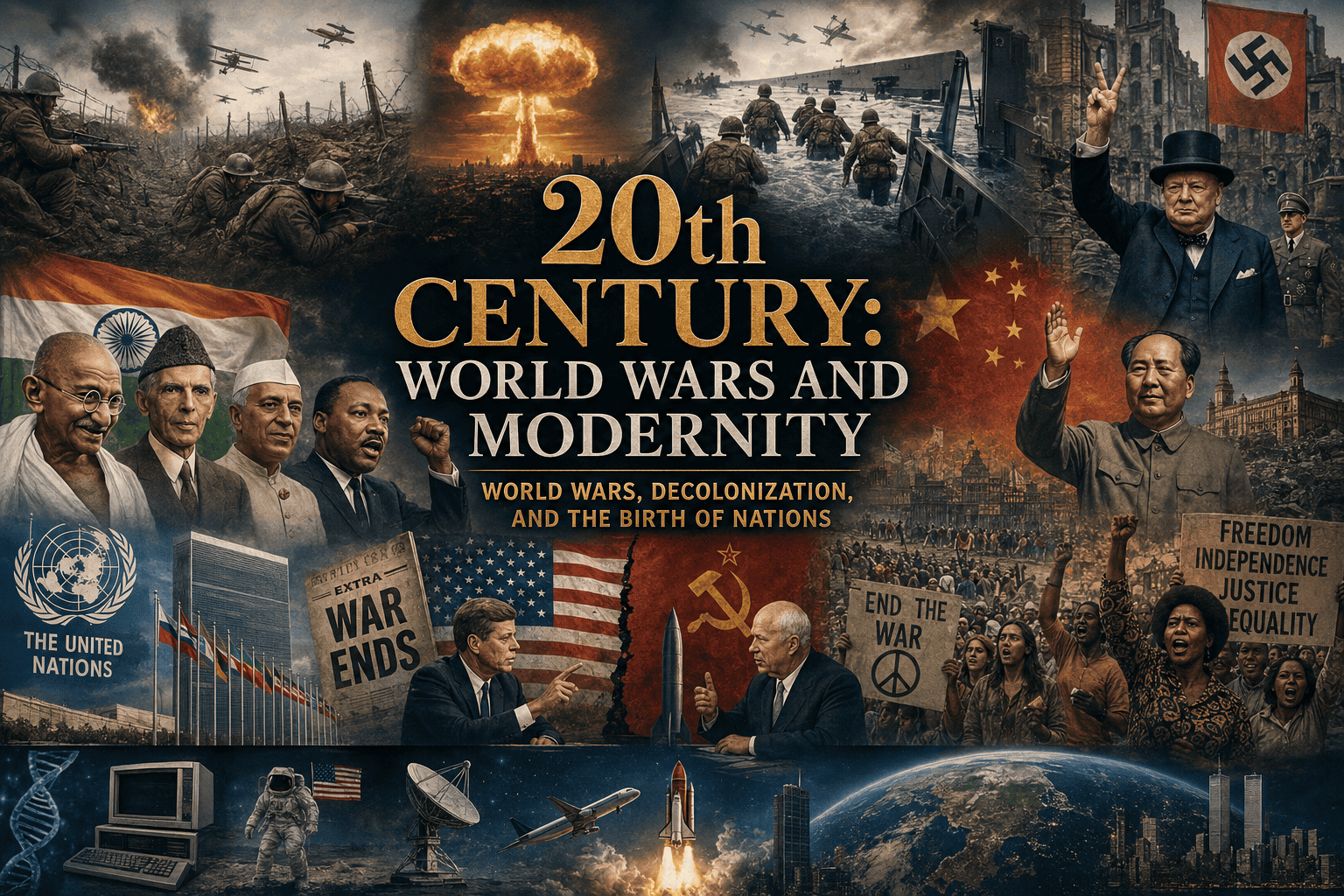
The 20th century was defined by two devastating world wars, as global conflict reshaped political boundaries, toppled empires, and led to the rise of new superpowers, most notably the United States and the Soviet Union in the post-war era. This period also saw dramatic ideological struggle during the Cold War, alongside the rapid pace of technological advancement — from the automobile and electricity to space travel and computing — that transformed daily life. Alongside these shifts, the century witnessed powerful movements for civil rights, decolonization across Africa and Asia, and the fall of communism, reshaping notions of freedom and self-determination worldwide. At its core, the 20th century reveals how devastating conflict and rapid innovation together forged the interconnected, modern world we live in today.
Content Overview
- The 20th Century (1901–2000 CE): World Wars, Decolonization, and the Birth of Nations
- CHAPTER 1 — Understanding the 20th Century
- CHAPTER 2 — World War I: The Great War (1914–1918)
- The World Before the War — The Armed Camp
- The Causes of World War I — MAIN Analysis in Full Detail
- The Spark — The Assassination of Archduke Franz Ferdinand
- The July Crisis—how a single assassination escalated into a world war
- The Western Front — Trenches, Gas, and Industrial Slaughter
- Key Battles of World War I
- The United States Enters the War (1917)
- The Russian Revolution and its effects on the war
- The End of the War and the Armistice (November 11, 1918)
- The Treaty of Versailles (1919) — Every Term Explained
- The Collapse of Empires
- CHAPTER 3 — The Interwar Period (1919–1939)
- CHAPTER 4 — World War II: Global Conflict and Aftermath (1939–1945)
- The War Begins — Poland Invaded (September 1, 1939)
- Blitzkrieg — Germany's Revolutionary War Method
- The Fall of France (May–June 1940)
- The Battle of Britain (July–October 1940)
- Operation Barbarossa — Germany Invades the Soviet Union (June 22, 1941)
- The Holocaust — The Most Systematic Genocide in History
- Pearl Harbor — Japan and America Enter the War
- D-Day—the Normandy invasion on June 6, 1944
- The Atomic Bombs — Hiroshima and Nagasaki
- The United Nations — Purpose, Structure, and Function
- CHAPTER 5 — The Cold War (1947–1991)
- What Was the Cold War?
- The Iron Curtain — Europe Divided
- The Truman Doctrine and Marshall Plan
- The Cuban Missile Crisis (October 1962) — The World's Most Dangerous Moment
- The Space Race — Sputnik to the Moon
- The Vietnam War (1955–1975) — Complete Account
- The Fall of the Berlin Wall (November 9, 1989) and the Collapse of the Soviet Union
- CHAPTER 6 — Decolonization and the Birth of New Nations
- CHAPTER 7 — Technological and Scientific Advancements
- Nuclear Science — From Theory to Bomb to Power
- The Manhattan Project — Scientists, Process, Decision
- Aviation — From the Wright Brothers to the Jet Age
- Computers — From ENIAC to Personal Computing
- The Internet — Origins and Development
- Medical Advances — Antibiotics, Vaccines, Surgery
- Apollo 11 — The Moon Landing: Complete Account
- CHAPTER 8 — Social and Cultural Changes
- CHAPTER 9 — Key Regional Stories
- CHAPTER 10 — Complete Decade-by-Decade Timeline (1901–2000)
- 1901–1910: The Edwardian Era and Rising Tensions
- 1911–1920: World War I and Revolution
- 1921–1930: The Roaring Twenties
- 1931–1940: Depression, Fascism, and War Begins
- 1941–1950: World War II and Decolonization Begins
- 1951–1960: Cold War and Independence Wave
- 1961–1970: Civil Rights, Space, and Vietnam
- 1971–1980: Détente, Oil Crisis, and Social Change
- 1981–1990: Reagan, Thatcher, and the Cold War's End
- 1991–2000: The Post-Cold War World
- CHAPTER 11 — Historical Mysteries
- CHAPTER 12 — Summary and Legacy of the 20th Century
The 20th Century (1901–2000 CE): World Wars, Decolonization, and the Birth of Nations
CHAPTER 1 — Understanding the 20th Century
Definition and Context
The 20th century covers the years from January 1, 1901 CE to December 31, 2000 CE. It was the final century of the second millennium CE, calculated according to the Gregorian calendar — the reformed solar calendar that Pope Gregory XIII had introduced in 1582 and that had become the standard calendar for international purposes by the 20th century. In Roman numerals, the century began in MCMI and ended in MM.
The 20th century was the most violent, the most technologically transformative, the most politically turbulent, and simultaneously the most scientifically productive century in human history. It began with empires covering most of the world — the British Empire controlling approximately a quarter of the Earth’s land surface, the French, Dutch, Belgian, and German colonial systems controlling most of the rest, and the Russian and Ottoman empires dominating vast Eurasian territories. By the century’s end, almost all of these empires had dissolved, replaced by approximately 200 independent nation-states.
It began with horses, candles, and telegraphs as primary technologies. It ended with the internet, nuclear power, genetic engineering, and human beings living in space. It began with most of humanity living in poverty in rural communities. It ended with the majority of the world’s population living in cities, with dramatically higher average life expectancy, literacy, and material living standards — though with scandalously unequal distribution of these improvements.
Most fundamentally, the 20th century produced the two most destructive wars in human history — World War I (approximately 20 million dead) and World War II (approximately 70–85 million dead) — and simultaneously developed the philosophical, institutional, and legal frameworks (the United Nations, the Universal Declaration of Human Rights, international humanitarian law) that represented humanity’s most serious attempt to prevent such catastrophes from recurring.
What Kind of World Existed in 1901 CE?
The world of 1901 was, in physical terms, recognizably connected to our own — railways, telegraphs, steamships, early automobiles, electric lights in cities — but its political and social organization was profoundly different.
In 1901, the British Empire — the largest empire in history — covered approximately 35 million square kilometers and governed approximately 412 million people (approximately 25% of the world’s population). Queen Victoria had just died (January 22, 1901) after a 63-year reign; her son Edward VII was King.
Germany, unified only in 1871, had become the leading land power in continental Europe, with the world’s fastest-growing industrial economy and a rapidly expanding navy that concerned Britain. The Kaiser Wilhelm II (who had dismissed Bismarck in 1890) was pursuing an aggressive foreign policy that was creating exactly the encirclement that Bismarck had spent his career preventing.
The United States was the world’s largest industrial economy but was not yet a global military power — it had emerged from the Spanish-American War (1898) with a small colonial empire but had not yet entered the European power competition.
Russia was the world’s largest country by land area — covering approximately one-sixth of the Earth’s land surface — but was politically unstable, industrializing unevenly, and was about to be shocked by its defeat to Japan in 1904–1905.
Japan — which had been a closed feudal society in 1853 — had, in less than 50 years, transformed into Asia’s first modern industrial power and had demonstrated at the Battle of Tsushima (1905) that it could defeat a European great power at sea.
China — the world’s most populous country — was in crisis. The Qing Dynasty was weak, humiliated by repeated foreign impositions, and facing internal pressures from reformers and revolutionaries. The Republic of China would be proclaimed in 1912; the Communist People’s Republic in 1949.
India — the world’s most populous colonial territory — was governed by the British Raj under Viceroy Lord Curzon. The Indian National Congress (founded 1885) was demanding greater political participation. Mohandas Gandhi was a young lawyer working in South Africa; Jawaharlal Nehru was an 11-year-old boy; Muhammad Ali Jinnah was a young law student in London.
CHAPTER 2 — World War I: The Great War (1914–1918)
The World Before the War — The Armed Camp
To understand why World War I happened, you must first understand the world that preceded it — the world of 1871 to 1914, which historians call the “Long Peace” because no major European war occurred in that period, but which was actually a period of accelerating military buildup, competitive alliance formation, and nationalist tension that made a major war increasingly likely.
After the Franco-Prussian War (1870–1871) and German unification, Europe organized itself into two competing alliance systems. Germany — allied with Austria-Hungary and Italy (the Triple Alliance) — faced France, Russia, and eventually Britain (the Triple Entente). Both alliances maintained large standing armies, invested heavily in military equipment, and developed detailed war plans.
The most dangerous of these plans was Germany’s Schlieffen Plan — a war-fighting strategy designed by Chief of Staff Alfred von Schlieffen in 1905 for a two-front war against France (in the west) and Russia (in the east). The plan called for rapidly defeating France in the west (by sweeping through Belgium, bypassing French border fortifications) and then transferring forces east to fight Russia, which was assumed to mobilize slowly. The plan’s rigid timetable — once mobilization began, it could not be stopped without chaos — made any European crisis extremely dangerous, because German military necessity would drive events regardless of diplomatic efforts.
The Causes of World War I — MAIN Analysis in Full Detail
Historians often explain the causes of World War I using the acronym MAIN—Militarism, Alliances, Imperialism, and Nationalism. Each deserves full explanation:
Militarism
By 1914, all major European powers maintained massive standing armies equipped with the latest weapons. Germany had increased its army from 420,000 in 1870 to approximately 2 million in 1914. The Anglo-German Naval Race — in which Germany’s Kaiser Wilhelm II deliberately challenged British naval supremacy by building a High Seas Fleet — was one of the most destabilizing developments of the pre-war period.
Britain’s 1889 “Two-Power Standard” required the Royal Navy to be at least as powerful as the next two navies combined. When Germany began building dreadnoughts (a new class of battleship made all previous battleships obsolete overnight when HMS Dreadnought was launched in 1906), Britain felt existentially threatened. The resulting naval arms race consumed enormous national resources and created a permanent sense of competitive hostility between Britain and Germany.
Military culture also permeated civilian society. In Germany, the army had enormous social prestige — wearing a military uniform was a mark of status; military virtues (discipline, hierarchy, obedience to authority) were celebrated in schools and literature. Similar patterns existed in France, Russia, and Austria-Hungary. Politicians who understood the dangers of war faced overwhelming cultural and military pressure to appear strong.
Alliances
The alliance system meant that a local conflict could rapidly become a continental or world war. If Austria-Hungary attacked Serbia, Russia (which considered itself the protector of Slavic peoples) would mobilize. If Russia mobilized, Germany (under the Schlieffen Plan) would need to attack France before attacking Russia. If Germany attacked France through Belgium, Britain (which had guaranteed Belgian neutrality since 1839) would enter the war.
The result was that the assassination of one man — Archduke Franz Ferdinand — in one city — Sarajevo — could within six weeks drag all the major European powers into war. The alliances had created a diplomatic hair trigger.
Imperialism
European powers competed aggressively for colonial territories — in Africa, Asia, and the Pacific. Each colonial acquisition by one power alarmed the others. The Moroccan Crises (1905 and 1911) — in which Germany challenged French control of Morocco — nearly produced war twice. The scramble for China’s markets and the Russo-Japanese War both reflected the same competitive imperialism.
Imperialism also generated wealth — which funded armaments. British colonial revenues paid for the Royal Navy; French colonial resources funded the Army. The connection between empire and military power made each power more jealous of the other’s colonial possessions.
Nationalism
Nationalism was the most explosive force in pre-war Europe — the conviction that peoples sharing language, culture, and ethnicity belonged in their own sovereign states. This force was simultaneously driving the breakup of multi-ethnic empires (the Ottoman Empire, the Austro-Hungarian Empire, the Russian Empire) and fueling aggressive foreign policies in unified nation-states (Germany, France, Italy).
Serbian nationalism was particularly dangerous for Austria-Hungary, which governed large Slavic populations (Serbs, Croats, Slovenes, Czechs, Slovaks, Poles, and others) who were inspired by Serbia’s example of successful Slavic independence. Serbian nationalist organizations — particularly the “Black Hand” (Ujedinjenje ili smrt — Union or Death) — were committed to uniting all Slavic peoples under Serbian leadership, which required destroying the Austro-Hungarian Empire.
Pan-Slavism — the idea that all Slavic peoples formed a natural community deserving Russian protection — was the Russian counterpart, providing Russia’s justification for intervening whenever Austria-Hungary threatened Serbian interests.
German nationalism expressed itself through demands for a “place in the sun” — colonial territories and great-power status commensurate with German economic strength. The German concept of Weltpolitik (World Policy) under Kaiser Wilhelm II was an aggressive assertion that Germany, as the dominant continental power, deserved global influence.
The Spark — The Assassination of Archduke Franz Ferdinand
Archduke Franz Ferdinand (1863–1914) was the heir presumptive to the Austro-Hungarian throne — the nephew of the aged Emperor Franz Joseph I (who had ruled since 1848). He was not a widely beloved figure — he was known for his reactionary politics, his quick temper, and his morganatic marriage (a marriage to a partner of unequal social rank) to Countess Sophie Chotek, who was not allowed to sit beside him at official Habsburg ceremonies.
On June 28, 1914 — the anniversary of the 1389 Battle of Kosovo, a date of deep symbolic significance for Serbian nationalists — Franz Ferdinand and Sophie visited Sarajevo, the capital of Bosnia-Herzegovina, which Austria-Hungary had annexed from the Ottoman Empire in 1908. The annexation was deeply resented by Serbian nationalists, who considered Bosnia a Slavic territory that should be part of Serbia.
A group of seven young Bosnian Serb nationalists — organized by the Black Hand — had positioned themselves along the route of Franz Ferdinand’s motorcade. The first attempt failed — one conspirator, Nedeljko Čabrinović, threw a bomb that bounced off the car and exploded under the following vehicle, injuring several people.
Franz Ferdinand continued to the city hall for the scheduled reception. After the ceremony, he insisted on visiting the people injured in the bombing at the hospital.His motorcade mistakenly turned onto Franz Josef Street, where Gavrilo Princip—one of the conspirators, who had nearly given up and was at a nearby delicatessen—saw the car slow to a stop just a few meters from him.
Gavrilo Princip (1894–1918) was a 19-year-old Bosnian Serb student — slight, sickly, deeply committed to South Slav nationalism. He stepped forward, drew his FN Model 1910 pistol, and fired two shots at a distance of approximately 1.5 meters. The first shot struck Franz Ferdinand in the jugular vein; the second struck Sophie in the abdomen. Both died within the hour.
Princip was immediately seized. He was too young for the death penalty under Austro-Hungarian law — he was sentenced to 20 years’ imprisonment and died of tuberculosis in prison in 1918, aged 23. His action had set in motion events that would kill approximately 20 million people.
The July Crisis—how a single assassination escalated into a world war
The six weeks between Franz Ferdinand’s assassination (June 28, 1914) and the outbreak of general war (early August 1914) constitute one of the most studied periods in diplomatic history — the “July Crisis,” in which the world’s leaders had multiple opportunities to step back from the brink and took none of them.
Austria-Hungary’s Response: The Austro-Hungarian government was determined to use the assassination as a pretext to crush Serbian nationalism permanently — knowing this might mean war with Russia but calculating (with German encouragement) that Russia was not yet ready for war. Austria-Hungary sent Serbia an ultimatum on July 23, 1914, containing demands so extreme (including the right for Austro-Hungarian officials to participate in Serbia’s internal judicial investigation) that they were designed to be rejected. Serbia accepted almost all demands but could not accept the sovereignty violations without ceasing to be an independent state. Austria-Hungary declared that unsatisfactory and declared war on Serbia on July 28, 1914.
The German “Blank Check”: Germany gave Austria-Hungary a “blank check” — unconditional support for whatever action Austria-Hungary took against Serbia — on July 5–6, 1914. Kaiser Wilhelm II and his Chancellor Bethmann Hollweg calculated that either the conflict could be localized (Russia would back down) or, if Russia intervened, Germany would fight from a position of advantage. It was a catastrophic miscalculation.
Russia’s Mobilization: Russia, alarmed by Austria-Hungary’s declaration of war against Serbia, began mobilization on July 30, 1914. Tsar Nicholas II was briefly persuaded by the Kaiser (they were cousins, both grandchildren of Queen Victoria) to limit mobilization — but his military commanders insisted that a partial mobilization was technically impossible. Full mobilization was ordered.
The Schlieffen Plan Takes Over: Germany declared war on Russia (August 1), then on France (August 3), and immediately began implementing the Schlieffen Plan — attacking France through neutral Belgium. Britain, which had guaranteed Belgian neutrality in the 1839 Treaty of London, declared war on Germany on August 4, 1914 — the day German troops crossed the Belgian border.
Within 37 days of the assassination in Sarajevo, all the major powers of Europe were at war.
The Western Front — Trenches, Gas, and Industrial Slaughter
The Western Front was the most important military theater of World War I — a line of fortified trenches that extended approximately 700 kilometers from the Swiss border in the south to the English Channel in the north, where French and British forces faced German forces across a “No Man’s Land” of shell-cratered, barbed-wire-strewn wasteland.
The trench system was not planned or designed — it was the product of military necessity. When the Schlieffen Plan’s rapid victory in France failed (German advance stopped at the First Battle of the Marne, September 5–12, 1914), both sides “dug in” to avoid being outflanked. Within weeks, a continuous line of trenches stretched the entire length of the front. For the next four years, this line barely moved — at enormous cost.
Why the Trenches Were So Deadly:
The defense had overwhelming advantages over the offense on the Western Front. The machine gun — which could fire 600 rounds per minute and required only a small crew — could stop an infantry advance in its tracks. Barbed wire slowed attacking infantry to a crawl in front of machine gun positions. Artillery shells that fell short (from either side) cratered No Man’s Land and made movement across it almost impossibly dangerous. Attacking infantry had to advance across this open ground on foot, while defenders fired from protected positions.
The result was that attacks — even attacks preceded by days or weeks of artillery bombardment designed to destroy the defenders’ positions — almost always failed with catastrophic losses. The artillery bombardment warned the defenders; when the bombardment stopped, defenders came up from deep bunkers and manned their positions just as the attacking infantry began crossing No Man’s Land.
Conditions in the Trenches:
Living in the trenches was a prolonged misery of mud, rats, lice, waterlogged feet, constant cold or heat (depending on season), the stench of decomposing bodies in No Man’s Land, constant artillery bombardment, and the psychological terror of knowing that any day might bring the order to “go over the top” — to climb out of the trench and advance across No Man’s Land.
“Shell shock” — now recognized as post-traumatic stress disorder (PTSD) — afflicted hundreds of thousands of soldiers. Men broke down, became unable to speak, trembled uncontrollably, or were completely paralyzed. British military authorities initially treated shell shock as cowardice or weakness — some men were court-martialed and even shot for “cowardice” that was in fact psychological injury from combat stress.
Trench foot — a fungal infection caused by prolonged exposure to cold, wet conditions — was endemic. Rats, feeding on corpses, infested the trenches. Lice were universal — every soldier carried them.
Key Battles of World War I
The Battle of Verdun (February 21 – December 18, 1916)
The Battle of Verdun was planned by German Chief of Staff Erich von Falkenhayn not to capture the fortress city, but to wear down France by drawing its forces into a prolonged battle of attrition and inflicting heavy losses. Falkenhayn called his strategy “bleeding to death” (verbluten) — recognizing that the French, with emotional attachment to Verdun as a symbol of national resistance, would sacrifice any number of men rather than surrender it.
The battle lasted 303 days — the longest single battle of the war. The German attack on February 21, 1916 used the heaviest artillery bombardment in history to that point — approximately 1,200 guns firing 2 million shells in a single day. The French line, shocked by the intensity of the bombardment, nearly broke at the opening.
France rotated approximately 259 of its 330 infantry divisions through Verdun during the battle — giving virtually every French soldier the experience of this particular hell. The Battle of Verdun became the defining trauma of 20th-century French national consciousness — the sacrifice and suffering at Verdun shaped French politics, culture, and military doctrine for generations.
Total casualties: approximately 700,000 (approximately 377,000 French and 337,000 German) — killed, wounded, and missing. The territorial gain: negligible.
The Battle of the Somme (July 1 – November 18, 1916)
The Battle of the Somme was launched by the British (with French support) partly to relieve pressure on the French at Verdun and partly as part of the planned 1916 Allied offensive. The British army — supplemented by volunteers of Kitchener’s “New Army” (the mass volunteer army raised after 1914) — had prepared for the battle with a week-long artillery bombardment of the German positions, expending approximately 1.5 million shells.
The British command believed the bombardment had destroyed the German defenses. They were catastrophically wrong. German troops had dug deep bunkers (up to 12 meters underground) that sheltered them from the bombardment. When the artillery stopped — signaling the infantry attack — the Germans climbed out and manned their machine gun positions before the British infantry had crossed No Man’s Land.
July 1, 1916 remains the bloodiest single day in British military history. In one day, the British Army suffered approximately 57,470 casualties — including approximately 19,240 killed. Some units were virtually annihilated — the 1st Newfoundland Regiment suffered over 700 casualties (killed and wounded) out of approximately 800 men who attacked that morning, in about 30 minutes.
The battle continued for 141 days. Total casualties: approximately 1.1 million (420,000 British, 200,000 French, 500,000 German). Territory gained: approximately 12 kilometers at the deepest penetration.
New Technologies of World War I
Poison Gas: First used by Germany at the Second Battle of Ypres (April 22, 1915) — chlorine gas released from cylinders was carried by the wind toward French and Algerian positions, producing a yellow-green cloud that caused choking, burning, and death. The initial attack broke the Allied line but German troops had not been prepared to exploit the gap. Both sides then developed and used multiple chemical agents:
Chlorine: choking agent, suffocating the victim. Phosgene: more dangerous than chlorine, responsible for approximately 80% of chemical warfare deaths in the war, because it often only produced symptoms 24–48 hours after exposure. Mustard Gas (dichlorodiethyl sulfide): the most feared chemical weapon — not an immediate killer but a persistent blister agent that caused enormous suffering. Mustard gas soaked into clothing and equipment, persisting for days. It caused large blisters on exposed skin, in the lungs, and most horrifyingly, in the eyes — causing temporary or permanent blindness. Approximately 90% of mustard gas casualties survived, but many were blinded or permanently disabled.
Both sides eventually equipped their soldiers with gas masks — initially improvised (cotton pads soaked in sodium thiosulfate solution) and later sophisticated rubber masks with filter canisters. Chemical weapons caused approximately 1.3 million casualties in World War I (of which approximately 90,000 were fatal), and the psychological impact — the terror of gas attacks — was enormous.
Tanks: The British developed the tank as a solution to the problem of crossing No Man’s Land under machine gun fire. The idea was simple: a vehicle armored against small arms fire that could cross trenches, crush barbed wire, and advance ahead of infantry. The execution was remarkably rapid — from initial concept (1915) to first battlefield use (September 15, 1916, at the Somme) took less than two years.
The first tanks were mechanically unreliable, slow (approximately 6 km/h), and extremely hot and fume-filled for their crews. But their psychological impact on German infantry who had never seen such machines was enormous. At the Battle of Cambrai (November 20–30, 1917), approximately 476 tanks were used in mass for the first time, achieving the largest single-day advance on the Western Front. Though initial gains were lost, Cambrai demonstrated the tank’s potential.
Aircraft: The first sustained military use of aircraft in history occurred in World War I. Aircraft developed from unarmed reconnaissance platforms (1914) to armed fighters (1915) to strategic bombers (1917) in just three years. The “aces” — fighter pilots who achieved five or more aerial victories — became the war’s first celebrities: the German Manfred von Richthofen (“the Red Baron,” 80 aerial victories), the Frenchman René Fonck (75), the British ace Edward Mannock (61).
Submarines: Germany’s U-boat (Unterseeboot — submarine) campaign nearly brought Britain to defeat. Britain depended on maritime trade for food and raw materials. German submarines targeted merchant ships bringing supplies to Britain — sinking 1,400 ships (approximately 3 million tonnes) in 1917 alone. By April 1917, Britain had approximately six weeks of food supplies remaining. The introduction of the convoy system — merchant ships sailing in groups protected by warships — dramatically reduced losses and was one of the decisive strategic developments of the war.
The sinking of RMS Lusitania (May 7, 1915) — a British passenger liner torpedoed off the Irish coast, killing 1,198 of 1,959 passengers including 128 Americans — turned American public opinion against Germany. Unrestricted submarine warfare (attacking any ship in a declared war zone, regardless of nationality) ultimately contributed to American entry into the war in April 1917.
The United States Enters the War (1917)
The United States had maintained official neutrality since 1914 under President Woodrow Wilson. American public opinion was divided — millions of Americans had German or Austro-Hungarian ancestry; many had Irish ancestry and were hostile to Britain; and many simply saw the war as a European quarrel that Americans had no reason to join.
Several factors pushed the United States toward war:
The Zimmermann Telegram (January 1917): Germany’s Foreign Secretary Arthur Zimmermann sent a secret telegram to the German ambassador in Mexico, instructing him to propose a military alliance between Germany and Mexico if the United States entered the war — with Mexico to receive Texas, New Mexico, and Arizona as reward. British intelligence intercepted and decoded the telegram and passed it to the Americans. Its publication in American newspapers caused outrage.
Unrestricted Submarine Warfare: Germany resumed unrestricted submarine warfare in February 1917 — announcing that it would sink any ship (including neutral American vessels) in the war zone around Britain. This directly threatened American lives and commerce.
The Russian Revolution: When Russia’s February Revolution (March 1917) overthrew the Tsar and established a provisional government, Wilson could now describe the war as a conflict between democracy and autocracy — removing the awkward fact that Britain’s autocratic Tsarist ally was one of the Entente’s main members.
Wilson requested a declaration of war from Congress on April 2, 1917, and Congress approved it on April 6, 1917.
The American Expeditionary Forces (AEF) under General John “Black Jack” Pershing — eventually growing to approximately 2 million soldiers in France — arrived too slowly to affect the war’s critical moments but provided fresh troops that reinforced the Allies as Germany launched its final desperate offensives in spring 1918.
The Russian Revolution and its effects on the war
The Russian Revolution of 1917 had two phases that both affected the war directly:
The February Revolution (March 1917 — the dates differ because Russia still used the Julian Calendar): The collapse of Tsarist Russia was triggered by a combination of military defeats (the war had cost Russia approximately 1.8 million dead and 5 million wounded by 1917), food shortages in cities, and complete loss of confidence in Tsar Nicholas II’s government.Bread riots in Petrograd (the renamed St. Petersburg) in late February 1917 grew into widespread strikes and eventually led to mutiny within the Petrograd garrison. The Tsar abdicated on March 2/15, 1917. A Provisional Government was formed by liberal politicians.
The Provisional Government made the fateful decision to continue fighting the war — partly from obligation to the Allies, partly from nationalist sentiment, and partly because the liberal politicians believed Russia needed to demonstrate its reliability as a democratic ally. This decision — deeply unpopular with soldiers and workers who wanted peace — undermined the Provisional Government’s legitimacy.
The October Revolution (November 1917): The Bolshevik party — led by Vladimir Lenin (1870–1924) — seized power in Petrograd on October 25–26 (November 7–8) 1917. Lenin had returned to Russia from Swiss exile in April 1917, transported by the German government in a sealed train — Germany calculated that a Bolshevik government would take Russia out of the war. This calculation proved correct. The Bolsheviks pledged “peace, land, and bread,” and their first action was to secure peace.
The Treaty of Brest-Litovsk (March 3, 1918) — negotiated by the new Bolshevik Foreign Commissar Leon Trotsky — took Russia out of the war at an enormous territorial price: Russia ceded Finland, Estonia, Latvia, Lithuania, Poland, Ukraine, and parts of the Caucasus — approximately 1.3 million square kilometers of territory. Germany could now transfer approximately 1 million soldiers from the Eastern Front to the West for its final offensives.
The End of the War and the Armistice (November 11, 1918)
By the summer of 1918, Germany was in crisis. The Ludendorff Offensives (Spring 1918) — Germany’s desperate attempt to win the war before American troops arrived in overwhelming numbers — had made significant territorial advances but at the cost of Germany’s best remaining troops and with insufficient resources to exploit the breakthroughs.
The Hundred Days Offensive — the Allied counterattack beginning August 8, 1918 (the “Black Day of the German Army,” as General Ludendorff called it) — used combined arms tactics (infantry, artillery, tanks, and aircraft working together in coordinated attacks) that were genuinely new in the war. The German army retreated, lost cohesion, and stopped fighting effectively. German soldiers surrendered in large numbers.
At home, Germany was in revolution. The Kiel Mutiny (October 29, 1918) — when German sailors mutinied rather than sail on a suicide mission against the British fleet — triggered a revolutionary wave. Kaiser Wilhelm II stepped down from the throne on November 9, 1918. A German Republic was proclaimed.
The Armistice was signed at 5:10 AM on November 11, 1918, in a railway carriage in the Compiègne Forest — and took effect at 11:00 AM (the eleventh hour of the eleventh day of the eleventh month). Fighting continued until the last moment — approximately 11,000 men were killed or wounded on the last day of the war, after the armistice had been signed but before it took effect.
Total death toll of World War I: approximately 9–11 million military dead and 7–10 million civilian dead — approximately 17–20 million total. Additional deaths from the 1918 Spanish Flu pandemic (which spread rapidly along military supply lines and killed approximately 50–100 million worldwide) brought the total mortality associated with the war period to perhaps 70–80 million.
The Treaty of Versailles (1919) — Every Term Explained
The Paris Peace Conference opened on January 18, 1919 — in the Hall of Mirrors at Versailles, exactly 48 years after the German Empire had been proclaimed in the same room. The conference was dominated by the “Big Four”: Woodrow Wilson (United States), David Lloyd George (Britain), Georges Clemenceau (France), and Vittorio Orlando (Italy). Germany and its allies were not permitted to attend as negotiating parties — they were summoned only to receive the terms.
The “War Guilt” Clause (Article 231): Germany and its allies were required to accept complete responsibility for causing the war “by the aggression of Germany and her allies.” This “war guilt clause” was the moral and legal foundation for all the financial penalties imposed. Germans considered it profoundly unjust — they believed the war had been caused by all the great powers’ failures. The resentment generated by Article 231 became one of Hitler’s most effective propaganda tools.
Reparations: Germany was obligated to compensate for all civilian damages resulting from the war.The amount was set by the Reparations Commission in 1921 at 132 billion gold marks (approximately $33 billion — roughly $500 billion in modern terms). The economic burden was not actually as impossible as German propagandists claimed, but the political symbolism was devastating. Germany did make some payments in the early 1920s but defaulted in 1923, triggering the French occupation of the Ruhr industrial region, which contributed to the hyperinflation crisis of 1923 that wiped out German middle-class savings.
Territorial Changes: Germany lost approximately 13% of its territory and 10% of its population. Alsace-Lorraine was returned to France (as expected and accepted). The Rhineland was demilitarized. The Saarland was placed under League of Nations administration for 15 years. Germany’s overseas colonies were distributed as “League of Nations mandates” to Britain, France, Japan, Australia, South Africa, and New Zealand. The Polish Corridor — a strip of territory connecting Poland to the Baltic Sea — was created by giving Germany’s eastern territories to the new Polish state, separating East Prussia from the German mainland.
Military Restrictions: Germany’s army was limited to 100,000 volunteers; no conscript army was permitted. The German navy was restricted to six battleships, six cruisers, and twelve destroyers, with submarines completely prohibited.The German air force was abolished. The General Staff — the planning and operational brain of the German military — was disbanded.
The League of Nations: Wilson’s Fourteen Points — the American war aims articulated in January 1918 — included the creation of a League of Nations, a permanent international organization to maintain peace through collective security. The League was established as part of the Versailles Treaty. The great irony: the United States Senate refused to ratify the Treaty of Versailles (and therefore did not join the League) — largely because Senate Republicans opposed the Covenant’s collective security provisions as a threat to American sovereignty. The League functioned from 1920 to 1946 without its most important potential member.
The Collapse of Empires
World War I destroyed four empires:
The German Empire: Kaiser Wilhelm II abdicated on November 9, 1918. The Weimar Republic was proclaimed. Germany lost its colonies and significant European territory.
The Austro-Hungarian Empire: Emperor Karl I abdicated on November 11, 1918. The empire collapsed into multiple successor states: Austria, Hungary, Czechoslovakia, Yugoslavia (the Kingdom of Serbs, Croats, and Slovenes), and ceded territories to Romania, Poland, and Italy.
The Ottoman Empire: The defeated Ottoman Empire was dismembered. Anatolia (modern Turkey) was occupied by British, French, Greek, Italian, and Armenian forces under the Treaty of Sèvres (1920). The subsequent Turkish War of Independence (1919–1923) under Mustafa Kemal (later Atatürk) expelled the occupiers and established the Republic of Turkey. The Arab territories of the Ottoman Empire became British and French “Mandates” — effectively colonies — under League of Nations authorization: Britain received Iraq, Palestine, and Transjordan; France received Syria and Lebanon.
The Russian Empire: The Bolshevik revolution replaced the Tsarist empire with the Soviet state. Finland, Estonia, Latvia, Lithuania, and Poland — all previously part of the Russian Empire — became independent states. The Bolsheviks fought a brutal Civil War (1917–1922) against the White armies (royalists, liberals, and various nationalist forces), emerging victorious to establish the Union of Soviet Socialist Republics (USSR) in 1922.
CHAPTER 3 — The Interwar Period (1919–1939)
The Great Depression — The Economic Catastrophe
The Wall Street Crash of October 1929 — when American stock market prices collapsed dramatically over several days — triggered the Great Depression, the worst economic crisis in the history of industrial capitalism. The Dow Jones Industrial Average fell from 381 in September 1929 to 41 in July 1932 — a decline of approximately 89%. American banks failed in large numbers; the money supply contracted; unemployment rose to approximately 25% of the workforce.
The Depression spread globally through interconnected financial and trade systems. The Smoot-Hawley Tariff Act (1930) — which dramatically raised American import duties — triggered retaliatory tariffs from trading partners and collapsed global trade. Industrial production fell approximately 50% in the United States, Germany, and other major economies. Unemployment reached 30–33% in Germany.
The political consequences were catastrophic. In Germany — already humiliated by Versailles, devastated by the 1923 hyperinflation, and now suffering 30% unemployment — the economic crisis provided the conditions in which extremist politics could thrive. The Nazi Party’s vote share rose from 2.6% in 1928 to 37.4% in July 1932 — the largest single electoral gain in German history — largely as a result of the Depression.
The Rise of Adolf Hitler — Complete Account
Adolf Hitler (1889–1945) was born in Braunau am Inn, Austria — a small town on the German-Austrian border — on April 20, 1889. His father Alois Hitler was a customs official; his mother Klara was devoted to him. He was a mediocre student who dropped out of school at 16, aspiring to be an artist. He applied twice to the Vienna Academy of Fine Arts and was rejected both times. He lived in Vienna from 1907 to 1913 as a failed artist — selling painted postcards, living in homeless shelters, and developing the rabid anti-Semitism and pan-German nationalism that would define his political career.
He moved to Munich in 1913 and when war broke out in 1914, enlisted enthusiastically in the Bavarian Army. He served as a corporal and dispatch runner — a dangerous role that brought him into constant combat; he was awarded the Iron Cross First Class (an unusual decoration for a corporal, suggesting genuine courage) and the Iron Cross Second Class. The defeat of 1918 — which he experienced in a military hospital, temporarily blinded by a British gas attack — was a profound trauma. He refused to believe Germany had been genuinely defeated; instead, he accepted the “stab-in-the-back” myth (Dolchstoßlegende) — the claim that Germany had been betrayed from within by Jews, Communists, and socialists while its armies remained unbeaten in the field. This myth was false (Germany’s army was genuinely beaten in 1918) but psychologically compelling to millions of Germans seeking someone to blame.
Hitler returned to Munich and was employed by the German Army as an intelligence agent monitoring political parties. In 1919, he was assigned to investigate the tiny German Workers’ Party (Deutsche Arbeiterpartei) and found himself agreeing with its nationalist and anti-Semitic program — and discovering he was a gifted public speaker. He joined the party and rapidly became its dominant personality. He renamed it the Nationalsozialistische Deutsche Arbeiterpartei (National Socialist German Workers’ Party — NSDAP, or Nazis) and designed its iconography including the swastika flag.
The Munich Putsch (November 8–9, 1923): Inspired by Mussolini’s successful March on Rome (October 1922), Hitler attempted to seize power in Bavaria and then march on Berlin. The putsch failed when Bavarian police opened fire on the marchers, killing 16 Nazis. Hitler was arrested, tried for treason, and sentenced to five years in Landsberg Prison (of which he served only nine months). In prison, he dictated Mein Kampf (My Struggle) to his deputy Rudolf Hess — a rambling but revealing document that laid out his ideology: extreme German nationalism, virulent anti-Semitism, the demand for Lebensraum in the east and his firm belief that he was destined to rescue Germany.
The Legal Road to Power (1930–1933): After the failed putsch, Hitler decided to pursue power through elections. The Depression gave him his opportunity. From 2.6% of the vote in 1928, the Nazi Party rose to 37.4% in July 1932 — the largest single party in the Reichstag.
German President Paul von Hindenburg — an 84-year-old Field Marshal who despised Hitler as a “Bohemian corporal” — twice refused to appoint him Chancellor. After the November 1932 elections (in which the Nazi vote fell to 33.1%), a group of conservative German politicians — most notably former Chancellor Franz von Papen — convinced Hindenburg that they could use Hitler as a tool, that they could control him in a coalition government. They were catastrophically wrong.
On January 30, 1933, Adolf Hitler became Chancellor of Germany. Within weeks, the Reichstag building burned (February 27, 1933 — whether set by the Dutch Communist Marinus van der Lubbe, acting alone as he claimed, or by the Nazis themselves as a pretext, remains historically disputed). Hitler used the fire to declare a state of emergency and suspend civil liberties. The Enabling Act (March 23, 1933) gave Hitler the power to rule by decree for four years — effectively ending parliamentary governance. When Hindenburg died in August 1934, Hitler merged the offices of President and Chancellor, making himself Führer (Leader) of Germany.
The Holocaust — Germany’s Systematic Genocide
We discuss the Holocaust in detail in Chapter 4. Here, in the context of the interwar period, it is important to note that the genocide did not begin suddenly — it was the culmination of years of increasingly radical persecution:
1933: Jews boycotted, dismissed from civil service. 1935: Nuremberg Laws stripped Jews of citizenship and prohibited marriage between Jews and non-Jews. 1938: Kristallnacht (November 9–10) — a nationwide pogrom in which approximately 7,500 Jewish businesses were destroyed, approximately 1,400 synagogues burned, and approximately 30,000 Jewish men arrested and sent to concentration camps.
The Holocaust’s escalation from discrimination to genocide occurred during World War II — discussed in Chapter 4.
CHAPTER 4 — World War II: Global Conflict and Aftermath (1939–1945)
The War Begins — Poland Invaded (September 1, 1939)
At 4:45 AM on September 1, 1939, German forces — approximately 1.5 million soldiers organized in 62 divisions — crossed into Poland from the north, west, and south simultaneously. The invasion had been anticipated but the speed and coordination of the German attack exceeded even German expectations. The German Luftwaffe (air force) attacked Polish air bases at dawn, destroying most of the Polish Air Force on the ground.
On September 3, 1939, Britain and France declared war on Germany — honoring their guarantees to Poland. World War II had begun.
Blitzkrieg — Germany’s Revolutionary War Method
Blitzkrieg (German: “lightning war”) was not a formal doctrine developed before the war — it was a style of warfare that emerged from the combination of German tactical excellence and new weapons technology.
The key elements of Blitzkrieg were:
Combined Arms Integration: Rather than using tanks, aircraft, artillery, and infantry separately (as most armies did), the Germans integrated them into a coordinated assault. Tanks broke through enemy lines; aircraft (especially the Junkers Ju 87 “Stuka” dive-bomber, with its screaming sirens) attacked artillery positions, supply lines, and communication centers; mobile infantry in trucks and armored vehicles exploited the breakthrough; artillery suppressed defenders.
Speed and Exploitation: Traditional offensive doctrine sought to destroy the enemy’s front-line forces. Blitzkrieg sought to bypass and encircle them — going deep into the enemy rear to destroy headquarters, supply depots, and communication centers. Once the enemy’s command structure and logistics were destroyed, its front-line forces would surrender without needing to be individually defeated.
Psychological Shock: Speed itself was a weapon. Troops appearing from unexpected directions, command posts destroyed, communications cut, confused orders — the shock of Blitzkrieg paralyzed defenders who could not understand what was happening.
Poland was conquered in approximately five weeks. France — expected by most military experts to resist Germany effectively, given the power of the French Army and the defensive strength of the Maginot Line — fell in six weeks.
The Fall of France (May–June 1940)
The fall of France in just six weeks (May 10 – June 22, 1940) was one of the most shocking military collapses in modern history. France had the largest army in Western Europe, had built the famous Maginot Line of fortifications along its German border, and had a tactical military doctrine that most experts considered sound.
Germany’s Manstein Plan exploited a weakness in Allied thinking: the Allies expected the main German attack to come through Belgium (as in 1914), and positioned their best forces there. The German attack through Belgium was indeed launched — but it was a feint. The main German armored thrust came through the Ardennes Forest — terrain that Allied planners had deemed impassable for armored vehicles — emerging at Sedan on the Meuse River on May 13, 1940. The French forces in this sector were second-rate; the breakthrough was rapid and decisive.
German armor raced for the English Channel — not turning north or south to attack French forces but driving straight west. Within days, the Allied armies in Belgium were encircled. The evacuation at Dunkirk (Operation Dynamo, May 26–June 4, 1940) saved about 338,000 British and Allied troops through a remarkable effort involving naval and civilian vessels, though most of their equipment was left behind.
France surrendered on June 22, 1940. The armistice was signed in the same railway carriage at Compiègne where Germany had signed the 1918 Armistice — a deliberate German humiliation. Germany occupied northern France and the Atlantic coast; a collaborationist French government under Marshal Philippe Pétain governed southern France from the town of Vichy.
The Battle of Britain (July–October 1940)
With France defeated and Britain isolated, Hitler expected Britain to seek terms. Winston Churchill — who had replaced Neville Chamberlain as Prime Minister on May 10, 1940 — refused. His speeches to Parliament (“We shall fight on the beaches…we shall never surrender”) and to the British people were extraordinary acts of rhetorical leadership that maintained British resolve at the war’s most desperate moment.
To invade Britain (Operation Sea Lion), Germany needed air superiority over the English Channel and southern England. The Luftwaffe began its campaign to destroy the Royal Air Force.
The Battle of Britain (July 10 – October 31, 1940) was the first major military campaign fought entirely by air forces. The Royal Air Force Fighter Command — approximately 650 operational fighters at the battle’s start — faced the Luftwaffe’s approximately 2,600 aircraft (fighters and bombers). Key advantages for Britain: radar (which gave early warning of incoming attacks), the Hurricane and Spitfire fighters (comparable to the best German aircraft), and fighting over home territory (British pilots who were shot down could return to their squadrons; German pilots who bailed out over Britain were captured).
Germany came close to winning. In August 1940, sustained attacks on radar stations and RAF airfields were seriously damaging British air defenses. Then on September 7, 1940, Germany switched its attacks from airfields to London — beginning the “Blitz” that killed approximately 43,000 British civilians over the following months. The switch was strategic error: it gave the RAF time to recover. The sustained attacks on London hardened British civilian resolve.
By October 1940, the Luftwaffe had failed to achieve air superiority. Operation Sea Lion was postponed indefinitely. Churchill’s famous tribute: “Never in the field of human conflict was so much owed by so many to so few.”
Operation Barbarossa — Germany Invades the Soviet Union (June 22, 1941)
At 3:15 AM on June 22, 1941, Germany launched Operation Barbarossa — the invasion of the Soviet Union — with 3.8 million Axis soldiers (the largest invasion force ever assembled), 3,600 tanks, and 2,700 aircraft attacking along a front of approximately 2,900 kilometers. It was the largest military operation ever conducted.
Hitler’s ideological motivations were explicit: he sought Lebensraum (living space) for German settlement, the destruction of “Judeo-Bolshevism” (his conflation of Jews and Communism), and the exploitation of Soviet agricultural and mineral resources. The war in the East was conceived from the beginning as a war of extermination — not a conventional war between states but a racial war of annihilation. German soldiers were not required to observe the Geneva Conventions when dealing with Soviet soldiers or civilians.
The initial German advance was staggering in its success. In the first three months, German forces destroyed three Soviet army groups, captured approximately 3 million Soviet soldiers, occupied Ukraine, White Russia (Belarus), the Baltic states, and advanced to the outskirts of Moscow and Leningrad.
But the Soviet Union did not collapse. Several factors combined to stabilize the front:
Soviet manpower reserves were enormous — the USSR had a population of approximately 170 million. Stalin’s industrial relocation program — moving entire factories eastward beyond the Ural Mountains, out of reach of German bombing — preserved Soviet industrial capacity. The brutal Soviet defensive resistance, even in hopeless situations, slowed the German advance. The Russian winter — which arrived early and severely in 1941 — stopped the German advance before Moscow. German soldiers, expected to fight a summer campaign, had not been issued winter clothing.
The siege of Leningrad (September 1941 – January 1944 — 872 days) killed approximately 800,000 Leningrad civilians from starvation, cold, and bombardment — the longest and most destructive siege in modern warfare. The city never surrendered.
The Holocaust — The Most Systematic Genocide in History
The Holocaust (from the Greek “holokauston,” meaning burnt offering) — the systematic, state-organized murder of European Jews and others — was conceived, planned, and executed by the Nazi German state between 1933 and 1945.Its main victims were Jewish people—about 6 million killed, roughly two-thirds of Europe’s Jewish population. Other victims included: Roma and Sinti people (approximately 500,000–1.5 million killed), disabled people (approximately 200,000–300,000 killed in the T4 “euthanasia” program), Soviet civilians and prisoners of war (approximately 3–3.5 million Soviet POWs killed), Polish non-Jewish civilians (approximately 1.8 million), Jehovah’s Witnesses, gay men, political opponents, and others.
Phase One — Persecution and Expulsion (1933–1939)
As described in Chapter 3, the Nazi regime progressively stripped German Jews of their rights, livelihoods, and eventually their citizenship. The goal in this phase was forced emigration — Jews should leave Germany. Approximately 300,000 German Jews (of approximately 500,000 before 1933) emigrated. However, most countries were unwilling to accept Jewish refugees—the Evian Conference of 1938, convened by President Roosevelt to address the crisis, resulted in no firm commitments to expand immigration quotas.
Phase Two — Ghettoization (1939–1941)
With the conquest of Poland (1939), Germany suddenly ruled over approximately 3.5 million Polish Jews — far too many to expel. The Nazi response was concentration — forcing Jews into designated sections of cities called ghettos, sealed off from the rest of the population and subject to controlled food supplies designed to maintain only minimal survival.
The Warsaw Ghetto was the largest — at its peak, approximately 400,000 Jews were confined in an area of approximately 3.5 square kilometers — 9.2 people per room. Food rations were set at approximately 253 calories per day (the minimum for human survival is approximately 2,000). Disease—especially typhus—and starvation claimed the lives of around 100,000 inhabitants of the Warsaw Ghetto before Nazi deportations began.
Phase Three — Mobile Killing Units (1941)
With the invasion of the Soviet Union in June 1941, Nazi policy shifted from concentrating Jews to killing them. The Einsatzgruppen — mobile killing units of SS and police personnel, following behind the advancing German army — were tasked with killing all Jews in the occupied Soviet territories.
The Einsatzgruppen carried out mass shootings across Ukraine, Belarus, the Baltic states, and Russia. The most notorious single massacre was at Babi Yar — a ravine outside Kiev, Ukraine. On September 29–30, 1941, approximately 33,771 Jews were marched to the ravine, forced to undress, and shot. The entire operation took approximately 36 hours. Over the following months, approximately 100,000 more people (primarily Jews but also Roma and Soviet POWs) were shot at Babi Yar. The site was used as an execution ground until 1943; the total number killed there is approximately 150,000–200,000.
The Einsatzgruppen killed about 1.5 million Jews during this phase through mass shootings, drownings, and the use of mobile gas vans.
Phase Four — The “Final Solution” and the Death Camps (1942–1945)
At the Wannsee Conference on January 20, 1942, senior Nazi officials met in a villa near Berlin to coordinate the implementation of the “Final Solution,” the plan to systematically murder Europe’s Jewish population. Chaired by Reinhard Heydrich, the meeting brought together representatives from the SS, the Nazi Party, and various government ministries, focusing on organizing and managing a policy that had already been decided.
Six dedicated death camps — all located in German-occupied Poland — were established for industrial-scale murder:
Auschwitz-Birkenau (combined concentration camp and death camp, established 1940 and 1942 respectively) was the largest, killing approximately 1.1–1.5 million people — the majority Jewish but also Roma, Soviet POWs, Polish political prisoners, and others. Jews arriving by train were subjected to “selection” on the Auschwitz-Birkenau ramp: SS doctors (including the notorious Josef Mengele, “the Angel of Death”) decided who was fit for slave labor and who would be killed immediately. Those selected for death — typically the elderly, children under 14, pregnant women, and anyone who appeared unfit for hard labor — were told they were going to shower and be deloused. They were led into large rooms labeled “shower rooms” and murdered with Zyklon B (hydrogen cyanide gas). Those selected for labor were worked, starved, and experimented on until they died.
Treblinka, Sobibor, and Bełżec were pure extermination camps — there was no selection, no labor component. Everyone who arrived was usually killed within a few hours.Treblinka killed approximately 700,000–900,000 people; Sobibor killed approximately 170,000–250,000; Bełżec killed approximately 430,000–500,000.
Chelmno and Majdanek were the remaining two of the six death camps.
Total victims of the Holocaust: approximately 6 million Jews and an additional 5–6 million non-Jewish victims — approximately 11 million people murdered in the most systematic genocide in human history.
Why the Holocaust Matters Beyond History
The Holocaust was not an ancient atrocity in a remote time — it happened within living memory, using modern bureaucratic, technological, and industrial methods. Its perpetrators were educated Europeans in one of the most culturally sophisticated societies of the time. Its lesson is permanent and urgent: genocidal hatred, when institutionalized by a state and implemented with modern bureaucratic efficiency, can kill millions with factory-like precision. The institutions created in the Holocaust’s aftermath — the United Nations, the Convention on the Prevention and Punishment of the Crime of Genocide (1948), the Universal Declaration of Human Rights (1948), the International Criminal Court — are humanity’s response to this lesson. Their inadequacy has been demonstrated repeatedly (Cambodia, Rwanda, Bosnia, Darfur) — but they represent the best attempt thus far.
Pearl Harbor — Japan and America Enter the War
On December 7, 1941, the Imperial Japanese Navy launched a surprise attack on the United States Navy’s Pacific Fleet at Pearl Harbor, Hawaii. At 7:48 AM (Hawaiian time), 353 Japanese aircraft — launched from six aircraft carriers — attacked in two waves.
The attack sank or damaged 19 American warships, including eight battleships, destroyed 188 aircraft, and resulted in the deaths of 2,403 U.S. personnel. The attack was intended to cripple the US Pacific Fleet and give Japan free rein in Southeast Asia (where it planned to seize British Malaya, the Dutch East Indies, and the Philippines for their oil, rubber, and other resources).
The attack achieved surprise and short-term success, but ultimately failed at the strategic level. All eight battleships were eventually repaired and returned to service. The three US aircraft carriers (which would prove decisive in the Pacific War) were at sea and escaped damage. The attack destroyed American isolationism overnight. President Roosevelt called December 7 “a date which will live in infamy” — Congress voted for war against Japan on December 8, 1941, with only one dissenting vote (Representative Jeannette Rankin of Montana, a committed pacifist who had also voted against entering World War I). Germany and Italy declared war on the United States on December 11, 1941.
D-Day—the Normandy invasion on June 6, 1944
Operation Overlord — the Allied invasion of German-occupied France — was the largest amphibious military operation in history.Planning began in 1943, and the operation was led by General Dwight D. Eisenhower (1890–1969), the Supreme Allied Commander.
At 6:30 AM on June 6, 1944, American, British, and Canadian forces — approximately 156,000 soldiers — landed on five beaches along a 80-kilometer stretch of the Normandy coast. They were supported by 5,000 ships, 11,000 aircraft, and 20,000 paratroopers who had jumped behind German lines during the night.
Utah Beach (American): The landing was relatively successful — a navigational error accidentally put landing craft onto a less heavily defended section of beach.
Omaha Beach (American): The most heavily defended beach — the landing was nearly catastrophic. Strong currents swept landing craft off course; a bombing raid intended to destroy German defenses had missed entirely; the beach was defended by the 352nd German Infantry Division (better troops than expected). In the first hours of the landing, American units suffered devastating casualties — particularly the 1st Infantry Division and the 29th Infantry Division. By mid-morning, the landing was stalled; General Bradley aboard his command ship considered withdrawing. Small groups of soldiers, on their own initiative, found ways up the cliffs and flanked the German positions. By nightfall, Omaha Beach had been secured at a cost of approximately 2,000 American casualties.
Gold, Juno, and Sword Beaches (British and Canadian): The British and Canadian landings were more successful than Omaha but still costly.
By nightfall on D-Day, the Allied beachhead was established. Allied casualties on June 6 were approximately 10,000–12,000 killed, wounded, and missing. German casualties were approximately 4,000–9,000. By June 11, approximately 326,000 Allied troops had landed in France.
The Atomic Bombs — Hiroshima and Nagasaki
By the summer of 1945, Germany had surrendered (May 8, 1945) but Japan continued fighting. The battle for Okinawa (April 1 – June 22, 1945) had killed approximately 12,000 American soldiers and approximately 110,000 Japanese military personnel, plus approximately 140,000 Okinawan civilians — giving American military planners a terrible preview of what an invasion of the Japanese home islands would cost. The Joint Chiefs of Staff estimated that Operation Downfall (the planned invasion of Japan) would cost approximately 250,000–1,000,000 American casualties and potentially millions of Japanese casualties (military and civilian).
The Manhattan Project — the American-led scientific and industrial effort to develop atomic weapons — had produced a functional weapon by July 1945, tested at Trinity Site in New Mexico on July 16, 1945. The weapon used a nuclear fission chain reaction — splitting uranium-235 or plutonium-239 atoms, releasing enormous energy.
Hiroshima (August 6, 1945): At 8:15 AM, the B-29 bomber Enola Gay (named after pilot Colonel Paul Tibbets’s mother), piloted by Tibbets himself, dropped a uranium bomb code-named “Little Boy” on Hiroshima — a Japanese city of approximately 350,000 people and an important military headquarters. The bomb detonated at an altitude of approximately 580 meters, producing a fireball approximately 1.2 kilometers in diameter with a surface temperature exceeding 7,000°C. Approximately 4.7 square kilometers of the city were immediately destroyed. Approximately 70,000–80,000 people were killed instantly; approximately 70,000 more died from radiation-related illnesses in the following months. Total deaths: approximately 140,000 by the end of 1945.
Nagasaki (August 9, 1945): After Japan did not respond to American demands for surrender, a plutonium bomb code-named “Fat Man” was dropped on Nagasaki by B-29 Bockscar, piloted by Major Charles Sweeney. The bomb’s yield was larger than Little Boy but Nagasaki’s hilly terrain confined the blast more than the flat terrain of Hiroshima. Approximately 40,000 people were killed immediately; total deaths by the end of 1945 were approximately 80,000.
The Soviet Union declared war on Japan on August 8, 1945 — between the two bombings — and rapidly overran Japan’s Kwantung Army in Manchuria. Faced with atomic bombings and Soviet entry into the Pacific War, Emperor Hirohito announced Japan’s surrender on August 15, 1945 (the “jewel voice broadcast” — heard by millions of Japanese who had never heard the Emperor’s voice). Japan officially surrendered on September 2, 1945, aboard the USS Missouri in Tokyo Bay.World War II was over.
The Debate About the Atomic Bombs:
The decision to use atomic weapons against Japan remains one of the most debated decisions in modern history. Those who defend it argue that it ended the war rapidly, avoiding the catastrophic casualties that would have resulted from an invasion of Japan. Those who criticize it argue that Japan was already on the verge of surrender, that using nuclear weapons against civilian populations set a terrible precedent, and that the decision was influenced by a desire to intimidate the Soviet Union rather than purely military necessity.
What is beyond debate: the atomic bombs fundamentally changed the nature of warfare and international relations, inaugurating the nuclear age that has defined global security considerations ever since.
The United Nations — Purpose, Structure, and Function
The United Nations was established by the UN Charter, signed on June 26, 1945, by representatives of 50 countries. It came into force on October 24, 1945 (still celebrated as UN Day). Its founding was the direct response to the failure of the League of Nations and the catastrophe of World War II.
Structure:
The General Assembly: All member states (now 193) are represented equally, each with one vote. The General Assembly can discuss any issue within the scope of the UN Charter, pass non-binding resolutions, approve the UN budget, and elect the non-permanent members of the Security Council.
The Security Council: The most powerful UN body, with primary responsibility for international peace and security. It has 15 members — 5 permanent (the United States, the United Kingdom, France, Russia, and China, each with the power of veto) and 10 non-permanent members elected for two-year terms. The permanent members’ veto power — any one of the five can block any Security Council resolution — has been both the Council’s strength (ensuring great-power support for its decisions) and its fundamental weakness (preventing action when great powers disagree).
The International Court of Justice: The UN’s primary judicial organ, based in The Hague, settling legal disputes between states.
The Secretariat: The UN’s administrative body, headed by the Secretary-General (currently António Guterres of Portugal).
Various specialized agencies: The World Health Organization (WHO), UNICEF, UNESCO, the World Bank, the International Monetary Fund, and many others.
CHAPTER 5 — The Cold War (1947–1991)
What Was the Cold War?
The Cold War was a state of political and ideological tension between the United States and the Soviet Union — and their respective alliance systems — that lasted from approximately 1947 to 1991. It was called “cold” because it never became a direct military conflict between the two superpowers (though they came terrifyingly close on several occasions) — instead, the rivalry was conducted through arms races, proxy wars, intelligence operations, economic competition, propaganda, and competition for influence in newly decolonized countries.
The fundamental conflict was ideological: the United States advocated for liberal democratic capitalism — free markets, multi-party democracy, individual rights; the Soviet Union advocated for Marxist-Leninist communism — state ownership of the means of production, single-party dictatorship, collective rights. Both claimed their system was superior and that history would vindicate them. Both were willing to subvert, overthrow, or support regimes across the world to advance their ideological and strategic interests.
The Iron Curtain — Europe Divided
Winston Churchill — no longer Prime Minister (he had been defeated in the July 1945 British election) but the most famous living statesman in the world — visited the United States in March 1946 and gave a speech at Westminster College in Fulton, Missouri. The speech included a line that came to define the next 45 years: “From Stettin on the Baltic to Trieste on the Adriatic, an iron curtain has fallen across the continent.”
Churchill was describing the division of Europe into two spheres: the western sphere of parliamentary democracies under American influence, and the eastern sphere of communist states under Soviet control. The Iron Curtain was a political and eventually a physical barrier — most dramatically embodied in the Berlin Wall, which divided the city of Berlin from August 13, 1961 until November 9, 1989.
The Truman Doctrine and Marshall Plan
President Harry S. Truman (1884–1972) articulated American foreign policy in his address to Congress on March 12, 1947, in what became known as the Truman Doctrine:“I believe it should be the policy of the United States to support free peoples resisting domination by armed groups or external pressure.” This became known as the policy of containment—the United States would not attempt to reverse Soviet control where it already existed, but would work to stop its further expansion.
The Marshall Plan (officially the European Recovery Program) — proposed by Secretary of State George Marshall in June 1947 — provided approximately $13 billion (roughly $150 billion in modern terms) in American economic assistance to Western European countries to rebuild their war-devastated economies. The plan had both humanitarian and strategic motives: rebuilding European prosperity would reduce the appeal of communist parties in France, Italy, and other countries where communist parties were large and potentially capable of electoral victory. The Soviet Union refused Marshall Plan assistance and prevented Eastern European countries under its influence from accepting it — a decision that contributed to the economic divergence between Western and Eastern Europe.
The Cuban Missile Crisis (October 1962) — The World’s Most Dangerous Moment
The Cuban Missile Crisis was the closest the world came to nuclear war. In October 1962, American U-2 spy plane photographs revealed that the Soviet Union was installing nuclear missile launch sites in Cuba — just 144 kilometers from Florida. Soviet SS-4 medium-range ballistic missiles deployed in Cuba would be capable of hitting Washington DC, New York, and most of the eastern United States with approximately eight minutes of warning time.
President John F. Kennedy (1917–1963) convened the Executive Committee of the National Security Council (ExComm) — a group of his senior advisors — for 13 days of secret deliberations while maintaining a public appearance of normality. The options ranged from doing nothing to immediate military strikes on the Cuban missile sites to a naval blockade (called a “quarantine” for legal reasons — a “blockade” is an act of war under international law).
Kennedy chose the naval quarantine — establishing a line 500 miles from Cuba beyond which Soviet ships carrying military material would be stopped and searched. On October 24, Soviet ships approaching the quarantine line slowed, stopped, and eventually turned back.Secretary of State Dean Rusk remarked, “We’re face to face, and it seems the other side has blinked.”
The crisis was resolved through a secret agreement: the United States publicly pledged not to invade Cuba; the Soviet Union publicly removed its missiles from Cuba. Secretly, the United States also agreed to remove its Jupiter missiles from Turkey (which were aimed at the Soviet Union) — a concession that was not publicly acknowledged for 25 years.
The crisis demonstrated both the terrifying fragility of nuclear deterrence and the possibility of managing it through careful statesmanship. It also prompted the installation of a direct telephone “hotline” between the White House and the Kremlin (operational from August 30, 1963) — because both Kennedy and Khrushchev recognized that in a crisis, rapid direct communication between leaders could prevent catastrophe.
The Space Race — Sputnik to the Moon
The Cold War competition between the United States and Soviet Union extended into outer space — the “Space Race” being both a technological competition (which required many of the same rocket technologies as ballistic missiles) and a propaganda competition (demonstrating which system produced better science and technology).
Sputnik 1 (October 4, 1957): The Soviet Union launched the world’s first artificial satellite — a metal sphere approximately 58 centimeters in diameter — into Earth orbit. Sputnik 1’s beeping radio signal, audible on shortwave radios around the world, was a profound shock to American confidence. If the Soviets could put a satellite in orbit, they could put a nuclear warhead anywhere on Earth.
Yuri Gagarin (April 12, 1961): Soviet cosmonaut Yuri Alekseyevich Gagarin (1934–1968) became the first human being in space, completing one orbit of the Earth in approximately 108 minutes aboard Vostok 1. Gagarin’s flight was another Soviet triumph — and another American shock. Kennedy, just weeks into his presidency, responded by committing the United States to landing a human being on the Moon “before this decade is out.”
Apollo 11 (July 16–24, 1969): The Apollo 11 mission fulfilled Kennedy’s commitment — on July 20, 1969, astronaut Neil Armstrong (1930–2012) became the first human being to walk on the Moon. As he stepped off the Eagle lunar module onto the lunar surface, he spoke the words: “That’s one small step for [a] man, one giant leap for mankind.”
The Moon landing, viewed by an estimated 600 million people around the world, was the most widely watched television broadcast up to that time.It demonstrated American technological capability and restored American confidence after the Soviet Union’s early lead in the Space Race.
The Vietnam War (1955–1975) — Complete Account
Vietnam was one of the Cold War’s most costly proxy conflicts — and the one that most profoundly damaged American self-confidence and global standing.
Background: Vietnam had been a French colony since the late 19th century. The Viet Minh — a communist-led nationalist movement under Ho Chi Minh (1890–1969) — fought the French for independence. After the French defeat at Dien Bien Phu (May 7, 1954) — where a French garrison was surrounded, besieged for 57 days, and forced to surrender to Viet Minh forces under General Vo Nguyen Giap — the Geneva Accords (1954) temporarily divided Vietnam at the 17th parallel. The communist North Vietnam (Democratic Republic of Vietnam) under Ho Chi Minh and the non-communist South Vietnam (Republic of Vietnam) under Ngo Dinh Diem.
The United States, applying the “domino theory” (if one country fell to communism, neighboring countries would follow), committed to supporting South Vietnam. American involvement escalated in stages:
The Eisenhower Phase (1955–1961): America provided financial and military equipment to South Vietnam and approximately 900 military advisors.
The Kennedy Phase (1961–1963): Kennedy expanded the number of American military advisors to approximately 16,700. American helicopters and pilots were flying combat missions. American advisors were fighting and dying. Kennedy was uncertain about further escalation — he privately expressed doubts about American involvement — but was assassinated before making any decision.
The Johnson Phase (1964–1969): The Gulf of Tonkin Resolution (August 7, 1964), passed by Congress after disputed reports of North Vietnamese attacks on U.S. destroyers, granted President Lyndon Johnson broad authority to act in Vietnam”take all necessary measures” to resist North Vietnamese aggression. Johnson escalated dramatically: by 1968, approximately 543,000 American soldiers were in Vietnam. Operation Rolling Thunder (1965–1968) dropped more bombs on North Vietnam than had been dropped on Germany and Japan combined in World War II.
The Tet Offensive (January 30 – September 23, 1968) was the military and political turning point. During Tet (the Vietnamese New Year), North Vietnamese and Viet Cong forces launched simultaneous attacks on more than 100 South Vietnamese cities and towns, including a raid on the American Embassy in Saigon. The attacks were ultimately repelled with enormous losses for the attackers — but the images of fighting in the American Embassy compound, broadcast into American living rooms, shattered the Johnson administration’s credibility. Johnson had been claiming the war was being won; Tet demonstrated this was false.
The Nixon Phase (1969–1975): Nixon won the 1968 election partly on the promise of “peace with honor.” His strategy was “Vietnamization” — gradually handing combat responsibilities to South Vietnamese forces while withdrawing American troops. He also secretly expanded the war — bombing Cambodia (1969–1970, initially secret) to destroy North Vietnamese supply lines along the Ho Chi Minh Trail. The invasion of Cambodia triggered massive American campus protests; at Kent State University (May 4, 1970), Ohio National Guard soldiers shot into a crowd of students protesting the Cambodia invasion, killing four. The image of a 14-year-old girl kneeling beside a dying student became one of the defining photographs of the anti-war movement.
The Paris Peace Accords (January 27, 1973) provided for a ceasefire and American withdrawal. The last American combat troops left Vietnam in March 1973. The South Vietnamese government — without American military support and with a Congress unwilling to fund further assistance — collapsed rapidly. Saigon (renamed Ho Chi Minh City) fell to North Vietnamese forces on April 30, 1975. The last Americans evacuated from the roof of the American Embassy by helicopter.
The War’s Costs: American military deaths: approximately 58,220. South Vietnamese military deaths: approximately 250,000.North Vietnamese and Viet Cong fatalities totaled roughly 1.1 million.South Vietnamese civilian deaths: approximately 430,000. North Vietnamese civilian deaths: approximately 65,000. Total Vietnamese deaths (all causes): approximately 2–3 million. Cambodia lost approximately 300,000 in the war and approximately 1.5–2 million to the Khmer Rouge genocide (1975–1979). The United States spent approximately $140 billion on the war.
The Fall of the Berlin Wall (November 9, 1989) and the Collapse of the Soviet Union
By the late 1980s, the Soviet Union was in profound crisis. Mikhail Gorbachev (born 1931) — who became General Secretary of the Communist Party in 1985 — recognized that the Soviet system was failing. His reforms — glasnost (openness: more freedom of expression and press freedom) and perestroika (restructuring: economic reform and limited market mechanisms) — were intended to save the Soviet system by reforming it. Instead, they released forces that destroyed it.
In Eastern Europe, Gorbachev signaled that the Soviet Union would no longer use military force to maintain communist governments — reversing the “Brezhnev Doctrine” that had been used to justify the invasion of Hungary (1956) and Czechoslovakia (1968). The result was the rapid peaceful collapse of communist governments across Eastern Europe in 1989: Poland (June 1989), Hungary (October 1989), East Germany (November 1989), Czechoslovakia (November–December 1989, the “Velvet Revolution”), Bulgaria (November–December 1989), and Romania (December 1989 — the only violent transition, in which Nicolae Ceaușescu was executed on Christmas Day).
The fall of the Berlin Wall on November 9, 1989:
The Berlin Wall — built by East Germany on August 13, 1961 to stop the massive emigration of East Germans to the West (approximately 3.5 million had left since 1949) — was the most powerful symbol of the Iron Curtain. Approximately 140 people had been killed trying to cross it.
On November 9, 1989, an East German government spokesman — Günter Schabowski — mistakenly announced at a press conference that new travel regulations allowing East Germans to visit the West were effective “immediately, without delay.” He had not been properly briefed — the regulations were supposed to take effect the following day with controlled procedures.
Crowds of East Germans gathered at the Wall’s checkpoints. The overwhelmed border guards — who had received no clear instructions — eventually simply opened the gates. Crowds from both sides swarmed the Wall; people began climbing it, embracing each other, and within hours began physically dismantling it with hammers and pickaxes (“Wall Peckers” — Mauerspechte — they became known). The scenes, broadcast live around the world, were among the most joyful in 20th-century history.
German reunification followed on October 3, 1990.
The Collapse of the Soviet Union (December 25, 1991):
The Soviet Union itself dissolved over the following two years. Soviet republics — Estonia, Latvia, Lithuania, Ukraine, Belarus, and others — declared independence. On December 25, 1991, Gorbachev resigned as President of the Soviet Union. The Soviet flag was lowered over the Kremlin and replaced by the Russian flag. The Union of Soviet Socialist Republics — which had existed since 1922 — ceased to exist.
CHAPTER 6 — Decolonization and the Birth of New Nations
What Was Decolonization and Why Did It Happen?
Decolonization — the process by which European colonial empires were dismantled and their territories became independent nations — was the most dramatic geopolitical transformation of the 20th century. In 1939, European empires controlled approximately 40% of the world’s land and population. By 1980, almost all of this had dissolved into approximately 100 new independent states.
Several forces drove decolonization:
World War II’s Impact: The war simultaneously weakened the European colonial powers (Britain and France were financially devastated, their empires stretched beyond capacity) and emboldened colonized peoples (millions of Asians and Africans had fought in the war and returned home with military training, organizational experience, and less deference toward European authority). Japan’s initial military victories over European powers in Southeast Asia —Singapore fell to Japan in February 1942 in what Churchill described as the worst disaster and greatest surrender in British history, an event that shattered the illusion of European invincibility.
The United Nations Charter (1945): The Charter explicitly recognized “the principle of equal rights and self-determination of peoples” — a phrase that colonized peoples immediately invoked against their European rulers.
American Pressure: The United States, ideologically committed to self-determination (despite its own domestic racial contradictions), generally supported decolonization — partly from principle, partly because colonial rule was a propaganda gift to the Soviet Union in its competition for influence among newly independent nations.
Nationalist Movements: Educated elites in colonized countries — many of whom had been educated in European universities, had absorbed European political philosophy (including liberal democracy and national self-determination), and had experienced the humiliation of racial discrimination in supposedly liberal societies — organized nationalist movements that pressed for independence.
The Partition of India (1947) — Complete Account
The Partition of India — the simultaneous independence and division of British India into two separate states (India and Pakistan) on August 14–15, 1947 — was one of the most consequential and most traumatic events of the 20th century. It created two of the world’s most populous nations; it triggered one of the largest mass migrations in history; and it produced communal violence that killed hundreds of thousands of people and traumatized generations.
Background — The Congress-League Divide
The Indian National Congress — founded in 1885 — had been the primary vehicle of Indian nationalism. Under Gandhi’s leadership from 1920 onward, it mobilized mass participation in the independence movement and maintained an explicitly secular character — claiming to represent all Indians regardless of religion.
The All-India Muslim League — founded in 1906 — initially sought Muslim representation within a united India. Under Muhammad Ali Jinnah’s leadership (he became League president in 1934), it evolved toward demanding a separate Muslim state. Jinnah’s “Two-Nation Theory” — articulated most explicitly in his March 22, 1940 Lahore Resolution — argued that Hindus and Muslims were not one nation but two distinct nations, and that Muslims required their own state to protect their political, cultural, and religious identity.
Mahatma Gandhi—widely regarded as the father of the Indian nation
Mohandas Karamchand Gandhi (1869–1948) was born in Porbandar, Gujarat, on October 2, 1869, the son of a local official. He was educated as a lawyer in London and then practiced law in South Africa (1893–1914), where he developed his philosophy of non-violent civil resistance (Satyagraha — “truth force” or “soul force”) in the context of fighting discrimination against Indians in South Africa.
Gandhi returned to India in 1915 and gradually emerged as the dominant figure in the Indian independence movement. His strategy was fundamentally different from either parliamentary negotiation or armed revolution — he sought to make British rule morally untenable and economically unsustainable through mass non-violent civil disobedience.
The Salt March (March 12 – April 5, 1930): Gandhi’s most brilliant political action. The British monopoly on salt production was both economically exploitative (poor Indians paid a salt tax for a basic necessity) and symbolically oppressive. Gandhi announced he would walk from his Sabarmati Ashram near Ahmedabad to the coastal town of Dandi — approximately 390 kilometers — and make salt from sea water in defiance of the Salt Laws.
The walk took 24 days. Gandhi was 60 years old and walked approximately 15–18 kilometers per day. His entourage grew as the march progressed — from 78 initial followers to thousands as news spread. When he reached Dandi on April 5 and picked up a handful of muddy salt from the beach, he was making salt illegally — and symbolically challenging the entire structure of British colonial authority.
The British arrested approximately 80,000 people in the following months, including Gandhi himself. But they could not arrest the idea. The Salt March was reported around the world — Time magazine’s correspondent described it as the “signal for a nation-wide movement of civil disobedience that makes the country virtually ungovernable.” It transformed the independence movement into a genuinely mass phenomenon.
Gandhi’s Philosophy: Satyagraha — non-violent resistance — was not passive acceptance of injustice. It was active resistance through non-cooperation, civil disobedience, boycotts, hunger strikes, and willingness to accept suffering and imprisonment rather than cooperate with unjust laws. Gandhi believed that non-violent resistance was morally superior to violence, practically more effective against a powerful opponent, and transformative — it changed both the oppressor (who faced the moral contradiction of using violence against peaceful resisters) and the oppressed (who discovered dignity and courage through resistance rather than through vengeance).
Gandhi was assassinated on January 30, 1948, in New Delhi, shot at close range by Nathuram Godse — a Hindu nationalist who blamed Gandhi for being too accommodating toward Muslims in the Partition process.
Muhammad Ali Jinnah—recognized as the founder of Pakistan
Muhammad Ali Jinnah (1876–1948) was born in Karachi on December 25, 1876 (the date is debated — some sources give 1875 or 1876 with various months). He was educated at Lincoln’s Inn in London, becoming one of the most distinguished lawyers in India. He was elegant, precise, and effective — a secularist who personally smoked, drank, and ate ham sandwiches, yet became the founder of an Islamic state.
Jinnah’s political evolution from an advocate of Hindu-Muslim unity (he was a member of both the Congress and the Muslim League until 1920, when Gandhi’s mass movement politics — which Jinnah considered dangerously demagogic — drove him away from Congress) to the advocate of a separate Muslim state was gradual. By the 1940s, he was immovable: the Two-Nation Theory was his position, and he pursued it with extraordinary single-mindedness.
His legal mind, his refusal to compromise, and his remarkable political ability in negotiating with both the British and the Congress produced Pakistan. He became Pakistan’s first Governor-General — but died on September 11, 1948, just 13 months after Pakistan’s independence, from tuberculosis and lung cancer that he had carefully concealed during the crucial independence negotiations.
Jawaharlal Nehru — India’s First Prime Minister
Jawaharlal Nehru (1889–1964) was born in Allahabad on November 14, 1889, to the prominent Kashmiri Brahmin family of Motilal Nehru (himself a leading nationalist politician). He was educated at Harrow (the elite English boarding school) and Trinity College, Cambridge, and read law at Inner Temple in London. He was deeply influenced by English liberalism and socialism, Irish nationalism, and the ideas of the Fabian Society.
Nehru became Gandhi’s political heir — the younger man who would lead India into independence and build its institutions. As Prime Minister from August 15, 1947 until his death on May 27, 1964 (17 years — still the longest serving Indian Prime Minister), Nehru shaped modern India’s character in fundamental ways:
Non-Alignment: Nehru — along with Egypt’s Nasser and Yugoslavia’s Tito — founded the Non-Aligned Movement at the Bandung Conference (1955) — a group of newly independent countries that refused to align with either the American or Soviet bloc in the Cold War. Non-alignment was both principle (newly independent nations should not immediately become pawns in other powers’ competitions) and practical (playing the two blocs against each other to obtain aid from both).
Socialism and Planning: Nehru believed in a “mixed economy” — with the state playing a leading role in development through five-year plans (inspired by the Soviet model). He promoted state-led development by building steel plants, large dams, and major universities.
Secularism and Democracy: Nehru insisted that India’s constitution (1950) be secular — protecting all religions equally and prohibiting religious discrimination. He successfully maintained democratic governance in a country that most Western observers predicted would quickly fragment or turn authoritarian.
The Partition’s Violence — The Full Story
The actual Partition was executed with catastrophic inadequacy. The Boundary Commission — led by a British lawyer, Sir Cyril Radcliffe, who had never visited India before and who was given only five weeks to draw the borders of two new nations — divided the provinces of Punjab (in the west) and Bengal (in the east) in ways that left millions of people on the “wrong” side of the new border.
When the borders were announced on August 17, 1947 — two days after independence — approximately 14–18 million people found themselves in the “wrong” country and began moving: Muslims from India moving to Pakistan (East and West), Hindus and Sikhs from Pakistan moving to India. This was the largest human migration in history to that point.
The migration was accompanied by communal massacres of terrifying scale. In the Punjab, where religious geography was most mixed, organized killings by Sikh jathas (armed groups), Hindu mobs, and Muslim groups targeted refugees moving in both directions. Trains arrived at their destinations filled with corpses — passengers massacred en route. Villages were burned. Women on both sides were subjected to abduction and sexual violence. The city of Lahore and the city of Amritsar — just 50 kilometers apart, now in different countries — were scenes of extraordinary violence.
Estimates of the death toll range from 200,000 to 2 million killed in Partition violence — the range reflecting the genuine uncertainty about events that occurred across a vast area with disrupted record-keeping. The psychological trauma — families separated, communities destroyed, generations who had lived together suddenly becoming mortal enemies — was incalculable.
The Partition created the India-Pakistan conflict over Kashmir that remains one of the world’s most dangerous flashpoints today. Both countries claim the princely state of Jammu and Kashmir; they have fought three full-scale wars over it (1947–48, 1965, 1971) and a limited high-altitude conflict at Kargil (1999); both now possess nuclear weapons; and the dispute remains unresolved.
African Independence Movements — Country by Country
Ghana (1957) — The First and the Model
Ghana became the first sub-Saharan African country to achieve independence from European colonial rule on March 6, 1957 — led by Prime Minister Kwame Nkrumah (1909–1972), whose achievement inspired independence movements across the continent.
Kwame Nkrumah was born in the western Gold Coast colony in 1909. He was educated at Lincoln University and the University of Pennsylvania in the United States, and at the London School of Economics. Deeply influenced by Pan-Africanism — the ideology that all peoples of African descent shared a common identity and destiny — he returned to the Gold Coast in 1947 to lead the independence movement.
His political strategy combined mass organization (the Convention People’s Party mobilized urban workers and rural communities) with willingness to serve prison sentences (he was imprisoned by the British in 1950 for incitement but was released and became Prime Minister when his party won elections in 1951). He worked within the constitutional framework while building unstoppable popular momentum for independence.
Ghana’s independence triggered the independence wave across Africa. Nkrumah’s famous declaration — “The independence of Ghana is meaningless unless it is linked up with the total liberation of Africa” — captured the pan-African vision that animated the decade’s independence movements. His 1963 founding of the Organisation of African Unity (OAU, later the African Union) was the institutional expression of this vision.
However, Nkrumah’s post-independence governance became increasingly authoritarian. He had opponents imprisoned, concentrated power in his own hands, and made himself President for Life. He was overthrown in a military coup while visiting Beijing in 1966. His trajectory — from inspiring independence leader to authoritarian ruler — was tragically replicated across many African post-colonial states.
Kenya — The Mau Mau Uprising (1952–1960)
Kenya’s path to independence was not peaceful. The British colony of Kenya had large European settler community in the fertile “White Highlands” — land appropriated from the Kikuyu people. The Kikuyu, the largest ethnic group in Kenya, had lost their best agricultural land to white settlers and faced racial discrimination, land alienation, and economic exploitation.
The Kenya Land and Freedom Army — known to the British as the Mau Mau — was a largely Kikuyu guerrilla movement that began armed resistance against British rule in 1952. The British declared a state of emergency and responded with counter-insurgency methods that were later acknowledged to have included systematic torture, concentration camps (called “detention camps”), and collective punishment of Kikuyu communities.
The Kenya Human Rights Commission later estimated that approximately 90,000 Kenyans were killed, tortured, or maimed during the emergency, and that approximately 160,000 were held in detention camps. A British government inquiry (the 2013 Hague Report) confirmed that “systematic torture” had been used by British forces — and the British government paid approximately £20 million in compensation to approximately 5,000 Kenyan survivors of colonial-era torture.
Jomo Kenyatta (c. 1897–1978) — the most prominent Kenyan nationalist leader, who had been imprisoned by the British (1952–1959) on disputed charges of managing the Mau Mau — became Kenya’s first Prime Minister at independence on December 12, 1963, and later President.
Nelson Mandela and the Anti-Apartheid Movement — Complete Biography
Nelson Rolihlahla Mandela (July 18, 1918 – December 5, 2013) was born in the village of Mvezo in the Transkei region of what is now the Eastern Cape province of South Africa, into the Thembu royal family. His clan name was Rolihlahla, meaning “pulling the branch of a tree” — colloquially translated as “troublemaker.” His English name “Nelson” was given to him by a teacher on his first day of school (the practice of giving African children English names was common in mission schools).
He was educated at Fort Hare University College — then the only institution offering higher education for Black South Africans — and studied law at the University of Witwatersrand in Johannesburg.
Apartheid: The apartheid system — Afrikaans for “separateness” — was formally introduced when the National Party won South Africa’s 1948 elections. Apartheid was a comprehensive system of racial classification and separation: South Africans were classified into racial groups (White, Coloured, Indian, African/Black); marriage and sexual relations between races were criminalized; separate public facilities (beaches, buses, parks, schools, hospitals) were mandated; Black South Africans were required to carry passbooks and could not live, work, or travel freely; the Group Areas Act forced racial residential segregation.
Apartheid’s enforcement was brutal — the security apparatus used detention without trial, torture, and murder against opposition.
Mandela’s Political Career:
1944: Mandela joined the African National Congress (ANC) and co-founded the ANC Youth League, which pushed the ANC toward mass activism.
1952: Mandela co-led the Defiance Campaign — a non-violent campaign of civil disobedience against unjust apartheid laws. Volunteers deliberately violated apartheid regulations (entering “Whites Only” areas, using “Whites Only” facilities) and accepted arrest. Approximately 8,500 people were arrested.
1960: The Sharpeville Massacre (March 21, 1960)—South African police fired on a peaceful protest against pass laws, killing 69 people and injuring about 180, many of whom were shot while trying to flee. The massacre led to international condemnation and the banning of the ANC.
After Sharpeville, Mandela concluded that non-violent resistance alone was insufficient. In 1961, he co-founded Umkhonto we Sizwe (MK — “Spear of the Nation”) — the armed wing of the ANC — and launched a sabotage campaign targeting infrastructure (power lines, railway lines, government offices) while deliberately avoiding casualties.
1962–1964: Mandela traveled to Algeria and other African countries to organize support and military training for MK.He was taken into custody on August 5, 1962. At the Rivonia Trial (1963–1964), he and others were charged with sabotage and conspiracy to violently overthrow the government. Mandela declared from the dock that he had opposed both white domination and black domination. I have cherished the ideal of a democratic and free society… It is an ideal for which I hope to live and achieve. But if needs be, it is an ideal for which I am prepared to die” — became one of the most celebrated political speeches of the 20th century. He was sentenced to life imprisonment.
27 Years in Prison:
Mandela served 27 years in prison — 18 of them on Robben Island, a small island off Cape Town, where he quarried lime in a courtyard (the glare from the white rock permanently damaged his eyesight) and was allowed one visitor every six months and one letter every six months.
Despite the isolation, Mandela remained the dominant symbol of resistance to apartheid. His continued imprisonment became an international cause — “Free Nelson Mandela” was one of the most recognized political slogans of the 1980s; a 1988 concert at Wembley Stadium celebrating his 70th birthday attracted 600 million television viewers worldwide. Governments around the world imposed economic sanctions on South Africa.
The apartheid government secretly began negotiations with Mandela in the late 1980s, recognizing that the system was becoming unsustainable — international isolation, economic sanctions, internal resistance (including the 1976 Soweto Uprising, in which schoolchildren protesting compulsory Afrikaans instruction were shot by police, killing approximately 176 people), and the ANC’s guerrilla campaign were all making governance increasingly difficult.
Release and Presidency:
On February 11, 1990, President F.W. de Klerk announced Mandela’s release. Mandela walked out of Victor Verster Prison into a crowd of thousands and a watching world. His first speech since 1964 — delivered from the balcony of Cape Town City Hall — called for negotiations, not vengeance.
The negotiations between the ANC and the National Party government (1990–1994) were difficult and sometimes threatened by political violence — both from right-wing white extremists and from conflict between the ANC and the Inkatha Freedom Party (a Zulu nationalist organization). Mandela showed remarkable skill in maintaining the negotiation process and preventing it from collapsing into civil war.
South Africa’s first multi-racial elections were held on April 27, 1994 — 27 million South Africans voted, most for the first time. The ANC secured 62.6% of the vote.On May 10, 1994, Nelson Mandela was inaugurated as South Africa’s first democratically elected President, saying: “Never, never and never again shall it be that this beautiful land will again experience the oppression of one by another.”
Mandela served one term as President (1994–1999). His government was characterized by the same commitment to reconciliation over revenge that had defined his approach since his release. The Truth and Reconciliation Commission (TRC) — chaired by Archbishop Desmond Tutu — provided amnesty to those who fully disclosed their politically motivated crimes, in exchange for testimony rather than punishment. The process was imperfect — many felt perpetrators went unpunished — but it allowed South Africans to begin confronting the past without descending into the cycle of retributive violence that had destroyed other post-colonial transitions.
Mandela passed away on December 5, 2013, at the age of 95. His state funeral was attended by 91 world leaders — the largest gathering of heads of state in history.
CHAPTER 7 — Technological and Scientific Advancements
Nuclear Science — From Theory to Bomb to Power
The nuclear age was born in the theoretical physics of the early 20th century. Albert Einstein (1879–1955) — born in Ulm, Germany, he later became an American citizen — published his Special Theory of Relativity in 1905 and his famous equation E=mc² — which expresses that energy (E) is equal to mass (m) multiplied by the square of the speed of light (c)Since the speed of light (approximately 300,000 km/s) is enormous, and its square is enormous, the equation implied that even tiny amounts of matter could produce enormous amounts of energy if converted. This was the theoretical foundation of nuclear energy.
Ernest Rutherford (1871–1937) — the New Zealand-born physicist who worked at Cambridge and Manchester — discovered the structure of the atom: a tiny, dense, positively charged nucleus surrounded by orbiting electrons. In 1919, he achieved the first artificial nuclear reaction — splitting nitrogen nuclei by bombarding them with alpha particles. He is called “the father of nuclear physics.”
James Chadwick (1891–1974) discovered the neutron in 1932 — the neutral particle in the atomic nucleus. This was crucial: neutrons could enter nuclei without being repelled by the positive charge of the nucleus, making them ideal projectiles for triggering nuclear reactions.
In 1938–1939, the German chemists Otto Hahn and Fritz Strassmann, and the Austrian physicists Lise Meitner (1878–1968) and her nephew Otto Frisch, achieved and explained nuclear fission — the splitting of a uranium nucleus by a neutron, releasing enormous energy and additional neutrons that could split other nuclei (a chain reaction). Meitner and Frisch calculated that fission of one kilogram of uranium-235 would release energy equivalent to approximately 20,000 tonnes of TNT.
The Manhattan Project — Scientists, Process, Decision
The Manhattan Project was the American-British-Canadian research and development program that produced the first nuclear weapons during World War II. It employed approximately 130,000 people at its peak, at more than 30 research and production sites across the United States, United Kingdom, and Canada, and cost approximately $2 billion (approximately $28 billion in modern terms).
Key scientists:
J. Robert Oppenheimer (1904–1967): The scientific director of the Manhattan Project’s weapons design laboratory at Los Alamos, New Mexico. A brilliant theoretical physicist who also proved to be an extraordinary organizer and leader of scientists. When the Trinity test (July 16, 1945) detonated the world’s first nuclear weapon, Oppenheimer reportedly recalled lines from the Bhagavad Gita: “Now I am become Death, the destroyer of worlds.” He was later stripped of his security clearance during the McCarthy era, having opposed the development of the hydrogen bomb.
Enrico Fermi (1901–1954): The Italian-American physicist who produced the world’s first controlled nuclear chain reaction on December 2, 1942, under the west stands of Stagg Field football stadium at the University of Chicago — in a contraption called “Chicago Pile-1,” which was essentially a pile of uranium and graphite bricks. The chain reaction was controlled by withdrawing and inserting cadmium rods that absorbed neutrons.
Leo Szilard (1898–1964): The Hungarian-American physicist who had patented the concept of the nuclear chain reaction in 1934 and who, in August 1939, drafted the letter signed by Einstein warning President Roosevelt that Germany might be developing an atomic bomb — the letter that triggered the American nuclear weapons program.
Aviation — From the Wright Brothers to the Jet Age
On December 17, 1903, at Kitty Hawk, North Carolina, Orville Wright (1871–1948) made the world’s first sustained, controlled, powered, heavier-than-air flight. The Wright Flyer — a biplane made of spruce wood and muslin cloth, powered by a 12-horsepower engine designed by the brothers themselves — flew for 12 seconds and covered 36.5 meters. In the same day, the brothers made four flights; the longest (piloted by Wilbur) lasted 59 seconds and covered 260 meters.
Aviation technology advanced with extraordinary speed, driven by both commercial demand and military necessity:
World War I: Within 11 years of Kitty Hawk, aircraft were fighting each other over the Western Front.
The 1920s–1930s: Charles Lindbergh’s first solo transatlantic flight (May 20–21, 1927) from New York to Paris in the Spirit of St. Louis (approximately 33.5 hours) made him the most famous person in the world and transformed public perception of aviation’s possibilities.
World War II: Strategic bombing of cities, carrier-based naval aviation, and close air support all became decisive factors. The B-29 Superfortress — the aircraft that dropped the atomic bombs — could fly at 9,000 meters altitude (above most antiaircraft fire), at 576 km/h, and carry 9 tonnes of bombs over a range of 5,600 kilometers.
The Jet Age: The first practical jet engines were developed simultaneously in Britain (Frank Whittle, 1937 patent) and Germany (Hans von Ohain, first flight October 27, 1939, in the Heinkel He 178). The German Messerschmitt Me 262, the first operational jet fighter, entered service in 1944.After the war, jet engines rapidly replaced piston engines in commercial aviation. The Boeing 707 (first commercial service 1958) reduced the transatlantic crossing from six days by ship to approximately eight hours by air.
Computers — From ENIAC to Personal Computing
The Electronic Numerical Integrator and Computer (ENIAC) — built at the University of Pennsylvania by engineers John Mauchly and J. Presper Eckert — was completed in 1945 and is often described as the world’s first general-purpose electronic computer. It occupied approximately 167 square meters of floor space, weighed approximately 27 tonnes, contained approximately 17,468 vacuum tubes, and consumed approximately 150 kilowatts of power. It could perform approximately 5,000 additions per second — remarkable at the time, though a modern smartphone performs billions of operations per second.
The Transistor (1947): The transistor — invented by William Shockley, John Bardeen, and Walter Brattain at Bell Labs on December 23, 1947 — replaced vacuum tubes with a tiny solid-state device that performed the same function (amplifying or switching electrical signals) in a fraction of the space and at a fraction of the power consumption. The transistor made miniaturization possible — and miniaturization made modern computing possible.
The Integrated Circuit (1958–1959): Jack Kilby (at Texas Instruments) and Robert Noyce (at Fairchild Semiconductor) independently invented the integrated circuit — combining multiple transistors and other electronic components on a single piece of semiconductor material. This enabled exponentially more powerful computers in exponentially smaller packages.
Moore’s Law: In 1965, Gordon Moore (co-founder of Intel) observed that the number of transistors on an integrated circuit was doubling approximately every two years — and predicted this would continue. “Moore’s Law” proved remarkably accurate for the next 50 years: the Intel 4004 processor (1971) had 2,300 transistors; the Apple M1 chip (2020) has 16 billion transistors. This exponential increase in computing power at decreasing cost was the engine of the information revolution.
The Personal Computer Revolution (1975–1985): The Altair 8800 (1975) — a kit computer sold to hobbyists — inspired a young Bill Gates and Paul Allen to write a version of the BASIC programming language for it, and to found Microsoft. Steve Jobs and Steve Wozniak introduced the Apple II (1977) — the first commercially successful personal computer with a color display. IBM introduced the IBM PC (1981), establishing the open architecture that became the industry standard. Apple’s Macintosh (1984) introduced the graphical user interface (GUI) and mouse to mass audiences.
The Internet — Origins and Development
The Internet originated as ARPANET — the Advanced Research Projects Agency Network — developed by the United States Department of Defense beginning in 1966. ARPANET’s fundamental innovation was “packet switching” — breaking data into small packets that could be routed independently through a network and reassembled at the destination. This made the network resilient: even if parts of it were destroyed (the original concern was nuclear attack), messages could be rerouted around damaged sections.
ARPANET connected four university computers in 1969 — UCLA, Stanford Research Institute, University of California Santa Barbara, and the University of Utah. The first message sent was “LO” — the computer at UCLA crashed after transmitting the first two letters of “LOGIN.”
Tim Berners-Lee (born 1955) — a British computer scientist working at CERN (the European nuclear research laboratory in Switzerland) — invented the World Wide Web in 1989–1991. His proposal for a “hypertext” information system (published in March 1989) became the foundation of the Web. He invented the URL (Uniform Resource Locator), HTTP (Hypertext Transfer Protocol), and HTML (Hypertext Markup Language) — the three standards that made the Web work. He made his invention freely available, refusing to patent it, ensuring that the Web could develop without license fees.
The first web browser available to the general public was Mosaic (1993), developed at the National Center for Supercomputing Applications. Netscape Navigator (1994) made web browsing accessible to non-technical users. By 1996, there were approximately 36 million Internet users worldwide; by 2000, approximately 400 million; by 2020, approximately 4.5 billion.
Medical Advances — Antibiotics, Vaccines, Surgery
Penicillin: On September 3, 1928, Alexander Fleming (1881–1955) — a Scottish microbiologist at St. Mary’s Hospital in London — noticed that a mold contaminating one of his culture plates (Penicillium notatum) was killing the Staphylococcus bacteria around it. He isolated the mold and identified its antibacterial activity, naming the active substance penicillin.
Fleming’s initial work did not develop penicillin into a practical medicine. Howard Florey (1898–1968) and Ernst Boris Chain (1906–1979) at Oxford University purified penicillin and demonstrated its effectiveness in animals (1940) and then in a dying human patient (1941). Mass production — developed in the United States during World War II by pharmaceutical companies including Pfizer — was achieved by 1943. Penicillin was used to treat infected wounds in the D-Day campaign with dramatic effect.
The impact of antibiotics on mortality was enormous. Before antibiotics, bacterial infections were often fatal — pneumonia killed approximately 30% of those infected; septicemia (blood poisoning) was almost always fatal; tuberculosis killed millions annually. Antibiotics — penicillin followed by streptomycin, tetracycline, and dozens of others — transformed these death sentences into treatable diseases.
The Polio Vaccine: Poliomyelitis (polio) was one of the most feared diseases of the first half of the 20th century — an infection that could cause paralysis, particularly in children. In 1952, approximately 58,000 Americans contracted polio; approximately 3,145 died and approximately 21,000 were left with some paralysis.
Jonas Salk (1914–1995) developed the first effective polio vaccine using killed (inactivated) poliovirus. The vaccine was tested in the largest clinical trial in American history — approximately 1.8 million children (“Polio Pioneers”) participated in 1954. The results were announced on April 12, 1955: the vaccine was declared “safe, effective, and potent.” The announcement produced scenes of public celebration across the United States. Asked who owned the patent, Salk replied: “Could you patent the sun? The people.”
Albert Sabin (1906–1993) later developed an oral polio vaccine using weakened (attenuated) live virus — easier to administer (by mouth on a sugar cube rather than injection) and producing stronger immunity. Sabin’s vaccine became the main tool in the worldwide effort to eliminate polio.
As of 2024, polio has been eradicated in all but a few countries — wild poliovirus type 2 was eradicated in 1999; wild poliovirus type 3 in 2019; wild poliovirus type 1 remains endemic only in Pakistan and Afghanistan.
Apollo 11 — The Moon Landing: Complete Account
The Apollo 11 mission launched from Kennedy Space Center, Florida, on July 16, 1969, with three astronauts: Neil Armstrong (Mission Commander), Buzz Aldrin (Lunar Module Pilot), and Michael Collins (Command Module Pilot).
After a journey of approximately 386,000 kilometers taking approximately four days, the spacecraft entered lunar orbit on July 19. On July 20, Armstrong and Aldrin descended in the Lunar Module (named Eagle) toward the lunar surface while Collins remained in the Command Module (named Columbia) in orbit.
The final approach to landing was complicated when the primary guidance computer began issuing “1202” alarm codes — indicating the computer was being overloaded with navigation tasks and was dropping non-essential calculations. Mission controllers on Earth — particularly flight controller Steve Bales — had just 30 seconds to decide whether to abort the landing. They continued.
Armstrong took manual control of the Eagle when the computer’s targeted landing site turned out to be a large boulder field. With only about 30 seconds of fuel left, he located a safe landing spot and touched down at 4:17 PM EDT on July 20, 1969.His words to Houston: “The Eagle has landed.” The Mission Control room erupted in cheers.
Armstrong stepped out of the Eagle and onto the lunar surface at 10:56 PM EDT on July 20, 1969. His words: “That’s one small step for [a] man, one giant leap for mankind.” (He intended to say “a man” but the “a” was barely audible in transmission.)
Armstrong and Aldrin spent approximately 2 hours and 31 minutes on the lunar surface, collecting 21.5 kilograms of lunar rocks and soil, planting an American flag (they were instructed to plant a national flag for identification purposes, though the flag’s planting was carefully staged to not look like territorial annexation — the plaque on the Lunar Module read “We came in peace for all mankind”), and speaking by telephone with President Nixon.
Six more Apollo missions landed on the Moon (Apollo 12, 14, 15, 16, 17) between 1969 and 1972. Apollo 13 (1970) suffered an oxygen tank explosion en route to the Moon — the crew survived through remarkable improvisation and returned safely. No human has walked on the Moon since December 14, 1972, when Gene Cernan became the last person to leave the lunar surface.
CHAPTER 8 — Social and Cultural Changes
The Civil Rights Movement in America — Complete Account
The Civil Rights Movement was the organized effort by African Americans and their allies to end racial segregation, discrimination, and disenfranchisement in the United States — particularly in the Southern states where Jim Crow laws had institutionalized racial apartheid since the end of Reconstruction in the 1870s.
Background: Despite the 13th Amendment (1865, abolishing slavery), 14th Amendment (1868, equal protection under law), and 15th Amendment (1870, voting rights regardless of race), African Americans in the South faced systematic disenfranchisement through poll taxes, literacy tests, grandfather clauses, and terror (lynching and other violence by the Ku Klux Klan). Segregation was enforced in schools, transportation, restaurants, theaters, parks, hospitals, and virtually every aspect of public life.
Rosa Parks and the Montgomery Bus Boycott (1955–1956): On December 1, 1955, Rosa Parks (1913–2005) — a 42-year-old African American seamstress and NAACP (National Association for the Advancement of Colored People) secretary — refused to give up her seat on a Montgomery, Alabama bus to a white passenger, as required by city law. She was arrested.
The Montgomery African American community — organized by local leaders including the 26-year-old Reverend Martin Luther King Jr. — organized a boycott of the city’s bus system. For 381 days, African Americans in Montgomery (approximately 40,000 of them, constituting approximately 75% of bus riders) walked, carpooled, and arranged alternative transportation rather than ride segregated buses. The boycott ended when the Supreme Court ruled in November 1956 that bus segregation was unconstitutional.
The boycott demonstrated several things that would define the movement: economic leverage (African American consumers’ spending power was a powerful tool); organized community action by ordinary people; the effectiveness of non-violent resistance in generating sympathy; and the emerging leadership of Martin Luther King Jr.
Martin Luther King Jr. (1929–1968) — Complete Biography
Michael King Jr. was born on January 15, 1929, in Atlanta, Georgia, the son of the Reverend Michael King Sr. and Alberta Williams King. His father changed both their names to Martin Luther King in 1934 — in honor of the Protestant reformer. Young Martin was intellectually precocious — entering Morehouse College at 15, graduating at 19, studying at Crozer Theological Seminary in Pennsylvania (where he was influenced by Gandhi’s philosophy of non-violent resistance), and earning his PhD from Boston University in 1955.
He became pastor of Dexter Avenue Baptist Church in Montgomery, Alabama in 1954 — and the following year was thrust into national leadership by the bus boycott.
King’s philosophy combined four intellectual traditions: Black Baptist preaching tradition (his sermons had the cadences and emotional power of the Black church); Gandhi’s Satyagraha (non-violent resistance as both moral principle and practical strategy); the American democratic tradition (invoking the Declaration of Independence and the Constitution, claiming their promises for Black Americans); and Christian theology (the obligation to love one’s enemies and seek their transformation rather than their destruction).
The Birmingham Campaign (1963): King and the Southern Christian Leadership Conference (SCLC) chose Birmingham, Alabama — one of the most violently segregated cities in America — as the target for a major campaign. Birmingham’s Public Safety Commissioner, Eugene “Bull” Connor, was predictably brutal — ordering fire hoses (powerful enough to strip bark from trees) and police dogs turned on peaceful demonstrators, including children. The images — broadcast nationally and internationally — produced overwhelming public support for civil rights legislation.
The March on Washington and “I Have a Dream” (August 28, 1963): Approximately 250,000 people gathered in Washington DC for the largest civil rights demonstration in American history. King spoke last. He delivered a prepared speech but then departed from it — beginning the improvised section that became the speech’s most famous passage:
“I have a dream that one day this nation will rise up and live by the true meaning of its creed: ‘We hold these truths to be self-evident, that all people are created equal.’”
He envisioned a day when, on the red hills of Georgia, the descendants of former slaves and former slave owners would sit together in unity and brotherhood.
I have a dream that my four little children will one day live in a nation where they will not be judged by the color of their skin but by the content of their character.
I have a dream today!”
The speech — one of the greatest in American history — combined prophetic vision with specific political demands, personal vulnerability with national aspiration, and the cadences of Black Baptist preaching with the language of American democratic idealism.
The Civil Rights Act (1964) and Voting Rights Act (1965): King’s campaigns and the sustained pressure of the movement — combined with the political skills of President Lyndon Johnson — produced the two most important pieces of civil rights legislation:
The Civil Rights Act of 1964 outlawed discrimination based on race, color, religion, sex, or national origin in employment and public accommodations — making segregated restaurants, hotels, theaters, and other facilities illegal.It created the Equal Employment Opportunity Commission.
The Voting Rights Act of 1965 outlawed discriminatory voting practices that had disenfranchised Black voters in the South — literacy tests, poll taxes, and other devices. It also provided for federal oversight of elections in jurisdictions with histories of discrimination. The act dramatically increased Black voter registration in the South — from approximately 23% in 1964 to approximately 52% by 1968.
King received the Nobel Peace Prize in 1964 — at 35, the youngest person to have received it.
The Assassination: Martin Luther King Jr. was assassinated on April 4, 1968, in Memphis, Tennessee, where he had come to support striking sanitation workers. He was shot on the balcony of the Lorraine Motel by James Earl Ray. He was 39 years old.
His assassination triggered riots in more than 100 American cities. President Lyndon Johnson proclaimed a national day of mourning. Cities and streets across America were named for him. His birthday — January 15 — became a federal holiday in 1983.
CHAPTER 9 — Key Regional Stories
China — Revolution, Mao, and Transformation
The Chinese Civil War and the Communist Victory (1945–1949)
China’s 20th century was one of the most turbulent national histories in the world — invasion, civil war, revolution, famine, and ultimately extraordinary economic transformation.
After the defeat of Japan in 1945, China immediately returned to the civil war between the Chinese Nationalist government (Kuomintang — KMT) under Generalissimo Chiang Kai-shek (1887–1975) and the Chinese Communist Party (CCP) under Mao Zedong (1893–1976). The United States supported the KMT; the Soviet Union nominally supported the CCP (though Stalin actually provided less support than Mao might have expected, calculating that a weakened China was more useful than a strong communist one).
Despite overwhelming American support — approximately $2 billion in aid and equipment — the KMT’s corrupt, incompetent governance and military failures produced a collapse of remarkable speed. By 1949, Communist forces controlled most of China. Chiang Kai-shek retreated with approximately 1.3 million KMT soldiers and civilians to the island of Taiwan, where the Republic of China government continues to operate.
On October 1, 1949, Mao Zedong stood on the Gate of Heavenly Peace (Tiananmen) in Beijing and proclaimed: “The Chinese people have stood up!” The People’s Republic of China was founded.
Mao Zedong — The Great Helmsman:
Mao Zedong (December 26, 1893 – September 9, 1976) was born to a prosperous peasant family in Hunan Province. Self-educated in classical Chinese literature and Marxist theory, he became one of the founding members of the Chinese Communist Party (1921). His political and military genius — particularly his theory of guerrilla warfare as a “people’s war” in which the peasantry was the revolutionary base — was decisive in the CCP’s ultimate victory.
As leader of the People’s Republic, Mao achieved genuine accomplishments: China was unified for the first time since the 1911 Revolution; the Communist system dramatically reduced extreme poverty and improved literacy and life expectancy in the 1950s; land was redistributed from landlords to peasants; women received legal equality.
But Mao also caused catastrophes of almost incomprehensible scale:
The Great Leap Forward (1958–1962): Mao’s attempt to rapidly industrialize China through “backyard steel furnaces” and collectivize agriculture through People’s Communes was one of the greatest man-made disasters in history. The Great Leap Forward produced the Great Chinese Famine — in which approximately 15–55 million people died from starvation and related causes (the exact figure is disputed, with most serious historians now estimating approximately 30–45 million). The famine was caused by: unrealistic production quotas that caused peasants to report false figures (which were then used to requisition grain, leaving insufficient food for local consumption); the collectivization that destroyed agricultural productivity; Mao’s refusal to acknowledge the crisis; and the continued export of grain while Chinese people starved.
The Cultural Revolution (1966–1976): Mao launched the Cultural Revolution — a mass political campaign that mobilized young “Red Guards” to attack the “Four Olds” (old customs, old culture, old habits, old ideas) and to purge “capitalist roaders” and “revisionists” from the Communist Party. The result was political chaos, widespread violence, and enormous cultural destruction. Universities and schools were closed for years; educated people were sent to “re-education” in the countryside; ancient temples, artworks, and books were destroyed; an estimated 500,000–2 million people were killed in political violence; and tens of millions were persecuted, imprisoned, or exiled to labor camps.
Mao died on September 9, 1976. He was succeeded eventually by Deng Xiaoping (1904–1997) — himself a victim of the Cultural Revolution, having been purged twice — who launched the Reform and Opening Up policy (1978) that transformed China from a closed communist economy to a hybrid market-socialist state. China’s GDP growth from 1978 to 2018 was approximately 9% per year — the most sustained rapid economic growth in history, lifting approximately 800 million people out of poverty.
CHAPTER 10 — Complete Decade-by-Decade Timeline (1901–2000)
1901–1910: The Edwardian Era and Rising Tensions
1901 — Queen Victoria Dies (January 22): Victoria’s 63-year reign ended; her son Edward VII succeeded. Britain was at the height of its imperial power — controlling approximately 25% of the world’s land and population.
1903 — Wright Brothers’ First Flight (December 17): Orville Wright flew the Flyer for 12 seconds and 36.5 meters at Kitty Hawk, North Carolina. In the same day, the brothers made four flights, the longest lasting 59 seconds.
1904–1905 — Russo-Japanese War: Japan’s modern forces defeated the Russian Empire’s armies in Manchuria and navy at Tsushima — the first time an Asian power had defeated a European power in modern warfare.
1905 — Albert Einstein’s Annus Mirabilis: Einstein published four revolutionary papers in 1905, including the Special Theory of Relativity and E=mc². He was 26 years old and working as a patent clerk in Bern, Switzerland.
1905 — First Russian Revolution: The “Bloody Sunday” massacre (January 22, 1905) — when Tsarist troops fired on a peaceful demonstration of workers and their families in St. Petersburg, killing approximately 100–1,000 (estimates vary widely) — triggered a revolutionary wave that forced Tsar Nicholas II to issue the October Manifesto, creating Russia’s first parliament (Duma).
1906 — HMS Dreadnought Launched: Britain’s revolutionary new battleship — faster, more heavily armed than any existing warship — made all existing battleships obsolete overnight. It also triggered the Anglo-German Naval Arms Race that would contribute to World War I.
1909 — Model T Ford Introduced: Henry Ford (1863–1947) introduced the Model T Ford — the first automobile designed for mass production using assembly line methods. By 1913, the Model T constituted approximately 50% of all automobiles in America; by 1927, when it was discontinued, approximately 15 million had been sold. Ford’s assembly line technique revolutionized manufacturing.
1911–1920: World War I and Revolution
1911 — Chinese Revolution: The Qing Dynasty — China’s last imperial dynasty, which had ruled since 1644 — was overthrown in the Xinhai Revolution. The Republic of China was proclaimed on January 1, 1912; Emperor Puyi (the “Last Emperor,” who was six years old) abdicated on February 12, 1912.
1912 — RMS Titanic Sinks (April 15): The “unsinkable” British ocean liner struck an iceberg on its maiden voyage and sank in approximately 2 hours and 40 minutes. Of 2,224 passengers and crew, approximately 1,517 died — mainly because there were insufficient lifeboats.
1914 — World War I Begins (August 4): The assassination of Franz Ferdinand triggered the July Crisis and eventually world war. Discussed in complete detail in Chapter 2.
1917 — Russian Revolution: The February Revolution overthrew the Tsar; the October Revolution brought the Bolsheviks to power. Discussed in Chapter 2.
1918 — World War I Ends; Spanish Flu Pandemic: The armistice ended the fighting on November 11, 1918. The Spanish Flu pandemic (1918–1919) killed approximately 50–100 million people worldwide — more than the war itself.
1919 — Treaty of Versailles; Amritsar Massacre: The Treaty of Versailles imposed harsh terms on Germany. On April 13, 1919, British Brigadier General Reginald Dyer ordered his soldiers to fire on a crowd of approximately 15,000–20,000 unarmed Indians gathered for a religious festival in the Jallianwala Bagh garden in Amritsar, Punjab. The soldiers fired for approximately 10 minutes, killing an estimated 379–1,000 people (estimates vary) and wounding approximately 1,200. The Amritsar Massacre transformed Indian public opinion — many moderate nationalists who had supported cooperation with Britain became committed independence activists. Gandhi called it “the most inhumane act I have ever seen.”
1921–1930: The Roaring Twenties
1921 — Irish Free State Established: After the Irish War of Independence (1919–1921) and the subsequent Anglo-Irish Treaty, 26 counties of Ireland became the Irish Free State (a self-governing dominion within the British Empire). Six northern counties remained in the United Kingdom as Northern Ireland — a partition that remained a source of conflict for the rest of the century.
1922 — Benito Mussolini’s March on Rome: The Italian fascist leader Mussolini (1883–1945) and his “Blackshirt” followers marched on Rome (October 22–30, 1922), pressuring King Victor Emmanuel III to appoint Mussolini Prime Minister. Within three years, Mussolini had established a totalitarian dictatorship.
1922 — Soviet Union Established: The Union of Soviet Socialist Republics was formally established on December 30, 1922.
1924 — Lenin Dies; Stalin Consolidates Power: Vladimir Lenin died on January 21, 1924. Joseph Stalin (1878–1953) — through clever political maneuvering and ruthless elimination of rivals — gradually established his total control of the Soviet Union by approximately 1928–1929.
1927 — Charles Lindbergh’s Solo Transatlantic Flight: May 20–21 — Lindbergh flew from New York to Paris in approximately 33.5 hours in the Spirit of St. Louis — the first solo transatlantic flight.
1928 — Penicillin Discovered: Alexander Fleming noticed penicillin mold killing bacteria. The discovery that would eventually save hundreds of millions of lives was initially ignored.
1929 — Wall Street Crash (October 24–29): The collapse of American stock market prices triggered the Great Depression — the worst economic crisis in the history of industrial capitalism. By 1932, about 25% of the American workforce was unemployed.
1931–1940: Depression, Fascism, and War Begins
1933 — Hitler Becomes German Chancellor (January 30): The beginning of Nazi Germany’s 12-year rule — which would produce the Holocaust and World War II.
1935 — Nuremberg Laws: Nazi Germany stripped Jewish people of citizenship and banned marriage between Jews and non-Jews.
1936–1939 — Spanish Civil War: The military uprising of General Francisco Franco (supported by fascist Italy and Nazi Germany) against the elected Spanish Republican government (supported by the Soviet Union) was a rehearsal for World War II — both in weapons testing and in the mobilization of international political sympathies. The Republic was defeated; Franco established a fascist dictatorship that lasted until his death in 1975.
1937 — Japanese Invasion of China (Marco Polo Bridge Incident, July 7): Japan expanded its occupation of China — the Second Sino-Japanese War began. The “Rape of Nanjing” (December 1937 – January 1938) — in which Japanese troops massacred an estimated 40,000–300,000 Chinese civilians and POWs in the captured city — became one of the most notorious atrocities of the 20th century.
1938 — Kristallnacht (November 9–10): The “Night of Broken Glass” — a nationwide Nazi pogrom against German Jews — destroyed approximately 7,500 Jewish businesses, burned approximately 1,400 synagogues, and resulted in approximately 30,000 Jewish men being sent to concentration camps.
1939 — World War II Begins (September 1): Germany invaded Poland.Britain and France formally declared war on September 3.
1941–1950: World War II and Decolonization Begins
1941 — Germany Invades Soviet Union (June 22); Pearl Harbor (December 7): Operation Barbarossa and the Japanese attack on Pearl Harbor brought the Soviet Union and the United States into the war.
1942 — Battle of Stalingrad Begins (August 23): The turning point of the Eastern Front — and arguably of World War II. Germany’s advance into the Soviet Union culminated in the epic battle for Stalingrad (modern Volgograd), lasting from August 1942 to February 2, 1943. Germany’s Sixth Army — approximately 300,000 men — was encircled by Soviet forces and the survivors (approximately 91,000) surrendered.Germany was never able to regain full offensive momentum on the Eastern Front.
1944 — D-Day (June 6): The largest amphibious invasion in history — Allied forces landed on the beaches of Normandy.
1945 — World War II Ends: Germany surrendered (May 8 — V-E Day); Japan surrendered (August 15 — V-J Day) following the atomic bombings of Hiroshima (August 6) and Nagasaki (August 9).
1945 — United Nations Established: The UN Charter was signed on June 26, 1945.
1947 — Partition of India (August 14–15): India and Pakistan became independent simultaneously — accompanied by mass migration and communal violence.
1947 — Marshall Plan Proposed: Secretary of State George Marshall proposed the European Recovery Program — $13 billion in American aid to rebuild war-devastated Western Europe.
1948 — State of Israel Established (May 14): The British Mandate for Palestine expired; David Ben-Gurion proclaimed the State of Israel. The following day, neighboring Arab states invaded — the first Arab-Israeli War. The war ended with Israel controlling more territory than the UN partition plan had assigned; approximately 700,000 Palestinian Arabs fled or were expelled, creating the refugee crisis (the Nakba — “catastrophe”) that remains unresolved.
1948 — Universal Declaration of Human Rights (December 10): The UN General Assembly adopted the UDHR — 30 articles articulating fundamental human rights “for all peoples and all nations.” The primary drafter was Eleanor Roosevelt (1884–1962) — former First Lady, American diplomat, and human rights activist. The UDHR is the world’s most widely translated document.
1949 — People’s Republic of China Established (October 1): Mao Zedong proclaimed the PRC from Tiananmen Gate.
1949 — NATO Established: The North Atlantic Treaty Organization was established as a collective defense alliance binding Western European countries and North America.
1951–1960: Cold War and Independence Wave
1953 — DNA Double Helix Discovered (April 25): James Watson (American, born 1928) and Francis Crick (British, 1916–2004) published in Nature their model of DNA as a double helix — the molecular structure that explained how genetic information was stored and copied. Their work built on X-ray crystallography images produced by Rosalind Franklin (1920–1958) and Raymond Gosling; Franklin’s crucial contribution was not fully acknowledged in their original paper. The discovery was the foundation of molecular biology and ultimately of genetic engineering, the Human Genome Project, and modern medicine.
1953 — Korean War Armistice (July 27): The armistice ending the Korean War (1950–1953) established the ceasefire line approximately along the 38th parallel — essentially restoring the pre-war border. The war killed approximately 36,000 Americans, 137,000 Chinese, 400,000 North Koreans, and 140,000 South Koreans. The Korean Peninsula remains technically in a state of war; North Korea’s nuclear weapons program is the most dangerous security challenge in East Asia.
1955 — Bandung Conference: Representatives of 29 Asian and African countries met in Bandung, Indonesia, to establish the Non-Aligned Movement — refusing alignment with either the American or Soviet bloc. The conference was a landmark of post-colonial internationalism.
1956 — Hungarian Revolution: Hungarian citizens and reform communists rose against Soviet domination in October–November 1956. The Soviet Union sent tanks to crush the uprising — approximately 2,500 Hungarians killed, approximately 200,000 fled to the West. The suppression demonstrated the limits of Soviet tolerance for reform in Eastern Europe.
1957 — Sputnik 1 (October 4): The Soviet Union launched the world’s first artificial satellite, beginning the Space Race.
1957 — Ghana Independence (March 6): The first sub-Saharan African country to achieve independence from European colonial rule, led by Kwame Nkrumah.
1958 — Great Leap Forward Begins: Mao’s disastrous campaign would result in the deaths of approximately 30–45 million Chinese in the resulting famine.
1961–1970: Civil Rights, Space, and Vietnam
1961 — Berlin Wall Built (August 13): East Germany began constructing the Berlin Wall to stop the massive emigration of East Germans to the West. Approximately 140 people were killed attempting to cross the Wall during its 28-year existence.
1961 — Yuri Gagarin in Space (April 12): The Soviet cosmonaut became the first human being in space.
1962 — Cuban Missile Crisis (October 16–28): The closest the world came to nuclear war. Soviet nuclear missiles in Cuba, an American naval quarantine, and 13 days of secret negotiations produced an agreement that avoided catastrophe.
1963 — JFK Assassinated (November 22): President Kennedy was shot in Dallas, Texas by Lee Harvey Oswald (who was himself shot two days later by nightclub owner Jack Ruby). The assassination shocked the world; conspiracy theories about it have never fully dissipated.
1963 — “I Have a Dream” Speech (August 28): King’s speech at the March on Washington.
1964 — Civil Rights Act Signed (July 2): President Johnson signed the landmark legislation outlawing segregation and employment discrimination.
1965 — US Combat Troops Deployed to Vietnam: The first American combat troops arrived in Vietnam in March 1965 — beginning the escalation that would eventually involve approximately 543,000 American soldiers.
1966 — Cultural Revolution Begins in China: Mao’s chaotic campaign caused enormous human suffering and cultural destruction.
1967 — Six-Day War (June 5–10): Israel defeated the combined forces of Egypt, Jordan, and Syria in six days, capturing the West Bank, Gaza Strip, Sinai Peninsula, and Golan Heights. The occupation of Palestinian territories that resulted became the central issue of Middle Eastern politics.
1968 — The Year of Upheaval: 1968 was a year of extraordinary global turmoil: the Tet Offensive (January); assassination of Martin Luther King (April 4); assassination of Robert Kennedy (June 5); student uprisings in France (May ’68), Germany, and the United States; Soviet invasion of Czechoslovakia to crush the “Prague Spring” reform movement (August 21); Democratic National Convention riots in Chicago. The year became a symbol of social and political disruption.
1969 — Moon Landing (July 20): Neil Armstrong became the first human being to walk on the Moon.
1971–1980: Détente, Oil Crisis, and Social Change
1971 — Bangladesh Independence: East Pakistan — culturally and linguistically distinct from West Pakistan, separated by 1,600 kilometers of Indian territory — revolted against West Pakistani domination in March 1971. Pakistan’s military response was genocidal: an estimated 300,000–3 million Bangladeshis were killed, and approximately 10 million fled to India. India intervened militarily in December 1971; West Pakistan’s forces in East Pakistan surrendered on December 16, 1971. Bangladesh became independent.
1971 — China Joins the United Nations: The People’s Republic of China replaced the Republic of China (Taiwan) in China’s UN seat — including the permanent Security Council seat.
1972 — Nixon Visits China: President Nixon’s historic visit to China (February 21, 1972) — normalized relations between the United States and China after 23 years of hostility, and opened China’s gradual integration into the global economy.
1972 — Munich Olympics Massacre (September 5): Palestinian Black September terrorists seized the Israeli Olympic team at the Munich Olympics, killing two athletes immediately. A botched German police rescue attempt resulted in the deaths of all nine remaining Israeli hostages, one German police officer, and five of the eight terrorists.
1973 — Yom Kippur War (October 6–25): Egypt and Syria launched a surprise attack on Israeli positions in the Sinai and Golan Heights on Yom Kippur — the holiest day in the Jewish calendar. Israel was initially surprised and suffered significant losses before reversing the offensive. The war led to the Arab oil embargo — Arab OPEC members refused to sell oil to countries supporting Israel, quadrupling global oil prices and triggering the 1973 Oil Crisis.
1974 — Watergate; Nixon Resigns: President Nixon resigned on August 9, 1974, facing certain impeachment for his involvement in the cover-up of the Watergate break-in (the June 17, 1972 break-in at the Democratic National Committee headquarters carried out by individuals linked to his re-election campaign).
1975 — Vietnam War Ends: Saigon fell to North Vietnamese forces on April 30, 1975 — the last Americans evacuating from the Embassy roof by helicopter.
1976 — Soweto Uprising (June 16): South African schoolchildren in Soweto protested compulsory Afrikaans instruction; police fired on the crowd, killing approximately 176 people. The uprising galvanized international opposition to apartheid.
1978 — Deng Xiaoping’s Reform and Opening Up: China’s new leader began the economic reforms that would transform China from a closed communist economy to the world’s largest economy.
1979 — Islamic Revolution in Iran: Shah Mohammad Reza Pahlavi was overthrown by a popular revolution led by Ayatollah Ruhollah Khomeini. The Islamic Republic of Iran was proclaimed — establishing a theocratic government based on Khomeini’s concept of velayat-e faqih (guardianship of the Islamic jurist).
1979 — Soviet invasion of Afghanistan (December 24): The Soviet Union entered Afghanistan to back its communist government against a growing insurgency. The United States (under President Carter and then Reagan) provided weapons and training to the Mujahideen resistance — including Stinger anti-aircraft missiles that proved decisive against Soviet helicopters. The USSR’s 9-year occupation (1979–1989) was its “Vietnam” — approximately 15,000 Soviet soldiers killed, enormous economic cost, and moral catastrophe. The CIA’s support for the Mujahideen contributed to the conditions that eventually produced al-Qaeda.
1981–1990: Reagan, Thatcher, and the Cold War’s End
1981 — AIDS Epidemic Recognized: The Centers for Disease Control in the United States published the first report on what would be recognized as AIDS (Acquired Immunodeficiency Syndrome) in June 1981. The HIV/AIDS pandemic eventually killed approximately 36 million people worldwide by 2020 and infected approximately 75 million.
1984 — Bhopal Gas Tragedy (December 2–3): A gas leak at the Union Carbide pesticide plant in Bhopal, India released approximately 40 tonnes of methyl isocyanate gas over the surrounding city. Approximately 3,787 people were killed immediately; approximately 15,000–20,000 died in subsequent years from related illness. Approximately 500,000 people were exposed. The disaster — the world’s worst industrial accident — became a landmark case in corporate liability for environmental disasters.
1985 — Mikhail Gorbachev Becomes Soviet Leader: The reformer who would, without intending to, bring down the Soviet Union.
1986 — Chernobyl Nuclear Disaster (April 26): The Number 4 reactor at the Chernobyl Nuclear Power Plant in Ukraine (then part of the Soviet Union) exploded during a safety test. The explosion and resulting fire released approximately 400 times more radiation than the Hiroshima atomic bomb. Approximately 30–60 people died in the immediate aftermath; long-term mortality estimates range from approximately 4,000 to 60,000. An area of approximately 2,600 square kilometers around Chernobyl was permanently evacuated.
1989 — Fall of the Berlin Wall (November 9): The most powerful symbol of the Cold War’s end.
1989 — Tiananmen Square Massacre (June 3–4): Chinese pro-democracy demonstrators — primarily students — had occupied Tiananmen Square in Beijing for weeks, demanding political reform. On the night of June 3–4, the Chinese government ordered the military to clear the square. Tanks and soldiers killed an estimated 200–10,000 protesters (the true figure is unknown because the Chinese government has never disclosed it); the most famous image of the 20th century — “Tank Man,” an unknown individual blocking a column of tanks in a side street near Tiananmen — was taken by several photographers and became the symbol of individual courage against state power.
1991–2000: The Post-Cold War World
1991 — Gulf War (January 17 – February 28): Following Iraq’s invasion of Kuwait (August 2, 1990), a US-led coalition of 35 countries launched Operation Desert Storm to expel Iraqi forces. The 42-day air campaign and 100-hour ground war resulted in a decisive coalition victory; Kuwait was liberated. Iraqi President Saddam Hussein (1937–2006) remained in power but was severely weakened.
1991 — Soviet Union Dissolves (December 25): Gorbachev resigned; the USSR was replaced by 15 independent states. The Cold War was over.
1992 — Bosnian War begins: After the breakup of Yugoslavia, conflict erupted across the former federation. The Bosnian War (1992–1995) included the Srebrenica Massacre (July 1995) — in which approximately 8,000 Bosnian Muslim men and boys were systematically executed by Bosnian Serb forces under General Ratko Mladić, in territory declared a UN “safe area.” The massacre was the worst act of genocide in Europe since the Holocaust.
1993 — Oslo Accords: Israeli Prime Minister Yitzhak Rabin and PLO Chairman Yasser Arafat signed the Oslo Accords on the White House lawn on September 13, 1993 — the first direct recognition between Israel and the PLO.The accords created a framework for Palestinian self-rule in the West Bank and Gaza. Rabin was assassinated by a right-wing Israeli extremist on November 4, 1995.
1994 — Rwandan Genocide (April 7 – July 15): In approximately 100 days, Hutu extremists organized and executed the systematic mass murder of approximately 800,000 Tutsi and moderate Hutu Rwandans — the fastest genocide in history. The international community, including the United Nations, failed to intervene despite clear warning signs and ongoing evidence. The failure of the international community to stop the Rwandan genocide — after the Shoah, after “Never Again” — was one of the moral catastrophes of the 20th century.
1994 — South African Elections (April 27): Nelson Mandela became South Africa’s first democratically elected President. Apartheid was over.
1997 — Hong Kong Returned to China (July 1): Britain returned Hong Kong to China after 156 years of British rule, under a “one country, two systems” arrangement that guaranteed Hong Kong’s distinct legal and economic system for a period of 50 years.
1998 — Good Friday Agreement (April 10): The peace agreement that ended (or at least suspended) “The Troubles” in Northern Ireland — a conflict between republican (Irish nationalist, predominantly Catholic) and loyalist (unionist, predominantly Protestant) communities that had killed approximately 3,500 people since 1968. The agreement established power-sharing institutions and addressed issues of governance, civil rights, and relationships between Northern Ireland, the Republic of Ireland, and Britain.
1999 — Euro Currency Introduced: Eleven European Union countries adopted the Euro as their common currency — the most significant step toward European integration since the Treaty of Rome (1957).
2000 — Y2K (January 1): Computers worldwide had been programmed to record years with only two digits — there were fears that computers would interpret “00” as 1900 rather than 2000, causing widespread failures. Massive preparations were made; minor glitches occurred; catastrophe was averted.
2000 — Human Genome Project Completed (June 26): American President Clinton and British Prime Minister Blair jointly announced the completion of the first draft sequence of the human genome — the complete DNA sequence of a human being, approximately 3 billion base pairs. The project, which cost approximately $3 billion and involved researchers from 20 institutions in 6 countries, was one of the greatest scientific achievements in history.
CHAPTER 11 — Historical Mysteries
The Decline of the Indus Valley Civilization
The Indus Valley Civilization, also known as the Harappan Civilization, thrived from about 3300 BCE to 1300 BCE across the Indus River region, including present-day Pakistan, northwest India, and parts of Afghanistan. At its height (approximately 2600–1900 BCE), it was the world’s most extensive civilization by area — covering approximately 1.25 million square kilometers. Its major cities — Mohenjo-daro, Harappa, Lothal, and Rakhigarhi — had sophisticated urban planning, standardized brick sizes, advanced drainage and sewage systems, and a writing system that has never been deciphered.
Around 1900 BCE, the civilization began to decline. By 1300 BCE, its major cities were abandoned and the civilization had essentially disappeared.
The cause of this decline — one of the greatest unsolved mysteries in archaeology — is actively debated. Current leading theories include: climate change and prolonged drought (evidence from isotope analysis of ancient lake sediments suggests a major climate disruption around 2100–1900 BCE); the changing course of rivers (the Ghaggar-Hakra river system, which fed many Indus cities, may have dried up); epidemic disease (genetic analysis of ancient skeletal remains has identified possible infectious disease markers); and external migration pressure. The Indus Valley script — despite numerous attempts using computational methods — remains undeciphered, meaning the civilization’s own records, if they contained accounts of their decline, are still unreadable.
The Voynich Manuscript
The Voynich Manuscript — a handwritten, lavishly illustrated book of approximately 240 pages, carbon-dated to approximately 1404–1438 CE — is housed at Yale University’s Beinecke Rare Book and Manuscript Library (MS 408). It is named after Wilfrid Voynich, a Polish-American book dealer who purchased it from a Jesuit college in Italy in 1912.
The manuscript is written entirely in an unknown script in an unknown language — or possibly an elaborate code. It is illustrated with: drawings of plants (most of which cannot be identified as any known species); astronomical diagrams; images of human figures bathing in pools connected by tubes; zodiac symbols; and various other illustrations whose meaning is completely unclear.
Cryptanalysts who broke the Nazi Enigma codes during World War II also tried to decode the manuscript, but were unsuccessful. The National Security Agency studied it classified — and failed. Academic linguists, computer scientists, and historians have proposed dozens of theories — that it is a natural language written in an unknown script; a constructed artificial language; an elaborate hoax designed to deceive a wealthy buyer; a genuine medical text in code; or the product of a mentally ill author. Each theory faces serious objections.
The Voynich Manuscript was included in this document’s source material as one of history’s enduring unsolved mysteries — a reminder that even in an age of powerful computers and interdisciplinary scholarship, some puzzles remain genuinely unsolvable.
The Disappearance of the Roanoke Colony
The Roanoke Colony — an English settlement established in 1587 on Roanoke Island (in what is now Dare County, North Carolina) — was England’s first attempt to establish a permanent settlement in North America. Governor John White led 115 colonists, including women and children. Virginia Dare, born August 18, 1587, was the first English child born in the Americas.
Governor White returned to England for supplies, intending to come back quickly. The Anglo-Spanish War (including the Spanish Armada’s attack of 1588) prevented any English ships from reaching Roanoke for three years. When White finally returned on August 18, 1590 (his granddaughter Virginia Dare’s third birthday), the colony had completely vanished — no buildings, no people, no bodies, no signs of violence or struggle. The only clues were the word “CROATOAN” carved on a fence post and “CRO” carved into a tree.
Modern archaeological investigations on Hatteras Island (formerly known as Croatoan Island) and other nearby locations have found some intriguing artifacts — including a signet ring and other objects consistent with late 16th-century English material culture. The most plausible current hypothesis is that the colonists dispersed, integrating with neighboring indigenous tribes (the Croatoan/Hatteras people) and possibly also moving inland to the mainland. But no definitive archaeological or documentary proof has been found.
CHAPTER 12 — Summary and Legacy of the 20th Century
What Changed Between 1901 and 2000
The 20th century’s transformations exceeded those of any previous century in both scale and speed:
From Empires to Nation-States: In 1901, the British Empire controlled a quarter of the world; European empires controlled most of the rest. By 2000, those empires had dissolved into approximately 200 independent nation-states. This was the most comprehensive geopolitical transformation in human history.
From Horses to Spacecraft: In 1901, the automobile was a novelty; aircraft did not exist; the fastest practical transport was the railway. By 2000, jet aircraft crossed the Atlantic in six hours; the Space Station was permanently inhabited; robotic probes had explored every planet in the solar system.
From Ignorance to Genomics: In 1901, the germ theory of disease was barely 40 years old; DNA had not been described; antibiotics did not exist. By 2000, the Human Genome had been sequenced; antibiotic-resistant bacteria were a growing concern (demonstrating progress’s new problems); HIV/AIDS was killing millions despite medical advances.
From Marginalization to (Limited) Equality: In 1901, women could not vote in most countries; Black Americans lived under legal apartheid in the American South; colonized peoples had no political rights. By 2000, women had the vote in virtually every democracy; racial apartheid had been legally abolished in South Africa and legal segregation had been abolished in the United States; dozens of formerly colonized nations governed themselves (however imperfectly).
From Isolation to Globalization: In 1901, a message from London to Sydney took days. By 2000, an email traveled instantly; financial transactions moved around the world in seconds; a disease outbreak in Asia could be detected in Europe within days; a popular song could be downloaded simultaneously on every continent.
The most influential figures of the 20th century
This is inevitably subjective, but the individuals who most shaped the century’s history include:
Vladimir Lenin (1870–1924): The Bolshevik leader whose revolution established the world’s first communist state — directly inspiring communist revolutions in China, Cuba, Vietnam, and elsewhere, and triggering the Cold War that organized global politics for 45 years.
Adolf Hitler (1889–1945): The Nazi dictator whose aggressive expansionism caused World War II and whose ideology produced the Holocaust — the most systematic genocide in human history. His example demonstrated the catastrophic potential of democratic societies to freely elect totalitarian leaders.
Franklin D. Roosevelt (1882–1945): The American president who navigated the Great Depression, led the United States into World War II, and helped design the post-war international order (including the United Nations). His four terms as President (1933–1945) were the most consequential in American history.
Joseph Stalin (1878–1953): The Soviet dictator whose industrialization of the USSR helped defeat Nazi Germany — but at the cost of approximately 6–20 million deaths in famines, collectivization, and purges. His post-war policies established the Soviet empire in Eastern Europe and triggered the Cold War.
Mao Zedong (1893–1976): The founder of the People’s Republic of China — unifying the world’s most populous country and lifting hundreds of millions from poverty, while also causing the Great Leap Forward famine (approximately 30–45 million dead) and the Cultural Revolution.
Mahatma Gandhi (1869–1948): The pioneer of non-violent civil resistance — whose methods inspired independence movements across Asia and Africa and civil rights movements in America and elsewhere. His assassination removed the most powerful advocate for Hindu-Muslim unity at the most critical moment.
Nelson Mandela (1918–2013): The South African leader who endured 27 years of imprisonment and emerged to lead a reconciliation rather than retribution — demonstrating that political transformation from oppression to democracy was possible without destroying the society in the process.
Winston Churchill (1874–1965): The British Prime Minister whose personal courage, rhetorical brilliance, and strategic determination during Britain’s darkest hours (1940–1941) — when Britain stood alone against Nazi Germany — was among the most consequential individual acts of political leadership in the century.
Martin Luther King Jr. (1929–1968): The American civil rights leader whose philosophy of non-violent resistance and whose “I Have a Dream” speech articulated the moral imperative of racial equality in terms that moved a nation and inspired movements worldwide.
Albert Einstein (1879–1955): The physicist whose theories of relativity transformed the understanding of space, time, and energy — and whose equation E=mc² underpinned both nuclear weapons and nuclear power.
How the 20th Century Shaped the 21st
Every major challenge and opportunity of the 21st century has its roots in the 20th:
Nuclear Weapons: The 20th century invented nuclear weapons and they remain the most dangerous objects in human history. There are approximately 12,700 nuclear warheads in the world as of 2024. The institutions created to manage them — the Nuclear Non-Proliferation Treaty (1968), arms control agreements — are products of 20th-century Cold War learning.
Climate Change: The Industrial Revolution of the 19th century and its 20th-century acceleration produced the fossil fuel consumption that is changing Earth’s climate. The scientific understanding of climate change is a 20th-century achievement; the political responses are 21st-century challenges.
The Internet and Information Technology: The internet, personal computing, and mobile communication — developed in the 20th century — are reshaping every aspect of 21st-century life: politics, economics, culture, warfare, medicine, and human relationships.
The Nation-State System: The nations whose relationships define 21st-century geopolitics — China, India, Pakistan, the United States, Russia, Germany, France, Japan, Israel, Iran — all acquired their current political form in the 20th century. The conflicts of the 21st century — in the Middle East, in South Asia, between China and Taiwan — are direct legacies of 20th-century decisions.
Human Rights Framework: The Universal Declaration of Human Rights (1948), the Geneva Conventions, the International Criminal Court, the Convention Against Genocide — all created in the 20th century in direct response to its catastrophes — are the legal and moral framework within which 21st-century human rights debates occur.
The 20th century’s lesson may be summarized simply: human beings are capable of extraordinary creativity and extraordinary destruction, often simultaneously. The same scientific knowledge that produced antibiotics that save millions of lives produced chemical weapons that kill thousands. The same industrial capacity that produces refrigerators and automobiles produced tanks and bombers. The same communication technology that spreads democratic ideals spreads totalitarian propaganda.
The 21st century’s task is to find better ways to maximize the first potential and minimize the second — to build on the 20th century’s genuine achievements (the eradication of smallpox, the end of colonial empires, the expansion of democracy, the development of international law) while honestly confronting its failures (genocide, the arms race, the destruction of the natural environment).
History is not destiny — but it is context. And the 20th century is our most immediate and most consequential context.
“History is a mirror reflecting humanity’s strengths and flaws. By learning from the past, we can build a better future. The stories within these centuries are not just tales of triumph but lessons of caution and inspiration for generations to come.”