African History
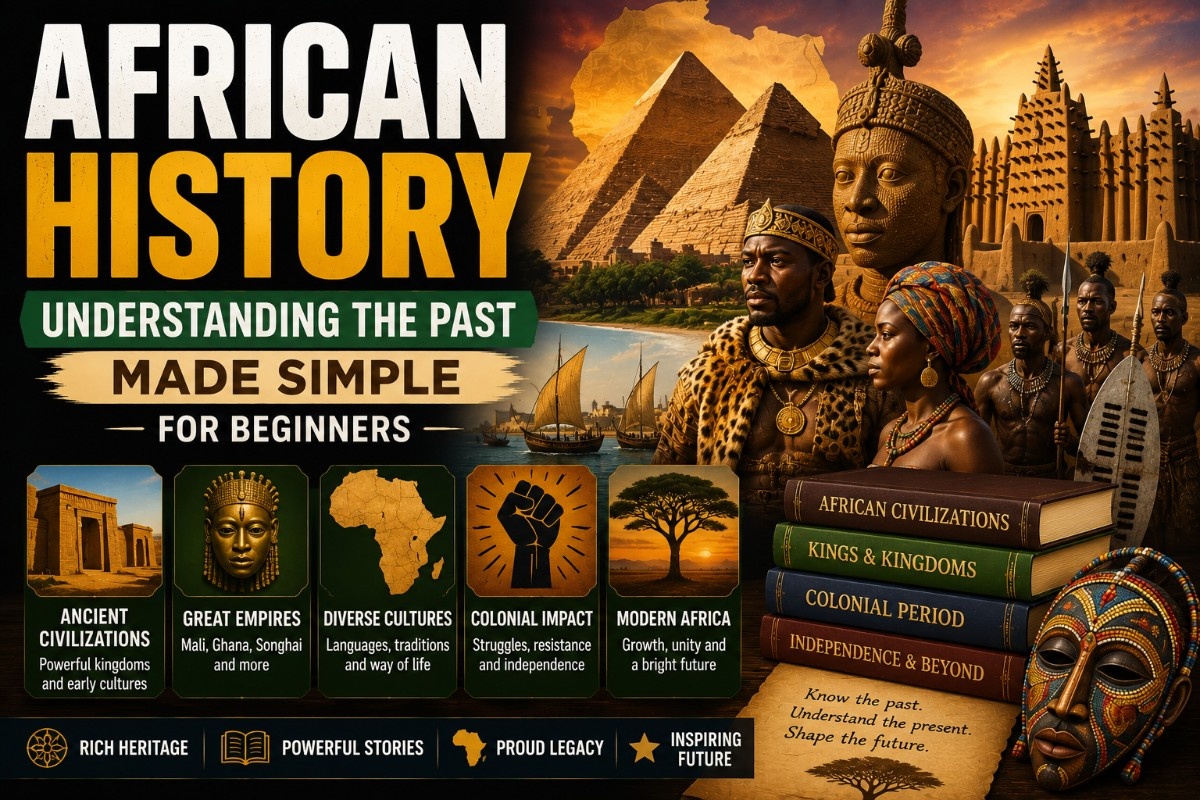
African history encompasses the diverse civilizations, kingdoms, and cultures of the African continent, from ancient Egypt and the Kingdom of Kush to powerful empires like Mali, Songhai, and Great Zimbabwe. It traces rich traditions of trade, art, and governance, as well as the profound impact of the transatlantic slave trade and European colonialism on African societies and their global diaspora. This history reflects both remarkable resilience and immense diversity across thousands of distinct ethnic groups, languages, and traditions. At its core, African history reveals a continent whose civilizations shaped world history long before, during, and after colonial encounters — challenging simplified or singular narratives of its past.
Content Overview
Introduction to Africa
Africa is the world’s second-largest continent, coming after Asia.
Key facts:
Area: about 30.3 million km²
About 20% of Earth’s land area
Population: about 1.4 billion people
Around 18% of the world’s population
Africa also has the youngest population globally. The average age is around 20 years, much younger than most other continents.
Experts predict that Africa’s population may reach 3.8 billion by the year 2100.
2. Location and Surrounding Oceans
Africa spans the Equator and the Prime Meridian, placing it in both the Northern and Southern Hemispheres.
It is surrounded by several seas and oceans:
North → Mediterranean Sea
West → Atlantic Ocean
East → Indian Ocean
Northeast → Gulf of Aqaba
Africa also includes many islands, including:
Madagascar (largest African island)
3. Countries and Political Organization
Africa contains:
54 independent countries
Many islands and territories
Largest country by area: Algeria
Most populous country: Nigeria
African countries cooperate through the African Union. Its headquarters are in Addis Ababa.
4. The Five Regions of Africa
Africa is usually divided into five major regions.
1. Northern Africa
Countries include:
Egypt
Libya
Tunisia
Algeria
Morocco
Key Features
Dominated by the Sahara Desert
Strong historical connections with the Middle East
One of the greatest ancient civilizations developed here: Ancient Egypt
Important achievements included: pyramids, hieroglyph writing, advanced mathematics.
2. West Africa
Countries include:
Nigeria
Ghana
Senegal
Mali
Ancient Empires
West Africa was home to influential empires such as:
Ghana Empire
Mali Empire
Songhai Empire
These empires controlled gold and salt trade routes across the Sahara.
One famous ruler was Mansa Musa. He was among the wealthiest individuals in history.
3. Central Africa
Countries include:
Democratic Republic of the Congo
Cameroon
Gabon
Characteristics
Dense tropical rainforests
Part of the Congo Basin
It is the second-largest rainforest in the world, following the Amazon.
Central Africa is rich in: minerals, forests, wildlife.
4. East Africa
Countries include:
Kenya
Ethiopia
Tanzania
Uganda
Birthplace of Humanity
East Africa is widely considered the cradle of human origins.
Modern humans (Homo sapiens) are believed to have evolved in Africa about 300,000 years ago.
An important ancient kingdom was the Kingdom of Aksum. It was an important trading power between Africa, Arabia, and India.
5. Southern Africa
Countries include:
South Africa
Zimbabwe
Botswana
Namibia
Famous Historical Kingdoms
Examples include: Great Zimbabwe, Zulu Kingdom.
The Zulu kingdom was ruled by the renowned warrior king Shaka Zulu.
5. Biodiversity and Wildlife
Africa is renowned for its rich wildlife and biodiversity.
The continent is home to many large animals, known as megafauna, including:
elephants
lions
giraffes
rhinoceroses
Many species persisted in Africa because it was less impacted by prehistoric mass extinctions.
6. Environmental Challenges
Africa faces several environmental problems:
desertification
deforestation
water shortages
pollution
Climate change is expected to affect Africa strongly.
Scientists from the Intergovernmental Panel on Climate Change view Africa as one of the continents most at risk from climate change.
7. African Culture and Traditions
African culture is extremely diverse.
It includes:
traditional music and dance
rich storytelling traditions
many religions and languages
Many African societies historically preserved history through oral traditions, meaning stories and knowledge were passed down by speaking rather than writing.
Because of this, anthropologists sometimes call African societies “oral civilizations.”
8. Colonialism and Modern Africa
During the late 19th century, European countries colonized most of Africa.
This era is called the Scramble for Africa.
Colonial powers included:
Britain
France
Portugal
Belgium
Germany
Most African nations achieved independence following World War II.
In 1963, African states established the Organisation of African Unity.This later became the African Union.
9. Economy and Resources
Africa is rich in natural resources, including:
oil
gold
diamonds
rare minerals
However, Africa remains one of the least wealthy continents per person.
Reasons include:
colonial history
political instability
corruption
economic inequality
Despite these challenges, Africa has rapidly growing economies and a youthful population, making it a key future global market.
Simple Summary
Africa is:
the second-largest continent
home to 1.4 billion people
divided into five regions: North Africa, West Africa, Central Africa, East Africa, Southern Africa
It is also:
the birthplace of humanity
rich in culture and biodiversity
historically shaped by empires, trade, and colonialism
Africa is becoming increasingly significant in the global economy and future population growth.