Philosophy of religion
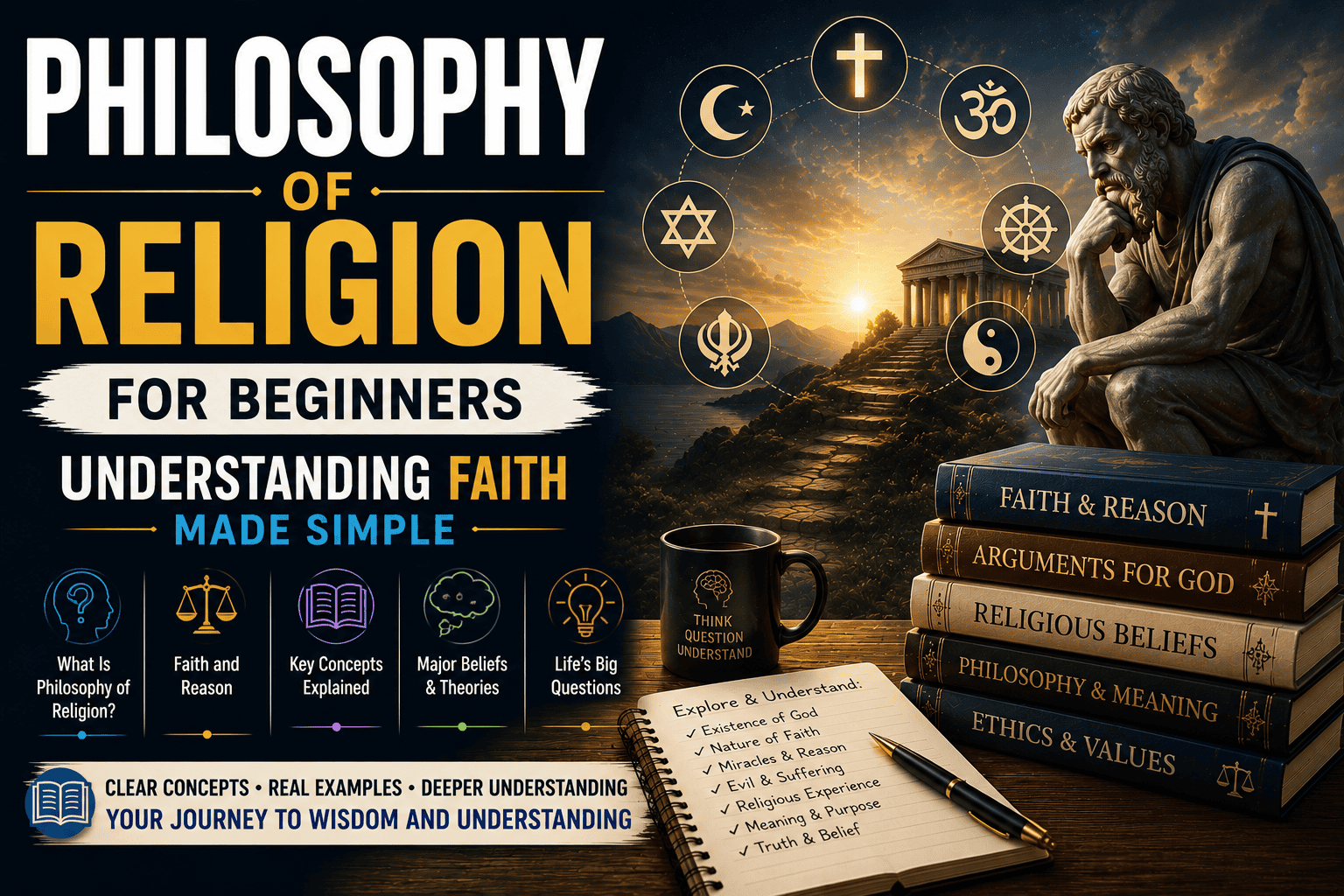
Examine Religious Ideas Through Critical and Philosophical Inquiry — Philosophy of Religion uses philosophical reasoning to investigate religious beliefs, concepts, experiences, and claims about the divine. It considers questions about the existence and nature of God, the relationship between faith and reason, and how human beings understand religious experiences. The field also addresses long-standing issues such as arguments concerning God’s existence, the problem of evil, miracles, and the interpretation of religious language.
Rather than promoting or rejecting a particular religious tradition, Philosophy of Religion examines different religious perspectives through logical analysis, questioning, and reasoned argument. It considers whether religious beliefs can be rationally supported and what standards might be used to evaluate such claims. At its core, the field asks how religious propositions can be understood, whether they can be justified through reason or evidence, and what it means for a religious belief to be rationally defensible.
Content Overview
- Introduction to Philosophy of Religion
- Arguments for the Existence of God
- Challenges and Critiques
- Logical Problem of Evil
- Evidential Problem of Evil
- Theodicies: Augustine, Irenaeus, and Process Thought
- Religious Existentialism: Kierkegaard, Tillich, Marcel
- Science and Religion: Conflict, Dialogue, Integration
- Atheism, Agnosticism, and Secular Humanism
- Case Study: Richard Dawkins vs. Alister McGrath on God’s Existence
- Major Thinkers in Philosophy of Religion
- Anselm of Canterbury – Faith Seeking Understanding
- Thomas Aquinas – Reason and Natural Theology
- Alvin Plantinga – Reformed Epistemology
- John Hick – Religious Pluralism and Soul-Making Theodicy
- Contemporary Voices: William Alston, Eleanor Stump, Charles Taylor
- Case Study: Comparing Aquinas’ Natural Theology with Plantinga’s Reformed Epistemology
- comparative Religion
Introduction to Philosophy of Religion
What is Philosophy of Religion?
Philosophy of religion is the careful, logical, and organized study of religious ideas, beliefs, and practices. While theology begins from faith and sacred texts, philosophy of religion begins from reason, logic, and critical reflection, asking whether religious claims are coherent, justifiable, or meaningful.
Philosophy vs. Theology: Reason and Revelation
Theology: Study of God and religion from within faith, using revelation, scripture, and tradition.
Philosophy of Religion: Study of religion from outside faith, using reason, critical analysis, and universal principles.
Explanation: Theology starts with “God exists” as a foundational truth and interprets reality from there. Philosophy, however, asks: Is belief in God rational? What does “God” mean?
Both overlap but differ in method:
Theology relies on revelation (divine truths revealed through scripture, prophets).
Philosophy relies on reason (logical inquiry, analysis).
Example: A theologian might say, “God is love because the Bible states it.” A philosopher might ask: “What does it mean to say ‘God is love’? Is this a metaphor or literal claim? How can it be justified logically?”
Faith, Reason, and Knowledge (Religious Epistemology)
Religious epistemology asks: How do we know religious truths? What is the relationship between faith (belief without proof), reason (logical thinking), and knowledge (justified true belief)?
Faith alone (Fideism): Religion is beyond reason (e.g., Tertullian: “I believe because it is absurd.”).
Reason + Faith: Many philosophers (Aquinas, Augustine) argued faith and reason work together.
Reason alone: Rationalists argue religion must stand on reason alone (e.g., Spinoza).
Example: A Christian might believe in the Resurrection by faith. A philosopher might ask: Is this belief historically verifiable or reasonable based on evidence? A religious epistemologist studies whether religious experience counts as a form of knowledge (as Alvin Plantinga argued).
Religion as Worldview and Metaphysical Commitment
A worldview is a comprehensive framework of beliefs about reality, morality, and meaning. Religion provides a metaphysical commitment—a foundational understanding of existence and purpose.
Religion doesn’t just give rituals or morality; it answers big metaphysical questions:
Where did the universe come from?
What is the nature of reality—material, spiritual, or a combination of both?
What is the meaning of life?
What happens after death?
Thus, religion is not just private belief but a lens to see reality.
Example: In Christianity, the worldview centers on creation, fall, redemption, and eternal life. In Buddhism, the worldview emphasizes impermanence, suffering, and liberation (nirvana).
Case Study: Kierkegaard’s Leap of Faith
Soren Kierkegaard (1813–1855) argued that faith is not based on rational proof but a passionate leap beyond reason.
For Kierkegaard, religious truth is subjective and requires commitment. Believing in God is like leaping across a chasm no rational bridge guarantees safety, but one must risk everything in trust.
This opposes philosophers who tried to prove God’s existence logically. Kierkegaard believed proof removes the very essence of faith: trust without certainty.
Example: The biblical account of Abraham and Isaac: God instructs Abraham to sacrifice his son. Rationally, this is absurd and unethical. Yet Abraham obeys, trusting God beyond reason a leap of faith.
Arguments for the Existence of God
Philosophers and theologians for centuries have debated whether God exists. They have developed rational arguments to defend belief in God. These arguments do not depend on religious scripture alone but on reason, logic, and observation of the world.
The four main categories of arguments are Cosmological, Teleological, Ontological, and Moral.
Cosmological Arguments
The Cosmological Argument is based on the idea of cause and effect. It says:
Everything that exists has a cause.
The universe exists, so it must have a cause behind it.
That first cause, which itself is uncaused, is what people call God.
It seeks to explain why there is something rather than nothing.
Classical (Aquinas’ Five Ways)
Thomas Aquinas (13th century) gave five ways to prove God’s existence. The first three are different forms of the cosmological argument:
Motion (First Mover): Everything in motion was set in motion by something else.This view proposes the existence of a First Mover, identified as God.
Causation (First Cause): Nothing causes itself. Everything has a cause. There must be a First Cause—God.
Contingency: Everything we see could either exist or not exist. But if everything were contingent, at one point nothing would exist. Therefore, there must be a necessary being God.
Example: Think of dominoes falling. Each domino knocks down the next. But the first domino must be pushed by someone. That first “push” is like God in Aquinas’ argument.
Modern Formulations (Kalam Cosmological Argument)
The modern cosmological argument, known as the Kalam argument. The Kalam Cosmological Argument is a modern form popularized by Muslim philosophers (like Al-Kindi, Al-Ghazali) and defended today by William Lane Craig.
It states:
Whatever begins to exist has a cause.
The universe began to exist.
Therefore, the universe has a cause (God).
Example: If you walk into a room and see a balloon floating, you know it must have been filled with air or helium. It didn’t just “exist” by itself. Similarly, the universe must have a cause.
Case Study: William Lane Craig on the Kalam Argument
Craig argues that both philosophy and modern science (Big Bang, thermodynamics) show that the universe had a beginning. Since it began, it must have a cause beyond space and time. He concludes that cause is God.
Teleological Arguments
The Teleological Argument (from telos, meaning purpose or design) says the universe shows signs of order, complexity, and purpose, which strongly suggests it was designed by an intelligent mind—God.
Intelligent Design and Fine-Tuning
Modern science shows that the universe is finely tuned for life:
The force of gravity,
The expansion rate of the universe,
The properties of atoms…
are all precisely balanced. If they were slightly different, life could not exist.
Example: Imagine walking into a room and finding a computer perfectly assembled, running software, and connected to Wi-Fi. Would you assume it randomly built itself? No—you’d conclude it was designed. Similarly, the universe looks designed.
Case Study: Paley’s Watchmaker Analogy
William Paley (1743–1805) argued: If you find a watch on the ground, you know it had a watchmaker, because it shows order and purpose. Similarly, the natural world—plants, animals, planets—shows even more complexity, so there must be a Divine Watchmaker (God).
Ontological Arguments
The Ontological Argument is unique. Instead of relying on observation, it uses pure reason and logic. It argues that the very concept of God proves His existence.
Anselm’s Ontological Proof
St. Anselm (11th century) defined God as: “That than which nothing greater can be imagined.”
If God exists only in the mind, then a greater being could be imagined as existing in reality.
By definition, God is understood as the greatest being imaginable.Therefore, God must exist in reality.
Example: If you think of the “perfect island,” it must exist in reality to be truly perfect. Similarly, the concept of God requires actual existence.
Modal Ontological Argument (Plantinga)
Alvin Plantinga (20th century) refined Anselm’s idea using modal logic (possibility and necessity):
If the existence of a perfectly great being is logically possible, then such a being must exist in at least one possible world. If it exists in one possible world, then it must exist in every possible world.
Therefore, God exists in the real world.
Case Study: Anselm vs. Gaunilo’s Critique
Gaunilo, a monk, criticized Anselm. He said: “If Anselm’s logic works, then we can prove the existence of a perfect island, but that’s absurd.” This shows how controversial and difficult the ontological argument is.
Moral Argument
The Moral Argument claims that the existence of objective morality (right and wrong that apply to everyone, everywhere) points to God.
If morality is just human opinion, then nothing is truly “wrong.”
But we believe murder, injustice, cruelty are objectively wrong.
Therefore, morality must come from a higher source—God.
Case Study: C.S. Lewis’ Argument from Moral Law
In Mere Christianity, C.S. Lewis argued:
Humans everywhere have a sense of moral law.
Just as physical laws point to a lawgiver, moral law points to a Moral Lawgiver—God.
For example, picture two children arguing over a toy. One says, “That’s not fair!” The idea of fairness extends beyond individual opinions, suggesting the presence of a universal moral standard.
Challenges and Critiques
The philosophy of religion is not only about building arguments in favor of God’s existence; it also involves addressing objections, doubts, and challenges. Over the centuries, some of the most profound philosophical debates have arisen from critiques of religious belief. These critiques test the strength of faith, theology, and metaphysics, pushing religious thought to deeper levels.
Understanding the problem of evil through logic and real-world evidence
Perhaps the most famous challenge to belief in an all-good, all-powerful God is the problem of evil.
Logical Problem of Evil
This form argues that the existence of evil is logically incompatible with an omnipotent, omnibenevolent God.
If God possesses unlimited power, then He would have the ability to stop evil from occurring.
If God is perfectly good, He would want to stop evil from happening.
Yet evil exists.
Therefore, such a God cannot exist.
Example: If a parent had the power to stop a child from suffering and refused, we would question their goodness. Why should God be different?
Evidential Problem of Evil
This version does not claim a logical contradiction but argues that the amount, intensity, and apparent pointlessness of suffering in the world make God’s existence unlikely.
Example: Natural disasters (earthquakes, tsunamis) kill thousands without any clear moral purpose.
Theodicies: Augustine, Irenaeus, and Process Thought
In response to the problem of evil, thinkers have offered theodicies—philosophical attempts to justify God’s goodness despite evil.
Augustine’s Theodicy:
Evil is not a substance but a privation (absence of good).
Human free will caused moral evil; natural evil is a result of humanity’s fall.
Example: Just as darkness is the absence of light, evil is the absence of good.
Irenaean Theodicy (Soul-Making Theodicy):
Difficult experiences and suffering can play a role in helping a person grow spiritually.
Just as an athlete needs struggle to grow stronger, humans need challenges to develop virtues like courage and compassion.
Process Theodicy (Modern):
God is not omnipotent in the classical sense but works with creation.
Evil exists because God cannot simply override the natural order.
Example: Like a teacher guiding students but unable to force their choices.
Religious Existentialism: Kierkegaard, Tillich, Marcel
Existentialist philosophers approach religion not just as abstract arguments but as personal lived experience.
Søren Kierkegaard: Faith is a “leap” beyond reason; one must commit passionately to God even amidst uncertainty. Example: Abraham’s willingness to sacrifice Isaac was not “rational” but an act of ultimate faith.
Paul Tillich: Religion is about “ultimate concern”—what we place at the center of our being. God is not just one being among others, but the source of all existence.
Gabriel Marcel: Stressed mystery over problem-solving. God is encountered through love, hope, and fidelity rather than abstract reasoning.
Science and Religion: Conflict, Dialogue, Integration
The relationship between science and religion has been debated for centuries.
Conflict View: Science and religion are fundamentally opposed. Example: Galileo vs. the Church over heliocentrism; Darwin’s evolution vs. Biblical creation.
Dialogue View: Science and religion explore different types of questions about life and the world. Science asks “how?” (mechanisms), religion asks “why?” (purpose).
Integration View: Science and religion can be harmonized into a unified worldview. Example: The “fine-tuning” argument in physics is seen by some as compatible with belief in a Creator.
Atheism, Agnosticism, and Secular Humanism
Atheism: Denies the existence of God(s). Often supported by appeals to science, naturalism, or the problem of evil.
Agnosticism: Is the view that we cannot know whether God exists or not. Example: Thomas Huxley coined the term, arguing humans cannot know ultimate reality.
Secular Humanism: Emphasizes human reason, ethics, and progress without recourse to the divine. Example: Focus on education, rights, and social development without religious authority.
Case Study: Richard Dawkins vs. Alister McGrath on God’s Existence
Richard Dawkins (Atheist, Biologist): In The God Delusion, he argues that belief in God is a delusion, unnecessary for morality or explanation of the universe. Science, particularly evolution, explains life without invoking God.
Alister McGrath (Theologian, Former Atheist): Counters Dawkins by arguing that atheism fails to explain meaning, purpose, and the human longing for transcendence. Science and faith are not in conflict; they offer different but complementary ways to understand truth.
Key Debate: Dawkins: God is unnecessary and improbable. McGrath: God is the best explanation for rationality, morality, and human purpose.
Major Thinkers in Philosophy of Religion
Anselm of Canterbury – Faith Seeking Understanding
Anselm (1033–1109) was a medieval Christian philosopher and theologian, famous for the motto “faith seeking understanding.” He believed that faith comes first, but once a person has faith, reason can be used to deepen that belief.
Ontological Argument for God’s Existence:
God is the greatest being that can be imagined.
Even an atheist understands this concept.
If God exists only in the mind, then a greater being (existing in reality) could be imagined.
Therefore, God must exist not just as an idea in the mind, but also as a reality outside of it.
Example: Imagine a perfect painting in your mind. If it only exists in thought, it is less great than if it exists on canvas. Similarly, God’s perfection demands His real existence.
Thomas Aquinas – Reason and Natural Theology
Thomas Aquinas (1225–1274) merged faith with reason. He argued that human reason, through observation of the natural world, can demonstrate God’s existence. His approach is known as Natural Theology – knowledge of God through reason and nature, not just revelation.
The Five Ways:
Motion (there must be a First Mover → God)
Causation (there must be a First Cause → God)
Contingency (something must exist necessarily → God)
Degrees of Perfection (a perfect standard → God)
Teleological Argument (design and purpose in nature → God)
Example: Think of dominoes falling. There must be a “first push.” Aquinas argued the universe also requires a “First Cause” → God.
Alvin Plantinga – Reformed Epistemology
Alvin Plantinga (1932–2022) was a modern Christian philosopher who challenged the idea that belief in God must be proven with evidence.
Reformed Epistemology: Belief in God can be considered a basic belief that does not need further justification.
Just like we naturally trust memory, perception, or logic without evidence, belief in God can also be rational without proof.
Faith is not irrational; it is a foundational part of human experience.
Example: You believe the external world exists even though you can’t “prove” it beyond doubt. Likewise, Alvin Plantinga argued that belief in God can reasonably be accepted as a foundational belief.
John Hick – Religious Pluralism and Soul-Making Theodicy
John Hick (1922–2012) emphasized religious pluralism and a unique defense of God’s goodness.
Key Contributions:
Religious Pluralism: All major religions are valid human responses to the same ultimate reality (God). No single religion has exclusive truth.
Soul-Making Theodicy: Evil and suffering are not meaningless but opportunities for humans to grow spiritually, morally, and in compassion.
Example: Just as an athlete grows stronger through training, humans develop virtues (like patience, courage, and love) through facing challenges.
Contemporary Voices: William Alston, Eleanor Stump, Charles Taylor
William Alston (1921–2009): Focused on religious experience. He argued that mystical experiences of God are as reliable as sensory experiences (like seeing or hearing). Example: Just as we trust our eyesight, Alston says a person can trust their spiritual experiences of God.
Eleanor Stump (b. 1947): Known for philosophy of religion and theodicy. She highlights how suffering can bring a deeper relationship with God. Example: A parent may allow a child to go through surgery, not out of cruelty, but for long-term healing.
Charles Taylor (b. 1931): Philosopher of modernity and secularism. He explains how faith survives in a secular age and why humans still search for transcendence. Example: Even in highly secular societies, people seek meaning through spirituality, art, or philosophy—showing an ongoing hunger for the divine.
Case Study: Comparing Aquinas’ Natural Theology with Plantinga’s Reformed Epistemology
Aquinas: Uses reason and evidence from the natural world (cosmological and teleological arguments). Belief in God is rational because it is logically inferred from creation.
According to Alvin Plantinga, belief in God can be properly basic—that is, it can be rational and foundational without requiring supporting arguments or evidence. Just as we accept memory or perception without proof, we can rationally accept God’s existence.
Example Comparison: Aquinas = like a detective proving someone’s existence through clues (reason + evidence). Plantinga = like trusting your senses directly (faith as a natural foundation).
comparative Religion
World Religions Overview
Defining Religion: Belief, Ritual, Myth, and Ethics
Foundational truths about the divine, cosmos, or human destiny (e.g., belief in one God in Islam, or Dharma in Hinduism).
Religion as Ritual: Practices that embody faith—prayer, sacrifice, festivals, meditation.
Religion as Myth: Narratives that convey sacred truth, not just “fiction.” For example, Genesis creation stories or Hindu epics like the Mahabharata.
Religion as Ethics: Moral codes that govern human life (e.g., Ten Commandments in Judaism/Christianity, Eightfold Path in Buddhism).
Example: In Christianity, the ritual of the Eucharist reflects belief in Christ’s sacrifice and carries ethical meaning living a life of service and love.
Typologies: Monotheism, Polytheism, Pantheism, Non-theism
Monotheism: Is the belief that there is only one God, as found in religions like Judaism, Christianity, and Islam.
Polytheism: Worship of many deities with distinct roles (Ancient Greece, Hinduism in some interpretations).
Pantheism: God is identical with the universe (Spinoza, aspects of Hindu Vedanta).
Non-theism: Focus on practice and philosophy without a personal god (Buddhism, Jainism).
Example: Buddhism is non-theistic: it doesn’t deny gods, but liberation (Nirvana) does not depend on them.
Religion and Culture: Intersections of Faith and Society
Religion influences law, art, politics, and social norms. Culture also shapes how religion is practiced (e.g., Christianity in Africa looks different than in Europe due to local traditions).
Example: Hindu festivals like Diwali are both religious and deeply cultural, involving family, food, and community celebration.