17th Century Explained: Scientific Revolution and Global Wars
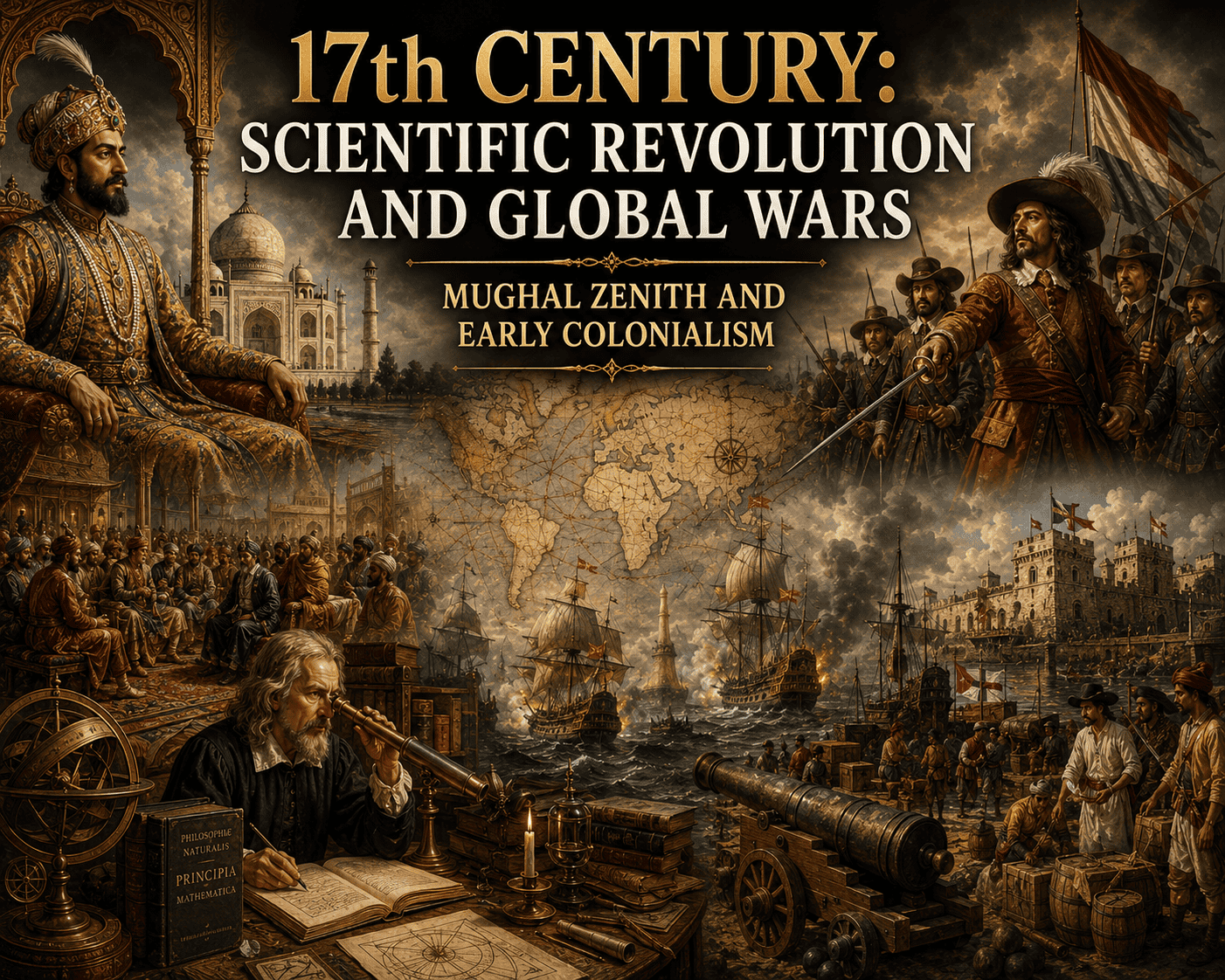
The 17th century was defined by the Scientific Revolution, as thinkers like Galileo, Newton, and Descartes transformed humanity’s understanding of the natural world through observation, mathematics, and reason, laying the foundation for modern science. This era also saw devastating global conflicts, including the Thirty Years’ War that ravaged Europe and reshaped its political landscape, alongside continued colonial expansion and competition among European powers across the Americas and Asia. Absolute monarchies rose to prominence, most notably under Louis XIV of France, while philosophical shifts began challenging traditional authority and paving the way for Enlightenment thought. At its core, the 17th century reveals how the pursuit of knowledge and power reshaped both the intellectual and political foundations of the modern world.
Content Overview
- The 17th Century (1601–1700 CE):
- CHAPTER 1 — Understanding the 17th Century
- CHAPTER 2 — Calendars of the 17th Century World
- CHAPTER 3 — The Mughal Empire at Its Zenith
- The Mughal Empire in 1601 — Where It Stood
- Jahangir (1605–1627) — The Emperor Who Loved Art and Nature
- Shah Jahan (1628–1658) — Beauty Carved in Marble
- The Taj Mahal — A Complete History Step by Step
- Shahjahanabad (Old Delhi) — A New Capital Built
- Aurangzeb (1658–1707) — Expansion, Intolerance, and Decline
- The Mughal Legacy in South Asian Civilization
- Chapter 4 — The Emergence of European Trading Companies
- CHAPTER 5 — The Dutch Golden Age
- CHAPTER 6 — The Thirty Years' War (1618–1648)
- CHAPTER 7 — The Scientific Revolution — Its Greatest Century
- The State of Knowledge in 1600
- Galileo Galilei (1564–1642) — Observation and the Inquisition
- Johannes Kepler (1571–1630) — The Principles Governing Planetary Motion
- René Descartes (1596–1650) — Reason and the Cartesian Revolution
- Francis Bacon (1561–1626) — The Scientific Method
- Isaac Newton (1643–1727) — The Greatest Scientific Mind
- The Royal Society (1660) — Science as an Institution
- CHAPTER 8 — Political Changes in Europe
- Louis XIV and French Absolutism (1643–1715)
- The Palace of Versailles — Power in Architecture
- The English Civil War (1642–1651) — Step by Step
- The Glorious Revolution (1688) — Constitutional Monarchy Born
- The Bank of England (1694) — Modern Finance Begins
- The Ottoman Defeat at Vienna (1683) — A Turning Point
- CHAPTER 9 — Asia in the 17th Century
- CHAPTER 10 — Religion and Cultural Developments
- CHAPTER 12 — Complete Decade-by-Decade Timeline (1601–1700)
- 1601–1610: Companies, Empires, and New Beginnings
- 1611–1620: Conflict Builds
- 1621–1630: Shah Jahan Rises
- 1631–1640: War and Wonder
- 1641–1650: Civil War and Peace Treaties
- 1651–1660: Restoration and Dutch Power
- 1661–1670: Louis XIV and Mughal Glory
- 1671–1680: Science and Empire
- 1681–1690: Newton, Glorious Revolution
- 1691–1700: The Century Closes
- CHAPTER 13 — Summary and Legacy of the 17th Century
The 17th Century (1601–1700 CE):
CHAPTER 1 — Understanding the 17th Century
Definition and Context
The 17th century covers the years from January 1, 1601 CE to December 31, 1700 CE. It belongs to what historians call the Early Modern Period — the era between the medieval world and the Industrial Revolution. This was the century in which the seeds planted in the 16th century’s Reformation, exploration, and scientific beginnings produced their most dramatic fruits. It was the century in which science transformed from a marginal intellectual activity into the most powerful tool for understanding reality that humanity had ever possessed. It was the century in which European trading companies began their transformation from commercial enterprises into colonial rulers. And it was the century in which the Mughal Empire reached the peak of its cultural magnificence — building the Taj Mahal — even as the forces that would eventually destroy it were beginning to gather.
To understand the 17th century, you must hold multiple truths simultaneously. It was a century of extraordinary beauty — in the Taj Mahal, in Rembrandt’s paintings, in Bach’s predecessors’ music, in Newton’s mathematical descriptions of the universe. And it was simultaneously a century of extraordinary violence — the Thirty Years’ War that killed perhaps a third of Germany’s population; the English Civil War that executed a king; the Atlantic slave trade that was accelerating its traffic in human beings; the Mughal succession wars that saw brothers kill brothers for the throne.
This is the paradox of the 17th century: it was simultaneously the most civilized and the most brutal century in human history up to that point. The same energy that built the Palace of Versailles funded the wars that devastated Europe. The same commercial genius that made the Dutch Republic wealthy also organized the most systematic exploitation of colonized peoples the world had yet seen.
What Kind of World Existed in 1601 CE?
The world of 1601 was still processing the transformations of the 16th century. In South Asia, the Mughal Empire under Akbar was at the height of its first great peak — wealthy, powerful, and culturally brilliant. In Europe, the aftermath of the Protestant Reformation was still generating religious conflict. In England, Queen Elizabeth I was in the last two years of her long reign. In China, the Ming Dynasty was showing signs of the internal weakness that would lead to its collapse in 1644. In Japan, Tokugawa Ieyasu was consolidating power after the chaos of the Sengoku Period. In the Americas, Spanish colonial rule was established and the Atlantic slave trade was growing.
The world of 1601 was also a world being remade by commerce. The British East India Company had just received its charter (December 31, 1600). The Dutch were preparing to establish their own trading company. The silver from American mines continued to flow around the world, connecting economies in ways that were genuinely new in human history. The world’s first recognizably modern financial instruments — stocks, bonds, and insurance — were being developed in the commercial cities of the Netherlands.
Why the 17th Century Is the Hinge of Modern History
The 17th century is the century in which the modern world becomes clearly recognizable. By 1700, several distinctively modern phenomena were in place: the sovereign nation-state system (established by the Peace of Westphalia in 1648); constitutional government with parliamentary limits on royal power (established in England by the Glorious Revolution of 1688); modern science as an organized, institutional pursuit (the Royal Society, 1660; Newton’s Principia, 1687); modern financial institutions (the Bank of England, 1694; the Amsterdam stock exchange); and global trade networks connecting every inhabited continent in a single commercial system.
None of these things existed in 1601 in their mature form. All of them existed in 1700. The 17th century is the century in which the medieval world finally gave way to something recognizably modern. That is why it is the hinge of history — the pivot between the world of Genghis Khan and the world of the Industrial Revolution.
The Eight Defining Forces of the Century
Force One — The Mughal Empire’s Peak and Decline: From Shah Jahan’s cultural magnificence to Aurangzeb’s destructive religious policies and military overextension — the story of the world’s wealthiest empire rising to its greatest glory and then beginning its long fall.
Force Two — European Trading Companies: The transformation of commercial enterprises into colonial powers — how the British East India Company and the Dutch VOC began the process of European domination of Asian trade that would eventually become outright colonial rule.
Force Three — The Dutch Golden Age: The extraordinary 17th-century flowering of a small republic’s commercial, artistic, scientific, and philosophical culture — the most creative society of its era.
Force Four — The Thirty Years’ War: The most destructive war in European history before the 20th century — which killed millions and ultimately produced the Peace of Westphalia, the foundation of the modern state system.
Force Five — The Scientific Revolution at Its Peak: Galileo, Kepler, Descartes, Bacon, and above all Newton — the century in which modern science was definitively established as the primary means of understanding the natural world.
Force Six — Political Transformation in Europe: The English Civil War and Glorious Revolution establishing constitutional monarchy; Louis XIV’s France establishing the model of absolute monarchy; the Ottoman defeat at Vienna establishing the limits of Ottoman expansion.
Force Seven — Asia’s Dynastic Transitions: The fall of the Ming and establishment of the Qing in China; the Tokugawa Shogunate’s stabilization of Japan; the Mughal succession crisis that would eventually lead to the empire’s decline.
Force Eight — The Growth of Colonial Trade and the Slave Trade: The expanding commercial networks connecting Europe, Africa, Asia, and the Americas — including the accelerating Atlantic slave trade that was becoming the foundation of New World plantation economies.
CHAPTER 2 — Calendars of the 17th Century World
The Gregorian Calendar in the Catholic World
By 1601, the Gregorian Calendar — introduced in 1582 — had been adopted by all major Catholic countries: Italy, Spain, Portugal, France, Poland, and the Catholic states of the Holy Roman Empire. These countries were now 10 days ahead of countries still using the Julian Calendar. This created practical problems: a letter written in Catholic France on January 10, 1601 Gregorian, would be dated December 31, 1600 Julian in Protestant England — the same physical moment, two different dates and even two different years.
The Gregorian Calendar’s adoption across the 17th century in Catholic countries meant that all events in these countries during the century are dated in the Gregorian system. The Battle of the White Mountain (1620, during the Thirty Years’ War) — fought in Bohemia, a Catholic country — is dated Gregorian. The Peace of Westphalia (1648) is dated Gregorian. Louis XIV’s construction of Versailles is dated Gregorian.
The Julian Calendar Still in Protestant Countries
Protestant countries — England, Scotland, Denmark, Sweden, the Protestant German states — continued to use the Julian Calendar throughout the 17th century, running 10 days behind Gregorian. This means that events in England during the 17th century — the English Civil War, the execution of Charles I, the Glorious Revolution — are traditionally dated in the Julian Calendar (called “Old Style” or O.S. in historical references), while their Gregorian equivalents are 10 days later (called “New Style” or N.S.).
The execution of King Charles I is traditionally dated January 30, 1649 (Julian/Old Style). In Gregorian terms, it occurred on February 9, 1649. Isaac Newton was born on December 25, 1642 (Julian) — Christmas Day — which was January 4, 1643 in the Gregorian Calendar. This is why historical sources sometimes give slightly different dates for the same event.
England would not adopt the Gregorian Calendar until 1752 — by which time the error had grown to 11 days, requiring the suppression of September 3–13, 1752, causing the famous protest “Give us back our 11 days!” by people who felt they had been robbed of part of their lives.
The Islamic Hijri Calendar in the Three Great Empires
The Islamic Hijri calendar — the purely lunar system beginning in 622 CE — organized religious and much of the administrative life of the three great Islamic empires of the 17th century: the Ottoman, Safavid, and Mughal. The 17th century CE corresponds approximately to the years 1009 to 1113 AH.
Key 17th-century events in Hijri terms: The construction of the Taj Mahal began in 1042 AH (1632 CE). Shah Jahan’s imprisonment by Aurangzeb occurred in 1068 AH (1658 CE). The Ottoman defeat at Vienna was in 1094 AH (1683 CE). All three empires maintained administrative records in both the Hijri calendar (for religious and legal purposes) and solar calendars derived from Persian tradition (for agricultural and fiscal purposes).
The Mughal Empire under Shah Jahan and Aurangzeb used the Hijri calendar in official court documents and religious contexts. Akbar’s solar Tarikh-i-Ilahi calendar had been largely abandoned after his death in 1605 by his successors, who were more orthodox in their Islamic practice and preferred the Hijri system.
The Chinese Calendar Under the Ming-to-Qing Transition
China experienced one of the most politically momentous calendar transitions in history during the 17th century. When the Manchu Qing Dynasty overthrew the Ming in 1644, one of the first acts of the new dynasty was to establish a new reign era — Shunzhi (“Smooth Rule”) — and issue the Qing calendar. The Shunzhi Emperor’s adoption of the Qing calendar was a political act of the first importance: it declared the Mandate of Heaven had passed from the Ming to the Qing.
The Qing also made an unusual decision regarding astronomical science: they hired Jesuit missionaries — particularly the German Jesuit Adam Schall von Bell — to reform the Chinese calendar using Western astronomical methods. This was pragmatic rather than ideological: the Jesuit astronomers could predict eclipses more accurately than the Ming court astronomers, and accurate eclipse prediction was a matter of imperial legitimacy (the Emperor was responsible for maintaining cosmic order, and failing to predict an eclipse was an embarrassing sign of cosmic misalignment). The Qing calendar reformed by Western Jesuit methods continued to use the traditional Chinese naming system and structure but incorporated more accurate astronomical calculations.
The Japanese Calendar Under the Tokugawa Shogunate
Japan under the Tokugawa Shogunate (established 1603) used a lunisolar calendar derived from the Chinese system. The Tokugawa establishment created a new political-temporal framework: the Edo Period (named for the new capital Edo, modern Tokyo) defined an era of stability after decades of civil war. The Shogunate’s Sakoku policy — isolating Japan from most foreign contact — also meant that the Gregorian calendar reform spreading through the rest of the world had no influence on Japan. Japan would not adopt the Gregorian calendar until the Meiji Restoration of 1868.
CHAPTER 3 — The Mughal Empire at Its Zenith
The Mughal Empire in 1601 — Where It Stood
When the 17th century began, the Mughal Empire under the aging Akbar was the wealthiest and most powerful state in Asia, and arguably the richest state in the world. Its GDP — estimated by economic historians like Angus Maddison — represented approximately 22–25% of world GDP. Its population was perhaps 100–150 million people. Its cities — Agra, Delhi, Lahore, Fatehpur Sikri (now abandoned but recently the imperial capital) — were among the largest in the world. Its court ranked among the most refined of its time, producing exquisite miniature paintings, supporting poets, musicians, and scholars from across the Islamic and Indian worlds, and sustaining a highly developed administrative system.
Akbar died in October 1605, ending his extraordinary 49-year reign. He left behind an empire of unprecedented territorial extent in South Asia, a system of administration (the mansabdari system) that would define Mughal governance for a century, and a cultural tradition of synthesis — blending Persian, Central Asian, and Indian artistic and intellectual traditions — that defined what “Mughal” meant as a cultural category. His successor, his son Salim, took the throne as Emperor Jahangir.
Jahangir (1605–1627) — The Emperor Who Loved Art and Nature
Nuruddin Muhammad Jahangir — whose name means “World Seizer” — was in many ways the most personally appealing of the Mughal emperors. He was a genuine lover of beauty in all its forms: of paintings, of gardens, of unusual animals and plants, of extraordinary artisans, of fine wine (he was known for his excessive drinking and later opium use), and of his extraordinary wife Nur Jahan, who would exercise remarkable political power during his reign.
Jahangir’s greatest legacy was as a patron and connoisseur of painting. Under his rule, the Mughal painting tradition — which Akbar had established by importing Persian masters and training Indian artists — reached its highest level of naturalistic achievement. Jahangir specifically encouraged the painting of animals, birds, plants, and flowers with scientific precision — commissioning paintings of specimens brought to his court that are remarkable for their accuracy and beauty. The court painter Mansur — whom Jahangir called “Nader-ul-Asr” (Wonder of the Age) — produced images of birds and animals that stand comparison with the finest natural history illustration of any period.
Jahangir also maintained the Tuzk-i-Jahangiri (Memoirs of Jahangir) — a personal diary of remarkable candor in which he recorded his daily observations of nature, his reactions to paintings, his assessment of courtiers, and his personal pleasures and sorrows. It gives us one of the most vivid portraits of any Mughal emperor as a human being.
Nur Jahan — The Woman Who Ran the Empire
Mihr-un-Nissa — known to history as Nur Jahan (Light of the World) — was Jahangir’s twentieth and last wife, whom he married in 1611 when she was approximately 34 years old and a widow. She was the daughter of a Persian nobleman who had served at the Mughal court and had been married earlier to a Mughal military commander who died in battle.
Nur Jahan’s influence over Jahangir — who was increasingly incapacitated by alcohol and opium — grew to the point where she effectively ran the empire during the later years of his reign. She issued imperial orders, appeared on coins, and led a political faction (the Nur Jahan junta) that controlled court appointments and imperial policy. She was also a woman of considerable talent: she designed patterns for embroidery and textiles, composed poetry, and was an excellent shot — she reputedly killed four tigers with six shots while sitting in a howdah (a seat on an elephant’s back), which Jahangir recorded with evident admiration.
Nur Jahan’s political power was real and largely effective, though it created resentments that contributed to the succession struggle at Jahangir’s death. She is the most powerful woman in Mughal history and one of the most powerful women in the history of any Islamic state.
Shah Jahan (1628–1658) — Beauty Carved in Marble
Shah Jahan — Abu’l-Muzaffar Shahab ud-din Muhammad — became the fifth Mughal Emperor in January 1628, following a brief succession struggle after Jahangir’s death in 1627. He was 35 years old and had already demonstrated military capability in campaigns across the empire. His name — Shah Jahan — means “King of the World.”
Shah Jahan’s reign represents the aesthetic and cultural peak of the Mughal Empire — the point at which all the wealth, sophistication, and artistic ambition of three generations of Mughal rulers converged into a moment of extraordinary creative achievement. He was a man of refined, almost obsessive aesthetic sensibility, and he channeled the resources of the world’s wealthiest empire into creating buildings, gardens, and objects of such beauty that they remain among the most admired in the world centuries later.
His personal life was defined by one of history’s most celebrated marriages. Arjumand Banu Begum — whom he had married in 1612 and who received the title Mumtaz Mahal (Chosen One of the Palace) — was his inseparable companion, his closest advisor, and by all accounts his deepest love. She accompanied him on military campaigns. She bore him 14 children. She died during the birth of their 14th child, Gauharara Begum, in June 1631 in Burhanpur. Shah Jahan was 38 years old. The grief he expressed was reportedly so intense — his hair turning white within weeks, his face gaunt, his appetite gone — that his court feared for his sanity.
From that grief came the Taj Mahal.
The Taj Mahal — A Complete History Step by Step
The Taj Mahal is the most recognized building in the world — the physical embodiment of the Mughal aesthetic and one of the supreme architectural achievements of all human civilization. Understanding it fully requires understanding not just what it looks like but why it was built, how it was built, and what it means.
Why It Was Built
Shah Jahan commissioned the Taj Mahal as a mausoleum for Mumtaz Mahal — a tomb that would be the most beautiful in the world, a statement that his love for her was worthy of permanent, transcendent expression in the most magnificent material available. The project was also a political statement: the resources required to build the Taj demonstrated the wealth and power of the Mughal Empire. And it was a religious statement: the inscriptions from the Quran that adorn its gates and interior walls frame the tomb within Islamic theology — as a garden of paradise, a vision of what awaits the faithful after death.
The Location and Design
The site chosen was on the south bank of the Yamuna River in Agra — the Mughal capital. The location was significant: the tomb’s white marble would be reflected in the river’s water, visible from great distances. The design was developed by a committee of architects, with the chief designer generally believed to be Ustad Ahmad Lahauri — a Persian-trained architect who synthesized Persian, Central Asian, and Indian architectural traditions.
The overall complex follows the classical Mughal charbagh design — a garden divided into four quadrants by water channels, representing the four rivers of paradise described in the Quran. The main mausoleum sits at the northern end of the complex on a raised marble plinth, rather than at the center of the garden — giving it the Yamuna River as its backdrop when viewed from the garden, and giving viewers of the garden the entire complex organized around the tomb’s silhouette.
Construction — Step by Step
Step 1 — Site Preparation (1632): The site was leveled and prepared over approximately a year. A 15-kilometer road was built to transport materials. The foundation was dug and packed with stone and brick, creating a stable base for the heavy marble structure. Wells were sunk to stabilize the ground near the river.
Step 2 — Materials Procurement: The main building material — white Makrana marble from the quarries at Makrana in Rajasthan — had to be transported approximately 300 kilometers by elephant and ox-cart. Semi-precious stones for the inlay work came from across the empire and beyond: carnelian from Baghdad, lapis lazuli from Afghanistan, jasper from the Punjab, jade from China, turquoise from Tibet, crystal from China, malachite from Russia, and sapphire from Sri Lanka — 28 types of stone in total.
Step 3 — The Main Structure (1632–1643): The main mausoleum was constructed first.At the height of construction, an estimated 20,000 workers built the structure using complex scaffolding and ramp systems. The central chamber — which contains the cenotaphs of Mumtaz Mahal and later Shah Jahan — was built below ground level, with its domed ceiling rising above ground to support the outer dome.
Step 4 — The Double Dome: The Taj Mahal has a double dome system — an outer dome visible from outside, and an inner dome that forms the ceiling of the interior chamber. The outer dome reaches approximately 73 meters from the base of the plinth. The space between the two domes provides structural stability and visual proportion — without the outer dome, the interior height required would make the building appear squat from outside; without the inner dome, the interior would feel overwhelmingly vast and cold.
Step 5 — The Pietra Dura Inlay Work: The most time-consuming and skilled aspect of the construction was the pietra dura (hard stone inlay) work that covers much of the white marble surface. Craftsmen cut semi-precious stones into precise shapes — flowers, vines, geometric patterns — and inlaid them into channels cut into the marble surface with extraordinary precision. The result is decorative work of almost microscopic delicacy that rewards close examination.
Step 6 — The Calligraphy: The Quranic calligraphy inscribed on the Taj’s gates and surfaces was designed by the Persian calligrapher Amanat Khan, who signed his work — an unusual honor. The inscriptions were designed with a deliberate optical illusion: the letters are proportionally larger at the top of the arch than at the bottom, so that when viewed from below they appear perfectly proportioned.
Step 7 — The Flanking Buildings: Two flanking buildings — a mosque on the west and a mirror-image guest house (jawab, meaning “answer”) on the east — were built to balance the composition. The mosque could be used for Friday prayers; the jawab existed purely for architectural symmetry, demonstrating that aesthetic perfection was worth more to Shah Jahan than utilitarian efficiency.
Step 8 — The Gardens and Gateway: The great gateway (Darwaza-i-Rauza) was built at the southern end of the complex, providing the approach through which visitors first see the Taj Mahal framed in its archway — one of architecture’s most carefully staged visual experiences. The gardens were planted with trees, flowers, and the water channels were filled.
Step 9 — Completion (1643): The main complex was substantially complete by approximately 1643, though finishing work continued until approximately 1653. The total cost is estimated in various sources at the equivalent of hundreds of millions of modern dollars. Whether any specific financial figure is accurate, the Taj represented the concentration of the empire’s greatest craftsmen, most skilled architects, and finest materials in a single building over approximately 22 years.
What the Taj Mahal Means
The Taj Mahal is many things simultaneously. It is a monument to personal love — one of the most extraordinary acts of devotion in history. It serves as a powerful expression of imperial authority, showcasing the wealth, refinement, and artistic vision of the Mughal Empire at its height. It is a religious statement — a vision of paradise made physical through architecture, a reminder that earthly beauty is a reflection of divine beauty. And it is an artistic masterpiece — achieving the Mughal ideal of synthesis, combining Persian dome design, Central Asian geometric decoration, and Indian architectural details into a coherent whole that transcends all of its components.
Today, the Taj Mahal is visited by approximately six to eight million people annually — one of the most visited buildings on Earth. It is a UNESCO World Heritage Site, designated one of the Seven Wonders of the Modern World, and universally acknowledged as one of the supreme achievements in all of human architecture.
Shahjahanabad (Old Delhi) — A New Capital Built
The Taj Mahal is the most famous of Shah Jahan’s building projects, but it was not the only extraordinary one. In 1638, Shah Jahan decided to build a completely new capital city. The existing capital, Agra, was becoming crowded and strategically vulnerable. The new city — called Shahjahanabad, now known as Old Delhi — was built on the west bank of the Yamuna River, incorporating both the enormous Red Fort (Lal Qila) and the Jama Masjid — one of India’s largest mosques.
The Red Fort — built of red sandstone with white marble inlays — took approximately nine years to complete (1639–1648). It was the largest palace complex in the Mughal world: approximately 2 square kilometers of fortified walls enclosing palaces, audience halls, gardens, barracks, workshops, and the imperial household. The Diwan-i-Khas (Hall of Private Audience) within the fort contained the famous Peacock Throne — a jewel-encrusted throne of gold and precious stones of such extraordinary value that it became legendary throughout the Islamic world. It was this throne that Nadir Shah of Persia would carry away in his devastating raid of 1739 — the blow that effectively ended the Mughal Empire’s real power.
Aurangzeb (1658–1707) — Expansion, Intolerance, and Decline
The Succession War
When Shah Jahan fell seriously ill in September 1657, the Mughal succession crisis that had been latent throughout his reign exploded into open civil war. He had four sons: Dara Shikoh (his eldest and favorite), Shah Shuja (Governor of Bengal), Aurangzeb (Governor of the Deccan), and Murad Bakhsh (Governor of Gujarat). All four had political ambitions and military forces.
Shah Jahan’s favorite was Dara Shikoh — a man in the Akbari tradition of religious synthesis, a Sufi mystic who had translated the Upanishads into Persian, composed poetry, and believed in the essential unity of all religions. Dara was Shah Jahan’s chosen heir.
Aurangzeb was Dara’s opposite in almost every respect. He was orthodox in Islamic practice — personally austere, religiously strict, suspicious of the religious syncretism that had characterized Akbar’s and Dara’s worldviews. He was also a brilliant military commander and a ruthless political operator. In the succession war, he outmaneuvered all his brothers, defeating them one by one. Dara Shikoh was captured, publicly paraded through Delhi in chains, tried for apostasy, and executed in 1659. Shah Shuja fled to Burma, where he disappeared. Murad Bakhsh was imprisoned and later executed. Shah Jahan himself — who had recovered from his illness — was imprisoned in Agra Fort, where he spent the last eight years of his life in comfortable but genuine captivity, reportedly able to see the Taj Mahal from his tower window. He died in January 1666.
Aurangzeb’s Military Achievements
Aurangzeb was undeniably a successful military commander. During his 49-year reign — the longest of any Mughal emperor — the empire expanded to its greatest territorial extent. He completed the conquest of most of the Deccan plateau — which had resisted Mughal control for centuries — incorporating the kingdoms of Bijapur (1686) and Golconda (1687) into the empire. By the end of his reign, the Mughal Empire covered approximately 4 million square kilometers — more than at any previous point.
And yet this territorial maximum coincided with, and helped cause, the empire’s fatal weakening. The conquest of Bijapur and Golconda — despite their additions to imperial territory — destroyed two prosperous, commercially active states that had been generating trade and tax revenue. The 26-year campaign against the Marathas in the Deccan that consumed the last decades of Aurangzeb’s reign was a strategic disaster that drained the empire of men, money, and morale without achieving lasting results.
The Religious Policies That Weakened the Empire
Aurangzeb’s most consequential decisions were religious ones — and they reversed precisely what had made the empire stable and prosperous under Akbar and, to a lesser degree, under subsequent emperors.
The Reimposition of the Jizya (1679): Aurangzeb reimposed the jizya — the tax on non-Muslim subjects that Akbar had abolished in 1564. This was not merely an economic decision. It was a symbolic declaration that the empire’s Hindu majority were second-class subjects, tolerated rather than equal. The reimposition provoked protests — contemporary sources describe crowds of Hindus blocking Shah Jahan’s road to petition against it — and created resentment that the empire never fully recovered from.
The Destruction of Hindu Temples: Aurangzeb ordered the destruction of numerous Hindu temples throughout his reign. The most significant were the Kashi Vishwanath temple in Varanasi — one of the most sacred Hindu sites in India — and the Krishna Janmabhoomi temple in Mathura. Mosques were built on the sites of destroyed temples, a pattern that generated lasting religious bitterness and is still a source of communal tension in India today. The precise number of temples destroyed during Aurangzeb’s reign is disputed by historians — figures range from dozens to thousands depending on source — but the pattern and intent are clear from contemporary sources.
Persecution of the Sikhs: Aurangzeb ordered the execution of Guru Tegh Bahadur — the ninth Sikh Guru — in Delhi in 1675, reportedly for refusing to convert to Islam. This execution was a traumatic shock to the Sikh community and directly contributed to the militarization of Sikhism under the tenth and last Guru, Gobind Singh, who reshaped the Sikhs into the Khalsa—a disciplined warrior community that would later emerge as one of the most formidable military forces in South Asia.
The Maratha Challenge — Shivaji and His Legacy
The most significant military and political challenge to Mughal power in the 17th century came from the Marathas — a Hindu warrior people from the Western Deccan (modern Maharashtra) whose guerrilla resistance to Mughal expansion proved impossible to suppress.
The founder of the Maratha Empire was Shivaji Bhonsle (1627/1630–1680) — one of the most remarkable figures in Indian history. Born to a Maratha military commander in the service of the Bijapur Sultanate, Shivaji from his youth was determined to establish an independent Hindu kingdom in the Deccan. He began capturing forts and territories in his teens and 20s, using a style of warfare that the Mughals found deeply frustrating: swift cavalry raids, mountain guerrilla tactics, avoiding open, set-piece battles where the numerically superior Mughals held the advantage.
Shivaji’s most famous encounter with the Mughals came in 1666, when he was summoned to Aurangzeb’s court in Agra — ostensibly as a sign of submission. There, he was humiliated — placed with officers of lower rank than he expected. He feigned illness, and then — in one of history’s most audacious escapes — reportedly concealed himself in a basket of fruit or sweets being sent out of the fort, escaping from Mughal custody under Aurangzeb’s nose. He returned to the Deccan and resumed his independence struggle.
In 1674, Shivaji performed a formal coronation at Raigad Fort — declaring himself Chhatrapati (Lord of the Umbrella, a title of sovereignty) of the Maratha kingdom. This was a defiant political statement: not a Mughal vassal, not a minor chieftain, but an independent sovereign. Shivaji died in 1680, but the Maratha state he founded outlasted him and eventually, in the 18th century, became the dominant power in India — occupying territory from Attock in the northwest to the borders of Bengal in the east.
Aurangzeb spent the last 26 years of his life (1681–1707) personally campaigning in the Deccan against the Marathas. He captured Shivaji’s son Sambhaji in 1689 and had him executed in a deliberately gruesome fashion that transformed Sambhaji into a Maratha martyr. But killing leaders did not kill the Maratha movement — it intensified it. New leaders emerged. The Mughal army — camped in the Deccan for decades, its soldiers dying of disease, its supply lines constantly raided — became exhausted and demoralized.
Aurangzeb died on March 3, 1707, in Ahmednagar in the Deccan, at the age of 88 — reportedly saying in his final letter: “I have greatly sinned, and I know not what torment awaits me.” He was buried in a simple grave open to the sky at Khuldabad — in deliberate contrast to the magnificent tombs of his predecessors. The Mughal Empire survived him, but in name only. Within a generation, it had fragmented into semi-independent regional states, and by 1739 — when Nadir Shah of Persia sacked Delhi and carried away the Peacock Throne — the empire’s reality had been reduced to a small territory around Delhi with no real military or economic power.
The Mughal Legacy in South Asian Civilization
Despite its decline and eventual fall to the British in the 19th century, the Mughal Empire left a legacy in South Asian civilization that is still visible everywhere:
Architecture: The Taj Mahal, Red Fort, Jama Masjid, Humayun’s Tomb, Agra Fort, Fatehpur Sikri — Mughal architectural monuments are among the most visited in the world and define the visual landscape of North India.
Language: The Mughal court language — a sophisticated Persian-influenced form of Hindi that eventually became Urdu — is the ancestor of both modern Urdu (Pakistan’s national language) and literary Hindi.
Music: The classical music traditions of North India — the Hindustani classical tradition — were significantly developed at Mughal courts, particularly under Akbar’s patronage of Tansen and subsequent emperors.
Cuisine: Mughal court cuisine — the biryanis, kormas, kebabs, and bread traditions of North Indian cooking — is the foundation of what the world today calls “Indian restaurant food.”
Administrative Traditions: The revenue assessment system developed under Akbar and refined by his successors was so effective that British colonial administrators largely preserved it, calling it the “zamindari” system.
Chapter 4 — The Emergence of European Trading Companies
The Logic of the Trading Company
The European trading companies of the 17th century represent one of the most consequential financial and political innovations in history. The basic problem they solved was this: long-distance ocean trade required enormous capital investment (ships, cargo, crews, weapons) and faced enormous risks (shipwreck, piracy, market fluctuations). No single merchant family had enough capital to sustain this scale of investment reliably, and no individual could afford the losses when a voyage failed.
The solution was the joint-stock company — an entity that pooled capital from many investors, each of whom owned a proportional “share” of the company and received a proportional share of the profits. If the company made money, all shareholders profited proportionally to their investment. If a ship sank, no single investor lost everything. The risk was shared across thousands of shareholders; so were the rewards.
This innovation — the joint-stock company — was not entirely new in 1600 (Italian merchant partnerships had some similar features), but the scale and institutional sophistication of the 17th-century trading companies were unprecedented. They were, in effect, the first modern corporations.
The British East India Company (1600) — Origins and Growth
The British East India Company — formally the “Governor and Company of Merchants of London trading into the East Indies” — received its royal charter from Queen Elizabeth I on December 31, 1600. Its founding capital of approximately £68,000 (about £10 million in modern purchasing power) was raised from 218 London merchants.
The Company’s initial purpose was purely commercial: to compete with the Portuguese and Dutch in the Asian spice trade. Its first fleet departed in February 1601, returning in 1603 with a cargo of pepper and spices that turned a handsome profit. The shareholders were pleased. The model was working.
In its early years, the Company faced stiff competition. The Dutch VOC (established 1602 — discussed below) was better capitalized, more aggressive, and had already established stronger positions in Southeast Asia. The Portuguese were entrenched along the Indian Ocean coastline. The Company made several attempts to establish a position in the Spice Islands (Moluccas) but was largely excluded by Dutch force.
The decisive turn came when the Company shifted its focus from Southeast Asian spices to Indian textiles. Indian cotton cloth — from Gujarat, Bengal, and the Coromandel Coast — was in enormous demand across the world: in Europe (where cotton was cheaper and more versatile than wool or silk), in West Africa (where Indian textiles were used in the slave trade), and in Southeast Asia (where they were exchanged for spices). This shift positioned the Company in India rather than Southeast Asia — a decision of world-historical importance.
How the East India Company Actually Operated
In its early 17th-century phase, the Company operated through a series of “factories” — the term used for permanent trading posts, not manufacturing facilities. These factories were essentially warehouses and offices staffed by Company employees (called “factors”) who negotiated with local merchants, stored goods, and managed the Company’s commercial relationships.
The Company’s first major factory in India was established at Surat — a major port on the Gujarat coast — in 1608/1612, after a Company ship captain, Thomas Best, defeated a Portuguese fleet off the Surat coast in 1612, demonstrating to the local Mughal governor that the English were a force worth dealing with. The Company obtained permission from the Mughal governor to establish a factory and conduct trade. Mughal India’s enormous textile production and commercial sophistication made it the most valuable trading partner in the world.
From this beginning, the Company gradually established factories at other ports: Masulipattam on the Coromandel Coast (1611), Masulipatnam, Madras (1639, where the Company built Fort St. George — the first British fortification in India), Bombay (1661, received as part of the dowry when the Portuguese princess Catherine of Braganza married King Charles II of England), and Calcutta (1690, where the Company established Fort William).
The Dutch East India Company (VOC, 1602) — The World’s First Corporation
The Vereenigde Oost-Indische Compagnie — the Dutch East India Company, universally known by its abbreviation VOC — was established in 1602 by an Act of the Dutch States-General, merging several competing Dutch trading companies. It is widely regarded as the world’s first true multinational corporation and the first publicly traded company — its shares were traded on the Amsterdam Stock Exchange from its founding.
The VOC’s initial capital — approximately 6.4 million guilders — was raised through public share sales. Anyone with money could buy a stake in the company: wealthy merchants, craftspeople, widows, farmers. This democratization of investment capital was revolutionary. The Amsterdam Stock Exchange, which developed to facilitate trading of VOC shares, was the world’s first modern stock market — the direct ancestor of every stock exchange that exists today.
The VOC was also granted quasi-governmental powers by the Dutch States-General: the right to conclude treaties with foreign rulers, to maintain armed forces, to build fortifications, and to administer justice in its territories. This made it not just a trading company but a sovereign power — one of the most remarkable examples in history of a private entity exercising governmental authority.
The VOC’s Global Reach — Southeast Asia and Beyond
The VOC focused primarily on Southeast Asia — the source of the most valuable spices. Its aggressive strategy of establishing monopoly control over spice production led it to use military force against both rival European powers and indigenous rulers in ways that the more commercially focused British East India Company initially avoided.
The VOC established its Asian headquarters at Batavia — on the northwestern coast of Java (modern Jakarta, Indonesia) — in 1619 under its most aggressive governor-general, Jan Pieterszoon Coen. Coen’s methods were extraordinarily brutal: in 1621, he ordered the massacre of most of the population of the Banda Islands — the world’s primary source of nutmeg — and replaced them with Dutch planters using enslaved labor. This genocide, which killed perhaps 95% of the Banda Islands’ population (approximately 13,000 to 15,000 people), gave the VOC a monopoly on nutmeg production that it maintained for decades.
The VOC also established major trading posts in Japan (at Dejima Island in Nagasaki Bay — the only foreign trading presence allowed by Japan’s Sakoku policy), in Ceylon (modern Sri Lanka, where it controlled the cinnamon trade), in Persia (at Bandar Abbas), in India (at Surat and other locations), in Taiwan (briefly), and at the Cape of Good Hope (modern Cape Town, South Africa, established 1652 as a supply station for VOC ships on the long voyage to Asia).
At its peak, the VOC had 40 warships, 150 merchant vessels, 50,000 sailors, and 10,000 soldiers. It was, effectively, a state — governing territories across the Indian Ocean world, making war and peace with Asian rulers, administering justice, and pursuing commercial profit with a ruthlessness that defined early colonial capitalism.
The Spice Trade — What Was Being Fought Over
To understand why the VOC was willing to commit massacres to control nutmeg, you need to understand the economic value of spices in 17th-century Europe. Black pepper, cinnamon, cloves, nutmeg, and mace were not merely flavoring agents. They were the essential preservatives of the pre-refrigeration world — used to preserve meat, mask the taste of food that had begun to turn, and as medicines. They were also luxury goods whose rarity and cost made them status symbols. A pound of nutmeg in 17th-century Amsterdam cost as much as three sheep or half a cow. A single successful spice voyage could return 400% profit on the investment. The Banda Islands — the only place in the world where nutmeg grew — were, in economic terms, more valuable per square kilometer than almost any other place on Earth. This is why the VOC was willing to commit genocide to control them.
CHAPTER 5 — The Dutch Golden Age
What Was the Dutch Republic?
The Dutch Republic — formally the Republic of the Seven United Provinces — was a small state in northwestern Europe that had declared independence from Spanish rule in 1581 and achieved formal recognition of that independence in the Peace of Westphalia in 1648. It occupied approximately the same territory as the modern Netherlands. Its population was perhaps 1.5 to 2 million people.
Despite its tiny size, the Dutch Republic in the 17th century was the most commercially dynamic, financially sophisticated, and culturally creative society in the world. How did a small, flat country without significant natural resources, without a strong agricultural base, and surrounded by larger and more powerful neighbors become the dominant commercial power of the century?
Why the Dutch? — The Conditions for Greatness
Several factors combined to produce the Dutch Golden Age. Religious tolerance — the Dutch Republic was one of the few places in Europe where different Protestant denominations, Catholics, and Jews could all practice their faith without severe legal discrimination. This tolerance attracted talented refugees from across Europe: Protestant artisans from the Spanish Netherlands (modern Belgium), Jewish merchants expelled from Spain and Portugal (who brought with them commercial networks and financial expertise stretching from Brazil to the Levant), Huguenot refugees from France. Amsterdam became the most cosmopolitan city in Europe.
The geography of the Netherlands — a delta of major rivers connecting the North Sea to the Rhine, Maas, and Scheldt river systems — made it naturally suited for trade. Dutch merchants were positioned at the intersection of Baltic trade (grain, timber, iron) flowing south and Atlantic trade (cloth, spices, colonial goods) flowing north. The herring industry — the Dutch fishery that processed vast quantities of herring from the North Sea — provided both food and an enormous merchant marine: herring fleets were the training ground for Dutch sailors.
Political organization: The Dutch Republic was not an absolute monarchy but a federal republic of seven provinces, each retaining significant autonomy. Its political system was dominated by the commercial classes — the regents (wealthy merchant families who dominated city governments) — rather than an aristocracy with military ambitions. The regents’ primary interest was commercial profit, not territorial expansion. This produced a government that was remarkably friendly to commerce, that kept taxes low for merchants, enforced contracts reliably, and invested in infrastructure.
Amsterdam — The World’s Financial Capital
Amsterdam in the 17th century was the most commercially sophisticated city in the world — the center of the global trading network that the Dutch had built. The Amsterdam Stock Exchange — the world’s first — was established in 1602 to facilitate trading of VOC shares. By the mid-17th century, the Exchange was trading not just company shares but forwards, futures, options, and other financial instruments that are still the basis of modern financial markets.
The Amsterdam Wisselbank (Exchange Bank), established in 1609, was one of the first modern central banks. It provided a stable currency, reliable payment settlement, and safe deposit for merchants across Europe. A merchant in Lisbon could send payment to a merchant in Hamburg through accounts at the Wisselbank without having to physically transport gold — a revolutionary convenience that made large-scale international commerce much more efficient.
Amsterdam’s physical infrastructure matched its financial sophistication. The famous canal rings — the concentric semi-circles of canals that give Amsterdam its distinctive appearance — were largely constructed in the 17th century, with the Grachtengordel (Canal Belt) built between 1613 and 1665. These canals were not ornamental but functional: they provided access to every warehouse and merchant house in the city, allowing goods to be unloaded directly from ships into storage without the expense and delay of land transport.
Dutch Art — Rembrandt, Vermeer, and the Golden Age of Painting
The Dutch Golden Age produced one of the greatest concentrations of artistic talent in history. The remarkable thing about Dutch Golden Age painting is not just its quality but its market: for the first time, art was produced primarily not for churches or royal courts but for the middle-class market. Wealthy merchants, prosperous tradespeople, and civic institutions bought paintings in enormous quantities — not just portraits of themselves but landscapes, still lifes, genre scenes of everyday life, and maritime paintings. This democratization of art patronage produced a diversity of subjects and styles that had not existed when art was dominated by religious and aristocratic commissioning.
Rembrandt van Rijn (1606–1669)
Rembrandt is universally acknowledged as one of the greatest painters who ever lived — perhaps the greatest master of light and shadow, of psychological depth in portraiture, and of the technical possibilities of oil paint. His works range from monumental group portraits (The Night Watch, 1642 — perhaps the most famous Dutch painting and certainly the most dynamic group portrait ever painted) to intimate self-portraits (he painted over 80 self-portraits across his career — an unprecedented exercise in artistic self-examination) to religious scenes of extraordinary emotional depth.
Rembrandt’s use of chiaroscuro — the dramatic contrast of light and deep shadow — was derived from the Italian master Caravaggio but taken further, used not just for dramatic effect but to convey psychological states. In his portraits, light falls on faces in ways that seem to reveal inner life, suggesting the complexity of human consciousness behind the physical appearance. His late works — painted when he was financially ruined and professionally isolated — have a freedom of brushwork and a depth of psychological insight that artists for centuries have found inexhaustible.
Johannes Vermeer (1632–1675)
Vermeer worked on a much smaller scale than Rembrandt — he produced only 34 or 35 surviving paintings, all relatively small. But each one is a masterpiece of light, silence, and psychological atmosphere. His subjects were typically domestic interiors — a woman reading a letter, a young woman with a pearl earring, a milkmaid pouring milk, a geographer studying a map. These scenes are suffused with natural light entering through windows in ways that seem to stop time, to preserve a moment of ordinary domestic life with extraordinary fidelity.
Vermeer’s mastery of natural light and its effects on color and texture was unmatched by any artist of his time and has been unmatched by few since. The Girl with a Pearl Earring (c. 1665) — sometimes called “the Mona Lisa of the North” — is so psychologically alive, so present as a human being, that it has inspired novels, films, and countless interpretations. Vermeer spent his entire life in Delft, knew nobody famous, and died leaving his wife and 11 children deeply in debt. His genius was rediscovered in the 19th century.
Dutch Science and Philosophy
The Dutch Republic’s intellectual culture was as remarkable as its art. The combination of religious tolerance, commercial prosperity, and the printing industry made Amsterdam a publishing center for ideas that could not be expressed safely elsewhere in Europe.
Baruch Spinoza (1632–1677) — born in Amsterdam to a Sephardic Jewish family that had fled Portugal — was one of the most original philosophers of the century. His Ethics (published posthumously in 1677) argued for a rigidly deterministic universe in which God and Nature were the same thing (a position called pantheism), in which human free will was an illusion, and in which the good life consisted of understanding rather than of religious observance. These ideas were so radical that the Amsterdam Jewish community excommunicated him in 1656, and his works were placed on the Catholic Index of Forbidden Books. But they were published in Amsterdam — where the relative freedom of the press made them available to readers across Europe — and influenced every major philosopher who came after him.
Christiaan Huygens (1629–1695) was perhaps the greatest Dutch scientist of the century. He invented the pendulum clock (1656) — the most accurate timekeeping device of the era and essential for the navigation needed for overseas trade. He discovered that Saturn had a ring (which Galileo had observed but misidentified) and that it had a large moon (Titan). He developed the wave theory of light — arguing (correctly) that light was a wave phenomenon rather than a stream of particles. He designed and built improved telescopes and was one of the founding members of the Académie des Sciences in Paris.
Antonie van Leeuwenhoek (1632–1723) — a Delft cloth merchant with no university education — was the first person to see bacteria and other microorganisms. He developed microscopes of extraordinary quality (his lenses were far superior to anything produced by professional instrument makers) and used them to examine everything he could get his hands on — pond water, dental scrapings, blood, semen, insects. His descriptions of “animalcules” (microorganisms) — reported to the Royal Society in London from the 1670s onward — opened an entirely new dimension of biological reality. He is the father of microbiology.
CHAPTER 6 — The Thirty Years’ War (1618–1648)
What Was the Holy Roman Empire?
To understand the Thirty Years’ War, you must first understand the political entity in which it occurred — the Holy Roman Empire. The Holy Roman Empire was not, as Voltaire famously observed, “neither holy, nor Roman, nor an empire.” It was, in reality, a loose confederation of hundreds of German-speaking states — kingdoms, principalities, duchies, free cities, ecclesiastical territories — nominally united under an elected Emperor (almost always from the Habsburg family) but with each member state retaining significant autonomy.
After the Protestant Reformation, the Empire had been further divided by religion: some territories had become Lutheran (following the Peace of Augsburg in 1555, which established the principle cuius regio, eius religio — whose realm, his religion — allowing princes to determine the religion of their territories); others had become Calvinist (a complication not covered by the Peace of Augsburg); most remained Catholic. This religious patchwork, superimposed on the existing political complexity, created a situation of extraordinary tension.
The Causes — Religion, Politics, and Imperial Ambition
The Thirty Years’ War had multiple overlapping causes that historians still debate. At its simplest, it was a conflict between the Catholic Habsburg Emperor — who wanted to reassert imperial authority over the Protestant princes and re-Catholicize the Empire — and the Protestant princes — who wanted to maintain their religious independence and political autonomy. But it was also a conflict between European great powers for dominance over Central Europe, with France (Catholic but fearing Habsburg encirclement), Sweden (Protestant and expansionist), Denmark (Protestant and interested in northern German territories), and Spain (Catholic Habsburg and supporting the Emperor) all intervening for their own geopolitical reasons.
The Four Phases of the War — Step by Step
Phase One — The Bohemian Phase (1618–1625)
The Defenestration of Prague (May 23, 1618): The war began with an act of extraordinary drama. A group of Protestant Bohemian nobles, outraged that the Catholic Habsburgs were violating their rights, threw the Emperor’s Catholic officials out of a window of Prague Castle — a drop of approximately 17 meters. The officials survived (Catholics attributed this to miraculous protection; Protestants pointed out they had landed in a pile of manure). This “Defenestration of Prague” was the symbolic beginning of the war.
The Bohemian Revolt: The Bohemian Estates — the representatives of the Bohemian nobility — deposed the Habsburg Emperor Ferdinand II as King of Bohemia and elected the Calvinist Elector Frederick V of the Palatinate as their new king. Frederick — young, inexperienced, and dramatically overestimating the military support he would receive — accepted.
The Battle of White Mountain (November 8, 1620): The decisive battle of the Bohemian phase was a catastrophic rout. Ferdinand II’s Catholic League forces under Count Tilly defeated Frederick’s army near Prague in approximately two hours. Frederick fled — earning the nickname “the Winter King” for his single winter of rule. Bohemia was reconquered. The leaders of the Bohemian revolt were executed. The Bohemian nobility was expelled or forced to convert. Protestantism was suppressed in Bohemia. The war seemed over — but it was just beginning.
Phase Two — The Danish Phase (1625–1629)
King Christian IV of Denmark — the richest monarch in northern Europe, his treasury filled with tolls from the Sound Strait through which all Baltic trade passed — entered the war as the champion of Protestant interests. He expected to be joined by England and the Dutch Republic with financial and military support. That support largely did not materialize.
Tilly’s Catholic forces and the new Imperial general Albrecht von Wallenstein — a Bohemian military entrepreneur who raised his own armies and paid for them with the territories he conquered — crushed the Danish intervention. By 1629, Christian IV was forced to sign the Peace of Lübeck, withdrawing from the war. Emperor Ferdinand then issued the Edict of Restitution (1629) — ordering the return to the Catholic Church of all ecclesiastical territories that had been secularized since 1555. This maximalist demand threatened dozens of Protestant princes and guaranteed the war’s continuation.
Phase Three — The Swedish Phase (1630–1635)
King Gustav II Adolf of Sweden — one of the most brilliant military commanders of the century — entered the war in 1630. He was Protestant, he was ambitious (he wanted Swedish dominance in northern Germany), and he had developed a revolutionary military system: his army combined musketeers and pikemen in a more mobile formation than any other European army, supported by light artillery that could be moved rapidly during battle.
Gustav Adolf’s campaigns were a series of devastating victories. At the Battle of Breitenfeld (September 17, 1631) — the first great Protestant victory of the war — he destroyed Tilly’s army. At the Battle of Lech (April 1632), Tilly himself was fatally wounded. Swedish forces swept through Germany, seemingly unstoppable. Then, at the Battle of Lützen (November 16, 1632), Gustav Adolf was killed in battle — riding personally into the fighting in thick fog, separated from his bodyguard, and shot multiple times. He was 37 years old. His death was a devastating blow to the Protestant cause.
Sweden continued to fight under the direction of the chancellor Axel Oxenstierna, but the momentum was lost. The Peace of Prague (1635) — negotiated between the Emperor and most German Protestant states — seemed to offer a basis for ending the war. But France now entered.
Phase Four — The French Phase (1635–1648)
Cardinal Richelieu — the brilliant, ruthless chief minister of the French King Louis XIII — had been funding Sweden and various Protestant powers throughout the war, even though France was Catholic. His logic was purely geopolitical: the Habsburgs (who ruled both Spain and the Holy Roman Empire) encircled France, and weakening them served French interests regardless of religious considerations. In 1635, France entered the war openly.
France’s entry transformed the character of the war from a primarily religious conflict to a straightforwardly geopolitical one. France vs. Habsburg Spain and the Empire became the central axis of conflict. The fighting continued for 13 more years — devastating Central Europe, killing millions, and producing no decisive military result until both sides were exhausted enough to negotiate.
The Peace of Westphalia (1648) — The Birth of the Modern State System
The Peace of Westphalia — actually two treaties signed simultaneously in the Westphalian cities of Osnabrück and Münster on October 24, 1648 — ended the Thirty Years’ War and, along with it, the Eighty Years’ War between Spain and the Dutch Republic. It is one of the most consequential peace agreements in history.
What the Peace Established
Religious Settlement: The peace extended the Peace of Augsburg’s principle of cuius regio, eius religio — the ruler determines the religion of the territory — to include Calvinism (which had not been covered in 1555). It also established 1624 as a “normal year” for determining which territories were officially Protestant or Catholic, preventing the Emperor from imposing the Edict of Restitution (1629).
Territorial Changes: France gained territories in Alsace and parts of Lorraine. Sweden gained territories in northern Germany (Pomerania, Wismar, Bishoprics of Bremen and Verden). The Dutch Republic gained formal recognition of its independence from Spain. Switzerland gained formal recognition of its independence from the Holy Roman Empire.
The Sovereignty Principle: Most importantly for world history, the Peace of Westphalia established — for the first time as a formally recognized international norm — the principle of state sovereignty: each state (in this case, each German prince) has supreme authority within its own territory, and other states have no right to interfere in its internal affairs. External powers — including the Pope — cannot legitimately intervene in a sovereign state’s religious or political arrangements.
This principle — sovereignty — is the foundation of the modern international order. Every treaty, every international agreement, every institution of the United Nations, every concept of national independence ultimately rests on the Westphalian principle. When we say today that one country has “violated the sovereignty” of another, we are invoking a concept that was first formally established at Westphalia in 1648.
The Death Toll and Destruction — Numbers and Reality
The Thirty Years’ War was the most devastating conflict in European history before the 20th century. The German-speaking lands — where most of the fighting occurred — suffered catastrophically. The population of Germany fell by approximately 25–40% between 1618 and 1648, depending on the region. Some areas were more severely affected: the population of Württemberg fell by 57%; Pomerania lost approximately 65% of its population; many German cities were reduced to small fractions of their pre-war populations.
The deaths came from multiple causes: direct military violence, yes, but even more from the indirect effects of war — famine caused by crop destruction and the requisitioning of food by armies; disease spread by armies moving through civilian areas; the displacement of populations fleeing warfare; the collapse of trade and normal economic activity. The Thirty Years’ War demonstrated with horrifying clarity that modern warfare’s greatest killer was not the sword or musket but the disruption of the food supply and the spread of disease in populations weakened by hunger.
CHAPTER 7 — The Scientific Revolution — Its Greatest Century
The State of Knowledge in 1600
In 1600, the intellectual framework for understanding the natural world in Europe was still substantially Aristotelian — based on the ancient Greek philosopher’s system of physics, cosmology, and biology, as interpreted through medieval Christian theology. Aristotle’s physics taught that heavier objects fall faster than lighter ones. His cosmology taught that the Earth was at the center of the universe, surrounded by crystalline spheres carrying the Moon, Sun, planets, and stars in perfect circular orbits. His biology taught that living things had inherent purposes and tendencies.
These ideas were not just scientific theories — they were integrated into the educational curriculum of every European university, into the theological frameworks of the Catholic Church, and into the common understanding of educated people across Europe. Challenging them was not just intellectually difficult; it could be dangerous. The philosopher Giordano Bruno had been burned at the stake in Rome in 1600 partly for advocating an infinite universe with multiple worlds — an idea derived from Copernican heliocentrism.
By 1700, all of this had changed. The Aristotelian framework was dead — replaced by a new understanding of the universe as an infinite, mathematically ordered system governed by universal laws discoverable through observation and experiment. The 17th century is the century in which this revolution was completed.
Galileo Galilei (1564–1642) — Observation and the Inquisition
Galileo began the century as the professor of mathematics at the University of Padua — one of the most intellectually free universities in Europe. He was already experimenting with falling bodies, developing the law of uniform acceleration, and building early telescopes. In 1609–1610, he built improved telescopes and made the astronomical discoveries that would change the world and eventually cost him his freedom.
His discovery of Jupiter’s four largest moons (now called the Galilean moons: Io, Europa, Ganymede, and Callisto) was particularly important. Here were four bodies clearly orbiting Jupiter, not the Earth — proving that not everything in the universe revolved around the Earth and providing strong support for the Copernican heliocentric model. He reported these discoveries in Sidereus Nuncius (The Starry Messenger, 1610) — a scientific publication that caused an immediate sensation across Europe.
His observation of sunspots — moving across the face of the Sun — demonstrated that the Sun rotated on its axis and was not the perfect, unchanging body that Aristotelian cosmology required. His observation that Venus showed phases like the Moon — waxing from crescent to full and back — was only explicable if Venus orbited the Sun, not the Earth.
The conflict with the Church came because Galileo was not content to present heliocentrism as a mathematical hypothesis (as Copernicus’s editor had done in 1543). He insisted it was physically true — that the Earth really moved around the Sun. In 1616, the Congregation of the Index declared heliocentrism formally “contrary to Holy Scripture,” and Galileo was instructed not to advocate it. He largely complied for 16 years.
Then, in 1632, he published the Dialogo sopra i due massimi sistemi del mondo (Dialogue Concerning the Two Chief World Systems) — a brilliantly written but thinly veiled advocacy for the Copernican system, with the arguments against heliocentrism placed in the mouth of a character named Simplicio (Simple One). Pope Urban VIII — who had been Galileo’s supporter — was furious, believing that Simplicio voiced his own arguments. Galileo was summoned to Rome.
The trial of 1633 is one of the defining episodes in the history of science and religion. Galileo was found “vehemently suspect of heresy” and forced to recant his scientific conclusions. He was condemned to house arrest for the rest of his life. He spent his last years at his villa at Arcetri near Florence, going blind, continuing to work — his final work, Discorsi (Discourses and Mathematical Demonstrations Relating to Two New Sciences, 1638), published in Protestant Leiden to avoid Church censorship, laid the mathematical foundation for Newton’s mechanics.
His conflict with the Church has become the paradigmatic story of the conflict between empirical science and religious authority — though modern historians recognize the reality was more complex, involving personal political conflicts, Galileo’s own temperament, and the specific institutional dynamics of Counter-Reformation Catholicism, not simply a straightforward conflict between “science” and “faith.”
Johannes Kepler (1571–1630) — The Principles Governing Planetary Motion
Johannes Kepler was a German mathematician and astronomer who worked in the tradition of Tycho Brahe — the Danish nobleman who had spent decades making the most precise naked-eye astronomical observations in history at his observatory on the island of Hven, before moving to Prague and inviting Kepler to work with his data.
Kepler’s contribution to astronomy was the discovery that planets move in elliptical orbits, not circular ones. This was a revolutionary finding. The circle had been considered the perfect geometric shape — appropriate for the perfect celestial realm — and both ancient astronomy and Copernican heliocentrism had assumed circular planetary orbits. Kepler’s analysis of Tycho Brahe’s precise observational data of Mars — which he worked on for approximately six years — convinced him that Mars moved in an ellipse with the Sun at one focus.
From this discovery, Kepler derived three laws of planetary motion that are still used today:
Kepler’s First Law: Planets orbit the Sun in elliptical orbits, with the Sun at one focus of the ellipse.
Kepler’s Second Law: A line connecting a planet to the Sun sweeps equal areas in equal times — meaning that planets move faster when closer to the Sun and slower when farther away.
Kepler’s Third Law: The square of the period of a planet’s orbit (the time to complete one revolution) is proportional to the cube of the semi-major axis of its orbit (roughly, its average distance from the Sun).
These three laws described planetary motion with a precision that Ptolemaic (Earth-centered) and even Copernican (circular orbit) models could not match. But Kepler could not explain why planets moved as they did — what force governed their elliptical orbits. That explanation would wait for Newton.
René Descartes (1596–1650) — Reason and the Cartesian Revolution
René Descartes — a French philosopher, mathematician, and scientist — was one of the most influential thinkers of the 17th century. His philosophical method — systematic doubt, the rejection of any belief that could not withstand rigorous rational scrutiny — is the foundation of modern Western philosophy.
His starting point was radical skepticism: he decided to doubt everything he possibly could, looking for something he could be certain of. He found it in his famous cogito ergo sum — “I think, therefore I am.” Even if he doubted everything else, the very act of doubting proved that something was doing the doubting — he could be certain of his own existence as a thinking thing. From this single certain point, he attempted to rebuild knowledge on secure rational foundations.
Descartes’ philosophical dualism — the sharp distinction between mind (res cogitans, thinking substance) and matter (res extensa, extended substance) — defined the terms of philosophical debate for centuries. His mechanistic view of the physical world — describing animals and even the human body as machines governed by mechanical laws — helped establish the framework in which science (the study of material mechanisms) was separated from theology (the study of the mind and soul).
In mathematics, Descartes invented analytic geometry — the connection of geometry and algebra through coordinate systems (Cartesian coordinates are named for him). This was a tool of revolutionary importance: it allowed geometric shapes to be described algebraically and algebraic equations to be visualized geometrically, creating a bridge between the two most powerful mathematical traditions.
Francis Bacon (1561–1626) — The Scientific Method
Francis Bacon — Lord Chancellor of England under King James I — was one of the most important architects of the scientific method, even though he made no great scientific discoveries himself. His contribution was methodological and philosophical: he argued, in works like the Novum Organum (New Instrument, 1620), for an empirical approach to knowledge based on systematic observation, experiment, and induction (reasoning from specific observations to general conclusions).
Bacon attacked what he called the “Idols” — the various biases and errors that distorted human thinking. The Idol of the Tribe (tendencies built into human nature, like seeing patterns where none exist); the Idol of the Cave (individual biases from personal experience); the Idol of the Marketplace (confusions arising from language); and the Idol of the Theatre (the uncritical acceptance of philosophical systems and traditions). By identifying these sources of error, Bacon was laying out the intellectual obstacles that systematic empirical science needed to overcome.
Bacon also articulated one of the most important ideas about science’s purpose: “knowledge is power” — not knowledge as a form of contemplation or spiritual development, but knowledge as a tool for practical domination of nature for human benefit. This idea — that science exists to improve human life through technology — became one of the fundamental justifications for scientific research and has driven scientific and technological development ever since.
Isaac Newton (1643–1727) — The Greatest Scientific Mind
Isaac Newton stands as perhaps the single most important scientist in human history — the person who synthesized the work of Copernicus, Kepler, Galileo, and Descartes into a single mathematical framework of universal applicability. His contributions were so fundamental and so broad that they defined the terms of scientific work for the next 200 years — until Einstein’s relativity and quantum mechanics required revisions that Newton himself could not have imagined.
Newton was born on December 25, 1642 (Julian Calendar) in Woolsthorpe, Lincolnshire, England — three months after his father’s death. He was premature at birth; the story is told that he was so small he could fit in a quart pot. He was a difficult, antisocial child who grew into a difficult, antisocial but supremely brilliant adult — reclusive, paranoid, prone to bitter priority disputes with other scientists, and apparently celibate his entire life.
The Annus Mirabilis — The Wonder Year(s)
In 1665–1666, Cambridge University was closed due to an outbreak of plague. Newton retreated to his family farm at Woolsthorpe. In approximately 18 months — the period he called his annus mirabilis (year of wonders) — he made discoveries that would have made any one of them the most important scientist of the century. He did all three simultaneously.
Calculus: Newton developed the mathematical tool he called “the method of fluxions” — what we now call calculus — to analyze rates of change and areas under curves. (Leibniz independently developed calculus in Germany in the 1670s, leading to one of history’s most bitter priority disputes. Modern mathematicians use Leibniz’s notation, but Newton’s discovery was probably earlier.)
Optics: Newton demonstrated through a series of experiments with prisms that white light was not a pure, simple substance but a mixture of all the colors of the spectrum. When a prism split white light into its colors, it was not adding colors to the light but separating the different components already present. This was the foundation of the science of spectroscopy — the analysis of light — that would later allow astronomers to determine the chemical composition of stars billions of light-years away.
Gravity: The famous apple story — that Newton was inspired by seeing an apple fall from a tree to develop his theory of universal gravitation — is a simplification but contains a kernel of truth. Newton began thinking about whether the force that pulled the apple to the Earth might extend all the way to the Moon — and whether that force could be what keeps the Moon in its orbit around the Earth.
The Principia Mathematica (1687) — What It Said and Why It Mattered
Newton spent years developing, verifying, and refining his ideas, finally publishing them in Philosophiae Naturalis Principia Mathematica (Mathematical Principles of Natural Philosophy) in 1687. The Principia is one of the most important books in the history of human knowledge.
The Principia established Newton’s three laws of motion and his law of universal gravitation. Let us explain each in terms that are completely clear:
Newton’s First Law of Motion (The Law of Inertia): An object at rest stays at rest, and an object in motion stays in motion with the same speed and in the same direction, unless acted upon by an external force. This means that no force is needed to keep something moving — force is needed only to start, stop, or change the direction of motion. Before Newton, this was not obvious — it seemed like things naturally slowed down and stopped. Newton explained this was due to friction and air resistance — in the absence of external forces, motion continues forever.
Newton’s Second Law of Motion: Force equals mass times acceleration (F = ma). The acceleration of an object is directly proportional to the force applied to it and inversely proportional to its mass. A large force on a small mass produces large acceleration; the same force on a large mass produces small acceleration. This law provided the quantitative tool for calculating the motion of any object under any force.
Newton’s Third Law of Motion: Every action is met with an equal and opposite reaction. Every force applied by one object on another produces an equal force in the opposite direction on the first object. When you push against a wall, the wall pushes back against you with equal force. This law explains how rockets work (the exhaust gas is pushed backward; the rocket is pushed forward), how walking works (you push the ground backward; the ground pushes you forward), and countless other phenomena.
The Law of Universal Gravitation: Every object in the universe attracts every other object with a force proportional to the product of their masses and inversely proportional to the square of the distance between them (F = Gm₁m₂/r²). This is “universal” because it applies to everything: the apple and the Earth, the Moon and the Earth, the Earth and the Sun, every star and every other star. Newton could demonstrate mathematically that this force, applied to Kepler’s elliptical orbits, explained exactly the planetary motions Kepler had described. The force of gravity — which Newton could describe mathematically but which he explicitly acknowledged he could not explain physically — governed the motion of everything in the universe.
The synthesis achieved in the Principia was breathtaking. In a single work, Newton unified terrestrial physics (how things move on Earth) with celestial mechanics (how planets and moons move) under a single set of mathematical laws. The universe was revealed as a perfectly ordered mathematical machine — its behavior predictable to any precision, given sufficient knowledge of its initial conditions and the relevant forces. This was the mature form of the mechanical worldview that would dominate science until the early 20th century.
The Royal Society (1660) — Science as an Institution
The Royal Society of London for Improving Natural Knowledge — founded in 1660 at the Restoration of Charles II and granted a royal charter in 1662 — was the world’s first scientific society in the modern sense. Its motto — Nullius in verba (“Take nobody’s word for it”) — expressed the empirical principle that scientific claims must be verified by evidence, not accepted on the authority of any person or tradition.
The Royal Society established practices that became standard in modern science: peer review (the evaluation of scientific claims by other experts before publication), the publication of scientific findings in a regular journal (the Philosophical Transactions, first published 1665 — the oldest continuously published scientific journal in the world), and the organization of collective scientific inquiry rather than isolated individual investigation.
Members of the early Royal Society included Isaac Newton (who served as President from 1703 to 1727), Robert Hooke (who discovered cells, built the first Gregorian telescope, and made contributions to physics, astronomy, and biology), Robert Boyle (who established chemistry as a scientific discipline), Christopher Wren (the architect of St. Paul’s Cathedral, who was also an accomplished astronomer and mathematician), and Samuel Pepys (the famous diarist, who served as President in 1684–1686).
The existence of the Royal Society meant that scientific discoveries could now be communicated rapidly across the European intellectual community, debated and verified by other scientists, and built upon systematically. Science was no longer the isolated pursuit of individual geniuses — it was a collective enterprise with institutional support and international communication networks.
CHAPTER 8 — Political Changes in Europe
Louis XIV and French Absolutism (1643–1715)
Louis XIV — the “Sun King” — became King of France in 1643 at the age of four, following his father Louis XIII’s death. He reigned for 72 years — the longest reign of any major European monarch in history — and his reign defined the model of absolute monarchy that European rulers emulated for a century.
Initially, France was governed by the regent Queen Mother Anne of Austria and her chief minister Cardinal Mazarin. Louis experienced the Fronde — a series of civil revolts (1648–1653) in which the French nobility and parlement attempted to limit royal authority — as a traumatic adolescent. These revolts were ultimately suppressed, but they left Louis with a permanent determination to ensure that no noble could ever again challenge the monarchy effectively.
When Mazarin died in 1661, Louis — now 22 years old — announced that he would govern personally, without a chief minister. He kept this remarkable promise for the remaining 54 years of his reign.
How Louis XIV Built Absolute Power — Step by Step
Step 1 — Controlling the Nobility: Louis’s most brilliant political innovation was bringing the French nobility to Versailles and making them entirely dependent on royal favor. A nobleman who lived at Versailles — attending the King’s daily rituals, competing for the honor of handing the King his shirt or candle — was a nobleman who was not in his home province organizing local power bases. Louis domesticated the French aristocracy by turning them from potential political rivals into ceremonial courtiers.
Step 2 — Centralizing Administration: Louis replaced the informal network of great noble families who had run France with professional bureaucrats — intendants appointed by the Crown — who administered the provinces, collected taxes, administered justice, and reported directly to the King. The intendant system created a genuinely centralized state administered by royal appointees rather than hereditary powers.
Step 3 — Religious Uniformity: Louis revoked the Edict of Nantes in 1685 — the edict that Henry IV had issued in 1598 granting French Protestants (Huguenots) legal religious freedom. The revocation was a massive strategic mistake. Approximately 200,000 Huguenots fled France — taking with them their skills as craftspeople, merchants, and military officers. Many settled in England, Prussia, and the Dutch Republic — strengthening France’s rivals.
The Palace of Versailles — Power in Architecture
The Palace of Versailles was Louis XIV’s most visible political statement. What had been a royal hunting lodge was transformed, between 1661 and 1710, into the largest palace in Europe — a building designed to express the absolute power, wealth, and magnificence of the French monarchy in architectural terms.
The numbers are staggering: the palace covers approximately 63,000 square meters of floor space. Its gardens cover approximately 800 hectares. At its height, Versailles housed approximately 10,000 people — the royal court, the nobles who were required to attend, and the thousands of servants who maintained them all. The Hall of Mirrors — 73 meters long, lined with 357 mirrors reflecting the garden through 357 windows — was the most spectacular room in Europe, designed to overwhelm visitors with the glory of France and its Sun King.
Versailles was also a political instrument. By requiring that the great nobles of France spend significant time at Versailles — attending court rituals, seeking royal favor, competing for positions of honor — Louis ensured that they were under his observation and dependent on his goodwill. A nobleman who offended the King might find himself excluded from the court rituals that defined social standing, his career and reputation instantly damaged.
The design of Versailles — the layout of the gardens, the disposition of the buildings, the symbolism of the Sun King imagery throughout — was a comprehensive statement about the nature of political power. It was imitated across Europe: the Schönbrunn Palace in Vienna, Peterhof in Russia, the Royal Palace at Stockholm — all owe their design philosophy to Versailles.
The English Civil War (1642–1651) — Step by Step
The English Civil War was one of the defining events of the 17th century — the conflict that produced the execution of a king, the temporary abolition of monarchy, and ultimately the Glorious Revolution of 1688 that established constitutional monarchy in England. Understanding it requires understanding the tensions between Crown and Parliament that had been building since the reign of James I (1603–1625).
Background — The Causes
King James I and his son Charles I both believed in the divine right of kings — the theological principle that the monarch’s authority came directly from God and was therefore not subject to limitation by Parliament or law. Parliament — the representative assembly of nobles, clergy, and commoners — believed it had essential rights in matters of taxation and legislation that the King was bound to respect. These two views were genuinely incompatible, and the question of which would prevail could not be avoided indefinitely.
The specific triggers for the Civil War included: Charles I’s attempts to raise taxes without parliamentary approval; his religious policies (he was married to a Catholic queen and his Archbishop of Canterbury, William Laud, imposed ceremonial practices that many Protestants considered dangerously close to Catholicism); and his military failures (wars against France and Spain that wasted money and achieved nothing).
Step 1 — The Long Parliament (1640): Charles was forced to summon Parliament to raise money for a war against Scotland (where his attempt to impose the English Prayer Book had produced a revolt). The Parliament refused to grant money unless Charles addressed their grievances — and then refused to dissolve when he tried to dismiss it. This “Long Parliament” sat, in various forms, until 1660.
Step 2 — The Breakdown (1641–1642): Parliament passed the Grand Remonstrance (1641) — a long list of grievances against Charles’s government. Charles responded by attempting to arrest five leading Members of Parliament personally, entering the House of Commons with soldiers to seize them. They had been warned and escaped. By January 1642, both sides knew that peaceful resolution was impossible. Both began raising armies.
Step 3 — The First Civil War (1642–1646): The country divided: roughly, the north and west supported the King (the Royalists, or Cavaliers); the south, east, and London supported Parliament (the Parliamentarians, or Roundheads — named for the short haircuts fashionable among Puritan men, in contrast to the Cavaliers’ flowing locks). The war was inconclusive until Parliament allied with the Scottish army (in exchange for promising to establish Presbyterian church government in England — a promise later broken) and created the New Model Army under Oliver Cromwell — a disciplined, well-trained, religiously motivated force that proved decisively superior to Royalist forces. The decisive battle was Naseby (June 14, 1645), where the New Model Army routed the Royalist forces. Charles I of England surrendered to the Scots in 1646.
Step 4 — The Second Civil War and the Pride’s Purge (1647–1648): Charles — in captivity — negotiated secretly with the Scots, who invaded England in 1648 in his support. The New Model Army crushed the Scottish invasion at Preston (August 1648). The army’s leaders—angered that Parliament continued negotiating with Charles I of England despite his repeated betrayals—ordered soldiers to remove from Parliament those members who favored further talks with the king. Colonel Pride’s soldiers barred approximately 140 MPs from the House of Commons on December 6, 1648 — an act known as “Pride’s Purge.” The remaining “Rump Parliament” then put Charles I on trial.
Step 5 — The Execution of Charles I (January 30, 1649): The trial of Charles I was an extraordinary event. The King refused to recognize the court’s authority — arguing, consistently, that no legitimate court could try a king — and simply refused to plead. He was found guilty of treason against his own people and condemned to death. On January 30, 1649, on a scaffold erected outside the Banqueting House in Whitehall — a building whose ceiling Rubens had painted with allegorical glorifications of his father James I’s kingship — Charles I was beheaded. He died with considerable dignity, reportedly wearing two shirts so that the cold January air would not make him shiver (which observers might have interpreted as fear rather than cold). The execution sent shockwaves through every court in Europe. The execution of a king by his own people was an act without precedent in European history, challenging the most fundamental assumptions about political authority.
Oliver Cromwell and the Commonwealth (1649–1660)
After Charles I’s execution, England became a Commonwealth — a republic — governed initially by the Rump Parliament and then, after 1653, by Oliver Cromwell as Lord Protector. Cromwell was one of the most complex and controversial figures in English history: a convinced Puritan who believed he was doing God’s work; a brilliant military commander; an effective administrator; a genuine advocate for some forms of religious tolerance (he allowed Jews to return to England for the first time since their expulsion in 1290); and simultaneously a brutal conqueror (his campaign in Ireland in 1649–1650, including the massacres at Drogheda and Wexford, left a legacy of Irish hatred of England that persisted for centuries).
The Commonwealth faced constant challenges: Royalist resistance, conflicts with Parliament, wars with the Netherlands and Spain, and the fundamental illegitimacy of a government that had no traditional constitutional basis. Cromwell died in September 1658. His son Richard was a capable administrator but lacked his father’s political authority and military prestige. In April 1659, Richard Cromwell resigned. By 1660, it was clear that only the restoration of the monarchy could provide stable government.
The Restoration (1660)
Charles II — the son of the executed king — was invited back to England by Parliament. He entered London on his 30th birthday, May 29, 1660, to enormous popular celebration. The monarchy was restored, but it was not the same monarchy as before. The events of 1642–1660 had permanently demonstrated that Parliament could, in extremis, execute a king. This implicit threat permanently changed the practical relationship between Crown and Parliament.
The Glorious Revolution (1688) — Constitutional Monarchy Born
James II — who succeeded his brother Charles II in 1685 — made the same mistake his father Charles I had made: he tried to use royal prerogative to override Parliament. Specifically, he attempted to use his dispensing power (the royal authority to exempt individuals from laws) to relieve Catholics and Dissenters from the Test Acts — laws that excluded non-Anglicans from public office. He also appointed Catholics to military and judicial positions and suspended parliamentary opposition.
The situation came to a head when James’s second wife gave birth to a son in June 1688 — raising the prospect of a Catholic succession. Seven leading English politicians — Whigs and Tories united by their alarm at James’s policies — sent a secret invitation to William of Orange (the ruler of the Dutch Republic and stadtholder, and James’s Protestant son-in-law through his marriage to James’s daughter Mary) to come to England with an army to protect English liberties.
William landed at Torbay in November 1688 with an army of approximately 15,000 men. James’s own army began to desert him. James fled to France. Parliament declared that James had “abdicated” and offered the crown jointly to William and Mary, on the condition that they accept the Declaration of Rights (enacted as the Bill of Rights in 1689).
What the Bill of Rights Established
The Bill of Rights (1689) established principles that defined constitutional monarchy:
Parliament must approve all taxes. No standing army can be maintained in peacetime without parliamentary consent. Freedom of speech and debate in Parliament cannot be questioned or impeached in any court or outside Parliament. Excessive bail and cruel and unusual punishment are prohibited. Elections of members of Parliament must be free. Parliament must meet regularly.
These principles — that government requires parliamentary consent, that fundamental rights are protected, that power is shared between Crown and Parliament rather than monopolized by the monarch — are the foundation of the British constitutional tradition and directly inspired the American Bill of Rights (1791) and constitutional systems across the world.
The Bank of England (1694) — Modern Finance Begins
In 1694, the Bank of England was established — chartered by William III’s government and initially organized to lend money to the government to fund the ongoing war against France. It was modeled on the Amsterdam Wisselbank and represented the introduction of sophisticated Dutch financial practices into the English economy.
The Bank of England’s most revolutionary feature was its ability to issue banknotes — paper promises to pay a specific amount — that circulated as currency. By creating a trusted institution to issue currency, manage government debt, and provide banking services to the commercial sector, the Bank of England enabled a scale of government borrowing (and therefore military and colonial expansion) that had previously been impossible.
The combination of parliamentary constitutional government (which provided investors with confidence that the government would honor its debts — because Parliament, representing the propertied classes who lent money, would not vote to default on itself) and the Bank of England (which provided the institutional mechanism for managing government debt at reasonable interest rates) gave Britain a financial advantage over its continental rivals, who would prove decisive in the 18th-century struggles for imperial supremacy.
The Ottoman Defeat at Vienna (1683) — A Turning Point
On September 12, 1683, the Ottoman siege of Vienna — the capital of the Habsburg Empire — was dramatically relieved by a combined force of Habsburg, German, and Polish troops. The Ottoman Grand Vizier Kara Mustafa had besieged Vienna since July 14, 1683, with an army of approximately 150,000–200,000 men. The city, defended by approximately 15,000 soldiers and militia, was at the point of collapse when the relief army arrived.
The relief force — assembled under the nominal command of the Polish King Jan III Sobieski — launched a massive attack down the slopes of the Vienna Woods. The largest cavalry charge in European history — approximately 18,000 horsemen, including Sobieski’s famous Polish Winged Hussars — broke the Ottoman lines. Kara Mustafa retreated in disorder, leaving behind enormous quantities of supplies, equipment, and — according to tradition — sacks of coffee beans that introduced coffee to Vienna and sparked the café culture of Central Europe.
The defeat at Vienna in 1683 was the definitive end of Ottoman military expansion into Central Europe. The Ottoman Empire had reached its limits. The subsequent counteroffensive by the Holy League (Austria, Venice, Poland, Russia) over the following 16 years — culminating in the Treaty of Karlowitz (1699) — reversed Ottoman gains in Hungary and established the Habsburg Empire as the dominant power in Central Europe. For the Ottoman Empire, Vienna marked the beginning of the long decline that would end with its complete dissolution after World War I.
CHAPTER 9 — Asia in the 17th Century
The Fall of the Ming Dynasty — Why It Collapsed
The Ming Dynasty — which had ruled China since 1368 — collapsed in 1644, but its final crisis had been building for decades. Multiple factors converged to bring down one of history’s most durable dynasties.
Climate and Agriculture: The early 17th century was part of the global climate disruption known as the Little Ice Age — a period of cooler temperatures that reduced agricultural yields, disrupted rainfall patterns, and caused repeated famines. Northern China was particularly hard hit: drought in the 1620s and 1630s devastated crops, causing mass starvation in areas that had been prosperous for centuries.
Economic Problems: The Ming monetary system depended on silver — particularly American silver flowing through the Portuguese and later Dutch trade networks. When the flow of silver was disrupted by international trade fluctuations in the 1620s–1630s, the Chinese money supply contracted sharply, causing deflation, inability to pay taxes, and economic crisis.
Administrative Decay: The Ming bureaucracy had developed serious structural problems: eunuch factionalism at court, poor communication between the emperor and the provinces, corruption in tax collection, and inadequate military funding. The Ming armies — once effective — had become poorly paid, poorly equipped, and poorly led.
Peasant Rebellions: The combination of famine, economic crisis, and administrative breakdown produced a series of massive peasant rebellions in the 1620s and 1630s. The most successful rebel leader was Li Zicheng — a postal runner who had been laid off in government cost-cutting and turned bandit, then rebel leader, then the commander of an army of hundreds of thousands. In April 1644, Li Zicheng’s forces took control of Beijing.The last Ming Emperor, Chongzhen, hanged himself from a tree on Coal Hill behind the Forbidden City rather than be captured.
The Manchu Opportunity: On the northeastern frontier — in Manchuria — a confederation of Jurchen tribes under the leadership of Nurhaci and his son Hong Taiji had been building military and political power since the early 17th century. Hong Taiji renamed his people the Manchu and his dynasty the Qing (“Pure”). The Qing had been fighting the Ming on the northeastern frontier for decades. When Li Zicheng captured Beijing, a Ming general named Wu Sangui — commanding the northeastern frontier forces — made the fateful decision to invite the Manchu Qing forces through the Great Wall to defeat the rebels.
The Qing swept through the Great Wall, defeated Li Zicheng, captured Beijing, and proclaimed themselves the new dynasty. The transition was dramatic in speed: in May 1644, Beijing had a Ming emperor; by June, the last Ming emperor was dead and the Qing were installing themselves in the Forbidden City.
The Qing Dynasty (1644) — The Manchu Conquest of China
The Qing conquest of China was not instantaneous — resistance from Ming loyalists continued in southern China until the 1680s. But the establishment of the Qing Dynasty was ultimately one of the most successful imperial transitions in Chinese history — the new rulers adopted Chinese institutions so thoroughly that within a generation they were governing essentially as Chinese emperors.
The key to the Qing success was their combination of Manchu military power with deliberate adoption of Chinese governmental and cultural forms. They preserved the Confucian examination system that had structured Chinese administration for more than a thousand years. They studied Chinese history and governance. They presented themselves as the legitimate heirs of Chinese imperial tradition, not as foreign conquerors.
At the same time, they maintained a distinct Manchu identity. Qing Emperors served simultaneously as the Son of Heaven in the Chinese tradition, as Khans in the Mongol tradition, and as patrons of Tibetan Buddhism in the Central Asian tradition — a multi-identity imperial strategy that allowed them to govern the vast multi-ethnic empire (encompassing China, Mongolia, Manchuria, and eventually Tibet and Central Asia) more effectively than any purely Chinese dynasty had managed.
The Qing Dynasty would rule China until 1912 — 268 years — making it the longest-ruling foreign dynasty in Chinese history and one of the most stable long-term governments in the world’s most populous country.
The Tokugawa Shogunate (1603) — Japan’s Long Peace
In 1603, Tokugawa Ieyasu — who had emerged victorious from the chaos following the death of Toyotomi Hideyoshi in 1598 — was appointed Shogun by the Emperor, establishing the Tokugawa Shogunate that would rule Japan without significant interruption until 1868. The Tokugawa period, centered on the new capital Edo (modern Tokyo), is also called the Edo Period.
Ieyasu and his successors established a system of governance remarkable for its stability. The key mechanisms were:
The Sankin-kotai System: Daimyo (feudal lords) were required to spend alternating years in Edo and in their home domains. When a daimyo returned to his domain, he had to leave his family in Edo as effectively hostages. This system kept the daimyo under Tokugawa surveillance, prevented them from accumulating independent power, and created the enormous infrastructure of roads and inns that developed to support the constant movement of daimyo retinues to and from Edo.
Class System: The Tokugawa imposed a rigid class hierarchy: samurai (warrior-administrators), farmers, artisans, merchants (in ascending order of supposed moral worth, with merchants ranked lowest because they did not produce anything — a Confucian value judgment). Crossing class lines was severely restricted. This system provided social stability but also rigidity.
Religious Control: Christianity — which had spread significantly in Japan in the late 16th century through Portuguese and Spanish missionaries — was suppressed and eventually banned. The Shimabara Rebellion (1637–1638) — a revolt by Japanese Christians and poor farmers against excessive taxation — was crushed with enormous brutality, killing perhaps 37,000 people. After Shimabara, Christianity was effectively eliminated from Japan for two centuries.
The Sakoku Policy — Japan Closes Its Doors
The Sakoku (literally “chained country” or “locked country”) policy — developed gradually in the 1630s and formalized in a series of edicts — restricted Japanese citizens from leaving Japan and foreigners from entering, on pain of death. Trade was limited to a small number of designated ports: the Dutch were permitted to trade at the artificial island of Dejima in Nagasaki Bay (the only Western trading presence in Japan for over two centuries); the Chinese were permitted limited trade; Korean relations were maintained through the Tsushima domain.
The rationale for Sakoku was primarily political: the Tokugawa were worried about the destabilizing potential of Christianity, about the possibility that daimyo with foreign connections might use foreign support to challenge Tokugawa authority, and about the dangerous luxury trade that enriched merchants at the expense of samurai. By limiting foreign contact, the Tokugawa protected their political order.
The consequences of Sakoku were complex. Japan did not simply stagnate — the Edo period saw remarkable developments in art (ukiyo-e woodblock prints), literature (haiku poetry reached its peak under Matsuo Bashō), urban culture (Edo grew to perhaps one million people by 1720 — the largest city in the world), and philosophy. The Tokugawa peace — approximately 250 years of absence of significant internal warfare — was a remarkable achievement in a country that had been continuously at war for much of the previous century.
But Sakoku also meant that Japan did not participate in the Scientific Revolution, did not develop modern firearms (ironically, having been early adopters of guns in the Sengoku Period, Japan deliberately stopped using them under Tokugawa rule because guns were socially disruptive to samurai culture), and fell dramatically behind European technological development. When American Commodore Matthew Perry arrived with his “Black Ships” (steam-powered warships) in 1853 and demanded Japan open its ports, Japan’s inability to resist modern military technology was the direct consequence of two centuries of isolation.
CHAPTER 10 — Religion and Cultural Developments
Baroque Art — Religion, Drama, and Power
The Baroque — the dominant artistic style of the 17th century in Catholic Europe — was in many ways the Counter-Reformation Church’s artistic weapon. After the shock of the Protestant Reformation, the Catholic Church recognized the power of art to move people emotionally and reinforce religious commitment. The Council of Trent (1545–1563) had explicitly stated that art should serve religious instruction, moving the faithful to devotion through beauty and drama.
The Baroque aesthetic responded: enormous scale, dramatic lighting, intense emotional expression, dynamic movement, and the involvement of the viewer in the artwork’s drama. Baroque churches were designed to overwhelm the senses — with gilded ceilings, dramatic lighting effects, realistic sculptures of saints in ecstasy, and altarpieces that seemed to bring the viewer into the presence of the divine event depicted.
The greatest sculptor of the Baroque was Gian Lorenzo Bernini (1598–1680) — who designed the colonnade of St. Peter’s Square in Rome, created the Baldachin (the enormous bronze canopy over the altar of St. Peter’s Basilica), and produced sculptures of such psychological and physical intensity that they seem about to breathe. His Ecstasy of Saint Teresa (1647–1652) — showing the saint in an expression of spiritual transport so physically intense that it appears almost erotic — is one of the most powerful sculptures in Western art.
Baroque music reached its peak in the works of Johann Sebastian Bach (1685–1750 — spanning the late 17th and early 18th centuries) and George Frideric Handel (1685–1759). The development of opera — the dramatic musical form that combined singing, orchestral music, and theatrical performance — was a specifically 17th-century achievement: Claudio Monteverdi’s L’Orfeo (1607) is generally considered the first great opera, establishing the genre that would produce Mozart, Verdi, and Wagner.
Philosophy — Locke, Hobbes, and Political Theory
The 17th century produced two of the most influential political philosophers in Western history, whose competing visions of human nature and legitimate government defined the terms of political debate for centuries.
Thomas Hobbes (1588–1679): Hobbes — writing in the shadow of the English Civil War, which he experienced as a Royalist exile in France — argued in Leviathan (1651) that human beings in a “state of nature” (without government) would experience a war of all against all — life would be “solitary, poor, nasty, brutish, and short.” To escape this miserable condition, people rationally agreed to surrender most of their rights to a sovereign — a single authority (a monarch or assembly) whose power must be absolute and undivided to maintain peace. Rebellion against the sovereign was never justified, because any sovereign government — however bad — was better than the chaos of the state of nature.
Hobbes’s pessimistic view of human nature and his defense of absolute sovereignty made him controversial — he was accused of atheism (because his materialist philosophy left little room for religion) and his absolutism was uncomfortable for both monarchists (who preferred divine right arguments) and parliamentarians. But his systematic analysis of the social contract — the idea that legitimate political authority derives from a consent of the governed, even if that consent is rational self-interest rather than love of the sovereign — was genuinely original and enormously influential.
John Locke (1632–1704): Locke — writing in the aftermath of the Glorious Revolution, which he supported — offered a radically different vision in his Two Treatises of Government (published 1689, written earlier). In his state of nature, human beings were not necessarily hostile to each other — they were rational creatures with natural rights (to life, liberty, and property) that existed prior to and independently of government. Government was created not to escape chaos but to protect these pre-existing natural rights more effectively than individuals could alone.
This meant that government had specific, limited purposes and could be legitimately resisted or overthrown if it violated natural rights — specifically if it attempted to take away life, liberty, or property without consent. The legislative power (representing the community) was supreme in Locke’s system; the executive existed to carry out the law, not to make it. And crucially, the people retained the right to dissolve a government that had betrayed its trust.
Locke’s ideas — natural rights, government by consent, the right of revolution against tyranny — became the foundational principles of the American Declaration of Independence (1776), the French Declaration of the Rights of Man (1789), and virtually every subsequent democratic revolution. Thomas Jefferson’s famous phrase “Life, Liberty and the pursuit of Happiness” was directly adapted from Locke’s “Life, Liberty and Property.” Locke is arguably the most politically influential philosopher of the modern world.
CHAPTER 12 — Complete Decade-by-Decade Timeline (1601–1700)
1601–1610: Companies, Empires, and New Beginnings
1600 — British East India Company Founded (December 31): Queen Elizabeth I granted the company’s charter on the last day of the previous century — but its history belongs to the 17th century. The company’s first voyages established the commercial patterns that would eventually lead to British domination of South Asian trade and then governance.
1601 — The Essex Rebellion: Robert Devereux, Earl of Essex — once Queen Elizabeth I’s favorite — led an abortive revolt in London. He was arrested, tried for treason, and executed on February 25, 1601. This failure of the last great Elizabethan noble to challenge the Crown demonstrated the strength of the Tudor state.
1602 — Dutch East India Company (VOC) Founded: The world’s first public corporation, the VOC began with the largest initial capital of any company yet established and the most ambitious commercial mandate: monopoly over Dutch trade east of the Cape of Good Hope. The world’s first modern stock exchange developed to trade VOC shares.
1603 — Elizabeth I Dies; James I Becomes King of England: The end of the Tudor dynasty and the beginning of the Stuart dynasty. James — King James VI of Scotland — became James I of England and Scotland, beginning the personal union of the two kingdoms that would eventually produce the United Kingdom.
1603 — Tokugawa Ieyasu Becomes Shogun: The Tokugawa Shogunate was established in Japan, beginning the Edo Period — 265 years of relative peace and isolation. Japan’s history from this point diverged dramatically from the rest of the world’s experience of the 17th century.
1605 — The Gunpowder Plot: A group of English Catholics — led by Robert Catesby and including Guy Fawkes — planned to blow up the Houses of Parliament on the day of the State Opening, killing King James I and most of the Protestant establishment. The plot was discovered on November 5, 1605. The conspirators were captured, subjected to torture, and put to death. The discovery is still celebrated annually in England as Guy Fawkes Night (Bonfire Night) on November 5.
1605 — Jahangir Becomes Mughal Emperor: Following Akbar’s death, his son Jahangir began his reign. The Mughal Empire continued its cultural brilliance under a new emperor whose love of art and nature would define his legacy.
1607 — English Colony at Jamestown: The first permanent English settlement in North America was established at Jamestown, Virginia — 104 colonists sent by the Virginia Company. The early years were catastrophic — disease, starvation, and conflict with indigenous peoples killed most of the settlers. But the colony survived, establishing the beginning of British North America.
1608 — Quebec Founded: The French explorer Samuel de Champlain established the city of Quebec — the foundation of French colonial presence in North America (New France). French Canada would eventually encompass vast territories before being defeated by the British in the Seven Years’ War (1756–1763).
1609 — The Bank of Amsterdam (Wisselbank) Established: One of the world’s first modern central banks, providing stable currency and payment settlement for merchants across Europe. Its model directly influenced the Bank of England (1694) and modern central banking.
1609 — Galileo Demonstrates the Telescope: Galileo presented his improved telescope to the Doge of Venice and quickly turned it to the night sky. Within months, he had made the discoveries — Jupiter’s moons, the phases of Venus, the mountains of the Moon — that would contribute to his eventual conflict with the Inquisition.
1610 — Henry IV of France Assassinated: The French king who had issued the Edict of Nantes (1598), bringing religious peace to France, was stabbed to death by a Catholic fanatic in his carriage in Paris. His eight-year-old son Louis XIII succeeded him under the regency of Queen Mother Marie de Medici.
1611–1620: Conflict Builds
1611 — King James Bible Published: The King James Version of the Bible — commissioned by King James I at the Hampton Court Conference in 1604 — was published in 1611. Produced by 47 scholars over seven years, it became the most influential book in the English language, shaping English prose style and vocabulary for four centuries.
1613 — Romanov Dynasty Established in Russia: Following the “Time of Troubles” — a period of political chaos, famine, and foreign invasion — the Russian zemsky sobor (assembly of the land) elected the 16-year-old Mikhail Romanov as Tsar. The Romanov dynasty would rule Russia until the revolution of 1917.
1614 — Napier’s Logarithms: The Scottish mathematician John Napier published his discovery of logarithms — a mathematical tool that reduced multiplication and division to addition and subtraction by working with exponents. Logarithms transformed practical calculation — navigation, astronomy, and engineering — making complex calculations tractable for the first time. The slide rule (a mechanical logarithm calculator) became the essential tool of engineers and scientists for 350 years, until electronic calculators replaced it in the 1970s.
1616 — Shakespeare and Cervantes Die: On April 23, 1616 — the same calendar date in their respective countries (Spain was Gregorian, England Julian) — William Shakespeare and Miguel de Cervantes died. Whether the death dates were actually the same astronomical moment depends on which calendar system you use (England’s Julian date of April 23 corresponded to Gregorian May 3, so Cervantes died about ten days earlier in astronomical terms). But the coincidence of dates is remarkable.
1618 — The Thirty Years’ War Begins: The Defenestration of Prague — the throwing of imperial officials out of a castle window in Bohemia — triggered the most destructive war in European history before the 20th century. The war would kill millions and reshape the political map of Europe.
1619 — First Enslaved Africans Arrive in English North America: A Dutch warship brought approximately 20 to 30 enslaved Africans to Point Comfort, Virginia — the beginning of African slavery in English North America. This moment, while small in scale, was the beginning of a system that would enslave millions and whose consequences still shape American society today.
1620 — The Mayflower Lands at Plymouth: 102 Puritan English emigrants — the “Pilgrims” — landed at Plymouth, Massachusetts in November 1620, having crossed the Atlantic on the Mayflower. Before landing, they signed the Mayflower Compact — a self-governing document establishing a basis for democratic self-government among themselves. The Pilgrims are foundational to American national mythology about religious freedom and democratic self-governance.
1621–1630: Shah Jahan Rises
1621 — VOC Massacre of the Banda Islands: The Dutch East India Company, under Governor-General Jan Pieterszoon Coen, massacred approximately 95% of the population of the Banda Islands — the world’s only source of nutmeg — in order to establish a monopoly on nutmeg production. This atrocity gave the VOC control of the most valuable single commodity in Asian trade.
1624 — Cardinal Richelieu Becomes Chief Minister of France: One of the greatest statesmen of the century, Richelieu dominated French policy for 18 years — centralizing royal power, suppressing the political rights of the Huguenots (while preserving their religious rights), and pursuing French interests in the Thirty Years’ War with complete pragmatic ruthlessness.
1625 — Charles I Becomes King of England: James I died and his son Charles I — stubborn, principled, and politically inept — became King. The conflict between his belief in divine right kingship and Parliament’s insistence on its rights would eventually produce civil war, Charles’s execution, and the establishment of constitutional monarchy in England.
1626 — Francis Bacon Dies in a Scientific Experiment: The irrepressible Francis Bacon allegedly died as a result of an experiment testing whether cold could preserve meat — he got out of his carriage in the snow to stuff a chicken with snow and contracted pneumonia. Whether this story is entirely accurate, the image of the father of empirical science dying in the pursuit of an experiment is too good to ignore.
1628 — Shah Jahan Becomes Mughal Emperor: Beginning the period of the Mughal Empire’s greatest cultural achievement — the Taj Mahal, the Red Fort, Shahjahanabad — and the reign that would end with Shah Jahan’s imprisonment by his own son.
1628 — William Harvey Describes the Circulation of Blood: The English physician William Harvey published his demonstration that blood circulates throughout the body in a closed loop — pumped by the heart through arteries, returning through veins — rather than being produced continuously by the liver (as Galen had taught). This was one of the most important discoveries in the history of medicine, establishing the foundation of modern cardiovascular physiology.
1628 — The Petition of Right: The English Parliament presented Charles I with the Petition of Right — asserting that taxation without parliamentary consent, imprisonment without cause, quartering soldiers in civilian homes, and martial law in peacetime were all illegal. Charles accepted it (needing parliamentary money) but continued to violate its principles — one of the steps toward civil war.
1631–1640: War and Wonder
1631 — Mumtaz Mahal Dies: The death of Shah Jahan’s beloved wife during childbirth triggered the commissioning of the Taj Mahal — one of the most beautiful buildings in human history, born from personal grief and imperial wealth.
1632 — Construction of the Taj Mahal Begins: The 22-year project that would produce what many consider the world’s most beautiful building was underway. Approximately 20,000 workers began the work that would eventually cost the equivalent of hundreds of millions of modern dollars.
1632 — Galileo Publishes the Dialogue: The Dialogue Concerning the Two Chief World Systems — Galileo’s brilliant but politically dangerous defense of heliocentrism — was published. Within a year, Galileo would be before the Inquisition.
1633 — Galileo’s Trial: Galileo was found “vehemently suspect of heresy” and forced to recant. He was placed under house arrest. The conflict between the empirical tradition of the Scientific Revolution and the authority of the Church reached its most dramatic moment.
1637 — Descartes Publishes Discourse on the Method: René Descartes published the Discourse on the Method — which included the famous cogito ergo sum — establishing the foundations of modern rationalist philosophy and analytic geometry.
1638 — Construction of Shahjahanabad (Old Delhi) Begins: Shah Jahan began building his new capital city — which would include the Red Fort and the Jama Masjid. The construction project would take approximately 10 years and produce some of the finest Mughal architecture in existence.
1639 — Madras (Fort St. George) Founded by East India Company: The British East India Company established its first significant fortification on the Indian subcontinent at Madras (modern Chennai) — a permanent base of operations on the Coromandel Coast.
1640 — The Long Parliament Meets: Charles I, forced to call Parliament to raise money for a war against Scotland, found himself facing a Parliament determined to address its long list of grievances against his government. The Long Parliament would sit, in various forms, until 1660.
1641–1650: Civil War and Peace Treaties
1642 — English Civil War Begins: Charles I raised his royal standard at Nottingham on August 22, 1642 — the traditional declaration of war. The English Civil War had begun. The conflict that would execute a king and establish constitutional monarchy was underway.
1642 — Newton Born: Isaac Newton was born on December 25, 1642 (Julian Calendar) at Woolsthorpe, Lincolnshire — three months after his father’s death. The greatest scientist of the century (and arguably of all time) entered the world.
1643 — Louis XIV Becomes King of France: The four-year-old Louis XIV succeeded his father Louis XIII under the regency of his mother Anne of Austria and Cardinal Mazarin. He would reign for 72 years — defining the model of absolute monarchy.
1644 — The Qing Dynasty Established: Manchu forces swept through the Great Wall, defeated the rebel Li Zicheng who had just captured Beijing, and established the Qing Dynasty. The last Ming Emperor had hanged himself. China’s new dynasty — which would rule until 1912 — was in power.
1645 — Battle of Naseby: The decisive battle of the English Civil War. Oliver Cromwell’s New Model Army decisively defeated the Royalist forces, effectively ending Charles I of England’s remaining military options.The King’s cause was lost.
1648 — Peace of Westphalia: The conclusion of the Thirty Years’ War and the Eighty Years’ War between Spain and the Dutch Republic. The peace established the sovereign state system that still organizes international relations today.
1649 — Execution of Charles I: On January 30, 1649, King Charles I of England was beheaded outside the Banqueting House in Whitehall. The execution of a monarch by his own Parliament was unprecedented in European history and sent shockwaves through every royal court.
1651–1660: Restoration and Dutch Power
1651 — Hobbes Publishes Leviathan: One of the most important works in the history of political philosophy argued for absolute sovereignty as the only alternative to the “nasty, brutish, and short” life of the state of nature. Hobbes wrote in the shadow of the English Civil War — the chaos of which seemed to confirm his pessimistic analysis of human nature.
1652 — Cape Colony Founded by the VOC: The Dutch East India Company established a supply station at the Cape of Good Hope — modern Cape Town, South Africa — to resupply ships on the long voyage to Asia. This small settlement was the beginning of South Africa’s complex colonial history.
1653 — Cromwell Becomes Lord Protector: Unable to work with the Rump Parliament, Cromwell dissolved it by force and eventually accepted the title of Lord Protector — effectively a military dictator with some constitutional formalities. His rule was effective but illegitimate, unable to establish a stable basis for governance after him.
1658 — Aurangzeb Becomes Mughal Emperor: After imprisoning his father Shah Jahan and executing his brothers, Aurangzeb took the Mughal throne. His reign would expand the empire to its greatest territorial extent — and plant the seeds of its eventual destruction through religious intolerance and military overextension.
1660 — The Restoration of Charles II: Following Cromwell’s death (1658) and the collapse of the Protectorate, Charles II was invited back to England. The monarchy was restored. Charles entered London on his 30th birthday to enormous popular celebration.
1660 — The Royal Society Founded: The world’s first modern scientific society was established in London — institutionalizing the scientific method and providing a forum for collective scientific inquiry that would accelerate the Scientific Revolution.
1661–1670: Louis XIV and Mughal Glory
1661 — Louis XIV Begins Personal Rule: Following Cardinal Mazarin’s death, Louis XIV announced he would govern France personally — without a chief minister. He kept this promise for 54 years.
1662 — Royal Society Receives Its Charter: The Royal Society — founded in 1660 — received its formal charter from Charles II, establishing it as an official institution with royal patronage.
1662 — Bombay Transferred to England: Bombay (modern Mumbai) was part of the dowry when the Portuguese princess Catherine of Braganza married King Charles II. Charles gave Bombay to the East India Company in 1668, who would develop it into the most commercially important city in India.
1663 — Construction of Versailles Begins: Louis XIV began the transformation of his father’s hunting lodge at Versailles into the most magnificent palace in Europe — a project that would consume enormous resources and define French absolutism in architectural form.
1665 — The Great Plague of London: The last major outbreak of bubonic plague in England killed approximately 100,000 people — about a fifth of London’s population. Isaac Newton, retreating from Cambridge to Woolsthorpe during the plague, used the enforced leisure to make the discoveries of his annus mirabilis.
1666 — The Great Fire of London: A bakery fire in Pudding Lane spread to destroy approximately 13,200 houses, 87 churches (including the medieval St. Paul’s Cathedral), and most of the buildings of the City of London over four days. The rebuilding of London — including the new St. Paul’s Cathedral designed by Christopher Wren — transformed the city’s architecture.
1666 — Newton’s Annus Mirabilis: Isaac Newton, at Woolsthorpe during the plague, developed the foundations of calculus, his theory of colors, and began working on universal gravitation — the scientific achievements that would culminate in the Principia of 1687.
1671–1680: Science and Empire
1674 — Shivaji Crowns Himself Chhatrapati: The Maratha leader Shivaji performed a formal coronation at Raigad Fort, declaring himself the sovereign King of the Marathas — a direct challenge to Mughal authority and the beginning of the Maratha Empire that would eventually become the dominant power in India.
1675 — Execution of Guru Tegh Bahadur: Aurangzeb ordered the execution of the ninth Sikh Guru — directly leading to the militarization of the Sikh community under Guru Gobind Singh and the creation of the Khalsa. The Sikh community would become one of the most effective military forces in South Asia.
1676 — Antonie van Leeuwenhoek observes bacteria: the Delft cloth merchant, who crafted some of the most advanced microscopes of his time, wrote to the Royal Society describing “animalcules” (microorganisms) he had seen in pond water. The existence of a previously invisible world of living microorganisms was revealed for the first time.
1678 — The Pilgrim’s Progress Published: John Bunyan published The Pilgrim’s Progress — an allegorical account of a Christian’s journey from the “City of Destruction” to the “Celestial City.” It became the best-selling book in the English language after the Bible for approximately two centuries and remains one of the most widely read works in religious literature.
1681–1690: Newton, Glorious Revolution
1681 — William Penn Receives Charter for Pennsylvania: King Charles II granted William Penn — a Quaker — a charter for the colony of Pennsylvania in North America, in settlement of a debt the Crown owed Penn’s father. Penn established Pennsylvania as a colony of religious tolerance — a “holy experiment” in peaceful governance. Philadelphia, the city Penn founded, became one of the most important cities in colonial North America.
1682 — Palace of Versailles Completed (Main Structure): Louis XIV moved the French royal court to Versailles — making it the center of French political and cultural life. The Hall of Mirrors and other main structures were complete.
1683 — Ottoman Defeat at Vienna: The massive Ottoman siege of Vienna was broken by the relief army of Jan Sobieski on September 12, 1683. The defeat marked the definitive end of Ottoman expansion into Central Europe and the beginning of the Ottoman decline.
1685 — Edict of Nantes Revoked: Louis XIV revoked Henry IV’s Edict of Nantes (1598), which had guaranteed French Protestants (Huguenots) legal religious freedom. Approximately 200,000 Huguenots fled France — many settling in England, Prussia, and the Dutch Republic, taking their commercial and craft skills with them.
1687 — Newton Publishes the Principia Mathematica: Philosophiae Naturalis Principia Mathematica established the three laws of motion and the law of universal gravitation — the mathematical framework that described the motion of everything from falling apples to planetary orbits. It is often regarded as the most significant scientific work ever published.
1688 — The Glorious Revolution: William of Orange landed in England, James II fled to France, and Parliament offered the Crown to William and Mary on condition they accept the Declaration of Rights. Constitutional monarchy was established in England. The principle that Parliament, not the monarch, was ultimately sovereign was definitively established.
1689 — The English Bill of Rights: The Declaration of Rights was enacted as law — establishing parliamentary sovereignty, the right to petition the monarch, free elections for Parliament, freedom of speech in Parliament, and prohibitions on excessive bail and cruel punishment. The foundation of English constitutional government.
1691–1700: The Century Closes
1690 — Battle of the Boyne: William III defeated the army of the exiled James II at the River Boyne in Ireland. This battle—still commemorated each year in Northern Ireland by Protestant (Unionist) marching groups—secured Protestant dominance in Ireland and affirmed William III of England’s position as king.
1690 — Calcutta Founded: Job Charnock of the British East India Company established a trading post at Calcutta (modern Kolkata) on the Hooghly River in Bengal. This settlement would grow to become the capital of British India and one of the world’s largest cities.
1694 — Bank of England Founded: On July 27, 1694, the Bank of England received its royal charter — the first step in creating the financial infrastructure that would fund British imperial expansion in the 18th century.
1694 — Death of Mary II of England: She had ruled alongside William III of England since the Glorious Revolution and died of smallpox. William continued to reign as sole monarch until his death in 1702.
1697 — Treaty of Ryswick: After years of warfare (the Nine Years’ War, 1688–1697) between France and the Grand Alliance (England, Dutch Republic, Holy Roman Empire, Spain), peace was made. Louis XIV recognized William III as King of England — abandoning his support for the exiled James II. France returned many conquered territories.
1699 — Treaty of Karlowitz: Following their defeat at Vienna in 1683 and subsequent military reverses, the Ottoman Empire signed the Treaty of Karlowitz — ceding most of Hungary to the Habsburg Empire, the Podolia region to Poland, and the Morea (Peloponnese) to Venice. This was the most significant territorial loss the Ottoman Empire had ever suffered and marked the definitive beginning of Ottoman decline.
1700 — The Great Northern War Begins: Sweden — which had been the dominant Baltic power through the 17th century — was challenged by a coalition of Russia (under Peter the Great), Denmark, and Poland-Saxony. The Great Northern War (1700–1721) would end Swedish dominance in the Baltic and establish Russia as the new dominant power in Northern and Eastern Europe — one of the defining political shifts of the early 18th century.
CHAPTER 13 — Summary and Legacy of the 17th Century
What Changed Between 1601 and 1700
The transformation from the world of 1601 to the world of 1700 was profound in almost every dimension.
Science: In 1601, the universe was still understood through Aristotelian physics and Ptolemaic cosmology — both demonstrably wrong. By 1700, Newton’s Principia had established a mathematical framework for understanding the universe that was correct enough to predict every celestial motion and engineering calculation humanity would attempt for the next 200 years.
Political Organization: In 1601, the divine right of kings was the dominant political theory in Europe, and the idea that Parliament could execute a king or limit royal authority was radical. By 1700, England had executed a king, restored the monarchy, and then replaced it with a constitutional system — demonstrating that governments derived from consent rather than divine right were both possible and stable.
Commerce and Finance: In 1601, long-distance trade was organized by individual merchant families or guilds with limited capital. By 1700, the joint-stock company model (the VOC, the East India Company), the stock market (Amsterdam), and the central bank (Bank of England) were established — the basic institutions of modern capitalism.
The Mughal Empire: In 1601, the Mughal Empire under Akbar was the world’s wealthiest state, a model of multi-religious tolerance and cultural sophistication. By 1700, Aurangzeb’s religious policies and military overextension had seriously weakened it — the empire was at its greatest territorial extent but internally fragmented and facing challenges that would, within a generation, lead to its practical dissolution.
Asia: In 1601, the Ming Dynasty still ruled China and Japan was emerging from a century of civil war. By 1700, China was under the Qing Dynasty — which would prove more stable and long-lasting than the Ming — and Japan was 97 years into the Tokugawa peace that would define its society until the 19th century.
The Most Important People of the 17th Century
Isaac Newton (1643–1727): The greatest scientist in human history, whose Principia Mathematica unified terrestrial and celestial mechanics in a mathematical framework of universal validity.
Shah Jahan (1592–1666): The Mughal Emperor whose cultural and architectural patronage produced the Taj Mahal and other masterpieces — the aesthetic peak of one of history’s greatest empires.
Aurangzeb (1618–1707): The Mughal Emperor whose military achievements and religious policies simultaneously expanded and fatally weakened the empire he inherited.
Louis XIV (1638–1715): The Sun King whose 72-year reign defined the model of absolute monarchy and made France the dominant power in Europe — at the cost of continuous warfare and eventual financial exhaustion.
Oliver Cromwell (1599–1658): The military and political leader of the English Parliamentary cause — whose execution of Charles I and governance of the Commonwealth demonstrated both the possibilities and the limits of republican government.
John Locke (1632–1704): The political philosopher whose theories of natural rights, government by consent, and the right of revolution against tyranny became the foundational principles of modern liberal democracy.
Galileo Galilei (1564–1642): The scientist who observed the physical evidence for heliocentrism and whose conflict with the Church defined the relationship between science and religious authority for the modern era.
René Descartes (1596–1650): The philosopher who established rationalism as a philosophical method and analytic geometry as a mathematical tool — founding modern Western philosophy.
Shivaji Bhonsle (1627/1630–1680): The founder of the Maratha Empire whose guerrilla resistance to Mughal authority planted the seeds of Hindu political revival in South Asia.
Rembrandt van Rijn (1606–1669): The greatest painter of the Dutch Golden Age — whose mastery of light, psychological depth, and technical innovation place him among the supreme artists of any era.
Jan Sobieski (1629–1696): The Polish King whose relief of the Ottoman siege of Vienna in 1683 stopped the last major Ottoman advance into Central Europe and preserved the Habsburg Empire.
How the 17th Century Shaped the 18th and Beyond
The 17th century’s legacies were immediate and enormous.
The Scientific Revolution → The Industrial Revolution: Newton’s physics, Boyle’s chemistry, and the experimental method established by the Royal Society were the intellectual foundation on which the Industrial Revolution’s engineering and technology were built. The steam engine, the textile machinery, and the structural engineering of the 18th and 19th centuries all depended on the mathematical and scientific framework established in the 17th century.
The Glorious Revolution → American Independence: Locke’s political philosophy — developed in the context of the Glorious Revolution — directly inspired the American Declaration of Independence (1776). Thomas Jefferson’s “Life, Liberty and the pursuit of Happiness” was adapted directly from Locke’s “Life, Liberty and Property.” The American Revolution was, in significant part, a practical application of 17th-century English political theory.
The East India Company → The British Empire: The British East India Company, established in 1600 and developing throughout the 17th century, was the institutional vehicle through which Britain built its enormous South Asian empire. The Company’s transformation from a commercial enterprise to a governing body — which occurred primarily in the 18th century — would not have been possible without the commercial and military infrastructure it built in the 17th.
The Mughal Decline → South Asian Colonial Vulnerability: The weakening of the Mughal Empire under Aurangzeb’s religious policies and military overextension created the political vacuum that the British East India Company would exploit in the 18th century. The Maratha Empire that emerged as the Mughal challenger was formidable but never fully unified — providing the British with opportunities for the classic strategy of divide and conquer that eventually gave them control of the subcontinent.
The Peace of Westphalia → The Modern State System: The sovereign state system established at Westphalia in 1648 is the foundation of every international agreement, every treaty, every institution of the United Nations, and every concept of national self-determination that has defined international relations for nearly four centuries. When modern diplomats invoke the principle of sovereignty, they are invoking a concept formalized in the 17th century.
The Dutch Golden Age → Modern Finance: The financial institutions developed in the Dutch Republic — the stock market, the joint-stock company, insurance, futures and options trading, modern accounting — were the foundation of the capitalist financial system that eventually spread across the world. The modern global economy is built on 17th-century Dutch innovations.
The 17th century is not ancient history. It is the era in which the foundations of our modern world were firmly established—shaping science, politics, philosophy, finance, and global connections. Understanding the 17th century is understanding the foundation of modernity itself.
“History is a mirror reflecting humanity’s strengths and flaws. By drawing lessons from history, we can create a better future. The stories within these centuries are not just tales of triumph but lessons of caution and inspiration for generations to come.”