Menu not found.
Pakistan History
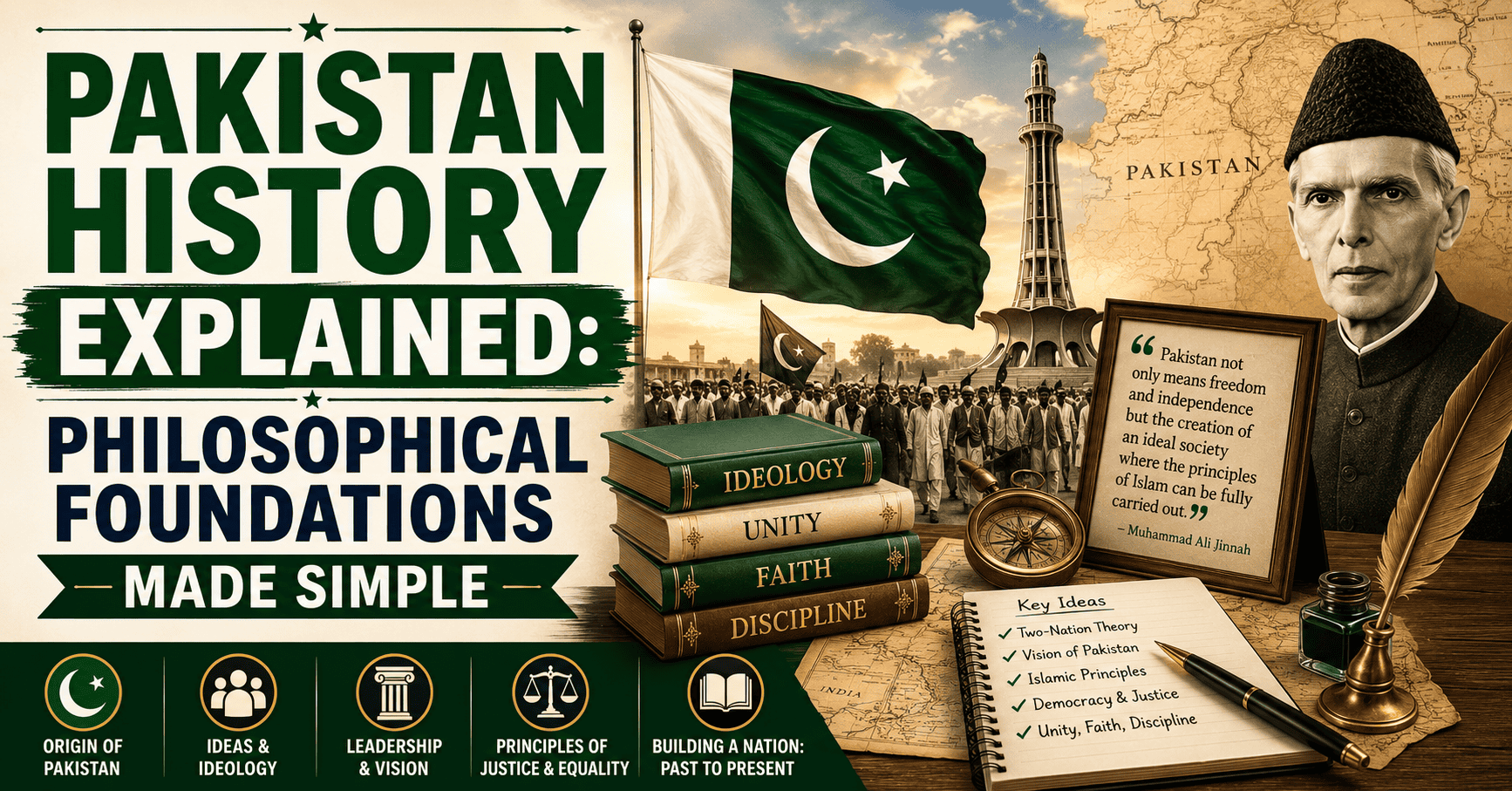
Pakistan’s history traces its roots to the ancient Indus Valley Civilization, one of the world’s earliest urban cultures, through centuries of empires, including the Mughal era, and eventual British colonial rule over the Indian subcontinent. It reached a defining turning point in 1947, when Pakistan emerged as an independent nation through the partition of British India, driven by the demand for a separate Muslim homeland led by Muhammad Ali Jinnah. Since independence, the country has navigated periods of military rule, democratic transitions, regional conflict, and the 1971 separation of East Pakistan into Bangladesh. At its core, Pakistan’s history reflects a nation shaped by the pursuit of identity, faith, and sovereignty amid complex political and regional dynamics.
Philosophy of ….
Pakistan
Geography, History, Civilization & Modern State
1. Introduction
Pakistan is a country located in South Asia.The country’s official name is the Islamic Republic of Pakistan.
Pakistan ranks among the world’s most populous countries.
Key facts:
- Population: about 241 million people
- Rank: 5th most populous country
- Capital city: Islamabad
- Largest city: Karachi
- Global size rank: 33rd largest country by area
Pakistan has the second-largest Muslim population globally.
2. Location and Borders
Pakistan is situated in South Asia, where it connects with Central Asia and the Middle East.
Land Borders
Pakistan shares borders with:
- India (east)
- Afghanistan (west)
- Iran (southwest)
- China (northeast)
Pakistan is separated from:
- Tajikistan by the narrow Wakhan Corridor.
Seas and Coast
Pakistan has a coastline along:
- Arabian Sea
- Gulf of Oman
Pakistan also shares a maritime border with:
- Oman.
3. Ancient Civilizations in Pakistan
The region that is now Pakistan was once home to some of the world’s earliest civilizations.
Mehrgarh
One of the earliest farming communities was:
- Mehrgarh
It is about 8,500 years old.
People there developed:
- farming
- pottery
- early village life
Indus Valley Civilization
Another major ancient civilization was the:
- Indus Valley Civilization
Important cities included:
- Harappa
- Mohenjo-Daro
This civilization was famous for:
- advanced city planning
- drainage systems
- trade networks
Gandhara Civilization
Another important cultural region was:
- Gandhara
This area became famous for:
- Buddhist learning
- Greek-influenced art
- major trade routes
4. Empires That Ruled the Region
Many powerful empires once governed the region that is now Pakistan.
Some important ones include:
Persian Empire
- Achaemenid Empire
Mauryan Empire
- Maurya Empire
This empire helped spread Buddhism.
Kushan Empire
- Kushan Empire
It served as a link for trade between Central Asia, India, and China.
Gupta Empire
- Gupta Empire
5. Arrival of Islam
Islam reached this region in the 7th and 8th centuries.
The first Muslim conquest was led by:
- Muhammad bin Qasim
He conquered Sindh under the Umayyad Caliphate.
Later Muslim dynasties ruled the region:
- Ghaznavid Empire
- Delhi Sultanate
- Mughal Empire
The Mughal Empire controlled large parts of South Asia for more than 300 years.
6. British Colonial Rule
In the 19th century, the area fell under the control of:
- British Raj
This lasted from 1858 to 1947.
During this period:
- railways were built
- modern administration developed
- new political movements emerged
7. Creation of Pakistan (1947)
Pakistan was created through the Pakistan Movement.
The movement was led by:
- Muhammad Ali Jinnah
The aim was to establish a separate homeland for Muslims in British India.
Pakistan became independent after the:
- Partition of India
This caused:
- massive migration
- violence
- millions of deaths and displacement
8. East and West Pakistan
Originally Pakistan had two parts:
- West Pakistan (today’s Pakistan)
- East Pakistan (today’s Bangladesh)
After political conflict and war, East Pakistan became:
- Bangladesh in 1971.
9. Modern Pakistan
Today Pakistan is a federal democratic republic.
It has experienced periods of:
- civilian democratic governments
- military rule
Pakistan has one of the world’s largest military forces.
It is also a nuclear weapons state.
10. Economy and Global Role
Pakistan is considered a middle power country.
It has:
- a growing economy
- a rapidly expanding middle class
- important strategic location
Pakistan is part of many international organizations:
- United Nations
- Shanghai Cooperation Organisation
- Organisation of Islamic Cooperation
- Commonwealth of Nations
- South Asian Association for Regional Cooperation
Pakistan is officially recognized as a major non-NATO ally of the United States.
11. Diversity of Pakistan
Pakistan is a very diverse country.
It has:
Many ethnic groups
- Punjabis
- Sindhis
- Pashtuns
- Baloch
- Kashmiris
Many languages
- Urdu (national language)
- English
- Punjabi
- Sindhi
- Pashto
- Balochi
12. Challenges
Pakistan continues to face several challenges:
- poverty
- illiteracy
- corruption
- political instability
- terrorism
However, the country has strong economic potential and a large young population.
Simple Summary
Pakistan is:
- the 5th most populated country
- located in South Asia
- home to ancient civilizations
- founded in 1947
- a nuclear-armed middle power
- culturally and geographically diverse
Its history links ancient civilizations, Islamic empires, colonial rule, and the formation of a modern state.