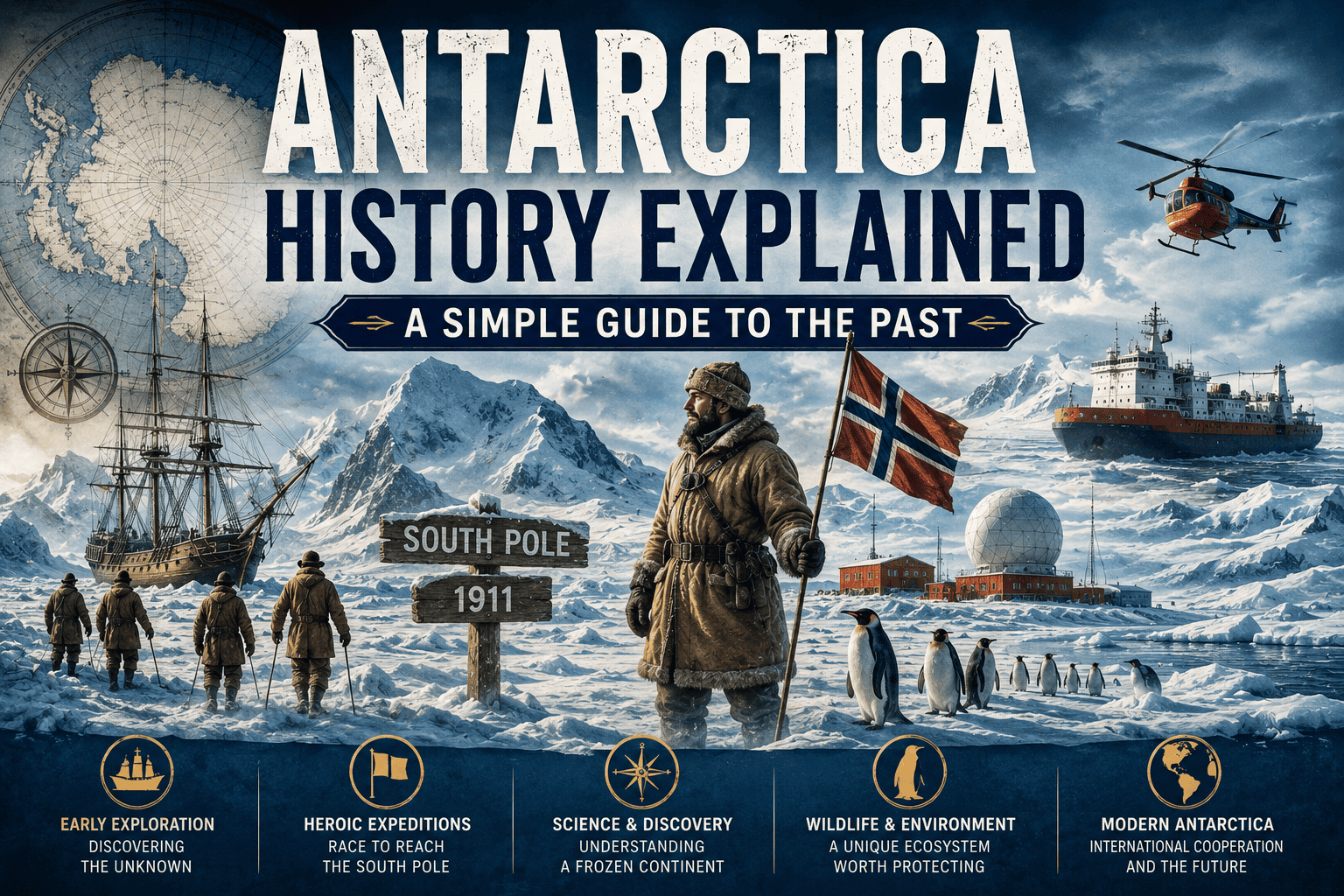
Antarctica History Explained
Antarctica’s history is unique among continents – with no Indigenous population, its story begins with exploration rather than ancient civilization, from early sightings in the 1820s to the dramatic race to reach the South Pole in the early 20th century by figures like Amundsen and Scott. It traces the rise of scientific research stations, the establishment of the Antarctic Treaty in 1959, which set the continent aside for peaceful scientific cooperation, and the ongoing international collaboration that governs it today. This history reflects a rare model of shared global stewardship, free from territorial conflict or permanent settlement. At its core, Antarctica’s story reveals how humanity chose scientific curiosity and cooperation over conquest in one of Earth’s last untouched frontiers.
Content Overview
- Antarctica
- 2. Physical Characteristics
- 3. The Three Main Regions of Antarctica
- 1. East Antarctica
- 2. West Antarctica
- 3. Antarctic Peninsula
- 4. Wildlife of Antarctica
- 5. Plants and Microorganisms
- 6. Discovery and Exploration
- 7. Race to the South Pole
- 8. Antarctic Treaty System
- 9. Scientific Research
- 10. Environmental Importance
- Simple Summary
Antarctica
Geography, Regions, Climate & Exploration
1. Introduction to Antarctica
Antarctica is the southernmost continent on Earth and the least populated. It lies almost entirely south of the Antarctic Circle and surrounds the South Pole.
Key facts:
- Area: about 14.2 million km²
- Fifth-largest continent
- Almost 40% larger than Europe
- Surrounded by the Southern Ocean
About 98% of Antarctica is blanketed by ice, creating the enormous Antarctic Ice Sheet.
2. Physical Characteristics
Antarctica is the coldest, driest, and windiest continent on Earth.
Important facts:
- Average ice thickness: about 1.9 km
- Holds about 70% of the world’s freshwater
- Lowest recorded temperature on Earth:
−89.2 °C
If all the ice in Antarctica were to melt, it could cause global sea levels to rise by roughly 60 meters.
Most of Antarctica is a polar desert, receiving very little rainfall or snowfall.
3. The Three Main Regions of Antarctica
Geographically, Antarctica is divided into three major regions.
1. East Antarctica
East Antarctica is both the largest and the highest region of the continent.
Characteristics
- Covers about two-thirds of Antarctica
- Very thick and stable ice sheets
- Extremely cold interior climate
This area holds some of the planet’s oldest ice, which researchers examine to learn about past climates.
2. West Antarctica
West Antarctica lies between the Antarctic Peninsula and East Antarctica.
Characteristics
- Smaller but geologically more unstable
- Contains the West Antarctic Ice Sheet
- Major focus of climate change research
Scientists worry that melting ice in this region could significantly raise global sea levels.
3. Antarctic Peninsula
Antarctic Peninsula extends toward the southern tip of South America.
Characteristics
- One of the warmest parts of Antarctica
- Contains many research stations
- Experiences the fastest warming temperatures on the continent
This area is the easiest part of Antarctica for scientists and tourists to reach.
4. Wildlife of Antarctica
Even with its harsh climate, Antarctica is home to several animal species.
Important animals include:
- Penguin
- Seal
- Krill
Numerous birds and marine creatures rely on the Southern Ocean ecosystem.
5. Plants and Microorganisms
Plant life is very limited.
Vegetation mainly includes:
- moss
- lichen
- microscopic algae
Small organisms such as mites, nematodes, and tardigrades also live in Antarctic environments.
6. Discovery and Exploration
The Antarctic ice shelves were first observed in 1820 during a Russian expedition led by:
- Fabian Gottlieb von Bellingshausen
- Mikhail Lazarev
The first confirmed landing on Antarctica occurred in 1895 by a Norwegian expedition.
7. Race to the South Pole
In the early 20th century, explorers competed to reach the South Pole.
The first person to reach it was:
- Roald Amundsen in 1911.
These expeditions were among the most challenging explorations in human history.
8. Antarctic Treaty System
Antarctica is managed under an international treaty known as the:
- Antarctic Treaty System
Signed in 1959, the treaty declares that Antarctica should be used solely for:
- peaceful purposes
- scientific research
The treaty prohibits:
- military activity
- mining
- nuclear testing
- nuclear waste disposal.
About 30 countries participate in this treaty system.
9. Scientific Research
Antarctica is among the most important places on Earth for scientific research.
Research focuses on:
- climate change
- glaciology
- astronomy
- oceanography
During summer, about 5,000 scientists and workers stay at research stations.
During winter, this number decreases to around 1,000.
10. Environmental Importance
Antarctica is crucial to the functioning of the global climate system.
Major concerns include:
- melting glaciers
- ozone depletion
- rising sea levels
- warming oceans
The melting of the West Antarctic Ice Sheet could significantly affect future sea-level rise.
Simple Summary
Antarctica is:
- the southernmost continent
- the coldest and driest place on Earth
- mostly covered by ice
The continent is divided into three regions:
- East Antarctica
- West Antarctica
- Antarctic Peninsula
Antarctica has no permanent population, but it plays a vital role in scientific research and climate studies.
Now you have a fully organized overview of all the continents.
- Asia
- Africa
- Europe
- North America
- South America
- Oceania & Australia
- Antarctica