Ontology
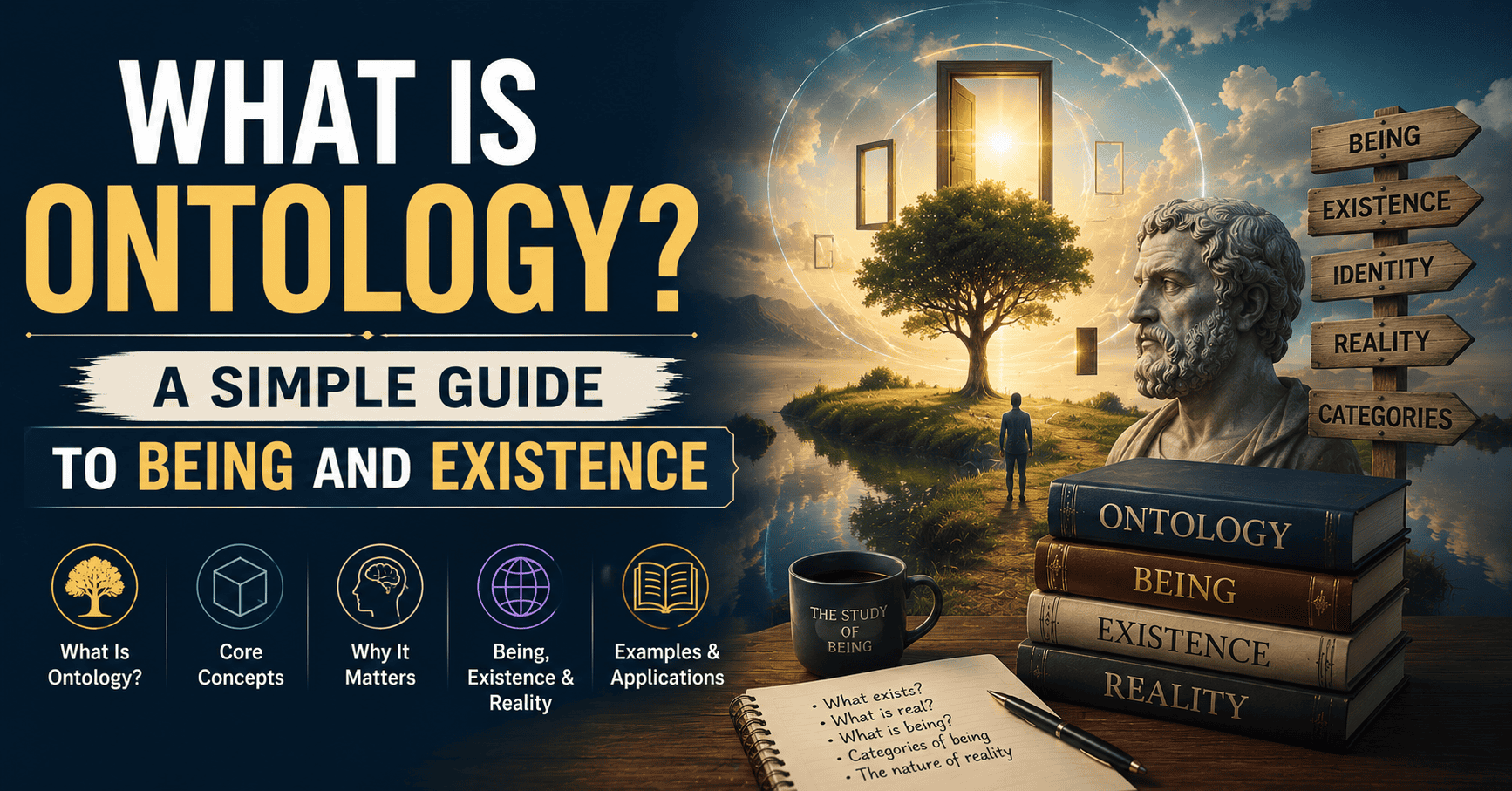
Understand What It Means to Exist — Ontology is a branch of philosophy concerned with the nature of being and existence. The word comes from the Greek terms ontos, meaning “being,” and logos, meaning “study” or “account.” Rather than attempting to create a complete inventory of everything that exists, ontology focuses on the deeper question of what kinds of entities exist and what characteristics make something part of reality.
Ontology examines categories of existence and the relationships between different kinds of things, such as physical objects, living beings, events, properties, ideas, and abstract entities. It asks questions about what it means for something to exist and whether different forms of existence should be understood in the same way. At its core, ontology seeks to determine what exists, what kinds of things exist, and what it means for anything to have existence at all.
Content Overview
- Ontology
- What Is Ontology? The Most Fundamental Question
- Major Thinkers in Ontology
- Being vs. Existence – The Nature of “To Be”
- The Nature of Being – What Fundamentally Exists?
- Categories of Being – Sorting the Furniture of Reality
- Universals, Particulars, and Substances
- Substance Theories – What Lies Beneath Properties?
- Substance and Accidents
- Essence, Existence, and Dependence
- Abstract Entities – Numbers, Sets, Propositions
- Properties, Relations, and Trope Theory
- Identity, Change, and Persistence
- Mereology – Parts, Wholes, and Composition
- Summary – The Big Picture of Ontology
Ontology
Ontology is the branch of metaphysics that explores what exists, what it means to exist, and the fundamental categories of reality. It answers the most basic question of all: What is there? But more than that, ontology asks in what way things exist, how they relate to each other, and what makes something genuinely real as opposed to merely apparent or imaginary.
What Is Ontology? The Most Fundamental Question
Example to start: Imagine you are looking at a tree. You can touch it, see its leaves, feel its bark. The tree seems unquestionably real. But now consider the number 7. Is it real? You cannot touch it, yet mathematics depends on it. Consider love – you can experience it, but you cannot put it in a jar. Consider your own self – are you just a collection of cells, or is there something more, like a soul or a continuing consciousness? Ontology asks: Are all these things real? And if they are, do they exist in the same way?
Definition: Ontology is the study of the most basic categories of existence. It asks questions like:
- What kinds of things exist?
- What does it mean for something to genuinely exist?
- What is the difference between something real and an illusion?
- Are numbers, minds, and time as real as trees, planets, and atoms?
Example – the reality of love: You say “I love my mother.” Is love a thing that exists independently? You cannot measure it with a ruler, yet it influences behaviour, causes actions, and has real effects. Some ontologists say love is a real relation between persons. Others say only physical brains and chemicals (like oxytocin) are real, and “love” is just a convenient label for a set of brain states. Ontology forces you to decide what kind of thing love is.
Major Thinkers in Ontology
Throughout history, philosophers have proposed different answers to ontological questions:
- Plato: Reality is split into two realms. There is the world of Forms (universals, ideas, perfect templates) and the world of sensibles (physical particulars, shadows of the Forms). For Plato, the Form of a tree is more real than any actual tree you can see.
- Aristotle: Created the first systematic ontology. He rejected Plato’s separate realm of Forms and instead argued that form exists in physical things. His theory of hylomorphism says every physical thing is a compound of matter (hyle) and form (morphe). A statue is marble (matter) shaped into a form (the statue’s shape).
- Willard Van Orman Quine (20th century): Famously said “To exist is to be the value of a variable.” In simpler terms, existence is shown by what our best scientific theories say there must be. If a theory quantifies over numbers (says “there exists an x such that x is a prime number”), then numbers exist – at least for the purposes of that theory.
- E. J. Lowe (20th‑21st century): Proposed a four‑category ontology: substances (like a person), kinds (like humanity), attributes (like being tall), and modes (like this person’s specific tallness). This framework aims to cover everything that can be said to exist.
Example – Quine’s view in practice: A physicist’s theory might say “There exist electrons.” According to Quine, that is enough to commit us to the existence of electrons. But a mathematician’s theory says “There exists a number between 2 and 4.” Quine would then say numbers exist, too – not as spooky entities, but as part of our best overall theory of the world.
Being vs. Existence – The Nature of “To Be”
Ontology makes a crucial distinction between being and existence.
- Being is the broadest term: it refers to anything that is, in any sense at all. A physical tree has being; a fictional character like Sherlock Holmes has being as an idea or concept; a possible future event has being as a possibility.
- Existence is narrower: it typically means having actuality in the physical, spatiotemporal world. Something that exists takes up space (or interacts causally) and can be located in time.
Example – Sherlock Holmes: The character Sherlock Holmes has being as a concept in literature and in our minds. We can talk about him, write stories about him, and even feel emotions about him. But Sherlock Holmes does not exist in the physical world – you cannot meet him on a London street. Ontology distinguishes these two senses.
Example – a unicorn: A unicorn has being as a mythical creature. The concept exists in the minds of storytellers. But no unicorn has ever existed in reality. The word “unicorn” refers to something that has being but not existence.
Example – numbers: Does the number 2 exist? From a Platonist perspective, numbers are thought to exist in a timeless, non-physical realm, possessing both being and a form of abstract existence.If you take a nominalist view, numbers are just useful fictions; they have being only as mental constructs, not as independent entities.
Key terms:
- Being: Anything that “is” in any sense – physical, mental, abstract, fictional, possible.
- Existence: The condition of having actuality in the real world.
Example of different modes of being: A tree, a thought, and a number all are, but in profoundly different ways. A tree occupies space and time. A thought occurs in a mind at a particular time but has no spatial location. A number has no location in space or time at all. Ontology’s job is to sort out these categories.
The Nature of Being – What Fundamentally Exists?
Ontology asks not just “what exists?” but also:
- In what way does it exist?
- How do entities relate to one another?
- What is the fundamental furniture of the universe?
Example: Is reality made only of physical matter (materialism)? Or are mental phenomena equally fundamental (idealism)? Or do abstract entities like numbers and propositions also exist (Platonism)? The answer changes everything about how we understand science, ethics, and even everyday life.
Example – the question of time: Is time real, or is it an illusion? Some ontologists (presentists) say only the present moment exists. Others (eternalists) say past, present, and future all exist equally – we just happen to be located at one point in the block universe. This is not a scientific question but an ontological one.
Categories of Being – Sorting the Furniture of Reality
Philosophers have long tried to create a complete list of the most general kinds of things that exist. These are categories of being.
Two primary categories:
| Category | Description | Examples |
|---|---|---|
| Concrete Entities | Things that exist in space and time, can be experienced through senses | Tables, trees, people, electrons, planets |
| Abstract Entities | Things that have no physical presence, no location, yet seem to be real | Numbers, sets, propositions, concepts, universals (like “redness”) |
Example – the chair and the number: You can sit on a chair – it is concrete. You cannot sit on the number 7, but you can use it in calculations. Do numbers exist? If so, in what way? This is a central ontological dispute.
Other ontological categories:
- Physical objects: Rocks, stars, chairs, animals. They have location, mass, duration.
- Abstract objects: Numbers, sets, geometric shapes. No location, no mass.
- Events: A concert, a war, a birthday party. They occur in time and involve change.
- Processes: Growth, erosion, digestion. They are extended in time and consist of stages.
- States: Being asleep, being sad, being a bachelor. They are conditions that obtain.
Example – an event vs. a physical object: A tree (object) exists over time but is relatively stable. A forest fire (event) is a happening; it has a beginning, middle, and end. Ontology must account for both.
Universals, Particulars, and Substances
Universals and Particulars
One of the most enduring debates in ontology concerns universals and particulars.
- Universals are properties or qualities that can be shared by many different things. Examples: redness, roundness, humanity, justice. The same universal can appear in many particulars.
- Particulars are individual entities that exist at a specific place and time. Examples: this red apple, that round ball, Socrates.
Example – redness: There are many red things – a red apple, a red car, a red dress. They all share the universal “redness.” But is redness a real thing that exists independently of the red objects? Or is “redness” just a name we give to a group of similar sensory experiences?
Major positions:
| Position | View on Universals | Example |
|---|---|---|
| Realism | Universals exist independently of the mind, in a separate realm or as part of reality. | The Form of Redness exists whether or not any red objects exist. |
| Nominalism | Only particulars exist. Universals are just names (labels) we assign to groups of similar particulars. | “Redness” is just a convenient word for a set of red objects. |
| Conceptualism | Universals exist, but only as mental concepts inside human minds. | Redness exists as an idea in the mind, not in an external realm. |
Example – the debate in action: Look at a red apple and a red stop sign. A realist says the same universal (redness) is present in both. A nominalist says each object has its own particular shade of red, and we group them under the word “red” because they are similar. A conceptualist says our minds create the concept of redness to organise experience, but nothing outside the mind corresponds directly to that concept.
Substances – Independent Existents
A substance is an entity that exists independently and possesses properties. It serves as the underlying entity that holds qualities, unlike properties, which cannot exist independently.
Example: A tree is a substance. It has properties like height, colour, bark texture. The property “green” cannot exist floating on its own – it must be attached to a substance like a tree or a leaf.
Key feature of substance: It does not depend on anything else for its existence. A tree, once grown, exists on its own. By contrast, a hole in the ground depends on the ground – a hole is not a substance; it is a lack or an absence.
Substance Theories – What Lies Beneath Properties?
Ontology offers different theories to explain what an object is at its deepest level.
1. Substance Theory (Traditional)
An object exists as a substance that has properties. The substance is the underlying core, and the properties are its attributes.
Example: A cat (substance) has properties: black colour, 4.5 kg weight, meowing sound. The substance is the cat itself; the properties could change (the cat could lose weight) while the substance remains the same cat.
2. Bundle Theory
Bundle theory denies that there is any underlying substance. An object can be understood as simply a collection of properties.
Example: A red ball is just the collection of properties: “spherical”, “red”, “solid”, “bouncy”, etc. There is no additional “thing” that holds these properties together – the bundle is the object.
Example – a tree as a bundle: According to bundle theory, a tree is just the collection of its features: tall + leafy + rough + green. There is no mysterious “treeness” underneath. When you remove all properties, nothing remains.
3. Substratum Theory
There is an invisible, unobservable substratum (sometimes called “bare particular”) that holds properties together. The substratum has no properties of its own – it is the pure bearer.
Example: An apple has colour, taste, shape, and mass. The substratum is the “glue” that unites these properties into a single apple. You cannot see or touch the substratum; you only experience the properties it supports.
Example – invisible glue: Think of a tree. The bark, the leaves, the height, the colour – they all stick together to form one object. Substratum theory says there is an unseen “stuff” that does the sticking. Without it, the properties would float apart.
4. Hylomorphism (Aristotelian)
Hylomorphism comes from Greek hyle (matter) and morphe (form). Every physical substance consists of a combination of matter and form.
Example: A statue is marble (matter) shaped into a statue’s form (the shape of a human figure). The marble alone is not a statue; the form alone is not a statue. Only the matter + form together make the substance.
Example – a human being: According to Aristotelian hylomorphism, a person is not just a body (matter) and not just a soul (form). The person is the unity of body and soul – the matter organised by the form.
Substance and Accidents
Classical metaphysics distinguishes between substance and accidents (or accidents are properties that depend on substances).
- Substance: Exists independently. Example: a cat.
- Accidents: Properties that cannot exist without a substance. Example: the cat’s colour or weight. The colour “black” cannot exist floating in the air – it requires a cat or some other substance.
Example – a tree: The tree is the substance. Its height, leaf colour, and bark texture are accidents – they could change (the tree could lose leaves) while the tree remains the same tree.
Essence, Existence, and Dependence
Essence
The essence of an entity is its core nature – what makes it what it is.
Example: The essence of a triangle is “having three straight sides.” If something does not have three straight sides, it is not a triangle. Similarly, the essence of a human being, for some philosophers, is “rational animal” – to be human is to possess rationality.
Example – the essence of water: Modern science says the essence of water is H₂O. Any substance that is not H₂O is not water, regardless of its appearance. This is a metaphysical claim about what water really is, beyond surface properties.
Existence (Abstract vs. Concrete)
Concrete entities exist in space and time. A tree, an electron, a planet – they occupy location and endure through time.
Abstract entities have no spatiotemporal location. Numbers, sets, propositions, universals – they do not exist “somewhere” but are said to exist in a different sense.
Example – the number 2: Does the number 2 exist in the same way as a tree? A Platonist says yes – numbers exist in a timeless, non‑physical realm. A nominalist says no – numbers are merely useful concepts with no independent existence. An ontologist must decide.
Dependence
Some entities cannot exist without others.
Example – a hole: A hole depends on its host object – a hole in the ground exists only because the ground is there. Without the ground, there is no hole. Holes are dependent entities.
Example – the redness of an apple: The redness cannot exist without the apple. It is a dependent property (an accident). The apple (substance) can exist without that particular shade of red (if it changes colour), but the redness cannot exist without some substance.
Abstract Entities – Numbers, Sets, Propositions
One of the most fascinating areas of ontology is the status of abstract entities.
| Entity | Description | Example Question |
|---|---|---|
| Numbers | Mathematical objects | Does the number 7 exist? Is it discovered or invented? |
| Sets | Collections of objects | Does the set {1,2,3} exist independently of our thinking about it? |
| Propositions | Meanings of sentences, truth‑bearers | Does the proposition “snow is white” exist as an abstract entity? |
Example – Platonism vs. Nominalism:
- Platonism: Numbers, sets, and propositions exist in a timeless, non‑physical realm. They are discovered, not invented. 2+2=4 is true regardless of human minds.
- Nominalism/Constructivism: Abstract entities are human constructions. Numbers are symbols; propositions are mental acts. They have no independent existence.
Example – where is the number 2? You cannot point to it. You cannot touch it. Yet mathematics would be impossible without it. Ontologists argue endlessly over whether such entities truly exist or are just convenient fictions.
Properties, Relations, and Trope Theory
Properties
Properties are the characteristics or qualities that substances have. They include colour, mass, texture, shape, temperature, and so on.
- Intrinsic properties: Belong to the thing itself, independent of other things. Example: mass, electric charge.
- Extrinsic properties: Depend on other things or contexts. Example: “being taller than” – you cannot be taller than something if nothing else exists to compare with.
Example: The mass of an electron is intrinsic – it does not change based on its environment. The property “being a mother” is extrinsic – it requires a child.
Relations
Relations are how entities connect to one another.Examples include relations such as “larger than,” “next to,” “loves,” and “causes.”
Example – the relation “taller than”: You and your friend. If you are 180 cm and your friend is 170 cm, the relation “taller than” holds between you. This relation is not a property of you alone – it requires both of you.
Trope Theory
Trope theory proposes that properties exist as individual instances rather than as shareable universals.
- Universal redness would be a single entity present in every red object.
- A trope is a particular instance of redness – this apple’s specific red, that car’s specific red. Each red object has its own unique trope.
Example – two red apples: Under universalism, the same universal “redness” is in both apples. Under trope theory, apple A has trope Red₁, apple B has trope Red₂. The two reds are numerically different but may be exactly similar.
Debate: Are properties repeatable (universals) or unique (tropes)? Trope theory avoids the problem of how one universal can be entirely present in multiple places at once.
Identity, Change, and Persistence
One of the deepest ontological puzzles: How can something remain the same through change?
Example – the river: Heraclitus said you cannot step into the same river twice, because the water has changed. Yet we speak of “the Thames River” as one and the same river over centuries. What makes it the same? Continuity of location? Continuity of name? A causal history?
Example – the human body: Your cells are replaced every few years. At the end of seven years, you have an almost entirely new set of atoms. Are you still the same person? Most of us say yes, but why?
Criteria for persistence:
- Psychological continuity (for persons): You are the same person if you have memories, intentions, and character traits that connect over time.
- Spatiotemporal continuity (for objects): An object persists if there is an unbroken path through space and time – a tree grows, loses branches, but its physical history remains connected.
Example – the Ship of Theseus (classic paradox): A ship has its planks replaced one by one. After all planks are new, is it still the same ship? Now suppose the old planks are reassembled into a second ship. Which one is the original? There is no obvious answer – the puzzle reveals that our ordinary concept of “same object” may be ambiguous.
Example – a car: If you replace the tyres, the battery, and eventually the engine, is it still “your car”? Most people say yes if the replacement is gradual and the car’s history is continuous. But if you replace every part, some philosophers argue it is a new car.
Mereology – Parts, Wholes, and Composition
Mereology is the branch of philosophy that studies the relationship between parts and wholes. It asks: When do parts compose a whole?Is a whole something greater than just the sum of its parts?
Example – a house: Bricks, mortar, wood, glass – each part exists. When arranged in a certain way, they become a house. Is the house just the collection of parts, or does “house” refer to something additional (a form, a function, a unity)?
Key questions in mereology:
- When do parts compose a whole? Every collection of atoms does not automatically make an object. What are the conditions? (Contact? Cohesion? Unity of function?)
- Is a whole identical to its parts? If you take a brick from a house, is it still the same house? Most say yes, because a house can survive loss of a brick. But if you take all bricks, the house is gone.
- Nihilism vs. Universalism:
- Mereological nihilism: No composite objects exist; only simple particles (atoms, quarks) exist. What we call “tables” are just particles arranged table‑wise.
- Mereological universalism: Any collection of objects, no matter how scattered, composes a whole.Even your left ear and the Eiffel Tower could be said to form an object—though an admittedly strange one.
Example – a statue and the clay: A statue is made of clay. If you squish the clay into a ball, the statue is destroyed, but the clay remains. Mereology asks: Is the statue a part of the clay, or is the clay a part of the statue? They are not identical because different properties (statue shape) come and go.
Summary – The Big Picture of Ontology
Ontology is the philosophical discipline that asks: What exists? In what ways? How do things relate? What does it mean to be?
It covers:
- The difference between being (any kind of “is”) and existence (actuality in the physical world).
- The most general categories of being: concrete and abstract, substances and properties, universals and particulars, parts and wholes.
- Substance theories: traditional substance, bundle theory, substratum theory, hylomorphism.
- Essence vs. existence – what makes a thing the kind of thing it is vs. the fact that it exists.
- Abstract entities – numbers, sets, propositions – and whether they are real.
- Properties, relations, tropes – how qualities and connections fit into reality.
- Identity and persistence – how things remain themselves through change (the Ship of Theseus, the river, the changing person).
- Mereology – the logic of parts and wholes, from bricks to houses to the entire universe.
Practical final thought: Ontology matters because every time you say “X is real” or “Y is just a concept,” you are making an ontological claim. When you decide that numbers are real, you commit to a certain view of mathematics. When you decide that only physical atoms are real, you become a materialist – and then you must explain love, justice, and consciousness in purely physical terms. These are not abstract puzzles; they shape how we live, how we do science, and how we understand ourselves. Ontology does not give easy answers, but it teaches us to ask the right questions – and sometimes the question is more important than the answer.