Formal Sciences
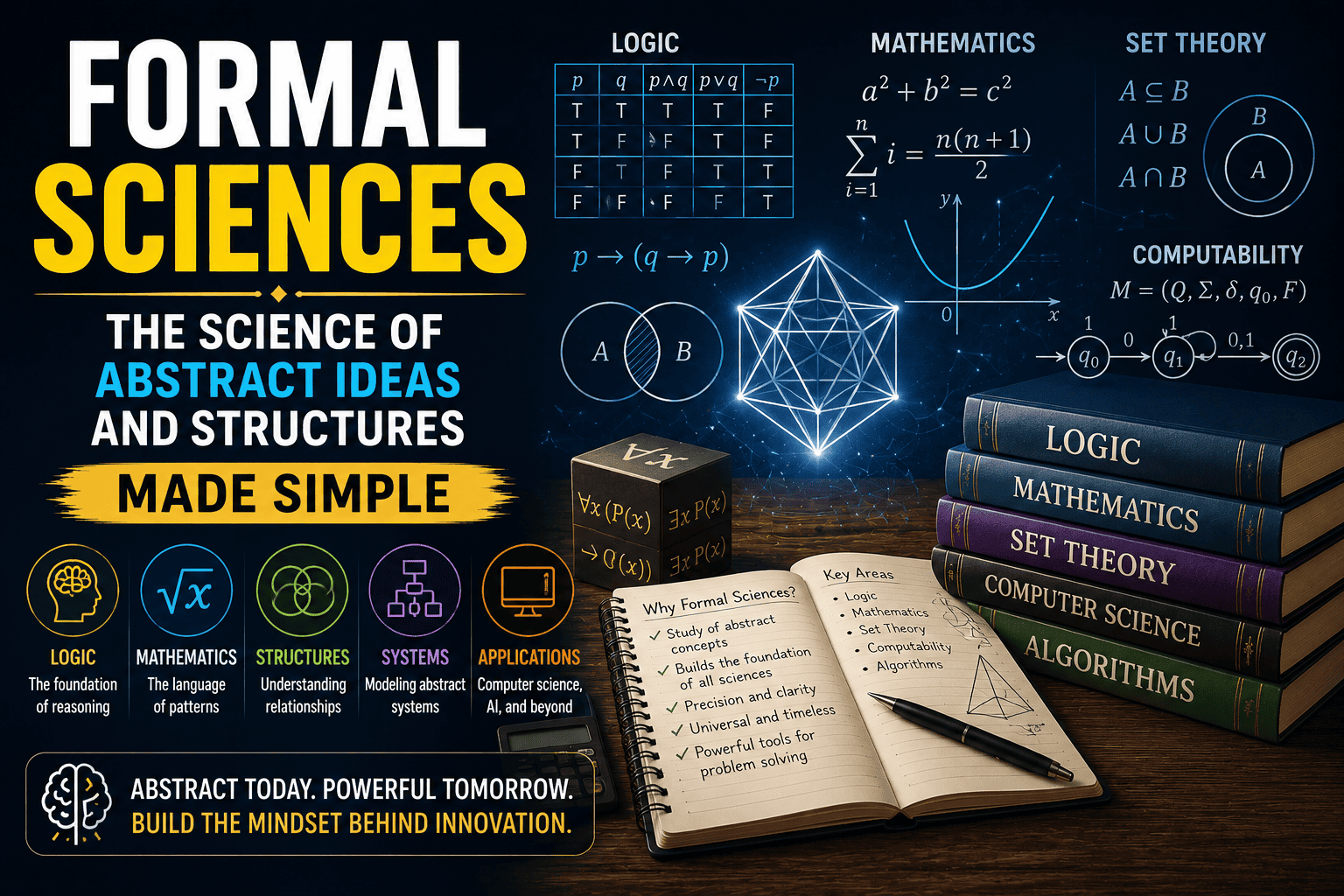
Explore the Abstract Foundations of Mathematical and Logical Knowledge — Formal sciences are disciplines that investigate abstract structures, systems, and relationships through precise definitions, logical reasoning, and mathematical methods rather than relying primarily on observation or physical experimentation. They include areas such as mathematics, logic, statistics, and theoretical computer science. While natural sciences study phenomena in the physical world through empirical evidence, formal sciences establish and examine conclusions through deduction, proof, and the internal consistency of formal systems.
These disciplines provide essential concepts, methods, and frameworks that support research across many other fields, including physics, engineering, economics, computer science, and social sciences. By focusing on abstract reasoning rather than direct observation, formal sciences allow researchers to investigate what follows logically from a given set of assumptions or rules. At their core, formal sciences explore what can be established through systematic reasoning and deduction, even without direct dependence on empirical experience.
Content Overview
- Formal Sciences: The Abstract Foundations of Human Knowledge
- Logic: The Foundation of Reasoning
- Mathematics: The Language of Structure and Pattern
- The History of Mathematics in Formal Sciences
- Mathematics as the Language of Logic
- Geometry – The Mathematics of Space
- General Mathematics and Analytic Geometry
- Arithmetic: The Science of Numbers
- Calculus and Multivariable Calculus
- Discrete Structures
- Algebra – Understanding Patterns and Structures
- Algebra and Linear Algebra
- Statistics and Probability
- Computer Science: Formal Systems in Action
- Importance of Formal Sciences in Modern Life
- Conclusion: Why Formal Sciences Matter
Formal Sciences: The Abstract Foundations of Human Knowledge
Introduction to Formal Sciences
Formal sciences represent the most abstract branch of human knowledge. Unlike natural sciences, which study the physical world, or social sciences, which examine human behavior, formal sciences focus on ideal systems created by the human mind. These systems are governed by rules, symbols, definitions, and logical relationships rather than experiments or observations.
Formal sciences are not concerned with what exists in nature, but with what must be true if certain assumptions are accepted. Their strength lies in deductive reasoning, where conclusions follow necessarily from premises.
Simple example: In mathematics, once you accept that two plus two equals four, every related conclusion follows logically, without needing to observe objects in the real world.
What are Formal Sciences?
Formal sciences deal with systems of abstract logic and reasoning. They differ from natural sciences by focusing on theoretical frameworks rather than empirical observations. Mathematics, Logic, and Computer Science are its core components.
Example: Mathematics underpins cryptography, ensuring secure communication in e-commerce. By abstracting patterns, it allows the formulation of encryption algorithms that protect sensitive data. Mathematics bridges abstract thought and real-world applications. Its logical foundations ensure it remains the cornerstone of modern science and technology.
Nature and Scope of Formal Sciences
Formal sciences study abstract structures such as numbers, symbols, algorithms, and logical relations. Their truths are not discovered through microscopes or telescopes but through proof, consistency, and logical coherence.
Formal systems are universal and timeless. A mathematical theorem proven centuries ago remains true today, regardless of culture or location.
Example: The Pythagorean theorem applies equally to ancient temples and modern skyscrapers because it is based on logical relationships, not physical materials.
Role of Deductive Reasoning
Deductive reasoning is central to all formal sciences. It begins with axioms or basic assumptions and derives conclusions through strict logical steps.
Example: If all even numbers are divisible by two, and eight is an even number, then eight must be divisible by two. No experiment is needed to verify this.
Logic: The Foundation of Reasoning
Logic is the study of sound reasoning and correct methods of thinking. It provides the rules that determine whether conclusions follow properly from premises.
Logic is essential not only in philosophy and mathematics but also in computer programming, artificial intelligence, law, and everyday decision-making.
Simple example: If it rains, the ground will become wet. It is raining. Therefore, the ground is wet. Logic evaluates whether this reasoning is valid.
Types and Applications of Logic
Formal logic focuses on symbolic representation of arguments, ensuring clarity and precision. It helps eliminate ambiguity and emotional bias from reasoning.
In computer science, logic is used to design circuits and decision-making systems.
Example: A computer program follows logical conditions such as “if this happens, then do that,” which is pure applied logic.
Mathematics: The Language of Structure and Pattern
Mathematics is the most extensive and influential formal science. It studies numbers, shapes, patterns, relationships, and change. Mathematics serves as the universal language through which other sciences express laws and models.
Example: Physics describes motion using equations, and economics models markets using mathematical functions.
The History of Mathematics in Formal Sciences
Mathematics originated with ancient civilizations. The Egyptians used geometry for land measurement, while Babylonians developed a base-60 system, evident in how we measure time (60 minutes/hour).
Greek mathematicians, like Euclid, formalized mathematical reasoning. Euclid’s Elements became the foundation of geometry. In modern times, Alan Turing laid the groundwork for formal logic in computer science.
For example, Euclid’s algorithm is a method used to determine the greatest common divisor (GCD) of two numbers.
For and
Divide 48 by 18 → remainder = 12.
Divide 18 by 12 → remainder = 6.
Divide 12 by 6 → remainder = 0.
GCD = 6.
Mathematics as the Language of Logic
Mathematics forms the backbone of logical reasoning. Deductive reasoning derives conclusions from axioms, while inductive reasoning generalizes patterns.
Example:
Deduction: If (x > 5) and (x < 10), then (x) lies between 5 and 10.
Induction: Observing that (2 + 2 = 4), (3 + 3 = 6), (4 + 4 = 8), one generalizes that (n + n = 2n).
Geometry – The Mathematics of Space
Geometry explores shapes and space. Euclidean geometry focuses on 2D and 3D figures.
Example: The Pythagorean theorem states: a² + b² = c².
For a right triangle with sides a = 3 and b = 4: c = √(3² + 4²) = √(9 + 16) = 5.
General Mathematics and Analytic Geometry
General mathematics introduces numerical relationships and problem-solving techniques. Analytic geometry connects algebra with geometry by describing shapes using equations.
Example: A circle can be represented by an equation, allowing engineers to design wheels and gears precisely.
Arithmetic: The Science of Numbers
Arithmetic deals with basic numerical operations such as addition, subtraction, multiplication, and division. It serves as the basis for all advanced mathematics.
Example: Budgeting monthly expenses relies on arithmetic to track income and costs.
Numbers and Their Types
Numbers form the foundation of mathematics.
Natural Numbers (1, 2, 3…): Count objects.
Integers (…-2, -1, 0, 1, 2…): Represent losses and gains.
Rational Numbers (p/q, q ≠ 0): Represent fractions.
Irrational numbers (such as π and √2) cannot be written as simple fractions.
Example:
Rational: 1/2 = 0.5.
Irrational: π ≈ 3.14159…
Proof Techniques
Mathematical proofs establish truths.
For example, demonstrate that the sum of the first n natural numbers follows a general formula.
1+2+3+⋯+n=2n(n+1)
This formula gives the sum of the first n natural numbers in a simple closed form.
Using induction:
Base Case (n = 1): 1 = 1(1 + 1)/2. True.
Inductive Step: Assume true for n, prove for n+1:
\frac{n(n+1)}{2} + (n+1) = \frac{(n+1)(n+2)}{2}
This identity shows how adding the next term ((n+1)) extends the sum formula from (n) terms to (n+1) terms.
Calculus and Multivariable Calculus
Calculus analyzes change.
Derivative: Slope of a curve. Example: For y = x², dy/dx = 2x.
Integral: Area under a curve. Example: ∫ x dx = x²/2 + C.
Calculus studies change and motion. It explains how quantities vary and how rates of change behave. Multivariable calculus extends these ideas to systems involving multiple variables.
Example: Calculus helps predict how fast a car accelerates or how population growth changes over time.
Discrete Structures
Discrete mathematics studies finite or countable systems such as graphs, networks, and logical statements. It is fundamental to computer science and information technology.
Example: Social media connections are modeled as networks using graph theory.
Algebra – Understanding Patterns and Structures
Algebra solves equations using symbols.
Example: Solve 2x + 5 = 15:
Subtract 5: 2x = 10.
Divide by 2: x = 5.
Quadratic equations (ax² + bx + c = 0) have solutions using the quadratic formula:
x = [-b ± √(b² – 4ac)] / 2a
For example, consider solving the quadratic equation:
x^2 + 5x + 6 = 0
This equation can be factored into two binomials, allowing you to find the values of x.
x = [-5 ± √(25 – 24)] / 2 = -2 or -3
Algebra and Linear Algebra
Algebra studies symbols and equations, while linear algebra focuses on vectors, matrices, and linear transformations.These areas play a vital role in fields such as engineering, physics, economics, and artificial intelligence.
Example: Image processing and facial recognition rely heavily on matrix operations.
Statistics and Probability
Statistics analyzes data, while probability measures uncertainty. Together, they allow decision-making in uncertain conditions.
Example: Medical trials use statistics to determine whether a treatment is effective or not.
Computer Science: Formal Systems in Action
Computer science applies formal logic and mathematics to computation. It studies how information is represented, processed, and automated.
Unlike machines, computer science itself is abstract it defines what computers can and cannot do in principle.
Example: Before building a computer program, scientists mathematically define how it should behave.
Algorithms: Step-by-Step Problem Solving
Algorithms are precise instructions for solving problems. They must be correct, efficient, and finite.
Example: Sorting names alphabetically follows a defined algorithm used in databases and search engines.
Theoretical Computing
Theoretical computer science explores the limits of computation, including which problems can be solved and how efficiently.
Example: Some problems are mathematically proven to be unsolvable by any computer, no matter how powerful.
Artificial Intelligence
Artificial intelligence uses logic, probability, and algorithms to simulate intelligent behavior. AI systems reason, learn, and make decisions based on formal models.
Example: Recommendation systems suggest videos or products by applying mathematical models to user data.
Importance of Formal Sciences in Modern Life
Formal sciences provide the invisible structure behind modern civilization. From digital communication to financial systems, formal logic and mathematics make complex technologies reliable and scalable.
Example: Online banking depends on cryptography, which is based entirely on formal mathematical principles.
Relationship with Other Sciences
Formal sciences support natural and applied sciences by providing tools for modeling, prediction, and verification.
Example: Climate models rely on mathematical equations and computational simulations.
Conclusion: Why Formal Sciences Matter
Formal sciences shape how humans think, reason, and create systems of knowledge. Though abstract, their impact is concrete powering technology, guiding decisions, and ensuring logical consistency across disciplines.
They remind us that behind every machine, model, and method lies a structure of pure thought.