Axiology
Explore the Nature and Meaning of Value — Axiology is the branch of philosophy that examines the concept of value and investigates what makes something good, worthwhile, meaningful, or desirable. It includes major areas such as Ethics, which focuses on moral values and conduct, and Aesthetics, which examines artistic and aesthetic value. Axiology also considers whether values exist objectively or are influenced by individual beliefs, cultural traditions, and personal perspectives.
The field addresses fundamental questions about how people determine what is valuable and how different values should be compared when they come into conflict. It explores ideas surrounding concepts such as truth, justice, happiness, beauty, and the meaning of a fulfilling life. At its core, axiology asks what we should value, why those values matter, and how they influence the choices and judgments we make.
Content Overview
- 1. Introduction to Axiology & Value Theory
- 2. Part A: Moral Philosophy (Ethics)
- Part B: Aesthetics (the study of art and beauty)
- 4. Conclusion: The Importance of Axiology
- 5. Learning Roadmap & Further Study
1. Introduction to Axiology & Value Theory
1.1 What is Axiology?
➮ Axiology & Value theory
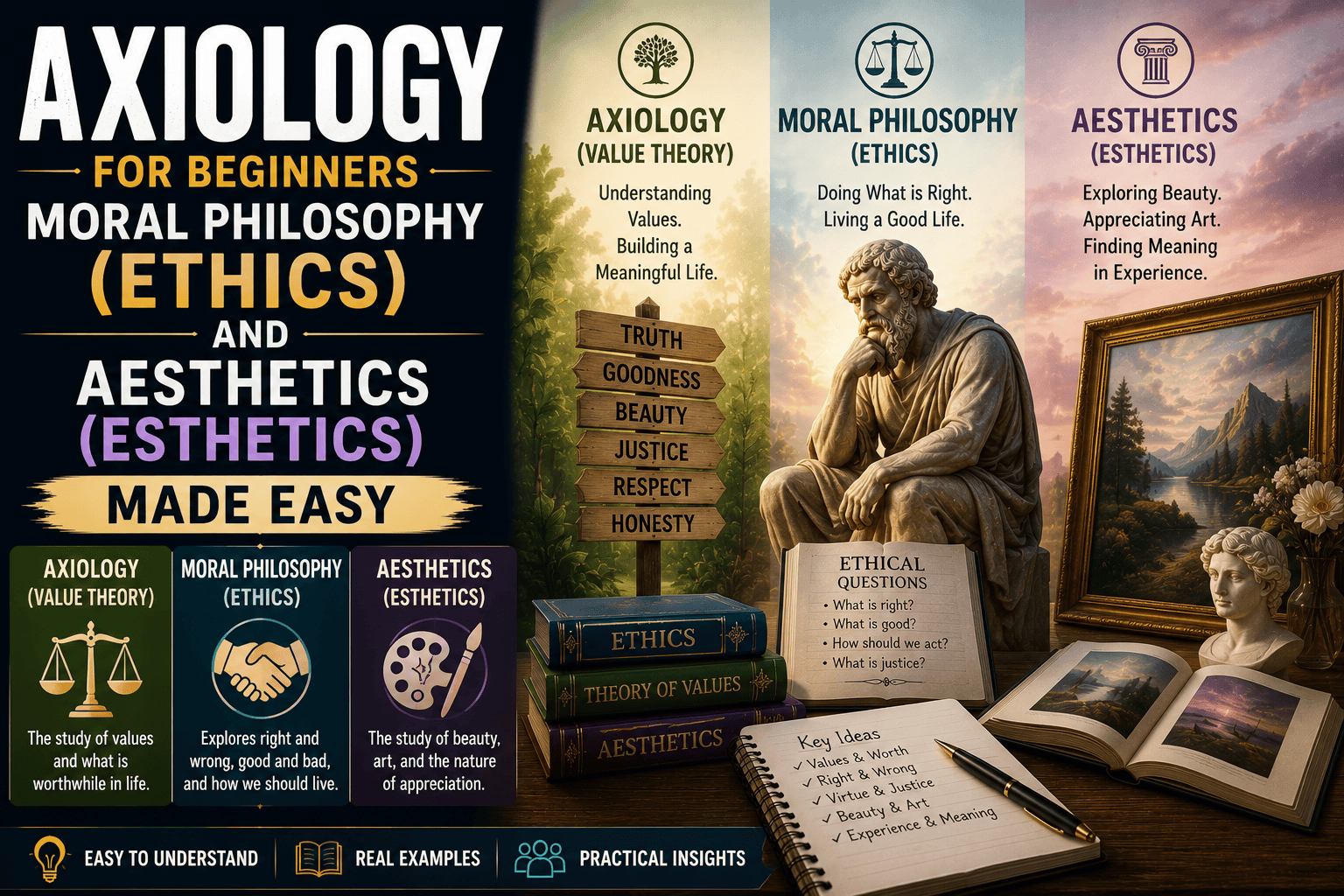
Axiology is the branch of philosophy concerned with the study of values, encompassing both moral principles and aesthetic appreciation.
It explores what is considered good, valuable, or worth pursuing.
Example: Debating the intrinsic value of happiness versus the instrumental value of money.
Value theory asks what is valuable or worthwhile in life, covering topics like beauty, happiness, and justice.
Axiology (from Greek axios = worth, logos = study) is the philosophical field dedicated to the study of value and valuation. It is the umbrella term that encompasses both Ethics, which deals with moral values (right/wrong, good/bad), and Aesthetics, which deals with artistic and sensory values (beauty, taste, art).
Axiology is the branch of philosophy that explores the nature of values and how judgments about worth or importance are formed. It asks questions like:
– What is valuable in life?
– What makes something good or bad?
Value theory is a part of axiology that explores what we consider important or worthwhile.
– Example: Why do we value honesty, friendship, or beauty? Is happiness the most important thing in life, or are there other values, like justice or freedom, that matter more?
– Aesthetics is the branch of philosophy that studies beauty, art, and sensory experiences.
It considers questions like “What defines beauty?” and “What makes something art?”
– Example: Aesthetic experiences can include admiring a sunset, listening to music, or viewing a painting.
1.2 Core Questions of Value Theory
Value theory, a core part of axiology, explores fundamental questions such as:
- What makes something valuable?
- What is the ultimate good in life? (e.g., happiness, justice, freedom)
- Are values objective (existing independently) or subjective (dependent on human perception)?
- How do we prioritize conflicting values?
Example: Why do we value honesty, friendship, or beauty? Is happiness the most important goal, or do values like justice or freedom matter more?
1.3 The Relationship Between Ethics and Aesthetics
While distinct, Ethics and Aesthetics are deeply connected branches of value theory. Both involve critical judgment, interpretation, and the attempt to establish criteria for evaluation—one in the realm of human conduct, the other in the realm of sensory experience and creativity.
Why Are Ethics and Axiology Important?
Ethics and axiology help us navigate complex moral questions and make better decisions. They encourage us to think critically about our actions and their impact on others. Whether it’s deciding how to treat the environment, resolving a conflict at work, or figuring out what kind of person we want to be, ethics and axiology provide the tools to guide us.
2. Part A: Moral Philosophy (Ethics)
➮ Moral philosophy or Ethics
Ethics – Investigates moral principles and right conduct. Example question: “How should I live?”
Ethics is the branch of philosophy that deals with questions of morality.It explores concepts of morality, including what is right or wrong and how people should act.
Ethics is the philosophical study of morality, which examines what is right and wrong, good and bad. It seeks to provide principles to guide human conduct.
2.1 What is Ethics?
Ethics, also called moral philosophy, is the study of what is right and wrong, good and bad, and how we should live our lives. It assists in addressing questions such as:
I don’t have enough context yet to give you a useful answer. What situation are you dealing with?
How should I handle this situation?
“What kind of person should I aim to become?”
– How do we treat others fairly?
Example: If you’ve ever wondered whether it’s okay to lie to protect someone’s feelings, you’re thinking about ethics.
Ethics, or moral philosophy, is the systematic study of what is right and wrong, good and bad, and how we should live our lives. It provides frameworks for addressing questions like:
- What should I do in this situation?
- What kind of person should I be?
- How do we create a just society?
Example: Debating whether it’s acceptable to lie to protect someone’s feelings is an exercise in applied ethics.
2.2 Major Branches of Ethics
2.2.1 Metaethics
➜Meta Ethics
It questions the meaning of ethical terms and the nature of moral facts.
For instance, it includes examining whether moral truths exist independently of human opinions or beliefs.
Meta-ethics explores the nature of moral judgments, asking whether moral values are objective or subjective and whether moral claims can be true or false.
Metaethics investigates the nature, origin, and meaning of ethical concepts themselves. It asks questions about ethics, rather than specific moral questions.
- Core Questions: Are moral facts real? Is morality a matter of personal opinion (subjectivism) or are there universal truths (moral realism)? What do we mean by “good”?
- Example: Is stealing inherently wrong, or does its wrongness depend on cultural norms or specific circumstances?
Metaethics doesn’t focus on specific moral questions but instead asks, “What does it mean to say something is right or wrong?”“It explores the fundamental nature of morality.”
– Example: Is morality just a matter of personal opinion, or are there universal moral truths? For instance, is stealing always wrong, or does it depend on the situation?
2.2.2 Normative Ethics
➜Normative Ethics
Normative ethics seeks to establish how things should or ought to be, how to value them, which actions are right or wrong, and which characteristics are good or bad.
For example, utilitarianism holds that the right action is the one that produces the greatest overall happiness.
Normative ethics investigates the ethical rules and principles that govern human actions. The main theories include:
- Deontology(Kant): Emphasizes duties and rules.
- Consequentialism (Mill, Bentham): Focuses on the outcomes or consequences of actions.
- Virtue ethics (Aristotle): Focuses on developing good character and moral virtues.
Normative ethics seeks to establish the norms, standards, or principles for morally right and wrong conduct.For instance, it involves exploring whether moral truths exist independently of human opinions or beliefs.
- Core Theories: Deontology, Utilitarianism, Virtue Ethics (explored in detail in section 2.3).
- Example: Utilitarianism provides a normative rule: “Act in a way that maximizes happiness for the greatest number of people.”
Normative ethics asks, “How should we act?”It seeks to establish clear guidelines or principles for distinguishing between right and wrong.
– Example: Utilitarianism is a normative theory that says the best action is the one that maximizes happiness for the most people. For instance, donating to charity might be considered good because it helps many people.
2.2.3 Applied Ethics
➜Practical or Applied Ethics
Practical ethics applies moral principles to real-world problems, such as medical ethics (e.g., euthanasia), environmental ethics, and business ethics.
- Bioethics: Example: Debates about the morality of genetic engineering and cloning.
- Environmental ethics: It studies the moral relationship between human beings and the natural world. Example: The ethical implications of deforestation and pollution.
- Medical Ethics: Example: The ethics of euthanasia and patient consent.
- Professional Ethics Professional ethics examines ethical standards in professional contexts.
Example: The ethical responsibilities of lawyers and doctors.
Applied ethics focuses on real-world moral issues and dilemmas. It looks at how ethical principles can be applied to specific situations.
Applied ethics examines specific, controversial moral issues by applying normative theories to real-world dilemmas.
- Bioethics: Deals with ethical questions in medicine and biological sciences. Bioethics deals with ethical questions in medicine, biology, and technology. Example: Is it right to use genetic engineering to create “designer babies”? ““Is it morally acceptable to use animals in scientific research?”
- Example: Is genetic engineering to prevent disease ethical? What about creating “designer babies”?
- Environmental Ethics: Explores our moral obligations towards the natural world.Environmental ethics explores our moral relationship with the natural world. Example: Is it wrong to cut down forests for development? What duties do we have to safeguard endangered species?
- Example: Do we have a duty to protect endangered species or preserve wilderness for future generations?
- Medical Ethics: Focuses on dilemmas in healthcare practice. Medical ethics deals with moral principles and issues in healthcare. Example: Is euthanasia (assisted dying) morally acceptable? Should doctors always tell patients the truth, even if it’s painful?
- Example: Is physician-assisted suicide morally permissible? What are the boundaries of keeping a patient’s information private?
- Professional Ethics: Governs conduct within specific professions. Professional ethics examines the moral responsibilities of people in specific professions. Example: Should a lawyer defend a client they know is guilty? What are the ethical duties of a journalist reporting on sensitive topics?
- Example: What are a journalist’s ethical duties when reporting on a sensitive crisis? Should an engineer prioritize safety over cost?
2.2.4 Discourse Ethics
➜Discourse Ethics
Discourse ethics, developed by Jürgen Habermas, suggests that moral truths can be arrived at through rational dialogue and consensus among participants in a discussion.
Discourse ethics centers on how ethical discussions are conducted, highlighting the role of reasoned dialogue and communication in reaching moral decisions.
Example: Ensuring that all voices are heard and respected in a debate about public policy.
Discourse ethics focuses on the fair procedures of argumentation and communication through which moral norms can be justified. It emphasizes that valid norms are those that can be agreed upon by all affected parties in an ideal, uncoerced dialogue.
- Example: In a community debate on public policy, discourse ethics would stress inclusive participation, respectful listening, and reason-based argumentation.
Discourse ethics focuses on how ethical issues are discussed and resolved through dialogue. It emphasizes fairness, respect, and rational communication.
– Example: In a debate about climate change, discourse ethics would ensure that everyone’s voice is heard and respected, even if their opinions differ
2.3 Major Ethical Theories
2.3.1 Deontology (Immanuel Kant)
Deontology judges the morality of an action based on its adherence to rules, duties, or principles, rather than its consequences.
- Key concept: The Categorical Imperative – act only in a way that you would want everyone else to follow as a universal rule.
- Example: Telling the truth is a duty, even if it leads to bad consequences, because a universal law of lying would make communication impossible.
2.3.2 Utilitarianism, developed by Jeremy Bentham and John Stuart Mill, focuses on maximizing overall happiness and minimizing suffering.
Utilitarianism is a form of consequentialism which argues that the right action is the one that results in the highest level of overall happiness or well-being for the greatest number of individuals.
- Key Concept: The Greatest Happiness Principle.
- Example: A utilitarian might support redirecting resources from a costly art program to feed the hungry if it results in greater aggregate well-being.
2.3.3 Virtue Ethics (Aristotle)
Virtue ethics focuses not on rules or consequences, but on the character of the moral agent.It asks what kind of person one should be. and emphasizes the cultivation of virtuous character traits (e.g., courage, wisdom, temperance, justice).
- Key Concept: Eudaimonia (flourishing or living well) is the goal of life, achieved by practicing virtue.
- Example: Instead of asking “Is lying wrong in this case?”, virtue ethics focuses on what a morally upright and honest person would do, or asks, “How will this action shape my character?”
2.3.4 Moral Relativism
Moral relativism asserts that moral judgments are true or false only relative to a particular standpoint (e.g., a culture, historical period, or individual) and that no single standpoint is uniquely privileged.
- Key Concept: Moral truth is not universal but is shaped by context.
- For example, a behavior seen as rude in one culture, such as direct eye contact, may be interpreted as a sign of respect in another.
2.4 Contemporary Ethical Issues
- AI Ethics: Addresses bias in algorithms, autonomous weapons, privacy, and the moral status of AI.
- Bioethics: Grapples with CRISPR gene editing, human cloning, and neuroethics.
- Environmental Ethics: Engages with climate justice, anthropocentrism vs. ecocentrism, and obligations to non-human animals.
2.5 Recommended Certifications
- Ethics for Professionals (Harvard Business School Online)
Part B: Aesthetics (the study of art and beauty)
3.1 Introduction to Aesthetics
Learning Roadmap
1. Begin with Introduction to Aesthetics to understand the basic concepts and history.
2. Explore Aesthetics in Art to see how these concepts apply to different art forms.
3. Study the Theories of Art to understand different perspectives on what art is and its purpose.
4. Examine Aesthetic Judgment and Taste to learn how we evaluate and appreciate art.
5. Dive into Aesthetics in Different Art Forms to see how beauty and artistic value manifest in various mediums.
Examples to Connect Aesthetics and Art
Mimetic theory suggests that art imitates real life, as seen in paintings like The Night Watch by Rembrandt.
– Expressive Theory: Edvard Munch’s The Scream expresses anxiety and despair.
– Formalist Theory: Jackson Pollock’s abstract paintings focus on form and composition.
– Institutional Theory: Andy Warhol’s Campbell’s Soup Cans became art because it was displayed in a gallery.
3.1.1 What is Aesthetics?
Aesthetics is the area of philosophy that studies beauty, art, and how we perceive and experience them through the senses. It examines our perceptions, judgments, and emotional responses to artistic and natural phenomena.
Example: The feeling of awe when viewing a grand landscape, the emotional pull of a symphony, or the intellectual fascination with an abstract sculpture are all subjects of aesthetic inquiry.
Aesthetics: Studies beauty, art, and taste, and includes the philosophy of art.
Aesthetics (or Esthetics): This branch of philosophy examines the nature of beauty, art, and taste, raising questions such as what makes something beautiful.
Aesthetics is the study of beauty, art, taste, and the appreciation of beauty.
Example: Analyzing what makes a work of art beautiful or why certain pieces evoke strong emotional responses.
The philosophy of art explores what art is, how creativity and interpretation work, and the standards used to assess artistic works.
For instance, it may involve considering whether art needs to be beautiful or if it can exist purely as an idea or concept.
3.1.2 Key Questions in Aesthetics
- Is beauty a property that exists within objects themselves, or is it something defined by the observer’s perception?
- What is the purpose of art? To imitate? To express? To challenge?
- How do we justify our aesthetic judgments? Is there a standard of taste?
3.1.3 Historical Overview
- Ancient Greece: Plato distrusted art as a mere imitation (mimesis) of an imperfect world. Aristotle, while agreeing on imitation, saw value in art’s ability to provoke catharsis (purging of emotions).
- 18th Century (Enlightenment): Immanuel Kant, in Critique of Judgment, argued aesthetic judgment is subjective (based on feeling) but claims universal agreement, as it arises from the free play of our cognitive faculties.
- 20th Century: Movements like Dada and postmodernism radically challenged traditional definitions of beauty and art, focusing on concept, context, and critique.
3.2 Aesthetics in Art
B. Aesthetics (Philosophy of Art & Beauty)
– B.1 What is Beauty? Subjective vs. Objective Theories
– B.2 Theories of Art: Realism, Expressionism, Formalism
B.3 Philosophy of Literature and Music
– B.4 The Role of Art in Society
3.2.1 What is Art?
A central, enduring question in aesthetics. Definitions range from representation and expression to institutional declaration.
Art is a creative expression that conveys ideas, emotions, or experiences.
– Example: A painting, a symphony, or a poem can all be considered art.
Philosophy of Art
The philosophy of art examines what art is, how creativity and interpretation function, and the standards by which artworks are judged.
*Example*: Debating whether art must be beautiful or whether it can be purely conceptual.
➜Philosophy of literature
Philosophy of Literature: This branch of aesthetics examines literary works’ nature, interpretation, and value, exploring issues such as symbolism, meaning, and the reader’s emotional experience.
➮ art philosophy
The philosophy of art explores how art is created, experienced, and evaluated.. It addresses questions like: What defines art? How should we interpret and evaluate artistic works?
The philosophy of art explores the essence of art, the roles of creativity and interpretation, and the principles used to evaluate artistic works.
For example, it might involve questioning whether art must be beautiful or if it can exist purely as a conceptual expression.
3.2.2 Major Theories of Art
- Mimetic Theory (Art as Imitation): Art’s primary function is to represent or imitate reality. Art imitates reality or nature. Example: A realistic portrait or a landscape painting.
- Example: A photorealistic painting or a classical Greek sculpture.
- Expressive Theory (Art as Expression): Art’s essence is to express the inner emotions, feelings, or ideas of the artist. Art expresses the artist’s emotions or ideas.
- Example: Edvard Munch’s The Scream conveys anxiety. Van Gogh’s brushstrokes express turbulent emotion. Example: Van Gogh’s Starry Night conveys his emotional state.
- Formalist Theory (Art as Form): The value of art lies in its formal properties—its composition, line, color, shape, and texture—independent of content or context. Art is about its form, structure, and composition.
- Example: Piet Mondrian’s geometric abstractions or the focus on color fields in Mark Rothko’s work.Example: Abstract art like Piet Mondrian’s Composition with Red, Blue, and Yellow focuses on shapes and colors.
- Institutional Theory: Art is defined by the context and institutions of the “artworld” (galleries, museums, critics, artists). The institutional theory of art, associated with Arthur Danto and George Dickie, holds that something is considered art when it is recognized as such by the art world, including museums, critics, and galleries.
- Example: Marcel Duchamp’s Fountain (a urinal) is art because it was chosen by the artist and presented within the institutional framework of an art exhibition. Example: Marcel Duchamp’s Fountain (a urinal) was considered art because it was presented in a gallery.
3.2.3 Aesthetic Judgment and Taste
This explores how and why we evaluate art. David Hume discussed the “standard of taste,” while Kant analyzed the “subjective universality” of aesthetic judgments. It requires distinguishing between subjective taste (“I like this”) and assertions of objective value (“This is beautiful”).
– Aesthetic judgment involves evaluating the beauty or artistic value of something.
– Taste refers to personal preferences in art and beauty.
– Example: Some people prefer classical music, while others enjoy modern pop.
3.3 Aesthetics Across Different Art Forms
- Visual Arts(Painting, Sculpture: Analyzes composition, perspective, color theory, and materiality (e.g., the use of light in Caravaggio, the balance in da Vinci’s Mona Lisa). – Focus on color, composition, and form. – Example: Leonardo da Vinci’s Mona Lisa is admired for its technique and enigmatic expression.
- Performing Arts (Music, Dance, Theater): Examines temporality, movement, sound, and live presence (e.g., the structure of a sonata, the narrative in a ballet, the catharsis in a tragedy). Focus on movement, sound, and performance. Example: Beethoven’s symphonies are celebrated for their emotional depth and complexity
- Literature and poetry focus on language, imagery, metaphor, and storytelling; for example, Hamlet explores human nature through poetic expression.
- Film & Digital Media: Engages with montage, cinematography, sound design, interactivity, and virtual aesthetics (e.g., the use of non-linear narrative in Pulp Fiction, the world-building in video games). Film and Digital Media Focus on visual storytelling, sound, and technology. Example: Inception uses innovative visuals and narrative structure to explore dreams and reality.
3.4 The Role of Art in Society
Theories propose various roles: art as a tool for social critique, as a preserver of culture, as a means of education, as a provider of solace or escapism, or as a catalyst for social change.
3.5 Recommended Certifications
- The Philosophy of Aesthetics (University of London via Coursera)
4. Conclusion: The Importance of Axiology
Axiology provides the foundational tools for navigating the complex landscape of human values. Ethics equips us to make reasoned moral decisions, resolve conflicts, and build just societies. Aesthetics deepens our appreciation for art and beauty, enriching our experience of the world and fostering critical thinking about culture and expression. Together, they are essential for a reflective and meaningful life, guiding us in determining not just what we do, but what we value.
5. Learning Roadmap & Further Study
Synthesize: Reflect on the connections between ethical and aesthetic values. How do our moral and artistic judgments inform one another?
Start with the Fundamentals: Understand the core questions of Axiology and Value Theory.
Dive into Ethics:
Begin with Normative Ethics (Kant, Mill, Aristotle) to grasp major action-guiding frameworks.
Explore Metaethics to deepen your understanding of what morality is.
Apply theories to real-world issues through Applied Ethics.
Explore Aesthetics:
Study the historical development from Plato to postmodernism.
Grapple with the definition of art by comparing the four major Theories of Art.
Examine how aesthetic principles manifest in specific art forms you enjoy.