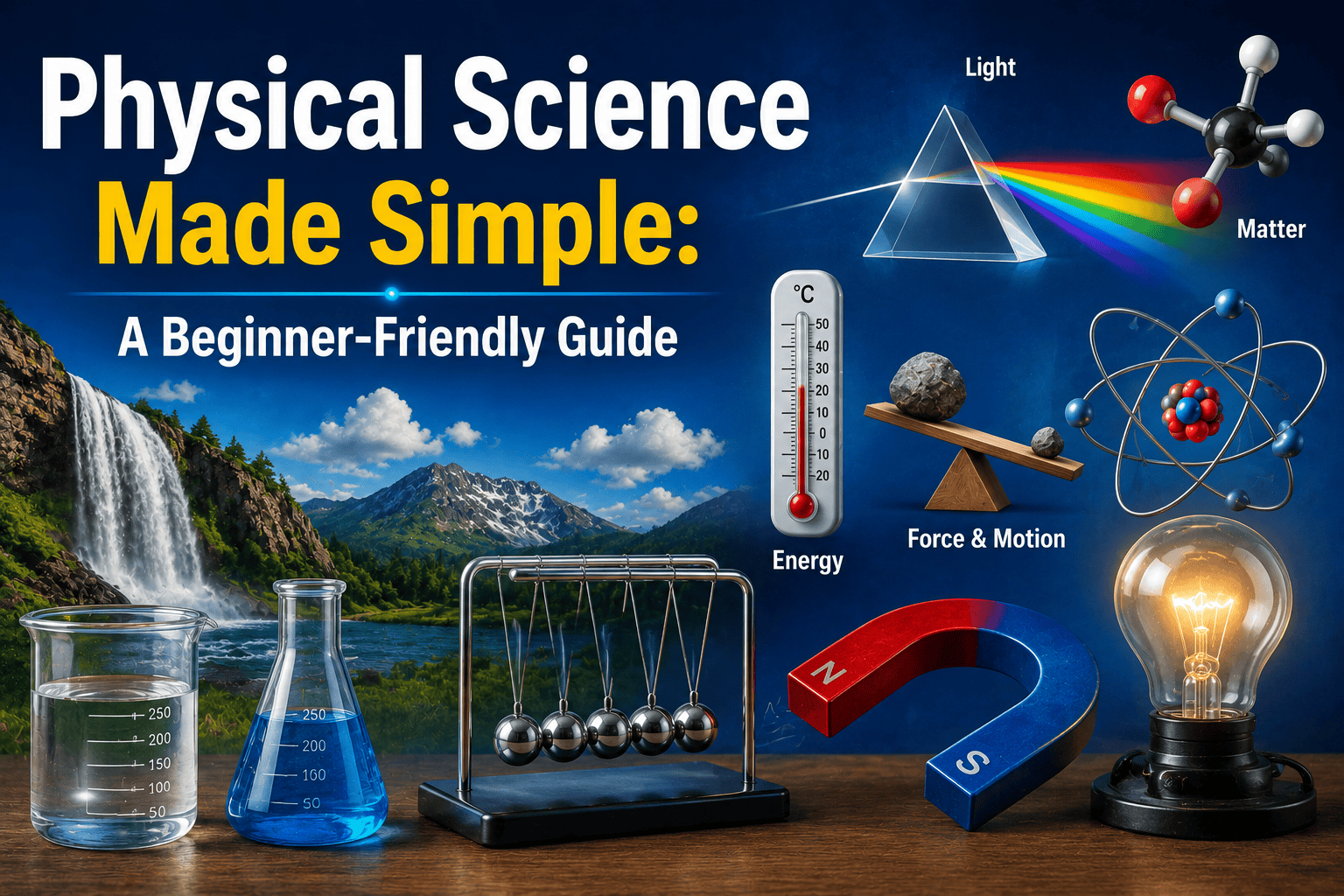
Physical Science
Explore the Fundamental Principles That Govern the Physical World — Physical science is a major branch of natural science concerned with the study of non-living matter, energy, and the interactions between them. It includes disciplines such as physics, chemistry, astronomy, and Earth science, covering phenomena that range from the behavior of subatomic particles and the properties of materials to the formation and dynamics of stars and galaxies. These fields work together to develop a deeper understanding of how the physical universe is structured and operates.
Physical science relies on observation, controlled experimentation, mathematical analysis, and scientific modeling to explain physical phenomena at different scales. It investigates concepts such as motion, forces, energy, matter, chemical interactions, and the fundamental properties of the universe. At its core, physical science seeks to identify and understand the basic principles that determine how the material world behaves and how physical systems interact.
Content Overview
- Introduction: What Is Physical Science?
- Part 1: The Nature of Physical Science
- Part 2: The Major Branches of Physical Science
- Part 3: Physics – The Science of Matter, Energy, and Forces
- Part 4: Chemistry – The Science of Matter and Change
- Part 5: Planetary and Earth Sciences – Studying Earth and Space
- Part 6: Physical Science in Daily Life – Practical Applications
- Part 7: Philosophical Significance of Physical Science
- Part 8: Relationship with Other Sciences and Engineering
- Conclusion: The Power of Physical Science
Introduction: What Is Physical Science?
Physical science is the branch of natural science that studies non-living systems – matter, energy, motion, forces, and the fundamental laws that govern the universe. Unlike the life sciences (biology, botany, zoology), which focus on living organisms, physical science investigates the physical and chemical principles that operate everywhere, from the smallest subatomic particle to the largest galaxy.
Physical science seeks to explain how nature works in a way that is observable, measurable, testable, and often expressible in mathematical language. It is the foundation of nearly all modern technology, from smartphones to spacecraft, and it provides the framework for understanding the cosmos.
Real-world example: When a ball falls to the ground, physical science explains why it falls (gravity), how fast it falls (acceleration due to gravity, 9.8 m/s²), and which force controls its motion (gravitational force). This same set of laws explains why planets orbit the sun and why a dropped feather falls slower than a hammer (air resistance).
Part 1: The Nature of Physical Science
1.1 Definition and Scope – Studying the Non-Living
Definition: Physical science is the systematic study of inanimate natural objects and phenomena. It encompasses all scientific disciplines that investigate the properties, behavior, and interactions of matter and energy without reference to living processes (except where those processes obey physical laws).
Scope: Physical science covers an enormous range of scales:
- Subatomic scale: Quarks, electrons, neutrinos (studied by particle physics)
- Atomic and molecular scale: Atoms bonding to form molecules (chemistry)
- Human scale: Everyday objects, motion, heat, sound
- Planetary scale: Earth’s structure, weather, oceans
- Cosmic scale: Stars, galaxies, black holes, the universe as a whole
1.2 Physical Science as an Empirical Science
Like all natural sciences, physical science is empirical – it relies on observation, experimentation, and measurement. Its findings must be reproducible and falsifiable.
Key methods:
- Observation: Using senses or instruments (telescopes, microscopes, thermometers) to gather data.
- Measurement: Quantifying properties such as length, mass, time, temperature, electric charge.
- Experimentation: Deliberately manipulating variables to test cause-and-effect.
- Mathematical modeling: Representing physical laws using equations, such as F = ma or E = mc².
Example: Newton’s law of universal gravitation was derived from repeated observations of planetary motion and falling objects. The equation F = G(m₁m₂)/r² has been tested and confirmed countless times.
1.3 The Role of Mathematics and Measurement
Mathematics is the language of physical science. Physical laws are almost always expressed in mathematical form because mathematics provides precision, predictability, and the ability to make quantitative predictions.
Examples:
- Kinematics: v = u + at (final velocity = initial velocity + acceleration × time)
- genui{“math_block_widget_always_prefetch_v2”:{“content”:”V = IR”}}
- Ohm’s Law explains that voltage is equal to the product of current and resistance.
- Ideal gas law: PV = nRT (pressure × volume = moles × gas constant × temperature)
Without mathematics, physical science would be merely qualitative description. With mathematics, it becomes a predictive engine.
1.4 Distinction from Life Sciences
| Aspect | Physical Science | Life Science |
|---|---|---|
| Subject matter | Non-living matter and energy | Living organisms |
| Typical scale | Subatomic to cosmic | Molecular to ecosystem |
| Key concepts | Force, energy, mass, charge, temperature | Evolution, metabolism, genetics, homeostasis |
| Examples | Physics, chemistry, astronomy | Biology, botany, zoology |
Overlap: Life sciences depend on physical sciences. Biological processes obey physical and chemical laws – nerve signals are electrical, metabolism is chemical, muscles use mechanical forces. Biochemistry and biophysics are interdisciplinary fields.
Part 2: The Major Branches of Physical Science
Physical science is broadly divided into three major branches, each addressing different aspects of the physical universe:
- Physics – The most fundamental physical science. Studies matter, energy, forces, space, and time.
- Chemistry – Studies substances, their composition, structure, properties, and reactions.
- Planetary and Earth Sciences – Studies Earth, other planets, and the cosmos. Includes geology, meteorology, oceanography, astronomy.
These branches overlap. For example, physical chemistry applies physics to chemical systems; geochemistry applies chemistry to Earth’s composition; astrophysics applies physics to stars and galaxies.
Part 3: Physics – The Science of Matter, Energy, and Forces
Physics studies how the universe behaves at every scale – from the smallest particles to the largest structures. It seeks to identify the fundamental laws that govern all physical phenomena.
3.1 Classical Physics
Classical physics describes phenomena at the human scale – speeds much slower than light, sizes much larger than atoms. It was largely developed before 1900 and remains extremely useful for everyday applications.
3.1.1 Mechanics – Motion, Forces, and Energy
Definition: Mechanics is the branch of physics that deals with the motion of objects and the forces that cause or change motion.
Subfields:
- Kinematics: Describes motion (position, velocity, acceleration) without regard to forces.
- Dynamics: Studies the relationship between forces and motion (Newton’s three laws).
- Statics is the branch of mechanics that deals with objects remaining at rest or balanced under forces.
- Fluid mechanics: Studies liquids and gases in motion or at rest.
Newton’s three laws of motion:
- Inertia: An object at rest stays at rest, and an object in motion stays in motion with constant velocity, unless acted upon by a net external force.
- The relationship can be expressed as:
- F = ma
- This means that the net force acting on an object is equal to its mass multiplied by its acceleration.
- Action–reaction: Whenever one object exerts a force on another, the second object exerts an equal and opposite force in return.
Example: A car accelerates when the force from the engine overcomes friction and air resistance. The car’s acceleration depends on its mass (heavier cars need more force) and the net force.
Energy in mechanics:
- Kinetic energy: Energy of motion (½ mv²).
- Potential energy: Stored energy due to position (gravitational potential energy = mgh).
- Conservation of energy: Energy cannot be created or destroyed; it can only change from one form into another.
3.1.2 Thermodynamics – Heat and Energy Transfer
Definition: Thermodynamics studies heat, temperature, and the conversion of energy from one form to another. It is essential for understanding engines, refrigerators, and even biological processes.
The four laws of thermodynamics (simplified):
- Zeroth Law of Thermodynamics: If two systems are each in thermal equilibrium with a third system, then they are also in equilibrium with each other, which makes the concept of temperature measurable.
- First law: Energy is conserved. Heat added to a system increases its internal energy and does work. (ΔU = Q – W)
- Second law: Heat cannot spontaneously flow from a colder body to a hotter body.In an isolated system, entropy naturally tends to increase over time, leading to greater disorder.
- Third law: As temperature approaches absolute zero (−273.15°C), entropy approaches a minimum.
Example: A refrigerator works by taking heat from its inside (cold compartment) and transferring it to the outside (warm room). This requires work (electricity) because the second law says heat does not flow cold to hot spontaneously.
3.1.3 Electromagnetism – Electricity, Magnetism, and Light
Definition: Electromagnetism studies electric charges, electric fields, magnetic fields, and their interrelationship. It also covers electromagnetic waves – radio waves, microwaves, infrared, visible light, ultraviolet, X-rays, gamma rays.
Key discoveries:
- Coulomb’s law: Force between two electric charges.
- I \rightarrow B
- Oersted discovered that an electric current flowing through a conductor produces a magnetic field around it.
- Faraday’s law: A changing magnetic field creates an electric current (basis for generators).
- Maxwell’s equations: Unified electricity, magnetism, and light, showing that light is an electromagnetic wave.
Example: Electric current flowing through wires powers household appliances. The current is the flow of electrons driven by voltage (electric potential difference).For example, a toaster generates heat through electrical resistance, while a motor operates by using magnetic fields to produce motion.
3.2 Modern Physics
Modern physics explores phenomena beyond the limits of classical physics – very small scales (quantum mechanics), very high speeds (relativity), or very strong gravity.
3.2.1 Quantum Mechanics – The Subatomic World
Definition: Quantum mechanics studies matter and energy at atomic and subatomic scales (nanometers and smaller). At this level, reality behaves probabilistically rather than deterministically.
Key concepts:
- Wave-particle duality: Particles (like electrons) also behave as waves, and waves (like light) behave as particles (photons).
- Quantization: Energy, angular momentum, and other quantities come in discrete packets (quanta).
- Heisenberg uncertainty principle: You cannot simultaneously know both the exact position and exact momentum of a particle. The more precisely you know one, the less you know the other.
- Probability clouds: Electrons are not in fixed orbits but exist in regions of probability (orbitals).
For example, in an atom, electrons exist in regions called orbitals—areas where there is a high likelihood of finding them. Their exact position at any given moment cannot be determined; only the probability of their location can be described.
Technological applications: Semiconductors (transistors, computer chips), lasers, MRI machines, atomic clocks.
3.2.2 Relativity – Space, Time, and Gravity
Definition: Relativity (developed by Albert Einstein) explains the behavior of objects moving at very high speeds (special relativity) and the nature of gravity as curved spacetime (general relativity).
Special relativity (1905):
- The speed of light (c) is constant in all inertial frames.
- Time dilation: Moving clocks run slow.
- Objects moving at very high speeds appear shorter in the direction of their motion due to length contraction.
- Mass-energy equivalence: E = mc² (energy equals mass times the speed of light squared).
General relativity (1915):
- Gravity can be understood not as a traditional force, but as the curvature of spacetime produced by mass and energy.
- Light bends around massive objects (gravitational lensing).
- Time runs slower in stronger gravity (gravitational time dilation).
Example: GPS satellites orbit at about 20,000 km altitude. Due to their speed (special relativity), their clocks run slower by about 7 microseconds per day. Due to weaker gravity (general relativity), their clocks run faster by about 45 microseconds per day. The overall result amounts to a difference of about 38 microseconds per day. Without correcting for this, GPS positions would drift by about 10 kilometers per day – useless for navigation.
3.2.3 Nuclear Physics – The Atomic Nucleus
Definition: Nuclear physics studies the atomic nucleus – protons, neutrons, and the forces that hold them together (strong nuclear force). It also covers radioactive decay, nuclear fission, and nuclear fusion.
Key concepts:
- Radioactivity: Unstable nuclei emit particles (alpha, beta) or gamma rays to become more stable.
- Half-life: The time it takes for half of a radioactive sample to decay.
- Nuclear fission: Splitting a heavy nucleus (e.g., uranium-235) into lighter nuclei, releasing energy.
- Nuclear fusion: Combining light nuclei (e.g., hydrogen into helium) to release even more energy – powers the sun and stars.
Example: Nuclear power plants generate electricity through controlled fission. A uranium-235 nucleus absorbs a neutron, becomes unstable, splits into two smaller nuclei, and releases 2–3 neutrons and a large amount of heat. Heat converts water into steam, and the steam rotates a turbine to produce motion.
3.3 Energy Technology – Applying Physics to Power the World
Energy technology is the applied branch of physics that focuses on generating, storing, and distributing energy efficiently.
Examples:
- Solar panels: Use the photovoltaic effect (quantum mechanics) to convert sunlight directly into electricity.
- Wind turbines: Convert kinetic energy of moving air into mechanical energy (classical mechanics), then into electricity.
- Batteries: Store chemical energy and convert it to electrical energy via electrochemical reactions.
- Hydroelectric dams: Convert gravitational potential energy (water stored at height) into kinetic energy (flowing water) then into electricity.
- Nuclear reactors: Use fission to generate heat for steam turbines.
Example: A lithium-ion battery (used in phones and electric cars) works by moving lithium ions between a graphite anode and a metal oxide cathode. When discharging, ions move from anode to cathode, releasing electrons that flow through an external circuit.
Part 4: Chemistry – The Science of Matter and Change
Chemistry studies substances – their composition, structure, properties, and the transformations they undergo during chemical reactions. It is often called the “central science” because it connects physics (atoms, energy) to biology (molecules of life) and applied sciences (medicine, materials).
4.1 Organic Chemistry – Carbon-Based Compounds
Definition: Organic chemistry studies carbon-containing compounds, with the exception of a few simple ones (like carbon dioxide, carbonates). Carbon can form long chains, rings, and complex structures because it has four bonding electrons.
Importance: Organic chemistry is the chemistry of life. DNA, proteins, carbohydrates, and lipids are organic molecules. So are plastics, fuels, pharmaceuticals, dyes, and explosives.
For example, Aspirin is an organic compound. It is synthesized from salicylic acid and acetic anhydride. Understanding organic chemistry allowed chemists to modify natural pain relievers into more effective, less irritating medicines.
4.2 Inorganic Chemistry – Metals, Minerals, and Non-Carbon
Definition: Inorganic chemistry studies compounds that do not contain carbon-hydrogen bonds. This includes metals, salts, minerals, coordination complexes, and many industrial catalysts.
Examples:
- Rust formation: Iron reacts with oxygen and water to form iron(III) oxide (rust). This is an inorganic redox reaction.
- Cement and concrete: The hydration of calcium silicates produces a hard matrix – essential for construction.
- Catalytic converters in cars: Use platinum, palladium, and rhodium to convert toxic exhaust gases (CO, NOx, hydrocarbons) into less harmful substances (CO₂, N₂, H₂O).
4.3 Physical Chemistry – Energy and Molecular Behavior
Definition: Physical chemistry applies the principles of physics (thermodynamics, quantum mechanics, statistical mechanics) to chemical systems. It explains why reactions occur, how fast they occur (kinetics), and how molecules interact.
Key topics:
- Thermochemistry: Heat changes during reactions (exothermic – releases heat; endothermic – absorbs heat).
- Reaction kinetics explains that the speed of a chemical reaction is influenced by temperature, reactant concentration, and activation energy.Higher temperatures increase reaction rates.
- Quantum chemistry: Uses quantum mechanics to calculate molecular orbitals, bond strengths, and spectra.
Example: Physical chemistry explains why chemical reactions occur faster at higher temperatures. Molecules have more kinetic energy, collide more frequently, and more collisions have enough energy to overcome the activation energy barrier.
4.4 Analytical Chemistry – Identifying and Measuring
Definition: Analytical chemistry develops and uses techniques to identify what substances are present (qualitative analysis) and how much of each is present (quantitative analysis).
Techniques:
- Chromatography: Separates mixtures into individual components (e.g., separating dyes in ink).
- Mass spectrometry: Measures the mass-to-charge ratio of ions to identify molecules.
- Spectroscopy: Measures how matter absorbs, emits, or scatters light. Used to identify elements and compounds.
- Electrochemical analysis: Measures voltage or current to determine concentrations (e.g., glucose meters for diabetes).
Example: A blood test in a hospital uses analytical chemistry to detect glucose, cholesterol, and electrolyte levels. A sample is mixed with reagents that produce a color change, and a spectrophotometer measures the intensity of that color to calculate concentration.
4.5 Biochemistry – The Chemistry of Life (Bridge to Life Sciences)
Definition: Biochemistry studies the chemical processes within and related to living organisms. It is the bridge between chemistry and biology.
Key topics:
- Enzymes are protein catalysts that accelerate biochemical reactions, making metabolism fast enough to support life.
- Metabolism: The sum of all chemical reactions in an organism – breaking down nutrients for energy (catabolism) and building cellular components (anabolism).
- DNA and RNA: Nucleic acids store and transmit genetic information.
- Signal transduction: How cells respond to chemical signals (hormones, neurotransmitters).
Example: The enzyme amylase in saliva breaks down starch (a large carbohydrate) into smaller sugars (maltose). This is a biochemical reaction that begins digestion in the mouth.
Part 5: Planetary and Earth Sciences – Studying Earth and Space
Planetary and Earth sciences study our planet, other planets, and the cosmos. They integrate physics, chemistry, geology, and astronomy.
5.1 Earth Science
Earth science examines Earth’s structure, processes, and history. It has four main subfields:
5.1.1 Geology – Rocks, Structure, and Earth’s History
Definition: Geology studies the solid Earth – its rocks, minerals, structures, and the processes that shape it (volcanoes, earthquakes, erosion). It also includes paleontology (fossils) and the Earth’s 4.5-billion-year history.
Key concepts:
- Plate tectonics: Earth’s lithosphere is broken into plates that move over the asthenosphere. Plate boundaries cause earthquakes, volcanoes, and mountain building.
- Rock cycle: Igneous (from magma), sedimentary (compacted sediment), and metamorphic (changed by heat/pressure) rocks transform from one type to another.
- Fossils and stratigraphy: Sedimentary rock layers (strata) contain fossils that record the history of life.
Example: Earthquakes result from tectonic plate movement. The Pacific Ring of Fire is a zone of frequent earthquakes and volcanic eruptions where the Pacific Plate subducts under other plates.
5.1.2 Geography – Spatial Patterns and Landforms
Definition: Geography studies the Earth’s physical features, climate, and the spatial distribution of human and natural phenomena. It is divided into physical geography (landforms, climate, vegetation) and human geography (populations, cities, cultures).
Example: Mountains influence climate and rainfall. As moist air rises over a mountain range, it cools and condenses, causing rain on the windward side and creating a rain shadow (dry area) on the leeward side. The Sierra Nevada mountains create a rain shadow that makes Nevada a desert.
5.1.3 Meteorology – Weather and Climate
Definition: Meteorology studies the Earth’s atmosphere, weather processes, and climate. It uses physics (fluid dynamics, thermodynamics) and chemistry to predict weather and understand long-term climate change.
Key concepts:
- Weather: Short-term atmospheric conditions – temperature, humidity, precipitation, wind, pressure.
- Climate: Long-term average weather patterns over decades or centuries.
- Storms: Hurricanes, tornadoes, thunderstorms, blizzards – result from atmospheric instability and energy transfer.
- Climate change: Global warming caused by greenhouse gas emissions (CO₂, methane) trapping heat.
Example: Storm forecasting using weather satellites, radar, and computer models saves lives by predicting hurricanes days in advance. For example, Hurricane Katrina (2005) was forecast well, but levee failures caused catastrophic flooding.
5.1.4 Oceanography – Oceans and Marine Systems
Definition: Oceanography studies the world’s oceans – their physical properties (temperature, salinity, currents), chemistry, geology (seafloor, trenches), and biology (marine life).
Key concepts:
- Ocean currents: Driven by wind, temperature, and salinity differences. The Gulf Stream carries warm water from the Caribbean to northern Europe, moderating its climate.
- Tides occur due to the gravitational forces exerted by the Moon and the Sun on Earth’s oceans.
- El Niño: A periodic warming of Pacific Ocean surface waters that affects global weather patterns.
Example: Ocean currents regulate global climate. The thermohaline circulation (“global conveyor belt”) moves warm surface water to the North Atlantic, where it cools, sinks, and flows back south deep underwater. Disruptions to this circulation could cause abrupt climate changes.
5.2 Astronomy – Celestial Bodies and the Cosmos
Definition: Astronomy studies celestial objects – planets, moons, stars, galaxies, black holes, nebulae, and the universe as a whole. It is considered one of the earliest branches of natural science.
Key subfields:
- Planetary astronomy: Studies planets and moons in our solar system and around other stars.
- Stellar astronomy: Studies stars – their formation, evolution, and death (supernovae, neutron stars, black holes).
- Galactic astronomy: Studies the Milky Way and other galaxies.
- Cosmology: Studies the origin, structure, and fate of the universe – Big Bang, dark matter, dark energy.
Example: Stars generate energy through nuclear fusion. In the Sun, hydrogen nuclei (protons) fuse into helium, releasing enormous amounts of energy in the form of light and heat. This process has sustained the Sun for about 4.6 billion years.
5.3 Astrology – A Cultural and Historical Perspective (Non-Scientific)
Definition: Astrology is the belief that the positions of celestial bodies (planets, stars) influence human affairs, personality, and events. Historically, astrology and astronomy were intertwined – early astronomers (like Ptolemy) also practiced astrology.
Scientific status: Astrology has been tested repeatedly and fails to produce predictions better than chance. There is no known physical mechanism by which distant stars and planets could affect human personality. It is not considered a scientific discipline.
Historical significance: Astrology drove early astronomical observations. Ancient Babylonians developed sophisticated methods to track planetary motions because they believed these motions carried meaning. Those observations became the foundation of astronomy.
Example: The zodiac signs (Aries, Taurus, Gemini, etc.) are based on constellations along the ecliptic (the Sun’s apparent path). Due to precession (wobble of Earth’s axis), the alignment has shifted over 2,000 years – yet astrologers still use the ancient positions. This alone indicates astrology does not correspond to physical reality.
Part 6: Physical Science in Daily Life – Practical Applications
Physical science is not just abstract theory. It shapes nearly every aspect of modern civilization.
6.1 Electricity and Electronics
- Electricity generation: Power plants use turbines (rotating machines) to convert mechanical energy into electrical energy via electromagnetic induction (Faraday’s law). The turbine is turned by steam (from coal, gas, nuclear), water (hydro), or wind.
- Electronics: Semiconductors (doped silicon) enable transistors – switches that control electric current. Millions of transistors on a single chip form a microprocessor, the brain of every computer, smartphone, and digital device.
6.2 Transportation and Motion
- Automobiles: Internal combustion engines convert chemical energy (fuel) into heat (thermodynamics), then into mechanical motion (pistons, crankshaft). Newton’s laws govern acceleration, braking, and safety (seatbelts, airbags).
- Airplanes: Aerodynamics (fluid mechanics) creates lift – air moves faster over the curved top of a wing, reducing pressure, and slower under the flat bottom, increasing pressure, lifting the plane.
- Spacecraft: Rocket propulsion uses Newton’s third law – exhaust gases expelled downward push the rocket upward. Orbital mechanics (gravitational physics) guides satellites.
6.3 Medicine and Medical Imaging
- X-rays: Electromagnetic radiation (physics) passes through soft tissue but is absorbed by dense bone, creating an image of fractures or tumors.
- MRI (Magnetic Resonance Imaging): Uses strong magnetic fields and radio waves (nuclear magnetic resonance, a quantum phenomenon) to image soft tissues like the brain.
- Radiation therapy: Uses high-energy X-rays or gamma rays (nuclear physics) to kill cancer cells.
6.4 Communication Technologies
- Fiber optics: Light (electromagnetic waves) travels through thin glass fibers via total internal reflection. Used for high-speed internet, cable TV, and telephone.
- Wireless communication: Radio waves (electromagnetism) carry information from cell towers to phones. Frequency modulation, digital encoding, and antennas are all applications of physics.
- Satellite navigation: GPS uses atomic clocks (quantum mechanics, relativity) and signals from multiple satellites to triangulate position.
6.5 Energy Production and Storage
- Fossil fuel power plants: Burn coal or natural gas to produce heat → steam → turbine → electricity. Thermodynamics limits efficiency (Carnot cycle).
- Nuclear power: Fission of uranium-235 produces heat without combustion. No CO₂ emissions, but radioactive waste.
- Renewable energy: Solar (photovoltaic), wind (kinetic to electric), hydro (potential to kinetic to electric), geothermal (Earth’s internal heat).
- Batteries and supercapacitors: Store energy electrochemically (batteries) or electrostatically (capacitors). Lithium-ion batteries power portable electronics and electric vehicles.
Part 7: Philosophical Significance of Physical Science
7.1 Order and Intelligibility of the Universe
Physical science reveals that nature follows consistent, mathematically expressible laws. The same law of gravity that makes an apple fall also keeps the Moon in orbit. This uniformity is not logically necessary – the universe could have been chaotic. The fact that it is intelligible has led many scientists (and philosophers) to wonder: Why does the universe have order?
Albert Einstein once stated that the most remarkable thing about the universe is that humans are able to understand it.
Section 7.2 discusses the boundaries of physical science and the questions it cannot fully explain or answer.
Physical science answers how questions – how do objects move? How do chemical reactions occur? How did the universe evolve? But it cannot answer why questions in a purposive sense: Why does the universe exist? The question of why anything exists instead of nothing remains one of the deepest mysteries beyond the full explanation of physical science. Why are the physical laws exactly what they are? These questions belong to philosophy and theology.
Example: Science can describe the Big Bang in detail – the expansion, the cooling, the formation of galaxies. But it cannot explain why there was a Big Bang or what “caused” it (if causation even applies to the origin of time itself).
7.3 Physical Science and Human Meaning
Physical science explains natural phenomena but does not determine human values, ethics, or life’s purpose. It tells you how to build a nuclear bomb, not whether you should. It tells you that humans are made of atoms, not that human life is precious. Many scientists argue that meaning and ethics come from human reason, culture, and empathy – not from physical laws.
Example: The discovery that humans evolved from earlier primates does not tell you how to treat other humans. It simply describes a process. Ethics requires a separate framework.
Part 8: Relationship with Other Sciences and Engineering
8.1 Physical Science as the Foundation
All other natural sciences depend on physical science.Biology depends on chemistry for understanding the molecules of life and on physics for concepts such as energy and thermodynamics.Environmental science uses physics (atmospheric dynamics), chemistry (pollutants), and geology (soil, water). Even social sciences use statistics (which depends on mathematics) and sometimes physics (e.g., traffic flow models).
8.2 Interdisciplinary Fields – Biophysics, Geochemistry, Astrobiology
- Biophysics: Applies physics to biological systems – protein folding, neural networks, molecular motors.
- Geochemistry: Applies chemistry to Earth’s composition – the carbon cycle, mineral formation, isotope dating.
- Astrobiology: Studies the origin, evolution, and distribution of life in the universe – combines astronomy, geology, and biology.
- Physical chemistry: Already mentioned – applies physics to chemical systems.
8.3 Engineering – Translating Physics into Technology
Engineering is the application of physical science to design, build, and maintain structures, machines, and systems. While physics discovers laws, engineering uses those laws to solve practical problems.
Examples:
- Civil engineering: Uses mechanics (forces, stress, strain) to build bridges and skyscrapers that do not collapse.
- Electrical engineering: Uses electromagnetism to design circuits, motors, and power grids.
- Mechanical engineering: Uses thermodynamics and mechanics to design engines, HVAC systems, and robots.
- Chemical engineering: Uses chemistry and thermodynamics to design industrial processes – refineries, plastics, pharmaceuticals.
Conclusion: The Power of Physical Science
Physical science is one of humanity’s most effective ways of understanding the non-living universe.. From the subatomic dance of quarks to the grand structure of galaxies, it reveals a cosmos governed by elegant, consistent laws. It has given us electricity, medicine, transportation, communication, and the ability to reach other worlds.
But physical science also humbles us. It shows that we are made of stardust – the same elements forged in ancient stars. It shows that our planet is a tiny speck in a vast, mostly empty universe. And it shows that our knowledge, while impressive, is always incomplete. There are still mysteries – dark matter, dark energy, the origin of time, the nature of consciousness – that lie beyond our current grasp.
Nevertheless, physical science is not a cold, lifeless enterprise. It is driven by curiosity, wonder, and the uniquely human desire to understand. Every new discovery opens new questions. And in that endless questioning, physical science becomes not just a collection of facts, but a living, breathing adventure one that belongs to all of us.
Final thought: The next time you flip a light switch, check your phone, or look up at the stars, remember that you are witnessing the results of centuries of physical science. The exploration of the universe through physical science is still continuing. The next great discovery – perhaps about quantum gravity, or life on another planet, or a new source of clean energy is waiting for the curious minds of today and tomorrow.