16th Century History: Reformation and Colonialism
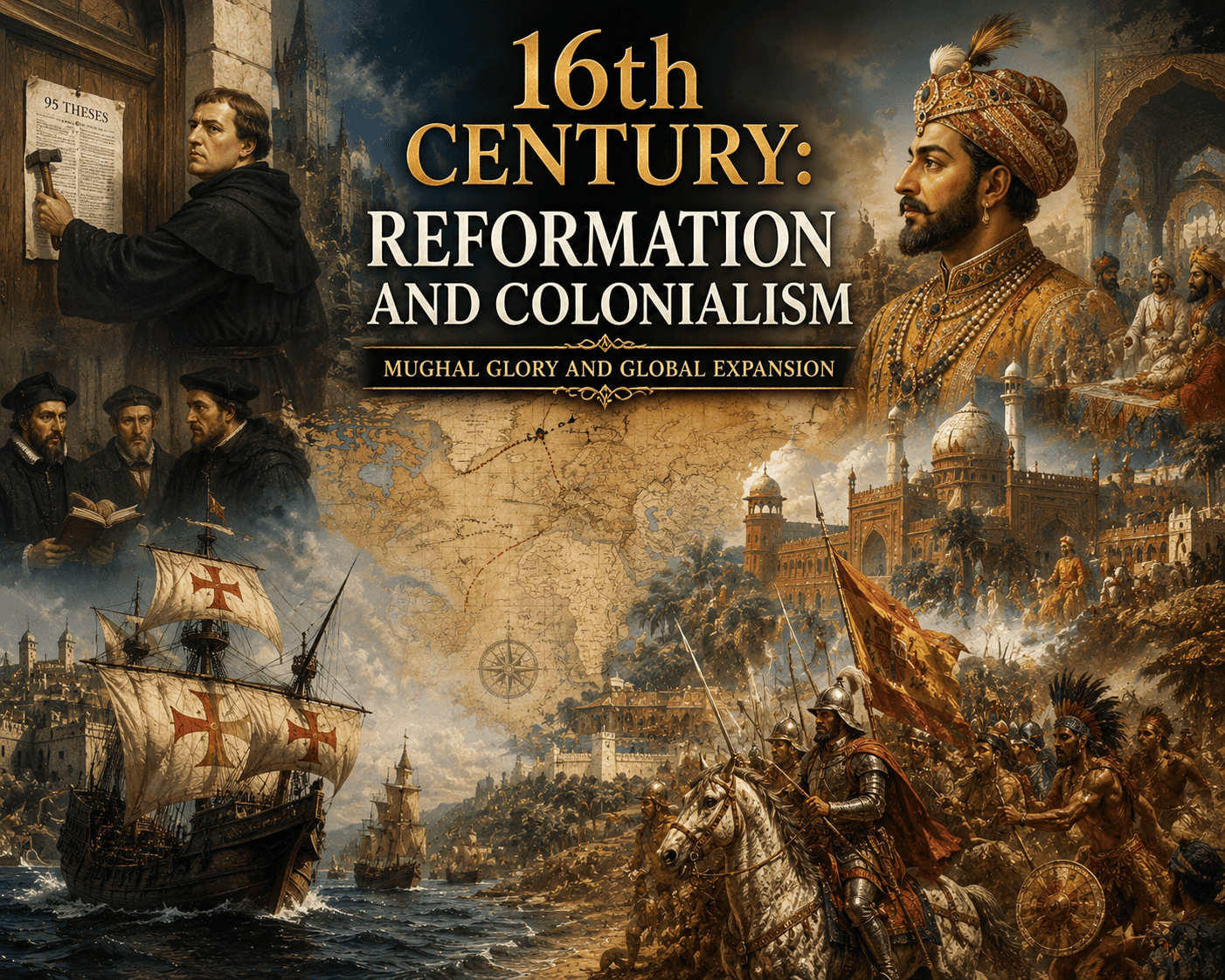
The 16th century was defined by the Protestant Reformation, sparked by Martin Luther’s 1517 challenge to the Catholic Church, which fractured European Christianity and ignited decades of religious conflict and political upheaval. This era also saw the rapid expansion of European colonialism, as Spain and Portugal built vast empires across the Americas, exploiting Indigenous populations and resources while establishing global trade networks. Powerful dynasties like the Ottoman, Mughal, and Ming empires flourished simultaneously, showcasing remarkable cultural and political achievements across Asia and the Middle East. At its core, the 16th century reveals how religious upheaval and colonial expansion reshaped global power, belief, and cultural exchange on an unprecedented scale.
Content Overview
- The 16th Century (1501–1600 CE): Mughal Glory and Global Expansion
- CHAPTER 1 — Understanding the 16th Century
- CHAPTER 2 — The Mughal Empire: Foundation and Glory
- Babur — From Exile to Emperor
- The First Battle of Panipat (1526) — Step by Step
- Humayun — The Emperor Who Lost and Regained His Throne
- Akbar the Great (1556–1605) — The Greatest Mughal
- Akbar's Administrative Revolution — Step by Step
- Akbar's Religious Policy — Din-i-Ilahi and Genuine Tolerance
- Akbar's Cultural Legacy — Art, Architecture, Literature
- CHAPTER 3 — The Ottoman Empire at Its Peak
- CHAPTER 4 — The Safavid Empire: Persia's Islamic Renaissance
- CHAPTER 5 — European Colonial Expansion: Portugal and Spain
- CHAPTER 6 — The Protestant Reformation
- What Was the Catholic Church Before the Reformation?
- Martin Luther and the Ninety-Five Theses (1517) — Step by Step
- Why the Printing Press Made the Reformation Possible
- The Spread of Lutheranism — Step by Step
- John Calvin and Calvinism
- Henry VIII and the English Reformation
- The Council of Trent — The Catholic Church’s Response to the Reformation
- CHAPTER 7 — The Scientific Revolution
- CHAPTER 8 — Ming Dynasty China and Japan's Sengoku Period
- CHAPTER 9 — Africa, the Americas, and Global Trade
- CHAPTER 10 — Complete Decade-by-Decade Timeline (1501–1600)
- 1501–1510: New Empires, New Worlds
- 1511–1520: Reformation Begins and Empires Clash
- 1521–1530: Conquest, Schism, and the Mughal Birth
- 1531–1540: Pizarro, Calvin, and Henry VIII
- 1541–1550: Copernicus and Counter-Reformation
- 1551–1560: Suleiman's Final Years
- 1561–1570: Akbar Consolidates Power
- 1571–1580: Lepanto and the New World's Silver
- 1581–1590: England Rises, Spain Stretches
- 1591–1600: The Century Closes — New Powers Emerge
- CHAPTER 11 — Summary and Legacy of the 16th Century
The 16th Century (1501–1600 CE): Mughal Glory and Global Expansion
The Century That Invented the Modern World
CHAPTER 1 — Understanding the 16th Century
Definition and Context
The 16th century covers the years from January 1, 1501 CE to December 31, 1600 CE. It is measured according to the Julian Calendar for most of the century — until 1582, when Pope Gregory XIII introduced the Gregorian Calendar that we use today, correcting an accumulated error of approximately ten days that the Julian system had built up over the previous fifteen centuries.
This correction was not merely technical. The need for a new calendar — announced to the world by the most powerful religious institution in Christendom — reflected the deep intellectual restlessness of the age. The 16th century was an era in which everything that had seemed settled and permanent in medieval civilization was being questioned, challenged, tested, and in many cases overturned.
The 16th century is, by almost any measure, the most consequential century in the transition from the medieval world to the modern world. In this single hundred years: a peasant’s son from Wittenberg challenged the authority of the Pope and permanently split the Christian Church. A Polish canon proposed that the Earth revolves around the Sun, overturning 1,400 years of received cosmological wisdom. A small band of Spanish soldiers overthrew two of the largest empires in the Americas, killing millions and extracting wealth on a scale the world had never seen. An Indian prince descended from Timur and Genghis Khan established an empire that would eventually produce the Taj Mahal. A Turkish sultan brought the Ottoman Empire to the gates of Vienna and the center of the Mediterranean. And Portuguese and Spanish sailors completed the first circumnavigation of the Earth, proving once and for all that the globe was connected.
Every one of these events echoes in our world today.
What Kind of World Existed in 1501 CE?
Stand at the beginning of the 16th century and survey the world with clear eyes. It is a world still largely organized by the patterns established in the preceding centuries — but straining against those patterns in every direction.
In South Asia, the Delhi Sultanate is in its final, weakened decades. A young Timurid prince named Babur — born in 1483, already twice exiled from his homeland — is consolidating his hold over Kabul in Afghanistan, looking eastward toward India’s wealth. Within 25 years, he will transform the subcontinent.
In the Middle East, the Ottoman Empire is already powerful but has not yet reached its greatest extent. In Persia, the Safavid dynasty is about to be founded by the young Shah Ismail I. In North Africa, the Mamluk Sultanate still controls Egypt, though not for much longer.
In Europe, the Renaissance is in full flower in Italy — Leonardo da Vinci is alive and working, Michelangelo is 26 years old. The printing press — invented by Gutenberg around 1450 — has been in operation for 50 years, and the flow of printed books is transforming intellectual life across the continent. The discovery of the Americas by Columbus in 1492 is just nine years old, and Europe is still absorbing what it means.
In China, the Ming Dynasty is in its middle period — prosperous, sophisticated, and increasingly inward-looking after the extraordinary naval expeditions of Zheng He earlier in the century. In Japan, the Sengoku (“Warring States”) period of civil war among competing daimyō warlords is well underway.
In the Americas, two enormous and sophisticated civilizations — the Aztec Empire in Mexico and the Inca Empire in South America — are at or near their peaks. Neither knows that European sailors have reached their hemisphere. Within 30 years, both will be destroyed.
In West Africa, the Songhai Empire is the dominant power of the Sahel, controlling the trans-Saharan trade routes and the legendary cities of Timbuktu and Gao. It too will fall before the century ends.
The Eight Defining Forces of the Century
Force One — The Mughal Empire (founded 1526): The establishment of one of history’s greatest empires on the Indian subcontinent, reaching its peak of cultural and administrative brilliance under Emperor Akbar.
Force Two — The Ottoman Empire at Its Peak: Under Suleiman the Magnificent, the Ottoman Empire reached its greatest territorial extent and institutional sophistication, threatening Western Europe and dominating the Eastern Mediterranean.
Force Three — The Safavid Empire: The establishment of Persia as a Shia Islamic state under the Safavid dynasty created a permanent theological and geopolitical rivalry with the Sunni Ottoman Empire that shaped the Middle East for centuries and still shapes it today.
Force Four — European Colonial Expansion: Portugal and Spain established the first truly global empires, connecting four continents through trade networks, colonial administration, and — tragically — the systematic exploitation and destruction of indigenous civilizations.
Force Five — The Protestant Reformation: Martin Luther’s challenge to the Catholic Church in 1517 permanently fractured Western Christianity, produced decades of religious warfare, and indirectly created the intellectual conditions for modern individualism, democracy, and scientific inquiry.
Force Six — The Scientific Revolution: Beginning with Copernicus’s heliocentric theory in 1543, a fundamental transformation in how human beings understood the universe began — one that would accelerate in the following centuries and eventually produce modern science and technology.
Force Seven — The Columbian Exchange: The biological, agricultural, and demographic exchange between the Old World and the New World — plants, animals, diseases, and people — was one of the most transformative events in human environmental and demographic history.
Force Eight — The Global Trade Network: For the first time in history, all the major inhabited regions of the world were connected by regular commercial exchange — European ships carried American silver to China, Chinese silk and porcelain to Europe, African slaves to the Americas, and Indian spices everywhere.
Calendars: From Julian to Gregorian
The calendar reform of 1582 is a perfect symbol of the 16th century’s spirit. The problem was this: the Julian Calendar, established by Julius Caesar in 46 BCE, assumed a year of exactly 365.25 days.The true length of a solar year is about 365.2422 days. This difference of 0.0078 days per year accumulated over 1,500 years into an error of approximately 10 days. By 1582, the spring equinox — which Easter’s calculation depended on — was falling 10 days earlier than the calendar indicated.
Pope Gregory XIII commissioned a team of astronomers and mathematicians — led by the Jesuit astronomer Christopher Clavius and the physician Luigi Lilio — to design a corrected calendar. Their solution: drop 10 days from October 1582 (October 4 was followed immediately by October 15), and modify the leap year rule to omit century years not divisible by 400 (so 1700, 1800, and 1900 would not be leap years, but 2000 would be).
The result — the Gregorian Calendar — is accurate to approximately one day in 3,300 years, and it is the calendar that virtually the entire world uses today. But its adoption in the 16th century was itself a politically complex process: Catholic countries adopted it immediately; Protestant countries — who resented papal authority — refused for decades or even centuries. England did not switch to the Gregorian calendar until 1752. Russia did not adopt it until 1918. The calendar reform thus illustrates perfectly the 16th century’s defining tension between the old universal Catholic order and the new fragmented world of competing religious and national authorities.
CHAPTER 2 — The Mughal Empire: Foundation and Glory
Babur — From Exile to Emperor
Zahir-ud-din Muhammad Babur was born on February 14, 1483, in Andijan — a city in the Fergana Valley of what is now Uzbekistan. His father was the ruler of a small kingdom. His lineage was extraordinary: on his father’s side, he was descended from Timur (Tamerlane), and on his mother’s side from Genghis Khan — making him the heir of two of the most powerful conquerors in human history. He was also a man of profound personal culture: a gifted poet in both Persian and Turki, a lover of gardens and music, a chess player of some skill, and a man of genuine intellectual curiosity who wrote one of the most remarkable autobiographies in any language — the Baburnama.
His early life was defined by loss and exile. He inherited his father’s small kingdom of Fergana as a young child but spent his entire youth fighting to maintain it. He captured Samarkand — the crown jewel of the Timurid world, Timur’s old capital — twice, and lost it twice. By his mid-twenties, he had been driven from everything he had inherited and had retreated to Kabul in Afghanistan, which he captured in 1504 and used as a base.
From Kabul, Babur launched raids into northwestern India beginning in 1519 — not yet full-scale invasions, but probing operations that familiarized him with the terrain and political situation. What he found encouraged him. The Delhi Sultanate under Sultan Ibrahim Lodi was in political crisis — the Afghan nobility resented Ibrahim’s centralizing policies, some had already appealed to Babur for help, and the army’s loyalty was uncertain. The opportunity was clear.
Babur’s Character — Understanding the Man
To understand why Babur succeeded where others had failed, you must understand his character. He combined qualities that rarely coexist in a single person: extraordinary military decisiveness with genuine intellectual reflectiveness; ruthless strategic calculation with genuine personal warmth; pride in his Mongol-Timurid heritage with openness to new ideas and techniques.
The Baburnama — his personal memoir, written in Turki and covering most of his adult life with remarkable candor — is one of history’s most revealing biographical documents. Babur describes his military campaigns in precise detail, but he also describes the flowers he saw in a garden, the fish in a stream, the taste of a melon he had not encountered before. He writes with equal care about the beauty of the Hindu Kush mountains and about the pain of losing a kingdom. He cried openly when he received news of a friend’s death. He drank wine — against Islamic law — with evident enjoyment and equal evident guilt. He was, in short, a complete human being, and the Baburnama allows us to see him as one.
The First Battle of Panipat (1526) — Step by Step
The First Battle of Panipat was fought on April 21, 1526, on the flat plains near the town of Panipat, approximately 90 kilometers north of Delhi. It lasted a few hours. In those hours, the political history of the Indian subcontinent changed permanently.
Step 1 — The Military Situation: Babur’s army numbered approximately 12,000 men — a force that seems pitifully small compared to Ibrahim Lodi’s estimated 100,000 soldiers and perhaps 1,000 war elephants. Any conventional military analysis would have predicted Babur’s defeat. But Babur had two decisive advantages: artillery and tactical genius.
Step 2 — The Artillery Setup: Babur arranged his cannon — perhaps 20 to 24 large artillery pieces, managed by Ottoman and other Central Asian gunpowder experts — along his front line. They were protected by carts chained together (a formation called the “Ottoman device” or tulughma wagon fort, borrowed from Ottoman military practice). Gaps between the carts allowed his cavalry to charge out. This formation protected his artillery while allowing his horsemen to maneuver.
Step 3 — The Flanking Cavalry: On each flank, Babur positioned units of fast cavalry with orders to sweep around the enemy’s sides once the battle was joined — a classic Mongol encirclement tactic called the tulughma. His center would hold, his artillery would fire, and his flanks would close like jaws around the enemy.
Step 4 — The Battle Opens: Ibrahim Lodi’s enormous army advanced. The front ranks — pressed forward by the mass of men and elephants behind them — were funneled toward Babur’s center by the terrain and by deliberate Mughal positioning. As they came within range, Babur’s cannon opened fire.
Step 5 — The Elephant Crisis: The sound and fire of the cannon terrified the war elephants — animals that had been trained for centuries as shock weapons but had never encountered gunpowder artillery at close range. The elephants panicked, turned, and stampeded — directly back into Ibrahim Lodi’s own army, causing catastrophic chaos among the advancing forces that could not escape because of the masses pressing from behind.
Step 6 — The Cavalry Sweep: While the Lodi army was disrupted and confused, Babur’s flanking cavalry swept around both sides in a classic pincer movement, completing the encirclement. Ibrahim Lodi was killed fighting — reportedly his body was found surrounded by the bodies of his guards, showing he died in combat rather than fleeing.
Step 7 — The Result: The battle was over in a few hours. The Delhi Sultanate — which had ruled northern India for 320 years since 1206 — was finished. Babur marched to Delhi and Agra, secured the treasury, and proclaimed himself Emperor of Hindustan.
The Significance: The First Battle of Panipat was one of those rare military engagements where a small force with superior technology and tactics defeats a vastly larger one so decisively that an entire political order collapses. It established the pattern that would define Mughal military success throughout the empire’s history: the combination of gunpowder artillery with traditional Central Asian cavalry mobility.
Humayun — The Emperor Who Lost and Regained His Throne
Babur died in 1530 — just four years after founding his empire — leaving it to his eldest son Humayun, who was 22 years old. Humayun was in many ways his father’s intellectual heir — cultured, curious, genuinely intelligent — but he lacked Babur’s military decisiveness and political ruthlessness, qualities that the circumstances of the early empire urgently required.
The early years of Humayun’s reign were difficult. He faced challenges from his own brothers (who wanted shares of the empire), from Afghan chieftains who refused to accept Mughal rule, and eventually from the brilliant Afghan general and administrator Sher Shah Suri — who defeated Humayun twice, forcing him into 15 years of exile in Persia and Sindh.
Those 15 years in exile at the Safavid Persian court of Shah Tahmasp were not wasted. Humayun absorbed Persian culture, Persian artistic traditions, and Persian administrative concepts that he brought back to India when he finally recaptured his empire in 1555 — one year before his death. The Persian cultural influence that Humayun introduced was carried further and deeper by his son Akbar, and it became the defining aesthetic of Mughal civilization: the synthesis of Central Asian, Persian, and Indian traditions that produced some of the most beautiful art and architecture in human history.
Humayun died on January 27, 1556 — reportedly by falling down the stairs of his library in Delhi. He was 47 years old. He left his empire to his 13-year-old son, who would become the greatest Mughal emperor.
Akbar the Great (1556–1605) — The Greatest Mughal
Who Was Akbar?
Jalal-ud-din Muhammad Akbar was born on October 15, 1542, in Umarkot (in modern Pakistan’s Sindh province), during his father Humayun’s years of exile. He spent his childhood years in the dangerous, uncertain world of an emperor without an empire. He never learned to read or write — a remarkable fact about a man who became one of the most intellectually curious rulers in history, who employed a team of readers to read books aloud to him and retained what he heard with extraordinary fidelity.
He became emperor at 13, initially governing under the regency of the brilliant general Bairam Khan. When he dismissed Bairam Khan from the regency and began ruling personally in 1560, at the age of 18, the real Akbar era began.
He ruled for 49 years — until his death in 1605. In that half-century, he transformed a fragile, recently reconquered kingdom into the largest and most powerful empire on the Indian subcontinent. He defeated and incorporated the powerful Rajput kingdoms of Rajasthan. He conquered Gujarat, giving the empire access to the sea. He extended Mughal control into Bengal in the east and the Deccan in the south. By his death, the Mughal Empire governed approximately 100 million people — roughly one-sixth of humanity.
But Akbar is remembered not primarily for territorial conquest. He is remembered for what he built in the realm of governance, culture, and human relations — achievements that were as remarkable as any military campaign.
Akbar’s Administrative Revolution — Step by Step
Step 1 — The Mansabdari System: Akbar created a standardized system of military and civil ranks called the mansabdari system. Every noble and official in the empire was assigned a specific numerical rank called a mansab — ranging from commanders of ten (the lowest) to commanders of ten thousand (the highest). The mansab determined the official’s salary, their military obligations (how many horses, elephants, and soldiers they were required to maintain and present when called), and their position in the imperial hierarchy.
The revolutionary aspect of the mansabdari system was that it replaced the chaotic, feudal arrangement of nobles with inherited rights and local power bases with a rational, centralized administrative pyramid where every person’s position depended on the emperor’s appointment and approval. A noble did not inherit his mansab — he held it at imperial pleasure. This gave Akbar far greater control over his nobility than any previous Indian ruler had achieved.
Step 2 — Revenue Administration: Akbar’s finance minister Raja Todar Mal — a brilliant Hindu administrator — implemented a comprehensive land revenue system across the empire. The system involved careful survey of agricultural land, classification by soil quality and crop productivity, and assessment of taxes in cash (rather than the traditional payment in kind) based on the average production over a ten-year period. This rational, survey-based revenue system — called the Ain-i-Dahsala — gave the empire predictable, systematic revenue and replaced the arbitrary and often corrupt local revenue extraction that had characterized previous administrations.
Step 3 — Abolition of the Jizya Tax: The jizya was a tax levied specifically on non-Muslim subjects in Muslim-ruled states — technically in exchange for protection and the right to practice their religion. In an empire where the vast majority of subjects were Hindu, the jizya was both economically burdensome and symbolically humiliating — a constant reminder of their second-class status under Islamic rule. Akbar abolished it in 1564. This was not merely a tax policy change; it was a profound political statement that all subjects of the Mughal Empire — regardless of their religion — were equally valued members of the imperial community.
Step 4 — Rajput Policy: The Rajput kingdoms of Rajasthan — fierce Hindu warrior states that had resisted both the Delhi Sultanate and Babur’s early Mughal state — were potentially the greatest internal threat to Mughal power. Akbar’s approach was not continued military suppression but strategic alliance through a combination of marriage, honor, and genuine partnership.
Akbar married Rajput princesses — most famously Jodha Bai of Amber, who became the mother of Akbar’s heir Jahangir — without requiring them to convert to Islam. He appointed Rajput nobles — including the great general Man Singh of Amber — to the highest positions in the Mughal military and administration. He allowed Rajput kingdoms to maintain their internal autonomy and cultural identity as long as they acknowledged Mughal suzerainty and provided military service. This policy converted the most dangerous potential opponents into the empire’s most loyal supporters. The Rajput generals who fought under Mughal banners were among the most effective military commanders in the empire’s history.
Akbar’s Religious Policy — Din-i-Ilahi and Genuine Tolerance
The Ibadat Khana — House of Worship
One of the most remarkable aspects of Akbar’s reign was his genuine, personal, lifelong engagement with religious questions. In 1575, he built a special hall at his new capital Fatehpur Sikri called the Ibadat Khana — the House of Worship — where he hosted weekly religious discussions. Initially these debates were between different schools of Islamic thought. But Akbar soon expanded the invitation to include Hindu scholars, Jain monks, Zoroastrian priests, and — after 1578, when the first Jesuit missionaries arrived at his court — Catholic Christian priests.
Father Antonio Monserrate, one of the Jesuits who participated in these discussions, wrote a detailed account of Akbar’s intellectual curiosity and openness. He described how Akbar would listen carefully to arguments from all sides, ask sharp questions, and express genuine interest in understanding each tradition on its own terms rather than simply looking for points of superiority for Islam.
Din-i-Ilahi — The Religion of God
In approximately 1582, Akbar developed or formalized his own spiritual path — called Din-i-Ilahi (“Religion of God”). It was not a new religion in the conventional sense — it had no formal theology, no scripture, no clergy, no requirement that anyone follow it. It was more like a spiritual court culture, drawing elements of Islamic Sufism (with its emphasis on direct experience of the divine), Hindu Vedanta (with its idea of an impersonal absolute reality), Zoroastrian sun worship, and Akbar’s own philosophical eclecticism.
Din-i-Ilahi was controversial in his lifetime and has been debated by historians ever since. Muslim scholars were horrified — they saw it as apostasy or at minimum as dangerous syncretism. Some Hindu scholars were skeptical of an Islamic emperor’s attempt to incorporate their tradition. But Din-i-Ilahi never claimed to replace other religions or to be compulsory. It was Akbar’s personal spiritual experiment, and it expressed something genuinely important about his worldview: that truth could not be the exclusive possession of any single religious tradition, and that genuine seeking after the divine was more important than formal adherence to any particular religious label.
The Broader Meaning of Akbar’s Religious Policy
To appreciate how radical Akbar’s religious pluralism was, you need to understand the 16th-century context. This was the century of the Protestant Reformation — when Christians were burning each other alive over theological disputes about the nature of the Eucharist. This was the century of the Spanish Inquisition — when Jews and Muslims were being tortured and killed for their beliefs across the Iberian Peninsula. This was the century of the Ottoman-Safavid wars — when Sunni and Shia Muslims were slaughtering each other over which branch of Islam was correct.
In this context, an emperor who ruled the largest empire on earth, who invited scholars of all major world religions to genuine dialogue, who abolished discriminatory taxes on non-Muslim subjects, who appointed people of all faiths to the highest positions in his government — this was extraordinary. It was not perfect tolerance in the modern liberal sense — Akbar was still a powerful autocrat who could be ruthless when challenged. But relative to the religious intolerance that characterized virtually every other major state in the 16th-century world, Akbar’s religious pluralism was genuinely ahead of its time.
Akbar’s Cultural Legacy — Art, Architecture, Literature
Fatehpur Sikri — A City in Red Sandstone
In 1571, Akbar began constructing a new imperial capital at Fatehpur Sikri — approximately 37 kilometers west of Agra. The city was built on a rocky ridge, constructed entirely of red Rajasthani sandstone, and designed to incorporate architectural elements from multiple traditions: Islamic mosque architecture, Hindu temple design, Jain aesthetic sensibility, and Persian palace traditions. The result was a complex of extraordinary beauty and originality.
The Buland Darwaza — the great gate of Fatehpur Sikri, built to celebrate Akbar’s conquest of Gujarat in 1573 — rises 54 meters and is considered one of the finest examples of Mughal architecture. The Jama Masjid is a mosque of remarkable elegance. The Diwan-i-Khas (Hall of Private Audience) features a unique central pillar with radiating walkways — a design whose purpose has been debated by art historians for centuries.
Fatehpur Sikri was occupied as the imperial capital for approximately 14 years before being abandoned — reportedly due to water supply problems. It has been perfectly preserved since abandonment, giving it the quality of a frozen moment in time, and is today a UNESCO World Heritage Site.
The Mughal Miniature Painting Tradition
Akbar assembled at his court some of the finest painters from Persia and India and established an imperial painting studio (karkhana) that would produce thousands of paintings over the following decades. The resulting Mughal miniature painting tradition blended Persian compositional conventions with Indian color sensibility and attention to natural detail — particularly in the depiction of plants, animals, and specific individuals.
Mughal miniature paintings are among the most beautiful and technically accomplished artworks of the 16th and 17th centuries. They recorded historical events, illustrated literary manuscripts (including a magnificent illustrated Baburnama), depicted court life, and created individual portraits of remarkable psychological penetration. The tradition Akbar established would reach its greatest refinement under his son Jahangir, who had an extraordinary eye for artistic quality.
Literature and Translation
Akbar commissioned Persian translations of major Sanskrit texts — including the Mahabharata (one of Hinduism’s two great epics) and the Ramayana. These translation projects served multiple purposes: they made Hindu literary tradition accessible to the Persian-educated Mughal elite, they demonstrated respect for India’s cultural heritage, and they contributed to the synthesis of Persian-Islamic and Indian Hindu traditions that defined Mughal civilization at its best.
Akbar also patronized poetry and music extensively. His court included the Nine Gems (Navaratnas) — nine exceptional talents in various fields — including the musician Tansen (whose music is legendary in Indian classical tradition), the poet and wit Birbal, and the finance minister Raja Todar Mal.
CHAPTER 3 — The Ottoman Empire at Its Peak
Selim I — The Conqueror of Egypt
Before we can understand Suleiman the Magnificent — the most celebrated Ottoman Sultan — we must understand what his father Selim I achieved to make Suleiman’s glory possible.
Selim I (reigned 1512–1520) came to power through a brutal internal coup — deposing his own father and killing his brothers and nephews to eliminate rivals. Having secured the throne, he launched a series of campaigns of extraordinary success. In 1514, he defeated the Safavid Persian Empire at the Battle of Chaldiran — using Ottoman artillery to devastating effect against the Safavid cavalry, and establishing a boundary between the two empires that roughly corresponds to the modern Turkey-Iran border.
In 1516–1517, Selim conquered the Mamluk Sultanate — defeating the Mamluks at the Battle of Marj Dabiq in Syria (1516) and at the Battle of Ridaniyya in Egypt (1517). This was one of the most consequential conquests of the early 16th century. The Mamluk Sultanate had been the most powerful Islamic state in the Middle East since its defeat of the Mongols at Ain Jalut in 1260. By defeating it in a matter of months, Selim made the Ottoman Empire the dominant power not just in Anatolia but across the entire Arab world — controlling Egypt, Syria, Palestine, and the holy cities of Mecca and Medina.
The last Abbasid Caliph — who had been living as a figurehead at the Mamluk court in Cairo since the Mongols destroyed Baghdad in 1258 — transferred the Caliphate to Selim I. From this point, the Ottoman Sultan was also the Caliph of Islam — the spiritual leader of all Sunni Muslims worldwide. This religious authority gave the Ottomans a legitimacy and a reach that extended far beyond their military power.
Selim I reigned for only eight years but transformed the Ottoman Empire from a powerful regional state into the dominant power of the Middle East, North Africa, and the Eastern Mediterranean. He left this enlarged and strengthened empire to his son Suleiman, who would push it to its absolute peak.
Suleiman the Magnificent (1520–1566) — The Greatest Ottoman
Who Was Suleiman?
SuSuleiman the Magnificent—known in the West as “the Magnificent” and in the Ottoman world as “Kanuni” (the Lawgiver)—was born around 1494 and became sultan in 1520 at about 26 years of age.He would reign for 46 years — the longest reign of any Ottoman Sultan — and under his rule the Ottoman Empire reached its greatest territorial extent, its highest institutional development, and its finest cultural achievements.
He was a man of complex character: extraordinarily capable as both military commander and administrator, deeply committed to Islamic law and justice, genuinely interested in poetry and goldsmithing (he was himself a skilled poet writing under the pen name Muhibbi — “the loving one”), and capable of both great generosity and terrible ruthlessness.
His personal life included one of the most remarkable royal romances of the era: his passionate, lifelong love for a Ruthenian slave woman named Hürrem Sultan (known in the West as Roxelana), whom he freed, married, and elevated to an unprecedented political role as his equal partner in governance. This relationship — the Ottoman Sultan formally marrying a former slave, against all precedent — was itself a signal of how Suleiman operated: he made his own rules.
Suleiman’s Military Campaigns — Step by Step
Campaign 1 — Hungary (1521): In his first year as Sultan, Suleiman captured Belgrade — the key fortress guarding the Danube approach to Central Europe. This was a strategic breakthrough that previous Ottoman sultans had been unable to achieve.
Campaign 2 — Rhodes (1522): The island of Rhodes, in the eastern Mediterranean, was held by the Knights Hospitaller — a Christian military order. They controlled the sea lanes between Ottoman Anatolia and Ottoman Egypt. Suleiman besieged the island with a massive force and after a long siege captured it in December 1522. He permitted the Knights to depart under honorable conditions—a display of generosity that was praised even by his opponents.
Campaign 3 — Hungary Again and the Battle of Mohács (1526): In 1526, Suleiman invaded Hungary again. On August 29, 1526, at the Battle of Mohács, his army destroyed the Hungarian royal army in approximately two hours. Louis II of Hungary was killed.Hungary was effectively conquered. The Battle of Mohács is still regarded as one of the most devastating events in Hungarian history.
Campaign 4 — The Siege of Vienna (1529): In 1529, emboldened by his Hungarian victory, Suleiman advanced to Vienna — the capital of the Habsburg Holy Roman Empire and effectively the capital of Catholic Central Europe. The siege of Vienna was one of the most consequential military events of the 16th century. We discuss it in detail below.
Campaign 5 — Persia and the East (1534–1555): Suleiman fought multiple wars against the Safavid Persian Empire, eventually capturing Baghdad (which became the capital of the Ottoman province of Iraq) and establishing a border with Persia that roughly corresponds to the modern Iraq-Iran border.
Campaign 6 — North Africa: The Ottoman Empire extended its reach across North Africa through a combination of direct conquest and support for local Muslim powers who accepted Ottoman suzerainty. By mid-century, the Ottoman Empire’s North African provinces included modern-day Libya, Tunisia, and Algeria.
Campaign 7 — The Mediterranean — Lepanto and Beyond: Throughout Suleiman’s reign, the Ottoman navy — under the command of the brilliant admiral Hayreddin Barbarossa — dominated the Mediterranean, threatening Spain, Italy, and the western Mediterranean islands.
The Siege of Vienna (1529) — Europe’s Closest Call
The Siege of Vienna in 1529 is one of the most important near-misses in European history. If Vienna had fallen to the Ottomans, the entire subsequent history of Europe — and through Europe, the world — would have been different.
The Context
After the Ottoman victory at Mohács in 1526, Hungary effectively became an Ottoman possession. The Habsburg archduke Ferdinand (brother of Holy Roman Emperor Charles V) claimed the Hungarian throne — bringing him into direct conflict with the Ottoman Empire. Suleiman marched to enforce his claim and to push the Ottoman frontier westward into Central Europe.
Step by Step — The Siege
Step 1 — The Advance (Spring–Summer 1529): Suleiman set out from Istanbul with a vast army — estimates range from 100,000 to 300,000 men. The march was delayed by unusually heavy rainfall, which turned roads to mud and slowed the artillery. This would prove crucial.
Step 2 — Arrival at Vienna (September 27, 1529): The Ottoman army arrived before Vienna on September 27, 1529. Vienna’s garrison numbered approximately 20,000 defenders — a small force, but the city had recently been reinforced and its walls strengthened. Most importantly, the Ottomans had been forced to leave most of their heavy artillery behind due to the muddy roads — they had primarily light guns, insufficient for breaching major fortifications.
Step 3 — The Assault Attempts: The Ottomans dug mines under Vienna’s walls — tunnels packed with gunpowder designed to blow gaps in the fortifications. The defenders responded with counter-mines — tunnels designed to intercept and collapse the Ottoman tunnels. Several assaults on the walls were repelled. The weather turned cold.
Step 4 — Withdrawal (October 14–15, 1529): After 18 days of siege, facing the onset of winter, running low on supplies, without the heavy artillery needed to breach the walls, and with no prospect of a quick victory, Suleiman ordered withdrawal. The Ottoman army retreated to Hungary and then back to Istanbul.
Why Vienna Matters
The Siege of Vienna demonstrated that the Ottoman advance into Western Europe had reached its practical limit. The Ottoman logistics system — extraordinary by any medieval standard — simply could not support a campaign so far from Istanbul in the face of European winter weather. Vienna would be besieged by the Ottomans once more — in 1683 — and that siege would also fail. The two failed sieges of Vienna mark the high-water mark of Ottoman expansion into Europe.
The near-miss also had profound psychological and political effects in Europe. The threat of the Turk — as the Ottomans were universally called in Europe — became a constant presence in European consciousness, motivating military cooperation that might otherwise have been impossible, and creating a sense of shared “Christian civilization” under threat that shaped European identity for centuries.
The Battle of Lepanto (1571) — The Sea Battle That Changed the Mediterranean
The Battle of Lepanto (October 7, 1571) was the largest naval battle in the Mediterranean since antiquity and one of the most strategically significant naval engagements of the 16th century.
Background
By the 1570s, the Ottoman navy dominated the Eastern Mediterranean. In 1570, the Ottomans invaded Cyprus — at the time a possession of Venice — and captured it after a brutal siege. The fall of Cyprus alarmed the Catholic powers of the Mediterranean. Pope Pius V organized a “Holy League” — a coalition of Spain, Venice, Genoa, the Papal States, Malta, and other Catholic powers — with the specific objective of challenging Ottoman naval supremacy.
The Battle — Step by Step
Step 1 — The Forces: The Holy League assembled a fleet of approximately 212 galleys and 6 galleasses (larger, more heavily armed vessels) under the command of Don John of Austria — the illegitimate half-brother of Philip II of Spain, a brilliant 24-year-old commander. The Ottoman fleet, under Ali Pasha, numbered approximately 251 galleys and many smaller vessels.
Step 2 — The Galleass Advantage: The Holy League’s six galleasses were the key technological innovation of the battle. These larger vessels carried far more cannon than ordinary galleys and were positioned in front of the main fleet. When the Ottoman fleet advanced to engage, the galleasses opened fire with devastating effect — disrupting the Ottoman formation before the main battle was joined.
Step 3 — The Battle: The battle lasted approximately four hours of ferocious, close-quarters fighting. The Holy League’s superior firepower — they carried more and heavier cannon than the Ottomans — gradually told against the Ottoman fleet. By the end of the day, Ali Pasha had been killed, his flagship captured, and the Ottoman fleet destroyed: approximately 210 Ottoman vessels were sunk or captured, and approximately 30,000 Ottoman sailors and soldiers were killed.
Step 4 — The Christian Captives Freed: Among the most dramatic moments of the battle was the freeing of approximately 12,000 Christian galley slaves from Ottoman ships. These men — captured in Ottoman raids on European coasts and forced to row at the oars of war galleys, chained in place during the fighting — were released as the Ottoman ships were captured.
The Aftermath and Significance
The Battle of Lepanto was hailed across Catholic Europe as a miraculous victory — the greatest defeat ever inflicted on Ottoman naval power. It had genuine strategic significance: it ended Ottoman expansion westward in the Mediterranean. The Ottomans rebuilt their fleet within a year, but they never again seriously challenged Christian naval power in the Western Mediterranean.
Lepanto also had enormous cultural significance. It inspired celebrations, artworks, and literature across Europe. The Spanish writer Miguel de Cervantes — author of Don Quixote, the first modern novel — fought at Lepanto and was wounded, losing the use of his left hand. He later called it “the greatest event witnessed by ages past, present, and to come.” The victory contributed to a growing European sense that Ottoman expansion could be resisted and ultimately reversed.
Ottoman Law, Culture, and Architecture
Suleiman’s title “Kanuni” — the Lawgiver — reflects his most enduring domestic achievement. He systematized and codified Ottoman law in ways that governed the empire for centuries. His legal code (kanunname) regulated taxation, land tenure, criminal penalties, and administrative procedures across the entire empire in a systematic way that replaced the more ad-hoc arrangements of previous reigns.
The Ottoman Empire under Suleiman was not just a military machine. It was a sophisticated civilization with extraordinary achievements in architecture (the great mosques of Istanbul designed by the architect Mimar Sinan), in ceramics (the famous Iznik tiles), in textile production (Ottoman silk and velvet were among the finest in the world), in calligraphy and miniature painting (different from Mughal and Persian traditions but equally accomplished), and in medicine (the Ottoman imperial hospital system was among the most advanced in the 16th-century world).
Mimar Sinan — arguably the greatest architect of the 16th century in any tradition — designed more than 300 structures across the Ottoman Empire during his long career. His masterpiece, the Selimiye Mosque in Edirne (completed 1575, slightly after our century’s midpoint), is considered one of the supreme achievements of Islamic architecture — its dome actually surpassing the Hagia Sophia’s dome in diameter.
CHAPTER 4 — The Safavid Empire: Persia’s Islamic Renaissance
Shah Ismail I — Founding the Dynasty
The Safavid dynasty was founded by Shah Ismail I in 1501 — the very first year of the 16th century — making it one of the defining events that launched the century. Ismail was a remarkable figure: a teenage military genius who claimed divine lineage, wrote mystical poetry, and conquered most of Persia in a matter of years.
Ismail was born in 1487 as the leader of the Safaviyya — a Sufi religious order that had accumulated military and political power over the previous century in northwestern Persia and Azerbaijan. The Safavids were originally Sunni Muslims who gradually developed Shia tendencies. By Ismail’s time, the Shia character of the movement was pronounced.
In 1501, Ismail captured Tabriz — then the largest city in northwestern Persia — and was crowned Shah. He immediately declared Twelver Shia Islam the state religion of his new empire. This was one of the most consequential religious-political decisions of the 16th century, with consequences that reverberate in the Middle East to this day.
Why Shia Islam as State Religion?
Ismail’s decision to make Shia Islam the official religion of Persia served multiple purposes simultaneously. It created a clear theological distinction between the Safavid Empire and the Sunni Ottoman Empire — making Persia a separate, distinct political and religious space rather than merely another province that might be absorbed into the Ottoman world. It gave the dynasty a unique claim to religious legitimacy: the Safavids claimed descent from the Shia Imams (the divinely guided leaders of Shia Islam), making Ismail not just a political ruler but a figure of religious authority.
The forced conversion of Persia’s predominantly Sunni population to Shia Islam was not peaceful or voluntary — Sunni scholars were expelled or killed, Sunni mosques were converted, and the population was required to accept the new religious identity. This process, brutal in its immediate implementation, succeeded in creating a distinctively Shia Persian identity that has persisted to this day. Modern Iran is approximately 90-95% Shia Muslim — a direct consequence of the Safavid religious revolution of the 16th century.
Shah Tahmasp and the Ottoman-Safavid Wars
Ismail was succeeded by his son Shah Tahmasp I (reigned 1524–1576), who ruled for 52 years — the longest reign in Safavid history. Tahmasp’s reign was defined primarily by the brutal, ongoing conflict with the Ottoman Empire. Suleiman the Magnificent invaded Safavid territory three times — capturing Baghdad and making it Ottoman, and repeatedly devastating northwestern Persia.
The Ottoman-Safavid wars were not merely political conflicts. They were theological ones — Sunni Islam against Shia Islam, expressed in military terms. Each side charged the other with heresy. The Ottomans executed thousands of Shia Alevis within their own borders as a security measure during the wars. The ideological dimensions of the conflict made compromise nearly impossible and the warfare correspondingly brutal.
The Treaty of Amasya (1555) — the first formal peace treaty between the Ottomans and Safavids — divided the region roughly along lines that would characterize the border for centuries: the Ottomans retained Iraq (including Baghdad), while the Safavids retained Persia and Azerbaijan. This division — a Sunni-controlled Iraq and a Shia-controlled Persia — is the historical root of the modern geopolitical and sectarian boundaries of the Middle East.
Persian Art, Architecture, and the Safavid Renaissance
Despite constant warfare, the Safavid Empire under Tahmasp and his successors produced extraordinary art and architecture. Persian miniature painting reached perhaps its highest point during the 16th century: the Shahnameh of Shah Tahmasp — a magnificent illustrated manuscript of Persia’s national epic — contains 258 full-page paintings that are among the finest miniature paintings ever produced. The colors are breathtaking, the compositions intricate, and the emotional expression of the figures remarkably sophisticated.
Safavid architecture developed the characteristic style of Persia — the blue-tiled dome, the geometric tile work, the iwans (large arched halls open to a courtyard) — that we associate with Persian architectural identity today. The city of Isfahan, which became the Safavid capital under Shah Abbas I (who reigned from 1588, slightly after our century, but whose capital was being built through the late 16th century), is one of the most beautiful cities ever constructed — its central Naqsh-e Jahan Square surrounded by mosques, palaces, and markets of extraordinary elegance.
The Safavid cultural achievement was made possible partly by the patronage of enlightened rulers and partly by the particular Persian cultural tradition — one of the world’s oldest and most sophisticated — that the Safavids inherited, preserved, and enriched.
CHAPTER 5 — European Colonial Expansion: Portugal and Spain
Why Europe Expanded — The Real Motivations
The European Age of Exploration was not driven by a desire for adventure or a philosophical commitment to discovery, though individual explorers certainly felt those things. It was driven primarily by economics and geopolitics — specifically, the desire to find sea routes to the spice-producing regions of Asia that bypassed the Ottoman middlemen who controlled the overland routes.
Spices — black pepper, cinnamon, cloves, nutmeg, ginger — were not luxuries in 16th-century Europe. They were economic essentials, used to preserve food, mask the taste of spoiled meat in an era before refrigeration, and in medicine. The overland spice trade routes ran through Ottoman-controlled territory, and the Ottomans taxed it heavily. Portuguese and Spanish monarchs who could find sea routes directly to the spice sources could bypass these taxes, purchase spices at source prices, and sell them in Europe at enormous profit.
This economic motivation was combined with genuine technological capability — the caravel and later the carrack (ocean-going sailing ships capable of long voyages), the magnetic compass, the astrolabe for calculating latitude, and increasingly accurate maps made long ocean voyages feasible for the first time. The Portuguese had been developing this capability systematically since the early 15th century under the patronage of Prince Henry the Navigator.
The Portuguese Maritime Empire — Step by Step
The Indian Ocean Revolution
Portugal’s achievement in the 16th century was to break into and dominate the Indian Ocean trade network — a system of commercial exchange that had been operating for over a thousand years under the control of Arab, Indian, Malay, and Chinese merchants.Portugal achieved this not through better trade goods—since European products could not compete with those of Asia—but through superior naval power, applied with remarkable strategic skill.
Step 1 — Vasco da Gama’s First Voyage (1497–1499): Vasco da Gama reached the Indian coast at Calicut in May 1498 — the first European to arrive in India by sea. His return cargo of spices was worth approximately 60 times the cost of the expedition. The Portuguese crown immediately invested in larger follow-up expeditions.
Step 2 — The Strategy of Control Points: The Portuguese quickly developed a strategy for dominating the Indian Ocean that did not require controlling large territories. Instead, they focused on controlling the key chokepoints — the narrow passages through which all Indian Ocean trade had to pass. These were: the Strait of Hormuz (controlling access to the Persian Gulf), the Strait of Mandeb (controlling access to the Red Sea and thus to Egypt and the Ottoman Empire), and the Strait of Malacca (controlling access to Southeast Asia and China). By fortifying and garrisoning these chokepoints, Portugal could extract tolls (the Portuguese called them “cartazes” — sailing passes) from every merchant ship in the Indian Ocean.
Step 3 — The Conquest of Goa (1510): Goa — a port city on India’s western (Malabar) coast — was captured by the Portuguese admiral Afonso de Albuquerque in 1510, lost briefly, and recaptured the same year. Goa became the capital of the Estado da India — the Portuguese State of India — and served as the administrative and military center of the entire Portuguese Indian Ocean empire. It remained a Portuguese territory until 1961, when it was incorporated into India. Albuquerque’s capture of Goa demonstrated that a relatively small European force with naval artillery superiority could defeat established Asian powers — a lesson that would be learned and applied repeatedly over the following centuries.
Step 4 — The Control of Malacca (1511): Malacca — a city on the Malay Peninsula controlling the strait between the Malay Peninsula and the island of Sumatra — was the most important trade hub in Southeast Asia. Ships carrying spices from the Spice Islands (modern Indonesia) passed through the Strait of Malacca on their way to India, Persia, and beyond. Albuquerque captured Malacca in 1511 with a fleet of 18 ships and approximately 1,200 men — an astonishing military achievement against a city of perhaps 100,000 people, accomplished through naval artillery superiority and surprise.
Step 5 — The Spice Islands (1512): Portuguese ships reached the Moluccas — the Spice Islands of modern Indonesia, source of cloves and nutmeg — in 1512. This completed the Portuguese commercial network from Lisbon around Africa, through India, to Southeast Asia and the Spice Islands.
Step 6 — The Cartaz System: The Portuguese enforced their control of the Indian Ocean through the cartaz — a sailing pass that every merchant ship was required to purchase from Portuguese officials. Ships caught sailing without a cartaz were treated as pirates: their cargo was seized and their crews killed or enslaved. This system generated enormous revenue and inserted Portuguese authority into a trade network that had functioned without European involvement for a thousand years.
Brazil
Portugal’s colonial presence in the Americas began in 1500 when Pedro Álvares Cabral, on his way to India, was blown off course and touched the coast of Brazil. Recognizing its potential, Portugal gradually established colonial presence, initially through the extraction of brazilwood (a valuable red dye) and then through the development of sugar plantations. Brazil would become one of history’s largest sugar producers — a process built on the forced labor of enslaved Africans in numbers that would eventually make Brazil the largest destination for enslaved people in the entire transatlantic slave trade.
The Spanish Empire in the Americas
While Portugal built its empire along the sea lanes of Africa and Asia, Spain focused its colonial energy on the Americas — with consequences of incomparable historical importance.
The Conquest of the Aztec Empire by Hernán Cortés (1519–1521)
The conquest of the Aztec Empire — one of the largest and most sophisticated states in the Americas, with a population estimated at 5 to 25 million people — by a Spanish force that began with fewer than 600 men is one of the most extraordinary and disturbing stories in human history.
Understanding the Aztec Empire: The Aztec (Mexica) Empire was centered on the city of Tenochtitlan — a stunning island metropolis in Lake Texcoco in the Valley of Mexico, founded in 1325 and by 1519 home to perhaps 200,000 to 300,000 people, larger than any city in Europe at the time. The empire was a complex tributary state in which the Mexica rulers extracted tribute in goods, labor, and sacrificial victims from dozens of subordinate peoples. It was this last practice — human sacrifice, conducted on a massive scale at the Templo Mayor — that provided Cortés with his most important strategic advantage.
Step 1 — Landing and Alliance Building (1519): Hernán Cortés landed on the Mexican coast in February 1519 with 11 ships, approximately 530 soldiers, 100 sailors, 16 horses, and 14 cannon. He immediately burned his ships — a famous act of leadership psychology that eliminated any possibility of retreat and forced his men to advance or die. His most crucial early acquisition was a woman named Malinche (also called Doña Marina or La Malinche) — a Nahua-speaking woman who also knew Maya and quickly learned Spanish, serving as Cortés’s interpreter and political advisor. Without Malinche, the conquest would have been impossible.
Cortés systematically identified and approached the peoples who resented Aztec domination. The most important were the Tlaxcalans — a powerful independent state that had maintained its independence from the Aztecs at enormous cost and who hated the Aztecs with fierce intensity. After initial fighting in which the Tlaxcalans recognized Spanish military superiority, they became Cortés’s most important allies. The Spanish-Tlaxcalan alliance would provide the majority of the military force for the conquest of Tenochtitlan.
Step 2 — Tenochtitlan (November 1519): Cortés marched to Tenochtitlan and was received by the Aztec ruler Moctezuma II in an extraordinary diplomatic encounter. The Aztecs were uncertain how to understand these strange visitors — there were religious traditions that complicated a simple military response, and Moctezuma may have hoped to observe and then destroy them after learning more. Cortés seized this uncertainty by taking Moctezuma hostage — holding him within his own palace and using him to issue orders in the name of the Aztec government while Spanish soldiers were ostensibly guests.
Step 3 — The Night of Sorrows (June 1520): The arrangement collapsed when Cortés was forced to leave Tenochtitlan to deal with a rival Spanish expedition. In his absence, the Spanish commander he left behind massacred Aztec nobles during a festival — triggering a popular uprising. When Cortés returned, the situation was desperate. On the night of June 30–July 1, 1520 — called by the Spanish “La Noche Triste” (The Night of Sorrows) — the Spanish and Tlaxcalans attempted to escape from Tenochtitlan across the causeways. The Aztecs attacked. Approximately 400 to 800 Spanish soldiers and thousands of Tlaxcalans were killed. Cortés himself wept as he watched his force destroyed. But he survived, and he reorganized.
Step 4 — The Siege of Tenochtitlan (1521): Cortés returned to Tenochtitlan with a rebuilt force — approximately 900 Spanish soldiers plus as many as 150,000 Tlaxcalan and other allied warriors. He also had a secret weapon he did not even know about: smallpox. The disease had arrived in Mexico with Spanish ships in 1520, and its epidemic spread through the Aztec population — killing enormous numbers including the ruler who succeeded Moctezuma — was devastating the city’s defenders before the siege even began.
Cortés built 13 brigantines — small armed boats — had them carried overland from Tlaxcala to the lake, and launched a naval siege of Tenochtitlan from the water while simultaneously attacking along the causeways. After 75 days of brutal urban warfare — the Spanish and their allies destroying the city block by block as they advanced — Tenochtitlan fell on August 13, 1521. The last Aztec ruler, Cuauhtémoc, was captured trying to escape by canoe.
The Aftermath: The conquest of the Aztec Empire opened Mexico — New Spain — to Spanish colonization. Spanish colonizers poured in, Catholic missionaries worked to convert the population, silver mines were opened, and the colonial economy was established on the forced labor of indigenous workers. The indigenous population of Mexico declined catastrophically — from perhaps 25 million before the conquest to approximately 1 million a century later, as a result of disease, violence, forced labor, and social disruption.
Francisco Pizarro and the Conquest of the Inca Empire (1532)
The conquest of the Inca Empire — the largest empire in pre-Columbian America, stretching over 4,000 kilometers along the Andes from modern Colombia to Chile — by Francisco Pizarro with a force that never exceeded 200 men is, if anything, even more extraordinary than the conquest of the Aztecs.
The Inca Empire: The Inca Empire (known as Tawantinsuyu — “the four regions”) was governed from Cusco in modern Peru. It controlled a territory of approximately 2 million square kilometers with a population estimated at 8 to 12 million people. It was connected by an extraordinary road network — approximately 40,000 kilometers of paved road through the Andes — and governed through a sophisticated system of state control over agricultural production, labor, and military service.
The Civil War: When Pizarro and his small force of Spanish conquistadors arrived in Peru in 1532, they found the Inca Empire in the grip of a devastating civil war. The previous emperor had died (probably of smallpox, which had reached South America ahead of the Spanish), and his two sons — Huascar and Atahualpa — had fought a brutal civil war for succession. Atahualpa had just won, but the empire was exhausted and divided. This internal weakness was Pizarro’s crucial strategic advantage.
The Ambush at Cajamarca: Pizarro invited Atahualpa to a meeting at Cajamarca under the pretense of a peaceful diplomatic encounter. Atahualpa arrived with thousands of unarmed or lightly armed attendants — a deliberate show of power, demonstrating that he felt no threat from the small Spanish force. In November 1532, Pizarro’s soldiers, hidden around the main square of Cajamarca, attacked the Inca retinue with horses, cannon, and steel swords. In the panic and confusion, thousands of Inca attendants were killed. Atahualpa was captured.
The Ransom: Atahualpa, realizing that the Spanish valued gold above all things, offered to fill his prison room once with gold and twice with silver in exchange for his freedom. This ransom — one of the largest in history — was paid: approximately 6,000 kilograms of gold and 12,000 kilograms of silver. Pizarro accepted the ransom but then had Atahualpa executed anyway — on charges of treason and, in a bitter irony, of being a pagan.
The Conquest: With their ruler dead and their political system — which depended on the ruler as its organizing principle — decapitated, the Inca Empire was unable to mount effective resistance. Pizarro marched to Cusco, captured it in November 1533, installed a puppet Inca ruler, and established Spanish colonial control. Subsequent years saw major Inca revolts — particularly the Great Inca Revolt of 1536 led by Manco Inca — but these were eventually suppressed.
The Columbian Exchange — How Two Worlds Transformed Each Other
The encounter between the Old World and the New World in the 16th century produced one of the most consequential biological exchanges in human history. The historian Alfred Crosby called it the “Columbian Exchange” — the transfer of plants, animals, diseases, and eventually people between the Eastern and Western Hemispheres.
From the New World to the Old World
The Americas contributed to the Old World crops that would transform agriculture and diet across Europe, Africa, and Asia: maize (corn), potatoes, tomatoes, chocolate (cacao), vanilla, tobacco, chili peppers, sweet potatoes, peanuts, squash, and turkeys. These are not minor additions. The potato — a nutritionally dense, easy-to-grow crop that thrives in cold, wet climates — would become the staple food of Ireland, northern Europe, and eventually much of the world. The population explosions of 18th-century Europe were partly made possible by the potato. China’s enormous population growth from the 17th to 19th centuries was partly driven by maize and sweet potato cultivation. Tomatoes — now considered quintessentially Italian — were unknown in Italy before 1521. Potatoes — now central to Irish, German, and Russian cuisine — were unknown in Europe before the 16th century.
From the Old World to the New World
The Old World contributed to the Americas: horses, cattle, pigs, sheep, goats, chickens, wheat, barley, rice, sugar cane, and citrus fruits. Horses, in particular, transformed the cultures of the Americas dramatically — many indigenous peoples of the North American Great Plains, upon acquiring horses (descended from Spanish horses that escaped or were traded in the 16th and 17th centuries), developed entirely new nomadic hunter cultures based on buffalo hunting from horseback.
The Disease Exchange — The Greatest Catastrophe
The most devastating component of the Columbian Exchange was the transfer of Old World diseases to the Americas. The indigenous peoples of the Americas had been isolated from Eurasia and Africa for approximately 12,000 to 15,000 years — since the last migration across the Bering land bridge. In that isolation, they had not been exposed to the major crowd diseases that had developed in Eurasian agricultural civilizations: smallpox, measles, influenza, typhus, bubonic plague, cholera.
When Old World humans arrived with these diseases — to which they had developed at least partial immunity over centuries of exposure — the result was catastrophic. Indigenous American populations had no immune response to these diseases. Epidemic after epidemic swept through Americas populations — sometimes killing 50%, 70%, or even 90% of local populations.
Smallpox was the most devastating. It reached Mexico in 1520 — before Cortés had even completed his conquest — carried by a Spanish soldier. It swept through the Aztec capital and the surrounding region with terrifying speed, killing the Aztec ruler and devastating the population that Cortés’s army had not killed. It preceded Pizarro into the Inca Empire — the civil war between Huascar and Atahualpa was triggered partly by the death of the previous emperor from smallpox epidemic. Across the Americas, smallpox and other diseases killed tens of millions of people in the 16th and 17th centuries.
The total death toll — from disease, violence, forced labor, and social disruption — is estimated at between 50 and 90 million people across the Americas in the century following first contact: one of the largest demographic catastrophes in human history.
Magellan and Elcano — The First Circumnavigation (1519–1522)
Ferdinand Magellan — a Portuguese navigator sailing for Spain — set out from Seville on September 20, 1519 with five ships and approximately 270 men. His mission was to find a westward route to the Spice Islands (the Moluccas) — going around the Americas that Columbus had encountered and across the Pacific Ocean.
Step 1 — The Atlantic: The fleet sailed south along the coast of South America, wintering in Patagonia (at the southern tip of South America) where one mutiny was suppressed and the mutineers left on shore.
Step 2 — The Strait of Magellan (November 1520): The fleet found and navigated the narrow, dangerous strait at the southern tip of South America that bears Magellan’s name — approximately 570 kilometers of treacherous water between the South American mainland and the island of Tierra del Fuego. One ship turned back at this point.
Step 3 — The Pacific (November 1520 – March 1521): The fleet crossed the Pacific Ocean — a journey of approximately 98 days without sight of any inhabited land except two uninhabited atolls. The crew suffered severely from scurvy (vitamin C deficiency), starvation, and thirst. Magellan called the ocean “the Pacific” for its relative calm — a deceptive name, but one that stuck.
Step 4 — The Philippines (March–April 1521): The fleet reached the Philippines in March 1521 — the first Europeans to visit these islands. Magellan became involved in local politics and was killed on April 27, 1521, by the warriors of the ruler of Mactan in a battle he had volunteered to fight on behalf of a friendly local ruler.
Step 5 — The Completion (Juan Sebastian Elcano): After Magellan’s death, the surviving ships (now reduced to two) continued. They reached the Moluccas — the Spice Islands — loaded their holds with cloves, and attempted to return. One ship was captured by the Portuguese. The other — the Victoria, under the command of Juan Sebastián Elcano — sailed westward across the Indian Ocean, around Africa, and back to Spain, arriving in Seville on September 6, 1522 — nearly three years after departure — with 18 surviving men from the original 270.
The circumnavigation proved definitively that the Earth is a globe and that its oceans are connected — that a ship can sail westward from Europe and eventually return from the east. It also demonstrated the vast size of the Pacific Ocean — something Columbus had fundamentally misjudged.
The Spanish Armada (1588) — England Survives
The Spanish Armada of 1588 was one of the most dramatic military events of the 16th century — a confrontation between the two dominant maritime powers of the age that established the future trajectory of European colonialism.
The Background
Spain and England had been moving toward open conflict for decades. Spain, under Philip II, was the dominant European power — controlling Spain, Portugal (conquered in 1580), most of Italy, the Netherlands, and an enormous American empire. England, under Elizabeth I, was a Protestant power that had been raiding Spanish shipping (through privateers like Francis Drake), supporting Protestant rebels in the Spanish-controlled Netherlands, and refusing to accept Spanish dominance of the Atlantic.
Philip II decided to end the problem. He assembled the “Invincible Armada” — a fleet of 130 ships carrying approximately 30,000 men — to sail to the Netherlands, pick up a Spanish army under the Duke of Parma, and then invade England.
The Campaign — Step by Step
Step 1 — The Armada Sails (May 1588): The Armada left Lisbon in May 1588 under the command of the Duke of Medina Sidonia — a capable administrator who openly admitted he had no naval expertise, but was the highest-ranking available Spanish noble.
Step 2 — The English Response: The English fleet under Lord Howard of Effingham (with Francis Drake as vice admiral) was based at Plymouth. When the Armada was spotted, a famous story holds that Drake was playing bowls and insisted on finishing the game before dealing with the Armada — a display of cool confidence that may or may not be historically accurate but perfectly captures the English spirit of the moment.
Step 3 — The Channel Battle (July–August 1588): As the Armada sailed up the English Channel in its famous crescent formation, English ships attacked from the rear and flanks. The English guns had greater range than the Spanish — the English could fire at the Spanish while staying beyond Spanish range. The English also had more maneuverable ships. But the Spanish formation held, and the Armada reached the port of Calais without decisive defeat.
Step 4 — The Fireships (August 7, 1588): The English sent eight fireships — old vessels packed with combustibles and set alight — into the Spanish anchorage at Calais. Frightened by the situation, the Spanish leaders ordered the ships to cut their anchors and disperse.The crescent formation — the Armada’s key defensive arrangement — was broken.
Step 5 — The Battle of Gravelines (August 8, 1588): The next day, at the Battle of Gravelines off the coast of Flanders, English ships attacked the scattered Spanish fleet in close combat. The Spanish suffered significant losses — approximately 5 ships sunk directly, others badly damaged. But the English were running low on ammunition. The Armada regrouped and began sailing north — the only available escape route.
Step 6 — The Northern Route and the Storms: The Armada sailed north around Scotland and south along the Irish coast to return to Spain. September storms off the Irish coast were catastrophic — approximately 24 Spanish ships were wrecked on the Irish coast, with the loss of perhaps 5,000 men. Of the 130 ships that had left Spain, approximately 67 returned. Of the approximately 30,000 men, perhaps 15,000 survived the campaign.
The Significance
The defeat of the Spanish Armada did not immediately end Spanish power — Spain remained the dominant European power for decades. But it established that England could resist Spanish naval supremacy, protected the Protestant Reformation in England, allowed English colonialism in the Americas to develop, and was the first step in England’s eventual emergence as the world’s dominant maritime power in the following centuries.
CHAPTER 6 — The Protestant Reformation
What Was the Catholic Church Before the Reformation?
To understand why the Protestant Reformation happened, you must first understand the power and the problems of the Catholic Church in 1500.
In 1500, the Catholic Church was the universal religious institution of Western Christendom — every Christian in Western Europe, from Portugal to Poland, from Scotland to Sicily, was Catholic. There were no Protestant churches because the concept of Protestantism did not yet exist. The Church was not merely a religious institution; it was the educational system (universities were Church institutions), the welfare system (hospitals and charitable institutions were run by the Church), the legal system (the Church had its own courts — canon law — that covered enormous areas of personal and property law), and the cultural framework within which all art, music, literature, and philosophy was produced and understood.
The Pope in Rome was not merely a spiritual leader. He was a political sovereign — ruling the Papal States in central Italy — and a political player who could make and unmake kings, launch crusades, and excommunicate rulers who defied him.
By 1500, this enormous institution had serious problems that were openly acknowledged even by sincere Catholics. Corruption was rampant: the sale of church offices (called simony — buying and selling positions like bishop or abbot), the sale of indulgences (documents that promised remission of punishment for sins, in exchange for money), and the accumulation of personal wealth by clergy at every level of the hierarchy were widespread and widely criticized. Many bishops and higher clergy were appointed for political reasons rather than spiritual ones — the illegitimate son of a powerful nobleman might be appointed bishop at the age of 16 because his family had the political connections to arrange it.
The theology of indulgences — the specific practice that triggered Luther’s revolt — deserves clear explanation. Catholic theology holds that after death, most souls must undergo a period of purification (Purgatory) before entering Heaven, because they died with unconfessed sins or without fully atoning for sins that were confessed. The Church claimed the authority to apply the “Treasury of Merit” — the accumulated spiritual surplus generated by Christ’s sacrifice and the virtuous acts of saints — to reduce or eliminate a soul’s time in Purgatory. An “indulgence” was an official Church document applying this spiritual credit to a specific soul, reducing their time in Purgatory. Originally, indulgences were given as recognition of acts of genuine piety — going on Crusade, for example. By 1517, they were being openly sold for cash, with the proceeds going partly to Rome (to fund the construction of Saint Peter’s Basilica) and partly to local Church authorities. The German Dominican friar Johann Tetzel was particularly famous for his aggressive marketing of indulgences — the jingle attributed to him, “As soon as the coin in the coffer rings, the soul from Purgatory springs,” captures the transactional crudeness that had developed.
Martin Luther and the Ninety-Five Theses (1517) — Step by Step
Martin Luther was born on November 10, 1483, in Eisleben in Saxony (modern Germany). He was the son of a copper miner who had worked his way up to modest prosperity and wanted his son to have a legal career. Luther studied law at the University of Erfurt — until a dramatic incident in July 1505, when he was caught in a violent thunderstorm and, terrified of death, vowed to become a monk if he survived. He survived, kept his vow, and became an Augustinian friar.
In the monastery, Luther was a model of religious dedication — fasting, praying, confessing his sins with such frequency and thoroughness that his confessor reportedly told him he was making things up to have something to confess. His problem was spiritual: despite following all the Church’s prescribed practices with extraordinary diligence, he could not achieve any sense of confidence that God had forgiven his sins or that he was acceptable to God. He described his spiritual condition as a kind of terror — the fear of God’s righteous judgment against a sinner who could never be good enough.
The resolution of his spiritual crisis came through his intensive study of Paul’s Letter to the Romans — particularly the phrase “the righteous shall live by faith” (Romans 1:17). Luther eventually concluded that salvation — being right with God — was not something that could be earned through human effort, the purchase of indulgences, or the performance of religious rituals. It was a free gift from God, received through trust (faith) in God’s promises, not through human merit. This insight — which Luther experienced as a liberation from a crushing spiritual burden — became the theological foundation of the Protestant Reformation.
The Ninety-Five Theses (October 31, 1517): In October 1517, the Dominican friar Johann Tetzel was selling indulgences near Wittenberg — where Luther was a professor of theology. Luther was furious — he believed that indulgences gave people false spiritual security, encouraging them to pay money rather than genuinely repent. He wrote 95 theses — arguments or propositions in Latin — challenging the theology and practice of indulgences, and posted them on the door of the Castle Church in Wittenberg (a standard academic practice for inviting scholarly debate).
The 95 Theses were not a manifesto of revolution. Luther was not, in October 1517, calling for a break from Rome. He was calling for an academic debate. But the printing press transformed what might have been a local university dispute into a continental explosion. The Theses were translated into German, printed, and distributed across Germany within weeks. Luther’s critique of indulgences resonated with grievances that millions of people — clergy and laity alike — had been harboring for decades.
Why the Printing Press Made the Reformation Possible
The Protestant Reformation was the first major historical event to be made possible by the printing press. Gutenberg’s press had been in operation since approximately 1450 — 67 years before Luther’s Theses. In those 67 years, the production of books had transformed European intellectual life. A growing literate population had access to a growing body of printed material. Ideas could spread across a continent in weeks rather than decades.
When Luther’s Theses and subsequent writings were printed and distributed, the response was unprecedented. Within two years, Luther’s works were the best-selling books in German history. People who had never thought of challenging Church authority found themselves reading arguments — clearly made, in language they could understand — for positions that resonated with their own doubts and grievances.
The Catholic Church’s traditional method of dealing with heresy — condemning the heretic at a local level, confiscating hand-copied manuscripts — was simply inadequate against printed mass distribution. By the time Church authorities condemned Luther’s writings, those writings had been read by hundreds of thousands of people who had already formed their own opinions. The information revolution of the printing press had made the old information-control methods obsolete.
The Spread of Lutheranism — Step by Step
Step 1 — Luther’s Escalating Challenge (1518–1520): As Church authorities challenged Luther, he was forced to clarify and defend his positions — and each defense led him further from Catholic orthodoxy. At the Leipzig Debate in 1519, he was trapped by his opponent Johann Eck into admitting that he agreed with some of the positions of Jan Hus — who had been burned as a heretic at the Council of Constance in 1415. By 1520, Luther had published three major works that directly challenged the foundations of the Catholic system: the Address to the Christian Nobility of the German Nation (calling on secular rulers to reform the Church), The Babylonian Captivity of the Church (attacking the sacramental theology of the Church), and The Freedom of a Christian (laying out his theology of salvation by faith).
Step 2 — Excommunication (1521): Pope Leo X excommunicated Luther on January 3, 1521. Luther publicly burned the papal bull of excommunication. His response to excommunication demonstrated that he had passed the point of no return.
Step 3 — The Diet of Worms (April 1521): Luther was summoned to appear before the Imperial Diet (assembly) at Worms, before the Holy Roman Emperor Charles V.He was called upon to renounce his writings.His response was the most famous statement of the Reformation:
“Unless I am persuaded by Scripture and clear reasoning—I cannot accept the authority of popes and councils, since they have often contradicted one another—my conscience remains bound to the Word of God.” I cannot and I will not recant anything, for to go against conscience is neither right nor safe. God help me. Here I stand.”
He was condemned by the Edict of Worms as an outlaw — anyone could kill him without legal consequence. But his protector, Elector Frederick the Wise of Saxony, arranged for him to be “kidnapped” and hidden in the Wartburg Castle.
Step 4 — The Bible in German: At the Wartburg, Luther translated the New Testament into German in approximately 11 weeks — an extraordinary feat of scholarly and literary accomplishment. His translation — later extended to the Old Testament — is to German what the King James Bible is to English: not merely a religious text but a foundational document of the literary language. He deliberately used the German of ordinary educated people — “the mother in the home, the children in the street, the common man in the marketplace” — making scripture accessible to anyone who could read.
Step 5 — The Peasants’ War (1524–1525): The Reformation’s radical social implications became clear when German peasants, inspired by Lutheran ideas of Christian freedom and equality, rose in revolt against their noble lords in the greatest uprising in pre-modern German history. Luther was horrified — he had never intended to challenge the social order. He wrote a pamphlet against the peasants that supported their brutal suppression, permanently damaging his reputation among the lower classes but aligning Lutheranism firmly with the existing social hierarchy.
John Calvin and Calvinism
John Calvin (1509–1564) was the second great figure of the Protestant Reformation — a Frenchman who eventually established himself in Geneva, Switzerland, where he created the most systematic and internationally influential version of Protestant theology.
Calvin’s theology began from the same premise as Luther’s — salvation by faith alone, scripture as the sole authority — but developed it in a different direction. The most distinctive Calvinist doctrine was predestination: the teaching that God, from before the beginning of time, has determined who will be saved and who will be damned, and that human will and human effort play no role in this determination. God’s election (choice) of some for salvation and others for damnation was based entirely on God’s sovereign will, not on any quality or merit in the human beings themselves.
This doctrine, which might seem psychologically crushing (how can you know if you are saved?), was actually experienced by many Calvinist communities as liberating and energizing. The practical implication developed in Calvinist communities was that outward signs of diligence, discipline, and worldly success — the “Protestant work ethic” — were evidence (though not proof) of divine election. This created the intense, disciplined, hard-working culture that characterized Calvinist communities across Switzerland, the Netherlands, Scotland, and eventually New England in America.
Max Weber’s famous argument in The Protestant Ethic and the Spirit of Capitalism (1905) — that Calvinist theology contributed to the development of modern capitalism by creating communities where worldly work, saving, and disciplined economic activity were seen as religiously meaningful — remains one of the most influential and debated theses in social science.
Henry VIII and the English Reformation
The English Reformation had a very different origin from the German one — not primarily theological but dynastic and political. Henry VIII (reigned 1509–1547) wanted to annul his marriage to Catherine of Aragon because she had not produced a male heir and he wished to marry Anne Boleyn. Pope Clement VII refused to grant the annulment — partly for theological reasons, partly because Catherine’s nephew was the Holy Roman Emperor Charles V, whose political support the Pope desperately needed.
Henry’s response was to remove the English Church from papal jurisdiction entirely. The Act of Supremacy (1534) declared Henry VIII the Supreme Head of the Church of England — placing the English Church under royal rather than papal authority. This was initially a political rather than theological move — the English Church under Henry retained most Catholic theology and practice.
The theological reformation of the Church of England proceeded under Henry’s successors, particularly the young Edward VI (1547–1553) under whom genuinely Protestant liturgy and theology were introduced. The brief reign of Mary I (1553–1558) — “Bloody Mary,” daughter of Catherine of Aragon — reversed course, restoring Catholicism and burning approximately 300 Protestants. The reign of Elizabeth I (1558–1603) established the Anglican settlement — a theologically reformed Church that retained episcopal (bishop-centered) governance and many Catholic liturgical elements while adopting Protestant theology.
The Council of Trent — The Catholic Church’s Response to the Reformation
The Catholic Church’s response to the Protestant challenge was not merely defensive. The Council of Trent (1545–1563) — the most important Church council since the medieval period — produced a comprehensive reform program that addressed both the genuine abuses the Protestants had criticized and the theological challenges they had raised.
On discipline: the Council banned simony and the sale of indulgences, required clergy to be educated and resident in their parishes or dioceses, and established seminaries to train priests properly. These were genuine reforms that addressed the corruption that had made Luther’s critique so resonant.
On theology: the Council firmly rejected the Protestant innovations — reaffirming salvation through a combination of faith and works, the authority of Church tradition alongside scripture, the seven sacraments, transubstantiation, Purgatory, and the veneration of saints. It made clear that there would be no theological compromise with Protestantism.
The Counter-Reformation also produced the Society of Jesus — the Jesuits, founded by the Spanish nobleman Ignatius of Loyola in 1540 — which became the most effective instrument of Catholic renewal. The Jesuits were educated, disciplined, and committed to the Pope’s authority. They established schools and universities across Catholic Europe and ran missionary operations that brought Catholicism to Asia, Africa, and the Americas.
CHAPTER 7 — The Scientific Revolution
What Was the Scientific Revolution?
The Scientific Revolution was the transformation in how European thinkers understood the natural world — a transformation that began in the 16th century with Copernicus’s heliocentric theory and continued through the 17th century with Galileo, Kepler, and Newton. Its essence was the replacement of ancient authorities (primarily Aristotle and the Church’s interpretation of him) with systematic observation, mathematical analysis, and experimental testing as the proper methods for understanding nature.
The Scientific Revolution did not happen all at once or smoothly. It was a gradual, contested, sometimes dangerous process. The figures who contributed to it were not secular scientists in the modern sense — most of them were devout Christians who believed they were uncovering God’s rational design for the universe. But the method they were developing — observation and mathematical analysis rather than deference to ancient texts — would eventually transform not just science but philosophy, politics, economics, and every other domain of human thought.
Nicolaus Copernicus (1473–1543) — The Sun at the Center
Nicolaus Copernicus was a Polish canon (a type of Church official) who spent decades making careful astronomical observations and developing a mathematical model of the solar system. His great work — De Revolutionibus Orbium Coelestium (On the Revolutions of the Celestial Spheres) — was published in 1543, the year of his death.
The Heliocentric Theory — What It Actually Said
The traditional model of the solar system — called the geocentric or Ptolemaic model — placed the Earth at the center, with the Sun, Moon, planets, and stars orbiting around it. This was not merely a religious position; it was the consensus of mathematical astronomy, based on Ptolemy’s Almagest (2nd century CE), and it made reasonably accurate predictions of planetary positions that had been verified over centuries.
Copernicus proposed instead that the Sun is at the center of the solar system, and that the Earth and the other planets orbit the Sun. In his model: the Earth rotates on its axis once per day (producing the apparent daily motion of the stars), the Earth orbits the Sun once per year (producing the apparent annual motion of the Sun through the constellations), and the other planets also orbit the Sun at different distances and periods.
Why Was This Revolutionary?
The heliocentric theory was revolutionary not primarily because it moved the Earth from the center of the universe — though that was symbolically important. It was revolutionary because it changed the relationship between mathematical astronomy and physical reality. Ptolemy’s geocentric model had made accurate predictions but required increasingly complicated modifications (epicycles upon epicycles) to account for observed planetary motions. Copernicus’s model was mathematically simpler and more elegant — an argument for its truth that Copernicus himself found compelling.
More fundamentally, it challenged the entire Aristotelian framework in which the heavens (above the Moon) were a perfect, unchanging realm of circular motions, while the Earth was an imperfect, changing, sublunary world. If the Earth moves — if it is just another planet orbiting the Sun — then the sharp distinction between the earthly and the heavenly collapses. The same physical laws might apply everywhere. This implication — that the physical world is uniform and governed by universal, discoverable laws — is the foundational assumption of modern science.
Copernicus dedicated his work to Pope Paul III and framed it carefully to minimize conflict with Church authorities. The Church did not immediately condemn it — indeed, Church astronomers found it a useful mathematical tool. It was not placed on the Index of Forbidden Books until 1616, when Galileo’s aggressive promotion of it made it politically unavoidable.
Andreas Vesalius — The Human Body Revealed
While Copernicus was transforming astronomy, the Flemish physician Andreas Vesalius (1514–1564) was revolutionizing the understanding of human anatomy. His masterwork — De Humani Corporis Fabrica (On the Fabric of the Human Body), published in 1543 (the same year as Copernicus’s De Revolutionibus) — was the most accurate and comprehensive anatomical text ever produced, based on his own systematic dissection of human cadavers.
Before Vesalius, European medical education was based on the ancient Greek physician Galen — whose anatomical works dated from the 2nd century CE and were based primarily on dissections of animals rather than humans. Galen’s authority was so complete that when Vesalius’s dissections contradicted Galen’s descriptions (which they did in over 200 specific instances), the established response was to assume the error was in the human body being dissected rather than in Galen’s text.
Vesalius rejected this deference to ancient authority. He trusted his eyes and his hands over Galen’s text. His De Humani Corporis Fabrica, illustrated by the finest artists from Titian’s studio in Venice, was a masterpiece of both scientific accuracy and artistic beauty — the first anatomical atlas that actually depicted the human body as it is rather than as ancient authority said it should be.
The significance of Vesalius’s method was as important as his specific discoveries. He was applying to medicine the same principle Copernicus was applying to astronomy: direct observation of reality, not deference to ancient authority, is the proper basis for knowledge.
Galileo Galilei — Observation Over Authority
Galileo Galilei (1564–1642) bridges the 16th and 17th centuries — he was born in the last decades of the 16th century and did his most important work in the 17th. But his significance for the 16th-century Scientific Revolution is in how he embodied and extended its core principles.
Galileo made his first major astronomical discoveries in 1609–1610, using a telescope he had improved for astronomical use. In a single year, he discovered that the Moon’s surface was mountainous and cratered (not the perfect, smooth sphere Aristotle’s cosmology required), that Jupiter had four moons orbiting it (proving that not everything orbited the Earth), that Venus showed phases like our Moon (which could only be explained by Venus orbiting the Sun), and that the Milky Way was composed of enormous numbers of individual stars.
Each of these discoveries was a specific empirical refutation of Aristotelian cosmology. Combined, they provided powerful observational evidence for the Copernican system. Galileo’s subsequent conflict with the Catholic Church — his condemnation in 1633 and his forced recantation — became one of the defining narratives of the relationship between science and religion, and the most famous episode of the Scientific Revolution.
Why the Scientific Revolution Changed Everything
The Scientific Revolution was not merely an improvement in specific knowledge about astronomy or anatomy. It was a revolution in how human beings understood the proper relationship between authority and observation, between tradition and evidence.
The medieval intellectual framework depended on two ultimate authorities: scripture (the Bible and Church tradition) and ancient philosophy (primarily Aristotle). If a question about the natural world arose, the proper method of answering it was to consult these authorities. Observation of the natural world could illustrate what the authorities said, but could not override them.
The Scientific Revolution introduced a new authority: systematic, repeatable, mathematically described observation of nature itself. If Aristotle says one thing and your telescope shows another — trust your telescope. This sounds obvious to us, educated in a scientific culture. In the 16th century, it was a genuinely radical idea that carried the risk of heresy charges.
The long-term consequences of this methodological revolution — the acceptance of observation and mathematical analysis as the ultimate arbiters of truth about the natural world — have been beyond any calculation in their impact on human life. Modern medicine, physics, chemistry, biology, engineering, and technology all rest on the methodological foundation that Copernicus, Vesalius, and Galileo helped establish.
CHAPTER 8 — Ming Dynasty China and Japan’s Sengoku Period
The Ming Dynasty in the 16th Century
The Ming Dynasty (1368–1644), which had been established at the end of the 14th century by the remarkable Zhu Yuanzhang, was in the middle decades of the 16th century experiencing both its most sophisticated cultural achievements and the beginning of the political and economic stresses that would eventually undermine it.
Ming China in the 16th century was still the largest, most populous, and arguably most economically sophisticated civilization in the world. Its population was approximately 200 million people — more than the entire population of Europe. Its capital Beijing — rebuilt as a planned imperial city in the early 15th century — was the largest city in the world, with a metropolitan population of perhaps 1 million. The Forbidden City — the imperial palace complex at Beijing’s heart, built between 1406 and 1420 — was the most magnificent royal residence on Earth.
Ming cultural achievements in the 16th century included: the final completion of the Great Wall of China in its current most famous form (with its brick facing and watchtowers), the production of blue-and-white porcelain of extraordinary quality that was exported across Asia and to Europe (where it was so prized that “china” became the English word for fine ceramics), the development of urban popular culture including novels, drama, and woodblock print illustrations, and significant advances in agriculture, medicine, and technology.
The greatest Chinese novel — “Journey to the West” (Xi You Ji) by Wu Cheng’en, the story of the Buddhist monk Xuanzang’s legendary pilgrimage to India accompanied by the Monkey King Sun Wukong — was written and published in the 16th century. It remains one of the most beloved works of Chinese literature and the inspiration for dozens of retellings, films, and television series in the modern era.
China’s Isolationism — Why It Chose Withdrawal
One of the most consequential decisions in Chinese history was the Ming Dynasty’s withdrawal from the maritime world in the mid-15th century — the discontinuation of the great naval expeditions of Zheng He and the imposition of restrictions on private maritime trade.
Zheng He (1371–1433) had led seven enormous naval expeditions between 1405 and 1433 — the largest fleets of pre-industrial history, reaching Southeast Asia, India, the Persian Gulf, and the coast of East Africa. His ships were the largest wooden ships ever built — the largest “treasure ships” reportedly over 130 meters long (though the exact figures are debated). These voyages could have established China as the dominant maritime power of the world, connecting it to global trade networks in ways that would have transformed world history.
They were discontinued for complex reasons: court politics (the Confucian bureaucracy resented the eunuch admirals who commanded the expeditions), the expense, the argument that China had everything it needed within its borders and did not need foreign goods, and genuine philosophical preference for inward cultural consolidation over outward expansion. Private maritime trade was restricted (though never fully eliminated), foreign contacts were regulated, and China gradually withdrew from active participation in the emerging global trade network.
The consequences were immense. While Portuguese and Spanish ships were connecting the world’s oceans in the 16th century, building global trade networks that would eventually make their small countries the dominant powers of the age, China — with technology and organizational capacity that exceeded European equivalents — was withdrawing from this world-historical project. By the 19th century, this withdrawal had contributed to China’s vulnerability to European pressure — the Opium Wars and the “Century of Humiliation” were the eventual consequence of a choice made in the 15th and 16th centuries.
Japanese Civil War — The Sengoku Period
Japan’s 16th century was dominated by the Sengoku Jidai — the “Warring States Period” (c. 1467–1615) — a century and a half of civil war among competing daimyō (regional warlords) for dominance over the Japanese archipelago. The Ashikaga Shogunate, which had governed Japan since the 14th century, had gradually lost effective power over the regional daimyō. By the 16th century, the Shogun was a ceremonial figure, and real power was contested between dozens of regional warlords.
The warfare of the Sengoku period was intense, transformative, and eventually productive. The constant competition between daimyō drove military innovation — castle design, infantry tactics, and the adoption of new weapons evolved rapidly. Peasants were conscripted into large infantry armies. New social mobility emerged as capable warriors of low birth could rise through military service.
Oda Nobunaga — The First Unifier
Oda Nobunaga (1534–1582) was the first of the three great warlords who would ultimately unify Japan. He was a daimyō from the province of Owari in central Honshu — not from a particularly powerful or prestigious family. What distinguished him was military genius, administrative ability, and a willingness to break with tradition.
Nobunaga’s Key Innovations — Step by Step
Innovation 1 — Firearms: Portuguese traders had brought the first firearms to Japan in 1543 — just 15 years before Nobunaga’s rise to power. Traditional Japanese military culture initially regarded firearms as crude, dishonorable weapons unsuited to the samurai aesthetic. Nobunaga saw them differently. He recognized their military potential immediately and invested heavily in musket-armed infantry. At the Battle of Nagashino in 1575 — one of the most studied battles in Japanese history —Oda Nobunaga positioned around 3,000 musketeers behind wooden defenses and used coordinated rotating volleys to shatter the enemy’s cavalry attacks. This use of organized musketry was decades ahead of comparable European developments.
Innovation 2 — Castle Design: Nobunaga built Azuchi Castle (1576–1579) on the shores of Lake Biwa — a revolutionary stone fortress that became the model for Japanese castle design in the following decades. Unlike the wooden fortifications of earlier Japanese castles, Azuchi’s stone base was resistant to fire and cannon. Its height and visibility were also deliberate political statements — Azuchi was designed to be seen from miles away as a demonstration of Nobunaga’s power.
Innovation 3 — Economic Policy: Nobunaga abolished the guild system (za) that had controlled commercial activity in his territories, instituting free markets (rakuichi-rakuza). He also eliminated toll barriers on roads, promoting commercial traffic. These policies accelerated economic development in his territories and gave him access to more tax revenue than his competitors.
Innovation 4 — Using Foreign Contact: Nobunaga welcomed Jesuit missionaries (who had arrived in Japan in 1549 with Francis Xavier) and maintained friendly relations with Portuguese traders. He was not interested in Christianity as a religion — he is thought to have held unconventional religious views, possibly including skepticism of traditional Buddhist claims. But he was interested in European technology, particularly firearms and shipbuilding, and he understood that the Jesuits and traders could provide access to these. He used them strategically.
By 1582, Nobunaga controlled approximately one-third of Japan. He was killed in June 1582 in a coup by one of his generals, Akechi Mitsuhide — stabbed while sleeping in a Kyoto temple and burned when the temple was set on fire. He died before completing Japan’s unification, but the work he had done made unification possible.
Toyotomi Hideyoshi — Completing the Unification
Toyotomi Hideyoshi (1537–1598) was Nobunaga’s greatest general — a man of extraordinary ability who rose from peasant origins (he was reportedly born to a peasant farmer, though the details of his early life are uncertain) to become the most powerful man in Japan.
After Nobunaga’s assassination, Hideyoshi moved with extraordinary speed to avenge his master and secure his own position. He defeated Akechi Mitsuhide within days, then systematically eliminated or subordinated the other daimyō who stood between him and dominance. By 1590, he had effectively unified Japan under his control — the first time the entire archipelago had been under a single authority since the early Kamakura period.
Hideyoshi’s domestic policies were significant. He conducted a national land survey — the Taiko-ken — to establish a systematic basis for taxation across the entire country. He implemented the “sword hunt” (katanagari) — requiring that non-samurai give up their weapons, creating a clear distinction between the samurai class (who bore arms as a social right) and the peasant and merchant classes (who did not). This policy contributed to the rigid social stratification of the Edo period that followed.
Hideyoshi also launched two invasions of Korea (1592 and 1597) — ambitious attempts to conquer the Korean peninsula and ultimately China. Both invasions failed, despite initial successes, due to determined Korean resistance (including the brilliant naval victories of Admiral Yi Sun-sin and his famous “turtle ships”), Chinese military intervention in support of Korea, and Hideyoshi’s death in 1598.
CHAPTER 9 — Africa, the Americas, and Global Trade
West Africa and the Slave Trade’s Expansion
The 16th century saw the dramatic expansion of the transatlantic slave trade — the forced transportation of African men, women, and children to the Americas as enslaved labor. This trade, which would eventually transport approximately 12.5 million Africans across the Atlantic over four centuries, was in its formative stages in the 16th century. The Portuguese had established the trade in the late 15th century, initially selling enslaved Africans in Europe. When the Spanish established sugar plantations in the Caribbean and the Portuguese established them in Brazil, the demand for enslaved agricultural workers exploded.
The trade devastated West African societies in ways that are difficult to fully measure. Coastal kingdoms that participated in the trade — acting as intermediaries, raiding or purchasing enslaved people from interior regions and selling them to European traders on the coast — gained access to European trade goods (particularly firearms and metal goods) but became dependent on continuing the trade to maintain their political and economic position. Interior peoples who resisted were raided. Political instability spread as the trade incentivized warfare and kidnapping.
The Songhai Empire — West Africa’s Last Great Empire
The Songhai Empire was the largest empire in the history of West Africa, centered on the Niger River bend in modern Mali and Niger. Under its greatest ruler, Askia Muhammad (reigned 1493–1528), it controlled territory stretching from the Atlantic coast to the borders of the Hausa states of modern Nigeria, and from the Saharan trade routes in the north to the tropical forests in the south.
The Songhai Empire was intensely Islamic — Askia Muhammad had performed the Hajj pilgrimage to Mecca in 1496–1497 and returned with religious credentials that enhanced his legitimacy. Timbuktu under Songhai rule was one of the great centers of Islamic learning in the world — the Sankore Mosque and its associated university had thousands of students and a library containing perhaps 700,000 manuscripts.
The Songhai Empire was destroyed in 1591 by an invasion from Morocco — the Saadian Sultan Ahmad al-Mansur sent an army of approximately 4,000 soldiers equipped with firearms across the Sahara to seize the goldfields of the Niger bend. Although the Moroccan army was much smaller than the Songhai forces, its use of firearms provided a decisive edge that the Songhai cavalry could not counter. The Battle of Tondibi (1591) ended Songhai power. The subsequent Moroccan occupation was unable to effectively govern the vast territory, and West Africa fragmented into dozens of smaller states — ending the great empire tradition that had characterized the region since the Ghana Empire of the 11th century.
The Silver Economy — Potosí and Global Money
In 1545, indigenous miners working for Spanish colonial authorities discovered the Cerro Rico — “Rich Mountain” — at Potosí, in modern Bolivia. The mountain contained the largest silver deposit ever found. The city of Potosí grew up around the mines with astonishing speed: by 1650, it had a population of approximately 160,000 people, making it one of the largest cities in the world — larger than London or Paris at the same time.
The silver mined at Potosí—along with later output from mines in Mexico and Peru—reshaped the global economy in ways that historians continue to analyze. The volume of silver pouring into the world economy was extraordinary: between 1500 and 1800, the Americas produced approximately 85% of the world’s silver.
This silver created an early form of global monetary integration. Spanish silver coins — the “pieces of eight” (pesos de ocho reales) — became the first truly global currency, accepted in markets from Spain to China. China in particular had a huge demand for silver because its economy had moved to silver-based taxation and payment in the 16th century — and China had limited domestic silver production. Spanish American silver flowed to China through multiple routes: across the Pacific on the Manila Galleon trade (established 1565), and westward across the Atlantic and through the Indian Ocean trade networks.
The silver economy also had destructive consequences. The massive increase in the money supply across Europe contributed to the “Price Revolution” of the 16th century — a long period of inflation as more money chased roughly the same amount of goods. This inflation disrupted traditional economic arrangements and contributed to social instability across Europe.
The human cost of the silver economy was enormous. The mines at Potosí and elsewhere were worked by conscripted indigenous labor under the mita system — a form of forced labor rotations imposed on indigenous communities. The working conditions in the mines were extremely dangerous: exposure to mercury (used in silver refining), cave-ins, altitude sickness (Potosí is at 4,090 meters elevation), and brutal labor conditions killed workers in enormous numbers.
Global Trade Networks Connecting the World
By the end of the 16th century, for the first time in human history, all the major inhabited regions of the world were connected by regular commercial exchange. The network worked approximately like this:
Spanish silver from the Americas flowed to Spain, then across Europe to purchase goods. Some Spanish silver flowed to Asia via Portuguese ships around Africa; more flowed via the Manila Galleon across the Pacific from Acapulco to Manila in the Philippines, where it purchased Chinese goods. Chinese silk and porcelain flowed eastward to the Americas and westward through the Indian Ocean to Europe. Indian cotton textiles were traded across the Indian Ocean to East Africa, Persia, Southeast Asia, and Europe, while ivory and gold from East Africa were transported to India and Arabia. West African slaves flowed to the Americas. American crops — potatoes, maize, tomatoes, chocolate — flowed to Europe, Africa, and Asia.
This global commercial network was imperfect, violent, exploitative, and built on the labor of millions of enslaved and coerced people. But it was real, and it was unprecedented. The world of 1600 was more economically interconnected than the world of 1500 — and incomparably more connected than the world of 1400. The 16th century built the first version of what we call the global economy.
CHAPTER 10 — Complete Decade-by-Decade Timeline (1501–1600)
1501–1510: New Empires, New Worlds
1501 — The Safavid Dynasty Established: Shah Ismail I captured Tabriz and crowned himself Shah of Persia, declaring Shia Islam the state religion. The Safavid Empire — which would shape Persian identity for centuries — was born.
1502 — Amerigo Vespucci’s Letters Published: The Florentine explorer Amerigo Vespucci’s accounts of the South American coast he had explored in 1499 and 1501 were published and widely read. Vespucci argued explicitly that the lands Columbus had reached were a “New World” — a separate continent, not part of Asia. The German cartographer Martin Waldseemüller, in his 1507 world map, labeled the new continent “America” in Vespucci’s honor — and the name stuck.
1503 — Leonardo da Vinci Begins the Mona Lisa: The most famous painting in the world was begun in this year (it was worked on over several years). Leonardo (1452–1519) embodied the Renaissance ideal of universal genius — painter, sculptor, architect, engineer, anatomist, and scientist simultaneously.
1509 — Henry VIII Becomes King of England: At 17 years old, Henry VIII inherited the English throne. He would reign for 38 years, during which he would break with Rome, establish the Church of England, execute two of his six wives, and transform England from a secondary European power into an increasingly significant one.
1510 — Portuguese Conquer Goa: Alfonso de Albuquerque captured Goa on India’s western coast, establishing the capital of the Portuguese Estado da India. This was the first permanent European territorial possession in Asia.
1511–1520: Reformation Begins and Empires Clash
1511 — Portuguese Control of Malacca: The capture of Malacca gave Portugal control of the most important trade strait in Southeast Asia, enabling dominance of the spice trade.
1513 — Balboa Crosses Panama: Vasco Núñez de Balboa became the first European to see the Pacific Ocean from the Americas, crossing the Isthmus of Panama with a Spanish force.He declared the Pacific Ocean and all its surrounding lands to be under Spanish control.
1514 — Battle of Chaldiran: The Ottoman Sultan Selim I defeated the Safavid Shah Ismail I at Chaldiran in eastern Anatolia — establishing a border between the two empires and demonstrating Ottoman artillery superiority. The Battle of Chaldiran ended Ismail’s aura of divine invincibility.
1516–1517 — Ottoman Conquest of Egypt: Selim I defeated the Mamluk Sultanate and conquered Egypt, Syria, and the Arab world. The Ottoman Sultan became the Caliph of Islam — the spiritual leader of all Sunni Muslims.
1517 — Martin Luther Posts the Ninety-Five Theses: On October 31, 1517, Luther challenged the theology and practice of indulgences. The Protestant Reformation had begun.
1519 — Cortés Arrives in Mexico: Hernán Cortés landed on the Mexican coast and began the encounter with the Aztec Empire.
1519 — Magellan Sets Sail: Ferdinand Magellan’s fleet departed Seville to circumnavigate the globe.
1519 — Leonardo da Vinci Dies: The greatest Renaissance genius died on May 2, 1519, in France, where he had spent his last years under the patronage of the French king.
1520 — Suleiman the Magnificent Becomes Ottoman Sultan: At approximately 26 years old, Suleiman I began his 46-year reign — the longest and most brilliant in Ottoman history.
1521–1530: Conquest, Schism, and the Mughal Birth
1521 — Fall of Tenochtitlan: On August 13, 1521, the Aztec capital fell to Cortés and his Tlaxcalan allies after a 75-day siege. The Aztec Empire was over.
1521 — Diet of Worms: Luther appeared before Holy Roman Emperor Charles V and refused to recant his writings. The Edict of Worms condemned him as a heretic and outlaw.
1521 — Magellan Killed in the Philippines: Ferdinand Magellan was killed in combat on the island of Mactan on April 27, 1521.
1522 — Elcano Completes the First Circumnavigation: Juan Sebastián Elcano arrived back in Seville on September 6, 1522, completing the first circumnavigation of the Earth with 17 surviving crew members.
1526 — First Battle of Panipat — Founding of the Mughal Empire: Babur defeated Ibrahim Lodi at Panipat on April 21, 1526. The Delhi Sultanate ended. The Mughal Empire began.
1526 — Battle of Mohács: Suleiman the Magnificent destroyed the Hungarian army and killed King Louis II. Hungary effectively became an Ottoman possession.
1527 — Sack of Rome: The troops of Holy Roman Emperor Charles V — predominantly German mercenaries — sacked Rome in one of the most shocking events of the century, leaving the Pope a virtual prisoner. The humanist culture of Renaissance Rome was shattered.
1529 — Siege of Vienna: Suleiman’s army besieged Vienna but failed to capture it — the furthest westward advance of the Ottoman Empire.
1530 — Death of Babur: The founder of the Mughal Empire died on December 26, 1530. Humayun became the second Mughal Emperor.
1531–1540: Pizarro, Calvin, and Henry VIII
1531 — Halley’s Comet Observed: The comet that would later be identified as Halley’s Comet was observed across Europe and Asia. Comets were universally interpreted as omens of disaster.
1532 — Spanish Conquest of the Inca Empire Begins: Francisco Pizarro captured the Inca Emperor Atahualpa at Cajamarca, beginning the conquest of the largest empire in pre-Columbian America.
1534 — Act of Supremacy — Henry VIII Head of Church of England: The English Parliament declared Henry VIII the Supreme Head of the Church of England, completing the break with Rome.
1534 — Founding of the Jesuits: Ignatius of Loyola and his companions founded the Society of Jesus (Jesuits) in Paris. The order would become the most effective instrument of the Catholic Counter-Reformation.
1536 — Calvin’s Institutes Published: John Calvin published the first edition of the Institutes of the Christian Religion — the most systematic and comprehensive statement of Protestant theology ever written. Geneva under Calvin would become the model Reformed city-state.
1539 — Guru Nanak Dies: The founder of Sikhism died, leaving behind a new religious tradition that emphasized monotheism, equality, and service — a tradition that would eventually produce a distinct religion and community of great significance in South Asia.
1540 — Humayun Driven from India: The Afghan chieftain Sher Shah Suri defeated Humayun twice and drove the Mughal emperor from India. The Mughal dynasty survived only in exile — Humayun at the Safavid Persian court.
1541–1550: Copernicus and Counter-Reformation
1543 — Copernicus Publishes the Heliocentric Theory: De Revolutionibus Orbium Coelestium proposed that the Earth revolves around the Sun. Published in Nuremberg, with a dedication to Pope Paul III.
1543 — Vesalius Publishes De Humani Corporis Fabrica: The most accurate and comprehensive anatomy ever produced, based on systematic human dissection. Published in Basel.
1543 — Portuguese Reach Japan: Portuguese traders reached Japan in 1543 — the first Europeans to do so. They introduced firearms to Japan, beginning the adoption of guns that would transform Japanese warfare.
1545 — Council of Trent Begins: The most important Council of the Catholic Church since the medieval period began meeting in Trent (in modern northern Italy). It would continue in sessions until 1563, defining the Catholic response to Protestantism.
1545 — Silver Discovered at Potosí: The massive silver deposits in the mountains above Potosí (in modern Bolivia) were discovered, beginning the mining operations that would flood the world with American silver.
1547 — Edward VI of England became king: the nine-year-old Protestant son of Henry VIII of England took the throne, and under a regency council, the Church of England adopted distinctly Protestant doctrines and forms of worship.
1549 — Francis Xavier Arrives in Japan: The Jesuit missionary Francis Xavier — co-founder of the Society of Jesus with Ignatius of Loyola — arrived in Japan and began the first Christian missionary work in the Japanese islands. Within decades, approximately 200,000 Japanese had converted to Christianity.
1551–1560: Suleiman’s Final Years
1553 — Mary I Restores Catholicism in England: Queen Mary I — daughter of Henry VIII and Catherine of Aragon — became Queen of England and restored Catholicism, burning approximately 300 Protestants. She was called “Bloody Mary” by Protestant propagandists.
1555 — Treaty of Augsburg: The Peace of Augsburg between Holy Roman Emperor Charles V and the Protestant princes established the principle “cuius regio, eius religio” — “whose realm, his religion” — allowing each German prince to determine whether his territory would be Catholic or Lutheran. It was the first formal legal recognition of religious diversity within Christendom.
1555 — Humayun Recaptures India: After 15 years of exile, Humayun recaptured Delhi and Agra from the Sur dynasty rulers who had replaced Sher Shah Suri. The Mughal dynasty was restored.
1556 — Humayun Dies, Akbar Becomes Emperor: Humayun died on January 27, 1556 — reportedly falling down his library stairs. The 13-year-old Akbar became the third Mughal emperor.
1556 — The Earthquake of Shaanxi: The deadliest earthquake in recorded history struck Shaanxi Province in China. It killed an estimated 830,000 people — the highest death toll of any single earthquake in history.
1558 — Elizabeth I Becomes Queen of England: The daughter of Henry VIII and Anne Boleyn became Queen of England on November 17, 1558. Her 45-year reign established the Anglican settlement, supported the arts and literature (the Elizabethan Golden Age), and presided over the defeat of the Spanish Armada.
1561–1570: Akbar Consolidates Power
1561 — Akbar Begins Personal Rule: Having dismissed his regent Bairam Khan in 1560, the 18-year-old Akbar began governing the Mughal Empire in his own right.
1562 — The French Wars of Religion Begin: Following the Protestant Reformation’s spread of Calvinism into France, a series of brutal civil wars between French Catholics and Protestants (called Huguenots) began. These wars would continue intermittently until 1598.
1565 — The Manila Galleon Trade Established: The regular transpacific trade route between Acapulco in Mexico and Manila in the Philippines — the first Pacific trade route — was established by Spanish navigator Andrés de Urdaneta. American silver began flowing to China in exchange for Chinese goods.
1566 — Death of Suleiman the Magnificent: Suleiman I died during the Siege of Szigetvár in Hungary on September 6, 1566, at approximately 72 years old. He had been Sultan for 46 years. His death marked the beginning of the Ottoman Empire’s slow, centuries-long decline.
1568 — Oda Nobunaga Enters Kyoto: Nobunaga’s capture of Kyoto — the traditional imperial capital — established him as the dominant power in central Japan and began the process of national unification.
1571 — Battle of Lepanto: The Holy League fleet defeated the Ottoman fleet off the coast of Greece on October 7, 1571. The Ottoman westward expansion in the Mediterranean was permanently halted.
1571–1580: Lepanto and the New World’s Silver
1572 — St. Bartholomew’s Day Massacre: On the night of August 23–24, 1572, Catholics murdered thousands of Huguenots across France — beginning with the assassination of Huguenot leaders in Paris and spreading to provinces across the country. The massacre shocked Protestant Europe and deepened the religious conflicts of the century.
1575 — Battle of Nagashino: Oda Nobunaga’s deployment of 3,000 musketeers in rotating volley fire destroyed the cavalry-based army of the Takeda clan. This battle demonstrated the decisive military potential of firearms in Japanese warfare.
1576 — Fatehpur Sikri Construction Begins: Akbar began constructing his new capital city at Fatehpur Sikri — a magnificent complex in red sandstone that would serve as the Mughal capital for approximately 14 years.
1580 — Philip II of Spain Becomes King of Portugal: The personal union of Spain and Portugal under Philip II created the largest empire the world had ever seen, controlling territories on every inhabited continent and virtually all of the Americas’ known coasts.
1581–1590: England Rises, Spain Stretches
1582 — The Gregorian Calendar Introduced: Pope Gregory XIII issued a papal bull introducing the reformed calendar. October 4, 1582, was followed immediately by October 15, correcting the accumulated 10-day error of the Julian Calendar. Catholic countries adopted it immediately.
1582 — Death of Oda Nobunaga: Nobunaga was assassinated by the general Akechi Mitsuhide in June 1582, while sleeping in a Kyoto temple. His death was immediately avenged by Toyotomi Hideyoshi.
1584 — Francis Drake Circumnavigates the Globe (Second Circumnavigation): The English privateer Francis Drake completed the second circumnavigation of the Earth — and the first by an English commander — bringing back a cargo of plunder from Spanish colonial ports worth approximately £600,000, enriching Queen Elizabeth and demonstrating English maritime capability.
1588 — The Spanish Armada Defeated: The Spanish invasion fleet of 130 ships was defeated by English naval forces and destroyed by storms off Scotland and Ireland. Of 130 ships, approximately 67 returned to Spain.
1590 — Toyotomi Hideyoshi Completes Japanese Unification: With the submission of the last independent daimyō, Hideyoshi completed the political unification of Japan.
1591–1600: The Century Closes — New Powers Emerge
1591 — Battle of Tondibi — End of the Songhai Empire: A Moroccan army equipped with firearms crossed the Sahara and destroyed the Songhai army at the Battle of Tondibi, ending the greatest empire in West African history.
1592 — Hideyoshi’s First Invasion of Korea: Japanese forces invaded Korea in the first of two Korean campaigns (1592–1593 and 1597–1598). Both ultimately failed due to Korean naval resistance and Chinese military intervention.
1598 — Edict of Nantes: The French King Henry IV — himself a former Huguenot who had converted to Catholicism to secure the French throne — issued the Edict of Nantes, granting French Protestants significant rights including freedom of conscience and permission to practice their religion in specified places. This ended the French Wars of Religion and was a pioneering statement of religious toleration.
1598 — Death of Toyotomi Hideyoshi: Hideyoshi died on September 18, 1598, with the Korean campaign still ongoing and the succession to his power uncertain. The subsequent power struggle among his generals would eventually produce the Tokugawa Shogunate.
1600 — Battle of Sekigahara: Slightly after our century, on October 21, 1600, Tokugawa Ieyasu defeated his rivals at the Battle of Sekigahara — the decisive engagement that established the Tokugawa Shogunate, which would rule Japan until 1868.
1600 — Charter of the British East India Company: On December 31, 1600, Queen Elizabeth I granted a royal charter to the Governor and Company of Merchants of London Trading into the East Indies — the British East India Company. This company, created on the last day of the 16th century, would become the vehicle for British colonial expansion in India and ultimately govern over 200 million people. It was the first joint-stock company to receive a monopoly charter for trade with Asia, and its creation marks the beginning of the British imperial project.
CHAPTER 11 — Summary and Legacy of the 16th Century
What Changed Between 1501 and 1600
The comparison between the world of 1501 and the world of 1601 reveals changes so profound that they amount to the replacement of one world by another.
Religion: In 1501, Western Christendom was a single (if imperfect) religious community under the Pope. By 1601, it was permanently divided into Catholic and multiple Protestant traditions — Lutheran, Calvinist, Anglican, Anabaptist, and others — engaged in devastating religious wars that would continue into the following century. The idea that a single religious authority could govern European intellectual and political life was finished.
Geography: In 1501, educated Europeans did not know that the Americas existed, did not know the Pacific Ocean existed, did not know how big the Earth was, and had no established commercial connection with sub-Saharan Africa, East Asia beyond India, or the Americas. By 1601, all of this had changed. The world had been circumnavigated, mapped, and connected by commercial networks that carried goods, people, plants, animals, and diseases across every ocean.
Politics: The Ottoman Empire was at its peak and declining, the Spanish Empire was the dominant European power, the Mughal Empire was at its height under Akbar, and England — which had been a secondary power in 1501 — was becoming a significant maritime force. The Portuguese maritime empire was in the process of being absorbed by Spain.
Science: The Copernican revolution had shattered the ancient cosmological model. Vesalius had transformed anatomy. Galileo was still alive, born in 1564. The Scientific Revolution was underway, and its trajectory pointed toward Newton, toward the Industrial Revolution, toward modern science and technology.
Economics: The global economy existed, for the first time, as a genuinely global system. American silver was the world’s currency. Chinese silk and porcelain circulated globally. Indian cotton and spices reached every market. The plantation economy of the Americas — built on African slave labor — was producing sugar that sweetened European diets. The age of global capitalism had begun.
The Most Important People of the 16th Century
Akbar the Great (1542–1605): The greatest Mughal emperor — whose administrative genius, religious tolerance, and cultural patronage created a model of multicultural governance that remains remarkable in any century.
Suleiman the Magnificent (c. 1494–1566): The Ottoman Empire at its height—he was a powerful military leader, a lawgiver, and a patron of a remarkable cultural flourishing in Islamic history.
Martin Luther (1483–1546): The man who permanently fractured Western Christianity and, through the printing press, demonstrated that individual conscience could challenge institutional authority.
Hernán Cortés (1485–1547): The conqueror whose defeat of the Aztec Empire opened the Americas to Spanish colonial exploitation and initiated one of history’s greatest demographic catastrophes.
Francisco Pizarro (c. 1471–1541): The conqueror of the Inca Empire — whose achievement was military and strategic, and whose methods were exemplary of colonial brutality.
Nicolaus Copernicus (1473–1543): The astronomer whose heliocentric theory initiated the Scientific Revolution and permanently changed humanity’s understanding of its place in the universe.
Elizabeth I of England (1533–1603): The Queen who established the Anglican settlement, supported the Elizabethan cultural golden age, defeated the Spanish Armada, and laid the foundations of English maritime power.
Philip II of Spain (1527–1598): The ruler of the largest empire in the world — Spain, Portugal, the Netherlands, much of Italy, and all of Spanish America — whose reign marked both the peak and the beginning of the decline of Spanish imperial power.
Shah Ismail I (1487–1524): The founder of the Safavid Empire who made Shia Islam the state religion of Persia — creating a religious and political identity that still defines Iran today.
Ferdinand Magellan (c. 1480–1521): The navigator who conceived and led the first circumnavigation of the Earth, proving the globe’s unity and the Pacific Ocean’s existence.
Oda Nobunaga (1534–1582): The warlord who began Japan’s unification using firearms and organizational innovation that were genuinely ahead of their time.
How the 16th Century Created the Modern World
The 16th century is the hinge of modern history — the century in which the medieval world ended and the modern world began. Every major feature of our contemporary world has roots in the 16th century:
The Nation-State System: The Peace of Augsburg (1555) and the subsequent development of the idea that each ruler determines the religion of his territory was a step toward the modern concept of national sovereignty — the idea that within its own borders, a state is supreme. The 1648 Peace of Westphalia (following our century) would codify this principle, but its foundations were laid in the 16th century.
Global Capitalism: The global trade networks established in the 16th century — connecting the Americas, Europe, Africa, and Asia through commercial exchange — are the ancestors of modern global capitalism. The joint-stock company, invented in the 16th century (the English East India Company was chartered in 1600), is still the dominant form of business organization.
Modern Science: The Scientific Revolution, begun with Copernicus in 1543, is the ancestor of all modern science. The principle that observation and mathematical analysis — not ancient authority — are the proper basis for knowledge about the natural world is the foundation of physics, chemistry, biology, medicine, and every other scientific discipline.
Religious Pluralism: The Protestant Reformation permanently shattered the idea that a single religious authority could govern all of Christendom. The subsequent development — through terrible warfare — of the principle of religious toleration was a necessary step toward modern freedom of conscience, freedom of religion, and separation of church and state.
Colonialism and Its Legacy: The colonial empires established in the 16th century created political, economic, and demographic structures whose consequences are still lived by billions of people today. The distribution of wealth between the Global North and the Global South, the population distributions of the Americas and Oceania, the persistence of poverty across much of Africa and South Asia — all of these are in significant part consequences of the colonial systems established in the 16th century.
The Long Shadow of Colonialism
It is impossible to write honestly about the 16th century without confronting the fact that many of its most “transformative” achievements were built on mass violence, enslavement, and cultural destruction.
The Columbian Exchange brought potatoes to Europe and maize to China — and smallpox to the Americas, killing tens of millions. The silver economy connected the global monetary system — and worked its miners to death at Potosí. The Portuguese maritime empire connected four continents through trade — and launched the transatlantic slave trade. The Spanish colonial empire produced extraordinary art and architecture — and destroyed two of the Americas’ greatest civilizations.
These facts do not negate the achievements of the 16th century. But they contextualize them. The global world that the 16th century created was not created by European dynamism alone — it was created by European dynamism combined with the labor of enslaved Africans, the deaths of indigenous Americans, the forced conversion of colonized peoples, and the extraction of resources from the Global South to the benefit of the Global North.
Understanding the 16th century fully means understanding both what was built and what was destroyed in the building. The modern world’s extraordinary capabilities — science, technology, global communication, medical knowledge — coexist with the modern world’s extraordinary inequalities and injustices, many of which were established or deepened in the 16th century. To understand where we are, we must understand how we got here — in all its complexity, achievement, and horror.
The 16th century invented the modern world. All of it — the magnificent and the terrible alike.
“History is a mirror reflecting humanity’s strengths and flaws. By understanding the past, we can create a better future. The stories within these centuries are not just tales of triumph but lessons of caution and inspiration for generations to come.”