The 15th Century: Discovery, Conquest and New Empires
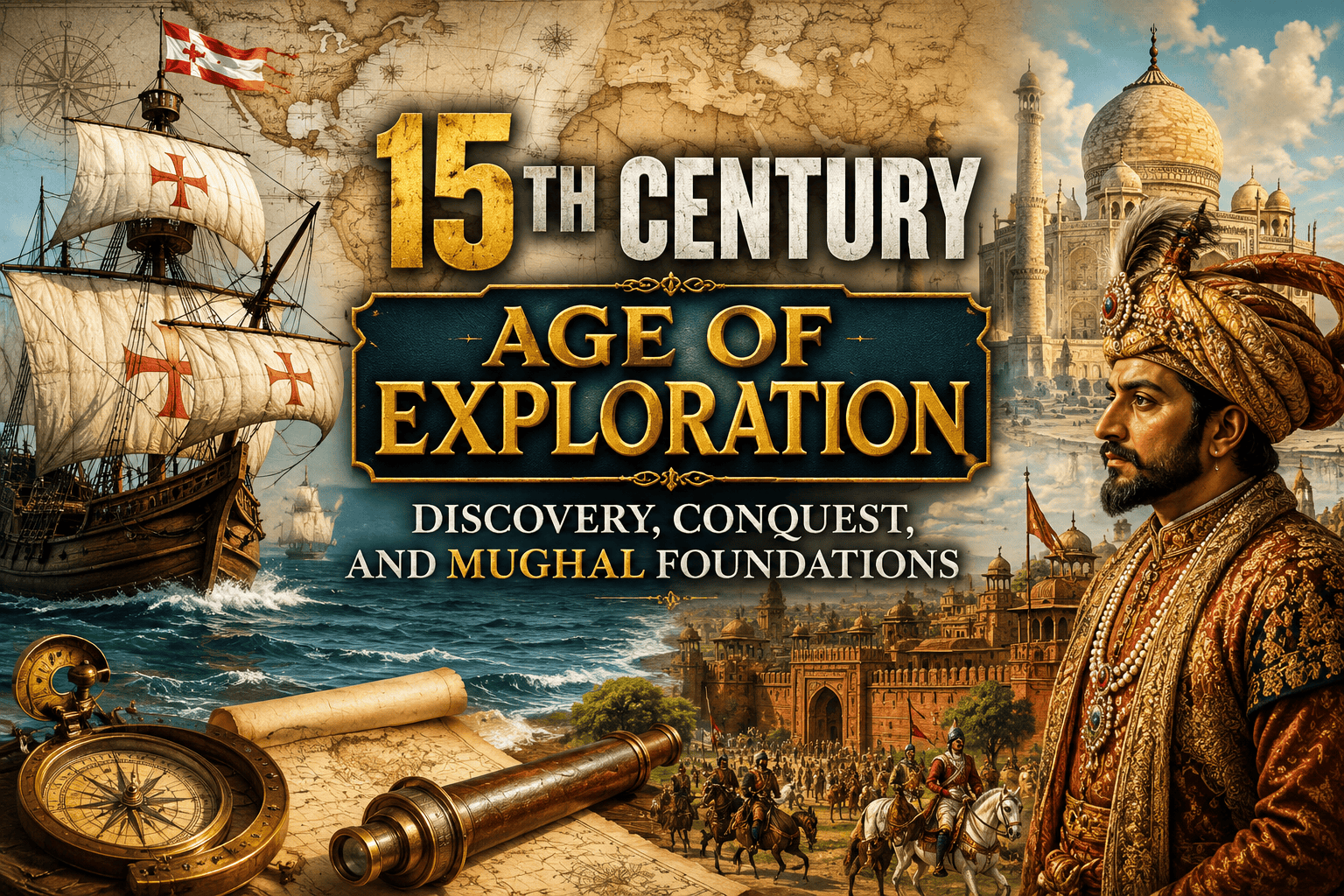
The 15th century was defined by the Age of Exploration, as European powers like Portugal and Spain launched voyages that led to Columbus’s arrival in the Americas in 1492, opening an era of global contact and conquest. This century also saw the fall of Constantinople in 1453 to the Ottoman Empire, marking the end of the Byzantine Empire and the rise of Ottoman power across the Mediterranean and Middle East. Meanwhile, the Renaissance flourished across Europe, driving major advances in art, science, and humanist thought, while powerful new dynasties and empires emerged across Africa, Asia, and the Americas. At its core, the 15th century reveals how exploration and conquest began reshaping the world into a new, interconnected global order.
The 15th Century (1401–1500 CE) — Complete World History Guide
- Chapter 1 — Understanding the 15th Century
- Chapter 2 — Major Empires and Kingdoms of the 15th Century
- 2.1 Overview — The World's Power Map in 1401 CE
- 2.2 The Ottoman Empire — Rise to Dominance
- 2.3 The Byzantine Empire — Final Years
- 2.4 The Fall of Constantinople (1453) — Complete Account
- 2.5 England — The Wars of the Roses (1455–1485)
- 2.6 France — Victory in the Hundred Years' War
- 2.7 Spain — The Reconquista Completed (1492)
- 2.8 Portugal — Pioneer of Exploration
- 2.9 Ming Dynasty China — Forbidden City and Zheng He
- 2.10 The Aztec Empire — Tenochtitlan and the Triple Alliance
- 2.11 The Inca Empire — South America's Greatest State
- Chapter 3 — Wars and Conflicts of the 15th Century
- Chapter 4 — The Age of Exploration
- Chapter 5 — The Renaissance
- Chapter 6 — Gutenberg's Printing Press
- Chapter 7 — Religion and Cultural Developments
- Chapter 8 — Science, Technology, and Innovation
- Chapter 9 — Complete Decade-by-Decade Timeline
- Chapter 10 — Summary and Legacy of the 15th Century
Chapter 1 — Understanding the 15th Century
1.1 Definition — What Is the 15th Century?
Definition: The 15th century is the period from January 1, 1401 CE to December 31, 1500 CE — one hundred years that historians universally recognize as one of the most transformative in the entire history of human civilization. It marks the transition from the Late Middle Ages to the Early Modern Era.
15th Century at a Glance:
Period:           1401 CE to 1500 CE
European Context: Transition from Late Middle Ages
                  to Early Modern Period
Key Transformations:
  - Fall of Constantinople (1453)
  - Renaissance expanding across Europe
  - Gutenberg's printing press (~1440)
  - Age of Exploration beginning
  - Ottoman Empire rising to peak power
  - Americas encountered by Europeans (1492)
  - Reconquista completed in Spain (1492)
  - Wars of the Roses ending in England (1485)
  - Ming Dynasty China at its height
  - Aztec and Inca Empires at their peaks
The 15th century is the pivotal century of world history — the century when the medieval world ended and the modern world began. Before 1401, most of the world’s great civilizations operated in relative isolation from each other. By 1500, European ships were connecting every major coastline of the globe, the printing press was spreading knowledge faster than ever before, the Roman Catholic Church was facing its first serious internal challenges in centuries, and two great civilizations in the Americas — the Aztec and Inca — were about to encounter a force that would transform their world irrevocably.
1.2 What Kind of World Existed in 1401 CE?
In the year 1401 CE, the world was still recovering from one of the worst catastrophes in human history — the Black Death (bubonic plague) of 1347–1353, which had killed approximately one-third of Europe’s population and caused massive disruption across Asia. The 14th century had been genuinely terrible: plague, the Hundred Years’ War between England and France, peasant revolts, the Western Schism (two or even three men simultaneously claiming to be Pope), and the devastating invasions of Timur (Tamerlane) across Central Asia and the Middle East.
By 1401, recovery was underway. Europe’s population was slowly rebuilding. Italian city-states — Florence, Venice, Milan, Genoa — were becoming wealthy through commerce and banking. The Renaissance was underway in Italy, with artists and scholars rediscovering classical Greek and Roman culture. In China, the Ming Dynasty — established in 1368 after overthrowing the Mongol Yuan Dynasty — was building one of the world’s most powerful and prosperous states. In the Americas, the Aztec and Inca civilizations were expanding rapidly, building empires of considerable sophistication completely unknown to the rest of the world.
The most important shadow hanging over the world in 1401 was the Ottoman Empire. The Ottoman Turks had been expanding steadily into Byzantine territory for decades. Constantinople — the last remnant of the Roman Empire and one of the greatest cities in the world — was increasingly surrounded. How long it could survive was becoming an urgent question.
1.3 The Transition from Medieval to Modern
Definition: The transition from the Medieval to the Modern Era refers to the gradual replacement of medieval institutions, worldviews, and structures — feudalism, universal church authority, manuscript culture, localized economies — with modern ones: nation-states, religious diversity, print culture, and global commerce.
This transition did not happen suddenly on January 1, 1401. It was a process that began in the 14th century and was not complete until the 17th century. But the 15th century contained more of the decisive moments of this transition than any other single century.
Medieval World (ending):          Modern World (beginning):
Feudal social hierarchy            Nation-states and central
  (king, lords, knights, serfs)      government authority
Universal Church authority         Religious diversity and
  (one Pope, one Church)             state control of religion
Manuscript culture                 Print culture
  (hand-copied books, rare,           (mass-produced books,
   expensive, clergy-controlled)      affordable, widely available)
Local economies                    Global commerce and trade
  (mostly self-sufficient regions)    networks connecting all continents
Geocentric worldview               Beginning of scientific inquiry
  (Earth at center, divine order)     challenging traditional assumptions
Limited geographical knowledge     Global geographical knowledge
  (most people's world = local area)  (all continents known by ~1500)
1.4 Why the 15th Century Matters More Than Any Other
The 15th century created the world we live in. Every major feature of modern global civilization can be traced directly to specific 15th century events.
The global trading system — the interconnected world economy where goods, ideas, and people move freely across all continents — began with the Age of Exploration of the 1480s–1490s. The printing press of the 1440s made mass literacy possible, leading eventually to universal education, scientific publishing, newspapers, and the information society. The Fall of Constantinople in 1453 ended the last remnant of ancient Rome and pushed Europe to find new trade routes, directly triggering the explorations that encountered the Americas. The Renaissance redefined what human beings believed they were capable of, placing human potential at the center of cultural life. The Spanish Inquisition, the completion of the Reconquista, and the expulsion of Jews from Spain in 1492 set patterns of religious intolerance and persecution that would shape European and American history for centuries.
Chapter 2 — Major Empires and Kingdoms of the 15th Century
2.1 Overview — The World’s Power Map in 1401 CE
Major Power Centers in 1401 CE:

EUROPE:
Byzantine Empire — Constantinople (dying, ~50,000 people)
Ottoman Empire — Rising, surrounding Byzantium
Holy Roman Empire — Central Europe (fragmented)
England — Lancaster dynasty, exhausted by French wars
France — Winning Hundred Years' War slowly
Portugal — Small but ambitious, expanding south
Aragon and Castile — Iberian kingdoms, Reconquista ongoing
Italian City-States — Florence, Venice, Milan, Genoa
                      (richest places in Europe)

MIDDLE EAST/CENTRAL ASIA:
The Ottoman Empire originated in Anatolia and expanded into Europe and the Middle East.
Timurid Empire — Central Asia and Persia (after Timur's death)
Mamluk Sultanate — Egypt and Syria
Various Persian dynasties

ASIA:
Ming Dynasty China — World's largest, most advanced state
Joseon Dynasty Korea — Stable, Confucian governance
Japan — Ashikaga Shogunate (weakening, civil wars)
Delhi Sultanate — Northern India (declining)
Vijayanagara Empire — Southern India (flourishing)

AFRICA:
Mali Empire — West Africa (declining)
Songhai Empire — Rising to replace Mali
Great Zimbabwe — Southern Africa
Swahili Coast City-States — East Africa (Indian Ocean trade)

AMERICAS:
Aztec Triple Alliance — Central Mexico (rapidly expanding)
Inca Empire — Andes, South America (rapidly expanding)
Various North American cultures — Mississippian, Pueblo, etc.
Maya city-states — Yucatán Peninsula (post-Classic period)
2.2 The Ottoman Empire — Rise to Dominance
Definition: The Ottoman Empire was a Turkish Muslim dynastic empire founded in northwestern Anatolia (modern Turkey) around 1299 by Osman I, which by the 15th century had become the dominant military and political power connecting Europe, the Middle East, and North Africa.
The Ottomans were one of many Turkish beyliks (principalities) that emerged after the Mongol destruction of the Seljuk Sultanate. What distinguished them from other such principalities was their location — on the frontier between Byzantine Christian territory and Muslim Anatolia — and their consistent military ability and political skill.
By 1400, the Ottoman Sultan Bayezid I had conquered almost all of Anatolia and most of the Balkans, bringing the Ottoman frontier to the walls of Constantinople itself. A catastrophic interruption occurred in 1402 when Timur (Tamerlane) invaded Anatolia, defeated and captured Bayezid at the Battle of Ankara, and temporarily dismembered the Ottoman Empire. Most observers assumed the Ottomans were finished.
They were wrong. Within twenty years, the Ottomans had reunified their state and resumed their expansion. The speed and completeness of this Ottoman recovery is one of the most remarkable institutional achievements of the medieval period. It demonstrated that Ottoman power was not dependent on a single exceptional ruler — it was built into the empire’s administrative and military institutions.
Ottoman Military System:
Janissaries (Yeniçeri — "New Soldiers"):
  The elite infantry corps of the Ottoman army.
  Recruited from Christian boys taken from their families
  in a levy called devshirme — forced conversion, training
  in Ottoman culture, language, and military arts.
  Result: Absolutely loyal soldiers who had no family
  connections or property interests to distract them.
  No family loyalty, no dynastic ambition — pure military focus.

  Equipment: By the 15th century, increasingly armed
  with firearms (the Ottomans adopted gunpowder weapons
  faster than most European armies).

  Size: By Mehmed II's time, ~10,000–12,000 elite troops.

Sipahi (cavalry):
  Provincial cavalry who received land grants (timars)
  in exchange for military service.
  Similar to European feudal knights but more systematically
  organized and controllable by central authority.

Artillery:
  The Ottomans became the most sophisticated users of
  artillery in the 15th century world.
  They commissioned European (mainly Hungarian and German)
  engineers to build massive bombards — cannons that could
  throw stone or metal balls hundreds of kilograms in weight.
  These cannons made previously impregnable fortifications
  vulnerable — including Constantinople's walls.
2.3 The Byzantine Empire — Final Years
The Byzantine Empire that entered the 15th century was a shadow of its former self. At its peak in the 6th century under Emperor Justinian, the Byzantine Empire had controlled the eastern Mediterranean, North Africa, the Italian peninsula, and the Balkans. By 1400, it had been reduced to the city of Constantinople itself, a small strip of the Peloponnese (the Despotate of Morea), and a few Aegean islands.
The population of Constantinople had shrunk from perhaps one million at its peak to approximately 50,000–100,000 — a city designed for a million people, now partially abandoned with gardens and farms inside the ancient walls. The commerce that had made Constantinople wealthy had largely been taken over by Venetian and Genoese merchants who had their own trading quarters in the city and operated under their own laws.
The Byzantine emperors of the final decades pursued a desperate diplomatic strategy: appealing to the Western Catholic world for military help against the Ottomans. The price demanded was Church union — the Orthodox Church submitting to papal authority, reversing the Great Schism of 1054. At the Council of Florence in 1439, Emperor John VIII signed a union decree. The Greek clergy and people largely rejected it, and no significant Western military help arrived anyway. The union satisfied almost no one and solved nothing.
2.4 The Fall of Constantinople (1453) — Complete Account
Definition: The Fall of Constantinople on May 29, 1453 was the capture of the Byzantine capital by the Ottoman army under Sultan Mehmed II, ending the Byzantine Empire — the last continuation of the Roman Empire — after approximately 2,200 years of continuous Roman political tradition dating from the Roman Republic.
This is one of the most significant events in all of world history. It ended an empire that had survived the fall of Rome’s western half by a thousand years, preserved Greek and Roman learning throughout the medieval period, and served as the eastern anchor of Christendom.
The Siege: Mehmed II — called “the Conqueror” (Fatih) — was 21 years old when he launched the siege. He had prepared meticulously for years. He commissioned the Hungarian engineer Urban to build the largest cannons in the world — the largest, called the “Basilica” or “Ottoman Great Bombard,” was approximately 8 metres long and could throw a 272-kilogram stone ball over 1.6 kilometres, destroying walls no previous weapon could damage.
The Siege of Constantinople — Key Facts:
Beginning:    April 6, 1453
End:          May 29, 1453
Duration:     53 days

Ottoman Forces:
  Regular army:    ~80,000–100,000 soldiers
  Janissaries:     ~10,000–12,000 elite infantry
  Artillery:       70+ cannons, including massive bombards
  Naval fleet:     ~320 ships

Byzantine Defenders:
  Total:     ~7,000–10,000 men (including Genoese volunteers)
  Regular:   ~5,000 Byzantine soldiers
  Mercenary: ~2,000 Genoese under Giovanni Giustiniani
  Civilians:  armed for the final defense

The Chain:
The Byzantines had extended a massive iron chain across
  the entrance to the Golden Horn (the harbor of Constantinople)
  to prevent Ottoman ships from attacking the sea walls.
  Mehmed's solution: he had his ships dragged overland
  on greased logs — approximately 70 ships were transported
  over the hill above Galata and relaunched into the
  Golden Horn behind the chain.
  This opened the sea walls to attack and stretched the
  Byzantine defenders thin.

The Walls:
  Constantinople's Theodosian Walls (built ~413 CE) were
  among the most formidable in the world — triple walls
  with a moat, designed to withstand any previous weapon.
  Mehmed's massive cannons changed this calculation.
  The bombards fired 7 times per day maximum
  (they needed hours to cool between shots).
  Over weeks of bombardment, sections of wall collapsed.
  The Byzantines repaired damage at night with earth and
  timber barricades, but the cumulative damage mounted.
The Final Assault: On the night of May 28–29, 1453, Mehmed launched a final massive assault. Waves of troops attacked the walls. The critical moment came when Giovanni Giustiniani — the Genoese commander whose personal courage had been crucial to the defense — was wounded and left the walls to have his wound dressed. His departure demoralized the defenders at a key point. The Ottomans found a small gate (the Kerkoporta) that had been left unlocked during a sortie and poured through.
Emperor Constantine XI Palaiologos refused to flee. According to tradition, he tore off his imperial insignia so he would not be recognized and died fighting with his soldiers. His body was never definitively identified. The last Roman Emperor died defending the walls of Rome’s eastern capital — one of history’s most poignant moments.
Consequences of the Fall of Constantinople:

Immediate:
- End of the Byzantine Empire — the last continuation of Rome
- Greek scholars flee to Italy with ancient manuscripts
- Ottoman control of the Bosphorus — the strait between
  Europe and Asia — giving them control over trade routes
* Constantinople was renamed Istanbul and became the capital of the Ottoman Empire
  (actually renamed — the Ottomans gradually used "Istanbul"
   from the Greek phrase "eis tin polin" — "to the city")

Short-term (years to decades):
- Greek scholars in Italy bring ancient Greek texts and
  knowledge, accelerating the Renaissance
- Ottoman control of eastern trade routes motivates
  European search for alternative sea routes to Asia
  → directly contributes to the Age of Exploration
- Psychological shock to Christian Europe — Constantinople
  had been the eastern bulwark of Christendom for centuries

Long-term (centuries):
- The Ottoman Empire controlled southeastern Europe,
  Anatolia, the Middle East, and North Africa for
  approximately 470 years until its dissolution in 1922
- The phrase "fall of Constantinople" became a cultural
  reference point for civilizational decline
- The Greek diaspora in Italy accelerated Italian humanism
  and Renaissance scholarship
- The Ottomans' control of eastern trade routes was a
  proximate cause of Columbus's voyage to the Americas
2.5 England — The Wars of the Roses (1455–1485)
Definition: The Wars of the Roses were a series of civil wars in England fought between 1455 and 1485 between two rival branches of the royal House of Plantagenet — the House of York (whose symbol was a white rose) and the House of Lancaster (whose symbol was a red rose) — for control of the English throne.
The name “Wars of the Roses” was actually invented in the 19th century by Sir Walter Scott — contemporary participants did not call it this. But the floral imagery became associated with the conflict through Shakespeare’s plays, particularly Henry VI Part 1, where nobles pluck roses of different colors to indicate their allegiance.
The Background: The roots of the conflict lay in the deposition of King Richard II by Henry Bolingbroke (Henry IV) in 1399. Henry IV’s claim to the throne was questionable — he had seized it by force. The Lancastrian kings Henry IV, Henry V, and Henry VI all ruled on a throne whose legitimacy could be challenged by other descendants of Edward III. The trigger for open conflict was the mental illness of Henry VI — he suffered complete mental breakdowns during which he was unresponsive and incapable of governing.
The Main Competitors:
House of Lancaster (Red Rose):
  King Henry VI — pious but mentally unstable
  Queen Margaret of Anjou — fierce and politically active,
effectively directed the Lancastrian cause during her husband’s reign
  incapacity. She became one of the most formidable military
  and political figures of the 15th century.

House of York (White Rose):
  Richard Duke of York — initial claimant, killed at battle
  of Wakefield (1460)
  Edward IV — Richard's son, energetic and capable king
               who won the throne twice (1461, 1471)
  Richard III — Edward's brother, seized throne from
                Edward's young son (Edward V), ruled 1483–1485

Key Battles:
First Battle of St. Albans (1455)  — York victory
Battle of Wakefield (1460)         — Lancaster victory, York killed
Battle of Towton (1461)            — Decisive York victory
                                     Bloodiest battle on English soil
Battle of Barnet (1471)            — York victory, Warwick killed
Battle of Bosworth Field (1485)    — Tudor victory, Richard III killed
The Battle of Bosworth Field (1485): The final decisive battle of the Wars of the Roses was fought near Market Bosworth in Leicestershire on August 22, 1485. Richard III faced Henry Tudor, a Lancastrian claimant of somewhat distant and questionable royal descent who had been in exile in France. Henry landed in Wales with approximately 5,000 men (many French mercenaries) and marched into England.
The battle was decided by treachery. The Stanley family — Lord Thomas Stanley and Sir William Stanley — commanded a large force that had been loyal to Richard but switched sides during the battle itself. When Richard saw Henry Tudor’s position on the battlefield, he made the fatally rash decision to charge personally at Henry with a group of knights to end the battle in single combat. His cavalry charge was intercepted by the Stanleys’ forces, who attacked Richard from the flank.
Richard III's Death at Bosworth:
Richard III's remains were discovered under a Leicester
car park in 2012 — one of the most extraordinary
archaeological discoveries in British history.

Physical evidence confirmed by archaeology:
- Severe scoliosis (curved spine) — Shakespeare's portrayal
  of him as a hunchback was partly accurate, though greatly
  exaggerated for dramatic effect
- Multiple wounds concentrated at the back of the skull —
  consistent with being unhorsed and killed from behind
  (possibly after losing his horse in marshy ground)
- His hands were bound behind him — suggesting he was
  captured briefly before being killed

After Bosworth:
Richard's body was carried back to Leicester strapped
naked to a horse, put on display, then buried without
ceremony in the Grey Friars church.
His remains were reinterred with full royal ceremony
in Leicester Cathedral in 2015.
Henry VII of England became king, establishing the Tudor dynasty. He cleverly united the warring factions by marrying Elizabeth of York — uniting the red and white roses into the Tudor rose symbol. The Wars of the Roses effectively ended the Plantagenet dynasty and began the Tudor dynasty that would produce Henry VIII, Edward VI, Mary I, and Elizabeth I — the monarchs who defined the 16th century in England.
2.6 France — Victory in the Hundred Years’ War
The Hundred Years’ War (1337–1453): Definition: The Hundred Years’ War was a series of conflicts fought between England and France from 1337 to 1453 over the English kings’ claims to the French throne. Despite its name, it was not continuous warfare but periods of fighting interrupted by truces and peace.
The conflict began when Edward III of England asserted a claim to the French throne through his mother, Isabella of France. The English initially won spectacular victories — Crécy (1346), Poitiers (1356), Agincourt (1415) — but ultimately lost almost everything due to French recovery, the inspiration of Joan of Arc, and the fundamental difficulty of permanently occupying a large hostile country.
Joan of Arc (c.1412–1431): Definition: Joan of Arc (Jeanne d’Arc) was a French peasant girl from Domrémy in the Lorraine region who claimed to receive visions from saints (including Saint Michael, Saint Catherine, and Saint Margaret) directing her to support the Dauphin Charles and drive the English from France. She became the most celebrated figure of the Hundred Years’ War and France’s national heroine.
Joan’s story is one of the most extraordinary in medieval history.Born around 1412 into a peasant family, Joan of Arc persuaded the Dauphin Charles—the uncrowned heir to the French throne—to grant her armor, a horse, and leadership of troops, claiming divine guidance. Her achievements were extraordinary.
Joan of Arc's Military Career:
Problem: English and Burgundian forces controlled
         northern France; the city of Orléans was
         under English siege; Charles could not be
         crowned at Reims (the traditional coronation
         city, under English control)

Joan's Achievements (1429):
May 1429:    Led French forces to relieve the Siege of
             Orléans — a crucial English stronghold.
             Her arrival transformed the morale of
             French troops who had been demoralized by
             after years of setbacks.


June–July 1429: Led a rapid military campaign clearing
                the Loire Valley of English troops.


July 17, 1429: Charles VII was crowned King of France
               at Reims Cathedral — Joan stood beside
              with him bearing her banner.


Capture and Trial:
May 1430:    Joan was captured by Burgundian forces
             near Compiègne and sold to the English.

1431:        Tried by a French ecclesiastical court
             controlled by English-allied Bishop Pierre
             by Pierre Cauchon on charges of heresy and witchcraft.

             The key charges: wearing men's clothing
             (considered gender transgression) and
             claiming direct divine authority (bypassing
             Church hierarchy).

May 30, 1431: Burned at the stake in Rouen marketplace.
              She was about 19 years old.


Legacy:
1456: Rehabilitation trial declared her conviction
      unfair and driven by political motives.

1920: Canonized as a Saint by the Catholic Church.
Joan of Arc is France's patron saint and national symbol.
The End of the War (1453): The war ended not with a single decisive battle but with the gradual French reconquest of English-held territories. The Battle of Castillon (July 17, 1453) — the same year as the Fall of Constantinople — was the last major battle, where French artillery destroyed an English army attempting to relieve the besieged city of Castillon. England lost almost all its French territories, retaining only Calais (until 1558).
The results of the Hundred Years’ War were profound. France emerged as a more unified nation with a stronger sense of French national identity. England turned its military ambitions inward — the Wars of the Roses consumed English energy for the next 30 years. Both countries developed more centralized monarchies as a result of the wars’ demands for efficient governance and taxation.
2.7 Spain — The Reconquista Completed (1492)
The Reconquista: The Reconquista — the Christian reconquest of Iberia from Muslim rule — had been underway for nearly 800 years when the 15th century began. It was completed on January 2, 1492, when the last Muslim kingdom in Iberia, the Emirate of Granada under Muhammad XII (Boabdil), surrendered to the forces of Ferdinand and Isabella.
The Catholic Monarchs — Ferdinand and Isabella: The marriage of Ferdinand of Aragon and Isabella of Castile in 1469 united the two most powerful Christian kingdoms of Iberia into a combined state of enormous military and economic power. Together they:
Completed the Reconquista by conquering Granada (1492). Established the Spanish Inquisition (1478) to enforce religious orthodoxy — a tribunal that became notorious for torture and execution of those suspected of secretly practicing Judaism or Islam after forced conversion. Expelled all Jews from Spain in 1492 — an estimated 100,000–300,000 people who either converted or left, taking with them significant commercial, intellectual, and medical expertise. Sponsored Christopher Columbus’s voyage (1492). Established the legal framework for Spanish colonization of the Americas.
The Spanish Inquisition — Key Facts:
Founded:  1478 by Pope Sixtus IV at Ferdinand's request
Purpose:  Investigate and punish heresy — specifically
          "conversos" (Jewish converts to Christianity,
          called Marranos) suspected of secretly
          continuing Jewish practices, and "moriscos"
          (Muslim converts, called crypto-Muslims)

Methods:
  - Interrogation and confession under pressure
  - Torture permitted to obtain confessions
  - Penalties ranged from penance to burning alive
    (auto-da-fé — "act of faith")

Scale:
  Estimates of total executions vary widely.
  Modern scholarship suggests approximately 3,000–5,000
  people were executed over three and a half centuries.
  Far more were imprisoned, fined, or subjected to
  public penance.

The Expulsion of Jews (1492):
  The Alhambra Decree of March 31, 1492 ordered all
Jews were required to convert to Christianity or leave Spain within
  four months.
  100,000–300,000 Jews (estimates vary widely) left Spain.
  Many went to the Ottoman Empire, where Mehmed II's
  successors welcomed them — the Ottoman Sultan reportedly
  said Ferdinand had "impoverished his own country and
  enriched ours."
  Jewish communities from Spain (Sephardic Jews) carried
  their Ladino language (medieval Spanish written in
  Hebrew characters) to Turkey, Greece, the Balkans,
  and North Africa, where some communities preserved it
  until the 20th century.
2.8 Portugal — Pioneer of Exploration
Portugal was a small country — approximately 92,000 km², with a population of perhaps 1 million in the 15th century — whose geographical position on the southwestern tip of Europe facing the Atlantic made it the natural pioneer of Atlantic exploration.
Prince Henry the Navigator (1394–1460): Definition: Prince Henry the Navigator (Infante Dom Henrique) was a Portuguese prince who organized and sponsored systematic exploration of the West African coast, establishing a school of navigation and creating the institutional infrastructure for Portugal’s Age of Exploration.
Henry never actually sailed on the voyages he sponsored — the “Navigator” title is somewhat misleading. His contribution was organizational and financial: he gathered cartographers, astronomers, mathematicians, and experienced sailors at his court at Sagres on Portugal’s southwestern tip, commissioned systematic exploration voyages down the African coast, and created a cumulative body of geographical and navigational knowledge that each subsequent voyage built upon.
Under his direction, Portuguese explorers progressively moved further south along the African coast: Madeira islands discovered (~1419), Azores discovered (~1427), Cape Verde islands reached (~1445), and the West African coast explored as far as modern Sierra Leone by the time of Henry’s death in 1460.
The Systematic Approach: What made Portuguese exploration different from previous expeditions was its systematic, cumulative character. Each voyage brought back charts, descriptions of coastlines, information about winds and currents, and samples of goods and resources. This information was analyzed and incorporated into the planning of subsequent voyages. Portugal was conducting what we might today call organized scientific research applied to geographical discovery.
Portuguese Navigation Technology:
The Caravel:
  A small, fast, maneuverable sailing ship developed
  by the Portuguese in the 15th century that made
  long ocean voyages practical.

  Key features:
  - Lateen (triangular) sails: allowed sailing closer
    to the wind direction — crucial for returning from
    Africa against prevailing winds
  - Shallow draft: could navigate coastal waters
    and river mouths
  - Small crew requirement: economically efficient
  - Typically 50–160 tonnes displacement

The Astrolabe:
  Instrument for measuring the altitude of stars or the sun
  above the horizon, allowing calculation of latitude.
  Portuguese navigators used a simplified maritime
  astrolabe to determine how far north or south they were.

Dead Reckoning:
  Calculating current position based on known starting
  position, compass heading, estimated speed (measured
  by throwing a log overboard and timing it), and
  elapsed time.
  Inaccurate over long distances but workable for
  coastal voyages.

Star Navigation:
  Portuguese navigators learned to use the Southern Cross
  (not visible from Europe) to determine latitude in the
  southern hemisphere — a significant navigational advance.
2.9 Ming Dynasty China — Forbidden City and Zheng He
The Ming Dynasty: Definition: The Ming Dynasty (1368–1644 CE) was a Chinese imperial dynasty founded by Zhu Yuanzhang (the Hongwu Emperor) after overthrowing the Mongol Yuan Dynasty. The Ming is considered one of the greatest eras of orderly government and stable prosperity in human history.
In the 15th century, the Ming Dynasty was at or near its peak. Its population of perhaps 60–80 million made it the largest state by population in the world. Its economy was the world’s largest. Its cities — especially Beijing, Nanjing, and Hangzhou — were the largest in the world.
The Forbidden City: Definition: The Forbidden City (Zijin Cheng) is the imperial palace complex in Beijing, built between 1406 and 1420 CE during the reign of the Yongle Emperor. It served as the home of Chinese emperors and the political center of China for 500 years (until 1912).
The Forbidden City was called “forbidden” because ordinary people were prohibited from entering without imperial permission. It covers approximately 72 hectares (180 acres) and contains approximately 980 buildings with approximately 8,728 rooms. It was built by approximately 200,000 workers over 14 years. The name reflects its status as a sacred, separate world — the emperor was the “Son of Heaven,” the intermediary between the divine and human worlds, and his residence was correspondingly separate from ordinary human space.
Forbidden City — Key Facts:
Construction:  1406–1420 CE under Yongle Emperor
Location:      Center of Beijing
Size:          720,000 m² (72 hectares)
Buildings:     ~980 buildings, ~8,728 rooms
Walls:         10 metres high, 3.4 km perimeter
Moat:          52 metres wide surrounding the outer wall
Workers:       ~200,000 workers, ~100,000 skilled artisans
Material:      Special white marble, enormous timber from
               Sichuan and Yunnan, gilded roof tiles

Organization:
Outer Court:   Ceremonial functions — the three great halls
               where the emperor carried out official duties

Inner Court:   Private residence of emperor, empress,
              and members of the imperial family

Garden:        Imperial Garden in the north

Today:
The Forbidden City is now the Palace Museum.
It contains one of the world's largest collections
of Chinese art and historical artifacts.
UNESCO World Heritage Site since 1987.
It received approximately 17 million visitors in 2019 —
the most visited museum in the world.
Zheng He’s Voyages (1405–1433): Definition: The Voyages of Zheng He were a series of seven naval expeditions ordered by the Yongle Emperor and commanded by the Muslim Chinese eunuch admiral Zheng He, sailing across the Indian Ocean to Southeast Asia, India, Arabia, and East Africa between 1405 and 1433.
These voyages were the most impressive display of Chinese naval power and organizational capability in history. They dwarfed anything contemporary European sailors were attempting.
Zheng He's Voyages — Scale and Significance:
Zheng He's Flagship (Treasure Ship):
  Length: ~127 metres (estimated)
         [Columbus's Santa María was ~18 metres]
  Width:  ~52 metres
  Crew:   ~500 per ship

Fleet Size (First Voyage, 1405):
  ~317 ships total
  ~27,800 crew members
  [Columbus had 3 ships and ~90 crew in 1492]

Destinations:
  Southeast Asia (Vietnam, Indonesia, Thailand, Malaysia)
  Indian subcontinent (Calicut, Cochin on the Malabar Coast)
  Arabia (Aden, Hormuz, Jeddah — near Mecca)
  East Africa (Malindi in modern Kenya, Mogadishu,
               Mombasa, Zanzibar)

Purposes:
  - Diplomatic: establish tributary relationships,
    bring foreign rulers to acknowledge Ming supremacy
  - Commercial: exchange Chinese goods (silk, porcelain,
    copper) for foreign goods (spices, gems, ivory, animals)
  - Display of power: demonstrate Ming Dynasty's
    magnificence to the wider world
  - The famous "tribute animals" included a giraffe
    from East Africa, brought to Beijing and believed
    by the Chinese to be a qilin — a mythological
    a symbol of good fortune


Why the Voyages Stopped (1433):
The death of the Yongle Emperor in 1424 removed
their main sponsor. Confucian bureaucrats who
dominated the imperial court opposed the voyages as
wasteful, un-Confucian (trade was considered undignified),
and potentially destabilizing.
In 1433, after Zheng He's seventh voyage, the programme
was ended. Ship construction records were apparently
burned to prevent any revival.

Historical "What If":
If China had continued the voyages and established
permanent overseas trading posts, China rather than
Portugal and Spain might have colonized the Americas
and Africa. Instead, within 60 years of the voyages
ending, Columbus reached the Americas — having sailed
in ships a fraction of the size of Zheng He's fleet.
2.10 The Aztec Empire — Tenochtitlan and the Triple Alliance
Definition: The Aztec Empire (more accurately the Triple Alliance) was a Mesoamerican empire centered in the Valley of Mexico, established in 1428 through an alliance of three city-states — Tenochtitlan, Texcoco, and Tlacopan — that dominated much of central Mexico and collected tribute from dozens of conquered peoples.
The Aztecs (who called themselves Mexica) had arrived in the Valley of Mexico as a relatively small, landless group in the early 13th century. According to their own tradition, they were guided by their patron god Huitzilopochtli to find the site of their future city: an eagle sitting on a cactus eating a snake on an island in a lake. They found this sign on an island in Lake Texcoco and founded Tenochtitlan around 1325 CE.
Tenochtitlan: By the 15th century, Tenochtitlan had grown into one of the largest cities in the world — with a population of perhaps 200,000–300,000 people. This made it larger than any city in Europe (contemporary London had about 50,000–80,000 people; Paris perhaps 200,000). The city was built on an island connected to the mainland by wide causeways. It featured a massive central ceremonial complex with pyramids, temples, and plazas, surrounding residential districts, a great market, elaborate gardens and zoos, and a sophisticated fresh water supply system (the Chapultepec aqueduct).
Aztec Empire Organization:
Political Structure:
  Triple Alliance: Tenochtitlan (dominant), Texcoco, Tlacopan
  Huey Tlatoani (Great Speaker): supreme ruler of Tenochtitlan
  and effectively the empire

Economy:
  Tribute system: conquered peoples paid regular tribute in
  food, textiles, precious materials, and labor.
  Tenochtitlan's great market at Tlatelolco was described
  by Spanish conquerors as larger and better organized
  than any market in Spain.

Agriculture:
  Chinampas ("floating gardens"): artificial islands
  built in the lake, extraordinarily productive.
  Multiple harvests per year possible on chinampas.

Religion:
  Polytheistic — hundreds of deities
  Huitzilopochtli (sun/war god): required regular
ritual sacrifices believed to sustain the movement of the sun
  The Aztecs' scale of human sacrifice was larger
  than any comparable civilization — thousands of
  captive warriors were sacrificed annually.
  This practice was both religiously sincere and
  politically strategic — captured enemies were
  sacrificed rather than enslaved, and neighboring
  peoples were kept in fear.

Military:
  Flower Wars (Xochiyaoyotl): Ritualized battles
  fought specifically to capture prisoners for sacrifice
  rather than to kill enemies.
  This system simultaneously maintained military
  capability and provided religious victims.
  Paradoxically, it may have made Aztec military
  methods less effective against the Spanish, who
  fought to kill rather than capture.
2.11 The Inca Empire — South America’s Greatest State
Definition: The Inca Empire (Tawantinsuyu — “Four Regions Together”) was the largest empire in pre-Columbian America, stretching approximately 4,300 kilometres along the western coast of South America from modern Colombia to Chile, with an estimated population of 6–12 million people at its peak.
The Inca state was founded in the city of Cusco in the Andes highlands of modern Peru. Its dramatic expansion from a small regional kingdom to a continent-spanning empire was largely accomplished during the 15th century under two great rulers — Pachacuti (reigned 1438–1471) and his son Topa Inca (reigned 1471–1493).
Pachacuti — The World-Shaker: Definition: Pachacuti (also spelled Pachacutec) was the ninth Sapa Inca (emperor) of the Kingdom of Cusco who transformed it from a small regional state into the Inca Empire. His name translates to “Earth-Shaker” or “one who changes the world.”
Inca Imperial Achievements:
Road System:
  ~40,000 km of roads throughout the Andes —
  more than the Roman road network at its peak.
  Included rope bridges across gorges, tunnels through
  mountains, and stone stairways on steep slopes.
  Traversed every terrain from coastal desert to
  high Andes to tropical rainforest.
  Regular stations (tambos) every ~20 km with food,
  supplies, and runners (chasquis) for message relay.
  Messages could travel the length of the empire
  (4,300 km) in approximately 7 days using relay runners.

Machu Picchu:
  Built approximately 1450 CE by Pachacuti.
  Located at 2,430 metres altitude in the Andes.
  Approximately 150 buildings — temples, residences,
  storage facilities, farming terraces.
  Population: approximately 750 people maximum.
  Likely a royal estate or religious center.
  Abandoned ~100 years after construction, possibly
  due to smallpox spreading from Spanish-contacted
  coastal regions before the Spanish reached the Andes.
  Unknown to the outside world until 1911 when
  Hiram Bingham "discovered" it (local farmers knew
  it existed throughout).

Administration:
  No writing system — used quipu (knotted strings)
  to record numerical information (census, tribute,
  calendars). Whether quipu also encoded narrative
  information remains debated.

Mita System:
  All subjects owed labor tax (mita) to the state.
  State provided food, tools, and supplies during
  mita service.
  Used for: construction, military service, farming
  state lands, mining.
  An innovative redistribution system — the state
  fed and supplied workers, then distributed food
  to the elderly, disabled, and non-working population.

Religion:
  Inti (sun god) was the primary deity.
The Sapa Inca was regarded as the son of the Sun.
  Coricancha (Temple of the Sun) in Cusco was
  covered in gold sheets — described by astonished
  Spanish as blinding in direct sunlight.
  Human sacrifice (qhapaq hucha) occurred at
  major ceremonies, typically involving children
  who were considered particularly pure.
Chapter 3 — Wars and Conflicts of the 15th Century
3.1 The Battle of Agincourt (1415)
Definition: The Battle of Agincourt on October 25, 1415 was a decisive English victory over a much larger French army during the Hundred Years’ War, achieved largely through the devastating effectiveness of English longbowmen.
King Henry V of England had invaded France to press his claim to the French throne. After a lengthy siege of Harfleur, he marched his army — weakened by dysentery, exhausted, and reduced to perhaps 6,000–9,000 men — toward Calais. A French army of perhaps 12,000–36,000 (estimates vary widely) intercepted him near the village of Agincourt.
Why England Won at Agincourt:
English Position:
  - Chosen carefully: a narrow field between two woods,
    preventing French flanking maneuvers
  - Muddy conditions (recent rain) — catastrophic for
    heavily armored French knights on foot
  - Sharpened stakes planted in front of archers
    to prevent cavalry charges

English Longbowmen:
  - Longbow range: ~230–300 metres effective range
  - Rate of fire: trained archer could fire 10–12
    arrows per minute
  - Penetration: could pierce plate armor at close range,
    chain mail at longer range
  - English had ~5,000 archers
  -* The total number of arrows used in battle is estimated to have reached into the millions

French Mistakes:
  - Advanced across muddy field in heavy plate armor
    (each suit weighing ~25 kg)
  - Front ranks crowded together in narrow field —
    men could barely swing weapons
  - Arrows falling like rain on packed, slow-moving men
  - Those who reached English lines were exhausted
    and barely able to fight

Result: French casualties ~6,000–10,000 dead or captured.
        English casualties: approximately 112–600 (disputed).
one of the most one-sided military victories in history

Henry V's order to kill prisoners:
During the battle, Henry ordered his men to kill the
French prisoners they had taken — one of the most
controversial orders in military history. His stated
reason: a suspected attack on his baggage train
required every man available for defense.
Modern interpretations vary: practical necessity,
violation of chivalric law, or war crime.
Shakespeare immortalized Agincourt in Henry V, including the famous St. Crispin’s Day speech: “We few, we happy few, we band of brothers…” — probably not what Henry V actually said, but a permanent contribution to the English language.
3.2 Ottoman Expansion Continues
After the conquest of Constantinople in 1453, Mehmed II continued expanding aggressively. He captured Serbia (1459), ended the Byzantine Despotate of Morea (1460), absorbed Trebizond — the last Byzantine successor state (1461), and advanced into Albania (where Skanderbeg led a famous resistance until his death in 1468). He attempted to capture the island of Rhodes (held by the Knights Hospitaller) but failed in 1480. He died in 1481 while preparing what was reportedly a major invasion of Italy.
His successor Bayezid II was less militarily aggressive, spending his reign consolidating Ottoman institutions. The Ottoman Empire’s expansion would resume vigorously in the 16th century under Selim I and Suleiman the Magnificent.
Chapter 4 — The Age of Exploration
4.1 Why Europe Began Exploring
The European Age of Exploration was not the result of pure curiosity or adventurism. It was driven by specific, concrete economic and political motivations.
The Trade Route Problem: The most profitable trade in the medieval world was the spice trade. Spices — pepper, cinnamon, cloves, nutmeg, ginger — came from South and Southeast Asia. In Europe they were worth more than their weight in silver. They preserved food, flavored it, and (people believed) had medical properties. The trade route from Asia to Europe went overland through Central Asia and the Middle East — the Silk Road — or by sea to the Persian Gulf or Red Sea, then overland to Mediterranean ports, controlled by Muslim middlemen and Italian merchants who took profit at every stage.
The Ottoman conquest of Constantinople in 1453 and Ottoman control of the eastern Mediterranean made these routes more expensive and less secure — not completely blocked (trade continued) but costlier. Western European countries — especially Portugal and Spain, which had no access to the Italian-controlled Mediterranean trade — had powerful economic reasons to find alternative routes.
The Economics of Spices:
Why spices were worth so much:
- Food preservation: salt was the main preservative,
  but spices masked the taste of partially spoiled food
- Medical belief: spices were believed to prevent plague
  and cure many diseases (mostly incorrect, but sincerely believed)
- Status symbol: serving exotic spices demonstrated wealth
- Limited supply: only grew in specific tropical regions
  (Spice Islands = Maluku Islands in modern Indonesia)

Price comparisons (approximate, late medieval):
  1 kg pepper: approximately equivalent to a skilled
               worker's monthly wages in England
  1 kg nutmeg: approximately equivalent to several cows
  1 kg cloves: extremely valuable — grew only in a few
               specific islands in the Maluku archipelago

The markup between production and European sale:
  Spices were bought cheaply at source and sold
  at 100x to 1000x the purchase price by the time
  they reached European consumers.
  Each middleman (Arab trader, Egyptian merchant,
  Italian shipper) took a substantial cut.
  Direct access to the source would make whoever
  achieved it extraordinarily wealthy.
4.2 Bartolomeu Dias — Around the Cape of Good Hope (1488)
Definition: Bartolomeu Dias was a Portuguese explorer who in 1487–1488 commanded the first European expedition to successfully navigate around the southern tip of Africa — the Cape of Good Hope — proving that a sea route from Europe to the Indian Ocean was possible.
Bartolomeu Dias departed from Lisbon in August 1487 with three ships.He followed the West African coast south, progressively further than any previous Portuguese expedition. In January 1488, his fleet was caught in a severe storm that drove them far south for approximately 13 days, after which the winds calmed. When Dias turned east, he found no land — he had been driven around the southern tip of Africa without knowing it. Turning north, he eventually made landfall on the southern African coast east of the Cape.
He sailed as far east as Mossel Bay on the Indian Ocean coast of South Africa before his crew refused to go further. On the return voyage he finally saw and named the southern cape — initially “Cape of Storms” (Cabo das Tormentas). King João II of Portugal renamed it the “Cape of Good Hope” (Cabo da Boa Esperança) — the hope of finding the sea route to India.
Dias’s achievement proved the concept. A direct sea route from Europe to Asia around Africa was feasible. It would be another ten years before Vasco da Gama actually sailed all the way to India, but Dias had done the critical exploratory work.
4.3 Christopher Columbus and the Americas (1492)
Definition: Christopher Columbus (Cristoforo Colombo in Italian, Cristóbal Colón in Spanish) was a Genoese-born navigator who, under Spanish sponsorship, made four voyages across the Atlantic Ocean between 1492 and 1504, making the European encounter with the Americas that fundamentally and permanently changed the world.
Columbus’s Idea: Columbus’s plan was not original — the idea that one could reach Asia by sailing west across the Atlantic was known to educated Europeans. The question was whether it was practical. Columbus made a critical error: he drastically underestimated the size of the Earth and the distance from Europe to Asia going westward, using the calculations of the geographer Toscanelli and his own creative interpretation of Marco Polo’s account of Asia’s eastern extent.
Columbus's Geographical Error:
Columbus's estimate of Earth's circumference:
  ~28,500 km (approximately 25% too small)

Actual Earth's circumference:
  ~40,075 km

Columbus's estimate of distance from Canary Islands
to Japan going west:
  ~3,700 km

Actual distance (Canaries to Japan going west):
  ~19,600 km

If the Americas had not existed, Columbus's fleet
would have run out of food and water approximately
halfway across the Pacific. He and his crew would
almost certainly have died.

The European scholars who rejected Columbus's proposal
were not ignorant — they were largely correct that
his distance estimates were wrong. Columbus survived
because two continents blocked his path, not because
his geography was right.
The First Voyage (1492): After being rejected by Portugal (whose experts correctly identified flaws in his distance calculations), Columbus took his proposal to Ferdinand and Isabella of Spain, who agreed to support him after completing the Reconquista in January 1492.
He sailed from Palos de la Frontera on August 3, 1492 with three ships: the Santa María (his flagship, approximately 18 metres long), the Pinta, and the Niña. He carried approximately 90 men.
After stopping in the Canary Islands, he sailed west across the Atlantic. After 33 days at sea without sight of land — the crew increasingly anxious and on the edge of mutiny — land was sighted on October 12, 1492. Christopher Columbus reached an island in the Bahamas that he named San Salvador, while the indigenous Taíno people knew it as Guanahani.
Columbus's Four Voyages:
First Voyage (1492–1493):
  Reached: Bahamas, Cuba, Hispaniola (Haiti/Dominican Republic)
  Founded: First European settlement in the Americas (La Navidad)
  On return: Santa María wrecked on coast of Hispaniola

Second Voyage (1493–1496):
  Reached: Lesser Antilles, Puerto Rico, Jamaica, Cuba
  Founded: First permanent European settlement (La Isabela)
  Established: Spanish colonial administration of Hispaniola

Third Voyage (1498–1500):
  Reached: Trinidad, mainland South America (Venezuela)
           — Columbus first touched continental American
             the mainland during this journey

  Removed: From Hispaniola in chains by new royal governor
           due to complaints of his colonial administration

Fourth Voyage (1502–1504):
  Reached: Central American mainland (Honduras, Nicaragua,
           Costa Rica, Panama)
  Sought: The strait through to Asia — which does not exist
  Stranded: In Jamaica for over a year with rotting ships

Columbus never admitted he had reached a new continent.
He maintained until his death in 1506 that he had
reached islands off the Asian coast.
The continent was named after Amerigo Vespucci — a
Florentine navigator whose letters describing the new
lands as a "New World" (Mundus Novus) were widely
published and read across Europe.
4.4 Vasco da Gama — The Sea Route to India (1498)
Definition: Vasco da Gama was a Portuguese navigator who commanded the first European fleet to reach India by sea, sailing around Africa and across the Indian Ocean, arriving at Calicut (Kozhikode) on the Malabar Coast of India in May 1498.
Vasco da Gama sailed from Lisbon on July 8, 1497 with four ships and approximately 170 men. Building on Dias’s discovery of the Cape route, he sailed south along the African coast, rounded the Cape of Good Hope in November 1497, and sailed up the East African coast.
At Malindi (in modern Kenya), da Gama hired an experienced Indian Ocean navigator — traditionally identified as Ahmad ibn Mājid, an Arab navigator — who used knowledge of the monsoon winds to guide the Portuguese fleet across the Indian Ocean to Calicut in 23 days. The monsoon system — reliable, predictable seasonal winds that blow alternately toward and away from India — had been used by Arab and Indian traders for centuries. Da Gama was simply the first European to take advantage of it.
The Significance of da Gama's Voyage:
He reached Calicut on May 20, 1498.

What this meant:
- The direct sea route from Europe to Asia was proven.
- Portugal could now trade directly with India, bypassing
  all Muslim and Italian middlemen.
- The spice trade could potentially be monopolized by
  whoever controlled the sea routes.

What he brought back:
  Spices worth 60 times the cost of the expedition.
This one return journey was enough to justify the entire
  Portuguese exploration programme.

What it began:
  The Portuguese Estado da India — a network of forts,
  trading posts, and naval bases throughout the Indian
  Ocean that gave Portugal control of Indian Ocean
trade throughout much of the 16th century.
  This was the world's first truly global trading empire.

The Violence:
  Da Gama's second voyage (1502–1503) was notoriously
  brutal. He burned a ship containing 400 Muslim pilgrims
  returning from Mecca — locking them in and burning
  the ship, killing all aboard. He cut off the hands,
  ears, and noses of Muslim traders and sent the pieces
  to the Zamorin (ruler) of Calicut with instructions
  to make curry with them.
  These actions reflected the Portuguese view that
  the Indian Ocean trade was a prize worth seizing by
  any means necessary and that Muslims were religious
  enemies as well as commercial competitors.
4.5 The Treaty of Tordesillas (1494)
Definition: The Treaty of Tordesillas (June 7, 1494) was an agreement between Spain and Portugal, mediated by Pope Alexander VI, dividing the world outside Europe into exclusive zones of exploration and colonization for each country.
After Columbus’s first voyage, Spain and Portugal were in danger of conflicting over their claims to newly discovered territories. Pope Alexander VI (a Spaniard himself) issued a series of papal bulls in 1493 drawing a line of demarcation 100 leagues west of the Azores and Cape Verde Islands — everything east belonged to Portugal, everything west to Spain.
Portugal objected — the line gave too little of the Atlantic to them. The Treaty of Tordesillas shifted the dividing line to 370 leagues west of the Cape Verde Islands. This new line, as later proved, gave Portugal Brazil (which bulges eastward into the Atlantic) while giving Spain the rest of the Americas.
Tordesillas — The Line That Divided the World:
West of the line (Spain):
  Most of the Americas (except Brazil)
  The Pacific Ocean
  Asia approached from the east (Philippines)

East of the line (Portugal):
  Africa
  Brazil
  The Indian Ocean
  Asia approached from the east (around Africa)

What the other European powers thought:
  France, England, and the Netherlands were not parties
  to this treaty and eventually ignored it entirely.
  French King Francis I reportedly asked to see the
  clause in Adam's will that left him out.

Long-term consequence:
  Why does Brazil speak Portuguese while the rest of
  South America speaks Spanish? The Treaty of Tordesillas.
  Portugal colonized Brazil (east of the line).
  Spain colonized everything else in the Americas.
4.6 The Columbian Exchange — What Moved Between Worlds
Definition: The Columbian Exchange refers to the widespread transfer of plants, animals, culture, human populations, technology, and diseases between the Americas and the Old World (Europe, Africa, and Asia) following Columbus’s voyage of 1492.
The Columbian Exchange was one of the most significant ecological events in human history — comparable to the breakup of the supercontinent Pangaea in its long-term consequences for the distribution of life on Earth.
The Columbian Exchange — What Crossed the Atlantic:

From the Americas to Europe/Africa/Asia:
Foods that transformed Old World agriculture and diet:
  - Potato: became a staple crop in Ireland, Germany,
    Russia. The Irish population grew from ~1 million
    to ~8 million largely due to potato cultivation
    before the Great Famine of 1845–1852.
  - Tomato: now considered essential to Italian,
    Spanish, and Mediterranean cuisine. Not used in
Italy prior to the 16th century.
  - Maize (corn): became a staple crop across Africa,
    Europe, and Asia.
  - Cacao (chocolate): now consumed globally.
  - Tobacco: transformed European and Asian culture.
  - Sweet potato, peanuts, chili peppers, squash,
    vanilla, pineapple, avocado, sunflower.

Animal diseases:
  - Syphilis: possibly (debated) — appeared in Europe
    in 1494, shortly after Columbus's return.

From Europe/Africa/Asia to the Americas:
Diseases (catastrophic effect):
  - Smallpox, measles, influenza, typhus, malaria,
    bubonic plague.
  - Indigenous American peoples had no previous
    exposure and therefore no immune resistance.
  - Estimated 50–90% of indigenous American population
    died within 100–150 years of contact.
* The population of the Americas before European contact was
    perhaps 40–100 million; within two centuries,
    perhaps 5–10 million survived.
  - The great dying of indigenous Americans was the
the greatest demographic catastrophe in human history

Animals:
  - Horse: had been extinct in the Americas for
    approximately 10,000 years. Reintroduced by
    the Spanish, it transformed indigenous cultures
    of the plains (the Great Plains horse culture).
  - Cattle, sheep, goats, pigs: all previously absent
    from the Americas.

Plants:
  - Wheat, rice, sugarcane: sugarcane's introduction
    and the slave trade to work sugar plantations
    transformed the demographics and economy of
    the Americas and Africa permanently.
Chapter 5 — The Renaissance
5.1 What Was the Renaissance?
Definition: The Renaissance (French for “rebirth”) was a cultural and intellectual movement that began in Italy in the 14th century and spread across Europe through the 15th and 16th centuries, characterized by renewed interest in classical Greek and Roman culture, the development of humanism, revolutionary advances in art and architecture, and a new confidence in human reason and individual capability.
The Renaissance was not a sudden break from the medieval world but a gradual shift in focus and values. Medieval culture had been oriented primarily toward God — art served theology, learning served faith, architecture glorified God. Renaissance culture was oriented toward the human — art celebrated human beauty and achievement, learning explored human potential, architecture expressed human rational design.
5.2 Humanism — The Philosophy Behind the Renaissance
Definition: Humanism was the intellectual movement at the center of the Renaissance that placed human beings, human potential, and human achievement at the center of thought, in contrast to the medieval focus on God, salvation, and the afterlife.
Renaissance humanists studied classical Greek and Latin texts — recovering the works of Cicero, Virgil, Plato, and others that had been little read or had been lost in the West. They found in these texts a celebration of human virtue, reason, beauty, and civic life that contrasted with medieval otherworldliness.
Medieval vs Renaissance Humanist Values:
Medieval Emphasis:           Renaissance Humanist Emphasis:
Salvation of the soul         Cultivation of the whole person
Contempt for the world        Engagement with the world
Humility and self-denial      Individual achievement and fame
God as center of everything   Human reason and capability
Latin only (learning)         Latin AND Greek (classical texts)
Theology as queen of sciences Philosophy, rhetoric, history equal
Uniformity of thought         Individual intellectual achievement
Life as preparation for death Life as valuable in itself
5.3 Florence — Heart of the Renaissance
Florence (Firenze) in the 15th century was the cultural capital of the world — a city of approximately 60,000–90,000 people that produced an extraordinary concentration of artistic and intellectual genius unmatched before or since in a comparable time and place. Dante, Petrarch, and Boccaccio had laid the literary foundations. The 15th century produced Brunelleschi, Donatello, Ghiberti, Fra Angelico, Botticelli, and Leonardo da Vinci.
Why Florence specifically? Several factors converged. Florence was one of Europe’s wealthiest cities, its economy built on banking (Florentine bankers were the financiers of Europe — the Bardi, Peruzzi, and eventually Medici families lent money to kings and popes), wool trade, and silk manufacture. Wealth created patrons. Patrons commissioned art. Competition among patrons created demand for excellence. The Florentine humanist tradition created an educated audience that appreciated and discussed art, literature, and ideas.
5.4 The Medici Family — Patrons of Genius
Definition: The Medici were a Florentine banking family who became the dominant political and cultural force in Florence from the early 15th century and served as the primary patrons of the Renaissance, financing artists, architects, philosophers, and scholars whose works defined European culture.
Cosimo de’ Medici (1389–1464) — called “Father of the Fatherland” by Florentines — was the first Medici to achieve dominant political power, ruling Florence through influence rather than official title. He founded the Platonic Academy — a gathering of scholars to study Plato’s philosophy — sponsored translations of Greek texts, commissioned works from Brunelleschi, Donatello, and Fra Angelico, and built the Medici Library (one of the first public libraries in Europe).
Lorenzo de’ Medici (1449–1492) — “The Magnificent”: Lorenzo de’ Medici was the most celebrated Renaissance patron. He ruled Florence from 1469 until his death in 1492, maintaining the city’s political independence through brilliant diplomacy, supporting artists including Botticelli, Leonardo da Vinci, and Michelangelo (who lived in the Medici household as a young man), writing poetry himself, and creating the intellectual atmosphere that made Florence the center of European culture.
Medici Patronage — What They Funded:
Architecture:
  - Brunelleschi's dome of Florence Cathedral (see 5.6)
  - San Lorenzo Basilica
  - Palazzo Medici (the Medici Palace, a model for
    Renaissance civic architecture)

Art (partial list of Medici commissions):
* Sandro Botticelli: *The Birth of Venus*, *Primavera*
  - Fra Angelico: Frescoes in San Marco monastery
  - Donatello: *Bronze David*, the first freestanding nude male sculpture since antiquity

  - Leonardo da Vinci: Various works in his early career

Philosophy and Scholarship:
  - Platonic Academy: first institution devoted to
    Platonic philosophy since antiquity
  - Marsilio Ficino: translated Plato's complete works
    into Latin (1484) — crucial for spread of Platonism
* Giovanni Pico della Mirandola: *Oration on the Dignity of Man*
    — one of Renaissance humanism's defining texts

Libraries:
  - Medici Library: eventually containing ~10,000 volumes
    (enormous for the period)
  - Open to scholars — a public intellectual resource

The Medici bank financed much of this:
At its height, the Medici bank operated branches in
  London, Bruges, Geneva, Lyon, Milan, Venice, Rome,
  Avignon, and other cities — the most international
  financial institution in Europe.
5.5 Renaissance Art — The Technical Revolution
Renaissance art represented a fundamental technical revolution, not merely a change in subject matter or style. Medieval art was largely symbolic — figures were depicted according to their spiritual importance (Jesus larger than disciples, larger than ordinary people), perspective was schematic (distant figures could be larger than close ones if spiritually important), and the goal was theological instruction rather than realistic representation.
Renaissance artists sought to depict the world as it actually appears to the human eye — with accurate perspective, anatomically correct human bodies, realistic light and shadow (chiaroscuro), and psychologically expressive faces.
Key Technical Innovations of Renaissance Art:

Linear Perspective (developed by Brunelleschi ~1415):
  Mathematical system for representing three-dimensional
  space on a two-dimensional surface.
  Key principle: parallel lines appear to converge at a
  "vanishing point" on the horizon as they recede.
  Before: Artists knew objects looked smaller at distance
  but had no mathematical system for depicting this.
  After: Any artist could calculate exactly how large to
  draw any object at any distance for realistic representation.

Chiaroscuro (light and shadow):
  Using contrasts of light and dark to model three-dimensional
  forms on a flat surface.
Leonardo da Vinci introduced *sfumato*, a technique that creates soft transitions between colors and tones, producing a smoky, blended effect.


Anatomical Accuracy:
  Renaissance artists studied human anatomy directly —
  Leonardo da Vinci dissected over 30 human corpses
  to understand musculature, bone structure, and anatomy.
  His anatomical drawings were centuries ahead of
  contemporary medical illustrations.

Oil Painting (developed/adopted from Flemish artists):
  Oil paints dried slowly, allowing blending and correction.
  Previously: egg tempera dried fast, less forgiving.
  Oil enabled the subtle gradations of tone and color
  seen in Leonardo and later Venetian artists.
5.6 Renaissance Architecture — Brunelleschi’s Dome
Filippo Brunelleschi (1377–1446) solved one of the great engineering problems of the medieval world: how to complete the dome of Florence Cathedral (the Duomo). The cathedral had been under construction since 1296. The nave, crossing, and walls were complete. But the dome — planned to be the largest in the world — had not been started because no one knew how to build it. The drum (the octagonal base on which the dome would rest) was already 55 metres above the floor. At that height, the traditional method of supporting wet mortar with wooden centering (scaffolding) was impossible — there was not enough timber in Tuscany to build the scaffolding required.
Brunelleschi invented a new approach based partly on his study of the ancient Roman Pantheon. He designed a double dome — an outer dome for appearance and an inner dome for structural strength — and invented a herringbone brick-laying pattern that allowed each course of bricks to support itself without centering. He designed special machinery to lift materials to the construction site, including hoists that could reverse direction without stopping the oxen driving them.
Florence Cathedral Dome — Facts:
Construction: 1420–1436 CE (dome) by Brunelleschi
Base diameter: 54.8 metres
Height above drum: 91 metres
Total height from ground: 116 metres

The engineering innovations:
  - Double-shell construction (inner and outer domes)
  - Herringbone brick pattern (self-supporting courses)
  - Sandstone ribs (8 outer, 16 inner) providing skeleton
  - No centering (scaffolding) used
  - Special construction machines designed by Brunelleschi

Historical significance:
  - Largest masonry dome ever built (still today)
  - Larger than the Pantheon in Rome (43m diameter)
  - Solved what had been considered an unsolvable problem
  - Established Brunelleschi's reputation and the principle
    that modern architects and engineers could surpass antiquity
  - Symbol of Florence visible from miles away
  - The lantern (crowning element) was added 1461–1467,
finished following Brunelleschi’s death
Chapter 6 — Gutenberg’s Printing Press
6.1 What Is the Printing Press? — Definition and Invention
Definition: The printing press with movable type is a mechanical device for producing multiple copies of text on paper or other material by pressing inked, movable letter-pieces (type) against the material. Johannes Gutenberg’s development of the European movable type printing press around 1440 CE is considered one of the most important technological innovations in human history.
Johannes Gutenberg (c.1400–1468) was a German goldsmith and inventor from Mainz who combined several existing technologies into a system that made book production both fast and economical for the first time.
What Gutenberg Combined:
1. Movable type:
   Individual metal letters (type) that could be
   assembled into words, sentences, and pages.
Made using an alloy composed of lead, tin, and antimony
   (which melted easily but produced hard, durable type).
   After printing, type could be disassembled and reused.

[Note: Movable type had already been developed earlier in China by Bi Sheng
   in 1041 CE, 400 years earlier, using ceramic type.
   Wang Zhen used wooden type. Korean printers used
   metal type from ~1230s. Gutenberg's innovation was
   specifically the metal alloy type, oil-based ink,
and incorporated a modified screw press that made the European
   system practical for the Latin alphabet.]

2. Oil-based ink:
   Previous European printing (woodblocks) used
   water-based inks that didn't adhere well to metal.
   Gutenberg developed oil-based inks that adhered
   reliably to metal type and transferred cleanly to paper.

3. Adapted screw press:
   The screw press was already used in Europe for
   wine and olive oil production.
   Gutenberg adapted it to apply even pressure to
   a frame of type against a sheet of paper.

4. Type mold:
   A device for quickly casting individual letters
   in precise, uniform dimensions from molten metal.
This made it possible to produce type on a large scale.
6.2 What Existed Before the Printing Press
Before Gutenberg’s press, every book in Europe was produced by hand — either by monastic scribes copying manuscripts or by commercial scribes in university towns. The process was slow: a skilled scribe could copy approximately four pages per day, meaning a Bible took approximately a year of full-time work. The result was expensive: a manuscript Bible cost approximately as much as a small farm.
The consequences were profound: books were rare, owned only by wealthy individuals and institutions. Access to written knowledge was severely restricted. Intellectual life was concentrated in universities, monasteries, and wealthy courts. New ideas spread slowly, carried physically from one place to another by traveling scholars and merchants.
6.3 Gutenberg’s Bible — The First Major Printed Book
Around 1450–1455, Gutenberg printed the Bible — approximately 180 copies on paper and vellum, each of approximately 1,280 pages. This was the first major book produced in Europe using movable type and remains one of the most valuable printed books in the world — approximately 49 copies survive in varying degrees of completeness.
Gutenberg Bible — Production Details:
Copies printed: ~180 (135 on paper, ~45 on vellum)
Pages per copy: ~1,280 (2 volumes)
Type used:      Blackletter (Gothic) style matching
                the handwritten manuscripts clergy knew
Time to print one copy: weeks (vs ~1 year to copy by hand)
Cost vs manuscript: approximately 30% cheaper initially,
                    then prices fell rapidly as competition
                    among printers increased

Surviving copies: ~49 worldwide
Current value: Individual leaves (single pages) sell
               for $100,000–$300,000
               Complete copies are essentially priceless
               (last complete sale was in 1978 for $2.2M;
               today value estimated at $25–35 million)
6.4 The Impact on European Society
The printing press’s impact was comprehensive and rapid. By 1500 — just 50 years after Gutenberg — there were approximately 1,000 printing establishments across Europe and approximately 15–20 million books had been printed. This was more books than had been produced in all of Western Europe in the previous millennium.
The Printing Revolution — Timeline and Impact:

1455: Gutenberg Bible printed
1460s: Printing spreads to Italian cities
1476: William Caxton establishes first English printing press
      at Westminster in London

1500: ~1,000 printing shops across Europe
      ~15–20 million books printed total

Impact on Literacy:
  Before printing: ~5–10% literacy in Western Europe
  (higher in cities, near zero in rural areas)
  Printing made books affordable → more people learned to
  read because reading had value → literacy grew progressively
  By 1600: ~25–35% literacy in Protestant Northern Europe
           (Protestant emphasis on reading scripture drove
           investment in education


Impact on Religion:
  The Bible became available in local languages.
  People could read scripture directly rather than hearing
  it interpreted by priests in Latin.
  Martin Luther's 95 Theses (1517) spread across Germany
  in weeks — impossible before printing.
  The Protestant Reformation was enabled by the

  printing press. Without mass printing, Luther would have
  been another Jan Hus — burned and forgotten.

Impact on Science:
  Scientific observations and theories could be published
  and read simultaneously across Europe.
  Before printing: a discovery in Florence might take
  decades to become known in London.
  After printing: Copernicus's heliocentric theory (1543)
  was available across Europe within years.
  The Scientific Revolution of the 16th–17th centuries
  depended on printing for its cumulative progress.

Impact on Politics:
  Political pamphlets and propaganda could be mass-produced.
  News could spread rapidly.
  Governments lost some control over information.
  The printing press created what we might call the
  first "information society" — characterized by
  rapid, wide information distribution.
Chapter 7 — Religion and Cultural Developments
7.1 The Western Schism and Its Resolution
The Western Schism (1378–1417) had been one of the most damaging crises in Catholic Church history. Following disagreements about papal elections, the Catholic Church had two — and briefly three — simultaneous claimants to the papacy, each with his own court and administration, each excommunicating the others. This event greatly weakened the authority and moral standing of the papacy.
The Council of Constance (1414–1418) resolved the schism by deposing or accepting the resignation of all competing popes and electing Martin V as the single undisputed pope in 1417. However, the Council also claimed authority over the papacy itself (the Conciliarist movement) — the idea that a general council of the Church was superior to the pope. This claim was eventually rejected by the papacy but reflected a genuine crisis of authority that would eventually contribute to the Protestant Reformation.
7.2 Jan Hus — Early Religious Reform
Definition: Jan Hus (c.1369–1415) was a Czech theologian, philosopher, and church reformer at the University of Prague who challenged papal authority and various church practices, anticipating many positions of the later Protestant Reformation. He was burned at the stake for heresy at the Council of Constance in 1415.
Hus was influenced by the English reformer John Wycliffe, whose ideas about church corruption, the authority of scripture over church tradition, and the right of ordinary people to receive communion in both kinds (both bread and wine, which the Catholic Church reserved wine for clergy) had reached Bohemia through scholarly and political connections.
Jan Hus's Key Positions:
  - Scripture has authority over papal decrees
  - The Pope's authority is not absolute — a pope
    can err and be overruled by a council
  - Clergy should not hold secular power or wealth
  - Christians should receive communion in both kinds
(both bread and wine—“sub utraque specie”)
  - The Church should be reformed to remove corruption

His Death at Constance:
  Hus was promised safe conduct to attend the Council
  of Constance to defend his views.
  Once there, he was arrested, tried for heresy,
  refused to recant, and burned alive on July 6, 1415.

Consequences:
  Bohemia erupted in the Hussite Wars (1419–1434).
  The Hussite movement was an early example of
  religiously motivated national resistance.
  Jan Hus is the Czech national hero — his image
  appears on Czech currency and his name is everywhere
  in Czech culture.

Connection to the Reformation:
Martin Luther openly recognized Jan Hus as a predecessor
  predecessor and said "we are all Hussites."
  The issues Hus raised — scripture vs tradition,
  church corruption, clerical privilege — were the
  same issues Luther addressed a century later.
7.3 The Birth of Guru Nanak and Sikhism (1469)
Definition: Guru Nanak Dev Ji (1469–1539) was the founder of Sikhism, born on April 15, 1469 in Nankana Sahib (in modern Pakistan). He is the first of the ten Sikh Gurus — the spiritual teachers through whose teachings the Sikh holy scripture (Guru Granth Sahib) was eventually compiled.
Guru Nanak was born into a Hindu merchant family in the Punjab region during the period when the Delhi Sultanate’s authority was weakening and the region was experiencing religious and political tensions between Hindu and Muslim populations. His spiritual experiences from childhood — described in Sikh tradition as direct communications with God — led him to develop a distinctive religious message.
Guru Nanak's Core Teachings:
Ik Onkar (ੴ) — One God:
  "There is only One God."
  God is formless, timeless, beyond human conception.
  God is not exclusively the Hindu God or the Muslim God —
  God transcends religious divisions.

Rejection of Caste:
  The Hindu caste system (Brahmin, Kshatriya, Vaishya, Shudra)
  was a system of hereditary social division that determined
  a person's spiritual status and social rights.
Guru Nanak taught that all people are equal
  before God regardless of caste, birth, or social station.

Rejection of Gender Discrimination:
  Women were equal to men before God.
  This was radical in the context of 15th century Punjab.

Three Pillars of Sikhism (taught by Guru Nanak):
  1. Naam Japna (ਨਾਮ ਜਪਣਾ): Meditate on God's name
  2. Kirat Karni (ਕਿਰਤ ਕਰਨੀ): Earn through honest labor
  3. Vand Chakna (ਵੰਡ ਛਕਣਾ): Share with others

Langar (Community Kitchen):
  Guru Nanak established the practice of langar —
  a free community kitchen where people of all
people of different castes, religions, and backgrounds sit together
  and share food equally.
  The practice continues in every Sikh Gurdwara
  (place of worship) worldwide today.

His Travels (Udasis):
  Guru Nanak undertook four major journeys across
  South Asia, the Middle East, and possibly Central Asia,
  spreading his message and engaging in dialogue with
  Hindu, Muslim, Buddhist, and Jain leaders.
  He reportedly visited Mecca and Medina, Varanasi,
  Sri Lanka, and other sacred sites.
Sikhism grew from Guru Nanak’s teachings through nine succeeding Gurus, culminating in the tenth Guru, Gobind Singh, who created the Khalsa (the Sikh warrior brotherhood) in 1699 and declared the Guru Granth Sahib as the eternal living Guru after him. Today Sikhism has approximately 30 million adherents worldwide, primarily in the Punjab region of India and Pakistan, with significant diaspora communities in the UK, Canada, USA, and Australia.
7.4 Religion in the Americas — Aztec and Inca Beliefs
Aztec religion: The Aztecs followed a polytheistic belief system, with numerous deities overseeing different aspects of nature and human life.The most important was Huitzilopochtli, the sun and war god, who required constant nourishment through human blood and hearts to keep the sun moving and prevent the world’s destruction. The Aztecs believed the world had been created and destroyed four times previously and that only regular human sacrifice could prevent the current world (the “Fifth Sun”) from ending.
The Templo Mayor (Great Temple) in Tenochtitlan was a massive pyramid with twin shrines at the top — one dedicated to Huitzilopochtli, one to Tlaloc (rain and agriculture god). It was the focus of massive sacrificial ceremonies. Archaeological excavations of the Templo Mayor site in Mexico City (discovered by accident during a construction project in 1978) have revealed thousands of sacrificial offerings including human remains, confirming the historical accounts.
Inca Religion: Inca religion centered on Inti (the sun god) and his relationship to the Sapa Inca (emperor), who was the Son of the Sun. The Coricancha (Temple of the Sun) in Cusco was covered in gold sheets — each morning priests reflected the rising sun’s light from the golden walls in elaborate ceremonies.
Chapter 8 — Science, Technology, and Innovation
8.1 Navigation Technology
The 15th century’s Age of Exploration was made possible by a combination of navigational technologies that had been developing for generations but reached practical effectiveness in this century.
The Astrolabe: The astrolabe was an ancient instrument (developed by ancient Greeks, refined by Islamic astronomers) that allowed measurement of the altitude of stars and the sun above the horizon. In its simplified maritime form, it could determine latitude — how far north or south you were. This was crucial for oceanic navigation: by measuring the altitude of the sun at noon or the Pole Star at night, a navigator could determine latitude to within approximately half a degree.
The Compass: The magnetic compass (known in China since the 11th century, in Europe since the late 12th) allowed determination of direction in any weather conditions — including cloud cover when stars and sun were invisible. This made year-round navigation possible rather than restricting it to clear skies.
Dead Reckoning: By recording compass heading, estimated speed (measured by throwing a log overboard and timing it against a measured length of rope), and elapsed time, navigators could calculate their estimated position from their last known position. Accumulated errors were corrected whenever land or recognizable stars were visible.
The Caravel: The Portuguese caravel was the ship that made the Age of Exploration possible. Its combination of lateen (triangular) sails — which could be angled to sail close to the wind — and square sails — more efficient before a following wind — made it capable of sailing in almost any wind direction. Its relatively shallow draft allowed coastal exploration. Its size (typically 50–200 tonnes) was small enough to crew economically but large enough for ocean voyages with supplies.
8.2 Military Technology — Cannons and Gunpowder
The 15th century was the century in which gunpowder artillery changed warfare permanently. Cannons had existed since the 14th century but were inaccurate, slow-firing, and unreliable. By the 15th century they had improved sufficiently to become decisive weapons — as demonstrated most dramatically by Mehmed II’s bombards destroying Constantinople’s walls in 1453.
Evolution of 15th Century Artillery:
Early 15th Century Cannons:
  - Cast from iron or bronze
  - Often breech-loading (unreliable seal at breech)
* Stone cannonballs, which were lighter than iron and more affordable
  - Rate of fire: perhaps 1–2 shots per hour
  - Often burst unpredictably

Mid-15th Century Improvements:
  - Muzzle-loading became standard (safer and more reliable)
  - Iron cannonballs replaced stone (denser, more destructive)
  - Cast bronze cannons (more uniform, less likely to burst)
  - Improved gunpowder formulation ("corned" powder —
    granulated rather than powdered — more consistent,
    more powerful, less moisture-absorbing)

Impact on Warfare:
  Medieval castle design — thick walls, high towers — was
  designed to resist catapults and scaling ladders.
  Cannon fire could collapse even the thickest stone walls.
  The medieval castle became obsolete.
  New fortification design (the trace italienne — low,
  thick earth and stone walls with angled bastions) was
  developed specifically to resist cannon fire.
  This redesign itself required enormous resources and
  effectively eliminated small feudal lords' ability to
  defend independently — only wealthy states could afford
  modern fortifications.

The result: Gunpowder artillery concentrated military
            power in the hands of large, wealthy states
            at the expense of individual feudal lords.
            This accelerated the centralization of political
            power that produced the modern nation-state.
8.3 Mathematics and Double-Entry Bookkeeping
In 1494, Italian mathematician Luca Pacioli published Summa de Arithmetica — an encyclopedic treatment of mathematics including the first printed description of double-entry bookkeeping. This publication codified accounting practices that Italian merchants, particularly in Venice and Florence, had been developing for over a century.
Definition: Double-entry bookkeeping is an accounting system where every financial transaction is recorded in at least two accounts — as a debit in one account and a credit in another — ensuring that the total debits always equal the total credits and allowing immediate detection of errors.
This seemingly dry accounting innovation had enormous consequences. It allowed merchants to track complex multi-party financial transactions accurately, identify profitable and unprofitable activities, and demonstrate their financial position clearly to partners and creditors. It was the foundation of modern corporate accounting, financial reporting, and ultimately capitalism’s organizational forms.
Chapter 9 — Complete Decade-by-Decade Timeline
9.1 The Decade 1401–1410
1401 CE: Florence commissioned a competition for new bronze doors for the Baptistery — won by Lorenzo Ghiberti over Brunelleschi. The rejected competition panels from both artists survive and are considered among the finest bronzes of the early Renaissance. The competition itself is considered a founding moment of Renaissance art.
1402 CE: Timur (Tamerlane) defeated and captured Ottoman Sultan Bayezid I at the Battle of Ankara. The Ottoman Empire was temporarily dismembered. Most observers believed the Ottomans were finished. They were wrong — by 1413 the Ottomans had reunified under Mehmed I.
1403 CE: The Yongle Emperor moved the Chinese capital from Nanjing to Beijing and began planning the Forbidden City. Beijing would remain China’s capital (with brief interruptions) until today.
1405 CE: Zheng He’s first voyage departed from China with a fleet of approximately 317 ships — the largest naval expedition in world history to that date. The fleet sailed through Southeast Asia to India, establishing diplomatic and tributary relationships.
1406–1420 CE: Construction of the Forbidden City in Beijing — the imperial palace complex that would house Chinese emperors for 500 years.
9.2 The Decade 1411–1420
1415 CE: The Battle of Agincourt on October 25 — Henry V of England defeated a much larger French army through the devastating effectiveness of English longbowmen. Henry V subsequently conquered northern France and was recognized as heir to the French throne by the Treaty of Troyes (1420).
1415 CE: Jan Hus was burned at the stake at the Council of Constance on July 6, triggering the Hussite Wars in Bohemia and anticipating the Protestant Reformation a century later.
~1415 CE: Brunelleschi developed the mathematical theory of linear perspective — the geometrical system for representing three-dimensional space on a two-dimensional surface. This single innovation transformed European art and architecture.
1416–1417 CE: The Council of Constance ended the Western Schism by electing Martin V as the single undisputed pope. The Catholic Church was reunified under one leader after 40 years of division.
1419 CE: Prince Henry the Navigator established his center of exploration at Sagres on Portugal’s southwestern tip, beginning Portugal’s systematic exploration of the African coast.
9.3 The Decade 1421–1430
1420 CE: The Forbidden City was completed. The Yongle Emperor moved into the new imperial palace in Beijing, establishing it as the new center of Chinese imperial power.
1421–1422 CE: Zheng He’s fourth voyage — the most extensive, reaching Arabia and East Africa. A giraffe was brought back to China and presented to the Yongle Emperor, who interpreted it as a divine omen.
1422 CE: Henry V of England died unexpectedly at age 35, just weeks after his father-in-law the French king. His infant son Henry VI inherited both crowns — England and (nominally) France. The regency government that managed England during Henry VI’s minority would prove unable to maintain his father’s conquests.
1428 CE: Joan of Arc appeared at the court of the Dauphin Charles, claiming divine mission to drive the English from France.
1429 CE: Joan of Arc led the relief of the Siege of Orléans (May 1429) and orchestrated the coronation of Charles VII at Reims (July 1429) — the two achievements that turned the tide of the Hundred Years’ War.
9.4 The Decade 1431–1440
1431 CE: Joan of Arc was burned at the stake in Rouen on May 30. She was approximately 19 years old. Her trial and execution were politically motivated — conducted by a French bishop serving English interests.
1433 CE: Zheng He’s seventh and final voyage returned to China. The Ming court ended the programme of overseas exploration — a decision that would prove to have enormous historical consequences, leaving the Indian Ocean open to Portuguese and later European commercial domination.
1436 CE: Brunelleschi completed the dome of Florence Cathedral — the largest masonry dome ever constructed, solving an engineering problem that had stumped builders for generations.
~1440 CE: Johannes Gutenberg began developing his movable type printing press in Mainz, Germany — combining metal type, oil-based ink, and the adapted screw press into a system that would revolutionize human communication.
1438 CE: Pachacuti became Sapa Inca, beginning the dramatic expansion of the Inca Empire. Over the next three decades, the empire expanded from a small regional kingdom to control the entire western coast of South America.
9.5 The Decade 1441–1450
~1450 CE: Pachacuti began construction of Machu Picchu — the magnificent mountain citadel that would remain largely unknown to the outside world for 450 years until Hiram Bingham described it in 1911.
~1450–1455 CE: Gutenberg printed the Bible — approximately 180 copies using his new printing press. The first major work produced by movable type printing in Europe.
1449 CE: Lorenzo de’ Medici was born — the man who would become the greatest patron of the Renaissance, “The Magnificent.”
~1448 CE: The Portuguese explorer João Fernandes Lavrador reached West Africa’s Gold Coast — the source of much of Europe’s imported gold. Portuguese trade in gold, and soon in enslaved Africans, was beginning to reshape the economics of Europe and Africa.
9.6 The Decade 1451–1460
1451 CE: Mehmed II became Sultan of the Ottoman Empire for the second time (he had briefly been Sultan at 12 before being deposed). He immediately began preparing for the conquest of Constantinople.
1452 CE: Leonardo da Vinci was born near Florence — the archetypal Renaissance man who would apply his extraordinary intelligence to painting, sculpture, architecture, music, mathematics, engineering, invention, anatomy, geology, botany, and cartography.
1453 CE: Two events that define the century:
May 29, 1453: The Fall of Constantinople — Mehmed II’s Ottoman army captured the city, ending the Byzantine Empire after more than a thousand years as the continuation of Rome. The last Roman Emperor, Constantine XI, died fighting on the walls.
July 17, 1453: The Battle of Castillon ended the Hundred Years’ War — French artillery destroyed the English army, ending England’s attempts to maintain control of France. England retained only Calais. The conflict, which had endured for 116 years, finally came to an end.
1455 CE: The Wars of the Roses began in England — the civil war between the Houses of York and Lancaster for the English throne. The First Battle of St. Albans (May 22, 1455) was the opening engagement.
~1455 CE: Gutenberg’s printing press was fully operational, printing Bibles that were distributed across Europe. The information revolution had begun.
1456 CE: A rehabilitation trial declared Joan of Arc’s 1431 conviction unjust and politically motivated. She was posthumously exonerated 25 years after her execution.
9.7 The Decade 1461–1470
1461 CE: Edward IV of the House of York seized the English throne after the decisive Battle of Towton — the bloodiest battle ever fought on English soil. Estimates of the dead range from 10,000 to 28,000.
1463 CE: Ottoman Sultan Mehmed II conquered Bosnia — Ottoman expansion into southeastern Europe continued steadily throughout the decade, absorbing most of the Balkans.
~1463 CE: Sandro Botticelli began his career in Florence under the patronage of the Medici — he would go on to create two of the most celebrated Renaissance paintings: The Birth of Venus and Primavera.
1469 CE: The marriage of Ferdinand of Aragon and Isabella of Castile united the two most powerful Christian kingdoms of Iberia — a political union that would create Spain and ultimately fund Columbus’s voyages.
1469 CE: Birth of Guru Nanak on April 15 in Nankana Sahib (modern Pakistan) — founder of Sikhism, one of the world’s major religions.
1469 CE: Lorenzo de’ Medici became effective ruler of Florence at age 20, beginning the most celebrated period of Medici cultural patronage.
9.8 The Decade 1471–1480
1471 CE: Edward IV won back the English throne that he had temporarily lost (Henry VI had been briefly restored). The Battles of Barnet and Tewkesbury in 1471 secured Edward’s position. The Earl of Warwick (“the Kingmaker”) was killed at Barnet.
~1471–1493 CE: Topa Inca expanded the Inca Empire dramatically, extending it north into Ecuador and Colombia and south into Chile and northwestern Argentina. The Inca Empire reached approximately 4,300 kilometres in length.
1478 CE: The Spanish Inquisition was formally established by Ferdinand and Isabella with papal approval, to investigate conversos (Jewish converts to Christianity) suspected of secretly practicing Judaism.
1480 CE: Mehmed II’s Ottoman forces launched an invasion of Italy, landing at Otranto in the south. They held the city briefly before withdrawing following Mehmed’s death in 1481.
~1478 CE: Sandro Botticelli painted Primavera — one of the first large-scale mythological paintings of the Renaissance, commissioned by Lorenzo de’ Medici.
9.9 The Decade 1481–1490
1481 CE: Mehmed II died — the Conqueror of Constantinople, builder of the Ottoman Empire as a major world power. His death prevented what might have been a major Ottoman invasion of Italy.
1483 CE: Richard, Duke of Gloucester, seized the throne from his young nephew Edward V, becoming Richard III. Edward V and his brother disappeared in the Tower of London — the “Princes in the Tower” — and were presumably murdered. Richard III remains one of history’s most controversial figures.
~1483 CE: Leonardo da Vinci painted The Virgin of the Rocks and began work on what would eventually become The Last Supper. He was working in Milan under the patronage of Ludovico Sforza.
1485 CE: The Battle of Bosworth Field on August 22 — Henry Tudor defeated and killed Richard III. The Wars of the Roses effectively ended. Henry VII founded the Tudor dynasty. His marriage to Elizabeth of York united the red and white roses.
1488 CE: Bartolomeu Dias rounded the Cape of Good Hope — the southern tip of Africa — proving that a sea route from Europe to the Indian Ocean was possible. This was the crucial geographical discovery that made Vasco da Gama’s later India voyage possible.
9.10 The Decade 1491–1500
1492 CE: Three transformative events in a single year:
January 2, 1492: The fall of Granada — Muhammad XII surrendered the last Muslim kingdom in Iberia to Ferdinand and Isabella, completing the Reconquista after approximately 780 years. Medieval Spain ended; modern Spain began.
March 31, 1492: The Alhambra Decree — all Jews in Spain ordered to convert or leave within four months. 100,000–300,000 people were expelled from the country.
October 12, 1492: Christopher Columbus made landfall in the Bahamas — the first documented European contact with the Americas since the Norse settlements of the 11th century. This date is conventionally taken as the beginning of the modern globalized world.
1493 CE: Columbus returned to Spain from his first voyage and was received in triumph. He brought with him indigenous Taíno people, gold, parrots, and samples of American plants — the first direct evidence of the new lands. Pope Alexander VI issued the papal bull dividing the New World between Spain and Portugal.
1494 CE: The Treaty of Tordesillas — Spain and Portugal divided the world’s unexplored territories between themselves. The line established by this treaty explains why Brazil speaks Portuguese while the rest of South America speaks Spanish.
1494 CE: Luca Pacioli published Summa de Arithmetica, including the first printed description of double-entry bookkeeping — codifying the accounting practices that underpin modern business and finance.
1497–1498 CE: Vasco da Gama sailed from Portugal around Africa to India, arriving at Calicut on May 20, 1498. The direct sea route from Europe to Asia — the commercial goal that had driven Portuguese exploration for decades — was finally achieved.
1499 CE: Amerigo Vespucci sailed along the northern coast of South America, eventually writing letters describing the new lands as a “Mundus Novus” (New World) — not part of Asia as Columbus insisted. A German mapmaker named the new continents “America” after Vespucci in 1507.
Chapter 10 — Summary and Legacy of the 15th Century
10.1 What Changed Between 1401 and 1500
No century before or since the 15th produced more fundamental changes to the structure of human civilization in a single hundred years.
The world’s religions were permanently altered: the Western Schism was resolved, Jan Hus anticipated the Protestant Reformation, Guru Nanak founded Sikhism, and the Ottoman conquest of Constantinople reshuffled the relationship between Christianity and Islam in a new geopolitical context.
The world’s information system was transformed: the printing press made mass communication possible for the first time, breaking the Church and universities’ monopoly on knowledge and setting in motion the literacy revolution that underlies modern democracy, science, and culture.
The world’s geography was transformed: Europeans made contact with the Americas, established the sea route to Asia, and began connecting the world’s separate civilizations into a single interacting global system.
The world’s political landscape was transformed: the Byzantine Empire ended, the Ottoman Empire became dominant, Spain and Portugal became global colonial powers, and England established the Tudor dynasty that would produce the nation’s most consequential monarchs.
10.2 Empires That Rose in the 15th Century
The Ottoman Empire under Mehmed II became the dominant power of the eastern Mediterranean, Middle East, and southeastern Europe — a position it would maintain for approximately 400 years. The Spanish Empire was born in the last decade of the century through the union of Castile and Aragon, the completion of the Reconquista, and Columbus’s voyages. The Portuguese maritime empire began taking shape with the exploration of Africa and the sea route to India. The Aztec Empire reached its peak territorial extent in Mesoamerica. The Inca Empire transformed from a small regional kingdom to control of the entire western coast of South America.
10.3 Empires That Fell in the 15th Century
The Byzantine Empire — the last continuation of Rome — ended on May 29, 1453. This was not just the end of a political state but the end of a civilizational continuity stretching back 2,200 years to the Roman Republic. The Hundred Years’ War brought an end to England’s claim to the French throne, effectively ending its long-standing ambitions on the continent.The Toltec Empire in Mexico collapsed and was never restored. The Mali Empire in West Africa began its terminal decline, replaced by the rising Songhai Empire.
10.4 The Most Important People of the Century
Mehmed II conquered Constantinople and created the dominant empire of the age. Joan of Arc saved France through a combination of military leadership and inspiring example. Gutenberg’s invention transformed human communication more profoundly than any technology between writing and the internet. Columbus’s voyage connected two halves of the world that had been separate for 15,000 years. Vasco da Gama opened the sea route that made global commerce possible. Brunelleschi’s dome demonstrated that modern engineers could surpass antiquity and defined Renaissance architecture. Lorenzo de’ Medici created the conditions for the greatest concentration of artistic genius in history. Guru Nanak founded a religion of equality and devotion still practiced by 30 million people. Pachacuti built the largest empire the Americas had ever known.
10.5 How the 15th Century Created the Modern World
15th Century Events → Modern World Consequences:

Fall of Constantinople (1453)
  → Greek scholars to Italy → Renaissance accelerated
  → Ottoman control of trade routes → exploration begins
  → Age of Exploration → Americas encountered → global world

Gutenberg's Printing Press (~1440)
  → Mass literacy → educated public
  → Protestant Reformation (1517)
  → Scientific Revolution (16th–17th century)
  → Newspapers → Democracy → Information society

Columbus reaches Americas (1492)
  → Columbian Exchange → global ecology transformed
  → European colonization of Americas
  → Atlantic slave trade → demographics of Americas
  → Modern global economy

Vasco da Gama reaches India (1498)
  → Portuguese Indian Ocean empire
  → Global sea trade routes
  → European commercial dominance of world trade

Renaissance expanding (throughout century)
  → Humanism → Scientific Revolution
  → Perspective, anatomy, naturalism → modern art and science
  → Individualism → modern concept of the person

Wars of the Roses end / Tudor dynasty (1485)
  → Henry VII → Henry VIII → Elizabeth I
  → Protestant Reformation in England
  → British Empire eventually

Reconquista completed / Spain unified (1492)
  → Expulsion of Jews (cultural consequences worldwide)
  → Spanish colonial empire in Americas
  → Spanish language now spoken by 500+ million people

Birth of Guru Nanak (1469)
  → Sikhism → 30 million followers worldwide
  → Cultural transformation of Punjab region

15th Century Summary:
Major Events: Fall of Constantinople, Age of Exploration,
              Printing Press, Renaissance, Wars of the Roses,
              Reconquista completed, Gutenberg Bible
Explorers:    Columbus, Vasco da Gama, Bartolomeu Dias,
              Zheng He (early century)
Empires:      Ottoman rising, Byzantine ending, Spanish and
              Portuguese empires beginning, Aztec and Inca peaks
Thinkers:     Leonardo da Vinci, Brunelleschi, Botticelli,
              Jan Hus, Luca Pacioli, Guru Nanak
Technology:   Printing press, improved navigation, artillery
Calendars:    Julian (Europe), Hijri (Ottoman/Islamic world),
              Chinese (Ming Dynasty), Aztec (365+260 day
              combined calendar), Inca (lunar-solar system)
The 15th century is where the medieval world ended and the modern world began. By 1500, a Florentine banker, a Portuguese sailor, a Chinese official, a Mexica priest, and an Ottoman vizier all lived in a world being rapidly connected by trade, exploration, and the flow of information through print. Within 50 more years, the outlines of the modern global order — European colonial dominance, global trade networks, mass literacy, religious diversity — would be clearly visible. The 15th century made all of it possible.