14th Century for Beginners: Plague, Renaissance and Dynasties
The 14th century was marked by catastrophe and transformation, dominated by the Black Death, a devastating plague that killed roughly a third of Europe’s population and reshaped its social and economic structures. This era also saw the beginnings of the Renaissance in Italy, as renewed interest in classical art, literature, and humanism began challenging medieval traditions, alongside the ongoing Hundred Years’ War between England and France that redefined dynastic power. Beyond Europe, powerful dynasties rose and fell, including the decline of the Mongol Empire and the flourishing of the Ming Dynasty in China. At its core, the 14th century reveals how devastation and crisis paradoxically opened the door to profound cultural and intellectual renewal.
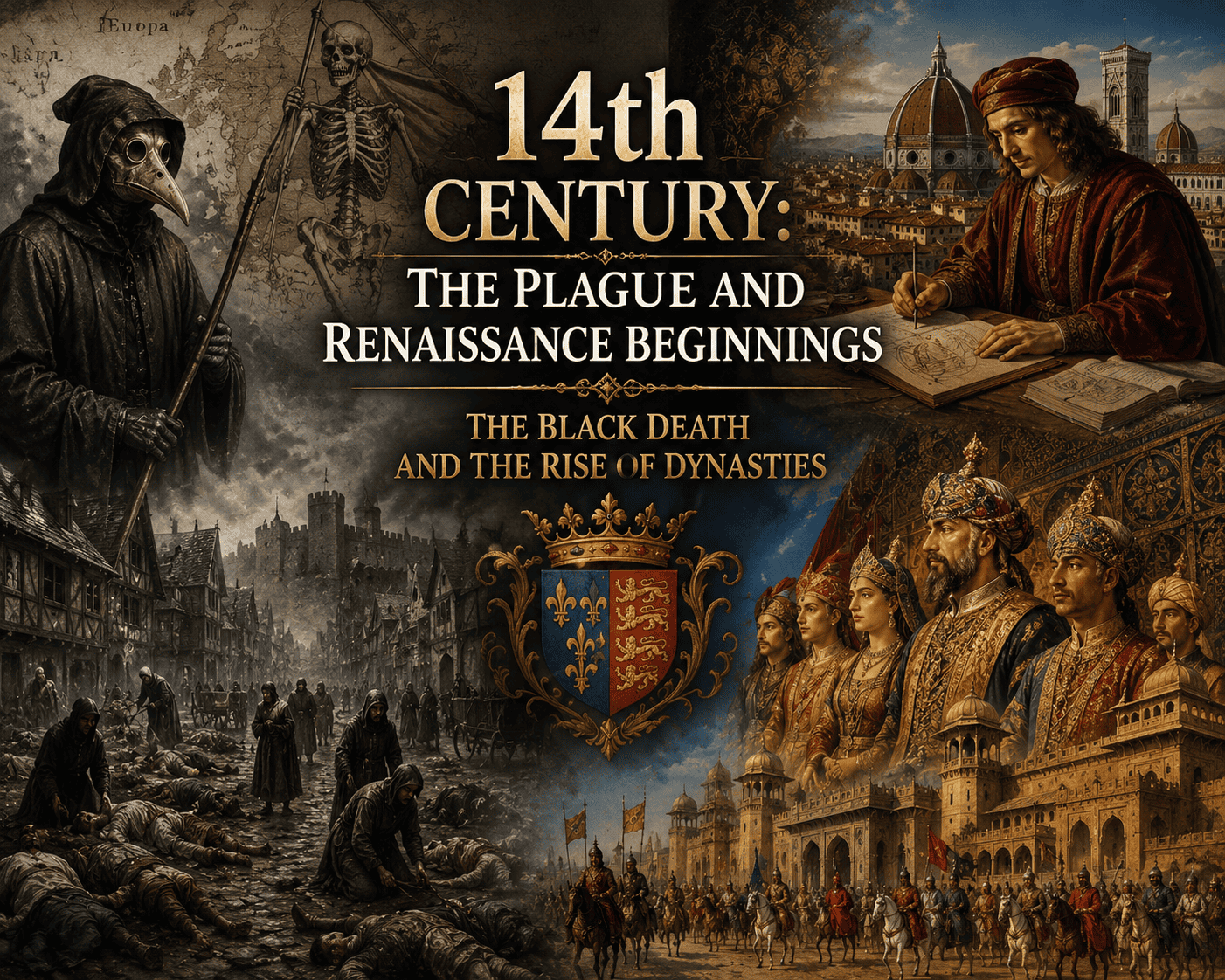
The 14th Century (1301–1400 CE): The Black Death and the Rise of Dynasties
- The Century That Shattered the Medieval World and Planted the Seeds of Rebirth
- CHAPTER 1 — Understanding the 14th Century
- CHAPTER 2 — Calendars of the 14th Century World
- CHAPTER 3 — Major Empires and Civilizations of the 14th Century
- The World Power Map in 1301 CE
- The Timurid Empire — Terror and Renaissance Combined
- The Delhi Sultanate — Islamic India Under Pressure
- The Mali Empire — Mansa Musa and West Africa's Golden Age
- China — The Fall of the Yuan and the Rise of the Ming Dynasty
- Japan — The Fall of Kamakura and the Muromachi Period
- Southeast Asia — Majapahit, Ayutthaya, and Lan Xang
- Africa — The Kanem Empire and Great Zimbabwe
- The Americas — Cahokia's Decline and the Aztec Founding
- The Ottoman Empire — The Rising Star of the 14th Century
- CHAPTER 4 — Wars and Major Conflicts of the 14th Century
- Overview — A Century of Unprecedented Violence
- The Hundred Years' War (1337–1453) — England vs. France
- The Battle of Crécy (1346) — The Longbow Changes Warfare
- The Rise of the Ottoman Empire and the Battle of Kosovo (1389)
- Russian Resistance to the Mongols — The Battle of Kulikovo (1380)
- Timur's Invasion of India (1398) — Delhi Devastated
- CHAPTER 5 — The Black Death (1347–1351): History's Greatest Pandemic
- What Was the Black Death?
- Origins — Where Did the Black Death Begin?
- How the Black Death Spread — Step by Step
- The Death Toll — Numbers That Break the Imagination
- How People Experienced the Plague — Day by Day
- Social, Economic, and Political Consequences
- How the Black Death Changed Art, Literature, and Culture
- The Long-Term Legacy — How Death Created the Renaissance
- CHAPTER 6 — Thinkers, Philosophers, and Religious Leaders
- The Intellectual Climate of the 14th Century
- Ibn Khaldun (1332–1406) — The Father of Sociology and History
- Ibn Battuta (1304–1368/1369) — The Greatest Traveler of the Medieval World
- Francesco Petrarch (1304–1374) — The Father of Humanism
- John Wycliffe (c. 1328–1384) — The Morning Star of the Reformation
- The Western Schism (1378–1417) — Three Men Claiming to Be Pope
- CHAPTER 7 — Religion and Cultural Developments
- CHAPTER 8 — Science, Technology, and Global Connections
- CHAPTER 9 — Complete Decade-by-Decade Timeline (1301–1400)
- 1301–1310: The Avignon Papacy and New Powers
- 1311–1320: The Great Famine Begins
- 1321–1330: New Empires Take Shape
- 1331–1340: War and Preparation
- 1341–1350: The Black Death Arrives
- 1351–1360: Europe in Ruins
- 1361–1370: Recovery and New Dynasties
- 1371–1380: Russia Pushes Back
- 1381–1390: Timur Rises and Peasants Revolt
- 1391–1400: The Century Closes in Fire
- CHAPTER 10 — Summary and Legacy of the 14th Century
The Century That Shattered the Medieval World and Planted the Seeds of Rebirth
CHAPTER 1 — Understanding the 14th Century
Definition and Context
The 14th century covers the years from January 1, 1301 CE to December 31, 1400 CE according to the Julian calendar — the calendar used by Christian Europe throughout this period.In the Islamic Hijri calendar, this roughly corresponds to the years 700 to 803 AH. In the Chinese calendar, it spans the final decades of the Yuan Dynasty and the first three decades of the Ming Dynasty.
The 14th century is one of the most dramatic, devastating, and transformative centuries in human history. If the 13th century was the century of the Mongols — of military conquest on a scale never seen before — the 14th century was the century of consequences: the consequences of Mongol disruption, the consequences of climate change, the consequences of a connected Eurasian world that allowed not just trade and ideas to travel rapidly, but also disease.
The 14th century is defined by six enormous forces that collided and interacted to reshape civilization. Understanding each of these forces — and how they reinforced each other — is the key to understanding this remarkable, terrible, creative century.
What Kind of World Existed in 1301 CE?
Imagine standing in the year 1301 CE and surveying the entire world. The Mongol Empire has already fragmented into its four successor khanates — the Yuan Dynasty in China, the Ilkhanate in Persia, the Golden Horde in Russia, and the Chagatai Khanate in Central Asia. These khanates are already weakening, fighting each other, and facing internal rebellions. The great Pax Mongolica — the Mongol Peace that made the Silk Road safe — is still functioning but beginning to fray.
In Europe, the High Middle Ages are transitioning into the Late Middle Ages. Gothic cathedrals continue to rise. Universities are producing educated clergy and lawyers. The feudal system still organizes society, but it is showing cracks. The Pope has just relocated from Rome to Avignon in France — a deeply disturbing development that many Christians interpret as a sign of the Church’s corruption.
In the Middle East, the Mamluk Sultanate of Egypt is the dominant Muslim power after its defeat of the Mongols at Ain Jalut in 1260. The Ilkhanate of Persia is in decline — it will collapse in 1335, just 34 years away.
In India, the Delhi Sultanate is at the height of its territorial expansion under Alauddin Khalji — the most powerful ruler the sultanate had yet produced. In China, the Yuan Dynasty — Kublai Khan’s Mongol empire — is struggling with economic problems, floods, and growing popular resentment.
In West Africa, the Mali Empire is fabulously wealthy, and its greatest ruler — Mansa Musa — will come to power in approximately 1312. In the Americas, the Mississippian culture at Cahokia is declining, while in Mexico, the Aztec people are still wandering before their founding of Tenochtitlan in 1325.
This is the world of 1301 CE. Prosperous in some places, strained in others, and completely unaware of the catastrophe that will arrive in 1347 and kill perhaps a third of the human beings living between China and England.
Why the 14th Century Is the Most Dramatic in Medieval History
The medieval world that had been built over five centuries — the feudal system, the universal Church, the great trade networks, the Mongol peace — was shattered in the 14th century. Not by a single force but by a convergence of crises that struck simultaneously and reinforced each other.
Climate cooling reduced harvests. Reduced harvests caused famine. Famine weakened populations. Weakened populations were more vulnerable to disease. Disease arrived in the form of the Black Death — the most lethal pandemic in recorded history. The Black Death killed so many people that the entire structure of medieval society was disrupted. The resulting social chaos — combined with the religious crisis caused by the Church’s inability to explain or stop the plague — planted the seeds of the Renaissance, the Reformation, and ultimately the modern world.
At the same time, new empires were rising. The Ottoman Empire was growing steadily in Anatolia and the Balkans. A new conqueror—Timur—inspired by Genghis Khan, was expanding an empire across Central Asia and the Middle East.In China, a peasant rebellion overthrew the Mongol Yuan Dynasty and established the Ming Dynasty — one of the most enduring in Chinese history.
The Six Defining Forces of the Century
Force One — The Black Death (1347–1351): The greatest pandemic in human history. Killed between 30% and 60% of Europe’s population, and millions more across Asia and North Africa. Discussed in complete detail in Chapter 5.
Force Two — The Great Famine (1315–1322): Before the Black Death, Europe was already weakened by several years of catastrophic harvest failures caused by unusually cold and wet weather — the beginning of the Little Ice Age.
Force Three — The Hundred Years’ War (1337–1453): The long conflict between England and France, which though it extended beyond the 14th century, was defined in this century by its most dramatic early battles — Crécy, Poitiers — and by the social disruption of constant warfare across France.
Force Four — The Rise of Timur (c. 1370–1405): A new Mongol-style conqueror who devastated Central Asia, Persia, India, and the Middle East — completing the destruction of the surviving institutions of the Islamic Golden Age.
Force Five — The Fall of the Yuan and Rise of the Ming in China (1368): The end of Mongol rule over China and the establishment of one of history’s most remarkable dynasties — the Ming, which would rule China for 276 years.
Force Six — The Western Schism (1378–1417): The split of the Catholic Church into two — and eventually three — competing papacies, each claiming to be the true Pope, which devastated the Church’s moral authority and paved the way for the Protestant Reformation of the 16th century.
CHAPTER 2 — Calendars of the 14th Century World
The Julian Calendar — Europe’s System
Europe in the 14th century still used the Julian Calendar — the solar calendar established by Julius Caesar in 46 BCE. By the 14th century, the Julian Calendar had accumulated an error of approximately 10 days relative to the actual astronomical position of the Sun. The spring equinox — which should occur around March 21 — was actually occurring around March 11 by the 14th century. This drift was causing increasing problems for calculating Easter and other religious dates tied to the equinox, but the problem would not be officially addressed until Pope Gregory XIII’s reform of 1582.
All major 14th-century European events — the Great Famine, the Hundred Years’ War, the Black Death, the Western Schism — are dated in Julian Calendar terms. Understanding this is important when comparing dates across different calendar systems. When European sources say the Black Death reached England in 1348, they mean 1348 Julian Calendar — approximately June 1348 by modern astronomical reckoning.
The Islamic Hijri Calendar
The Hijri calendar — the Islamic lunar calendar that began in 622 CE with Muhammad’s migration from Mecca to Medina — continued to organize Islamic life throughout the 14th century. Since the Hijri calendar is purely lunar (354 days per year), the 14th century CE corresponds to approximately the years 700 to 803 AH.
Key 14th-century events in Hijri terms: Mansa Musa’s legendary pilgrimage to Mecca occurred in 724 AH (1324 CE). The Black Death struck Egypt and the Levant in 749 AH (1348 CE). Timur began his major conquests around 771 AH (1370 CE). His devastating invasion of India occurred in 800 AH (1398 CE) — a year that Islamic scholars found numerologically significant, as it opened a new Hijri century with a catastrophe.
The 14th century was one of the most traumatic in Islamic history — the plague struck the Islamic world as severely as it struck Europe, and the ongoing disintegration of The Mongol khanates left much of the Islamic heartland politically unstable. Ibn Khaldun — the greatest Islamic historian and social theorist — wrote his masterwork the Muqaddimah partly as an attempt to understand the cyclical patterns of rise and decline that the catastrophes of his century so vividly illustrated.
The Chinese Calendar — From Yuan to Ming
The Chinese lunisolar calendar continued to be used throughout the 14th century, first under the declining Yuan Dynasty and then under the new Ming Dynasty after 1368. One of the most politically significant calendar actions of the century was taken by Zhu Yuanzhang — the founder of the Ming Dynasty — when he established a new reign era name: Hongwu (Vast Martial Power). In traditional Chinese governance, the first act of a new dynasty was to establish a new calendar and new reign era names — declaring that time itself had begun anew under divine mandate.
This symbolic resetting of time was not just ceremonial. It declared that the Mandate of Heaven — the divine approval that legitimized Chinese imperial rule — had passed from the Mongol Yuan Dynasty to the new Ming. By changing the calendar’s reign era, Zhu Yuanzhang was making a theological and political claim: the previous time was over, a new age had begun.
The Persian Calendar Under the Ilkhanate and Timurids
Persia experienced two major political transitions in the 14th century. The Ilkhanate — the Mongol khanate that had ruled Persia since the sack of Baghdad in 1258 — collapsed in 1335, fragmenting into several competing successor states. Then, from around 1370, Timur began conquering the region, eventually establishing Timurid control.
Throughout these transitions, the Persian solar calendar remained the primary calendar for Persian administrative and cultural life. Timur himself used the Persian calendar for his empire’s administration — a significant act of cultural adoption for a man who otherwise identified strongly with the Mongol tradition.
The Hindu and Buddhist Calendars
In India, the 14th century brought extraordinary trauma under Timur’s invasion of 1398 and the continuing pressure of the Delhi Sultanate. The Hindu lunisolar calendar — used for religious festivals, agriculture, and personal life — continued to organize the life of the Hindu majority regardless of who ruled politically. The coexistence of the Hindu calendar (used by the population) and the Hijri calendar (used by the administration) was a practical expression of the cultural duality of medieval India.
In Southeast Asia, the Buddhist calendar organized the religious life of the great new kingdoms that were rising — the Ayutthaya Kingdom in Thailand, the Lan Xang Kingdom in Laos, and the Khmer successors to Angkor. The Majapahit Empire of Java used a different Hindu-Buddhist calendar system rooted in Indian traditions but distinctively Javanese in its application.
CHAPTER 3 — Major Empires and Civilizations of the 14th Century
The World Power Map in 1301 CE
The world in 1301 CE was dominated by the successor states of the Mongol Empire, the Islamic sultanates of the Middle East and South Asia, the emerging Christian kingdoms of Europe, and the great civilizations of Africa and Southeast Asia. The Americas remained entirely unknown to the rest of the world.
The power structure of 1301 looked like this: In East Asia, the Yuan Dynasty of Kublai Khan’s successors still ruled all of China, though Kublai had died in 1294 and his successors were less capable. In South Asia, the Delhi Sultanate under Alauddin Khalji was at the peak of its power. In the Middle East, the Mamluk Sultanate dominated, while the Ilkhanate in Persia was already beginning to fracture. In Europe, France and England were the dominant powers, with the Holy Roman Empire a weaker presence. In West Africa, the Mali Empire under its kings was the wealthiest state in the world relative to the resources available to it.
By 1400, every single one of these power structures had either collapsed or been dramatically transformed. The 14th century was a century of almost complete political turnover.
The Timurid Empire — Terror and Renaissance Combined
Who Was Timur?
Timur — known in the West as Tamerlane, a corruption of “Timur-i-leng” meaning “Timur the Lame” — was born in 1336 near the city of Kesh (modern Shahrisabz in Uzbekistan) in the Chagatai Khanate. He was of Turco-Mongol heritage, claiming descent from Genghis Khan through his mother’s line, and throughout his life he used the Mongol legacy as a source of legitimacy and inspiration.
He was lame — a wound in his right leg and right arm from an early battle left him with a permanent limp and reduced arm function. This physical limitation made his military achievements even more remarkable. He was also a man of genuine intellectual interests: he played chess brilliantly, studied Islamic theology, spoke multiple languages, and reportedly had discussions with the greatest scholars of his time, including Ibn Khaldun.
Timur rose from a local chieftain in the Chagatai Khanate to master of Central Asia through a combination of military genius, political cunning, and absolute ruthlessness. By 1370, he had established himself as the ruler of Transoxiana — the region between the Oxus and Jaxartes Rivers, centered on the great cities of Samarkand and Bukhara.
Timur’s Military Campaigns — Step by Step
Step 1 — Central Asia (1370–1380): Timur consolidated control over Transoxiana and the surrounding regions, eliminating rivals and incorporating their forces into his army.
Step 2 — Persia and the Middle East (1381–1387): Timur conquered Persia systematically, capturing the major cities — Herat, Isfahan, Shiraz — and installing governors loyal to him. The conquest was not without extraordinary violence: at Isfahan, after the population revolted and killed some of his soldiers, Timur ordered a massacre and the construction of a tower of 70,000 human skulls.
Step 3 — The Golden Horde (1391–1395): Timur defeated Tokhtamysh — the Khan of the Golden Horde — in two major campaigns, destroying Sarai (the Golden Horde capital) and devastating the Crimea and the Volga region. This effectively ended the Golden Horde as a major power and removed a dangerous rival from Timur’s north.
Step 4 — India (1398): In one of history’s most devastating military campaigns, Timur invaded the Delhi Sultanate. His army crossed the Hindu Kush mountains, defeated the Sultanate’s forces, and sacked Delhi. The destruction was catastrophic — the city was so thoroughly looted and burned that it took decades to recover. Timur reportedly built towers of skulls outside Delhi as well. He captured enormous quantities of gold, precious stones, and artisans whom he took back to Samarkand to beautify his capital.
Step 5 — The Ottoman Empire and Egypt (1400–1402): Timur invaded Syria (capturing Aleppo and Damascus), then turned against the Ottoman Empire — at that time one of the rising powers of the Islamic world. At the Battle of Ankara (1402), he destroyed the Ottoman army and captured the Ottoman Sultan Bayezid I — the only Ottoman sultan ever captured in battle. This single victory delayed the Ottoman conquest of Constantinople by 50 years. Timur then raided Egypt’s borders but did not invade.
The Timurid Renaissance — Beauty from Ashes
Here is the great paradox of Timur. The man who built towers of skulls and massacred hundreds of thousands of people was also the man who created one of history’s greatest cultural flowerings. After his conquests, Timur brought the most skilled artists, architects, scholars, poets, and craftspeople from across his empire to Samarkand — his capital. He invested enormous resources in making Samarkand the most beautiful and sophisticated city in the Islamic world.
The result was the Timurid Renaissance — a flourishing of art, architecture, literature, philosophy, and science in Central Asia that continued under his successors (especially his grandson Ulugh Beg, who built an astronomical observatory of world-class quality in Samarkand). The architectural monuments of Timur’s Samarkand — the Bibi-Khanym Mosque, the Gur-e-Amir mausoleum (Timur’s own tomb), the Registan square — are still recognized as masterpieces of Islamic architecture and are UNESCO World Heritage Sites.
The Timurid Renaissance also produced Babur — Timur’s direct descendant — who would carry this cultural tradition to India and found the Mughal Empire in 1526. The Mughal Empire’s extraordinary artistic and architectural achievements — including the Taj Mahal — were direct heirs of the Timurid tradition.
The Delhi Sultanate — Islamic India Under Pressure
The Delhi Sultanate in 1301 was at the height of its power under Alauddin Khalji (reigned 1296–1316) — arguably the most capable ruler the Sultanate ever produced. Alauddin implemented extraordinary economic reforms: he controlled prices in the Delhi marketplace, issued fixed rations to his army paid in cash rather than land grants, and created a system of state granaries to ensure food supply. These reforms allowed him to maintain a large professional army that repelled multiple Mongol invasions — Alauddin defeated Mongol invasions in 1303, 1305, and 1306, a remarkable military achievement.
After Alauddin’s death in 1316, the Sultanate entered a period of political instability — a series of weak sultans, palace coups, and declining central authority. The Tughlaq dynasty (which came to power in 1320) made several dramatic administrative decisions, including the disastrous experiment of moving the capital from Delhi to Daulatabad in the Deccan (1327) — an attempt by Sultan Muhammad bin Tughlaq to better govern the empire’s southern territories. The forced migration of Delhi’s entire population to Daulatabad and back — a journey of approximately 1,100 kilometers — was a catastrophic administrative experiment that caused enormous suffering and significantly weakened the Sultanate.
Timur’s invasion of 1398 struck a Sultanate already weakened by internal conflicts. His sack of Delhi was so devastating — killing tens of thousands, looting the treasury, carrying away thousands of skilled craftspeople — that the Sultanate never fully recovered. It survived for over a century more, but as a much diminished power, never reclaiming its 14th-century peak.
The Mali Empire — Mansa Musa and West Africa’s Golden Age
The Man Who Made Gold Cheap
Mansa Musa I — who reigned over the Mali Empire from approximately 1312 to approximately 1337 — is often cited as the wealthiest individual in human history when wealth is calculated as a share of contemporary global GDP. Whether or not this specific calculation is accurate, what is indisputable is that Mansa Musa ruled an empire of extraordinary wealth derived from the trans-Saharan trade in gold and salt, and that his famous pilgrimage to Mecca in 1324–1325 demonstrated this wealth to the entire world in spectacular fashion.
The Hajj Pilgrimage (1324–1325) — The Journey That Shook the World
In 1324, Mansa Musa set out from his capital at Niani on the Hajj — the Islamic pilgrimage to Mecca that every Muslim who is physically and financially able is obligated to perform. Mansa Musa’s pilgrimage was unlike any other in history.
His entourage reportedly included 60,000 men — including 12,000 personal servants dressed in silk, 500 slaves each carrying a gold staff weighing about 2.7 kilograms, and 100 camels each loaded with approximately 135 kilograms of gold dust. Whether these precise numbers are historically accurate is debated, but the general scale of the display — extraordinary wealth on an unprecedented public scale — is corroborated by multiple independent contemporary sources.
When Mansa Musa arrived in Cairo, he spent and distributed so much gold that he disrupted the Egyptian economy. He bought goods, distributed gifts, and donated to mosques so lavishly that the value of gold in Egypt dropped significantly — causing inflation that Cairo merchants complained about for years afterward. Contemporary Egyptian sources say the gold market took 12 years to recover from Mansa Musa’s visit.
His pilgrimage put the Mali Empire on the map — literally. After his return, Mali appeared on European portolan charts (navigational maps) for the first time. The Catalan Atlas of 1375 shows a figure labeled “Musa Mali” sitting on a throne holding a large gold nugget, with the caption “this king is the richest and most noble lord in all this region on account of the great quantity of gold that is found in his land.” This European awareness of West African gold wealth was one of the motivations for the later Portuguese exploration of the African coast.
What Mansa Musa Built
Beyond his wealth display, Mansa Musa was a genuine patron of Islamic culture and scholarship.He returned with scholars, poets, and architects from Cairo and Mecca. The most famous was the Andalusian architect Abu Ishaq al-Sahili, who designed mosques and palaces in the Malian cities of Timbuktu and Djenne. Timbuktu — under Mansa Musa and his successors — became one of the great centers of Islamic learning, with libraries containing hundreds of thousands of manuscripts and scholars who attracted students from across the Islamic world. The University of Sankore in Timbuktu was operating at a time when Harvard was still 300 years in the future.
China — The Fall of the Yuan and the Rise of the Ming Dynasty
Why the Yuan Dynasty Collapsed
The Yuan Dynasty — the Mongol dynasty that Kublai Khan had established over China — collapsed in 1368 for multiple converging reasons. First, the dynasty suffered from a series of weak successors after Kublai Khan’s death in 1294: in the 40 years from 1307 to 1333, China had nine different emperors — an average of one every four and a half years — a symptom of profound political instability. Second, the dynasty’s economic policies were disastrous: excessive printing of paper money caused severe inflation, a reminder of the lesson from the 13th century that paper currency only works when the government limits supply. Third, the Yellow River flooded catastrophically in 1344, requiring enormous labor for repairs and devastated agricultural production across the North China Plain. Fourth, the Black Death struck China in the 1330s–1340s, decades before it reached Europe, killing millions and further destabilizing the already troubled dynasty.
The combination of these factors produced a series of peasant rebellions beginning in the 1340s. Multiple rebel groups competed for control of China. The one that eventually won was led by Zhu Yuanzhang — one of history’s most remarkable figures.
Zhu Yuanzhang — From Beggar to Emperor
Zhu Yuanzhang was born in 1328 to an extremely poor peasant family in Anhui Province. By the time he was a teenager, famine and disease had killed most of his immediate family. He had spent time as a Buddhist monk and as a wandering beggar before joining a rebel army in 1352.
His story is one of the most extraordinary rags-to-riches narratives in world history. Starting as a common foot soldier, Zhu rose through the rebel ranks through a combination of military ability, political intelligence, and the cultivation of capable lieutenants. By the 1360s, he had eliminated most rival rebel leaders. In 1368, his forces captured Beijing — the Yuan capital — and the last Yuan Emperor fled north to Mongolia. Zhu Yuanzhang proclaimed the Ming Dynasty (Ming means “Brilliant” or “Luminous”) and took the reign title Hongwu — “Vast Martial Power.”
The Ming Dynasty — A Fresh Beginning
The Ming Dynasty (1368–1644) was in many ways a reaction against everything the Yuan Dynasty had been. The Yuan had been cosmopolitan — welcoming foreigners, promoting trade, tolerating religious diversity, and maintaining connections with the wider Eurasian world. The early Ming was deliberately inward-looking — suspicious of foreigners, restricting maritime trade, emphasizing Confucian orthodoxy, and rebuilding Chinese cultural identity after nearly a century of Mongol rule.
However, the early Ming also achieved extraordinary things. The Great Wall of China — in its current, most famous form — was largely built during the Ming Dynasty. The Forbidden City in Beijing — which was rebuilt as the imperial capital under the third Ming Emperor, Yongle (reigned 1402–1424) — is the most magnificent palace complex in the world and a UNESCO World Heritage Site. The monumental voyages of Zheng He — a Chinese Muslim admiral who led seven enormous naval expeditions across Southeast Asia, India, the Persian Gulf, and East Africa between 1405 and 1433 — were Ming achievements of extraordinary ambition.
Japan — The Fall of Kamakura and the Muromachi Period
The Kamakura Shogunate — Japan’s first military government, established in 1192 — was brought down not by foreign invasion but by internal political conflict. The Mongol invasions of 1274 and 1281 had severely strained the Shogunate’s resources and legitimacy: the samurai who had fought valiantly against the Mongols received no land grants as reward (because the invasions had been repelled rather than conquered territory being available for distribution), creating deep resentment.
The Genkō War (1331–1333) began when Emperor Go-Daigo attempted to restore direct imperial rule, enlisting the support of several powerful samurai lords including Ashikaga Takauji and Nitta Yoshisada. The Kamakura Shogunate came to an end in 1333.However, Emperor Go-Daigo’s attempt at direct imperial rule — called the Kemmu Restoration — lasted only three years before Ashikaga Takauji turned against him, drove him out of Kyoto, and established the Ashikaga Shogunate (also called the Muromachi Period, 1336–1573).
Japan then experienced several decades of civil war during the Nanboku-chō period (“Southern and Northern Courts”) — a period when two rival imperial courts (one in Kyoto supported by the Ashikaga, one in Yoshino in the mountains supported by Go-Daigo and his successors) competed for legitimacy. This conflict was not resolved until 1392, when the southern court submitted to the Ashikaga Shogunate.
The Muromachi Period, despite its political instability, was a time of significant cultural development. Zen Buddhism became deeply embedded in Japanese samurai culture, influencing everything from garden design and tea ceremony to architecture and ink painting. The Noh theater tradition developed during this period. And the seeds of the merchant culture that would eventually challenge samurai dominance were being planted in the growing commercial cities.
Southeast Asia — Majapahit, Ayutthaya, and Lan Xang
The Majapahit Empire — The Greatest of the Maritime Empires
The Majapahit Empire (1293–1527), based on the island of Java in modern Indonesia, reached its greatest extent in the 14th century under the rule of Hayam Wuruk (reigned 1350–1389) and his prime minister Gajah Mada. At its peak, Majapahit claimed suzerainty over most of what is now Indonesia, Malaysia, and parts of the Philippines and Southeast Asian mainland — though the extent of real control is debated by historians.
Gajah Mada — the prime minister who was effectively the empire’s most powerful figure — took a famous oath called the Palapa Oath in approximately 1336, swearing that he would not eat spicy foods (palapa) until he had united the entire archipelago under Majapahit rule. This oath became famous in later Indonesian history and national mythology.
The Majapahit court produced some of the finest literature and art in Javanese history. The epic poem Nagarakretagama (1365) provides a detailed description of the Majapahit court and its claims to empire. The temple complexes of East Java — including Panataran — show a distinctive Javanese Hindu-Buddhist artistic tradition of great sophistication.
The Ayutthaya Kingdom — A New Thai Power
The Ayutthaya Kingdom was founded in 1351 by King Uthong (also called Ramathibodi I) at a strategically located island at the confluence of three rivers in the Chao Phraya valley in modern central Thailand. It became one of the most powerful and wealthy kingdoms in Southeast Asian history, ruling most of what is now Thailand for over 400 years until its destruction by Burmese forces in 1767.
Ayutthaya benefited from its location on major trade routes connecting China to India and the Middle East. Its port attracted merchants from China, Japan, India, Persia, and later Europe. The city grew into one of the largest in the world — by the 17th century, its population rivaled that of London and Amsterdam. Its art and architecture blended Khmer, Mon, and original Thai aesthetic traditions in ways that became the foundation of Thai cultural identity.
The Lan Xang Kingdom — The Land of a Million Elephants
The Lan Xang Kingdom (literally “Land of a Million Elephants”) was founded in 1353 by Fa Ngum — a prince of the royal family of Muang Sua (in modern Laos) who had been raised at the Khmer court in Angkor — when he united the various Lao principalities under his rule with Khmer military assistance. Lan Xang eventually became one of the largest kingdoms in mainland Southeast Asia, covering most of modern Laos and parts of Thailand and Vietnam.
Fa Ngum introduced Theravada Buddhism as the state religion and established connections with the Khmer cultural tradition. The kingdom’s capital, Luang Prabang, became a center of Lao Buddhist culture that — remarkably — preserves much of its medieval character to this day, having been designated a UNESCO World Heritage Site.
Africa — The Kanem Empire and Great Zimbabwe
The Kanem Empire
The Kanem Empire — centered around Lake Chad in the region covering parts of modern Nigeria, Niger, Chad, and Libya — was one of the oldest continuously existing states in sub-Saharan Africa, with origins going back to the 9th century CE. In the 14th century, the empire was ruled by the Sayfawa dynasty, which had converted to Islam centuries earlier and maintained close connections with the Arab world through trans-Saharan trade.
The Kanem Empire controlled crucial trans-Saharan trade routes, profiting from the exchange of slaves, ivory, and other sub-Saharan goods for North African horses, cloth, and manufactured goods. Its rulers patronized Islamic scholarship and built mosques and Quranic schools. Despite ongoing challenges from neighboring peoples and internal succession disputes, the Kanem Empire remained an important regional power through the 14th century.
Great Zimbabwe — A Mystery in Stone
Great Zimbabwe is one of the most remarkable archaeological sites in Africa — a complex of massive stone enclosures and towers built without mortar in the highlands of modern Zimbabwe. Construction began around the 11th century CE and continued through the 14th and 15th centuries, during which time it served as the capital of the Kingdom of Zimbabwe.
The Kingdom of Zimbabwe was a Bantu-speaking civilization that derived its wealth from gold mining and cattle raising in the highlands, and from trade — gold from Zimbabwe’s mines traveled through the Swahili Coast city-states to Arab merchants in the Indian Ocean trade network, eventually reaching markets as far as China. The rulers of Great Zimbabwe controlled this gold trade and used their wealth to build the extraordinary stone structures that give the civilization its name.
The Great Enclosure — the largest ancient structure south of the Sahara — has walls up to 11 meters high and 5 meters thick, constructed from precisely shaped granite blocks fitted together without mortar with remarkable precision. The purpose of these structures — palace, royal court, religious center, or a combination — is still debated by archaeologists.
The Americas — Cahokia’s Decline and the Aztec Founding
The Decline of Cahokia
The great Mississippian city of Cahokia — which had been one of North America’s largest pre-Columbian urban centers, with a population perhaps reaching 15,000 to 20,000 at its peak around 1100 CE — was in severe decline by the 14th century and was effectively abandoned by approximately 1350. The causes of Cahokia’s decline remain actively debated among archaeologists.
Environmental evidence suggests that intensive agriculture and deforestation in the surrounding region had caused soil erosion, flooding, and declining agricultural productivity. Climate data suggests that the beginning of the Little Ice Age in the 13th–14th centuries produced cooler, shorter growing seasons that stressed the agricultural system Cahokia depended on. Paleodemographic analysis suggests possible disease, and archaeological evidence suggests possible political violence and social collapse. The abandonment of Cahokia — one of the most sophisticated pre-Columbian cities north of Mexico — is one of American archaeology’s most significant unsolved mysteries.
The Founding of Tenochtitlan (1325)
In 1325 — while Europe was beginning to recover from the Great Famine and before the Black Death had arrived — The Mexica established the city of Tenochtitlan on an island in Lake Texcoco, located in the Valley of Mexico. According to Aztec tradition, their god Huitzilopochtli had commanded them to build their city where they saw an eagle perching on a cactus and eating a snake — and this vision appeared on an island in the lake.
The founding of Tenochtitlan is one of history’s most consequential moments — though no one outside the Valley of Mexico knew it was happening. From this small island city, the Mexica (Aztec) people would build one of the most powerful and largest empires in the Americas in just over a century, culminating in a civilization of perhaps 5 to 6 million people before the Spanish arrival in 1519.
Tenochtitlan itself — built on an island and connected to the lakeshore by massive causeways, with aqueducts bringing fresh water, chinampas (floating gardens) providing food, and an enormous ceremonial center dominated by the Templo Mayor — was, by the time the Spanish arrived, one of the largest cities in the world, with a population larger than any contemporary European city.
The Ottoman Empire — The Rising Star of the 14th Century
The Ottoman Beylik — the tiny Turkish border state founded by Osman I in approximately 1299 — grew with remarkable speed in the 14th century. Under Osman’s son Orhan (reigned approximately 1324–1360), the Ottomans captured Bursa in 1326, making it their first major city and capital. They crossed into Europe — the Balkans — for the first time in 1345, entering as allies of a Byzantine claimant to the throne and then establishing their own foothold.
Under Murad I (reigned 1362–1389), the Ottomans became a major Balkan power. They captured Adrianople (modern Edirne in Turkey) in 1369 and made it their new capital — placing the Ottoman center of gravity in Europe rather than Asia. They defeated Bulgaria in 1371. They established the devshirme system — a regular levy of Christian boys from Balkan villages, who were raised as Muslims and trained as elite soldiers (the Janissaries) and administrators — creating the most professional and loyal military force in the region.
The Battle of Kosovo (June 28, 1389) was the defining moment of 14th-century Ottoman expansion into the Balkans. A coalition of Serbian, Bosnian, Albanian, and Bulgarian forces under the Serbian Prince Lazar met the Ottoman army under Sultan Murad I on the Kosovo plain. Both Sultan Murad and Prince Lazar were killed in the battle. The Ottoman victory was decisive — Serbia became an Ottoman vassal, and Kosovo remained in Ottoman-influenced territory for over 500 years. The battle became one of the defining events of Serbian national identity and is still commemorated annually in modern Serbia.
CHAPTER 4 — Wars and Major Conflicts of the 14th Century
Overview — A Century of Unprecedented Violence
The 14th century was one of the most violent in human history — not because any single war was larger than previous conflicts, but because multiple devastating conflicts occurred simultaneously across the globe, layered on top of the Black Death’s catastrophic mortality. The combination of plague, famine, and warfare produced levels of death and social disruption that previous generations would have associated with the end of the world — and indeed, many 14th-century people believed exactly that.
The Hundred Years’ War (1337–1453) — England vs. France
Background — Why Did the War Start?
The Hundred Years’ War was actually a series of conflicts — punctuated by truces, treaties, and periods of relative peace — that lasted approximately 116 years, from 1337 to 1453. Calling it a single “war” is a convenient simplification; it was more like a recurring armed dispute over a fundamental constitutional question: who was the rightful king of France?
The dispute had deep roots. English kings were also major landowners in France — as a result of the Norman Conquest of 1066, English royalty held the Duchy of Normandy, the Duchy of Gascony, and other French territories. English kings had for centuries navigated the complicated reality of being both sovereign monarchs in England and vassals of the French king for their French territories.
The immediate trigger came in 1328 when the French King Charles IV died without a direct male heir — ending the Capetian dynasty that had ruled France for 341 years. The two strongest claimants were Philip of Valois (Philip VI, nephew of Charles) and Edward III of England (grandson of Charles through his mother). Philip was crowned King of France. Edward initially accepted this but later reversed himself — claiming the French throne himself and formally declaring war in 1337.
Step by Step — The Early War
Step 1 — Naval Victory at Sluys (1340): The English navy destroyed the French fleet at the Battle of Sluys off the coast of modern Belgium. This gave England control of the English Channel and made it possible to transport armies to France reliably.
Step 2 — The English Invasion of Normandy (1346): King Edward III landed in Normandy with a large English army and began marching toward Paris, plundering as they went. The French king assembled a large force to stop them.
Step 3 — The Battle of Crécy (August 26, 1346): The Battle of Crécy was one of the most decisive battles of the century. A large French army — including professional knights from across Europe, Genoese crossbowmen, and infantry — caught the English army at the village of Crécy in northern France.
The English deployed in a strong defensive position on a hill. Their weapon was the English longbow — a weapon of remarkable range and power, capable of shooting an arrow that could penetrate armor at 200 meters in the hands of a trained archer. English longbowmen could shoot approximately 10 to 12 arrows per minute — dramatically faster than the Genoese crossbowmen hired by the French. When the battle began, the English archers unleashed storms of arrows that cut down the French cavalry before they could close to hand-to-hand combat range.
The French cavalry charged repeatedly — reportedly 15 or 16 separate charges — and each time was devastated by English archery. King Philip VI himself was wounded. The French losses were catastrophic: estimates suggest between 4,000 and 8,000 French knights and soldiers killed; English casualties were minimal. The Battle of Crécy demonstrated conclusively that massed archery by trained infantry could defeat armored cavalry — permanently changing the military calculus of European warfare.
Step 4 — The Siege and Fall of Calais (1346–1347): Following Crécy, Edward besieged the port of Calais, which surrendered after 11 months. Calais became an English base in France that England held for over 200 years. The famous story of the Burghers of Calais — six leading citizens who came to Edward with ropes around their necks to beg for the city’s mercy, and were saved at the last moment by Edward’s wife Queen Philippa — became one of the most celebrated acts of mercy in medieval tradition (and was commemorated in Rodin’s famous sculpture in the 19th century).
Step 5 — The Black Death Interrupts (1348–1356): The Black Death’s arrival in France and England in 1348 forced a truce — both sides had more immediate problems than fighting each other. The war resumed after the worst of the plague had passed, continuing through the rest of the century with varying fortunes.
The Battle of Crécy (1346) — The Longbow Changes Warfare
The English longbow deserves specific examination because the Battle of Crécy — and the other major Hundred Years’ War battles of the century, particularly Poitiers (1356) — demonstrated something revolutionary: that well-trained, relatively inexpensive infantry with the right weapons could defeat the most expensive military force of the medieval world — armored knights on horseback.
The longbow was a weapon 1.8 to 2 meters long, typically made from yew wood, that required exceptional strength and years of training to use effectively. English longbowmen were typically trained from childhood, and regular archery practice was legally required in medieval England. A skilled English longbowman could shoot 10 to 12 arrows per minute — a rate of fire impossible with the crossbow, which took considerably longer to cock and load.
A volley of longbow arrows from a massed force of trained archers created what modern military analysts would recognize as a “suppressive fire” effect — so many arrows falling on an enemy force that moving through the zone was extremely dangerous and the ability to aim or maneuver was severely restricted. When thousands of armored knights charged toward a hill defended by thousands of English archers all shooting simultaneously, the arrow storm was catastrophic.
The lesson of Crécy was learned and relearned across the following century: technology and training could overcome the traditional advantages of aristocratic cavalry. The professional, missile-weapon-equipped infantryman was the future of European warfare. The days of the knight in shining armor as the decisive factor in battle were numbered.
The Rise of the Ottoman Empire and the Battle of Kosovo (1389)
We have discussed the Ottoman Empire’s rise in Chapter 3. The Battle of Kosovo (June 28, 1389) was its defining moment in the 14th century.
The battle was fought on the Kosovo Polje (Kosovo Field) between a Balkan Christian coalition and the Ottoman army. The coalition included forces from Serbia, Bosnia, Albania, and Bulgaria — united in an effort to stop Ottoman expansion into European territory. The Serbian Prince Lazar led the coalition. The Ottoman Sultan Murad I commanded his own forces.
The battle was brutal and closely fought. Both supreme commanders died: Sultan Murad was killed — according to tradition, by the Serbian knight Miloš Obilić, who penetrated the Ottoman camp after the battle and assassinated the Sultan. Prince Lazar was captured during or after the battle and executed. Despite the death of their Sultan, the Ottoman forces won decisively. The Balkan coalition was broken. Serbia became an Ottoman vassal — paying tribute and providing military service to the Ottomans, though maintaining a degree of internal autonomy.
The Battle of Kosovo entered Serbian national mythology as a defining moment of tragic heroism — an entire epic poetry cycle (the Kosovo Cycle) developed around the battle and its heroes. It became the most emotionally and politically charged event in Serbian historical consciousness —a significance that played a direct role in the assassination of Archduke Franz Ferdinand in Sarajevo in 1914 by a Serbian nationalist, an event that triggered World War I.
Russian Resistance to the Mongols — The Battle of Kulikovo (1380)
The Mongol Golden Horde had dominated the Rus’ principalities since its conquest in 1237–1240. For approximately 140 years, Russian princes had paid tribute to the Golden Horde, sought confirmation of their authority from the Mongol Khan, and lived under Mongol suzerainty. The psychological and cultural impact of this “Tatar Yoke” on Russian national consciousness was enormous.
By the 1370s, the Golden Horde was severely weakened — partially by Timur’s attacks from the south, partially by internal succession struggles, partially by the Black Death which had struck the steppe peoples. The Moscow prince Dmitri Donskoi — “Dmitri of the Don” — began challenging Mongol authority.
The Golden Horde ruler Mamai assembled a large force to reassert Mongol dominance. On September 8, 1380, the two armies met at Kulikovo Field (Field of Snipes) near the confluence of the Don and Nepryadva rivers. The Russian forces, led by Dmitri Donskoi, won a decisive victory. Mamai’s army was routed.
The Battle of Kulikovo did not immediately end Mongol dominance — two years later, a different Mongol leader (Tokhtamysh) attacked Moscow and burned it, reimposing tribute. But the victory at Kulikovo was enormously significant symbolically. It demonstrated that a Russian army could defeat the Mongols in open battle. It established Moscow and its prince as the leader of Russian resistance to Mongol domination. And it began the gradual process of Russian assertion of independence that would culminate a century later in the “Great Stand on the Ugra River” (1480) — the definitive end of Mongol suzerainty over Russia.
Dmitri Donskoi was canonized as an Orthodox Christian saint in 1988 — 608 years after his victory at Kulikovo — in recognition of his role in Russian national and religious history.
Timur’s Invasion of India (1398) — Delhi Devastated
Timur’s invasion of India in 1398 was one of the most destructive military campaigns of the 14th century. The Delhi Sultanate, already weakened by internal conflicts, was in no position to resist.
Timur crossed the Hindu Kush mountains in the summer of 1398, ravaging the Punjab as he advanced. At the outskirts of Delhi, the Sultanate’s army — which included war elephants — attempted to make a stand. Timur’s forces, experienced in dealing with elephants from their campaigns in Persia, drove the elephants into panic by unleashing camels loaded with burning hay — the frightened elephants stampeded back into the Delhi army.
The battle lasted a few hours. The Sultanate’s army was routed. Timur entered Delhi. What followed was a systematic sack that lasted several days — the city was looted of virtually everything of value, tens of thousands of Hindu and Muslim citizens were massacred (prisoners who had been taken during the advance — reportedly 100,000 of them — were killed before the battle to prevent them causing trouble during the fighting), and thousands of skilled artisans were taken captive and transported to Samarkand to beautify Timur’s capital.
When Timur left, Delhi was effectively a ghost town. Contemporary sources describe corpses lying unburied in the streets, the entire population either dead, fled, or enslaved, and a famine immediately following because there was no one left to farm. The Sultanate survived, but it never recovered its former power. The invasion of Timur was the beginning of the end for the Delhi Sultanate — though it would limp on until Babur’s victory at Panipat in 1526.
CHAPTER 5 — The Black Death (1347–1351): History’s Greatest Pandemic
What Was the Black Death?
The Black Death was an epidemic — more accurately, a pandemic — of bubonic plague caused by the bacterium Yersinia pestis. It swept through Asia, the Middle East, and Europe between approximately 1338 and 1353, killing an estimated 75 to 200 million people across Eurasia. In Europe alone, it killed between 30% and 60% of the entire population in approximately four years — the highest mortality rate from any single event in European history.
The name “Black Death” is actually not contemporary — 14th-century sources called it “the Great Pestilence” or “the Great Mortality.” The name “Black Death” became common in European languages from the 16th century onward, probably referring to the darkening of the skin in the final stages of the disease, or more loosely to the death and darkness it brought.
Bubonic plague presents primarily as enormous, painful swellings — called buboes — in the lymph nodes of the armpits, groin, and neck. These buboes could grow to the size of an egg or an apple, were excruciatingly painful, and typically turned black as the disease progressed — hence one possible origin of the name. The disease also causes high fever, delirium, vomiting of blood, and extreme exhaustion. Without treatment, bubonic plague kills approximately 30% to 60% of those infected. In the medieval world, with no antibiotics and no understanding of bacterial disease, virtually every infected person either recovered through their immune system alone or died.
There were two other forms of the plague that appeared during the Black Death. Pneumonic plague — spread directly from person to person through coughing — infected the lungs and was almost 100% fatal without treatment. Septicemic plague — where the infection entered the bloodstream directly — caused blackening of the skin across large areas (gangrene) and was also nearly 100% fatal.
Origins — Where Did the Black Death Begin?
Recent genetic studies of ancient bacterial DNA taken from 14th-century plague burial sites have helped shed light on the origins of the Black Death. The most recent research (as of the early 2020s) suggests the plague originated in or near the Tian Shan mountain region of Central Asia — near modern Kyrgyzstan — in the late 1330s.
The ancient trade and migration networks of the Mongol Empire’s successor states provided the highway for the disease’s spread. Yersinia pestis lives in rodent populations — particularly marmots on the Central Asian steppe — and is transmitted by fleas. When conditions cause an explosion in flea population (warm weather after a cold period, for example), fleas spread rapidly between rodents and then to humans who handle the animals or enter rodent territories.
Once the disease reached human populations on the trade routes, the Silk Road’s connected network of caravan routes, cities, and ports spread it rapidly westward. Infected people, infected rats in grain shipments, and infected fleas on travelers and merchants carried the disease across Central Asia to the Black Sea ports, then by ship to the Mediterranean, and from there across Europe and North Africa.
How the Black Death Spread — Step by Step
Step 1 — Central Asia (late 1330s to early 1340s): The plague first appeared among rodent and human populations near the Tian Shan mountains.Archaeological evidence from a Nestorian Christian cemetery near Issyk-Kul (in modern Kyrgyzstan) shows an unusual spike in deaths in 1338–1339, with gravestones explicitly mentioning “pestilence” — possibly the earliest documented outbreak.
Step 2 — China (early 1340s): The plague struck China — still under the weakened Yuan Dynasty — in the early 1340s, likely arriving via trade routes from Central Asia. Chinese sources describe massive population losses in the northern provinces. The plague contributed to the social disruption and peasant rebellions that would eventually overthrow the Yuan Dynasty in 1368.
Step 3 — The Crimea (1346): As discussed in our account of the 13th century, the infamous episode at Kaffa (on the Crimean coast) in 1346 — where besieging Mongol forces may have catapulted plague-infected corpses over the city walls — spread the disease to the Genoese merchants inside. This episode, whether or not it is historically accurate in its biological details, represents the moment when the plague reached a Mediterranean seaport and the ship-based trade networks of the medieval world.
Step 4 — Constantinople and the Eastern Mediterranean (late 1347): Ships from the Crimea brought the plague to Constantinople — the greatest city in the region — in the summer of 1347. From Constantinople, it spread along Mediterranean shipping routes.
Step 5 — Sicily and Italy (October 1347): The plague arrived in Sicily in October 1347 aboard ships from the Black Sea. The Sicilian authorities ordered the ships out of port — but it was already too late. From Sicily it spread to mainland Italy: Genoa, Venice, Pisa, and Florence were all hit by early 1348. Italy’s cities — densely populated, closely connected by trade, rich but crowded — were devastated. Florence lost perhaps half to two-thirds of its population. Giovanni Boccaccio, who survived the plague in Florence, described the city’s experience in the introduction to the Decameron with harrowing detail.
Step 6 — France and Spain (1348): From Italy the plague spread to southern France and the Iberian Peninsula. Marseille was struck in January 1348. Paris was hit by the summer of 1348. By the end of 1348, the plague had reached most of France.
Step 7 — England (June 1348): The plague arrived in England at the port of Weymouth in Dorset in June 1348, probably brought by a ship from Bordeaux in France. It spread through England with devastating speed — reaching London by autumn and the north of England by 1349.
Step 8 — Scandinavia, Germany, and Eastern Europe (1349–1351): The plague continued its relentless advance, reaching Scandinavia (via English wool ships) in 1349, Germany and Poland in 1349–1350, and Russia by 1351. By 1352, it had swept across virtually the entire European continent.
The Death Toll — Numbers That Break the Imagination
Let us try to make the scale of the Black Death’s mortality comprehensible through specific examples.
Florence, Italy: Before the Black Death, Florence had a population estimated at approximately 80,000 to 100,000 people — one of the largest cities in medieval Europe. Giovanni Boccaccio, writing from personal experience, estimated that 100,000 people died in Florence and its surrounding territory. Modern historians estimate the city lost approximately 50,000 to 65,000 people — between 50% and 65% of its population — in approximately five months in 1348.
England: England’s pre-plague population is estimated at approximately 4 to 5 million people. By 1377 — the date of the first English poll tax records, which provide population data — England’s taxable population had declined dramatically. Historians estimate the Black Death killed approximately 1.5 to 2 million English people — between 30% and 45% of the population — between 1348 and 1350.
The Middle East and North Africa: The Islamic world was hit as severely as Europe. The Egyptian chronicler al-Maqrizi described Alexandria losing 60,000 deaths in a single day at the peak of the epidemic. Egypt’s population — estimated at 8 million before the plague — may have declined to approximately 4 to 5 million by 1350. The city of Cairo, which had been one of the world’s great metropolises, was deeply traumatized.
The Overall Toll: Modern demographic historians estimate the Black Death reduced the world’s population from approximately 450 million before the plague to approximately 350 to 375 million afterward — a loss of 75 to 100 million people. Europe’s population did not recover to its pre-plague levels until approximately 1500 — 150 years after the Black Death.
How People Experienced the Plague — Day by Day
To understand the Black Death’s impact fully, we need to imagine experiencing it from inside — not as a historical statistic but as a lived reality.
Day 1 to 3 — Infection and Incubation: You feel nothing wrong yet. The bacterium, introduced through a flea bite or — if pneumonic plague — breathed in from another person’s cough, is multiplying in your lymph nodes. You feel vague fatigue, perhaps a mild headache. You go about your daily activities, possibly infecting others through flea transmission.
Day 3 to 5 — The First Symptoms: Fever arrives — high, sudden, devastating. Your temperature climbs to 39–41 degrees Celsius. You are exhausted, confused, and aching in every joint. Then the bubo appears — a sudden, rapidly growing swelling in your armpit, groin, or neck. It is the size of an egg within hours, growing to the size of an apple within days. It is hard, hot, and excruciatingly painful. The slightest touch is agony. You cannot move your arm or leg freely because of the swelling.
Day 5 to 7 — The Crisis: The bubo may fill with fluid and burst open — releasing infected pus in enormous quantities. The smell is overwhelming. If the bubo bursts and drains, there is a slight chance of survival through your immune system. Black patches of dead skin begin appearing elsewhere on your body — gangrene caused by small blood clots blocking circulation. You vomit blood. You become delirious — confused, frightened, seeing things. Your family is terrified to touch you — they know the disease spreads, though they do not know how.
The Social Reality: In a village or city experiencing a major plague outbreak, the social fabric broke down rapidly. Priests refused to perform last rites for fear of infection. Doctors — knowing no effective treatment — were reluctant to approach patients. Families abandoned sick members. Bodies accumulated in the streets because there were not enough healthy people to bury them. Giovanni Boccaccio described parents abandoning children and children abandoning parents. The structures of care — family, church, community — collapsed under the weight of death on an incomprehensible scale.
The Psychological Reality: Imagine living in a world where approximately half the people you know have died within six months — your neighbors, your colleagues, your family members. Where you wake up every morning not knowing if today is the day you will develop the first symptoms. Where the smell of death is always present in the air. Where the bells that toll for funerals ring so constantly they lose all meaning. This was the psychological reality of the Black Death. The trauma was generational — not just the people who survived, but their children and grandchildren, were shaped by the knowledge of what had happened.
Social, Economic, and Political Consequences
The Labor Shortage — Peasants Gain Power
When one-third to one-half of the labor force is dead, the survivors become enormously valuable. This is the most fundamental economic consequence of the Black Death and it had transformative long-term effects.
Before the Black Death, European peasants were primarily serfs — legally bound to the lord’s land, required to provide labor and payments in exchange for the right to farm. Supply of labor exceeded demand — there were always more peasants than jobs, so lords could keep wages low and conditions poor.
After the Black Death, the equation was reversed overnight. Lords desperate for workers to farm their land competed for the dramatically reduced supply of laborers by offering better wages, reduced labor obligations, lower rents, and eventually freedom from serfdom. Peasants who had been powerless for generations suddenly had bargaining power. When lords tried to use law to freeze wages at pre-plague levels — as the English Parliament did with the Statute of Laborers in 1351 — they faced resistance, non-compliance, and eventually open revolt.
The English Peasants’ Revolt of 1381 — in which thousands of English peasants marched on London under leaders including Wat Tyler and the radical priest John Ball, briefly captured the Tower of London, and forced the young King Richard II to make dramatic concessions — was a direct consequence of the social disruption caused by the Black Death. Though the revolt was suppressed, the direction of change it represented was irreversible. Serfdom gradually disappeared from England over the following century.
The Church’s Crisis of Authority
The Black Death struck the Catholic Church with devastating force — not just in terms of the deaths of clergy, but in terms of its moral and spiritual authority. The clergy — whose whole professional function was to mediate between human beings and God — died at the same rate as everyone else. The Church’s prayers and sacraments offered no protection against the plague. The Pope fled Avignon for a château in the countryside. Bishops and priests fled their parishioners. The elaborate structures of the medieval Church — confession, last rites, Christian burial — collapsed in many places because there simply were not enough clergy to administer them.
The theological crisis this created was profound. If the clergy had no special divine protection, what did that say about their special relationship with God? If prayer didn’t stop the plague, what was the purpose of the institutional Church? If God was allowing this to happen, what did that say about God? These questions — which the medieval Church did not have satisfying answers to — fed a growing mood of skepticism, anticlericalism, and willingness to challenge religious authority that would eventually produce the Protestant Reformation of the 16th century.
The Flagellant Movement
One of the most dramatic social responses to the Black Death was the flagellant movement. Groups of people — sometimes hundreds or thousands — would travel from town to town, publicly flogging themselves with leather whips in acts of extreme penitence, believing that by suffering on behalf of humanity they might persuade God to end the plague.
The flagellants were not merely eccentric. They represented a genuine popular theology — a belief that the plague was God’s punishment for human sin, and that human beings could somehow atone through self-inflicted suffering. The movement spread rapidly through Germany and neighboring countries. The authorities — both Church and secular — were ambivalent and then hostile: the flagellants were outside Church control, they spread the plague as they traveled from town to town, and their radical populist theology threatened established order. Pope Clement VI condemned the flagellant movement in 1349, and it gradually declined.
Scapegoating the Jews
One of the most horrifying social consequences of the Black Death was the massacre of Jewish communities across Europe. Jews — who lived as minorities in Christian communities throughout Western Europe — were accused of causing the plague by poisoning wells. These accusations were false and had no factual basis. But they provided a target for the terror and grief of populations desperate for an explanation and an enemy.
Jewish communities were massacred across Germany, France, the Low Countries, and Spain. The massacres were so severe that entire Jewish communities were destroyed — estimated killed in the thousands. Pope Clement VI issued papal bulls condemning the massacres and pointing out that Jews were dying of the plague at the same rate as Christians (which disproved the poisoning theory), but these interventions had limited effect. Thousands of Jewish survivors fled eastward — to Poland and Lithuania, where King Casimir III the Great welcomed them, creating the large Eastern European Jewish communities that would exist until the Holocaust of the 20th century.
How the Black Death Changed Art, Literature, and Culture
The Black Death’s impact on European art and culture was profound and lasting. The confrontation with death on such a massive scale forced a fundamental reorientation of how Europeans thought about life, the body, and their relationship with God.
The Danse Macabre (Dance of Death): The most characteristic artistic motif to emerge from the Black Death was the Danse Macabre — images of a skeletal Death figure leading people of every social rank in a dance toward the grave. Kings, popes, merchants, peasants, children — all are shown dancing with Death, all equally powerless before its call. These images appeared on church walls, in manuscripts, and in woodcut prints across Europe. They were not simply morbid decoration. They made a democratizing, equalizing statement: death comes for everyone equally, regardless of rank or wealth. The greatest king is no more protected than the humblest peasant.
The Decameron — Literature from Plague’s Heart: Giovanni Boccaccio’s Decameron (1353) — 100 stories told by 10 young Florentines who have retreated to a country villa to escape the plague — is one of the great works of Italian literature. Its framing narrative provides one of the most vivid firsthand descriptions of the Black Death in Florence. The stories themselves are a conscious embrace of life, pleasure, wit, and human ingenuity — a psychological response to death that chose celebration rather than despair. The Decameron is often cited as one of the foundational texts of the Italian Renaissance, both for its stylistic influence and for its humanistic celebration of earthly life.
A New Attention to the Physical Body: The Black Death made the human body — its vulnerability, its mortality, its physical details — a subject of intense attention in art and literature. The earlier medieval tradition of art emphasized the spiritual and symbolic over the physical. After the Black Death, there was a new interest in depicting bodies realistically — in their suffering, their beauty, their physical presence. This shift in artistic attention from the symbolic to the physical was one of the intellectual currents that fed into the Renaissance.
The Long-Term Legacy — How Death Created the Renaissance
The connection between the Black Death and the Italian Renaissance is one of history’s most profound paradoxes. The Renaissance — the extraordinary cultural and intellectual flowering that began in Italy in the late 14th and 15th centuries — emerged directly from the disruption that the Black Death caused to the existing medieval order.
Here is the mechanism: The Black Death killed enormous numbers of people, including many clergy and scholars who maintained the existing intellectual tradition. This disruption created space for new ideas and new thinkers to gain influence. The labor shortage created by the plague dramatically increased the incomes of survivors — craftspeople, merchants, and farmers who had survived now received higher wages and prices for their goods, creating a new class of prosperous non-aristocratic people with money to spend on art, education, and luxury goods. This new prosperous merchant class in Italian city-states became the patrons of the Renaissance.
At the same time, the Church’s failure to explain or stop the plague had severely damaged its intellectual and moral authority. The willingness to question established religious authorities — which would have been dangerous heresy before the plague — became more acceptable in a world where those authorities had so visibly failed. This new willingness to think independently, to trust reason and observation over tradition and authority, was the intellectual foundation of both the Renaissance and, ultimately, the Scientific Revolution.
The Black Death was the medieval world’s greatest catastrophe. It was also — indirectly, through the disruption it caused — one of the preconditions for the modern world’s birth.
CHAPTER 6 — Thinkers, Philosophers, and Religious Leaders
The Intellectual Climate of the 14th Century
The 14th century produced some of the most original thinkers in medieval history — partly because the crises of the age (the Black Death, the Western Schism, the collapse of established orders) forced genuine re-examination of assumptions that had seemed unquestionable before. The century saw the emergence of proto-Renaissance humanism in Italy, the founding of academic sociology and historiography in the Islamic world, the most comprehensive travel literature in medieval history, and the beginning of serious challenges to papal authority that would eventually produce the Protestant Reformation.
Ibn Khaldun (1332–1406) — The Father of Sociology and History
Who He Was
Ibn Khaldun — Abu Zayd Abd al-Rahman ibn Muhammad ibn Khaldun al-Hadrami — was born in 1332 in Tunis (in modern Tunisia) to an aristocratic family with Andalusian roots (they had fled the Christian Reconquista of Spain). He was educated in the traditional Islamic sciences — Quran, hadith, jurisprudence, Arabic language — and then entered political life, serving at the courts of various North African and Andalusian rulers in an extraordinarily turbulent series of appointments, political intrigues, imprisonments, and exiles.
His personal experience of political instability — having watched multiple dynasties rise and fall, having been imprisoned and exiled, having lived through the Black Death which killed his family — gave him a profound and somewhat disillusioned perspective on human political life. This perspective became the foundation of his masterwork.
He also had a remarkable encounter with Timur: in 1401, during Timur’s siege of Damascus (where Ibn Khaldun happened to be), he was lowered from the city walls in a basket and spent several weeks in conversation with Timur — one of the most extraordinary intellectual encounters of the medieval world.
The Muqaddimah — The Birth of Social Science
In 1377, Ibn Khaldun retreated to a fortress in Algeria — the Qal’at Ibn Salamah — and in approximately five months wrote the Muqaddimah (Introduction or Prolegomena), which was intended as the introductory volume to his comprehensive history of the world. But the Muqaddimah became, in the eyes of later historians and social scientists, something far more significant than an introduction: the first systematic attempt to analyze human society according to rational, empirical principles rather than religious or moral frameworks.
The Muqaddimah covers an extraordinary range: the philosophy of history, the nature of human civilization, the causes of the rise and fall of dynasties, the sociology of nomadic vs. urban society, economics, demography, psychology, Islamic theology and jurisprudence, and much more. Its central theoretical contribution is the concept of asabiyyah — often translated as “social cohesion,” “group feeling,” or “tribal solidarity.”
Ibn Khaldun observed that new dynasties and empires typically arise from groups with strong internal solidarity — often nomadic or tribal peoples who maintain close bonds of mutual loyalty and shared identity. This solidarity gives them military effectiveness and political cohesion that allows them to conquer more sedentary, urban civilizations. But over time, as the conquering group becomes wealthy and urban, it loses its asabiyyah — members become individualistic, luxury-seeking, and politically divided. Eventually, they are overthrown by a new group with stronger asabiyyah — and the cycle begins again.
This cyclical theory of history — derived from empirical observation of actual historical patterns — was one of the first attempts to explain historical change through regular, analyzable social mechanisms rather than through divine will or the moral failings of individuals. It anticipated many concepts that later social scientists would develop independently: the sociological concept of social cohesion, the political science concept of elite circulation, the economic concept of the relationship between economic development and political stability.
Ibn Khaldun also made what may be the first systematic statement of what we now call the Laffer Curve — the economic principle that tax rates that are too high reduce total tax revenue by discouraging economic activity. He wrote that at the start of a dynasty, low tax rates can still generate substantial revenue. At the end of the dynasty, taxation yields a small revenue from large assessments.” The economist Arthur Laffer, who gave his name to the curve in the 20th century, has acknowledged Ibn Khaldun as a predecessor.
The intellectual historian Arnold Toynbee called the Muqaddimah “undoubtedly the greatest work of its kind that has ever yet been created by any mind in any time or place.” The philosopher of history Ernst Breisach called Ibn Khaldun “the greatest historian and social scientist of the Middle Ages.”
Ibn Battuta (1304–1368/1369) — The Greatest Traveler of the Medieval World
Who He Was
Ibn Battuta — Abu Abdullah Muhammad ibn Battuta — was born in 1304 in Tangier, Morocco, to a family of Islamic legal scholars (qadis). He was educated in Islamic law and at the age of 21, in 1325, he set out on the Hajj pilgrimage to Mecca. He never really came home. His journey to Mecca was the beginning of approximately 29 years of travel that took him to virtually every corner of the Islamic world and far beyond.
By the time he finally returned to Morocco in 1354, he had traveled an estimated 120,000 to 140,000 kilometers — more than any other traveler before the age of steam, including Marco Polo (whose travels were estimated at approximately 40,000 kilometers). He had visited the equivalent of 44 modern countries and had personal experience of an extraordinary range of climates, cultures, political systems, languages, and societies.
Where He Went — The Remarkable Journey
Ibn Battuta’s travels took him through North Africa, Egypt, the Levant, Arabia, Persia, the Indian Ocean coastline of East Africa, Central Asia, India (where he served as a qadi — Islamic judge — at the court of the Delhi Sultanate for several years), the Maldives, Sri Lanka, Southeast Asia, China (where he reached Beijing), Spain, West Africa (where he crossed the Sahara and visited Mali during the later period of its glory), and many territories in between.
He encountered rulers from Mali to China, observed Islamic practice in its extraordinary diversity across different cultures, experienced the Black Death firsthand when it swept through the Middle East in 1348, and witnessed the political upheavals caused by the Mongol successor states.
The Rihla — His Account of the Travels
On his return to Morocco, the Sultan Abu Inan commanded Ibn Battuta to dictate his account to a scholar named Ibn Juzayy, who compiled it into the Rihla (Journey) — one of the most important works of medieval travel literature and a uniquely valuable historical source for 14th-century societies across Eurasia and Africa.
The Rihla provides detailed descriptions of the Mali Empire under Mansa Sulayman (Mansa Musa’s brother and successor), including court ceremonies, social customs, and economic conditions. It describes the Delhi Sultanate under Muhammad bin Tughlaq — a Sultan Ibn Battuta describes as simultaneously brilliant and capricious, generous and murderously unpredictable. It describes the cities of coastal East Africa, the Maldive Islands, the court of the Golden Horde, and dozens of other societies that have few or no other contemporary written sources.
Ibn Battuta was not primarily a scientific observer in the modern sense — he was interested in Islamic scholars, rulers, and legal practices, and his descriptions of non-Islamic peoples were sometimes dismissive. But his breadth of observation, the consistency of his detail, and the sheer range of his travels make the Rihla an invaluable historical document of the 14th-century world.
Francesco Petrarch (1304–1374) — The Father of Humanism
Who He Was
Francesco Petrarch was born in Arezzo, Italy, in 1304 — the same year as Ibn Battuta, born on the other side of the Mediterranean. His family had been exiled from Florence as a result of political conflict. He grew up partly in Avignon (where the papal court was located at the time) and studied law in Bologna before abandoning it for scholarship and poetry.
Petrarch is often called the “Father of Humanism” — the intellectual movement that placed human beings and human experience at the center of intellectual and artistic attention, in contrast to the medieval tradition that centered everything on God and the afterlife. He is also often described as the first modern person — the first European intellectual who expressed something like the modern sense of individual selfhood, personal ambition, and autonomous intellectual judgment.
What Petrarch Did — Making the Renaissance Possible
Step 1 — Recovering Classical Latin: Petrarch became obsessed with the Latin literature of ancient Rome — Cicero, Virgil, Horace, Livy — and worked to locate, copy, and study manuscripts of classical authors that had been neglected or lost during the medieval centuries. He found a collection of Cicero’s personal letters in a library in Verona — letters that revealed Cicero as a fully human, complex, politically engaged individual rather than just a rhetorical authority — and was deeply moved by the experience of connecting with a human being across 1,400 years of time.
Step 2 — Criticizing Scholasticism: Petrarch criticized the dominant intellectual tradition of his time — Scholasticism, the systematic theology of Thomas Aquinas and his successors — as dry, abstract, and disconnected from actual human life. He argued that philosophy should be concerned with making people better and happier, not with abstract logical puzzles about the nature of God or the categorization of being.
Step 3 — Celebrating Individual Achievement: Petrarch celebrated individual human achievement — in literature, in the arts, in statecraft — as intrinsically valuable, not merely as service to God. This was a subtle but profound shift: the medieval tradition valued human achievements primarily as instruments of divine glory. Petrarch began to celebrate them for their own sake.
Step 4 — The Sonnets: Petrarch wrote a collection of love poems in Italian — not Latin — addressed to a woman named Laura (whose exact identity is unknown). The Canzoniere (Songbook) — 366 poems exploring his feelings for Laura, his spiritual struggles, and his personal inner life — is one of the masterpieces of European poetry. Its influence on later European poetry — including Shakespeare’s sonnets — was enormous. By writing serious, psychologically sophisticated literature in Italian rather than Latin, Petrarch helped establish the legitimacy of vernacular literature — literature in the language people actually spoke — which was essential for the democratization of reading and writing that the Renaissance produced.
John Wycliffe (c. 1328–1384) — The Morning Star of the Reformation
Who He Was
John Wycliffe was an English theologian and philosopher at Oxford University who became the most radical critic of the Catholic Church in 14th-century England. He challenged the papacy, the theology of the Eucharist, the authority of the clergy, and the Church’s ownership of property in ways that anticipated — by 150 years — the arguments of Martin Luther and the Protestant Reformation.
What Wycliffe Did — Reform Before Its Time
Step 1 — Challenging Papal Authority: Wycliffe argued that the Pope’s authority was not absolute — that secular rulers had legitimate authority over the Church in their territories and that a Pope who failed to live according to the gospel’s teachings had no right to demand obedience. This position — called “Erastianism” after a later writer who expressed similar views — was politically useful to the English Crown, which was resisting papal financial demands.
Step 2 — The Bible as the Only Authority: Wycliffe argued that the Bible — not the Church’s traditions or the Pope’s pronouncements — was the only ultimate authority in matters of faith. This idea—sola scriptura (“scripture alone”)—later became a central principle of the Protestant Reformation when Martin Luther formally expressed it about 150 years afterward. For Wycliffe, if Church practice or papal decree contradicted scripture, scripture won.
Step 3 — Translating the Bible into English: Wycliffe and his followers undertook the translation of the Bible into English — making it accessible for the first time to ordinary English people who could not read Latin. The Wycliffe Bible (completed approximately 1382) was handwritten and therefore rare and expensive — but it represented the first complete English Bible and established the principle that ordinary people had a right to read and interpret scripture for themselves.
Step 4 — The Lollards: Wycliffe’s followers — called Lollards (probably from a Dutch word meaning “mumblers”) — spread his ideas through preaching across England. The Lollard movement emphasized individual Bible reading, rejected many Catholic sacraments and practices, and anticipated many Protestant arguments. It was suppressed by the English authorities — possessing a Lollard text became a capital offense in 1401 — but it never fully died out, and Lollard ideas fed into the English Reformation of the 16th century.
Step 5 — Influence on Jan Hus: Wycliffe’s writings reached Bohemia (modern Czech Republic), where a theologian named Jan Hus read them with enthusiasm and built on them to create the Hussite movement — a major 15th-century reform movement that anticipated the Protestant Reformation and led to the Hussite Wars (1419–1434). Jan Hus was burned at the Council of Constance in 1415 — making him a martyr whose memory inflamed the Reformation controversy for decades.
The Western Schism (1378–1417) — Three Men Claiming to Be Pope
The Western Schism was one of the most damaging events in the medieval Catholic Church’s history. It began in 1378 and lasted until 1417 — 39 years during which the Catholic Church was divided between two and eventually three competing claimants to the papacy, each claiming to be the legitimate successor of Saint Peter, each excommunicating the other, and the Catholic faithful of Europe unable to know with certainty who was actually the true Pope.
The background was the Avignon Papacy (1309–1377) — the period when the papacy had been relocated from Rome to Avignon in southern France, under the influence of the French Crown. This relocation — which many Christians found deeply improper, since the Pope was supposed to be the Bishop of Rome — damaged the papacy’s prestige and independence.
When the papacy finally returned to Rome in 1377 under Gregory XI, who died the following year, the cardinals elected an Italian pope — Urban VI — under pressure from a Roman mob. Urban VI proved to be erratic and abusive, alienating the cardinals who had elected him. The French cardinals declared his election invalid (because it had been made under duress) and elected a new Pope — Clement VII — who returned to Avignon. This was the beginning of the Schism.
For nearly 40 years, Europe was divided: France, Scotland, Castile, and other countries recognized the Avignon popes; England, the Holy Roman Empire, and other countries recognized the Roman popes. The situation became even more bizarre in 1409 when a Church council at Pisa attempted to end the schism by deposing both existing popes and electing a new one — but neither deposed pope accepted their deposition, leaving the Church with three simultaneous claimants.
The Schism was finally resolved at the Council of Constance (1414–1418), which deposed or accepted the resignation of all three claimants and elected a new pope — Martin V — whom all parties accepted. But the damage was lasting. The spectacle of three men simultaneously claiming to be the Vicar of Christ — each excommunicating the others, each calling the others frauds and heretics — shattered the Church’s claim to divine authority and moral infallibility in ways that no apology or theological argument could fully repair. The Western Schism is one of the most important background causes of the Protestant Reformation of the 16th century.
CHAPTER 7 — Religion and Cultural Developments
Christianity — Corruption, Schism, and Reform
The 14th century was catastrophic for the Catholic Church’s institutional credibility. In a period of roughly 70 years, the Church experienced: the Avignon Papacy (1309–1377) — widely perceived as French political captivity; the Black Death — which killed clergy in enormous numbers and raised devastating theological questions the Church could not answer; the Western Schism (1378–1417) — which divided Christendom between competing popes; and the beginnings of serious intellectual challenges to papal authority from Wycliffe, Marsilius of Padua, and others.
Yet this institutional crisis was accompanied by extraordinary popular religious creativity. The mystical tradition — emphasizing direct personal experience of God rather than institutional mediation — flourished. Meister Eckhart in Germany, Julian of Norwich in England, and Catherine of Siena in Italy all developed rich mystical theologies that spoke to people’s hunger for genuine spiritual experience in a time when institutional religion seemed to have failed.
Catherine of Siena (1347–1380) — born the same year the Black Death first struck Italy — is one of the most remarkable figures of the century. She devoted herself to caring for plague victims, wrote letters to popes and emperors advocating for Church reform, and eventually succeeded in persuading Pope Gregory XI to return the papacy from Avignon to Rome in 1377. She was canonized in 1461 and declared a Doctor of the Church in 1970.
Islam — Timur’s Destruction and New Intellectual Centers
The 14th century brought extraordinary trauma to the Islamic world — the completion of the Mongol destruction begun in the 13th century, now in the form of Timur’s campaigns. Timur sacked the cities of Persia, Iraq, Syria, and India with devastating thoroughness. The cultural and intellectual life that had survived the initial Mongol destruction of Baghdad in 1258 now faced a second devastating blow.
However, the intellectual energy of the Islamic world did not stop. Cairo — protected by the Mamluk Sultanate — remained a major center of Islamic learning. The work of Ibn Khaldun and Ibn Battuta demonstrated that the Islamic intellectual tradition was fully capable of producing extraordinary original thought even in a century of catastrophe. Timbuktu in West Africa — protected by the Mali Empire’s distance from the Mongol and Timurid destructions — was growing as a center of Islamic learning that would flower most brilliantly in the following century.
The Sufi mystical tradition continued to spread Islam into new territories — into sub-Saharan Africa, into India’s interior, into Southeast Asia — through the peaceful means of personal holiness and spiritual teaching rather than military conquest. The Sufi missionaries who established Islam in Bengal, in Java, and in West Africa in the 14th century were among the most consequential figures in Islamic history, even though most of their names are not widely known today.
The Early Renaissance — Why Italy? Why Now?
The Italian Renaissance did not begin with a single event or a single person. It was a gradual process — beginning in the late 13th century and accelerating through the 14th — through which Italian art, literature, and thought began to break from medieval conventions and develop new ways of representing human experience, new interest in the classical past, and new confidence in human reason and observation.
Why Italy? Several factors converged. Italy had uniquely preserved connections with the classical Roman past — not just through literature (Latin was still in use) but through actual physical remains: aqueducts, amphitheaters, statues, inscriptions, and other Roman ruins surrounded Italian cities and served as constant reminders of a great pre-Christian civilization. Italy’s city-states — Florence, Venice, Genoa, Milan — were the most commercially prosperous societies in Europe, producing a wealthy merchant class with money to spend on art and education. The proximity of Byzantine Constantinople — a conduit for Greek classical texts — and the Papal States — which attracted scholars and artists to Rome — gave Italy unusual access to both classical learning and institutional patronage.
Why now — in the 14th century? The Black Death’s disruption of the existing medieval order played a crucial role, as discussed in Chapter 5. So did the development of vernacular literature — works of poetry, fiction, and history written in Italian rather than Latin — by figures like Dante (who died in 1321), Petrarch (1304–1374), and Boccaccio (1313–1375). These three writers — the tre corone (three crowns) of Italian literature — established Italian as a literary language of the highest order and demonstrated that vernacular writing could convey the full range of human experience.
Literature — Chaucer, Boccaccio, and the Vernacular Revolution
Giovanni Boccaccio’s Decameron (1353) and Geoffrey Chaucer’s Canterbury Tales (begun 1387, incomplete at Chaucer’s death in 1400) are the two most significant literary works of the 14th century in European literature — and both are products of the Black Death’s disruption.
The Decameron — 100 stories told by 10 young Florentines sheltering from the plague — is framed by one of the most powerful accounts of the Black Death in any language. The stories themselves cover an extraordinary range: comedy, tragedy, romance, satire, folk tale, philosophical fable. Boccaccio’s Italian prose is of remarkable flexibility and richness — establishing standards for Italian literary prose that shaped the language for centuries. The Decameron’s frank celebration of human ingenuity, pleasure, and wit — even in the shadow of mass death — is one of the defining documents of the humanist spirit.
The Canterbury Tales similarly presents a cross-section of 14th-century English society through the voices of pilgrims traveling to the shrine of Thomas Becket in Canterbury. Chaucer’s characters — the Knight, the Miller, the Wife of Bath, the Pardoner, the Prioress, and dozens more — are fully realized human beings with distinct voices, personalities, social positions, and self-deceptions. The Tales’ gentle but penetrating social satire — including some devastating portraits of corrupt clergy — reflects the same skepticism toward established authority that the Black Death had fostered.
Both works share a commitment to vernacular literature — writing in the language people actually speak rather than in scholarly Latin — and both demonstrate that vernacular writing can achieve the full range of artistic and intellectual seriousness. This commitment to the vernacular was essential for the democratization of reading and writing — and ultimately for the impact of the printing press when it arrived in the following century.
CHAPTER 8 — Science, Technology, and Global Connections
Climate Change — The Little Ice Age Begins
One of the most significant and least discussed factors shaping the 14th century was climate change. The Medieval Warm Period — a period of relatively mild temperatures in Europe and the North Atlantic that had lasted from approximately 950 to 1250 CE — was ending.In its place emerged what climatologists refer to as the Little Ice Age—a span of generally cooler temperatures that persisted, with some fluctuations, until around 1850.
The transition from the Medieval Warm Period to the Little Ice Age was not a smooth or gradual process. It involved periods of extreme weather — unusually cold winters, wet summers, late frosts, early freezes — that devastated agricultural production in years when the timing was worst. This climate shift had direct human consequences.
The Great Famine (1315–1322) — When the Sky Stopped Cooperating
The Great Famine of 1315–1322 was one of the first major disasters of the 14th century and the most direct consequence of the climate shift. In 1315, an unusually wet and cold spring and summer prevented proper germination and ripening of crops across much of Europe. The harvest of 1315 was catastrophically short. In 1316, the wet weather continued. And in 1317. And in 1318. For several consecutive years, European agriculture simply could not produce enough food to feed the population.
The effects were devastating. Livestock died of disease and cold. Seed grain was consumed in desperation, leaving nothing to plant the following year. Famine spread across northern Europe — England, France, the Low Countries, Germany, and Scandinavia were all affected. Contemporary chroniclers describe people eating cats, dogs, and in extreme cases human corpses. Crime rates soared as desperate people stole food. Infanticide increased. Life expectancy plummeted.
Historians estimate that the Great Famine killed approximately 10% to 25% of the population in affected areas — perhaps 2 to 4 million people across northern Europe. This mortality, combined with the weakening of survivors’ immune systems from years of malnutrition, left the population in a compromised state precisely when the Black Death arrived 25 years later.
The Great Famine was the first shock. The Black Death was the second and far greater shock. Together, they transformed medieval Europe from an expanding, increasingly prosperous society into a severely reduced, traumatized, desperate one — and in doing so, created the conditions for the Renaissance.
Mechanical Clocks — Time Becomes Precise
One of the most consequential technological developments of the 14th century was the mechanical clock — a device using a verge-and-foliot escapement mechanism (a rotating wheel with teeth caught by a swinging arm) to regulate the release of energy from a falling weight, thereby producing a regular, measurable tick.
The mechanical clock was a European invention of the late 13th to early 14th century — the exact date and location of the first mechanical clock are disputed, but by the 1320s and 1330s, mechanical clocks were being installed in churches and town halls across northern Italy and England. The Salisbury Cathedral clock (c. 1386) is the oldest surviving mechanical clock still in operation.
Before the mechanical clock, time was measured by sundials (which required sunlight), water clocks (which were affected by temperature), or the ringing of church bells at set hours. The mechanical clock, for the first time, made time measurable with consistent precision regardless of weather, season, or time of day — and made time public, by placing clocks on towers where entire communities could see them simultaneously.
The social consequences were profound. Time became something that could be divided, measured, and sold — the basis of the modern concept of hourly wages (workers paid for time rather than for the completion of a task), of scheduled meetings, of coordinated activities across large organizations. The mechanical clock is often cited by historians as one of the most important preconditions for the development of modern capitalism and the scientific worldview — both of which depend on precise, regular measurement.
The Hanseatic League — Trade Networks of Northern Europe
The Hanseatic League — known simply as “the Hanse” — was a commercial and defensive confederation of merchant guilds and market towns in northern Europe, primarily in the Baltic and North Sea regions. At its height, the Hanse included over 200 cities and dominated trade across a vast area from London in the west to Novgorod in the east, and from Hamburg and Bremen in the south to Bergen in the north.
The Hanse developed in the 13th century and reached its greatest power in the 14th and 15th centuries. Its member cities cooperated to provide safe transport and trade for goods across long distances, setting standards for weights and measures, maintaining warehouses (called Kontore) in foreign trading cities, and using collective political pressure (including trade boycotts and military action) to negotiate favorable trading conditions from kings and princes.
The commodities that moved through the Hanse network were the essentials of Northern European life: salted herring from the Baltic (essential for the Catholic population’s Friday and Lenten diet), timber and naval stores from Scandinavia and the Baltic (essential for shipbuilding), grain from Prussia and Poland (feeding the growing cities of the west), wool from England (raw material for the Flemish cloth industry), and finished cloth from Flanders (the most valuable textile in northern Europe). The Hanse was, in effect, the supply chain of medieval Northern European civilization.
Gunpowder Weapons Continue to Spread
The transmission of Chinese gunpowder technology westward — which had begun in the 13th century through Mongol networks — continued and accelerated in the 14th century. By the early 14th century, cannon were in use in both the Islamic world and Europe. The earliest reliable European depiction of a cannon dates to 1326 — a manuscript illustration of a vase-shaped cannon firing an arrow-shaped bolt.
By the Battle of Crécy in 1346, the English had some cannon on the battlefield — though their primary weapon was still the longbow, and the cannon played a minor psychological rather than decisive military role. By the end of the 14th century, cannon were becoming militarily significant: the first recorded use of cannon to breach fortifications was in the siege of the town of Bodiam Castle in England, and by the early 15th century, cannon were becoming genuinely important siege weapons.
The development of effective cannon would have revolutionary consequences in the following century — the Ottoman canon that breached Constantinople’s legendary walls in 1453 demonstrated definitively that the age of the stone castle and the walled city as military strongholds was ending.
CHAPTER 9 — Complete Decade-by-Decade Timeline (1301–1400)
1301–1310: The Avignon Papacy and New Powers
1301 — Philip IV of France vs. Pope Boniface VIII: The French King Philip IV (Philip the Fair) and Pope Boniface VIII were engaged in a fierce power struggle over whether the French clergy could be taxed without papal permission. Philip blocked the export of gold from France (cutting off papal revenue), Boniface responded with the papal bull Unam Sanctam (1302) — which made the most extreme claim to papal supremacy over secular rulers ever articulated — and Philip responded by having Boniface arrested in 1303. Boniface was released but died shortly afterward. This confrontation effectively ended the era of papal supremacy over European secular rulers.
1305 — The Avignon Papacy Begins: The new Pope, Clement V — a Frenchman and close ally of Philip IV — declined to go to Rome. He settled in Avignon in southern France, beginning what critics called the “Babylonian Captivity of the Church” — a period during which the papacy was effectively under French political influence, located in a city that was technically papal territory but effectively French.
1307 — The Arrest of the Knights Templar: On Friday, October 13, 1307 — a date that may be the origin of the Friday the 13th superstition —Philip IV of France ordered the coordinated arrest of all Knights Templar in France. Hundreds of Templar knights were arrested, tortured into confessions of heresy and other crimes, and eventually executed. Philip’s motivation was primarily financial: the Templars were the most sophisticated banking organization in Europe and Philip was deeply in debt to them. Pope Clement V — Philip’s ally — cooperated with the suppression. The Templar Order was formally disbanded by the Council of Vienne in 1312. The last Templar Grand Master, Jacques de Molay, was burned at the stake in 1314, reportedly cursing both Philip and Clement from the flames. Both died within the year.
1309 — The Avignon Papacy Formally Established: Pope Clement V formally established the papal court at Avignon. The papacy would remain in Avignon until 1377 — nearly 70 years — under seven successive popes, all French. The Avignon period severely damaged the papacy’s universal credibility, since the Pope was supposed to be the Bishop of Rome, not of Avignon. Petrarch coined the phrase “Babylonian Captivity” to describe it.
1311–1320: The Great Famine Begins
1315–1317 — The Great Famine: Unusually cold and wet summers across northern Europe destroyed consecutive harvests. Millions died of starvation across England, France, the Low Countries, Germany, and Scandinavia. The famine continued in less severe form until approximately 1322, permanently weakening northern European populations.
1316 — Louis X of France Issues the First Charter Abolishing Serfdom: A remarkable early step toward the eventual abolition of serfdom in France. Louis X issued a royal ordinance declaring that “every serf in France who desires liberty shall obtain it.” This was more symbolic than immediately practical — serfdom continued in practice in France for many years — but it established an important legal principle.
1314 — The Battle of Bannockburn: Scottish forces under Robert the Bruce decisively defeated the English army of Edward II at Bannockburn near Stirling Castle. This victory secured Scottish independence from England — at least temporarily — and established Robert the Bruce as Scotland’s national hero.
1321–1330: New Empires Take Shape
1321 — Dante Alighieri Dies: The greatest poet of the Middle Ages died in Ravenna on September 14, 1321, having completed the Divine Comedy. He left behind not only one of the supreme literary works of all time but a model of how vernacular Italian literature could aspire to the highest seriousness and beauty.
1324–1325 — Mansa Musa’s Pilgrimage to Mecca: The Mali Emperor’s legendary Hajj demonstrated to the entire Islamic world — and eventually to Europe — the extraordinary wealth of West Africa. His lavish distribution of gold in Egypt led to inflation in the region that persisted for years.
1325 — Founding of Tenochtitlan: The Mexica (Aztec) people founded their capital city on an island in Lake Texcoco in the Valley of Mexico. From this beginning, they would build one of the largest empires in the Americas.
1327 — Edward II of England Deposed and Murdered: King Edward II — one of England’s worst medieval kings, defeated at Bannockburn and dominated by favorites — He was removed from power by his wife, Isabella of France, and her ally Roger Mortimer. He was imprisoned in Berkeley Castle, where he died in September 1327. Tradition — though contested by historians — says he was murdered by having a red-hot iron inserted internally.
1331–1340: War and Preparation
1333 — The Fall of the Kamakura Shogunate: Emperor Go-Daigo, with samurai support including Ashikaga Takauji, overthrew Japan’s first military government. The subsequent power struggle led to the establishment of the Ashikaga Shogunate.
1336 — Ashikaga Takauji Establishes the Muromachi Period: After turning against Emperor Go-Daigo’s restoration, Ashikaga Takauji established a new shogunate in Kyoto. The resulting civil conflict between the northern court (Ashikaga-backed) and southern court (Go-Daigo and successors) would continue until 1392.
1336 — Founding of the Vijayanagara Empire: The Vijayanagara Empire was founded in southern India by brothers Harihara and Bukka Raya, who established their capital on the banks of the Tungabhadra River. This empire would become the last major Hindu empire in India, serving as a bulwark against the southward expansion of the Delhi Sultanate, and would reach its greatest cultural and political flowering in the 15th and 16th centuries.
1337 — The Hundred Years’ War Begins: Edward III of England formally claimed the French throne and declared war on France. The conflict would continue, with interruptions, until 1453.
1341–1350: The Black Death Arrives
1346 — Battle of Crécy: The English army under Edward III defeated the French army under Philip VI at Crécy in Normandy. English longbowmen devastated French cavalry in one of the most decisive battles of the century.
1346–1347 — Siege of Calais: Following Crécy, Edward besieged the port of Calais, which surrendered after 11 months. England held Calais until 1558.
1347 — The Black Death Reaches Sicily: Ships from the Black Sea brought plague to Messina, Sicily, in October 1347. From Sicily, it spread rapidly through the Mediterranean world.
1347–1351 — The Black Death Sweeps Europe: The most devastating pandemic in European history killed between 30% and 60% of the European population in approximately four years. Individual cities lost half their population or more. The social, economic, and cultural consequences were transformative.
1348 — Foundation of the Order of the Garter: Despite the plague raging across England, King Edward III founded the Order of the Garter — one of the most prestigious chivalric orders in history. According to tradition, the order was founded when King Edward picked up a garter that had slipped from the leg of the Countess of Salisbury at a court ball, and wore it himself, saying “Honi soit qui mal y pense” (Evil be to him who evil thinks). The order continues to exist today as England’s highest order of chivalry.
1351–1360: Europe in Ruins
1351 — The Statute of Laborers (England): The English Parliament attempted to roll back the economic gains peasant workers had made as a result of the labor shortage caused by the Black Death, by legislating maximum wages at pre-plague levels. The statute was widely evaded and deeply resented — contributing to the social tensions that would explode in the Peasants’ Revolt of 1381.
1353 — The Decameron Published: Giovanni Boccaccio completed the Decameron — 100 stories framed by the Black Death’s devastation of Florence. One of the foundational texts of the Italian Renaissance and one of the greatest works of medieval European literature.
1356 — Battle of Poitiers: The second major English victory of the Hundred Years’ War. The English Prince of Wales (the Black Prince) defeated and captured the French King John II at Poitiers using the same combination of longbow archery and disciplined infantry defense that had worked at Crécy. The French king’s ransom — 3 million gold écus — was a crippling financial burden on France.
1358 — The Jacquerie: A massive peasant revolt across northern France, triggered by the economic devastation caused by the plague and the brutal taxation imposed to pay King John II’s ransom. The revolt was suppressed with great violence, but it demonstrated the dangerous social tensions that the Black Death had unleashed.
1361–1370: Recovery and New Dynasties
1368 — Fall of the Yuan Dynasty and Rise of the Ming: Zhu Yuanzhang’s forces captured Beijing and the last Yuan Emperor fled to Mongolia. The Ming Dynasty — which would rule China for 276 years — was proclaimed.
1370 — Timur Begins His Rise: Timur consolidated his control over Transoxiana, beginning the conquests that would make him one of the most powerful rulers of the 14th century.
1363 — The Ottoman Turks Capture Adrianople: The Ottomans captured the major Balkan city of Adrianople (modern Edirne) and made it their European capital — a dramatic signal of Ottoman intentions to expand into Europe.
1371–1380: Russia Pushes Back
1375 — The Catalan Atlas: A Majorcan Jewish cartographer named Abraham Cresques completed the Catalan Atlas — one of the most detailed and accurate maps of the medieval world, showing the Mali Empire with Mansa Musa sitting on a golden throne, reflecting the fame of his pilgrimage 50 years earlier.
1378 — The Western Schism Begins: The death of Pope Gregory XI — who had returned the papacy to Rome from Avignon — triggered a disputed election. The French cardinals declared Urban VI’s election invalid and elected their own pope, Clement VII, who returned to Avignon. Christendom was now split between two competing popes.
1380 — Battle of Kulikovo: Russian forces under Dmitri Donskoi defeated the Golden Horde army at Kulikovo Field. The first major Russian military victory over the Mongols — a turning point in Russian national confidence and the beginning of Moscow’s rise as the center of Russian resistance.
1381 — The English Peasants’ Revolt: Thousands of English peasants, angered by a new poll tax and the economic restrictions of the Statute of Laborers, marched on London under Wat Tyler and John Ball. They briefly occupied the Tower of London and demanded the abolition of serfdom. King Richard II (14 years old) met them and agreed to their demands — then had the revolt’s leaders arrested and executed after the peasants dispersed.
1381–1390: Timur Rises and Peasants Revolt
1386 — Battle of Sempach — Switzerland Defeats Austria: A Swiss Confederation force defeated the Habsburg army of Austria at Sempach, killing Duke Leopold III. This victory, in which the Swiss infantry using halberds and pike formations proved decisively superior to Austrian cavalry, was another demonstration that well-organized infantry could defeat armored knights.
1389 — Battle of Kosovo: The Ottoman Sultan Murad I and the Serbian Prince Lazar were both killed in this battle, which ended in an Ottoman victory and made Serbia an Ottoman vassal. The battle became the defining moment of Serbian national mythology.
1390 — Timur Defeats the Golden Horde (First Campaign): Timur’s forces defeated the Golden Horde army of Tokhtamysh on the Volga steppe, beginning the destruction of the Golden Horde’s power.
1391–1400: The Century Closes in Fire
1391 — Massacres of Jews in Spain: Violent anti-Jewish riots swept through the Iberian Peninsula, triggered by inflammatory preaching and the social tensions of the late 14th century. Thousands of Jews were killed and tens of thousands were forced to convert to Christianity (becoming conversos). This was a major turning point in Spanish Jewish history — the beginning of the process that would culminate in the expulsion of Jews from Spain in 1492.
1395–1396 — Timur Sacks the Golden Horde and the Crusade of Nicopolis: Timur’s second campaign against the Golden Horde devastated the Volga region and destroyed Sarai (the Horde’s capital), effectively ending the Golden Horde as a major power. At the Battle of Nicopolis (September 25, 1396), the Ottoman forces crushed a major Crusade — a coalition of Hungarian, French, German, and other Western European forces assembled to push the Ottomans out of the Balkans. The defeat of the Crusade of Nicopolis effectively ended Western Europe’s serious military engagement with the Ottoman expansion.
1397 — The Kalmar Union: Denmark, Norway, and Sweden were united under a single monarch — Queen Margaret I of Denmark — through the Kalmar Union. This union, while often contested internally, kept Scandinavia as a single political entity until 1523.
1398 — Timur Sacks Delhi: Timur’s devastating invasion of the Delhi Sultanate culminated in the sack of Delhi. The Sultanate never fully recovered.
1399 — Richard II of England Deposed: Richard II of England, who had ruled since 1377 (initially under a regency and later independently from 1389), was overthrown by his cousin Henry IV of England. Henry then took the throne as the first Lancastrian king, while Richard died in captivity, likely from starvation.
1399–1400 — Timur Invades Syria and Defeats the Ottomans: Timur swept through Syria, sacking Aleppo and Damascus, then turned against the Ottoman Empire. The stage was set for the Battle of Ankara in 1402 — which would fall just after the century’s end.
CHAPTER 10 — Summary and Legacy of the 14th Century
What Changed Between 1301 and 1400
The world of 1400 was almost unrecognizable compared to the world of 1301. The changes were not gradual — they were catastrophic, compounding, and simultaneous. Let us make the comparison explicit:
Population: Europe’s population in 1301 was approximately 75 to 80 million people. By 1400, the population had fallen to about 50–55 million—a decline of roughly 30%, caused by the combined impact of the Great Famine, the Black Death, recurring outbreaks of disease, and ongoing warfare. The world’s total population declined from approximately 450 million to approximately 350 to 375 million.
China: In 1301, China was ruled by the Mongol Yuan Dynasty — a foreign dynasty resented by the Chinese population. By 1400, China was 32 years into the Ming Dynasty — a Chinese dynasty of extraordinary cultural pride and institutional ambition, which would go on to build the Forbidden City and send enormous naval expeditions across the Indian Ocean.
The Islamic World: In 1301, Baghdad — though still not fully recovered from its 1258 sacking — was still the symbolic center of Arab-Islamic civilization. By 1400, Baghdad had been sacked again by Timur (in 1401, just after the century’s end), and the center of Arab-Islamic cultural life had definitively shifted to Cairo. The great cities of Central Asia — Samarkand, Bukhara, Herat — were being rebuilt as Timurid cultural capitals of extraordinary beauty.
The Church: In 1301, the Catholic Church — despite its conflict with Philip IV of France — still commanded enormous institutional authority throughout Christendom. By 1400, the Church was in its 22nd year of the Western Schism, with two competing popes (soon to become three), its moral authority severely damaged by its failure to explain the Black Death, and serious intellectual challenges to its authority emerging from Wycliffe in England and Hus in Bohemia.
Europe’s Social Structure: The feudal system in 1301 was still largely intact — peasants bound to the land, nobles owing military service, the Church owning vast territories. By 1400, the labor shortage caused by the Black Death had begun transforming these relationships. Serfdom was declining in England and parts of France. The merchant class was growing. The social certainties of the feudal world were eroding.
Empires That Rose in the 14th Century
The Timurid Empire (founded c. 1370): Timur’s empire stretching across Central Asia, Persia, and beyond. Its cultural legacy — the Timurid Renaissance, the architectural glories of Samarkand, and its eventual descendant the Mughal Empire — exceeded its political longevity.
The Ming Dynasty (established 1368): One of the most enduring Chinese dynasties, ruling from 1368 to 1644. It rebuilt the Great Wall, constructed the Forbidden City, and maintained Chinese civilization’s extraordinary continuity.
The Ottoman Empire (rapidly expanding through the century): From a tiny border state in 1299 to a major Balkan power by 1389, the Ottomans were the century’s most dramatic rising power. Their trajectory pointed toward the conquest of Constantinople (1453) and eventual empire.
The Ayutthaya Kingdom (founded 1351): A major Southeast Asian power that would rule most of modern Thailand for over 400 years.
The Lan Xang Kingdom (founded 1353): The first unified Lao state, establishing the foundations of Lao civilization.
The Vijayanagara Empire (founded 1336): The last major Hindu empire in India, which preserved Hindu cultural traditions in the south for over two centuries.
Empires That Fell or Declined
The Yuan Dynasty (fell 1368): Kublai Khan’s Mongol dynasty over China, overthrown by the Ming rebellion after 97 years.
The Golden Horde (effectively broken by 1395): Timur’s campaigns against Tokhtamysh destroyed the Golden Horde’s military power and capital, though the khanate limped on in fragments until the 16th century.
The Ilkhanate (collapsed 1335): The Mongol khanate in Persia, which fragmented after the death of its last ruler without a recognized successor.
The Delhi Sultanate (severely weakened by 1399): Timur’s sack of Delhi in 1398 left the Sultanate a shadow of its former self, setting the stage for its eventual replacement by the Mughal Empire in 1526.
The Crusader States (permanently gone, last remnant in 1291): Technically falling in the 13th century’s last year, but the impossibility of their return was definitively established in the 14th century as the Mamluk Sultanate destroyed the coastal infrastructure.
The Mali Empire (beginning decline by late 14th century): Mali’s greatness peaked with Mansa Musa in the early 14th century. By the late 14th century, the empire was beginning to fragment under pressure from Tuareg nomads and internal succession conflicts.
The Most Important People of the Century
The Black Death — Not a Person but a Force: If we were to list the single most important “actor” of the 14th century, it would be the Yersinia pestis bacterium and the pandemic it caused. No individual human achievement or failure shaped the century as profoundly as the Black Death.
Timur (1336–1405): The conqueror whose campaigns devastated Central Asia, Persia, India, and the Middle East — and whose cultural patronage produced the Timurid Renaissance. His legacy includes both extraordinary destruction and extraordinary beauty.
Mansa Musa (reigned c. 1312–1337): The Mali emperor whose legendary pilgrimage to Mecca put West Africa on the world map and demonstrated the extraordinary wealth of trans-Saharan civilization.
Zhu Yuanzhang (1328–1398): The peasant who became the founder of the Ming Dynasty — one of history’s most dramatic personal transformations and political achievements.
Ibn Khaldun (1332–1406): The Islamic historian who founded sociology and historiography as systematic disciplines — the most important social thinker of the medieval world.
Geoffrey Chaucer (c. 1343–1400): The English poet whose Canterbury Tales established English as a major literary language and provided an incomparable portrait of 14th-century English society.
Giovanni Boccaccio (1313–1375): The Italian writer whose Decameron was born from the Black Death and became one of the founding texts of the Italian Renaissance.
Francesco Petrarch (1304–1374): The “Father of Humanism” whose rediscovery of classical Latin, criticism of scholasticism, and development of vernacular Italian literature planted the intellectual seeds of the Renaissance.
John Wycliffe (c. 1328–1384): The English theologian whose challenge to papal authority and translation of the Bible into English anticipated the Protestant Reformation by 150 years.
Catherine of Siena (1347–1380): The Italian mystic who cared for plague victims, wrote letters to popes, and played a crucial role in returning the papacy from Avignon to Rome.
Dmitri Donskoi (1350–1389): The Moscow prince whose victory at Kulikovo demonstrated that Russian forces could defeat the Mongols, beginning Russia’s long road to full independence.
How the 14th Century Shaped the 15th and Beyond
The 14th century’s catastrophes planted seeds whose fruits appeared in the 15th century and beyond with remarkable specificity.
The Black Death → The Renaissance: The disruption of the existing medieval order, the death of so many clergy and conservative scholars, the enrichment of plague survivors, and the profound questioning of Church authority all contributed to the conditions that made the Italian Renaissance possible. The Renaissance — which reached its full flowering in the 15th and 16th centuries — is unthinkable without the Black Death’s disruption of what came before.
The Western Schism → The Protestant Reformation: The 39-year division of the papacy into competing claimants demonstrated to millions of Christians that the institutional Church was a human and fallible organization rather than a divinely guaranteed perfect institution. The resulting loss of confidence in papal authority made the 16th-century Reformation — when Luther, Calvin, and others broke from Rome — intellectually and psychologically possible. Without the Western Schism, the Reformation would have been much harder to accomplish.
Wycliffe → Hus → Luther: The intellectual chain from John Wycliffe in 14th-century England to Jan Hus in 15th-century Bohemia to Martin Luther in 16th-century Germany is one of the clearest intellectual genealogies in history. Each built on and radicalized the one before. The Reformation was not a sudden rupture but the culmination of 150 years of increasingly radical critique of the Catholic Church.
Timur’s Destruction → The Mughal Empire: Timur’s grandson Ulugh Beg built an astronomical observatory at Samarkand that made Timurid Central Asia a center of Islamic science. Timur’s direct descendant Babur carried this cultural tradition to India when he founded the Mughal Empire in 1526. The remarkable artistic and architectural accomplishments of the Mughal Empire—including the Taj Mahal—trace their origins to the Timurid Renaissance that arose in the aftermath of 14th-century upheaval.
The Ming Dynasty → Chinese Voyages: The Ming Dynasty, established at the end of the 14th century, would launch the extraordinary naval expeditions of Zheng He in the early 15th century — sending enormous fleets across Southeast Asia, India, the Persian Gulf, and East Africa, demonstrating Chinese technological and organizational capabilities that exceeded European equivalents of the same period.
The Ottoman Expansion → The Conquest of Constantinople (1453): The Ottoman Empire’s remarkable growth in the 14th century — from a tiny border state to the dominant Balkan power — set the trajectory that would lead to the conquest of Constantinople in 1453 and the establishment of an empire that would last until 1922.
The Black Death Legacy — How Death Made the Modern World
We end with the 14th century’s most profound legacy — one that connects the medieval world’s greatest catastrophe to the birth of everything we call modern.
The Black Death killed between 30% and 60% of Europe’s population. It was, by any measure, the worst thing that had happened to European civilization since the fall of Rome. And yet — through a process that seems almost cruel in its irony — it was also one of the necessary preconditions for the modern world’s emergence.
Here is the mechanism, stated clearly: The medieval world was organized around institutions — the feudal system, the Catholic Church, the guild system — that were extraordinarily stable but also extraordinarily rigid. These institutions maintained order and social cohesion, but they also prevented change. The feudal lord depended on serf labor; the Church depended on its unchallenged spiritual authority; the guilds depended on controlled access to trades. Innovation that threatened these institutions was suppressed.
The Black Death killed so many people that these institutional structures broke down. There were not enough serfs to maintain feudalism’s labor requirements, so serfs gained bargaining power. There were not enough clergy to maintain the Church’s sacramental monopoly, so people had to find personal ways of connecting with the divine. There was not enough labor to maintain the guild system’s careful restrictions, so new ways of organizing production were developed.
Out of this institutional breakdown came the conditions for something genuinely new. The labor shortage enriched survivors and created the prosperous merchant class that funded the Renaissance. The Church’s failure created the spiritual crisis that produced the Reformation. The disruption of traditional intellectual authorities created space for the new humanism, for empirical observation, for personal judgment — the intellectual foundations of both the Renaissance and the Scientific Revolution.
The Black Death was not the cause of the modern world in any simple sense. But it was a necessary disruption — a clearing of the ground — that allowed new ideas, new institutions, and new human possibilities to emerge from the ruins. That is perhaps the most important lesson of the 14th century: sometimes the worst catastrophes in history contain within them — buried deep, expressed only decades or centuries later — the seeds of profound renewal.
The medieval world ended in the 14th century. The modern world began.
“History is a mirror reflecting humanity’s strengths and flaws.By studying the past, we can shape a better future. The stories within these centuries are not just tales of triumph but lessons of caution and inspiration for generations to come.”