The 13th Century: Mongol Conquests and Global
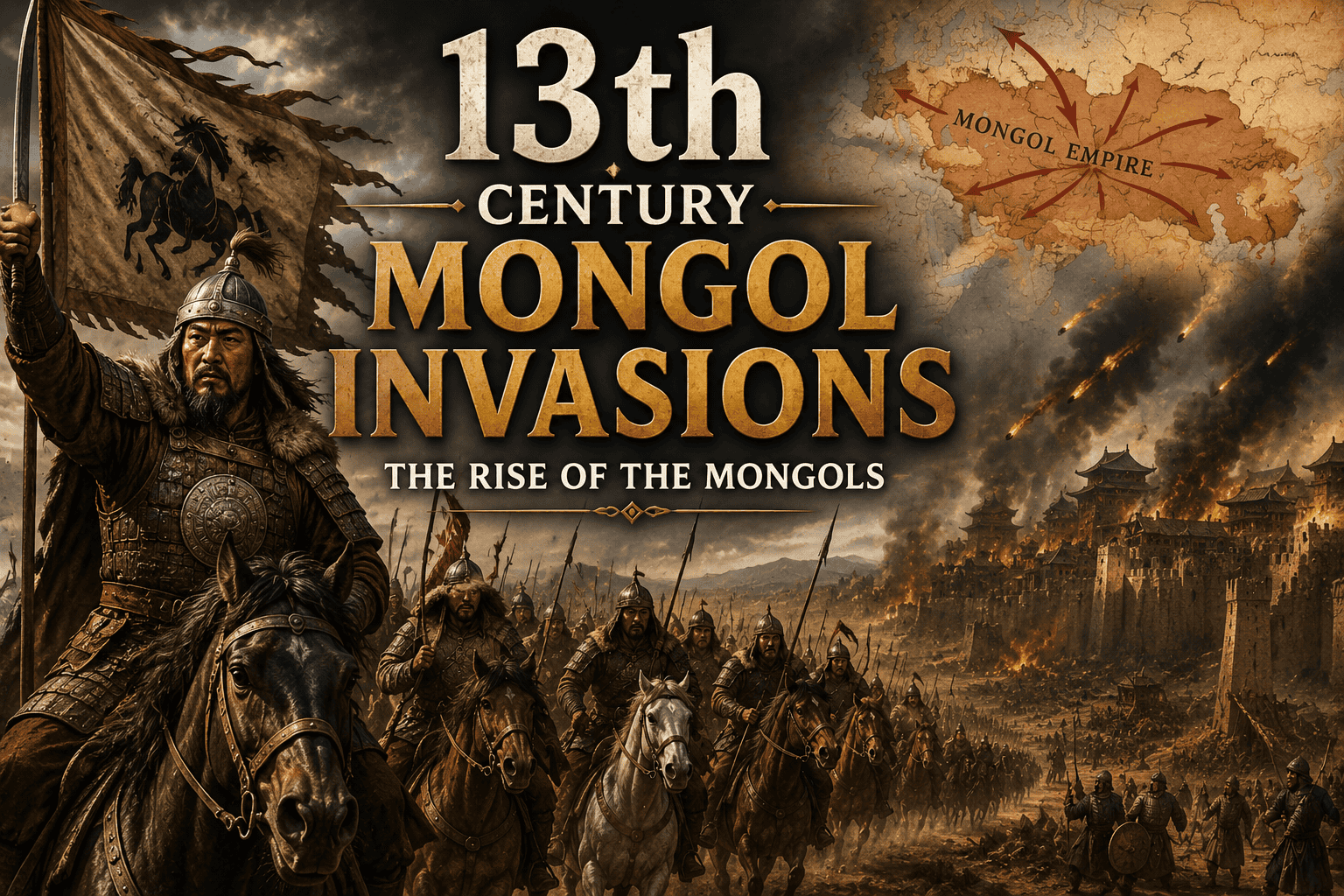
The 13th century was dominated by the unprecedented rise of the Mongol Empire under Genghis Khan and his successors, who conquered vast stretches of Asia, the Middle East, and Eastern Europe, creating the largest contiguous land empire in history. This era saw the Mongols reshape trade and cultural exchange across Eurasia, reviving and expanding networks like the Silk Road while also causing widespread destruction through military conquest. Beyond the Mongols, this century witnessed continued Crusades, the rise of powerful Italian city-states, and significant developments in art, architecture, and early university learning across Europe. At its core, the 13th century reveals how Mongol expansion connected and transformed civilizations across the globe, reshaping trade, power, and cultural exchange on an unprecedented scale.
The Complete 13th Century (1201–1300 CE): World History Guide
- The Century That Remade the Earth
- CHAPTER 1 — Understanding the 13th Century
- CHAPTER 2 — Calendars of the 13th Century World
- CHAPTER 3 — Major Empires and Kingdoms of the 13th Century
- The World's Power Map in 1200 CE
- The Mongol Empire — The World's Largest Contiguous Empire
- The Yuan Dynasty — Kublai Khan's China
- The Islamic World — After the Sack of Baghdad
- The Delhi Sultanate — Islamic India
- Europe — High Middle Ages and the Magna Carta
- Japan — Kamakura Shogunate and the Mongol Invasions
- Southeast Asia — New Kingdoms Emerging
- Africa — The Mali Empire and West Africa's Golden Age
- The Americas — Cahokia and the Rise of the Inca
- CHAPTER 4 — Wars and Battles of the 13th Century
- The Mongol War Machine — Overview
- The Mongol Conquest of Central Asia and Persia (1219–1221)
- The Battle of Kalka River (1223) — Europe Gets a Warning
- The Mongol Invasions of Eastern Europe (1236–1242)
- The Siege of Baghdad (1258) — The End of the Islamic Golden Age
- The Battle of Ain Jalut — the first significant defeat suffered by the Mongols
- The Fall of Acre (1291) — The End of the Crusader States
- CHAPTER 5 — Thinkers, Philosophers, and Key Figures
- The Intellectual Climate of the 13th Century
- Thomas Aquinas (1225–1274) — the most prominent figure in scholastic philosophy
- Roger Bacon (c. 1220–1292) — The Prophet of Experimental Science
- Dante Alighieri (1265–1321) — The Poet Who Described the Entire Universe
- Genghis Khan (c. 1162–1227) — The Great Unifier
- Kublai Khan (1215–1294) — The Emperor Who Bridged Two Worlds
- Marco Polo (1254–1324) — The Man Who Showed Europe a New World
- Nasir al-Din al-Tusi (1201–1274) — The Astronomer of Maragheh
- CHAPTER 6 — Religion and Cultural Developments
- The Religious Map of the 13th Century
- Islam After Baghdad — Sufism and New Centers
- Christianity — The Papacy at Its Height and the Inquisition
- Buddhism — Decline in India, Explosion in East Asia and Southeast Asia
- The Magna Carta (1215) — Foundation of Constitutional Government
- The Rise of Universities
- Gothic Architecture — Cathedrals as Theology in Stone
- CHAPTER 7 — Science, Technology, and Global Connections
- CHAPTER 8 — Complete Decade-by-Decade Timeline (1201–1300)
- 1201–1210: The Eve of the Mongol Storm
- 1211–1220: Conquest Begins
- 1221–1230: Destruction and Death of the Great Khan
- 1231–1240: Eastern Europe in the Crosshairs
- 1241–1250: The Miracle That Saved Western Europe
- 1251–1260: Baghdad Falls — The Islamic World Shattered
- 1261–1270: New Empires, New Realities
- 1271–1280: Kublai Khan Rules China — Marco Polo Arrives
- 1281–1290: The Kamikaze Storms and Burma's Fall
- 1291–1300: The Last Crusaders and the Ottoman Seed
- CHAPTER 9 — Summary and Legacy of the 13th Century
The Century That Remade the Earth
CHAPTER 1 — Understanding the 13th Century
What Is the 13th Century? — Definition and Context
The 13th century is the period from January 1, 1201 CE to December 31, 1300 CE, measured according to the Julian calendar that Christian Europe used at the time. It falls within what historians of Europe call the High Middle Ages — the period when medieval civilization was at its most developed, before the catastrophes of the 14th century (the Black Death, the Hundred Years’ War) began pulling it apart.
But the 13th century is not primarily a European story. It is a Eurasian story — and the central character is neither a European king nor a Christian pope nor an Islamic caliph. The central character is Temüjin of the Mongol tribe — the man who became Genghis Khan — and the extraordinary, terrifying, world-altering empire he and his descendants built.
To understand the 13th century, you must first accept that you are about to read about events that most people alive in 1200 CE could not have predicted, would not have believed possible, and — if they were among the millions in its path — could not have survived.
Let us begin with a clear picture of what the world looked like at the start of this century, before the storm.
What Kind of World Existed in 1201 CE?
Imagine you are standing in the year 1201 CE and you have the ability to travel the entire world in a single day — a magical bird’s-eye view of human civilization. What would you see?
In East Asia: Two Chinese dynasties facing each other across a border that ran roughly east-west across China. In the north, the Jurchen Jin Dynasty ruled northern China and considered itself civilized and powerful. In the south, the Southern Song Dynasty maintained one of the world’s most prosperous and technologically advanced societies — with paper money, printed books, large cities, gunpowder weapons, and a sophisticated civil service. On the steppes of Mongolia, north of the Jin border, scattered nomadic tribes were fighting each other constantly — and one young chieftain named Temüjin was in the process of uniting them by a combination of military genius, political cunning, and ruthless violence.
In the Middle East: The Abbasid Caliphate in Baghdad was old and weak — the spiritual authority of Islam since 750 CE, but militarily dependent on whoever’s soldiers happened to be nearby. In Egypt and Syria, the Ayyubid dynasty (founded by the legendary Saladin) ruled. The Crusader States — small Christian kingdoms along the Palestinian coast, remnants of the First Crusade — were still clinging to existence, perpetually besieged and perpetually arguing among themselves. In Persia and Central Asia, the Khwarazmian Empire was at its height, ruling a vast territory from the Aral Sea to the Persian Gulf.
In South Asia: The Delhi Sultanate — only a few years old, founded in 1206 — was just beginning to consolidate Muslim political control over northern India. The subcontinent was a patchwork of Hindu kingdoms, each with its own language, culture, and gods, gradually feeling the pressure of Islamic military power from the northwest.
In Europe: It was the age of great stone cathedrals rising toward the sky, of universities where young men debated Aristotle in Latin, of knights in iron armor fighting for land and honor, of a Church that claimed authority over every king on the continent. The Magna Carta had not yet been signed (that would happen in 1215). Paris was the intellectual capital of Europe. Rome was the spiritual capital. No European king had the faintest idea that armies from beyond the edge of the known world were about to change everything.
In Africa: The Mali Empire was in the process of formation — soon to become the richest and most powerful state in West Africa under the legendary Sundiata Keita. Trans-Saharan trade routes carried gold north and salt south, making the rulers of the Sahel fabulously wealthy. The Kanem Empire around Lake Chad was at its peak.
In the Americas: The continent of North America had the Mississippian city of Cahokia — a monumental earthwork city near modern St. Louis with a population of perhaps 15,000 to 20,000 people — at the end of its peak period and beginning its decline. In the Andes of South America, the Quechua-speaking people of the Cuzco Valley were beginning to develop the political structures that would eventually become the Inca Empire. Neither of these civilizations had any contact with the rest of the world — and no one in Asia, Europe, Africa, or the Middle East knew they existed.
This was the world of 1201 CE. A world of separate civilizations, each sophisticated in its own way, each unaware of most of the others. Within 50 years, a single force — the Mongol Empire — would shatter this world and connect its pieces in ways that had never happened before.
The Mongol Moment — Why This Century Changed Everything
Here is the central paradox of the 13th century: the most destructive military force in medieval history was also the greatest engine of global connection and trade.
In 1206, Temüjin was proclaimed Genghis Khan — “Universal Ruler” — at a great assembly of Mongol tribes. The moment those words were spoken, the world began to change. What followed in the next 70 years was the most rapid and comprehensive restructuring of the Eurasian political map in human history.
Let us be specific about the scale. By 1241, Mongol armies had:
Destroyed the Khwarazmian Empire of Persia and Central Asia — a major power — in approximately two years. Conquered northern China from the Jin Dynasty after two decades of warfare. Crushed the Rus’ principalities — the predecessors of modern Russia, Ukraine, and Belarus — in a campaign lasting less than three years. Simultaneously raided Poland and Hungary, defeating the armies of both countries at the same time. Reached the outskirts of Vienna — the heartland of Europe.
And yet — simultaneously — the Mongol Empire was creating conditions for the most active period of Eurasian trade in history. The Pax Mongolica — the Mongol Peace — made the Silk Road safer than it had ever been. A merchant could travel from the Mediterranean to Beijing in relative safety. A diplomat could carry messages from the Pope to the Great Khan. A curious young Venetian named Marco Polo could spend 16 years at the court of Kublai Khan and return to tell the tale.
This century simultaneously destroyed and connected. It brought an end to the Islamic Golden Age with the sack of Baghdad and also helped drive the spread of knowledge that later contributed to the European Renaissance. It massacred millions and enabled the trade that would carry the Black Death westward a century later. It is the most consequential century in human history between the fall of Rome and the Industrial Revolution.
Why the 13th Century Matters to Every Generation After It
You might ask — reasonably — why should someone living today care about events that happened over 700 years ago? Here is the answer:
Almost everything that defines the modern world has roots in the 13th century. The principle that rulers must follow the law — not just make it — was established in the Magna Carta of 1215. Without that principle, there is no constitutional government, no rule of law, no democracy as we understand it. The transmission of Chinese technologies — gunpowder, paper, printing, the compass — through the Mongol network to the West was a direct precondition for the European Renaissance, the Age of Exploration, and the Scientific Revolution. The destruction of the Islamic Golden Age in Baghdad redirected the Islamic world’s intellectual center of gravity in ways that still shape the Middle East today. The Ottoman Empire — which would dominate the Middle East for 600 years — was founded in 1299, the last year of the 13th century, as a tiny border state that barely anyone noticed. The foundations of the Delhi Sultanate, laid in this century, led directly to the Mughal Empire and ultimately to the shape of modern South Asia — including India, Pakistan, and Bangladesh. Every one of these threads runs through the 13th century.
CHAPTER 2 — Calendars of the 13th Century World
Why Different Civilizations Used Different Calendars
One of the most revealing facts about any civilization is how it measures time. A calendar is not just a practical tool for knowing when to plant crops or when festivals occur. A calendar is a statement of values, of what a civilization considers most important, of which astronomical cycles it has mastered, and of which religious or historical events it considers the center of all history.
In the 13th century, at least six major calendar systems were in active use simultaneously across the world. None of them agreed with each other about what year it was. A Mongol shaman, a Chinese imperial astronomer, an Islamic jurist in Baghdad, a Hindu priest in Delhi, a Theravada Buddhist monk in Burma, and a Franciscan friar in Paris were each operating within an entirely different framework for understanding time — while all living in the same years.
Understanding these calendars is not just an interesting curiosity. It is a window into the different civilizations that the 13th century brought into collision.
The Julian Calendar — Europe’s System
The Julian Calendar was the standard calendar of Christian Europe in the 13th century. It was created by Julius Caesar in 46 BCE on the advice of Egyptian astronomers and introduced in 45 BCE. It established the 365-day year with a leap year every four years — a system elegant in its simplicity.
However, the Julian Calendar had a subtle problem. The actual solar year — the time it takes the Earth to orbit the Sun — is not exactly 365.25 days. It is approximately 365.2422 days. This tiny difference accumulates over time. By the 13th century, the Julian Calendar had drifted approximately 9 to 10 days out of alignment with astronomical reality. The spring equinox — which should fall around March 21 — was actually occurring earlier than the calendar showed. This mattered enormously for calculating Easter, which was tied to the spring equinox. The problem would not be officially corrected until Pope Gregory XIII reformed the calendar in 1582 — the Gregorian Calendar we use today.
In the 13th century, all the major events that Western historians use to anchor the century are dated in Julian Calendar terms. Here is a clear reference list of major 13th-century events in Julian dates:
King John signs the Magna Carta — June 15, 1215. The Mongol army destroys the Khwarazmian capital Samarkand — 1220. The Mongols defeat the Rus’ princes at the Kalka River — May 31, 1223. Genghis Khan dies — August 18, 1227. The Mongol army defeats the Polish-German force at Legnica — April 9, 1241. The Mongols sack Baghdad — February 10, 1258. The Mamluks defeat the Mongols at Ain Jalut — September 3, 1260.1271: Kublai Khan proclaimed the Yuan Dynasty.The first Mongol invasion of Japan — 1274. Marco Polo arrives at Kublai Khan’s court — approximately 1275. The second Mongol invasion of Japan and the kamikaze — 1281. The fall of Acre, ending the Crusader States — May 18, 1291. Osman I founds the Ottoman Beylik — approximately 1299.
The Islamic Hijri Calendar — Lunar Time in the 13th Century
The Islamic calendar — called the Hijri calendar — is a purely lunar calendar. It tracks time by the cycles of the Moon exclusively, without any adjustment to keep pace with the solar year. A lunar year of 12 months has approximately 354 days — about 11 days shorter than a solar year. This means the Islamic calendar shifts through the seasons over time: Ramadan — the month of fasting — occurs in summer some years, in winter others, cycling through all seasons over a period of approximately 33 years.
The Hijri calendar begins in the year 622 CE — the year of Muhammad’s Hijra (migration from Mecca to Medina), which Muslims consider the founding moment of the Islamic community as a political entity. The year 622 CE is Year 1 of the Hijri calendar (written as 1 AH — Anno Hegirae, Year of the Migration).
This means that the 13th century CE corresponds to the 7th Hijri century. The specific correspondences for key events:
The year 602 AH corresponds to 1205–1206 CE — the year Genghis Khan unites the Mongol tribes. This same year, the Delhi Sultanate was being founded by Qutb ud-Din Aibak. The year 656 AH corresponds to 1258 CE — the year the Mongols sack Baghdad. To Muslims, the destruction of Baghdad in 656 AH was a date of shattering significance: the end of the Abbasid Caliphate that had been the spiritual center of Sunni Islam since 132 AH (750 CE). The year 699 AH corresponds to 1299–1300 CE — the founding of the Ottoman Beylik, the tiny border state that would grow into the Ottoman Empire.
The destruction of Baghdad was not just a political catastrophe. For Muslims, it felt like the end of a sacred institution. Prayers across the Islamic world had been offered in the name of the Abbasid Caliph for 500 years. The news of Baghdad’s fall spread through the Hijri calendar’s months like a wound spreading through a body.
The Chinese Lunisolar Calendar
China used a sophisticated lunisolar calendar — a system that tracked both the Moon’s monthly cycles and the Sun’s annual cycle, inserting an extra intercalary month approximately every three years to keep the calendar aligned with the seasons. This dual tracking made the Chinese calendar more complex than either a purely solar or purely lunar system, but also more accurate in maintaining alignment with the agricultural seasons.
The Chinese calendar organized years in cycles of 60, combining a 10-element “Heavenly Stem” system with a 12-element “Earthly Branch” system (the Earthly Branches are associated with the animals of the Chinese zodiac). This 60-year cycle is still in use in China and much of East Asia today for traditional purposes.
In the 13th century, the Song Dynasty used the Chinese calendar in the south of China while the Jin Dynasty used it in the north. When the Mongols conquered northern China and eventually the Southern Song, Kublai Khan faced an important decision: which calendar should the Yuan Dynasty use? He chose the Chinese calendar — a political statement of enormous significance. By adopting the Chinese calendar and the Chinese system of naming the dynasty (Yuan, meaning “Origin”), Kublai Khan was declaring himself the legitimate continuation of Chinese imperial tradition. He was not a foreign conqueror imposing alien customs; he was the new Son of Heaven, stepping into a role that Chinese history had always provided.
This decision — choosing the calendar — was as much a political act as a practical one.
The Persian Solar Calendar
The Persian calendar — also called the Solar Hijri or Jalali calendar — is a solar calendar that tracks the Sun’s position with remarkable precision. It was reformed in the 11th century under the Seljuk Sultan Malik Shah by a committee that included the great mathematician and poet Omar Khayyam. The Jalali calendar is actually more accurate than the Gregorian calendar used in the West today — its year length is closer to the actual astronomical solar year.
In the 13th century, the Persian calendar remained in use in Persia and Central Asia — the territories that became the Ilkhanate after the Mongol conquest. The Ilkhanid rulers, who initially followed traditional Mongolian shamanist religion, did not impose a new calendar. But as the Ilkhanate gradually became Islamic — culminating in Ghazan Khan’s formal conversion to Islam in 1295 — the Persian solar calendar and the Islamic lunar calendar coexisted within the same territory, used for different purposes.
The Hindu Calendar
India under the Delhi Sultanate in the 13th century was a meeting of two calendar worlds. The Islamic administrators used the Hijri lunar calendar for official government purposes. The Hindu population — the vast majority of the subcontinent — used the Hindu lunisolar calendar for their religious festivals, agricultural planning, and personal life events.
The Hindu calendar is actually a family of related calendar systems rather than a single unified system. Different regions of India used different variants, based on different astronomical calculations and associated with different religious traditions. However, all of them shared the basic lunisolar structure — tracking both lunar months and solar years — and all of them organized time around a much larger framework than any Western or Islamic calendar: the concept of vast cosmic cycles of time (yugas, kalpas) that made human history seem very small and brief.
The coexistence of Hindu and Islamic calendars in 13th-century India was a microcosm of the broader cultural coexistence that the Delhi Sultanate managed — imperfectly, sometimes violently, but also with significant degrees of everyday accommodation.
The Buddhist Calendar
The Buddhist calendar is a lunisolar system used primarily in Southeast Asia — Myanmar (Burma), Thailand, Cambodia, Sri Lanka, and Laos. It counts years from the death (or in some traditions, the enlightenment or birth) of the Buddha, believed to have occurred in 544 BCE. This means the Buddhist Era (BE) runs approximately 543 to 544 years ahead of the Common Era. The year 1200 CE corresponds approximately to 1743 BE.
In the 13th century, the Buddhist calendar was becoming more widely established across mainland Southeast Asia as Theravada Buddhism spread from Sri Lanka northward into Burma, Thailand, and Cambodia. The Pagan Kingdom of Burma — before its destruction by the Mongols in 1287 — was a major center of Theravada Buddhist learning, producing extraordinary temple complexes and supporting thousands of monks.
When the Mongols destroyed the Pagan Kingdom in 1287, they did not destroy Buddhism — but they did shatter the political framework that had supported its most extravagant expression. The temples of Pagan still stand today, though they were never completed after the Mongol conquest.
How Calendars Reflected Civilization and Power
The most important lesson to draw from looking at 13th-century calendars is this: time is not neutral. Different civilizations did not simply have different ways of counting the same thing. They had fundamentally different understandings of what time is, where it comes from, and what it means.
For Christians in 13th-century Europe, time was linear — it had a beginning (the Creation), a center (the Incarnation of Christ), and it was moving toward an end (the Last Judgment). Every year was measured from Christ’s birth. This gave European civilization a strong sense of historical direction and purpose.
For Muslims, time was also linear and directed toward God’s judgment, but the center of history was the Hijra — the moment when the first Islamic community was established. Every year measured from that moment reminded Muslims of their identity as a community called into existence by divine command.
For Chinese civilization, time was cyclical — the 60-year cycles of the calendar, the rise and fall of dynasties following the Mandate of Heaven, the great cosmic cycles of yin and yang. This gave Chinese historical thinking a very different character: less focused on linear progress toward a goal, more attentive to patterns that repeat across generations.
For Hindu civilization, human historical time was almost vanishingly small — a brief moment within vast cosmic cycles measured in millions of years. This perspective made the urgencies of political history seem less absolute and fostered a certain philosophical detachment.
When the Mongol Empire brought all these different civilizations into contact — sometimes gentle trade contact, sometimes violent military contact — it was also bringing different experiences of time into collision. The Pax Mongolica was not just an exchange of goods and technologies. It was an exchange of ways of understanding the world.
CHAPTER 3 — Major Empires and Kingdoms of the 13th Century
The World’s Power Map in 1200 CE
Before we can understand what the 13th century changed, we need a clear picture of who was powerful in 1200 CE and where they were. Think of this as taking a photograph of the world’s political landscape at the start of the century — knowing that by the end of the century, this photograph will be almost unrecognizable.
East Asia: The Mongol tribes, still disunited, occupied the steppes north of China. The Jin Dynasty of the Jurchen people ruled northern China — a sophisticated, literate state that had conquered the northern Song in the early 12th century. The Southern Song Dynasty held the south — one of the world’s most urbanized and commercially advanced societies. In Japan, the Kamakura Shogunate had just been established, with the samurai class rising to dominance. In Korea, the Goryeo Dynasty maintained a strong centralized state.
South and Southeast Asia: The Delhi Sultanate was just being founded in northern India. The ancient Chola dynasty of southern India was in decline. In Southeast Asia, the magnificent Khmer Empire at Angkor was still powerful but beginning its long descent. The Pagan Kingdom unified Burma. Thailand had not yet coalesced as a political entity — that would happen with the Sukhothai Kingdom emerging around 1238.
Middle East and Central Asia: The Abbasid Caliphate in Baghdad was spiritually authoritative but militarily weak. The Ayyubid dynasty — Saladin’s successors — ruled Egypt and Syria. The Khwarazmian Empire under Shah Muhammad II was at its greatest extent, controlling Persia, Afghanistan, and much of Central Asia. The Crusader States clung to the Palestinian coast. The Byzantine Empire — the last remnant of the Eastern Roman Empire — ruled from Constantinople, weakened by the failed Fourth Crusade that was about to attack it.
Europe: The Holy Roman Empire under the Hohenstaufen dynasty competed with the Papacy for supremacy over European political life. The kingdoms of France, England, Castile, Aragon, and Portugal were developing into coherent national states. The Kievan Rus’ principalities — forerunners of modern Russia, Ukraine, and Belarus — were disunited and would soon be catastrophically vulnerable to the Mongol invasion.
Africa: The Mali Empire was forming in West Africa under the foundational work that would culminate in Sundiata Keita’s victory at the Battle of Kirina around 1235. The Kanem Empire around Lake Chad was at its peak, controlling the trans-Saharan trade routes north through the desert. In East Africa, the Swahili Coast city-states were prosperous trading partners with the Arab world and India.
The Americas: The Mississippian culture — the most complex civilization in North America north of Mexico — had its great city of Cahokia at the tail end of its peak. In the Andes, the Quechua people of the Cuzco Valley were building the political foundations of what would become the Inca Empire.
The Mongol Empire — The World’s Largest Contiguous Empire
Definition and Scale
The Mongol Empire was the largest contiguous land empire in human history — meaning the largest empire in one connected landmass, without ocean breaks. At its peak around 1270 CE, it covered approximately 24 million square kilometers — about 9.3 million square miles — and ruled over 100 million people. To put this in perspective: this was larger than the entire continent of North America. It stretched from the Korean Peninsula in the east to the borders of Poland and Hungary in the west. From the frozen tundra of Siberia in the north to the jungles of Vietnam and the deserts of Persia in the south.
It was founded in 1206 when Temüjin was proclaimed Genghis Khan at a great assembly of Mongol tribes on the steppes of Central Asia. It reached its greatest extent under his successors — particularly his son Ogedei and his grandson Kublai — before gradually fragmenting into four major successor states called khanates.
How the Mongol Military Machine Actually Worked — In Detail
To understand why the Mongols conquered so much so fast, you need to understand not just that they were brave or fierce — many armies throughout history have been brave and fierce — but specifically what they did differently that made them so dramatically more effective than their opponents.
The Cavalry Advantage — Speed as Strategy: Every Mongol warrior was a mounted horseman from childhood. Mongolian horses were smaller than European warhorses but extraordinarily hardy — able to travel long distances on minimal food, surviving on grass when necessary. Each Mongol warrior typically had three to five horses on campaign, rotating between them so that no single horse was ever exhausted. This gave Mongol armies a speed of movement that their enemies simply could not match. A Mongol army could cover 100 miles in a single day when needed — compared to perhaps 15 to 20 miles for a European medieval army. This speed meant Mongol armies could appear where they were not expected, could cut off retreat before it began, and could coordinate movements across vast distances in ways that made their opponents feel like they were fighting ghosts.
The Decimal Organization — Structure as Strength: Before Genghis Khan, Mongol tribal armies were organized by clan — groups of men who fought together because they were relatives.This produced a critical weakness: allegiance to one’s clan often conflicted with loyalty to the military. A warrior might refuse an order from a general of a different clan. Genghis Khan abolished this entirely. He reorganized the entire army into units of ten (arban), one hundred (zuun), one thousand (mingan), and ten thousand (tumen). Leadership of each unit was assigned by demonstrated merit and loyalty — not by birth or clan. A man from a humble family who proved himself in battle could command a unit of a thousand. A man born to a noble family who proved incompetent would not. This meritocratic organization produced a military force of extraordinary cohesion and flexibility.
Psychological Warfare — Terror as Strategy: The Mongols understood something that few other military commanders in history have implemented as systematically: the most effective weapon is the one that makes your enemy not want to fight. Before attacking any city or territory, Mongol envoys would arrive with a simple message delivered politely and clearly: “Surrender now and you will be protected. Your lives, your property, your customs, and your religion will be respected. Resist and every man, woman, and child in your city will be killed.” The Mongols made this promise and kept it — in both directions. Cities that surrendered without a fight were generally treated well. Cities that resisted were utterly destroyed, their populations massacred, their buildings burned to rubble. Word of what happened to cities that resisted spread faster than the Mongol armies themselves. Many cities along the Mongols’ path surrendered without a fight, saving enormous amounts of time and lives — though the cities that had already been destroyed as examples were past saving.
Technological Adaptation — Learning from Everyone: This is perhaps the most underappreciated aspect of Mongol military genius. The Mongols were not too proud to learn. When they encountered types of warfare they were not equipped for — particularly siege warfare against walled cities — they did not simply throw cavalry at stone walls until enough men died. They recruited experts. After conquering northern China, they incorporated Chinese engineers who understood siege technology: catapults, trebuchets, battering rams, tunneling, fire weapons, early explosive devices. When they needed to govern conquered territories, they recruited Persian, Chinese, and Uyghur administrators. When a writing system was required, they adopted the Uyghur script. When they needed sailors to invade Japan, they built a fleet using Chinese and Korean naval expertise. This constant learning and adaptation made the Mongol Empire far more sophisticated and effective than a purely military force could ever be.
The Yam System — Communication as Power: One of Genghis Khan’s most brilliant innovations was the yam — a system of relay postal stations positioned approximately every 25 to 30 kilometers along major routes across the empire. Each station maintained a fresh supply of horses and riders. An official messenger carrying urgent dispatches would ride to the nearest station, hand his message to a fresh rider on a fresh horse, and that rider would race to the next station — and so on. Using the yam, a message could travel from one end of the empire to the other in approximately two weeks — from modern Moscow to modern Beijing. No other communication system in the medieval world could approach this speed. It allowed Genghis Khan — and his successors — to coordinate military campaigns across thousands of miles, receive intelligence from distant fronts, and respond to crises before opponents could fully develop their plans.
The Four Khanates — How the Empire Divided
When Genghis Khan died in 1227, his enormous empire was divided among his sons and eventually fragmented into four major successor states, called khanates. Understanding these four khanates is essential for understanding the later 13th century.
The Yuan Dynasty (East Asia): Ruled by Kublai Khan after 1260, covering China, Mongolia, Korea, and surrounding areas. Kublai completed the conquest of China by defeating the Southern Song in 1279. He ruled as Emperor of China, adopted Chinese governing institutions, and founded the Yuan Dynasty (1271–1368) — the first foreign dynasty to rule all of China.
The Ilkhanate (Persia and the Middle East): Ruled by Hulagu Khan and his successors, covering modern Iran, Iraq, Afghanistan, and surrounding areas. Hulagu Khan was the commander who captured and sacked Baghdad in 1258. The Ilkhanate was initially hostile to Islam but gradually converted — Ghazan Khan’s formal conversion to Islam in 1295 was a turning point that transformed the Ilkhanate into a Muslim state.
The Golden Horde (Russia and Eastern Europe): Ruled by Batu Khan and his successors, covering modern Russia, Ukraine, Kazakhstan, and surrounding areas. The Mongol name for this khanate was the Ulus of Jochi. The Rus’ principalities — forerunners of modern Russia — paid tribute to the Golden Horde for approximately 240 years, from the invasion of 1237 until the great standoff at the Ugra River in 1480. This period of Mongol domination is called the “Tatar Yoke” in Russian historical memory and had profound effects on Russian political culture.
The Chagatai Khanate (Central Asia): Named after Chagatai, second son of Genghis Khan, this khanate controlled Central Asia — modern Kazakhstan, Uzbekistan, Kyrgyzstan, Tajikistan, and Xinjiang. It was the most traditional of the khanates — maintaining the nomadic steppe lifestyle most closely aligned with Mongol heritage — and also the most unstable, frequently fragmenting and reforming. The Chagatai Khanate was also the most persistent source of raids into the Delhi Sultanate of India throughout the later 13th and early 14th centuries.
The Yuan Dynasty — Kublai Khan’s China
Kublai Khan (1215–1294) was one of the most remarkable rulers in Chinese history — remarkable especially because he was not Chinese. He was the grandson of Genghis Khan, raised in the Mongol tradition, who chose to become the Emperor of China rather than simply its conqueror.
The process of completing the Mongol conquest of China was long and difficult. Northern China had been under Mongol control since the Jin Dynasty fell in 1234. But the Southern Song Dynasty — protected by rivers, rice paddies, and a military that had adapted to use gunpowder weapons, fire arrows, and naval forces — held out for another 45 years. The final campaign against the Southern Song (1267–1279) was won not by Mongol cavalry on open steppe — terrain that favored the Mongols — but by a massive naval battle at Yamen in 1279, where the last Song fleet was destroyed and the last Song emperor, a child, was drowned as his loyal general jumped into the sea holding him rather than surrender.
Once all of China was his, Kublai made a series of extraordinary political decisions that distinguished him from most other Mongol rulers. He moved his capital from Karakorum — the traditional Mongol center on the steppe — to a new city called Dadu on the site of modern Beijing, putting his seat of power in the Chinese heartland. He adopted Chinese court rituals, the Chinese calendar, Chinese governing institutions, and the Chinese practice of holding imperial examinations for government positions (though he suspended this practice for a time). He gave the dynasty a Chinese name: Yuan, meaning “Origin.” He commissioned the construction of a grand palace complex that would eventually inspire the name “Khanbaliq” — the Great Khan’s city — and which Marco Polo described in terms of breathless wonder.
At the same time, Kublai maintained the Mongol identity of the ruling class. The empire was divided into four social ranks: Mongols at the top, then Central Asian allies (called Semu), then northern Chinese, then southern Chinese (the recently conquered Song subjects) at the bottom. Mongols were exempt from certain taxes, received preferential treatment in legal disputes, and held the highest military and civilian positions. This ethnic hierarchy created resentments that would eventually contribute to the Yuan Dynasty’s fall — the Ming Rebellion of 1368.
Kublai was also an enthusiastic patron of trade, arts, and intellectual activity. He welcomed foreigners from across the world to his court — and one of those foreigners, a young Venetian merchant named Marco Polo, would spend 16 years in his service and return to write the book that introduced Asia to the European imagination.
The Islamic World — After the Sack of Baghdad
The sack of Baghdad in February 1258 was not merely a military defeat. It was a civilizational catastrophe of the first order, and understanding why requires understanding what Baghdad had been.
For 500 years — since the Abbasid Caliph al-Mansur built it in 762 CE — Baghdad had been the intellectual and cultural capital of the Islamic world. The House of Wisdom (Bayt al-Hikma), established in the early 9th century, had been the most ambitious institution of learning in the medieval world. It employed scholars who translated ancient Greek scientific and philosophical texts into Arabic — preserving works of Aristotle, Euclid, Galen, Ptolemy, and many others that would otherwise have been lost entirely. Islamic scholars built on these translations to make their own contributions: algebra (al-Khwarizmi’s Kitab al-Mukhtasar), optics (Ibn al-Haytham), medicine (Ibn Sina — Avicenna), astronomy (al-Biruni), and philosophy (al-Farabi, Ibn Rushd — Averroes). Baghdad’s libraries contained hundreds of thousands of manuscripts — the accumulated scientific and philosophical knowledge of five centuries of Islamic civilization.
Hulagu Khan’s army sacked and burned the city for weeks. The specific fate of the libraries is disputed — some sources say books were thrown into the Tigris River, turning the water black with ink; others say the libraries were looted for their gold bindings; others say they were simply burned. Whatever the precise details, the result was the same: irreplaceable accumulated knowledge was destroyed. The Abbasid Caliph al-Musta’sim — the spiritual leader of Sunni Islam — was executed. Baghdad’s population — perhaps 500,000 to 800,000 people — was reduced by an estimated 200,000 to possibly as many as 800,000 deaths, depending on which historical source you follow.
But the Islamic world did not end. It adapted — as it had adapted to every previous crisis in its 600-year history. Several new centers of Islamic power emerged to fill the vacuum.
The Mamluk Sultanate of Egypt: Founded in 1250, just eight years before the sack of Baghdad, the Mamluk Sultanate would become the most powerful Muslim state for the next 250 years. The Mamluks were slave-soldiers — men of Turkish and Circassian origin who had been purchased as children, trained as elite cavalry warriors, and risen through military merit to dominate Egyptian politics. They would prove to be the only military force capable of stopping the Mongols in open battle — a achievement they accomplished at the Battle of Ain Jalut in 1260.
The Delhi Sultanate: In India, the Delhi Sultanate continued to expand and consolidate, becoming increasingly important as a center of Islamic civilization. Scholars, artists, and intellectuals fleeing the Mongol destruction in Central Asia and Persia found refuge at the courts of the Delhi Sultans. Delhi grew into one of the world’s largest cities.
Timbuktu and the Mali Empire: In West Africa, far beyond the reach of the Mongols, the Mali Empire was building one of the richest Islamic states in the world. Timbuktu became a center of Islamic learning that would reach its peak in the 14th and 15th centuries but whose foundations were laid in the 13th.
The Delhi Sultanate — Islamic India
The Delhi Sultanate (1206–1526) was founded by Qutb ud-Din Aibak — a former slave who had served as the general of Muhammad of Ghor. When Muhammad was assassinated in 1206, Aibak declared himself Sultan of Delhi — making him the founder of both the Delhi Sultanate and its first ruling dynasty, called the Slave Dynasty or Mamluk Dynasty.
The slave origins of this dynasty were not unique in the medieval Islamic world. The Mamluk system — training enslaved men as elite soldiers and administrators — produced some of the most effective rulers in Islamic history. A man born into slavery who demonstrated exceptional ability could rise to command armies, govern provinces, and even found dynasties. Qutb ud-Din Aibak is a perfect example: born a slave, he became a general, then a king.
The Qutb Minar in Delhi — a 73-meter-tall minaret of red sandstone and marble, still standing today as a UNESCO World Heritage Site — was begun by Aibak and completed by his successor Iltutmish. It was a statement of permanence: this Islamic rule is here to stay.
Iltutmish (reigned 1211–1236) is often considered the true consolidator of the Delhi Sultanate. He fended off repeated Mongol raids from the northwest — the Chagatai Khanate regularly sent forces probing into the Punjab — while simultaneously expanding the sultanate’s control over northern India. He also made a historically significant decision: he chose his daughter Raziyya as his heir, making her the first woman to rule as Sultan of Delhi (reigned 1236–1240). Raziyya Sultan rode into battle without a veil, administered justice publicly, and governed effectively — until she was overthrown in a coup by nobles who could not accept female rule.
The sultanate faced a fundamental governing challenge throughout the 13th century: how to rule a vast population that was almost entirely non-Muslim with a relatively small Muslim ruling class. The solution was a mixture of military control, economic extraction (the jizya tax on non-Muslim subjects), and pragmatic accommodation of existing social structures. Hindus continued to run local administration, manage agriculture, and conduct trade largely as before — while the sultanate extracted taxes and provided military protection (primarily against the Mongols). The temples of the Hindu population were sometimes destroyed and sometimes left alone depending on local circumstances and the disposition of individual rulers.
Europe — High Middle Ages and the Magna Carta
Europe at Its Medieval Peak
Europe in the 13th century was experiencing the High Middle Ages — the peak of medieval civilization before the catastrophes of the following century. Gothic cathedrals were rising across France, England, and Germany — architectural marvels that required decades of skilled labor and represented the concentration of community wealth and devotion in stone. Universities were becoming established institutions: Paris, Oxford, Cambridge, Bologna, Salamanca — centers where young men (exclusively men at this point) studied theology, law, medicine, and the newly rediscovered works of Aristotle.
The agricultural revolution of the High Middle Ages — the heavy plow, the three-field crop rotation system, the horse collar — had significantly increased food production, allowing population growth and the expansion of towns and trade. Europe’s population had roughly doubled between 1000 and 1300 CE. Cities were growing. Commerce was expanding. The feudal system that had organized European society for centuries was still dominant, but it was beginning to show cracks as commerce created new forms of wealth that did not fit the old lord-vassal hierarchy.
The Magna Carta (1215) — The Most Important Document in Constitutional History
The Magna Carta — Latin for “Great Charter” — was signed on June 15, 1215, at a place called Runnymede beside the River Thames near Windsor Castle in England. It was not signed willingly. King John of England — one of the least popular kings in English history — was forced to put his seal on it by his rebellious barons, who had seized London and were threatening full-scale civil war.
To understand why the Magna Carta happened, you need to understand who King John was and what he had done. John had inherited the English throne in 1199 from his brother Richard I (Richard the Lionheart). He had then proceeded to lose most of England’s territories in France to the French king Philip II — a humiliating military failure. To recover these territories, he needed enormous amounts of money. To raise this money, he imposed arbitrary taxes on his barons, seized their property without legal process, threw their associates into prison without trial, and generally acted as if no law applied to him whatsoever.
The barons had had enough. They raised an army, seized London, and presented John with a list of demands. The Magna Carta was the result of that confrontation.
The document itself contained 63 clauses — most of them quite specific and technical, addressing particular grievances of the English baronage about specific medieval feudal practices. But buried within these specific clauses were two that would reverberate through history:
Clause 39 stated: “No free man shall be seized, imprisoned, dispossessed, outlawed, exiled, or ruined in any way, nor in any way proceeded against, except by the lawful judgment of his peers and the law of the land.”
Clause 40 declared that justice would not be sold, denied, or delayed for anyone.
These two clauses established principles that would be fundamental to constitutional government: due process of law, the right not to be imprisoned without legal cause, and the principle that justice is not a commodity that rulers can sell or withhold at will. King John immediately appealed to Pope Innocent III to annul the charter — which the Pope did, calling it “shameful, demeaning, illegal, and unjust.” John died the following year. But the charter was reissued by subsequent governments, gradually becoming accepted as a statement of fundamental English law.
The Magna Carta directly inspired: the English Petition of Right (1628), the English Bill of Rights (1689), the United States Constitution and its Bill of Rights (1789), the Universal Declaration of Human Rights (1948), and the constitutional frameworks of dozens of modern democracies. A document wrested from an unpopular medieval king in a meadow beside the Thames became the foundational text of modern constitutional governance.
Japan — Kamakura Shogunate and the Mongol Invasions
The Kamakura Shogunate — Japan’s first military-led government
The Kamakura Shogunate (1192–1333) was established after the Genpei War (1180–1185), in which the Minamoto clan defeated the Taira clan in one of Japanese history’s most dramatic conflicts. The Shogun — a military title — governed Japan in the name of the Emperor, who remained in the ancient capital of Kyoto as a ceremonial figure. Real power resided with the warrior class — the samurai — whose culture of martial skill, loyalty, and honorable death in battle was becoming the defining cultural force in Japanese society.
Under the Kamakura Shogunate, Japan was a relatively stable and prosperous society — until the letter arrived from Kublai Khan.
The Mongol Letters — Diplomacy Before War
Between 1266 and 1272, Kublai Khan sent multiple embassies to Japan demanding submission. The letters were polite but unmistakably threatening. The Kamakura Shogunate — after consultation with the Emperor in Kyoto — simply refused to reply. This was not a hasty or uninformed decision. The Japanese leadership knew who the Mongols were and what they had done across Eurasia. They chose defiance anyway.
The First Invasion (1274) — Step by Step
Step 1 — The Fleet: Kublai Khan assembled a force of approximately 900 ships carrying approximately 40,000 soldiers — primarily Mongol and Chinese troops, with a significant Korean contingent. The Koreans were particularly important: Korea had been conquered by the Mongols in the 1230s and was now a vassal state providing ships, sailors, and logistical support for the invasion of Japan.
Step 2 — Landing at Hakata Bay: The invasion fleet landed on Kyushu, Japan’s southwestern island, at Hakata Bay (near modern Fukuoka city). The fighting was intense from the first moment. The samurai, accustomed to individual combat — the proud tradition of two warriors introducing themselves to each other before fighting — were shocked by the Mongol tactics of tight formation fighting, coordinated archery barrages, and the use of exploding fire bombs (huo pao — gunpowder-based projectile weapons the Japanese had never encountered).
Step 3 — The Storm: After fierce fighting on the beaches and inland, a significant storm struck the invasion fleet. Ships were driven onto rocks, capsized, and destroyed. The surviving Mongol commanders ordered a withdrawal. The first invasion had failed — not through Japanese military superiority alone, but through a combination of fierce resistance and fortunate weather.
Step 4 — Japanese Preparations: In the seven years between the first and second invasion, Japan was not passive. The Japanese constructed a stone wall along the coast of Hakata Bay — approximately 20 kilometers long, up to 2 meters high — specifically to prevent a second landing. They also developed new naval tactics for attacking Mongol ships before they could disembark troops.
The Second Invasion (1281) — The Kamikaze
Kublai Khan’s second attempt was on an incomparably larger scale. He assembled two fleets: the Eastern Route Army (approximately 900 ships, 40,000 men, departing from Korea) and the Jiangnan Army (approximately 3,500 ships, approximately 100,000 men, departing from southern China — former Song naval forces). Together, this was possibly the largest seaborne invasion force assembled before modern times.
The Japanese coastal defenses and the stone wall successfully prevented the Mongols from establishing a beachhead. For nearly two months, the invasion fleet sat offshore in Hakata Bay, unable to land effectively, its soldiers crowded onto ships in the summer heat. Disease spread. Supplies ran short.
Then, in late August 1281, a massive typhoon struck. It lasted two days. When it passed, the Mongol fleets were largely destroyed. Japanese sources speak of bodies covering the sea surface from shore to shore. Modern historians estimate that 60,000 to 90,000 Mongol and allied soldiers died — drowned, killed in the storm, or killed by Japanese forces who attacked survivors on the beaches.
The Japanese called the storms that had twice saved their country kamikaze — “divine wind” — an expression of their belief that the gods had intervened to protect Japan. This concept of divine protection of the Japanese islands would persist in Japanese cultural and religious consciousness for centuries — and would be invoked again in the 20th century when Japanese pilots flying suicide missions against American ships in World War II were also called kamikaze.
Southeast Asia — New Kingdoms Emerging
The Khmer Empire in Decline
The Khmer Empire (Angkor) had been the dominant power of mainland Southeast Asia for over 400 years. Its capital — the city of Angkor, with its vast temple complexes including the magnificent Angkor Wat — had at its peak supported a population of perhaps one million people, the largest pre-industrial urban agglomeration in the world. In the 13th century, this extraordinary civilization was beginning its long decline.
Several factors contributed. Theravada Buddhism, spreading from Sri Lanka through the region, was replacing the state Hinduism that had motivated the construction of Angkor’s great temple-mountains. These temples had been built as earthly representations of the Hindu cosmic mountain Meru — the home of the gods — and as monuments to divine kingship. Theravada Buddhism, with its emphasis on personal monastic practice and salvation through individual merit rather than grand state ritual, reduced the ideological motivation for such colossal construction projects. When later Khmer kings converted to Theravada Buddhism, the great temple-building era ended.
The Rise of Sukhothai
The Sukhothai Kingdom — generally considered the first independent Thai state — emerged around 1238 when two Thai chieftains, Si Inthrathit and his companion, overthrew Khmer overlordship and established an independent kingdom in north-central Thailand. The Sukhothai kings adopted Theravada Buddhism as the state religion and developed a distinctive Thai art style — the elongated, flame-crowned Buddha images of the Sukhothai style are still icons of Thai artistic tradition today.
The Destruction of Pagan
The Pagan Kingdom of Burma (Myanmar) had been unified under Anawrahta in the 11th century and had become a great center of Theravada Buddhist learning, home to thousands of Buddhist temples and pagodas. In 1287, a Mongol army invaded Burma and sacked Pagan. King Narathihapate had already fled southward. The Mongols did not permanently occupy Burma — the terrain and climate made long-term occupation difficult — but the destruction of Pagan ended the Kingdom’s political unity. Burma fragmented into multiple competing states and was not reunified until the 16th century.
Africa — The Mali Empire and West Africa’s Golden Age
Sundiata Keita and the Birth of Mali
The Mali Empire was one of the largest, wealthiest, and most sophisticated states in the medieval world — and it was almost entirely unknown to Europeans until much later. It was founded by a man named Sundiata Keita, whose life story is preserved in one of Africa’s greatest oral epic traditions — the Sundiata Epic, still performed by griots (traditional oral historians and musicians) in West Africa today.
According to tradition, Sundiata was born a prince of the Keita clan of the Mande people, but was a sickly child unable to walk. His father, the king of Kangaba, died, and the kingdom was conquered by the brutal Sosso king Soumaoro Kanté. Sundiata and his family were sent into exile. In exile, the young prince learned to walk, then learned to fight, then gathered allies.
Around 1235 CE, Sundiata led a coalition army against Soumaoro Kanté at the Battle of Kirina. Soumaoro was defeated — the epic says by an arrow tipped with a rooster’s spur, which was Soumaoro’s secret weakness. The victory gave Sundiata control of the western Sudan. He built on this foundation a centralized empire with a standing army, a legal code, and standardized weights and measures for trade.
The Mali Empire’s wealth came primarily from two sources: gold and salt. The goldfields of Bambuk and Bure (in modern Mali and Guinea) produced enormous quantities of gold. Salt from the Saharan mines of Taghaza was essential for food preservation and worth almost its weight in gold in the tropical south. Mali controlled the trade routes that connected these two commodities, extracting taxes from every caravan that passed through its territory.
Mali’s most renowned ruler, Mansa Musa (r. c. 1312–1337), lived just beyond the 13th century, but his immense wealth and famous pilgrimage to Mecca in 1324–1325 were made possible by the foundations established by Sundiata Keita and his successors during the 13th century. Mansa Musa’s pilgrimage brought so much gold to Egypt and the Middle East that it caused gold price inflation in the region for years afterward — a remarkable demonstration of Mali’s incredible wealth.
The Americas — Cahokia and the Rise of the Inca
Cahokia — North America’s Great City
Cahokia was the largest pre-Columbian city north of Mexico. Located near modern East St. Louis, Illinois, at the confluence of the Missouri, Illinois, and Mississippi Rivers — one of the most strategically and agriculturally important locations in North America — Cahokia at its peak (approximately 1050–1200 CE) had a population estimated at 10,000 to 20,000 people, making it larger than London at the same time.
The city was dominated by enormous earthen mounds — more than 100 of them — built by human labor without wheels, draft animals, or metal tools. Monks Mound, the largest, has a larger footprint than the Great Pyramid of Giza at Giza. It was a platform mound — built to elevate important buildings (temples, the ruler’s residence) above the surrounding city. The organization required to plan and build these mounds, and to feed and govern a city of Cahokia’s size without writing, metal tools, or domestic animals (other than dogs), represents one of the great achievements of pre-Columbian North American civilization.
In the 13th century, Cahokia was declining. Environmental degradation — deforestation around the city leading to erosion and reduced agricultural productivity — climate changes, and possibly political instability were all contributing factors. By 1300, the population had declined significantly, and by 1350–1400, the site was largely abandoned. The reasons for Cahokia’s decline remain a subject of active archaeological investigation.
The Inca Foundations in the Andes
In the Andes Mountains of modern Peru, the Quechua-speaking people of the Cuzco Valley were in the early stages of developing the political and military structures that would eventually become the Inca Empire. The traditional founding of the Inca state is attributed to Manco Capac — a semi-legendary figure said to have emerged from Lake Titicaca and founded the city of Cuzco. Historical Inca rulers — the Sapa Inca (paramount chief) — expanded their control gradually through the Cuzco Valley in the 13th century.
The great explosion of Inca imperial expansion that would eventually create the largest empire in pre-Columbian American history — stretching over 4,000 kilometers from modern Colombia to Chile — did not occur until the 15th century. But the political and cultural foundations of that empire were being laid in the 13th century in the Cuzco Valley.
CHAPTER 4 — Wars and Battles of the 13th Century
The Mongol War Machine — Overview
The 13th century is, above all other things, a century of Mongol military campaigns. To understand why the Mongols were so extraordinarily effective — why they defeated opponents on every side, in every type of terrain, from the frozen steppes of Russia to the jungles of Vietnam to the rice paddies of southern China to the deserts of Persia — requires understanding that their military effectiveness was not just about individual bravery or numbers. It was about systems.
The Mongols had a system for intelligence gathering — they sent advance scouts deep into enemy territory, often years before an invasion, gathering information about roads, rivers, fortifications, supply sources, and local political rivalries that could be exploited. They had a system for logistics — the yam postal network ensured supplies and reinforcements could be moved efficiently. They had a system for adapting — when they encountered new military challenges, they incorporated the expertise of conquered peoples rather than insisting on doing things the Mongol way. And they had a system for decision-making — the kurultai (great assembly) of senior princes and commanders made major strategic decisions collectively, preventing the kind of paralysis that comes when a single commander makes all decisions alone.
The Mongol Conquest of Central Asia and Persia (1219–1221)
The Fatal Insult That Destroyed an Empire
The story of how the Mongol destruction of the Khwarazmian Empire began is one of the most consequential episodes of diplomatic failure in human history.
In 1218, Genghis Khan sent a trade caravan to the Khwarazmian Empire — a genuinely commercial venture carrying goods from Mongol-controlled territories and including diplomatic representatives. The caravan had approximately 500 men and carried valuable goods. At the city of Otrar, the governor — a man named Inalchuq, cousin of the Khwarazmian Shah Muhammad II — either believed the caravan was a Mongol spy mission or simply wanted its goods. He had all the merchants arrested and killed and seized the goods.
Genghis Khan’s response to this outrage was precisely measured. He sent three ambassadors to Shah Muhammad II demanding justice — specifically, the execution of the governor of Otrar. Muhammad II’s response was to execute the senior Mongol ambassador and shave the heads and beards of the others in a deliberate insult — since beards were marks of honor in both Islamic and Mongol culture — before sending them back.
With that decision, Muhammad II sealed the fate of his empire.
The Campaign — Step by Step
Step 1 — Preparation: Genghis Khan spent a year and a half preparing. He gathered intelligence through spies and merchants who had traveled through Khwarazmian territory. He assembled an army estimated at 100,000 to 200,000 men — the most powerful force he had ever led. He planned the campaign not as a single attack but as a coordinated multi-front operation designed to prevent the Khwarazmian forces from concentrating against any single thrust.
Step 2 — The Crossing (Spring 1219): The Mongol army crossed the Jaxartes River (modern Syr Darya) and began the campaign.
Step 3 — Otrar: The city of Otrar — where the original insult had occurred — was besieged. After a siege of five months, it fell. The governor Inalchuq made a desperate final stand in his citadel before being captured. According to accounts, molten silver was poured into his ears and eyes — an execution that directly echoed the commercial crime that had started the war.
Step 4 — Bukhara (February 1220): Bukhara — one of the great cities of the Islamic world, a center of scholarship and commerce — was approached by Genghis Khan himself with the main army. The garrison fled. Genghis Khan entered the city, assembled its citizens in the main mosque, and allegedly told them: “I am the punishment of God. If you had not committed great sins, God would not have sent a punishment like me upon you.” The city was looted, its defenders killed, its population subjected to mass rape and murder. The famous Kalon Minaret — one of the few buildings to survive — still stands in modern Bukhara, Uzbekistan.
Step 5 — Samarkand (March 1220): Samarkand — the greatest city in Central Asia, the regional capital, defended by a large garrison — fell after just five days. The garrison was killed. The artisans and scholars were spared and sent to Mongolia. The general population was plundered.
Step 6 — The Flight and Death of Shah Muhammad: Shah Muhammad II fled westward with Mongol forces in pursuit. He was chased across Persia, never able to establish a defensive position, his armies dissolving around him. He eventually took refuge on a small island in the Caspian Sea, where he died of illness — reportedly in rags, having given his last clothing to servants who were cold.
Step 7 — The Pursuit of Jalal ad-Din: Muhammad’s son Jalal ad-Din was made of harder stuff. He gathered surviving Khwarazmian forces and defeated a Mongol force at the Battle of Parwan in 1221 — one of the few Mongol defeats of this era. Genghis Khan personally responded by leading a much larger army.. At the Battle of the Indus, Jalal ad-Din was finally cornered. He famously leaped his horse from a cliff into the Indus River and swam to the opposite bank, escaping into India. Genghis Khan reportedly watched this escape with admiration, saying “A father should have such a son.” Jalal ad-Din continued to fight for years, but without a homeland or a state, he was eventually killed in obscure circumstances in 1231.
The Khwarazmian Empire was gone. Its cities were in ruins. Its population had been massacred or enslaved. Central Asia — one of the most prosperous and culturally rich regions on Earth — was devastated. Some historians estimate that the Mongol conquest reduced the population of Persia and Central Asia by as much as 75% in some areas, though such figures are difficult to verify and likely exaggerated in some cases.
The Battle of Kalka River (1223) — Europe Gets a Warning
While Genghis Khan was campaigning in Central Asia and Persia, his generals Jebe and Subutai led a separate force on what began as a reconnaissance in force through the Caucasus. They fought their way through the Caucasus Mountains, defeating the Alan (Ossete) tribes, then turned against the Cuman steppe nomads of the Black Sea region.
The Cumans appealed to the Rus’ princes for help — pointing out, reasonably, that the Mongols would attack the Rus’ next if the Cumans fell. A coalition of approximately nine Rus’ princes and their armies, plus the Cuman forces, assembled to meet the Mongols. The combined force was large — potentially 80,000 men or more.
The Mongols feigned retreat — a classic tactic — drawing the coalition army in pursuit for nine days, stretching their supply lines and tiring their horses. Then, at the Kalka River (in modern Ukraine), the Mongols turned and fought. The coalition, which had been arguing among itself throughout the campaign, was unable to coordinate its defense. The battle was a catastrophic defeat. Most of the Rus’ and Cuman forces were destroyed.
The victorious Mongols celebrated by constructing a wooden platform over the captured Rus’ princes and eating their victory feast on top of it — the princes were slowly crushed to death beneath. The Mongols believed that shedding royal blood on the ground was dishonorable; death by crushing avoided this.
This battle was a warning that the Rus’ principalities failed to heed. The Mongols withdrew eastward — they had accomplished their reconnaissance, learned what they needed to know, and would return in force when ready. They would return in 1237, and nothing would stop them.
The Mongol Invasions of Eastern Europe (1236–1242)
The Campaign That Nearly Conquered Europe
The campaign that Batu Khan (grandson of Genghis) and the general Subutai launched against Eastern Europe beginning in 1236 was one of the most carefully planned and executed military operations in medieval history. Subutai had been in command at Kalka River in 1223 — he had studied the Rus’ principalities for 13 years and knew exactly their weaknesses.
Step 1 — Destroying the Volga Bulgars (1236): The Volga Bulgars — a Muslim Turkic people living in the Volga-Ural region — were the first target. Their destruction removed a potential source of warning and resistance. The Mongols then dealt with the Cuman steppe nomads, either destroying those who resisted or incorporating those who submitted into the Mongol army.
Step 2 — The Winter Campaign Against Rus’ (1237–1238): The Mongols invaded the Rus’ principalities in December 1237 — deliberately attacking in winter, when the frozen rivers provided roads for their cavalry and when the Rus’ least expected attack. The city of Ryazan refused to surrender and was destroyed. Its prince was killed. The Mongol army then moved northwest. Vladimir — the most important city in northeastern Rus’ — was surrounded. The grand prince Vladimir fled to gather reinforcements. Vladimir was captured and burned while the prince was away. When he returned with an army, he was defeated and killed at the Battle of the Sit River (March 4, 1238). City after city fell or was burned. Only Novgorod in the far north — perhaps saved by the spring thaw making the ground too muddy for Mongol cavalry — was spared.
Step 3 — The Drive into Ukraine and the Sack of Kiev (1240): After consolidating the northeast, the Mongols turned south and west. Kiev — the spiritual and cultural capital of the Rus’ world, called “the mother of Rus’ cities” — was besieged and captured in December 1240. The Mongols were reportedly so numerous that the noise of their carts, horses, and soldiers drowned out conversation in the besieged city. Kiev was sacked and burned. Archaeological evidence shows layers of ash, collapsed buildings, and human skeletal remains from this destruction that are still being discovered by modern excavations.
Step 4 — Poland and Hungary (1241): In 1241, the Mongol army simultaneously invaded both Poland (to the north) and Hungary (to the south). This coordinated two-front advance was a masterpiece of strategic planning. In Poland, a combined army of Polish and German forces under Duke Henry II the Pious was destroyed at the Battle of Legnica on April 9, 1241. Henry was killed; his head was paraded through the streets on a spear. In Hungary, the main Mongol force under Batu Khan defeated King Béla IV’s army at the Battle of Mohi on April 11, 1241 — just two days after Legnica, and 300 miles away. King Béla IV fled west with the Mongols in pursuit, eventually reaching the Adriatic coast.
Step 5 — The Brink of Vienna: By the winter of 1241–1242, the Mongol army had advanced to the Adriatic coast in the south and to the outskirts of Vienna in the west. Western Europe lay open. There was no military force remaining between the Mongols and France, the Holy Roman Empire, and the rest of Western Christian civilization. The Pope issued calls for crusade. Frederick II, Holy Roman Emperor, began organizing defenses. And then — the news arrived.
Step 6 — The Miracle of 1242: In December 1241, the Great Khan Ogedei — Genghis’s son and successor — died in Karakorum. According to Mongol law and custom, all senior princes and generals were required to return to the homeland for a kurultai to elect the next Great Khan. Batu Khan and Subutai turned their armies around and marched east. They never returned to Western Europe.
European contemporaries — and many historians — have debated whether the Mongol withdrawal was purely about succession politics, or whether the Mongols would have continued westward even without Ogedei’s death. Some historians argue that the Mongol army was over-extended and facing supply problems. Others argue that but for Ogedei’s death, France and Germany would have been invaded. The answer is unknown. What is certain is that Western Europe was spared, and it did not know why.
The Siege of Baghdad (1258) — The End of the Islamic Golden Age
The Siege of Baghdad (January 29 to February 10, 1258) is one of the most consequential military events in medieval history — not because of its tactical complexity but because of what it destroyed.
Hulagu Khan — a grandson of Genghis Khan and brother of Kublai Khan — led the Mongol forces. He had spent years preparing the campaign, assembling an army estimated at 120,000 to 150,000 men with Chinese siege engineers and artillery. The Caliph al-Musta’sim had done almost nothing to prepare. He had a small army, had alienated potential allies, and apparently believed that the spiritual prestige of the Caliphate would protect Baghdad from conquest.
The Mongols surrounded the city on multiple sides, built siege works, and began a systematic bombardment with catapults and trebuchets. Within days, the outer defenses were breached. The Caliph’s army attempted a counterattack and was destroyed in open battle. On February 10, 1258, the city was captured.
What followed over the next several days was catastrophic. The Mongols moved through the city systematically. The exact death toll is unknown and contested — medieval Islamic sources say 800,000 or even more; modern historians estimate 200,000 to 400,000, still an almost incomprehensible number. The libraries — including the House of Wisdom with its centuries of accumulated manuscripts — were destroyed. The sophisticated irrigation canals that had made the region one of the most agriculturally productive in the world were broken or deliberately destroyed. Baghdad never recovered its position as the world’s most important city.
The Caliph was captured. He was, according to most accounts, rolled into a carpet and killed by trampling — the traditional Mongol method of executing royalty without spilling blood directly on the ground. With his death, the Abbasid Caliphate — which had existed since 750 CE and had been the spiritual center of Sunni Islam for 508 years — ceased to exist.
The Battle of Ain Jalut — the first significant defeat suffered by the Mongols
The Battle of Ain Jalut (“Spring of Goliath,” near the town of Ein Harod in modern Israel) on September 3, 1260, was a turning point in world history. It was the first time a Mongol army had been defeated in open battle by a force that then held the field — and it permanently halted Mongol expansion into Africa and the Levant.
The Mamluk Sultan of Egypt, Qutuz, assembled an army and marched into the Levant — formerly the Crusader States territory. The Mongol general Kitbuqa, commanding a force significantly smaller than the main Mongol army (which had been partially withdrawn due to the death of the Great Khan Möngke), engaged the Mamluks at Ain Jalut.
The Mamluks used a feigned retreat — a tactic borrowed from the Mongols themselves — to draw the Mongols into unfavorable terrain. The Mongol force was destroyed. Kitbuqa was captured and executed. The Mamluks had done what no one had managed before: beaten the Mongols in a decisive engagement.
The significance was not just military. It established the Mamluk Sultanate as the preeminent Muslim power in the Middle East — the defenders of Islam against the Mongol threat. Cairo replaced Baghdad as the intellectual and political center of Arab-Islamic civilization. This shift in the center of gravity of the Islamic world had lasting consequences for the development of Arabic culture and scholarship.
The Fall of Acre (1291) — The End of the Crusader States
The Crusader States — the Christian kingdoms established in the Holy Land after the First Crusade of 1095–1099 — had been slowly losing ground for generations.Saladin’s recapture of Jerusalem in 1187 proved to be the decisive turning point.Despite subsequent Crusades, the Christians were never able to permanently recover the holy city.
By 1291, the Crusader States had been reduced to a few coastal cities. Acre — modern Akko in northern Israel — was the last major stronghold, the capital of what remained of the Kingdom of Jerusalem.
The Mamluk Sultan al-Ashraf Khalil besieged Acre with an army estimated at 60,000 to 100,000 men and dozens of siege engines. The city’s defenders — a mixed force of crusading knights, Italian merchants’ militias, Hospitallers, Templars, and local Christian inhabitants — numbered approximately 15,000. The siege lasted six weeks before the walls were breached on May 18, 1291.The street fighting was intense and violent.Most of the civilian population was killed or enslaved. The Templars made a final stand in their fortified headquarters — the building was so undermined by both sides that it collapsed, killing defenders and attackers alike.
The Mamluk Sultanate then deliberately destroyed the remaining coastal cities — Tyre, Sidon, Haifa, Caesarea — to prevent any future Crusader landing. After 192 years, the Crusader presence in the Holy Land was over. It would never return.
CHAPTER 5 — Thinkers, Philosophers, and Key Figures
The Intellectual Climate of the 13th Century
The 13th century produced an extraordinary concentration of intellectual talent. In Europe, the rediscovery of Aristotle’s complete works — translated first into Arabic by Islamic scholars, then from Arabic into Latin by European translators in Spain and Sicily — transformed European philosophy and theology. The universities of Paris, Oxford, and Bologna became centers of fierce intellectual debate about how to reconcile the ancient Greek philosopher’s rationalist worldview with Christian theology. This debate produced scholasticism — the dominant intellectual movement of medieval Europe.
In the Islamic world, the destruction of Baghdad temporarily disrupted the great tradition of Islamic learning, but scholars found new centers in Cairo, Persia, India, and West Africa. The astronomical observatory at Maragheh in Persia — built by the Ilkhanate after the Mongol conquest — became a new center of Islamic scientific achievement. In China, the Mongol court’s openness to trade and foreign visitors created unprecedented opportunities for cross-cultural intellectual exchange.
Thomas Aquinas (1225–1274) — the most prominent figure in scholastic philosophy
Who Was He?
Thomas Aquinas was born in 1225 at Roccasecca Castle near Aquino in the Kingdom of Sicily (modern Italy), the son of a count of the Lombard nobility. He was educated first by the Benedictine monks of Monte Cassino and then at the University of Naples — one of the first universities in Europe. Despite his family’s wishes (they kidnapped him for a year to prevent him), he joined the Dominican Order — the Order of Preachers — as a young man. He studied under Albertus Magnus (Albert the Great) in Paris and Cologne, then spent his career teaching and writing in Paris, Rome, and Naples.
He was a large, quiet, methodical man — his fellow students apparently called him “the dumb ox” because of his size and silence. Albertus Magnus reportedly replied: “You call him a dumb ox, but in his teaching he will one day produce such a bellowing that it will be heard throughout the world.” This turned out to be accurate.
What He Did — Step by Step
Step 1 — The Problem He Faced: When Aristotle’s complete philosophical works became available in Western Europe in the 12th and 13th centuries through Arabic translations, they created a crisis. Aristotle was the most comprehensive and systematic philosophical thinker of antiquity — his works covered logic, metaphysics, physics, biology, ethics, and politics in detail that no one had matched. But Aristotle had reached many conclusions that seemed to contradict Christian theology: he denied the immortality of the individual soul, he believed the universe was eternal (without a beginning), and his ethical framework was based on human reason and natural virtue rather than divine grace. Simply accepting Aristotle as an authority seemed to undermine Christianity. Simply rejecting him abandoned the most powerful intellectual tool available to European thinkers.
Step 2 — The Solution — Faith and Reason Are Compatible: Aquinas’s fundamental claim was that faith and reason — theology and philosophy — are not enemies but complementary paths to truth. God is the author of both the natural world (which reason can investigate) and revelation (which faith accepts). Therefore, genuine conflicts between reason and faith are impossible — apparent conflicts arise from errors in either reasoning or interpretation of scripture. The task of the theologian-philosopher is to show how they fit together.
Step 3 — Natural Law: Drawing on Aristotle’s ethics but transforming it, Aquinas developed the concept of natural law — the idea that God has built a rational moral order into the universe that human beings can discern through the use of reason. Theft is wrong not merely because God forbade it but because it contradicts the rational social order that allows human beings to flourish. Injustice is wrong not merely because scripture says so but because it contradicts the rational nature of human community. This idea — that moral principles can be known through reason, not just through revelation — became the foundation of Western natural law theory, which in turn became the foundation of modern human rights law. When the Universal Declaration of Human Rights asserts that human beings have inherent dignity and rights, it is drawing (whether it acknowledges it or not) on the tradition of natural law thinking that Aquinas systematized.
Step 4 — The Five Ways: Aquinas offered five arguments for the existence of God, based on features of the natural world that require explanation: the fact of motion (something must have started the first motion), the fact of causation (there must be a first cause), the contingency of existing things (something must exist necessarily), the degrees of perfection observed in things (there must be a maximum perfection from which others derive), and the teleological order of nature (things act toward ends, implying design). These arguments — the “Five Ways” — have been debated, refined, criticized, and defended by philosophers ever since.
Step 5 — The Summa Theologica: His greatest work is the Summa Theologica (Summary of Theology) — a monumental, systematic treatment of virtually the entire Christian theological tradition, organized as a series of questions and answers. Each question is examined by presenting objections, then providing a response, then addressing each objection in turn. This format — transparent reasoning, consideration of counter-arguments, systematic organization — was one of the most influential intellectual styles in Western history. The Summa is incomplete — Aquinas reportedly had a mystical experience near the end of his life and said “All that I have written seems like straw compared to what I have seen” — and stopped writing. He died three months later.
His Legacy: Thomas Aquinas was canonized in 1323, less than 50 years after his death. His philosophical synthesis — called Thomism — became the official philosophy of the Catholic Church and remains enormously influential. In 1879, Pope Leo XIII’s encyclical Aeterni Patris declared that Thomism should be the basis of Catholic intellectual life — a declaration still operative in Catholic philosophy and theology today.
Roger Bacon (c. 1220–1292) — The Prophet of Experimental Science
Roger Bacon was an English Franciscan friar who studied and taught at Oxford and Paris. He was called Doctor Mirabilis — “Wondrous Teacher” — by those who recognized the extraordinary range and originality of his mind. He is remarkable in the context of 13th-century European thought for his insistence that knowledge of the natural world must be based on observation and experiment rather than on the authority of ancient texts.
Bacon was not a full modern scientist — he believed deeply in astrology, alchemy, and the authority of scripture. But his insistence that empirical observation should check and guide philosophical reasoning about the natural world was genuinely ahead of its time. He wrote to Pope Clement IV (who had asked for a summary of his work) arguing that the Church was wasting resources on learning Latin grammar and Aristotelian logic when it should be investing in mathematics, optics, experimental science, and languages — knowledge that would be genuinely useful for understanding God’s creation and for defending Christendom against its enemies.
His speculations about technology were remarkable: he wrote about flying machines, self-propelled ships, and carriages moving without horses — concepts that were pure speculation in his time but show a genuinely creative scientific imagination. He also provided one of the earliest European descriptions of gunpowder and its properties — knowledge that may have come to him through the exchange networks of the Mongol era.
Bacon was imprisoned for a time by his Franciscan superiors — possibly for his unorthodox views, possibly for practicing alchemy, possibly due to internal Franciscan politics. The exact reasons are unclear. He died around 1292, largely unrecognized by his contemporaries, but was later celebrated as a forerunner of the scientific method.
Dante Alighieri (1265–1321) — The Poet Who Described the Entire Universe
Dante was born in Florence, Italy, in 1265 — the year that Thomas Aquinas was beginning work on the Summa Theologica. He grew up in a Florence torn by factional conflict between the Guelph faction (supporting the Pope) and the Ghibelline faction (supporting the Holy Roman Emperor). He became deeply involved in Florentine politics, holding several government positions, and was permanently exiled from Florence in 1302 after his political faction was defeated. He never returned.
The Divine Comedy — written during his years of exile and completed shortly before his death in 1321 — is a poem in three parts (Inferno, Purgatorio, Paradiso) describing the narrator’s journey through Hell, Purgatory, and Heaven, guided by the ancient Roman poet Virgil and then by Dante’s beloved Beatrice. It is written not in Latin — the language of scholarship and the Church — but in Italian, making it accessible to educated readers who could not read Latin. This choice was itself a statement: the vernacular language is capable of conveying the highest truths.
The Divine Comedy synthesizes virtually all of medieval Christian theology, classical mythology, contemporary Italian politics, and personal experience into one of the most ambitious and successful literary works ever produced. It places real people — popes, emperors, philosophers, Dante’s personal enemies — in specific locations in Hell, Purgatory, and Heaven, making it simultaneously a work of universal theology and vividly personal poetry.
Dante sits at the end of the 13th century and the beginning of the 14th, representing the synthesis of everything the medieval world had built intellectually — and pointing toward the Renaissance that was coming.
Genghis Khan (c. 1162–1227) — The Great Unifier
We have discussed Genghis Khan extensively in previous chapters, but his place in this chapter of great minds and figures of the century deserves explicit attention. Genghis Khan was not a philosopher or a theologian. He could not read or write (he used the Uyghur script for the Mongol language only after his conquests made it necessary, and he used scribes). He was not a builder of cities or a patron of the arts in the conventional sense.
But he was, in the most fundamental sense, a political and military genius of the first order — a man whose understanding of human motivation, organizational design, and strategic thinking was centuries ahead of his contemporaries. His creation of the decimal military organization, his insistence on merit over birth, his system of religious tolerance, his postal communication network, and his willingness to learn from and incorporate conquered peoples — these were genuine intellectual achievements, even if they were not written in books.
The Yasa — the Mongol legal code attributed to Genghis Khan — established rules for military discipline, trade, treatment of embassies, and social behavior that governed an empire stretching across the largest land area any empire has ever controlled. That such an empire held together at all — even briefly — testifies to the organizational genius of its founder.
Kublai Khan (1215–1294) — The Emperor Who Bridged Two Worlds
Kublai Khan was the grandson of Genghis Khan who completed the conquest of China and founded the Yuan Dynasty. He was born in 1215 — the same year the Magna Carta was signed — and died in 1294, having reigned as Great Khan and Emperor of China for 34 years.
Kublai’s greatness lay in his ability to hold two identities simultaneously — Mongol and Chinese — and to use both effectively. As a Mongol prince, he commanded the loyalty of the Mongol aristocracy through the traditional virtues of courage, generosity, and military prowess. As Emperor of China, he adopted Chinese governance institutions, patronized Chinese arts and scholarship, and presented himself as the legitimate Son of Heaven rather than merely a foreign conqueror.
He welcomed to his court scholars, merchants, and officials from across the world. Marco Polo served him as a diplomatic representative. Rashid al-Din — the Persian historian who would write one of the most comprehensive histories of the Mongol Empire — worked in the Ilkhanate but corresponded with Kublai’s court. Islamic astronomers and Christian missionaries both found audiences with the Great Khan. Kublai was one of the most cosmopolitan rulers in history.
His failures were also significant: the failed invasions of Japan (1274 and 1281), the costly and ultimately unsuccessful campaigns against Vietnam and Java, and the economic strains these ambitions placed on China contributed to the gradual weakening of Yuan authority. After his death in 1294, the Yuan Dynasty entered a period of rapid decline.
Marco Polo (1254–1324) — The Man Who Showed Europe a New World
Marco Polo was born in Venice in 1254 to a family of merchants. His father Niccolò and uncle Maffeo had already made one journey to the court of Kublai Khan (approximately 1260–1269). When they returned to Venice, they found Marco — whom Niccolò had never met, as Marco’s mother had died during his father’s absence. In 1271, the two brothers set out again for China, this time taking the 17-year-old Marco with them.
The journey from Venice to Kublai Khan’s court took approximately three and a half years, traveling overland through Turkey, Persia, Afghanistan, and across Central Asia, then through the Gobi Desert to China. Marco arrived at Kublai Khan’s court around 1275 and remained in the Khan’s service for approximately 16 to 17 years. He served as a diplomatic representative, governor of a province, and observer — traveling widely across China and Southeast Asia on official missions.
Marco Polo returned to Venice in 1295, having been gone for 24 years. A few years later, during a war between Venice and Genoa, he was captured and imprisoned in Genoa. His cellmate was Rustichello of Pisa, a writer of romances. Polo dictated his memories of Asia to Rustichello, who wrote them up as “Il Milione” — known in English as “The Travels of Marco Polo.”
The book described — in remarkable detail — the court of Kublai Khan, the cities of China (Hangzhou was described as “the greatest city in the world”), the trade routes of Asia, the islands of Japan and Southeast Asia, and the general wealth and sophistication of East Asian civilization. His accounts of paper money, coal being used as fuel, the scale of Chinese cities, and the efficiency of the Chinese postal system were so far beyond what Europeans knew that many contemporaries thought he was making it up. He was reportedly known in Venice as “il Milione” — “the million lies.”
Modern historians and archaeologists have largely confirmed the broad accuracy of Polo’s account. He really had been to China. He really had served Kublai Khan. His book opened European imaginations to the existence and wealth of Asia and directly inspired later explorers — Christopher Columbus carried a heavily annotated copy of Marco Polo’s Travels on his voyage to the Americas in 1492.
Nasir al-Din al-Tusi (1201–1274) — The Astronomer of Maragheh
Nasir al-Din al-Tusi was born in 1201 in Tus, in the Khorasan region of Persia (modern Iran). He was one of the greatest scientists of the medieval Islamic world — a polymath who made significant contributions to mathematics, astronomy, philosophy, and theology.
His life was shaped by the Mongol conquest. When the Mongols swept through Persia in the 1220s–1230s, al-Tusi was living in a castle of the Ismaili sect, which provided him relative safety in exchange for his service as an administrator and intellectual. When Hulagu Khan arrived to conquer the Ismaili castles in 1256, al-Tusi managed to present himself as willing to serve the Mongols. Hulagu — who was interested in science and astronomy — took him on as an advisor.
After the sack of Baghdad in 1258, al-Tusi persuaded Hulagu to build a great astronomical observatory at Maragheh in northwestern Persia. The Maragheh Observatory, completed in 1262, was one of the finest scientific institutions of the medieval world. Equipped with sophisticated instruments including large quadrants and armillary spheres, staffed with astronomers from across the Islamic world and from China, it produced astronomical tables of great accuracy.
Al-Tusi’s most important scientific contribution was the “Tusi couple” — a mathematical device consisting of a small circle rotating inside a larger circle, which showed how circular motions could produce linear motion. This device solved a problem in Ptolemaic astronomy — how to account for the observed motion of planets without violating the requirement that all heavenly motion be perfectly circular. The Tusi couple was later used by Nicolaus Copernicus in his heliocentric model — raising the question of whether Copernicus knew of al-Tusi’s work, possibly transmitted through Byzantine manuscripts or direct contact.
CHAPTER 6 — Religion and Cultural Developments
The Religious Map of the 13th Century
The 13th century was one of the most religiously turbulent and significant in human history. Three major religious traditions — Christianity, Islam, and Buddhism — were all undergoing major transformations, and the Mongol Empire’s disruption of existing political orders created new space for religious change across Eurasia.
Christianity was at the height of its institutional power in Western Europe (the papacy under Innocent III claimed unprecedented authority) while simultaneously experiencing internal crises (the Crusades were failing, heretical movements like the Cathars were growing, and the corruption of the clergy was becoming a major concern). Islam had just suffered the catastrophic sack of Baghdad — the destruction of the Abbasid Caliphate — while simultaneously expanding into new regions through trade, missionary activity, and the conversion of Mongol rulers. Buddhism was declining in India (where it had originated) while spreading powerfully into Southeast Asia, Japan, and (through the Mongol courts) into parts of Central Asia and China.
Islam After Baghdad — Sufism and New Centers
The destruction of Baghdad did not destroy Islam — but it transformed it. In the immediate aftermath of 1258, the Islamic world experienced a period of profound spiritual crisis and reinvention.
Sufism — the mystical dimension of Islam, emphasizing direct personal experience of the divine through meditation, prayer, and spiritual practice — became increasingly important in this period. Sufi orders (tariqas) spread across the Islamic world, providing spiritual community and guidance in an era when the traditional institutional structures of Islam had been shattered. The great Sufi poet Rumi (Jalal ad-Din Muhammad Rumi, 1207–1273) — whose works in Persian are among the most beloved in world literature — was himself a refugee from the Mongol destruction of Central Asia. His Masnavi (Spiritual Couplets) is a 25,000-verse poem exploring Islamic spirituality through stories, parables, and lyrical meditation. His works are still among the best-selling poetry collections in the United States today — an extraordinary testament to their enduring power.
New centers of Islamic power and learning emerged. The Mamluk Sultanate in Cairo became the most important. Cairo’s Al-Azhar University — founded in 972 CE — became the premier institution of Islamic learning, a role it maintains to this day. The Delhi Sultanate attracted scholars, poets, and artists from across the Islamic world who were fleeing Mongol devastation. The Sufi missionaries who spread Islam into South Asia, Southeast Asia, and sub-Saharan Africa in the 13th and following centuries were among the most important agents of cultural exchange in medieval history.
Christianity — The Papacy at Its Height and the Inquisition
Pope Innocent III (pontificate 1198–1216) was perhaps the most powerful pope in history — the one who came closest to realizing the medieval Church’s claim to supremacy over all secular rulers. He excommunicated kings, launched crusades, presided over the Fourth Lateran Council (1215), and approved the founding of the Franciscan and Dominican orders.
The Fourth Lateran Council (1215) was the most important council of the medieval Church. It defined the doctrine of transubstantiation (the teaching that the bread and wine of the Eucharist truly become the body and blood of Christ), required annual confession by all Catholics, defined marriage as a sacrament, and imposed regulations on Jewish and Muslim minorities in Christian territories (including distinctive clothing requirements).
The Fourth Crusade (1202–1204) — officially directed at recapturing Jerusalem — was diverted to Constantinople instead, where the Crusaders sacked the greatest Christian city in the world. The Byzantine Emperor was deposed and replaced with a Latin Emperor. The looting of Constantinople by fellow Christians deepened the rupture between Eastern Orthodoxy and Western Catholicism that has never been fully healed.
The Inquisition was established in the 13th century to combat heresy — particularly the Cathar heresy in southern France. The Cathars believed that the material world was created by an evil god and that only the spiritual world was good — a position that entirely undermined the Church’s authority, since the Church was a material institution claiming spiritual power. Pope Gregory IX established the papal Inquisition in 1231, placing it under the Dominican order. Inquisitors were authorized to use torture to obtain confessions (a practice authorized by Pope Innocent IV in 1252) and to recommend the death penalty for unrepentant heretics (carried out by secular authorities). The Albigensian Crusade (1209–1229) — a military campaign against the Cathars in southern France — had already preceded the formal Inquisition and resulted in enormous violence and the destruction of Cathar communities.
Buddhism — Decline in India, Explosion in East Asia and Southeast Asia
Buddhism’s 13th century story is one of dramatic contrast. In India — where Buddhism had originated in the 5th century BCE — the religion was in severe decline. The Islamic invasions of northern India from the 11th century onward had devastated the great Buddhist monasteries. Nalanda — the greatest university in the ancient world, with perhaps 10,000 students studying Buddhist philosophy, logic, mathematics, medicine, and astronomy — had been destroyed by Turkish forces in the 1190s. Without the monasteries and their libraries to maintain and transmit Buddhist teaching, Indian Buddhism gradually faded until it was almost entirely replaced by Hinduism and Islam in the country of its birth.
But while Buddhism was fading in India, it was exploding everywhere else. In Japan, the 13th century saw the founding of three new Buddhist schools that would become among the most influential in Japanese history: Pure Land Buddhism (emphasis on faith in the Amida Buddha as the path to rebirth in the Pure Land), Zen Buddhism (emphasis on meditation practice and direct experience rather than scripture), and Nichiren Buddhism (founded by the fiery monk Nichiren, who proclaimed the Lotus Sutra as the supreme Buddhist teaching and predicted that Japan’s suffering — including the Mongol invasions — was punishment for following incorrect Buddhist teachings). All three schools remain important in Japan today.
In mainland Southeast Asia — Burma, Thailand, Cambodia, Laos — Theravada Buddhism was replacing the older mixture of Hinduism and Mahayana Buddhism that had previously dominated the region. Sri Lanka, which had maintained a Theravada tradition throughout, became the source from which this Buddhism spread northward through the trade networks of the region. The adoption of Theravada Buddhism by the Sukhothai Kingdom in Thailand in the 13th century shaped Thai culture in ways that are still visible today — Thai art, architecture, Royal rituals and everyday life alike reflect this 13th-century adoption.
The Magna Carta (1215) — Foundation of Constitutional Government
We have discussed the Magna Carta in Chapter 3 in the context of English politics. Here, let us examine its deeper cultural and philosophical significance.
The Magna Carta was, on its face, a feudal document — a set of promises from a king to his barons about their specific feudal rights and grievances. But embedded within its 63 clauses were two principles of extraordinary long-term significance.
The first principle was due process — the idea that no person could be imprisoned, exiled, or deprived of property except through a legal process that followed established rules. This was revolutionary because it implied that the king himself was bound by law — that his will alone was not sufficient to imprison someone or seize their property. The king was not above the law; the law was above the king.
The second principle was that justice was a right, not a commodity — that it could not be sold, denied, or delayed. This attacked the medieval reality in which courts could be bribed, justice could be purchased, and the powerful could avoid legal consequences through wealth and influence.
These principles — though their original application was limited to “free men” (a relatively small class in 1215 England) — contained within them the seeds of universal human rights. Over the following eight centuries, the circle of those protected by these principles expanded steadily: from barons, to all free men, to all men, to all people. The philosophical claim encoded in the Magna Carta — that every person has rights that even the most powerful ruler cannot legitimately violate — was eventually extended to include everyone.
The Rise of Universities
The 13th century was the great formative century of the Western university. The University of Paris — the most intellectually influential university in medieval Europe — was formally organized and received a royal charter from Philip II of France in 1200. University of Oxford had been educating students since the 12th century and was formally recognized with a charter in 1214. Cambridge was founded in 1209 by scholars who fled Oxford after a dispute with the town. Bologna — the oldest continuously operating university in the Western world, founded in 1088 — was the premier center for the study of Roman law.
These universities operated differently from modern universities, but shared some key characteristics. They were organized as corporations — legally recognized bodies with rights and privileges distinct from those of the surrounding city. Students paid fees to attend lectures given by masters who had earned degrees through their own study. The curriculum was organized around the seven liberal arts (grammar, rhetoric, logic, arithmetic, geometry, music, astronomy) at the undergraduate level, leading to higher study in theology, law, or medicine.
The most important new element in 13th-century university education was the availability of Aristotle’s complete works in Latin translation. The effort to integrate Aristotle into Christian theology — the project of Scholasticism — was conducted primarily in university classrooms and produced the great intellectual debates and achievements of the century. Thomas Aquinas wrote the Summa Theologica while teaching at the University of Paris. Roger Bacon studied and taught at Oxford and Paris. This was a genuinely new intellectual institution — the university — producing a genuinely new kind of intellectual activity: systematic, organized, public, subject to debate and criticism, and transmissible across generations through written texts.
Gothic Architecture — Cathedrals as Theology in Stone
Gothic architecture is simultaneously the most visible physical legacy of 13th-century European civilization and one of the most sophisticated expressions of medieval theological ideas.
The technical innovations of Gothic architecture — the pointed arch, the ribbed vault, the flying buttress — were not merely decorative. They were structural solutions to a specific engineering problem: how to build much taller stone buildings with much larger windows than was possible in the earlier Romanesque style.
The Romanesque style used thick stone walls to support the weight of the roof — walls so thick that windows had to be small, keeping the interior dark. Gothic architecture transferred the outward thrust of the roof to external supports — the flying buttresses — allowing the interior walls to be much thinner and pierced with large windows filled with stained glass. The result was interior spaces of extraordinary height and light — spaces that felt genuinely transcendent, that seemed to lift the human spirit upward toward God.
This was not accidental. The builders and theological patrons of the great Gothic cathedrals believed that light was the primary metaphor for the divine — that God was, in some sense, pure light. The Abbot Suger of Saint-Denis (who pioneered Gothic architecture in the 12th century) wrote explicitly that the beauty and light of the new church helped lift the minds of worshippers from material things toward divine contemplation. The cathedrals were theological arguments in stone and glass — buildings that made the invisible visible, that used physical light to evoke spiritual enlightenment.
The great Gothic cathedrals of the 13th century include: Chartres Cathedral (largely rebuilt after a fire in 1194, with some of the finest stained glass in the world), Notre-Dame de Paris (begun 1163, largely complete by the mid-13th century), Reims Cathedral (begun 1211, the coronation church of French kings), Amiens Cathedral (begun 1220, the tallest complete Gothic cathedral in France), Salisbury Cathedral (begun 1220, one of England’s finest), and Cologne Cathedral (begun 1248, though not completed until 1880 — it remained unfinished for 600 years). These buildings survive today as the most magnificent physical legacy of medieval European civilization.
CHAPTER 7 — Science, Technology, and Global Connections
The Pax Mongolica — The Silk Road Reborn
The Pax Mongolica — the period of relative stability across the Mongol Empire from approximately 1260 to 1350 CE — was one of the most significant periods of global trade and cultural exchange in premodern history. For the first time, a single political authority controlled the entire length of the Silk Road from the Black Sea to Beijing. A merchant could travel this entire route without crossing a hostile border, without being subject to unpredictable taxation by multiple different states, and with the reasonable expectation that the roads would be maintained and patrolled against bandits.
The Mongols issued passports — bronze tablets called paizas, inscribed with the authority of the Great Khan — that guaranteed the bearer safe passage, food, horses, and accommodation throughout the empire. Marco Polo’s family carried one of these. The yam postal relay system not only carried official messages but also provided infrastructure for travelers — every station had fresh horses, food, and shelter.
The volume and variety of goods traveling the Silk Road during the Pax Mongolica was unprecedented. Silk, porcelain, and spices moved westward. Glassware, wool textiles, and silver moved eastward. But more important than the goods were the people and ideas: merchants, diplomats, missionaries, physicians, artists, and scholars traveled distances that previous generations would have considered impossible. The Franciscan friar William of Rubruck traveled from France to Karakorum — the Mongol capital — in 1253–1255 and wrote an account of remarkable detail and accuracy. The Flemish diplomat Rabban Sauma, a Nestorian Christian from China, traveled in the opposite direction — from Beijing to Rome — in 1287–1288.
Gunpowder and Firearms — The Mongol Transmission
Gunpowder had been discovered in China by the 9th century CE — accidentally, by Daoist alchemists seeking an immortality elixir. By the 10th and 11th centuries, Chinese military engineers had developed a range of gunpowder weapons: fire arrows, fire bombs thrown from catapults (huo pao — fire artillery), early guns called fire lances (bamboo or metal tubes containing gunpowder and projectiles), and eventually true guns.
The Mongol conquests spread knowledge of gunpowder weapons westward along two paths. First, the Mongols themselves used Chinese siege engineers and their weapons in their campaigns across Central Asia, Persia, and Eastern Europe. Accounts of the Mongol siege of Baghdad and the Mongol invasions of Poland and Hungary mention fire weapons that terrified European observers. Second, the Pax Mongolica allowed the general transmission of technical knowledge along the Silk Road.
By the end of the 13th century, gunpowder weapons were being experimented with in the Islamic world and (via the Islamic world) in Europe. The first reliable European account of a cannon dates to 1326 — just 26 years after the end of the 13th century. Within two centuries, gunpowder weapons had transformed warfare across Eurasia so completely that the medieval knight in armor became obsolete. The castle — the defining military technology of medieval Europe — became obsolete. War became a matter of industrial production of cannon and muskets rather than the individual valor of mounted warriors. All of this transformation has its roots in the 13th-century transmission of Chinese gunpowder technology along the Mongol networks.
Paper Money and Economic Revolution in China
The Song Dynasty had already developed paper money before the 13th century — the world’s first paper currency. But Kublai Khan’s Yuan Dynasty took this further, creating a unified paper currency for all of China: the “chao” (notes of the Zhongtong and later Zhiyuan era).
Marco Polo’s description of this system in his Travels caused amazement and incredulity among European readers. He described a process by which the Great Khan issued pieces of paper stamped with the imperial seal, and all subjects throughout the empire were required to accept these pieces of paper in payment for goods, just as they would accept gold or silver. Refusing to accept the paper money was punishable by death. The Khan could, in effect, create money at will.
This system worked — for a time — because the Yuan government maintained the value of the paper currency by accepting it for tax payments and by limiting the amount issued. But the temptation to issue more paper money than the economy could support was eventually irresistible, and the resulting inflation was a contributing factor to the Yuan Dynasty’s decline. The lesson of the 13th century’s paper money experiment — that paper currency works only when people trust the government that issues it, and that trust can be destroyed by printing too much — is a lesson that monetary history has had to relearn many times since.
Maritime Technology — Chinese Junks and European Cogs
The Chinese junk — the large, multi-masted sailing ship that dominated East Asian waters — was the most sophisticated vessel in the world in the 13th century. Chinese junks featured watertight compartments in their hull (a concept not adopted in European shipbuilding until the 18th century), making them more resistant to sinking from a single puncture. They used battened sails — sails reinforced with horizontal wooden battens — which were more efficient and easier to control than European square sails. They were large: some Yuan-era junks were reportedly 100 meters in length, capable of carrying hundreds of passengers and enormous cargoes.
It was Chinese junks that carried Kublai Khan’s invasion forces to Japan in 1274 and 1281 — fleets of thousands of ships that represented the largest amphibious operations in the medieval world. It was Chinese junks that later carried Ibn Battuta from Arabia to China in the 14th century. The superiority of Chinese maritime technology in the 13th century was clear to anyone who saw both Chinese and European ships.
In Europe, the dominant vessel of the 13th century was the cog — a single-masted, square-rigged ship with a flat bottom and steep sides, used primarily in the Baltic and North Sea trade. The cog was simpler and more rugged than the clinker-built Viking ships it replaced, capable of carrying larger cargoes and surviving rougher seas. The Hanseatic League — the trading confederation that dominated Baltic and North Sea commerce — built its wealth on cog technology. But compared to the Chinese junk, the European cog of the 13th century was a modest achievement.
Astronomy and Mathematics — The Islamic World Advances
Despite the destruction of Baghdad, Islamic science did not stop. The Maragheh Observatory in northwestern Persia, built by Hulagu Khan at the urging of Nasir al-Din al-Tusi in 1262, became one of the finest scientific institutions of the medieval world.
The observatory was staffed by astronomers from across the Islamic world and from China — a remarkable instance of the Pax Mongolica facilitating scientific exchange. It was equipped with large precision instruments including a mural quadrant (for measuring the altitude of celestial objects), an armillary sphere (representing the celestial sphere with its major circles), and various other devices. The resulting astronomical observations were compiled into the Zij-i Ilkhani — the Ilkhani Tables — one of the most accurate astronomical reference works of the medieval period.
The mathematical innovation of the Tusi couple (discussed in Chapter 5) was one of the most significant theoretical advances in medieval astronomy — showing how to produce linear motion from circular motion, solving a long-standing problem in Ptolemaic astronomy. This mathematical tool was later used by Copernicus in his heliocentric model, published in 1543 — suggesting a direct mathematical lineage from 13th-century Islamic astronomy to the Scientific Revolution.
CHAPTER 8 — Complete Decade-by-Decade Timeline (1201–1300)
1201–1210: The Eve of the Mongol Storm
1202–1204 — The Fourth Crusade and the Sack of Constantinople: One of the most embarrassing episodes in Crusading history. The Fourth Crusade was supposed to travel by sea from Venice to Egypt, then attack the Ayyubid Sultanate. But the Crusaders could not pay Venice for the ships. Venice — in the person of the elderly, blind, but politically shrewd Doge Enrico Dandolo — offered a deal: help Venice recapture the Dalmatian city of Zara (taken by the King of Hungary), and Venice would transport the Crusaders on credit. Pope Innocent III excommunicated the entire Crusade for attacking Zara — a Christian city — but they continued. Then a complicated political dispute involving the Byzantine throne led the Crusaders to Constantinople. When the Byzantines could not pay what they had promised, the Crusaders attacked. On April 12, 1204, Constantinople — the greatest Christian city in the world, the repository of treasures accumulated over 900 years — was sacked by Western Crusaders. The Latin Empire of Constantinople was established in its place. The Byzantine Empire went into exile in Nicaea. This event deepened the schism between Catholic and Orthodox Christianity to an unbridgeable degree and permanently weakened the Byzantine Empire before the Ottoman threat.
1206 — Temüjin Proclaimed Genghis Khan: At a great kurultai (assembly) on the Onon River in Mongolia, Temüjin was acclaimed as Genghis Khan — Universal Ruler — of all the Mongol peoples. He was approximately 44 years old. The Mongol Empire was born.
1206 — Foundation of the Delhi Sultanate: Qutb ud-Din Aibak, the slave-general of Muhammad of Ghor, declared himself Sultan of Delhi. The Delhi Sultanate — which would rule northern India for the next 320 years and set the stage for the Mughal Empire — was founded.
1209 — Cambridge University Founded: Scholars fleeing a dispute between the University of Oxford and the town of Oxford settled in Cambridge and began teaching. Cambridge University — which would produce Newton, Darwin, and dozens of other scientific revolutionaries — was born.
1209 — The Albigensian Crusade Begins: Pope Innocent III called a crusade against the Cathars of southern France — the first Crusade directed against fellow Christians rather than non-Christians. The war was brutal: the famous command attributed to the Crusaders’ papal legate at the siege of Béziers — “Kill them all; God will recognize his own” — became one of history’s most notorious examples of religious violence.
1211–1220: Conquest Begins
1211–1215 — Genghis Khan vs. the Jin Dynasty: Genghis Khan began the long campaign against the Jin Dynasty of northern China. The Jin had a massive army and sophisticated fortifications — not easily overcome by steppe cavalry. The Mongols adapted, learning siege techniques and recruiting Chinese engineers. By 1215, the Jin capital Zhongdu (modern Beijing) had fallen and been sacked.
1215 — The Magna Carta: King John of England signed the Magna Carta on June 15, 1215, under pressure from his rebellious barons. The document established foundational principles of constitutional governance that would reverberate through centuries of legal and political history.
1215 — The Fourth Lateran Council: Pope Innocent III convened the most important council of the medieval Church. It defined transubstantiation, required annual confession, approved the Franciscan and Dominican orders, and imposed regulations on Jewish and Muslim minorities in Christian territories.
1217–1221 — The Fifth Crusade: The Fifth Crusade aimed to conquer Egypt — recognizing that control of Egypt was the key to reconquering Jerusalem. Initial successes in capturing the Nile Delta city of Damietta were squandered when the Crusader leadership refused a generous peace offer from the Ayyubid Sultan that would have included the return of Jerusalem. A disastrous military campaign ended with the Crusaders trapped, flooded, and forced to surrender. The Fifth Crusade was one of the most complete failures in Crusading history.
1219–1221 — Mongol Destruction of the Khwarazmian Empire: In response to the killing of his trade caravan and the execution of his ambassadors, Genghis Khan launched his campaign against the Khwarazmian Empire. The great cities of Central Asia — Samarkand, Bukhara, Merv, Nishapur — were destroyed. Population losses in Central Asia were catastrophic.
1221–1230: Destruction and Death of the Great Khan
1221 — Battle of the Indus: Genghis Khan personally pursued the Khwarazmian prince Jalal ad-Din to the banks of the Indus River. Jalal ad-Din made a desperate last stand with his surviving forces, fighting with extraordinary courage before leaping his horse from a cliff into the river and escaping into India. Genghis Khan watched from the bank, reportedly expressing admiration for the prince’s courage.
1223 — Battle of Kalka River: The Mongol generals Jebe and Subutai, on their long reconnaissance raid through the Caucasus and southern Russia, defeated a combined force of Cuman and Rus’ princes at the Kalka River. This was Europe’s first encounter with Mongol forces — a warning that was not heeded.
1227 — Death of Genghis Khan: Genghis Khan died on August 18, 1227, during a campaign against the Tangut Western Xia Kingdom. The exact circumstances are unknown — he may have fallen from a horse, or died of illness, or been wounded. He was approximately 65 years old. He was buried in secret in Mongolia — his burial place has never been found, fulfilling his wish that no one should be able to venerate or disturb his remains. His son Ogedei became the second Great Khan. The Mongol Empire passed from its founder to its second generation.
1228–1229 — The Sixth Crusade and the Return of Jerusalem: The Sixth Crusade was led by Holy Roman Emperor Frederick II — the most intellectually sophisticated ruler in 13th-century Europe, who spoke Arabic and had friendly relations with Islamic rulers. Rather than fighting his way to Jerusalem, he negotiated. Through a treaty with the Ayyubid Sultan al-Kamil, Frederick obtained Jerusalem, Bethlehem, and a corridor to the coast for 10 years. Both sides were criticized for the deal: Frederick’s fellow Christians thought it was too accommodating to Muslims; the Ayyubid Sultan was criticized by his own subjects for surrendering holy sites to Christians. Jerusalem returned to Christian hands — but fell again to Kwarazmian Turks in 1244, never to be under Christian control again until the 20th century.
1231–1240: Eastern Europe in the Crosshairs
1231 — Pope Gregory IX Establishes the Papal Inquisition: The institutional Inquisition — courts with papal authority specifically dedicated to investigating and prosecuting heresy — was established. The Dominican order was given primary responsibility for conducting the Inquisitions.
1236–1237 — Batu Khan Destroys the Volga Bulgars and Cumans: The preparatory campaigns for the great Western invasion. Batu Khan systematically eliminated or incorporated the peoples of the Eurasian steppe that lay between Mongolia and Europe.
1237–1238 — The Mongols Devastate Northeastern Rus’: The Mongol invasion of the Rus’ principalities began in December 1237. In the course of approximately three months, Ryazan, Vladimir, Suzdal, Moscow, and dozens of smaller towns were burned. The grand prince was killed. Perhaps half the population of northeastern Rus’ died or was enslaved.
1240 — The Mongols Sack Kiev: The “mother of Rus’ cities” was besieged and burned. The population was massacred. Kiev — which had been one of the great cities of medieval Europe — was reduced to a small town that would take centuries to recover.
1240 — Battle of the Neva: The young Prince Alexander of Novgorod defeated a Swedish invasion at the Neva River. He was hailed as a national hero and given the name “Nevsky” — “of the Neva.” While recognizing Mongol suzerainty in the east, he successfully defended Novgorod’s independence from Western threats.
1241–1250: The Miracle That Saved Western Europe
1241 — Battle of Legnica (April 9): A combined force of Polish, German, Templar, and Hospitaller knights under Duke Henry II of Silesia was crushed by a Mongol force under Baidar and Kadan. Duke Henry was killed. His severed head was paraded through the streets on a spear. The road to Germany lay open.
1241 — Battle of Mohi (April 11): Two days after Legnica and 300 miles to the south, the main Mongol army under Batu Khan and Subutai defeated King Béla IV of Hungary at the Mohi Bridge on the Sajó River. King Béla barely escaped, pursued by Mongols all the way to the Adriatic coast. Hungary was devastated — perhaps a third of its population killed or displaced.
December 1241 — Ogedei Khan Dies: The Great Khan died at Karakorum. All senior Mongol princes and generals were required to return for the succession council. The advance toward Vienna stopped. Western Europe was saved — by the death of a Mongolian prince 4,000 miles away.
1242 — Battle on the Ice (April 5): Alexander Nevsky defeated the Teutonic Knights — a German crusading order that had been advancing eastward into Baltic and Russian territory — on the frozen Lake Peipus. The battle became famous in Russian culture as the defense of Russian identity against Western (Catholic) encroachment.
1248–1254 — The Seventh Crusade: King Louis IX of France led the Seventh Crusade — again targeting Egypt, following the Fifth Crusade’s strategic logic. Initial success at Damietta was followed by disaster when the army advanced up the Nile and was caught between flooding and an Egyptian force. Louis IX was captured — the first capture of a Western king in the Crusades. He was ransomed for an enormous sum. The Crusade failed.
1251–1260: Baghdad Falls — The Islamic World Shattered
1251 — Möngke Khan Becomes Great Khan: After years of succession struggle following Ogedei’s death, Möngke — grandson of Genghis and elder brother of Kublai — was elected Great Khan. He immediately launched major campaigns in all directions: Kublai against the Southern Song, Hulagu against the Ismailis and then the Abbasid Caliphate.
1256 — Hulagu Khan Destroys the Ismaili Assassins: The Nizari Ismaili sect — famous in the West as the “Assassins,” a group of politically motivated killers based in mountain fortresses in Persia — was systematically annihilated. Hulagu’s army captured their fortresses one by one. The Grand Master was killed. The last great Ismaili fortress, Alamut, fell and its famous library was destroyed. The Assassins as a political force were eliminated.
1258 — Siege and Sack of Baghdad (January 29 – February 10): The most consequential military event of the century for the Islamic world. The Abbasid Caliphate — which had existed since 750 CE — was ended. The Caliph was executed. The House of Wisdom was destroyed. Baghdad was devastated. The Islamic Golden Age was over.
1258 — The First Mongol Invasion of Syria: After Baghdad, Hulagu’s army continued westward, capturing Aleppo and Damascus. The Mongol advance seemed unstoppable. The Crusader States in the Holy Land adopted a policy of tactical neutrality — refusing both sides’ requests for alliance, calculating that a Mongol victory over the Mamluks would not necessarily be worse for them than a Mamluk victory.
1259 — Death of Möngke Khan: The Great Khan died during the campaign against the Southern Song in China. His death triggered another succession struggle between his brothers Kublai and Ariq Böke. Hulagu, who had been advancing into Palestine, withdrew most of his forces to participate in the succession politics, leaving a relatively small Mongol force under General Kitbuqa in Syria.
1260 — Battle of Ain Jalut (September 3): The Mamluk Sultan Qutuz and his general Baybars led an Egyptian army into Palestine and defeated the Mongol force under Kitbuqa. Kitbuqa was captured and executed. The Mongols retreated from Syria. The Battle of Ain Jalut permanently halted Mongol expansion into Africa and the Levant. The Mamluk Sultanate emerged as the most powerful Muslim state in the Middle East.
1261–1270: New Empires, New Realities
1261 — The Byzantine Empire Restored: Michael VIII Palaiologos, ruler of the Byzantine Empire in exile at Nicaea, recaptured Constantinople from the Latin Empire in a surprise attack while the Latin Emperor was away. The Latin Empire of Constantinople, established by the Fourth Crusade in 1204, collapsed after 57 years. The Byzantine Empire was restored — but it never fully recovered its former strength, and Constantinople remained vulnerable until its final fall to the Ottomans in 1453.
1264 — The Beginning of Kublai’s Reign: After defeating his brother Ariq Böke in the Mongol civil war, Kublai Khan established his authority as Great Khan of the whole empire (in theory — in practice, the other khanates were becoming increasingly independent). He moved the capital to Dadu (modern Beijing) and began his transformation of China’s governance.
1265–1274 — Thomas Aquinas Writes the Summa Theologica: The greatest intellectual project of the medieval European world was underway.
1268 — Baybars and the Mamluks Consolidate Power: The Mamluk Sultan Baybars (who had murdered the previous Sultan Qutuz in a political coup) systematically reduced the remaining Crusader cities of the Holy Land — capturing Jaffa, Ashkelon, and Caesarea. He also defeated a Mongol invasion attempt from the Ilkhanate, cementing the Mamluk role as defenders of Islam.
1270 — The Eighth Crusade and the Death of Louis IX: King Louis IX of France, the most devoted Crusader of his age, launched an eighth crusade — this time targeting Tunis in North Africa, perhaps hoping to convert the Tunisian ruler to Christianity (or perhaps because his brother Charles of Anjou, King of Sicily, had commercial interests in Tunis). Louis landed at Tunis in the summer heat, and disease struck almost immediately. Louis IX died of typhoid on August 25, 1270, at the age of 55 — a king who had spent 15 years on Crusade, had been captured and ransomed, and died on another Crusade without achieving his goals. He was canonized in 1297 as Saint Louis.
1271–1280: Kublai Khan Rules China — Marco Polo Arrives
1271 — Kublai Khan Proclaims the Yuan Dynasty: Kublai formally declared the establishment of a new Chinese dynasty — the Yuan, meaning “Origin” or “Primal” — giving his Mongol realm adopting a Chinese name and incorporating it into the established tradition of imperial dynasties. He commissioned the construction of the city of Dadu (modern Beijing) as his capital. Marco Polo and his father and uncle departed Venice on their journey to Asia.
1274 — The First Mongol Invasion of Japan: The invasion fleet of approximately 900 ships and 40,000 soldiers landed at Hakata Bay on Kyushu. The Japanese fought fiercely. A storm damaged the fleet and the Mongols withdrew. Japan was saved — for now.
~1275 — Marco Polo Arrives at Kublai Khan’s Court: The young Venetian began his 16-year service at the court of the Great Khan. He traveled extensively throughout China, Southeast Asia, and possibly India, gathering the observations that he would later dictate as “The Travels of Marco Polo.”
1279 — Fall of the Southern Song Dynasty: Kublai Khan’s forces completed the conquest of southern China with the naval Battle of Yamen. The last Song fleet was destroyed. The last Song Emperor — a child — was carried into the sea and drowned by a loyal general who preferred death to surrender. For the first time in history, all of China was under Mongol control. The Yuan Dynasty ruled the whole country.
1281–1290: The Kamikaze Storms and Burma’s Fall
1281 — The Second Mongol Invasion of Japan: The massive invasion — 4,400 ships, approximately 140,000 men — was halted by the Japanese coastal defenses and then destroyed by the typhoon of late August. The kamikaze — divine wind — became one of the defining events of Japanese national mythology.
1284 — The Sicilian Vespers and the War of the Sicilian Vespers: Not a Mongol event, but significant. On Easter Monday, March 30, 1282, a French soldier in Palermo made an unwelcome advance on a Sicilian woman near a church. The resulting confrontation turned into a massacre of the French garrison — the entire French population of Sicily was killed in hours. This was the beginning of the Sicilian Vespers revolt, which eventually brought the Spanish Aragonese into power in Sicily, beginning the Spanish domination of southern Italy that would last centuries.
1287 — Mongol Invasion of Burma and the Fall of Pagan: The Pagan Kingdom of Burma — a major center of Theravada Buddhist civilization — was invaded and sacked by Mongol forces. The King had already fled. The great temples of Pagan were not destroyed, but the political unity of Burma was shattered. Burma fragmented into multiple competing states.
1289 — Pope Nicholas IV Sends Ambassadors to the Mongols: The Papacy made multiple attempts to convert the Mongol rulers to Christianity or establish an alliance against the Islamic world. Franciscan missionaries traveled to the Mongol courts. While some Mongol rulers (particularly in the Ilkhanate) showed interest in Christianity — Hulagu Khan’s wife was a Nestorian Christian — none converted to Catholicism, and the hoped-for Christian-Mongol alliance against Islam never materialized.
1291–1300: The Last Crusaders and the Ottoman Seed
1291 — The Fall of Acre (May 18): The Mamluk Sultan al-Ashraf Khalil besieged Acre — the last major Crusader stronghold in the Holy Land. After six weeks of siege and brutal street fighting, the city fell. The surviving Crusaders fled by sea. The remaining coastal cities were systematically destroyed by the Mamluks to prevent future Crusader use. After 192 years, the Crusader States were over.
1291 — Marco Polo’s Journey Home: Marco Polo finally left China in 1291, accompanying a Mongol princess who was being sent by sea to marry the Ilkhan of Persia. He sailed through Southeast Asia and the Indian Ocean, reaching Persia and then Venice in 1295, having been away for 24 years.
1295 — Ghazan Khan Converts to Islam: The Ilkhanid ruler of Persia, Ghazan Khan, formally converted to Islam, declaring it the state religion of the Ilkhanate. This was the final step in the Islamization of the western Mongol khanates. The Ilkhanate transformed from a Mongol shamanist-Buddhist-Christian state into a Muslim Persian one, adopting Persian culture and becoming a patron of Persian art, literature, and science.
1299 — Osman I Founds the Ottoman Beylik: In the borderlands of northwestern Anatolia — the frontier zone between the crumbling Byzantine Empire and the remaining Mongol-aligned Seljuk successor states — a minor Turkish chieftain named Osman I established an independent principality (beylik). This tiny border state — known as the Ottoman Beylik after Osman — was so small and obscure that few contemporaries paid it any attention. Within 150 years, it would conquer Constantinople and become the Ottoman Empire, which would dominate the Middle East, North Africa, and southeastern Europe for 600 years.
The Ottoman Empire’s founding in 1299 — the last year of the 13th century — is one of history’s most consequential examples of a small beginning with enormous consequences.
CHAPTER 9 — Summary and Legacy of the 13th Century
What Changed Between 1201 and 1300
The scale of change in the 13th century is almost impossible to fully comprehend. Let us make it concrete by comparing the world at the start of the century to the world at its end.
The Mongol Transformation: In 1201, the Mongol tribes were relatively unknown nomadic groups on the Central Asian steppe. In 1300, the Mongol successor states — the Yuan Dynasty, the Ilkhanate, the Golden Horde, the Chagatai Khanate — controlled most of Eurasia. The largest empire in human history had been built and had already begun to fragment. Nothing in the political map of Eurasia in 1300 resembled the political map of 1200.
China: In 1201, the Song and Jin dynasties divided China between them. In 1300, all of China was under the Yuan Dynasty — Mongol rule — which would continue until 1368.
The Islamic World: In 1201, Baghdad was the spiritual and intellectual center of Islamic civilization, the Abbasid Caliphate its organizing institution. In 1300, Baghdad was a depleted shadow of its former self, the Caliphate was dead, and Islam’s most important cities were Cairo, Delhi, and (in West Africa) cities of the Mali Empire.
Europe: In 1201, the Crusades were still a viable enterprise, Jerusalem was recoverable in principle, and the Crusader States existed. In 1300, the last Crusader stronghold had fallen, Jerusalem was irretrievably under Muslim rule, and the Crusading ideal was dying. But the universities of Europe were flourishing, Gothic cathedrals were rising, and the intellectual seeds of the Renaissance had been planted.
Japan: In 1201, Japan had no experience of foreign invasion. In 1300, Japan had repelled two of the largest amphibious operations in medieval history, and the concept of divine protection — kamikaze — had been born.
Africa: In 1201, the Mali Empire was forming. In 1300, it was one of the great powers of the world — fabulously wealthy, thoroughly Islamic, its capital Timbuktu becoming a center of scholarship.
Technology: Gunpowder weapons, paper money, the magnetic compass, sophisticated astronomical tables, and the earliest firearms were all spreading westward from China and the Islamic world via the Mongol networks. The world of 1300 had access to technologies that the world of 1200 barely knew existed.
Empires That Rose in the 13th Century
The Mongol Empire (founded 1206): The defining empire of the century. At its peak, the largest contiguous land empire in history.
The Yuan Dynasty (proclaimed 1271): The first and only foreign dynasty to unify all of China. It lasted until 1368.
The Ilkhanate (established c. 1256): The Mongol khanate in Persia. It converted to Islam and became a Persian Muslim state, lasting until 1335.
The Golden Horde (established c. 1242): The Mongol khanate in Russia and Eastern Europe. It dominated the Rus’ principalities for over two centuries.
The Delhi Sultanate (founded 1206): The Muslim sultanate of northern India. It laid the political and cultural foundations for the later Mughal Empire.
The Mali Empire (consolidated c. 1235): The great West African empire built by Sundiata Keita. It became legendary for its gold wealth and Islamic scholarship.
The Mamluk Sultanate (founded 1250): The slave-soldier sultanate of Egypt. It became the most powerful Muslim state after the sack of Baghdad and stopped the Mongols at Ain Jalut.
The Sukhothai Kingdom (c. 1238): The first Thai state, founded in central Thailand after overthrowing Khmer overlordship. It established the foundations of Thai culture and Theravada Buddhism.
The Ottoman Beylik (founded 1299): So tiny at founding that its future importance was unimaginable. It would become the Ottoman Empire — one of history’s longest-lasting and most significant empires.
Empires That Fell or Declined
The Jin Dynasty: Defeated by the Mongols after decades of warfare, falling definitively in 1234.
The Southern Song Dynasty: The last Chinese state to resist the Mongols, finally conquered in 1279.
The Khwarazmian Empire: Destroyed by Genghis Khan in 1219–1221 — one of the most complete imperial destructions in history.
The Abbasid Caliphate: Ended by the Mongols in 1258 after 508 years of continuous existence.
The Crusader States: The Kingdom of Jerusalem and associated crusader polities, finally extinguished in 1291.
The Pagan Kingdom: Destroyed by the Mongol invasion of Burma in 1287, fragmenting into competing successor states.
The Khmer Empire (Angkor): Did not fall in the 13th century but began the long decline that would end with the abandonment of Angkor in the 15th century.
The Latin Empire of Constantinople: Established by the Fourth Crusade in 1204, collapsed when the Byzantines recaptured Constantinople in 1261.
The Most Important People of the 13th Century
Genghis Khan (c. 1162–1227): The man who united the Mongol tribes and launched the greatest empire-building project in history. No single individual has shaped as much territory in as short a time.
Kublai Khan (1215–1294): The grandson who completed the conquest of China, founded the Yuan Dynasty, and personified the Mongol Empire at its most cosmopolitan and sophisticated.
Subutai (c. 1175–1248): The greatest Mongol general — an undefeated commander who won more battles across a greater geographic range than any other general in history. He planned and executed the conquests of Persia, Russia, Poland, and Hungary.
Thomas Aquinas (1225–1274): The philosopher-theologian whose synthesis of faith and reason shaped Western intellectual culture for centuries.
Sundiata Keita (c. 1217–1255): The founder of the Mali Empire — one of the wealthiest and most powerful states in the medieval world.
King John of England (1166–1216): His oppressive rule triggered the barons’ revolt that produced the Magna Carta — making him, paradoxically, one of the most consequential rulers in constitutional history despite being one of England’s worst kings.
Marco Polo (1254–1324): The traveler whose account of Asia opened European imaginations to the wider world and inspired the Age of Exploration.
Nasir al-Din al-Tusi (1201–1274): The Islamic astronomer-mathematician who built the Maragheh Observatory and made mathematical contributions that influenced Copernicus.
Pope Innocent III (1160–1216): The most powerful pope in history — who called the Fourth Crusade, launched the Albigensian Crusade, presided over the Fourth Lateran Council, and claimed unprecedented authority over secular rulers.
How the 13th Century Shaped the 14th and Beyond
The 13th century planted seeds whose fruits appeared in the 14th and 15th centuries.
The Black Death: The Pax Mongolica — which made the Silk Road safe for trade and travel — also made it safe for the bacteria that caused the Black Death to travel rapidly westward. When the plague emerged in Central Asia around the 1330s, it had the Mongol road network as its highway. The same connections that carried silk and spices carried Yersinia pestis. The Black Death of the 14th century — the deadliest pandemic in history — was made possible by the 13th century’s Mongol connections.
The Renaissance: The transmission of Chinese and Islamic knowledge to Europe via the Pax Mongolica, combined with the influx of Greek scholarship from Byzantine scholars fleeing the Latin Empire’s disruption of Constantinople, provided some of the intellectual raw material for the European Renaissance. The universities that Scholasticism had built in the 13th century were the institutions that educated Renaissance humanists.
The Age of Exploration: Marco Polo’s account of Asia’s wealth, read by Christopher Columbus in a heavily annotated copy, contributed to Columbus’s conviction that sailing west to Asia was worthwhile. The Age of Exploration — which began with Columbus in 1492 and transformed the entire world — has its intellectual inspiration partly in the 13th-century Pax Mongolica.
The Mughal Empire: The Delhi Sultanate, consolidated in the 13th century, was the political foundation on which the Mughal Empire was built when Babur arrived from Afghanistan in 1526. The Mughal Empire itself — one of the greatest in South Asian history — was a 16th-century fruit of a 13th-century seed.
The Ottoman Empire: The tiny Ottoman Beylik founded in 1299 grew steadily. By 1453, it had conquered Constantinople. By 1516–1517, it had conquered Egypt and the Mamluk Sultanate. By the 17th century, it was one of the greatest empires in the world. This empire — which shaped the modern Middle East, North Africa, and southeastern Europe — was planted as a seed in the last year of the 13th century.
The Mongol Legacy: The Mongols did not create a lasting empire — within a century, their khanates had either collapsed or been absorbed by local cultures. But the world they had connected remained connected. The roads, the postal systems, the trade networks, the cultural exchanges — these persisted after the Mongol political authority faded. The 13th century was the first truly “global” century — the first time when a single political authority connected most of Eurasia and allowed ideas, technologies, diseases, and people to move across its full extent. That moment of connection — however violent and destructive its origins — was the beginning of the global interconnection that defines the modern world.
Final Reflection — The 13th Century as a Mirror
The 13th century shows us, with unusual clarity, several truths that remain relevant today.
It shows us that the most powerful force in the world is not always the largest or the most established. In 1200, no one would have predicted that a collection of nomadic tribes in Mongolia would, within a generation, destroy the most powerful empires in the world. Genghis Khan’s achievement was not built on superior numbers — the Mongols were always outnumbered by their opponents. It was built on superior organization, adaptability, intelligence gathering, and the willingness to learn from everyone.
It shows us that destruction and creation are often inseparable. The Mongols destroyed Baghdad — and created the conditions for the Pax Mongolica. They devastated the Rus’ principalities — and inadvertently created the conditions that eventually shaped the Russian national identity. The same connections that carried trade also carried the plague.
It shows us that ideas — documents like the Magna Carta, philosophical systems like Thomism, literary works like Dante’s Comedy — can outlast empires. The Mongol Empire is gone. The Abbasid Caliphate is gone. The Crusader States are gone. But the Magna Carta’s principles are still operative in constitutional law. Thomas Aquinas is still studied in philosophy departments. Dante is still read in Italian high schools.
And it shows us that small beginnings can have enormous consequences. In 1299, the Ottoman Beylik was so small it barely deserved the name empire. In 1453, it conquered Constantinople. In 1683, its armies reached the gates of Vienna. The lesson: never underestimate a determined people with a compelling idea and the patience to grow.
The 13th century is finished. But its consequences are still unfolding.
“The stories within these centuries are not just tales of triumph but lessons of caution and inspiration for generations to come.”