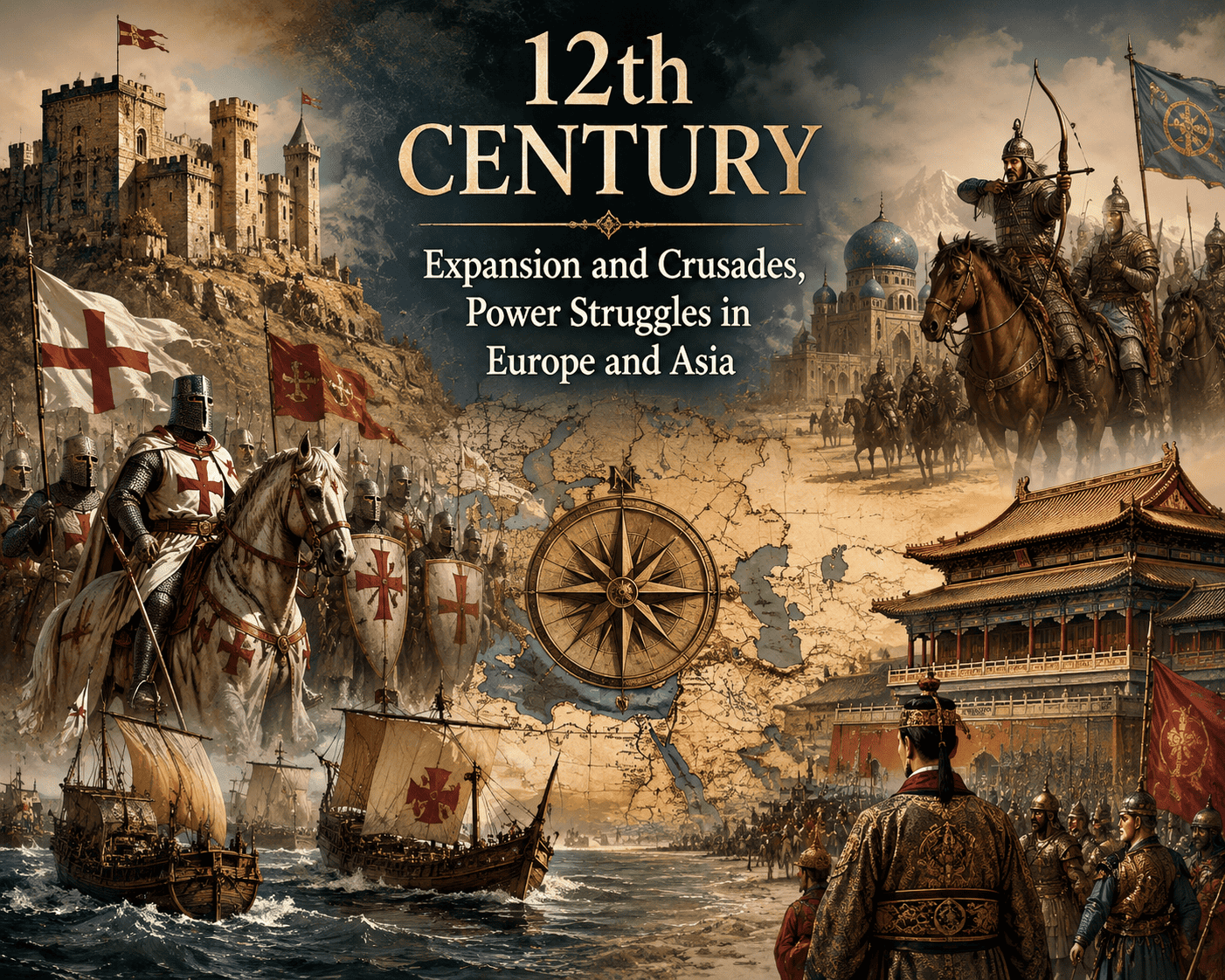
The 12th Century: Expansion and Crusades, Power Struggles in Europe and Asia
The 12th century was shaped by the continuation of the Crusades, including the Second and Third Crusades, as European powers and Islamic forces — led by figures like Saladin — clashed repeatedly over control of the Holy Land. This era also saw the rise of powerful medieval states, including the growth of the Holy Roman Empire, the expansion of the Angevin Empire under Henry II in England, and the flourishing of Islamic learning and culture under various dynasties. Feudal power struggles intensified across Europe, while intellectual life advanced through the founding of early universities and renewed interest in classical philosophy. At its core, the 12th century reveals a world defined by the ongoing contest for territory, faith, and authority between rival empires and civilizations.
The 12th Century (1101–1200 CE) — Complete World History Guide
- Chapter 1 — Understanding the 12th Century
- Chapter 2 — Major Empires and Kingdoms of the 12th Century
- 2.1 Overview — The World's Power Map in 1101 CE
- 2.2 Europe — Feudalism, Normans, and Emerging Nations
- 2.3 England — The Anarchy and Henry II
- 2.4 France — Capetians and Feudal Power
- 2.5 The Holy Roman Empire — Continued Conflict with the Papacy
- 2.6 The Byzantine Empire — Komnenian Recovery and Decline
- 2.7 The Middle East — Ayyubids Replace Fatimids
- 2.8 China — Song Dynasty and the Jin Invasion
- 2.9 Japan — End of Heian, Birth of the Kamakura Shogunate
- 2.10 Southeast Asia — Khmer Empire and Angkor Wat
- 2.11 India — Ghurid Invasions and the Delhi Sultanate
- 2.12 Africa — Almohads and the Ife Empire
- 2.13 The Americas — Toltec Fall and Chaco Canyon
- Chapter 3 — Wars and Battles of the 12th Century
- 3.1 Overview — Why the 12th Century Was So Conflicted
- 3.2 The Second Crusade (1147–1149)
- 3.3 The Battle of Hattin (1187) — Saladin's Greatest Victory
- 3.4 The Reconquest of Jerusalem (1187)
- 3.5 The Third Crusade (1189–1192) — Richard I of England vs Saladin
- 3.6 The Battle of Arsuf (1191)
- 3.7 The Treaty of Ramla (1192)
- 3.8 The Anarchy in England (1135–1154) — Detailed
- 3.9 The Siege of Lisbon (1147)
- 3.10 Jin–Song Wars in China
- 3.11 The Battle of Didgori (1121) — Georgia's Greatest Victory
- 3.12 Norman Invasion of Ireland (1169)
- Chapter 4 — Thinkers, Philosophers, and Religious Leaders
- 4.1 The Intellectual Climate of the 12th Century
- 4.2 Pierre Abelard (1079–1142) — Christian Humanism and Scholasticism
- 4.3 Shahab al-Din Suhrawardi (1154–1191) — School of Illumination
- 4.4 Hōnen Shōnin (1133–1212) — Pure Land Buddhism
- 4.5 Hildegard of Bingen (1098–1179) — Universal Genius
- 4.6 Muhammad al-Idrisi (1100–1165) — Geography and Cartography
- 4.7 Shota Rustaveli — Georgian Epic Poetry
- Chapter 5 — Religion and Cultural Developments
- Chapter 6 — Advances in Science, Technology, and Culture
- Chapter 7 — Complete Decade-by-Decade Timeline
- Chapter 8 — Summary and Legacy of the 12th Century
Chapter 1 — Understanding the 12th Century
1.1 Definition — What Is the 12th Century?
Definition: The 12th century is the period from January 1, 1101 CE to December 31, 1200 CE — the one hundred years immediately following the 11th century. It belongs to what European historians call the High Middle Ages, a period of significant social, economic, religious, and cultural development across the continent and beyond.
12th Century at a Glance:
Period:     1101 CE to 1200 CE
European Classification: High Middle Ages
Islamic World:  Continued Islamic Golden Age
China:          Song Dynasty (Northern → Southern)
Japan:          Heian Period ending → Kamakura beginning
India:          Ghurid invasions → Delhi Sultanate
Southeast Asia: Khmer Empire peak (Angkor Wat)
Africa:         Almohad dominance, Ife Empire rise
Americas:       Toltec collapse, Mississippian culture
The 12th century is sometimes called the “Renaissance of the 12th Century” in European historiography — a term coined by historian Charles Homer Haskins in 1927. This phrase refers to the extraordinary intellectual and cultural awakening in Western Europe during this period: the rise of the first universities, the flowering of scholastic philosophy, the beginning of Gothic architecture, the translation of ancient Greek and Arabic texts into Latin, and the early stirrings of a new humanistic intellectual culture.
However, as with the 11th century, restricting the story to Europe misses the full picture. The 12th century was simultaneously the golden age of the Khmer Empire (Angkor Wat was constructed during this century), a period of dramatic military and political transformation in China, the century in which Saladin reconquered Jerusalem, and the period when the foundations of the Delhi Sultanate were laid in India.
1.2 What Kind of World Existed in 1101 CE?
In the year 1101 CE, the world had just been transformed by the First Crusade’s capture of Jerusalem. The Crusader Kingdom of Jerusalem was barely a year old, surrounded by hostile Muslim powers and dependent on continued European support to survive. In Europe, the Norman Conquest of England was 35 years old and its consequences — the reshaping of the English language, aristocracy, and administration — were still unfolding.
In China, the Song Dynasty was managing a delicate balance between commercial prosperity and military vulnerability. The Treaty of Shanyuan with the Liao Dynasty was holding but at the cost of annual tribute. New threats were forming in the north that Song strategists could not yet fully perceive — the Jurchen people of Manchuria were beginning to build the power that would eventually form the Jin Dynasty and shatter Northern Song.
In the Islamic world, the shock of the First Crusade had not yet been absorbed. Muslim rulers were still adjusting to the reality of a Christian Crusader state in the heart of the Levant. The theological and political response — centered eventually on the concept of jihad as a defensive obligation — was still forming.
In Southeast Asia, the Khmer Empire under a new king was about to begin one of the most ambitious architectural programmes in human history. And in Japan, the sophisticated but politically stagnant Heian court culture was slowly being superseded by a new warrior class — the samurai — whose rise would transform Japanese civilization.
1.3 How the 12th Century Connected to the 11th
Every major theme of the 12th century grew directly from events of the 11th. The Crusades — which dominated 12th century politics — began in 1095. The Norman territorial expansion — England, Sicily, and now Ireland — was a direct continuation of the Norman military dynamism that had defined the late 11th century. The Seljuk Empire that had captured Baghdad and defeated Byzantium at Manzikert was still the dominant power in the Middle East at the century’s start. The Great Schism of 1054 was fresh enough that theological debates between Catholic and Orthodox churches were still generating heat.
The 12th century is therefore not a clean break from the 11th but its direct continuation — the same stories, the same conflicts, the same civilizations, now entering new chapters.
1.4 Why the 12th Century Matters
The 12th century matters for several reasons that directly connect to the modern world.
The Crusader-Islamic conflict of the 12th century — culminating in Saladin’s reconquest of Jerusalem in 1187 and the Third Crusade’s failure to recover it — established patterns of Christian-Islamic confrontation and coexistence whose echo can still be heard in modern geopolitics. The Treaty of Ramla of 1192, which ended the Third Crusade, was a pragmatic compromise that acknowledged Muslim political control while guaranteeing Christian pilgrim access — a template for managing competing claims to sacred space that remains relevant.
The founding of the Delhi Sultanate in 1192 began over 300 years of Islamic rule in northern India, profoundly shaping Indian culture, language, architecture, and social structure in ways still visible in modern India, Pakistan, and Bangladesh.
The establishment of the Kamakura Shogunate in Japan in 1192 created the samurai-dominated political system that defined Japanese civilization until 1868 — a period of nearly 700 years.
The construction of Angkor Wat created what remains the world’s largest religious monument and the defining symbol of Cambodian national identity.
1.5 The High Middle Ages — What This Term Means
Definition: The High Middle Ages is the period of European history from approximately 1000 to 1300 CE, between the Early Middle Ages (the so-called “Dark Ages” following Rome’s fall) and the Late Middle Ages (marked by the Black Death of 1347–1351 and the crises that followed). It is characterized by population growth, agricultural expansion, the rise of towns and trade, the building of Gothic cathedrals, the founding of universities, and the Crusades.
Medieval Period Divisions:
Early Middle Ages (Dark Ages): ~500–1000 CE
  - Fall of Rome's Western Empire (476 CE)
  - Viking and Magyar invasions
  - Feudalism developing
  - Literacy largely confined to monasteries
  - Population low and declining/stagnant

High Middle Ages: ~1000–1300 CE  ← 12th Century here
  - Population growth (Europe ~38 million → ~74 million)
  - Agricultural improvements (heavy plow, horse collar)
  - Towns reviving, trade expanding
  - Gothic cathedrals being built
  - First universities founded
  - Crusades dominating politics
  - Scholastic philosophy developing

Late Middle Ages: ~1300–1500 CE
  - Black Death (1347–1351) kills 1/3 of Europe
  - Hundred Years' War
  - Great Schism of Western Church
  - Renaissance beginning in Italy
  - Fall of Constantinople (1453)
The “Renaissance of the 12th Century” within the High Middle Ages refers specifically to the intellectual flowering that occurred when scholars in Spain, Sicily, and southern Italy — regions where Islamic, Jewish, and Christian cultures coexisted — began translating Arabic and Greek scientific and philosophical texts into Latin. For the first time, Western European scholars gained access to the full body of Aristotle’s work, to Islamic mathematics and medicine, to ancient Greek astronomy. This intellectual revolution was the direct precursor to the European scholastic tradition and ultimately to the Scientific Revolution.
Chapter 2 — Major Empires and Kingdoms of the 12th Century
2.1 Overview — The World’s Power Map in 1101 CE
Major Power Centers of the World in 1101 CE:

EAST ASIA:
Song Dynasty China — Still powerful, but under pressure
Jin Dynasty — Rising Jurchen power in Manchuria
Japan — Heian Period, transitioning to warrior culture
Korea (Goryeo) — Stable, Buddhist scholarship flourishing

SOUTH/SOUTHEAST ASIA:
Delhi Sultanate — Founding (1192, late century)
Khmer Empire — Peak power (Angkor Wat building from ~1113)
Pagan Kingdom — Buddhist temple building continuing
Champa Kingdom — Coastal Vietnam, conflict with Khmer
Hoysala Dynasty — Southern India, unique architecture

MIDDLE EAST:
Crusader States — the Kingdom of Jerusalem and the County of Tripoli
                  Principality of Antioch, County of Edessa
Seljuk Sultanate — Fragmented but still significant
Fatimid Caliphate — Egypt (collapsing, replaced 1171)
Ayyubid Dynasty — Egypt and Syria under Saladin (from 1171)
Byzantine Empire — Komnenian recovery, then decline again

EUROPE:
Holy Roman Empire — Conflict with papacy continuing
Norman England — Henry I, then civil war (Anarchy), then Henry II
Capetian France — Expanding, but slowly
Almohad Caliphate — North Africa and Spain
Georgia — Golden Age under David the Builder and Queen Tamar

AFRICA:
Almohad Caliphate — Northwest Africa and Iberia
Ife Empire — West Africa (Nigeria)
Kanem-Bornu — Central Africa

AMERICAS:
Mississippian Culture — North America, Cahokia peak
Toltec Empire — Central Mexico (collapsing)
Pueblo Culture — American Southwest (Chaco Canyon declining)
2.2 Europe — Feudalism, Normans, and Emerging Nations
Feudalism at Its Peak: Definition: Feudalism was the dominant political, economic, and social system of medieval Europe in which land (the primary source of wealth and power) was held by lords in exchange for military service to a higher lord, and worked by peasants (serfs) who owed labor and produce to their lord in exchange for protection.
In the 12th century, feudalism was at its most fully developed. The social hierarchy was clearly defined: king at the top, major lords (dukes, counts, earls) receiving land grants from the king in exchange for military service, lesser knights receiving land from the major lords, and peasants (free and unfree) at the base working the land.
Feudal Hierarchy:
KING
  └── Grants land (fiefs) to...
GREAT LORDS (such as dukes, counts, and earls)
        └── Grant land to...
            KNIGHTS (Lesser nobility)
              └── Rule over...
                  PEASANTS (free villeins, serfs)
                    └── Work the land and pay
                        dues to lords above them

Key Obligations:
King → Great Lords: Military service (knights for 40 days/year),
financial support and advice
Great Lords → Knights: Land (fief), protection, justice
Knights → Peasants: Protection, justice, land use
Peasants → Knights: Labor (corvée), percentage of crops,
                    various fees and dues

The Church existed alongside this structure,
owning approximately 1/3 of all land in Western Europe
and owing its own forms of feudal obligation
while also claiming independence from secular authority.
Norman expansion continued into the 12th century, as the Normans—who had already taken England in 1066 and Sicily between 1072 and 1091—kept extending their influence. In 1169, Anglo-Norman forces crossed to Ireland — invited initially by the deposed Irish king Dermot MacMurrough — beginning a process of English involvement in Ireland that would last for 800 years and whose consequences shaped Irish and British history profoundly.
2.3 England — The Anarchy and Henry II
The Anarchy (1135–1154): The Anarchy was a period of civil war in England and Normandy from 1135 to 1154, during which Stephen of England and Empress Matilda contested the throne after Henry I of England died without a legitimate male heir.
Henry I of England had just one legitimate son, William Adelin, who died when the White Ship disaster sank in 1120—an event that profoundly altered the course of English history. Henry forced his barons to swear to accept his daughter Matilda as successor, but when Henry died in 1135, his nephew Stephen moved quickly to seize the throne. Many barons accepted Stephen, but Matilda and her supporters (including her half-brother Robert of Gloucester and her husband Geoffrey of Anjou) fought for her claim.
The Anarchy — Why It Mattered:
Duration: 1135–1154 (approximately 19 years of civil war)

Consequences:
- Widespread destruction of towns and agricultural land
- Weakening of royal authority over barons
- Chronicle of the period (Peterborough Chronicle) describes
  a time when "Christ and his saints slept" — medieval
  way of saying God had abandoned England to suffering
- Castles built illegally throughout England as barons
exploited the weakness of central authority
- Economy severely disrupted, famine widespread

Resolution:
Treaty of Wallingford/Winchester (1153):
Stephen recognized as king for life.
Matilda's son Henry (of Anjou) recognized as heir.
When Stephen of England died in 1154, Henry II of England succeeded him as king.
Henry II and the Angevin Empire: Henry II (reigned 1154–1189) was one of the most remarkable rulers of medieval England. He ruled not just England but a vast collection of territories on both sides of the English Channel — the so-called Angevin Empire — inherited from his father (Anjou, Maine, Touraine), his mother (Normandy, England), and his wife Eleanor of Aquitaine (Aquitaine, Poitou). At its peak, his territory covered more of France than the French king controlled.
Henry II was an energetic, brilliant, and often brutal ruler who rebuilt royal authority after the Anarchy. His legal reforms — the Assize of Clarendon (1166), the Assize of Northampton (1176), and the establishment of common law courts with professional judges traveling the country — laid the foundations of the English common law system that is the ancestor of legal systems throughout the English-speaking world today.
Thomas Becket and the Church-State Conflict: Henry II’s greatest political disaster was his conflict with Thomas Becket, Archbishop of Canterbury. Henry had appointed his friend Becket as Archbishop expecting him to support royal authority over the Church. Instead, Becket became a fierce defender of Church independence and opposed Henry’s attempts to limit clerical privileges — specifically the practice of “benefit of clergy” by which priests accused of crimes could be tried only in Church courts, not royal courts.
The conflict escalated over years until four of Henry’s knights, hearing the king cry out in frustration “Will no one rid me of this turbulent priest?”, traveled to Canterbury Cathedral and murdered Becket before the altar on December 29, 1170. The assassination shocked all of Europe. Henry did public penance, walking barefoot to Canterbury and being flogged by monks at Becket’s tomb. Becket was canonized as a saint within three years. Canterbury became the most important pilgrimage site in England, immortalized in Chaucer’s Canterbury Tales two centuries later.
2.4 France — Capetians and Feudal Power
France in the 12th century was technically a unified kingdom under the Capetian dynasty but practically a collection of nearly independent territories. The most powerful figure in 12th century France for much of the period was not the King of France but Henry II of England, whose Angevin territories covered the western half of the French kingdom.
The Capetian kings of the 12th century — Louis VI (reigned 1108–1137), Louis VII (reigned 1137–1180), and Philip II Augustus (reigned 1180–1223, reigning into the 13th century) — were engaged in the slow, patient work of building genuine royal authority over their great vassals. Louis VII’s marriage to Eleanor of Aquitaine and its annulment (Eleanor then married Henry II) was one of the most consequential diplomatic events of the century, giving the English king control of southwestern France.
2.5 The Holy Roman Empire — Continued Conflict with the Papacy
The Investiture Controversy — the conflict between the papacy and the Holy Roman Emperor over who had the right to appoint church officials — had been partially resolved by the Concordat of Worms in 1122. This agreement established a compromise: the Pope would appoint bishops to their spiritual office (conferring the ring and staff representing spiritual authority), while the Emperor would invest them with their secular lands and rights (conferring the scepter representing political authority). In practice, this meant both parties had influence over episcopal appointments and the compromise was uneasy.
Frederick Barbarossa: Frederick I “Barbarossa” (Red Beard), Holy Roman Emperor from 1155 to 1190, was the dominant European political figure of the mid-12th century. He pursued an aggressive policy of asserting imperial authority over both the German princes and northern Italian cities. His conflict with the Lombard League — a coalition of northern Italian cities that refused imperial control — climaxed at the Battle of Legnano in 1176.
The Battle of Legnano (1176): Definition: The Battle of Legnano on May 29, 1176 was a decisive defeat of the imperial forces of Frederick Barbarossa by the Lombard League infantry near Milan. It is historically significant as one of the first battles in medieval history where trained infantry decisively defeated feudal cavalry — foreshadowing the later dominance of Swiss and Flemish infantry over mounted knights.
The Lombard League cities — Milan, Venice, Brescia, Bologna, and others — had rebuilt Milan (which Barbarossa had destroyed in 1162) and organized a military alliance. At Legnano, their disciplined infantry formations, organized around the carrocchio (a large ox-drawn wagon bearing the city’s standard, representing civic pride and honor), stood firm against the imperial cavalry and eventually routed it. Barbarossa himself barely escaped.
Significance of Legnano:
Military: Demonstrated that disciplined infantry could
          defeat feudal cavalry — a major tactical lesson
          that would be reinforced repeatedly in the
          over the next two centuries.

Political: Forced Barbarossa to negotiate the Peace
           of Constance (1183), granting Lombard cities
           extensive self-government while nominally
           remaining within the empire.

Symbolic: Celebrated as a victory of communal freedom
          over imperial tyranny — the Lombard League's
          victory became a founding myth of northern
          a sense of civic identity in Italy


Legacy: Legnano is celebrated as a national holiday
        in Italy (June 7 originally, now May 29).
        The anthem "Il Canto degli Italiani" references
        the Battle of Legnano explicitly.
2.6 The Byzantine Empire — Komnenian Recovery and Decline
The Komnenian dynasty (1081–1185) achieved a partial recovery of Byzantine power after the catastrophe of Manzikert. Alexios I Komnenos (reigned 1081–1118) had restored order from chaos and used the First Crusade’s armies (which he had partially invited) to recover some Anatolian territory. His son John II Komnenos (reigned 1118–1143) and grandson Manuel I Komnenos (reigned 1143–1180) continued this recovery, with Manuel in particular pursuing ambitious foreign policies that temporarily made Byzantium a significant Mediterranean power again.
However, the Battle of Myriokephalon in 1176 shattered Manuel’s ambitions. Attempting to drive the Seljuks from the Anatolian plateau, Manuel’s army was ambushed in a mountain pass — a near-repeat of Manzikert — and decisively defeated. Manuel himself compared it to Manzikert. After his death in 1180, Byzantine political stability collapsed again into the familiar pattern of palace coups and rapid imperial succession.
2.7 The Middle East — Ayyubids Replace Fatimids
The Fatimid Decline: The Fatimid Caliphate in Egypt, which had been one of the most powerful and sophisticated states in the Islamic world for two centuries, collapsed in the 12th century through a combination of internal political dysfunction, military weakness, and the rise of an extraordinary adversary — Saladin.
The later Fatimid caliphs were increasingly controlled by powerful viziers who wielded actual power while the caliphs performed ceremonial functions. Competing viziers fought each other, sometimes inviting Crusader military assistance against each other — a sign of how thoroughly the Fatimid political system had collapsed.
Saladin and the Ayyubid Dynasty: Definition: Salah ad-Din Yusuf ibn Ayyub — known in the West as “Saladin” — was a Kurdish Muslim military leader who became the most famous Islamic commander of the 12th century, founder of the Ayyubid dynasty, and the man who reconquered Jerusalem from the Crusaders in 1187.
Saladin rose through the military service of Nur ad-Din, the Zengid ruler of Syria, who had been the most effective anti-Crusade military organizer before Saladin. When Nur ad-Din sent Saladin to Egypt in 1169 to prevent a Crusader takeover of the Fatimid Caliphate, Saladin used the opportunity to become the real power in Egypt. When the last Fatimid Caliph al-Adid died in 1171, Saladin did not appoint a successor — ending the Fatimid Caliphate after 200 years and replacing it with his own Ayyubid dynasty, while returning Egypt to Sunni Islam.
Saladin's Strategic Achievement:
Before Saladin: The Crusader States sat between
                Syria (Zengid/Ayyubid) and Egypt (Fatimid) —
                these two Muslim powers were often rivals,
                allowing Crusaders to maintain balance.

Saladin's Solution: Unite Egypt and Syria under one ruler.
                    Remove the strategic advantage that
                    kept Crusaders between divided enemies.

After 1171: Egypt (Ayyubid) + Syria (Ayyubid) =
            Crusader States surrounded on multiple sides
            by a unified hostile power.

This strategic encirclement made the Battle of Hattin
and the fall of Jerusalem almost inevitable.
2.8 China — Song Dynasty and the Jin Invasion
Northern Song’s Fatal Miscalculation: The Northern Song Dynasty made one of the most catastrophic diplomatic errors in Chinese history in the early 12th century. The Jurchen people of Manchuria were building the Jin Dynasty and making war on the Liao Dynasty — the same Liao Dynasty that had forced Song to pay annual tribute since the Treaty of Shanyuan in 1005.
The Song court saw an opportunity. They formed an alliance with the Jurchen Jin to confront their shared enemy, the Liao. Together they destroyed the Liao Dynasty in 1125. Song expected to recover the northern territories it had lost to Liao. Instead, the Jin immediately turned on their Song allies.
In 1127, Jin forces sacked Kaifeng — the Song capital — and captured both the reigning Emperor Huizong and his son Emperor Qinzong. This catastrophic event is known as the Jingkang Incident and marks the end of the Northern Song Dynasty. The humiliation of having two emperors taken prisoner and paraded through Manchuria was seared into Chinese historical memory.
The Southern Song: The Northern Song’s remnants established the Southern Song Dynasty (1127–1279) with a new capital at Lin’an (modern Hangzhou). The Southern Song never recovered the north — the Jin Dynasty controlled everything north of the Huai River for the rest of the century — but it rebuilt its power and continued to be one of the world’s most economically and technologically sophisticated states.
The Southern Song established a permanent navy — the world’s first standing professional navy organized as a government institution rather than a temporary military measure. This navy used paddle-wheel ships powered by treadmills operated by sailors — an early form of mechanical naval propulsion. In 1161, this navy defeated a Jin attempt to cross the Yangtze River using gunpowder weapons, including early fire bombs and possibly the first use of gunpowder weapons in a naval battle.
2.9 Japan — End of Heian, Birth of the Kamakura Shogunate
The Decline of Heian Culture: The Heian period’s elaborate court culture and Fujiwara political dominance had been based on a fundamental economic arrangement — aristocratic families holding vast tax-exempt estates (shōen) that provided their income. As more land became tax-exempt, the imperial government’s revenue shrank. Provincial administration deteriorated. Local lords needed to defend their property and found that the court in Kyoto could not protect them.
This created demand for professional warriors — samurai — who received land in exchange for military service. Two great warrior clans rose to prominence: the Taira (Heike) and the Minamoto (Genji). Their rivalry climaxed in the Genpei War (1180–1185), a five-year civil war that produced some of the most celebrated episodes in Japanese literature and history.
The Genpei War and the Kamakura Shogunate: The Genpei War ended with the decisive naval Battle of Dan-no-Ura in 1185, where the Minamoto forces defeated the Taira fleet. The Taira commander, rather than surrender, drowned himself and the young Emperor Antoku, throwing the imperial regalia into the sea.
Minamoto no Yoritomo — the Minamoto leader who had directed the war from his base at Kamakura rather than going to Kyoto — was appointed Seii Taishogun (Shogun — supreme military commander) by the Emperor in 1192. This appointment created the template for Japanese governance that would last until 1868.
The Shogunate System:
Emperor: Theoretically supreme, performed ritual and
         religious functions, source of all legitimacy.
         In practice: politically powerless ceremonial figure.

Shogun:  Military dictator, ruling in the emperor's name.
         Actual political and military power.
         Based at Kamakura (not the imperial capital Kyoto).

This dual system — emperor as symbolic source of
legitimacy, military ruler as actual power —
had parallels in 11th century Japan (Fujiwara regents)
but the Shogunate made military power permanent and
institutionalized for nearly 700 years.

The Shogunate system survived from:
Kamakura Shogunate:  1192–1333
Ashikaga Shogunate:  1338–1573
Tokugawa Shogunate:  1603–1868
2.10 Southeast Asia — Khmer Empire and Angkor Wat
The Khmer Empire at Its Peak: The Khmer Empire of Cambodia reached its greatest territorial extent and cultural achievement in the 12th century. Under Suryavarman II (reigned approximately 1113–1150) and later Jayavarman VII (reigned 1181–1218), the empire controlled much of mainland Southeast Asia.
Angkor Wat: Definition: Angkor Wat is a temple complex in northwestern Cambodia, built during the reign of Suryavarman II in the first half of the 12th century. It is the world’s largest religious monument, covering approximately 162.6 hectares (about 401 acres), and represents the peak of Khmer architectural achievement.
The name “Angkor Wat” means “City Temple” (Angkor = city, Wat = temple). It was originally dedicated to the Hindu god Vishnu — serving as both the state temple of the Khmer Empire and the mausoleum of Suryavarman II. In the 14th or 15th century it became a Buddhist temple and has remained a Buddhist site continuously since.
Angkor Wat — Key Facts:
Construction:  ~1113–1150 CE under Suryavarman II
Religion:      Originally Hindu (Vishnu), later Buddhist
Size:          Largest religious monument in the world
               ~162.6 hectares (401 acres) of temple complex
               Surrounded by a moat 190 metres wide, 5.5 km long
               Total area including moat and causeway: ~1,626 hectares

Architecture:
The temple represents Mount Meru — the sacred mountain
located at the center of the universe in Hindu and Buddhist cosmology

The five central towers symbolize the five peaks of Mount Meru.
The surrounding moat represents the oceans surrounding
the cosmic mountain.
The causeway represents the road from the human world
to the divine world.

Gallery walls covered with ~1,200 square metres of
bas-reliefs depicting: Hindu mythology (scenes from
Ramayana and Mahabharata), historical scenes including
Suryavarman II's military campaigns, scenes from
heaven and hell in Hindu cosmology.

Astronomical alignments:
The temple faces west, which is unusual—
most Khmer temples face east) which aligned it with
the setting sun, associated with death and ancestors.
At the spring equinox, the sun rises precisely
over the central tower when viewed from the main
causeway entrance — an intentional solar alignment.

Modern significance:
Angkor Wat is the symbol of Cambodia, appearing on
the national flag — the only building in the world
to appear on a national flag.
UNESCO World Heritage Site since 1992.
Jayavarman VII — The Buddhist King: Late in the 12th century, Jayavarman VII (reigned 1181–1218) became the greatest Khmer ruler, reversing a Cham invasion that had briefly captured the Khmer capital Angkor in 1177. He built even more massively than Suryavarman II, constructing the Bayon temple at Angkor Thom and hundreds of hospitals and rest houses throughout the empire — all decorated with the serene, smiling stone faces that became his architectural signature. Uniquely among Khmer rulers, Jayavarman VII was a devout Mahayana Buddhist who dedicated his temples to the Buddhist ideal of compassion rather than to Hindu deities.
2.11 India — Ghurid Invasions and the Delhi Sultanate
The Ghurid Dynasty: The Ghurid Empire was a dynasty based in the Ghor region of modern Afghanistan that converted to Islam in the 12th century and became one of the most aggressive expansionist powers in the Islamic world. Under Sultan Muhammad of Ghor (also known as Mu’izz ad-Din Muhammad), the Ghurids launched a series of invasions into the Indian subcontinent that permanently transformed the subcontinent’s religious and political landscape.
The Battle of Tarain (1191 and 1192): The First Battle of Tarain (1191) was actually an Indian victory — the Rajput King Prithviraj III of Delhi defeated Muhammad of Ghor and captured him. According to tradition, Prithviraj released Muhammad — an act of chivalrous generosity that would prove fatal.
The Second Battle of Tarain (1192) was one of the most decisive battles in Indian history. Muhammad of Ghor returned with a larger, better-organized force. The Rajput cavalry — numerous and individually brave — was outmaneuvered by Ghurid tactics, which used a feigned retreat to draw the Rajput horse forward before surrounding and destroying them. Prithviraj III was captured and executed.
Consequences of Tarain (1192):
Short-term:
- Muhammad of Ghor's forces captured Delhi
- Destruction of the Prithviraj III kingdom
- Muhammad's general Qutb ud-Din Aibak became
  governor of the conquered Indian territories

Long-term:
- Foundation of the Delhi Sultanate (1206)
  when Qutb ud-Din Aibak became the first Sultan
  after Muhammad's death
- Over 300 years of Islamic sultans ruling Delhi
  (Delhi Sultanate: 1206–1526)
- Then replaced by the Mughal Empire (1526–1857)
- Total period of Muslim political dominance in
  northern India: approximately 600 years

Cultural Impact:
- Introduction of Islamic architecture to India
  (Qutb Minar built by Qutb ud-Din Aibak)
- Persian as language of culture and administration
- Synthesis of Islamic and Indian cultural traditions
  that produced Urdu language, Mughal painting,
  Indo-Islamic architecture, and eventually
  the hybrid culture of the Indian subcontinent
Nalanda University Destroyed (1193): Nalanda University — one of the greatest centers of learning in the ancient and medieval world — was destroyed by Ghurid forces under Bakhtiyar Khilji in 1193. Nalanda, in modern Bihar (India), had been a functioning university since approximately the 5th century CE, attracting scholars from across Asia. At its peak it housed perhaps 10,000 students and 2,000 teachers, with a library containing millions of manuscripts covering Buddhist philosophy, logic, grammar, medicine, and other subjects.
The destruction of Nalanda was a catastrophic blow to Indian Buddhist scholarship.The library is said to have burned for three months. Hundreds of monks were killed. The destruction effectively ended Buddhism as a major living tradition in its land of origin — Indian Buddhism, already weakened by the revival of Hinduism and competition from Islam, never recovered. The monks and scholars who survived fled to Nepal, Tibet, and Southeast Asia, carrying Buddhist learning to new homes.
2.12 Africa — Almohads and the Ife Empire
The Almohad Caliphate: Definition: The Almohad Caliphate was a Berber Muslim dynasty originating in Morocco that became the dominant power in North Africa and the Muslim portions of Spain in the 12th century, replacing the Almoravids they had overthrown.
The Almohads were founded by Muhammad ibn Tumart, a religious reformer who studied in the Islamic East and returned to Morocco with a strict monotheistic message (Almohad means “those who affirm the unity of God”). He attracted a following among the Atlas Mountain Berber tribes and launched a military movement that overthrew the Almoravids in Morocco (1147) and Spain.
Under Abd al-Mumin and subsequent caliphs, the Almohad Empire controlled all of North Africa from the Atlantic to Libya and all Muslim Spain. They were patrons of scholarship and philosophy — the great philosopher Averroës (Ibn Rushd, 1126–1198) worked under Almohad patronage. However, they were also religiously strict, persecuting Jews and Christians in their territories and destroying synagogues — a departure from the relative religious tolerance of earlier Islamic Spain.
The Ife Empire (West Africa): The Ife civilization in modern southwestern Nigeria developed into one of the most remarkable artistic cultures in African history during the 12th century. Ife art — particularly the naturalistic bronze and terracotta portrait heads produced by Ife sculptors — represented a completely independent tradition of realistic portrait sculpture of extraordinary quality.
When European explorers and later scholars first encountered Ife bronzes in the 19th and 20th centuries, many refused to believe Africans had created them, suggesting (without any evidence) that they must have been made by ancient Greeks or other external influences. This reaction revealed more about European racial prejudices than about Ife art. Modern scholarship has firmly established Ife as the source of these masterworks, and they are now recognized as among the greatest achievements of world sculpture.
Ife Artistic Achievement:
Period: Approximately 11th–15th centuries CE
Medium: Naturalistic portrait heads in bronze (lost-wax casting)
        and terracotta materials
Style:  Highly realistic, individualized — each face
        appears to be a specific person
Technique: Lost-wax (cire perdue) bronze casting of remarkable
           advanced technical complexity
Scale:  Life-size and near life-size portrait heads
Subjects: Believed to represent kings (Ooni) of Ife
          and other important persons

Technical significance:
The lost-wax technique used at Ife was independently
developed and reached levels of technical refinement
equal to or exceeding contemporary European bronzework.
The thin walls of Ife bronzes (sometimes only 3mm thick)
required extremely sophisticated casting technique.

Cultural significance:
Ife is regarded as the spiritual and cultural center
of the Yoruba people.
The Ife kings (Ooni) were believed to be descendants
of the god Oduduwa, who created the world.
Other Yoruba kingdoms traced their legitimacy to
royal descent from Ife rulers.
The artistic tradition influenced subsequent
Nigerian art including Benin bronzes (from 14th century).
2.13 The Americas — Toltec Fall and Chaco Canyon
The Toltec Empire Falls: The Toltec civilization of central Mexico, centered at Tula, collapsed in the early 12th century due to a combination of drought, internal political conflict, and pressure from northern nomadic peoples (collectively called Chichimec). The fall of Tula around 1150–1200 CE created a power vacuum in central Mexico that various successor states competed to fill, eventually leading to the rise of the Aztec (Mexica) civilization in the 14th–15th centuries.
Chaco Canyon Declines: In the American Southwest, the Ancestral Pueblo culture centered on Chaco Canyon in modern New Mexico was declining. Chaco Canyon had been a major ceremonial, trade, and administrative center since approximately the 9th century — the great houses of Pueblo Bonito and other sites were multistory stone buildings with hundreds of rooms, connected to outlying communities by a sophisticated road network. By the late 12th century, environmental stress (drought) and social pressures caused the abandonment of Chaco Canyon. The population dispersed to other locations, eventually establishing the Pueblo communities that still exist in the American Southwest.
Natchez Ceremonial Centers: The Mississippian culture in the American Southeast was constructing ceremonial mound centers throughout the 12th century. The Natchez people of the lower Mississippi Valley built platform mounds topped with temples and chiefly residences. The Mississippian culture shared religious iconography and trade goods across enormous distances — copper ornaments, ceramic vessels, and carved stone objects found at Mississippian sites show connections from the Great Lakes to the Gulf of Mexico.
Chapter 3 — Wars and Battles of the 12th Century
3.1 Overview — Why the 12th Century Was So Conflicted
The 12th century was defined by conflict on multiple fronts simultaneously. In the Middle East, the Crusader States fought for survival against increasingly unified and determined Islamic opposition. In Europe, internal dynastic conflicts (the Anarchy in England, Barbarossa’s Italian campaigns, the continuing church-state conflict) consumed enormous resources.In China, the Jin invasion brought an end to the Northern Song dynasty. In India, the Ghurid invasions transformed the subcontinent. In Japan, the Genpei War between warrior clans ended the Heian period.
Unlike the 11th century’s largely separate regional conflicts, the 12th century saw some of the first genuinely intercontinental strategic interactions — the Crusades connected Western European military ambitions directly to Middle Eastern politics in ways that affected everything from Byzantine policy to Egyptian governance.
3.2 The Second Crusade (1147–1149)
Background: The County of Edessa — the northernmost and most exposed of the Crusader States, established in 1098 — fell to Zengi, the Zengid ruler of Mosul, in 1144. This was the first major Crusader territorial loss and triggered a new Crusade call.
Bernard of Clairvaux: The Second Crusade was preached by Bernard of Clairvaux, the most influential churchman in 12th century Europe — a Cistercian monk whose personal holiness, forceful preaching, and extensive correspondence made him the moral conscience of Catholic Christendom. He secured the participation of two kings — Louis VII of France and Conrad III of the Holy Roman Empire — an unprecedented level of royal commitment.
The Catastrophic Failure: The Second Crusade was a complete disaster. The German contingent under Conrad was destroyed in Anatolia by Seljuk forces — ambushed in the same regions that had proven fatal to the People’s Crusade in 1096. The French forces under Louis VII also suffered heavily in Anatolia. When the surviving forces finally reached the Holy Land, they made the baffling strategic decision to attack Damascus — a city that had been a useful, neutral buffer between the Crusader States and more dangerous enemies. The siege of Damascus failed in four days, and the Second Crusade ended with nothing accomplished and much prestige lost.
3.3 The Battle of Hattin (1187) — Saladin’s Greatest Victory
Definition: The Battle of Hattin on July 4, 1187 was a decisive engagement in Galilee in which Saladin’s Ayyubid army surrounded and destroyed the main military force of the Kingdom of Jerusalem, effectively ending the kingdom’s ability to defend itself and opening the way for the reconquest of Jerusalem.
The Strategic Context: Saladin had spent years methodically building his power — uniting Egypt and Syria, securing the loyalty of other Muslim rulers, and preparing for the final confrontation with the Crusader States. The trigger for the 1187 campaign was the breaking of a truce by Raynald of Chatillon, the aggressive lord of Kerak castle, who attacked a Muslim caravan and refused to release the prisoners or compensate for the losses despite a truce being in effect.
The Battle: The Crusader army — approximately 20,000 men including virtually every fighting man in the Kingdom of Jerusalem — marched in summer heat to relieve the besieged city of Tiberias. Saladin controlled the water sources. The Crusaders became desperately thirsty as they marched. They were surrounded and harassed by Muslim cavalry and archers throughout their march. On the night of July 3–4, they tried to reach water at a spring near the Horns of Hattin — twin extinct volcanic peaks — and were surrounded.
The Battle of Hattin — Military Analysis:
Saladin's Strategy:
  - Control all water sources on the route
  - Use cavalry to harass and exhaust, not to close
  - Force the enemy to fight in conditions of
    maximum disadvantage (thirst, heat, fatigue)
  - Never allow the Crusaders to rest or recover

Crusader Mistakes:
  - Advanced in the hottest period of summer
  - Left a secure water supply (Sephoria) for
    an uncertain advance in response to siege of Tiberias
  - Failed to force a decisive battle while still fresh
  - Lost cohesion as thirst and exhaustion took hold

Result:
  - Crusader army completely destroyed or captured
  - King Guy of Jerusalem captured
  - Raynald of Chatillon personally executed by Saladin
  - The True Cross (believed to be a fragment of
    Christ's actual cross, the most sacred Christian
    relic in the Middle East) captured
  - Road to Jerusalem open — no army remained to defend it
3.4 The Reconquest of Jerusalem (1187)
After Hattin, Saladin moved rapidly. City after city surrendered or was taken — Acre, Jaffa, Sidon, Beirut, Ascalon. Jerusalem itself was besieged. Without the army destroyed at Hattin, the city could not be defended militarily. Balian of Ibelin negotiated a surrender on October 2, 1187.
Saladin’s treatment of Jerusalem’s population was deliberately contrasted with the Crusaders’ massacre of 1099. He negotiated a ransom for most inhabitants — those who could pay were released, those who could not were enslaved, but there was no general massacre. Saladin personally ransomed many poor Christians from his own funds. The contrast between the Christian capture of 1099 and the Muslim capture of 1187 was noted by contemporaries on all sides.
The news of Jerusalem’s fall reached Europe with shocking impact. Pope Gregory VIII issued a papal bull attributing the disaster to the sins of Christians. Within two years, the Third Crusade — the most famous of all — was being organized.
3.5 The Third Crusade (1189–1192) — Richard I of England vs Saladin
The Kings Who Came: The Third Crusade assembled the most impressive collection of European royalty of the medieval period: Frederick Barbarossa of the Holy Roman Empire, Philip II Augustus of France, and Richard I “the Lionheart” of England all took the cross. Frederick drowned crossing a river in Anatolia in 1190, and most of his army went home — a devastating loss. Philip and Richard quarreled continuously but arrived in the Holy Land in 1191.
Richard I “the Lionheart”: Richard I (reigned 1189–1199) was by reputation the greatest military commander of his age. He was physically imposing, personally brave to the point of recklessness, and tactically sophisticated. He spoke French rather than English and spent approximately six months of his ten-year reign in England — yet he became England’s most celebrated warrior king.
The Siege of Acre: The centerpiece of the early Third Crusade was the lengthy Siege of Acre (1189–1191), a key port city held by Saladin. The siege had begun before Richard arrived, and when he brought his fleet with supplies and siege equipment, he turned a stalemate into a victory. Acre fell on July 12, 1191. Richard then made the controversial decision to execute approximately 2,700 Muslim prisoners — partly for logistical reasons (he could not feed them during a campaign march) and partly as a demonstration of power. The massacre shocked the Islamic world.
3.6 The Battle of Arsuf (1191)
Definition: The Battle of Arsuf on September 7, 1191 was a significant Crusader victory in which Richard I of England defeated Saladin’s army while marching his forces along the coast from Acre toward Jaffa.
Richard’s tactical achievement at Arsuf was maintaining the cohesion of his march under continuous Muslim harassment. Saladin’s cavalry attacked constantly, trying to provoke the Crusader cavalry into breaking formation and charging — which would isolate them for destruction. Richard’s orders were strict: maintain the march formation, do not charge without command.
Richard's Tactical Problem at Arsuf:
Muslim cavalry tactics:
* Advance, fire arrows, then withdraw
  - Repeated harassment, never closing for melee
  - Goal: provoke Crusader cavalry to charge
  - Isolated charging cavalry could be surrounded and killed

Richard's Solution:
  - Maintain tight column formation (infantry on outside,
    cavalry protected inside)
  - Infantry wear armor, absorb arrow fire
  - Strict orders: no cavalry charge without signal
  - Wait for enemy to come within range before charging

The Battle:
  - After hours of harassment, the Hospitallers
    (military order) could no longer contain their
    frustration and charged without orders
  - Richard immediately sent the full cavalry charge
    to support them rather than see them isolated
  - The charge hit Saladin's cavalry while they were
    close, unprepared for the sudden reversal
  - Saladin's forces broke and fled
  - Disciplined pursuit prevented the routing of
    Crusader forces afterward

Result: Crusader tactical victory — path to Jaffa open.
        Saladin's army not destroyed — war continued.
3.7 The Treaty of Ramla (1192)
Richard and Saladin never met face-to-face, conducting their negotiations through intermediaries. Both sides recognized the military reality: Richard could not hold Jerusalem even if he captured it (his army would go home after the Crusade, leaving too few defenders), and Saladin could not expel the Crusaders from the coast as long as Richard’s army was intact.
The Treaty of Ramla (September 2, 1192) established a three-year truce with the following terms: the Crusader States retained the coastal strip from Tyre to Jaffa; Jerusalem remained under Muslim political control; unarmed Christian pilgrims were guaranteed access to Jerusalem’s holy sites; the city of Ascalon (whose fortifications Richard had rebuilt and Saladin demanded demolished) was demolished. Both Richard and Saladin expressed mutual respect — Saladin reportedly sent ice from Mount Hermon when Richard was ill.
Treaty of Ramla — Legacy:
Short-term: Preserved Crusader States in reduced form.
The Crusaders retained control of the coastline, securing valuable trade revenues.
            Muslims kept Jerusalem (religious capital).
            Pilgrims could visit without political control.

Long-term: The city remained open, allowing free access for pilgrims
           concept established by this treaty is
           the template still being discussed today
           for managing competing claims to Jerusalem.

Saladin died on March 4, 1193 — just six months after
the treaty was signed. He died having given away most of
his personal wealth in charity, leaving only one gold piece
and forty-seven silver pieces — insufficient for his own
funeral expenses.

Richard I was captured returning home (Austrian
archduke Leopold had a grudge) and held for ransom.
England paid an enormous ransom (150,000 marks —
two to three times the annual royal revenue).
Richard died from a crossbow bolt wound in 1199.
3.8 The Anarchy in England (1135–1154) — Detailed
The civil war between King Stephen and Empress Matilda lasted nearly 20 years and represents one of England’s most destructive domestic conflicts. The contemporary Peterborough Chronicle described the period in apocalyptic terms — barons building illegal castles, collecting unauthorized tolls, taxing and torturing peasants, destroying churches and villages, widespread famine as agricultural production collapsed.
The war was also a conflict about inheritance rights and the position of women in medieval society. Matilda’s claim came through direct descent from King Henry I — she was his daughter. Stephen’s claim came through his mother Adela — daughter of William the Conqueror and therefore Henry I’s sister. In feudal law, a daughter’s claim was stronger than a nephew’s, but the barons who swore to support Matilda changed their minds when faced with the actual prospect of being ruled by a woman.
The Treaty of Wallingford in 1153 resolved the succession by the politically elegant solution of Stephen remaining king for life while Matilda’s son Henry became recognized heir. When Stephen died in October 1154, Henry II began one of medieval England’s most important reigns.
3.9 The Siege of Lisbon (1147)
The Siege of Lisbon in 1147 was one of the most significant military events of the Iberian Reconquista and an example of how the Crusading movement intersected with local European wars. A fleet of Northern European Crusaders — English, Flemish, German, and Rhinelanders — on their way to the Holy Land for the Second Crusade stopped in Portugal at the request of King Afonso Henriques.
Afonso offered the Crusaders land and plunder from Lisbon in exchange for their help taking the city from its Moorish Muslim defenders. After a four-month siege, Lisbon fell on October 25, 1147. Many of the Crusaders settled in Portugal permanently. The capture of Lisbon established Portugal as a viable kingdom and gave it control of its most important future city and port.
3.10 Jin–Song Wars in China
The Jin Dynasty, having destroyed the Northern Song’s power in the Jingkang Incident of 1127, attempted further southward expansion against the Southern Song. A series of major campaigns followed throughout the mid-12th century. The Southern Song defensive strategy relied on the natural barriers of the Yangtze and Huai Rivers and on an organized river navy.
The decisive moment came in the naval Battle of Caishi in 1161, when the Song navy defeated a much larger Jin fleet attempting to cross the Yangtze River. Song forces used gunpowder fire bombs — thrown or launched by catapult — to set fire to the Jin fleet. This battle, won partly through superior military technology, preserved the Yangtze as the boundary between Jin and Southern Song for another century.
3.11 The Battle of Didgori (1121) — Georgia’s Greatest Victory
Definition: The Battle of Didgori on August 12, 1121 was a decisive victory by the Georgian army under King David IV “the Builder” against a massive Seljuk coalition, considered the greatest military victory in Georgian history and celebrated as Georgian national holiday.
The Seljuk coalition opposing David reportedly numbered several hundred thousand men (medieval chronicles exaggerate; modern estimates suggest perhaps 250,000 to 400,000) assembled from multiple Islamic powers — the Seljuk Sultanate, the Artuqids, and other regional powers — against David’s Georgian army of approximately 56,000. David used the narrow Didgori pass to negate the enemy’s numerical advantage and employed a deception that sent enemy deserters into the Muslim camp just before battle, causing confusion at a critical moment. The result was a decisive Georgian victory that allowed David to capture the city of Tbilisi (taken back from Muslim control) and establish Georgia’s Golden Age.
3.12 Norman Invasion of Ireland (1169)
The Norman involvement in Ireland began in 1169 when Richard de Clare (known as “Strongbow”) and other Anglo-Norman knights crossed to Ireland at the invitation of Dermot MacMurrough, the deposed king of Leinster who wanted military help recovering his kingdom. Strongbow married Dermot’s daughter and inherited Leinster when Dermot died in 1171, creating a Norman lordship in Ireland.
King Henry II of England, concerned about an independent Norman power base developing in Ireland, crossed to Ireland in 1171–1172 with a large army. The Irish kings generally submitted to Henry, making him Lord of Ireland — a title English (later British) monarchs would hold until 1542 when Henry VIII adopted the title King of Ireland. This Norman intervention began over 800 years of English involvement in Ireland.
Chapter 4 — Thinkers, Philosophers, and Religious Leaders
4.1 The Intellectual Climate of the 12th Century
The 12th century intellectual climate in Europe was transformed by the Translation Movement — the systematic translation of Arabic and Greek texts into Latin, primarily in Spain and Sicily where Muslim, Jewish, and Christian scholars worked in proximity. For the first time, Western European scholars gained access to Aristotle’s complete works, to Islamic mathematics (including Arabic numerals and algebra), to Avicenna’s Canon of Medicine, and to dozens of other texts unknown or unavailable in Western Europe.
This influx of knowledge created an intellectual crisis and an intellectual revolution simultaneously. Aristotle’s works on natural philosophy, logic, and metaphysics were far more sophisticated than anything available in 12th century Europe. How should they be reconciled with Christian theology? This question drove the scholastic philosophical enterprise for the next 200 years.
4.2 Pierre Abelard (1079–1142) — Christian Humanism and Scholasticism
Who He Was: Pierre Abelard was a French philosopher, theologian, and logician who was arguably the most brilliant — and most controversial — intellectual in 12th century Europe. His method of applying rigorous logical analysis to theological questions both attracted enormous student followings (he was one of the most popular lecturers in Paris) and earned him powerful enemies among conservative churchmen.
Sic et Non (Yes and No): Abelard’s most influential work, Sic et Non (Yes and No), compiled approximately 158 theological questions and assembled contradictory quotations from Church Fathers on each side of each question. The point was not to resolve these contradictions but to identify them clearly so they could be addressed through logical analysis. This method — presenting a question, listing arguments for and against, then working toward a resolution — became the standard format of scholastic philosophy and university teaching, still recognizable in academic writing today.
The Tragic Love Story — Abelard and Héloïse: Abelard’s personal life was as dramatic as his intellectual life. He became the tutor of Héloïse, niece of a canon of Notre-Dame Cathedral in Paris. They fell deeply in love, conducted a secret affair, had a son (whom they named Astrolabe), and secretly married. When Héloïse’s uncle discovered the relationship, he arranged for thugs to castrate Abelard as punishment. Peter Abelard entered monastic life, while Héloïse d’Argenteuil became a nun.
Their subsequent correspondence — preserved as Historia Calamitatum (The Story of My Misfortunes) and their letters — is one of the most remarkable literary and intellectual exchanges of the medieval period. Héloïse’s letters demonstrate a philosophical mind equal to Abelard’s, questioning conventional religious motivations and arguing for the primacy of intention over action in moral judgment.
4.3 Shahab al-Din Suhrawardi (1154–1191) — School of Illumination
Who He Was: Yahya ibn Habash Suhrawardi was a Persian Islamic philosopher who founded the “Illuminationist” (Ishraq) school of Islamic philosophy — one of the most important original developments in Islamic philosophy since Avicenna. He was executed at approximately age 36 on orders of Saladin’s son Al-Malik al-Zahir in Aleppo, reportedly for heterodox views.
Illuminationist Philosophy: Suhrawardi’s central insight was that knowledge and reality are fundamentally about light. God is the Light of Lights — the ultimate source of all illumination. All existence is a gradation of light, from the pure divine light through descending levels of spiritual beings (archangels, angels, souls) to the material world of physical light and shadow. Knowledge is not primarily the result of logical deduction (Aristotle’s approach, followed by Avicenna) but of direct illumination — the soul’s direct experience of the divine light.
This framework drew on ancient Persian Zoroastrian symbolism of light and darkness, Platonic philosophy, and Islamic mysticism (Sufism), synthesizing them into a unified philosophical system that influenced Islamic philosophy, Persian poetry, and Sufi mysticism deeply for centuries.
4.4 Hōnen Shōnin (1133–1212) — Pure Land Buddhism
Who He Was: Hōnen Shōnin was a Japanese Buddhist monk who founded Jōdo Shū — Pure Land Buddhism — in 1175, one of the most important developments in Japanese religious history. His teaching made Buddhist salvation accessible to ordinary people regardless of social class or scholarly ability.
The Pure Land Teaching: Traditional Buddhism in Japan (esoteric Buddhism, Zen precursors) was primarily a practice for educated monks who could engage in complex meditation, ritual, and scholarship. Hōnen argued that in the current degenerate age (mappō — the末法 period when the Buddha’s teaching had declined), these rigorous practices were beyond most people’s ability.
His solution was the nembutsu — simple, sincere repetition of the name “Namu Amida Butsu” (Praise to Amida Buddha). Hōnen taught that Amida Buddha had made a vow to save all beings who sincerely called on his name and that simple, sincere nembutsu practice would result in rebirth in the Pure Land — a paradise from which enlightenment was easily attained.
Significance of Pure Land Buddhism:
Before Hōnen: Buddhism was largely for educated monks,
              aristocrats, and wealthy patrons who could
              fund elaborate rituals and support monasteries.

After Hōnen: Buddhist salvation available to farmers,
             merchants, soldiers, women, the illiterate.
             Just sincere nembutsu — no scholarship required.

Impact:
- Jōdo Shū became one of Japan's largest Buddhist sects.
- Inspired further development by Hōnen's disciple Shinran,
  who founded Jōdo Shinshū (True Pure Land) — now the
  largest Buddhist denomination in Japan.
- Democratized religion in Japan as Christianity's
  Protestant Reformation later democratized Christianity
  in Europe — access to salvation through individual
  faith rather than institutional mediation.
4.5 Hildegard of Bingen (1098–1179) — Universal Genius
Who She Was: Hildegard of Bingen was a German Benedictine abbess, visionary mystic, composer, natural scientist, medical writer, poet, and one of the most remarkable figures in medieval European history. Born in 1098 (in the last years of the 11th century), her major creative work was done in the 12th century. She is one of very few women in the medieval period to have left a large and varied body of preserved work.
Her Achievements:
In music, Hildegard composed approximately 70 liturgical songs — a larger body of surviving medieval composition than any other single composer. Her musical style is distinctive: wide-ranging melodies with unusual intervallic leaps, ecstatic and soaring in character, representing her visionary spirituality through sound.
In science and medicine, she wrote Physica (Natural History) and Causae et Curae (Causes and Cures) — systematic treatments of plants, animals, stones, and human medicine. These works, while embedded in medieval cosmological thinking, contain careful observations of natural phenomena and constitute a significant contribution to 12th century natural science.
As a visionary, Hildegard received religious visions from early childhood and described them in Scivias (Know the Ways) — a large work combining theology, prophecy, and extraordinary illustrated visual descriptions of her visionary experiences. The illuminations made under her supervision to illustrate Scivias are among the most original works of medieval art.
As a public figure, Hildegard corresponded extensively — with popes, emperors, kings, bishops, and abbots throughout Europe — offering advice, prophecy, and moral challenge. She undertook four public preaching tours in her 70s, unusual for any person of the period, extraordinary for a woman.
4.6 Muhammad al-Idrisi (1100–1165) — Geography and Cartography
Who He Was: Muhammad al-Idrisi was an Arab geographer, cartographer, and traveler who produced one of the most comprehensive works of medieval geography — Tabula Rogeriana (Roger’s Book), completed in 1154 under the patronage of Roger II of Sicily.
Tabula Rogeriana: Working at the multicultural Norman court of Sicily, where Arabic, Greek, and Latin scholarship coexisted, al-Idrisi synthesized geographical information from ancient Greek sources (particularly Ptolemy), Islamic geographical tradition, and accounts from travelers and merchants to produce a book of world geography accompanied by a silver world map (now lost but reconstructed from copies).
Al-Idrisi's World Map:
The map was drawn with south at the top (a convention
in Islamic cartography) and north at the bottom —
opposite to modern convention.
When you flip it to match modern orientation, it
is remarkably accurate for its time.

Coverage:
- Eurasia from the Atlantic to Central Asia
- North Africa in considerable detail
- Sub-Saharan Africa partially (based on trade reports)
- Scandinavia and Britain
- A remarkably accurate outline of the British Isles

Significance:
* The most precise world map created during the 12th century
- Synthesized Islamic and Greek geographical traditions
- Remained in use for approximately three centuries
- The Norman court of Sicily — multicultural and
  multilingual — was the ideal intellectual environment
  for this synthesis of traditions
4.7 Shota Rustaveli — Georgian Epic Poetry
Shota Rustaveli was a Georgian poet at the court of Queen Tamar who wrote The Knight in the Panther’s Skin (Vepkhistqaosani) in the late 12th or early 13th century. This epic poem — approximately 1,664 stanzas — is the Georgian national epic, held by Georgians in the same reverence that Dante’s Divine Comedy holds for Italians or Shakespeare for the English.
The poem tells the story of three knights’ adventures intertwined with themes of love, friendship, and courtly valor. What makes it remarkable for a medieval work is its celebration of friendship between men (the central relationship is a profound male friendship), its complex portrayal of female characters including a warrior queen, and its philosophical framework that presents earthly love as a reflection of divine love rather than its enemy — a more positive view of human feeling than typical medieval Christian didacticism.
Chapter 5 — Religion and Cultural Developments
5.1 Christianity — The Crusading Spirit and Papal Authority
The 12th century was the high water mark of Crusading ideology — the concept that military force used in defense of Christianity or the recovery of Christian holy places was not just permissible but spiritually meritorious. The Crusading movement shaped European culture, economics, and politics profoundly.
The Crusades created new institutions — the Military Orders — that became major political and economic powers. They stimulated Italian commercial cities (Venice, Genoa, Pisa) to develop the shipping infrastructure that would eventually underpin Mediterranean commerce and European commercial expansion. They brought Europeans into sustained contact with Islamic and Byzantine cultures, triggering the translation movement that transformed European intellectual life.
The Concordat of Worms (1122): The Investiture Controversy that had dominated the late 11th century was partially resolved by the Concordat of Worms in 1122. The compromise formula established a distinction between the spiritual aspects of church appointments (controlled by the Pope) and the temporal/feudal aspects (controlled by the Emperor). In practice, this created an ongoing dual source of influence over the Church that was uneasy but functional.
5.2 The Second Lateran Council (1139)
Definition: The Second Lateran Council was an ecumenical council of the Roman Catholic Church held in the Lateran Palace in Rome in 1139, called by Pope Innocent II. It ended the papal schism that had divided the church since 1130 and issued a series of disciplinary canons addressing clerical abuses.
Key decrees: Marriage of clergy was absolutely prohibited and any marriages contracted by ordained clergy were declared invalid — this permanently established celibacy as a requirement for the Western Catholic priesthood. Tournaments (mock battles practiced by knights) were condemned as dangerous and potentially fatal vanity. New religious orders were brought under stricter papal oversight.
5.3 The Knights Templar — Warrior Monks
Definition: The Knights Templar (Poor Fellow-Soldiers of Christ and of the Temple of Solomon) was a Catholic military order founded approximately 1119 CE, originally to protect Christian pilgrims traveling to Jerusalem. They became one of the most powerful, wealthy, and influential organizations of the 12th and 13th centuries.
The Templars were genuine military monks — they took vows of poverty, chastity, and obedience, lived according to the Rule of St. Bernard of Clairvaux, but also trained as professional soldiers and fought in the Crusades. The paradox of warrior monks — combining the religious life with military violence — was resolved theologically by Bernard of Clairvaux himself, who wrote In Praise of the New Knighthood arguing that killing in defense of Christianity was not murder but “malicide” (killing of evil).
Templar Organization and Power:
Military:
  - Maintained a standing professional army
    when most medieval armies were seasonal
  - Castles throughout the Crusader States
    and southern Europe
  - Naval fleet
  - Some of the most experienced cavalry
    within the medieval world
Financial:
  - Pilgrims deposited money before traveling
    to the Holy Land, received a letter of credit,
    collected the equivalent in Jerusalem.
  - This was a medieval banking system —
    the first to operate internationally
  - The Templars effectively invented the
    concept of a bank letter of credit (check)
  - Accumulated enormous wealth and became
    financiers to European monarchs

Political:
  - Answerable only to the Pope (exempt from
    all local bishops and kings)
  - Controlled territories throughout Europe
  - Owned hundreds of manors providing income

End: The Templars were suppressed in 1312.
     King Philip IV of France, deeply in debt to them,
     had them arrested on charges of heresy,
     confiscated their wealth, and pressured
     Pope Clement V to abolish the order.
     The last Grand Master, Jacques de Molay,
     was executed by burning at the stake in 1314.
5.4 Gothic Architecture — Notre-Dame and the New Style
Definition: Gothic architecture is a style of medieval European architecture that emerged in 12th century France, characterized by pointed arches, ribbed vaults, flying buttresses, and large stained glass windows admitting colored light into interior spaces.
The first Gothic building is generally identified as the choir of the Basilica of Saint-Denis near Paris, rebuilt by Abbot Suger and completed in 1144. Suger was both a churchman and an aesthetic theorist — he believed that beautiful light and soaring architecture could lift the human soul toward the divine. His theology of light directly influenced the Gothic aesthetic choice of enormous windows filled with colored glass.
Gothic vs Romanesque Architecture:
Romanesque (pre-Gothic):
  - Round arches
  - Thick, heavy walls necessary to support weight
  - Small windows (thick walls have limited window space)
  - Dark interiors
  - Low and massive appearance

Gothic (from 12th century):
  - Pointed arches (distribute weight more efficiently)
  - Ribbed vaults (direct weight to specific points)
  - Flying buttresses (external stone arches that absorb
    the outward thrust of vaults, transferred outside
    the wall to vertical piers)
  - Because flying buttresses carry the weight, walls
    can be thin → enormous windows become possible
  - Tall, soaring interiors flooded with colored light
  - Appearance of lightness and height despite massive size

Notre-Dame de Paris:
Construction began: 1163 CE
Completed:         Approximately 1260 CE
Height:            69 metres (nave)
                   96 metres (towers)
Length: approximately 128 metres
Innovations:       Among the first buildings to use
                   flying buttresses on a large scale
The famous west facade with its three portals,
two towers, and rose window established a template
for Gothic cathedral design copied throughout Europe.
5.5 Islam — Averroës and the Golden Age in Spain
Averroës — Ibn Rushd (1126–1198): The greatest Islamic philosopher of the 12th century was Ibn Rushd, known in the Latin West as Averroës. Working in Muslim Spain under Almohad patronage (until he fell from favor), he wrote extensive commentaries on Aristotle’s complete works — commentaries so thorough and authoritative that he became known in medieval Europe simply as “The Commentator.” When Aristotle’s works were translated into Latin and entered European universities, they often came with Averroës’s commentaries attached.
Averroës argued for the compatibility of reason and religious faith — that philosophy could operate independently of theology in its own domain. This position, called “Averroism,” was controversial both in the Islamic world (where he was accused of heterodoxy) and in Christian Europe (where “Latin Averroism” created major theological controversies at the University of Paris in the 13th century).
Chapter 6 — Advances in Science, Technology, and Culture
6.1 Gunpowder Weapons — Song China’s Military Technology
By the 12th century, Song China had moved beyond simple fire arrows and fire bombs to more sophisticated gunpowder applications. The fire lance — a tube of bamboo or metal packed with gunpowder and other materials, strapped to a spear — was an early form of a gun, producing a burst of flame and projectiles. Fire bombs (huopao) were hurled by catapult into enemy formations and fortifications. Smoke bombs were used to obscure troop movements.
The Battle of Caishi in 1161 demonstrated gunpowder weapons in naval combat — fire bombs launched by catapult onto Jin Dynasty ships, setting them alight. This was possibly the first naval battle decided in part by gunpowder weapons in world history.
12th Century Chinese Gunpowder Weapons:
Fire Lance:
  - Bamboo or metal tube packed with gunpowder
  - Produces burst of flame (~5 seconds)
* An early forerunner of the gun
* Employed by infantry in close-range combat

Fire Bomb (Huopao):
  - Clay or paper container filled with gunpowder
    mixture, sometimes with incendiary materials
    (naphtha, poison, caltrops)
  - Lit and thrown or launched by trebuchet
  - Explodes on impact

Fire Arrow:
  - Arrow with gunpowder tube attached
  - Ignited before firing
  - Used against personnel and buildings

Smoke Bomb:
  - Produces obscuring smoke rather than fire
  - Used for concealment during troop movements

Progress toward firearms:
  - True firearms (where projectile is propelled
    by explosion) appeared in China approximately
originating in the 13th century and reaching Europe by the 14th
6.2 The Compass Reaches Europe
The magnetic compass was known in China from at least the 11th century for navigation. By the late 12th century, it had reached Europe — the English scholar Alexander Neckam described it in his works De utensilibus and De naturis rerum around 1187–1202, as did the French poet Guyot de Provins around 1190.
How exactly compass knowledge traveled from China to Europe remains debated — it may have come through the Islamic world via trade and scholarly exchange, or through direct contact. The compass reached Europe at a transformative moment — it arrived just as European maritime commerce and navigation were expanding significantly, and it played an important role in making year-round navigation possible by allowing sailors to maintain direction in cloudy conditions when stars and sun were invisible.
6.3 The Venice Arsenal (1104) — Industrial Shipbuilding
Definition: The Arsenal of Venice (Arsenale di Venezia), established around 1104, was a state-owned shipyard and armaments factory that pioneered assembly-line production of ships — one of the earliest examples of industrial mass production in history.
Venice was one of the most commercially sophisticated cities in the medieval world. Its wealth came entirely from maritime trade — controlling sea routes between Western Europe and the Byzantine Empire and the wider eastern Mediterranean. Ships were Venice’s industrial product and military asset simultaneously.
The Arsenal organized shipbuilding as a systematic, large-scale industrial process. Different sections specialized in different components — hulls, oars, sails, ropes, iron fittings, weapons. By the later medieval period, the Arsenal could produce a complete war galley per day — a level of industrial throughput unmatched anywhere in the medieval world.
6.4 Windmills — First Recorded (1185)
The first clear European documentary reference to a windmill is from 1185 in Yorkshire, England, though windmills may have been in use slightly earlier. The Islamic world had used wind power since the 7th century CE (the earliest known windmills were in Persia/Afghanistan). European windmills may have been independently invented or may have traveled west through the Islamic world.
Medieval Windmill Technology:
Post Mill (earliest European type):
  The entire mill structure rotates on a central post
  to face the wind — the miller had to push the mill
  around manually to align the sails with wind direction.

Tower Mill (later development):
  Only the cap (top section with the sails) rotates —
  more efficient and stable.

Uses:
  - Grinding grain (primary use)
  - Pumping water (especially important in the Netherlands
    for land drainage from the 13th century onward)
  - Powering bellows for forges
  - Sawing timber

Significance:
  Medieval windmills were an important source of mechanical
  power in an era before steam or electricity.
  In regions like the Netherlands and East Anglia,
  windmills transformed agriculture and land management.
6.5 The Song Dynasty’s Artistic Achievement
The great 12th century Song painting Along the River During the Qingming Festival (Qingming Shanghe Tu) is one of the most important paintings in Chinese art history and one of the most detailed depictions of pre-modern urban life anywhere in the world. The scroll painting (approximately 5.25 metres long) attributed to Zhang Zeduan depicts the Northern Song capital Kaifeng during the Qingming festival — showing the city’s streets, the Yellow River, the Rainbow Bridge, market stalls, restaurants, boats, government buildings, and hundreds of individual figures engaged in daily activities.
The painting is both a masterwork of visual art and an invaluable historical document — it shows in extraordinary detail how the world’s largest city in the 12th century actually functioned: the types of boats on the river, the street food being sold, the architecture of commercial buildings, the clothing of different social classes, the transportation methods, the commercial activities. It is the medieval equivalent of a detailed photograph of a bustling metropolis.
6.6 First Medieval Universities
The 12th century saw the founding of the first European universities — a development of enormous long-term consequence for Western civilization. Before universities, higher education happened primarily in cathedral schools or monasteries, available mainly to clergy and restricted in curriculum.
First European Universities:
~1088 CE: University of Bologna (Italy)
           the oldest university still in continuous operation
           Initially focused on Roman law
           Students organized as guilds, hired professors

~1096 CE: University of Oxford (England)
           Exact founding date uncertain
           1167: English students expelled from Paris
                 return home, accelerating Oxford's development

~1150 CE: University of Paris (France)
           Grew from cathedral school of Notre-Dame
           Became dominant center of theology and philosophy
           Abelard and later Aquinas taught here

~1180s: University of Montpellier (medicine focus)

University Features:
- Students and masters organized in guilds (universitas)
- Formal degree system: Bachelor → Master → Doctor
- Standard curriculum: Trivium (grammar, rhetoric, logic)
                       Quadrivium (arithmetic, geometry,
                       astronomy and music)
                       Then theology, law, or medicine
- Latin as universal academic language
- Students came from across Europe

Significance:
Universities created an international scholarly community
sharing a common language (Latin) and common methods —
an intellectual infrastructure for the development of
science, philosophy, law, and medicine that built
cumulatively over centuries.
6.7 Ars Antiqua — Western Music Begins
The 12th century saw the beginning of systematic polyphonic music in Western Europe — music where multiple independent melodic lines are combined simultaneously, as opposed to monophonic music (one melody line) like Gregorian chant.
The Notre-Dame School of polyphony, associated with composers Léonin and Pérotin in Paris, developed organum — a style where one or more melodic lines were added above the plain chant melody. Léonin compiled the Magnus Liber Organi (Great Book of Polyphony) around 1170 — the first major collection of polyphonic music in Western history.
This tradition, called Ars Antiqua (Ancient Art) by later theorists, was the beginning of the European tradition of composed, notated, polyphonic music that eventually developed through the Renaissance, Baroque, Classical, Romantic, and modern periods. Every Bach fugue, Beethoven symphony, and modern orchestral work descends from the polyphonic innovations of 12th century Paris.
Chapter 7 — Complete Decade-by-Decade Timeline
7.1 The Decade 1101–1110
1101 CE: The Treaty of Alton between King Henry I of England and his brother Robert Curthose of Normandy settled their rivalry — Robert renounced his claim to England, Henry compensated him financially. This ended an immediate succession crisis and allowed Henry to consolidate his English rule.
1104 CE: The Venice Arsenal was established — the world’s first industrial shipyard producing ships through systematized, large-scale organization. Venice’s commercial and military power in the Mediterranean would grow steadily through the 12th century.
1104 CE: David the Builder (Davit IV) of Georgia defeated Seljuk forces at Ertsukhi, beginning the systematic recapture of Georgian territory from Seljuk control. Georgia’s Golden Age was beginning.
1107–1111 CE: Sigurd I of Norway led the first Norwegian Crusade — a military expedition to the Holy Land that cooperated with the Crusader States in capturing the port of Sidon. Sigurd I of Norway became the first Scandinavian ruler to visit Jerusalem, and his journey was later commemorated in Norwegian saga literature.
7.2 The Decade 1111–1120
~1113 CE: King Suryavarman II was crowned in Cambodia and began construction of Angkor Wat — the largest religious monument ever built. Construction continued throughout his reign until approximately 1150.
~1119 CE: The Knights Templar were founded in Jerusalem by Hugues de Payens and eight other French knights. Initially a tiny band protecting pilgrims, they would grow into one of the most powerful organizations in the medieval world.
1120 CE: The White Ship disaster — the vessel carrying William, heir to Henry I of England, sank in the English Channel. William drowned along with nearly all aboard. This catastrophic loss of the royal heir set in motion the succession crisis that would eventually produce the Anarchy.
7.3 The Decade 1121–1130
1121 CE: The Battle of Didgori — David the Builder’s Georgian army decisively defeated a massive Seljuk coalition. This victory is celebrated as Georgia’s greatest military achievement and opened the way for David to capture Tbilisi and establish Georgia’s Golden Age.
1122 CE: The Concordat of Worms ended the first phase of the Investiture Controversy — the conflict between papacy and Holy Roman Emperor over church appointments. The compromise formula was uneasy but functioned for over a century.
1127 CE: The Jin Dynasty seized Kaifeng, the Song capital, in what became known as the Jingkang Incident—a devastating turning point. Both Emperor Huizong and his son Emperor Qinzong were captured and taken to Manchuria. The Northern Song Dynasty effectively ended. The Southern Song was established at Lin’an under Emperor Gaozong.
1128 CE: Portugal gained independence from León — the Battle of São Mamede established Afonso Henriques as Prince of Portugal. Portugal was confirmed as an independent kingdom in 1143 by the Treaty of Zamora.
7.4 The Decade 1131–1140
1131 CE: The Southern Song Dynasty established a permanent professional navy — the world’s first standing naval force organized as a government institution rather than temporary military measure. Naval bases were established along the Yangtze River.
1135 CE: King Henry I of England died. His nephew Stephen immediately seized the throne despite oaths sworn to support Henry’s daughter Matilda. The Anarchy—England’s destructive civil war—began.
1139 CE: The Second Lateran Council ended the papal schism that had divided the Catholic Church since 1130. Pope Innocent II consolidated his position. The Council issued decrees including the absolute prohibition of clerical marriage.
~1138–1144 CE: Abbot Suger rebuilt the choir of Saint-Denis near Paris in the new Gothic style — pointed arches, ribbed vaults, large stained glass windows. The first Gothic building was complete, establishing an architectural revolution that would produce the great cathedrals of the 12th and 13th centuries.
7.5 The Decade 1141–1150
1144 CE: The County of Edessa — the northernmost Crusader State — fell to Zengi, the Zengid ruler of Mosul. This was the first major Crusader territorial loss since the establishment of the Crusader States. Bernard of Clairvaux began preaching the Second Crusade.
1147 CE: The Siege of Lisbon — Anglo-Norman Crusaders on their way to the Holy Land helped King Afonso Henriques of Portugal capture Lisbon from its Moorish defenders, permanently establishing Portuguese control of the city.
1147 CE: The Second Crusade began — led by King Louis VII of France and King Conrad III of the Holy Roman Empire — and ended in complete failure by 1149, having accomplished nothing and suffering significant military losses.
1147 CE: The Almohads under Abd al-Mumin captured Marrakesh, completing their overthrow of the Almoravids and establishing control over Morocco. They would extend control to Algeria, Tunisia, Libya, and Spain over the following years.
~1150 CE: The Toltec Empire in central Mexico collapsed, likely due to drought and internal political conflict. The abandonment of Tula began the power vacuum that successor states would compete to fill over the following century.
7.6 The Decade 1151–1160
1154 CE: Henry II of England became king following the death of Stephen of England, bringing the Anarchy to an end. Henry II was simultaneously Duke of Normandy, Count of Anjou and Maine, and (through his wife Eleanor of Aquitaine) Duke of Aquitaine — creating the vast Angevin “empire.”
1154 CE: Muhammad al-Idrisi completed Tabula Rogeriana at the Norman court of Sicily — the most comprehensive geographical work of the 12th century and the most accurate world map produced to that date, commissioned by the Norman King Roger II.
1163 CE: Construction began on Notre-Dame Cathedral in Paris — the most famous Gothic cathedral and a defining monument of medieval civilization. Construction continued for approximately 180 years.
~1161 CE: The Song Dynasty navy defeated the Jin Dynasty at the Battle of Caishi using gunpowder fire bombs — one of the earliest recorded uses of gunpowder weapons in a naval engagement.
7.7 The Decade 1161–1170
1162 CE: Temüjin — who would become Genghis Khan — was born in Mongolia. His birth year is variously given as 1155–1167 in different sources; 1162 is the traditional date. The man who would go on to build the largest contiguous land empire in history began his life as the son of a minor tribal chief.
1169 CE: The Norman invasion of Ireland began when Anglo-Norman knights, led by Strongbow (Richard de Clare), crossed to Ireland. This intervention began centuries of English involvement in Ireland.
1170 CE: Thomas Becket, Archbishop of Canterbury, was murdered in Canterbury Cathedral by four knights acting on a perceived royal wish of King Henry II. The assassination shocked Europe, led to Henry’s public penance, Becket’s rapid canonization, and Canterbury’s establishment as England’s most important pilgrimage site.
1175 CE: Hōnen Shōnin founded Jōdo Shū — Pure Land Buddhism — in Japan, democratizing Buddhist salvation through the simple practice of sincere nembutsu recitation and making Buddhist practice accessible to all social classes.
7.8 The Decade 1171–1180
1171 CE: Saladin established the Ayyubid Dynasty in Egypt when the last Fatimid Caliph al-Adid died and was not replaced. Egypt returned to Sunni Islam under Ayyubid control.
1175 CE: The Treaty of Windsor formalized the relationship between England and Ireland after Henry II’s Irish campaign, with Irish kings acknowledging English overlordship.
1176 CE: The Battle of Legnano — Frederick Barbarossa’s imperial forces were decisively defeated by the Lombard League infantry, demonstrating that organized infantry could defeat feudal cavalry and forcing Barbarossa to negotiate.
1176 CE: The Battle of Myriokephalon — Byzantine Emperor Manuel I Komnenos’s army was ambushed and defeated by Seljuk forces in Anatolia, shattering Byzantine ambitions to recapture the Anatolian plateau. Manuel himself compared it to Manzikert.
~1177 CE: The Chōjū-jinbutsu-giga scrolls — the “Animal Scrolls” — were created in Japan. These four scrolls of ink drawings show animals (frogs, rabbits, monkeys) behaving like humans — praying, sumo wrestling, swimming, playing. They are considered the world’s first comic scrolls and an ancestor of modern manga (Japanese comics).
7.9 The Decade 1181–1190
1181 CE: Jayavarman VII became king of the Khmer Empire after repelling a Cham invasion that had briefly sacked Angkor. His reign (1181–1218) would see the greatest building programme in Khmer history — Angkor Thom, the Bayon, and hundreds of hospitals across the empire.
1184 CE: Queen Tamar became sole ruler of Georgia, beginning one of the most prosperous periods in Georgian history. Under her rule, Georgia controlled a large portion of the Caucasus and was a major regional power. Shota Rustaveli wrote The Knight in the Panther’s Skin under her patronage.
1185 CE: The Battle of Dan-no-Ura ended the Genpei War in Japan. The Minamoto clan defeated the Taira, and the young Emperor Antoku drowned along with the Taira commander. Minamoto no Yoritomo established the Kamakura shogunate.
1185 CE: The first European documentary reference to windmills appeared in Yorkshire, England — a land grant including reference to a windmill, confirming wind-powered milling was established technology by this date.
1187 CE: The Battle of Hattin on July 4 destroyed the main Crusader army. Jerusalem fell to Saladin on October 2, 1187 — reversing the conquest of 1099 and ending 88 years of Crusader Kingdom control. The news triggered the Third Crusade.
~1188 CE: Shen Kuo’s Dream Pool Essays — the great 11th century scientific encyclopedia — was circulating in expanded form. The encyclopedic tradition it represented was continued by later Song scholars.
7.10 The Decade 1191–1200
1191 CE: The Battle of Arsuf on September 7 — Richard I of England defeated Saladin’s army during the Third Crusade while marching along the coast from Acre to Jaffa. Richard’s disciplined management of his marching column under continuous harassment demonstrated superior tactical skill.
1192 CE: The Treaty of Ramla on September 2 ended the Third Crusade. Jerusalem remained under Muslim control; Christian pilgrims were guaranteed access; the Crusaders retained the coastal strip. Both Saladin and Richard had achieved their minimum objectives.
1192 CE: The Delhi Sultanate was effectively founded when Muhammad of Ghor’s forces captured Delhi following the Second Battle of Tarain. The general Qutb ud-Din Aibak would formally become the first Sultan in 1206 after Muhammad’s death.
1192 CE: Minamoto no Yoritomo was appointed Shogun by the Japanese Emperor, formally establishing the Kamakura Shogunate. The samurai warrior class now officially controlled Japan’s military and political life, though the imperial court continued ceremonially.
1193 CE: Nalanda University in Bihar (India) was destroyed by forces under Bakhtiyar Khilji. The burning of its vast library and killing of its monks effectively ended Buddhism as a major force in the land of its birth.
1194 CE: Henry VI of the Holy Roman Empire conquered Sicily after its Norman king William II had died without heirs. Henry claimed Sicily through his wife Constance, daughter of the Norman king Roger II. This made the Holy Roman Emperor also king of southern Italy and Sicily — surrounding the Papal States and creating a political situation that would generate major conflicts in the 13th century.
Chapter 8 — Summary and Legacy of the 12th Century
8.1 What Changed Between 1101 and 1200
The 12th century was a century of profound transformation that produced changes still visible in the modern world.
In the Middle East, Saladin reconquered Jerusalem and established the Ayyubid Dynasty — reshaping the political and religious geography of the Levant in ways that influenced all subsequent history. The Treaty of Ramla established a pragmatic coexistence model for competing claims to sacred space that remains a reference point today.
In Europe, the founding of universities created the institutional infrastructure for organized, cumulative knowledge development that eventually produced modern science. Gothic architecture transformed the visual landscape of Western Europe and represented a theological and aesthetic vision of extraordinary power. The Angevin Empire established patterns of English-French rivalry that would continue for centuries.
In Asia, the Jingkang Incident ended the Northern Song Dynasty and created the Southern Song, which continued as one of the world’s most sophisticated states while pioneering industrial naval power. The Delhi Sultanate’s founding began 600 years of Islamic political influence in the Indian subcontinent.
In Japan, the establishment of the Kamakura Shogunate created the samurai-dominated political system that defined Japanese civilization for 700 years. The founding of Pure Land Buddhism democratized religious access in ways that paralleled the Protestant Reformation in later European history.
8.2 Empires That Rose in the 12th Century
The Ayyubid Dynasty rose from nothing to control Egypt, Syria, and much of the Levant. The Khmer Empire reached its greatest territorial and architectural peak. The Delhi Sultanate was founded, establishing Islamic political dominance in northern India for centuries. The Almohad Caliphate replaced the Almoravids as the dominant Islamic power in North Africa and Spain. The Kamakura Shogunate established the samurai political order in Japan. Georgia rose to regional dominance under David the Builder and Queen Tamar.
8.3 Empires That Fell or Declined
The Fatimid Caliphate — one of the great powers of the 11th century — ended in 1171 without significant resistance. The Northern Song Dynasty was shattered by the Jin invasion and the Jingkang Incident of 1127. The Byzantine Empire under Manuel I suffered the catastrophic defeat at Myriokephalon in 1176, ending its Komnenian recovery. The Crusader Kingdom of Jerusalem lost its capital (1187) and was reduced to a coastal strip by the Third Crusade’s settlement. The Toltec Empire collapsed. Nalanda University — one of the world’s great intellectual centers — was destroyed.
8.4 Key Figures of the Century
Saladin reconquered Jerusalem and created the Ayyubid Dynasty. Richard I demonstrated the limits of even the best medieval military power against a strategically superior opponent. Henry II of England created the common law foundations of the English legal system. David the Builder of Georgia created a Golden Age for his civilization. Suryavarman II built Angkor Wat. Jayavarman VII expanded the Khmer Empire and expressed a new Buddhist vision of governance through his hospital network. Hōnen Shōnin democratized Buddhism in Japan. Hildegard of Bingen demonstrated that women could achieve universal intellectual and artistic eminence in medieval conditions. Averroës preserved and extended Aristotle for both Islamic and Western scholarship. Muhammad of Ghor began the transformation of northern India.
8.5 How the 12th Century Shaped the 13th and Beyond
12th Century Events → Long-Term Consequences:

Saladin's reconquest of Jerusalem (1187)
  → Third Crusade fails to recover it (1192)
  → Fourth Crusade sacks Constantinople (1204)
  → Crusader States collapse by 1291
  → Christian-Islamic relations shaped for centuries

Delhi Sultanate founded (1192)
  → Islamic rule in northern India
  → Mughal Empire follows (1526–1857)
  → Modern India, Pakistan, Bangladesh shaped by this history

Kamakura Shogunate (1192)
  → Samurai culture dominates Japan until 1868
  → Zen Buddhism develops under samurai patronage
  → Japanese military tradition and bushido code

Universities founded (12th century)
  → Scholastic philosophy (Aquinas, 13th century)
  → Scientific Revolution foundations (16th–17th century)
  → Modern university system worldwide

Gothic architecture begins (12th century)
  → Chartres, Cologne, Westminster built in 13th century
  → Defines European sacred architecture for 300 years
  → Neo-Gothic revival in 19th century

Pure Land Buddhism (1175)
  → Largest Buddhist denomination in modern Japan
  → Template for accessible religious practice

Mongol tribes unifying (Genghis Khan born ~1162)
  → Mongol conquests transform Eurasia in 13th century
  → Largest land empire in history
  → Trade routes reconnected, plague spreads, civilizations fall

12th Century Summary:
Empires:   Ayyubid, Almohad, Khmer, Delhi Sultanate,
           Jin, Southern Song, Kamakura, Georgian Golden Age
Wars:      Crusades, Jin-Song wars, Anarchy in England,
           Norman invasions, Genpei War
Thinkers:  Abelard, Suhrawardi, Hildegard, al-Idrisi,
           Averroës, Hōnen, Rustaveli
Religions: Christianity spreads north; Islamic Golden Age;
           Buddhist reforms in Asia
Technology: Gunpowder weapons, compass in Europe,
            Venice Arsenal, windmills, Gothic architecture
Calendars:  Julian (Europe), Hijri (Islamic world),
            Chinese (East Asia), Persian (Iran/Central Asia)
The 12th century brought the medieval world to its fullest expression — the height of the Crusading movement, the peak of feudalism, the flourishing of Gothic art and scholastic philosophy — while simultaneously containing within it the seeds of the transformations that would end the medieval period: the Mongol unification beginning with Genghis Khan’s birth, the university system that would produce modern science, and the commercial sophistication of Italian city-states that would fund the Renaissance.