Oceania and Australia History
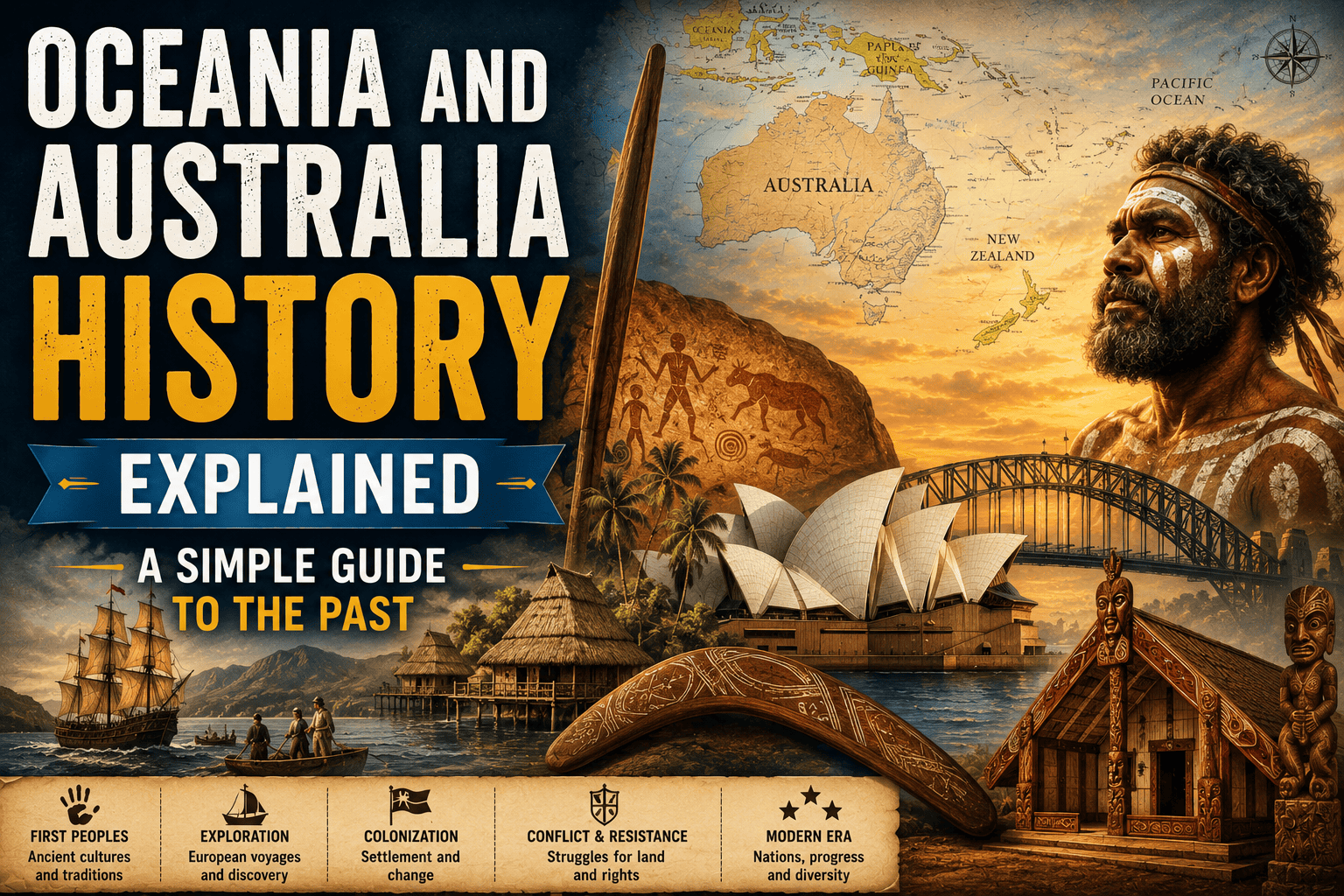
Oceania and Australia’s history encompasses the ancient cultures of Aboriginal Australians and Pacific Islander peoples, whose traditions and connections to land stretch back tens of thousands of years, through European exploration, colonization, and the modern nation-building that followed. It traces the profound impact of British settlement in Australia, the colonization of Pacific island nations, and the ongoing struggles for Indigenous rights and cultural recognition. This history reflects a region of vast geographic diversity, from island communities shaped by seafaring traditions to a continent transformed by immigration and industrial development. At its core, it explores how Indigenous heritage, colonial legacy, and modern identity continue to shape this unique corner of the world.
Content Overview
- Oceania and Australia
- 2. Location and Geography
- 3. Major Countries and Territories
- 4. The Four Regions of Oceania
- 1. Australasia
- 2. Melanesia
- 3. Micronesia
- 4. Polynesia
- 5. Early Human Settlement
- 6. European Exploration
- 7. Colonial Period
- 8. World Wars in the Pacific
- 9. Modern Oceania
- 10. Culture and Traditions
- Simple Summary
Oceania and Australia
Geography, Regions, History & Civilization
1. Introduction to Oceania
Oceania is a vast region made up of islands and continental landmasses mainly located in the Pacific Ocean. In some models, it is considered the smallest continent, while in others it is viewed as a region made up of numerous island groups.
Key facts:
- Area: about 9 million km²
- Population: about 46 million people (2024)
- Smallest continent by land area
- Second least populated after Antarctica
Australia is the largest country and landmass in Oceania, dominating the region both geographically and economically.
2. Location and Geography
Oceania lies mainly in the Pacific Ocean and spans parts of both the Eastern Hemisphere and Western Hemisphere.
It includes:
- the Australian continent
- thousands of islands across the Pacific
- Major island groups like New Guinea and New Zealand.
One of the tallest mountains in Oceania is:
- Puncak Jaya (4,884 m)
3. Major Countries and Territories
Important countries in Oceania include:
- Australia
- New Zealand
- Papua New Guinea
- Fiji
- Samoa
- Kiribati
The largest city in Oceania is:
- Sydney.
4. The Four Regions of Oceania
Geographers divide Oceania into four major regions.
1. Australasia
Australasia usually includes:
- Australia
- New Zealand
- sometimes New Guinea
Characteristics
- Highly developed economies
- Advanced infrastructure
- High standards of living
Australia is the largest and most influential country in this region.
Indigenous peoples include:
- Aboriginal Australians
- Maori.
2. Melanesia
Melanesia lies north-east of Australia.
Major countries include:
- Papua New Guinea
- Solomon Islands
- Vanuatu
- Fiji
Characteristics
- Dense tropical forests
- Diverse indigenous cultures
- Large natural resources
The island of New Guinea is home to one of the world’s largest tropical rainforests.
3. Micronesia
Micronesia is made up of numerous small islands spread across the western Pacific Ocean.
Important countries include:
- Federated States of Micronesia
- Palau
- Marshall Islands
- Nauru
Characteristics
- Small island nations
- Marine ecosystems
- Economies dependent on fishing and tourism
4. Polynesia
Polynesia covers a vast triangular area across the Pacific Ocean.
Major countries and territories include:
- Samoa
- Tonga
- New Zealand
- Hawaii
- Tahiti
Characteristics
- rich ocean navigation traditions
- strong indigenous cultures
- long-distance seafaring history
5. Early Human Settlement
Humans first arrived in Oceania more than 60,000 years ago.
Early settlers migrated from Southeast Asia to:
- Australia
- New Guinea
- Pacific islands
These populations developed unique cultures and languages across the Pacific.
6. European Exploration
European explorers began reaching Oceania during the 16th century.
Important explorers included:
- Portuguese explorers
- Spanish explorers
- Dutch navigators
Later, the British explorer:
- James Cook
charted numerous Pacific islands and explored Australia’s east coast.
7. Colonial Period
During the 18th and 19th centuries, many islands became colonies of European powers such as:
- United Kingdom
- France
- Germany
This era of colonization significantly shaped languages, political structures, and economic systems.
8. World Wars in the Pacific
Oceania played an important role during:
- World War I
- World War II
The Pacific region experienced significant military battles and strategic operations.
9. Modern Oceania
Today, Oceania includes both highly developed economies and developing island nations.
Highly developed countries:
- Australia
- New Zealand
Many Pacific island nations depend on:
- tourism
- fisheries
- international aid.
Tourism provides a key source of income for many Pacific islands.
10. Culture and Traditions
Oceania has a rich cultural heritage including:
- traditional navigation
- tribal art
- music and dance
- oral storytelling traditions
One of the world’s oldest artistic traditions is the rock art of Aboriginal Australians.
Simple Summary
Oceania is:
- the smallest continent
- located in the Pacific Ocean
- divided into four main regions
Regions:
- Australasia
- Melanesia
- Micronesia
- Polynesia
The region is known for:
- thousands of Pacific islands
- unique indigenous cultures
- diverse ecosystems
- strong maritime traditions.