South America History
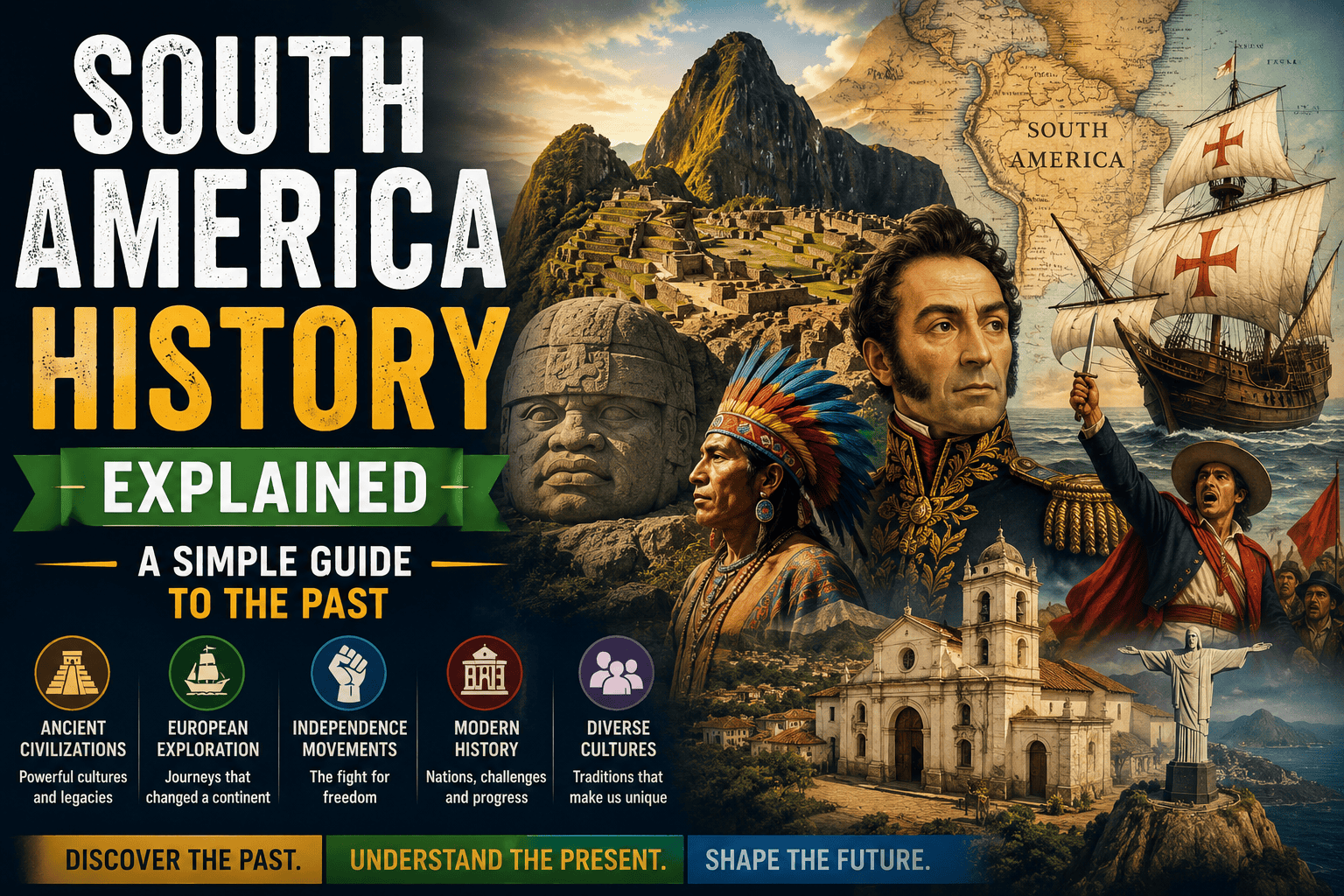
South American history traces the rise of ancient civilizations like the Inca, Moche, and Chibcha, through Spanish and Portuguese colonization, to the independence movements and modern nation-building that shaped the continent’s diverse countries. It examines the profound impact of colonial exploitation, the blending of Indigenous, European, and African cultures, and the struggles for sovereignty led by figures like Simón Bolívar. This history reflects deep social and political complexity, marked by periods of revolution, dictatorship, and democratic transformation across the region. At its core, South American history reveals how conquest, cultural fusion, and the fight for self-determination shaped a continent of remarkable diversity.
Content Overview
- South America
- 2. Location and Borders
- 3. Countries of South America
- 4. The Three Main Regions of South America
- 1. Northern South America
- 2. Central South America
- 3. Southern South America
- 5. Major Geographic Features
- 6. Early Civilizations
- 7. European Colonization
- 8. Culture and Society
- 9. Modern South America
- Simple Summary
South America
Geography, Regions, History & Civilization
1. Introduction to South America
South America is the world’s fourth-largest continent. It is mostly in the Southern Hemisphere and entirely in the Western Hemisphere.
Key facts:
- Area: about 17.84 million km²
- Population: about 434 million people (2021)
- The fourth-largest continent, following Asia, Africa, and North America.
- The fifth-largest continent by population, following Asia, Africa, Europe, and North America.
The continent makes up the southern portion of the Americas. (Encyclopedia Britannica)
2. Location and Borders
South America is bordered by major oceans and seas.
West → Pacific Ocean
North & East → Atlantic Ocean
Northwest → Caribbean Sea
South → Drake Passage near Antarctica
3. Countries of South America
South America contains 12 independent countries:
- Argentina
- Bolivia
- Brazil
- Chile
- Colombia
- Ecuador
- Guyana
- Paraguay
- Peru
- Suriname
- Uruguay
- Venezuela
There are also territories such as:
- French Guiana
- Falkland Islands
4. The Three Main Regions of South America
South America can be divided into three main geographic regions.
1. Northern South America
Countries include:
- Colombia
- Venezuela
- Guyana
- Suriname
- French Guiana
Characteristics
- Tropical climate
- Rainforests and rivers
- Important river systems such as the Orinoco River
The northern region contains part of the Amazon rainforest, one of the most biodiverse ecosystems on Earth.
2. Central South America
Countries include:
- Brazil
- Peru
- Bolivia
- Paraguay
- Ecuador
Geography
This region contains:
- the Amazon River
- the Amazon Rainforest
The Amazon Basin hosts the world’s largest rainforest ecosystem, rich in biodiversity. (Encyclopedia Britannica)
3. Southern South America
Countries include:
- Argentina
- Chile
- Uruguay
This region is often called the Southern Cone.
Characteristics
- Temperate climate
- Large agricultural lands
- Advanced urban economies
Major cities include:
- Buenos Aires
- Santiago
5. Major Geographic Features
Andes Mountains
The Amazon Basin hosts the world’s largest rainforest ecosystem, rich in biodiversity.
They form the longest mountain range on any continent in the world.
Amazon Basin
The Amazon Basin contains the Amazon River, the world’s largest river system.
The basin is home to a vast rainforest that supports a significant portion of the world’s plant and animal species. (Encyclopedia Britannica)
6. Early Civilizations
Before European arrival, several advanced civilizations developed.
The most famous was the:
- Inca Empire
The Incas built:
- advanced roads
- cities in the Andes mountains
- agricultural terraces
Their capital city was Cusco.
7. European Colonization
In the 16th century, European nations started colonizing South America.
Major colonial empires included:
- Spain
- Portugal
Due to this colonial past, most South Americans today speak:
- Spanish
- Portuguese
Portuguese is the main language in Brazil, which accounts for nearly half of South America’s population.
8. Culture and Society
South American culture developed through interaction between:
- Indigenous peoples
- European colonists
- African slaves
- Later immigrants from Europe and Asia
This created diverse traditions in:
- music
- dance
- religion
- cuisine
9. Modern South America
Today, the largest economy in South America is:
- Brazil
The continent contains many natural resources including:
- iron
- copper
- oil
- forests
- fertile farmland
However, certain countries continue to face challenges such as:
- economic inequality
- political instability
- environmental deforestation.
Simple Summary
South America is:
- the fourth-largest continent
- home to 12 countries
- divided into three major regions
- Northern South America
- Central South America
- Southern South America
The continent is known for:
- the Amazon rainforest
- the Andes mountains
- the Inca civilization
- diverse cultures and languages.