Engineering
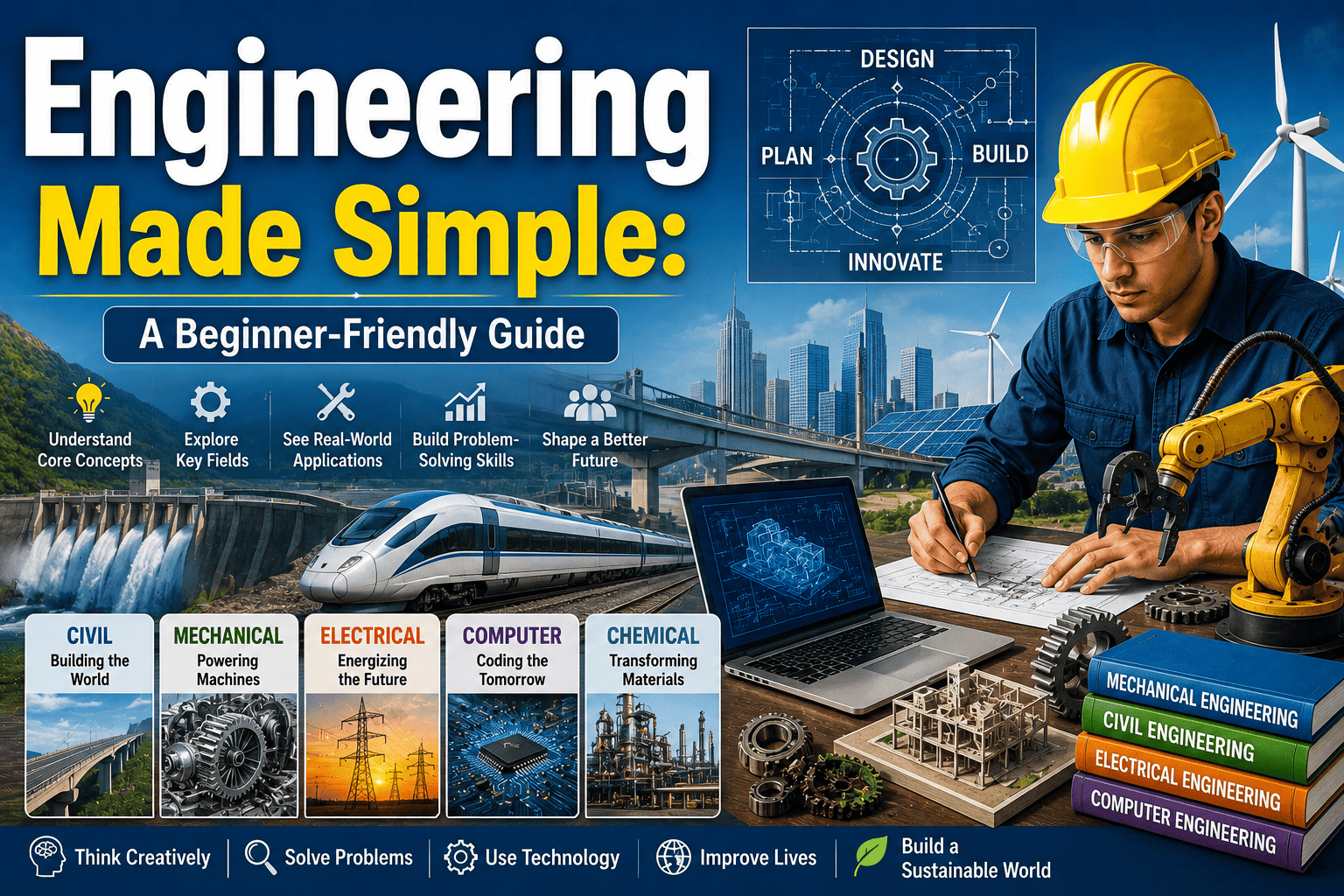
Engineering is the application of scientific and mathematical principles to design, build, and optimize structures, systems, and technologies that solve practical problems. It spans diverse branches like civil, mechanical, electrical, and chemical engineering, each focused on translating theoretical knowledge into functional, real-world solutions. Through a rigorous cycle of design, testing, and refinement, engineering transforms scientific understanding into the infrastructure, machines, and technologies that shape modern life. At its core, it asks how we can innovate and build practical solutions to meet human needs.
Content Overview
- Engineering
- Major Branches of Engineering
- 1. Civil Engineering
- 2. Chemical Engineering
- 3. Mechanical Engineering
- 4. Electrical Engineering
- Summary Mind Map (Engineering Fields)
Engineering
1. Definition of Engineering
Engineering is the discipline that uses scientific knowledge, mathematics, and technology to design, build, and improve systems, machines, structures, and processes that solve real-world problems.
Engineering connects science and practical applications.
Example:
Scientists discover laws of motion, but engineers apply those laws to design cars, bridges, and airplanes.
Engineering fields often overlap and collaborate.
Example:
Building a power plant requires:
- Civil engineers → structure and foundation
- Mechanical engineers → turbines and machines
- Electrical engineers → generators and power systems
- Chemical engineers → fuel and chemical processes
Major Branches of Engineering
Four major classical engineering disciplines include:
- Civil Engineering
- Chemical Engineering
- Mechanical Engineering
- Electrical Engineering
These are commonly referred to as the “core engineering fields.”
1. Civil Engineering
Definition
Civil engineering involves the planning, construction, and upkeep of infrastructure and public works.
It focuses on building structures that support society.
Examples of projects:
- Bridges
- Roads
- Dams
- Buildings
- Airports
- Water supply systems
Civil engineering is one of the oldest engineering fields, dating back to ancient civilizations.
Example:
Roman engineers built massive aqueducts that transported water across cities.
Major Subfields of Civil Engineering
1. Structural Engineering
Focus:
Designing buildings and structures so they can withstand forces like wind, earthquakes, and gravity.
Example:
Designing skyscrapers that remain stable during strong winds.
2. Transportation Engineering
Focus:
Designing transportation systems.
Examples:
- highways
- railways
- airports
- traffic systems
Example:
Designing efficient highway intersections helps reduce traffic congestion.
3. Environmental Engineering
Focus:
Protecting the environment and public health.
Example projects:
- water treatment plants
- waste management systems
- pollution control systems
Example:
Cleaning contaminated water before it enters rivers.
4. Geotechnical Engineering
Focus:
Studying soil and rock behavior for construction.
Example:
Before building a skyscraper, engineers test soil strength to determine the correct foundation.
Civil Engineering Roadmap (Learning Path)
Step 1 – Foundation Knowledge
Students learn basic sciences:
- Mathematics
- Physics
- Chemistry
These subjects help engineers understand forces, materials, and structures.
Step 2 – Core Civil Engineering Subjects
Students study:
- Engineering Mechanics
- Structural Analysis
- Fluid Mechanics
- Soil Mechanics
- Construction Materials
Example:
Learning how water flows through pipes using fluid mechanics.
Step 3 – Specialized Civil Engineering Fields
Students choose specializations such as:
- Structural engineering
- Transportation engineering
- Environmental engineering
- Geotechnical engineering
Step 4 – Practical Skills
Engineers learn tools such as:
- CAD design software
- structural simulation tools
- construction management systems
Example:
Designing building structures using digital modeling software.
Step 5 – Professional Practice
Civil engineers work in:
- construction companies
- government infrastructure departments
- urban planning agencies
2. Chemical Engineering
Definition
Chemical engineering uses principles of chemistry, physics, and engineering to convert raw materials into valuable products.
Chemical engineers design large-scale chemical production systems.
Examples of industries:
- pharmaceuticals
- petroleum
- plastics
- fertilizers
- food processing
Example:
Producing gasoline from crude oil in a refinery.
Major Areas of Chemical Engineering
1. Process Engineering
Focus:
Designing industrial processes for manufacturing chemicals.
Example:
Designing a system to produce ammonia fertilizer.
2. Reaction Engineering
Focus:
Understanding and controlling chemical reactions.
Example:
Optimizing temperature and pressure in reactors to increase production efficiency.
3. Separation Processes
Focus:
Separating chemicals into pure substances.
Methods include:
- distillation
- filtration
- extraction
Example:
Separating crude oil into products like gasoline, diesel, and kerosene.
4. Biochemical Engineering
Focus:
Applying biological processes to industrial production.
Example:
Producing insulin using bacteria in biotechnology factories.
Chemical Engineering Roadmap
Step 1 – Science Foundations
Students study:
- Chemistry
- Mathematics
- Physics
Example:
Understanding molecular reactions and thermodynamics.
Step 2 – Core Chemical Engineering Subjects
Key subjects include:
- Thermodynamics
- Chemical Reaction Engineering
- Fluid Flow
- Heat Transfer
- Mass Transfer
Example:
Designing reactors that maintain optimal temperatures.
Step 3 – Industrial Process Design
Students learn to design entire chemical plants.
Example:
Planning pipelines, reactors, and cooling systems.
Step 4 – Specialization
Chemical engineers may specialize in:
- petroleum engineering
- pharmaceutical production
- environmental chemical engineering
- food engineering
Step 5 – Industrial Applications
Chemical engineers work in industries such as:
- oil refineries
- pharmaceutical companies
- food manufacturing plants
- energy production
3. Mechanical Engineering
Definition
Mechanical engineering focuses on the design, analysis, and production of machines and mechanical systems.
Mechanical engineering is one of the most wide-ranging fields of engineering.
Examples of machines:
- engines
- turbines
- robots
- vehicles
- manufacturing machines
Example:
Designing a car engine that converts fuel into mechanical motion.
Major Areas of Mechanical Engineering
1. Thermodynamics
Study of heat and energy conversion.
Example:
Understanding how engines convert fuel energy into motion.
2. Fluid Mechanics
Study of fluids (liquids and gases).
Example:
Designing airplane wings to move efficiently through air.
3. Machine Design
Focus:
Designing mechanical parts such as gears, bearings, and engines.
Example:
Designing the gear system in automobiles.
4. Robotics and Automation
Focus:
Building automated machines and robots.
Example:
Industrial robots used in manufacturing factories.
Mechanical Engineering Roadmap
Step 1 – Scientific Foundations
Students learn:
- mathematics
- physics
- mechanics
These help understand forces and motion.
Step 2 – Core Mechanical Engineering Subjects
Key subjects:
- Engineering Mechanics
- Thermodynamics
- Fluid Mechanics
- Materials Science
- Machine Design
Step 3 – Engineering Design Skills
Students learn to use:
- CAD software
- simulation tools
- manufacturing techniques
Example:
Designing mechanical parts in 3D modeling software.
Step 4 – Specialization
Possible fields:
- automotive engineering
- aerospace engineering
- robotics
- energy systems
Step 5 – Industry Applications
Mechanical engineers work in:
- automotive companies
- aerospace industry
- manufacturing plants
- robotics companies
4. Electrical Engineering
Definition
Electrical engineering is the study of electricity, electronic systems, and power technologies.
Electrical engineers design and manage systems that produce, transmit, and use electrical energy.
Examples:
- power grids
- electronic devices
- communication systems
- computer hardware
Major Areas of Electrical Engineering
1. Power Engineering
Focus:
Generation and distribution of electrical energy.
Example:
Designing power stations and transmission lines.
2. Electronics Engineering
Focus:
Designing electronic circuits and devices.
Example:
Microchips used in smartphones and computers.
3. Telecommunications
Focus:
Communication systems using signals.
Example:
Mobile networks and satellite communication.
4. Control Systems
Focus:
Automatic control of machines and systems.
Example:
Autopilot systems in airplanes.
Electrical Engineering Roadmap
Step 1 – Basic Science Knowledge
Students study:
- mathematics
- physics
- electromagnetism
Step 2 – Core Electrical Engineering Subjects
Key subjects include:
- Circuit Theory
- Signals and Systems
- Electromagnetics
- Digital Electronics
- Power Systems
Step 3 – Practical Skills
Students work with:
- circuit design software
- microcontrollers
- electrical testing equipment
Example:
Designing a circuit that powers LED lighting systems.
Step 4 – Specialization
Electrical engineers may specialize in:
- power engineering
- electronics engineering
- telecommunications
- embedded systems
Step 5 – Industry Applications
Electrical engineers work in:
- power generation companies
- electronics manufacturing
- telecommunications companies
- renewable energy industries
Summary Mind Map (Engineering Fields)
Engineering can be visualized like a tree structure:
Engineering
│
├── Civil Engineering → infrastructure and construction
│
├── Chemical Engineering → chemical production and industrial processes
│
├── Mechanical Engineering → machines and mechanical systems
│
└── Electrical Engineering → electricity, electronics, and power systems
Each branch follows a similar learning roadmap:
- Basic science knowledge (math, physics, chemistry)
- Core engineering principles
- Design and analysis methods
- Specialized subfields
- Industrial applications
Simple Real-World Example
Building a modern electric car requires all four engineers:
Civil Engineer → builds roads and charging infrastructure
A mechanical engineer designs engines and mechanical systems.Electrical Engineer → develops battery and electronic control systems
Chemical Engineer → designs battery chemistry and fuel processing