Eastern Religions
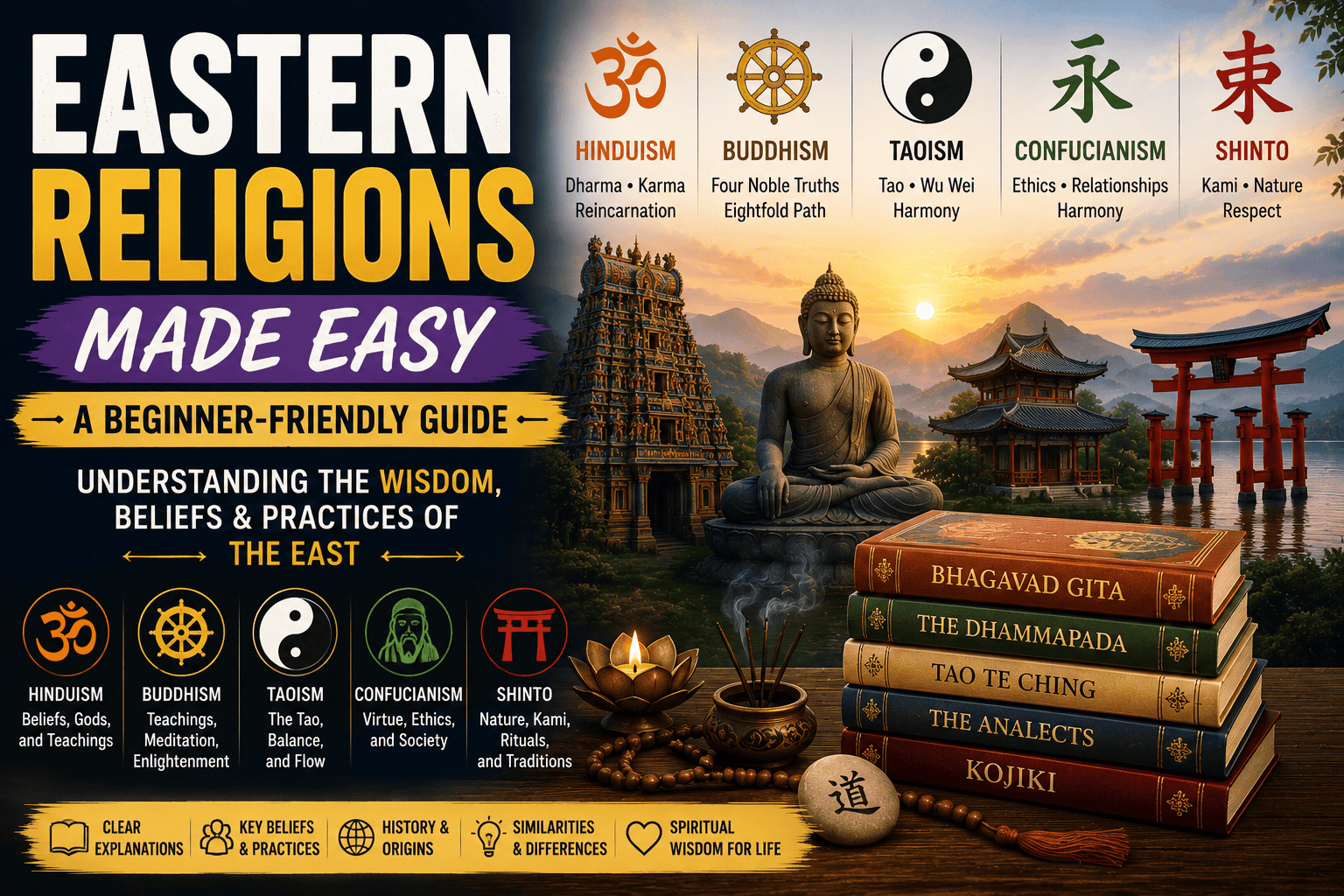
Explore the Diverse Spiritual Traditions of Asia — Eastern religions is a broad term commonly used for major religious and philosophical traditions that developed across different parts of Asia, including Hinduism, Buddhism, Taoism, Confucianism, and Shinto. Each tradition presents its own understanding of existence, morality, consciousness, and the nature of the self. Many of these traditions place strong emphasis on ideas such as karma, rebirth, harmony, impermanence, self-cultivation, and enlightenment, while often bringing philosophical reflection together with spiritual and ethical practices.
These traditions address fundamental questions about human suffering, the changing nature of life, personal identity, and the pursuit of a meaningful existence. Practices such as meditation, contemplation, ritual, discipline, and ethical conduct play different roles across individual traditions. Studying them together highlights the wide range of Asian approaches to spirituality and human flourishing while recognizing the important differences between them. At its core, the study of Eastern religions explores how diverse traditions understand life, consciousness, morality, and the search for inner balance and meaning.
Content Overview
- Introduction: Why Study Eastern Religions?
- Part 1: Hinduism – The Eternal Way (Sanatana Dharma)
- 1.1 What is Hinduism? A Family of Traditions
- 1.2 Dharma – Sacred Duty and Cosmic Order
- 1.3 Karma – The Law of Cause and Effect
- 1.4 Samsara – The Cycle of Rebirth
- 1.5 Moksha – Liberation from the Cycle
- 1.6 The Four Aims of Life (Purusharthas)
- 1.7 The Four Stages of Life (Ashramas)
- 1.8 Paths to Moksha – Four Yogas
- 1.9 Example: How an Ordinary Person Lives These Ideas
- Part 2: Buddhism – The Middle Way to Awakening
- 2.1 The Historical Buddha – Siddhartha Gautama
- 2.2 The Four Noble Truths (The Diagnosis)
- 2.3 The Eightfold Path (The Prescription)
- 2.4 Nirvana – Blowing Out the Flame
- 2.5 The Three Marks of Existence
- 2.6 Dependent Origination (Pratityasamutpada)
- 2.7 The Two Truths – Conventional and Ultimate
- 2.8 Major Schools
- 2.9 Example: Mindfulness Meditation in Daily Life
- Part 3: Jainism – The Path of Absolute Non-Violence
- 3.1 The Tirthankaras and Mahavira
- 3.2 Ahimsa – Non-Violence in Thought, Word, Deed
- 3.3 Anekantavada – Many-Sidedness of Truth
- 3.4 Aparigraha – Non-Attachment to Possessions
- 3.5 Liberation of the Soul (Kevala Jnana)
- 3.6 The Five Vows (Mahavratas)
- 3.7 The Concept of Karma as Subtle Matter
- 3.8 Example: The Life of a Jain Monk (including the cloth mask)
- Part 4: Sikhism – The Path of the Warrior-Saint
- 4.1 Guru Nanak’s Revolutionary Message
- 4.2 One God (Ik Onkar) and Equality of All
- 4.3 The Three Pillars
- 4.4 The Guru Granth Sahib: The Eternal Guru as Living Scripture
- 4.5 The Khalsa: The Community of the Pure
- 4.6 The Five Ks – External Symbols of Internal Commitment
- 4.7 The Concept of Miri-Piri (Spiritual and Temporal Authority)
- 4.8 Example: The Langar (Free Community Kitchen) in Action
- Part 5: Taoism – The Way of Natural Harmony
- 5.1 Basic: Laozi and the Tao Te Ching
- 5.2 Core Concept: The Tao – The Unnameable Source of All
- 5.3 Core Concept: Wu Wei – Action Without Force
- 5.4 Yin and Yang – Complementary Opposites
- 5.5 Intermediate: Te (Virtue) – Living in Accord with the Tao
- 5.6 Advanced: Zhuangzi’s Skepticism and Spontaneity
- 5.7 Example: Water as the Ultimate Teacher
- Part 6: Confucianism – The Way of Social Harmony
- 6.1 Kong Qiu (Confucius) and the Analects
- 6.2 Ren – Benevolence or Human-Heartedness
- 6.3 Li – Ritual Propriety and Social Order
- 6.4 Xiao – Filial Piety (Respect for Parents and Ancestors)
- 6.5 The Five Key Relationships
- 6.6 The Junzi – The Noble Person
- 6.7 Advanced: Rectification of Names (Zhengming)
- 6.8 Example: The Significance of Ancestor Veneration in Family Life
- Part 7: Case Study – Two Paths to Transcendence
- Conclusion: Common Threads and Unique Gifts
Introduction: Why Study Eastern Religions?
Every human culture has asked the same fundamental questions: Who am I? Why does suffering exist? How should I treat others? What happens after death? The religions and philosophies that arose in South and East Asia collectively called Eastern religions offer answers that are often radically different from the Western traditions (Judaism, Christianity, Islam). Instead of focusing on a single God who judges humanity, many Eastern traditions focus on natural laws (like karma), cycles of rebirth, inner transformation through meditation, and social harmony through ritual. This guide will take you from the most basic definitions to advanced philosophical nuances, using clear examples at every step.
Part 1: Hinduism – The Eternal Way (Sanatana Dharma)
1.1 What is Hinduism? A Family of Traditions
Hinduism is not a single religion with one founder or one holy book. It is a vast family of traditions that originated in the Indus Valley (modern-day India and Pakistan) over 4,000 years ago. Hindus may worship many gods (polytheism), one god (monotheism), or no god (atheistic Hinduism), yet they share core concepts. The Sanskrit name for Hinduism is Sanatana Dharma, meaning “the eternal way” or “everlasting duty.”
1.2 Dharma – Sacred Duty and Cosmic Order
Dharma is the moral law that upholds the universe. For an individual, it means one’s sacred duty or righteous way of living.
Explanation: Dharma is like a universal blueprint. The sun has a dharma to shine; a river has a dharma to flow; a bee has a dharma to make honey. For humans, dharma depends on age, occupation, and relationships. The dharma of a student is to learn and respect teachers. The dharma of a parent is to nurture children. The dharma of a soldier is to protect, but never to harm innocents. Dharma is not a list of commandments from God; it is an inherent order that one discovers through scriptures, conscience, and wise people.
Example: A shopkeeper finds a wallet full of money. His dharma as an honest person is to return it to the owner, even if no one is watching. By doing so, he upholds cosmic order.
1.3 Karma – The Law of Cause and Effect
Karma (literally “action”) is the universal law that every action produces a corresponding result, either in this life or a future life.
Explanation: Karma is not punishment or reward from a deity. It works like a natural law—similar to gravity or magnetism. If you plant a mango seed, you get a mango tree; you cannot get an apple tree. Similarly, kind, truthful, helpful actions produce future happiness; cruel, dishonest, harmful actions produce future suffering. Karma can be stored over lifetimes. The intention behind the action matters more than the action itself.
Example: A person volunteers at a homeless shelter out of genuine compassion. That creates good karma, which may manifest later as good health, supportive friends, or inner peace.In contrast, a person who mistreats a coworker may generate negative karma, which can result in isolation or adverse consequences later on.
1.4 Samsara – The Cycle of Rebirth
Samsara is the endless cycle of birth, life, death, and rebirth (reincarnation) that the soul (atman) undergoes.
Explanation: Hindus believe that the soul is eternal and indestructible. When the physical body dies, the soul leaves it and is reborn in a new body—human, animal, or even a celestial being. The type of rebirth is determined by the balance of karma from previous lives. Good karma leads to a more fortunate rebirth (e.g., healthy, wealthy family). Bad karma leads to a less fortunate rebirth (e.g., as an insect or a person in extreme poverty). Most people do not remember past lives, but the accumulated tendencies (samskaras) carry over.
Example: A person who was greedy in a past life may be born into a family with little food, experiencing the lack they caused others. A person who was compassionate may be born with a natural inclination to help.
1.5 Moksha – Liberation from the Cycle
Moksha means liberation freedom from samsara, the cycle of rebirth. It is the highest goal of Hinduism.
Explanation: Even a good rebirth in heaven (which is temporary) still involves suffering because all conditioned existence is impermanent. Moksha is permanent. In moksha, the individual soul (atman) realizes it is identical with the ultimate reality (Brahman). This is like a drop of water merging into the ocean. There is no more separate self, no more desires, no more karma, and no more rebirth. Moksha is described as sat-chit-ananda: existence-consciousness-bliss.
Example: Imagine dreaming that you are a butterfly. The butterfly feels real, but when you wake up, you realize you were always a human. Samsara is the dream; moksha is waking up to your true nature.
1.6 The Four Aims of Life (Purusharthas)
Hinduism recognizes that people have different legitimate goals. These four aims provide a balanced roadmap:
- Dharma (righteousness, duty) – the foundation.
- Artha (wealth, prosperity) – earning money and resources, but ethically.
- Kama (pleasure, desire) – enjoying love, art, and sensual experiences, without excess.
- Moksha (liberation) – the ultimate aim.
Explanation: A person should first learn dharma, then earn artha to enjoy kama, but all the while moving toward moksha. These are not conflicting; they are stages.
1.7 The Four Stages of Life (Ashramas)
Traditionally, a Hindu male (and in modern times, females also) passes through four stages:
- Brahmacharya (Student Stage): Focus on learning, celibacy, and discipline.
- Grihastha (Householder Stage): Marry, raise a family, earn money, support the community.
- Vanaprastha (Forest-dweller Stage): Gradually retire, give responsibilities to children, focus on spiritual practice.
- Sannyasa (Renunciant Stage): Give up all possessions and attachments, wander, seeking only moksha.
Example: A person in the householder stage performs daily rituals, has a career, and raises children (all dharma). After grandchildren arrive, they may go on pilgrimages and meditate more.
1.8 Paths to Moksha – Four Yogas
Hindu philosophy describes four main spiritual paths, each suited to different temperaments:
- Jnana Yoga (Path of Knowledge): Intense study of scriptures and self-inquiry (e.g., “Who am I?”). Best for intellectual people.
- Bhakti Yoga (Path of Devotion): Loving surrender to a personal god (e.g., Vishnu, Shiva, Devi). Best for emotional people.
- Karma Yoga (Path of Action): Performing all actions selflessly, without attachment to results. Best for active people.
- Raja Yoga (Path of Meditation): Systematic mental discipline, including postures (asana), breath control (pranayama), and deep meditation (dhyana). Best for disciplined people.
Advanced example: A bhakti yogi might chant the name of Rama for hours, crying in love. A jnana yogi might meditate on the phrase “I am not the body, I am not the mind, I am pure consciousness.” Both lead to the same moksha.
1.9 Example: How an Ordinary Person Lives These Ideas
A Hindu woman named Meera wakes up and offers water to the rising sun (a ritual to honor dharma). She goes to work as a doctor. She treats all patients equally, seeing the divine in them (karma yoga). She knows that if she does her duty well, good karma will follow, but she does not obsess over it. In the evening, she lights a lamp before a picture of her chosen god, singing a devotional song (bhakti). She hopes that after many lifetimes, her soul will attain moksha and never be reborn.
Part 2: Buddhism – The Middle Way to Awakening
2.1 The Historical Buddha – Siddhartha Gautama
Buddhism began with a real person, Siddhartha Gautama, a prince born around 500 BCE in what is now Nepal. He was sheltered from all suffering, but at age 29, he saw an old man, a sick man, a corpse, and a peaceful monk. Shocked, he left his palace to find the end of suffering. After six years of extreme asceticism (starving himself) and then abandoning extremes, he sat under a Bodhi tree and meditated until he awakened. He became the Buddha (“the Awakened One”). He then taught for 45 years.
2.2 The Four Noble Truths (The Diagnosis)
The Buddha’s first sermon contained four truths, comparable to a doctor’s diagnosis:
- The Truth of Suffering (Dukkha): Life is unsatisfactory.Even moments of pleasure are short-lived and often create a desire for more. Birth, aging, sickness, death, separation from loved ones, and not getting what you want—all are dukkha.
- The Truth of the Cause of Suffering (Samudaya): The cause is tanha—craving, thirst, or attachment. Craving for sensual pleasures, craving for existence, and craving for non-existence.
- The Truth of the End of Suffering (Nirodha): Suffering can completely cease by abandoning craving.
- The Truth of the Path (Magga) teaches that suffering can be overcome through following the Eightfold Path.
Example: A person craves a new phone (cause). They buy it, feel happy for a week, then the happiness fades and they crave a newer model (suffering continues). Ending the craving for the phone ends that cycle of dissatisfaction.
2.3 The Eightfold Path (The Prescription)
The path has eight factors, often divided into three categories: Wisdom, Ethical Conduct, and Mental Discipline.
Wisdom (Prajna):
- Right View: Understanding the Four Noble Truths and karma. Seeing things as they are, not as we wish.
- Right Intention: Renouncing craving, ill will, and harmfulness. Cultivating kindness and compassion.
Ethical Conduct (Sila):
- Right Speech: No lying, harsh words, gossip, or divisive talk. Speak truthfully and helpfully.
- Right Action involves avoiding killing, stealing, and sexual misconduct. Be peaceful and honest.
- Right Livelihood: Do not earn a living through weapons, meat, poisons, intoxicants, or slavery.
Mental Discipline (Samadhi):
- Right Effort: Prevent unwholesome states, abandon them, cultivate wholesome states, and maintain them.
- Right Mindfulness: Paying attention to the body, feelings, mind, and mental phenomena in the present moment without judgment.
- Right Concentration: One-pointed meditation leading to deep absorption (jhana).
Example: A butcher has wrong livelihood. If he switches to being a gardener (right livelihood), that supports right action and reduces suffering for animals and himself.
2.4 Nirvana – Blowing Out the Flame
Nirvana (nibban in Pali) literally means “blowing out” or “extinguishing.” It is the final end of suffering and the cessation of rebirth.
Explanation: What is blown out? The three destructive forces are greed, hatred, and ignorance. When these are extinguished, no more karma is produced, and the cycle of samsara ends. Nirvana is understood not as a physical place like heaven, but as a timeless state characterized by peace, liberation, and deep, unshakable well-being.A person who attains nirvana during life is called an arahant (worthy one). After physical death, they enter parinirvana (final nirvana), which cannot be described in terms of existence or non-existence.
Example: A flame on a candle depends on wax and wick. When you blow it out, you cannot say the flame “goes somewhere.” It simply ceases. Similarly, the conditioned self ceases in nirvana.
2.5 The Three Marks of Existence
The Buddha taught that all conditioned phenomena (everything except nirvana) have three characteristics:
- Anicca (Impermanence): Everything changes. Your body, feelings, thoughts, relationships—none last.
- Dukkha (Suffering/Unsatisfactoriness): Because things are impermanent, clinging to them brings suffering.
- Anatta (No-Self): There is no permanent, unchanging soul or self. What we call “me” is just a bundle of five aggregates: form, feelings, perceptions, mental formations, and consciousness.
Explanation: The concept of anatta is unique to Buddhism. There is no “soul” that reincarnates. Instead, the process of karma continues like a flame passing from one candle to another—the second flame is not identical to the first, but it is not completely different either.
2.6 Dependent Origination (Pratityasamutpada)
This is a deep teaching explaining how suffering arises. It is a 12-link chain: because of ignorance, mental formations arise; because of formations, consciousness; because of consciousness, name-and-form; because of name-and-form, six sense spheres; because of the six senses, contact; because of contact, feeling; because of feeling, craving; because of craving, clinging; because of clinging, becoming; because of becoming, birth; because of birth, old age and death. By breaking any link (especially ignorance and craving), the whole chain collapses.
Example: If you feel an itch (feeling) and immediately scratch (craving and clinging), you reinforce the habit. If you mindfully observe the itch without reacting, you break the chain.
2.7 The Two Truths – Conventional and Ultimate
In Mahayana Buddhism, a distinction is made between:
- Conventional truth (samvriti-satya): Everyday reality, including tables, chairs, and persons. This is true only in a relative sense.
- Ultimate truth (paramartha-satya): Emptiness (shunyata)—the fact that all phenomena lack inherent existence. They exist dependently, not independently.
Advanced example: A rainbow exists conventionally (you can see colors), but ultimately it has no substance. Likewise, the self exists conventionally but is empty of inherent selfhood.
2.8 Major Schools
- Theravada (Way of the Elders): Found in Sri Lanka, Thailand, Myanmar. Focuses on the original Pali Canon and the ideal of the arahant.It focuses on personal liberation through meditation and the monastic way of life.
- Mahayana (Great Vehicle): Found in China, Japan, Korea, Tibet. Emphasizes the bodhisattva ideal—someone who postpones their own nirvana to save all beings. Includes schools like Zen (meditation) and Pure Land (faith in Amitabha Buddha).
- Vajrayana (Diamond Vehicle): Found in Tibet and Mongolia. Uses tantra, mantras, and visualizations to achieve rapid enlightenment.
2.9 Example: Mindfulness Meditation in Daily Life
A Buddhist office worker sets a timer for 10 minutes. She sits upright, closes her eyes, and brings attention to her breath. When a thought arises—“I forgot to reply to that email”—she does not chase it. She gently labels the distraction as “thinking” and then brings her attention back to the breath.Over time, this trains her mind to not react impulsively to cravings. When she later feels anger at a rude customer, she notices the anger as a passing sensation, not a command to act. Suffering is reduced.
Part 3: Jainism – The Path of Absolute Non-Violence
3.1 The Tirthankaras and Mahavira
Jainism was founded by a lineage of 24 teachers called Tirthankaras (“ford-makers” who help cross the river of samsara). The last and most historically known is Mahavira (599–527 BCE), a contemporary of the Buddha. He practiced extreme asceticism for 12 years and achieved kevala jnana (omniscience). He taught a path of radical non-violence.
3.2 Ahimsa – Non-Violence in Thought, Word, Deed
Ahimsa is the supreme principle of Jainism—harm no living being, not even by a harsh word or a violent thought.
Explanation: For Jains, every living being, from a human down to a microscopic organism, possesses a soul (jiva). All souls are equal in their potential for perfection. Therefore, hurting any being is hurting a soul. Ahimsa is not merely refraining from physical violence; it includes not speaking unkindly and not even thinking ill of anyone. This is called trividha ahimsa (threefold non-violence).
Example: A Jain layperson will be a strict vegetarian, avoid root vegetables (because pulling them kills the plant and tiny insects in the soil), and will not swat a mosquito but gently blow it away.
3.3 Anekantavada – Many-Sidedness of Truth
Anekantavada means “non-absolutism” or “many-sidedness.” Truth has multiple facets; no single perspective captures the whole reality.
Explanation: This is the Jain theory of relativity in knowledge. A blind man touching an elephant’s leg says the elephant is like a pillar; another touching the tail says it’s like a rope. Both are partially correct, but both are wrong if they claim absolute truth. Similarly, any statement about reality is true only from a certain viewpoint (naya). This promotes intellectual humility and non-violence in debate.
Example: Two people argue whether a jar “exists” or “does not exist.” A Jain would say: from the viewpoint of its substance, it exists; from the viewpoint of its shape, it is a jar, not a pot; from the viewpoint of a person who has smashed it, it no longer exists as a jar. All are true in context.
3.4 Aparigraha – Non-Attachment to Possessions
Aparigraha means non-possessiveness, non-hoarding, and detachment from material things.
Explanation: Attachment to possessions creates greed, which leads to violence (e.g., hoarding food while others starve). Limiting possessions reduces opportunities for harming. For lay Jains, this means not accumulating unnecessary wealth. For monks, it means owning almost nothing—just a robe, a bowl, a broom, and a mouth-cover.
Example: A Jain business owner may be wealthy but lives simply, donates most profits to charity, and never buys luxury items for status.
3.5 Liberation of the Soul (Kevala Jnana)
The Jain goal is to liberate the soul from all karmic matter and attain moksha. In moksha, the soul rises to the top of the universe (siddhashila) and resides there forever in perfect bliss, omniscience, and power. This is not merging with a god but remaining a pure, independent soul. Liberation is achieved by:
- Stopping the influx of new karma (through vows and discipline).
- Shedding existing karma (through austerities like fasting, confession, and meditation).
3.6 The Five Vows (Mahavratas)
For monks, these are absolute; for laypeople, they are followed partially (anuvratas):
- Ahimsa (Non-violence): No harm to any living being, even by accident.
- Satya (Truthfulness): Speak only truth, and only if it does not harm.
- Asteya (Non-stealing): Refrain from taking anything that has not been freely given.
- Brahmacharya (Chastity): Complete celibacy for monks; fidelity for laypeople.
- Aparigraha (Non-attachment): Limit possessions.
3.7 The Concept of Karma as Subtle Matter
Unlike Hinduism and Buddhism, Jains believe that karma is not just a moral law but actual physical particles (karma pudgala) that attach to the soul. Every action, especially violent ones, attracts these sticky particles. They weigh the soul down and obscure its natural qualities (knowledge, bliss, power). Austerities burn off these particles. This is a uniquely Jain doctrine.
3.8 Example: The Life of a Jain Monk (including the cloth mask)
A Digambara (“sky-clad,” i.e., naked) monk owns nothing. He walks barefoot, using a peacock-feather broom (rajoharana) to sweep the ground before each step, avoiding crushing insects. He wears a muhapatti—a white cloth over his mouth—to prevent accidentally inhaling tiny airborne organisms. He eats only once a day, food offered by laypeople, and never after sunset (to avoid attracting insects). He meditates on the soul’s pure nature. This extreme gentleness is his path to liberation.
Part 4: Sikhism – The Path of the Warrior-Saint
4.1 Guru Nanak’s Revolutionary Message
Sikhism began in the 15th century in Punjab (India) with Guru Nanak (1469–1539). He was raised Hindu but also interacted with Muslims. One day, after bathing in a river, he disappeared for three days and returned with a message: “There is no Hindu, there is no Muslim; all are children of the One God.” He rejected caste discrimination, empty rituals, and religious violence.
4.2 One God (Ik Onkar) and Equality of All
Ik Onkar means “There is One God.” God is formless, timeless, all-pervading, and can be known through grace and meditation.
Explanation: God is not separate from creation; the world is God’s expression. All humans—regardless of gender, caste, religion, or color—are equal. Women have full spiritual and social equality. Sikhism rejects the idea of renunciation (leaving family); one can reach God while living a normal, honest household life.
Example: A Sikh and a Muslim may sit side by side in the Gurdwara (Sikh temple) to eat the same food from the Langar (free kitchen). No one is higher or lower.
4.3 The Three Pillars
Guru Nanak taught three essential practices:
- Naam Japo (Meditate on God’s Name): Constantly remember God through chanting, singing hymns (kirtan), and inner repetition. The most common name is “Sat Nam” (True Name).
- Kirat Karo (Earn an Honest Living): Work hard and ethically. Do not exploit others. Do not beg or steal.
- Vand Chakko (Share with Others): Give at least 10% of your income (dasvandh) to charity. Serve the community, especially by feeding the hungry.
Example: A Sikh farmer works his own land (Kirat Karo), wakes at 3 am to meditate on God (Naam Japo), and donates a portion of his grain to the Gurdwara’s kitchen (Vand Chakko).
4.4 The Guru Granth Sahib: The Eternal Guru as Living Scripture
The sacred text of Sikhism is the Guru Granth Sahib, which is regarded not merely as a book but as the living Guru. The last human Guru, Guru Gobind Singh (1666–1708), declared that after his death, the scripture would be the eternal Guru. It contains hymns from Sikh Gurus and also from Hindu and Muslim saints (like Kabir and Farid), showing inclusiveness. It is written in Gurmukhi script and is always treated with utmost respect: placed on a raised platform, covered with a canopy, and fanned with a chauri (fly-whisk). When not being read, it rests on a special bed.
4.5 The Khalsa: The Community of the Pure
In 1699, Guru Gobind Singh created the Khalsa (meaning “pure”) as a community of committed Sikhs. At a special ceremony (Amrit Sanchar), Sikhs drink sweetened water stirred with a double-edged sword, and take vows. They adopt the surname Singh (lion) for men and Kaur (princess) for women, abolishing caste names. The Khalsa is expected to defend the weak and fight oppression, while remaining spiritually disciplined.
4.6 The Five Ks – External Symbols of Internal Commitment
Every baptized Sikh (Khalsa) wears five physical articles, all starting with the letter “K” in Punjabi:
- Kesh (Uncut hair): Hair is left uncut as a sign of acceptance of God’s form. Men wrap it in a turban (a sign of dignity).
- Kangha (Wooden comb): Worn in the hair to keep it clean and tidy, symbolizing discipline.
- Kara (Steel bracelet): Worn on the right wrist. Its circular shape reminds of God’s infinity; steel reminds of strength and restraint.
- Kirpan (Ceremonial sword): A small curved dagger symbolizing the duty to defend justice and the weak. It is a spiritual, not aggressive, weapon.
- Kachera (Cotton undergarment): A specific style of shorts that symbolizes self-control and chastity, and also allows ease of movement in battle.
Example: When a Sikh touches his kara during a moment of anger, it reminds him to act with righteousness, not violence.
4.7 The Concept of Miri-Piri (Spiritual and Temporal Authority)
Guru Hargobind (sixth Guru) introduced the concept of Miri (temporal power) and Piri (spiritual power). He wore two swords: one symbolizing worldly authority (to defend the innocent) and one spiritual authority (to meditate and teach). Sikhism rejects the idea that spiritual people must be pacifists. A Sikh saint must also be a soldier when necessary, but only in self-defense or to protect others from tyranny.
4.8 Example: The Langar (Free Community Kitchen) in Action
Every Gurdwara has a Langar—a free, vegetarian meal served to all visitors, regardless of religion, caste, or wealth. Volunteers cook, serve, and wash dishes. Everyone sits on the floor in rows (pangat) to eat together. This breaks down social hierarchies. The Langar is funded by donations and run entirely by seva (selfless service). A visitor might see a wealthy businessman sitting next to a homeless person, both eating the same dal and roti. This is Sikhism’s living message of equality.
Part 5: Taoism – The Way of Natural Harmony
5.1 Basic: Laozi and the Tao Te Ching
Taoism (pronounced “Dow-ism”) is a philosophical and religious tradition that originated in China. Its foundational text is the Tao Te Ching (The Way and Its Power), traditionally attributed to Laozi (Lao Tzu), a contemporary of Confucius (6th century BCE). The book has only 5,000 Chinese characters but is profoundly deep. Later, Zhuangzi (Chuang Tzu) wrote a second classic with witty stories.
5.2 Core Concept: The Tao – The Unnameable Source of All
The Tao (literally “Way”) is the ultimate, formless, eternal principle that underlies and flows through all of reality.
Explanation: The Tao Te Ching opens: “The Tao that can be told is not the eternal Tao.” This means the ultimate reality cannot be captured in words. It is not a god to be worshiped but a natural process. The Tao is like the source of a river—unseen, but everything comes from it. It is empty yet inexhaustible.It acts without force, yet nothing remains unaccomplished.
Example: A tree grows, a bird flies, a river flows—all are following the Tao. They do not struggle or forceThe Tao represents the natural way or guiding principle of the universe.
5.3 Core Concept: Wu Wei – Action Without Force
Wu wei means “non-action” or “effortless action.” It is acting in complete harmony with the Tao, without forcing or striving.
Explanation: Wu wei is not laziness.It resembles a skilled carpenter who shapes wood without strain, sensing the grain and working in harmony with it. Or a skilled surfer who flows with the wave. When you act with wu wei, you do the right thing at the right time without struggle. The result is perfect, yet you did not “try.”
Example: A person trying to fall asleep by forcing themselves to sleep fails. When they let go and stop trying, sleep comes naturally. That is wu wei.
5.4 Yin and Yang – Complementary Opposites
Yin and Yang are the two fundamental, opposite but complementary forces that make up all phenomena. Yin is dark, passive, feminine, cool, soft; Yang is light, active, masculine, hot, hard.
Explanation: Nothing is purely yin or purely yang. Day becomes night; summer becomes winter; health requires a balance. The famous symbol shows a black teardrop (yin) with a white dot inside, and a white teardrop (yang) with a black dot inside—each contains the seed of the other. Conflict arises when one side dominates unnaturally.
Example: A Taoist would not say “good must destroy evil.” Instead, they see good and evil as relative. Overly rigid morality creates imbalance. A little “evil” (like a storm clearing the air) can be natural.
5.5 Intermediate: Te (Virtue) – Living in Accord with the Tao
Te (pronounced “duh”) means power, virtue, or integrity. It is the quality of someone who lives according to the Tao. A person with te is humble, gentle, and yet unshakable. They win arguments without arguing, lead without dominating, and are effective without effort. The Tao Te Ching says: “The highest virtue is not virtuous; therefore it has virtue.”
Example: A leader with te does not shout orders. She listens, trusts her team, and things get done smoothly. People say, “We did it ourselves.”
5.6 Advanced: Zhuangzi’s Skepticism and Spontaneity
The Zhuangzi text uses humorous stories to challenge rigid thinking. One famous story: Zhuangzi dreamed he was a butterfly, flying happily. When he woke up, he did not know if he was Zhuangzi who dreamed of a butterfly, or a butterfly now dreaming he is Zhuangzi. This shows that the distinction between self and other, reality and illusion, is not absolute. The advanced Taoist embraces uncertainty and lives spontaneously, without attachment to fixed categories.
5.7 Example: Water as the Ultimate Teacher
The Tao Te Ching says water is the closest element to the Tao. Water is soft, yet it wears away stone. It goes to the lowest places, which everyone avoids, yet it nourishes all life. It accepts any shape (round container, square container). It does not compete. A Taoist practices “water-like” behavior: be humble, adaptable, gentle, yet persistent. When someone insults them, they do not fight; they flow around the obstacle like water.
Part 6: Confucianism – The Way of Social Harmony
6.1 Kong Qiu (Confucius) and the Analects
Confucianism is a philosophical and ethical system based on the teachings of Kong Qiu (551–479 BCE), Latinized as “Confucius.” He lived during a time of war and chaos in China. His goal was to restore social order through moral education, not through laws or force. His sayings were collected by students in the Analects (Lunyu).
6.2 Ren – Benevolence or Human-Heartedness
Ren (pronounced “ren”) is the virtue of benevolence, compassion, and humaneness. It is the most important quality in Confucianism.
Explanation: Ren is often translated as “love” or “goodness.” It is the feeling of care you have for another person. Confucius said, “Do not do to others what you would not want done to yourself” (the Golden Rule). Ren is not abstract; it is expressed in concrete relationships. A person of ren is kind, respectful, and empathetic.
Example: A Confucian boss sees an employee struggling. Instead of punishing, he asks, “How can I help?” He treats the employee as a human being, not a tool.
6.3 Li – Ritual Propriety and Social Order
Li refers to rituals, manners, customs, and proper behavior. It is the way ren is expressed in action.
Explanation: Li covers everything from how to bow to an elder, to how to conduct a wedding, to how to eat soup without slurping. Confucius believed that performing li correctly trains the heart to be respectful. Without li, ren has no form. With li, society becomes harmonious because everyone knows their roles and respects others.
Example: A student greets their teacher with a slight bow and uses honorifics. This small act of li reminds both parties of the respect inherent in the teacher-student relationship.
6.4 Xiao – Filial Piety (Respect for Parents and Ancestors)
Xiao is the virtue of respecting and caring for one’s parents, elders, and ancestors.
Explanation: For Confucius, the family is the foundation of society. If a child does not respect their parents, they will not respect any authority. Filial piety includes obedience, financial support in old age, continuing the family line, and performing ancestor rituals. Even after parents die, a good child mourns appropriately and offers sacrifices.
Example: A son visits his aging mother every week, cleans her house, and asks for her advice on important decisions. At festivals, he sets a place at the table for deceased grandparents, offering food and incense.
6.5 The Five Key Relationships
Confucianism lists five primary relationships, each with mutual obligations:
- Ruler to Subject: Ruler must be benevolent; subject must be loyal.
- In the parent-child relationship, parents should show love while children should demonstrate respect and obedience.
- Husband to Wife: Husband must be righteous; wife must be obedient (in traditional view; modern interpretations are more equal).
- Older Sibling to Younger Sibling: Older must be gentle; younger must be respectful.
- Friend to Friend: Both must be trustworthy.
Explanation: Notice that only the friend relationship is equal.The other relationships are hierarchical, yet both individuals have responsibilities toward one another. A ruler who is cruel loses the right to loyalty (Confucius supported overthrowing bad rulers).
6.6 The Junzi – The Noble Person
The junzi (sometimes translated “gentleman” or “noble person”) is the Confucian ideal. The junzi is not born noble; they become noble through self-cultivation. They have ren (benevolence), practice li (rituals), are learned, and are not greedy. The opposite is the xiaoren (“small person”), who seeks personal gain and ignores virtue.
Example: A junzi, even when poor, remains dignified and generous. A xiaoren, even when rich, is selfish and rude.
6.7 Advanced: Rectification of Names (Zhengming)
Confucius taught that society is in chaos because names do not match reality. A “father” should act like a father (loving, teaching). A “ruler” should act like a ruler (benevolent, just). If the ruler acts like a tyrant, the name “ruler” no longer fits. Therefore, to fix society, we must call things by their proper names and then act accordingly.
Advanced example: A company CEO who only cares about profit but not employees’ welfare is not a true “leader.” Rectifying names would mean either the CEO changes behavior or loses the title.
6.8 Example: The Significance of Ancestor Veneration in Family Life
In traditional Confucian families, a small altar with photographs of deceased grandparents is kept in the home. On death anniversaries and major holidays, family members offer food, incense, and bow. This is not worship of the dead as gods; it is an expression of xiao (filial piety) that continues beyond death. It reminds the living that they are part of a long chain of generations, and they must live honorably.
Part 7: Case Study – Two Paths to Transcendence
7.1 Buddhism: Meditation as Mindful Detachment
In Buddhism (specifically Theravada or Zen), the primary method to end suffering is meditation. A meditator sits and observes the breath, bodily sensations, and thoughts. They learn to see all phenomena as impermanent, unsatisfactory, and not-self. Through this direct insight, craving naturally falls away. No God is involved. The practitioner relies entirely on their own effort and mindfulness. The final goal is nirvana—the extinction of the flame of desire.
Example: A Buddhist monk feels a sharp pain in his knee during meditation. Instead of reacting with aversion, he notes “pain, pain” and watches it change. He sees the pain is not “his”; it is just a sensation. The suffering attached to the pain disappears.
7.2 Hinduism: Bhakti as Loving Devotion to God
In Hindu bhakti yoga, the path is the opposite of detachment. The practitioner cultivates intense, emotional love for a personal god (e.g., Krishna, Shiva, or Devi). They sing hymns, cry, dance, offer flowers and food, and constantly remember the god’s name. The goal is not to realize “I am God” but to surrender completely, becoming a humble servant or lover of the divine. The final state is moksha, but achieved through grace and love, not through detached analysis.
Example: A Hindu devotee of Krishna spends hours chanting “Hare Krishna, Hare Rama.” She weeps at the temple, feeling separation from her beloved Lord. In that intense emotion, her ego dissolves, and she tastes a bliss that is not different from moksha.
7.3 Comparative Analysis: Self-Effort vs. Grace; Emptiness vs. Divine Presence
- Method: Buddhism uses meditation (self-effort, analysis). Bhakti uses devotion (surrender, emotion).
- Theology: Buddhism is non-theistic (no creator God needed). Bhakti is theistic (God as a loving person).
- Ultimate reality: Buddhism points to emptiness (shunyata) or nirvana. Bhakti points to a personal deity with qualities.
- Commonality: Both paths lead to transcendence of ego. Both require discipline. Both can be practiced by laypeople.
7.4 Summary Table
| Aspect | Buddhist Meditation | Hindu Bhakti |
|---|---|---|
| Primary practice | Sitting mindfulness, breath awareness | Chanting, singing, praying to an image |
| Attitude toward desire | Observe and let go of craving | Redirect desire toward God |
| Role of God | None (or optional in Mahayana) | Central – God is the beloved |
| Goal | Nirvana (extinction) | Moksha (union with or service to God) |
| Emotion | Equanimity (calm) | Passionate love (sometimes ecstatic) |
Conclusion: Common Threads and Unique Gifts
After this deep exploration, several common themes emerge across Eastern religions:
- Karma and rebirth (Hinduism, Buddhism, Jainism, and Sikhism shares karma but not rebirth in the same sense).
- Non-violence (Ahimsa) as a core virtue (strongest in Jainism, also in Buddhism and Hinduism).
- Liberation from suffering or rebirth as the ultimate goal.
- Discipline (meditation, rituals, ethical vows) as the means.
Yet each tradition offers a unique gift:
- Hinduism gives a vast, colorful tapestry of gods, paths, and philosophies for every temperament.
- Buddhism offers a precise, psychological analysis of suffering and a practical meditation toolkit.
- Jainism teaches radical gentleness and respect for the tiniest life.
- Sikhism balances deep spirituality with courageous social action and equality.
- Taoism whispers the wisdom of going with the flow, like water.
- Confucianism builds harmonious families and societies through respect and ritual.
Understanding these traditions does not require converting to any. It simply opens the mind to the many ways humans have answered the eternal questions. And in that openness, we may find our own path to peace, meaning, and connection.