Abrahamic Religions
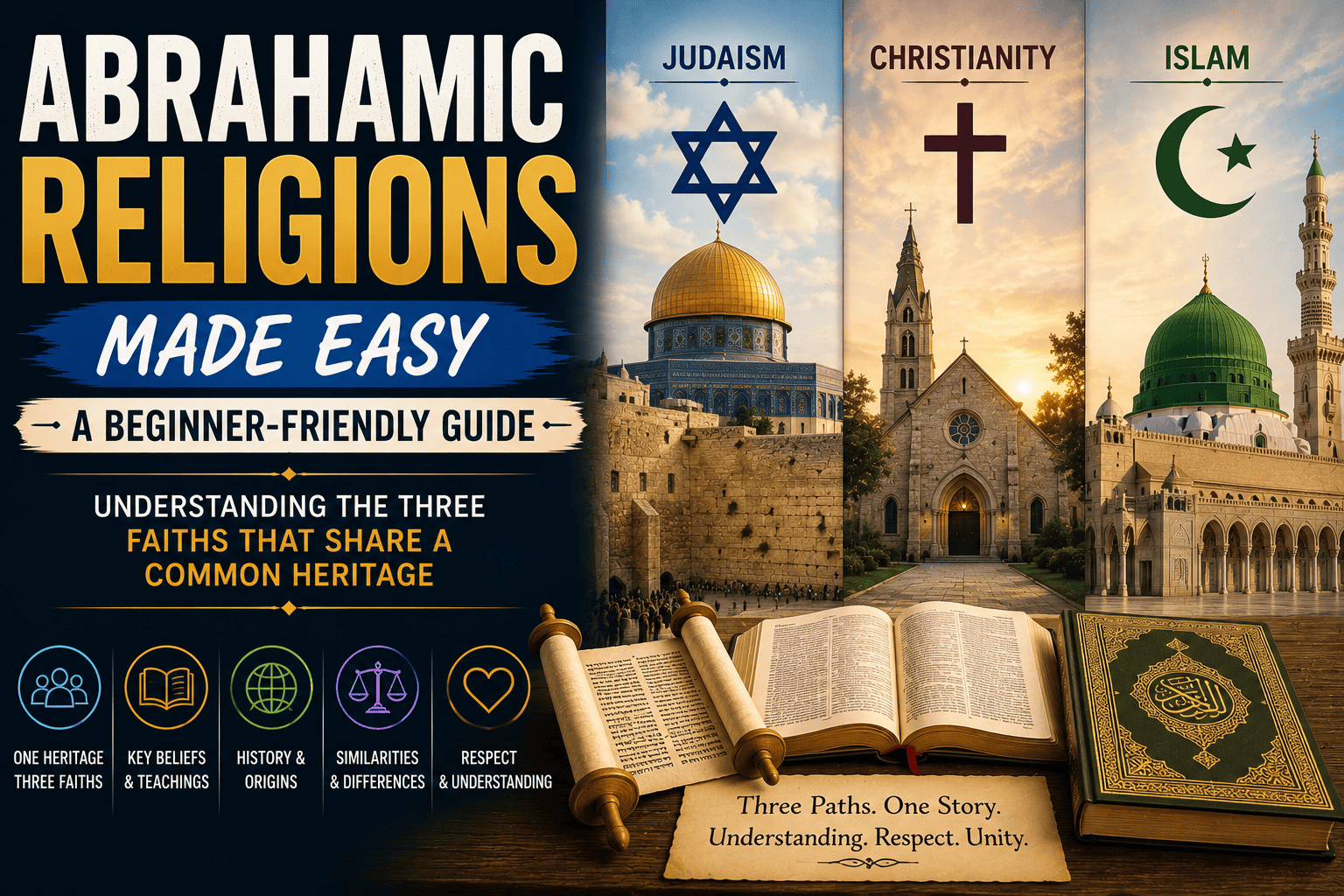
Explore the Shared Heritage and Distinct Traditions of Abrahamic Faiths — Abrahamic religions commonly refers to Judaism, Christianity, and Islam, three major monotheistic traditions that connect their religious histories and traditions to Abraham. Although they differ in scriptures, beliefs, rituals, theological interpretations, and religious practices, they share important themes, including belief in one God, divine guidance or revelation, and moral principles associated with the will of God. Over many centuries, these traditions have had a significant influence on societies, cultures, ethical systems, legal traditions, and intellectual history.
Studying these religions together provides an opportunity to understand both their historical connections and the ways in which they developed distinctive approaches to questions about God, humanity, morality, revelation, and religious life. Comparing their beliefs and traditions can highlight areas of common heritage as well as important theological and cultural differences. At its core, the study of Abrahamic religions explores how related faith traditions understand humanity’s relationship with the divine while following their own distinct religious paths.
Content Overview
- The Abrahamic Religions: Origins, Beliefs, and Shared Heritage
- Why Are They Called "Abrahamic" Religions?
- Judaism – Covenant, Torah, and Rabbinic Tradition
- Christianity – The Life of Christ, the Church, and Christian Doctrines
- Islam – Qur'an, Prophethood, and Sharia
- Case Study: The Shared Narrative of the Sacrifice (Isaac vs. Ishmael)
The Abrahamic Religions: Origins, Beliefs, and Shared Heritage
Why Are They Called “Abrahamic” Religions?
The term “Abrahamic” serves as a theological umbrella uniting Judaism, Christianity, and Islam under the spiritual paternity of one man: Abraham (or Ibrahim in Arabic).
These three faiths, which together represent over half of the global population, all trace their origins to this patriarchal figure. However, the connection is not merely genealogical; it is deeply theological. Each tradition views Abraham as the pioneer of pure monotheism—a man who abandoned the idolatry of his time to worship the One true God.
- In Judaism, Abraham is the founding father of the Israelite nation. The covenant God makes with him establishes the Jewish people as God’s chosen inheritors of the Promised Land. His son Isaac continues this specific lineage.
- In Christianity, Abraham is revered as the supreme archetype of faith. The Apostle Paul argues that because Abraham believed God before the law was given, he is the spiritual father of all believers, both Jew and Gentile.
- In Islam, Abraham (Ibrahim) is a Hanif—a pure monotheist. Muslims trace their lineage through his firstborn son, Ishmael, making Abraham the direct ancestor of Prophet Muhammad.
Thus, the label “Abrahamic” highlights a shared spiritual ancestry. These religions may disagree on the specifics, but they all look back to the same patriarch as the starting point of their journey with God.
Judaism – Covenant, Torah, and Rabbinic Tradition
The Covenant: God’s Sacred Agreement with Israel
What It Is
The covenant is the foundational concept in Judaism. It is a sacred, binding agreement established between God and the people of Israel, defining their mutual relationship, obligations, and destiny.
Detailed Explanation
The covenantal relationship is not a single event but a series of divine promises and human responsibilities that unfold throughout the Hebrew Bible.
- The Abrahamic Covenant (Genesis 12 & 17): God promises Abraham land, numerous descendants, and universal blessing. This covenant is sealed with the physical sign of circumcision, marking Abraham’s household as set apart for God’s purposes.
- The Mosaic Covenant (Exodus 19–24): At Mount Sinai, God gives the Torah to Moses. This covenant is conditional. Israel agrees to be God’s “treasured possession” and a “kingdom of priests,” but this status depends upon their obedience to the divine commandments. The famous declaration, “We will do and we will hear” (Exodus 24:7), seals their acceptance.
- The Davidic Covenant (2 Samuel 7): God promises King David that his dynasty will endure forever. This promise fuels the Jewish messianic hope—the expectation of a future descendant of David who will restore Israel.
Importance in Judaism
- Establishes the unique relationship between God and Israel.
- Defines Jewish identity and purpose as a holy nation.
- Creates clear obligations through the 613 mitzvot.
- Promises blessings for obedience and consequences for disobedience.
- Provides the theological framework for hope, redemption, and the messianic age.
The Torah: Central Scripture and Law of God
What It Is
The Torah is the primary scripture of Judaism. Its name translates to “instruction” or “teaching,” and it contains the foundational laws, narratives, and divine revelations that shape Jewish life.
Detailed Explanation
The Torah consists of the first five books of the Hebrew Bible: Genesis, Exodus, Leviticus, Numbers, and Deuteronomy. It is traditionally attributed to Moses, who received it directly from God at Mount Sinai.
The Torah serves a dual purpose:
- Narrative: It tells the story of creation, the patriarchs and matriarchs, the enslavement in Egypt, the exodus, and the wilderness wanderings toward the Promised Land.
- Law: It contains 613 commandments (mitzvot) that cover every dimension of human existence. These commandments are traditionally categorized into three types:
- Mishpatim: Rational, civil and social laws (e.g., prohibitions against theft and murder).
- Edot: Testimonies or ritual observances (e.g., keeping Shabbat and dietary laws) that commemorate historical events.
- Chukim: Divine decrees without obvious rational explanation (e.g., the laws of kashrut and the red heifer ritual).
The Torah is read publicly in synagogues on a weekly cycle, ensuring that the entire scroll is completed and restarted each year, maintaining an unbroken connection to the divine word.
Importance in Judaism
- It is the direct revelation of God’s will to humanity.
- It provides the blueprint for ethical, spiritual, and communal life.
- It distinguishes Israel from other nations by establishing a unique way of living.
- It serves as the foundation for all subsequent rabbinic interpretation and legal development.
- Its constant study and public reading maintain community continuity and identity.
Rabbinic Tradition: Guiding Jewish Law Through Halakha
What It Is
Rabbinic tradition is the ongoing, dynamic interpretation of the Torah through the Oral Law. It guides Jewish law (Halakha), adapting biblical commandments to changing historical and cultural circumstances.
Detailed Explanation
According to Jewish tradition, when God gave Moses the Written Torah at Sinai, He also gave an Oral Torah—explanations, clarifications, and applications of the written laws that were intended to be transmitted verbally through the generations.
As oral transmission became vulnerable to loss, these teachings were codified. Around 200 CE, Rabbi Yehudah HaNasi compiled the Mishnah, the first written collection of the Oral Law. Later generations of rabbis analyzed and debated the Mishnah, producing the Gemara. Together, the Mishnah and Gemara form the Talmud.
- There are two versions: the Jerusalem Talmud and the more authoritative Babylonian Talmud.
The practical application of these rabbinic discussions yields Halakha (literally, “the way to walk”). Halakha is the comprehensive system of Jewish law that governs prayer, dietary practices (kashrut), family purity, Sabbath observance, business ethics, and civil disputes. Rabbis are not priests who mediate between God and man, but rather scholars and judges who interpret the law and render legal decisions.
Importance in Judaism
- It makes the Torah relevant to everyday life across different eras and geographies.
- It provides authoritative guidance for new situations not directly addressed in the Bible.
- It ensures continuity between ancient Israel and modern Jewish communities.
- It allows Judaism to evolve while remaining firmly rooted in tradition.
- It democratizes religious knowledge, encouraging lifelong study for all Jews.
Example: The Sabbath (Shabbat)
What It Is
Shabbat is the weekly day of rest and spiritual renewal, observed from sundown on Friday until sundown on Saturday. It is the most important ritual institution in Jewish life, embodying the covenant relationship between God and Israel.
Detailed Explanation
The observance of Shabbat is rooted in two interconnected biblical passages:
- Creation: “For in six days the Lord made heaven and earth… and rested on the seventh day” (Exodus 20:11). Shabbat commemorates God’s rest after creation.
- Redemption: “Remember that you were a slave in the land of Egypt… therefore the Lord your God commanded you to keep the Sabbath day” (Deuteronomy 5:15). Shabbat recalls the liberation from Egypt, serving as a weekly declaration of freedom.
Observance involves abstaining from 39 categories of creative work (melakhot), which include activities like planting, writing, and kindling fire. Instead, the day is filled with positive actions:
- Attending synagogue for prayer and Torah reading.
- Sharing festive, leisurely meals with family and friends.
- Engaging in Torah study and rest.
- Lighting candles to usher in the holiness of the day.
Importance in Judaism
- It is the most visible and frequent sign of the covenant.
- It sanctifies time rather than space, making holiness accessible to everyone.
- It provides a weekly respite from material pursuits, allowing for spiritual reflection.
- It is considered a “foretaste of the World to Come,” offering a glimpse of perfect peace.
- It unites the global Jewish community in a shared rhythm of rest and worship.
Christianity – The Life of Christ, the Church, and Christian Doctrines
The Life of Christ: The Central Events of Salvation
What It Is
The life of Jesus of Nazareth—specifically his birth, ministry, crucifixion, and resurrection—constitutes the core historical and theological foundation of Christianity.
Detailed Explanation
For Christians, Jesus is not merely a prophet or teacher; he is the incarnate Son of God. His life is divided into four pivotal acts:
- The Birth (Incarnation): The Gospel of John declares, “The Word became flesh and dwelt among us” (John 1:14). Jesus’ virgin birth signifies that he is fully divine and fully human, the perfect mediator between God and humanity.
- The Ministry: For approximately three years, Jesus traveled throughout Galilee and Judea. He taught in parables, performed miracles (healing the sick, raising the dead, calming storms), and proclaimed the arrival of the Kingdom of God. His teachings, such as the Sermon on the Mount, reinterpreted the Jewish law with an emphasis on inner transformation and love for enemies.
- The Crucifixion: Jesus was arrested, tried, and executed by crucifixion under the Roman governor Pontius Pilate. Christians view this not as a failure, but as a substitutionary atonement. Jesus died as the perfect, sinless sacrifice to pay the penalty for the sins of all humanity. As Isaiah 53:5 states, “He was pierced for our transgressions.”
- The Resurrection: On the third day, Jesus rose bodily from the dead. This is the historical event that validates his divinity and secures the promise of eternal life. As Paul writes, “If Christ has not been raised, your faith is futile” (1 Corinthians 15:17).
Importance in Christianity
- The cross and resurrection are the mechanisms of human salvation.
- Jesus’ life provides the perfect moral and spiritual model for believers.
- The incarnation reveals that God intimately understands human suffering.
- The resurrection guarantees the future resurrection of all believers.
- These events form the content of the Gospel (Good News) proclaimed by the Church.
The Church: The Community of Believers
What It Is
The Church is not a physical building but the global community of baptized believers who follow Jesus Christ. It is described in the New Testament as the “Body of Christ” and the “household of God.”
Detailed Explanation
The Church was born on the day of Pentecost, when the Holy Spirit descended upon the apostles, empowering them to preach the Gospel. Over the centuries, this community structured itself into three major historical traditions:
- Catholicism: The Roman Catholic Church is the largest Christian body, led by the Pope (the Bishop of Rome). It emphasizes apostolic succession, the authority of sacred tradition alongside Scripture, and the seven sacraments as channels of grace.
- Orthodoxy: The Eastern Orthodox Church and Oriental Orthodox Churches value continuity with the early ecumenical councils, liturgical beauty (icons, incense, chant), and a mystical approach to theology. They are distinct from Catholicism in their understanding of papal authority and the Filioque clause.
- Protestantism: Born out of the 16th-century Reformation, Protestantism comprises a diverse family of denominations (Lutheran, Baptist, Methodist, Pentecostal, Reformed, etc.). They emphasize the principles of Sola Scriptura (Scripture alone) and Sola Fide (faith alone) for salvation.
Importance in Christianity
- The Church is the primary context for worship, fellowship, and discipleship.
- It administers the sacraments (baptism and the Eucharist) as means of grace.
- It preserves and preaches the apostolic teaching.
- It is the vehicle through which believers support one another and serve the world.
- It maintains unity (despite denominational differences) through the shared confession of Christ.
Core Christian Doctrines: Trinity, Salvation, and Grace
What It Is
Christianity is defined by several distinctive doctrines that shape its understanding of God, humanity, and redemption. The most central are the Trinity, the nature of salvation, and the concept of grace.
Detailed Explanation
- The Trinity: Christians believe in one God who exists eternally in three co-equal, co-eternal persons: Father, Son, and Holy Spirit. This is a profound mystery—not three gods, but one God in three persons. The Father is the creator, the Son is the redeemer (Jesus Christ), and the Holy Spirit is the sanctifier, who indwells and empowers believers.
- Salvation: Salvation is the deliverance from sin and its consequences—spiritual death and eternal separation from God. Christianity teaches that all humans have sinned and fallen short of God’s glory. Salvation is made possible exclusively through the life, death, and resurrection of Jesus Christ. By repenting of sin and placing faith in Christ, a person is “born again” and receives eternal life.
- Grace: Grace is the unmerited, unconditional favor of God. The Apostle Paul famously declares, “For it is by grace you have been saved, through faith—and this is not from yourselves, it is the gift of God—not by works, so that no one can boast” (Ephesians 2:8-9). Grace means salvation cannot be earned; it is a free gift received through faith.
Importance in Christianity
- The Trinity defines the internal relational nature of God.
- Salvation provides hope and assurance of eternal life.
- Grace eliminates human boasting and cultivates humility and gratitude.
- These doctrines differentiate Christianity from strict unitarian monotheism (Judaism and Islam).
- They form the orthodoxy tested by the early ecumenical creeds.
Example: The Nicene Creed
What It Is
The Nicene Creed is the most widely accepted ecumenical statement of Christian faith. It was formulated by the early Church to definitively articulate the core doctrines of Christianity.
Detailed Explanation
The original creed was adopted at the Council of Nicaea in 325 CE and later expanded at the Council of Constantinople in 381 CE. It was created primarily to combat the heresy of Arianism, which denied the full divinity of Jesus Christ.
The creed affirms:
- The divinity of Jesus: “True God from True God, begotten, not made, of one Being with the Father.”
- The incarnation and salvation: “For us and for our salvation, he came down from heaven… was crucified, died, and was buried.”
- The resurrection: “On the third day, he rose again.”
- The Holy Spirit: “The Lord, the giver of life, who proceeds from the Father.”
Importance in Christianity
- It serves as a unifying banner across Catholic, Orthodox, and most Protestant churches.
- It provides a concise summary of the faith for teaching and worship.
- It protects the Church from theological errors regarding the nature of Christ.
- It is recited in liturgical services as a public declaration of belief.
- It maintains continuity with the early, apostolic Church.
Islam – Qur’an, Prophethood, and Sharia
The Qur’an: The Central Revelation of God
What It Is
The Qur’an is the holy book of Islam. Muslims believe it is the literal, uncreated, and final word of God (Allah), dictated verbatim to the Prophet Muhammad through the angel Gabriel.
Detailed Explanation
The Qur’an was revealed to Muhammad over a period of 23 years, beginning in 610 CE. It consists of 114 chapters (surahs), which are organized roughly from longest to shortest. The text is in eloquent, rhythmic Arabic, which Muslims regard as a linguistic miracle that cannot be replicated.
The Qur’an addresses a wide range of topics:
- Theology: The absolute oneness of God (Tawhid), his attributes, and his sovereignty.
- Prophets: It recounts the stories of earlier prophets, including Adam, Noah, Abraham, Moses, and Jesus, presenting them as Muslims (submitters to God).
- Law and Ethics: It provides guidance on prayer, charity, fasting, pilgrimage, family law, and social justice.
- Eschatology: It vividly describes the Day of Judgment, paradise (Jannah), and hell (Jahannam).
The Qur’an confirms the original revelations given to the Jews and Christians (the Torah and the Gospel) but asserts that these previous scriptures have been distorted or corrupted over time. Consequently, the Qur’an serves as the ultimate arbiter, the final and uncorrupted revelation for all of humanity.
Importance in Islam
- It is the absolute, infallible word of God.
- It is the primary source of Islamic theology, law, and spirituality.
- It is memorized and recited in Arabic by millions of Muslims worldwide.
- Its recitation is a central act of worship in daily prayers.
- It is the final authority against which all other knowledge is measured.
Prophethood: Muhammad as the Seal of the Prophets
What It Is
Prophethood is a fundamental belief in Islam. Muslims believe that God has sent prophets to every nation to guide them to monotheism and righteousness, and that Muhammad is the final and greatest of these messengers.
Detailed Explanation
Islam recognizes a long lineage of prophets, numbering 124,000 in some traditions. The most prominent include: Adam (the first), Noah, Abraham, Moses (who received the Torah), David (who received the Psalms), and Jesus (who received the Gospel). Muslims honor all of them as righteous men chosen by God.
However, Muhammad holds the supreme position as the Seal of the Prophets (Qur’an 33:40). This means:
- He is the final messenger; no new prophet will come after him.
- He brings the complete and final revelation (the Qur’an), which supersedes all previous scriptures.
- His life (Sunnah) serves as the perfect practical model for all Muslims.
Muhammad’s sayings, actions, and tacit approvals are meticulously recorded in the Hadith literature. These collections (the most revered being those of Bukhari and Muslim) provide the second most important source of guidance after the Qur’an.
Importance in Islam
- Belief in Muhammad is a core requirement of the Islamic confession of faith (Shahada).
- His life provides a concrete, living example of how to implement the Qur’an’s teachings.
- He is the final link in the chain of Abrahamic prophecy.
- His role ensures that the religion is complete and preserved for all time.
- Loving and obeying Muhammad is an expression of love for God.
Sharia: The Divine Law of Islam
What It Is
Sharia is the comprehensive moral, legal, and ethical system of Islam. It is derived from divine sources and provides a complete framework for how a Muslim should live in submission to God.
Detailed Explanation
The word “Sharia” literally means “a path to water,” signifying the clear path to salvation. It is derived primarily from two fundamental sources:
- The Qur’an: The direct word of God.
- The Sunnah/Hadith: The exemplary life and teachings of Prophet Muhammad.
Islamic scholars use various principles of jurisprudence (Fiqh) to interpret these sources and apply them to new situations. Sharia covers two broad categories:
- Ibadah (Worship): Rules governing prayer, fasting, almsgiving, and pilgrimage.
- Muamalat (Social Transactions): Rules governing family law (marriage, divorce, inheritance), criminal law, business contracts, and personal ethics.
It is important to note that Sharia is not a monolithic, fixed code. It has been interpreted differently across various schools of Islamic jurisprudence (e.g., Hanafi, Maliki, Shafi’i, Hanbali). Its ultimate objectives (Maqasid) are to protect faith, life, intellect, lineage, and property.
Importance in Islam
- It guides the Muslim from cradle to grave in every aspect of life.
- It ensures that daily actions become acts of worship when done with the right intention.
- It establishes justice, fairness, and compassion in society.
- It preserves Islamic identity and distinctiveness.
- It provides a legal and ethical framework that adapts to new contexts while remaining rooted in divine revelation.
Example: Ramadan Fasting (Sawm)
What It Is
Sawm, or fasting during the month of Ramadan, is the fourth pillar of Islam. It requires Muslims to abstain from food, drink, smoking, and marital relations from dawn until sunset for an entire lunar month.
Detailed Explanation
Ramadan is the ninth month of the Islamic lunar calendar. It commemorates the first revelation of the Qur’an to Muhammad. The fast is both a physical discipline and a profound spiritual exercise.
During the daylight hours, Muslims refrain from all physical consumption. The fast is broken each evening with a meal called Iftar, traditionally starting with dates and water, following the example of the Prophet.
Beyond mere abstention, Ramadan is a time of intensified spiritual activity:
- Increased Prayer: Muslims perform extra nightly prayers (Tarawih) and recite the entire Qur’an.
- Charity: Acts of giving and feeding the poor are highly emphasized.
- Self-Reflection: The month encourages introspection, patience, and the cultivation of empathy for those who experience hunger daily.
The month culminates in the celebration of Eid al-Fitr, a festival of thanksgiving and community gathering.
Importance in Islam
- It is a direct commandment from God, demonstrating obedience.
- It promotes spiritual purification, self-discipline, and control over worldly desires.
- It creates empathy for the poor and less fortunate.
- It unites the global Muslim community in a shared experience.
- It is a month of immense spiritual rewards, mercy, and forgiveness.
Case Study: The Shared Narrative of the Sacrifice (Isaac vs. Ishmael)
Judaism and Christianity: The Sacrifice of Isaac
What It Is
In the Jewish and Christian traditions, the binding of Isaac (the Akedah) is the story of Abraham’s ultimate test of faith, where he is commanded by God to offer his son Isaac as a sacrifice.
Detailed Explanation
According to Genesis 22, God tests Abraham by commanding him to sacrifice his beloved son, Isaac, on Mount Moriah. Abraham proceeds without hesitation. He builds an altar, binds Isaac, and raises the knife. At the crucial moment, an angel of the Lord intervenes, providing a ram caught in a thicket to be sacrificed instead.
For Jews, this event is the pinnacle of human faith and the foundation of the covenant. It demonstrates that Abraham loved God above all else. For Christians, this narrative is a prophetic foreshadowing of the Gospel: the Father sacrificing His only Son, Jesus, with the ram symbolizing the substitutionary atonement of Christ.
Importance in Judaism and Christianity
- It is the supreme example of faith and fear of God.
- It established the covenantal promise that Isaac’s descendants would be blessed.
- For Christians, it prefigures the sacrifice of Christ on the cross.
- It teaches that God values the intent of the heart over literal human sacrifice.
- It is a foundational story read during significant religious observances (e.g., Rosh Hashanah in Judaism; Holy Week in Christianity).
Islam: The Sacrifice of Ishmael
What It Is
In Islamic tradition, the son offered for sacrifice is understood to be Ishmael (Ismail), Abraham’s firstborn son through Hagar, rather than Isaac.
Detailed Explanation
The Qur’an recounts the story in Surah As-Saffat (37:99-113) without explicitly naming the son. However, the overwhelming consensus among Islamic exegetes is that the son was Ishmael. This identification is significant because Ishmael is the direct ancestor of the Arab people and of Prophet Muhammad.
In the Islamic narrative, both Abraham and Ishmael willingly submit to God’s command. When Ishmael is told of the vision, he replies, “O my father, do as you are commanded. You will find me, if God wills, of the steadfast” (Qur’an 37:102). As with the biblical account, God provides a great ram as a substitute.
This act of submission is commemorated annually by Muslims worldwide during Eid al-Adha (the Festival of Sacrifice). Families slaughter a halal animal (sheep, goat, or camel) and distribute the meat to the poor, family, and neighbors.
Importance in Islam
- It demonstrates the absolute submission (Islam) required of believers.
- It connects the final prophet, Muhammad, directly to the patriarch Abraham.
- It establishes the Hajj pilgrimage and the ritual of sacrifice as perpetual acts of worship.
- It is a communal reaffirmation of faith and obedience to God.
- It teaches the virtue of surrendering one’s personal attachments for the sake of the Divine.
The Common Theme: Faith and Obedience to God
What It Is
Despite the differing identity of the son, the Abrahamic sacrifice narrative shares a universal theological core across all three traditions: the triumph of unwavering faith and radical obedience over personal attachment and human logic.
Detailed Explanation
In all three readings, the narrative serves the same purpose—to showcase a man who trusted God so completely that he was willing to relinquish that which was most precious to him. Abraham’s action is not viewed as barbaric or tragic; it is revered as the ultimate demonstration of loyalty to the Divine.
Furthermore, in all three traditions, God intervenes at the final moment to provide a substitution. This teaches that God desires mercy, spiritual surrender, and the intention of the heart above the literal act of taking a human life. The substitution (a ram in Judaism/Christianity and a ram in Islam) establishes a pattern of animal sacrifice (historically) or its spiritual commemoration (contemporary) as a means of drawing near to God.
Importance Across All Traditions
- It reminds believers that faith must be tested and proven.
- It establishes Abraham as the eternal model of monotheistic devotion.
- It teaches that obedience to God takes precedence over even the most powerful human emotions.
- It reinforces the shared spiritual ancestry of Jews, Christians, and Muslims.
- It serves as a powerful call to trust in divine providence, even in the face of apparent loss.
When we examine the pillars of Judaism, Christianity, and Islam, we clearly see the shape of a single, ancient tree with diverse, flourishing branches.
Judaism is the deep, anchoring root. It preserves the covenant, the law, and the memory of exodus and exile. It teaches the world that holiness is cultivated through rigorous adherence to divine instruction and communal responsibility.
Christianity is the branch that extended God’s promises to the ends of the earth. It reinterprets the covenant through the lens of a crucified and risen Messiah, shifting the focus from ethnic lineage to faith in Christ. It teaches the world about unconditional grace, sacrificial love, and the promise of eternal life.
Islam is the branch that returns to the stark, uncompromising monotheism of Abraham. It presents the final, complete revelation, emphasizing submission to God’s will in every facet of life. It teaches the world about discipline, community, and the absolute sovereignty of the Creator.
These traditions are not strangers; they are siblings. They argue fiercely over theology—the nature of God, the identity of the messiah, the role of the law, and the final prophet but they agree on the essentials: there is one God, Abraham is His beloved servant, and we are called to walk in faith and obedience.
Understanding these pillars does not require us to ignore the differences, but to appreciate the shared heritage behind them. In an age of division, recognizing that billions of people are reading variations of the same ancient texts and praying to the same God is a powerful foundation for mutual respect, dialogue, and perhaps even peace. The tree of Abraham is ancient, deeply rooted, and its shade continues to shelter a significant portion of humanity.