mathematics
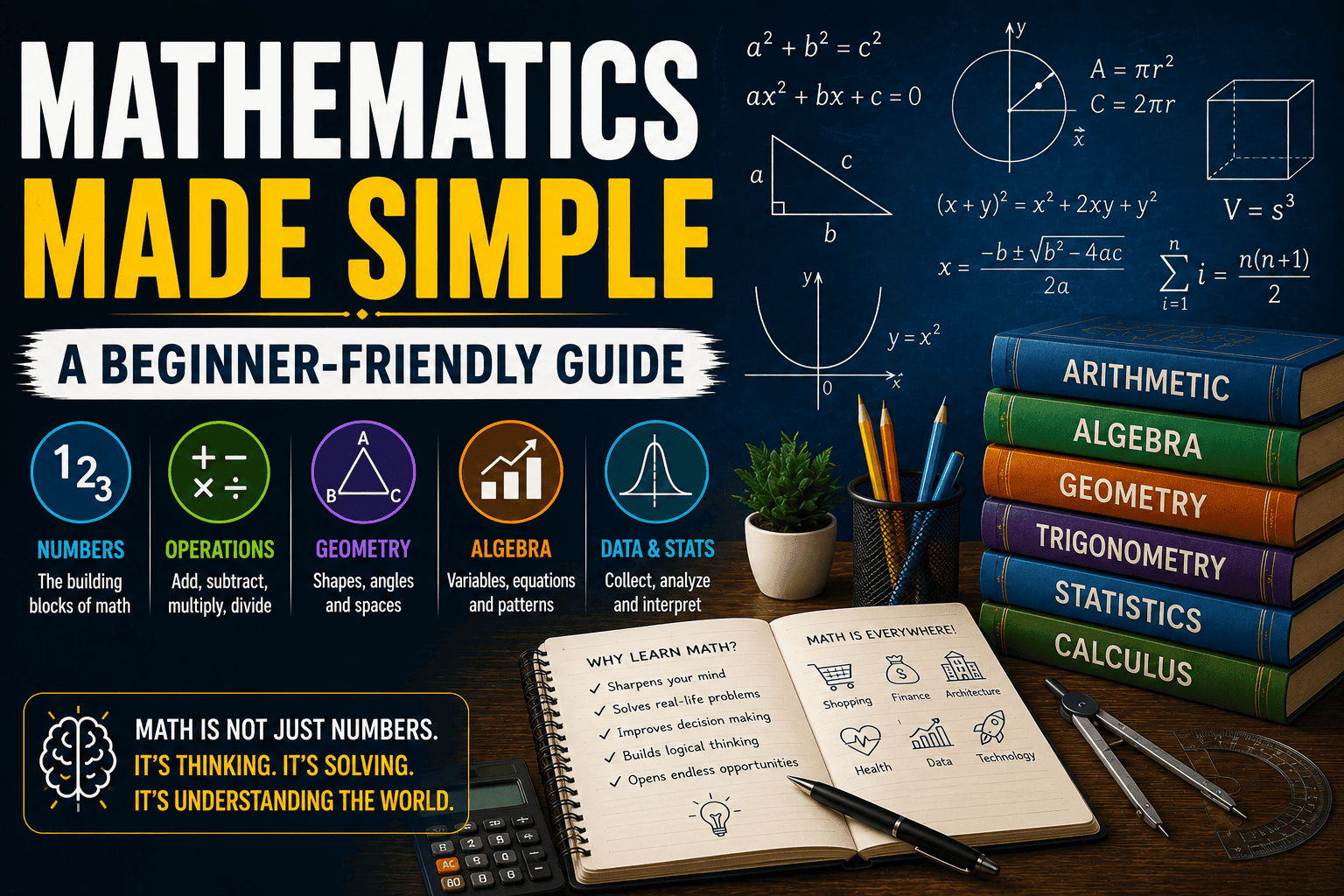
Explore the Language of Numbers, Patterns, Structures, and Logical Reasoning — Mathematics is a formal discipline that studies quantities, patterns, structures, relationships, space, and change through precise definitions and logical reasoning. Rather than depending primarily on physical observation, mathematics develops knowledge through deduction and rigorous proof. Its many branches include arithmetic, geometry, algebra, calculus, topology, and number theory, with each area addressing different types of mathematical structures and problems.
Mathematics provides essential tools for describing and analyzing complex systems across science, engineering, technology, economics, and many other disciplines. Through mathematical models, abstract ideas can be used to represent physical processes, financial systems, algorithms, and patterns found in the world. At its core, mathematics explores which conclusions can be established with certainty through logical reasoning and proof.
Content Overview
- Mathematics as the Language of Logic
- 1. Foundations of Mathematical Thinking
- 2. Numbers and Their Types
- 3. Basic Mathematical Operations
- 4. Algebra: Understanding Patterns and Structures
- 5. Geometry: The Mathematics of Space
- 6. Trigonometry: Mathematics of Angles
- 7. Mathematical Logic and Proofs
- Proof Techniques
- 8. Advanced Mathematics
- 9. Discrete Mathematics
- 10. Number Theory
- 11. Statistics and Probability
- 12. Mathematics in Nature
- 13. Mathematics in Modern Technology
- Conclusion: Why Mathematics Matters
Mathematics as the Language of Logic
Mathematics is often described as the language of logic because it expresses ideas with precision and clarity. While everyday language can sometimes be ambiguous, mathematics uses well-defined symbols, rules, and structures to represent logical reasoning.
From counting objects to describing the motion of planets, mathematics allows us to analyze patterns, understand relationships, and solve problems across science, technology, economics, and engineering.
In this article, we explore the foundations of mathematics, logical reasoning, mathematical structures, and real-world applications.
1. Foundations of Mathematical Thinking
The Nature of Mathematical Statements
A mathematical statement is a sentence that is either true or false, but never both simultaneously.
Examples:
- 2 + 3 = 5 (True)
- 7 is an even number (False)
Mathematical statements form the foundation of logical reasoning because they allow us to build arguments and proofs.
Deduction vs. Induction: Reasoning Approaches
Mathematics uses two major reasoning methods.
Deductive Reasoning
Deduction is reasoning that goes from a general rule to a specific conclusion.
Example:
- All multiples of 4 are even.
- 20 is a multiple of 4.
- Therefore, 20 is even.
If the premises hold true, the conclusion necessarily follows.
Inductive Reasoning
Induction observes patterns to form general conclusions.
Example:
2² = 4
3² = 9
4² = 16
From these examples we might infer that squaring numbers produces positive results.
Induction helps discover patterns but must eventually be proven logically.
2. Numbers and Their Types
Numbers are the building blocks of mathematics.
Natural Numbers
Natural numbers are counting numbers.
1, 2, 3, 4, 5 …
Example:
If a classroom has 25 students, the number 25 is a natural number.
Integers
Integers are numbers that consist of positive values, negative values, and zero.
…, −3, −2, −1, 0, 1, 2, 3 …
Example:
Temperature changes:
5°C (above zero)
−4°C (below zero)
Rational Numbers
Rational numbers can be written as fractions.
p/q where q ≠ 0
Examples:
1/2
3/4
−5/8
Decimals such as 0.75 or 0.333… are also rational.
Real Numbers
Real numbers include all numbers that appear on the number line.
They include:
- Natural numbers
- Integers
- Rational numbers
- Irrational numbers
Examples of irrational numbers:
π
√2
Complex Numbers
Complex numbers expand the real number system by introducing the imaginary unit.
i = √−1
A complex number has the form:
a + bi
Example:
3 + 2i
Complex numbers are used in engineering, electronics, and signal processing.
3. Basic Mathematical Operations
Mathematics relies on four fundamental operations:
Addition
Subtraction
Multiplication
Division
Examples:
8 + 2 = 10
9 − 4 = 5
6 × 3 = 18
12 ÷ 4 = 3
Arithmetic Properties
Commutative Property
Changing the order does not affect the result.
3 + 5 = 5 + 3
4 × 2 = 2 × 4
Associative Property
Altering the grouping does not affect the outcome.
The correct expression should be:
For example, (2 + 3) + 4 gives the same result as 2 + (3 + 4).
This shows the associative property of addition, where changing the grouping does not change the result.
Distributive Property
Multiplication distributes over addition.
3(4 + 2) = 12 + 6 = 18
4. Algebra: Understanding Patterns and Structures
Algebra uses symbols and variables to represent numbers and relationships.
Example equation:
x + 5 = 10
Solution:
x = 5
Algebra helps us describe patterns and solve unknown values.
Linear Equations
A linear equation represents a straight line.
Example:
y = 2x + 1
If x = 3
y = 7
Linear equations are used in economics, physics, and business analysis.
Quadratic Equations
Quadratic equations contain squared variables.
Example:
x² − 5x + 6 = 0
Factoring gives:
(x − 2)(x − 3) = 0
Solutions:
x = 2 or x = 3
Quadratic equations create parabolic graphs.
Functions and Graphs
A function explains how one value depends on another.
Example:
f(x) = x²
If x = 4
f(4) = 16
Graphs help visualize these relationships.
5. Geometry: The Mathematics of Space
Geometry studies shapes, distances, and spatial relationships.
Classical geometry was developed by
Euclid.
Euclidean Geometry
Euclidean geometry studies familiar shapes:
Triangles
Circles
Angles
Example:
The sum of the interior angles of any triangle is always 180°.
Non-Euclidean Geometry
In curved spaces, triangle angles may not equal 180°.
This concept became important in the
Theory of General Relativity
developed by
Albert Einstein.
It explains how gravity bends space and time.
6. Trigonometry: Mathematics of Angles
Trigonometry is the study of how the sides and angles of triangles are related.
Main trigonometric functions:
Sine (sin)
Cosine (cos)
Tangent (tan)
Example:
In a right triangle:
Opposite side = 3
Hypotenuse = 5
sin(θ) = 3/5
Applications include:
Architecture
Navigation
Astronomy
Engineering
7. Mathematical Logic and Proofs
The Basics of Logic
Logic studies valid reasoning and argument structure.
It ensures mathematical conclusions follow logically from assumptions.
Logical Operators
Common logical operators include:
Negation (¬P)
Conjunction (P ∧ Q)
Disjunction (P ∨ Q)
Implication (P → Q)
Example:
P: It is raining
Q: The ground is wet
P → Q means:
“If it rains, the ground becomes wet.”
Logical Fallacies
A logical fallacy is an incorrect reasoning pattern.
Example:
“Everyone believes it, so it must be true” is an example of faulty reasoning, because a claim being widely believed does not necessarily make it true.
This is called appeal to popularity.
Proof Techniques
Mathematics requires rigorous proof.
Direct Proof
Example:
If n is even, then it can be expressed in the form 2k, where k is an integer.
Therefore n is divisible by 2.
Proof by Contradiction
Begin by assuming the opposite of the claim and then demonstrate that this assumption leads to a contradiction.
Example:
Proving that √2 is irrational.
Mathematical Induction
Induction proves statements for all natural numbers.
Example:
The sum of the first n natural numbers can be expressed by the formula:
1 + 2 + 3 + \cdots + n = \frac{n(n+1)}{2}
8. Advanced Mathematics
Calculus: Understanding Change
Calculus was independently developed by
Isaac Newton
and
Gottfried Wilhelm Leibniz.
Derivatives
Derivatives measure rates of change.
Example:
Velocity = rate of change of distance.
Integrals
Integrals calculate accumulated quantities.
Example:
Finding the area under a curve.
9. Discrete Mathematics
Discrete mathematics studies countable structures.
Topics include:
Sets
Relations
Functions
Graph theory
Graph theory is used to analyze networks such as social media or transportation systems.
10. Number Theory
Number theory studies integers and their properties.
Important topics include:
Prime numbers
Modular arithmetic
Cryptography and Cybersecurity
Modern encryption systems like the
RSA encryption algorithm
use large prime numbers to secure digital communication.
This protects data used in online banking and internet security.
11. Statistics and Probability
Probability: Measuring Uncertainty
Probability measures the likelihood of events.
Example:
The probability of rolling a 6 on a fair die is 1/6.
1/6
Probability is widely used in risk analysis, weather forecasting, and finance.
Statistics: Analyzing Data
Statistics studies the collection and interpretation of data.
Important measures include:
Mean (average)
Median (middle value)
Mode (most frequent value)
Example dataset:
2, 3, 5, 5, 10
Mean = 5
Median = 5
Mode = 5
Statistics helps scientists and researchers interpret real-world information.
12. Mathematics in Nature
Mathematics appears naturally in many patterns.
The Fibonacci sequence, described by
Leonardo of Pisa, appears in plant growth and spiral structures.
Sequence:
1, 1, 2, 3, 5, 8, 13
Another famous pattern is the Golden Ratio, often found in art, architecture, and biology.
13. Mathematics in Modern Technology
Modern technology relies heavily on mathematics.
Applications include:
Algorithms in computing
Artificial intelligence
Machine learning
Cryptography
These fields depend on mathematical models to process information and make predictions.
Conclusion: Why Mathematics Matters
Mathematics is the foundation of all sciences. It provides the logical structure necessary to understand the universe, develop technologies, and solve complex problems.
From physics and engineering to artificial intelligence and cybersecurity, mathematics remains the essential language that drives scientific progress and innovation.