Asceticism
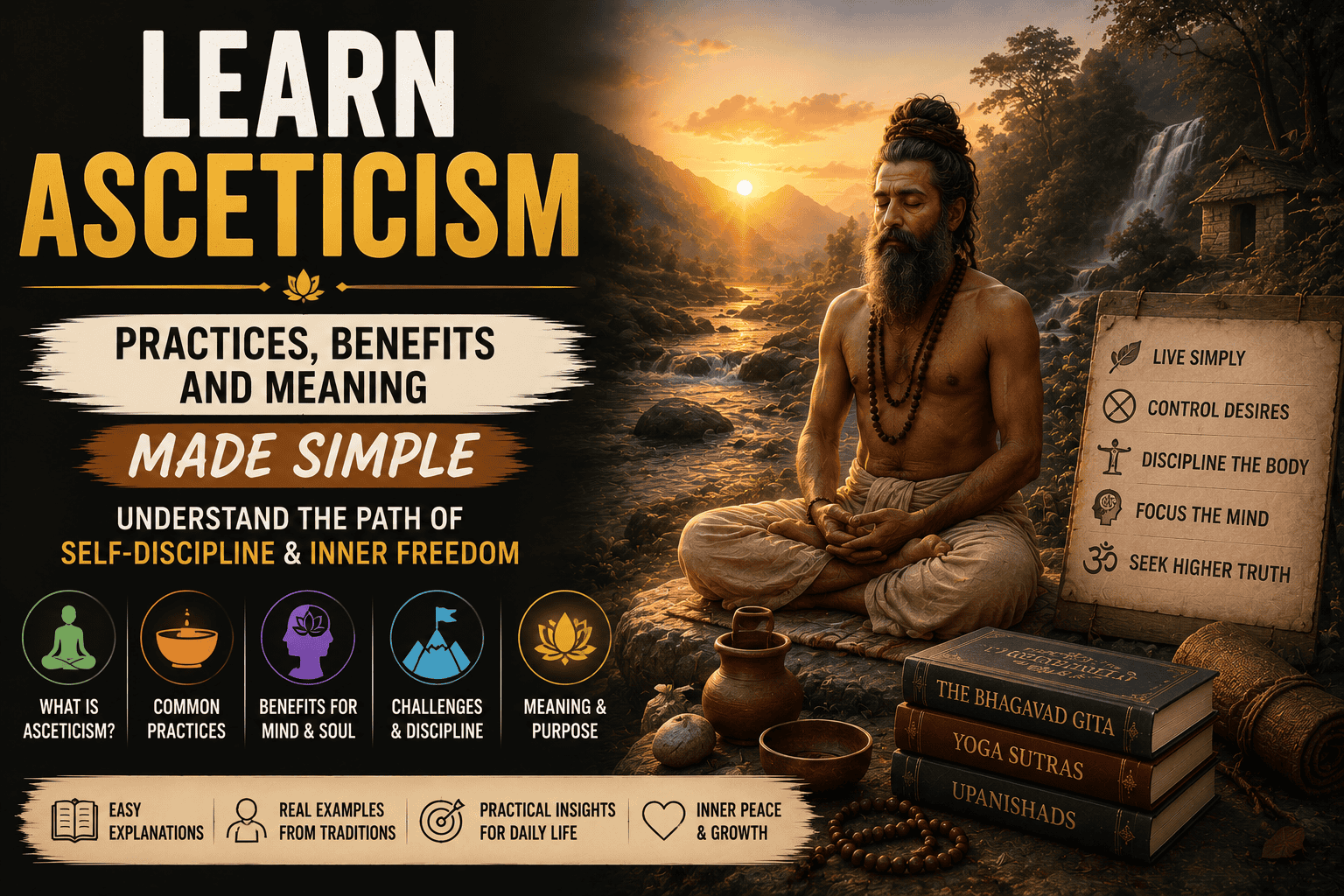
Explore the Practice of Self-Discipline, Simplicity, and Spiritual Growth — Asceticism refers to a way of life centered on intentional self-control, restraint, and the reduction of attachment to worldly comforts. Across different philosophical and religious traditions, ascetic practices have been used to pursue spiritual development, moral discipline, purification, or greater awareness of the self. Examples can include fasting, meditation, solitude, voluntary simplicity, and giving up certain material or sensory pleasures.
Asceticism does not necessarily mean rejecting the world itself; instead, it often involves limiting distractions and desires in order to develop greater clarity, discipline, and inner freedom. Different traditions interpret these practices in distinct ways, from religious devotion and spiritual transformation to philosophical self-mastery. At its core, asceticism raises a fundamental question: Does greater freedom come from possessing more, or from becoming less dependent on what we desire?
Content Overview
- Introduction: The Inner and Outer Dimensions of Religion
- Part 1: Asceticism – Renunciation and Discipline
- 1.1 Basic: Definition – What Is Asceticism?
- 1.2 Basic: Purpose of Ascetic Practices – Why Renounce?
- 1.3 Intermediate: Spiritual Purification, Detachment, and Transformation
- 1.4 Advanced: Asceticism in World Religions – An Overview
- 1.5 Intermediate: Ethical and Psychological Dimensions of Renunciation
- 1.6 Advanced: Critiques and Limits of Asceticism
- 1.7 Case Study: St. Anthony of Egypt and Early Christian Monasticism
- Part 2: Mysticism – Direct Encounter with the Divine
- 2.1 Basic: Defining Mysticism and Religious Experience
- 2.2 Basic: Nature of Mystical Experience – Unity, Ineffability, Ecstasy
- 2.3 Intermediate: Types of Mystical Experience – Unitive, Visionary, Dark Night
- 2.4 Advanced: Mysticism Across Traditions
- 2.5 Intermediate: Comparative Themes – Ego Death, Union, Grace vs. Effort
- 2.6 Advanced: Theological Interpretations of Union with the Divine
- 2.7 Case Study: Rumi’s Mystical Poetry – The Reed Flute and the Beloved
- Part 3: Sacraments and Rituals – Sacred Acts and Communal Worship
- 3.1 Basic: What Is a Sacrament? Grace Through Ritual
- 3.2 Basic: The Role of Ritual in Religious Life – Order, Meaning, Community
- 3.3 Intermediate: Symbolism, Sacred Acts, and Communal Worship
- 3.4 Intermediate: Rites of Passage – Birth, Marriage, Death
- 3.5 Intermediate: Pilgrimage, Festivals, and Sacred Times
- 3.6 Advanced: Ritual Symbolism – Sacred Objects and Actions
- 3.7 Advanced: Sacramental Theology in Comparative Perspective
- 3.8 Case Study 1: A Comparison of the Eucharist in Christianity and the Hajj in Islam
- 3.9 Case Study 2: Ritual and Mysticism Combined – The Sufi Sama Ceremony
- The Interplay of Discipline, Experience, and Community
Introduction: The Inner and Outer Dimensions of Religion
Religions are not simply sets of beliefs. They are lived realities that involve the whole person – body, mind, and spirit. This guide explores three essential dimensions of religious life:
- Asceticism – the disciplined renunciation of worldly pleasures to achieve spiritual growth.
- Mysticism – the direct, personal experience of the divine or ultimate reality.
- Sacraments and Rituals – the structured, communal acts that channel grace and express faith.
These dimensions often overlap. A monk’s fasting (asceticism) may lead to a vision of God (mysticism), and both are expressed through ritual acts like prayer or pilgrimage. Understanding these three pillars gives you a powerful lens for analyzing any religious tradition.
Part 1: Asceticism – Renunciation and Discipline
1.1 Basic: Definition – What Is Asceticism?
Asceticism (from Greek askesis – “exercise” or “training”) is the voluntary practice of self-discipline, renunciation, and restraint from worldly pleasures for spiritual, moral, or philosophical purposes.
Explanation: An ascetic deliberately avoids or limits indulgences that most people consider normal or enjoyable such as rich food, sexual activity, comfortable clothing, sleep, or material possessions. However, asceticism is not mere deprivation. It is purposeful training, like an athlete’s rigorous workout. The goal is to strengthen the will, purify the soul, reduce attachment to the material world, and draw closer to the divine or to enlightenment.
Example: A Christian monk who eats only one simple meal a day, sleeps on a hard wooden board, and spends most of the night in prayer is practicing asceticism. He is not punishing himself for punishment’s sake; he is training his body and mind to focus entirely on God.
Example: A Hindu yogi who practices brahmacharya (celibacy) and stands on one leg for hours is performing an ascetic austerity (tapas) to accumulate spiritual power and hasten liberation.
1.2 Basic: Purpose of Ascetic Practices – Why Renounce?
Ascetic practices serve multiple interconnected purposes across religions:
- Spiritual Purification: By controlling bodily desires, the ascetic removes obstacles to spiritual perception. Desires for food, sex, and comfort are seen as “dust” that covers the soul’s natural clarity.
- Discipline of the Body: The body is viewed as a tool or a vehicle, not an end in itself. Asceticism trains the body to obey the spirit, much like a rider trains a horse.
- Detachment from the World: Worldly pleasures are temporary and often lead to suffering or distraction. Renouncing them shifts focus to eternal realities (God, nirvana, moksha).
- Ego Reduction: Indulgence feeds the ego (“I want, I deserve”). Asceticism humbles the ego, teaching that happiness does not come from external things.
- Acquisition of Spiritual Power (Tapas): In some traditions (e.g., Hinduism), intense asceticism generates a spiritual heat (tapas) that gives the practitioner extraordinary abilities or favor from the gods.
- Imitating a Holy Model: Many ascetics imitate the founder or ideal figure – Buddha’s renunciation of palace life, Jesus’s forty days in the desert, Muhammad’s retreats to the cave of Hira.
Example: In Islam, fasting during Ramadan (Sawm) is obligatory for all able adults. It trains self-control, reminds believers of the suffering of the poor, and purifies the soul. This is a temporary, communal asceticism, not a lifelong renunciation.
1.3 Intermediate: Spiritual Purification, Detachment, and Transformation
Asceticism is not an end in itself; it is a means to transformation. The ascetic seeks to reorder their desires so that the highest good (God, enlightenment) becomes the only real object of longing. This involves:
- Detachment (Vairagya in Hinduism, Renuntiatio in Christianity): Learning to enjoy things without clinging to them. An ascetic may own a robe but not be attached to its color or softness.
- Purification (Katharsis): Removing sinful habits, selfish motives, and mental distractions. In Christianity, this is called purgation – the first stage of the mystical path.
- Theosis or Deification: In Eastern Christianity, asceticism leads to theosis – becoming “like God” through grace. The body itself is transfigured.
Example: St. John of the Cross described the “dark night of the soul” – a painful period where all spiritual consolations are removed, leaving the soul pure and ready for union with God. This is an advanced stage of ascetic purification.
1.4 Advanced: Asceticism in World Religions – An Overview
1.4.1 Asceticism in Christianity: Desert Fathers and Monasticism
Desert Fathers (3rd–4th century CE): The first Christian hermits fled to the Egyptian desert to escape the corrupting influence of society and to wage spiritual warfare against demons and their own passions. The most famous was St. Anthony of Egypt (see case study). They lived in tombs, abandoned forts, or caves, practicing prolonged fasting, all-night vigils, and manual labor.
Monasticism: As the movement grew, communities formed. St. Benedict (480–547) wrote a “Rule” that balanced prayer, work, and study. Benedictine monks took vows of poverty (no personal property), chastity (no sex), and obedience (to the abbot). Later orders like the Franciscans emphasized radical poverty; the Cistercians emphasized silence and manual labor.
Purpose: To follow Christ’s example – he fasted 40 days, had “no place to lay his head,” and called his disciples to “deny themselves, take up their cross.” Asceticism in Christianity is always oriented toward love of God and neighbor, not self-hatred.
Example: A Trappist monk (Cistercian) wakes at 3:30 AM for vigils, eats no meat, speaks only during designated times, and spends hours in silent prayer. This discipline frees him to “pray without ceasing.”
1.4.2 Asceticism in Hinduism: Sannyasa and Yogic Austerities
Sannyasa (Renunciation): In classical Hinduism, life is divided into four stages (ashramas). The fourth stage, sannyasa, is for those who renounce all worldly ties – family, wealth, social status. The sannyasin wears orange or white, carries a staff and water pot, and wanders, begging for food. They practice tapas (austerities): fasting, celibacy, silence, and meditation on the self (atman).
Yogic Asceticism: The Yoga Sutras of Patanjali (c. 400 CE) describe niyamas (observances) including tapas (austerity), svadhyaya (self-study), and ishvara pranidhana (surrender to God). Hatha yoga includes extreme postures, breath control, and cleansing practices (e.g., swallowing a long cloth to clean the stomach).
The goal is to remove karma, calm the mind, and realize the unity of the self with Brahman, leading to liberation (moksha).
Example: A sadhu (holy man) in India may hold one arm raised in the air for years until the muscles atrophy, or lie on a bed of nails. These extreme ascetic acts are believed to generate immense spiritual power and hasten liberation.
1.4.3 Asceticism in Buddhism: The Monastic Code and the Middle Way
The Buddha’s Middle Way: Before his enlightenment, Siddhartha Gautama tried extreme asceticism nearly starving to death. He rejected this as not leading to awakening. He taught the Middle Way between indulgence (palace life) and self-mortification. However, Buddhist monks and nuns still practice a disciplined asceticism.
Vinaya (Monastic Rule): The code for Buddhist monks (bhikkhus) includes:
- No eating after noon (one meal a day, before midday).
- No handling money.
- No sleeping on high or luxurious beds.
- No entertainment (music, dancing, shows).
- Celibacy.
- Possessions limited to eight items (robe, bowl, razor, needle, belt, water strainer, etc.).
Dhutangas (Ascetic Practices): Some monks take on extra “forest practices” – living in cemeteries, wearing robes made of discarded rags, eating only from the alms bowl, sitting only in the open, etc. These are not required but encouraged for those seeking rapid progress.
Goal: To reduce craving (tanha), the root of suffering, and to cultivate mindfulness and concentration leading to nirvana.
Example: A Theravada monk in Thailand goes on a “tudong” (walking pilgrimage) through the forest, sleeping under trees, eating only what is given, and meditating in charnel grounds to contemplate death.
1.4.4 Islamic Asceticism (Zuhd) and Sufism
Zuhd (Asceticism): The Arabic word zuhd means “renunciation” – specifically, turning away from the world (dunya) toward Allah. Early Muslim ascetics, like Hasan al-Basri (642–728), wore coarse wool (the origin of “Sufi” – from suf = wool), ate little, and wept out of fear of God’s judgment. They rejected luxury and status.
Sufism (Islamic Mysticism): Sufis transformed asceticism from fear-based renunciation to love-based detachment. The goal is not merely to avoid sin but to become so absorbed in love of God that worldly things lose their pull.
Sufi Practices: Dhikr (remembrance of God – repeating divine names), fasting beyond Ramadan, night prayers (tahajjud), and sometimes seclusion (khalwa). Some Sufi orders (e.g., Mevlevi, known as whirling dervishes) use music and dance as a form of ecstatic worship.
Example: Rabi’a al-Adawiyya (8th century) – a female Sufi saint – was asked why she carried a torch and water. She responded, “I wish to burn paradise and extinguish hell so that these illusions may vanish.” Then people will worship God out of love, not fear or hope of reward.”
1.5 Intermediate: Ethical and Psychological Dimensions of Renunciation
Ethical Dimension: Asceticism cultivates virtues that benefit both the individual and society:
- Non-violence (Ahimsa): By controlling one’s own appetites, the ascetic is less likely to harm others for gain.
- Compassion: Experiencing voluntary poverty creates empathy for the poor.
- Honesty and Contentment: A simple life reduces the temptation to lie, steal, or exploit.
Psychological Dimension: Modern psychology has begun to appreciate certain ascetic practices:
- Willpower as a muscle: Deliberate self-denial (e.g., fasting) strengthens self-control, which can be applied to other areas (e.g., breaking bad habits).
- Detachment from hedonic adaptation: The “hedonic treadmill” means we quickly return to a baseline happiness after gaining possessions. Asceticism breaks the cycle of craving and dissatisfaction.
- Ego dissolution: Renouncing status symbols and comfort reduces the ego’s defensive structures, allowing for more authentic relationships and spiritual openness.
Example: A person who practices intermittent fasting (a mild modern asceticism) may find they are less irritable and more focused. Extended to a spiritual context, the ascetic reports a sense of freedom: “I no longer need the latest phone to feel worthy.”
1.6 Advanced: Critiques and Limits of Asceticism
Not all religious thinkers praise asceticism. Critiques include:
- Body negativity: Some forms of asceticism treat the body as evil, leading to dualism (spirit good, matter bad). This can cause psychological harm (e.g., eating disorders, self-hatred).
- Spiritual pride: An ascetic may become proud of their renunciation, defeating the purpose. The desert fathers warned of the demon of “vainglory.”
- Neglect of social duties: Extreme renunciation (leaving family, refusing to work) can be selfish. Buddhism’s Middle Way and Protestant Christianity’s “work ethic” balance asceticism with engagement.
- Ineffectiveness: The Buddha concluded that extreme asceticism did not lead to enlightenment; only mental cultivation does.
Advanced example: The Catholic Church distinguishes between “ordinary” asceticism (fasting during Lent, daily prayer) and “extraordinary” (hair shirts, self-flagellation). The latter is permitted but not required, and must be supervised by a spiritual director to avoid pathology.
1.7 Case Study: St. Anthony of Egypt and Early Christian Monasticism
Who: St. Anthony (c. 251–356 CE) is called the “Father of Monasticism.” He was a wealthy Egyptian Christian who heard the Gospel reading: “If you would be perfect, go, sell what you possess and donate it to the poor.” He obeyed, placed his sister in a convent, and withdrew to a small hut in the desert.
His Ascetic Life: For decades, Anthony lived in extreme solitude, first in a tomb (where he fought demons who appeared as wild beasts), then in an abandoned fort near the Red Sea. He ate only bread and salt, drank only water, ate once a day after sunset, and sometimes went two to four days without food. He wove palm fronds for manual labor, slept on a mat of rushes, and spent nights in prayer.
His Influence: Disciples gathered around him, forming the first loosely organized monastic communities. Athanasius of Alexandria wrote The Life of Anthony, which became a bestseller of the ancient world, inspiring Augustine of Hippo and countless others. Anthony’s model – fleeing the world to battle demons and passions shaped Christian spirituality for centuries.
Why This Matters: Anthony shows how personal asceticism can become a movement. He did not invent monasticism, but he crystallized its core ideals: solitude, poverty, fasting, prayer, and spiritual warfare. His life demonstrates that asceticism is not masochism but a strategic retreat to gain clarity and strength for the ultimate battle against one’s own disordered desires.
Example from the Life: Once, a philosopher asked Anthony how he could live without books.Anthony the Great responded that his “book” was the natural world itself, explaining that whenever he wished, he could perceive God’s message within creation.
Part 2: Mysticism – Direct Encounter with the Divine
2.1 Basic: Defining Mysticism and Religious Experience
Mysticism (from Greek mystes – “initiated person”) refers to the direct, immediate, and personal experience of the divine, ultimate reality, or the ground of being. It goes beyond belief, doctrine, or ritual – it is experiential knowledge.
Explanation: A mystic does not simply believe in God or nirvana; they feel or see it directly, often in a state that transcends ordinary consciousness. These experiences are usually described as unitive (a sense of oneness), joyful, and beyond words. Mysticism exists within almost every major religion, though its forms vary.
Example: A Christian mystic like Julian of Norwich (14th century) had visions of Christ bleeding on the cross and heard him say, “All shall be well, and all manner of“Everything will be fine.” This was not merely a theological idea but a deeply experienced conviction.
2.2 Basic: Nature of Mystical Experience – Unity, Ineffability, Ecstasy
The American psychologist and philosopher William James (1842–1910) identified four marks of mystical experience in his classic The Varieties of Religious Experience:
- Ineffability: The experience cannot be adequately described in words. You “know” it, but you cannot fully explain it.
- Noetic quality: It feels like a genuine source of knowledge, not just emotion. The mystic says, “I have seen the truth.”
- Transiency: Mystical states are temporary, lasting from a few seconds to several hours. They fade but leave lasting effects.
- Passivity: The mystic feels that the experience is given, not produced by their own effort. It overwhelms them suddenly, like a powerful wave.
Other common features: Sense of unity (with God, the universe, all beings); loss of ego boundaries; overwhelming joy or peace; sense of timelessness or eternity; illumination or light.
For example, a Zen practitioner may experience kensho, a sudden realization of their true nature. He may later say, “The sky is blue, the bird sings, but there is no ‘me’ separate from them.” This is noetic and ineffable.
2.3 Intermediate: Types of Mystical Experience – Unitive, Visionary, Dark Night
Scholars classify mystical experiences into several types:
- Unitive Mysticism: A sense of oneness – with God, nature, or the cosmos. The distinction between self and other dissolves. Examples: Advaita Vedanta’s “Tat tvam asi” (You are that); Sufi fana (annihilation in God); some psychedelic experiences.
- Visionary Mysticism: Seeing spiritual beings, landscapes, or symbols. Examples: Teresa of Avila’s vision of a golden angel piercing her heart; Ezekiel’s vision of the chariot; Black Elk’s vision of the six grandfathers.
- Ecstatic Mysticism: Overwhelming emotions – joy, love, tears, even physical sensations like levitation (reported in some traditions). For example, Rumi would spin until entering a state of wajd, or spiritual ecstasy.
- Dark Night of the Soul: A painful stage where all spiritual consolation disappears. The mystic feels abandoned by God. This is not a failure but a purification leading to deeper union. John of the Cross is the primary theorist.
Example: A Carmelite nun goes through months of spiritual dryness – no joy in prayer, no sense of God’s presence. She continues her disciplines faithfully. Then, suddenly, she experiences a profound, silent union. The dark night was the preparation.
2.4 Advanced: Mysticism Across Traditions
2.4.1 Christian Mysticism: Teresa of Avila and John of the Cross
Teresa of Ávila was a Spanish Carmelite reformer and a Doctor of the Church who lived from 1515 to 1582. Her book The Interior Castle describes the soul as a castle with seven “mansions” (stages). The first mansions involve prayer and self-knowledge; the later mansions involve supernatural experiences: raptures, visions, and the “prayer of union.” In the seventh mansion, the soul is spiritually married to God. Teresa was known for levitation (which she prayed to stop, as it drew attention).
John of the Cross (1542–1591): Also a Spanish Carmelite and Doctor of the Church. He wrote The Dark Night of the Soul and The Ascent of Mount Carmel. He taught three stages: purgation (cleaning senses and spirit), illumination (divine light), and union (transforming union). The “dark night” is the painful purgation of attachments, even to spiritual consolations.
Example: John described a “living flame of love” that burns away the soul’s impurities until it becomes pure light. This flame is the Holy Spirit.
2.4.2 Islamic Sufism: Rumi, Al-Ghazali, Ibn Arabi
Rumi (1207–1273): Persian poet and founder of the Mevlevi order (whirling dervishes). His Masnavi is a six-volume poem of spiritual teaching. Rumi’s mysticism is ecstatic and love-centered. He uses metaphors of the reed flute (separated from its reed bed, longing to return), the lover and beloved, and wine (divine intoxication). For Rumi, the goal is fana (annihilation of the ego) followed by baqa (subsistence in God).
Al-Ghazali (1058–1111): A theologian who experienced a spiritual crisis and abandoned his prestigious teaching post to become a wandering Sufi. His Revival of the Religious Sciences integrated Islamic law with mysticism. He argued that intellectual knowledge alone is dead; only direct taste (dhawq) of God’s presence gives certainty.
Ibn Arabi (1165–1240): The “Greatest Master” of Sufi philosophy. He taught wahdat al-wujud (the Unity of Being). All of existence is viewed as an expression of God . The cosmos is God’s self-disclosure. The idea of the perfect human (al-insan al-kamil) refers to a person who comes to realize this unity. This is a highly advanced metaphysical mysticism.
For example, Ibn Arabi expresses in his poetry that the heart can embrace every form—serving as a place for different faiths and traditions—and ultimately follows a path defined by love.
2.4.3 Hindu Mysticism: Advaita Vedanta and Bhakti
Advaita Vedanta (Non-dualism): The school of philosophy associated with Shankara (8th century). It teaches that the individual self (atman) is not separate from the ultimate reality (Brahman). The experience of “I am Brahman” (Aham Brahmasmi) is liberation. This is a unitive, noetic mysticism achieved through study, meditation, and the grace of a guru.
Bhakti Mysticism: The devotional path (bhakti yoga) involves intense love for a personal god (Krishna, Shiva, Devi). Mystics like Mirabai (16th century) sang of her union with Krishna as a lover. The experience is ecstatic and emotional, often involving dancing, crying, and loss of self-consciousness.
Example: The Upanishads (ancient Hindu scriptures) describe a state where “the seer sees no separate other, the hearer hears no separate other, the knower knows no separate other. That is the Infinite.”
2.4.4 Buddhist Mysticism: Zen and Vipassana
Zen Buddhism: Zen (Chan in Chinese) emphasizes direct insight into one’s own nature, bypassing scriptures and concepts. The practice of zazen (sitting meditation) and working on koans (paradoxical riddles like “What is the sound of one hand?”) can trigger kensho or satori (sudden enlightenment). This is a noetic, transient experience of emptiness (shunyata) and suchness (tathata).
Vipassana (Insight Meditation): In Theravada Buddhism, the meditator observes the arising and passing of all sensations, thoughts, and feelings. Eventually, the three marks of existence (impermanence, suffering, no-self) are directly seen. This is a less dramatic but equally transformative mystical experience.
Example: A Zen master rings a bell. The student hears the bell and, for a moment, there is no “I” hearing, no “bell” as a separate object – just pure ringing. That is a glimpse of enlightenment.
2.5 Intermediate: Comparative Themes – Ego Death, Union, Grace vs. Effort
Across traditions, several common themes appear:
- Ego death: The sense of a separate self dissolves. In Christianity, this is “dying to self”; in Sufism, fana; in Buddhism, anatta (no-self); in Advaita, the removal of avidya (ignorance).
- Union: The mystic experiences oneness – with God, with the cosmos, with the ground of being. Christians speak of “deification” (theosis); Sufis of “unity of being”; Hindus of “Atman is Brahman”; Buddhists of “non-duality” (advaya).
- Grace vs. Effort: Some traditions (e.g., Protestant Christianity, Pure Land Buddhism) emphasize that mystical union is a gift of grace, not achieved by works. Others (e.g., early Buddhist meditation, Raja Yoga) emphasize systematic effort. Most traditions hold both: you prepare the field (effort), but the harvest is grace.
Example: A Christian contemplative prays for hours, but the vision of Christ comes unexpectedly – not as a reward but as a free gift. A Buddhist monk sits for years, but the moment of enlightenment is described as “falling into” it.
2.6 Advanced: Theological Interpretations of Union with the Divine
How different traditions interpret “union” varies significantly:
- Christian orthodoxy: Union with God is a union of love and will, not of essence. The creature remains creature; God remains God. The mystic “participates” in divine nature (2 Peter 1:4) but does not become God ontologically.
- Sufi interpretation: For Ibn Arabi, union is recognizing that only God truly exists. The mystic’s individual existence was an illusion. Fana is the removal of that illusion. This is closer to monism (all is one) than theistic union.
- Advaita Vedanta: There is no “union” because there was never separation. The realization is that you are Brahman right now. “Union” is a metaphor for waking up from the dream of separateness.
- Buddhist interpretation: There is no permanent self to unite with anything. “Union” is a misleading term. What happens is the cessation of the illusion of a separate self. Nirvana is not union but the end of suffering.
Advanced example: A Christian mystic might say, “I am in God and God is in me, yet I am not God.” A Sufi might say, “I am the Truth” (Hallaj’s Ana al-Haqq) – which got him executed for blasphemy. The difference is not just words but fundamental theology.
2.7 Case Study: Rumi’s Mystical Poetry – The Reed Flute and the Beloved
Who: Jalal al-Din Rumi (1207–1273) was a Persian jurist, theologian, and poet who, after meeting a wandering dervish named Shams of Tabriz, abandoned his academic career and became a ecstatic mystic poet. His major work is the Masnavi-ye Ma’navi (Spiritual Couplets), often called the “Quran in Persian.”
The Reed Flute Metaphor: Rumi’s Masnavi opens: “Listen to the reed flute, how it complains / Telling the tale of separations.” The reed was cut from its reed bed (the divine source). Its plaintive music is the soul’s longing to return to God. The flute’s hollow interior (emptiness) is necessary for the music (divine revelation) to pass through.
Key Themes in Rumi’s Poetry:
- Love (ishq) as the driving force of the universe. Not romantic love but cosmic, divine love.
- Intoxication: Wine is a symbol of divine ecstasy that makes the self forget itself.
- The Beloved: God is the Beloved. The lover (the mystic) seeks to be annihilated in the Beloved’s presence.
- Dance and music: The sama ceremony (whirling) is a physical expression of the soul’s ecstatic journey. The dervish whirls with one hand up (receiving divine grace) and one hand down (giving it to the earth).
Example of Rumi’s Poetry:
Rumi reflects that from the moment one first encounters love, the search begins—often without realizing that what is sought is already within. Lovers do not ultimately find each other in a distant place; they are, in a deeper sense, always present within one another.
Why This Matters: Rumi’s poetry is read worldwide by Muslims and non-Muslims alike. It shows that mysticism can be expressed in art that transcends its original religious context. The longing for union with the divine is a universal human theme.
Part 3: Sacraments and Rituals – Sacred Acts and Communal Worship
3.1 Basic: What Is a Sacrament? Grace Through Ritual
A sacrament is a religious ritual or rite that is believed to convey divine grace – a special, invisible blessing from God or the sacred – through visible, physical elements and actions.
Explanation: The word comes from Latin sacramentum, meaning “a sacred oath” or “a sign of the sacred.” In Christianity, sacraments are outward, physical signs (water, bread, wine, oil) that produce an inward, spiritual effect (forgiveness, strengthening, healing). In a broader sense, any religion has rituals that function as sacraments – acts that connect the material world to the spiritual.
Example in Christianity: Baptism uses water (physical) to wash away sin and initiate the person into the church (spiritual). The Eucharist uses bread and wine (physical) to convey the real presence of Christ (spiritual).
Example in Hinduism: A puja (ritual worship) involves offerings of flowers, incense, food, and water to a deity’s image. The deity is believed to accept the offering and return a blessing (prasada).
3.2 Basic: The Role of Ritual in Religious Life – Order, Meaning, Community
Rituals are repeated, structured actions that carry religious significance. They serve several essential functions:
- Creating Order: Life is chaotic. Rituals provide a predictable, sacred structure – daily prayers, weekly worship, annual festivals. This reduces anxiety and gives a sense of control.
- Transmitting Meaning: Rituals encode stories, beliefs, and values. When a community performs a ritual, they are rehearsing their worldview.
- Building Community: Shared rituals create bonding, collective identity, and solidarity. Eating together, singing together, suffering together (e.g., fasting) – all strengthen group ties.
- Marking Time: Religious calendars (Advent, Ramadan, the Jewish Sabbath) create sacred time, distinct from ordinary, profane time.
- Transforming Individuals: Rites of passage (birth, initiation, marriage, death) mark and facilitate life transitions. The ritual changes the person’s social and spiritual status.
Example: Muslims pray five times daily (salah). The exact times are determined by the sun’s position. This structures the entire day around remembrance of Allah. Praying in congregation at a mosque on Fridays reinforces the ummah (global Muslim community).
3.3 Intermediate: Symbolism, Sacred Acts, and Communal Worship
Rituals are rich in symbolism – physical objects and actions that stand for invisible realities.
Common symbolic actions:
- Bowing or prostrating: Humility before the divine.
- Raising hands: Offering, receiving blessing, or prayer.
- Procession: Journeying toward the sacred.
- Circumambulation (walking in a circle): Repeating the cosmic order; done around the Kaaba in Mecca and Buddhist stupas.
Sacred objects:
- Cross (Christianity): Salvation through Christ’s death.
- Lotus (Buddhism/Hinduism): Purity rising from muddy water (material world).
- Om symbol (Hinduism): The primordial sound of the universe.
- Crescent and star (Islam): Associated with the lunar calendar and divine light.
Communal worship: Most rituals are not solitary. The group performs together, creating a collective effervescence (Emile Durkheim’s term) – a feeling of being swept up in something larger than oneself. Singing, chanting, and synchronized movements (kneeling, standing) intensify this.
Example: A Catholic Mass includes standing (for the Gospel), sitting (for readings), kneeling (for the consecration), and processing to receive communion. The entire congregation moves as one body.
3.4 Intermediate: Rites of Passage – Birth, Marriage, Death
The French anthropologist Arnold van Gennep (1873–1957) identified three stages in rites of passage: separation (leaving the old status), liminality (being in-between), and incorporation (entering the new status).
Birth rituals:
- Christian baptism: Water and words separate the child from original sin and incorporate them into the church.
- Islam’s Aqiqah: On the seventh day, the child’s head is shaved, and an animal is sacrificed. The hair’s weight in silver is given to charity.
- Hindu Namakarana: Naming ceremony, often 11th or 12th day after birth, involving a priest and offerings to fire.
Marriage rituals:
- Christian wedding: Vows, exchange of rings, blessing by clergy. The couple is separated from single life and incorporated into a new family unit.
- Islamic Nikah: A contract signed before witnesses, with a bridal gift (mahr), and a sermon.
- Hindu Vivaha: The couple circles a sacred fire seven times (saptapadi), binding them for seven lifetimes.
Death rituals:
- Jewish Shiva: Seven days of mourning, sitting on low stools, receiving visitors. The dead is washed and buried within 24 hours.
- Islamic Janazah: The body is washed, wrapped in white cloth, prayed over, and buried facing Mecca. The funeral prayer is considered a shared responsibility of the community.
- Hindu cremation: The body is burned to release the soul; ashes are scattered in a sacred river (e.g., Ganges). Rituals for the ancestors (śrāddha) continue for days.
Example: In Bali (Hindu-influenced), a cremation (ngaben) is a joyous, noisy affair because the soul is being freed from the body to be reborn. The elaborate tower (bade) is burned, symbolizing the destruction of the material world.
3.5 Intermediate: Pilgrimage, Festivals, and Sacred Times
Pilgrimage: A journey to a sacred place, often with physical hardship (walking, climbing). Pilgrimage combines ritual movement, asceticism (enduring discomfort), and communal worship.
- Hajj (Islam): All able Muslims should go to Mecca once. Rituals include circling the Kaaba seven times, running between Safa and Marwa, standing at Arafat, and stoning the devil. The hajj erases past sins.
- Kumbh Mela (Hinduism): The largest gathering of humans on Earth. Pilgrims bathe at the confluence of sacred rivers (Ganges, Yamuna, mythical Sarasvati) to wash away karma.
- Camino de Santiago (Christianity): A network of pilgrimage routes to the shrine of St. James in Spain.Pilgrims often travel on foot for weeks, carrying a scallop shell as a symbolic emblem of their journey.
Festivals: Annual celebrations that reenact mythic events or mark seasonal changes.
- Easter (Christianity): Resurrection of Christ. Includes Lent (40 days of fasting), Holy Week, and Easter Sunday.
- Eid al-Fitr (Islam): Breaking the fast of Ramadan. Communal prayer, feasting, giving charity (zakat al-fitr).
- Diwali (Hinduism): Festival of lights. Celebrates Rama’s return from exile. Lights, fireworks, sweets, and worship of Lakshmi (goddess of wealth).
- Vesak (Buddhism): Buddha’s birth, enlightenment, and death. Devotees release caged birds, light lanterns, and pour water over a statue of the baby Buddha.
Sacred Times: Not just dates but hours (prayer times), days (Sabbath, Friday prayers), and seasons (Advent, Lent, Ramadan). Sacred time is “different” – it participates in the eternal.
Example: For Orthodox Jews, the Sabbath (from Friday sunset to Saturday sunset) is a day of complete rest – no work, no driving, no turning on lights. This creates a weekly “island in time” (Abraham Joshua Heschel) focused on family, prayer, and Torah study.
3.6 Advanced: Ritual Symbolism – Sacred Objects and Actions
Ritual symbols work on multiple levels simultaneously. They are “condensed” (carry many meanings) and “multivocal” (speak to different people differently). The anthropologist Victor Turner studied ritual symbols among the Ndembu of Africa and identified three properties:
- Orectic pole: The symbol appeals to basic human desires (e.g., milk = mother’s nurturing, blood = life).
- Normative pole: The symbol conveys social values and rules (e.g., the cross = self-sacrifice and obedience).
- Cognitive pole: The symbol organizes beliefs about the world (e.g., the four directions = cosmic order).
Examples of sacred objects and their symbolism:
- Water (baptism, ablution, libation): Cleansing, death/rebirth, life, the primordial chaos.
- Fire (Hindu havan, Zoroastrian temple flames): Purification, divine presence, energy, destruction of evil.
- Bread and wine (Eucharist): Sustenance, community, sacrifice, blood.
- Incense (Catholic Mass, Buddhist temples): Prayer rising to heaven, purification, sweetness.
- Oil (anointing in Christianity, Judaism): Healing, consecration, joy, the Holy Spirit.
Example: In a Hindu arati ceremony, a priest waves a lamp with five flames (representing the five elements: earth, water, fire, air, ether) before the deity. The worshippers then pass their hands over the flame and touch their eyes – receiving the deity’s blessing. The lamp is a condensed symbol of cosmic creation and divine presence.
3.7 Advanced: Sacramental Theology in Comparative Perspective
Sacramental theology asks: How does a physical ritual convey spiritual grace? Different traditions answer differently:
- Catholic/Orthodox Christianity: Sacraments ex opere operato (by the work performed) – the ritual itself, when done with proper form and intention, objectively gives grace, regardless of the minister’s holiness. The bread and wine are believed to become the actual body and blood of Christ, a doctrine known as transubstantiation.
- Protestant Christianity (Reformed tradition): Sacraments are symbolic and memorial. The bread and wine are signs, not the actual body. Grace comes through faith, not the ritual action.
- Hinduism: The puja invites the deity to temporarily inhabit the image (pratima).The deity receives the offerings and then returns prasada, or blessed food, to the devotees.The efficacy depends on the devotee’s purity, intention, and the priest’s correct recitation.
- Islam: Rituals (prayer, fasting, pilgrimage) are acts of obedience. God rewards them with spiritual benefit, but there is no “sacramental” transformation of physical elements. Water for wudu (ablution) cleanses physically and ritually, but it is not a vehicle of a divine substance.
- Buddhism: Rituals (making offerings, bowing to a Buddha statue) are primarily for training the mind – cultivating generosity, humility, and mindfulness. They are not “sacraments” in the Western sense because there is no God to dispense grace.
Advanced example: The Catholic Eucharist requires a validly ordained priest and the words of institution (“This is my body”). A layperson cannot perform it. In contrast, a Zen Buddhist zazen (sitting meditation) requires no priest – only a cushion and a wall. The difference reflects the theology: sacraments are gifts of the church’s authority; meditation is a universal human capacity.
3.8 Case Study 1: A Comparison of the Eucharist in Christianity and the Hajj in Islam
The Eucharist (Christianity):
- What: A ritual meal of bread and wine, instituted by Jesus at the Last Supper. Also called Holy Communion, the Lord’s Supper, Mass.
- Frequency: Weekly (Sundays) for most denominations; daily in some Catholic and Orthodox traditions.
- Core theology: The bread and wine become (or represent) the body and blood of Christ. The communicant receives Christ, is united to his sacrifice, and is nourished spiritually.
- Ritual actions: The priest consecrates the elements; the congregation recites prayers (the Lord’s Prayer, the Creed); then people process to receive the host (bread) and often the chalice (wine). In Catholic tradition, only the priest drinks the wine; the congregation receives only the host.
- Meaning: Forgiveness of sins, participation in the new covenant, anticipation of the heavenly banquet, and union with fellow believers (the church as the body of Christ).
The Hajj (Islam):
- What: The annual pilgrimage to Mecca, required once in a lifetime for those who are physically and financially able.
- Frequency: Once a year during the month of Dhu al-Hijjah. An individual Muslim typically goes only once, though some go multiple times.
- Core theology: The Hajj reenacts the trials of Abraham (Ibrahim), Hagar (Hajar), and Ishmael (Ismail). It symbolizes the unity of Muslims worldwide and the equality of all before Allah. It is an act of complete submission (islam).
- Ritual actions (over 5-6 days):
- Ihram: Entering a state of purity, wearing two white seamless cloths (men). No cutting nails, hair, or using perfume.
- Tawaf: Circling the Kaaba seven times counterclockwise.
- Sa’i: The ritual of moving back and forth seven times between the hills of Safa and Marwa, recalling Hagar’s search for water.
- Arafat: Standing (or sitting) from noon to sunset on the Plain of Arafat, praying and asking forgiveness. This is the most essential rite.
- Muzdalifah: Sleeping under the open sky, collecting pebbles.
- Ramy al-Jamarat: Throwing seven pebbles at three pillars representing the devil (Satan who tried to dissuade Abraham).
- Eid al-Adha: Sacrificing an animal (sheep, goat, cow) – meat given to the poor.
- Halq or Taqsir: Shaving or cutting hair, ending the state of ihram.
- Tawaf al-Ifadah: Another circumambulation of the Kaaba.
- Tawaf al-Wada: Farewell circumambulation before leaving Mecca.
Comparison:
- Eucharist is weekly, local, and focused on eating/drinking. Hajj is once-in-a-lifetime, distant, and focused on bodily movement and sacrifice.
- Both are central to their respective faiths – the “source and summit” of Christian life (Catholic Catechism) and the fifth pillar of Islam.
- Both use physical elements (bread/wine; stones, animal blood) to connect to foundational events (Last Supper; Abrahamic covenant).
- Both create community: the Eucharist unites the local congregation; the Hajj unites the global ummah.
3.9 Case Study 2: Ritual and Mysticism Combined – The Sufi Sama Ceremony
What is Sama? Sama (Arabic for “listening”) is a Sufi ritual that includes music, chanting, and whirling dance. It is most famously associated with the Mevlevi order (Rumi’s followers – the “whirling dervishes”). The purpose is to induce a mystical state (hal) and ultimately wajd (ecstasy), leading to the remembrance (dhikr) and love of God.
The Ritual Structure (Mevlevi Sama):
- Preparation: Participants perform ritual ablutions and dress in a long white skirt (tennure) symbolizing the ego’s shroud, a black cloak (hırka) symbolizing the grave, and a tall camel-wool hat (sikke) symbolizing the tombstone.
- Procession: The sheikh (spiritual master) leads the dervishes into the semahane (whirling hall). They bow to each other – representing the divine breath.
- Na’t-i Sharif: A eulogy to the Prophet Muhammad is recited.
- Taksim: A solo improvisation on the reed flute (ney) – the sound of the reed flute representing the soul’s longing (as in Rumi’s poem).
- The Whirling (Devr-i Veled): The dervishes remove their black cloaks (leaving the ego’s grave). They cross their arms, then open them – right hand up (receiving grace), left hand down (giving to earth). They spin on their left foot, using the right foot to push. They spin in circles around the sheikh, who represents the sun. Each dervish spins individually, eyes open but unfocused, maintaining balance for 10-30 minutes.
- Quranic recitation and prayer: The whirling is accompanied by a choir singing Sufi poetry (often Rumi’s) and instrumental music (drum, ney). The speed increases, then slows.
- Conclusion: The sheikh recites a prayer, and the dervishes return to their cells.
How Ritual and Mysticism Combine:
- Ritual provides the structure – the precise steps, the timing, the costumes, the music. This creates a safe container for intense experience.
- Mysticism provides the goal – union with God, fana (annihilation of ego), ecstatic love. The spinning is not a performance; it is a meditation in motion.
- The physical act (whirling) induces altered states: The repeated rotation stimulates the vestibular system, causing a trance-like state. Combined with the hypnotic music and the poetry of divine love, the dervish may lose self-awareness and feel “spun by the Beloved.”
Example: A Mevlevi dervish describes the experience: “At first I am aware of my feet, my balance, the people around me. Then, after some minutes, my ego falls away.I am no longer spinning; I have become the spinning itself. The universe spins around a single point – which is God. There is no ‘me’ left. Only love.”
Why This Matters: The Sama ceremony shows that asceticism, mysticism, and ritual are not separate categories. The dervish’s life includes ascetic discipline (poverty, celibacy, fasting). The Sama ritual is a structured, sacramental act (with symbolic clothing and music). And the goal is mystical union. All three dimensions work together.
The Interplay of Discipline, Experience, and Community
We have explored three profound dimensions of religious life:
- Asceticism – the disciplined training of body and mind through renunciation. It is the athlete’s preparation for the spiritual race.
- Mysticism – the direct, often overwhelming experience of the divine. It is the mountaintop glimpse that transforms everything.
- Sacraments and Rituals – the communal, symbolic actions that transmit grace, mark time, and bind communities.They form the essential, everyday practices of religious life.
These are not isolated compartments. The ascetic’s fasting clears the mind for mystical vision. The mystic’s ecstasy is expressed in ritual dance or song. The ritual meal (Eucharist, prasada) feeds the soul for continued discipline. And all three are embedded in communities – monasteries, Sufi orders, congregations – that preserve and pass them on.
Understanding these dimensions allows us to see any religion more deeply. When you see a monk meditating in a cave, you are seeing asceticism. When you hear Rumi’s poetry, you are hearing mysticism. When you watch a bride circle a fire or a pilgrim throw a stone at a pillar, you are witnessing ritual. Each is a doorway to the sacred.