Epistemology
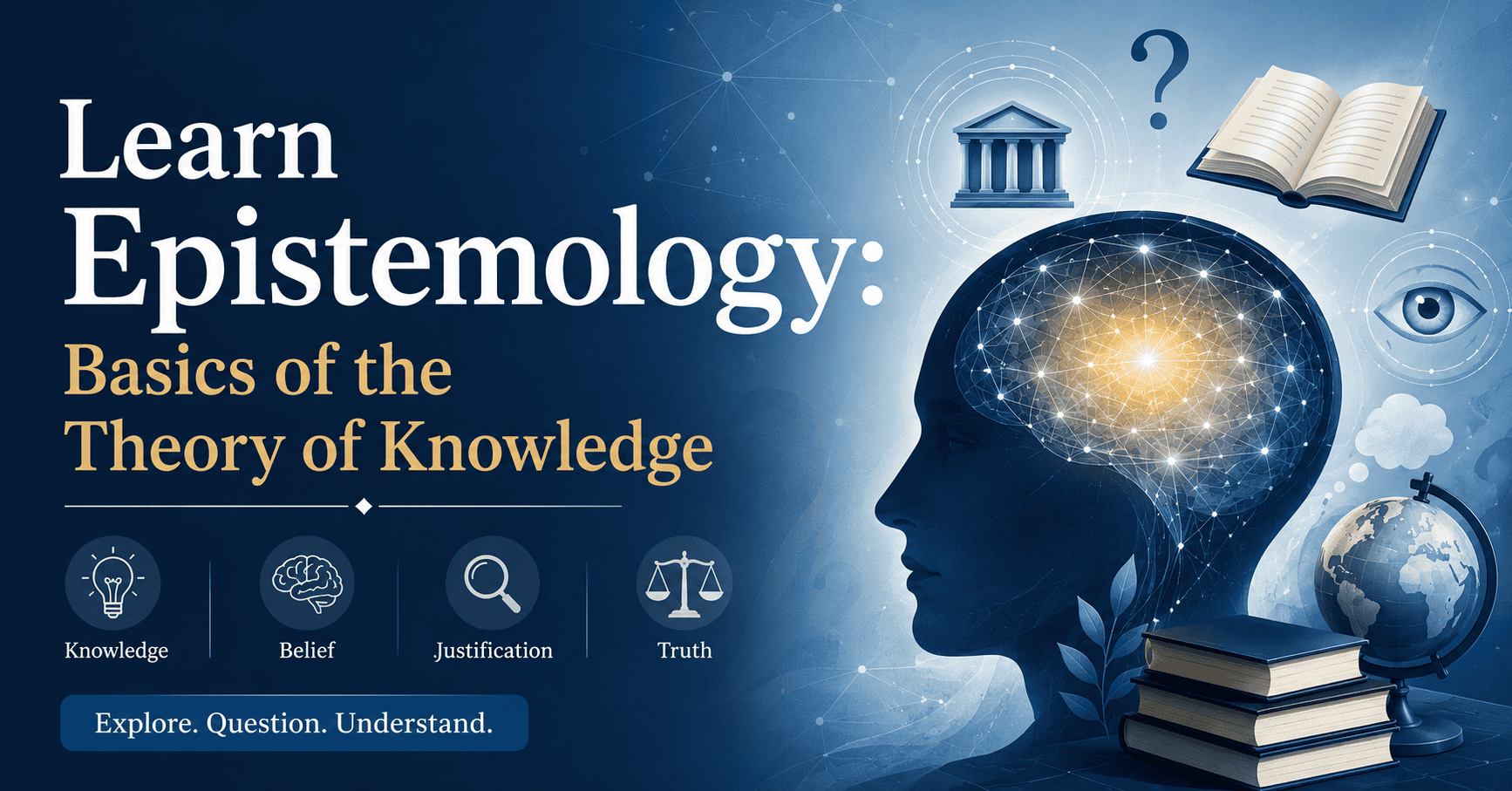
Understanding the Nature and Limits of Human Knowledge — Epistemology is the philosophical study of knowledge and the processes through which people come to understand and evaluate what they believe to be true. It explores the origins of knowledge, the reliability of different sources of information, and the standards used to determine whether a belief is adequately supported. It also raises fundamental questions about perception, experience, reason, and whether our understanding of reality accurately reflects the world itself.
The field examines important ideas such as truth, evidence, justification, certainty, belief, and rational inquiry. These concepts are relevant not only to philosophy but also to science and other areas of knowledge. For instance, when scientists evaluate whether experimental results provide sufficient evidence for a particular conclusion, they are addressing questions about justification and reliability. At its core, epistemology explores how knowledge can be established and how we can distinguish well-supported understanding from assumption, uncertainty, or error.
Content Overview
- Epistemology Introduction
- Epistemology Key Areas (Branches)
- Knowledge and its Types
- Key Questions in Epistemology
- Some of the main questions include:
- Can we trust our senses?
- Is mathematical knowledge innate or learned?
- What counts as knowledge?
- What makes a belief justified or true?
- How can we overcome doubt and uncertainty?
- What are the key conditions needed for knowledge?
- How can we differentiate between knowledge and belief?
- What are the sources of knowledge?
- What are the limits of human knowledge?
- Some of the main questions include:
Epistemology Introduction
What is Epistemology?
Epistemology, also called the theory of knowledge, is a branch of philosophy that studies what knowledge is, how we get it, and what its limits are. In simple words, epistemology tries to answers questions like:
- What is knowledge?
- How do we acquire knowledge?
- How can we be certain about what we know?
- What do people actually know?
- What does it mean to know something?
- How do we gain knowledge?
- How can we tell if what we believe is actually true?
Example: Imagine you believe it’s going to rain because the sky is cloudy. Epistemology would ask: What makes you sure that it’s going to rain? Is that belief true? Do you have valid reasons or proof to back that up? Epistemology helps us understand how we think, believe, and understand the world around us.
Why is Epistemology Important?
Epistemology is the foundation of all learning and thinking. Before accepting any idea, belief, or fact, we need to understand how we know it’s true. This is where epistemology helps. For example, before accepting a scientific claim, we rely on our understanding of evidence and reasoning core ideas in epistemology. It underpins critical thinking and informs fields like science, law, and ethics. Example: In court, a judge uses epistemology when deciding whether a witness’s testimony is reliable and based on facts, epistemology helps determine if a witness’s testimony counts as reliable knowledge.
Importance in Daily Life: Epistemology underpins all other philosophical inquiries, providing the tools to assess claims, beliefs, and evidences.
Misinformation Awareness: Strengthens our ability to analyze truth in the digital age. By understanding philosophy, we develop the ability to challenge assumptions, think independently, and seek deeper truths about the world.
Science: Scientists use epistemology to judge the truth of theories and experiments.
Ethics: In law and ethics, epistemology helps evaluate evidence and moral decisions.
AI and Technology: Helps design intelligent systems by understanding how humans gain knowledge.
Combating Misinformation: In a world full of fake news, epistemology teaches us how to identify the truth.
Understanding epistemology is essential for:
Critical Thinking: Helps differentiate between justified beliefs and unfounded opinions. Critical Thinking Improves problem-solving and decision-making. It helps us decide which beliefs are reasonable and which are not.
Science and Inquiry: Underpins the scientific method and empirical research.
Ethical Decision-Making: Influences moral judgments by establishing knowledge criteria. Ethics and morality influence and shape legal, political, and social systems.
Artificial Intelligence: Helps design ethical AI and automation.
Epistemology Key Areas (Branches)
Epistemology Branches
Epistemology is a broad field. Here are some of its main branches: Formal Epistemology, Social Epistemology, and Meta-Epistemology.
Formal Epistemology
Formal epistemology use logic and math to understand knowledge. It use formal systems such as logic, probability theory, and mathematics to study epistemic concepts like belief, certainty, and evidence. It aims to mathematically model these concepts and processes, providing a structured approach to understanding knowledge. Example: Bayesian epistemology, a branch of formal epistemology, uses probability to update beliefs in light of new evidence. It provides a framework for understanding rational belief revision.
Example: Bayesian theory helps update our beliefs when new information arrives. For instance, if you believe it’s not going to rain, but then see dark clouds, you might change your belief based on new evidence.
Social Epistemology
This focuses on how we gain knowledge from others in society through teachers, media, books, etc. It Studies the social dimensions of knowledge creation, such as testimony (How people seek information from others), peer review, and collective intelligence and explores the common aspects of knowledge production and dissemination and examines how social processes, institutions, and interactions influence our beliefs and understanding. Social epistemology investigates how information spreads, the credibility of sources, and the impact of collective knowledge on individual beliefs. Examines how social interactions and institutions affect how knowledge is created and shared.
Example: If you learn something from YouTube or a friend, you’re using social epistemology. It also examines the reliability of sources like news, social media, or online articles.
Meta-Epistemology
This branch studies the study of knowledge itself. It questions the methods and goals of epistemology. Meta epistemology investigates the foundations and methods of epistemology itself. It questions the nature, aims, and validity of epistemological inquiries. Meta epistemologists might debate whether epistemological theories should be descriptive (explaining how we do think) or normative (explaining how we should think).
Example: A meta-epistemologist might ask: “Should knowledge be defined by facts or usefulness?” or “Is it more important how people actually think, or how they should think?”
Knowledge and its Types
What is Knowledge?
What is knowledge. This field is fundamental because it helps us evaluate beliefs, evidence, and claims about the world.
Types of Knowledge
There are three main kinds of knowledge:
- Propositional Knowledge (Knowledge-That)
- Procedural Knowledge (Knowledge-How)
- Experiential Knowledge (Knowledge by Acquaintance)
Propositional Knowledge (Knowledge-That)
Propositional Knowledge (Knowledge-That) Refers to factual knowledge, such as “Paris is the capital of France.” Knowing that something is true (e.g., “Paris is in France”).
Procedural Knowledge (Knowledge-How)
Procedural Knowledge (Knowledge-How) Relates to skills and abilities, such as knowing how to ride a bike. Knowing how to perform a task. Example: Knowing how to do something, like riding a bike. Skills, e.g., knowing how to bake bread. Knowing how to do something. Definition: Skill-based knowledge. For example, knowing how to ride a bicycle.
Experiential Knowledge (Knowledge by Acquaintance)
Experiential Knowledge (Knowledge by Acquaintance) Gained through personal experience, such as knowing what it feels like to be in love. Knowledge gained through experience (e.g., tasting chocolate). Knowledge gained through personal experience. Example: Recognizing a friend’s face because you have met them before. Knowing something from experience. Knowing what it feels like to be happy. Identifying your friend’s voice during a phone call.
Core Elements of Knowledge
Belief
Core Elements of Knowledge To know something, three things are generally required: A belief is a mental representation that an individual holds as true. Belief: Knowledge requires belief; one must believe a proposition to know it. Explanation: For someone to know something, they must first believe it. Belief: Thinking something is true (e.g., believing it will rain). Belief: You need to accept it as true.
Example: You believe that water boils at 100°C.
Truth
Understanding Truth (Nature of Truth): For a belief to count as knowledge, it must align with reality. Explanation: A belief must match reality to count as knowledge. Example: Believing that water boils at 100°C is true under normal atmospheric pressure. Truth is an objective reality that corresponds with facts.
Correspondence Theory: Truth aligns with facts or reality. Truth matches reality. For example, the statement “Snow is white” is regarded as true when it matches the actual nature of snow. States that truth corresponds to reality. Explanation: A belief is true if it accurately reflects reality. Example: The statement “snow is white” is true because it corresponds with how snow appears.
Coherence Theory: Truth depends on logical consistency within a system of beliefs. Truth fits a system of beliefs. Example: A detective’s theory is true if all evidence aligns. Claims that truth is what fits within a coherent system of beliefs. Explanation: A belief is true if it fits well with other beliefs we hold. Example: Scientific theories are often accepted because they form a consistent system of ideas.
Pragmatic Theory: Truth is what proves useful or works in practice. Example: Believing vaccines save lives because they reduce disease. Truth is judged by its real-life results or practical effects. Explanation: A belief is true if it works or has practical benefits. Example: Believing in a medical treatment because it consistently helps patients recover.
Truth and Knowledge Truth is a necessary condition for knowledge, as false beliefs cannot constitute knowledge.
Justification
Justification provides reasons or evidence that support a belief. Justification: Beliefs must be justified through evidence or reasoning to qualify as knowledge. Explanation: A belief must be supported by evidence or reasoning. Justification: Evidence for the belief (e.g., checking a weather app). Example: A justified true belief (JTB): You believe it’s raining (belief), it is raining (truth), and you saw raindrops (justification).
Understanding Justification: The Nature of Justification
You should have solid reasons or proof to support that. Example: You know that water boils at 100°C because you’ve seen it happen and it’s supported by science.
Epistemic Justification: Explores what justifies beliefs and knowledge claims. It focuses on how beliefs are justified. It asks what makes a belief rational or reasonable, considering internal perspectives (beliefs justified by internal factors) and external perspectives (justified by external factors like reliability) views.
The Gettier Problem
The Gettier problem questions whether ‘justified true belief’ can always be considered knowledge. Sometimes, people can have a belief that is true and justified but it’s still just luck that it turned out to be true. Example: You look at a clock that says 3 PM. It is currently 3 PM, which makes your belief correct. But the clock is broken and has been stuck at 3 PM for hours. You were just lucky so is that really knowledge?
Limits and Sources of Knowledge
Limits: The Extent of Human Knowledge How much can we truly know? What Can We Know? Examines the scope of human knowledge. The Limits of Knowledge: Can we know other minds? Example: You assume friends feel joy, but you can’t directly access their emotions. This section explores the boundaries of human knowledge and discusses the various ways we acquire information, which leads us to the next major section. The Limits of Knowledge Issues such as uncertainty and skepticism challenge our ability to attain absolute knowledge.
Sources of Knowledge: There are different ways we gain knowledge:
1. Perception: Gaining knowledge through our senses (e.g., seeing, hearing). Acquired through our senses, such as seeing, hearing, and touching. Learning through your senses (seeing, hearing, touching, etc.) Example: Seeing a rainbow.
2. Memory: Retaining and recalling past experiences. Remembering past experiences and information. Example: Recalling your first day of school.
3. Reason and Intuition: Using logic or innate understanding. Logical inference and immediate understanding. Logical deduction and rational thinking. Using logic and deep understanding. Example: Proving Pythagoras’ theorem or understanding that stealing is wrong without needing to be told.
4. Testimony: Acquiring knowledge through others’ accounts. Knowledge gained from others. Learning from what others tell us. Learning from others (books, teachers, media). Example: Learning history from textbooks or learning about dinosaurs from a science book. We trust that fire is hot because we feel its heat (perception) and are told by others (testimony).
Skepticism: Challenges to Knowledge
What is Skepticism?
Skepticism challenges whether true knowledge is possible. The belief that questions whether we can know anything for sure. Skepticism questions whether true or certain knowledge is possible. It questions whether knowledge is possible. Radical skeptics argue that we cannot have certain knowledge, while more moderate skeptics question specific domains like science or religion. Questions whether true knowledge is possible. Skepticism questions whether we can ever be completely certain about anything.
Types of Skepticism
1. Cartesian Skepticism: Doubts reality itself. Doubts the reliability of senses (e.g., the Dream Argument). Example: Are we dreaming right now? Are we in a simulation?
Dream Argument: It questions how we can be certain we are not dreaming, suggesting that our experiences could be dreams at any time. Evil Demon Hypothesis: How can we trust our perceptions if a deceptive force might be manipulating them? The idea suggests that a powerful deceiver might be controlling or distorting our perceptions of reality.
2. Humean Skepticism: Doubts cause and effect. Questions inductive reasoning. Example: The sun has risen every day, but how can we be sure it will tomorrow? Questions inductive reasoning and cause-effect relationships. Challenges induction. Focuses on doubts about inductive reasoning (generalizing from past experiences). Example: The sun rises every day, but that doesn’t mean it will rise tomorrow.
Responses to Skepticism
Foundationalism
Some beliefs are obvious and require no evidence. Basic beliefs justify other beliefs. Some beliefs serve as the foundation for others. Example: “I exist” – this is something you can’t doubt. Basic sensory perceptions can serve as the foundation for further beliefs.
Coherentism
Beliefs are justified by their consistency with each other. Knowledge is justified through interconnected beliefs. Beliefs are justified when they support each other in a network. Example: Your belief that your friend is honest is supported by many consistent experiences. A set of beliefs that fit together well supports our overall understanding.
Contextualism
What counts as knowledge can depend on the situation. Example: In everyday life, we trust our eyes. But in philosophy, we might question if we are dreaming. “I know I have hands” in everyday life, but not in a debate.
Internalism
Justification relies on reasons or evidence that are available to the individual thinking about it. Justification requires conscious reasoning (e.g., solving a math problem step-by-step). Justification depends on internal factors, like mental states.
Key Questions in Epistemology
Some of the main questions include:
Can we trust our senses?
Our senses = eyes, ears, nose, tongue, skin: Sometimes yes, sometimes no.
Example: When you see a glass of water, you trust your eyes it’s real. But if you put a spoon in water, it looks bent, even though it’s not. So, senses can trick us sometimes.
Is mathematical knowledge innate or learned?
Innate = born with it, Learned = we study it: It’s mostly learned, but we have a natural ability to understand it. Example: A baby can tell which pile has more toys (a little math in the brain).
But solving 2 + 2 = 4 is something we learn in school.
What counts as knowledge?
Knowledge means you know something is true and have a good reason. Example: You say: “It is raining.” You look outside and see rain. That is knowledge because: You believe it, It is true, You have proof.
What makes a belief justified or true?
A belief is good when it has evidence (proof) and is actually true. Example: You believe: “There is a cat in the room.” You saw the cat and heard it meow. Your belief is justified because you have proof.
How can we overcome doubt and uncertainty?
We remove doubt by checking carefully and finding evidence. Example: You think your homework is in your bag. You’re not sure. You open the bag and check. Now no doubt!
What are the key conditions needed for knowledge?
There are 3 main things:
- Belief – You believe it
- Truth – It is actually true
- Justification – You have a good reason
Example: You state, “The sun rises in the east.”
- You believe it
- It is true
- You learned it and see it
So, it is knowledge.
How can we differentiate between knowledge and belief?
- Belief = You think something is true
- Knowledge = It is true AND you have proof
Example: Belief: “There is chocolate in the fridge.” (You just guess) Knowledge: You open the fridge and see chocolate
What are the sources of knowledge?
Where knowledge comes from:
- Senses (seeing, hearing, etc.)
- Reason (thinking, logic)
- Experience (learning by doing)
- Others (teachers, books)
Example:
- You touch fire → it’s hot (experience)
- Teacher tells you Earth is round (others)
What are the limits of human knowledge?
We cannot know everything. Example:
- You cannot see the future
- You cannot know what someone is thinking exactly
Humans have limits we keep learning, but some things stay unknown.