Natural Science
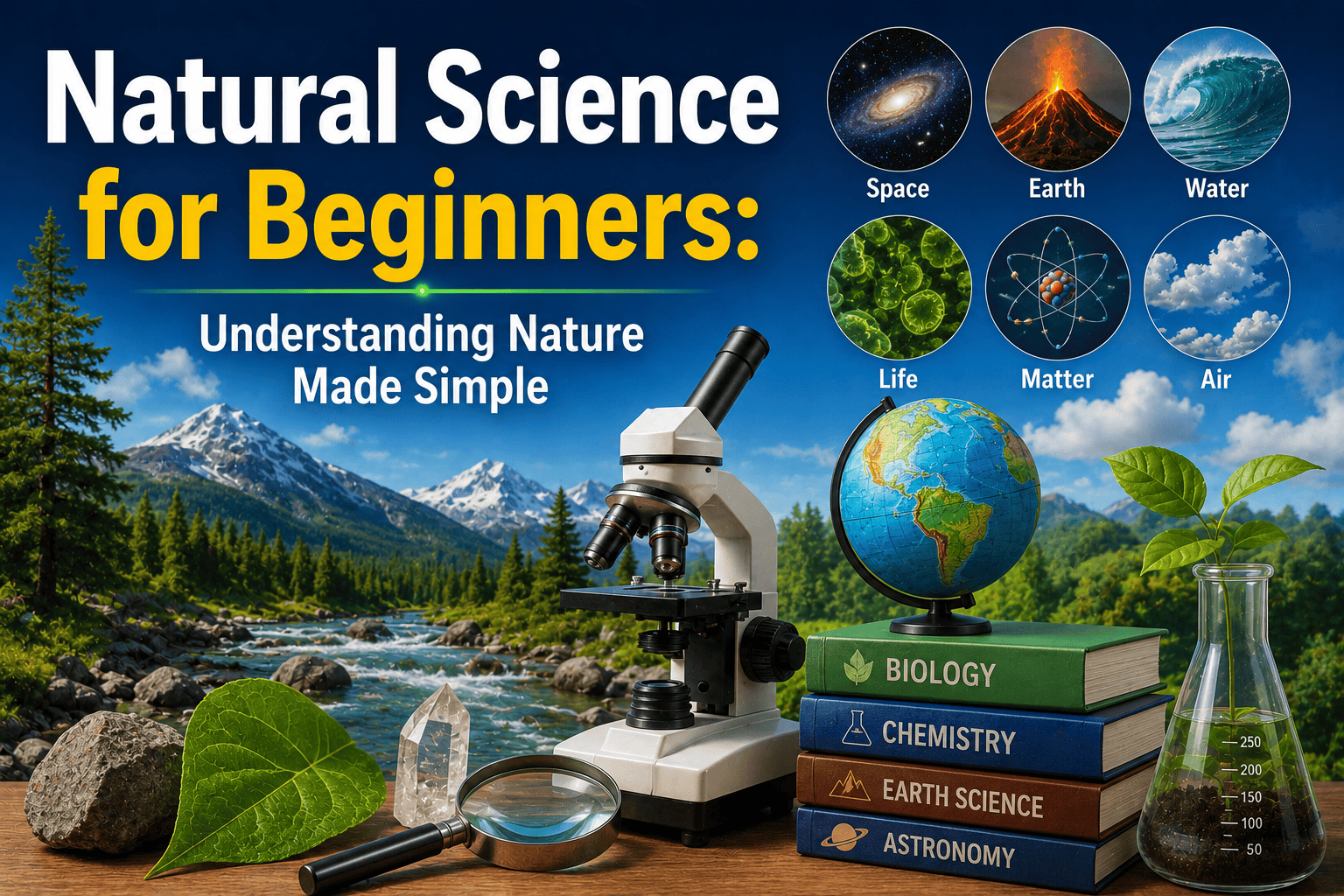
Explore the Laws and Processes That Govern the Natural World — Natural science is a broad area of scientific study focused on understanding physical and living phenomena through observation, measurement, experimentation, and evidence. It includes disciplines such as physics, chemistry, biology, and Earth science, with each field examining different aspects of matter, energy, organisms, Earth, and the environment. Researchers use systematic methods to develop explanations and evaluate whether those explanations are supported by evidence.
The scientific method plays a central role in natural science by allowing hypotheses and theories to be tested against observations and experimental results. Scientific explanations can be strengthened, modified, or rejected as new evidence becomes available, making the field an ongoing process of investigation and discovery. At its core, natural science seeks to understand the processes, relationships, and physical laws that shape the natural universe.
Content Overview
- Introduction: What Are Natural Sciences?
- Part 1: The Empirical Foundation of Natural Sciences
- Part 2: Major Classification of Natural Sciences
- Part 3: Life Sciences – Understanding Living Systems
- Part 4: Physical Sciences – Matter, Energy, and the Universe
- Part 5: Integration of Life and Physical Sciences
- Part 6: Importance of Natural Sciences in Modern Society
- Part 7: Case Studies – Natural Sciences in Action
- Conclusion: Understanding Reality Through Evidence
Introduction: What Are Natural Sciences?
Natural sciences are branches of knowledge that seek to understand the natural world through observation, experimentation, and evidence. Unlike formal sciences (logic, mathematics, computer science), which work with abstract symbols and proofs, natural sciences are empirical – their conclusions must be supported by data gathered from the real world.
Natural sciences explain how the universe functions, from the smallest living cell to the vast structure of galaxies. Their purpose is not belief or speculation, but systematic understanding based on reproducible proof.This guide offers a comprehensive and in-depth examination of the two primary branches of natural science—life sciences and physical sciences—their subfields, how they interconnect, and their significant influence on human civilization.
Example: We accept gravity as real because repeated experiments and observations confirm its effects. A dropped apple always falls toward Earth – this predictable, testable outcome is the hallmark of natural science.
Part 1: The Empirical Foundation of Natural Sciences
1.1 Definition and Core Principles
Definition: Natural sciences are academic disciplines that study natural phenomena – the physical, chemical, and biological aspects of the universe – using empirical methods.
Core principles:
- Empiricism: All knowledge comes from sensory experience and measurement.
- Testability: Claims must be verifiable or falsifiable through experiments or observations.
- Reproducibility: Results must be obtainable by other researchers under similar conditions.
- Predictive power: Scientific theories should allow predictions about future events.
- Provisionality: Scientific knowledge is never absolute; it remains open to revision when new evidence emerges.
1.2 Empirical Methods – Observation, Experimentation, and Evidence
Natural sciences rely on a cycle of observation, hypothesis formation, experimentation, and theory refinement.
- Observation: Gathering data without interfering. For example, astronomers observe distant galaxies through telescopes.
- Experimentation: Manipulating variables to test cause-and-effect. For example, a biologist exposes plants to different light levels to measure growth.
- Measurement: Quantifying phenomena using instruments (thermometers, spectrometers, scales).
- Statistical analysis: Determining whether observed effects are likely due to chance or real causes.
Example: Scientists know that water boils at 100°C at sea level because this result can be tested repeatedly under the same conditions. If you heat water to 100°C at standard atmospheric pressure, it always boils – a reproducible empirical fact.
1.3 Distinction from Formal Sciences and Metaphysics
| Feature | Natural Sciences | Formal Sciences | Metaphysics/Philosophy |
|---|---|---|---|
| Basis | Empirical data | Axioms and logic | Reason, intuition, speculation |
| Method | Observation, experiment | Proof, deduction | Conceptual analysis |
| Testability | Testable/falsifiable | Not empirically testable | Often not testable |
| Example | Physics, chemistry, biology | Mathematics, logic | “What is existence?” |
Natural sciences are empirical; formal sciences are analytic; metaphysics deals with questions that may not be resolvable by empirical means. This distinction does not imply superiority – each domain has its role.
1.4 The Self-Correcting Nature of Science
Scientific knowledge is not a static collection of facts. It evolves. When new evidence contradicts an existing theory, the theory is modified or replaced. This self-correction is a strength, not a weakness.
Example: For centuries, Newtonian physics explained motion accurately. However, in the early twentieth century, observations of Mercury’s orbit and the bending of light near the Sun were found to be inconsistent with the predictions made by Newton. Einstein’s theory of general relativity provided a more accurate description, but it did not discard Newton entirely – Newton’s laws remain excellent approximations for everyday speeds and masses.
Part 2: Major Classification of Natural Sciences
Natural sciences are broadly divided into two major branches:
- Life Sciences (Biological Sciences): Study living organisms and life processes. Examples: biology, botany, zoology, microbiology, genetics, ecology.
- Physical Sciences: Study non-living matter, energy, and the fundamental laws that govern their behavior. Examples: physics, chemistry, astronomy, earth science.
Although separated conceptually, both fields are deeply interconnected. Life operates under physical and chemical laws; biological systems depend on the principles of physics and chemistry and cannot function independently of them.
Part 3: Life Sciences – Understanding Living Systems
Life sciences focus on organisms, biological processes, and ecosystems. They aim to answer fundamental questions about life, growth, adaptation, reproduction, and survival.
3.1 Biology: The Core of Life Sciences
Biology (from Greek bios – life; logos – study) is the scientific study of life. It examines structure, function, growth, evolution, and interaction of living organisms at all levels – from molecules to entire ecosystems.
Historical note: From ancient observations by Aristotle (who classified animals) to modern genetic engineering, biology has evolved into a data-driven, quantitative discipline.
Example: Biology explains how the human body heals wounds through cell division (mitosis) and tissue repair. White blood cells migrate to the injury site, remove debris, and trigger the growth of new skin cells.
3.2 Botany – The Science of Plants
Botany studies plant life, including their structure, reproduction, growth, metabolism, and ecological importance. Plants form the foundation of most terrestrial ecosystems and produce oxygen essential for animal life.
Subfields: Plant taxonomy (classification), plant physiology (function), plant ecology (interactions), ethnobotany (human use of plants).
Example: Photosynthesis – the process by which plants convert sunlight, carbon dioxide, and water into glucose and oxygen – is a central discovery of botany. This process supports all food chains and produces the oxygen we breathe.
3.3 Zoology – The Science of Animals
Zoology focuses on animal life, including anatomy, behavior, evolution, physiology, and classification. It helps humans understand biodiversity, animal welfare, and ecological balance.
Subfields: Entomology (insects), ichthyology (fish), herpetology (reptiles and amphibians), ornithology (birds), mammalogy (mammals).
Example: Zoological studies explain why birds migrate seasonally. For instance, Arctic terns fly from the Arctic to the Antarctic and back each year – a journey driven by changes in daylight, food availability, and genetic programming.
3.4 Microbiology – The Hidden World of Life
Definition: Microbiology studies microscopic organisms such as bacteria, archaea, viruses, fungi, and protozoa. Despite their small size, these organisms have enormous effects on health, industry, agriculture, and ecosystems.
Key discoveries: Germ theory of disease (Pasteur, Koch), antibiotics (Fleming), vaccines, and the human microbiome.
Example: Gut bacteria (e.g., Escherichia coli, Lactobacillus) help humans digest food, synthesize vitamins (e.g., vitamin K), and strengthen the immune system. Disruption of this microbiome is linked to diseases like inflammatory bowel disease and obesity.
3.5 Genetics – The Science of Heredity
Definition: Genetics studies genes, DNA, heredity, and variation in living organisms. It explains how traits are passed from parents to offspring and how mutations and genetic recombination create diversity.
Key ideas include the DNA double helix (identified by James Watson and Francis Crick in 1953), genes as the basic units of inheritance, the genetic code, Mendelian patterns of inheritance, and contemporary gene-editing techniques such as CRISPR.
Example: Genetics explains why eye color often resembles that of parents. Variations in the OCA2 and HERC2 genes control the amount of melanin in the iris – brown eyes have more melanin, blue eyes have less.
3.6 Ecology – Interconnected Systems of Life
Definition: Ecology examines relationships between organisms and their environments – both living (biotic) and non-living (abiotic). It emphasizes balance, sustainability, energy flow, and nutrient cycling.
Levels: Population ecology (single species), community ecology (multiple species), ecosystem ecology (living + physical environment), landscape ecology, and global ecology.
Example: Removing top predators (e.g., wolves) from an ecosystem can cause overpopulation of herbivores (e.g., deer), which then overgraze vegetation, leading to soil erosion and loss of biodiversity. Reintroducing wolves to Yellowstone National Park restored ecological balance – a classic case study in ecology.
3.7 Additional Subfields of Life Sciences
- Anatomy: The structure of organisms – bones, muscles, organs.
- Physiology: How body parts function – circulation, respiration, digestion.
- Evolutionary biology: How species change over time through natural selection, genetic drift, and speciation.
- Cell biology: The structure and function of cells – the basic unit of life.
- Molecular biology: The molecular basis of biological activity – DNA, RNA, protein synthesis.
- Neuroscience: The nervous system – brain, neurons, behavior.
Example: Evolutionary biology explains why antibiotic resistance develops in bacteria. When antibiotics are used, susceptible bacteria die, but resistant mutants survive and reproduce – natural selection in action.
Part 4: Physical Sciences – Matter, Energy, and the Universe
Physical sciences study non-living systems and the fundamental laws governing matter, energy, space, time, and their interactions.
4.1 Physics: Laws Governing Nature
Physics seeks universal laws that explain motion, energy, force, space, and time. It is the most fundamental natural science because all other sciences (chemistry, biology, astronomy) operate under physical laws.
4.1.1 Classical Physics
Classical physics explains phenomena at human-scale levels – speeds much slower than light, objects larger than atoms.
- Mechanics (Newtonian): Studies motion and forces. Isaac Newton developed the three laws of motion along with the law of universal gravitation.
- Thermodynamics: Studies heat, work, temperature, and energy transfer. The laws of thermodynamics govern everything from engines to living cells.
- Electromagnetism: Studies electricity, magnetism, and their relationship (Maxwell’s equations). Describes light, radio waves, X-rays.
Example: Newton’s laws explain why a moving car stops when brakes are applied – the brake pads exert a force opposite to the car’s motion, causing deceleration.
4.1.2 Modern Physics
Modern physics explores extreme conditions – very high speeds (near light speed), very small scales (atomic and subatomic), or very strong gravity.
- Quantum mechanics: Behavior of particles at atomic and subatomic levels. Concepts: wave-particle duality, uncertainty principle, quantum entanglement.
- Relativity (Special and General): Special relativity describes space and time for objects moving at constant high speeds (E=mc²).General relativity explains gravity as the curvature of spacetime.
- Nuclear physics: Atomic nuclei, radioactivity, nuclear fission and fusion.
Example: Quantum physics enables technologies like semiconductors (transistors in computers), lasers (used in surgery and fiber optics), and magnetic resonance imaging (MRI) in hospitals.
4.1.3 Energy Technology
Energy technology applies physical laws to generate, store, and distribute energy efficiently.
- Solar panels: Convert sunlight into electricity via the photovoltaic effect (quantum physics).
- Wind turbines: Convert kinetic energy of wind into mechanical power (classical mechanics).
- Batteries: Store chemical energy and convert it to electrical energy (electrochemistry, thermodynamics).
- Nuclear reactors: Use controlled nuclear fission to generate heat, then electricity.
Example: Solar panels are made of silicon semiconductors. When sunlight strikes the silicon, photons knock electrons loose, creating an electric current – a direct application of quantum mechanics.
4.2 Planetary and Earth Sciences
These sciences study Earth and celestial bodies, their structure, processes, and history.
4.2.1 Earth Science
Earth science examines Earth’s structure, composition, and dynamic processes.
- Geology: Rocks, minerals, plate tectonics, volcanoes, earthquakes, Earth’s history (including fossil record). Subfields: mineralogy, petrology, paleontology, seismology.
- Meteorology: Atmosphere, weather patterns, climate, storms, and climate change.It applies principles of physics and chemistry to forecast weather conditions.
- Oceanography: Oceans – currents, waves, marine life, seafloor geology, chemistry of seawater.
- Geography: Spatial relationships between Earth’s physical features and human activities.It includes physical geography, which studies landforms and climate, as well as human geography, which focuses on populations and urban areas.
Example: Weather forecasting relies on meteorological data from satellites, weather stations, and radar, combined with computer models based on fluid dynamics and thermodynamics.
4.2.2 Astronomy – Study of the Universe
Definition: Astronomy studies stars, planets, galaxies, comets, and cosmic events using scientific observation and physical laws. It is one of the oldest natural sciences.
Subfields: Observational astronomy (telescopes across all wavelengths), astrophysics (physical properties of celestial bodies), cosmology (origin and evolution of the universe), planetary science (planets and moons).
For example, astronomers identify exoplanets by studying variations in the light emitted by distant stars. When a planet passes in front of its star (transit method), the star’s brightness dims slightly – a measurable, repeatable observation.
4.2.3 Astrology – A Historical and Non-Scientific Perspective
Definition: Astrology is the belief that the positions of celestial bodies influence human affairs, personality, and events. Historically, astrology and astronomy were intertwined; early astronomers (like Ptolemy) also practiced astrology.
Scientific status: Astrology lacks empirical evidence, fails controlled tests, and does not provide testable predictions. It is not considered a scientific discipline. Horoscopes are belief-based, not experimentally verified.
Example: Studies have shown that people born under the same zodiac sign do not share consistent personality traits – a falsification of astrological claims.
4.3 Chemistry: The Science of Matter and Change
Definition: Chemistry studies substances – their composition, structure, properties, and the transformations they undergo during chemical reactions. It bridges physics (atoms, energy) and biology (molecules of life).
4.3.1 Organic Chemistry
Focuses on carbon-based compounds, which are the basis of all known life. Includes hydrocarbons, proteins, carbohydrates, lipids, nucleic acids, and synthetic polymers (plastics).
Example: Medicines like aspirin, antibiotics, and chemotherapy drugs are developed using organic chemistry principles – synthesizing molecules that interact with biological targets.
4.3.2 Inorganic Chemistry
Studies metals, minerals, coordination complexes, and non-carbon compounds. Includes catalysis, solid-state chemistry, and materials science.
Example: Construction materials like cement and concrete involve inorganic chemistry – the hydration of calcium silicates produces a hard, durable matrix.
4.3.3 Physical Chemistry
Explores energy changes, molecular behavior, reaction rates (kinetics), and thermodynamics of chemical systems. Uses physics principles (quantum mechanics, statistical mechanics) to explain chemistry.
Example: Battery efficiency depends on physical chemistry – the movement of ions between electrodes, the thermodynamics of the redox reaction, and the kinetics of charge transfer.
4.3.4 Analytical Chemistry
Identifies and quantifies chemical components in samples. Techniques include chromatography (separating mixtures), mass spectrometry (measuring molecular mass), and spectroscopy (analyzing light absorption/emission).
For example, food safety testing relies on analytical chemistry to identify pesticide residues, detect heavy metals such as lead and mercury, and uncover contaminants or adulterants in food products.
4.3.5 Biochemistry
Biochemistry bridges chemistry and biology at the molecular level. It studies the chemical processes within and related to living organisms – enzymes, metabolism, DNA replication, signal transduction.
Example: Enzymes that digest food (e.g., pepsin in the stomach, amylase in saliva) are studied in biochemistry. These proteins catalyze reactions that would otherwise take hours or days to occur.
Part 5: Integration of Life and Physical Sciences
5.1 How Biological Systems Depend on Physics and Chemistry
Living systems do not violate physical laws; they operate within them. Understanding biology requires knowledge of chemistry (molecules, reactions) and physics (energy, forces, thermodynamics).
Examples:
- Nerve signals rely on electrical impulses (movement of sodium and potassium ions across cell membranes) – physics of electromagnetism and chemistry of ion gradients.
- Muscle contraction involves the sliding of actin and myosin filaments driven by ATP hydrolysis – biochemistry and classical mechanics.
- Photosynthesis converts light energy into chemical energy – quantum physics (light absorption by chlorophyll) and organic chemistry (carbon fixation).
- Blood circulation obeys fluid dynamics (pressure, flow, viscosity) – a branch of physics.
5.2 Interdisciplinary Fields
- Biophysics: Applies physics to biological systems – protein folding, molecular motors, neural networks.
- Geobiology: Studies interactions between Earth’s physical environment and life – how microbes influence mineral formation, how life affects climate.
- Astrobiology: The study of the origin, evolution, and distribution of life in the universe – combines biology, chemistry, and astronomy.
- Biogeochemistry: Tracks chemical cycles (carbon, nitrogen, phosphorus) through living and non-living systems.
Example: The carbon cycle involves photosynthesis (plants absorbing CO₂), respiration (animals releasing CO₂), combustion (burning fossil fuels), and geological processes (limestone formation). Understanding this cycle requires biology (photosynthesis), chemistry (CO₂ reactions), and earth science (rock weathering).
Part 6: Importance of Natural Sciences in Modern Society
6.1 Medicine and Healthcare
Natural sciences have transformed medicine from guesswork to evidence-based practice.
- Vaccines (immunology, virology) have eradicated smallpox and nearly eliminated polio. The rapid development of mRNA vaccines for COVID-19 saved millions of lives.
- Antibiotics (microbiology, organic chemistry) turned bacterial infections from death sentences to minor illnesses.
- Medical imaging (physics, engineering) – X-rays, CT scans, MRI, ultrasound – allows non-invasive diagnosis.
- Genomic medicine (genetics, molecular biology) enables personalized treatments based on a patient’s DNA.
Example: The development of the HPV vaccine (against cervical cancer) required decades of virology, immunology, and clinical trials – a triumph of life sciences.
6.2 Environmental Protection and Climate Science
Natural sciences provide the evidence base for environmental policy.
- Climate models (physics, chemistry, computer science) predict global warming, sea-level rise, and extreme weather. These models drive international agreements like the Paris Accord.
- Pollution monitoring (analytical chemistry, ecology) tracks air and water quality, identifying harmful substances (e.g., lead, mercury, PM2.5).
- Conservation biology identifies endangered species, designs wildlife corridors, and restores degraded ecosystems.
Example: The Montreal Protocol (1987) – based on atmospheric chemistry showing that chlorofluorocarbons (CFCs) destroy the ozone layer – phased out CFCs. The ozone hole is now healing.
6.3 Technology and Energy
Natural sciences underpin nearly every modern technology.
- Semiconductors (quantum physics, materials science) enable computers, smartphones, and solar cells.
- Renewable energy (physics, chemistry) – wind turbines, solar panels, batteries, hydrogen fuel cells.
- Telecommunications (electromagnetism, optics) – fiber optics, satellite communication, 5G networks.
Example: Global Positioning System (GPS) relies on Einstein’s theory of relativity. Without correcting for time dilation (special relativity due to satellite speed, general relativity due to weaker gravity), GPS would accumulate errors of several kilometers per day.
6.4 Space Exploration and Fundamental Discovery
- Space telescopes (astronomy, optics) – Hubble and James Webb have revealed galaxies forming just after the Big Bang.
- Planetary rovers (engineering, geology) – Curiosity and Perseverance on Mars search for signs of past life.
- Fundamental physics – detection of gravitational waves (2015) confirmed a prediction of general relativity and opened a new window on the universe.
Example: The discovery of the Higgs boson (2012) at CERN’s Large Hadron Collider required thousands of physicists and engineers – confirming the mechanism that gives particles mass.
Part 7: Case Studies – Natural Sciences in Action
7.1 Case Study 1: Vaccine Development – From Biology to Public Health
Problem: Infectious diseases kill millions. How to prevent them?
Scientific process:
- Microbiology identifies the pathogen (virus, bacteria).
- Immunology studies how the immune system responds.
- Molecular biology isolates antigens (surface proteins) or genetic material (mRNA).
- Clinical trials (phases I–III) test safety and efficacy in thousands of volunteers.
- Epidemiology tracks disease spread and vaccine impact.
Example (mRNA vaccines for COVID-19): Researchers sequenced the SARS-CoV-2 genome in January 2020. Within days, they designed mRNA encoding the spike protein. Lipid nanoparticles delivered the mRNA into cells, which produced spike proteins, triggering immunity. By December 2020, vaccines were authorized – the fastest vaccine development in history.
7.2 Case Study 2: Climate Modeling – Physics, Chemistry, and Computing
Problem: How will Earth’s climate change over the next century?
Scientific process:
- Physics: Laws of fluid dynamics, thermodynamics, and radiative transfer govern atmosphere and ocean circulation.
- Chemistry: Carbon cycle, greenhouse gas absorption spectra, aerosol interactions.
- Computational science: Solve complex equations on supercomputers. Models divide Earth into grid boxes (e.g., 100 km x 100 km) and calculate temperature, humidity, wind, and cloud cover over time.
- Paleoclimatology (earth science): Validate models against past climates (ice cores, tree rings, sediment layers).
Example: The Coupled Model Intercomparison Project (CMIP) gathers results from dozens of climate models worldwide. Their consistent predictions – warming of 1.5–4°C by 2100 depending on emissions – inform the IPCC reports and global policy.
7.3 Case Study 3: CRISPR Gene Editing – Genetics Applied
Problem: Genetic diseases (sickle cell anemia, cystic fibrosis, some cancers) are caused by mutations. Can we correct them?
Scientific process:
- Microbiology: Scientists discovered that bacteria use CRISPR-Cas9 as an immune system to cut viral DNA.
- Molecular biology: They adapted this system to work in human cells – a guide RNA targets a specific DNA sequence, and Cas9 cuts it. Then, natural DNA repair can insert a corrected gene.
- Clinical trials: Early trials for sickle cell disease and beta-thalassemia have shown success – patients produce healthy red blood cells after treatment.
Example: In 2023, the UK approved CRISPR-based therapy for sickle cell disease. A patient’s own stem cells are edited outside the body and reinfused. This is a direct application of genetics, biochemistry, and cell biology.
Conclusion: Understanding Reality Through Evidence
Natural sciences transform observation into knowledge and knowledge into progress. By relying on evidence rather than assumption, they provide humanity with the most reliable understanding of the natural world. From the smallest living cell to the vast structure of galaxies, from the chemical bonds in a single molecule to the complex dynamics of global climate, natural sciences offer a systematic, self-correcting path to truth.
The distinction between life sciences and physical sciences is useful for organization, but reality is integrated. Life operates under physical and chemical laws. A complete understanding of biology requires physics and chemistry; a complete understanding of Earth requires biology. Many major discoveries occur at the intersections of fields, such as biophysics, biochemistry, geobiology, and astrobiology.
As we face global challenges – emerging diseases, climate change, biodiversity loss, and sustainable energy – natural sciences will be essential. They do not tell us what values to hold or which policies to choose, but they provide the factual foundation without which our choices are blind. Understanding natural sciences empowers us to be informed citizens, to appreciate the wonder of the universe, and to participate in the ongoing human quest for truth.
Final thought: Every time you take a vaccine, check a weather forecast, use a smartphone, or marvel at a starry night, you are benefiting from centuries of natural science. The journey is far from over. The next great discovery awaits.