Natural Law
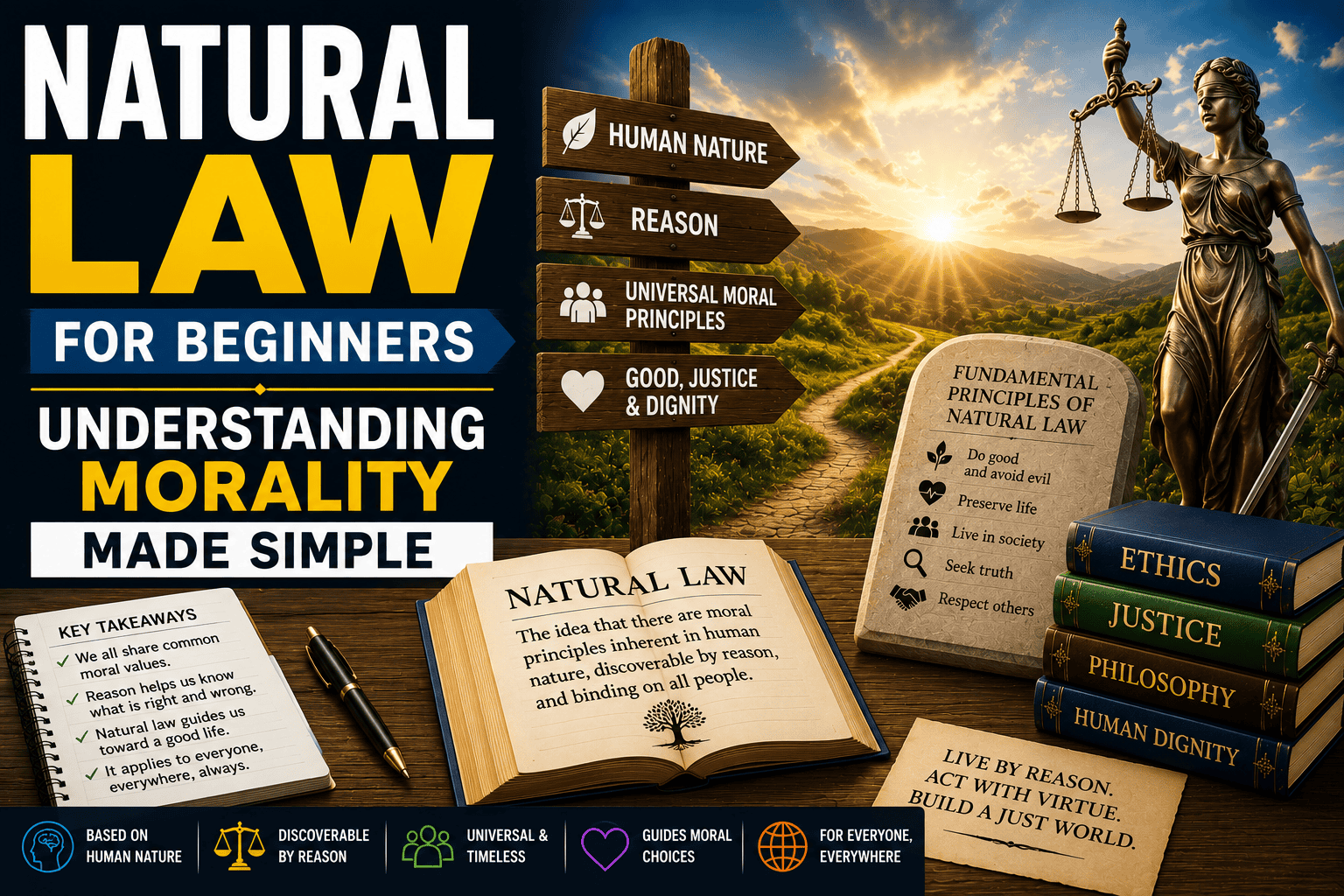
Explore the Idea of Universal Moral Principles — Natural Law is a philosophical and legal theory that proposes that certain principles of right and wrong can be understood through human nature and rational thought rather than being created solely by governments or written laws. Associated with thinkers such as Aristotle, Thomas Aquinas, and John Locke, the tradition argues that legitimate laws should be consistent with fundamental principles of justice and morality. From this perspective, a law can be formally enacted yet still be considered unjust if it conflicts with basic moral principles.
Natural Law has influenced discussions in ethics, political philosophy, jurisprudence, and the development of ideas surrounding human rights and justice. It raises important questions about whether moral standards are universal and objective or whether they depend primarily on social rules, cultural traditions, and collective agreement. At its core, Natural Law asks whether there are moral truths that exist independently of human-made laws and institutions.
Content Overview
- Introduction: What Is Natural Law?
- Part 1: The Definition and Core Principles of Natural Law
- Part 2: The Historical Development of Natural Law
- Part 3: Natural Law in Religious Traditions
- Part 4: Natural Law in Jurisprudence – The 20th Century Revival
- 4.1 The Hart-Fuller Debate – Law and Morality Separated?
- 4.2 John Finnis and the New Natural Law Theory
- 4.3 Ronald Dworkin – Law as Integrity and Interpretive Theory
- 4.4 Natural Law and Human Rights – From Locke to the Universal Declaration
- 4.5 Case Study: The Nuremberg Trials – Unjust Laws and Crimes Against Humanity
- Part 5: Natural Law in Contemporary Debate
- Part 6: Case Studies in Natural Law
- Conclusion: The Enduring Legacy of Natural Law
Introduction: What Is Natural Law?
Natural law is one of the oldest and most influential concepts in Western philosophy, legal theory, and theology. At its simplest, natural law is the idea that there exists a set of universal moral principles inherent in human nature, discoverable by human reason, and binding on all people regardless of time, place, or culture. These principles provide a standard by which human-made laws (positive laws) can be judged and, if necessary, resisted.
Natural law is not a specific legal code like the U.S. Constitution or the Ten Commandments. Rather, it is a framework for thinking about right and wrong, justice and injustice, and the proper relationship between law and morality. Natural law theory asserts that an unjust law is not truly a law in the fullest sense (the famous dictum “an unjust law is no law at all”), or at least that it lacks moral authority and does not obligate the conscience.
Simple example: Almost all human societies, across history and geography, have prohibited murder. This near-universal prohibition suggests that there is something about human nature – a recognition of the value of life, a capacity for reason, a sense of empathy – that makes murder wrong. This wrongness does not depend on any particular legislature or ruler. It is, in this view, a natural law.
This guide provides a comprehensive, deep exploration of natural law: its definition, core principles, historical development, expression in religious and secular traditions, role in jurisprudence, and contemporary relevance. Each section is structured from basic definitions to advanced concepts, with clear examples and case studies.
Part 1: The Definition and Core Principles of Natural Law
1.1 Defining Natural Law – Inherent and Universal
Definition: Natural law (Latin: ius naturale, lex naturalis) is a philosophical and legal theory that posits the existence of inherent laws derived from nature and universal moral principles that are discoverable through reason. Natural law is believed to exist independently of human will.It is considered ‘natural’ because it is not produced by human activity.
Explanation: Natural law theory begins with the observation that human beings, like all natural objects, have a nature – a characteristic way of being and functioning that defines what it means to be a good or flourishing human being. From this nature, natural law theorists derive moral norms. For example, humans are rational, social, and alive. Therefore, it is good to develop reason (through education), to live in community (through justice and cooperation), and to preserve life (through prohibitions on killing). These norms are universal because human nature is universal.
Example: The idea that slavery is wrong is not explicitly mentioned in most ancient legal codes. Yet, natural law thinkers argued that slavery violates the inherent dignity and freedom of human beings, and therefore is unjust regardless of what positive law permits. This argument was used by abolitionists in the 18th and 19th centuries.
1.2 Natural Law vs. Positive Law – The Central Distinction
Natural law is best understood in contrast to positive law (from Latin positus – laid down, established).Positive law refers to rules established by human authorities such as legislatures, courts, or governing bodies. It includes statutes, regulations, judicial decisions, and treaties. Positive law is changeable, local, and dependent on human will.
Natural law, by contrast, is unchanging, universal, and independent of human will. It is not created by any human institution. It is discovered through reason, not invented through legislation.
| Aspect | Natural Law | Positive Law |
|---|---|---|
| Source | Nature, reason, or God | Human legislators and institutions |
| Universality | Universal – applies to all people | Local – applies only within a jurisdiction |
| Changeability | Unchanging (though understanding may deepen) | Changeable (can be repealed or amended) |
| Moral status | Intrinsically moral | May be moral or immoral |
| Obligation | Obliges conscience | Obliges legally; may or may not oblige morally |
Example: A law requiring drivers to stop at a red light is purely positive – it could be changed to “stop only on odd-numbered days,” and it would still be law (though a bad one). A law permitting the torture of children, however, would violate natural law. It is not merely a bad law; it is, in the view of natural law theorists, not truly law at all, or at least not binding on conscience.
1.3 The Core Principle: “Do Good and Avoid Evil”
At its most basic level, natural law says: do good and avoid evil. This is the first, foundational precept from which all other precepts are derived. It is self-evident to human reason. You do not need a religious revelation or a law degree to know that you should do good and avoid evil. You know it immediately, as soon as you understand the terms.
From this foundation, natural law theorists derive more specific precepts:
- Preserve life.
- Nurture and educate the young.
- Seek truth (especially about God).
- Live in society.
- Avoid ignorance, offense, and harm.
Example: A child can recognize, even without instruction, that harming a smaller child without reason is wrong.The child may not be able to articulate “do good and avoid evil,” but the principle is already at work. Natural law theorists argue that this basic moral knowledge is part of being human.
1.4 Natural Law as Discoverable by Reason
Natural law is not revealed only through scripture or prophecy.It can be understood through human reason alone. This means that a person who has never heard of the Bible, the Quran, or the Buddha can still know the basic principles of natural law by reflecting on human nature and human flourishing.
This is a crucial claim. It means that natural law can provide a universal moral language for dialogue across cultures and religions. It also means that natural law provides a basis for criticizing laws and customs that violate basic human dignity, even when those laws are deeply embedded in a particular tradition.
Example: A Confucian philosopher in ancient China, a Stoic philosopher in ancient Rome, and a Muslim jurist in medieval Baghdad might disagree on many things. But natural law theory holds that they would all agree, upon reflection, that murder is wrong, that promises should be kept, and that parents should care for their children. These shared judgments are evidence of a common moral law written into human nature.
1.5 Natural Law in Ethics, Politics, and Jurisprudence
Natural law is not a single discipline. It appears in different contexts:
- Ethics: Natural law provides a theory of moral right and wrong based on human nature and flourishing. Actions that support human well-being—such as life, health, friendship, and knowledge—are considered good, while those that hinder it are regarded as wrong.
- Politics: Natural law provides a standard for evaluating governments and laws.A government that consistently violates fundamental moral principles—such as through acts like genocide—undermines its own legitimacy.
- Jurisprudence: Natural law theory holds that there is a necessary connection between law and morality. A legal system that is radically unjust may not be fully law, or at least does not obligate the citizen.
Example: When Dr. Martin Luther King Jr. wrote from a Birmingham jail that “one has a moral responsibility to disobey unjust laws,” he was appealing to natural law. He distinguished between just laws (those that “square with the moral law”) and unjust laws (those “out of harmony with the moral law”). This distinction is meaningless without some concept of a higher moral law.
Part 2: The Historical Development of Natural Law
2.1 Ancient Roots – Greek Philosophy and the Cosmos
2.1.1 Pre-Socratics and the Search for Order
The idea of a law inherent in nature has ancient roots. The pre-Socratic philosophers of ancient Greece (6th–5th centuries BCE) sought to identify the fundamental principle (arche) that governs the cosmos. For Heraclitus, it was logos – a rational principle that structures all things. This logos is not a human invention; it is built into the fabric of reality.
The Sophists (5th century BCE) introduced a distinction between nomos (human law, convention) and physis (nature). Some Sophists argued that human laws are merely arbitrary conventions, while others insisted that there is a natural standard of justice. This debate set the stage for later natural law theory.
2.1.2 Aristotle’s Natural Justice
Aristotle (384–322 BCE) is often considered a precursor to natural law theory. In his Nicomachean Ethics, he distinguished between:
- Legal justice – what is just by human enactment (can vary from city to city).
- Natural justice – what is just by nature (has the same validity everywhere).
Aristotle wrote: “Natural justice is that which everywhere has the same force and does not exist by people’s thinking this or that.” He gave examples such as the prohibition on murder and the importance of honoring parents. However, Aristotle did not develop a full systematic theory of natural law; that would come later.
Example: Aristotle observed that while different cities have different laws about property, all cities prohibit murder. The prohibition on murder, he argued, is not a matter of convention but of nature.
2.2 Stoicism and Roman Law – Cicero’s Enduring Legacy
2.2.1 Stoic Philosophy – Living According to Nature
The Stoic philosophers (3rd century BCE – 2nd century CE) developed the most influential natural law theory of the ancient world. For the Stoics, the universe is a rational, ordered whole, governed by a divine reason (logos). To live well is to live in accordance with nature – which means living in accordance with reason.
The Stoics argued that all human beings share the same rational nature, and therefore share the same basic moral law. This law is universal, unchanging, and accessible to all through reason. The Stoics also emphasized the equality of all human beings – a radical idea in the ancient world.
Example: The Stoic philosopher Epictetus, himself a former slave, argued that no human being is by nature a slave. Slavery violates the rational and free nature of the person. This argument would later be taken up by Christian abolitionists.
2.2.2 Cicero’s “True Law” and Human Equality
Cicero (106–43 BCE), a Roman statesman, lawyer, and philosopher, is the main source of Roman law doctrine of natural law. He transmitted Stoic natural law ideas into the Roman legal tradition and, through it, into Western jurisprudence. Cicero defined true law as “right reason in agreement with nature; it is of universal application, unchanging and everlasting”.
Cicero drew several radical conclusions from this definition:
- Human equality: “There is no fundamental difference among members of the human species… one definition applies to everyone.”
- Government by consent: A commonwealth (res publica) is “the property of a people,” not a tyrant.
- Tyranny is illegitimate: A state ruled by a tyrant “cannot be called a republic” because there is “no bond of justice whatever”.
These ideas – human equality, popular sovereignty, and the right to resist tyranny – would echo through history, influencing the American founders and the French Revolution.
Example: When Thomas Jefferson wrote in the Declaration of Independence that all men are created equal and endowed by their Creator with certain unalienable rights, he was drawing directly on the Ciceronian natural law tradition.
2.2.3 Roman Jurisprudence – Ius Naturale and Ius Gentium
Roman jurists (lawyers and legal scholars) developed a sophisticated legal system that distinguished between:
- Ius civile (civil law) – the law specific to Roman citizens.
- Ius gentium (law of nations) – the law common to all peoples, derived from reason and natural justice.
- Ius naturale (natural law) – the law that nature teaches all animals, including humans.
The Roman jurist Ulpian (c. 170–228 CE) famously defined natural law as “that which nature has taught all animals.” This broad definition included animal instincts as well as human reason, and was not adopted by later natural law theorists. More influential was the idea that ius gentium reflects universal human reason and provides a standard for evaluating local laws.
2.3 Medieval Synthesis – Thomas Aquinas and the Fourfold Law
2.3.1 Eternal, Divine, Natural, and Human Law
The most systematic and influential natural law theory in the Western tradition was developed by Thomas Aquinas (1225–1274). In his Summa Theologica, Aquinas distinguished four types of law:
- Eternal Law (lex aeterna): God’s plan for the universe. It is the rational ordering of all things by God. Only God knows it fully.
- Natural Law (lex naturalis): The participation of the rational creature in the eternal law. Humans, by their reason, can grasp the basic principles of right and wrong. This is natural law.
- Divine Law (lex divina): Law revealed by God in scripture (the Old and New Testaments). It is necessary because human reason is fallible and because humans need guidance toward their supernatural end (eternal beatitude).
- Human Law (lex humana): Laws made by human authorities to govern society. These must be derived from natural law. A human law that contradicts natural law is not truly law but a “corruption of law.”
Example: The prohibition on murder is part of natural law (it can be known by reason). The exact penalty for murder, such as life imprisonment, falls under human law. The command to love one’s enemies is part of divine law (revealed in the New Testament).
2.3.2 The Light of Reason and the First Precept
For Aquinas, natural law is “nothing other than the light of the intellect planted in us by God, by which we know what should be done and what should be avoided”. This light is not something we earn; it is given to us by our Creator.
The first precept of natural law is: good is to be done and pursued, and evil is to be avoided. From this, reason derives more specific precepts corresponding to the basic inclinations of human nature:
- Self-preservation: the inclination to preserve one’s own life.
- Procreation and education of offspring: the inclination to have children and care for them.
- Knowledge of truth: the inclination to know God and to live in society.
- Rational sociability: the inclination to avoid ignorance and to live peacefully with others.
Example: The inclination to preserve one’s life gives rise to the natural law precept against killing. The inclination to know truth gives rise to the precept against lying. The inclination to live in society gives rise to the precept to keep promises.
2.3.3 Natural Law as Participation in Eternal Law
For Aquinas, natural law is not separate from God; it is understood as the participation of rational beings in the eternal law. This means that when a human being uses reason to discover that murder is wrong, that human is, in a real sense, sharing in God’s own rational ordering of the universe. Natural law is not a substitute for divine revelation; it is a complement to it.
However, because of human sin (what Aquinas called the “law of concupiscence”), our reason can be clouded and our will weakened. This is why divine law is also necessary.
Example: A person may know by natural law that stealing is wrong, yet rationalize a particular theft (“they can afford it,” “they owe me”). Divine law provides clear commands (“you shall not steal”) and the grace to obey them.
2.4 The Secular Turn – Grotius, Hobbes, and Locke
The 17th and 18th centuries saw a gradual secularization of natural law theory. While earlier thinkers grounded natural law in God’s eternal law, later thinkers sought to derive natural law from human nature alone.
2.4.1 Hugo Grotius and the “Etiamsi Daremus” Thesis
Hugo Grotius (1583–1645), a Dutch jurist and theologian, is often called the “father of international law.” In his De Jure Belli ac Pacis (On the Law of War and Peace), he made a famous claim: natural law would be valid “even if we were to grant that there is no God” (etiamsi daremus non esse Deum). This does not mean Grotius was an atheist; he was a devout Christian. But he argued that natural law can be known by reason alone, independent of revelation.
Grotius’s natural law was based on the rational and social nature of human beings. Humans, he argued, have a natural desire for society and an aversion to harming others. From these basic facts, reason derives rules for peaceful coexistence.
Example: Grotius used natural law to argue for the freedom of the seas (against Portuguese and Spanish claims to monopoly). The sea, he argued, cannot be owned because it is naturally open to all – a conclusion reached by reason, not by appeal to scripture.
2.4.2 Thomas Hobbes – Natural Law and the State of Nature
Thomas Hobbes (1588–1679) had a very different view. In Leviathan, he described the “state of nature” as a war of all against all, in which life is “solitary, poor, nasty, brutish, and short.” In this state, there is no justice or injustice – only power.
But Hobbes also argued that reason discovers laws of nature that counsel peace. The primary law of nature is to pursue peace. The second is to give up one’s right to all things (to make a social contract) in exchange for security. Hobbes’s natural law is not about human flourishing or virtue; it is about self-preservation. It leads not to a limited government but to an absolute sovereign.
Example: For Hobbes, the natural law prohibits murder not because murder is intrinsically evil, but because it is contrary to the condition of peace that reason recommends for self-preservation.
2.4.3 John Locke – Natural Rights and Government by Consent
John Locke (1632–1704) transformed natural law into natural rights. In his Two Treatises of Government, Locke argued that in the state of nature, all persons are “free, equal, and independent.” The law of nature, described as being “written in the hearts of all people,” holds that no one should harm another’s life, health, freedom, or property.
These natural rights – to life, liberty, and property – are not granted by government. They are inherent in human nature. The role of government is to safeguard these rights.If a government violates them, the people have a right to rebel.
Locke’s natural law theory was enormously influential. It shaped the American Declaration of Independence (“life, liberty, and the pursuit of happiness”), the French Declaration of the Rights of Man and of the Citizen, and the modern human rights movement.
Example: When the American colonists declared independence from Britain, they appealed to “the laws of nature and of nature’s God.” They argued that the British government had violated their natural rights, and therefore they were justified in establishing a new government.
2.5 The Enlightenment and Its Critics
2.5.1 David Hume’s Challenge – The Is-Ought Problem
David Hume (1711–1776) delivered a devastating critique of natural law. He observed that many natural law writers move from describing how things are (facts) to prescribing how things ought to be (values) without any logical justification. This is the is-ought problem.
For instance, one could argue: “Human beings possess rationality.” Therefore, they ought to act rationally.” But Hume pointed out that an “ought” cannot be derived from an “is” without a hidden normative premise. The fact that humans are rational does not, by itself, prove that they should be rational. They could be rational but choose to act irrationally.
Hume’s critique remains a central challenge for any natural law theory that seeks to derive morality from nature.
Example: It may be a fact that human beings naturally seek self-preservation. But does that fact mean that we ought to seek self-preservation? A person could rationally choose suicide. Hume’s point is that the “ought” must be justified separately.
2.5.2 Immanuel Kant – Reason and the Moral Law Within
Immanuel Kant (1724–1804) offered a different foundation for morality. He rejected natural law theories based on human nature or happiness. Instead, he grounded morality in the rational will alone. The moral law, for Kant, is a law that rational beings give to themselves (autonomy). It is expressed in the categorical imperative: act only according to that maxim whereby you can at the same time will that it should become a universal law.
Kant’s theory is not a natural law theory in the traditional sense. It does not appeal to human nature, purposes, or flourishing. Yet it shares with natural law the idea that morality is rational, universal, and binding on all persons.
Example: The categorical imperative would forbid lying because you cannot will that everyone lie (the universalization test fails). This is a different route to the same conclusion that natural law reaches (lying is wrong).
2.5.3 The Decline of Natural Law in the 19th Century
In the 19th century, natural law theory fell out of favor. The rise of legal positivism (see Part 4), historicism (the idea that all values are historically conditioned), and utilitarianism (the idea that morality is about maximizing happiness) pushed natural law to the margins. Many legal scholars and philosophers dismissed natural law as obsolete, unscientific, or merely a cover for conservative religious positions.
Part 3: Natural Law in Religious Traditions
3.1 Natural Law in Christianity
3.1.1 Biblical Foundations – Paul’s “Law Written on the Heart”
The Bible, particularly the writings of St. Paul, provides a scriptural basis for natural law. In his Letter to the Romans, Paul writes about Gentiles (non-Jews) who do not have the Mosaic law but who “do by nature what the law requires.” They indicate that “the requirements of the law are written on their hearts, and their conscience also bears witness” (Romans 2:14–15).
This passage is crucial for Christian natural law theory. It suggests that even those who have never heard the Ten Commandments can know basic moral truths through their conscience, which is a kind of natural law. This does not mean that revelation is unnecessary; but it does mean that morality is not entirely dependent on revelation.
Example: A person in a remote jungle who has never heard of Jesus can still know that murder is wrong. Their conscience tells them so. This, for Paul, is evidence of the law written on the heart.
3.1.2 Catholic Natural Law – The Magisterium and Sexual Ethics
The Catholic Church has consistently affirmed natural law as the foundation of its moral teaching.The Catechism of the Catholic Church explains that natural law is “inscribed within every person,” guiding human reason to pursue good and avoid wrongdoing. It is considered universal, constant, and foundational to human rights and responsibilities.
The Catholic Church uses natural law reasoning to address controversial moral issues, particularly in sexual ethics. For example, the Church teaches that contraception is wrong because it violates the natural purpose of the sexual act (which is both unitive and procreative). Similarly, the Church teaches that homosexual acts are wrong because they do not conform to the natural complementarity of male and female.
These teachings are controversial, and many critics argue that the Church’s natural law reasoning is selective or based on a contested understanding of nature.
Example: The Church’s opposition to in vitro fertilization (IVF) is based on natural law arguments about the dignity of the human embryo and the proper context of procreation (within the marital act).
3.1.3 Protestant Receptions – Luther, Calvin, and the Barth-Brunner Debate
Protestant attitudes toward natural law have been mixed. Martin Luther and John Calvin did not reject natural law entirely. They understood that natural law underpins civil society and that even those without religious belief can still grasp basic moral distinctions between right and wrong. However, they emphasized that sin has darkened human reason, and that only scripture provides a sure guide to God’s will.
In the 20th century, a famous debate erupted between Karl Barth and Emil Brunner, two Swiss Reformed theologians. Barth rejected natural law entirely, arguing that fallen human reason cannot reliably know God’s will. Only God’s revelation in Jesus Christ can provide moral knowledge. Brunner, by contrast, defended a limited role for natural law. Barth’s position became dominant in neo-orthodox Protestant circles, but many Protestant ethicists have since recovered a qualified natural law theory.
Example: Barth argued that the Nazi regime could be condemned only on the basis of divine revelation, not on the basis of natural law, because natural law is too easily co-opted by sinful human agendas. Critics respond that natural law provided a basis for the Nuremberg trials (see Part 4).
3.2 Natural Law in Islam – Sharia, Reason, and Maqasid
3.2.1 The Role of Reason (Aql) in Islamic Jurisprudence
Islamic jurisprudence (usul al-fiqh) has long debated the role of reason in deriving legal rules. The primary sources of Islamic law are the Qur’an and the Sunnah (the practice of the Prophet Muhammad). But Muslim jurists also use analogical reasoning (qiyas) and consensus (ijma). The question of whether reason alone can discover moral truths (husn and qubh) – good and bad – has been extensively debated.
Some Islamic schools (e.g., the Mu‘tazilites) held that reason can independently know good and evil. Others (e.g., the Ash‘arites) held that good and evil are determined solely by divine command. In practice, all schools rely on reason in some form, even if they reject a full natural law theory.
Example: The prohibition on murder is found in the Qur’an. But a Muslim jurist might also argue that murder is wrong because it violates the rational purpose of human life – an argument that does not depend on revelation alone.
3.2.2 Hard vs. Soft Natural Law Theories in Islam
Scholars of Islamic law have identified two broad approaches to natural law:
- Hard natural law: Holds that reason alone can determine the moral quality of actions, even in the absence of revelation. This position is associated with the Mu‘tazilite school and some contemporary thinkers.
- Soft natural law: Holds that reason can discover moral truths, but that these truths are confirmed and specified by revelation. This is closer to the Thomist position and is associated with some Ash‘arite and Maturidite thinkers.
Anver Emon’s Islamic Natural Law Theories (2010) provides a detailed analysis of these debates, showing that premodern Muslim jurists did develop sophisticated natural law arguments, even if they did not use the Latin terminology.
3.2.3 Maqasid al-Sharia – Higher Objectives of the Law
A related concept in Islamic jurisprudence is maqasid al-sharia – the higher objectives or purposes of Islamic law. Classical jurists such as al-Ghazali and al-Shatibi identified five essential objectives: protection of religion, life, intellect, lineage, and property. These objectives are not arbitrary; they reflect a rational understanding of what human beings need to flourish.
The maqasid approach has strong affinities with natural law. It provides a framework for reasoning about new issues (e.g., organ donation, genetic engineering) by reference to the underlying purposes of the law, not merely the literal text.
Example: If the purpose of Islamic law is to protect life, then measures to prevent the spread of a deadly disease (e.g., mandatory vaccination) can be justified,even if they are not directly stated in the Qur’an or the Sunnah.
3.3 Natural Law in Judaism – Torah, Covenant, and the Noahide Laws
Judaism has its own natural law tradition, though it is expressed in different terms. The Noahide laws are seven commandments that, according to rabbinic tradition, are binding on all descendants of Noah (i.e., all humanity). They include prohibitions on idolatry, blasphemy, murder, theft, sexual immorality, and eating a limb from a living animal, as well as a positive command to establish courts of justice.
These laws are not derived from the Torah’s covenant with Israel. They are, in effect, a natural law for all humanity. They are accessible to reason, and they provide a basis for evaluating the conduct of non-Jews.
The concept of natural law also appears in Jewish philosophy. Maimonides (1135–1204), the great Jewish philosopher and jurist, argued that some commandments are rational (mishpatim) – they would be binding even without revelation. Others are “statutes” (hukkim) – they have no apparent reason but are accepted on divine authority. This distinction parallels the Thomist distinction between natural law and divine positive law.
Example: The prohibition on murder is a mishpat – it is rational and binding on all. The prohibition on mixing wool and linen is a hok – it is binding only on Jews, and its reason is not evident.
3.4 Natural Law in Eastern Traditions – Confucian Natural Order and Hindu Dharma
3.4.1 Confucian Natural Law – Heaven (Tian) and Human Nature
Natural law concepts are not limited to Western traditions. Confucian philosophy, which has shaped East Asian societies for over two millennia, contains a strong natural law strain. The core idea is that the universe has a moral order, rooted in Heaven (Tian) , which human beings can discern through reason and cultivate through ritual and virtue.
The Confucian term Li (principle, order) refers to the inherent pattern of things, both in nature and in human society. This pattern is not arbitrary; it reflects the way the cosmos actually is. Human beings flourish when they align their lives with this natural order. The Confucian emphasis on filial piety (respect for parents) is not merely a social convention; it is a reflection of the natural relationship between parent and child.
3.4.2 Mencius on Inborn Goodness and Moral Tendencies
Mencius (372–289 BCE), the most influential Confucian thinker after Confucius himself, argued that human nature is inherently good. He used the analogy of “sprouts” (duan): just as a sprout has the potential to become a full-grown plant, every human being has innate moral tendencies that can be cultivated into full virtue.
Mencius identified four “sprouts”:
- The feeling of compassion – the root of benevolence.
- The feeling of shame – the root of righteousness.
- The feeling of deference – the root of propriety.
- The feeling of right and wrong – the root of wisdom.
These sprouts are not learned; they are part of human nature. They are, in effect, a natural law. However, unlike Western natural law theorists, Mencius emphasized that these sprouts must be cultivated through education, ritual, and self-cultivation. They do not automatically flower into virtue.
Example: Mencius famously gave the example of a child about to fall into a well. Anyone who saw this would feel alarm and compassion – not because they wanted to gain favor with the child’s parents, but because the feeling is innate. This spontaneous compassion is evidence of the natural goodness of human nature.
3.4.3 Hindu Dharma – Cosmic Order and the Laws of Life
In Hindu thought, the concept of Dharma (from the Sanskrit root dhr – to uphold, support) refers to the cosmic order that upholds the universe and the moral and social duties that flow from that order. Dharma is not a human invention; it is an aspect of the structure of reality. It is discoverable through the Vedas, through reason, and through the example of wise persons.
Dharma is often contrasted with Adharma (that which opposes cosmic order). The concept of Rita (cosmic law) in the Rig Veda is an early expression of this idea. While Hindu dharma is more closely tied to one’s social station (varna) and stage of life (ashrama) than Western natural law, it shares the core idea that morality is rooted in the nature of reality, not merely in human convention.
Example: The prohibition on harming living beings (ahimsa) is a central principle of Hindu dharma. It is not derived from a legislative act; it is rooted in the nature of the universe and the interconnectedness of all life.
Part 4: Natural Law in Jurisprudence – The 20th Century Revival
After a long period of decline, natural law theory experienced a revival in the 20th century, largely in response to the horrors of World War II and the need to condemn Nazi atrocities on grounds that went beyond positive law.
4.1 The Hart-Fuller Debate – Law and Morality Separated?
4.1.1 Legal Positivism (H.L.A. Hart)
H.L.A. Hart (1907–1992) was the leading legal positivist of the 20th century. In his book The Concept of Law, Hart argued that law and morality are separable. A legal system can exist even if its laws are unjust. The validity of a law depends on its source (e.g., enactment by a legislature) not its content. Hart acknowledged that most legal systems incorporate moral principles, but this is a contingent fact, not a necessary truth.
For Hart, the proper response to an unjust law is not to deny that it is law, but to change it through legislation or, in extreme cases, to engage in civil disobedience. But calling a wicked law “not truly law” only confuses the issue.
4.1.2 Lon Fuller’s Procedural Natural Law – The Inner Morality of Law
Lon Fuller (1902–1978), a Harvard law professor, challenged Hart’s positivism. In The Morality of Law, Fuller argued that there is an inner morality of law – procedural principles that any legal system must respect to function as law. These principles include:
- Generality: Laws should apply broadly rather than being created for specific individual cases.
- Promulgation (laws must be publicly announced).
- Non-retroactivity (laws should apply only to future conduct).
- Clarity (laws must be understandable).
- Non-contradiction (laws should not contradict each other).
- Possibility of compliance: Laws should not require people to do what cannot be done.
- Constancy: Laws should remain stable and not be altered too often.
- Congruence between official action and declared rule.
A system that systematically violates these principles, Fuller argued, is not merely a bad legal system; it is not a legal system at all. Nazi Germany, for example, issued secret, retroactive, and contradictory “laws” that were not genuine law. Fuller’s position is sometimes called procedural natural law: it focuses on the procedures of lawmaking, not the substantive content of the laws.
Example: If a government issues a secret decree that punishes an act committed before the decree was issued, that “law” violates the principle of non-retroactivity. For Fuller, this is not a valid law, even if it was issued by a sovereign.
4.2 John Finnis and the New Natural Law Theory
4.2.1 Seven Basic Goods – Self-Evident Ends of Human Existence
John Finnis (born 1940) is the leading contemporary natural law theorist. In his book Natural Law and Natural Rights (1980), he sought to revitalize natural law theory using the tools of analytic philosophy. Finnis does not begin with God or with metaphysics. He begins with practical reason: what are the basic reasons for action that we all, inevitably, take as good?
Finnis identifies seven basic goods – aspects of human flourishing that are self-evidently valuable and provide reasons for action:
- Life: the drive for self-preservation, health, and vitality.
- Knowledge: the desire for truth and understanding.
- Play: the enjoyment of activity for its own sake.
- Aesthetic experience: the appreciation of beauty.
- Sociability (friendship): the desire to live in harmony with others.
- Practical reasonableness: the capacity to choose intelligently and morally.
- Religion: the desire for harmony with a cosmic order beyond human control.
These goods are not derived from a theory of human nature; they are, Finnis argues, directly grasped by practical reason as self-evident. Any attempt to argue for them would already presuppose them.
4.2.2 Practical Reasonableness and the Common Good
The seven basic goods provide the ends of human action. But they do not, by themselves, tell us how to act when goods conflict. For that, Finnis develops practical reasonableness – a set of requirements for morally good action. These include:
- A rational plan of life.
- No arbitrary preferences among goods.
- Detachment from particular projects.
- Commitment to one’s own good and the good of others.
- Respecting every fundamental good in each action.
The common good is not the sum of individual goods; it is the set of conditions that enable all members of a community to pursue the basic goods.
Example: If you must choose between saving a friend’s life (the good of life) and finishing a work project (the good of knowledge, perhaps), practical reasonableness requires you to weigh the goods, not arbitrarily favor one. In most cases, life takes priority.
4.2.3 Natural Law without Theistic Foundations
Unlike Aquinas, Finnis does not ground natural law in God’s eternal law. His theory is methodologically secular: it starts from practical reason and basic goods, not from revelation or theology. However, Finnis argues that the basic goods and the requirements of practical reasonableness are consistent with theism and can be integrated into a theistic worldview.
This has made Finnis’s theory attractive to both religious and secular thinkers. It provides a rational foundation for morality without requiring belief in God.
Example: A secular humanist and a Catholic can both agree that life, knowledge, friendship, and play are basic human goods. They may disagree about the source of these goods, but they can agree on their value.
4.3 Ronald Dworkin – Law as Integrity and Interpretive Theory
Ronald Dworkin (1931–2013) was not a natural law theorist in the traditional sense, but his work shares important affinities with natural law. Dworkin argued that law is not just a system of rules, as Hart suggested, but also encompasses underlying principles. Judges do not simply apply rules; they interpret the law in light of the community’s moral and political principles.
Dworkin’s famous concept of law as integrity holds that judges should interpret the law as if it were a coherent, principled whole. This often requires appealing to moral principles that are not explicitly stated in statutes or precedents. In this sense, law is not separate from morality.
Example: In a difficult case about abortion, a judge might need to decide whether the state has an interest in protecting potential life. That question is not answered by any statute; it requires a moral judgment. Dworkin argues that this moral judgment is part of legal reasoning, not separate from it.
4.4 Natural Law and Human Rights – From Locke to the Universal Declaration
Natural law theory provided the philosophical foundation for modern human rights. John Locke argued that natural law gives rise to natural rights – rights that belong to all human beings by virtue of their humanity, not by virtue of any government grant.These rights encompass life, freedom, and ownership of property.
The American Declaration of Independence (1776) and the French Declaration of the Rights of Man and of the Citizen (1789) both appealed to natural law and natural rights. The Universal Declaration of Human Rights (1948) is, in many ways, a secularized version of this natural law tradition. It proclaims rights that are “inherent” and “inalienable” – language that echoes the natural law tradition.
Example: Article 1 of the Universal Declaration states: “All human beings are born free and equal in dignity and rights. They are described as “endowed with reason and conscience,” highlighting the natural law view that people are capable of recognizing moral truths through rational thought.
4.5 Case Study: The Nuremberg Trials – Unjust Laws and Crimes Against Humanity
After World War II, the Allied powers prosecuted Nazi leaders for war crimes, crimes against peace, and crimes against humanity. The defendants argued that they were simply following German law – that they had no legal duty to disobey.
The Nuremberg Tribunal rejected this defense. It held that there exist universal moral principles that transcend national law. Acts such as genocide are crimes regardless of what local law permits. This is a classic natural law argument: an unjust law is not a valid law, and following orders does not excuse atrocity.
One of the prosecutors, Robert Jackson, famously stated: “If certain acts of violation of treaties are crimes, they are crimes whether the United States does them or whether Germany does them. “We are not prepared to establish a rule of criminal conduct for others that we would not accept for ourselves.” This reflects the principle of reciprocity—avoiding actions toward others that we would not want directed at us—which is a key idea in natural law and many moral traditions.
Example: The Nuremberg Tribunal declared that the Nazi regime’s laws were “so unjust as to be unworthy of the name of law.” This is a direct application of the natural law doctrine that an unjust law is no law at all.
Part 5: Natural Law in Contemporary Debate
5.1 Natural Law and Bioethics – Abortion, Euthanasia, and Genetic Engineering
Natural law theory has played a significant role in bioethics, especially within Catholic moral theology. Natural law arguments are used to oppose abortion (on the grounds that it violates the basic good of life), euthanasia (on the grounds that life is a basic good not subject to direct attack), and certain forms of genetic engineering (on the grounds that they violate the integrity of human nature).
Critics argue that natural law is too rigid, that it relies on a contested view of “nature,” and that it fails to account for the complexity of real-life moral dilemmas.
Example: A natural law argument against euthanasia might run as follows: Life is a basic human good. We have a natural inclination to preserve life. Intentionally ending a human life is a direct attack on that good. Therefore, euthanasia is always wrong, regardless of the circumstances.
5.2 Natural Law and Environmental Ethics – Stewardship and Intrinsic Value
Natural law theory is also being applied to environmental ethics. If human flourishing depends on a healthy natural environment, then protecting the environment is a moral duty. Some natural law theorists argue that non-human animals and even ecosystems have intrinsic value, not merely instrumental value.
The concept of stewardship – that humans have a responsibility to care for creation – has deep roots in the natural law tradition. Pope Francis’s encyclical Laudato Si’ (2015) uses natural law reasoning to argue that climate change is a moral issue, not merely a scientific or economic one.
Example: A natural law argument for environmental protection might run as follows: Human beings have a natural inclination to live in a healthy, sustainable environment. Destroying the environment for short-term gain is contrary to this natural inclination and therefore morally wrong.
5.3 Natural Law and Global Justice – Beyond State Borders
Natural law has also been invoked in discussions of global justice. If human beings have natural rights, these rights are not limited by national borders. The duty to respect human rights extends to all human beings, regardless of citizenship.
This has implications for immigration, humanitarian intervention, and global economic justice. Some natural law theorists argue that wealthy nations have a duty to assist poor nations, not merely as a matter of charity but as a matter of justice.
Example: A natural law argument for open borders might run as follows: Human beings have a natural right to migrate in search of safety and livelihood. States do not have unlimited authority to exclude immigrants. Therefore, immigration restrictions must be justified by compelling reasons.
5.4 Criticisms of Natural Law Theory
5.4.1 The Naturalistic Fallacy
David Hume’s is-ought problem remains a central challenge. Critics argue that natural law theorists illegitimately derive moral conclusions (“ought”) from factual premises (“is”). Just because humans have a natural inclination to preserve life does not mean that they ought to preserve life. One could rationally choose death.
Natural law theorists respond that the is-ought gap is not as wide as Hume thought. When we fully understand what a thing is – its nature, its purposes, its potential – we can derive norms. For example, a good knife is one that cuts well; this is a normative claim derived from the nature of a knife. Similarly, a good human is one that lives well according to human nature.
5.4.2 Moral Disagreement and Cultural Relativism
If natural law is universal and knowable through reason, why is there so much disagreement about moral issues? Why do some cultures practice infanticide, others prohibit it? Critics argue that moral disagreement is evidence that there is no universal natural law.
Natural law theorists respond that disagreement does not disprove the existence of a truth. People disagree about physics, yet physics is true. Moreover, much moral disagreement is about applications, not basic principles. Almost everyone agrees that murder is wrong; they disagree about what counts as murder (e.g., abortion, euthanasia, war).
5.4.3 Historical Association with Controversial Positions
Natural law theory has been used to justify conservative positions on sexuality, gender, and reproduction that many contemporary people find oppressive. The Catholic Church’s use of natural law to condemn contraception, homosexuality, and divorce is controversial. Critics argue that natural law is not a neutral rational framework but a mask for particular religious and cultural prejudices.
Natural law theorists respond that the arguments must be evaluated on their merits. If a natural law argument is sound, it should be accepted regardless of its conclusions. And there are natural law theorists who reach liberal conclusions on many issues.
Part 6: Case Studies in Natural Law
6.1 Case Study: Martin Luther King Jr. and Civil Disobedience
Martin Luther King Jr. (1929–1968) was a Baptist minister and civil rights leader who appealed to natural law in his campaign against racial segregation. In his “Letter from Birmingham Jail,” King distinguished between just and unjust laws.
A just law, King wrote, is “a man-made code that squares with the moral law or the law of God.” In contrast, an unjust law is one that conflicts with moral principles. Martin Luther King Jr., drawing on Thomas Aquinas, argued that an unjust law is a human rule not grounded in eternal or natural law.
King argued that segregation laws were unjust because they degraded human personality and were enacted by a minority (whites) against a majority (Blacks). He called on people to disobey unjust laws openly, lovingly, and with a willingness to accept the consequences.
Example: King’s campaign in Birmingham, Alabama, involved sit-ins, marches, and boycotts. He was arrested and wrote his famous letter. His appeal to natural law provided a moral justification for civil disobedience that went beyond mere political disagreement.
6.2 Case Study: The Universal Declaration of Human Rights (1948)
The Universal Declaration of Human Rights was formally approved by the United Nations General Assembly in 1948.It was drafted by a committee chaired by Eleanor Roosevelt and including representatives from diverse cultural and religious backgrounds.
The UDHR proclaims a set of rights that are “inherent” and “inalienable.” It does not ground these rights in any particular religious or philosophical tradition, but the language is clearly influenced by natural law. The preamble emphasizes the acknowledgment of every person’s inherent dignity and the equal, inalienable rights shared by all humanity.
The UDHR has been criticized for being too Western, but it has also been embraced by many non-Western societies. It remains the most authoritative statement of international human rights norms.
Example: Article 5 of the UDHR prohibits torture and “cruel, inhuman or degrading treatment or punishment.” This prohibition is now widely accepted as a norm of customary international law, regardless of what any particular nation’s positive law says.
6.3 Case Study: The Hobby Lobby Contraception Mandate Case
In 2014, the U.S. Supreme Court decided Burwell v. Hobby Lobby Stores, Inc. The case involved a provision of the Affordable Care Act (ACA) that required employers to provide health insurance covering contraception. The owners of Hobby Lobby, a chain of craft stores, objected on religious grounds. They argued that providing coverage for certain contraceptives (which they believed could cause early abortions) violated their religious beliefs.
The Court decided in favor of Hobby Lobby. In its decision, the Court cited the Religious Freedom Restoration Act (RFRA), which prohibits the government from substantially burdening religious exercise unless it has a compelling interest and uses the least restrictive means.
The case raised natural law questions: Do corporations have religious freedom rights? Does the state have a compelling interest in providing contraception? Is there a natural law duty to accommodate religious conscience? Critics argued that the Court’s decision elevated religious beliefs over the rights of employees.
Example: The Hobby Lobby case shows how natural law concepts – religious freedom, conscience, the dignity of the human person – continue to play a role in contemporary legal debates.
Conclusion: The Enduring Legacy of Natural Law
Natural law is one of the oldest and most persistent ideas in human history. From the pre-Socratics to the Stoics, from Aquinas to Grotius, from Locke to Finnis, thinkers have returned to the idea that there is a universal moral law rooted in human nature and accessible to human reason.
Natural law has provided the foundation for human rights, the justification for civil disobedience, and the vocabulary for criticizing unjust laws.It has been cited by abolitionists and civil rights advocates, as well as by those opposing genocide and supporting religious freedom. It has also been used to justify conservative positions on sexuality and reproduction, generating controversy.
Natural law is not without its critics. The is-ought problem, moral disagreement, and the potential for abuse are serious challenges. Yet natural law endures because it answers a deep human need: the need to believe that right and wrong are not merely matters of opinion or power, but are rooted in the way things really are.
Whether one accepts natural law theory or rejects it, understanding it is essential for understanding Western philosophy, law, and politics. The questions natural law raises – What is human nature? What is the purpose of law?How can we distinguish between right and wrong? – are questions that every reflective person must confront.
Final thought: The idea that there is a law higher than human law – a law that binds the conscience and limits the power of rulers – has inspired some of the greatest moral and political achievements in history. It has also been used to justify oppression. The challenge is to use natural law reasoning critically, humbly, and in dialogue with others. The search for universal moral truth is never finished. But the search itself is a distinctly human endeavor – one that natural law theory captures at its best.