Philosophy of Logic
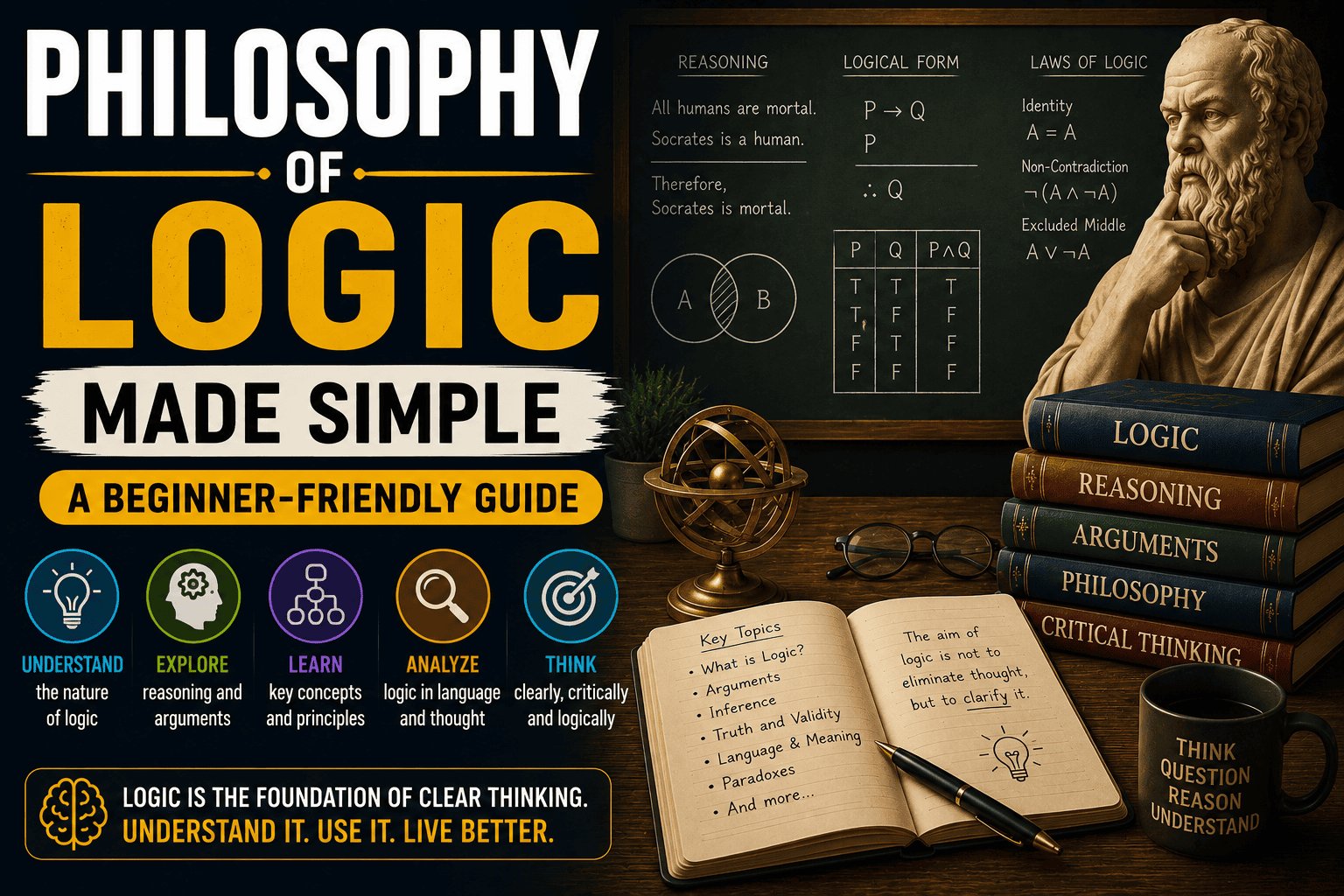
Explore the Foundations of Reasoning and Rational Thought — The Philosophy of Logic investigates the principles that determine whether reasoning is sound, arguments are valid, and conclusions follow appropriately from their premises. It examines fundamental concepts such as truth, inference, consistency, and logical validity, while also considering how formal systems can represent different forms of reasoning. The field connects logic with areas such as language, mathematics, computer science, and human thought.
This subject also explores deeper questions about the nature and status of logical principles, including whether logical laws are objective truths, human constructions, or something in between. It considers different logical approaches, such as classical, modal, and fuzzy logic, and examines how each can address particular types of reasoning. At its core, the Philosophy of Logic asks why the principles of reasoning work and what they reveal about truth, thought, and reality.
Content Overview
- 1. Introduction to Logic
- 2. Importance of Logic
- 3. Basic Concepts
- 4. Historical Overview of Logic
- 5. Types of Logic
- 6. Logical Operators & Connectives
- 7. Reasoning & Inference
- 7.1 Inference (Main Node)
- 7.2 Rules of Inference
- 7.2.1 Modus Ponens (If P → Q, P ⊢ Q)
- 7.2.2 Modus Tollens (If P → Q, ¬Q ⊢ ¬P)
- 7.2.3 Hypothetical Syllogism (P → Q, Q → R ⊢ P → R)
- 7.2.4 Disjunctive Syllogism (P ∨ Q, ¬P ⊢ Q)
- 7.2.5 Conjunction (P, Q ⊢ P ∧ Q)
- 7.2.6 Simplification (P ∧ Q ⊢ P)
- 7.2.7 Addition (P ⊢ P ∨ Q)
- 7.2.8 Resolution
- 7.2.9 Constructive Dilemma
- 7.2.10 Destructive Dilemma
- 7.3 Predicate Logic Inference
- 8. Proof Techniques
- 9. Logical Truth & Consequence
- 10. Applications of Logic
- 11. Advanced & Specialized Topics
1. Introduction to Logic
Logic is the study of reasoning how we think clearly and make correct arguments. It helps us know if what we believe or say actually makes sense.
1.1 What is Logic?
Logic is like a toolbox for your brain that shows you how to think in the right order and check if your reasoning is correct.
Study of reasoning and argumentation:
Logic teaches you how to reason correctly and make arguments that others can follow.
Distinguish valid vs invalid reasoning:
Logic helps you see the difference between:
- Valid reasoning: Conclusion follows the rules and is guaranteed to be true if premises are true.
- Invalid reasoning: Conclusion does not follow from the premises, so it might be wrong.
Example (classic one):
- Premise 1: All humans are mortal.
- Premise 2: Socrates is a human.
- Conclusion: Therefore, Socrates is mortal.
This is valid reasoning, because if the premises are true, the conclusion must be true.
Another example:
- If it rains, the ground gets wet.
- It is raining.
- Therefore, the ground is wet.
Even in daily life, logic helps you make sense of cause and effect.
1.2 Philosophy of Logic
The philosophy of logic asks big questions about thinking itself. It studies:
- Nature of logical truth: What makes a statement always true?
Example: “If it rains, then it rains.” This is true no matter what. - Logical necessity: Some things must be true by logic, not just by facts.
Example: “All bachelors are unmarried.” It cannot be false. - Foundations of reasoning: What rules make reasoning work?What makes some arguments effective while others fail?
Syntax vs Semantics
Logic has two sides: structure and meaning.
- Syntax: The rules for writing formulas correctly. Think of it like grammar in language.
Example: (P ∧ Q) → R is correct syntax; ∧ P → Q R) is wrong. - Semantics: The meaning or truth of formulas. It tells us whether a statement is true or false.
Example: P ∧ Q is true only when both P and Q are true.
1.3 Model Theory
Model theory is the study of different “worlds” or interpretations where logical statements are true. Think of it as checking if a story makes sense in all possible situations.
Example:
- Statement: “All birds can fly.”
- Model 1: Only typical birds → True
- Model 2: Includes penguins → False
Model theory shows how logic works across all situations.
1.4 Godel’s Incompleteness Theorems
Kurt Gödel showed that in any sufficiently powerful system that includes arithmetic:
- There are true statements that cannot be proved inside the system.
- The system cannot prove its own consistency.
Simply put: Even math and logic have limits. Not all truths can be reached by strictly following rules—some lie beyond what formal proofs can establish.
Summary:
- Logic = thinking clearly and correctly.
- Syntax = correct form; Semantics = correct meaning.
- Model theory = does the logic work in all situations?
- Gödel = shows there are limits even in perfect logic systems.
2. Importance of Logic
Logic is not just theory—it is practical in many fields. Learning logic helps you think clearly, solve problems, and create systems that work reliably.
2.1 Philosophy: Analyzing Arguments, Metaphysics, Ethics
Logic is the foundation of philosophical thinking. Philosophers use logic to analyze arguments, test ideas, and explore deep questions about existence and morality.
Examples:
Ethics:
- Argument: All humans should avoid harming others.
- Stealing harms people.
- Therefore, humans should not steal.
Logic helps ensure the conclusion follows from the premises and avoids contradictions in moral reasoning.
Metaphysics:
- Argument: Everything that exists has a cause.
- The universe exists.
- Therefore, the universe has a cause.
Logic allows philosophers to structure reasoning about abstract concepts.
2.2 Mathematics: Proofs, Theorems, Formal Systems
Logic is the backbone of mathematics. Every theorem or formula relies on rigorous logical reasoning.
Examples:
Simple Proof:
- Claim: The sum of two even numbers is even.
- Proof: Let the numbers be 2a and 2b (where a,b are integers). Their sum = 2a + 2b = 2(a+b). 2(a+b) is divisible by 2 → even
Formal Systems:
Mathematicians use axioms + logical rules to build large systems of knowledge. Logic ensures no contradictions appear.
Logic in math guarantees that every step in a proof is valid.
2.3 Computer Science: Algorithms, Programming, Verification
Logic is essential in computer science because computers need precise, unambiguous instructions.
Examples:
- Algorithms: Logic helps create step-by-step procedures to solve problems.
Example: Searching for a name in a list: - If list is empty → Stop
- If name found → Return position
- Else → Move to next item
- Programming: Conditional statements use logic:
If the age is 18 or older, it displays “You can vote”; otherwise, it shows “You cannot vote.”
This is logic applied in code: “If P then Q, else R”.
- Verification: Logic ensures software behaves correctly. Tools called formal verification systems check programs against logical rules to prevent bugs.
2.4 Artificial Intelligence: Automated Reasoning, Knowledge Representation
Logic is the brain of AI systems. AI needs rules to make decisions, learn patterns, and solve problems.
Examples:
- Expert Systems: AI uses “if-then” rules like a human expert.
- Rule: If patient has fever ∧ cough → possible flu
- Rule: If patient has fever ∧ rash → possible measles
- Automated Reasoning: AI can derive conclusions automatically.
- All cats are mammals
- Whiskers is a cat
- AI concludes: Whiskers is a mammal
- Knowledge Representation: Logic structures knowledge so AI can understand relationships.
- Concept hierarchy: Animal → Mammal → Cat
- Logic helps AI answer: “Is Whiskers an Animal?” → Yes
Summary:
- Philosophy: Logic helps think clearly, analyze arguments, and explore deep questions.
- Mathematics: Logic builds proofs and ensures every theorem is valid.
- Computer Science: Logic powers algorithms, programming, and software verification.
- Artificial Intelligence: Logic helps AI reason, learn, and make decisions automatically.
3. Basic Concepts
Logic has some core building blocks that you must understand before moving forward. These are like the letters and words of the language of reasoning.
3.1 Propositions
A proposition is a statement that can be evaluated as either true or false. Think of it as a fact that can be checked.
Examples:
- “It is raining.” True or False depending on the weather.
- “2 + 2 = 4.” True
- “The moon is made of cheese.” False
Note: Questions, commands, or opinions like “What time is it?” Commands like “Close the door” are not propositions because they cannot be judged as true or false.
3.2 Arguments
An argument is a set of propositions (premises) meant to support a conclusion. Logic studies whether the conclusion really follows from the premises.
Example:
- Premise 1: All humans are mortal.
- Premise 2: Socrates is a human.
- Conclusion: Socrates is mortal.
Here, the premises support the conclusion, forming a valid argument.
3.3 Validity
An argument is considered valid when its conclusion necessarily follows from its premises, meaning that if the premises are true, the conclusion cannot be false. It’s about structure, not truth. Even if the premises are false, the argument can be valid if the logic works.
Example:
- Premise 1: All cats are dogs. (False)
- Premise 2: Felix is a cat.
- Conclusion: Felix is a dog. Valid (structure correct, premises just happen to be false)
3.4 Soundness
A sound argument is both logically valid and based on true premises. Sound arguments are always correct in real life.
Example:
- Premise 1: All humans are mortal. True
- Premise 2: Socrates is human. True
- Conclusion: Socrates is mortal. True & valid → Sound
3.5 Logical Equivalence
Two statements are logically equivalent if they are always true or false in the same situations.
“If it rains, the ground becomes wet” is logically equivalent to saying, “If the ground is dry, then it did not rain.”
4. Historical Overview of Logic
Logic has a rich history, evolving over thousands of years. Knowing history helps understand why modern logic exists.
4.1 Aristotle (384–322 BCE)
- Father of formal logic.
- Created syllogistic logic: combining premises to reach conclusions.
Example:
- All men are mortal.
- Socrates is a man.
- Therefore, Socrates is mortal.
Aristotle laid the foundation for deductive reasoning.
4.2 George Boole (1815–1864)
- Created Boolean Algebra, which is logic using 0 and 1 (true/false).
- Basis of digital electronics and computers.
Example:
AND (∧), OR (∨), NOT (¬) operations in computers come from Boole.
4.3 Gottlob Frege (1848–1925)
Founder of modern predicate logic. Introduced variables and quantifiers like ∀ (“for all”) and ∃ (“there exists”).
Example:
Statement: “All humans are mortal.” Symbolically: ∀x (Human(x) → Mortal(x))
Frege allowed expressing complex reasoning mathematically.
4.4 Bertrand Russell & Alfred North Whitehead (1872–1970, 1861–1947)
- Wrote Principia Mathematica, trying to reduce all of mathematics to logic.
- Showed how math and logic are deeply connected.
4.5 Kurt Gödel (1906–1978)
- Proved Incompleteness Theorems:
- Some truths in math cannot be proved.
- No system can prove its own consistency.
Gödel showed limits of logic and formal systems, even in perfect reasoning systems.
Summary:
- Propositions: statements true/false
- Arguments: premises supporting a conclusion
- Validity: correct logical structure
- Soundness: valid + true premises
- Logical equivalence: statements with same truth in all cases
- Historical roots: Aristotle → Boole → Frege → Russell/Whitehead → Gödel
5. Types of Logic
Logic is not just one kind it has different types depending on what you want to reason about. We can classify them into Classical Logic, Non-Classical Logic, and Meta-Logic.
5.1 Classical Logic
Classical logic is the traditional form of reasoning, based on true/false statements.
5.1.1 Propositional Logic
Deals with simple statements (propositions) and logical connectives like AND, OR, NOT.
Connectives:
- AND (∧): It is true only when both statements are true.
- OR (∨): A statement is true if at least one of the conditions is true.
- NOT (¬): True if the statement is false
Example:
- P: It is raining
- Q: The ground is wet
- P ∧ Q → True if both P and Q are true
- P ∨ Q is true if at least one of the statements is true.
- ¬P is true when it is not raining.
5.1.2 Predicate Logic (First-Order Logic)
Extends propositional logic with variables and quantifiers (like ∀ “for all” and ∃ “there exists”). Allows reasoning about objects and their properties.
Example:
- Statement: “All humans are mortal.”
- Symbolically: ∀x (Human(x) → Mortal(x))
- Meaning: Every human being is mortal.
- Statement: “Some cats are black.”
- Symbolically: ∃x (Cat(x) ∧ Black(x))
- Meaning: There exists at least one cat that is black
5.1.3 Syllogistic Logic (Aristotle)
Combines two premises to reach a conclusion.
Example:
- All men are mortal.
- Socrates is a man.
- Therefore, Socrates is mortal
This is classical deductive reasoning and the foundation of logic.
5.2 Non-Classical Logic
Non-classical logic modifies or extends classical rules to handle situations classical logic cannot handle.
5.2.1 Modal Logic
Deals with possibility (◇) and necessity (□).
Example:
- ◇P means that it is possible that it will rain tomorrow.
- □P → “It is necessary that 2+2=4.”
Useful in philosophy, computer science, and AI.
5.2.2 Intuitionistic Logic
Rejects the law of excluded middle (P ∨ ¬P). Focuses on constructive proofs (you must explicitly construct an example to prove it).
Example:
- In classical logic, a statement must be either true or false—for example, either “There is life on Mars” or “There is no life on Mars.”
- Intuitionistic logic: We cannot claim it true until we construct evidence.
5.2.3 Fuzzy Logic
Truth is not just true or false, but can be partial (degrees of truth).
Example:
“It is hot today” → 70% true if it’s warm, 30% false if not very hot.
Widely used in AI, temperature control, and smart systems.
5.2.4 Paraconsistent Logic
Allows contradictions without collapsing the system.
Example:
“The light is on” and “The light is not on” form a contradiction.
In classical logic, contradiction breaks everything; paraconsistent logic handles it.
5.2.5 Temporal Logic
Deals with time-based reasoning (always, eventually, before, after).
Example:
- “It will eventually rain”
- “If it rains today, the ground will be wet tomorrow.” is a conditional statement expressing that rain leads to a wet ground the next day.
Important in computer programs, scheduling, and AI planning.
5.3 Meta-Logic (Study of Logic Itself)
Meta-logic is the study of how logic works, its rules, structure, and limits.
5.3.1 Syntax
Rules for writing well-formed formulas (correct logical sentences).
Example: (P ∧ Q) → R is correct syntax; ∧ P → Q R) is incorrect.
5.3.2 Semantics
Deals with meaning and truth values of statements.
Example: (P \land Q) is true only when both (P) and (Q) are true.
5.3.3 Proof Theory
Studies rules for deduction and how to derive conclusions from premises.
Example: Modus Ponens: P → Q, P ⊢ Q
5.3.4 Model Theory
Studies interpretations of logical systems, checking whether statements are true under different “models.”
Example:
“All birds can fly.” True in a model of typical birds, false if penguins are included.
5.3.5 Gödel’s Incompleteness Theorems
Already discussed in previous sections, applies here as a meta-logical concept:
- Some truths cannot be proven within the system they belong to.
- No system can prove its own consistency.
Summary of Types of Logic
- Classical Logic: Propositions, predicates, syllogisms → True/False reasoning
- Non-Classical Logic: Handles possibilities, uncertainty, time, contradictions
- Meta-Logic: Studies logic itself, syntax, semantics, proofs, and limits
By mastering these concepts, you gain an understanding of the major forms of logic, from Aristotle’s ideas to modern AI applications.
6. Logical Operators & Connectives
What are Logical Operators?
Logical operators (also called logical connectives) are symbols used to combine or modify logical statements (propositions).
A proposition is a statement that can be identified as either true or false.
Examples of propositions:
- “The sky is blue.” (True)
- “2 + 2 = 5.” (False)
Logical operators help us build more complex statements from simple ones.
Example:
- P = “It is raining”
- Q = “I take an umbrella”
We can combine them: P ∧ Q → It is raining AND I take an umbrella.
6.1 Negation (¬P)
Negation is the operation that flips the truth value of a statement.
- If P is true → ¬P is false
- If P is false → ¬P is true
Symbol: ¬
Example:
- P = “The door is open”
- ¬P = “The door is NOT open”
- If P = True → ¬P = False
- If P = False → ¬P = True
Truth Table:
| P | ¬P |
|---|---|
| True | False |
| False | True |
6.2 Conjunction (P ∧ Q)
Conjunction means AND. The statement is true only when both parts are true.
Symbol: ∧
Example:
- P = “It is raining”
- Q = “I have an umbrella”
- P ∧ Q represents a logical AND statement, for example: “It is raining AND I have an umbrella.”
Truth Table:
| P | Q | P ∧ Q |
|---|---|---|
| T | T | T |
| T | F | F |
| F | T | F |
| F | F | F |
Meaning: Both must be true.
6.3 Disjunction (P ∨ Q)
Disjunction means OR. It is true if at least one statement is true.
Symbol: ∨
Example:
- P = “I will study”
- Q = “I will watch TV”
- P ∨ Q = “I will study OR watch TV”
Truth Table:
| P | Q | P ∨ Q |
|---|---|---|
| T | T | T |
| T | F | T |
| F | T | T |
| F | F | F |
Meaning: Only false when both are false.
6.4 Implication (P → Q)
Implication means: IF P THEN Q
Symbol: →
Example:
- P = “It rains”
- Q = “The ground gets wet”
- P → Q = “If it rains, then the ground gets wet” is a conditional (if–then) statement expressing that rain leads to a wet ground.
Truth Table:
| P | Q | P → Q |
|---|---|---|
| T | T | T |
| T | F | F |
| F | T | T |
| F | F | T |
Important idea: If the condition (P) is false, the implication is considered true.
Simple Example:
“If I study, I will pass.” If I did not study, the statement is not considered false.
6.5 Biconditional (P ↔ Q)
Biconditional means: P if and only if Q
Symbol: ↔
This means both directions must be true:
- P → Q
- AND Q → P
Example:
- P = “A number is even”
- Q represents the statement “The number is divisible by 2.”
- P ↔ Q: A number is even exactly when it can be divided by 2 without any remainder.
Truth Table:
| P | Q | P ↔ Q |
|---|---|---|
| T | T | T |
| T | F | F |
| F | T | F |
| F | F | T |
Meaning: True when both statements have same truth value.
6.6 Exclusive OR (XOR)
Definition: Exclusive OR means only one is true, not both.
Symbol often written as: ⊕ or XOR
Example:
- P = “I will drink tea”
- Q = “I will drink coffee”
- XOR means: I drink tea OR coffee but not both.
Truth Table:
| P | Q | P XOR Q |
|---|---|---|
| T | T | F |
| T | F | T |
| F | T | T |
| F | F | F |
Meaning: True only when exactly one statement is true.
6.7 Truth Tables
A truth table is a table used to show the truth value of logical expressions for all possible cases.
It helps us:
- analyze logic
- test arguments
- check equivalence
- verify logical rules
Example: Expression: ¬P ∨ Q
Truth Table:
| P | Q | ¬P | ¬P ∨ Q |
|---|---|---|---|
| T | T | F | T |
| T | F | F | F |
| F | T | T | T |
| F | F | T | T |
Example of Logical Reasoning Using Operators
- P = “It rains”
- Q = “Road is wet”
- Rule: P → Q
If P is known to be true, then by applying Modus Ponens, Q must also be true.
Real Life Examples
Computer Programming:
if user_logged_in AND user_is_admin:
    allow_access
Uses AND (∧) logic.
Digital Circuits:
Computers use:
- AND gates
- OR gates
- NOT gates
These are physical versions of logical operators.
Complete Operator Summary
| Operator | Symbol | Meaning |
|---|---|---|
| Negation | ¬ | NOT |
| Conjunction | ∧ | AND |
| Disjunction | ∨ | OR |
| Implication | → | IF…THEN |
| Biconditional | ↔ | IF AND ONLY IF |
| XOR | ⊕ | Only one true |
Why Logical Operators Are Important
They are the foundation of:
- reasoning
- mathematics
- computer science
- artificial intelligence
- programming
- digital electronics
- formal proofs
Without them logic cannot work.
7. Reasoning & Inference
Reasoning is the process of drawing conclusions from given premises or evidence.In logic, reasoning is formalized as inference.
7.1 Inference (Main Node)
Inference is the act of deriving new statements from known statements using rules of reasoning. There are three primary kinds of inference.
7.1.1 Deductive Reasoning (General → Specific)
Starts from general rules and derives specific conclusions that are guaranteed to be true if premises are true.
Example:
- All humans are mortal. (General)
- Socrates is a human.
- Conclusion: Socrates is mortal.
Deductive reasoning gives certainty, not probability.
7.1.2 Inductive Reasoning (Specific → General)
Starts from specific observations and forms general rules, which are probable, not guaranteed.
Example:
- Observation 1: Swan 1 is white
- Observation 2: Swan 2 is white
- Conclusion: All swans are white (probable but not guaranteed)
Induction is common in science and research.
7.1.3 Abductive Reasoning (Best Explanation)
Starts from an observation and finds the most likely explanation.
Example:
- Observation: The ground is wet.
- Possible explanations: It rained, someone watered the garden, a pipe burst.
- Best explanation: It probably rained
Abduction is used in diagnosis, AI, detective work.
7.2 Rules of Inference
Rules of inference are patterns of reasoning that guarantee valid conclusions. These are core tools for reasoning in logic and proofs.
7.2.1 Modus Ponens (If P → Q, P ⊢ Q)
If the statement “P implies Q” is true and P holds, then Q necessarily follows.
Example:
- If it rains, the ground gets wet. (P → Q)
- It is raining. (P)
- Therefore, the ground is wet. (Q)
7.2.2 Modus Tollens (If P → Q, ¬Q ⊢ ¬P)
If “P implies Q” and Q is false, then P must be false.
Example:
- If it rains, the ground gets wet. (P → Q)
- The ground is not wet. (¬Q)
- Therefore, it did not rain. (¬P)
7.2.3 Hypothetical Syllogism (P → Q, Q → R ⊢ P → R)
Chain reasoning: If P implies Q and Q implies R, then P implies R.
Example:
- If it rains, the ground gets wet. (P → Q)
- If the ground becomes wet, then the plants will grow (Q → R).
- Therefore, if it rains, the plants grow. (P → R)
7.2.4 Disjunctive Syllogism (P ∨ Q, ¬P ⊢ Q)
If at least one statement is true and one is false, the other must be true.
Example:
- Today is Saturday or Sunday. (P ∨ Q)
- Today is not Saturday. (¬P)
- Therefore, today is Sunday. (Q)
7.2.5 Conjunction (P, Q ⊢ P ∧ Q)
If P is true and Q is true, then “P AND Q” is true.
Example:
- P: It is raining.
- Q: I have an umbrella.
- Conclusion: It is raining AND I have an umbrella.
7.2.6 Simplification (P ∧ Q ⊢ P)
From a conjunction, either individual statement can be logically inferred.
Example:
- P ∧ Q means both statements are true at the same time, for example: “It is raining AND it is cold.”
- Therefore, it is raining.
7.2.7 Addition (P ⊢ P ∨ Q)
If P is true, then “P OR Q” is also true.
Example:
- P: It is raining.
- Therefore, it is raining OR it is sunny.
7.2.8 Resolution
A rule to combine disjunctions to simplify arguments, often used in AI.
Example:
(P ∨ Q), (¬P ∨ R) ⊢ (Q ∨ R)
7.2.9 Constructive Dilemma
Definition: Combines conditional statements with disjunctions.
Example:
(P → Q) ∧ (R → S), P ∨ R ⊢ Q ∨ S
7.2.10 Destructive Dilemma
Definition: Combines conditional statements with negation and disjunctions.
Example:
(P → Q) ∧ (R → S), ¬Q ∨ ¬S ⊢ ¬P ∨ ¬R
7.3 Predicate Logic Inference
In predicate logic, we apply inference to quantified statements.
7.3.1 Universal Instantiation (∀x P(x) ⊢ P(a))
From a statement true for all objects, we can infer it is true for a specific object.
Example:
- ∀x (Human(x) → Mortal(x))
- For Socrates: Human(Socrates) → Mortal(Socrates)
7.3.2 Existential Instantiation (∃x P(x) ⊢ P(a))
From a statement that something exists, pick a specific example.
Example:
- ∃x (Cat(x) ∧ Black(x)) → There is a cat, say Felix, that is black
7.3.3 Universal Generalization (P(a) ⊢ ∀x P(x))
If something is true for an arbitrary element, it is true for all.
Example:
If a randomly chosen human is mortal, and the choice is arbitrary, we can infer all humans are mortal
7.3.4 Existential Generalization (P(a) ⊢ ∃x P(x))
If a statement is true for a specific object, then something exists for which it is true.
Example:
Felix is a black cat → There exists a black cat
Summary (Reasoning & Inference)
- Inference: Drawing conclusions from premises.
- Types of reasoning: Deductive (certain), Inductive (probable), Abductive (best explanation)
- Rules of Inference: Modus Ponens, Modus Tollens, Hypothetical & Disjunctive Syllogisms, etc.
- Predicate logic inference: involves working with statements that use quantifiers like “for all” (∀) and “there exists” (∃), applying rules such as universal instantiation, existential instantiation, and generalization.
Mastering these makes you proficient in reasoning, proof writing, and AI/logical problem solving.
8. Proof Techniques
A proof is a sequence of logical steps used to demonstrate that a statement is true.Different techniques exist depending on the problem.
8.1 Direct Proof
Start with assumptions and logically derive the conclusion step by step.
Example:
- Statement: If a number n is even, then n² is also even.
- Proof: Let n = 2k (even). Then n² = (2k)² = 4k² = 2(2k²) → even
8.2 Proof by Contradiction
Assume the contrary of the statement you want to prove and demonstrate that it results in a contradiction.
Example:
- Statement: √2 is irrational.
- Proof: Assume √2 is rational → √2 = p/q → leads to both p and q being even → contradiction
8.3 Proof by Contrapositive
To prove “If P implies Q,” you can instead prove the equivalent statement: “If not Q, then not P.”
Example:
- Statement: If the square of a number n is even, then n is also even.
- Contrapositive: Instead of proving a statement directly, one can show that if n is odd, then n² is also odd, which is often a simpler approach.
8.4 Proof by Mathematical Induction
Definition: Prove a statement for all natural numbers using Base Case + Inductive Step.
Example:
- Statement: The sum of the first n natural numbers is given by ( n(n+1)/2 ).
- Base case: n=1 → 1 = 1(1+1)/2
- Inductive step: Assume true for n=k, prove for n=k+1 → works
9. Logical Truth & Consequence
9.1 Logical Truth
A statement true in all possible interpretations.
Example:
- “If it rains, then it rains.”
- “P ∨ ¬P” (Law of excluded middle)
9.2 Logical Consequence
A conclusion is necessarily true when the premises are true.
Example:
- Premises: Every human is mortal, and Socrates is a human.
- Conclusion: Socrates is mortal
Logical truth is absolute, while logical consequence depends on premises.
10. Applications of Logic
Logic is used everywhere in reasoning, science, and AI.
10.1 Mathematics
Uses:
- Proving theorems
- Building formal systems
- Checking consistency of axioms
Example:
Pythagorean theorem, proofs of number theory statements
10.2 Computer Science
Uses:
- Algorithms and programming
- Software verification
- Database queries and logic programming
Example:
Boolean logic in circuits can be applied as: “If the user is an admin, then access is granted.”
10.3 Artificial Intelligence
Uses:
- Expert systems
- Automated reasoning
- Knowledge representation
Example:
AI medical diagnosis: If symptoms X and Y, then disease Z
10.4 Philosophy
Uses:
- Ethics: reasoning about moral principles
- Epistemology: analyzing knowledge claims
- Metaphysics: reasoning about existence and reality
11. Advanced & Specialized Topics
For expert-level logic and research.
11.1 Non-Monotonic Logic
Reasoning when knowledge changes (not all conclusions remain valid).
Example:
- Typically, birds are able to fly; since Tweety is a bird, it is assumed that Tweety can fly.
- However, given that Tweety is a penguin, it follows that Tweety cannot fly.
11.2 Higher-Order Logic
Logic that allows quantifying over predicates and functions, not just objects.
Example:
∀P ∃x P(x) → statements about properties, not just individuals
11.3 Proof Assistants & Formal Verification
Software that checks proofs automatically.
Examples: Coq, Lean → used in software and hardware verification
11.4 Logical Paradoxes
Examples:
- Russell’s Paradox: Bertrand Russell described a paradox involving the “set of all sets that do not contain themselves,” known as Russell’s Paradox.
- Liar Paradox: “This statement is false.”
Shows limits of naive logic systems
11.5 Decision Theory & Logic
Applying logic to make rational decisions under uncertainty
Example:
Expected utility: If action A has 70% chance of benefit X, take it
11.6 Applications in Natural Language Semantics
Using logic to analyze meaning in language.
Example:
“Every student passed” → ∀x(Student(x) → Passed(x))
Helps in computational linguistics and AI understanding of language
Summary
- Proof Techniques: Ways to show statements are true (Direct, Contradiction, Contrapositive, Induction)
- Logical Truth & Consequence: Absolute truth vs truth following premises
- Applications: Math, CS, AI, philosophy
- Advanced Topics: Non-monotonic logic, higher-order logic, proof assistants, paradoxes, decision theory, language
After mastering this, you can reason, prove, and apply logic professionally, including AI, math, and philosophy.