Religious Philosophy
Examine Religious Belief Through Philosophical Reasoning — Philosophy of Religion investigates fundamental questions about religion, faith, the existence of God, and the nature of religious experience. It uses philosophical methods such as logical analysis, critical reasoning, and argumentation to examine religious claims and their implications. Topics commonly include arguments for and against the existence of God, the problem of evil, the relationship between faith and reason, and the possibility of religious knowledge.
Unlike theology, which generally develops its inquiries within the framework of a particular religious tradition, Philosophy of Religion can approach these questions from a broader philosophical perspective. It considers whether religious beliefs can be supported by reason, revelation, personal experience, or other forms of evidence, while also examining the role of uncertainty and doubt. At its core, Philosophy of Religion asks how religious beliefs can be understood and evaluated, and whether questions about the divine can be meaningfully addressed through human reasoning.
Content Overview
- Religious Philosophy
- Religion as a Philosophical System
- Major Traditions and Approaches
- Metaphysics of Religion
- Epistemology of Faith
- Ethics and Morality in Religious Philosophy
- Language and Symbolism in Religion
- Comparative Religious Philosophy
- Mysticism and Esotericism
- Religious Philosophy and Science
- Critiques and Challenges
- Contemporary Issues in Religious Philosophy
Religious Philosophy
Introduction
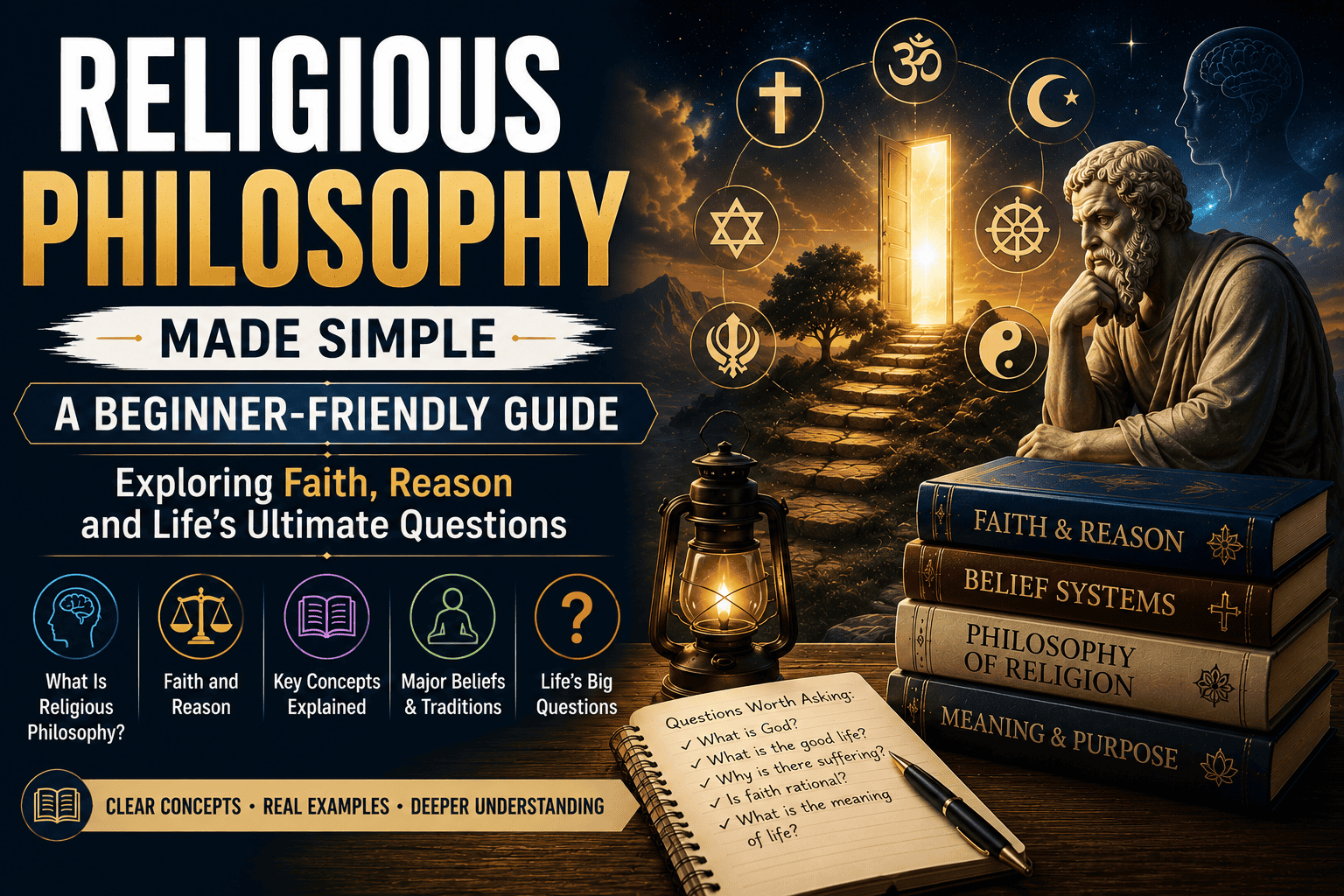
Religious philosophy studies religion as a system of ideas, not just as faith or worship. It asks questions like:
What is God?
Why do humans seek the sacred?
How do religions interpret the meaning of life?
Example: If theology says “God exists because the Bible says so,” then religious philosophy asks “What does it mean for God to exist?” and “Can human reason help us understand God?”
Difference from Philosophy of Religion & Theology
Theology: speaks within a religion (e.g., Christian theology).
Philosophy of Religion: a critical, mostly secular study of religious concepts.
Religious Philosophy: broader; includes mystical, doctrinal, rational, and symbolic reasoning inside religions.
Why Study Religious Philosophy?
Because it connects reason + faith. It helps people understand the intellectual depth of religion, not just rituals.
Religion as a Philosophical System
Core Concepts in Religious Thought
The Sacred & The Profane
Sacred = holy, divine, beyond normal life.
Profane = ordinary, everyday life.
Example: A mosque, church, or temple is “sacred space,” while your kitchen is “profane space.”
Faith, Reason, and Revelation
Faith = belief without full proof.
Reason = logical understanding.
Revelation = divine truth given to humans.
Example: Muslims believe the Qur’an is revelation, Christians say the Bible, Hindus say the Vedas.
Symbol, Myth, and Ritual
Religions use stories (myths), symbols (cross, crescent, Om), and rituals (prayer, fasting) to express truths. Example: Baptism in Christianity symbolizes spiritual cleansing.
Major Traditions and Approaches
Western Religious Philosophy (Greek, Christian, Islamic, Jewish)
Greek (Plato’s “God of Forms”),
Christian (St. Augustine, Aquinas),
Islamic (Al-Farabi, Ibn Sina, Al-Ghazali),
Jewish (Maimonides).
Eastern Religious Philosophy (Hindu, Buddhist, Taoist, Confucian)
Hinduism (Advaita Vedanta – Atman = Brahman),
Buddhism (emptiness, Nirvana),
Taoism (harmony with Tao),
Confucianism (moral harmony).
Indigenous & Mystical Traditions
Native American, African spiritualities, Sufism, Kabbalah, Zen, etc. Example: Sufis see God as Beloved, while Buddhists focus on liberation from suffering.
Metaphysics of Religion
Studies “reality” in religion.
Nature of God/Ultimate Reality: Is God personal (like in Christianity/Islam) or impersonal (like Brahman in Hinduism)?
Being and Existence: Does everything depend on God?
Soul and Afterlife: Do humans live after death?
Example: Christianity teaches eternal heaven/hell, Hinduism teaches rebirth, Buddhism teaches Nirvana (freedom from rebirth).
Epistemology of Faith
Sources of Knowledge: Revelation, Intuition, Mysticism
Revelation (scriptures)
Intuition (inner knowledge)
Mysticism (direct experience of God)
Faith vs. Rational Inquiry
Can religion be proven logically, or is it only by faith?
Example: St. Thomas Aquinas gave logical proofs of God, while Kierkegaard said faith is beyond logic.
Religious Experience and Its Validity
Ethics and Morality in Religious Philosophy
Divine Command Theory: Morality comes from God’s will.
Virtue Ethics: Focus on developing a good character (like compassion, truthfulness).
Theodicy (Problem of Evil): If God is good, why is there evil?
Example: Christianity says evil comes from human free will, Buddhism says suffering comes from ignorance and desire.
Language and Symbolism in Religion
Religious Language: Literal (God is King) or metaphorical (God is Light).
Sacred Texts: not just laws but also philosophy.
Hermeneutics (Interpretation): Understanding scripture in context.
Example: The Qur’an calls God “The Light of the Heavens and Earth” – not physical light but symbolic.
Comparative Religious Philosophy
Convergences and Divergences in Doctrines
Convergences: Many religions agree on compassion, justice, prayer, and seeking ultimate reality.
Divergences: They disagree on God’s nature, salvation, and afterlife.
Example: Christianity sees God as Trinity, Islam as One (Tawhid), Buddhism does not center on a creator God.
Interfaith Philosophical Dialogues
Religious philosophers compare ideas to find common ground.
For example, Christian mystic Thomas Merton drew inspiration from Zen monks.
Universalism vs. Exclusivism
Exclusivism: Only one religion is true.
Universalism: The idea that all religions point toward the same truth
Example: A Muslim exclusivist might say only Islam leads to salvation, while a Hindu universalist might say all paths reach Brahman.
Mysticism and Esotericism
Mystical Union with the Divine
Philosophy explores what it means to be united with God.
Example: Sufis talk about fana (loss of self in God).
Esoteric Traditions (Kabbalah, Sufism, Vedanta, Zen)
Hidden, deeper teachings for spiritual seekers.
Example: Kabbalah in Judaism, Sufism in Islam, Vedanta in Hinduism, Zen in Buddhism.
Philosophy of Spiritual Practices (Prayer, Meditation, Asceticism)
Prayer (talking to God),
Meditation (silencing mind),
Asceticism (discipline like fasting).
Example: Buddhist monks meditate for enlightenment; Christians practice fasting in Lent.
Religious Philosophy and Science
Cosmology, Creation, and Evolution
Did the universe come from God or Big Bang? Example: Islamic Kalam argued “everything that begins has a cause, so the universe has God as cause.”
Consciousness and the Soul
Can science explain consciousness? Example: Hinduism says consciousness is eternal (Atman), while materialist science says it’s brain activity.
Miracles and Natural Laws
Are miracles possible if nature has fixed laws? Example: Christianity says Jesus’ resurrection is a miracle; philosophers debate if this breaks science or reveals higher law.
Critiques and Challenges
Skepticism and Atheism
Thinkers like Nietzsche and Dawkins argue religion is unnecessary or harmful. Example: Nietzsche said “God is dead” meaning modern humans no longer need belief to find meaning.
Religious Pluralism & Relativism
Pluralism: many truths coexist.
Relativism: truth depends on culture, no absolute truth.
Secularism, Postmodernism, and Religion
Secularism pushes religion into private life.
Postmodernism says all religious “truths” are narratives, not universal.
Contemporary Issues in Religious Philosophy
Religion and Politics
How religion shapes law, war, and peace. Example: Islamic Sharia debates; Christian influence on Western ethics.
Philosophy of Religion in the Era of Technology and Artificial Intelligence
Can machines have souls? Can AI replace priests or gurus? Example: In Japan, a Buddhist temple uses a robot to chant sutras.
Globalization, Interfaith Ethics, and Future of Religion
Can religions unite for climate change, poverty, peace? Example: Pope Francis and Muslim scholars signing peace declarations.