Indigenous & Traditional Religions
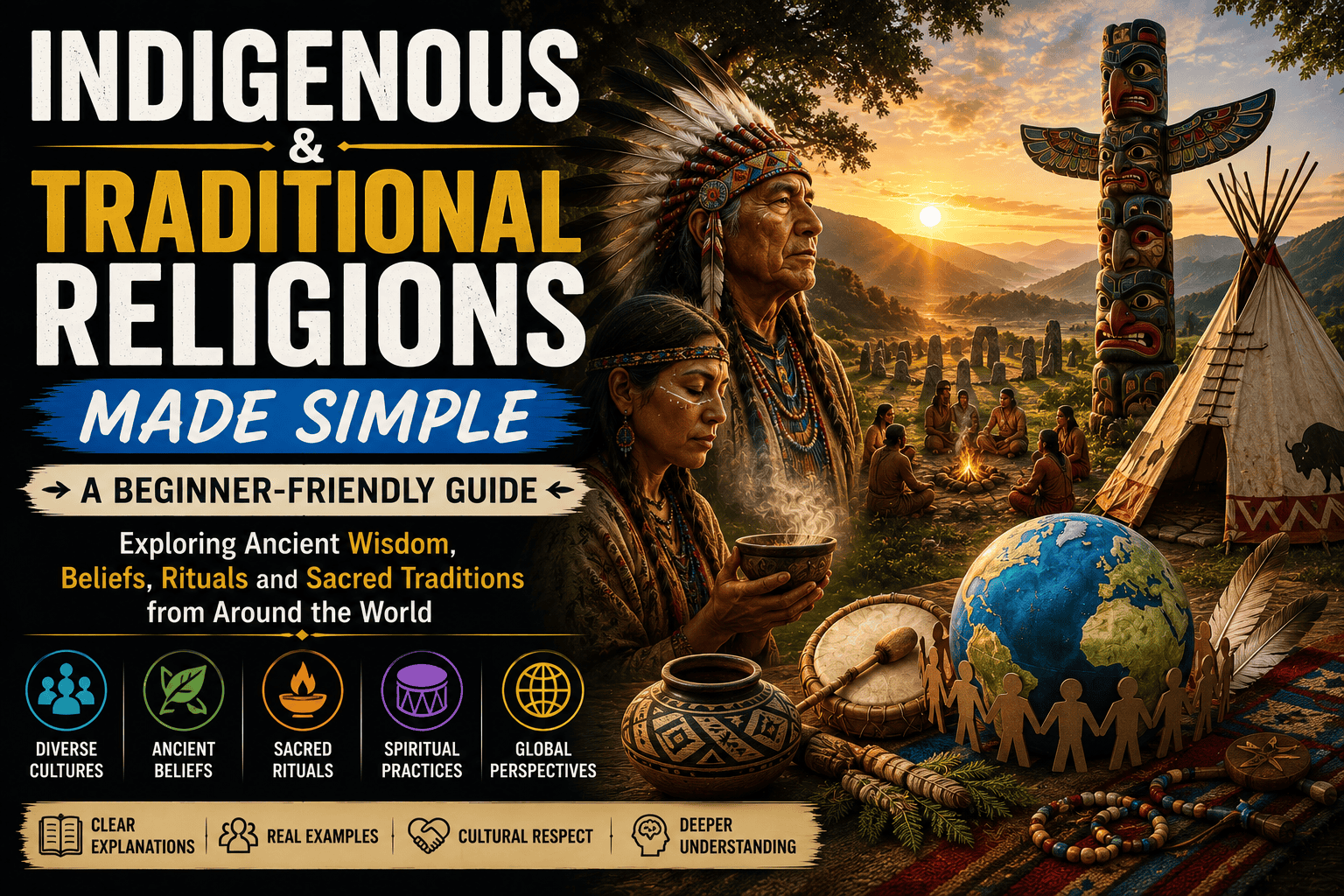
Explore the Spiritual Traditions Rooted in Land, Community, and Ancestry — Indigenous and traditional religions encompass a wide range of spiritual beliefs and practices developed by native, tribal, and local communities around the world. These traditions are often closely connected to particular landscapes, ancestral heritage, community relationships, and cultural histories. Rather than depending primarily on written scriptures, many rely on oral traditions, storytelling, ceremonies, rituals, and knowledge passed from one generation to another.
These belief systems frequently understand the sacred as closely connected with the natural world and everyday community life. Animals, plants, rivers, mountains, weather, seasons, and ancestral relationships may hold spiritual significance, although the specific beliefs and practices differ greatly from one culture to another. At their core, Indigenous and traditional religions demonstrate how spirituality can be deeply connected to land, ancestry, cultural identity, community, and humanity’s relationship with the natural world.
Content Overview
- Introduction: What Are Indigenous and Traditional Religions?
- Part 1: African Indigenous Religions – Ancestors, Ritual, and Community
- 1.1 African Indigenous Religions – No Single Name, Many Traditions
- 1.2 The Supreme God (Olodumare, Nyame, Mulungu)
- 1.3 Ancestors as Mediators Between the Living and the Divine
- 1.4 Rituals – Maintaining Harmony Between Humans, Spirits, and Nature
- 1.5 The Role of Diviners, Healers, and Elders
- 1.6 Death, Burial, and the Living-Dead
- 1.7Cosmology – The Three-Tiered Universe
- 1.8 Ethical Systems Based on Communal Well-Being (Ubuntu)
- 1.9 Example: Libation Rituals – Pouring Water or Palm Wine to Honor Ancestors
- Part 2: Native American Spirituality – Sacred Earth and Nature
- 2.1 Diversity of Nations – Lakota, Navajo, Iroquois, Cherokee
- 2.2 The Earth as Sacred – Land Is Not Property but a Relative
- 2.3 The Great Spirit and Many Spiritual Powers
- 2.4 The Relationship Between Humans and the Natural World – Kinship with All Beings
- 2.5 Sacred Sites – Mountains, Rivers, and Burial Mounds
- 2.6 The Medicine Wheel and Four Directions
- 2.7 Oral Traditions and Mythic Time – Emergence and Creation Stories
- 2.8 Ceremonial Objects – Feathers, Drums, Tobacco, and Sage
- 2.9 Example: Vision Quests – Seeking Guidance from Spiritual Powers Through Solitude and Fasting
- Part 3: Shamanism and Animism – Intermediaries with the Spirit World
- 3.1 What Is Shamanism? A Cross-Cultural Phenomenon
- 3.2 The Shaman as an Intermediary Between the Physical and Spiritual Realms
- 3.3 Animism – The Belief That All Beings (Plants, Animals, Objects, Places) Have Spirits
- 3.4 Trance, Journeying, and Altered States of Consciousness
- 3.5 The Shaman’s Role – Healer, Diviner, Psychopomp, and Protector
- 3.6 Intermediate: Spirit Helpers – Animal Guides, Ancestor Spirits, and Nature Deities
- 3.7 Advanced: Soul Loss and Soul Retrieval – A Shamanic Perspective on Illness
- 3.8 Advanced: Neo-Shamanism – Contemporary Adaptations (e.g., Michael Harner’s Core Shamanism)
- 3.9 Example: Siberian Shamans Entering Trance to Heal or Seek Visions
- Part 4: Case Study – The Sun Dance Ritual
- 4.1 Who Practices the Sun Dance? Plains Indigenous Peoples (Lakota, Dakota, Cheyenne, Arapaho)
- 4.2 Renewal, Sacrifice, and Connection with the Creator (Wakan Tanka)
- 4.3 Ritual Structure: Preparation, the Center Pole, Fasting, and Dancing
- 4.4 Piercing – Voluntary Sacrifice as an Offering
- 4.5 The Sun Dance as a Response to Colonial Suppression and Revival
- 4.6 Example: A Participant’s Journey – From Vow to Healing
- Part 5: Interfaith Dialogue and Global Perspectives – Bridging Religions
- 5.1 Why Interfaith Dialogue? Responding to Religious Conflict and Diversity
- 5.2 Religious Pluralism – All Religions Offer Valid Paths to Truth
- 5.3 Inclusivism – One Religion Has Ultimate Truth, Others Contain Partial Truths
- 5.4 Exclusivism – Only One Religion Is True
- 5.5 Ecumenism – Unity Among Christian Denominations
- 5.6 Interfaith Movements – Dialogue Between Different Religions
- 5.7 Theological Challenges – How to Respect Differences Without Relativism
- 5.8 The Role of Scripture and Prayer in Interfaith Dialogue
- 5.9 Example: Vatican II (Nostra Aetate) – Recognizing Truth in Non-Christian Religions
- Part 6: Religion in a Multicultural and Globalized World
- 6.1 Globalization – What It Means for Religion
- 6.2 Secularism – The Decline of Traditional Religious Authority
- 6.3 Religious Fundamentalism – A Reactionary Response
- 6.4 Hybridity – New Religious Movements and Blended Practices
- 6.5 Migration and Diaspora – How Religions Travel and Transform
- 6.6 Digital Religion – Online Worship, Virtual Pilgrimages, and Social Media
- 6.7 Postcolonial Perspectives – Critiques of Western Definitions of “Religion”
- 6.8 Example: The Globalization of Yoga – From Hindu Spiritual Practice to Worldwide Wellness Industry
- Part 7: Case Study – The Global Gathering of the World’s Religions
- 7.1 Establishment in 1893 – The World’s Columbian Exposition in Chicago
- 7.2 Swami Vivekananda, J. T. Sunderland, and Others
- 7.3 Revival in 1993 – Centennial Celebration and Continued Mission
- 7.4 Core Principles: Promoting Peace, Understanding, and Justice Across Faiths
- 7.5 Major Declarations – Toward a Global Ethic (1993)
- 7.6 Criticisms – Who Gets Included? The Problem of Representation
- 7.7 Example: Structured Interfaith Cooperation – Panel Discussions, Shared Prayers, and Action Projects
- Conclusion: The Enduring Wisdom of Indigenous Traditions and the Necessity of Interfaith Dialogue
Introduction: What Are Indigenous and Traditional Religions?
Before we discuss the major world religions like Christianity, Islam, or Hinduism, we must recognize the oldest spiritual traditions on Earth: Indigenous and Traditional Religions. These are not “primitive” or “simple.” They are highly sophisticated systems of belief and practice that have sustained communities for thousands of years. Unlike the “book religions” (with sacred scriptures like the Bible or Quran), indigenous traditions are usually transmitted orally, through stories, songs, rituals, and dances. They are deeply tied to specific lands, languages, and kinship networks.
This part of our guide covers three broad families: African Indigenous Religions, Native American Spirituality, and Shamanism/Animism (which appear on every continent). Then we move to how these and other religions interact in today’s globalized world through interfaith dialogue. You will learn basic definitions, intermediate concepts, and advanced theological nuances, all with clear examples.
Part 1: African Indigenous Religions – Ancestors, Ritual, and Community
1.1 African Indigenous Religions – No Single Name, Many Traditions
Africa is a vast continent with over 3,000 ethnic groups. There is no single “African religion.” Instead, there are dozens of distinct traditions: Yoruba (Nigeria), Akan (Ghana), Zulu (South Africa), Dogon (Mali), Maasai (Kenya/Tanzania), and many others. However, they share common themes: belief in a Supreme God, veneration of ancestors, ritual to maintain harmony, and a worldview that does not separate sacred from secular.
1.2 The Supreme God (Olodumare, Nyame, Mulungu)
Most African indigenous religions acknowledge a Supreme Creator God. This God is usually distant, having created the world and then withdrawn. The Yoruba call this God Olodumare; the Akan call Nyame; the Kikuyu call Ngai; the Zulu call uMvelinqangi. Because the Supreme God is remote, humans do not approach God directly. Instead, they interact with lesser deities, spirits, and ancestors.
For example, among the Yoruba people, Olodumare is linked with the sky and is seldom worshipped through direct sacrifice. People pray to orishas (divine intermediaries) like Shango (god of thunder) or Ogun (god of iron).
1.3 Ancestors as Mediators Between the Living and the Divine
Ancestors are deceased family members who lived good lives, died properly, and now exist in the spirit world. They are not worshiped as gods but honored as intermediaries.
Explanation: In African thought, death does not sever relationships.The “living-dead” continue to be regarded as members of the family and are believed to have the power to bless or punish their descendants. Ancestors know the needs of the living because they were once human. Therefore, they are approached first before contacting higher spirits or God. Proper burial rites are essential; if a person dies without rites, they become a wandering, potentially harmful ghost.
For example, in a Zulu people family, beer may be poured onto the ground as an offering while speaking to ancestral spirits to seek protection and a fruitful harvest. The eldest son typically serves as the ritual leader, caring for the ancestral shrine within the home.
1.4 Rituals – Maintaining Harmony Between Humans, Spirits, and Nature
Rituals are prescribed, symbolic actions that maintain or restore balance (harmony) between the human community, the spirit world, and the natural environment.
Explanation: Disharmony causes illness, drought, conflict, or misfortune. Rituals can be seasonal (planting, harvest), life-cycle (birth, initiation, marriage, death), or crisis-oriented (epidemic, war). Rituals involve offerings (food, drink, animals), prayers, songs, dances, and sometimes possession trance. The goal is not just personal salvation but communal well-being.
For example, among the Dogon people of Mali, the Sigi ritual is held every 60 years to renew and restore the world. Entire villages perform masked dances over several days, reenacting the creation myth.
1.5 The Role of Diviners, Healers, and Elders
- Diviner (Babalawo, Sangoma): A specialist who communicates with spirits to diagnose the cause of a problem (e.g., an offended ancestor, a broken taboo). They use divination tools like cowrie shells, bones, or a ifa palm nut chain.
- Healer (N’anga, Inyanga): Uses herbal medicine, spiritual cleansing, and rituals to cure physical and spiritual illness.
- Elder: A respected older person who knows genealogies, customs, and rituals. Elders make decisions for the community and lead ancestor rituals.
Example: A Yoruba diviner throws 16 palm nuts to generate a pattern of binary signs, which corresponds to a verse from the Odu Ifa (corpus of wisdom). The verse reveals which ancestor is displeased and what offering is needed.
1.6 Death, Burial, and the Living-Dead
Death is a transition, not an end. Proper burial is a moral and religious duty. The corpse is washed, dressed, and placed in a grave with items for the afterlife (tools, food). After a period of mourning (days or months), a second funeral or “final rites” may be performed to formally transfer the deceased to the ancestor realm. The living-dead are remembered by name for about three to five generations; after that, they become “forgotten ancestors” and merge with the collective spirit world.
Example: Among the Malagasy (Madagascar), the Famadihana (“turning of the bones”) ritual exhumes ancestors every few years, rewraps them in fresh shrouds, and dances with the remains. This renews the bond between living and dead.
1.7Cosmology – The Three-Tiered Universe
Many African traditions view the universe as having three interconnected levels:
- Sky (Heaven): Home of the Supreme God and some celestial spirits.
- Earth (Human realm): Where humans, animals, plants, and some spirits reside.
- Underworld (Land of the Dead): Where ancestors and earth spirits dwell.
These levels are not sealed. Rituals, dreams, and spirit possession allow movement between them. Certain mountains, caves, or trees are “gates” where the levels touch.
Advanced example: The Dogon of Mali have an elaborate cosmology involving a cosmic egg, the star Sirius, and a granary-shaped universe. Their creation story describes how the first being, Amma, created the world through a spiral dance.
1.8 Ethical Systems Based on Communal Well-Being (Ubuntu)
African ethics are not based on abstract commandments but on what sustains the community. The Nguni word Ubuntu means “I am because we are.” A person is a person through other people. Good actions are those that strengthen kinship, respect elders, care for children, and honor ancestors. Evil actions (witchcraft, murder, theft) disrupt harmony and can bring curses.
Advanced example: In a traditional court, the goal is not to punish but to restore balance. A thief may be required to repay double and offer a feast to the victim’s family. Reconciliation is more important than retribution.
1.9 Example: Libation Rituals – Pouring Water or Palm Wine to Honor Ancestors
Libation is a simple but profound ritual. A community elder pours a liquid (water, palm wine, milk, or beer) onto the ground while speaking the names of ancestors. Each pour is accompanied by a petition: “We pour for our father Kwame, who taught us farming; bless our seeds. We pour for our mother Afua, who healed the sick; protect our children from disease.” The liquid symbolizes the flow of life from the spirit world to the living. After the ritual, participants may drink some of the same liquid, establishing a shared meal with the ancestors. This is the example given in your prompt.
Part 2: Native American Spirituality – Sacred Earth and Nature
2.1 Diversity of Nations – Lakota, Navajo, Iroquois, Cherokee
“Native American spirituality” is a broad term covering hundreds of distinct nations in North, Central, and South America. Each has its own language, ceremonies, and stories. The Lakota (Sioux) of the Great Plains, the Navajo (Diné) of the Southwest, the Iroquois (Haudenosaunee) of the Northeast, and the Cherokee of the Southeast are just a few. Despite differences, common themes include the sacredness of land, a Great Spirit or Creator, and a web of relationships among all beings.
2.2 The Earth as Sacred – Land Is Not Property but a Relative
For Native Americans, the Earth is not a resource to be owned, bought, or sold. It is a living, sacred relative that provides life.
Many origin stories say that humans were born from the Earth (emergence stories) or were created by the Earth Mother. Therefore, harming the land is like harming one’s own mother. Sacred sites mountains, springs, caves, rock formations are places where spiritual power is concentrated. Desecrating them brings spiritual and physical harm to the people.
Example: The Lakota consider the Black Hills (Paha Sapa) in South Dakota to be the heart of the Earth. The U.S. government’s seizure of the Black Hills is not just a land dispute; it is a religious wound.
2.3 The Great Spirit and Many Spiritual Powers
Many Native traditions acknowledge a supreme, often mysterious, creative force.The Wakan Tanka is referred to by the Lakota as the “Great Mystery.”The Algonquian call it Kitchi Manitou. However, this Great Spirit is not a personal God in the Western sense. There are also countless lesser spirits: spirits of animals, plants, weather, directions, and ancestors. These spirits can be communicated with through rituals, dreams, and visions.
Example: A Navajo ceremony for healing may invoke Talking God, House God, and Water Sprinkler, each with specific songs and sand paintings.
2.4 The Relationship Between Humans and the Natural World – Kinship with All Beings
Humans are not superior to nature. They are one strand in a web of kinship that includes animals, plants, rocks, rivers, and stars.
Explanation: This is often called animism (see Part 3). Every being has a spirit, a life force, and a voice. Hunting is not a right but a reciprocal relationship: the hunter thanks the animal’s spirit, uses every part, and performs rituals to ensure the animal’s rebirth. Plants are addressed respectfully before harvesting. This worldview produces sustainable practices over millennia.
Example: The Iroquois Thanksgiving Address (Ohen:ton Karihwatehkwen) is a speech given at the start of any gathering. It thanks each element of creation in order: the people, the earth, the waters, the fish, the plants, the medicines, the animals, the trees, the birds, the winds, the thunderers, the sun, the moon, the stars, and finally the Creator. It takes 20 minutes to recite.
2.5 Sacred Sites – Mountains, Rivers, and Burial Mounds
Sacred sites are locations where spiritual power is naturally strong or where mythic events occurred. Examples include:
- Devils Tower (Wyoming): Sacred to Lakota and Cheyenne as a bear’s claw mark.
- Bear Butte (South Dakota): A vision quest site.
- Serpent Mound is an ancient effigy mound created by the Adena culture, shaped in the form of a serpent.
- Chaco Canyon (New Mexico): Ancestral Puebloan ceremonial center aligned with lunar cycles.
Protecting these sites from development, mining, or tourism is a central religious issue for many tribes.
2.6 The Medicine Wheel and Four Directions
The medicine wheel is a symbolic circle representing the universe, the cycle of life, and the four directions (East, South, West, North). Each direction has associated colors, animals, elements, and virtues. For example:
- East: Spring, dawn, eagle, enlightenment.
- South: Summer, youth, coyote, trust.
- West: Autumn, adulthood, bear, introspection.
- North: Winter, elders, buffalo, wisdom.
Medicine wheels can be physical stone arrangements (e.g., Bighorn Medicine Wheel in Wyoming) or conceptual maps used in teaching, healing, and ceremony.
Example: A Lakota healer may place a person in the center of a medicine wheel and ask them to face each direction, praying for the qualities associated with that direction.
2.7 Oral Traditions and Mythic Time – Emergence and Creation Stories
Native American stories are not fairy tales; they are theological texts that explain how the world came to be, how humans acquired fire or corn, and how ceremonies were first given. Mythic time is not a linear past but a perpetual present. By retelling the story and performing the ritual, the event becomes real again.
Advanced example – Navajo emergence (Diné Bahaneʼ): The First World was black (like water). The Second World was blue (like sky). The Third World was yellow. In the Fourth World, the present, the Hero Twins (Monster Slayer and Born for Water) rid the earth of monsters. Each world had its own beings, and the Navajo emerged through a reed.
2.8 Ceremonial Objects – Feathers, Drums, Tobacco, and Sage
Objects used in ritual are not decorations; they carry spiritual power:
- Eagle feather: Represents the Thunderbird and the connection to the Creator. Used to bless and purify.
- Drum: The heartbeat of the people; calls spirits.
- Tobacco (asemaa): Offered to spirits before picking plants, hunting, or requesting guidance. Smoke carries prayers upward.
- Sage (white sage): Burned as smudge to purify a person or space.
Advanced note: Commercial sale of white sage has become controversial because non-Natives overharvest it and sell it without understanding its sacred context—an issue of religious appropriation.
2.9 Example: Vision Quests – Seeking Guidance from Spiritual Powers Through Solitude and Fasting
A vision quest (hanbleceya in Lakota) is a rite of passage or personal spiritual search. The seeker goes alone to a remote, sacred place (often a hilltop or cave) for one to four days without food or water. They may carry a pipe and tobacco offerings. Through fasting, prayer, and exhaustion, they hope to receive a vision—an animal, a voice, or a symbol—that gives them direction, a name, or a power. The vision is then explained or interpreted by a respected elder. This is the example from your prompt.
Part 3: Shamanism and Animism – Intermediaries with the Spirit World
3.1 What Is Shamanism? A Cross-Cultural Phenomenon
Shamanism is not a religion but a set of practices found among many indigenous peoples across Siberia, Central Asia, the Arctic, the Americas, Africa, and Australia. The word comes from the Tungus (Siberian) word šaman. A shaman is a person who enters altered states of consciousness to interact with spirits for healing, divination, or guidance.
3.2 The Shaman as an Intermediary Between the Physical and Spiritual Realms
The shaman is a specialist who travels to the spirit world (often via trance) and returns with knowledge, power, or healing. They can see what ordinary people cannot: hidden causes of illness, the location of lost souls, or the intentions of enemies.
Explanation: In societies with shamans, the physical world (visible) and spiritual world (invisible) are not separate. The shaman can pass between them, often by riding a spirit animal, climbing a world tree, or crossing a bridge. This journey is called shamanic flight or journeying.
Example: A Siberian shaman who is asked to heal a sick person will drum rhythmically until she enters a trance. In her vision, she sees a worm-like creature eating the patient’s liver. She pulls it out spiritually and then confirms by physically removing a real worm (a parasitic infection) that she saw in her journey.
3.3 Animism – The Belief That All Beings (Plants, Animals, Objects, Places) Have Spirits
Animism (from Latin anima = soul) is the belief that the world is full of persons, only some of whom are human. Animals, trees, rivers, mountains, stones, and even tools have a spirit or life force.
Explanation: Animism is not a primitive mistake. It is a relational epistemology: you know a being not by dissecting it but by interacting with it respectfully. A hunter asks the deer’s spirit for permission.A canoe maker offers a song to the tree before cutting it. When a tool breaks, it may be because its spirit was offended. Many scholars (like Graham Harvey) argue that animism is a coherent worldview still held by millions.
For example, among the Ojibwe, manitous are understood as spiritual presences found in elements like rocks, thunder, and animals. A particular stone by a lake is not viewed as an ordinary object but as a revered “Grandfather,” to whom offerings such as tobacco may be given.
3.4 Trance, Journeying, and Altered States of Consciousness
Shamans enter trance states through:
- Drumming (monotonous rhythm, often 4–7 beats per second)
- Dancing (spinning, leaping until exhaustion)
- Singing or chanting
- Fasting or sleep deprivation
- Ingesting hallucinogenic plants (e.g., ayahuasca in Amazonia, peyote in Native American Church)
In trance, the shaman’s soul is said to leave the body. They travel to the upper world (sky) or lower world (underground). They encounter spirit helpers—often animals like bears, eagles, or snakes—who guide them.
Example: An Amazonian shaman drinks ayahuasca, a brew containing DMT. He vomits (purification), then sees jaguars and anacondas. These spirits show him how to extract a dart from a patient’s body—a dart sent by a rival shaman.
3.5 The Shaman’s Role – Healer, Diviner, Psychopomp, and Protector
- Healer: Diagnoses spiritual causes of illness and retrieves lost souls or extracts intrusions.
- Diviner: Locates lost objects, predicts weather, finds game animals.
- Psychopomp: Guides the soul of a deceased person to the land of the dead, ensuring they do not linger and harm the living.
- Protector: Defends the community against hostile spirits or witchcraft.
Example: A Tibetan pawo (shaman) performs a lu’i gtor ma ritual to appease naga (water spirits) who are causing skin disease because a construction site polluted their lake.
3.6 Intermediate: Spirit Helpers – Animal Guides, Ancestor Spirits, and Nature Deities
Every shaman has personal spirit helpers. These are often acquired during an initiatory crisis (a severe illness or vision). The helper may be a wolf, bear, eagle, or a deceased shaman’s spirit. The helper protects the shaman during dangerous journeys and gives them specific powers: healing, clairvoyance, or control over weather.
Example: A Mapuche shaman (Chile) has a ngeykure (jade stone) that contains the spirit of an ancestor. She speaks to it daily and receives guidance.
3.7 Advanced: Soul Loss and Soul Retrieval – A Shamanic Perspective on Illness
In many shamanic cultures, illness is not caused primarily by germs but by soul loss. A traumatic event (accident, abuse, grief) causes a part of the soul to flee the body. The person feels numb, depressed, or physically sick. The shaman journeys to find the lost soul piece, negotiate with the spirits holding it, and blow it back into the patient. This is called soul retrieval. Afterward, the patient must be reintegrated into the community.
Advanced example: A woman who witnessed her house burning down feels “not all there.” The shaman sees her soul fragment hiding behind a tree in the spirit world.He recovers it and restores it to her heart. Within weeks, her energy returns.
3.8 Advanced: Neo-Shamanism – Contemporary Adaptations (e.g., Michael Harner’s Core Shamanism)
Since the 1970s, non-indigenous people have adapted shamanic techniques into “Core Shamanism,” developed by anthropologist Michael Harner. Core Shamanism extracts universal elements (drumming, journeying to lower/upper worlds, power animals) from specific cultural contexts. It is practiced in Western workshops and healing circles. Critics argue this is cultural appropriation and strips shamanism of its communal and ecological roots. Supporters say it makes shamanic healing available to all.
Example: A person in New York City attends a weekend workshop where they learn to drum and journey to meet their “power animal.” They have no connection to Siberian or Amazonian traditions but find psychological benefit.
3.9 Example: Siberian Shamans Entering Trance to Heal or Seek Visions
The term is derived from the traditional shamanic practices of the Evenki and Buryat peoples of Siberia. A Siberian shaman wears a costume decorated with iron symbols (bones, birds, bear claws). He beats a flat drum. As the drumming intensifies, he begins to tremble, sweat, and speak in strange voices (spirit voices). He may dance on a fire or cut himself without bleeding. After the trance, he reports what he saw. This is the example from your prompt.
Part 4: Case Study – The Sun Dance Ritual
4.1 Who Practices the Sun Dance? Plains Indigenous Peoples (Lakota, Dakota, Cheyenne, Arapaho)
The Sun Dance (Wi wanyang wacipi in Lakota) is the most important annual ceremony of the Plains Indians. It is performed by the Lakota, Dakota, Cheyenne, Arapaho, Crow, Blackfoot, and others. Each nation has its own specific forms, but the core elements are similar.
4.2 Renewal, Sacrifice, and Connection with the Creator (Wakan Tanka)
The Sun Dance is a vow. A person may promise to perform the dance in exchange for healing, to fulfill a vision, or to give thanks for a blessing. The dance renews the bond between the people, the Earth, and the Creator. It also renews the tribe’s spiritual power for the coming year.
4.3 Ritual Structure: Preparation, the Center Pole, Fasting, and Dancing
- Preparation: Several weeks of purification in a sweat lodge. A sacred tree (cottonwood) is located, felled ceremonially, and brought to the dance circle as the center pole. The pole represents the axis mundi (world tree) connecting sky, earth, and underworld.
- Fasting: Dancers abstain from food and water for up to four days.
- Dancing: Dancers face the center pole, moving up and down (hopping) while looking at the sun. They blow on eagle-bone whistles. The dance continues from sunrise to sunset.
4.4 Piercing – Voluntary Sacrifice as an Offering
In traditional Sun Dances (practiced by some communities today, but not all), dancers undergo piercing. The chest or back skin is pierced with wooden skewers attached to ropes tied to the center pole. The dancer leans back, pulling against the skewers until the skin tears free. This is a sacrifice of one’s own flesh, offered to Wakan Tanka in exchange for healing or vision. It is never done lightly or without spiritual preparation.
Example: A Lakota man whose father is dying of cancer may vow to pierce at the Sun Dance. During the ceremony, he dances for hours, then leans back until the skewers rip out. He reports seeing a vision of his father walking on a road. Later, his father recovers. The sacrifice is accepted.
4.5 The Sun Dance as a Response to Colonial Suppression and Revival
The U.S. and Canadian governments banned the Sun Dance from the late 19th century until the 1930s (and in Canada until 1951) because they considered it “barbaric” and a hindrance to assimilation. Many tribes practiced it secretly.Following the American Indian Religious Freedom Act, the Sun Dance has experienced a revival.However, controversies remain: some tribes keep it closed to outsiders (including cameras), while others allow limited observation. The piercing element is still practiced but is controversial even within some Native communities.
Advanced example: The Lakota Sun Dance today is often held on reservations like Pine Ridge. Participants must be screened for health and spiritual readiness. Women on their moon time (menstruation) are traditionally not allowed to dance because their own power is already strong.
4.6 Example: A Participant’s Journey – From Vow to Healing
A young Cheyenne woman, after a vision of an eagle, vows to Sun Dance. She spends a year preparing—learning songs, fasting, and sewing her dance outfit (a skirt and shawl). At the ceremony, she dances from sunrise to sunset for four days, without water. On the fourth day, she is pierced. As the skewers tear, she faints. Her helpers catch her. She later says she saw her deceased grandmother, who gave her a name and a healing herb. She returns to her community transformed.
Part 5: Interfaith Dialogue and Global Perspectives – Bridging Religions
5.1 Why Interfaith Dialogue? Responding to Religious Conflict and Diversity
As globalization brings people of different faiths into closer interaction—through migration, trade, and digital communication—tensions can sometimes emerge. Interfaith dialogue is the practice of respectful conversation between people of different religious traditions. Its goals are mutual understanding, reduction of prejudice, and cooperation on shared social issues (peace, poverty, environment).
5.2 Religious Pluralism – All Religions Offer Valid Paths to Truth
Pluralism is the belief that no single religion possesses absolute truth alone.Multiple religions are equally valid responses to the divine or ultimate reality.
Explanation: Pluralists like John Hick argue that the great world religions are different cultural and historical “lenses” through which the same ultimate reality is perceived. Each is effective in transforming human beings from self-centeredness to reality-centeredness. Pluralism respects differences but rejects claims of exclusive superiority.
Example: A pluralist Christian might say, “Jesus is my savior, but a devout Muslim who follows Allah and the Prophet Muhammad is also on a true path. We will both be saved, though we understand God differently.”
5.3 Inclusivism – One Religion Has Ultimate Truth, Others Contain Partial Truths
Inclusivism holds that one’s own religion is the fullest or final revelation, but other religions contain elements of truth that prepare people for the fullness.
Explanation: This is a middle position between pluralism (all equal) and exclusivism (only one true). Inclusivism allows for respect and learning from others while maintaining a hierarchy of truth.
Example from your prompt: The Second Vatican Council (1962–1965) of the Roman Catholic Church produced the document Nostra Aetate (In Our Age). It states that the Catholic Church rejects nothing true and holy in non-Christian religions (Hinduism, Buddhism, Islam, Judaism) but also affirms that Christ is the unique mediator of salvation. This is classic inclusivism.
5.4 Exclusivism – Only One Religion Is True
Exclusivism is the view that only one religious system provides the correct understanding of God and salvation. All others are false, misguided, or even demonic. This was the dominant Christian view for centuries (“No salvation outside the church”). Exclusivism is still found in some evangelical Christian, conservative Islamic, and orthodox Jewish circles. It makes interfaith dialogue difficult but not impossible if participants agree to disagree respectfully.
5.5 Ecumenism – Unity Among Christian Denominations
Ecumenism (from Greek oikoumene = the whole inhabited world) is the movement to promote cooperation and unity among different Christian denominations (Catholic, Orthodox, Protestant, Anglican).
Explanation: Ecumenism does not necessarily mean merging into one church. It can mean recognizing each other’s baptisms, sharing communion (in some cases), and working together on social issues. The World Council of Churches (founded 1948) is the main ecumenical body.
Example: A Catholic parish and a Lutheran church in the same town might hold an joint service during the Week of Prayer for Christian Unity. They read the same scripture, pray together, and share coffee afterward.
5.6 Interfaith Movements – Dialogue Between Different Religions
Interfaith (or interreligious) dialogue goes beyond Christianity. It includes meetings between Christians, Muslims, Jews, Hindus, Buddhists, Sikhs, Jains, and Indigenous traditions. Levels of dialogue:
- Dialogue of life: Neighbors of different faiths share festivals, life events, and daily kindness.
- Dialogue of action: Working together on hunger, homelessness, or climate change.
- Dialogue of theological exchange: Scholars discussing concepts like God, revelation, or salvation.
- Dialogue of religious experience: Meditating or praying together (carefully, without syncretism).
Example: The Elijah Interfaith Institute brings together Jewish, Christian, and Muslim leaders for study and retreat.
5.7 Theological Challenges – How to Respect Differences Without Relativism
A serious challenge for interfaith dialogue is avoiding two extremes: (1) relativism (saying “all religions are the same” – which is false and disrespectful to real differences) and (2) polemics (arguing only one is correct). Advanced dialogue requires “committed pluralism” or “inclusive particularism” – participants stay rooted in their own tradition while genuinely learning from others. They accept that some differences are irreducible (e.g., whether God became incarnate as Jesus). The goal is not agreement but understanding and respect.
5.8 The Role of Scripture and Prayer in Interfaith Dialogue
When people from different scriptures gather, reading from each other’s holy texts can be powerful. However, joint prayer is tricky. A Muslim cannot pray to Jesus as God; a Christian cannot pray to Allah as only one person of the Trinity. Many interfaith events solve this by having moments of silent reflection, or by rotating prayers led by each tradition separately, not mixing words.
Advanced example: At a UN interfaith gathering, a Hindu may chant a mantra, then a Jewish rabbi blows the shofar, then a Buddhist monk rings a bell. No one is forced to pray to a deity they reject.
5.9 Example: Vatican II (Nostra Aetate) – Recognizing Truth in Non-Christian Religions
The Second Vatican Council’s declaration Nostra Aetate (1965) was a watershed.It states that the Catholic Church respects and values whatever is true and holy in other religions, even when their teachings and practices differ from its own.forth, nonetheless often reflect a ray of that Truth which enlightens all men.” This allowed Catholics to engage in interfaith dialogue without converting the other person on the spot. This is the inclusivist example from your prompt.
Part 6: Religion in a Multicultural and Globalized World
6.1 Globalization – What It Means for Religion
Globalization is the increasing interconnectedness of economies, cultures, and populations through trade, travel, technology, and migration. Religion is not left behind. A Hindu temple can be built in Texas. A Muslim imam in London can issue a fatwa online for followers in Indonesia. Globalization creates both homogenization (e.g., Christmas celebrated in non-Christian countries) and hybridization (new blends like Buddhist-Christian meditation).
6.2 Secularism – The Decline of Traditional Religious Authority
Secularism is the separation of religion from state and the decline of religious authority in public life. In many Western European countries, church attendance has dropped sharply. People identify as “spiritual but not religious.” This challenges religions to adapt – to explain why their ancient teachings matter in a scientific, consumerist society.
Example: In Japan, many young people have Shinto weddings but Buddhist funerals and otherwise live secular lives. Religion is a service, not an identity.
6.3 Religious Fundamentalism – A Reactionary Response
Fundamentalism is a movement that arises in response to modernity and secularism. Fundamentalists believe that the only way to preserve true religion is to return to “fundamentals” – a literal reading of scripture, strict moral codes, and rejection of outside influences. This can lead to violence (e.g., Islamic extremism, Christian anti-abortion bombings, Hindu nationalist attacks on Muslims) but also to peaceful separatism (e.g., Amish communities).
Example: The Taliban in Afghanistan enforced a literalist interpretation of Sharia law, banning music, education for girls, and non-Islamic rituals.
6.4 Hybridity – New Religious Movements and Blended Practices
Hybridity occurs when elements from different religious traditions combine. This can be organic (a person practicing both Zen meditation and Catholic Mass) or organized (new religions like Cao Dai in Vietnam, which blends Buddhism, Taoism, Confucianism, and Christianity). Globalization allows rapid spread of hybrid forms.
Example: The growing popularity of “mindfulness” (Buddhist-derived) in corporate workplaces, stripped of Buddhist cosmology, is a hybrid secular-spiritual practice.
6.5 Migration and Diaspora – How Religions Travel and Transform
When people migrate, they take their religion with them. However, in the new country, religion often changes. For example, Hinduism in the diaspora becomes more “temple-centered” and less home-based; Islam in Europe develops new institutions (Islamic banking, halal certification) and new debates (minarets, headscarves). Diaspora religions also influence the host culture – think of Diwali festivals in London or Ramadan lights in New York.
Example: The Vietnamese Buddhist temple in Louisiana not only serves Vietnamese immigrants but also attracts local non-Vietnamese practitioners through meditation classes and social services.
6.6 Digital Religion – Online Worship, Virtual Pilgrimages, and Social Media
The internet has created new religious spaces. During the COVID-19 pandemic, millions attended virtual church, mosque, and temple services. Some apps (like Muslim Pro) provide prayer times and Quran recitation. Virtual pilgrimages to Mecca (VR Hajj) are debated. Social media allows religious leaders to reach millions instantly but also amplifies hate speech and misinformation.
Example: The “Eucharist” live-streamed by the Vatican on YouTube had millions of views. Viewers at home performed “spiritual communion” when they could not physically receive.
6.7 Postcolonial Perspectives – Critiques of Western Definitions of “Religion”
Many scholars argue that the very category “religion” is a Western invention imposed on non-Western cultures. In many African and Native American contexts, there is no word for “religion” separate from “culture,” “law,” “medicine,” or “daily life.” Postcolonial critics like Talal Asad show that defining “religion” as private belief (rather than public practice) is a Protestant Christian bias. This affects interfaith dialogue: when indigenous traditions are asked to send “religious representatives,” they may be forced to conform to Western models.
As an advanced example, the Lakota Sun Dance was labeled a “religion” by the U.S. government in order to regulate it under religious freedom laws. However, Lakota elders emphasize that it is not merely a “religion,” but a way of life.
6.8 Example: The Globalization of Yoga – From Hindu Spiritual Practice to Worldwide Wellness Industry
Yoga originated in ancient India as a spiritual discipline (Patanjali’s Yoga Sutras) aimed at liberation (moksha). In the 20th century, gurus like Swami Vivekananda and T. Krishnamacharya brought yoga to the West. Today, yoga is practiced globally in studios, gyms, and schools. Most Western practitioners do it for fitness, flexibility, and stress relief – not for samadhi (enlightenment). This is a classic example of globalization: a religious practice is decontextualized, commodified, and re-presented. Hindus have mixed reactions: some are pleased that yoga spreads Hindu wisdom; others are critical of “yoga without the yamas and niyamas” (ethical restraints). This is the example from your prompt.
Part 7: Case Study – The Global Gathering of the World’s Religions
7.1 Establishment in 1893 – The World’s Columbian Exposition in Chicago
The first Parliament of the World’s Religions took place in Chicago in 1893 during the World’s Fair, also known as the Columbian Exposition. It was the first formal, international gathering of representatives from Eastern and Western religions. The organizers were liberal Protestants who wanted to showcase religious diversity and promote a “universal religion” of peace.
7.2 Swami Vivekananda, J. T. Sunderland, and Others
The most famous participant was Swami Vivekananda, a Hindu monk from India. He began his address with a warm greeting to the audience as “sisters and brothers of America,” which was met with a standing ovation. He spoke about religious tolerance and the universal acceptance of Vedanta. Other participants included: Anagarika Dharmapala (Buddhist from Sri Lanka), representatives of Shinto, Jainism, Islam, and Judaism, and various Christian denominations. No Native American or African traditional representative was invited, reflecting the era’s colonialism.
Example: Vivekananda’s speech concluded: “I am proud to belong to a religion which has taught the world both tolerance and universal acceptance.“We believe not only in universal tolerance, but also in accepting all religions as true.”
7.3 Revival in 1993 – Centennial Celebration and Continued Mission
After 1893, the Parliament did not meet again until 1993 – exactly 100 years later – also in Chicago. This time, the gathering was much more inclusive: indigenous traditions, African religions, women, and grassroots activists were represented. The 1993 Parliament produced a landmark document: “Towards a Global Ethic” drafted by Catholic theologian Hans Küng. It stated that there can be no peace among nations without peace among religions, and no peace among religions without dialogue.
7.4 Core Principles: Promoting Peace, Understanding, and Justice Across Faiths
The Parliament is not a decision-making body (it has no authority over any religion). It is a space for:
- Sharing beliefs and practices.
- Learning about the “other.”
- Acting together on common issues: climate change, racial justice, refugee support, gender equality.
- Celebrating diversity.
It meets every few years in different cities (Barcelona, Cape Town, Salt Lake City, Toronto, etc.).
7.5 Major Declarations – Toward a Global Ethic (1993)
The 1993 “Declaration Toward a Global Ethic” identified four irrevocable directives:
- A dedication to promoting nonviolence and respecting all forms of life.
- A commitment to fostering solidarity and establishing a fair economic system.
- Commitment to a culture of tolerance and a life of truthfulness.
- A dedication to promoting equality and fostering partnership between men and women.
These are not new commandments but principles already found in all major religions. The declaration was signed by many religious leaders.
7.6 Criticisms – Who Gets Included? The Problem of Representation
The Parliament has been criticized for:
- Underrepresenting smaller or less organized traditions.
- Overrepresenting liberal, English-speaking leaders who are comfortable with Western-style panels.
- Excluding groups deemed “extremist” (e.g., no ISIS, no Westboro Baptist Church), raising the question: who decides who is a legitimate representative?
- Tokenism – inviting one Native American elder to sit on a stage but ignoring the community’s internal processes.
Despite these criticisms, the Parliament remains the largest and most visible interfaith gathering globally.
7.7 Example: Structured Interfaith Cooperation – Panel Discussions, Shared Prayers, and Action Projects
At a typical Parliament, a day might include:
- Morning prayer from the Zoroastrian tradition.
- A panel on “Indigenous Land Rights and Sacred Sites” with speakers from the Maasai, Sámi, and Lakota.
- Workshops on “Interfaith Youth Leadership.”
- A “sustainable eating” lunch where participants discuss how their faiths address food waste.
- Evening plenary with a keynote by the Dalai Lama (if attending).
- A “Night of 1,000 Lights” vigil for peace.
Participants leave with concrete action plans – for example, forming local interfaith councils to resettle refugees.
Conclusion: The Enduring Wisdom of Indigenous Traditions and the Necessity of Interfaith Dialogue
Indigenous and traditional religions remind us that spirituality can be deeply local, embedded in land, language, and kinship. They teach reverence for ancestors, respect for all beings, and the importance of ritual to maintain balance. In a world facing climate crisis, the indigenous principle of the sacred Earth offers a powerful alternative to exploitation.
At the same time, we live in a globalized, pluralistic world. No tradition lives in isolation. Interfaith dialogue is not about erasing differences but about learning to live with them peacefully. The Parliament of the World’s Religions shows that such dialogue is possible, though imperfect. Whether you are a devout believer, a curious seeker, or a skeptical observer, understanding these traditions and the conversations between them is essential for being a responsible citizen of the 21st century.