chemistry
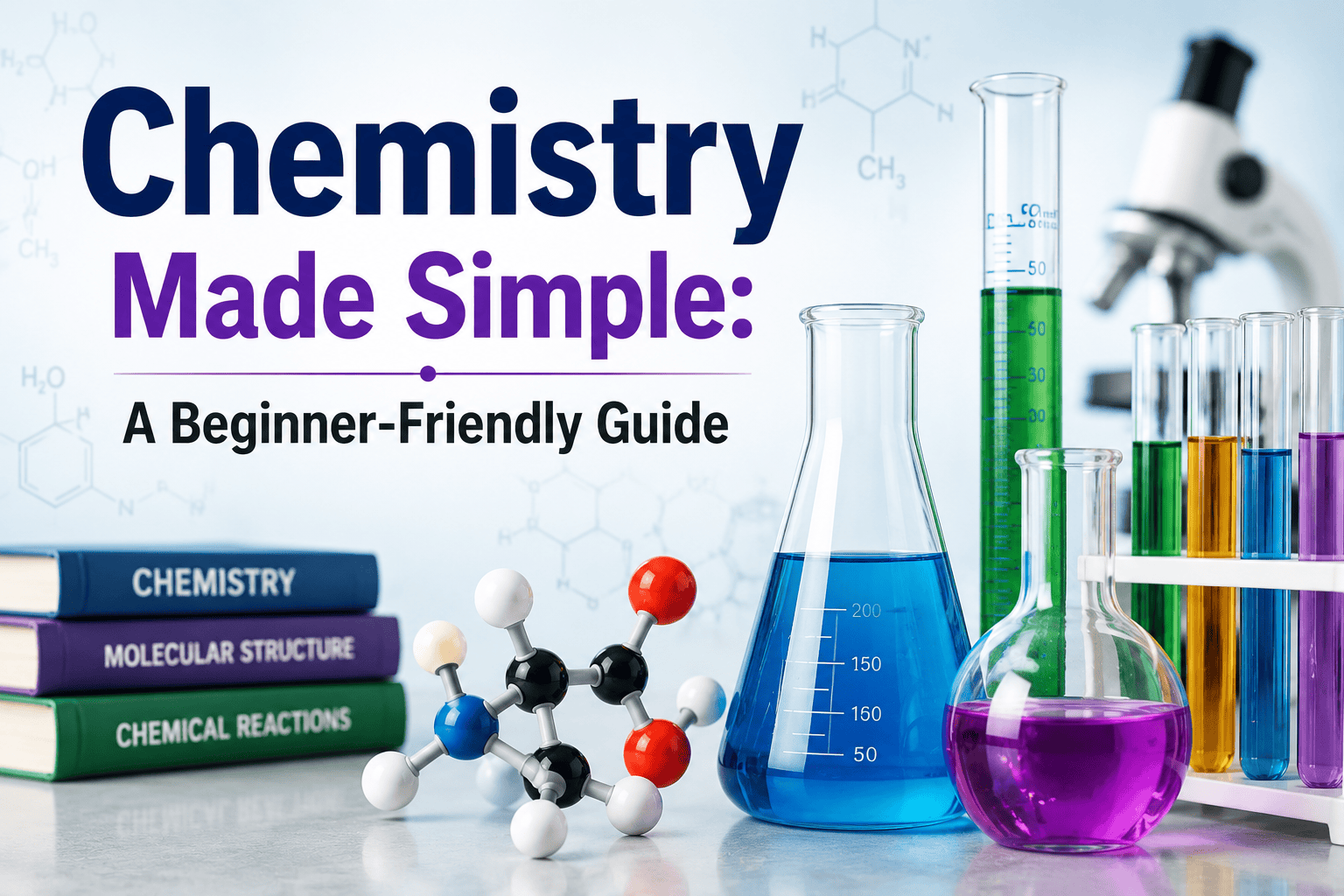
Chemistry is the science that studies the composition, structure, properties, and transformations of matter, focusing on how atoms and molecules interact, combine, and react with one another. It spans diverse branches like organic, inorganic, physical, and biochemistry, each exploring different aspects of substances and their behavior. Through experimentation and theoretical models, chemistry explains everything from simple chemical reactions to complex biological processes and industrial applications. At its core, it seeks to understand how matter changes and why those changes occur at the molecular level.
Content Overview
- Introduction to Chemistry
- Chapter 1: The Foundations of Chemistry
- Chapter 2: Atomic Structure and the Periodic Table
- Chapter 3: Chemical Bonding
- Chapter 4: Chemical Reactions
- Chapter 5: Stoichiometry and the Mole Concept
- Chapter 6: States of Matter
- Chapter 7: Solutions and Their Properties
- Chapter 8: Acids, Bases, and pH
- Chapter 9: Thermochemistry
- Chapter 10: Organic Chemistry
- Inorganic Chemistry
- Physical Chemistry
- Chapter 11: Analytical Chemistry and Biochemistry
- Chapter 12: Chemistry in Industry and Everyday Life
- Conclusion
Introduction to Chemistry
What Is Chemistry?
Chemistry is often referred to as the “central science” because it connects physics with other natural sciences, including biology and geology. It studies the composition, structure, properties, and changes of matter, playing a crucial role in understanding the material world and its processes.
Chemistry is the field of science that explores matter—its composition, structure, properties, and the changes it experiences during chemical reactions. Everything around us—air, water, food, medicines, metals, plastics—is made of chemical substances.
Chemistry helps us understand what substances consist of, how they react with each other, and the reasons behind their changes.
Real-world example: When iron rusts, chemistry explains why oxygen and moisture react with iron to form rust.
Importance of Chemistry in Everyday Life
Chemistry plays a vital role in daily living:
Cooking involves chemical reactions
Medicines are designed using chemistry
Cleaning agents remove stains through chemical action
Fuels release energy via chemical reactions
Example: Soap removes grease because its molecules interact with both water and oil.
Relationship with Other Sciences
Chemistry connects all natural sciences:
Physics explains energy and atomic behavior
Biology depends on biochemical reactions
Environmental science studies chemical pollution
Medicine relies on pharmaceutical chemistry
Example: Photosynthesis is a biological process explained through chemistry and physics.
Chapter 1: The Foundations of Chemistry
The Foundations of Chemistry: Matter is anything that has mass and takes up space, and its properties can be physical, like color and melting point, or chemical, such as reactivity.
– The Scientific Method: In chemistry, experiments are conducted to test hypotheses, involving observation, measurement, and experimentation.
– Example: The role of observation is critical; for instance, observing color changes in a chemical reaction can indicate a change in chemical composition.
Matter and Its Properties
Matter is anything that has mass and takes up space. It exists in different forms and states.
Properties of matter include:
Physical properties (color, density, melting point)
Chemical properties (reactivity, flammability)
Example: Water is liquid at room temperature, while iron is solid.
The Scientific Method in Chemistry
Chemistry uses a systematic method:
Observation
Hypothesis
Experiment
Analysis
Conclusion
Experiments must be repeatable and measurable.
Example: A chemist tests whether heating increases reaction speed by repeating experiments under controlled conditions.
Role of Observation in Experiments
Observation is the foundation of chemical discovery.
Example: Color change during a reaction indicates formation of a new substance.
Chapter 2: Atomic Structure and the Periodic Table
Atomic Structure and the Periodic Table:
Structure of the Atom: Atoms consist of protons, neutrons, and electrons. Their arrangement defines the element’s properties.
Isotopes and Ions: Isotopes are atoms of the same element with different masses; ions are charged atoms due to loss or gain of electrons.
Example: The periodic table organizes elements by atomic number and similar properties, allowing predictions about element behavior.
Structure of the Atom
Atoms are the smallest units of matter and are made up of smaller particles.
Protons (positive)
Neutrons (neutral)
Electrons (negative)
Example: Carbon atoms serve as the foundation of all organic life.
Isotopes and Ions
Isotopes: Same element, different mass
Ions: Charged atoms
Example: Carbon-14 is used in archaeological dating.
Organization of the Periodic Table
Elements are arranged based on atomic number and properties.
Example: Elements that belong to the same group tend to have similar chemical properties and behave in similar ways.
Chapter 3: Chemical Bonding
Ionic and Covalent Bonds: Ionic bonds form between metals and nonmetals through electron transfer, while covalent bonds share electrons between nonmetals.
Molecular Geometry and Polarity: The shape of molecules affects their physical properties and reactivity.
Example: Water (H₂O) is a polar molecule due to its bent shape and electronegativity differences, leading to unique solvent properties.
Ionic and Covalent Bonds
Ionic bonds involve electron transfer
Covalent bonds involve electron sharing
Example: Salt forms via ionic bonding; water via covalent bonding.
Molecular Geometry and Polarity
Molecule shape affects properties like solubility.
Example: Water’s bent shape makes it polar, enabling life.
Water Molecule and Its Unique Properties
Water dissolves many substances and regulates temperature.
Example: Oceans stabilize Earth’s climate.
Chapter 4: Chemical Reactions
Types of Reactions: Reactions include synthesis, decomposition, single replacement, double replacement, and combustion.
When balancing equations, the law of conservation of mass states that the number of atoms of each element must be equal on both sides of the equation.
Example: The combustion of methane (CH₄) produces carbon dioxide (CO₂) and water (H₂O), illustrating the release of energy.
Types of Chemical Reactions
Combination
Decomposition
Displacement
Combustion
Example: Burning fuel releases energy through combustion.
Balancing Chemical Equations
Chemical equations must conserve mass.
Example: Reactants equal products in atom count.
Combustion of Hydrocarbons
Hydrocarbons burn to produce energy, CO₂, and water.
Example: Petrol combustion powers vehicles.
Chapter 5: Stoichiometry and the Mole Concept
Understanding the Mole: The mole is a unit for counting particles, equal to Avogadro’s number (6.022 × 10²³).
Stoichiometric Calculations: These calculations involve using mole ratios from balanced equations to determine reactant and product quantities.
Example: Converting grams of sodium chloride (NaCl) to moles allows for predicting the number of formula units in a reaction.
Understanding the Mole
A mole is a unit that corresponds to a specific, constant number of particles.
Example: One mole of water weighs 18 grams.
Stoichiometric Calculations
Used to calculate quantities in reactions.
Example: Determining how much oxygen is needed to burn fuel completely.
Converting Grams to Moles
This connects lab measurements with atomic theory.
Chapter 6: States of Matter
States of Matter: Matter exists primarily in four states: solid, liquid, gas, and plasma, each with distinct properties.
Changes of State: Matter can change states through processes like melting, freezing, condensation, and evaporation.
Example: The boiling point of water (100°C) is a critical temperature where it transitions from liquid to gas.
Solids, Liquids, Gases, and Plasma
States depend on particle motion and energy.
Example: Steam is gaseous water.
Changes of State
Matter changes state due to temperature and pressure.
Example: Ice melts into water at 0°C.
Boiling and Melting Points of Water
Water’s unique values support life on Earth.
Chapter 7: Solutions and Their Properties
Solvent and Solute Interaction: Solutions consist of solutes dissolved in solvents, with water often acting as the universal solvent.
Concentration Units: Molarity and molality are common ways to express concentration in chemistry.
Example: Creating a saltwater solution involves dissolving sodium chloride in water, demonstrating solute-solvent interactions.
Solvent and Solute
A solution is a homogeneous mixture.
Example: Salt dissolving in water.
Concentration and Dilution
Concentration measures amount of solute.
Example: Diluting juice reduces sweetness.
Making a Saltwater Solution
Demonstrates solubility and mixing.
Chapter 8: Acids, Bases, and pH
Properties of Acids and Bases: Acids donate protons (H⁺), while bases accept protons. Their interactions determine pH levels.
The pH Scale: Ranges from 0 (acidic) to 14 (basic), with 7 being neutral. pH affects chemical behavior and biological processes.
Example: Mixing vinegar (acetic acid) with baking soda (sodium bicarbonate) illustrates a neutralization reaction, producing carbon dioxide gas.
Properties of Acids and Bases
Acids donate protons
Bases accept protons
Example: Lemon juice is acidic; soap is basic.
The pH Scale
Measures acidity or alkalinity.
Example: Blood maintains a stable pH for survival.
Neutralization Reaction
Acid + base → salt + water
Example: Vinegar and baking soda reaction.
Chapter 9: Thermochemistry
Heat and Energy: Thermochemistry studies heat changes during chemical reactions, determining whether they are endothermic (absorbing heat) or exothermic (releasing heat).
Example: The reaction between baking soda and vinegar absorbs heat, illustrating an endothermic process, while combustion releases heat.
Heat and Energy in Reactions
Reactions involve energy transfer.
Endothermic vs Exothermic
Endothermic absorbs heat
Exothermic releases heat
Example: Hand warmers use exothermic reactions.
Baking Soda and Vinegar Reaction
Shows energy change.
Chapter 10: Organic Chemistry
Structure and Function of Organic Molecules: Organic chemistry focuses on carbon-containing compounds, their structures, properties, and reactions.
Functional groups: Distinct sets of atoms within a molecule that determine its chemical behavior and reactivity.
Example: Glucose (C₆H₁₂O₆) is a simple sugar with functional groups that make it an essential energy source for living organisms.
Organic Molecules
Carbon-based compounds form life’s backbone.
Functional Groups
Determine chemical behavior.
Example: Alcohol group gives ethanol its properties.
Structure of Glucose
Essential energy molecule.
Inorganic Chemistry
Physical Chemistry
Chapter 11: Analytical Chemistry and Biochemistry
Chemical Processes in Living Organisms: Biochemistry examines the chemical substances and processes in biological systems.
Role of Macromolecules: These include carbohydrates, proteins, lipids, and nucleic acids, each serving vital roles in life.
Example: Enzymes, which are proteins, act as catalysts, speeding up biochemical reactions critical for metabolism.
Chemical Processes in Living Organisms
Life depends on controlled reactions.
Role of Macromolecules
Carbohydrates: energy
Proteins: structure
Lipids: storage
Nucleic acids: information
Enzyme Action
Enzymes speed up life processes.
Example: Digestive enzymes break down food.
Chapter 12: Chemistry in Industry and Everyday Life
Applications in Various Industries: Chemistry is foundational in pharmaceuticals, agriculture, food science, and materials science.
Environmental Chemistry: Understanding chemical processes helps address pollution and develop sustainable practices.
Example: The development of biodegradable plastics demonstrates chemistry’s role in creating environmentally friendly materials.
Industrial Applications
Chemistry produces fuels, plastics, medicines.
Environmental Chemistry
Helps reduce pollution and protect ecosystems.
Clean Energy Solutions
Batteries, solar cells, hydrogen fuel.
Conclusion
Chemistry connects matter, life, energy, and technology. It explains the invisible processes shaping the visible world and drives innovation for a sustainable future.