Earth Science and Geology
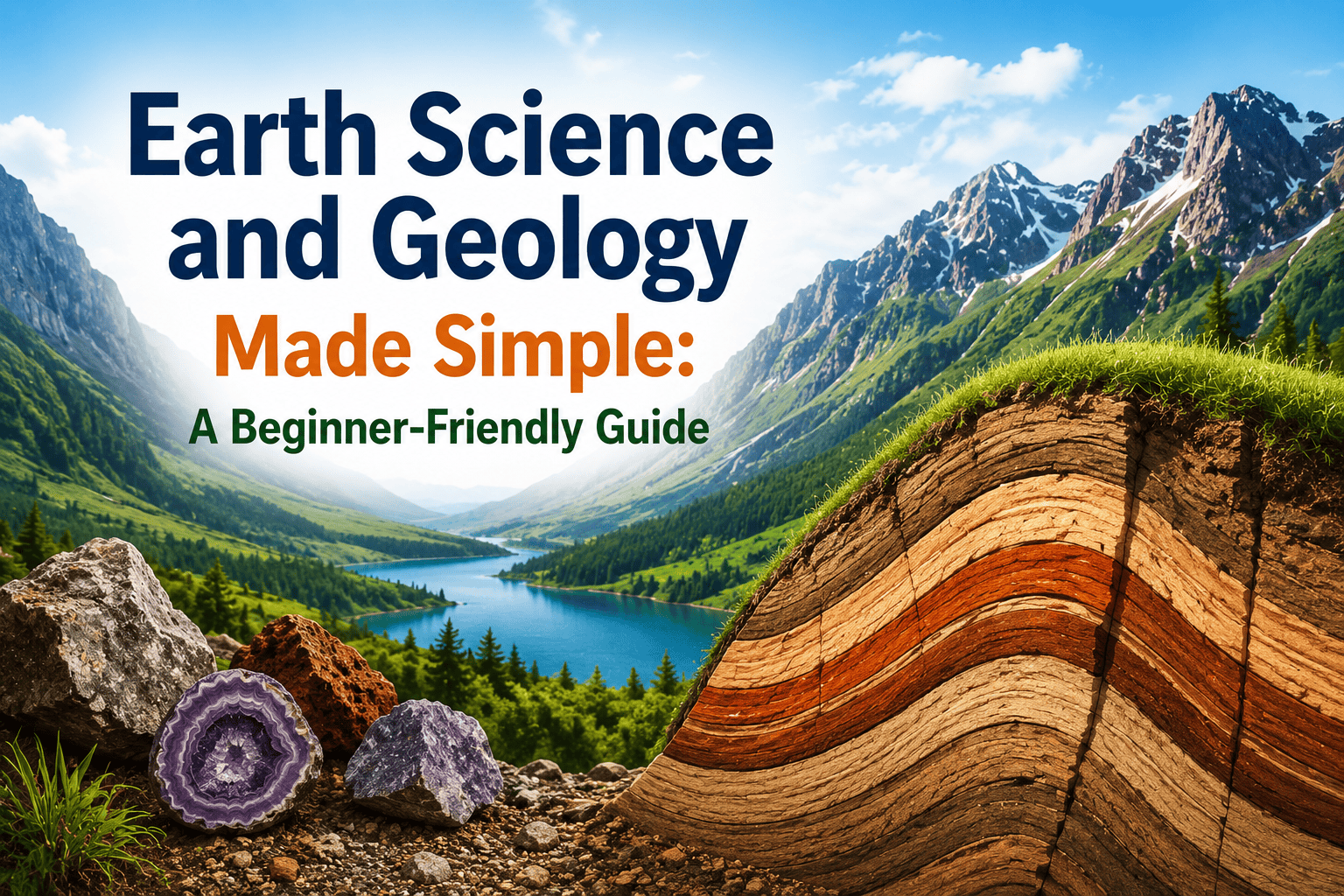
Earth science, particularly geology, is the study of the Earth’s physical structure, composition, and the processes that shape it over time. It examines rocks, minerals, tectonic plates, and natural phenomena like volcanic activity, erosion, and earthquakes to understand how the planet has evolved across billions of years. By analyzing geological formations and the fossil record, earth science reconstructs Earth’s history and predicts future changes to its surface and systems. At its core, it seeks to understand the dynamic forces that continuously shape the world beneath our feet.
Content Overview
Earth Science
Earth Science is the scientific study of the planet Earth, its structure, processes, atmosphere, oceans, and its place in the universeIt describes how the Earth was formed, how it continues to change, and how natural systems interact with each other.
Earth Science combines several major disciplines:
- Geology – study of the solid Earth
- Meteorology – study of weather and atmosphere
- Oceanography – study of oceans
- Astronomy – study of celestial bodies beyond Earth
These different branches combine to provide a full understanding of the Earth as a system.
Example: A volcanic eruption involves geology (magma), meteorology (ash in atmosphere), and oceanography (if it occurs under the ocean).
1. Geology (Earth Structure)
1.1 Definition of Geology
Geology is the scientific study of the solid structure, materials, and processes of the Earth. It investigates rocks, minerals, mountains, earthquakes, volcanoes, and the internal layers of the planet.
The word geology comes from:
- Geo = Earth
- Logos = Study
So geology literally means “study of the Earth.”
Geologists analyze how the Earth formed 4.5 billion years ago and how it continues to change.
1.2 Structure of the Earth
The Earth is made up of several layers, much like the layers of an onion.
1.2.1 Crust
The crust is the outermost layer of Earth.
Thickness:
- 5–10 km under oceans
- 30–70 km under continents
Types:
- Continental crust – thick, made mostly of granite
- Oceanic crust – thin, made mostly of basalt
Example:
Countries like Pakistan, China, and India sit on continental crust.
Ocean basins, such as the Pacific Ocean, are made up of oceanic crust.
1.2.2 Mantle
Below the crust lies the mantle, which extends to about 2,900 km deep.
It consists of semi-solid rock that moves slowly over time.
Important concept:
Plate Tectonics
This theory explains that the Earth’s crust is divided into large plates that float on the mantle.
Example:
The Himalaya Mountains formed when the Indian Plate collided with the Eurasian Plate.
This collision is still continuing today.
1.2.3 Outer Core
The outer core lies below the mantle.
Characteristics:
- Liquid metal (mostly iron and nickel)
- Very high temperature (4,000–6,000°C)
Movement of molten metal here generates the Earth’s magnetic field.
Example:
Earth’s magnetic field shields the planet from harmful radiation coming from the Sun.
1.2.4 Inner Core
The inner core is the very center of the Earth.
Properties:
- Solid metal
- Mostly iron
- Temperature about 5,500°C
Despite extreme heat, intense pressure keeps it solid.
Example:
Scientists study inner core behavior using earthquake waves.
1.3 Rocks and Minerals
Minerals
A mineral is a naturally formed, non-living substance with a definite chemical makeup.
Examples:
- Quartz
- Gold
- Diamond
- Salt
Example:
Salt used in food comes from the mineral halite.
Rocks
Rocks are made of one or more minerals.
Three major rock types:
1. Igneous Rocks
Formed when magma or lava cools.
Examples:
- Granite
- Basalt
- Obsidian
Example:
Volcanoes produce basalt lava.
2. Sedimentary Rocks
Formed from compressed sediments like sand and mud.
Examples:
- Sandstone
- Limestone
- Shale
Example:
Many fossils are found in sedimentary rocks.
3. Metamorphic Rocks
They form when pre-existing rocks are transformed under intense heat and pressure.
Examples:
- Marble
- Slate
- Quartzite
Example:
Marble used in buildings originates from limestone.
1.4 Geological Processes
Earthquakes
Earthquakes occur when tectonic plates suddenly move.
Example:
When two plates stick together and then suddenly slip, energy releases as seismic waves.
Example event:
The 2005 Kashmir earthquake occurred due to tectonic movement.
Volcanoes
Volcanoes form when magma rises from inside Earth to the surface.
Example volcano types:
- Shield volcano
- Composite volcano
- Cinder cone
Example:
Mount Fuji is a well-known volcanic mountain located in Japan.
Mountain Formation
Mountains form by:
- Plate collision
- Volcanic activity
- Faulting
Example:
The Himalayas formed from continental plate collision.
2. Meteorology (Weather)
2.1 Definition
Meteorology is the scientific study of Earth’s atmosphere and weather processes.
It explains phenomena such as:
- Rain
- Storms
- Winds
- Clouds
- Temperature changes
Meteorologists analyze atmospheric data to predict weather conditions.
2.2 Structure of the Atmosphere
The atmosphere is a blanket of gases that surrounds our planet.
Main layers:
- Troposphere
- Stratosphere
- Mesosphere
- Thermosphere
- Exosphere
Troposphere
This is the lowest layer.
Height:
- About 8–15 km above Earth
Important fact:
All weather occurs here.
Example:
- Clouds
- Rain
- Thunderstorms
Stratosphere
Above the troposphere lies the stratosphere.
Important feature:
Ozone layer
This layer shields living things from the Sun’s harmful ultraviolet rays.
Example:
Airplanes often fly in the lower stratosphere because the air is stable.
Mesosphere
Altitude:
50–85 km
Example:
Most meteors burn up here before reaching the surface.
Thermosphere
Altitude:
85–600 km
Example:
Beautiful auroras occur here.
2.3 Weather Elements
Weather depends on several factors:
Temperature
Temperature indicates how hot or cold the air is.
Example:
Deserts often have extremely high temperatures during the daytime.
Air Pressure
Air pressure is the weight of air pressing on Earth’s surface.
Example:
Low pressure often causes storms.
Humidity
Humidity refers to how much moisture is present in the air.
Example:
Tropical regions have high humidity.
Wind
Wind is the flow of air from regions of higher pressure to regions of lower pressure.
Example:
Sea breeze occurs when cool ocean air moves toward warm land.
Precipitation
Precipitation includes:
- Rain
- Snow
- Hail
- Sleet
Example:
Monsoon rainfall is common in South Asia.
2.4 Weather Systems
Cyclones
Cyclones are large rotating storm systems.
Example:
Tropical cyclones form over warm ocean water.
Thunderstorms
Thunderstorms involve:
- Lightning
- Thunder
- Heavy rain
Example:
They often occur on hot summer days.
Tornadoes
Tornadoes are violently rotating columns of air.
Example:
The United States experiences many tornadoes each year.
3. Oceanography (Oceans)
3.1 Definition
Oceanography is the scientific study of Earth’s oceans, including their physical, chemical, biological, and geological aspects.
Oceans cover about 71% of the Earth’s surface.
They regulate climate, support marine life, and influence global weather.
3.2 Major Oceans
Earth has five major oceans:
- Pacific Ocean
- Atlantic Ocean
- Indian Ocean
- Southern Ocean
- Arctic Ocean
Example:
Pacific Ocean is the largest ocean on the planet.
3.3 Ocean Zones
Oceans are divided into several zones.
Sunlight Zone
Upper layer where sunlight penetrates.
Example:
Most marine plants grow here.
Twilight Zone
Middle layer with little light.
Example:
Some fish have glowing organs.
Midnight Zone
Deep ocean with no sunlight.
Example:
Creatures like giant squid live here.
3.4 Ocean Currents
Ocean currents are vast, continuous flows of water moving through the oceans.
They transport heat around the planet.
Example:
The Gulf Stream moves warm water from tropical regions toward Europe.
This keeps European climates warmer than expected.
3.5 Tides
Tides are periodic rises and falls of ocean water caused by gravitational forces.
Main influences:
- Moon
- Sun
Example:
High tide occurs when ocean water bulges toward the Moon.
3.6 Marine Ecosystems
Oceans support enormous biodiversity.
Examples:
- Coral reefs
- Deep sea ecosystems
- Coastal ecosystems
Example:
Coral reefs support thousands of fish species.
4. Astronomy (Celestial Bodies)
4.1 Definition
Astronomy is the science that explores stars, planets, space, and everything in the universe.
It examines:
- Stars
- Planets
- Galaxies
- Black holes
- Cosmic phenomena
Astronomy aims to explain how the universe began and how it changes over time.
4.2 Solar System
Earth is part of the Solar System, with the Sun at its center.
Major components:
- Sun
- Planets
- Moons
- Asteroids
- Comets
Planets
Eight major planets orbit the Sun.
Examples:
- Mercury
- Venus
- Earth
- Mars
- Jupiter
- Saturn
- Uranus
- Neptune
Example:
Mars is called the Red Planet because its surface contains iron oxide, which gives it a reddish color.
Moons
Many planets have natural satellites.
Example:
Earth has one moon: Moon.
The Moon influences tides on Earth.
4.3 Stars
Stars are massive glowing spheres of hot gas.
Example:
The Sun is the nearest star to Earth.
Stars produce energy through nuclear fusion.
4.4 Galaxies
A galaxy is a huge group of stars along with gas and dust held together in space.
Earth’s solar system belongs to the:
Milky Way
It contains hundreds of billions of stars.
4.5 Black Holes
Black holes are areas in space where gravity is so powerful that nothing can easily escape from them.
Their gravity is so strong that even light cannot get away from them.
Example:
Black holes form after massive stars collapse.
5. Astrology (Contrast with Astronomy)
Although often mentioned with astronomy, astrology is different.
Astrology Definition
Astrology is the idea that the positions of stars and planets can affect a person’s life and personality.
Example:
Horoscopes based on zodiac signs.
Difference Between Astronomy and Astrology
| Aspect | Astronomy | Astrology |
|---|---|---|
| Type | Scientific discipline | Belief system |
| Method | Scientific observation | Symbolic interpretation |
| Focus | Physical universe | Human destiny |
Example:
Astronomy studies how planets orbit the Sun.
Astrology claims that planetary positions affect human behavior.
Conclusion
Earth Science is a broad field that explores the Earth and its environment by combining different related areas of study.
The four major branches include:
- Geology – explains Earth’s structure, rocks, and internal processes.
- Meteorology – studies weather patterns and atmospheric behavior.
- Oceanography – examines oceans, marine ecosystems, and ocean currents.
- Astronomy focuses on studying stars, planets, and the universe beyond our planet.
Together, these sciences help humans understand how our planet works, how natural events occur, and how Earth interacts with the broader universe including stars like the Sun and galaxies like the Milky Way.
Understanding Earth Science is crucial for solving global challenges such as climate change, natural disasters, ocean pollution, and space exploration.