History
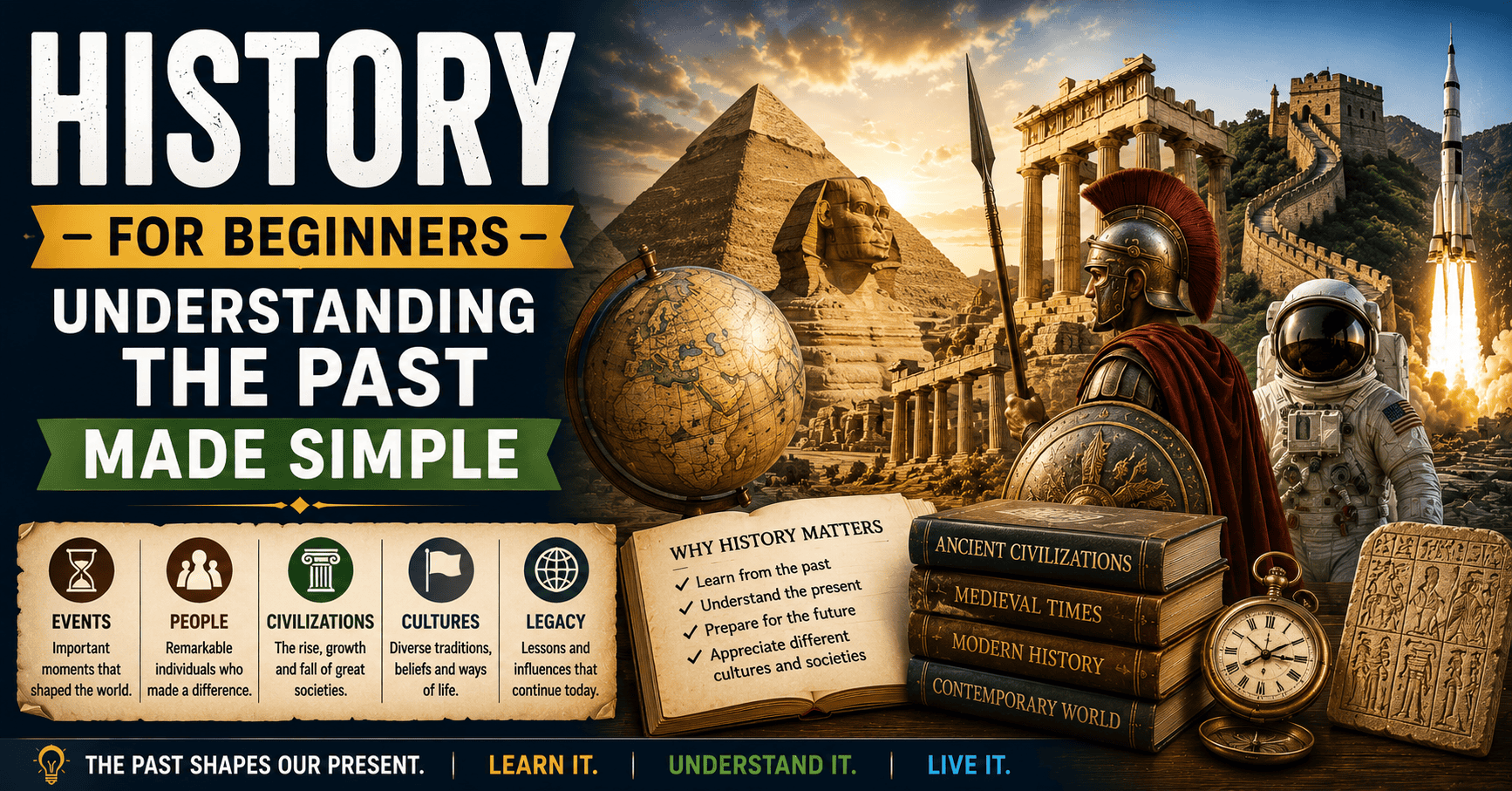
History is the systematic study of past events, societies, and human experiences, examining how civilizations have developed, changed, and interacted over time. It draws on written records, archaeology, and other evidence to reconstruct narratives about politics, culture, economics, and everyday life across different eras. By analyzing causes and consequences of past events, history seeks to understand not just what happened, but why — and what patterns and lessons emerge from human experience. At its core, it asks how the past shapes the present and informs our understanding of who we are.
Content Overview
- Introduction
- 1. Philosophy of History — A Deep Foundation
- 2. Key Historical Eras: From Ancient to Modern Times
- 3. Evolution of Societies and Cultures
- 4. Why Philosophy of History Matters
- Chapter 1: Introduction to History
- Chapter 2: History and Mystery
- Chapter 3: Ancient Civilizations and Lost Cities
- Chapter 4: Unexplained Phenomena in History
- Chapter 5: Philosophical Reflections on History and Mystery
- Conclusion
- 1. Introduction to History
- 2. Meaning and Definition of History
- 3. Nature of History: Science, Humanities, or Hybrid
- 4. Purpose of Studying History
- 5. Sources of History
- 6. Historical Method and Source Criticism
- 7. Schools of Historical Thought
- 8. Branches of History
- 9. Evolution of History as an Academic Discipline
- 10. History and Its Relationship with Other Fields
- 11. Importance and Uses of History
- 12. Conclusion
- section 2
- Continental History: Wars, Power, and Evolution (Countries, States, & Regions)
- 2.1 ASIAN HISTORY: WARS & EVOLUTION
- 2.2 AFRICAN HISTORY: EMPIRES, COLONIALISM & RESISTANCE
- 2.3 European History: Revolutions and the World Wars
- 2.4 NORTH AMERICA
- 2.5 SOUTH AMERICA
- 2.6 AUSTRALIA & OCEANIA
- 2.7 ANTARCTICA
- Section 3: History, Evolution, and Wars Across the Centuries
- 3.1 1ST–10TH CENTURY: EARLY CIVILIZATIONS & EMPIRES
- 3.2 11TH CENTURY: MEDIEVAL WORLD & CRUSADES
- 3.3 12TH CENTURY: EXPANSION & POWER STRUGGLES
- 3.4 13TH CENTURY: MONGOL INVASIONS & GLOBAL CONNECTIONS
- 3.5 14TH CENTURY: PLAGUE & EARLY RENAISSANCE
- 3.6 15TH CENTURY: AGE OF EXPLORATION & EMPIRES
- 3.7 16TH CENTURY: REFORMATION & GLOBAL COLONIALISM
- 3.8 17TH CENTURY: SCIENTIFIC REVOLUTION & GLOBAL CONFLICTS
- 3.9 18TH CENTURY: ENLIGHTENMENT & REVOLUTIONS
- 3.10 19TH CENTURY: INDUSTRIALIZATION & NATIONALISM
- 3.11 20TH CENTURY: WORLD WARS & MODERNITY
Introduction
1. Philosophy of History — A Deep Foundation
1.1 What Is the Philosophy of History?
The Philosophy of History is the branch of philosophy that asks fundamental questions about history itself, such as:
- What is history really about?
- Does history follow patterns or laws?
- Is history driven by ideas, economics, power, or chance?
- Does history have a direction, purpose, or end?
- Can we truly know the past objectively?
While history records events, the philosophy of history reflects on:
- how history is written,
- why events happen,
- and what meaning they carry for humanity.
In simple terms:
History tells us what happened.
Philosophy of history asks why it happened and what it means.
1.2 Two Main Branches of Philosophy of History
A. Speculative (Substantive) Philosophy of History
Focuses on patterns, direction, and purpose in history.
Key questions:
- Is history progressing?
- Does civilization rise and fall in cycles?
- Is there an ultimate destiny of humanity?
Examples of thinkers:
- Hegel – history as progress of freedom
- Marx – history driven by class struggle
- Ibn Khaldun – rise and fall of civilizations
- Spengler – civilizations as living organisms
B. Critical (Analytical) Philosophy of History
Focuses on how history is known and written.
Key questions:
- Can history be objective?
- Are historical narratives biased?
- How reliable are sources?
Modern concerns:
- Bias in colonial histories
- Power shaping narratives
- Silenced voices (women, minorities, colonized peoples)
2. Key Historical Eras: From Ancient to Modern Times
History is commonly divided into eras to understand human evolution more clearly. These eras are not rigid but help structure historical understanding.
2.1 Prehistoric Era (Before Writing)
Key Features:
- No written records
- Knowledge passed orally
- Archaeology is primary source
Sub-divisions:
- Paleolithic (Stone tools, hunting-gathering)
- Neolithic (Agriculture, settlement)
Major Evolution:
- Control of fire
- Tool-making
- Language development
This era laid the biological and cultural foundation of humanity.
2.2 Ancient Era (c. 3000 BCE – 500 CE)
Defining Feature: Invention of writing
Major Civilizations:
- Mesopotamia
- Egypt
- Indus Valley
- China
- Greece
- Rome
Key Developments:
- States and empires
- Laws (Code of Hammurabi)
- Philosophy (Plato, Aristotle)
- Organized religion
- Trade networks
Philosophical Significance:
- First political theories
- Ethics, justice, governance
- Concept of citizenship
2.3 Medieval Era (c. 500 – 1500 CE)
Often misunderstood as a “dark age,” this era was actually transformative.
Key Characteristics:
- Feudalism
- Religious dominance (Christianity, Islam)
- Scholastic philosophy
- Rise of Islamic Golden Age
Major Developments:
- Universities
- Preservation of ancient knowledge
- Advances in science, medicine, mathematics
Global Perspective:
- Europe: Feudal kingdoms
- Islamic world: Science, philosophy
- Asia: Powerful empires (Tang, Abbasids)
2.4 Early Modern Era (c. 1500 – 1800)
Turning Point in History
Major Events:
- Renaissance
- Reformation
- Age of Exploration
- Scientific Revolution
Key Changes:
- Humanism
- Decline of religious monopoly
- Expansion of empires
- Capitalism begins
Philosophical Shift:
- Reason over tradition
- Individual over authority
- Science over superstition
2.5 Modern Era (c. 1800 – Present)
Defining Features:
- Industrialization
- Nationalism
- Democracy
- Colonialism and decolonization
- World wars
Key Transformations:
- Machines replace manual labor
- Urbanization
- Mass education
- Human rights discourse
Philosophical Questions:
- Progress vs destruction
- Freedom vs control
- Technology vs humanity
3. Evolution of Societies and Cultures
History is fundamentally the story of how societies evolve — socially, politically, economically, and culturally.
3.1 From Bands to States
Human societies evolved through stages:
- Hunter-Gatherer Bands
- Small groups
- Equality-based
- Survival-focused
- Tribal Societies
- Kinship-based
- Rituals and myths
- Leadership emerges
- Chiefdoms
- Hierarchies
- Resource control
- Warfare increases
- States & Empires
- Laws and bureaucracy
- Standing armies
- Taxation and governance
3.2 Cultural Evolution
Culture evolves through:
- Language
- Religion
- Art
- Knowledge
- Technology
Examples:
- Oral myths → Written scriptures
- Tribal rituals → Organized religions
- Hand tools → Machines → Digital tech
Culture is adaptive, responding to:
- Environment
- Conflict
- Trade
- Innovation
3.3 Forces Driving Historical Evolution
Different philosophers identified different driving forces:
| Thinker | Driving Force |
|---|---|
| Marx | Economic class struggle |
| Hegel | Ideas & consciousness |
| Ibn Khaldun | Social cohesion (Asabiyyah) |
| Darwin-inspired historians | Adaptation & survival |
| Modern historians | Multi-causal (economy + culture + power) |
3.4 Continuity and Change
History is not just change — it is also continuity.
- Some ideas persist (family, belief, power)
- Others transform (slavery, monarchy, technology)
Understanding what changes and what remains is central to historical thinking.
4. Why Philosophy of History Matters
Without philosophy of history:
- History becomes a list of dates
- Narratives become propaganda
- Power controls memory
With philosophy of history:
- We question narratives
- We understand patterns
- We gain wisdom, not just information
History without philosophy is blind.
Philosophy without history is empty.
Chapter 1: Introduction to History
1.1 Overview of History and Its Evolution
History is humanity’s shared and collective memory—a vast and intricate tapestry woven from triumphs and failures, progress and collapse, discovery and destruction. It reflects the long journey of human civilization through time and provides insight into how societies have evolved socially, politically, economically, and culturally.
From the earliest cave paintings to the complexities of modern digital societies, history allows us to trace the development of ideas, institutions, and identities. The rise and fall of empires such as the Roman Empire, or transformative innovations like the printing press, demonstrate how key moments and discoveries have shaped the course of human civilization.
History is not merely a record of past events; it is a living narrative that explains why societies are the way they are today. It helps us understand continuity and change, success and failure, and the consequences of human choices across time.
1.2 From Oral Tradition to Written History
The earliest human histories were passed down through oral traditions, myths, and legends. With the invention of writing, history entered a new phase:
- Hieroglyphs in ancient Egypt
- Cuneiform tablets in Mesopotamia
- Oracle bones in ancient China
These early records marked the transition from prehistory to recorded history, enabling scholars to reconstruct humanity’s journey through major epochs such as:
- The Stone Age
- The Bronze Age
- The Classical Era
- The Industrial Revolution
- The Digital Age
As civilizations evolved, so did methods of recording and interpreting the past, laying the foundation for history as an academic discipline.
1.3 Importance and Why We Study History
Studying history allows us to:
- Understand human origins and identity
- Analyze patterns of change
- Learn from past successes and failures
- Develop critical thinking skills
History provides perspective. By examining the decisions and struggles of earlier generations, we gain insight into modern political systems, social structures, and cultural conflicts.
History also trains the mind to:
- Evaluate sources
- Question narratives
- Distinguish fact from interpretation
In politics, law, culture, and international relations, historical knowledge guides decision-making and helps societies avoid repeating destructive mistakes.
History is not only about the past; it is a guide to the future.
Chapter 2: History and Mystery
The Nature of Historical Mysteries
History is not a closed book. It is an ongoing conversation between evidence, interpretation, imagination, and uncertainty. Many aspects of the past remain unresolved, reminding us of the limits of knowledge and the vastness of human experience.
Historical mysteries highlight humanity’s enduring desire to understand the unknown.
2.1 The Enigma of the Past
The past often appears as a fragmented puzzle. Ruins, artifacts, and ancient texts whisper stories of lost civilizations, yet their full meanings remain elusive.
Questions that continue to challenge historians include:
- Why did some civilizations flourish while others vanished?
- Why do some technologies seem to emerge well before their time?
- What knowledge has been lost forever?
Undeciphered scripts, submerged cities, and unexplained monuments suggest that history is incomplete—and perhaps always will be.
2.2 The Role of Evidence and Interpretation
Historical mysteries often arise due to:
- Scarcity of evidence
- Destruction of records
- Ambiguous artifacts
Even with modern tools such as carbon dating, DNA analysis, and satellite imaging, interpretation remains central to historical study.
A single artifact—such as a coin, manuscript, or pottery shard—can either clarify history or deepen its mystery. Interpretation is shaped by cultural context, theoretical frameworks, and available evidence.
2.3 Unsolved Historical Mysteries
Some of history’s most compelling mysteries continue to resist explanation:
The Indus Valley Civilization
One of the world’s earliest urban civilizations (2600–1900 BCE), known for:
- Advanced drainage systems
- Planned cities
- Standardized bricks
Yet its script remains undeciphered, and its decline unexplained. Was it climate change, environmental collapse, invasion, or internal decay?
The Voynich Manuscript
A medieval manuscript written in an unknown script, filled with strange illustrations of plants and symbols. Despite centuries of analysis, its language and purpose remain unknown.
Atlantis: Myth or Reality?
Described by Plato as a powerful civilization destroyed in a catastrophe. Some view Atlantis as allegory, others link it to real locations such as Santorini. Its existence remains unproven.
Stonehenge
A prehistoric monument whose massive stones raise questions:
- Religious site?
- Astronomical calendar?
- Burial ground?
Its true purpose remains uncertain.
The Lost Roanoke Colony
An English settlement that vanished in the late 16th century, leaving behind only the word “CROATOAN”. The fate of its settlers remains unknown.
Chapter 3: Ancient Civilizations and Lost Cities
History is filled with cities that once thrived and then disappeared, leaving behind ruins and questions.
3.1 Mohenjo-Daro and Harappa
Located in present-day Pakistan and India, these cities demonstrate extraordinary urban planning. Their sudden abandonment remains unexplained.
3.2 Atlantis
The legendary sunken city continues to symbolize human ambition, idealism, and downfall.
3.3 El Dorado
The mythical city of gold pursued by Spanish explorers reflects colonial ambition and the power of myth in shaping historical action.
3.4 Pompeii: The Frozen City
Preserved under volcanic ash in 79 CE, Pompeii offers a rare snapshot of Roman life and raises questions about human response to disaster.
3.5 The Maya Civilization
Renowned for astronomy and architecture, the Maya experienced a mysterious collapse, possibly due to drought, warfare, or environmental degradation.
Chapter 4: Unexplained Phenomena in History
4.1 The Bermuda Triangle
An area associated with unexplained disappearances of ships and aircraft, inspiring theories from natural phenomena to the supernatural.
4.2 Ghost Ships: The Mary Celeste
Discovered abandoned in 1872, with cargo intact but crew missing. No definitive explanation exists.
4.3 The Tunguska Event
A powerful explosion in Siberia in 1908 leveled vast areas of forest without leaving behind a crater. Meteor, comet, or something unknown?
4.4 The Dancing Plague of 1518
Dozens danced uncontrollably for weeks in Strasbourg. Was it mass hysteria, poisoning, or cultural stress?
Chapter 5: Philosophical Reflections on History and Mystery
5.1 The Role of Mythology in History
Myths often blend imagination with truth. Legends like Atlantis and El Dorado reveal cultural values and human desires.
5.2 History as a Cycle
Thinkers such as Ibn Khaldun and Oswald Spengler argued that civilizations rise and fall in cycles, challenging linear views of progress.
5.3 The Human Fascination with the Unknown
Mysteries endure because they challenge certainty and inspire exploration. Often, the pursuit of answers is as meaningful as the answers themselves.
Conclusion
History is not only a record of what happened—it is a dialogue between memory, meaning, and mystery. It connects humanity’s past to its present and future, revealing patterns, lessons, and unanswered questions. By studying history, we do not merely look backward; we learn how to move forward with wisdom, humility, and curiosity.
1. Introduction to History
History is the systematic study of the past, with primary emphasis on the human past. It seeks to understand how human societies, institutions, ideas, and cultures developed over time. Unlike myths or legends, history relies on evidence, critical analysis, and reasoned interpretation to reconstruct past events.
In a broader sense, the term history may refer to:
- Past events themselves
- A specific period in the past
- Written accounts or narratives about the past
2. Meaning and Definition of History
The word “history” comes from the Greek term historia, which means inquiry or investigation.
Academic Definition
History is an academic discipline that analyzes and interprets evidence to:
- Describe what happened in the past
- Explain why it happened
- Understand its consequences
Example:
Studying the causes of World War II and its impact on modern international relations.
3. Nature of History: Science, Humanities, or Hybrid
There is a continuing discussion about what history really is:
3.1 History as a Social Science
- Uses systematic methods
- Relies on evidence and verification
- Studies human society and institutions
3.2 History as a Humanity
- Focuses on interpretation and narrative
- Emphasizes meaning, values, and context
- Uses language and storytelling
3.3 History as a Hybrid Discipline
Most modern scholars see history as a mixed field that combines:
- Scientific methods of inquiry
- Humanistic interpretation and narrative
4. Purpose of Studying History
The aims of history are debated among scholars:
4.1 Theoretical Purpose
- To discover historical truth
- To explain causes and patterns
4.2 Practical Purpose
- To learn lessons from the past
- To guide present and future decisions
Example:
Studying past constitutional failures to improve modern governance.
5. Sources of History
Historical knowledge is based on sources that give evidence about the past.
5.1 Primary Sources
Original materials from the time being studied:
- Official documents
- Letters and diaries
- Laws and treaties
- Archaeological remains
Example: The Constitution of 1973 (Pakistan).
5.2 Secondary Sources
Works produced by historians based on primary sources:
- Books
- Research articles
- Historical analyses
Example: A contemporary history book about South Asia
6. Historical Method and Source Criticism
Historians use source criticism to evaluate evidence:
6.1 External Criticism
- Authenticity of the source
- Date, authorship, and origin
6.2 Internal Criticism
- Accuracy of content
- Bias and reliability
Historians compare multiple sources to create a coherent and balanced narrative.
7. Schools of Historical Thought
7.1 Positivism
- History should be studied scientifically
- Focus on facts and empirical evidence
7.2 Annales School
- Emphasizes long-term social structures
- Studies economy, geography, and culture
7.3 Marxist Historiography
- Focus on class struggle and economic forces
- Views history as driven by material conditions
7.4 Postmodernism
- Questions objectivity and grand narratives
- Emphasizes multiple perspectives and interpretations
8. Branches of History
8.1 Period-Based History
- Ancient History
- Medieval History
- Modern History
8.2 Region-Based History
- African History
- European History
- South Asian History
8.3 Thematic History
- Political History
- Social History
- Economic History
- Military History
8.4 Method-Based History
- Quantitative History
- Comparative History
- Oral History
9. Evolution of History as an Academic Discipline
9.1 Ancient Origins
- Greece: Herodotus and Thucydides
- China: Sima Qian
- Islamic World: Al-Tabari and Ibn Khaldun
9.2 Medieval Period
- Chronicles and religious narratives
9.3 Modern Professionalization
- 19th century development of scientific methodology
- Establishment of universities and archives
10. History and Its Relationship with Other Fields
History is closely related to:
- Historiography (study of historical writing)
- Philosophy (nature of truth and knowledge)
- Politics (state and power)
- Law (legal history and constitutions)
- Education (curriculum development)
11. Importance and Uses of History
History helps society to:
- Understand identity and heritage
- Analyze social and political change
- Prevent past mistakes
- Strengthen critical thinking
Example:
Understanding colonial history to address post-colonial challenges.
12. Conclusion
History is an important field that links the past, present, and future together. Through careful analysis of evidence and thoughtful interpretation, it provides deep insights into human civilization. Whether viewed as a social science, a humanity, or a hybrid field, history remains essential for understanding the complexities of human life and guiding responsible decision-making.
section 2
Continental History: Wars, Power, and Evolution (Countries, States, & Regions)
(Countries, States & Regions)
The study of continental history is often organized by regions because geography, climate, culture, and natural resources directly influence how societies evolve, why wars occur, and how civilizations develop. Dividing history into continental regions allows historians to:
- Understand regional dynamics separately
- Compare development patterns across continents
- Analyze regional conflicts and alliances
- Track the rise and fall of empires within defined geographies
INTRODUCTION TO SECTION 2
Continental history studies how geography, power, war, and culture shaped civilizations across regions.
Wars are central because they:
- Redrew borders
- Destroyed empires
- Created nations
- Changed laws, identities, and ideologies
This section describes each continent, its regions, and the key wars and stages of development.
2.1 ASIAN HISTORY: WARS & EVOLUTION
(Birthplace of Civilizations and Continuous Conflict)
Asia is the oldest and most conflict-rich continent, where religion, empire, colonialism, and nationalism collided.
2.A.1 ASIA – 6 REGIONS
Asia is the biggest continent in terms of size and diversity.It is organized into six primary regions to examine civilizations and conflicts.
- Northern Asia – Siberia, Arctic regions
- Sparse population, nomadic cultures, Russian expansion
- Major conflicts: Russian conquest, Cold War militarization
- Central Asia – Kazakhstan, Uzbekistan, Turkmenistan, Kyrgyzstan, Tajikistan, and Mongolia
- Nomadic empires, Silk Road, Mongol invasions
- Major conflicts: Mongol conquests, Russian annexation, Soviet era conflicts
- Eastern Asia – China, Korea, Japan
- Agricultural and urban civilizations, Confucianism, Samurai culture
- Major conflicts include the Mongol invasions, the Opium Wars, the Sino-Japanese Wars, and the Korean War
- Western Asia – the Middle East (including Mesopotamia, the Levant, Anatolia, and the Arabian Peninsula)
- Birthplace of civilizations, religions, and empires
- Major conflicts: Crusades, Ottoman expansions, Arab-Israeli Wars, Gulf Wars
- Southern Asia – India, Pakistan, Bangladesh, Sri Lanka, and Afghanistan
- Rich civilizations, colonial encounters
- Major conflicts: 1857 Rebellion, 1947 Partition, Indo-Pak Wars, Afghan Wars
- Southeast Asia – Thailand, Vietnam, Indonesia, Malaysia, Philippines, Myanmar
- Maritime kingdoms, trade empires, colonialism
- Major conflicts: Vietnam War, Khmer Rouge genocide, anti-colonial revolutions
Why divide Asia this way?
Each region has unique geography, cultures, empires, and war histories. Northern nomads differ drastically from the agricultural civilizations of Southern Asia, and maritime Southeast Asia has its own colonial and trade history.
2.1.1 Northern Asia (Siberia & Russia)
Major Evolution
- Tribal nomads → Russian expansion
- Absorption into the Russian Empire
Key Wars
- Russian conquest of Siberia (16th–18th c.)
- Cold War militarization
- Soviet collapse (1991)
Impact
- Resource-based power
- Strategic military geography
2.1.2 Central Asia
(Kazakhstan, Uzbekistan, Turkmenistan, Kyrgyzstan, Tajikistan)
Historical Evolution
- Silk Road civilizations
- Turkic & Persian influence
- Islamic empires
Major Wars
- Mongol invasions (13th c.)
- Russian imperial conquest (19th c.)
- Soviet domination
- Post-1991 ethnic conflicts
Consequences
- Artificial borders
- Weak nation-states
- Authoritarian regimes
2.1.3 Eastern Asia
(China, Japan, Korea)
Major Wars
a) Mongol Conquests (13th Century)
- Destruction of cities
- Creation of Yuan Dynasty
b) Opium Wars (1839–42, 1856–60)
- China vs Britain
- Forced trade
- Loss of sovereignty
c) Sino-Japanese Wars
- 1894–95 (Japan defeats China)
- 1937–45 (Japanese invasion of China)
d) Korean War (1950–53)
- Cold War proxy war
- Division of Korea
Evolution
- China → Communist state (1949)
- Japan → Militarism → Pacifism
- Korea → Permanent division
2.1.4 Western Asia (Middle East)
Key Conflicts
a) Crusades (1095–1291)
- Religious wars
- Christian vs Muslim powers
b) Ottoman Wars
- Expansion across Asia, Europe, Africa
c) Arab-Israeli Wars (1948–present)
- Creation of Israel
- Palestinian displacement
d) Gulf Wars (1991, 2003)
- Oil politics
- Western intervention
Evolution
- Collapse of Ottoman Empire
- Artificial nation-states
- Chronic instability
2.1.5 Southern Asia
(India, Pakistan, Bangladesh, Sri Lanka, Afghanistan)
Major Wars
a) Indian Rebellion (1857)
- Anti-colonial uprising
b) Partition Violence (1947)
- India–Pakistan creation
- Mass killings
c) Indo-Pak Wars
- 1947, 1965, 1971, 1999
d) Bangladesh War (1971)
- Genocide
- Birth of Bangladesh
e) Afghan Wars
- Soviet invasion (1979)
- US invasion (2001)
Evolution
- Colonialism → nationalism
- Militarized states
- Nuclear rivalry
2.1.6 Southeast Asia
(Vietnam, Cambodia, Indonesia, Malaysia, Philippines)
Major Wars
a) Vietnam War (1955–75)
- Communism vs capitalism
- Massive destruction
b) Khmer Rouge Genocide (Cambodia)
- 2 million deaths
c) Anti-colonial struggles
- Against France, Britain, Netherlands
Evolution
- Post-colonial states
- Authoritarian regimes
- Cold War scars
2.2 AFRICAN HISTORY: EMPIRES, COLONIALISM & RESISTANCE
2.A.2 AFRICA – 5 REGIONS
Africa is divided into five regions according to geography and historical development:
- North Africa – Egypt, Libya, Algeria, Morocco, Tunisia
- Ancient empires, Islamic caliphates, Arab conquests
- Major wars: Roman conquests, Ottoman expansions, colonial campaigns
- West Africa – Ghana, Mali, Songhai
- Gold trade, empires, Islamic influence
- Major wars: Inter-empire conflicts, European slave trade impact
- East Africa – Kenya, Tanzania, Ethiopia, Somalia
- Swahili city-states, coastal trade
- Major wars: European colonization, resistance, modern conflicts
- Central Africa – Congo Basin, Chad, Cameroon
- Dense forests, tribal societies
- Major wars: Colonial exploitation, post-independence civil wars
- Southern Africa – South Africa, Zimbabwe, Zambia, Botswana
- Great Zimbabwe, Zulu kingdom
- Major wars: Tribal wars, European settler conflicts, Apartheid struggles
Importance:
Dividing Africa highlights different colonial experiences, empires, and post-colonial evolution. North Africa is tied to Mediterranean empires; Southern Africa has unique indigenous-state resistance.
Regions
- North Africa
- West Africa
- East Africa
- Central Africa
- Southern Africa
Major Conflicts
- Arab conquests
- Trans-Saharan wars
- European colonization
- Anti-colonial wars (Algeria, Kenya)
- Post-independence civil wars
Impact
- Artificial borders
- Ethnic conflict
- Resource wars
2.3 European History: Revolutions and the World Wars
2.A.3 EUROPE – 4 REGIONS
Europe is divided into four regions based on geography and culture:
- Northern Europe – Scandinavia, Baltic states
- Viking history, Protestant Reformation, industrial growth
- Southern Europe – Italy, Spain, Greece, Portugal
- Roman and Greek civilizations, Renaissance, Mediterranean trade
- Eastern Europe – Poland, Russia, Hungary, Romania, Balkans
- Byzantine legacy, Slavic kingdoms, Cold War influences
- Western Europe – France, Germany, UK, Netherlands, Belgium
- Feudalism, nation-states, colonial empires, revolutions
Why divide Europe?
Each region developed its own political systems, cultures, and patterns of conflict, ranging from Renaissance-era Southern Europe to Cold War Eastern Europe.
Major Wars
- Hundred Years’ War
- Napoleonic Wars
- World War I
- World War II
- Cold War division
Evolution
- Feudalism → Nation-states
- Democracy & fascism
- European Union
2.4 NORTH AMERICA
2.A.4 NORTH AMERICA – 5 REGIONS
- Canada – British/French colonial heritage, indigenous peoples
- United States – Revolution, Civil War, superpower evolution
- Mexico – Aztec empire, Spanish conquest, independence wars
- Central America – Maya, colonial states, independence struggles
- Caribbean – Sugar economies, colonial plantations, slave revolts
Why divide North America?
Colonial histories, indigenous experiences, and independence movements differ sharply across regions.
Key Conflicts
- Native displacement
- American Revolution (1776)
- Civil War (1861–65)
- Cold War leadership
Evolution
- Colonial → Superpower
- Constitutional governance
2.5 SOUTH AMERICA
2.A.5 SOUTH AMERICA – 5 REGIONS
- Northern South America – Colombia, Venezuela
- Andean Region – Peru, Ecuador, Bolivia
- Southern Cone – Argentina, Chile, Uruguay
- Guiana Shield – Guyana, Suriname, French Guiana
- Brazil – Portuguese colony, largest landmass
Importance:
Different regions had distinct empires (Inca vs Amazonian cultures), colonial powers (Spain vs Portugal), and wars of independence.
Wars
- Independence wars
- Dictatorships
- Guerrilla conflicts
Evolution
- Colonial collapse
- Economic dependency
2.6 AUSTRALIA & OCEANIA
2.A.6 AUSTRALIA & OCEANIA
- Australia – Aboriginal history, British colonization
- New Zealand – Maori society, colonial wars
- Papua New Guinea – Tribal societies
- Melanesia – Fijian, Solomon Islands
- Micronesia – Island states
- Polynesia – Hawaii, Samoa, Tahiti
Importance:
Island geography → maritime cultures → unique colonial and cultural evolution.
Conflicts
- Indigenous displacement
- World War involvement
Evolution
- Settler societies
- Strategic military role
2.7 ANTARCTICA
2.A.7 ANTARCTICA
- Single continental region
- No indigenous societies or wars
- Modern importance: science, environmental treaties
- No wars
- Scientific cooperation
- Treaty-based governance
Summary of Continental Classification
| Continent | Number of Regions | Purpose of Division |
|---|---|---|
| Asia | 6 | Cultural, climatic, historical diversity |
| Africa | 5 | Empire history, colonial impact |
| Europe | 4 | Political, cultural, war distinctions |
| North America | 5 | Colonial vs indigenous history |
| South America | 5 | Empires, colonial power, geography |
| Australia/Oceania | 6 | Maritime & island cultures |
| Antarctica | 1 | Scientific focus |
Why this matters:
By dividing history regionally, historians can trace wars, empires, and societal evolution accurately before analyzing specific events century-by-century.
Section 3: History, Evolution, and Wars Across the Centuries
Scope: This section analyzes human history chronologically (1st–20th century), combining wars, philosophical thought, and civilizational evolution. It integrates continental frameworks for precise context.
3.0 CONTINENTAL FRAMEWORK RECAP
Before diving into centuries, here’s the continental structure for reference:
| Continent | Regions | Importance |
|---|---|---|
| Asia | Northern, Central, Eastern, Western, Southern, Southeast | Largest, oldest civilizations, empires, wars |
| Africa | North, West, East, Central, South | Empires, colonialism, anti-colonial wars |
| Europe | Northern, Southern, Eastern, Western | Renaissance, revolutions, world wars |
| North America | Canada, US, Mexico, Central America, Caribbean | Indigenous civilizations, colonialism, modern superpowers |
| South America | Northern, Andean, Southern Cone, Guiana Shield, Brazil | Empires, Spanish/Portuguese colonies, independence wars |
| Australia/Oceania | Australia, New Zealand, Papua New Guinea, Melanesia, Micronesia, Polynesia | Indigenous history, colonialism, maritime evolution |
| Antarctica | 1 region | Scientific exploration, no civilizations |
3.1 1ST–10TH CENTURY: EARLY CIVILIZATIONS & EMPIRES
Philosophers
- Confucius (China, 551–479 BCE) – ethics, society
- Laozi (Daoism, 6th c BCE) – harmony with nature
- Aristotle (Greece, 384–322 BCE) – politics, logic
- Chanakya/Kautilya (India, 4th c BCE) – statecraft, Arthashastra
- Augustine of Hippo (North Africa, 354–430 CE) – religion, law
Major Historical Events
Asia: Maurya Empire (India), Han Dynasty (China), Persian collapse → Islamic Caliphates emerging
Europe: Roman Empire expansion, Germanic migrations
Africa: Kingdom of Axum (Ethiopia), Carthage destroyed by Rome
Americas: Olmecs → early Maya civilization
Wars
- Roman–Persian Wars
- Hun invasions of Europe
- Gupta-Maratha conflicts in India
Evolution
- Centralized empires, codified laws, emergence of organized religion
- Philosophy linked to governance, ethics, and societal order
3.2 11TH CENTURY: MEDIEVAL WORLD & CRUSADES
Philosophers
- Ibn Sina (Avicenna, Persia) – medicine, philosophy
- Al-Ghazali (Islamic world) – theology
- Anselm of Canterbury (Europe) – scholasticism
Major Historical Events
Asia: Seljuk Turks expansion, Song Dynasty (China)
Europe: Crusades 1095–1291, feudalism
Africa: Almoravid expansion (North Africa)
Wars
- First Crusade (1096–1099)
- Seljuk-Byzantine conflicts
- Anglo-Saxon vs Norman in England
Evolution
- Feudal systems, religious influence in law & governance
- Cultural exchange due to Crusades and trade
3.3 12TH CENTURY: EXPANSION & POWER STRUGGLES
Philosophers
- Averroes (Ibn Rushd, Spain) – rationalism & Islamic philosophy
- Zhu Xi (China) – Neo-Confucianism
Major Wars & Evolution
Asia: Ghurid expansion (India), Mongol precursors
Europe: Continued Crusades, growth of kingdoms
Africa: Mali Empire forming
Wars
- Second Crusade (1147–1149)
- Ghurid invasions in India
Evolution
- Spread of Islamic scholarship, architecture, and governance models
- Trade along Silk Road expanded cultural contacts
3.4 13TH CENTURY: MONGOL INVASIONS & GLOBAL CONNECTIONS
Philosophers
- Thomas Aquinas (Europe) – known for scholastic thought and integrating rational philosophy with religious faith
- Rumi (Persia) – Sufi philosophy
Major Wars
Asia:
- Mongol invasions across China, Persia, Russia, Central Asia
- Destruction of Khwarazmian Empire
Europe: Mongol raids into Eastern Europe
Africa: Mali Empire consolidates, trans-Saharan trade grows
Americas: Maya collapse begins
Consequences
- Largest contiguous land empire (Mongol)
- Trade and cultural diffusion across Eurasia
- Destruction and migration reshaped demographics
3.5 14TH CENTURY: PLAGUE & EARLY RENAISSANCE
Philosophers
- Petrarch (Italy) – humanism
- Ibn Khaldun (North Africa) – philosophy of history
Major Events
- Black Death (1347–1351) – 1/3 Europe dies
- Rise of Ottoman Empire (1299–1453)
- Ming Dynasty established (China)
Wars
- Hundred Years’ War begins (1337)
- Ottoman expansion into Byzantine territories
Evolution
- Societal restructuring after plague
- Early humanism in Europe
- Political centralization in Asia and Middle East
3.6 15TH CENTURY: AGE OF EXPLORATION & EMPIRES
Philosophers
- Leonardo da Vinci (Italy) – Renaissance thought
- Niccolò Machiavelli – political realism
Major Events
- European explorations → Americas discovered
- Mughal foundations in India
- Rise of maritime kingdoms in Southeast Asia
Wars
- Wars of Reconquista (Spain)
- Expansion of Portuguese & Spanish empires
- Ottoman consolidation in Eastern Europe
Evolution
- Global trade networks
- Early colonial expansion
- Rise of gunpowder empires
3.7 16TH CENTURY: REFORMATION & GLOBAL COLONIALISM
Philosophers
- John Calvin – Protestant Reformation
- Akbar the Great – noted for his administrative reforms and promotion of religious tolerance in India
Major Wars
- European religious wars (France, Germany)
- Mughal expansion in India
- Spanish conquests in Americas
Evolution
- Printing press accelerates ideas
- Centralized bureaucracies in empires
- Colonial administration established
3.8 17TH CENTURY: SCIENTIFIC REVOLUTION & GLOBAL CONFLICTS
Philosophers
- Galileo Galilei – science & observation
- Thomas Hobbes – political philosophy
Major Wars
- Thirty Years’ War (1618–1648, Europe)
- Mughal–Maratha conflicts
- Qing consolidation in China
Evolution
- Scientific thinking spreads
- Gunpowder states dominate
- Religious conflicts reshape European politics
3.9 18TH CENTURY: ENLIGHTENMENT & REVOLUTIONS
Philosophers
- Voltaire, Rousseau, Montesquieu – democracy, liberty, law
- Akbar’s successors decline, rise of regional Indian powers
Major Wars
- Seven Years’ War (1756–63, global conflict)
- American Revolution (1776)
- Maratha-British wars (India)
Evolution
- Enlightenment ideas spread
- Nation-states begin
- Colonization intensifies in Asia, Africa
3.10 19TH CENTURY: INDUSTRIALIZATION & NATIONALISM
Philosophers
- Karl Marx – class struggle, socialism
- John Stuart Mill – liberalism
Major Wars
- Napoleonic Wars (1803–1815)
- Anglo-Sikh Wars (1845–46, India)
- Indian Rebellion (1857)
- US Civil War (1861–65)
- Russo-Japanese War (1904–05)
Evolution
- Industrialization changes societies
- Nationalism rises in Europe & Asia
- Colonial resistance grows
3.11 20TH CENTURY: WORLD WARS & MODERNITY
Philosophers
- Bertrand Russell – logic, peace advocacy
- Mahatma Gandhi – nonviolence, independence philosophy
Major Wars
- World War I (1914–18) – Europe, colonies involved
- World War II (1939–45) – global, including Asia, Pacific
- Independence & partition of India/Pakistan (1947)
- Korean War (1950–53), Vietnam War (1955–75)
- Arab-Israeli conflicts, Cold War (1947–1991)
Evolution
- Decolonization in Asia & Africa
- Emergence of US & USSR superpowers
- Modern nation-states, global trade, international organizations
SECTION 3 – SUMMARY
- Philosophers influenced governance, ethics, law, and scientific thought
- Wars shaped borders, societies, and ideologies
- Evolution of civilizations depended on geography, culture, and conquest
- Continental framework helps connect regional and global history